Ecology of bark beetles: coping with the problem of patchy, unreliable, and mediocre resources
Many insects are adapted to ephemeral resources, such as dung, fungal fruiting bodies, carcasses, and dead wood that have patchy distributions in space and time (Hanski Reference Hanski1987). The fauna associated with such patches often show distinct successional processes, generally characterised by an initial invasion of habitat specialists, then generalists and predators (Hanski Reference Hanski1987). Dead wood exemplifies such resources, experiencing rapid colonisation by subcortical phloem feeders, followed by habitat-specialist parasites and predators, and thereafter a continuous colonisation by generalist phloeophagous, xylophagous, mycetophagous, parasitic, and predatory insects and microorganisms (Flechtmann et al. Reference Flechtmann, Dalusky and Berisford1999; Olsson et al. Reference Olsson, Jonsson, Hjältén and Ericson2011).
Dead wood is often quite variable in quality, even within a single resource patch. Nutritional quality is relatively low, requiring mechanisms to obtain adequate nitrogen and contend with high lignin (Mattson Reference Mattson1980a; Ayres et al. Reference Ayres, Wilkens, Ruel and Vallery2000). A large number of species compete for this resource, necessitating a variety of strategies to optimise breeding success. For example, the lower stems tend to have thicker bark, providing a suitable habitat for large insects, whereas upper stems only have sufficient resources for smaller insects, leading to resource partitioning (Paine et al. Reference Paine, Birch and Svihra1981; Grünwald Reference Grünwald1986; Schlyter and Anderbrant Reference Schlyter and Anderbrant1993). There is also temporal partitioning in response to changing physical and chemical properties of the host (Rankin and Borden Reference Rankin and Borden1991; Flechtmann et al. Reference Flechtmann, Dalusky and Berisford1999).
There are ∼6000 known species of bark beetles (Coleoptera: Curculionidae: Scolytinae) (Bright and Skidmore Reference Bright and Skidmore2002; Knížek and Beaver Reference Knížek and Beaver2004), a derived weevil subfamily, first appearing in the fossil record about 100 million years ago (Jordal et al. Reference Jordal, Sequeira and Cognato2011). In addition to the true bark beetles, which feed on plant and often fungal tissue in the inner bark (Wood Reference Wood1982; Six Reference Six2003), some scolytines specialise on other tissues, e.g., the cone beetles (Conophthorus Hopkins species) (Mattson Reference Mattson1980b), and the scolytine ambrosia beetles (Wood Reference Wood1982). Here we use the term “bark beetle” in the strictest sense, i.e., those that establish larval galleries in the phloem tissues of woody plants.
Scolytine bark beetles are considered subsocial insects in that they often provide some level of care for their offspring, and most breed in aggregations on their host plant (Wilson Reference Wilson1971; Kirkendall et al. Reference Kirkendall, Kent and Raffa1997; Costa Reference Costa2006; Biedermann and Taborsky Reference Biedermann and Taborsky2011; Jordal et al. Reference Jordal, Sequeira and Cognato2011). They spend most of their life cycle in the phloem layer under the corky bark of their host tree. Depending on whether they have a monogamous or polygamous mating system, females or males, respectively, initiate colonisation and attract mates and conspecifics through the release of semiochemicals (Rudinsky Reference Rudinsky1962; Borden Reference Borden1985; Kirkendall et al. Reference Kirkendall, Kent and Raffa1997). Females construct ovipositional tunnels or galleries, along which they deposit eggs singly or in groups. Larvae feed in the inner bark, typically on a mix of plant and fungal tissues (Bleiker and Six Reference Bleiker and Six2007). As in other poikilothermous organisms, development rate is temperature-dependent (Bentz et al. Reference Bentz, Logan and Amman1991), with generation time varying from months to years depending on the species and local climate. Pupation occurs in the phloem or corky bark in niches excavated by the mature larvae. The young (teneral or callow) adults of many species engage in maturation feeding under or within the bark before emerging, but some species conduct maturation feeding on shoots after emerging and then disperse to breeding hosts (Stoszek and Rudinsky Reference Stoszek and Rudinsky1967; Långström Reference Långström1983; McNee et al. Reference McNee, Wood and Storer2000).
Most bark beetles can develop in a broad range of species within a genus or family of trees (Kelley and Farrell Reference Kelley and Farrell1998). Conifers in the Pinaceae are particularly common hosts (Sequeira et al. Reference Sequeira, Normark and Farrell2000; Franceschi et al. Reference Franceschi, Krokene, Christiansen and Krekling2005), including for the most economically important bark beetle species. These conifers have relatively similar defence chemistry constituents, even among different genera (Squillace Reference Squillace1976). Some bark beetle species intermittently erupt into widespread epidemics that cause billions of dollars of losses and other conflicts with human values (Raffa et al. Reference Raffa, Aukema, Bentz, Carroll, Hicke and Turner2008). For example, the mountain pine beetle, Dendroctonus ponderosae Hopkins, has recently killed over 70 billion cubic metres of its primary host lodgepole pine (Pinus contorta var. latifolia Engelmann; Pinaceae) and other conifer species across 13 million ha in British Columbia, Canada alone (Kurz et al. Reference Kurz, Dymond, Stinson, Rampley, Neilson and Carroll2008). Among Eurasian species, only Ips typographus (Linnaeus) appears capable of causing mortality on a comparable scale, with significant outbreaks usually following large-scale storm felling events (Christiansen and Bakke Reference Christiansen and Bakke1988; Schroeder Reference Schroeder2001). During population eruptions, attacks on nonhost genera sometimes occur (Huber et al. Reference Huber, Aukema, Hodgkinson and Lindgren2009), and such episodes may initiate host switches that could potentially become stable and lead to speciation.
Fungal symbionts are critical for the success of many bark beetles, e.g., mycangial fungi may enhance nitrogen content (Ayres et al. Reference Ayres, Wilkens, Ruel and Vallery2000). However, their relationships are complex. For example, D. ponderosae prefers to feed on phloem with both Ophiostoma montium (Rumbold von Arx) (Ascomycota: Ophiostomataceae) and Grosmannia clavigera (Robinson-Jeffrey and Davidson) (Ascomycota: Ophiostomataceae) over phloem with either species alone or lacking fungal growth (Bleiker and Six Reference Bleiker and Six2007). The assemblage of fungi varies with temperature (Six Reference Six2003) and population phase (Aukema et al. Reference Aukema, Werner, Haberkern, Illman, Clayton and Raffa2005). Fungal symbionts are thought to assist beetles in overcoming host defences (Horntvedt et al. Reference Horntvedt, Christiansen, Solheim and Wang1983; Kim et al. Reference Kim, Plattner, Lim and Breuil2008; Plattner et al. Reference Plattner, Kim, Diguistini and Breuil2008; Lieutier et al. Reference Lieutier, Yart and Sallé2009; DiGuistini et al. Reference Diguistini, Want, Liao, Taylor, Tanguay and Feau2011), but this role is controversial (Six and Wingfield Reference Six and Wingfield2011), and likely varies with species, development stage and ecological context (Klepzig et al. Reference Klepzig, Adams, Handelsman and Raffa2009; Lieutier et al. Reference Lieutier, Yart and Sallé2009). These associations may also exert costs (Klepzig et al. Reference Klepzig, Flores-Otero, Hofstetter and Ayres2004; Kopper et al. Reference Kopper, Klepzig and Raffa2004), and some fungal symbionts appear antagonistic to beetles (Ayres et al. Reference Ayres, Wilkens, Ruel and Vallery2000; Six and Klepzig Reference Six and Klepzig2004). We know less about bacterial symbionts, but recent evidence indicates that they could play a variety of nutritionally and ecologically important roles (Cardoza et al. Reference Cardoza, Klepzig and Raffa2006; Scott et al. Reference Scott, Oh, Yuceer, Klepzig, Clardy and Currie2008; Adams et al. Reference Adams, Boone, Bohlmann and Raffa2009, Reference Adams, Currie, Cardoza, Klepzig and Raffa2011; Morales-Jiménez et al. Reference Morales-Jiménez, Zúñiga, Villa-Tanaca and Hernández-Rodríguez2009).
Bark beetle–host interactions
Bark beetles employ diverse reproductive strategies in relation to the level of defences in the host trees they exploit, ranging from complete avoidance by most species, entry into moderately to well-defended individuals by some tree-killing species, and entry into relatively well-defended individuals by a few parasitic species (Grégoire Reference Grégoire1988; Furniss Reference Furniss1995). In a forest pest management context, bark beetles are often referred to as “primary” and “secondary”, depending on whether or not they normally kill trees. Paine et al. (Reference Paine, Raffa and Harrington1997) grouped them relative to the condition of their typical hosts as saprophages, facultative parasites (colonising severely weakened or recently killed trees), near obligate parasites (colonising and killing live trees), and obligate parasites (breeding in living trees). For our discussion, we have modified these life history categories to more precisely describe the effects on hosts and position in the successional sequence. We designate them as late succession saprophages, early succession saprophages, facultative predators, and parasites, respectively (Fig. 1).
Conceptual illustration of the interaction between host condition and various guilds of bark beetles. The vertical dotted line denotes the transition between a physiologically dead and live host. Although tree death is a gradual rather than discrete event, from a hypothetical bark beetle perspective, trees to the right are capable of mounting active defences, such as resin mobilisation, allelochemical biosynthesis, and hypersensitive encapsulation. Trees to the left have only residual levels of preformed compounds, and even these concentrations are largely reduced by volatilisation, oxidation, etc.

According to our designation, late succession saprophages are those species that appear unable to tolerate any defences and hence occupy trees at a late stage of decomposition. These include the so-called “sour sap beetles” in the Tribe Hylastini, for example. There is a continuum between this group and the early succession saprophages, which arrive when the host is moribound or recently dead (Wood Reference Wood1982). For example, many species of Ips De Geer and Scolytus Geoffroy occupy wind-thrown, severely drought-stressed, or recently dead trees (Furniss and Carolin Reference Furniss and Carolin1980). Such trees may have some residual concentrations of allelochemicals, but are unable to mount effective induced defences. The vast majority of bark beetles fall into the early succession saprophage category.
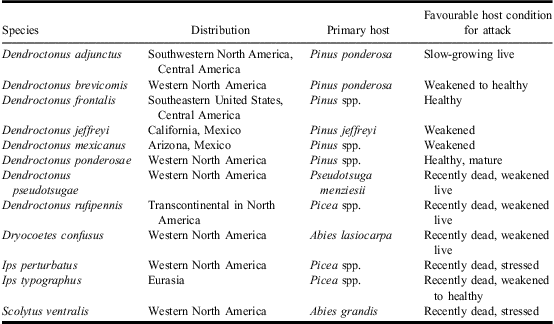
A small number of species, particularly in Dendroctonus, are facultative predators, which have evolved an enhanced ability to tolerate defensive terpenoids or exploit them, either directly as kairomones or as precursors in the biosynthesis of pheromones critical in mediating group attack of healthy trees. An important distinction is that aggregation by facultative predators is a prerequisite for successful establishment for individuals colonising a host, not merely an outcome of many individuals responding to the same host and insect cues, as occurs for many saprophages and parasites. Only 15–20 species of bark beetles are capable of killing large numbers of live trees under favourable circumstances (Table 1). Most of these are associated primarily with hosts that have compromised defences, but a few attack well-defended trees (Hard Reference Hard1985; Lessard and Schmid Reference Lessard and Schmid1990; Bleiker et al. Reference Bleiker, Lindgren and Maclauchlan2003, Reference Bleiker, Lindgren and Maclauchlan2005). A few species have a high ability to tolerate defensive terpenoids, and most likely derive protection from natural enemies as a result. These parasites attack living, relatively healthy live trees, and normally reproduce without killing their host (Grégoire Reference Grégoire1985; Furniss Reference Furniss1995).
Examples of bark beetle species that commonly kill substantial numbers of trees (Furniss and Carolin Reference Furniss and Carolin1980; Christiansen and Bakke Reference Christiansen and Bakke1988; Cibrián Tovar et al. Reference Cibrián Tovar, Tulio Méndez Montiel, Campos Bolañas, Yates and Flores Lara1995).
A change from saprophagy to predation, which is the most likely evolutionary path (Southwood Reference Southwood1985), required an integrated suite of adaptations, including physiological mechanisms to metabolise defensive chemicals, e.g., P450 enzymes (Seybold et al. Reference Seybold, Huber, Lee, Graves and Bohlmann2006), associations with symbionts that may directly or indirectly assist with colonisation (Kim et al. Reference Kim, Plattner, Lim and Breuil2008; Klepzig et al. Reference Klepzig, Adams, Handelsman and Raffa2009; Lieutier et al. Reference Lieutier, Yart and Sallé2009; DiGuistini et al. Reference Diguistini, Want, Liao, Taylor, Tanguay and Feau2011), and behavioural adaptations such as severing resin canals (Berryman Reference Berryman1972), group attack (Berryman et al. Reference Berryman, Dennis, Raffa and Stenseth1985), synchronisation of emergence as a facilitator of group attack (Raffa and Berryman Reference Raffa and Berryman1987; Logan et al. Reference Logan, White, Bentz and Powell1998; Logan and Powell Reference Logan and Powell2001), and communal feeding by larvae (Grégoire Reference Grégoire1985; Storer et al. Reference Storer, Wainhouse and Speight1997). Species with gregarious larval feeding include some early succession saprophages attacking very resinous hosts, as well as true parasites. For example, the lodgepole pine beetle, Dendroctonus murrayanae Hopkins, may attack suppressed trees at low densities near ground level (Furniss and Kegley Reference Furniss and Kegley2008), while Dentroctonus micans and its closely related North American congener Dentroctonus punctatus display a typical parasitic lifestyle, where single-mated females attack live trees (Grégoire Reference Grégoire1988; Furniss Reference Furniss1995; Lindgren et al. Reference Lindgren, Lewis and Grégoire1999). There also appear to be regional differences in the colonisation behaviours of some parasitic species, such as Dendroctonus valens LeConte (Furniss and Carolin Reference Furniss and Carolin1980; Aukema et al. Reference Aukema, Zhu, Moeller, Rasmussen and Raffa2010), which could indicate how different habitat and landscape structures favour different strategies.
Interestingly, apart from the concentration of tree killing within Dendroctonus, there appears to be little or no linkage between the evolution of tree killing and phylogeny, i.e., the most destructive tree killers fall in several divergent clades even within this genus (Sequeira et al. Reference Sequeira, Normark and Farrell2000; Sequeira and Farrell Reference Sequeira and Farrell2001; Jordal et al. Reference Jordal, Sequeira and Cognato2011), suggesting that tree killing evolved independently several times. Further evidence for this includes the lack of relationships between the chemistry of pheromone blends and phylogeny (Cognato et al. Reference Cognato, Seybold, Wood and Teale1997; Symonds and Elgar Reference Symonds and Elgar2004), no widespread phylogenetic linkages between tree-killing bark beetles and their symbiotic fungi or fungal virulence (Six and Paine Reference Six and Paine1999; Lieutier et al. Reference Lieutier, Yart and Sallé2009), and no single type of mycangium (pronotal sac, maxillary sac, or pit) (Six and Klepzig Reference Six and Klepzig2004) associated with tree-killing bark beetles. Rather than being phylogenetically constrained, the selective pressures facilitating the switch from saprophagy to a facultative predatory life history strategy appear to be linked to trade-offs between overcoming host defences and interspecific competition in particular bark beetle–host tree associations, with the ultimate driver being reproductive fitness.
Reproductive fitness can be expressed quantitatively as the number of brood per female (Brown et al. Reference Brown, Marquet and Taper1993). Natural selection maximises fitness against trade-offs and constraints (Charnov and Downhower Reference Charnov and Downhower2002). With respect to bark beetles, host defence traits such as constitutive and inducible allelochemicals affect the likelihood that an establishment attempt will succeed. If the defence threshold is breached, other factors affecting the quality of the substrate for developing larvae, such as phloem thickness, moisture content, and nutrient content affect the number of adult brood produced per parent. These features determine host “susceptibility” and “suitability”, respectively (Raffa Reference Raffa1988). Abiotic (severe drought, lightning) and biotic (disease, insect defoliation, root and lower-stem beetles, age) environmental factors may influence both the defensive capability and nutritional quality, sometimes in opposing fashions. Availability and quality of the resource are also influenced indirectly by intra-specific and interspecific competition. Consequently, most bark beetles have evolved mechanisms such as epideictic pheromones, auditory signals, and microsite preference to limit their interaction with competitors (Lanier and Wood Reference Lanier and Wood1975; Raffa Reference Raffa2001).
Between the devil and the deep blue sea: trade-offs between bottom-up and lateral forces
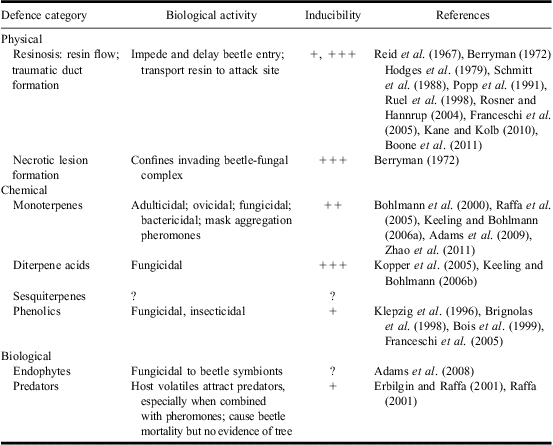
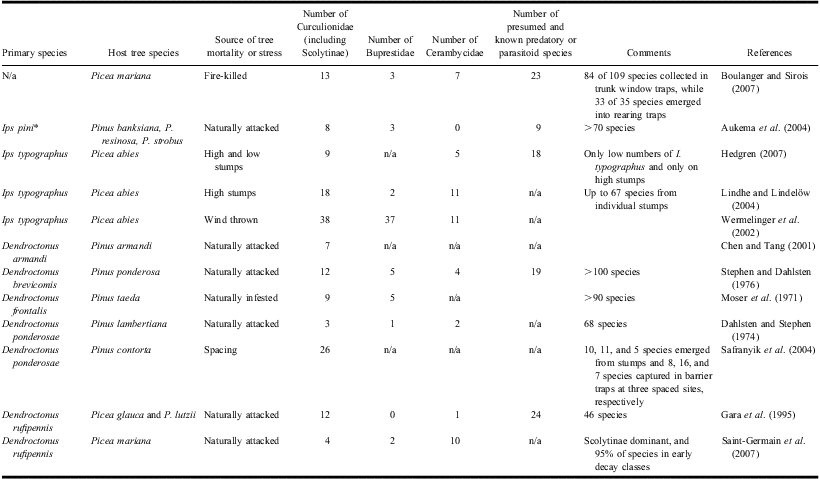
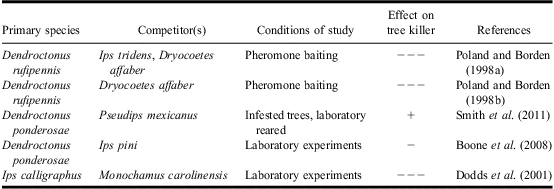
Bark beetles face numerous, and at times opposing challenges (Fig. 2). In particular, tree physiology constructs a trade-off between bottom-up and lateral forces. Those that attack relatively healthy trees must overcome their potent constitutive and induced defence systems (Table 2). Those that colonise dead or severely weakened trees are confronted with a limited resource, severe competition, and often lower food quality (Tables 3A–3D). Natural enemies can also exert substantial mortality, but the role of host condition in their impacts appears more diffuse. For example, predators attracted to the pheromones of “secondary” bark beetles may also feed on the “primary” species once inside the host (Boone et al. Reference Boone, Six and Raffa2008), causing “apparent competition” (Holt and Barfield Reference Holt and Barfield2003). Within a bark beetle species, however, higher predation rates on late-arriving than early-arriving individuals may select against “cheating”, thereby facilitating cooperative mass attack strategies (Aukema and Raffa Reference Aukema and Raffa2004). Some bark beetles may partially avoid predators, competitors, and antagonistic fungi by feeding as late instar larvae in the outer bark even though the phloem is more nutritious (Miller and Keen Reference Miller and Keen1960; Goldman and Franklin Reference Goldman and Franklin1977; Flamm et al. Reference Flamm, Coulson, Beckley, Pulley and Wagner1989; Dodds et al. Reference Dodds, Graber and Stephen2001; Hofstetter et al. Reference Hofstetter, Mahfouz, Klepzig and Ayres2005), suggesting natural enemies can be important evolutionary drivers. For purposes of simplicity, we will limit our discussion of the top-down dimension.
Illustrations of lateral and bottom-up selection pressures encountered by tree-killing bark beetles. (A) Dendroctonus ponderosae oviposition gallery on wind thrown lodgepole pine showing interspecific competition by Ips pini. (B) High density attacks by D. ponderosae on lodgepole pine leading to excessive intraspecific competition. (C) Successful induced defence by lodgepole pine against D. ponderosae. (D) Pitch tube with killed D. ponderosae. In all cases, there was no brood production by D. ponderosae. Photo credits: (A) K.F. Raffa; (B, C) B.S. Lindgren; (D) B.E. Steed.
Selected examples of multiple defences of conifers against bark beetles and associated microorganisms.
The relative strength of the inducibility is denoted by the number of signs.
Diverse assemblage of saproxylic insects colonising dead or highly stressed conifers.
*Early succession saprophage with limited ability to kill trees.
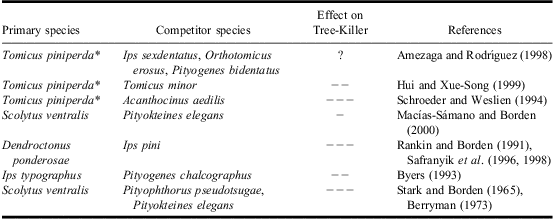
Field impacts of competition by wood-boring insects (including bark beetles) on reproduction or population density of tree-killing bark beetles.
−, negative effect; ?, variable or unclear effect.
The relative strength of the effect is denoted by the number of signs.
*Early succession saprophage with limited ability to kill trees.
Paired competition* studies between tree-killing bark beetles and other subcortical insects.
−, negative effect; +, positive effect.
The relative strength of the effect is denoted by the number of signs.
*In some cases the effects are due to opportunistic predation.
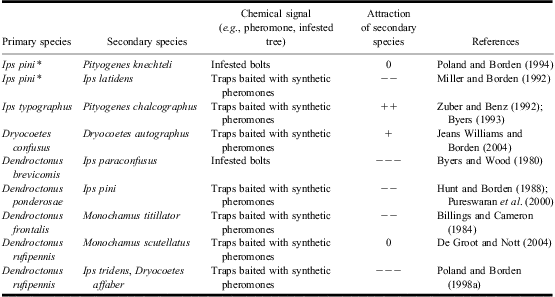
Attraction of secondary bark beetles and wood-boring insects to chemical cues associated with tree-killing bark beetles (synthetic pheromones, infested trees).
−, negative effect; +, positive effect; 0, neutral.
The relative strength of the effect is denoted by the number of signs.
*Early succession saprophage with limited ability to kill trees.
Interactions among bottom-up and lateral selection pressures may have contributed to the evolution of the predatory lifestyle among bark beetles, and also to its relative rarity. According to our model, dead and severely stressed trees provide a safe alternative, but because of their poor defences they are available to many species (Table 3A). There is a strong trend for so-called “less-aggressive” species to significantly reduce fitness of “more-aggressive” species, and generally outcompete them in field and laboratory studies (Table 3B, 3C). Some of these trade-offs are “quantitative”, such as reduced resource per individual or reduced nutritional value of unhealthy trees, whereas others are “qualitative” or “catastrophic” (Roitberg et al. Reference Roitberg, Robertson and Tyerman1999), such as a beetle being killed by a tree that resists attack or dying before finding a host that it accepts. As several authors have pointed out, optimal solutions for maximising brood per parent and those for minimising the likelihood of total failure to reproduce are not always identical (reviewed in Roitberg et al. Reference Roitberg, Robertson and Tyerman1999). This is especially problematic for bark beetles, which often deposit their entire clutch in one host (although some species appear more adept at leaving a host to deposit additional eggs elsewhere (Coulson Reference Coulson1979)). Unfortunately, almost all life tables of bark beetles only quantify within-tree mortality factors, due to the operational challenges of quantifying dispersal losses in forests, so we have limited knowledge of mortality caused by inability to find acceptable hosts. The available evidence, however, suggests that losses during dispersal and host-finding are quite high (Berryman Reference Berryman1973, Reference Berryman1979; Pope et al. Reference Pope, Coulson, Fargo, Gagne and Kelly1980; Safranyik et al. Reference Safranyik, Carroll, Régnière, Langor, Riel and Shore2010). For example, Pope et al. (Reference Pope, Coulson, Fargo, Gagne and Kelly1980) estimated that 57% of newly developed Dendroctonus frontalis Zimmermann adults that emerge from brood trees do not enter a new host, even in the artificially homogeneous habitat structure of pine plantations and even during outbreak conditions.
When evaluating the role of “host-availability” in bark beetle strategies, it is sometimes useful to partition two components: the number of trees acceptable to the insect on the landscape, and the likelihood that entry of such trees will result in successful establishment. For beetles limited to dead or severely stressed trees the former is low and the latter is high; beetles willing to enter healthy trees invert those odds. Saprophagous bark beetles are regulated primarily by bottom-up processes, i.e., availability of dead or severely stressed trees (Wood Reference Wood1982), and inherent lateral processes such as interspecific competition (Denno et al. Reference Denno, McClure and Ott1995). Thus, populations of most bark beetles tend to track resource availability with a lag, the length of which depends on the generation time of the insect.
Bark beetles that are facultative predators, on the other hand, have two quasi-stable population states, endemic and epidemic (Berryman Reference Berryman1982; Raffa and Berryman Reference Raffa and Berryman1983, Reference Raffa and Berryman1987; Mawby et al. Reference Mawby, Hain and Doggett1989; Safranyik and Carroll Reference Safranyik and Carroll2006; Kausrud et al. Reference Kausrud, Grégoire, Skarpsaas, Erbilgin, Gilbert, Økland and Stenseth2011). Even though trees are both abundant and long lived relative to bark beetles, their availability as hosts fluctuates as a result of the interaction between their defensive ability (genetic, environmental, phenological, demographic) and beetle population size (Berryman Reference Berryman1982; Raffa and Berryman Reference Raffa and Berryman1983, Reference Raffa and Berryman1987; Safranyik and Carroll Reference Safranyik and Carroll2006; Kausrud et al. Reference Kausrud, Grégoire, Skarpsaas, Erbilgin, Gilbert, Økland and Stenseth2011). Thus, predatory bark beetles cannot persist by solely using healthy trees, but like most predators must usually focus on weakened hosts, or even resort to scavenging when the availability of susceptible live hosts is poor (Lewis and Lindgren Reference Lewis and Lindgren2002; Wallin and Raffa Reference Wallin and Raffa2004). According to our model, the primary biotic population regulation forces during the endemic phase are bottom-up via resource limitation, lateral via interspecific competition, and their interaction via crowding within a small subset of the resource caused by host defences. We further propose that top-down forces, i.e., predation and parasitism, act to further keep populations within the range where bottom-up and lateral forces most strongly reinforce each other.
A transition to the epidemic phase can occur when populations increase, such as when warmer conditions reduce overwintering mortality (Powell and Bentz Reference Powell and Bentz2009), or overall host resistance decreases simultaneously among a large number of trees, such as following severe drought (Kane and Kolb Reference Kane and Kolb2010), thus allowing attacks on live hosts to have a high likelihood of success (Berryman Reference Berryman1982; Raffa et al. Reference Raffa, Aukema, Bentz, Carroll, Hicke and Turner2008). In the case of D. ponderosae in British Columbia, this incipient epidemic phase appears to be associated in part with a biotic stress. An initial increase in attacks occurs on suppressed trees previously colonised by a specialised guild of late succession saprophages, e.g., Pseudips mexicanus (Hopkins) (Safranyik and Carroll Reference Safranyik and Carroll2006; Smith et al. Reference Smith, Carroll and Lindgren2009). Whether there is a direct causal relationship between the saprophages and D. ponderosae is not entirely clear, but such a linkage is supported by (a) the reproductive fitness of the predator appears to be higher in trees also attacked by P. mexicanus (Smith et al. Reference Smith, Carroll and Lindgren2011), and (b) prior infestation by P. mexicanus appears to weaken defences, particularly inducible defences (Boone et al. Reference Boone, Aukema, Bohlmann, Carroll and Raffa2011). Thus, whether or not the epidemic population phase is reached depends in part on environmental conditions promoting secondary bark beetles, which in turn affect host vigour.
Once tree-killing beetles have transitioned to the epidemic population phase, they gain partial escape from interspecific competition, since the vast majority of the organisms that invade dead wood cannot cope with the intricate and potent defences of live trees (Table 3B). By exposing themselves to potentially lethal defensive reactions, the so-called pioneer beetles, i.e., those that initiate attacks on live trees, likely incur some risk (Table 3). However, they can endure this environment for several days, and if they are successful in eliciting aggregation often do not show lower reproduction than late arrivers (Raffa and Berryman Reference Raffa and Berryman1983; Pureswaran et al. Reference Pureswaran, Sullivan and Ayres2006; but see Latty and Reid Reference Latty and Reid2009). Further, tree-killing bark beetles show several layers of behavioural redundancy, in that one set of cues elicits landing, another elicits the initial decision to enter, and still others are needed to elicit continued excavation (Shepherd Reference Shepherd1966; Raffa and Berryman Reference Raffa and Berryman1982; Wallin and Raffa Reference Wallin and Raffa2000; Saint-Germain et al. Reference Saint-Germain, Buddle and Drapeau2007). These behaviours allow some beetles to leave well-defended trees before digging deep into the bark where they would succumb to resins and toxins (Amman Reference Amman1975; Hynum and Berryman Reference Hynum and Berryman1980). In fact, cases of outright mortality to resinosis are relatively low in life tables (Berryman Reference Berryman1973; Amman Reference Amman1984; Mills Reference Mills1986; Langor and Raske Reference Langor and Raske1988). We suggest that a more complete measure of beetle losses attributable to host defences should also include failure to enter, because many beetles resume flight after landing on hosts they deem too risky but ultimately die before finding an acceptable host; i.e., losses during host-searching leave no direct signature (Berryman Reference Berryman1973; Safranyik et al. Reference Safranyik, Shrimpton and Whitney1975; Pope et al. Reference Pope, Coulson, Fargo, Gagne and Kelly1980; Wright et al. Reference Wright, Berryman and Wickman1984; Safranyik et al. Reference Safranyik, Carroll, Régnière, Langor, Riel and Shore2010).
There is some evidence that host selection behaviours of bark beetles are affected by cues providing information about the local density of conspecifics (Wallin and Raffa Reference Wallin and Raffa2000, Reference Wallin and Raffa2004). Such phenomena are known from other eruptive insect species, e.g., the migratory desert locust Schistocerca gregaria (Forskål) (Orthoptera: Acrididae) (Simpson et al. Reference Simpson, McCaffery and Haegele1999), as well as many bacteria (Ng and Bassler Reference Ng and Bassler2009), fungi (Rhome and Del Poeta Reference Rhome and Del Poeta2009), and vertebrates (Cambui and Rosas Reference Cambui and Rosas2012). In addition, there is evidence of a shift in the relative proportion of phenotypes associated with entering healthy trees within a bark beetle population during different population phases (Wallin and Raffa Reference Wallin and Raffa2004), a relationship supported by modelling studies (Kausrud et al. Reference Kausrud, Grégoire, Skarpsaas, Erbilgin, Gilbert, Økland and Stenseth2011) and articulated in natural history terms by early forest entomologists (Keen Reference Keen1938; Evenden et al. Reference Evenden, Bedard and Struble1943). Thus, at endemic populations, most beetles tend to avoid highly defended hosts, whereas at epidemic populations many beetles accept such hosts (Boone et al. Reference Boone, Aukema, Bohlmann, Carroll and Raffa2011; Powell et al. Reference Powell, Townsend and Raffa2012). Since a shift in host acceptance behaviour can be generated in the laboratory by selective breeding (Wallin et al. Reference Wallin, Rutledge and Raffa2002), there appears to be a genetic component to what in the field is manifested as “aggressiveness”. This gene by environment interaction provides some insight to how a tree-killing life history strategy may have evolved.
Once a population eruption starts, host defence no longer plays a major role since the insects are abundant enough to overcome all but the most vigorous or genetically resistant trees (Yanchuk et al. Reference Yanchuk, Murphy and Wallin2008). For example, a recent study by Boone et al. (Reference Boone, Aukema, Bohlmann, Carroll and Raffa2011) showed that the likelihood of an entering mountain pine beetle successfully eliciting mass attack on a lodgepole pine varies with stand-level beetle density from ∼27% at low populations to 93% at high populations, with most of the increase occurring over a relatively narrow population range. In addition, lateral forces in the form of intraspecific competition, as well as some top-down effects by parasites and predators, may reduce populations at this stage (Turchin et al. Reference Turchin, Taylor and Reeve1999). Climatic influences, most notably extreme cold, can be important in ending population eruptions in D. ponderosae, both by causing high mortality and by delaying development (Powell and Bentz Reference Powell and Bentz2009). In the absence of such events, host depletion is the primary mechanism by which outbreaks end.
Making the best of a sticky situation: a conceptual model integrating drivers of natural selection and mechanisms of host selection
Tree-killing bark beetles use cooperative behaviour to jointly overcome defences of a selected “prey” tree. This behaviour has been likened to that of other social predators, e.g., wolves, which only attack large prey when in packs (Berryman et al. Reference Berryman, Dennis, Raffa and Stenseth1985). In contrast with earlier arguments that implicitly assumed a sacrifice of individuals for a group gain, Alcock (Reference Alcock1982) and Raffa and Berryman (Reference Raffa and Berryman1983) argued that host choice and colonisation behaviours could be explained based on selection operating on individual beetles. As with other gregarious species, aggregation incurs both benefits and costs, with evolutionary transitions largely driven by ecological pressures, even in the absence of genetic relatedness (Choe and Crespi Reference Choe and Crespi1997; Costa and Pierce Reference Costa and Pierce1997; Costa Reference Costa2006).
Host physiology plays an important role in the relative benefits to emitters versus receivers incurred by pheromones. While a tree's defences are still effective, the emitter benefits from attracting conspecifics, as does the receiver, because each contributes to successful colonisation. On the other hand, only the receiver benefit from “eavesdropping” on another's mating signals when they arise from a dead tree. Despite these different relationships between emitter and receiver, the final pattern, i.e., an aggregated distribution, is similar, thus obscuring the underlying dynamics.
Species that convert host defence compounds into aggregation pheromones appear more prominent among the major tree killers (Schlyter and Birgersson Reference Schlyter and Birgersson1999; Blomquist et al. Reference Blomquist, Figueroa-Teran, Aw, Song, Gorzalski and Abbott2010). The production of verbenols, for example, relates to the amounts of pre-cursor produced by the host tree (Schlyter and Birgersson Reference Schlyter and Birgersson1999). Tree-killing species whose major pheromones arise from de novo synthesis, such as Dendroctonus brevicomis LeConte and D. frontalis (Barkawi et al. Reference Barkawi, Francke, Blomquist and Seybold2003), also link their signalling to tree physiology, by using host volatiles to synergise their pheromones. Maintaining such linkage is important, because beetles can obtain information on both conspecifics and the tree's rapidly changing defensive ability during attack. As tree defences decline and colonisation proceeds, the beetles and their symbionts convert aggregants into anti-aggregants, which limits intraspecific competition to that needed to kill trees (Wood Reference Wood1982; Hunt and Borden Reference Hunt and Borden1990). Pheromones produced by de novo synthesis (Byers and Birgersson Reference Byers and Birgersson1990) appear to be under more selection pressure from natural enemies (Schlyter and Birgersson Reference Schlyter and Birgersson1999; Raffa et al. Reference Raffa, Hobson, LaFontaine and Aukema2007) than oxygenated monoterpenes, a postulate we suggest for future testing, and for developing more inclusive tritrophic models.
Trees in which conditions are optimal, can be envisioned as “Goldilocks hosts”, whereby the “too-hard” conditions are trees rich in toxic chemicals, the “too-soft” conditions are trees so readily occupied that they also harbour many competitors, and the “just right” condition integrates these two factors, as well as the number of brood a tree can support (which relates to tree size) (Fig. 3). However, the incidence and condition of potential host trees are dynamic, so the optimal solution varies in time, space, and in response to beetle numbers (Fig. 4A). That dynamic is in turn influenced by higher scale factors such as forest structure (Fig. 4B) and weather (Fig. 4C). A biotic or abiotic disturbance that stresses the host tree population would push this optimum to the right, i.e., “healthier” trees would become accessible. An increase in beetle population size would also expand the optimum to the right, because beetles would be able to kill trees that would otherwise mount too vigorous a defence (Fig. 3).
Conceptual diagram of proposed trade-off between interspecific competition and host defence in exerting selection pressure on predatory bark beetles. The vertical dotted line denotes the gradient condition between a physiologically dead and live host. The arrow shows the hypothesised most favourable host susceptibility condition for attack by facultative predatory bark beetles, i.e., where the cumulative effect of competition and host defence is minimised.
Feedback processes and cross-scale interactions influencing the host defence curve in Figure 3. (A) The efficacy of tree defence is not absolute, but rather diminishes with stand-level beetle population size. The same defensive capability that renders an attack unlikely to succeed during endemic conditions confers little risk to attacking beetles during epidemic conditions. (B) Effect of stand structure on host population responses to exogenous stress. If stand structure is highly heterogeneous (tree age, species, etc.) a stress event renders a relatively small number of additional trees below the level (to the left of the vertical line) at which they become susceptible (to a given beetle population size). If the stand is more homogeneous, an equivalent stress moves relatively more trees into this susceptible zone. (C) Effect of the scale at which different stress agents increase the pool of susceptible trees. Landscape-scale events, such as severe drought, simultaneously decrease the resistance of many hosts. In contrast, localised stresses, such as root disease and lightning, create small pockets of stressed hosts, which are scattered in space and time. The former more sharply and synchronously increase the pool of susceptible trees, which more strongly increases stand-level population size and increases the likelihood of successful attack as per panel A. As in panel B, it is important to consider that successful beetle development removes trees from the available pool.
According to our hypothesis, the relative frequency, severity, and distribution of stress events mediate whether or not selection pressures favour a saprophytic life strategy with high interspecific competitive abilities, or a predatory life strategy with high intraspecific competitive tolerance and an ability to cope with defensive host compounds. The transitions from endemic to epidemic population phases among predatory bark beetle species, for example, tend to be associated with increased incidence of stress, e.g., lightning strikes (Coulson et al. Reference Coulson, Hennier, Flamm, Rykiel, Hu and Payne1983), defoliation (Wright et al. Reference Wright, Berryman and Wickman1984), root disease (Lewis and Lindgren Reference Lewis and Lindgren2002), and nonlethal, lower-stem colonising species (Safranyik and Carroll Reference Safranyik and Carroll2006; Aukema et al. Reference Aukema, Zhu, Moeller, Rasmussen and Raffa2010; Smith et al. Reference Smith, Carroll and Lindgren2011).
Empirical support of the trade-off between host defence and competition pressures can be found in some bark beetle–wildfire interactions. When D. ponderosae colonise severely fire-injured lodgepole pines, they encounter little resistance, but incur high interspecific competition; when they colonise uninjured or lightly injured trees, they risk attack failure, and when successful, experience high intraspecific competition due to the high-attack densities required (Powell et al. Reference Powell, Townsend and Raffa2012). Hence, brood emergence per parent is optimal in moderately fire-injured trees (Fig. 5). Unfortunately for the beetle, such trees are quite rare, accounting for only about 27% along transects extending from burn edges (Powell et al. Reference Powell, Townsend and Raffa2012). At the landscape scale, this is a high overestimate because it excludes severely injured trees within the burn epicentre as well as the preponderance of habitat not disturbed by fire.
Example of trade-offs affecting tree-killing bark beetles: performance of Dendroctonus ponderosae along a gradient of lodgepole pines with varying degrees of burn injury from wildfire. (A) Higher attack densities are required to overcome defences of uninjured than injured trees. (B) Interspecific competition is higher on injured than well-defended trees. Different species predominate at different levels of host stress: Ips species in lightly injured trees, Pityogenes species in moderately injured trees, Monochamus species in highly injured trees. (C) Dendroctonus ponderosae within-tree replacement rates are highest within moderately stressed trees. (D) Dendroctonus ponderosae preferentially attacks moderately stressed trees. Redrawn from Powell et al. (Reference Powell, Townsend and Raffa2012).
The sibling species Tomicus destruens (Wollaston) and Tomicus piniperda (Linnaeus) illustrate host-availability optimisation. The more aggressive T. destruens has its main peak in autumn, when tree susceptibility is often higher due to summer drought stress (Peverieri et al. Reference Peverieri, Faggi, Marziali and Tiberi2008). Tomicus piniperda flies at low temperatures extremely early in the spring (Långström Reference Långström1983). The former strategy risks failure to reproduce due to intraspecific competition for susceptible trees, whereas the latter risks mortality to environmental extremes. This temporal niche separation in its native European range could have been an important factor for the successful invasion of North America by T. piniperda, where native competitors and predators fly later (Haack and Lawrence Reference Haack and Lawrence1995). Similarly, D. ponderosae flies in late summer when the probability of drought stress is often highest (although the importance of drought stress varies markedly among regions: Waring and Pitman Reference Waring and Pitman1985), whereas Dendroctonus rufipennis (Kirby) flies while the ground is still partially frozen and its hosts’ roots are not yet physiologically active (Beckwith Reference Beckwith1972; Safranyik Reference Safranyik1988).
Bark beetles arriving at a suitable host engage in scramble (exploitative) competition when occupying a host tree (Schlyter and Anderbrant Reference Schlyter and Anderbrant1993; Reeve et al. Reference Reeve, Rhodes and Turchin1998). Saprophages have to compete for the resource both interspecifically and intraspecifically, but do not encounter a dynamic host defence. Predators on the other hand can escape interspecific competition by attacking live hosts, but have to overcome host defence, which necessitates group attack and may lead to high intraspecific competition (Raffa and Berryman Reference Raffa and Berryman1983; Safranyik and Linton Reference Safranyik and Linton1985; Anderbrant Reference Anderbrant1990). Once established, bark beetles use indirect interference competition, e.g., allomones or acoustic signalling to deter other individuals from occupying the same resource (Ryker and Rudinsky Reference Ryker and Rudinsky1976; Wood Reference Wood1982; Ryker Reference Ryker1984; Denno et al. Reference Denno, McClure and Ott1995). Thus, chemical signalling contributes to spatial niche partitioning, reducing interspecific competition (Poland and Borden Reference Poland and Borden1994, Reference Poland and Borden1998a). For example, both Pityogenes chalcographus (Linnaeus) and I. duplicatus normally occupy parts of trees with thinner bark than does I. typographus (Linnaeus) in part due to inhibition caused by allomonal interference (Byers Reference Byers1993; Schlyter and Anderbrant Reference Schlyter and Anderbrant1993), reducing direct interaction between them. Ips typographus aggregation is inhibited by P. chalcographus pheromones, however, indicating that the latter may successfully occupy a resource if it can establish priority (Byers Reference Byers1993).
As defensive ability of the host increases, fewer species can cope with its resin and allelochemicals, providing potential “competitor-free space” (Cavallero and Raffaele Reference Cavallero and Raffaele2010) to poor competitors (Fig. 3). Competition and the need for resource partitioning mechanisms may thus be important selective forces that led to “aggressiveness”, i.e., predation, in some bark beetles (Raffa Reference Raffa1988; Raffa et al. Reference Raffa, Phillips and Salom1993). For example, D. ponderosae appears to suffer less interspecific competition during outbreaks, when it attacks healthy trees, than during nonoutbreak periods, when it is restricted to stressed trees (Raffa and Berryman Reference Raffa and Berryman1987). Analogous relationships relative to virulence have been observed among various species of microorganisms that colonise plants (Cook and Baker Reference Cook and Baker1983; Wicklow Reference Wicklow1992). This escape from competitors is only partial, however: many “secondary” phloeophages are attracted to the aggregation pheromones of, and/or host stress volatiles generated by tree-killing bark beetles (Rankin and Borden Reference Rankin and Borden1991; Hedgren Reference Hedgren2004) (Table 3D).
Profiling tree killers: lineage, environment, and a changing template
While there is no explicit evidence that saprophagy is the ancestral condition among bark beetles, it is one of the major routes in the evolution of insect phytophagy in general (Southwood Reference Southwood1985), and by far the most common strategy employed by bark beetles and other phloeophagous groups. Rather than representing a specific lineage, however, tree killing seems to have evolved independently multiple times, given its distribution among currently accepted phylogenies (Wood Reference Wood1982; Kelley and Farrell Reference Kelley and Farrell1998; Seybold et al. Reference Seybold, Bohlmann and Raffa2000). An intriguing question, then, is whether the predatory strategy is a transitional stage in the evolution from saprophyte to parasite, or if it is a stable evolutionary condition. Even though the amplitudes of population fluctuations are dramatic, conifer-bark beetle interactions are generally stable when viewed over long periods of time (Romme et al. Reference Romme, Knight and Yavitt1986; Raffa and Berryman Reference Raffa and Berryman1987; Griffin et al. Reference Griffin, Turner and Simard2011). That is, these insects and plants have co-existed for millions of years (Wood Reference Wood1982; Bernays Reference Bernays1998; Sequeira et al. Reference Sequeira, Normark and Farrell2000; Labandeira et al. Reference Labandeira, LePage and Johnson2001), and the host responses to disturbance are often quite resilient. For example, the natural history of lodgepole pine suggests that this species may have evolved characteristics that maximise its fitness both in response to disturbances such as stand-replacing fires and bark beetle predation. It colonises a site rapidly after disturbance, begin reproducing at a very early age, i.e., before they are large enough to support beetle brood and so are not prone to predation, grow quickly, and have seeds and cones that can remain viable long after a tree has been killed (Lotan and Perry Reference Lotan and Perry1983).
Recent warming trends have allowed northward migration of mountain pine beetle into populations of lodgepole pine that had not experienced severe pressure. Such naïve trees appear more suitable for reproduction than those growing in areas that have experienced previous outbreaks (Cudmore et al. Reference Cudmore, Björklund, Carroll and Lindgren2010). Thus, it would appear that where the beetles and trees have co-existed in a predator–prey relationship, trees evolved traits that constrain beetle reproduction (Clark et al. Reference Clark, Carroll and Huber2010).
Although mortality rates of suitable host trees caused by facultative predators within an outbreak area can be extremely high (Safranyik Reference Safranyik1988; Werner et al. Reference Werner, Holsten, Matsuoka and Burnside2006; Björklund and Lindgren Reference Björklund and Lindgren2009; Björklund et al. Reference Björklund, Lindgren, Shore and Cudmore2009), these bark beetles must retain the ability to survive as saprophages during lengthy endemic population phases. Another potential survival strategy would be parasitism, but we propose that several simultaneously acting barriers impeded evolution towards parasitism. Specifically, larvae of parasitic species feed communally (Grégoire Reference Grégoire1985; Storer et al. Reference Storer, Wainhouse and Speight1997; Schlyter and Birgersson Reference Schlyter and Birgersson1999), facilitated by larval aggregation pheromones (Grégoire et al. Reference Grégoire, Braekman and Tondeur1982), a dramatic change from the elaborate gallery systems of most bark beetles (Kirkendall Reference Kirkendall1983). Second, as parasitism does not require aggregation, it would entail a loss of within-gender pheromone communication, which is widespread among scolytines (Wood Reference Wood1982). Third, facultative predators must have the ability to tolerate defensive compounds during the period of mass attack and initial development (Reid and Purcell Reference Reid and Purcell2011; Clark et al. Reference Clark, Carroll and Huber2012), but parasites must do so throughout larval development. Consistent with this, D. micans is highly tolerant of conifer resin (Storer and Speight Reference Storer and Speight1996) and the bacteria associated with D. valens are more tolerant of monoterpenes than those associated with D. ponderosae (Adams et al. Reference Adams, Boone, Bohlmann and Raffa2011). Fourth, trees sometimes resist colonisation attempts by these insects, so foregoing the mass attack strategy as a “parasite” does incur some risk. Consequently, we hypothesise that the facultative predatory strategy is evolutionary stable under specific environmental conditions, such as the homogeneous landscape structure of some conifer biomes, given the constraints on alternative evolutionary pathways.
Conclusions and needs for future research
We propose that tree killing arose largely from a trade-off between high interspecific competition in poorly defended hosts versus high risk in well-defended hosts, with losers at competition finding the latter strategy more advantageous. In this regard, tree-killing bark beetles resemble other extremophiles that have partially escaped lateral pressures by colonising relatively vacant but hostile environments, and in some cases, exerting changes that render extreme environments more suitable for subsequent competitors (Menge and Sutherland Reference Menge and Sutherland1987; Schleucher Reference Schleucher1993; Crain and Bertness Reference Crain and Bertness2006; Cavallero and Raffaele Reference Cavallero and Raffaele2010).
We hypothesise that evolutionary shifts were facilitated by genetically and phenotypically flexible host selection behaviours, biochemical adaptations that facilitate rapid aggregation and detoxification, and associations with symbionts capable of detoxifying defensive compounds. Direct linkage of aggregation pheromones to host kairomones, i.e., by exploiting them as precursors and synergists, both maximised the beetles’ likelihood of success and minimised the requisite intraspecific competition that accompanies group attack. This lifestyle also selected for morphologies and detoxification systems, often closely related to those used in pheromone biosynthesis, which conferred at least moderate tolerance of host physical and chemical defences. Beetles evolved behavioural adaptations to attack hosts when their defensive systems are compromised. Symbionts coevolved with their hosts, and close associations with fungi and bacteria improved the ability to detoxify tree allelochemicals, digest a substrate relatively low in nitrogen and high in cellulose, and defend against other opportunistic microorganisms. The tree-killing strategy in bark beetles may be relatively recent (Seybold et al. Reference Seybold, Bohlmann and Raffa2000), but based on fossil evidence the genus Dendroctonus has existed for at least 45 million years (Labandeira et al. Reference Labandeira, LePage and Johnson2001).
Thus, a behaviour that humans dub “aggressive” because of the socioeconomic losses it incurs, and its closer resemblance to predation than scavenging, can be better understood when placed within an evolutionary ecology context (Raffa et al. Reference Raffa, Phillips and Salom1993). Since having escaped their historical insect competitors by fleeing to an unoccupied habitat that requires them to contend with plant defences, tree-killing bark beetles now find themselves competing with humans for a mutually desired resource (i.e., live trees). But humans have proven to be less formidable competitors than phloeophagous insects in the sense that some of our activities (e.g., harvesting, monocultures, fire suppression, species introductions, emission of greenhouse gases) have actually augmented the success of tree-killing bark beetles (Lewis and Lindgren Reference Lewis and Lindgren2000; Logan and Powell Reference Logan and Powell2001; Raffa et al. Reference Raffa, Aukema, Bentz, Carroll, Hicke and Turner2008). The recent, widespread mountain pine beetle epidemic in western North America can be viewed as a testament to both the selective advantages of the predatory life strategy under certain conditions, and the potential for human activities to bring those conditions into confluence.
Our conceptual framework suggests several potential emphases for future research. First, we need more detailed studies of low-density populations of outbreak species. Despite the serious challenges posed by financial trends and operational logistics, we feel such investments offer a high likelihood of success, given that almost all studies that have endeavoured to compare endemic with epidemic populations have identified intriguing differences (e.g., Coulson et al. Reference Coulson, Hennier, Flamm, Rykiel, Hu and Payne1983; Mawby et al. Reference Mawby, Hain and Doggett1989; Lewis and Lindgren Reference Lewis and Lindgren2002; Wallin and Raffa Reference Wallin and Raffa2004; Smith et al. Reference Smith, Carroll and Lindgren2011), and that some of the resulting information (e.g., density-related changes in pheromone communication; Sullivan et al. Reference Sullivan, Dalusky, Mori and Brownie2011), has in turn improved our ability to conduct such studies. Second, area-wide studies that develop complete cross-generation life tables of tree-killing, parasitic, and saprophagous bark beetles, stratified across variable stand-level population densities, would greatly improve our understanding of underlying selective pressures. Third, interdisciplinary studies that integrate mechanistic and descriptive approaches to bottom-up, lateral, and top-down forces affecting reproductive success, again comparing tree-killing, parasitic, and saprophagous species, will facilitate connections between pattern and process, and identify key thresholds and nonlinearities. Fourth, functional genomics holds the promise of identifying genes associated with particular behavioural and other traits, and comparing these among species, population phases, and individuals could greatly facilitate direct tests of the more speculative, but hopefully thought-provoking ideas that we posit here.
Acknowledgements
The authors thank all their colleagues and students who in numerous discussions provided the inspiration for this paper; D. Six, K. Klepzig, B. Roitberg, J. Thompson for literature suggestions; and R.G. Bennett for his support and patience. Three anonymous reviewers provided reviews that significantly improved the manuscript. B.S.L. thanks the Raffa family for their hospitality during two visits to Madison. The research was funded by the University of Northern British Columbia and a Natural Sciences and Engineering Research Council of Canada Discovery Grant (B.S.L.), and by the National Science Foundation DEB-0816541, United States Department of Agriculture National Research Initiative (2008-02438), and the University of Wisconsin-Madison, College of Agricultural and Life Sciences (K.F.R.).