

One central aspect of the desire to pursue and enjoy a relationship — or any interaction — lies in the sensory dimensionality involved. People can use their visual appearance, voice quality, touching, proximity, and scent in a manner that pleases or entices the other, or of course, in a manner that is insufficient or overwhelming. When each person's use of the visual, auditory, and tactile corresponds to what pleases the other emotionally and aesthetically, then the interaction will become more appealing for both (Wicklund & Vandekerckhove, Reference Wicklund, Vandekerckhove, Postmes, Spears, Lea and Reicher2000; Wicklund & Vida-Grim, Reference Wicklund, Vida-Grim, Greenberg, Koole and Pyszczynski2004). Previous work has distinguished among the several sensory channels that are entailed in interacting with another person in the context of romantic relationships: sight, hearing, touch, bodily sensations, and interaction through substitute objects (Miron, Rauscher, Reyes, Gavel, & Lechner, Reference Miron, Rauscher, Reyes, Gavel and Lechner2012). In a series of three studies, Miron and colleagues (Reference Miron, Rauscher, Reyes, Gavel and Lechner2012) assessed participants’ preferences for the sensory channels used in romantic interactions. Participants were asked, for instance, to report their desire to hold the partner's hand (Touch modality) and the degree to which they liked their romantic partner's scent (Bodily Sensations modality, which included body scent, warmth, and texture). One important finding is that intimates who are oriented toward relating to their romantic partners via multiple sensory channels are protected against relationship difficulties, compared to those who prefer using fewer channels (Miron et al., Reference Miron, Rauscher, Reyes, Gavel and Lechner2012).
It is tempting to think that ‘more is better’ in the sense that the intensity and mutual desire to continue the relationship are maximised with high levels of contact using all sensory dimensions. However, we will take the position here that selectivity is the ingredient to maximising mutual appeal. To the extent that each partner is selective in using the sensory dimensions, a mutual and aesthetic relation will continue. We propose that the psychological basis of this selectivity is an orientation to the other's inner world of thoughts, desires, and emotions, achieved through taking the perspective of the romantic partner in specific relationship contexts. Our focus is thus on the relation between perspective taking and selectivity in approaching the partner sensorially when the partner who initiates the sensory interaction takes into consideration his or her romantic partner's openness to certain sensory modes.
To give an example, if a woman understands what appeals to her romantic partner, owing to having taken his perspective before meeting with him, she will then be more prepared for a nuanced sensory interaction. Engaging in a particular form of sensory contact with the partner presupposes having thought of the partner's preferences, thoughts, and desires for the upcoming interaction, as well as the context in which the partner operates before the meeting. If the woman infers that the partner may be too tired after work for interacting in the touch or acoustical domains, then she may be more selective in the sensory modalities used. As a result, she will interact with her romantic partner in the visual domain (i.e., by exchanging glances or looking at her partner) and will not engage in an interaction that involves touching the partner or talking with the partner about the daily events. This perspective-taking orientation would result in a more discriminant sensory contact compared to someone who is not in tune with the partner's sensory preferences.
In the current article, we define sensory specificity as the motivated selection of sensory channels involved in relating to the other. As the above example suggests, the woman's selection of the visual modality over the touch or acoustical modes is in response to the information she has inferred about her partner by imagining his situation (i.e., taking his perspective). In contrast, a less discriminating sensory selection strategy would have been for her to implement all sensory modalities that the couple may typically use in the evening (e.g., touch, visual, acoustical, and/or bodily sensations modes) in that particular interaction. Thus, becoming sensitised to the romantic partner's needs, preferences, and context through perspective taking could lead the person to select specific sensory modalities and to be more tuned into what the partner is ready for — at least subjectively. This requires the person to imagine the romantic partner's situation and how the other feels or thinks about the immediate situation. In this article, we used and adapted Miron et al.’s (Reference Miron, Rauscher, Reyes, Gavel and Lechner2012) measures of preference for sensory channels (touch, visual, acoustical, bodily sensations, and the substituted modality) in order to assess sensory specificity. Specifically, sensory specificity was defined as the extent to which people rate sensory channels as differentially desired or used in their interactions with their romantic partners (showing higher discrimination among sensory channels). Lower sensory specificity would then translate in the form of romantic partners’ appraising the sensory channels as equally desired or used (showing lower discrimination among the various sensory channels).
The Background of the Person's Orientation Toward Another's Perspective
The central determining variable in the present studies is the person's orientation toward another's perspective. Two different and relevant orientations, or mindsets, have been addressed in this literature. One mindset instigates empathy via instructions given to an individual to imagine another person's feelings about a situation (Batson, Reference Batson1991; Batson, Fultz, & Schoenrade, Reference Batson, Fultz and Schoenrade1987). Empathy is as an other-oriented emotional response elicited by and congruent with the perceived welfare of someone in need, which can lead to altruistically motivated helping behaviour (Batson, Reference Batson1991, Reference Batson2011). A second mindset is created by asking participants to try to understand another person's thoughts about a situation, or more generally, to be attuned to whether the other person possesses some specific knowledge (Piaget, Reference Piaget1924; Feffer & Suchotliff, Reference Feffer and Suchotliff1966). This induction involves a cognitive exercise in considering the world from other viewpoints and ‘allows an individual to anticipate the behavior and reactions of others’ (Davis, Reference Davis1983, p. 115). The pre-existing literature regards the first type of induction as producing a feeling-emotional relation to the other (Batson, Reference Batson2011; Davis, Reference Davis1983), while the second (‘perspective taking’) entails a non-emotional angle (Davis, Reference Davis1983).
Prior work has revealed the beneficial effects of perspective taking for interpersonal dynamics (Cooley, Reference Cooley1930; Dymond, Reference Dymond1949; Foote & Cottrell, Reference Foote and Cottrell1955; Galinski, Maddux, Gilin, & White, Reference Galinsky, Maddux, Gilin and White2008). Effective social interaction results when people modify their behaviour in social situations as a result of an understanding of the perspective of the other (Feffer & Suchotliff, Reference Feffer and Suchotliff1966; Scaffidi Abbate, Isgrò, Wicklund, & Boca, Reference Scaffidi Abbate, Isgrò, Wicklund and Boca2006). For instance, Long and Andrews (Reference Long and Andrews1990) defined perspective taking as the cognitive tendency to put oneself in another person's place. Aside from measuring dispositional perspective taking using Davis's Interpersonal Reactivity Scale, these authors also measured two specific forms of perspective taking. One scale (Self Dyadic Perspective Taking; SDPT) measured perspective taking of oneself (e.g., ‘Before criticising my partner, I try to imagine how I would feel in his/her place’). The second scale (Other Dyadic Perspective Taking, ODPT) assessed participants’ perceptions of the perspective taking of their partner (e.g., ‘When my partner is upset with me he/she tries to put him/herself in my shoes for a while’). It is important to note that the last two scales are aimed at assessing perspective taking within the concrete context of the marriage relationship. Both husbands and wives completed all three scales. Long and Andrews (Reference Long1993) found that, for both husbands and wives, all three types of perspective taking were predictive of spouses’ marital adjustment (Long & Andrews, Reference Long and Andrews1990). However, for both husbands and wives, perceptions of the spouse's perspective taking (i.e., imagining what the partner is doing, feeling, and thinking) had the largest effect size of the three types of perspective taking. This underscores the importance of taking the perspective of the spouse within the concrete context of the marriage relationship. Another study by Long (Reference Long1993b) indicated that inadequate dyadic perspective taking by one spouse (as measured with the SDPT scale) and perceptions of a spouse's inadequate perspective taking (as measured with the ODPT scale) both predicted the spouse's thoughts about divorce (Long, Reference Long1993a).
Two assumptions are at play in past research on dyadic perspective taking (Long, Reference Long1993a). One is that individuals typically respond to romantic partners (e.g., their spouses) only from their own egocentric points of view (see Epley & Caruso, Reference Epley, Caruso, Markman, Klein and Suhr2009; Steins & Wicklund, Reference Steins and Wicklund1996, for a more general discussion of this point). Such egocentrism does not facilitate inferring the specific needs and desires of romantic partners, and in turn, leads to mismatched interactions. A second assumption is that perspective taking is not a general trait but rather a skill that romantic partners may not be using in their romantic relationship, but might well be using in other contexts (e.g., at work with coworkers). This second idea assumes that the use of perspective-taking skills within romantic relationships is motivated by the partners’ current motives. This is a position we are taking in this article, as we assume that individuals must be motivated to be oriented towards their romantic partners’ thoughts, desires, and emotions.
Altogether, past research shows that adequate use of perspective-taking skills within the concrete interaction is necessary for successful social interaction within a marriage or close relationship (Hansson, Jones, & Carpenter, Reference Hansson, Jones and Carpenter1984; Long, Reference Long1993b; Vansteenwegen, Reference Vansteenwegen1998; Waldinger, Schulz, Hauser, Allen, & Crowell, Reference Waldinger, Schulz, Hauser, Allen and Crowell2004). That is, as partners try actively to infer and understand each other's feelings and thoughts, they come to feel understood and validated in the relationship. This is because perspective taking with a romantic partner indicates to the partner that the other is open to his/her point of view and sensitive to that perspective (Long, Reference Long1993b). On the other hand, a lack of perspective taking results in feeling misunderstood, unimportant, and dismissed (Peloquin & Lafountain, Reference Péloquin and Lafontaine2010). Over time, such perceptions may damage the relationship and eventually lead to its dissolution (Long, Reference Long1993a, Reference Long1993b; Waldinger et al., Reference Waldinger, Schulz, Hauser, Allen and Crowell2004).
In our first study, we used a classical perspective-taking research scenario to create a new measure of perspective taking that approximates the concept of dyadic perspective taking proposed by Long (Reference Long1993a, Reference Long1993b). The classical perspective-taking scenario used in experiments on perspective taking involves asking the target person to imagine a situation from a different visual point of view (Piaget, Reference Piaget1924; Steins & Wicklund, Reference Steins and Wicklund1996) or from a different psychological perspective (see Batson, Reference Batson2011, for a review). Most importantly, in the classical paradigm, the other person's behaviour-in-concrete-context is always the observer's basis for inferring that actor's perceptions and emotions (Gendolla & Wicklund, Reference Gendolla and Wicklund2009; Scaffidi Abbate et al., Reference Scaffidi Abbate, Isgrò, Wicklund and Boca2006). For instance, in Steins and Wicklund (Reference Steins and Wicklund1996), participants were located near a target person, positioned 180 degrees vis-à-vis that person. Then they were asked to place a small, blank card against their foreheads and quickly write a given letter (or given number) on the card. In this manner, a perspective-taking response involved writing a letter (or number) that made sense to the target person, as opposed to the target having to read the letter in a backward form (e.g., a B with its loops to the left). Similarly, Scaffidi Abbate et al. (Reference Scaffidi Abbate, Isgrò, Wicklund and Boca2006) conceptualised perspective taking as being attuned to whether another person possessed a given piece of knowledge. This was measured by asking participants to indicate which of two postcards should be sent to the experimenter's grandparents in Great Britain. As the site of the study was Sicily, the participants’ perspective taking could be defined as selecting the postcard printed in English, as opposed to the one produced in Italian. Thus, given information about the other's situation (i.e., grandparents in Britain), the Italian participants were in a position to make inferences about the grandparents’ potential preference for an English versus an Italian postcard.
Similarly, in our Study 1, we operationalised perspective-taking orientation through questions addressing the extent to which the participant thinks about certain facets of the other's setting and behaviours prior to meeting the other. For example, participants were asked how much they imagined what the partner was doing prior to an actual meeting between the two. This variable is treated as an individual difference in regard to the orientation toward the other's perspective. In the second study, we employed an experimental manipulation that induced participants to pay attention to the partner's needs, and thus was more focused than the operationalisation of Study 1. This operationalisation also assumed that participants would be motivated to use their perspective-taking skills, in that the relationship situation we used triggered a helping orientation (i.e., their romantic partner was struggling with a need). In doing so, we drew on prior research (Batson, Reference Batson2011) and employed both mindset inductions (i.e., try to imagine another person's feelings; try to understand another person's thoughts) discussed at the beginning of this section. We left open the question of which of the two inductions invokes a stronger orientation toward the other and, as a result, increases sensory specificity.
Finally, we used an additional operationalisation of the orientation toward another's perspective, in the form of Davis's (Reference Davis1983) dispositional measures of Fantasy and Perspective Taking. The question for this operationalisation is whether a professed tendency to take perspectives in general, across people and situations, is adequate to tap into the participant-partner relationship. We propose that only the focused act of taking the perspective of the partner in a specific context can lead to sensory specificity in one's intended interactions with the partner. Thus, we expect that our context-dependent perspective-taking operationalisation will enhance sensory specificity, even after controlling for dispositional perspective-taking ability.
The Moderating Effect of Relationship Type on Sensory Specificity
Prior work has examined whether geographic separation of romantic partners can place limits on intimacy processes and ultimately alter relationship satisfaction (Holt & Stone, Reference Holt and Stone1988; Knox, Zusman, Daniels, & Brantley, Reference Knox, Zusman, Daniels and Brantley2002; Sahlstein, Reference Sahlstein2004). Research by Van Horn et al. (Reference Van Horn, Arnone, Nesbitt, Desilets, Sears, Giffin and Brudi1997), for instance, has uncovered several differences between long-distance relationships that are intact versus long-distance relationships that are terminated (i.e., the partners were no longer in a relationship). These differences include perceptions that the partner is not good at understanding his or her own problems, that less free time was spent with the person, and that less intimate self-disclosure occurred.
It is possible that the absence of face-to-face sensory contact deprives long-distance intimates of opportunities for exercising perspective taking and obtaining information about their romantic partner's sensory preferences. Scaffidi Abbate et al. (Reference Scaffidi Abbate, Isgrò, Wicklund and Boca2006) and Wicklund (Reference Wicklund2007) hinted that perspective taking would be difficult ‘if another person's visual or conceptual perspective was inaccessible—owing perhaps to distance’ (Scaffidi Abbate et al., Reference Scaffidi Abbate, Isgrò, Wicklund and Boca2006, p. 287). Wicklund (Reference Wicklund2007) argues that perspective taking and empathy are difficult when the people involved are not together physically. This is because individuals must be present in a shared physical context in order to infer what the other person is seeing, hearing, or smelling, and so on. To be sure, the classical perspective-taking paradigms (e.g., Piaget, Reference Piaget1924; Stephenson & Wicklund, Reference Stephenson and Wicklund1983) nearly always entail the relevant participants’ mutual physical presence. The perceiver needs such contextual information to anchor the other person's psychological state. One wants to know where the person is, what facial expressions are displayed, or what the person is doing at a particular moment. This information is not readily available for long-distance intimates, especially for those who meet infrequently.
It follows that physical presence of the other is needed for perspective-taking efforts to translate into a more discriminant approach to partners’ sensory preferences. This leads us to predict an interactive effect of perspective taking and geographical closeness on sensory specificity (Hypothesis 1). This means that an orientation to the perspective of the partner will facilitate attunement to the partner's sensory preferences, especially for those involved in geographically close relationships.
Aspects of the Relationship
On the basis of existing treatments of perspective taking, we expected sensory specificity in reacting to one's partner to be a function of: (a) attraction to the partner, (b) frequency of contact, and (c) an inverse function of difficulty of maintaining the relationship. First, attraction to the partner should motivate the person to become more attuned to the partner's sensory preferences. Equally likely is that higher sensory selectivity leads to heightened attraction to a partner that one knows and understands. Steins and Wicklund (Reference Steins and Wicklund1996, Experiment 3) operationalised attraction to the other by means of information about that person, including details about personal background (e.g., childhood events, age, growing up, siblings). When there was no conflict present between the participant and the opposite-sex other, an attractive other produced better perspective taking. Thus, we expect to see a positive correlation between attraction to the partner and sensory specificity (Hypothesis 2).
Second, frequency of contact should be positively correlated with sensory specificity, as frequent contact allows the partners direct exposure to information about the other's sensory preferences (Wicklund, Reference Wicklund2007; Hypothesis 3).
Third, relationship difficulty should decrease fine attunement into the other's perspective. In Steins and Wicklund's (Reference Steins and Wicklund1996) Study 1, the more difficult the breakup between the participants and their former romantic partners, the less attuned they were to the perspectives of others who were immediately pertinent to the partner and to the broken relationship. Moreover, because the difficulty of relating at a distance may restrict opportunities for finely tuned sensory contact, relationship difficulty should be negatively correlated with sensory specificity in long-distance relationships, but less so in non-distance relationships. Thus, the more difficult it is for long-distance partners to maintain the relationship, the less sensitive they will be in their sensory approach to their romantic partner (Hypothesis 4).
STUDY 1
Method
Participants and Procedure
Two hundred and ten undergraduate students from a Midwest university in the United States who answered affirmatively the prescreening question ‘Are you currently involved in an exclusive romantic relationship? participated in the study. The data from five participants who reported no longer being in a relationship at the time of the study were excluded from the analysis, as were the data from three outliers. Two additional participants did not complete the sensory specificity measures. Thus, the data from 200 participants were used for analyses (96 in geographically close and 104 in long-distance relationships; 69 men and 131 women; Mrelationshipduration = 21.41 months, SD = 19.94). Eight and a half percent of participants were engaged to be married, whereas the rest (91.5%) were not engaged. Participants were undergraduate students from several large introductory psychology courses who participated in research studies to complete a course requirement. They were recruited via the Psychology Participants pool online website where undergraduate students sign up for studies. Once the participants arrived at the lab, they were directed to a research room and were tested individually by a research assistant. Participants were first asked to read and sign a consent form; if they agreed to participate, they then completed a short questionnaire that included the variables of interest.
Measures
Perspective taking
Perspective-taking orientation to the partner was measured with three items (α = .72) designed specifically for this study: ‘If you think of your current romantic partner before you and your partner get together on a typical day, to what extent do you typically imagine what the partner is doing before meeting with you?’ on an 11-point scale, ranging from 0 (not at all) to 10 (a lot); ‘If you think of your romantic partner before you and your partner get together on a typical day, how much time do you spend thinking about what the partner is doing before meeting with you?’ (0 = I'm not typically thinking about what the partner is doing before the meeting; 1 = less than 10 minutes; 2 = 10–30 minutes; 3 = 30–60 minutes; 4 = 1–6 hours; 5 = 6–12 hours; 6 = 12 hours to a week; 7 = more than a week); and ‘During a typical day (24 hours), how often do you think about what your partner is doing?’ (0 = I don't typically think of what my partner is doing; 1 = less than 10 minutes; 2 = 10–30 minutes; 3 = 30–60 minutes; 4 = 1–3 hours; 5 = 3–6 hours; 6 = more than 6 hours). The data were standardised before averaging them.
Sensory specificity
Participants completed questions about their usual contact with their partner on the following sensory dimensions: visual, acoustical, touch, body sensation (warmth, texture, smell), and a substitute modality in the form of using objects to compensate for the absence of the partner (Miron et al., Reference Miron, Rauscher, Reyes, Gavel and Lechner2012). To compute a sensory specificity score for each participant, we first averaged participants’ estimates in hours of the amount of time they spent using each of the five sensory channels during a typical day (24 hours) when they were alone with their partner. Five separate indices were created, reflecting the five different types of sensory contact. Touch mode included touching the other (e.g., body, face, or hands), kissing or caressing the other, hugging, holding the other close or cuddling the other, and holding hands (five items; α = .90). Visual mode included looking at the other, looking into the other's eyes, and watching the other do things (α = .85). Acoustical mode included listening to the other (one item). Body sensations mode included feeling his/her body warmth, smelling the other's scent, and feeling the texture of the partner's hands, face, or hair, and so on (three items, α = .80). Substitute mode included ‘having an object that reminds you of the other’ (one item).
To assess specificity in the use of the five sensory channels, a discrepancy score was computed using the following formula: Sensory specificity = MAX – MIN, where MAX and MIN are the maximum and minimum scores for each sensory dimension for each participant separately. A higher discrepancy score indicates more sensory specificity. For example, Participant 1 had the following scores for Touch, Acoustical, Visual, Bodily Sensations, and Substitute, respectively (time estimates in hours): 1.60, 7.00, 0.80, 2.00, and .25. Her discrepancy score was 6.75 (7.00 minus .25). On the other hand, Participant 80 had the scores 8.40, 9.00, 8.00, 6.00, and 6.00, resulting in a discrepancy score of 3.00 (9.00 minus 6.00). Thus, the first participant reported more discriminant sensory contact with the romantic partner than did the second participant.
Aspects of the relationship
Participants were asked whether they were in a long-distance relationship (yes/no) in order to measure type of relationship. To measure attraction to the partner, participants responded to six items (α =. 88); for example, ‘To what extent are you in love with this person?’, ‘How passionate are you feeling about this person?’ on scales ranging from 0 (not at all) to 10 (extremely). To measure frequency of contact, participants indicated the average number of hours per day they spent with their partners face to face, the average number of days per month between face-to-face visits, and for how long the participant and the partner had been living in different places (in years/months; this was converted into months). Only those in long-distance relationships were asked the last two questions. To measure relationship difficulty, participants were asked two questions (α =. 71): ‘How difficult is it to maintain the relationship?’ and ‘How difficult is it to keep the relationship exciting?’ on scales ranging from 0 (not at all) to 10 (extremely).
Personality measures of perspective taking
We included two of Davis's (Reference Davis1983) dispositional measures of perspective taking (Perspective Taking and Fantasy). The Perspective Taking scale (seven items; α = .76) measures the dispositional tendency to adopt the psychological point of view of others in everyday life (e.g., ‘I sometimes try to understand my friends better by imagining how things look from their perspective’). The Fantasy scale (seven items; α = .76) refers to transposing oneself imaginatively into fictional situations (e.g., ‘When I am reading an interesting story or novel, I imagine how I would feel if the events in the story were happening to me’). Both sets of items were accompanied by 5-point scales ranging from 0 (doesn't describe me well) to 4 (describes me very well).
Results
Perspective taking and sensory specificity
Perspective Taking and Relationship Type (1 = distance; 2 = non-distance) were both centred, then their interaction (Perspective Taking × Relationship Type) was computed. These three terms (the main effects and the interaction) were then regressed onto the sensory specificity variable. The more participants took the perspective of their partner, the more attuned they were to the sensory behaviours called for by the relationship context, β = .24, p = .001. Long-distance participants were more sensorially specific than those in non-distance relationships, β = -.23, p = .001. The interaction was not significant, β = .01, p = .85.
The differential dynamics of distance relationships
Attraction predicted specificity across the two types of relationships, β = .21, p = .002 (β = .24, p = .02 for distance relationships and β = .19, p = .06 in non-distance relationships). The frequency of contact variables were not correlated with sensory specificity, either in the overall sample or within each type of relationship (all rs < .16, all ps > .13). Neither difficulty nor the interaction between difficulty and relationship type predicted specificity, both ps > .22Footnote 1 , respectively.
Dispositional measures of perspective taking
Davis's Perspective Taking was not correlated with sensory specificity, β = .13, p = .07, nor was Fantasy, β = .07, p = .34. To test the idea that it is the taking of the partner's perspective that enhances sensory specificity and not dispositional perspective taking across people and settings, we ran an additional regression analysis that included our perspective-taking measure and Davis's measures as predictors in regression along with relationship type and the three interaction terms (Perspective Taking × Relationship Type, Davis's Perspective Taking × Relationship Type, and Davis's Fantasy × Relationship Type). Our relationship-specific measure of perspective taking continued to predict sensory specificity, β = .23, p = .001, as compared to the two dispositional measures of Davis (both βs < .07, both ps >. 33)Footnote 2 . This indicates that the specific act of imagining the partner's context and feelings before meeting with the partner predicts specificity of sensory contact with the partner.Footnote 3
Discussion
Study 1 shows that across distance and non-distance relationships, the perspective-taking orientation is related to sensory specificity. Surprisingly, distance partners were more sensorially specific than non-distance participants. A look at our measure of sensory specificity suggests that this effect could be due to the limited opportunity that distance partners had for using certain dimensions, such as sight and touch, and their reliance on other channels such as hearing (telephone contact) and the substitute channel. This divergence can account for their higher discrepancy values between their MAX and MIN scores and is thus not necessarily a motivated sensory selectivity. This aspect may also account for the lack of predicted relationship between sensory specificity and contact variables. Thus, the motivation to be sensorially specific may have been absent in Study 1, as what we measured in that study was the usual preference for sensory channels, within the given relationship. Of course, this does not explain why we did find a positive correlation between perspective taking and sensory specificity. Another reason for the lack of the predicted interaction between relationship type and perspective taking is that participants were not placed in a psychological context that triggered a motivation to use one's perspective-taking skills.
To address these potential problems, Study 2 employed a measure of sensory specificity that did not depend on the self-reported number of hours that partners use specific sensory channels. Instead, we measured intended or desired sensory contact with the romantic partner. In addition, to motivate participants to use their relationship-specific perspective-taking skills, we employed a different operationalisation of perspective taking. We asked participants to read a letter in which a person describes how difficult it had been for him/her to adjust to college. Participants were asked to imagine that the letter writer was their romantic partner. Then they were instructed, depending on assignment to condition, to try to remain objective, imagine the partner's feelings, or understand the partner's thoughts. Thereafter they reported the extent to which they would like to help the partner by implementing each sensory modality.
As in Study 1, we predicted an interactive effect of perspective taking and relationship type on desired sensory specificity. Specifically, we predicted that instructions to take the perspective of the partner, either by imagining the partner's feelings or the partner's thoughts, would lead to more intended sensory specificity, compared to instructions to remain objective and detached, for participants in non-distance relationships. Little or no difference in sensory specificity as a function of the perspective-taking manipulation was expected for distance relationships. This is because physical presence of the other is needed in order that perspective-taking efforts translate into a more discriminant approach to the partner's sensory preferences.
The secondary hypotheses are exactly as in Study 1. We expected a positive correlation between attraction and sensory specificity, and a negative correlation between infrequency of physical contact and sensory specificity. Supporting our assumption that difficulty in relating at a distance may restrict opportunities for partners to engage in finely tuned sensory contact, we predicted that relationship difficulty would be negatively correlated with sensory specificity in long-distance relationships, but not in non-distance relationships.
Finally, we included Davis's dispositional measures of Fantasy and Perspective Taking to check whether the specific act of taking the perspective of the partner in a concrete romantic context can enhance sensory specificity above and beyond the effect of a general tendency to take perspectives in general, across people and situations, as assessed by Davis's measures.
STUDY 2
Method
One hundred and twenty undergraduate students from a Midwest university in the United States were tested individually. The data of nine students who reported no longer being in a relationship at the time of the study were excluded from the analyses. Three further participants did not complete the main measures. In addition, two others were outliers on the main measures and were excluded from the analyses (the results were the same with these participants included). Thus, the data from 106 participants were used for analyses (62 in geographically close and 44 in long-distance relationships; 72 women and 34 men; M relationshipduration = 23.89 months, SD = 29.17). Participants were undergraduate students from several large introductory psychology courses who participated in research studies to complete a course requirement. They were recruited via the Psychology Participants pool online website. Approximately 6% of participants (6.4%) were engaged to be married, whereas the remainder (93.6%) were not engaged.
Procedure
As the participants arrived individually for the study, they were invited to a research room and asked to read and sign a consent form, provided they agreed to participate. Then they completed an initial questionnaire in which they answered questions about their relationship. After that, they were handed an instructions form stating that they would be asked to read a letter and to imagine that the letter was written by their romantic partner. They were asked to read the letter according to a particular set of reading instructions, allegedly because past research has shown that people find that they process the information better if they are given a prior reading perspective. The letter was written in the first person. The letter writer (gender not given) conveyed that since starting at [the current university], he/she has been stressed over his/her financial situation and how he/she soon became overwhelmed by holding down two jobs and trying to do well in school. The letter finished with: ‘I do not feel I can handle this schedule much longer but financially I have no choice. I am tired and stressed and do not know what to do.’
Manipulation of perspective taking
At this point, participants were randomly assigned to one of three orientations: imagine-feelings, understand-thoughts, and stay-objective. Those in the imagine-feelings condition were asked to try to imagine how their romantic partner was feeling about the situation and to picture to themselves the partner's emotions. Participants in the understand-thoughts condition were asked to try to understand what their romantic partner was thinking about the situation and to picture to themselves the partner's thoughts and ideas about the situation. Participants in the stay-objective condition were asked to try to be as objective and detached as possible about their partner's situation and not to let themselves be caught in imagining how the partner is feeling or thinking.
Dependent Measures
After reading the letter, participants were asked to turn the page and complete a questionnaire. Participants were asked to describe their first reactions to their partner's letter by indicating their agreement or disagreement with the statements provided (e.g., ‘I would like to touch my partner’), on a scale ranging from 0 (not at all) to 9 (very much). In contrast to Study 1, in which the sensory-contact and perspective-taking orientation measures focused on self-reported, ongoing tendencies, the present sensory-contact measure taps into desired sensory contact.
As in Study 1, we created five sensory indices: Touch mode was assessed with the following six items: ‘I would like to touch my partner’, ‘I would like to kiss or caress my partner’, ‘I would like to hug my partner’, ‘I would like to hold my partner close’, ‘I would like to cuddle my partner’, ‘I would like to hold my partner's hand’ (α = .91). Visual mode was measured with three items: ‘I would like to look at my partner’, ‘I would like to see my partner's face’, ‘I would like to look into my partner's eyes’ (α = .79). Hearing mode was measured with four items: ‘I would like to talk with my partner’, ‘I would like to listen to my partner’, ‘I would like to discuss this issue with my partner’, and ‘I would like to hear my partner's voice’ (α = .73). Body sensory mode was assessed with three items: ‘I would like to feel my partner's body warmth’, ‘I would like to feel the texture of my partner's hands, face or hair’, and ‘I would like to smell my partner's scent’ (α = .77). Substitute mode was measured with two items: ‘I would like to hold something in my hands that belongs to my partner’, and ‘I would like to look at a photo of my partner’ (α = .91). As in Study 1, to measure sensory specificity, we computed a discrepancy score using the following formula: Sensory specificity = MAX – MIN; where MAX and MIN are the maximum and minimum scores of all of the five sensory dimensions for each participant.
Manipulation checks
To assess the effectiveness of the manipulation, participants were asked three questions: ‘To what extent did you try to imagine how your partner is feeling about the situation when reading their letter?’, ‘To what extent did you try to understand what your partner is thinking about the situation when reading their letter?’ and ‘To what extent did you try to remain objective and detached when reading your partner's letter?’, on 11-point scales ranging from 0 (not at all) to 10 (very much).
Aspects of the relationship
As in Study 1, participants were asked whether they were in a long-distance relationship (yes/no), that is, type of relationship. Attraction to the partner (six items, α = .91), frequency of contact, and difficulty of maintaining the relationship (two items; α = .80) were measured, as in Study 1.
Dispositional measures of perspective taking
Individual differences in perspective taking and fantasy were again assessed using Davis's (Reference Davis1983) subscales (α = .74 for the Fantasy scale and α = .74 for Perspective Taking scale).
Results
Manipulation checks
There were no significant interactions between type of relationship and perspective-taking manipulation on the manipulation checks, all Fs < 2.14, all ps > .125, all η p 2 < .06. The only significant main effects were of manipulation on the three manipulation checks, all Fs > 11.42, all ps < .001, all η2 > .20. Accordingly, we analysed the manipulation check data collapsing across type of relationship. As shown in Table 1, the manipulation of perspective taking was effective (the questionnaire for 13 participants did not include these three questions due to a researcher error). Participants reported imagining their partner's feelings to a greater extent in the imagine-feelings condition and in the understand-thoughts condition than in the objective condition, t(93) = 4.42, p < .001, Cohen's d = 1.65, and t(93) = 4.59, p < .001, Cohen's d = 1.86, respectively. They also reported trying to understand the partner's thoughts to a greater extent in the understand-thoughts condition and the imagine-feelings condition than in the objective condition, t(93) = 4.30, p < .001, Cohen's d = .97, and t(93) = 3.57, p < .001, Cohen's d = .77, respectively. There were no significant differences between the understand-thoughts and imagine-feelings conditions regarding the extent to which participants tried to imagine the partner's feelings or to understand his/her thoughts about the situation, both ts < .85, both ps > .44. Finally, participants reported trying to a greater extent to remain detached and objective in the stay-objective condition than in the imagine-feelings and understand-thoughts conditions, t(93) = 5.46, p < .001, and Cohen's d = 1.50, and t(93) = 3.59, p = .001, Cohen's d = .91, respectively (see Table 1 for means and standard deviations).
Manipulation Checks as a Function of the Perspective-Taking Manipulation in Study 2

Note: Row and column means with different subscripts reflect significant differences between conditions p ≤ .05. All three manipulation checks were accompanied by scales ranging from 0 (not at all) to 10 (very much). The numbers in parentheses denote standard deviations.
Perspective taking and sensory specificity
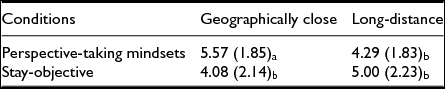
A 2 × 3 univariate ANOVA revealed a significant interaction effect between type of relationship and the perspective-taking orientation, F(2, 100) = 3.62, p = .03, η p 2 = .21. The main effects were not significant, both Fs < 1.91. Since the imagine-feelings and understand-thoughts conditions did not differ significantly with regard to resulting sensory specificity scores no matter which type of relationship (both ts < .65, both ps > .50), we collapsed the analyses across these two perspective-taking orientations. The means and standard deviations are reported in Table 2. The interaction of the perspective-taking manipulation (recoded as 1 = Objective and 2 = Perspective-taking orientation) and relationship type was significant, F(1, 102) = 6.99, p = .01, η p 2 = .06, while the main effects were not significant, both Fs < 1.
Desired Sensory Specificity as a Function of the Mindset Manipulation and Relationship Type in Study 2
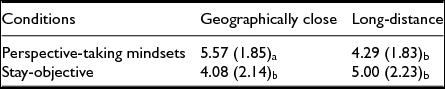
Note: Column and row means with different subscripts reflect statistically significant differences between conditions at p ≤ .05. The numbers in parentheses denote standard deviations.
Simple effect tests indicated that among geographically close participants, those in the perspective-taking condition showed greater sensory specificity than those in the stay-objective condition, t(102) = 2.67, p = .009, Cohen's d = .74 (see Table 2). There was no corresponding effect for those in long-distance relationships, t(102) = 1.15, p = .25, Cohen's d = .35. While geographically close and long-distance intimates did not differ in specificity in the stay-objective condition, t(102) = 1.39, p = .17, Cohen's d = .42, they did differ in the combined perspective-taking condition, such that geographically close partners indicated more desired sensory specificity than did long-distance partners, t(100) = 2.55, p = .01, Cohen's d = .70.
The differential dynamics of distance relationships
Attraction to the partner was not correlated with sensory specificity for the entire sample, β = -.04, p = .71, nor was there an interaction between attraction and type of relationship on specificity, β = -.03, p = .76. Attraction predicted specificity in the stay-objective condition, β = .33, p = .05, but not in the perspective-taking orientation conditions, β = -.18, p = .13. This may have occurred because the effects of the manipulated perspective-taking orientation overcame any preexisting differences in attraction to the partner among participants in that condition.
The interaction between time spent face to face and relationship type was not significant, β = .03, p = .83. However, across both types of relationships, the more time participants spent with their partners face to face, the more sensorially specific they were (n = 101), β = .19, p = .057. For relationships at distance, the more days there were between visits, the lower the sensory specificity (n = 41): r = -.36, p = .02. Similarly, although only a trend, the more time long-distance participants reported spending apart, the lower the sensory specificity (n = 43), r = -.22, p = .15. This means that the more opportunities for face-to-face interaction participants had with their romantic partner, the more discriminant they were in their desired sensory contact.
There was a marginally significant interaction between relationship type and difficulty on sensory specificity, β = -.18, p = .057. Given that we predicted this interaction, we proceeded to analyse the simple effects. The more difficult it was for long-distance participants to maintain the relationship, the lower their specificity scores, β = -.36, p = .02. Difficulty did not predict specificity for geographically close participants, β = -.03, p = .41.
Dispositional measures of perspective taking
There were no significant differences as a function of relationship type with regard to Fantasy and Perspective Taking scores. For both relationship types, higher scores on the Fantasy scale were associated with lower sensory specificity, β = -.28, p = .02 for non-distance participants and β = -.30, p = .06 for distance participants. Dispositional perspective taking was not associated with sensory specificity in both types of relationship, both βs < .21, both ps > .15. As expected, when all three perspective-taking variables were included in regression along with the Manipulation, Relationship Type, and the three interaction terms (Manipulation × Relationship Type; Davis's Fantasy × Relationship Type and Davis's Perspective Taking × Relationship Type), only Manipulation × Relationship Type predicted higher sensory specificity, β = .18, p = .05, while Fantasy continued to have a negative effect on specificity, β = -.29, p = .003.
Discussion
Study 2 results indicate that the effect of the perspective-taking manipulation on sensory specificity is restricted to those involved in non-distance relationships. There were no differences in sensory specificity between distance and non-distance participants within the stay-objective condition, whereas a difference was found among those given a perspective-taking mindset. When induced to take the perspective of their partners, distance participants displayed less sensory specificity than did non-distance participants.
We have assumed that the physical proximity involved in regular face-to-face interactions behooves perspective taking, and in turn, a finer tuning into the partner's sensory preferences. The lower desired sensory specificity of the long-distance participants, even in the perspective-taking conditions, appears to support this assumption. In addition, more support for this hypothesis is provided in the following: The more days that passed between face-to-face visits, the lower the sensory specificity for long-distance participants. This suggests that absence of opportunity to interact physically prevents long-distance participants from arriving at the sensory consequences of their attempts to take the other's perspective. Specifically, long-distance intimates would have a more difficult time than their non-distance counterparts in coming to know their partners’ contexts and preferences. Finally, difficulty of maintaining the relationship was associated significantly with less sensory specificity in distance relationships, but not in non-distance relationships.
General Discussion
We defined sensory specificity as selectivity in use of (Study 1) and preference for (Study 2) sensory channels in romantic relationships. Study 1 indicated that perspective taking predicted sensory specificity in both types of relationships, whereas in Study 2, perspective taking led to enhanced specificity only for partners in non-distance relationships. The question is why an interactive effect occurred in Study 2 but not in Study 1. One possibility is that in Study 1, our specificity measure was dependent on the participants’ self-reports of the time spent with the partner on all sensory channels, allowing for more measurement error. In contrast, the measure used in Study 2 gave participants a common metric (i.e., a 10-point Likert scale) to gauge their desired sensory interaction with the partner.
A second explanation is that the measure of perspective-taking orientation used in Study 1 was not very focused. That is, the results across the two studies are in proportion to the precision or focus of the perspective-taking orientation, in place and time. First, at the broadest or least focused level, is the individual difference measure of chronic tendency to take perspectives (Davis, Reference Davis1983). Both studies showed that this measure generally did not account for our outcome variable. The sole exception is in Study 1, among those in distance relationships. Second, the operationalisation of perspective taking in Study 1 pointed participants’ attention to the partner's concrete situation. However, the temporal aspect was more open in referring to the participant's general (across time) attunement to the partner's perspective. Nevertheless, this empirical definition of perspective taking showed a definite relation to sensory specificity. However, there was no differential effect for distance versus non-distance relationships. Third, the most focused of all was the experimental manipulation of Study 2. Here, attention was directed to a specific, here-and-now plight of the partner that triggered a motivation to help the partner by making use of one's relationship-specific perspective-taking skills. Thus, the manipulation matched the spatial/temporal focus of manipulations and settings used in classical perspective-taking research as well as the underlying motivation to become open to the other's perspective (Piaget, Reference Piaget1924; Stephenson & Wicklund, Reference Stephenson and Wicklund1983). This last condition is especially important given the documented evidence suggesting that the default mindset is not to take the other's perspective but, rather, to use one's own perspective as a reference (Epley, Keysar, Van Boven, & Gilovich, Reference Epley, Keysar, Van Boven and Gilovich2004).
The effects in Study 2 were robust and markedly differential as a function of relationship type. These effects are congruent with the idea that comprehending another's perspective requires a sense of the other's ongoing context (Wicklund, Reference Wicklund2007). Without having such situational cues as to the other's psychological states, perspective-taking effects are dampened, as was the case for distance relationships in Study 2. Indeed, in Study 2, the number of days between visits related negatively to sensory specificity in distance relationships. In a parallel manner, reported difficulty of maintaining the relationship correlated negatively with sensory specificity in these relationships: The correlation between difficulty and specificity across the two studies was statistically significant, r = -.26, p = .002.
Conceptualising Perspective Taking in the Context of Sensory Interactions
Both studies indicate that the effects of taking the partner's perspective on sensory specificity do not rest on the participants’ generalised tendency to imagine other people's perspectives. The findings are in line with prior work by Long (Reference Long1993b), who found that wives but not husbands in clinically defined low-adjustment and high-adjustment couples do not differ in their general perspective-taking abilities. He concluded that for reasons unique to their relationship, the wives in the low-adjustment couples might not be motivated to use their general perspective-taking skills in their interactions with their spouses. Long (Reference Long1993b) did find that both husbands and wives in high-adjustment couples had higher relationship-specific perspective-taking scores than low-adjustment couples (p. 254). Presumably, these skills are likely beneficial for the relationship. Our results are also consistent with research suggesting that non-partner-specific dispositions toward perspective taking do not account for a unique variance in the measured relationship outcomes (Arriaga & Rusbult, Reference Arriaga and Rusbult1998). Altogether, these findings underscore the need to study perspective taking as a relationship variable with focus on a given moment, as opposed to looking at perspective taking as a general personality characteristic. That is, perspective-taking orientation should be studied in a context that is psychologically and physically inhabited by romantic partners who are motivated to use their perspective-taking skills. As we have noted, the type of context used in Study 2 matches the spatial/temporal focus and settings of the classical perspective-taking research (Piaget, Reference Piaget1924; Stephenson & Wicklund, Reference Stephenson and Wicklund1983).
There are two potential interpretations of the absence of an effect of perspective orientation among long-distance partners in Study 2. An informational interpretation assumes that the cues to the other's immediate psychological states are scarcely available to distance partners. A second account may be labelled motivational. When a partner — or any target person — is absent physically for a significant time period, there is less psychological pressure, and therefore motivation, for the would-be perspective-taker to try to translate available information into potential actions to be taken vis-a-vis the target person. Not only the research on perspective taking (Steins & Wicklund, Reference Steins and Wicklund1996), but numerous other social-psychological concepts would point toward this interpretation.
For instance, one relevant example is Milgram's concept of psychological distance. Across his many studies, Milgram (Reference Milgram1974) varied both the physical distance between the person administering the shocks and the victim of these shocks, as well as the number of cues signalling the victim's distress. In one study, participants needed to move the victim's hand onto the shock plate in order to administer the punishment. Here, obedience effects were depressed substantially, potentially because seeing the victim's reactions facilitated the participant's ability to take the victim's perspective.
Physically seeing and hearing the partner gives individuals access to cues about the situation of the other and therefore provides them with knowledge necessary for perspective-taking efforts to materialise into partner-specific interactions. Email, instant messaging, and online chatting are routinely used to maintain relationships (Johnson, Haigh, Becker, Craig, & Wigley, Reference Johnson, Haigh, Becker, Craig and Wigley2008). However, electronically mediated communication may not provide adequate information about the ‘other-plus-context’ (Wicklund & Vandekerckhove, Reference Wicklund, Vandekerckhove, Postmes, Spears, Lea and Reicher2000, p. 198). In contrast, face-to-face interaction provides that kind of information by exposing the perceiver to ‘mundane stories’ of the distant other's life obtained through day-to-day mundane conversations (Rodriguez, Reference Rodriguez2014). In long-distance relationships, another issue resides in the nature of communication that occurs over mediated channels. Stafford (Reference Stafford2010) found that long-distance partners communicate in a manner to accentuate positive affect and minimise differences — a strategy that can keep intimates unaware of viewpoints of their partners that may be different from their own.
Implications for Romantic Interactions
Galinsky and his colleagues (Reference Galinsky, Maddux, Gilin and White2008) found that the two perspective-taking orientations we used in the second study involve different processes and outcomes in strategic interactions. Specifically, in conflictual situations in which the various parties must negotiate conflict resolution or achieve a negotiated goal that is mutually satisfying, the exercise of understanding the other's thoughts and situation may render outcomes that are better for all parties. This is in contrast to the effects obtained when individuals are asked to imagine the other's feelings, which can instigate an enhanced concern for the other's wellbeing at the expense of one's own wellbeing (Galinsky et al., Reference Galinsky, Maddux, Gilin and White2008; Galinski, Gilin & Maddux, Reference Galinsky, Gilin, Maddux, Forgas, Kruglanski and Williams2011). However, we found no differences between the two orientations used in Study 2. One possible explanation is that in the context offered to participants in Study 2, both orientations led to greater attunement to the interpersonal cues concerning the partner's dire situation, which triggered increased valuing of the partner (Batson, Reference Batson2011).
Our findings are consistent with prior work suggesting that taking the perspective of the partner enhances propensity toward accommodating the emotions, attributions, and behavioural preferences of the partner when that partner has engaged in a potentially destructive act (Arriaga & Rusbult, Reference Arriaga and Rusbult1998). Altogether, these findings suggest that greater attunement to the partner's world is due to an enhanced orientation toward taking the perspective of the partner.
Our current studies focused on the effect of perspective taking on sensory specificity in the context of positive relationships with the partner. Future research could examine the beneficial effects of sensory specificity on relationship satisfaction and relationship maintenance as well as the detrimental effects of diminished sensory specificity. Is habitual sensory specificity a marker of successful relationships? What are the other motivational antecedents of sensory specificity? Is empathic concern for one's romantic partner (or valuing the partner's welfare) one of these antecedents? Looking at the current data, there was a significant relationship between attraction and sensory specificity in Study 1 and in the stay-objective condition in Study 2. Given the correlational nature of these data, it is nevertheless difficult to conclude whether attraction to the partner leads to enhanced sensory specificity, or whether greater specificity caused increased attraction to the partner. More work is needed to parse out these potential explanations.
The current work does not address whether the specific sensory channels the perceiver believes the partner desires actually match the sensory preferences of the partner. Initial evidence (Navarro & Miron, 2011) suggests that similarity in partners’ preferences for the various sensory channels of relating is associated with higher self-reported relationship satisfaction. However, those data do not answer the question of whether intended sensory specificity matches the partner's desired sensory specificity in a here-and-now context. The question is important, given that empathic inaccuracy in the context of intimate relationships — inferring inaccurately the specific content of one's romantic partner's thoughts or feelings (Ickes, Reference Ickes1997) — was identified as a characteristic of individuals involved in violent intimate relationships (Clements, Holtzworth-Munroe, Schweinle, & Ickes, Reference Clements, Holtzworth-Munroe, Schweinle and Ickes2007).
Future work could explore whether empathic inaccuracy also leads to mismatched sensory interactions in romantic relationships. Such research could manipulate perspective taking as we did in Study 2, assess both romantic partners’ preferences for sensory interaction in a particular relationship context, and measure relationship satisfaction as the dependent variable. This experimental design would allow one to examine whether imagining the thoughts and feelings of the partner would lead to a selection of sensory channels that match the sensory channels actually desired by the partner. In the example given at the beginning of this article, the woman who infers that the partner is too tired for touch and talking will use the visual sensory channel to interact with her partner. The question is, of course, whether her selection of sensory channels is what her partner actually desires and whether the actor-partner congruence of sensory channels ultimately enhances relationship satisfaction.
Future work could also investigate whether frequently taking the perspective of one's romantic partner across situations can create a generalised readiness to orient towards the perspective of the partner. This readiness can override the default option of centring on one's own perspective that was observed in various types of social interactions (Epley et al., Reference Epley, Keysar, Van Boven and Gilovich2004). For instance, valuing the other's welfare is an essential antecedent of empathic concern and altruistic motivation to help the other (Batson, Eklund, Charmok, Hoyt, & Ortiz, Reference Batson, Eklund, Chermok, Hoyt and Ortiz2007). Can awareness of valuing the romantic partner's welfare create a more general attitude of openness toward the other's perspective and therefore promote the use of more discriminant partner-focused strategies of interaction?
The work presented in this article makes two important contributions to the field of interpersonal and romantic interaction. First, the focus here is on the non-verbal realm, broken down into the specifics of the sensorial dimensionality. Making oneself available to the other through the sensory dimensions, plus sensing all of the dimensions as emanated by the partner, is cast as a motor of interaction, most especially of continued interaction that is powered by mutual aesthetics (Wicklund & Vida-Grim, Reference Wicklund, Vida-Grim, Greenberg, Koole and Pyszczynski2004). Such dynamics occur quite independently of the usual cognitive and linguistic factors that are often portrayed as the building stones of continued and romantic interaction (Byrne, Reference Byrne1971; Watson et al., Reference Watson, Klohnen, Casillas, Nus, Haig and Berry2004). Second, when the non-verbal repertoire is brought into play, it is generally treated as a lump sum, with the implicit assumption of ‘the more, the better’ (see Wicklund, Reference Wicklund2007). Our studies, in contrast, assume that the discriminating, interpersonally sensitive implementation of the sensory modalities is more effective than ‘more is better’. Future work could further explore the benefits of such discriminating strategies for relationship maintenance and satisfaction.