Introduction
Traumatic brain injury (TBI) is the leading cause of disability in those aged under 40 years, commonly affecting young males injured in road traffic accidents. The injury interrupts the important developmental transition to independence and results in significant emotional distress (Ponsford et al. Reference Ponsford, Sloan and Snow1995). However, despite a century of research, the current understanding of the relationship between TBI and psychiatric disorders is limited. Importantly, there are dramatic variations in reported incidence and prevalence rates between studies, with post-injury incidence of depression ranging from 15.3% to 33% and prevalence from 18.5% to 77% (Kim et al. Reference Kim, Lauterbach, Reeve, Arciniegas, Coburn, Mendez, Rummans and Coffey2007). Reported prevalence of anxiety disorder ranges between 19% (Rutherford et al. Reference Rutherford, Merrett and McDonald1977) and 70% (Lewis, Reference Lewis1942).
Psychiatric disorders can emerge in the acute stages (Fedoroff et al. Reference Fedoroff, Starkstein, Forrester, Geisler, Jorge, Arndt and Robinson1992; Jorge et al. Reference Jorge, Robinson, Arndt, Forrester, Geisler and Starkstein1993a) and remain for decades post-injury (Hibbard et al. Reference Hibbard, Uysal, Kepler, Bogdany and Silver1998, Koponen et al. Reference Koponen, Taiminen, Portin, Himanen, Isoniemi, Heinonen, Hinkka and Tenovuo2002). However, the course of disorder development, particularly depression, also remains unclear, with evidence for both increases (Hoofien et al. Reference Hoofien, Gilboa, Vakil and Donovick2001; Whelan-Goodinson et al. Reference Whelan-Goodinson, Ponsford, Johnston and Grant2009) and decreases over time (Ashman et al. Reference Ashman, Spielman, Hibbard, Silver, Chandna and Gordon2004; Fann et al. Reference Fann, Burington, Leonetti, Jaffe, Katon and Thompson2004). Post-injury anxiety disorders have also been shown to increase (Koponen et al. Reference Koponen, Taiminen, Portin, Himanen, Isoniemi, Heinonen, Hinkka and Tenovuo2002) and decrease over time (Ashman et al. Reference Ashman, Spielman, Hibbard, Silver, Chandna and Gordon2004), with some authors finding no relationship between time post-injury and onset (Hibbard et al. Reference Hibbard, Uysal, Kepler, Bogdany and Silver1998; Williams et al. Reference Williams, Evans, Needham and Wilson2002). Substance use may relapse in the first year post-injury (Bombardier et al. Reference Bombardier, Temkin, Machamer and Dikmen2003), decrease post-injury and not increase to pre-injury levels (Sbordone et al. Reference Sbordone, Liter and Pettler-Jennings1995), or return to pre-injury levels (Ponsford et al. Reference Ponsford, Whelan-Goodinson and Bahar-Fuchs2007). Discrepancy also exists concerning the reported onset and course of bipolar disorders and schizophrenia post-injury (Jorge et al. Reference Jorge, Robinson, Starkstein, Arndt, Forrester and Geisler1993c; Fujii & Ahmed, Reference Fujii and Ahmed2002; Kim et al. Reference Kim, Lauterbach, Reeve, Arciniegas, Coburn, Mendez, Rummans and Coffey2007).
Clarification is also required concerning the contribution of pre-injury psychiatric history to post-injury disorders. The literature variously posits that pre-injury disorders increase risk for post-injury disorder development (Deb et al. Reference Deb, Lyons, Koutzoukis, Ali and McCarthy1999; Ashman et al. Reference Ashman, Spielman, Hibbard, Silver, Chandna and Gordon2004), that they are not significantly associated (Fann et al. Reference Fann, Katon, Uomoto and Esselman1995; Jorge et al. Reference Jorge, Robinson, Moser, Tateno, Crespo-Facorro and Arndt2004), or that those without a pre-injury history have an increased risk of post-injury psychiatric disorder (Fann et al. Reference Fann, Burington, Leonetti, Jaffe, Katon and Thompson2004).
Studies utilizing the Structured Clinical Interview for DSM (SCID), considered the gold-standard measure of psychiatric diagnosis in TBI have been retrospective (Hibbard et al. Reference Hibbard, Uysal, Kepler, Bogdany and Silver1998) or cross-sectional (Whelan-Goodinson et al. Reference Whelan-Goodinson, Ponsford, Johnston and Grant2009). Other retrospective studies using structured clinical interviews have focused on mild TBI (Deb et al. Reference Deb, Lyons, Koutzoukis, Ali and McCarthy1999), used small samples (van Reekum et al. Reference van Reekum, Bolago, Finlayson, Garner and Links1996), or had long post-injury follow-up periods (Koponen et al. Reference Koponen, Taiminen, Portin, Himanen, Isoniemi, Heinonen, Hinkka and Tenovuo2002). Retrospective studies are potentially inaccurate, as they rely on recall of symptoms experienced many years previously.
Only three prospective studies have examined more than one class of psychiatric disorder. Ashman et al. (Reference Ashman, Spielman, Hibbard, Silver, Chandna and Gordon2004) used the SCID to diagnose depression, anxiety and substance use disorders in a cross-sequential design, but interpretation was impacted by cohort effects, pre-injury psychiatric symptoms were recalled 4 years post-injury, and there was no secondary participant corroboration. Jorge and colleagues focused their prospective studies predominantly on depressive disorders, diagnosed using the Present State Examination (Fedoroff et al. Reference Fedoroff, Starkstein, Forrester, Geisler, Jorge, Arndt and Robinson1992; Jorge et al. Reference Jorge, Robinson, Arndt, Forrester, Geisler and Starkstein1993a, Reference Jorge, Robinson, Moser, Tateno, Crespo-Facorro and Arndt2004), and also examined mania (Jorge et al. Reference Jorge, Robinson, Starkstein, Arndt, Forrester and Geisler1993c), alcohol use disorders (Jorge et al. Reference Jorge, Starkstein, Arndt, Moser and Crespo-Facorro2005) and generalized anxiety disorder (GAD) with co-morbid depression (Jorge et al. Reference Jorge, Robinson, Starkstein and Arndt1993b). Separate examination of individual disorders precludes an analysis of co-morbidity and interaction over time. More recently, Bombardier et al. (Reference Bombardier, Fann, Temkin, Esselman, Barber and Dikmen2010) conducted a comprehensive prospective examination of the rates of depression following complicated mild to severe TBI, according to a nine-item depression scale, the Patient Health Questionnaire (PHQ-9; Kroenke et al. Reference Kroenke, Spitzer and Williams2001). This scale was reported to be comparable to the SCID (Fann et al. Reference Fann, Bombardier, Dikmen, Esselman, Warms, Pelzer, Rau and Temkin2005), but differs in that it does not allow the examiner to determine attribution of symptoms to depression or the TBI. Lifetime history of mood, anxiety, psychotic and alcohol use disorders was based on patient self-report of diagnosis. There have been no truly prospective studies that have examined the full spectrum of psychiatric disorders using the SCID (Kim et al. Reference Kim, Lauterbach, Reeve, Arciniegas, Coburn, Mendez, Rummans and Coffey2007). Accordingly, we aimed to examine prospectively the frequency, nature and course of post-injury psychiatric disorders in individuals with TBI.
Method
Procedures
Hospital and university ethics approvals were obtained. Potential participants were recruited from consecutive TBI admissions to a rehabilitation hospital that treats 30–50% of all head injuries in the state within the context of a no-fault accident compensation system (August 2005 to April 2008). Inclusion criteria were: complicated mild [i.e. post-traumatic amnesia (PTA) duration <1 day, Glasgow Coma Scale (GCS) score 13–15, and the presence of intracranial abnormalities on neuroimaging (Williams et al. Reference Williams, Levin and Eisenberg1990; Kashluba et al. Reference Kashluba, Hanks, Casey and Millis2008)], moderate or severe TBI; age at injury 16–80 years; no previous TBI or other neurological disorder; residence in Australia post-discharge; and sufficient cognitive and English ability to complete interviews according to the treating neuropsychologist. Patients with pre-morbid psychiatric history, learning or behavioural problems were not excluded.
Written informed consent was obtained. Participants completed the initial assessment during their in-patient admission (76.5%) or soon after discharge (23.5%). The mean interval between injury and initial assessment was 61.02 days (s.d.=43.62, median=50.0, range 4–210). The initial assessment was conducted beyond 100 days post-injury for 20 participants for whom the duration of PTA was significantly longer (t=−3.09, df=100, p>0.01). Follow-up assessments were scheduled at 3, 6 and 12 months post-injury. The online Appendix presents a flow chart of the consecutive hospital admission patient allocations and study participation.
Only data from the 102 participants who completed the 12-month assessment were included in the analysis. There were no significant differences between these participants and those who were eligible but did not complete the assessment, according to age (t=0.74, df=214, p>0.05), gender (χ2=0.22, df=1, p>0.05), injury due to assault (χ2=0.01, df=1, p>0.05), PTA severity category measured prospectively using the Westmead PTA Scale (χ2=5.39, df=3, p>0.05), or GCS severity category (χ2=1.42, df=2, p>0.05). All participants completed the initial and 12-month assessments. The majority of participants completed all follow-up time points (72.5%), 22.5% completed two of the three follow-up assessments (missing either the 3- or the 6-month assessment) and 5% completed only the initial and 12-month assessments. Data from the 3- and 6-month assessments were combined to ensure full coverage of the initial to 6-month time period.
Measures
A semi-structured interview was used to obtain participant's demographic information. Information regarding injury and previous health problems, including psychiatric and/or substance use problems, was obtained from medical files with written consent.
SCID
The SCID Research Version (First et al. Reference First, Spitzer, Gibbon and Williams2002) is a semi-structured clinical interview used to diagnose DSM-IV-TR Axis I psychiatric disorders (APA, 2000). Modification of the SCID was required. First, the known injury and trauma history was taken into account when asking about post-traumatic stress disorder (PTSD) symptoms. As in previous studies (Hibbard et al. Reference Hibbard, Uysal, Kepler, Bogdany and Silver1998; Ashman et al. Reference Ashman, Spielman, Hibbard, Silver, Chandna and Gordon2004), post-injury psychiatric disorders related to the injury were not diagnosed as ‘due to a general medical condition’ or as an adjustment disorder. Adjustment disorders were still diagnosed if the cause was not directly related to the TBI. The format was also modified to allow for multiple administrations; at the initial assessment, the SCID was administered twice, regarding both current and lifetime pre-injury psychiatric disorders. Current disorders represented disorders present at the time of the injury in addition to those that had developed immediately after the injury. No diagnoses were made while the participant was in PTA. At follow-up, assessment of psychiatric disorders related to the intervening period between the current and previous assessments conducted.
The SCID was also administered to a proxy informant nominated by the participant to gain a more detailed history of the participant's psychological functioning. This was completed for 72.5% of participants, by their mother (34.2%), wife (19.7%), sister (11.8%), girlfriend (9.2%), friend (7.9%), daughter (6.6%), brother (2.6%), husband (2.6%), boyfriend (1.3%) or other (3.9%). The participant declined proxy informant involvement in 20.6% of cases, and the proxy informant declined in 6.9%. Agreement between raters with regard to pre-injury diagnoses was as follows (κ=0.49): both the participant and proxy informant agreed that there was no diagnosis (34.3%); both provided consistent accounts of the diagnosis (2.9%); the proxy informant was not aware of at least one diagnosis that the participant reported, but they may have agreed on other diagnoses (26.5%); an additional diagnosis was made due to the proxy informant report, and again they may have agreed on other diagnoses (4.9%); both the participant and the proxy informant agreed on the diagnostic category (i.e. anxiety disorder) but provided different specific diagnoses (1%); there was a combination of the aforementioned agreement issues (1%). Agreement between raters with regard to post-injury diagnoses were as follows (κ=0.6): both the participant and proxy informant agreed that there was no diagnosis (26.5%); both provided consistent accounts of the diagnosis (15.7%); the proxy informant was not aware of at least one diagnosis that the participant reported but they may have agreed on other diagnoses (13.7%); an additional diagnosis was made due to the proxy informant report, and again they may have agreed on other diagnoses (12.7%); both the participant and the proxy informant agreed on the diagnostic category but provided different specific diagnoses (1.0%); there was a combination of the aforementioned agreement issues (1.0%).
The Longitudinal, Expert, All Data (LEAD) procedure (Spitzer, Reference Spitzer1983) was used, whereby a consensus diagnosis is made using longitudinal assessments by expert clinicians on the basis of all data available. Thus, the participant's and proxy informant's reports and information from medical files and other available sources were collated and reviewed regularly by the three SCID administrators (K.G., L.J., M.K.) to determine the respective diagnosis at each time interval, which also assisted in a reduction of inter-rater drift. The SCID administrators had doctoral training in clinical psychology (M.K., L.J.) and clinical neuropsychology (K.G.), and also specialist comprehensive training in the use of the SCID.
National Adult Reading Test (NART)
The NART (Nelson, Reference Nelson1982), a valid measure in TBI populations (Watt & O'Carroll, Reference Watt and O'Carroll1999), was used to provide an estimate of pre-morbid intellectual function.
Statistical analysis
Descriptive analyses were performed and frequency data were obtained. Significance was determined using χ2 and Student's t tests, analysed using SPSS version 17 (SPSS Inc., USA). A random effects logistic regression was calculated to examine whether the probability of having a post-injury psychiatric disorder was dependent on gender, age, pre-injury psychiatric history, time post-injury, or injury severity (PTA and GCS). The regression was completed once with time entered as discrete assessment points (categorical), and separately with time in months post-injury (continuous). Regressions were also computed for post-injury depression and anxiety disorders with time as a continuous variable and pre-injury history for the respective diagnostic category.
Frequencies of pre- and post-injury substance use disorders and selected anxiety and mood disorders in the present study were compared to prevalence rates in the general population after adjustment for age and gender distribution (ABS, 2009). The population survey used DSM-IV criteria using the World Health Organization's (WHO) Composite International Diagnostic Interview Version 3 (WMH-CIDI 3.0), which has moderate to good concordance with the SCID for lifetime disorders, and substantial concordance for 12-month disorders (Haro et al. Reference Haro, Arbabzadeh-Bouchez, Brugha, Girolamo, Guyer, Jin, Lepine, Mazzi, Reneses, Vilagut, Sampson and Kessler2006). Because of the large number of comparisons, α was adjusted to 0.01 to reduce the risk of Type I errors.
Results
Participants
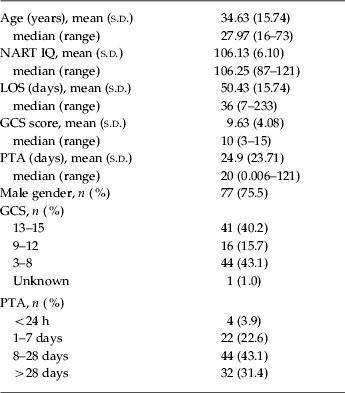
Participants' demographic and injury details are presented in Table 1. Most participants sustained the TBI following a motor vehicle accident (64.4%). Other injury mechanisms included motorcycle accident (16.8%), fall (7.9%), bicycle accident (4.1%), machinery accident (4.0%), assault (1%), sporting accident (1%) and suicide attempt (1%, person versus train). Cause of injury information was unavailable for one participant. The majority of injuries were categorized as moderate to severe according to the PTA duration. Of the 41 participants with GCS in the mild range (13–15), only three had PTA <24 h, all of whom had abnormal computed tomography (CT) findings.
Demographic and injury information for the participants (n=102)

NART IQ, National Adult Reading Test Intelligence Quotient; LOS, length of stay with regard to in-patient rehabilitation admission; GCS, Glasgow Coma Scale; PTA, post-traumatic amnesia; s.d., standard deviation.
Frequency of lifetime psychiatric disorders pre-injury
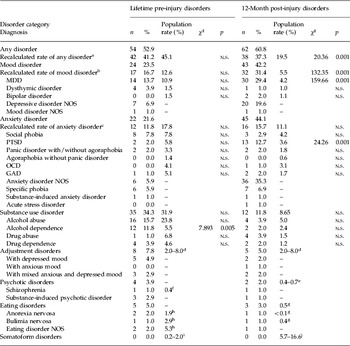
Over half the participants met criteria for one or more pre-injury lifetime psychiatric disorder. As shown in Table 2, the most frequent diagnostic categories were substance use disorders, for which alcohol use disorders predominated, followed by mood and anxiety disorders. With the exception of alcohol dependence, frequencies in the TBI group were similar to lifetime rates in the general population. A review of the medical records from the rehabilitation hospital revealed that 19 participants had a documented psychiatric history.
Frequency of psychiatric disorder compared with the general population (α=0.01)

MDD, Major depressive disorder; PTSD, post-traumatic stress disorder; GAD, generalized anxiety disorder; OCD, obsessive–compulsive disorder; NOS, Not otherwise specified; n.s., not significant.
a The sum of all substance use disorders, and the recalculated rates for mood disorders and anxiety disorders.
b The sum of frequency rates for MDD, dysthymic disorder and bipolar disorder only.
c The sum of frequency rates for social phobia, PTSD, panic disorder with/without agoraphobia, agoraphobia without panic disorder, OCD and GAD only.
d Prevalence of adjustment disorder as reported in the DSM-IV-TR (APA, 2000); statistical comparisons were not conducted.
e One-year population rate of psychotic disorders were from ICD-10 ratings of Australian males (Jablensky et al. Reference Jablensky, McGrath, Herrman, Castle, Gureje, Evans, Carr, Morgan, Korten and Harvey2000); statistical comparisons were not conducted.
f Lifetime prevalence of schizophrenia was obtained from a global systematic review (Saha et al. Reference Saha, Chant, Welham and McGrath2005); statistical comparisons were not conducted.
g One-year population rates for eating disorders were from a New Zealand population study (Wells et al. Reference Wells, Browne, Scott, McGee, Baxter and Kokaua2006); statistical comparisons were not conducted.
h Lifetime population rates for eating disorders were from an Australian female twin study (Wade et al. Reference Wade, Bergin, Tiggemann, Bulik and Fairburn2006); statistical comparisons were not conducted.
i Lifetime prevalence rate of somatoform disorders as reported in the DSM-IV-TR (APA, 2000); statistical comparisons were not conducted.
j One-year population rate for somatoform disorder was from a German study (Härter et al. Reference Härter, Baumeister, Reuter, Jacobi, Höfler, Bengel and Wittchen2007); statistical comparisons were not conducted.
More participants had co-morbid pre-injury psychiatric disorders (29.4%) than a single pre-injury psychiatric disorder (23.5%). Fifty per cent of those with a pre-injury lifetime mood disorder also had a co-morbid anxiety disorder, and 54.5% of those with an anxiety disorder also had a co-morbid mood disorder.
Frequency of psychiatric disorders in the first 12 months post-injury
During the first year post-injury, almost 61% of participants had one or more psychiatric disorders. This figure was significantly greater than the frequency of pre-injury disorders (χ2=8.50, df=1, p<0.01). As can be seen in Table 2, anxiety disorders were the most prevalent, followed by mood disorders. The TBI group had significantly higher post-injury frequencies of any disorder, any mood disorder, major depressive disorder (MDD) and PTSD relative to the general population. Conversely, this was not the case for adjustment substance use, psychotic, eating or somatoform disorders.
More than a third of the sample (37.3%) had two or more psychiatric disorders in the first year post-injury, and 23.5% had one psychiatric disorder during the same time. This difference was not significant (McNemar test, p=0.1). In the year following injury, 72.1% of those with a post-injury mood disorder also had a co-morbid anxiety disorder, and 68.9% of those with an anxiety disorder also had a co-morbid mood disorder.
Course of disorders in the first year post-injury
There was a significant association between pre- and post-injury psychiatric history (χ2=8.50, df=1, p<0.01), whereby more individuals with a pre-injury history also experienced a psychiatric disorder in the first year post-injury. Of the 54 participants with a pre-injury psychiatric history, 40 (74.1%) also had a post-injury psychiatric disorder. However, of the 48 participants without a pre-injury psychiatric history, 22 (45.8%) developed a novel post-injury psychiatric disorder. Because of these findings, the post-injury course of disorder development was further examined separately, depending on pre-injury psychiatric history.
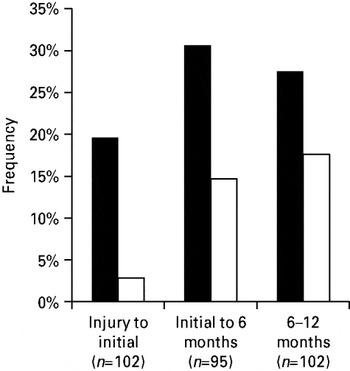
Fig. 1 shows that the frequency of psychiatric disorder at each time interval was around 20–30% for those with a pre-injury history, and rates of novel disorders were minimal initially, increasing to 15–17% throughout the year. The results of the random effects logistic regression (categorical) indicated that frequency rates at the 6- and 12-month assessments were significantly higher than the rates at the initial assessment (p=0.001 and p<0.001 respectively), but were not significantly different from each other (p>0.05). When the regression was recomputed with time as a continuous variable, it revealed that with each month post-injury, the odds of having a psychiatric disorder within the first year post-injury increased by 15% [odds ratio (OR) 1.15, 95% confidence interval (CI) 1.07–1.23, p<0.001]. The odds of having a post-injury psychiatric disorder increased fourfold for those with a pre-injury psychiatric history (OR 4.42, 95% CI 1.71–11.44, p=0.002). There was no significant effect of age, gender or injury severity according to GCS or PTA (all p>0.05) on the probability of experiencing a post-injury psychiatric disorder.
Frequency of psychiatric disorder post-injury by pre-injury status. ▪, Participants with pre-injury psychiatric history; □, participants without pre-injury psychiatric history.

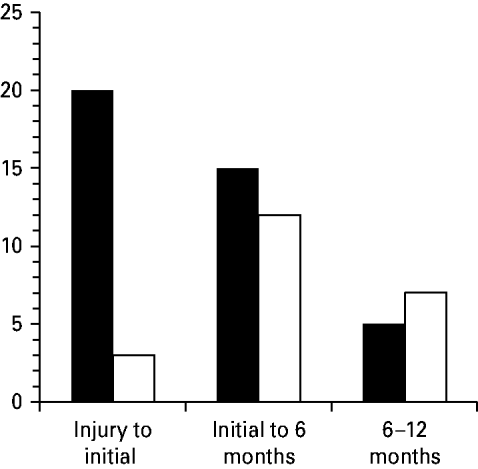
Fig. 2 shows that participants with a pre-injury history were most likely to display disorders for the first time post-injury at the initial assessment or within the first 6 months. Conversely, the onset of novel disorders was generally not evident at the initial assessment but emerged throughout the year. Psychiatric disorders for both groups were likely to persist throughout the year.
Time period psychiatric disorders were first diagnosed post-injury. ▪, Participants with pre-injury psychiatric history; □, participants without pre-injury psychiatric history.

The respective courses of depressive and anxiety disorders were also examined. The random effects model demonstrated that a history of depression increased the odds of having a post-injury depressive disorder 5.25 times (95% CI 1.66–16.64, p=0.005), and with every month post-injury, the odds of having a depressive disorder increased by 20% (OR 1.2, 95% CI 1.1–1.3, p<0.001). A history of anxiety disorder increased the odds of having a post-injury anxiety disorder 9.47 times (95% CI 3.21–27.93, p<0.001), and with every month post-injury, the odds of having an anxiety disorder increased by 11% (OR 1.11, 95% CI 1.03–1.19, p=0.005).
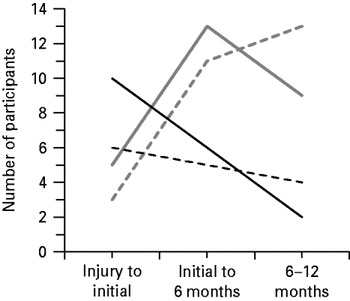
Fig. 3 reveals that pre-existing depressive disorders tended to emerge consistently throughout the first year post-injury, whereas pre-existing anxiety disorders were more likely to emerge earlier post-injury. Novel anxiety disorders tended to develop in the first 6 months post-injury, whereas the onset of novel depressive disorders was found to increase over time. Participants with a pre-injury history of psychiatric disorders who experienced co-morbid post-injury anxiety and depression (n=20) tended to be diagnosed with both of these at the same assessment (60%), or the anxiety emerged first (25%); those who developed novel anxiety and depression (n=10) were equally likely to have onset of both at the same time (40%), or experience the anxiety first (40%). Thus, emergence of depression tended not to precede anxiety. Of note, the majority of individuals with pre-injury substance use disorders alone did not develop post-injury mood and anxiety disorders.
Time period depressive and anxiety disorders were first diagnosed post-injury. Participants with novel anxiety (
 ), novel depression (
 ), pre- and post-injury anxiety (——), and pre- and post-injury depression (- - -).

Post-injury anxiety and depression symptoms
Depressed mood was the most frequent MDD symptom at 6 and 12 months. At 6 months, the second most frequent MDD symptom was fatigue/loss of energy, whereas at 12 months it was anhedonia. There was a 20% reduction in reported thoughts of death and suicide at 12 months from 6 months. Psychomotor agitation/retardation was the least frequent symptom at both 6 and 12 months, with 39% endorsement.
Of those with a diagnosis of PTSD at 12 months, the most frequent re-experiencing symptom was intense psychological distress at internal or external cues (73%); the most frequent avoidance symptom was efforts to avoid thoughts, feelings or conversations (82%) and the most frequent numbing symptom was feelings of detachment or estrangement from others (83%); the most frequent increased arousal symptom was hyper-vigilance (70%). Flashbacks were uncommon (18%). All symptoms of GAD were endorsed with approximately equal frequency, as in the general population (ABS, 2009).
Discussion
The current study found that more than half of the participants with TBI had a pre-injury lifetime psychiatric disorder, predominantly substance use, mood and anxiety disorders. This finding is similar to the rates of 50–52% cited in other studies that have used the SCID or other clinical interviews (Fann et al. Reference Fann, Katon, Uomoto and Esselman1995; Hibbard et al. Reference Hibbard, Uysal, Kepler, Bogdany and Silver1998; Whelan-Goodinson et al. Reference Whelan-Goodinson, Ponsford, Johnston and Grant2009). A previous cross-sectional study (Whelan-Goodinson et al. Reference Whelan-Goodinson, Ponsford, Johnston and Grant2009) found a similar rate of pre-injury disorders, and more novel post-injury disorders. However in the current study, pre-injury co-morbidity rates were substantially higher, suggesting that earlier history taking results in the capture of more pre-injury psychiatric disorders. Thus, the prospective design may be more sensitive and more reliable in detecting psychiatric history and may also minimize the likelihood of idealizing one's former self.
Rates of pre-injury psychiatric disorders were similar to those in the general population, after accounting for age and gender distribution, with the exception of alcohol dependence, which underscores the association between very heavy alcohol use and motor vehicle accidents; or the predominant cause of injury in this sample.
Throughout the first year post-injury, psychiatric disorders were diagnosed in 61% of participants; a significantly higher rate than in the general population. Disorders changed from pre-injury patterns, with a decline in substance use disorders, most probably due to hospital recommendations for abstinence for 1 year post-injury, and a significant increase in frequency of depressive and anxiety disorders.
The frequencies of post-injury psychiatric disorders in the present study were substantially higher than the rate of 18.3% found in a study of predominantly mild-TBI patients over 1 year post-injury, who were assessed for psychiatric disorders in the preceding month (Deb et al. Reference Deb, Lyons, Koutzoukis, Ali and McCarthy1999). This difference may be due to the longer time-period surveyed in the current study, or the fact that the current study included a more severely injured sample. The frequencies of most disorders were also higher than in a comparable Australian sample of orthopaedic and mild-TBI patients (O'Donnell et al. Reference O'Donnell, Creamer, Pattison and Atkin2004), suggesting that the brain injury is a contributing factor over and above the effects of general trauma.
Conversely, the present study's post-injury frequencies of psychiatric disorders were lower than those reported in previous retrospective studies (van Reekum et al. Reference van Reekum, Bolago, Finlayson, Garner and Links1996; Hibbard et al. Reference Hibbard, Uysal, Kepler, Bogdany and Silver1998). This is not surprising given that these studies used long retrospective periods post-injury; 36 and 7 years, respectively. Clearly, the likelihood of experiencing psychiatric symptoms increases cumulatively over time. Additionally, relying on recall of symptoms over such long periods is arguably less reliable, especially in individuals who may have injury-related memory impairments. Use of ratings scales, which may allow for misattribution of somatic symptoms, may also account for inflated ratings. For instance, in a study using the PHQ-9, 53.1% of TBI patients met criteria for MDD during the first year (Bombardier et al. Reference Bombardier, Fann, Temkin, Esselman, Barber and Dikmen2010), which is substantially higher than the frequency of 29.4% found in the current study using the SCID.
The frequencies of post-injury disorders were similar to those of Whelan-Goodinson et al. (Reference Whelan-Goodinson, Ponsford, Johnston and Grant2009), although there were lower rates of substance use disorders in the current study, probably because the 5-year post-injury range in the former study extended beyond the 1 year of abstinence recommended by treating doctors in both studies.
One of the most striking findings was the high rate of anxiety disorder not otherwise specified (NOS), diagnosed in over one-third of participants post-injury. For many cases, the anxiety had features of both PTSD and GAD but did not meet full criteria for either disorder. There may be a qualitative difference in the experience of anxiety disorders after TBI that traditional diagnostic schemes do not accommodate. Occasionally, it was not possible to determine criteria based on information from the proxy informant. Accordingly, this finding may also reflect the difficulties inherent in conducting comprehensive interviews in this population, despite every attempt to obtain all information. A third possibility relates to the severity and duration of the symptoms, and in these cases the NOS category allows for some ‘subthreshold’ diagnoses, which later developed into a full criteria disorder. Similar reasons may also account for the high rates of depressive disorder NOS, which was diagnosed in close to one-fifth of the sample post-injury. In support of this, such diagnoses were rare in the study by Whelan-Goodinson et al. (Reference Whelan-Goodinson, Ponsford, Johnston and Grant2009), which included participants mostly beyond 1 year post-injury. Intervention in the first year post-injury may prevent later development into more severe disorders. It may also be the case that individuals and their informants improve in their ability to notice and report psychiatric symptoms over time, particularly as the focus in the first year may be limited to more functional and physically based issues.
Pre-injury history was significantly associated with presence of a post-injury disorder, suggesting that those individuals are at increased risk of developing a post-injury disorder and may benefit from more extensive monitoring.
Early onset post-injury (i.e. the first 6 months) was more common than later onset. Post-injury course also differed according to pre-injury status, with a positive history resulting in greater likelihood of diagnosis at initial assessment. Individuals without a psychiatric history were significantly more likely to develop a novel disorder later in the year, highlighting the need for follow-up of these individuals as well. Jorge et al. (Reference Jorge, Robinson, Arndt, Forrester, Geisler and Starkstein1993a) conducted a prospective study of the course of MDD in 66 participants with TBI. ‘Acute’ onset MDD, at around 1 month post-injury, was more common than ‘delayed’ onset (3 to 12 months post-injury) and was not related to pre-injury psychiatric disorder history. By contrast, the present study found that acute onset was far less common than delayed onset (n=9 v. n=33) and was closely associated with a pre-injury history of depression (66.6%) compared to delayed onset (27.3%). These differences may relate to the distribution of injury severity; with 44% of the Jorge study sustaining mild TBI. Participants with mild TBI may be more aware of changes closer to the time of injury than the more severely injured, who confront more lasting disabilities, the nature of which may take months to years to fully comprehend.
No previous studies have prospectively examined the onset of anxiety disorders following TBI. The current findings indicate that those with a pre-injury history were likely to be diagnosed again with an anxiety disorder in the first 6 months post-injury. Anxiety disorders tended to precede or emerge at the same time as depressive disorders. Hypothetically, treatment of anxiety in these cases may avert the onset of depression.
The issue of causality and influence of neurophysiological mechanisms is frequently debated. It has been argued that brain injury should precipitate onset in the acute phase (Lishman, Reference Lishman1988). The results of the present study argue for an association of acutely presenting disorders with pre-injury history rather than with the brain injury. Onset of psychiatric disorders in the chronic phases is said to occur in response to psychosocial changes, as insight into physical, cognitive and social impairments develops (Lishman, Reference Lishman1988). Those with more severe injuries are more likely to have impaired insight in the first 6 months post-injury, with later developing insight related to greater emotional dysfunction (Godfrey et al. Reference Godfrey, Partridge, Knight and Bishara1993). The development of insight clearly varies according to numerous factors, including the injury severity, associated cognitive impairments, degree of exposure of the injured person to the impact of their disabilities on their lifestyle, support available and the individual's coping style (Anson & Ponsford, Reference Anson and Ponsford2006). Such factors may, in turn, influence the timing of emergence of reactive psychiatric disorders. The findings of this study are consistent with the assumption that the experience of injury and psychosocial adjustment play a strong role in the development of novel anxiety and depression after TBI. Further imaging studies and concurrent assessment of insight and psychosocial functioning are needed. In the meantime, clinicians may benefit from considering both aetiologies and trialling interventions accordingly (Moldover et al. Reference Moldover, Goldberg and Prout2004).
The results of this study need to be viewed in light of certain limitations. It was not possible to ascertain whether disorders diagnosed both pre-injury and at initial assessment had been present continuously or whether they had remitted and re-emerged after injury. Additionally, study participants were predominantly young males with moderate to severe TBI, recruited from an in-patient rehabilitation centre that treats 30–50% of the moderate to severe TBI cases in the state. The results may not be generalizable to TBI populations with mild injuries, non-compensable injuries such as assaults, or those not receiving rehabilitation.
This is the first prospective study to examine the full spectrum of psychiatric disorders using the SCID in patients with TBI. The results demonstrated that psychiatric disorders are common in individuals with TBI, both prior to and in the first year post-injury. Although there is evidence that the majority of post-injury psychiatric disorders represent the re-emergence or continuation of pre-existing disorders, rates of novel post-injury disorders were substantial. Thus, it is important for rehabilitation clinicians to assess pre-injury psychiatric history and prospectively monitor psychiatric status over an extended period. On the one hand, those with a pre-injury psychiatric history need to be screened early in recovery and appropriate treatment instituted expeditiously before these disorders develop fully, and to mitigate against the impact of the psychiatric disorder on the rehabilitation process. On the other hand, those with no pre-injury history are at risk for anxiety and/or depression after a delay of several months post-injury and throughout at least the first year. To examine the course of disorders beyond the first year post-injury, we plan to continue prospective follow-up assessments annually for 5 years post-injury in this cohort. Further examination of the risk factors for development of post-injury disorders is warranted.
Note
Supplementary material accompanies this paper on the Journal's website (http://journals.cambridge.org/psm).
Acknowledgements
This research was supported by a grant from the Victorian Neurotrauma Initiative (Ref: d150). We acknowledge the use of Australian Bureau of Statistics data and thank J. Taffe for statistical assistance. The authors also acknowledge the assistance of Mary Karamitsios with data collection and recruitment.
Declaration of Interest
This research and manuscript were prepared during the course of employment at the Monash-Epworth Rehabilitation Centre for the authors J. Ponsford, K. Gould, L. Johnston and M. Schönberger. This research was conducted as partial fulfilment of the Doctorate in Clinical Neuropsychology at Monash University by K. Gould, an Australian Postgraduate Award scholarship recipient.