INTRODUCTION
Cognitive decline is one of the most frequent and disabling non-motoric features of Parkinson’s disease (PD). Even in the early stages of the disease, around 40% of patients present mild cognitive impairments in multiple domains (Baiano, Barone, Trojano, & Santangelo, Reference Baiano, Barone, Trojano and Santangelo2019), with episodic memory (EM) as the most common complaint (Chahine et al., Reference Chahine, Weintraub, Hawkins, Siderowf, Eberly and Oakes2016; Yarnall et al., Reference Yarnall, Breen, Duncan, Khoo, Coleman, Firbank and Rowe2014). This deficit can have a significant impact on the quality of life of patients and caregivers and increases the patient’s risk of morbidity and mortality (Forsaa, Larsen, Wentzel-Larsen, & Alves, Reference Forsaa, Larsen, Wentzel-Larsen and Alves2010; Leroi, McDonald, Pantula, & Harbishettar, Reference Leroi, McDonald, Pantula and Harbishettar2012; Szeto et al., Reference Szeto, Mowszowski, Gilat, Walton, Naismith and Lewis2016). Furthermore, it has been suggested that early changes in EM in PD patients prognosticates further cognitive decline (Broeders et al., Reference Broeders, Velseboer, De Bie, Speelman, Muslimovic, Post and Schmand2013; Hoogland et al., Reference Hoogland, Boel, de Bie, Geskus, Schmand, Dalrymple-Alford and Geurtsen2017; Pascual-Leone, Press, Papagno, & Trojano, Reference Pascual-Leone, Press, Papagno and Trojano2018).
Despite the reported prevalence and severity of memory impairments in PD, their exact nature and neural underpinnings are still unclear. Under the retrieval hypothesis, often dominant among clinicians, it is argued that material is successfully encoded into memory and that the memory dysfunction in PD is secondary to retrieval deficits. A dissociation between recall and recognition would be expected. This hypothesis also considers that EM deficits are mediated by attentional or executive deficits, as a result of the frontal-subcortical dysfunction often observed in PD (Brønnick, Alves, Aarsland, Tysnes, & Larsen, Reference Brønnick, Alves, Aarsland, Tysnes and Larsen2011; Dujardin, Defebvre, Grunberg, Becquet, & Destée, Reference Dujardin, Defebvre, Grunberg, Becquet and Destée2001), which interferes with memory retrieval mechanisms. Several studies have highlighted the prominence of recall failures in PD patients (Costa et al., Reference Costa, Monaco, Zabberoni, Peppe, Perri, Fadda and Carlesimo2014; Economou, Routsis, & Papageorgiou, Reference Economou, Routsis and Papageorgiou2016; Ivory, Knight, Longmore, & Caradoc-Davies, Reference Ivory, Knight, Longmore and Caradoc-Davies1999; Rodríguez-Ferreiro, Cuetos, Herrera, Menéndez, & Ribacoba, Reference Rodríguez-Ferreiro, Cuetos, Herrera, Menéndez and Ribacoba2010; Saka & Elibol, Reference Saka and Elibol2009). However, contrary to what one would expect from a unique retrieval deficit, several studies have also described recognition deficits in PD patients (Baran, Tekcan, Gürvit, & Boduroglu, Reference Baran, Tekcan, Gürvit and Boduroglu2009; Higginson, Wheelock, Carroll, & Sigvardt, Reference Higginson, Wheelock, Carroll and Sigvardt2005; Owen et al., Reference Owen, James, Leigh, Summers, Marsden, Quinn, Lange and Robbins1992; Sahakian et al., Reference Sahakian, Morris, Evenden, Heald, Levy, Philpot and Robbins1988; Stebbins, Gabrieli, Masciari, Monti, & Goetz, Reference Stebbins, Gabrieli, Masciari, Monti and Goetz1999; Whittington, Podd, & Stewart-Williams, Reference Whittington, Podd and Stewart-Williams2006; Woods & Tröster, Reference Woods and Tröster2003), compatible with the idea of poor encoding processes. These findings are not necessarily problematic for the retrieval hypothesis, but it does leave open the possibility that mechanisms other than retrieval may be at play. Furthermore, Chiaravalloti et al. (Reference Chiaravalloti, Ibarretxe-Bilbao, Deluca, Rusu, Pena, García-Gorostiaga and Ojeda2014) argued that the differences between individuals with PD and healthy controls in delayed free recall and recognition tasks disappear when controlling for the encoding of the stimuli at learning, thereby suggesting that encoding is impaired in PD (Brønnick et al., Reference Brønnick, Alves, Aarsland, Tysnes and Larsen2011).
From a neuropsychological perspective, in addition to the frontal damage typically observed in PD, morphological and functional changes in the entorhinal cortex, hippocampus, and surrounding temporal areas have also been described in PD, including in its early stages (Biundo, Weis, & Antonini, Reference Biundo, Weis and Antonini2016; Ibarretxe-Bilbao et al., Reference Ibarretxe-Bilbao, Zarei, Junque, Marti, Segura, Vendrell and Tolosa2011; Junqué et al., Reference Junqué, Ramírez-Ruiz, Tolosa, Summerfield, Martí, Pastor and Mercader2005; Pirogovsky-Turk, Filoteo, Litvan, & Harrington, Reference Pirogovsky-Turk, Filoteo, Litvan and Harrington2015; Tanner et al., Reference Tanner, Mareci, Okun, Bowers, Libon and Price2015). For example, studies have demonstrated hippocampal neurodegeneration, mainly involving the CA2-3 subfield (Foo et al., Reference Foo, Mak, Chander, Ng, Au, Sitoh and Kandiah2016; Novellino et al., Reference Novellino, Vasta, Sarica, Chiriaco, Salsone, Morelli and Quattrone2018) associated with initial stages of cognitive decline in PD, specifically with impaired memory encoding and storage (Chen et al., Reference Chen, Kang, Chen, Liu, Wu, Li and Lin2016). Also, correlations between memory-encoding performance and hippocampal volume in PD patients have been established (Weintraub et al., Reference Weintraub, Doshi, Koka, Davatzikos, Siderowf, Duda and Clark2011). In addition, Bezdicek et al. (Reference Bezdicek, Ballarini, Buschke, Růžicka, Roth, Albrecht and Jech2019) have recently shown that memory deficits are related to reduced connectivity between the hippocampus and the precuneus/superior parietal cortex, which are structures related to associative memory and attentional control, respectively. Finally, in a longitudinal structural MRI study with PD patients, Ibarretxe-Bilbao et al. (Reference Ibarretxe-Bilbao, Zarei, Junque, Marti, Segura, Vendrell and Tolosa2011) revealed that hippocampal atrophy is a marker of the evolution of the disease to dementia that may explain the memory decline observed in these patients.
Altogether, the picture emerging from the data currently available is a mixed one where memory deficits in PD appear to stem from both encoding and retrieval deficits, with more weight on one or another depending on the method used. This mosaic of findings is difficult to interpret in the absence of studies in which all phases of memory (encoding, retention, and retrieval) are measured within the same paradigm and patients, together with the potential contribution of executive dysfunction. This latter aspect is relevant, because, while some authors argue that executive deficits may underlie memory deficits (Higginson et al., Reference Higginson, King, Levine, Wheelock, Khamphay and Sigvardt2003), others advocate for a dissociation between memory and executive dysfunction (Chiaravalloti et al., Reference Chiaravalloti, Ibarretxe-Bilbao, Deluca, Rusu, Pena, García-Gorostiaga and Ojeda2014; McKinlay et al., Reference McKinlay, McKinlay, Grace, Dalrymple-Alford and Roger2010; Recio et al., Reference Recio, Martín, Carvajal, Ruiz and Serrano2013). Our study aimed to provide such data.
To investigate the individual contributions of encoding, consolidation, and retrieval mechanisms to the memory deficits of PD patients, we used the Free and Cued Selective Reminding Test (FCSRT; Buschke, Sliwinski, Kuslansky, & Lipton, Reference Buschke, Sliwinski, Kuslansky and Lipton1997), a test widely used for the assessment of EM failure in mild cognitive impairment and dementia (Dubois et al., Reference Dubois, Burn, Goetz, Aarsland, Brown, Broe and Gauthier2007). This test has demonstrated high sensitivity and specificity to cognitive decline and dementia (Grober, Lipton, Hall, & Crystal, Reference Grober, Lipton, Hall and Crystal2000), and is also a good tool to discriminate AD patients from other forms of dementia (Bussè et al., Reference Bussè, Caffarra, Rossi, Zorzi, Fragiacomo, Camporese and Cagnin2018; Lemos, Duro, Simões, & Santana, Reference Lemos, Duro, Simões and Santana2014; Teichmann et al., Reference Teichmann, Epelbaum, Samri, Levy Nogueira, Michon, Hampel and Dubois2017). The FCSRT combined with the item-specific deficit approach (ISDA) introduced by Wright et al. (Reference Wright, Woo, Schmitter-Edgecombe, Hinkin, Miller and Gooding2009) allows for the precise quantification of encoding, consolidation, and retrieval deficits. The ISDA is a method used to characterize memory process deficits in list-learning data (Wright et al., Reference Wright, Woo, Schmitter-Edgecombe, Hinkin, Miller and Gooding2009). Its construct validity was originally demonstrated in a mixed sample of neurologically compromised individuals that included persons with HIV infection and traumatic brain injury (Cattie et al., Reference Cattie, Woods, Arce, Weber, Delis and Grant2012; Wright, Schmitter-Edgecombe, & Woo, Reference Wright, Schmitter-Edgecombe and Woo2010; Wright et al., Reference Wright, Woo, Schmitter-Edgecombe, Hinkin, Miller and Gooding2009) using the California Verbal Learning Test. Since its introduction, the ISDA method combined with the FCSRT has been successfully applied to the study of Alzheimer’s disease (AD, Oltra-Cucarella, Pérez-Elvira, & Duque, Reference Oltra-Cucarella, Pérez-Elvira and Duque2014) and that of mild cognitive impairment (Andrés, Vico, Yañez, Siquier, & Amer Ferrer, Reference Andrés, Vico, Yañez, Siquier and Ferrer2019; Oltra-Cucarella, Delgado, Duque, Pérez-Vicente, & Cabello-Rodríguez, Reference Oltra-Cucarella, Delgado, Duque, Pérez-Vicente and Cabello-Rodríguez2018). These studies reported that the source of memory impairment in amnestic MCI patients and AD is mostly related to genuine encoding failures.
In sum, the aim of our study was to quantify encoding, consolidation, and retrieval performance in non-demented PD patients and healthy controls using the FCSRT and applying the ISDA. Under the encoding hypothesis, PD patients should show a selective reduction of the encoding performance. Under the retrieval hypothesis, PD patients should exhibit, relative to controls, a selective impairment in the retrieval measure (while controlling for encoding performance). Under a mixed hypothesis, PD patients should exhibit impairments in both measures. Finally, if encoding and/or retrieval deficits are related to a more general executive dysfunction, we should observe a reduction of these deficits when executive dysfunction is controlled for.
METHODS
Participants
Fifteen PD patients (one woman) without dementia who consulted the Department of Neurology of a tertiary hospital in Mallorca (Spain) were recruited. All patients fulfilled the UK Brain Bank diagnostic criteria for PD. Other inclusion criteria were (1) age (45–80), (2) H&Y disease stages and UPDRS evaluated by a neurologist specializing in movement disorders. The exclusion criteria were: (1) the presence of dementia diagnosed by a neurologist according to the Movement Disorder Society diagnostic criteria for PD dementia (Dubois et al., Reference Dubois, Burn, Goetz, Aarsland, Brown, Broe and Gauthier2007); (2) the presence of other neurological or psychiatric disorders (e.g., traumatic brain injury or schizophrenia); and (3) the presence of visual hallucinations. All patients were symptomatically stable, taking medication, and tested while on their medication. Patients were evaluated individually in a single session that lasted about 90 min. The control group was composed of 15 healthy adults (2 women), recruited through advertisements. None reported a history of neurological, psychiatric relevant condition, alcohol or drug abuse, head trauma; or significant motor, visual, or auditory deficits.
Procedure
The study was carried out in accordance with the ethical guidelines set in the Declaration of Helsinki (1964), with the approval of the local ethics committee. All participants provided informed consent before participation.
With the aim to control for the presence of different depression levels, we used the Spanish version of the Patient Health Questionnaire (PHQ-9; Diez-Quevedo, Rangil, Sanchez-Planell, Kroenke, & Spitzer, Reference Diez-Quevedo, Rangil, Sanchez-Planell, Kroenke and Spitzer2001). Neuropsychological assessment covered global cognition (Montreal Cognitive Assessment, MoCA; Nasreddine et al., Reference Nasreddine, Phillips, Bédirian, Charbonneau, Whitehead, Collin and Chertkow2005); language/executive skills (Phonetic verbal fluency; words beginning with F, A, and S for 1 min each, or FAS) in addition to the FCSRT.
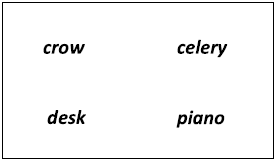
The FCSRT was administered in accordance with the standard instructions (Buschke et al., Reference Buschke, Sliwinski, Kuslansky and Lipton1997; Fombuena, Reference Fombuena2008), as described below, and was used to derive conventional memory scores, as well as ISDA indices. The test consisted of three immediate free recall trials, followed by three cued recall test for items not retrieved during free recall. The maximum score for these six recalls was 48. This was followed by a 30-min delayed recall task, itself comprising of a free recall test followed by cued recall for the items not recalled during free recall. Participants were tested individually and received the instruction to memorize the items in order to be able to recall them later. Each participant was shown a sequence of four cards (DINA4), each containing four items (e.g., crow, celery, desk, and piano, see Figure 1). Each item belonged to a different semantic category (e.g., bird, vegetable, piece of furniture, and instrument), and participants had to identify and read these words aloud in response to a semantic category provided by the examiner (e.g., when the cue provided is “vegetable”, participants have to read aloud the word “celery”). A non-semantic interference task (counting backward in threes) was performed for 20 s after the identification of the 16 words and after each cued recall. Participants were given 90 s for each of the free recall phases. This free recall phase was interrupted if the participant remained silent for 15 s. Items that were not remembered during the free recall phase were cued using their semantic category (cued recall). This procedure was repeated three times (learning trials). During the first two trials, if a participant was unable to recall words freely or given the semantic cue, the examiner gave the participant the correct answer.
Example of four stimuli sheet.

ISDA indices were calculated according to the procedure originally described by Wright et al. (Reference Wright, Woo, Schmitter-Edgecombe, Hinkin, Miller and Gooding2009) (see Annex 1 for formulas). The ISDA encoding deficit index relates to acquisition during the learning trials and is calculated as the number of words that were recalled only once or not at all over the three learning trials, divided by the total number of items to be remembered. The ISDA consolidation deficit index represents the proportion of information retained and is defined as the number of words that are not recalled in the delayed recall phase (free or cued recall) divided by the number of words recalled at least once during learning (free or cued recall). The ISDA retrieval deficit index was calculated by summing individual items recalled at least once during list learning and at delayed cued recall. As the consolidation index, this value is divided by items recalled during the list learning. As ISDA indices are deficit indices rather than performance indices, higher deficit scores indicate poorer performance.
RESULTS
Demographic and clinical results
Demographic and clinical characteristics are reported in Table 1 for PD patients and controls, together with the corresponding statistical comparisons. The two groups did not differ significantly with respect to age, education, gender distribution, and global cognitionFootnote 1 (MoCA). Significant differences were, however, revealed for depression and fluency (FAS; total number of words) tests.
Demographic data and general cognitive performance (mean of raw scores and SDs) from PD patients and controls

Note. Comparison between Parkinson’s disease (PD) and control group (t test significance); FAS = verbal fluency; MoCA maximum score = 30; cut-off score ≥ 26; PHQ-9 maximum score = 27; clinical threshold ≥ 10; p-values and effect sizes are provided.
FCSRT: traditional scores
First, traditional measures of recall were analyzed. Percent recall (see Table 2) was analyzed using univariate analyses of covariance (ANCOVAs) controlling for depression and FAS. They revealed lower free recall for PD patients at immediate and delayed recall. There were, however, no significant differences between patients and controls for cued or total recall. These results reveal a deficit in free recall in PD patients. However, PD patients benefit from cues as much as controls do, suggesting that the EM deficit observed in PD patients appears when having to recall (at learning and at delayed recall) items without support from semantic cues.
Means and standard deviations (in brackets) for recall performance (raw scores and percentages) on the FCSRT. p-values resulting from ANCOVA controlling for depression and FAS are provided. Maximum total immediate recall = 48. Maximum total delayed recall = 16

Abbreviations: PD, Parkinson’s disease; FCSRT, Free and Cued Selective Reminding Test; p-value (percentages).
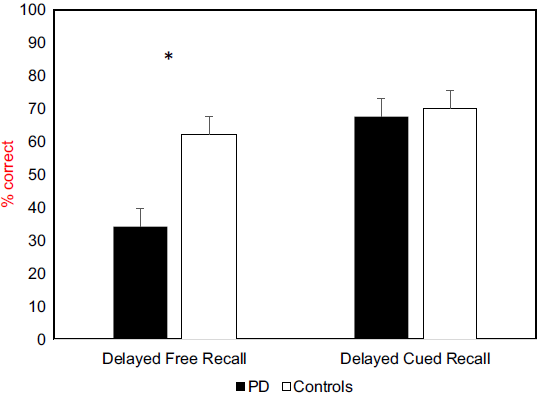
In order to investigate the role of initial learning on long-term memory, we followed Chiaravalloti et al. (Reference Chiaravalloti, Ibarretxe-Bilbao, Deluca, Rusu, Pena, García-Gorostiaga and Ojeda2014). Delayed free and cued recall (percentage) were analyzed controlling for initial learning (total immediate recall percentage) as a covariate. Percentage of cued recall was calculated as the proportion of recalled words from the remaining – non-freely recalled – words. Depression and FAS were also controlled as covariates. This 2 (group) × 2 (free vs. cued) ANCOVA revealed a nonsignificant effect of group [F (1, 25) = 0.672, p = .42, η p2 = .026], but a significant type of recall [F (1, 25) = 5.09; p < .05, η p2 = .169] and group x type of recall interaction [F (1, 25) = 4.62; p < .05, η p2 = .156]. This interaction (see Figure. 2) showed a greater difference between PD patients and controls for free recall. When looking at the effect of the covariates, the results also showed that whereas initial learning had a significant effect on delayed recall [F (1, 25) = 28.97, p < .01, η p² = .536], depression [F (1, 25) = .052, p = .82, η p² = .002], and FAS [F (1, 25) = .521, p = .477, η p² = .02] did not.
Delayed free and cued percent recall performance. Error bars represent standard errors.

To further analyze the interaction group x type of recall observed in delayed recall taking into account the effect of initial learning, univariate ANOVAs were carried out on free and cued recall separately before and after (ANCOVAs) controlling for initial learning. The univariate ANOVAs showed significant differences between PD patients and controls in delayed free [F (1, 26) = 6.601, p = .016, η p² = .202] but not cued [F (1, 26) = .072, p = .789, η p² = .003] recall. Controlling for initial learning revealed that the differences between groups in free recall were no longer significant [F (1, 26) = 2.437, p = .131, η p² = .089].
ISDA: encoding, consolidation, and retrieval deficit indices
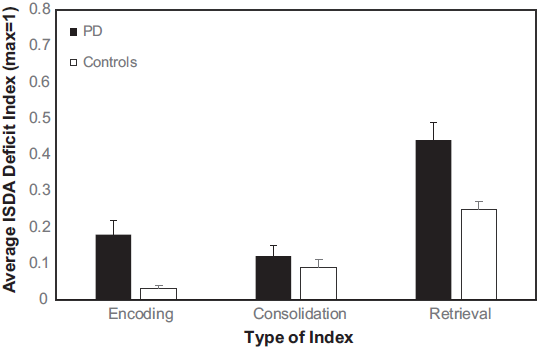
ISDA indices are crucial to quantify the differences observed between PD patients and controls at different memory stages. A 2 (group) × 3 (index) repeated measures ANCOVA with depression and FAS as covariates was carried out on the three different deficit indices (see Figure 3). The results showed a significant effect of group [F (1, 25) = 6.973, p = .01, η p² = .211], but the effects of type of index [F (1, 25) = 2.519, p = .125, η p² = .088] and the group x type of index [F (1, 25) = 1.386, p = .25, η p² = .051] did not reach significance.
ISDA indices (encoding, consolidation, and retrieval) for patients with Parkinson’s and controls. Higher deficit scores indicate poorer performance. Error bars represent standard errors.

Furthermore, the differences between PD patients and controls in the retrieval deficit index remained significant despite controlling for initial learning (total recall) [F (1, 27) = 5.234, p = .03, η p² = .162], indicating that the deficit observed on retrieval in PD patients could not be explained solely by a deficit at encoding.
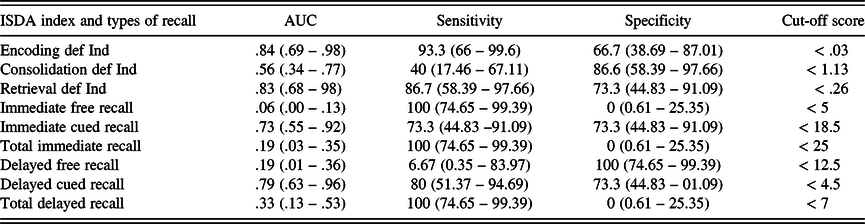
Finally, in order to evaluate further how sensitive the different ISDA indices were, diagnostic accuracy was evaluated with the receiver operating characteristics (ROC) analysis and the area under the curve (AUC). The optimal cut-off scores for maximum accuracy (Youden index), and their respective values of sensitivity, specificity, and confidence intervals for ISDA indices are presented in Table 3, together with the traditional memory measures. As can be seen, the two measures with the best AUCs were the encoding (.84) and retrieval (.83) ISDA indices. These indices also had the best balance between sensitivity and specificity to classify participants as PD patients or healthy controls. These results reveal that both encoding and retrieval memory processes discriminate well between PD and healthy controls.
AUCs, sensitivity, and specificity for traditional scores and the three FCSRT ISDA indices (encoding, consolidation, and retrieval) with 95% confidence intervals (in brackets). Cut-off scores (Youden index) are also included

Abbreviations: AUC, area under the curve; ISDA, item-specific deficit approach.
DISCUSSION
PD is associated with memory deficits. An important question would be to locate the source of these deficits. Based on previous literature, a mixed picture including encoding and retrieval difficulties would emerge as explanatory factors. The novelty of this study lies in the investigation and quantification of encoding, consolidation, and retrieval in PD patients within one paradigm. We did this by applying the ISDA method to the FCSRT, a test that has proven to be sensitive to memory impairment in aging studies.
Following previous literature, we expected significant differences between PD patients and controls in both encoding and retrieval ISDA indices. We also explored the influence of initial learning on the retrieval difficulties typically observed in PD patients (see Chiaravalloti et al., Reference Chiaravalloti, Ibarretxe-Bilbao, Deluca, Rusu, Pena, García-Gorostiaga and Ojeda2014 for similar analysis).
Our results indicate significant differences between PD patients and controls in free recall at learning and delayed recall in the FCSRT, confirming the main hypothesis of EM problems in these patients. The difficulties were observed in free recall, where no semantic support was provided by cues. When providing cues to help retrieving the non-recalled items, there were no differences between PD patients and controls. This was so much so that when free and cued recall were added (total recall), no significant differences between PD patients and controls were observed. These results are in line with previous data revealing that PD patients’ memory performance significantly improved with cued recall paradigms (Costa et al., Reference Costa, Monaco, Zabberoni, Peppe, Perri, Fadda and Carlesimo2014; Higginson et al., Reference Higginson, Wheelock, Carroll and Sigvardt2005; Pillon, Deweer, Agid, & Dubois, Reference Pillon, Deweer, Agid and Dubois1993; Whittington et al., Reference Whittington, Podd and Stewart-Williams2006). The benefit from cues observed in PD patients in a situation of deep (semantic) learning has been traditionally observed in patients with frontal damage (Swick & Knight, Reference Swick and Knight1996).
Some authors have suggested that at least part of the retrieval deficit observed in PD patients relates to poor learning (Brønnick et al., Reference Brønnick, Alves, Aarsland, Tysnes and Larsen2011; Chiaravalloti et al., Reference Chiaravalloti, Ibarretxe-Bilbao, Deluca, Rusu, Pena, García-Gorostiaga and Ojeda2014). To further explore the possibility that poor initial learning or encoding could explain the observed retrieval deficits, we equated the two groups by controlling the amount of information acquired during learning trials (i.e., total recall) as a covariate. Once the groups were equated on learning abilities, the differences in delayed free recall disappeared. Hence, an encoding dysfunction relating to a deficient use of learning strategies, may account for at least some of the differences observed at retrieval in PD patients. This encoding deficit is compatible with some hippocampal damage that has been described in previous studies (Balthazar, Yasuda, Cendes, & Damasceno, Reference Balthazar, Yasuda, Cendes and Damasceno2010; Bezdicek et al., Reference Bezdicek, Ballarini, Buschke, Růžicka, Roth, Albrecht and Jech2019; Junqué et al., Reference Junqué, Ramírez-Ruiz, Tolosa, Summerfield, Martí, Pastor and Mercader2005).
When analyzing the ISDA indices, the results revealed a general effect of group, with greater deficits in PD patients at all memory phases. The sensitivity analysis further revealed encoding and retrieval as especially sensitive indices. In addition, we also observed that the differences in the retrieval deficit index remained significant despite controlling for the amount of information acquired during learning trials. Therefore, although important, encoding deficits could not entirely explain the differences observed in retrieval.
Previous scientific evidence on memory and PD has focused on encoding and retrieval processes, disregarding consolidation. Some authors have indeed suggested that consolidation would be relatively spared in PD (Economou, Routsis & Papageorgiou, Reference Economou, Routsis and Papageorgiou2016). Also, it is usually recognized that consolidation is a relatively passive process in memory, little affected by attention and executive functions. Our predictions followed the path of previous research, and consistent with it, our sensitivity analysis revealed lower sensitivity for the consolidation index than for the encoding and retrieval indices. However, a logical prediction in the context of an encoding and retrieval deficit would be to expect a consolidation deficit as well, as they are co-dependent processes. If encoding and retrieval are affected, consolidation might be affected as well, even if to a lesser extent. Therefore, we cannot completely rule out the possibility that a consolidation deficit would be detectable in greater samples of PD patients or when assessing delayed recall at longer delays (see Blake, Wroe, Breen & McCarthy, Reference Blake, Wroe, Breen and McCarthy2000).
Several strengths and limitations of the present study should be acknowledged. One major strength of ISDA method is that it allows to distinguish different mnesic profiles. In terms of sensitivity, ISDA indices also showed a better balance between sensitivity and specificity than the traditional measures of the FCSRT. Previous studies using ISDA indices to analyze performance on the FCSRT (Andrés et al., Reference Andrés, Vico, Yañez, Siquier and Ferrer2019; Oltra-Cucarella et al., Reference Oltra-Cucarella, Pérez-Elvira and Duque2014) reported that the source of memory impairment in amnestic MCI patients and AD mostly related to genuine encoding failures. The greater deficit observed in our PD patients, however, seems to relate to retrieval (see Figure 2). This contrast is more relevant if one takes into account the fact that using the same methodology as the one used in the present study, Andrés et al. (Reference Andrés, Vico, Yañez, Siquier and Ferrer2019) observed exactly the same pattern and level of recall in control participants, adding validity to the ISDA method. Hence, our results indicate that ISDA method applied to the FCSRT may help to discriminate between memory disorders in aMCI individuals and those observed in individuals with PD.
A potential limitation of this study is its relatively small sample size, as is often the case in clinical samples. In addition to increasing the chances to detect a possible consolidation deficit, a greater sample might also increase the chances for a group x index interaction to reach significance. This should, however, not be of critical relevance, as diagnostic accuracy revealed a clearly higher sensitivity for the encoding and retrieval indices than for the consolidation index, revealing differential effects on different memory processes.
Our findings may have significant implications for neuropsychological models of memory deficits in PD, which tend to focus on the frontal deterioration as responsible for these memory deficits. Moreover, despite previous research hints that executive dysfunction can explain a substantial part of the memory deficits (Higginson et al., Reference Higginson, King, Levine, Wheelock, Khamphay and Sigvardt2003; McKinlay et al., Reference McKinlay, McKinlay, Grace, Dalrymple-Alford and Roger2010), we did not find any effect of executive function (as measured by fluency) on traditional or ISDA indices. However, only one test of executive functions (FAS) was used in our study, limiting the interpretation of our results (Kudlicka, Clare, & Hindle, Reference Kudlicka, Clare and Hindle2011). Given the complexity of executive functions (see for example Miyake et al., Reference Miyake, Friedman, Emerson, Witzki, Howerter and Wager2000), further studies should investigate the relationship between different memory processes (mainly encoding and retrieval) and different executive functions before firmer conclusions can be reached.
Various studies suggest that PD-MCI might consist of different cognitive deficits profiles with distinct etiologies and prognoses (Monchi, Hanganu, & Bellec, Reference Monchi, Hanganu and Bellec2016). ISDA indices may help to early identify the different forms of cognitive profiles in PD. That would allow to develop specific techniques based on the self-generation strategy, imagery, or context that have proven to aid in learning and remembering new information in multiple sclerosis and traumatic brain injury (Chiaravalloti, Sandry, Moore, & Deluca, Reference Chiaravalloti, Sandry, Moore and Deluca2016; Goverover, Chiaravalloti, Genova, & DeLuca, Reference Goverover, Chiaravalloti, Genova and DeLuca2018).
To conclude, our results (recall performance, ISDA indices, and sensitivity and specificity) confirm the hypothesis that there is an encoding and retrieval affectation in PD patients. Furthermore, although showing that an encoding deficit in PD patients is important to complement the traditional view that tends to focus on frontal dysfunction, it is also important to show that retrieval deficits cannot be entirely explained by difficulties at initial learning.
Acknowledgments
This study was part of Antònia Siquier’s doctoral thesis. Antònia Siquier received support in the form of an FPU predoctoral studentship from the Spanish Ministry of Economy and Competitivity (REF FPU18/00761). Pilar Andres was supported by the Ministry of Science, Innovation and Universities (REF PSI2016-75484-R), the Spanish State Agency for Research (AEI), and the European Regional Development Fund (FEDER). Thanks are due to Aina Yañez for statistical advice and Fabrice Parmentier for his useful comments on an early version of this paper. We also thank Juan García Caldentey and Elena Estelrich Peyret for their help with the recruitment of patients.
Conflict of interest
The authors have nothing to disclose.
Annex 1: ISDA Indices
Encoding Deficit Index = Σ number of items on a list-learning test that are not recalled on more than half of the learning trialsFootnote */total number of items (16).
Consolidation Deficit Index = Σ items recalled during list learning but not recalled on subsequent delayed-recall trials/sum of items recalled at least once during learning.
Retrieval Deficit Index = Σ items recalled during list learning but inconsistently recalled across delayed-recall trials/sum of items recalled at least once during learning.