

INTRODUCTION
Acantholobulus pacificus (Edmondson, Reference Edmondson1931) (Brachyura: Panopeidae) was originally described from Pearl Harbor, Oahu, Hawaii (Edmondson, Reference Edmondson1931; as Panopeus), and has been subsequently recorded from Tahiti (Forest & Guinot, Reference Forest and Guinot1961; as Panopeus) and New Zealand (Ahyong & Wilkens, Reference Ahyong, Wilkens, Galil, Clark and Carlton2011). Felder & Martin (Reference Felder and Martin2003), who established a new genus Acantholobulus to accommodate four specific taxa previously assigned to Panopeus, remarked that there were no obvious morphological characters to distinguish A. pacificus and A. mirafloresensis (Kim & Abele, 1989) originally described from the Panama Canal, although they did not synonymize them. In fact, Edmondson (Reference Edmondson1931) had already suggested that his new species might have actually been introduced from mainland America. Furthermore, Felder & Martin (Reference Felder and Martin2003) also commented that A. bermudensis (Benedict & Rathbun, 1891), the type species of Acantholobulus occurring in the western Atlantic, was very similar to A. mirafloresensis, being not easy to distinguish the two taxa morphologically. Brockerhoff & McLay (Reference Brockerhoff, McLay, Galil, Clark and Carlton2011) suggested that the native range of A. pacificus was the tropical Eastern Pacific and proposed the likely vector to be hull fouling and/or ballast water.
Tokyo Bay is a major inshore water body located at the middle part of the Pacific side of the Honshu mainland of Japan. The Tokyo metropolitan area and other big cities face this embayment, along with many major harbours for trade vessels. According to Iwasaki et al. (Reference Iwasaki, Kimura, Kinoshita, Yamaguchi, Nishikawa, Nishi, Yamanishi, Hayashi, Okoshi, Kosuge, Suzuki, Henmi, Furota and Mukai2004), 16 of 20 introduced invertebrate species recorded from Japan occur in Tokyo Bay. With regard to decapod crustaceans, three introduced brachyuran species occur in the area, i.e. Pyromaia tuberculata (Lockington, 1877) (Inachoididae), Carcinus aestuari (Nardo, 1847) (Portunidae) and Rhithropanopeus harrisii (Gould, 1846) (Panopeidae), of which the last species was the most recently recorded (Iseda et al., Reference Iseda, Otani and Kimura2007).
Three specimens of an unfamiliar xanthoid crab were collected during an investigation of sessile fauna in the Port of Yokohama, Tokyo Bay. Detailed examination of the specimens has revealed that they agree well with descriptions of Acantholobulus pacificus and A. mirafloresensis, previously unknown from Japanese waters or elsewhere in the western North Pacific. We herewith identify our specimens with A. pacificus, and comment on its taxonomy and the known geographical range in the Pacific Ocean.
MATERIALS AND METHODS
The crabs inhabited on experimental plastic settlement plates (25 × 50 cm2) used for an investigation of the occurrence of sessile organisms. These had been suspended at 1–3 m depth in the Port of Yokohama (35°28′35″N 139°38′25″E), located at the western part of Tokyo Bay. The specimens are deposited in the Natural History Museum and Institute, Chiba (CBM). The measurements provided include the carapace length (distance between the midpoints of the frontal and posterior margins) by the carapace width (distance between the tips of fifth anterolateral teeth). The terminology for the carapace regions follows Serène (Reference Serène1984). Synonymies are restricted to references presenting significant morphological descriptions and/or figures or new geographical records.
For comparison, the following material was examined: Rhithropanopeus harrisii. CBM-ZC 3634, 1 female (11.1 × 15.2 mm), Shinhama, Gyotoku, Ichikawa, Tokyo Bay, subtidal, 31 October 1996, coll. T. Furota; CBM-ZC 3635, 1 male (13.6 × 18.7 mm), Daiba, Tokyo, 18 May 1997, coll. T. Furota; CBM-ZC 5451, 1 male (12.6 × 16.2 mm), Shinhama, Gyotoku, Ichikawa, Tokyo Bay, intertidal, 5 July 1997, coll. T. Furota.
TAXONOMIC ACCOUNT
Infraorder BRACHYURA
Family PANOPEIDAE
Subfamily PANOPEINAE
Genus Acantholobulus Felder & Martin, Reference Felder and Martin2003
Acantholobulus pacificus (Edmondson, Reference Edmondson1931)
Panopeus pacificus Edmondson, Reference Edmondson1931: 12, pl. IV; Forest & Guinot, Reference Forest and Guinot1961: 116, figures 102, 103a, b, 104, 105a, b; pl. IV.
Neopanope sp.? Edmondson, Reference Edmondson1931: 14, pl. IV, C.
Acantholobulus pacificus Felder & Martin, Reference Felder and Martin2003: 440, 446–447; Ng et al., Reference Ng, Guinot and Davie2008: 190 (list); Brockerhoff & McLay, Reference Brockerhoff, McLay, Galil, Clark and Carlton2011: 36 (list); Ahyong & Wilkens, Reference Ahyong, Wilkens, Galil, Clark and Carlton2011: 454 (list); Castro, Reference Castro2011: 83.
MATERIAL EXAMINED
CBM-ZC 11599, 3 males (8.8 × 12.5, 10.5 × 15.0, 10.9 × 15.7 mm), Port of Yokohama, Tokyo Bay, Japan, 35°28′35″N 139°38′25″E, 1–3 m deep, November 2012, coll. T. Furota.
DESCRIPTION OF JAPANESE SPECIMENS
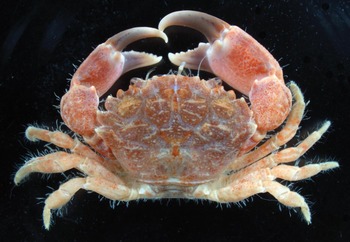
Carapace (Figures 1 & 2A) hexagonal in outline, greatest width across fifth anterolateral teeth, about 1.4 times as wide as long; dorsal surface almost glabrous except for rows of setae on transverse ridges or striae, slightly convex in longitudinal direction, nearly flat in transverse direction. Regions slightly divided by shallow grooves, smooth to sparsely granular; 2M, 3M, and 1P discernible, 3M narrow; division of L (anterior branchial region) obscure. Transverse ridges on either side of midline smooth to granular, including one short postfrontal; two protogastric (anterior one longer than posterior one); one oblique hepatic aligned with anterior protogastric; one metagastric; one short, oblique ridge on mesial side of branchial region, aligned with metagastric; one long slightly oblique epibranchial.
Acantholobulus pacificus (Edmondson, Reference Edmondson1931), male (10.5 × 15.0 mm), Port of Yokohama, CBM-ZC 11588, entire animal in dorsal view, preserved in 70% ethanol.

Acantholobulus pacificus (Edmondson, Reference Edmondson1931), male (10.5 × 15.0 mm), Port of Yokohama, CBM-ZC 11599: (A) carapace, dorsal view; (B) left third maxilliped, outer view; (C) carpus of right cheliped, dorsal view; (D) right chela, outer view; (E) left chela, outer view; (F) left fifth pereopod (fourth ambulatory leg), dorsal view; (G) left first gonopod, ventral view; (H) thoracic sternites 1–4, ventral view; (I) abdomen and telson, ventral view. Scale bars: A, C–F, H, I, 2 mm; B; 1 mm; G, 0.5 mm.

Frontal margin (Figure 2A) slightly produced, divided into two lobes by small V-shaped median notch; each lobe slightly sinuous, consisting of two granulated edges, with lateral angle slightly produced, rounded. Supraorbital margin granulate, with two distinct fissures; inner orbital tooth distinct, bluntly triangular. Suborbital margin concave, bordered with coarse granules, bearing prominent inner tooth. Subhepatic region minutely granulate, with scattered feathered setae. First anterolateral tooth (= external orbital tooth) small, subconical, blunt or subacute, partially fused with second anterolateral tooth; second anterolateral tooth with lateral margin arcuate; sinus between first and second anterolateral teeth concave, depth variable; third anterolateral tooth subrectangular, slightly narrower at base than fused first and second teeth; fourth anterolateral tooth subtriangular with anterolaterally directed, subacute or blunt tip, slightly narrower at base than third anterolateral tooth; fifth anterolateral tooth subtriangular with subacute or blunt tip, exceeding as far as or slightly beyond fourth anterolateral tooth, directed laterally (Figure 2A). Posterolateral margins (Figure 2A) nearly straight. Posterior margin (Figure 2A) faintly sinuous; posterior submarginal ridge nearly straight.
Third maxilliped (Figure 2B) with ischium bearing shallow median sulcus. Merus subquadrate, slightly more than half length of ischium; distolateral margin bluntly angular, distal margin faintly concave. Distal margin of exopod deeply notched; inner mesial margin with prominent lobe subdistally.
Chelipeds (Figures 1 & 2D, E) unequal. Carpi with dorsal surface (Figure 2C) finely granulate and rugose with low protuberances or short ridges; inner surface with distinct subconical tooth. Major cheliped with palm inflated, finely to coarsely granulated on upper side of outer and inner surfaces; dorsal surface with shallow longitudinal sulcus; ventral surface rounded; fixed finger slightly deflexed, distally curved, with two shallow longitudinal sulci on outer surface, cutting edge with row of blunt teeth of various sizes, tip pointed; dactylus slightly arcuate, subequal in length to palm, dorsal surface bluntly carinate in proximal half, cutting edge with row of blunt teeth (proximalmost tooth largest, molar-like), tip pointed. Minor cheliped generally similar to major cheliped in general ornamentation; fixed finger more strongly deflexed; dactylus slightly longer than palm; cutting edges of fingers sharp, weakly denticulate.
Ambulatory legs (Figures 1 & 2F) moderately slender, with sparse long setae on upper and lower margins of meri to propodi. Upper margins of meri rounded, not carinate. Dactyli with covering of stiff setae, each unguis acute, naked.
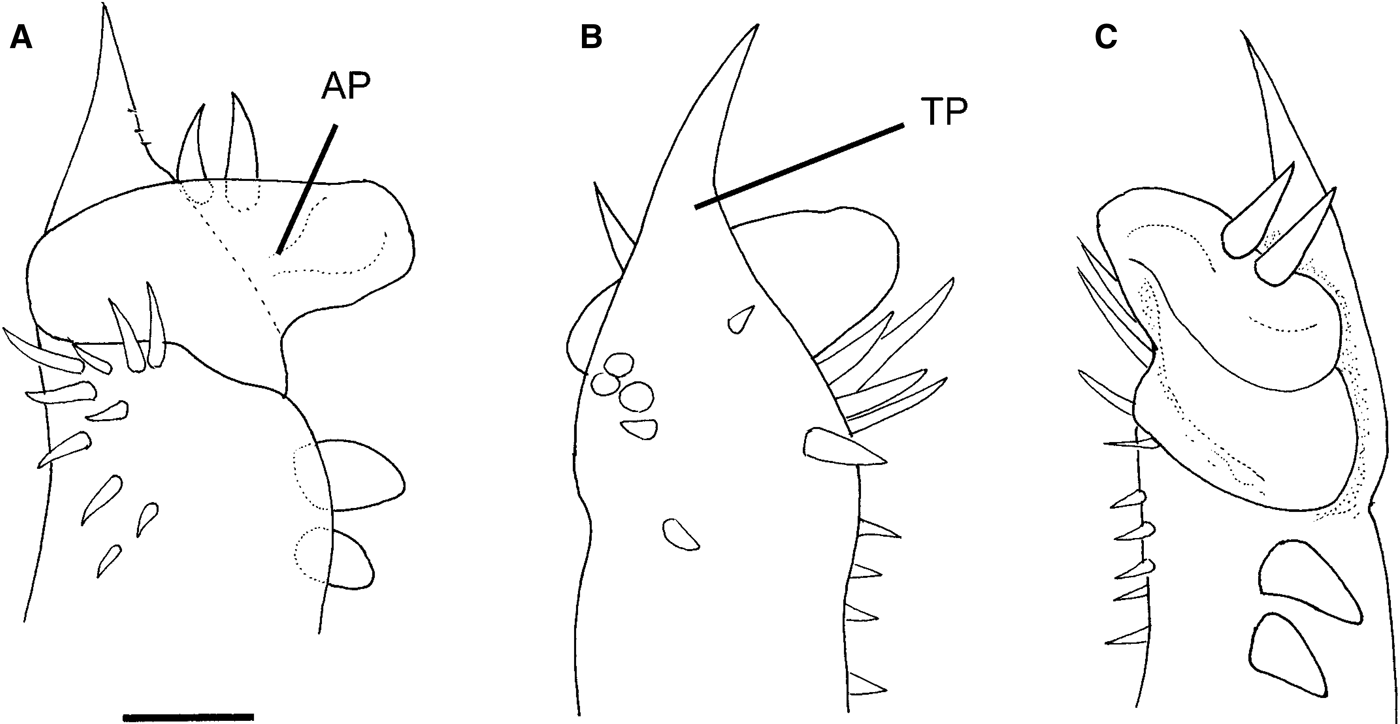
Male first gonopod (Figure 2G) slightly curved in proximal half and nearly straight in distal half, not reaching suture between thoracic sternites 4 and 5; terminal process (Figure 3A–C) spine-like, distinctly overreaching accessory process; accessory process rounded transversely, with two or three slender spines on dorsal surface (Figure 3A, C); one or two prominent lateral spine proximal to base of accessory process, directed outward; lateral surface of distal part with cluster of slender spines proximal to base of accessory process (Figure 3A), extending onto proximally as longitudinal row; ventral surface of distal part also with small spines around base of terminal process (Figure 3B).
Acantholobulus pacificus (Edmondson, Reference Edmondson1931), male (10.5 × 15.0 mm), Port of Yokohama, CBM-ZC 11599, distal part of left first gonopod: (A) lateral view; (B) ventral view; (C) dorsal view. AP, accessory process; TP, terminal process. Scale bar: 0.1 mm.

Male thoracic sternum with greater part nearly smooth, but with granules on lateral parts of sternites 1–4; sparse setae present, particularly on sternites 6 and 7. Sternites 1 and 2 (Figure 2H) fused, triangular. Suture between sternites 3 and 4 interrupted medially (Figure 2H). Sternite 4 with anterior extension of sterno-abdominal cavity reaching beyond mid-length (Figure 2H).
Male abdomen (Figure 2I) with somites 1 and 3 widest; somites 3–5 fused, though sutures still discernible. Somite 1 with distal margin deeply excavated. Somite 2 distinctly narrower than somites 1 and 3. Somite 6 approximately as long as wide. Telson (Figure 2I) shorter than somite 6, roundly triangular, reaching posterior one-third of thoracic sternite 4 when locked.
VARIATION
As is apparent from the above description, distinctiveness of granules and transverse ridges on the carapace is subject to substantial intraspecific variation. Furthermore, in the largest specimen, the right third and fourth anterolateral teeth are fused, but this represents an aberrant condition.
COLOUR IN LIFE
Carapace and appendages generally dark brown. Carapace with yellowish-white irregular markings on branchial to cardiac region. Palms of chelipeds with dark brown spots on whitish background of outer and inner surfaces; fingers of chelae black. Ambulatory legs mottled with dark brown and whitish-yellow.
DISTRIBUTION
Oahu, Hawaii (Edmondson, Reference Edmondson1931; Felder & Martin, Reference Felder and Martin2003); Tahiti (Forest & Guinot, Reference Forest and Guinot1961); New Zealand (Ahyong & Wilkens, Reference Ahyong, Wilkens, Galil, Clark and Carlton2011); newly recorded from Tokyo Bay, Japan. The native range is estimated to be the tropical Eastern Pacific (Brockerhoff & McLay, Reference Brockerhoff, McLay, Galil, Clark and Carlton2011), but is not yet fully confirmed (D. Felder, personal communication).
REMARKS
The present specimens agree well with the previous accounts of Acantholobulus pacificus (cf. Edmondson, Reference Edmondson1931; Forest & Guinot, Reference Forest and Guinot1961; as Panopeus) in all diagnostic features, particularly in the characteristic structure of the distal part of the male first gonopod, and as such they are identified with that species with little hesitation. Edmondson (Reference Edmondson1931) preceded his original description of A. pacificus by noting the possibility that the species was ‘transported to Hawaii through shipments of oysters or on the bottoms of ships', because he found the species in association with ‘sponges, barnacles and tunicates attached to buoys and floats in Pearl Harbor, Oahu'. Felder & Martin (Reference Felder and Martin2003) remarked that except for the large size of specimens referred to A. pacificus, there were no obvious morphological characters to distinguish A. pacificus from A. mirafloresensis, described from the Panama Canal. Our comparison between the present Japanese specimens with the original description of the latter taxon by Abele & Kim (Reference Abele and Kim1989) also failed to detect any significant morphological characters differentiating the two taxa. In particular, the complex structure of the distal ornamentation and armature of the male first gonopod closely agrees between our specimens and the type description of A. mirafloresensis. Thus, we are inclined to believe that the two taxa are conspecific. Furthermore, differentiation between A. pacificus and A. bermudensis is to be clarified (cf. Felder & Martin, Reference Felder and Martin2003), and we follow Felder & Martin (Reference Felder and Martin2003) to tentatively recognize that these taxa are specifically distinct. Molecular genetic study to evaluate the relationship between these three taxa is still in progress (D. Felder, personal communication), and therefore, a final decision on the likely synonymy is deferred until that work is completed.
The present specimens represent the first record of Acantholobulus pacificus from the western North Pacific, as well as from Japan. Because of the lack of previous records from the area and the known distributional pattern, for which anthropogenic introduction has been suggested (Carlton & Eldridge, Reference Carlton and Eldredge2009; Brockerhoff & McLay, Reference Brockerhoff, McLay, Galil, Clark and Carlton2011), we assume that the occurrence of this species in the area is also due to an artificial introduction. It is the second exotic representative of the family Panopeidae to be recorded from the area. At present, the route and means of introduction to Japan are unknown, though Brockerhoff & McLay (Reference Brockerhoff, McLay, Galil, Clark and Carlton2011) estimated the native range of A. pacificus to be tropical Eastern Pacific and the likely vector as hull fouling and/or ballast water.
The first exotic species of the family Panopeidae to be reported in the area was Rhithropanopeus harrisii from the Nagoya Port, Aichi Prefecture (Iseda et al., Reference Iseda, Otani and Kimura2007). This species also occurs in Tokyo Bay (Iseda et al., Reference Iseda, Otani and Kimura2007; unpublished data). Acantholobulus pacificus is distinguished from R. harrisii by the hexagonal outline of the carapace (versus rounded) and the more pronounced anterolateral teeth of the carapace. The sinus separating the first and second anterolateral teeth is usually much deeper in A. pacificus than in R. harrisii. The structure of the distal part of the male first gonopod is quite different. In R. harrisii, the distal part of the first gonopod has a prominent terminal process consisting of a somewhat twisted stalk and a rounded, compressed lobe bearing one spine-like process on its mesial side; a row of spine/spinules along the ventral margin consists of several spinules and one elongate subterminal spine (cf. Buitendijk & Holthuis, Reference Buitendijk and Holthuis1949: 99, figure 2d; Williams, Reference Williams1984: figure 331f).
ECOLOGY
The specimens were found on experimental plastic settlement plates retrieved in November 2012, on which an introduced balanid barnacle Amphibalanus eburneus (Gould) dominated. Other sessile invertebrates seen on the plates include: Haliplanella lineata (Verrill) (Cnidaria: Anthozoa: Actinariana: Haliplanellidae); Hydroides sp. (Annelida: Polychaeta: Serpulidae); Perna viridis Linnaeus (Mollusca: Bivalvia: Mytilidae); and Styela plicata Lesueur (Chordata: Ascidiacea: Stolidobranchia: Styelidae).
In a subsequent survey made in March 2013 at the same locality, no specimens of Acantholobulus pacificus were found; therefore, it is not yet clear if a reproducing local population of this species has established itself in Tokyo Bay.
ACKNOWLEDGEMENTS
We thank Dr Darryl Felder (University of Louisiana—Lafayette) for providing us with information on the American Panopeidae and for reviewing the draft of the manuscript. We also thank the Yokohama Port and Airport Technology Office, Ministry of Land, Infrastructure and Tourism, for providing an opportunity to investigate sessile fauna in the Port of Yokohama.