Fragments of medieval polyphony turn up quite regularly, mostly as single leaves from bindings, but not since the British Library manuscript Egerton 3307 was first reported in 1946 and the Aosta codex in 1948 has a major source of such proportions from the late medieval period come to light.Footnote 1 A volume in the Archivio di San Lorenzo in Florence, SL 2211, labelled ‘Campione dei Beni, 1504’ records the acquisition and rental of church properties from 1482 up to and beyond that date.Footnote 2 It uses 111 parchment folios of a music manuscript that were very thoroughly scraped to remove the music and heavily overwritten. Thirty of the 222 pages were scraped but not reused, so are much easier to read.Footnote 3 Ronald Forsyth Millen communicated the palimpsest to Frank D'Accone, who first announced the discovery at Certaldo in 1982 and published a preliminary report on his work in progress in 1984.Footnote 4 Even without the aid of more recent technology, he was able to read a surprising amount and to identify several dozen compositions, including unique compositions by Ugolino da Orvieto, by Giovanni Mazzuoli and by his son Piero, not previously known as a composer, both of whose careers were documented during his far-reaching archival studies in Florence.Footnote 5 D'Accone had made his account available to John Nádas, who reported on his further work at Certaldo in 1984, a study not published until 1992.Footnote 6 Nádas produced more identifications, a reconstruction of the original gatherings and a repertorial discussion, meanwhile presented in his magisterial dissertation of 1985, and constantly honed and revised since.Footnote 7 The truly impressive achievement of the Introductory volume is to have reconstructed the original order and physical structure and, at the heart of the volume, an inventory with an astonishingly high number of identifications, incorporating input from other scholars since D'Accone, ‘Una nuova fonte’. Nádas's work is now brought together in recent collaboration with Andreas Janke, stimulated by new multispectral images, a triumph of arduous and painstaking forensic and analytical work. A full study and some form of facsimile have been eagerly awaited for thirty years, and are now offered in this handsome publication from LIM.
Reconstruction of the original gatherings was not straightforward, and is intertwined with the identifications. Missing gatherings and bifolios, and the order of the surviving leaves, were projected on the basis of original roman folio numbers where visible, and their contents partly hypothesised by analogy with other trecento compilations, respecting composer groupings and generic subdivisions. Now-separated parts of the same piece helped to establish adjacence of pages that were originally facing, pieces remaining incomplete indicated a missing adjacent folio, and pieces that bridged gathering joins confirmed the ordering of gatherings, as did some barely legible gathering signatures. Clef changes signified the start of a new part, and hair and flesh disposition corroborated conjugates. Some of the original quinterns, IV, III, IX, V, I and VIII, are largely intact, although now in that order, but many are not, have lost bifolios, or have been arbitrarily reordered. Gatherings II, VI, VII and XII are entirely missing, and the remainder are represented to a greater or lesser degree but with the bifolios considerably rearranged. Only in a few cases was there any slight ambiguity, related to guesses about generic ordering.Footnote 8 One is mentioned (San Lorenzo Palimpsest (SLP) I: 22), where the positions of fols. B and 89 (as R128 and R123 in gathering XIII)Footnote 9 might be reconsidered if it were assumed that the two-part ballatas were followed by three-part pieces. All the projected bifolios make sense in relation to their current positions, except the pairing of the index folio B with modern fol. 89. The folio number for R123 is apparently visible, but not for R128; because of their separation in the present manuscript, they can no longer form an intact bifolio. An original bifolio was presumably separated for reuse; fol. A was also a singleton.
The gathering diagrams and the inventory speak louder than words, but nevertheless I was hungry for more words. The prose that accompanies these tables runs to only twenty-six pages. An introductory chapter gives the study history of the palimpsest since its discovery and explains the tabulations. Chapter II reports the ‘second life’ of the manuscript as a record of San Lorenzo's properties and rentals. Starting in 1482, it gives a date for the dismantling and thorough erasure of the then-obsolete music manuscript. Chapter III gives a fascinating account of the imaging and processing techniques that led to the multispectral images reproduced in volume II. Of Chapter IV's ten pages devoted to the ‘original music source’ only five are prose; they recapitulate very little earlier work on the manuscript. An updated version of the twenty-three pages of repertorial discussion in Nádas's dissertation and in further publications would have been welcome here. It is a pity that the shifting progress of earlier work was not digested into a single commentary that settled on the most recent opinions; previous publications still need to be reconciled and consulted.Footnote 10 Only one transcription is offered (of no. 159, Soies lies); why not an appendix with more unica, even legible excerpts or partial transcriptions, and pieces with added contratenor parts, of which several are reported (SLP I: 24)? Fascinating hints about possible stemmatic connections with or independence from other manuscripts are scattered throughout various earlier studies of the palimpsest; it is to be hoped that these will be drawn together and extended in future work.
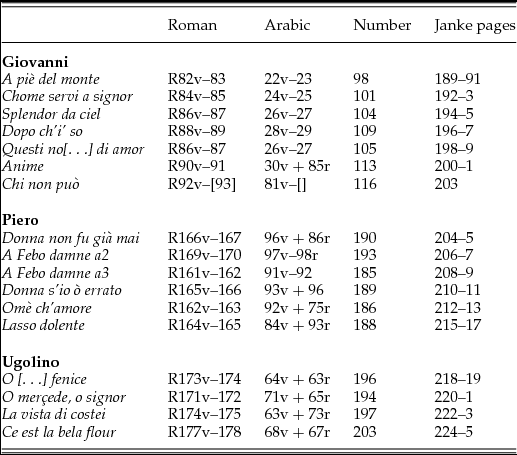
Both the studies under review are short on finding aids, although SLP I does have indexes of text incipits and by composer. The reader is made to work unnecessarily hard. Janke 2016 is listed in the SLP bibliography, but not vice versa; its numberings are not coordinated with SLP, published in the same year. The SLP inventory and gathering diagrams are in the order of the reconstructed music manuscript, using its roman foliation, and providing piece numbers. Although Janke 2016 reproduces some of Nádas's gathering diagrams with the original roman foliations, implementing his identifications, outside those diagrams he refers only by the arabic numbers of the present (musically irrelevant) order, and does not give piece numbers. Both publications lack a conversion table from the present to the original order, and as others may share my difficulty, I offer Table 1 to enable reference between Janke 2016, earlier publications (and even with SLP chapter III) that use only the arabic foliation of the present manuscript, on the one hand, and the reordered roman foliation and piece numbers of the SLP gathering diagrams and inventory, on the other.

a As reconstructed in the gathering diagram and inventory. The roman numbers are given here in arabic form preceded by R for easier reference.
b Piece numbers on the recto are followed, after a semicolon, by those on the verso. The inventory should be consulted for complete folio references, largely non-adjacent. This table is intended simply as a cross-reference in MS order, as Janke gives neither piece numbers nor roman foliation.
The 111 parchment folios survive from a projected original total of at least 190. Assuming that no further gatherings followed gathering XIX and the highest folio number,Footnote 11 a third of the original manuscript is totally lost, and searches in the San Lorenzo archives have so far failed to yield more. Preserved entirely or in part are 126 Italian, 80 French and 10 Latin works (216). The 79 or more missing folios might have contained 144 further works, making a total of 360, exceeding the 353 actually copied in Squarcialupi (Sq). The number could even exceed 400 if, as is likely, the number of page-fillers was comparable to that in the surviving portions of SL. The quarto-size pages are similar in size to Bologna Q15 but slightly differently proportioned. Although comparable to Sq in scope and repertory size, SL mostly has only seven staves to the page,Footnote 12 rather than the eleven of the larger folios of Sq. Thus it is surprising that despite its smaller format SL may have contained at least as many pieces as Sq. In SL entire gatherings and parts of gatherings are missing; but of Sq's 216 folios, many blank-ruled openings were left for compositions that were never entered, including two entire sections, but with their composer portraits, for Giovanni [Mazzuoli] organist of Florence, and for Paolo da Firenze, whose works, however, are in Pit; all those in SL have concordances in Pit. A whole section in SL is devoted to unica by Giovanni, preceding the Landini section.Footnote 13
The Italian trecento repertory is known from retrospective compilations, most of the early fifteenth century, most systematically arranged in composer groups and sometimes within those by genre, and in the case of Sq with composer portraits at the head of each section. Pit, Sq and FP contain only madrigals, ballatas and caccias, with very considerable overlap of composers and repertory.Footnote 14 Like them, SL starts with composer sections in roughly chronological order and considerable overlap with the existing repertory manuscripts.Footnote 15 The authors make the important point that SL is not only a retrospective collection but also one that reflects ongoing song composition and collecting in the first two decades of the fifteenth century.
Gatherings I–IV of SL contain works of Jacopo da Bologna and Giovanni da Cascia, older composers whose stabilised transmission has been noted.Footnote 16 Bartolino occupies from the middle of gathering IV to at least the beginning of VI, Donato gatherings VIII to the beginning of IX. The mid-century composers Lorenzo and Gherardello probably occupied the missing gatherings VI and VII. Giovanni Mazzuoli's works are uniquely preserved in IX–X. Landini's works, well preserved elsewhere, evidently occupied the now seriously mutilated gatherings XI–XIII. We can be thankful that the surviving folios of SL happen to preserve so much unique material, especially works by Ugolino da Orvieto and Giovanni and Piero Mazzuoli.Footnote 17 Paolo's works are in gathering XIV, which seems to conclude the retrospective trecento collection. There is one unidentified new unicum by Landini (no. 130), marked ‘idem F’, and one by Paolo (no. 161). The very incomplete gathering XV was devoted to French songs, all here anonymous, including four by Machaut (plus two page-fillers by Machaut in XIV) that circulated in the repertory manuscripts; FP likewise has a separate added gathering of French works. A unique feature of SL is the tantalising harvest of fifty-four anonymous French songs, unidentified and apparently unique, entered as page-fillers by the main scribe throughout the manuscript. Enlarged incipits are reproduced in SLP I (Appendix C of ‘Unidentified compositions’) in the hope of facilitating further identifications. It would indeed be astonishing to uncover such a large repertory without concordances. These and other identified songs are assumed to come from outside Florence, and not to be part of the core repertory.Footnote 18 Although there is no reason to connect the fillers authorially with pieces higher on the page, as in MSS such as Lucca where the same composer sometimes seems to apply also to the lower piece, because they are French-texted they are assumed not to be by Italian composers, and Nádas refers to Sq's preference for Italian-texted works.Footnote 19 A French ballade ascribed to Ugolino (no. 203) may give us pause. Of the five French-texted songs on the ‘second’ of the new bifolios of the Lucca codex reported by John Nádas and Agostino Ziino, two are widely circulated, the other three unica, one of them attributed to the Italian composer Antonius de Cividale.Footnote 20 They drew attention to a trend of Italian composers setting French texts (pp. 9–10); is it even possible that some of the anonymous and unique French page-fillers in SL may be by the Italian composers within whose sections they appear?
Gathering XVI contains a few French works, but is mostly devoted to caccias by various authors: Vincenzo, Gherardello, Landini and two previously unknown ones (nos. 174, 176).Footnote 21 The last three gatherings are deemed later additions but by the same scribe. Gatherings XVII and XVIII (interchangeable until they were foliated) include unique works by newer composers: Piero Mazzuoli, and four hitherto unknown Italian compositions by Ugolino da Orvieto. These are followed by a group of unique (and as yet untranscribed) French rondeaux and ballades by Hubertus de Salinis, the only non-Italian composer to have pieces attributed to him in SL, and one by Ugolino (as noted).
What was probably the final gathering XIX of SL is devoted, uniquely among the trecento anthologies, to a group of – mostly widely circulated – international motets dating back into the fourteenth century and forward to the early fifteenth, all anonymous here except two of the three by Salinis. These include three attributed with varying certainty to Vitry, one each by Jacopo, Royllart and B. de Cluny, and three by Salinis (already known from Bologna Q15), one of which (Psallat chorus) was also recently identified by Michael Scott Cuthbert in the Utrecht fragments (Utrecht 1846).Footnote 22 B. de Cluny's Apollinis/Pantheon is presented with the original triplum, tenor and an additional triplum, but without its essential motetus Zodiacum; this version is unperformable. Only two of the motets are undoubtedly Italian, both known from other sources: Jacopo's Lux purpurata, and the anonymous Florentia mundi/Parce pater, which can be partially reconstructed from a complementary page in the lost Egidi fragment.Footnote 23 The Italian motet of this period is associated predominantly with the Veneto, unlike both of these. Motets are almost entirely absent from the other trecento anthologies,Footnote 24 an exclusion that remains puzzling, unless as Veneto products they did not find a home in Florentine manuscripts, even though these are among slightly later additions to SL outside its main canon. SL is firmly Florentine by all signals including its reuse in a Florentine archive less than a century after its creation. It has a very large overlap with the Sq repertory, removing unique status from at least eight Sq compositions, and also from Jacopo's motet previously known only in Padua. The Florentine circulation of such pieces is confirmed, if not in all cases their authorship; the Jacopo motet is here anonymous.
Where SL most significantly departs from Sq is in supplying music in sections devoted to Paolo da Firenze, Giovanni Mazzuoli and his son Piero, besides the four Italian compositions and French ballade by Ugolino da Orvieto. Ugolino was employed as a singer at Florence Cathedral in 1417–18,Footnote 25 and was accorded at least a grouping if not a whole gathering of his own, perhaps reflecting his late arrival and short tenure in Florence.Footnote 26 An earlier assumption that a whole gathering might have been devoted to him was tempered by the discovery of other attributions within that gathering, notably to Salinis, as noted above. Ugolino and Piero must be the youngest composers represented, reflected in their position after the French section.
Andreas Janke's dissertation of 2016 is an essential complement to SLP. Chapter 1 gives much important general codicological information absent from SLP I, including a detailed description of the script, though he naturally concentrates on the gatherings containing the works by his three composers, and their layouts and notation, tabulating use of special note-forms. He tries to fit SL to notional categories set out by Johann Peter Gumbert (kodikologische Einheiten, Sammelhandschrift versus zusammengesetzte Handschrift) rather than taking on its own terms the particular features of SL, with its single scribe.
In the succeeding chapters he undertakes thorough and well-documented biographical reviews of Giovanni, Piero and Ugolino, elaborating and refining what was already known about the Mazzuoli, and giving archival texts in full.Footnote 27 He presents some new documents from the cathedral relating to Piero as organist there, a position that D'Accone postulated but is now confirmed. He includes more recent studies of the Florentine Catasto, but with few major surprises. On the basis of his careful musical analyses, he discredits previous attempts to attribute works to Giovanni Mazzuoli (pp. 90–1). A final chapter sets the newly discovered music and its texts in context, including an interesting discussion of the categories ‘Italian’ and ‘French’, an exploration of a possible mentor relationship between Landini and Giovanni, and an assessment of Piero's status as a ‘modern’, offering some comparisons with Ciconia.
An appendix includes impressive transcriptions of what can be read in Janke's selection from the new unica by Giovanni and Piero Mazzuoli and Ugolino. Out of at least fifteen compositions of Giovanni he transcribes from only seven, of Piero's (relatively legible) nine only six and of Ugolino's five just four. These are the pieces subjected to detailed poetic and musical analysis in the body of the volume, and tabulated there. It would have been helpful to have incipits or legible excerpts from the others to aid in possible future identifications in anonymous transmissions. The transcriptions themselves are not provided with numbers, foliations or manuscript locations, so I give these in Table 2.

Considerable progress has been made since the 1980s in meeting the apparently insurmountable challenge of reading the erased music, drawing on successive photographic developments and techniques of digital imaging and restoration. Following an initial set of ultraviolet images, DIAMM photographed the manuscript in high resolution in natural and ultraviolet light in 2001. As Nádas generously acknowledged, subjected to restoration techniques with software such as Adobe Photoshop, these images enabled many more identifications, and were used in other studies.Footnote 28 The next advance was the production of multispectral images in 2013, described in Chapter 3 of the Introduction.Footnote 29 The images are presented with ‘unambiguously falsified colours, which not only result in better contrast between over- and underwriting for the reader, but . . . cannot be mistaken for the original state of the manuscript’. ‘Uneven scraping, patching and other factors that vary spatially across a single page can contribute to output images that also vary from region to region’ within a page.
Even this degree of technical magic often only enables identification of a piece with one already known, and only rarely suffices for full transcriptions of pieces or voices that are unique or not yet identified, notably the fifty-four French songs mentioned above. The multispectral images evidently reveal more than previous photography, or at least complementary data, but I cannot believe that the identifications offered could have been done solely on the basis of the images as printed in SLP II. The authors presumably had the opportunity to magnify and manipulate the images on screen for optimum legibility of each page area and even each note. The print quality is not sufficient to respond to magnification. I had hoped that this publication would have included a guided DVD to enable scholars to navigate through the various options of ultra-violet, variously filtered multispectral and enhanced natural-lit images, and make their own choices and adjustments.
Because multispectral images are sourced in monochrome, they do not distinguish what is red: staves, foliation, coloration in one piece in gathering XVIII,Footnote 30 composer attributions, gathering signatures (Janke 2016, 31) and signs of congruence. These inscriptions, especially the composer attributions, are less legible in the manipulated false-colour images than on the DIAMM colour images taken in natural light (where even without enhancement they are comparably legible to the ‘manipulated’ black and white images in Janke 2016, 29), and even in the unrestored black and white image of fol. 22v (R82v) reproduced by D'Accone (in ‘Una nuova fonte’), where the attribution to ‘Magister Johannes organista Florentin’ is easier to read than in the new image, where it recedes into the yellow mostly used for the overwriting.
Above all, I do not understand why the decision was taken not to suppress the distracting and musically irrelevant overwriting altogether in a volume devoted to recovering the underlying music, especially given that a full colour facsimile of the manuscript as it now appears is promised (SLP I: ix–x, n.1). The brief demonstration of the colour filters in SLP I, chapter III (p. 12, fig. 4) shows the possibility of a nearly complete elimination of the overwriting. In my view, the red and green channels and the greyscale input all make the music easier to read than the pseudo-colour image that retains the overwriting. Despite the stated criteria as needing to be ‘consistent from one folio to the next’, there are unexplained and widely differing appearances between pages. Sometimes the overwriting is so dominant that little or nothing can be seen of the musical layer. It purports to be reproduced mostly in a lighter yellowish hue (as on fols. R1v, 2r), and the music underneath in a darker or blue shade. Overwriting is sometimes yellow as promised (it is not too obtrusive, for example, for no. 188, R164v, and for fol. 16r [R26r], reproduced in SLP I: 15), but one often wishes it away, as on pages including roman fols. 3v, 6v, 22v, 23v–24, 26v, 29v, 33r, 34v, 42v, 44v, 49r–v, 50v, etc.). Sometimes the overwriting remains heavy and dark (as on roman fols. 1r, 10v, 30v, 36v, 45v–46, 47v, etc.), obscuring what might be discerned of the music. Some underlying musical material is in the yellow that was supposed to distinguish the overwriting, and the page headings of the later Campione often obliterate what might be seen of composer attributions in red.
The Inventory and gathering diagrams standardise composer names without indicating whether a full or partial name is visible in the manuscript; nor are attributions in this source distinguished from those known only from concordances, or presumed from the context of a section of works by the same composer. SLP I: 18–21 lists full or partial attributions that are visible, but many of these have to be taken on trust. All (except a few for Zacara page-fillers) were apparently in the upper margin; they are listed only by roman foliation and not by piece number, making it cumbersome to check attributions for specific pieces. This information could usefully have been incorporated in a separate column in the inventory, where ‘no attribution in SL’ is noted inconsistently, and only for pieces from no. 145 onwards, although several earlier items are listed as having ‘no attribution’.
It seems that one scribe is responsible for the entire collection, although variations in script, staff size and ink colour are mentioned.Footnote 31 This may indicate a spread over time, though I agree that there is no noticeable script distinction between the main body and the additions, whose clefs and custodes remain consistent, even for the four pieces in void notation in gathering XVIII, not so noted in the inventory remarks column.Footnote 32 Eventually, some analysis of these variations could shed more light on the process of compilation, especially whether there is a distinction of ink colour on the same page between the main piece and the page filler, something that the monochrome multispectrals will not show. In order not to assume too long a time-spread for the consistent scribal hand, it seems unlikely that the additions were very much later than the body of the manuscript. Nádas dated Sq 1410–15, and placed the gestation of SL's initial main retrospective corpus in those same years, the subsequent stages slightly later.Footnote 33 Dating of the later additions has been proposed as late as c.1420–5 (Nádas, ‘The Songs of Paolo Tenorista’, 61), c.1420 or after (D'Accone, ‘Una nuova fonte’, 18; Nádas, ‘The Transmission’, 415); Nádas later proposed a date towards the end of the second decade (‘Manuscript San Lorenzo 2211’, 148); Janke 2016 suggests ‘from 1417’ (49–50). The main corpus of SL might be brought forward to a slightly later overlap with Sq in the mid-1410s or vice versa, making it closer to the scribally consistent additions. That initials were envisaged but only guide letters provided suggests that there was not a hard break between the core repertory and the continuation: the MS was never completed as intended. Indeed, as can be demonstrated for other manuscripts, it may have remained unbound for a while, presumably as a growing collection, at least as far as the additions are concerned.
Since San Lorenzo was the parish church of the Medici, it cannot be ruled out that the music manuscript reused for the Campione had indeed been associated with them, though the authors prudently do not commit to a Medici provenance. Nádas also observed that the main scribe of SL is apparently the same hand that copied the later added Gloria and Credo on fols. 82v–85r of Lo 29987, which could bear upon the early history of that source,Footnote 34 some of whose contents have Visconti associations; but the first folio of the surviving portion of the divided manuscript bears a fifteenth-century Medici coat of arms. This could bring the chronology of those two manuscripts together in Florence in the Medici orbit at an earlier date than hitherto suggested for Lo 29987. These relationships deserve further exploration; there seems no reason to challenge the judgement that this scribe was working in Florence. The authors make the exciting suggestion that the ‘notary-scribe-organist-composer Piero Mazzuoli’ might have been SL's compiler, particularly as his compositions show both musical and textual editing.Footnote 35 He was organist of San Lorenzo from 1403 to 1415, one of the immediate successors there to Landini (D'Accone, ‘Una nuova fonte’, 15–16), a further possible provenance confirmation, and succeeded his father as organist at Florence cathedral in 1426. I wonder if any surviving autograph notarial protocols have been checked.
Zacara has his own section and portrait in Sq (albeit with eleven blank-ruled pages), where he is described as if in the present tense (he died by 1416) as ‘cantor domini nostri pape’, that is, John XXIII, the Pisan pope wholeheartedly supported by the Florentines. It is thought unlikely that a section was intended for him in SL: he was ‘added to our collection at a point when there was no room for a separate section . . . Zacara was to achieve that exalted status in the more ‘official’ Florentine collection, Sq.’Footnote 36 Unless the main compilation of SL preceded that of Sq, I do not see the chronological force of this argument. Zacara nevertheless occupies a unique place in SL, as the only Italian composer with attributed Italian songs copied at the bottom of non-adjacent folios. His are the only additions outside the composer groupings, the only non-French page fillers, and include two newly attributable songs. All as far as can be established have superior readings: SL improves on Sq's hitherto unique version of Zacara's Dicovi per certança (no. 134, fol. Av, R126r) of which Nádas and Janke (in ‘New Insights’) give a new transcription.Footnote 37
In short, SLP is much to be welcomed, especially for its impressive reconstruction of the structure and contents of SL. Janke 2016 is likewise welcome for its detailed codicological descriptions, biographical updatings and study of the new unica. Most welcome now would be a DVD or web-based images that would enable readers to gain maximum benefit from the different and complementary photographic processes and enhancement techniques that made these extraordinary results possible. There is still room for a book-length study of the manuscript and its repertory that builds on this work, bringing together research from scattered publications, updating and extending what can be inferred about this uniquely valuable source.