Between 1967 and 1970, under the direction of Edward Large, excavations took place on an extensive villa complex south-west of Halstock, Dorset (ST 534 076 ). From 1970 to 1985 the excavations were directed by Ron Lucas, and the complete results were published as a monograph by the Dorset Natural History and Archaeological Society in 1993.Footnote 51 Earlier antiquarian exploration of the site had revealed two fine mosaic floors, one depicting an image of Medusa, the other a geometric design.Footnote 52
In 1979, during the early stages of the excavations at Littlecote Park Roman villa, Wilts., the writer approached Ron Lucas to enquire whether there were any limestone tesserae discarded from the Halstock excavations, which might have been of use in the planned restoration work on the triconch mosaic at Littlecote. The response was positive. An abandoned pile of assorted limestone tesserae was gathered up and transferred to Littlecote. After initial cleaning, the assemblage was found to contain a number of large and unusually-shaped stones. These were considered to be unsuitable for restoration purposes, and were consequently put into storage. As the restoration of the Littlecote mosaic was eventually undertaken using manufactured terracotta, to distinguish between the surviving antique areas and the restored parts of the floor, the Halstock material remained in storage, virtually forgotten until quite recently.
Following the quantification and assessment of the Littlecote archive, in preparation for analysis ahead of publication, the Halstock stones came to light once more. The writer reviewed the material and realised that it contained a substantial quantity of specifically-cut stones which were inappropriate for normal tessellated flooring, and which deserved a more detailed examination. It is quite common to find misshapen tesserae, used in mosaic and tessellated pavements, which have not been cut to a regular cube-like form. However, it was the unusual quantity and diversity of shapes and sizes, in what was a relatively modest assemblage, that appeared exceptional, and these stones were consequently separated for comparison against the mainstream regularly-cut tesserae. More significantly, many of the pieces were in cross-section quite thin compared with their surface area, appearing more like small tiles than normal tesserae. There were also some exceptionally large pieces.
Consequently, it is suggested here that the group is a small collection of stones surviving from what must have been an area of opus sectile, either forming a complete patterned pavement of a type relatively common in the Mediterranean provinces, or perhaps an ornamental border to a standard tessellated or mosaic central panel. Being cut from relatively coarser materials and ranging in degrees of thickness, the Halstock tiles should not be compared with finer marble pieces used as wall decoration in more palatial buildings, such as at Fishbourne, Woodchester, Richborough and Silchester, or as furniture inlay as found at Piddington and Fishbourne. Pavements of opus sectile are extremely rare in the buildings of Roman Britain.Footnote 53 Exceptionally early evidence in the form of residual and discarded material was recovered from the Neronian proto-palace at Fishbourne, where tiles of red, blue, white, grey and yellow stones of a type widespread in Italy and southern Gaul indicated that opus sectile pavements had been laid in that period, although no primary floors were found in situ.Footnote 54 Other late Roman examples, however, include a pavement in the central octagonal Room 15 at Great Witcombe, Glos. A fragment of this floor was recorded by Samuel Lysons when he uncovered the room in 1819, and it has been graphically restored by David Rider and the writer in a functional review of the Great Witcombe site.Footnote 55 There are also two entrance vestibules in houses at Silchester, House 1 in Insula XXIII and House 2 in Insula XXIV, paved with similar tile designs.Footnote 56 Further late pieces, similar in form to the examples from Halstock, were recovered in minor work on the Banwell villa, Somerset.Footnote 57 The Halstock collection consists, in the main, of bluish grey Somerset limestone, which through time has become patinated with a calcareous surface. There is a smaller quantity of terracotta pieces which display a distinctive diamond shape, but these could be simply ill-cut tesserae. However, it was the number identified which justified their separation from the rest of the assemblage. A small number of triangular forms in hard chalk were also present, but again they may originate from standard tessellation. It has frequently been observed that certain softer grades of chalk, used as tesserae, can dissolve over time. This phenomenon has been recognised by the presence of lines of decayed and dissolved chalk tesserae in the excavation of surviving mosaic and tessellated floors. It is suggested here that there may have been a larger number of inferior chalk pieces in the original pavement at Halstock, which over time have disintegrated and dissolved away. Originally, there may have been a geometric tiled floor surface made up principally of bluish grey limestone, highlighted with pieces in red terracotta and white chalk.
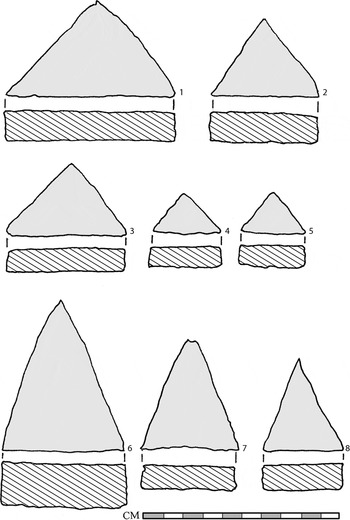
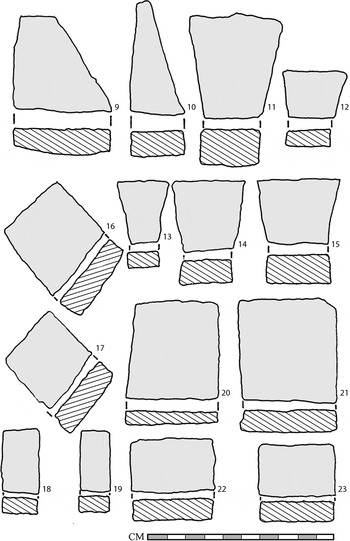
The line drawings (figs 3–4) of a selection of the pieces from Halstock indicate the variety of forms and sizes represented. These consist of regular triangles (1–5), elongated triangles (6–8), truncated right-angled triangles (9–10), wedge-shaped forms (11–15), a large number of diamond shapes (16–17), a large selection of ‘border’ sticks (18–19), and a few larger square and rectangular tiles (20–3), which compare with the square tiles from Room 15 at Great Witcombe and those recovered at Fishbourne.
Cut stones from the Halstock villa, Dorset (Nos 1–8). Scale 1:2.

Cut stones from the Halstock villa, Dorset (Nos 9–23). Scale 1:2.

The Halstock assemblage poses the question as to how many other examples of opus sectile pavements have been lost during the refurbishment of buildings in the Roman period. Tiles found as residual detritus in other archaeological excavations may also have been mis-identified and discarded as unusual loose tesserae, their original function not recognised and, therefore, not retained in the site archive. This appears to have been the case at the Halstock villa. The assemblage has now been deposited with the Halstock archive at the Dorset County Museum, Dorchester.Footnote 58