Introduction
The use of radiolabelled fluorodeoxyglucose (FDG) with positron emission tomography (PET) and computed tomography (CT) is well-established in: staging certain cancers, assessing for distant metastases, identifying occult primary malignancies and examining disease response following treatment. Additional indications for use include localising sources of infection and pyrexia of unknown origin. A proportion of FDG-PET/CT scans consistently detect increased uptake in regions of the body. Such findings are termed incidentalomas, defined as ‘unexpected, asymptomatic tumours discovered serendipitously during an unrelated procedure’.Reference Mirilas and Skandalakis1
Increased use of PET-CT imaging has resulted in an increase in the discovery of incidentalomas, with an overall detection rate of up to 2 per cent.Reference Liu, Ghesani and Zuckier2 Common sites for incidental increased FDG uptake include the thyroid, gastrointestinal tract, lung, breast, and adrenal and prostate glands.Reference Liu, Ghesani and Zuckier2–Reference O'Sullivan, Muntinga, Grigg and Ioannidis4 Incidentalomas pose a challenge for the clinician because of the uncertainties that exist regarding their ideal management, the possible requirements for further investigation, and the potential for unnecessary or excessive treatment.Reference Weiner5 Patient anxiety as a result of incidentaloma detection is a well-recognised feature, and recommendations have been made to discuss the implications of their detection prior to imaging.Reference Powell6
Increased uptake within the parotid glands is particularly uncommon given their low tissue volume and reduced avidity for radiolabelled glucose analogues.Reference Uchida, Minoshima, Kawata, Motoori, Nakano and Kazama7,Reference Kendi, Magliocca, Corey, Galt, Switchenko and Wadsworth8 However, a number of case reports have been published reporting this finding, as well as series assessing the prevalence. We performed a systematic review of parotid incidentalomas detected on FDG-PET/CT to assess the overall incidence and aetiologies, and to develop an evidence-based investigation and management guideline to aid surgeons and multidisciplinary team members in the care of patients with these findings.
Materials and methods
A systematic review was performed in accordance with the Preferred Reporting Items for Systematic Review and Meta-Analysis (‘PRISMA’) guidelines, on the 25 August 2020.Reference Liberati, Altman, Tetzlaff, Mulrow, Gotzsche and Ioannidis9 The key words used were: ‘incidentaloma’, ‘incidental finding’, ‘parotid’, ‘parotid gland’, ‘salivary gland’ and ‘head and neck’. No restrictions were placed on date of publication or language. Articles were reviewed independently by two authors (CT and MB) to determine whether they should be included in the analysis.
Results
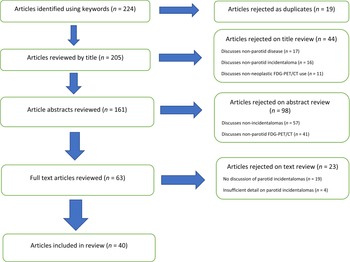
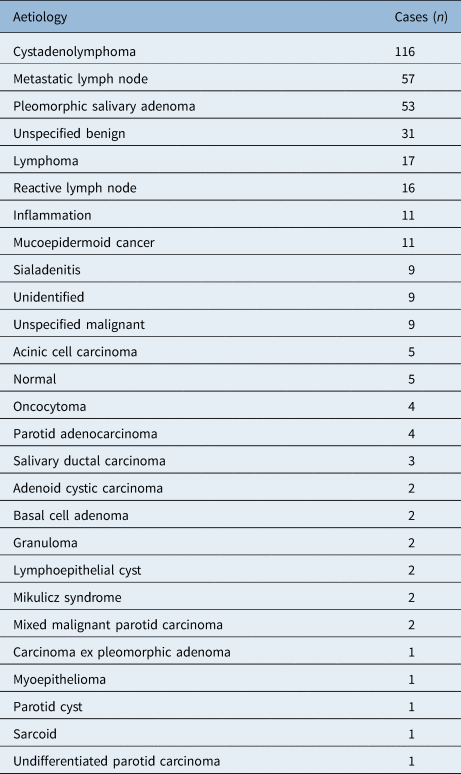
The results of the Preferred Reporting Items for Systematic Review and Meta-Analysis are shown in Figure 1. Forty articles were included, discussing 558 parotid incidentalomas.Reference Horiuchi, Yasuda, Shohtsu and Ide10–Reference Bitar, Martiniova, Bell and Ravizzini50 Aetiology was recorded in 377 incidentaloma cases (67.6 per cent). The aetiology of the parotid incidentalomas included in the review are described in Table 1.
Preferred Reporting Items for Systematic Review and Meta-Analysis (‘PRISMA’) flowchart. FDG = fluorodeoxyglucose; PET = positron emission tomography; CT = computed tomography

Aetiology of parotid incidentalomas

Benign aetiology was reported in 256 incidentaloma cases (69.6 per cent) and malignant aetiology in 112 (30.4 per cent) (p = 0.21; two-tailed t-test); the aetiology could not be identified in 9 incidentaloma cases. The commonest aetiology was cystadenolymphoma or Warthin's tumour (30.8 per cent), followed by metastatic disease to the gland (15.1 per cent).
The aetiology of metastatic disease was reported in 23 cases (40.6 per cent). Metastatic melanoma was the most common aetiology (43.5 per cent) (p = 0.01; two-tailed t-test), which demonstrated 100 per cent metastasis in this review. Metastatic disease corresponded with the primary malignancy being investigated using FDG-PET/CT in all cases (p = 1; two-tailed t-test). Incidentaloma incidence within a larger series of imaging was reported in 12 articles. The mean overall incidence was 0.74 per cent (range, 0.21–1.55 per cent).
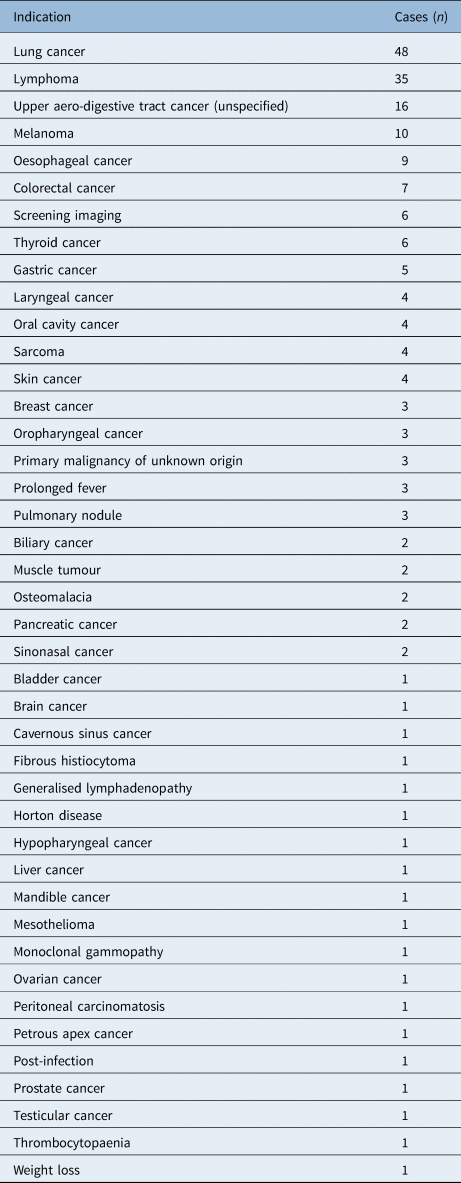
The indication for imaging was reported in 202 cases (36.2 per cent), with no indication stated in the remaining 356 cases (63.8 per cent). The commonest indication for FDG-PET/CT imaging was lung cancer staging; other indications are reported in Table 2. The only imaging indication significantly associated with an incidentaloma aetiology was primary lung cancer, which was associated with both cystadenolymphoma (p = 0.015; two-tailed t-test) and pleomorphic salivary adenoma (p = 0.011; two-tailed t-test).
Indications for FDG-PET/CT imaging

FDG = fluorodeoxyglucose; PET = positron emission tomography; CT = computed tomography
Patient gender was identified in 131 cases, and included 92 males (70 per cent) and 39 females (30 per cent) (p = 0.65; two-tailed t-test). The side of increased uptake was described in 78 patients, with unilateral involvement demonstrated in 70 patients (90 per cent). There was no statistical difference in the side of involvement (p = 0.78; two-tailed t-test). The majority of incidentalomas were not investigated further because of the poor prognosis of the primary malignancy or the otherwise reassuring nature of the FDG-PET/CT finding.
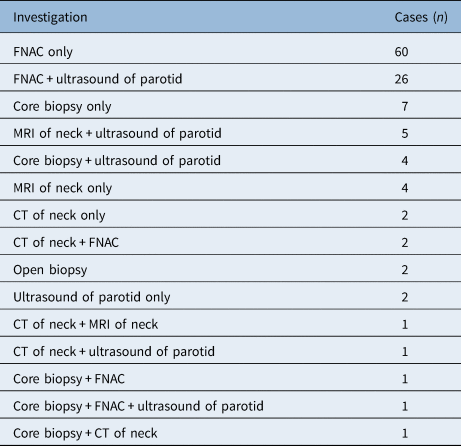
Further investigations performed in the assessment of parotid incidentalomas are identified in Table 3. The most common investigation was fine needle aspiration cytology (FNAC) with or without ultrasound imaging, for either guidance or purely for imaging. However, this changed to core biopsy in more recent cases. The accuracy of core biopsy sampling (sensitivity = 100 per cent; positive predictive value = 100 per cent) was higher than that for FNAC (sensitivity = 67 per cent; positive predictive value = 67 per cent), in line with recent literature.
Further investigations performed

FNAC = fine needle aspiration cytology; CT = computed tomography; MRI = magnetic resonance imaging
Ultrasound was the most commonly performed radiological investigation following incidentaloma detection. When further management was undertaken, partial or superficial parotidectomy was performed, with total parotidectomy reserved for proven cases of primary parotid malignancy.
Discussion
The overall incidentaloma detection rate on FDG-PET/CT imaging in the literature is reported as 6.7–12 per cent.Reference Wang, Lau, Shakher, Rischin, Ware and Hong51,Reference Sone, Sobajima, Kawachi, Kohara, Kato and Naganawa52 The low mean parotid incidentaloma incidence reported in this review corresponds with the lower incidence of neoplastic and non-neoplastic disease in these glands. Whilst only a small proportion of incidentaloma aetiology was non-neoplastic (6.3 per cent), this review alerts both clinicians and radiologists to this possibility and particularly systemic disease in cases of bilateral involvement.
The high incidence of cystadenolymphomas amongst parotid incidentalomas is of interest, and Treglia et al. observed a similar finding when assessing focal uptake levels in different types of parotid incidentaloma.Reference Treglia, Bertagna, Sadeghi, Muoio and Giovanella53 Cystadenolymphomas account for approximately 30 per cent of benign parotid masses and 24 per cent of all tumours within the gland, though the incidence over a 25-year study period has demonstrated this to be rising.Reference Thielker, Grosheva, Ihrler, Wittig and Guntinas-Lichius54,Reference Luers, Guntinas-Lichius, Klussmann, Küsgen, Beutner and Grosheva55 A number of theories have been proposed regarding increased FDG accumulation in cystadenolymphomas. These include increased propensities for accumulation within lymphoid tissue and active lymphocytes, but also the higher incidence of cystadenolymphomas in smokers, who are at greater risk of developing lung malignancy and thereby undergo imaging.Reference Kotwall56
The high rate of solid malignant incidentalomas (25.6 per cent) differs from previous studies.Reference Eneroth57–Reference Britt, Stein, Patel, Harari and Hartig60 Rates of primary parotid malignancy are generally quoted at 20 per cent or less, and Britt et al. have previously reported a 6 per cent malignancy rate in incidentalomas.Reference Britt, Stein, Patel, Harari and Hartig60 The reporting of mucoepidermoid cancer as the most common solid primary malignancy corresponds to its global increase in incidence over time.Reference Britt, Stein, Patel, Harari and Hartig60–Reference Son, Panwar, Mosher and Lydiatt63
In addition to follow up with clinical and flexible nasoendoscopy examination, the recommendation for core biopsy in the assessment of incidentaloma mass is based on the higher sensitivity and positive predictive values that we have calculated. The power for these calculations is low, but the conclusion confirms the findings of previous work assessing the accuracy of core biopsy in parotid neoplasia assessment.Reference Howlett, Menezes, Lewis, Moody, Violaris and Williams64 This more definite result achieved from histological analysis rather than from a cytological sample can assist in developing a more suitable course of management for the incidentaloma, and delays from repeat sampling can also be avoided. The addition of ultrasound to guide sampling also improves ‘hit rate’, with core biopsy suggested as superior to fine needle aspiration.Reference Howlett, Menezes, Lewis, Moody, Violaris and Williams64–Reference Haldar, Sinnott, Tekeli, Turner and Howlett66
Competing interests
None declared