Introduction
With the rapid aging of the world population, dementia has emerged to be the focus of clinical and public health research because it has become the most common illness leading to mental and social burden, requiring considerable supportive care, and driving huge economic and nursing costs as well as causing wage and productivity losses for both family members and caregivers (Kalaria et al., Reference Kalaria2008). Accounting for two-thirds of the total number of dementia, Alzheimer's disease (AD) is a major subtype of dementia that causes a decline over a period of years in short-term memory, language, ability to recognize friends and family members, and other basic cognitive abilities. Numerous studies have documented excess mortality rates among patients with AD (Steenland et al., Reference Steenland, MacNeil, Vega and Levey2009).
Mild cognitive impairments (MCI) have been commonly considered to be an intermediate transition state between age-related cognitive decline and dementia, the condition that reflects acquired cognitive impairments in older adults that do not meet criteria for dementia and are characterized by deficits not explainable by age, educational background, or medical illness (Petersen et al., Reference Petersen, Stevens, Ganguli, Tangalos, Cummings and DeKosky2001). MCI has been of substantial public health interest because of its association with difficulties in the performance of everyday activities (Gauthier et al., Reference Gauthier2006), increased risk of dementia (Palmer et al., Reference Palmer, Fratiglioni and Winblad2003), and death (Yaffe et al., Reference Yaffe, Petersen, Lindquist, Kramer and Miller2006).
More recently, the potential of early interventions for dementia has increased interest in investigating whether these MCI inevitably progress to dementia (Morris et al., Reference Morris2001). Traditional epidemiologic research has focused on risk factors for the development of dementia from intact cognition and previous clinical studies of MCI have suggested that risk factors for progression from MCI to AD are higher age, being female, lower education level, lack of reading, hypertension, diabetes, and the presence of the apolipoprotein E gene (APOE)ε4 allele (Roselli et al., Reference Roselli, Tartaglione, Federico, Lepore, Defazio and Livrea2009; Dickstein et al., Reference Dickstein, Walsh, Brautigam, Stockton, Gandy and Hof2010; Profenno et al., Reference Profenno, Porsteinsson and Faraone2010; Wilson et al., Reference Wilson2010).
Although knowledge of established risk factors for AD can logically contribute to the search for predictors of the progression of cognitive impairment, it has not yet been firmly established where in the cognitive impairment process these risk factors for AD exert their effects, and whether there are unique risk factors for the progression of MCI to AD. However, most published papers treated MCI or AD as terminal event separately that cannot answer these questions completely. Recognition of these factors and the mechanisms by which they contribute to AD will be beneficial in the current treatment regimens for AD and in the development of future therapies.
There is some heterogeneity among outcomes of MCI (Palmer et al., Reference Palmer, Fratiglioni and Winblad2003). MCI are transient states, whereby some remain unchanged (persistent MCI), and some worsen (to severe cognitive deterioration or AD). In this paper, we define MCI and severe cognitive deterioration as non-absorbing (i.e. transient) states and AD as absorbing state. A multi-state Markov process, widely used in decision analysis or economic analysis (Teipel et al., Reference Teipel, Ewers, Reisig, Schweikert, Hampel and Happich2007) to explain risk factors and to make predictions associated with progressive diseases such as AD (Tyas et al., Reference Tyas2007), was used for the analysis.
The main goals of this study were (1) to determine whether known risk factors for AD (i.e. age, gender, education, hypertension, diabetes, reading, and APOEε4 allele) increase the risk of progression from MCI to AD; (2) to explore these potential risk factors’ effects on each of the possible transitions; and (3) to make predictions for possible transition probabilities.
Materials and methods
Study population
The design of this study has been described elsewhere (Ma et al., Reference Ma, Qu, Wang, Yin, Bai and Ding2009). Briefly, in March 2006, a cross-sectional study was conducted among the community-dwelling residents aged over 65 years. By random cluster sampling, eight geographically convenient communities with a high proportion of elderly residents who are all native Chinese speakers were selected in the whole Taiyuan city, China. This survey composed of face-to-face interviews and self-administered questionnaires including questions on socio-demographic features, physical/emotional health, and medical conditions such as medical history, current medication, and a subjective assessment of memory disturbances or depression. Information about the subjects was appraised by a panel of neurologists, neuropsychologists, a geriatrician, and clinical nurses. Of 6,500 eligible participants, 308 subjects were excluded because 126 withdrew for personal reasons, 85 were with incomplete information, 55 were non-eligible, and 42 due to other reasons. This left 6,192 eligible subjects who had cognitive assessments and neuropsychological tests by well-trained research psychologists. Of these 6,192, 5,592 experienced age-related cognitive decline (i.e. normal aging) and 600 met MCI criteria. The final analytic sample consisted of 600 MCI patients as baseline and then included in the follow-up of a longitudinal cohort. Each enrolled subject was scheduled to be evaluated every six months over five years. The general health examination and questionnaire, AD diagnosis, and cognitive measures were completed in the evaluation. Participants did not differ significantly from non-participants in mean age, gender, living environments, or mortality rate.
The study was approved by Shanxi Medical University Ethics Committee. Informed consent form describing the aims and methods (cognitive assessments, neurological and physical examinations) of the study was provided and signed by all participants at baseline. Blood samples were collected to establish APOE status.
Risk factors assessed
Some known risk factors for AD were collected. They included age at assessment (years), gender (female/male), education (three education levels: years ≤9, 10–15, ≥16; in China typical or compulsory number of years of education is nine), hypertension (present/absent), diabetes (present/absent), reading (much: reading books, magazines, or newspapers more than 5,000 Chinese words per day on average/little: less than 5,000 words), and APOE status (presence/absence of at least one epsilon 4 allele).
Psychometric assessment and cognitive states
It is impossible to observe dementia in continuous time. In practice the best for us to obtain is cohort data of elderly people, followed and examined at a finite number of visits. Twice a year, cognitive assessments were taken on a cohort of initially MCI subjects participating in the project. At each visit, assessments were used to classify subjects into one of the three cognitive and functional decline states: MCI, global impairment, and AD.
The Montreal Cognitive Assessment (MoCA), one of the most widely used brief screening instruments for cognitive impairment, provides a total score ranging from 0 to 30, with lower scores indicative of greater cognitive impairment. The MoCA is not identified with any single quality-of-life domain, but measures from each domain may be influenced by cognitive status. Thus, in this investigation, the MoCA was used to classify subjects by level of cognitive impairment.
The Instrumental Activities of Daily Living Scale (IADL; Lawton and Brody, Reference Lawton and Brody1970), a simple and efficient instrument for assessment of functional abilities in elderly patients, assesses the ability of the subject to perform simple everyday tasks: using the telephone, using transport, managing money, shopping, taking drugs, preparing food, housekeeping, and doing laundry. The average score ranged from 0 (totally independent) to 16 (totally dependent). The IADL score was divided into three categories: independent (0–4), assistance requested (5–11), and dependent (≥12).
Those with MCI had at least one specific area of impaired cognitive function, such as memory or naming, but had intact global cognitive ability and activities of daily living (ADL). The criteria used for MCI initially proposed by Petersen et al. (Reference Petersen, Smith, Waring, Ivnik, Kokmen and Tangelos1997) specify (1) the presence of a subjective memory complaint, (2) preserved general intellectual functioning as estimated by performance on a vocabulary test, (3) demonstration of a memory impairment by cognitive testing, (4) intact ability to perform ADL, and (5) absence of dementia. In this study, scores of MoCA for MCI were 19–24 and no subtypes of MCI were identified.
Participants with global impairment were impaired regarding global cognitive ability, ADL, or both; other impairments in a specific area of cognitive function could also have been present. Participants with global impairment did not meet criteria for dementia because only one area of cognitive function was impaired or, if two areas of cognition were impaired, ADL were intact (Tyas et al., Reference Tyas2007), and scores of MoCA were 15–18. Participants who met our criteria for AD had a decline in function, impairments in memory and at least one other area of cognitive function, and impaired ADL (Tyas et al., Reference Tyas2007). Clinical diagnosis of AD was determined by a board-certified neurologist using National Institute of Neurological and Communicative Disorders and Stroke/Alzheimer's Disease and Related Disorders Association criteria.
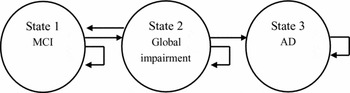
There were conversions between the state of MCI and global impairment, i.e. to poorer or to better cognitive status. Once cognitive function developed into AD, it will be no longer reversible and become the absorbing state. State structure with circles representing the states of cognitive function and with arrows between the states representing the possible transitions is illustrated in Figure 1.
Possible transitions between transient states (mild cognitive impairments, global impairment) and absorbing state (AD) in a community-based prospective study of outcome of mild cognitive impairments, Taiyuan, China, 2006–2011.

Statistical methods
The multi-state models (MSMs) provide a comprehensive view of the disease process and make risk-factors analysis and long-term predictions more easily. The conditional distribution of the status of an individual participant at an arbitrary examination given his status at previous examinations was assumed to have the Markov property (i.e. the status at this examination depended on the status at only the most recent previous examination and was independent of status at other previous examinations; Andersen and Perme, Reference Andersen and Perme2008; Meira-Machado et al., Reference Meira-Machado, de Uña-Álvarez, Cadarso-Suárez and Andersen2009).
Multi-state processes are fully characterized through transition probabilities between states h and j. A time-homogeneous Markov process has intensities constant and independent of time t. The transition matrix P(t, u) defines the probabilities of being in each state at a fixed time in the future, conditional on the current state.
For a Cox's proportional hazards regression MSM, we can write λhji(t)=λhj0(t) exp (βThjZ hji), where λhj0(t) is the baseline intensity function between states h and j, βhj is the vector of regression parameters, and Zhji is the vector of covariates for subject i. Maximum likelihood estimates can be computed from the transition probability matrix. The hazard ratios and their confidence intervals were derived from Cox's regression models and were used to assess the contribution of each risk factor to the probability of transition. Statistical significance was determined at the 0.05 level.
Questions of fit of the Markov model can, to some extent, be assessed by comparing observed transition frequencies with expected frequencies. Pearson chi-squared statistic to test the fit of the Markov model is readily obtained by methods similar to those used in Markov chains. Aguirre-Hernandez and Farewel (Reference Aguirre-Hernandez and Farewell2002) developed a Pearson-type test for stationary and continuous time Markov models, which can be used when the transition rates depend on several explanatory variables.
The status of a participant at each examination in this study was recorded as being in one of three states: MCI (State 1), global impairment (State 2), and AD (State 3). Hence, a Markov chain was used to model transitions from one state to another. In this chain, MCI and global impairment were considered transient states, whereas dementia was absorbing state. The data were modeled by a three-state Markov process with two transient states and one absorbing. The transitions are represented in Figure 1. The analytic approach takes the transient nature of cognitive status and transitions in cognitive status occurring possibly in both directions into consideration. The possible predictors of these transitions in this study included age, gender, education, hypertension, diabetes, reading, and APOE status.
The freely available msm package written in the R programming language was used to fit multi-state Markov model to the data (Jackson, Reference Jackson2009; Reference Jackson2011).
Results
Mean age at baseline was 69.7 (6.6) years, ranging from 65- to 90-years-old; 71.0% were females; 89.3% had nine or fewer years of education while 2.8% had at least 16 years of education; 68.5% and 77.1% reported hypertension and diabetes, respectively, at enrollment; 20.9% had habits of reading much; and 71.6% possessed at least one APOE 4 allele. During five years of follow-up, 82 participants were lost (53 died, 17 moved, and 12 withdrew).
Markov assessment
Whether the Markov assumption is tenable has to be evaluated before using MSM. The Markov assumption is that future evolution only depends on the current state at time t; in other words, the history of the process is summarized by the state occupied at time t. The Markov assumption may be checked, among others, by including covariates depending on the history (Andersen and Perme, Reference Andersen and Perme2008; Meira-Machado et al., Reference Meira-Machado, de Uña-Álvarez, Cadarso-Suárez and Andersen2009). Following this procedure, we verified that the effect of time spent in State 1 was not significant (p > 0.05) providing evidence that Markov's model was satisfactory.
Multivariate Cox-Markov model analysis
We surveyed factors that may influence the outcome of MCI including the social demographic variables (age, gender, and education), health status (hypertension and diabetes), life style (reading), and genetic risk factor (APOE status). At the level of being 0.05, these factors were put into multi-state Markov model for multivariate analysis, and the results showed that gender, age, education level, hypertension, diabetes, reading, and ApoEε4 had statistical significance for MCI progression.
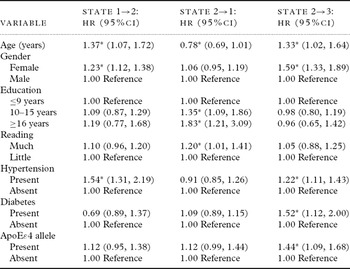
Table 1 summarized the effects of the possible risk factors on transitions within the states. Multivariate analysis showed that gender, age, and hypertension were statistically significant predictors of the transition from MCI to global impairment; age, education, and reading statistically influenced transition from global impairment to MCI; and gender, age, hypertension, diabetes, and ApoEε4 status were statistically associated with transition from state global impairment to AD.
Association of possible risk factors to the risk of transitions based on multi-state model in a community-based prospective study of outcome of mild cognitive impairments, Taiyuan, China, 2006–2011

*p < 0.05.
CI = confidence interval; HR = hazard ratio.
Only age was a significant risk factor for all possible transitions. Being female was a significant predictor of transitions from MCI to both global impairment and AD. However, the effect was much stronger for AD (Hazard Ratio (HR): 1.59; 95% Confidence Interval (95%CI): 1.33–1.89) than for global impairment (HR: 1.23; 95%CI: 1.12–1.38). The presence of an ApoEε4 allele increased the risk in transition from global impairment to AD (HR: 1.44; 95%CI: 1.09–1.68) but had its marginal statistically significant effect on transition between MCI and global impairment. Education (HR: 1.35; 95%CI: 1.09–1.86) and reading (HR: 1.20; 95%CI: 1.01–1.41) were both important factors for transition from global impairment to MCI, while having no significant effect on other transitions (p > 0.05). Baseline hypertension significantly affected transitions from MCI to global impairment and then to AD in the Markov chain. However, diabetes significantly affected transition from global impairment to AD (HR: 1.52; 95%CI: 1.12–2.00).
Chi-square test for goodness-of-fit of the MSM showed that the fitted model was acceptable (chi-square = 76.32, df = 88 (upper); 51 (lower), p > 0.05).
Transition prediction
Let Pij(s, t) be the transition probability for a subject from state i at time s to state j at time t, that is, Pij(s, t)=P{X(t)=j|X(s)=i}. Table 2 showed an average transition probability matrix for the population with the covariates set to their mean values in the data from baseline after three years.
Estimated transition probability matrix (three years) based on multi-state model in a community-based prospective study of outcome of mild cognitive impairments, Taiyuan, China, 2006–2011

Discussion
There were many reports about MCI outcome, but the results show great differences due to the use of various clinical diagnostic criteria, measurement instruments, and the various sample sizes (Yaffe et al., Reference Yaffe, Petersen, Lindquist, Kramer and Miller2006). Much of the research on risk factors for progression from MCI to dementia has focused on clinical predictors, such as neuropsychologic test performance, despite the recommendation that inclusion of factors other than cognitive test performance would increase the utility of clinical predictive models (Tian et al., Reference Tian, Bucks, Haworth and Wilcock2003). Little has been done to examine more traditional epidemiologic risk factors for progression from MCI to dementia.
We used a novel analytic strategy in our study to determine predictors of transitions in cognitive status through the spectrum from MCI to AD. Multivariate analysis showed that being female, increasing age, low educational level, history of hypertension or diabetes, presence of an ApoEε4 allele, and reading little were associated with increased risks of transition from state of MCI to state of severe cognitive deterioration.
Most of our results were consistent with those of other studies using more traditional analytic strategies. Age (Teipel et al., Reference Teipel, Ewers, Reisig, Schweikert, Hampel and Happich2007; Roselli et al., Reference Roselli, Tartaglione, Federico, Lepore, Defazio and Livrea2009), gender (Tervo et al., Reference Tervo2004; Zhou et al., Reference Zhou2006), education (Tian et al., Reference Tian, Bucks, Haworth and Wilcock2003; Tervo et al., Reference Tervo2004; Zhou et al., Reference Zhou2006), hypertension (Roselli et al., Reference Roselli, Tartaglione, Federico, Lepore, Defazio and Livrea2009; Profenno et al., Reference Profenno, Porsteinsson and Faraone2010), diabetes (Roselli et al., Reference Roselli, Tartaglione, Federico, Lepore, Defazio and Livrea2009; Dickstein et al., Reference Dickstein, Walsh, Brautigam, Stockton, Gandy and Hof2010; Profenno et al., Reference Profenno, Porsteinsson and Faraone2010), reading (Wilson et al., Reference Wilson2010), and APOE (Hsiung et al., Reference Hsiung, Sadovnick and Feldman2004; Aggarwal et al., Reference Aggarwal, Wilson, Beck, Berry-Kravis and Bennett2005) have been associated with the progression of MCI. However, there were still many conflicting results from population-based studies that found gender (Amieva et al., Reference Amieva2004), educational level (Tervo et al., Reference Tervo2004), hypertension (Posner et al., Reference Posner, Tang, Luchsinger, Stern and Mayeux2000), diabetes (Arvanitakis et al., Reference Arvanitakis2006), and APOE (Amieva et al., Reference Amieva2004) did not predict progression to dementia.
We found that education and reading play no role in determining transitions to cognitive decline. When a transition from global impairment to MCI occurred, education and reading became protective risk factors. Other investigators have argued just the opposite (Roselli et al., Reference Roselli, Tartaglione, Federico, Lepore, Defazio and Livrea2009; Wilson et al., Reference Wilson2010). Thus, these established risk factors for dementia appear to operate primarily in later life, on the road to dementia, contrary to Tyas's results (Tyas et al., Reference Tyas2007).
The results showed that for the transient state of MCI, subjects were more likely (67%) to remain in that cognitive state at the next cognitive assessment than to transition to cognitive deterioration, and transition probabilities to global impairment or AD were approximately 17% each. However, for the transient state of global impairment, probability of remaining in the same state was only 18% and that of forward transition (deterioration in cognitive status) was three times more likely than that of backward transition (improvements in cognitive status).
In this study, a multi-state Markov chain with two transient states (mild cognitive deterioration and global impairment) and one absorbing state (AD) was used to model the one-step transitions, which may capture the full range of cognitive function from MCI through dementia. MSMs have several advantages over the traditional prognostic models and are commonly used in studies of chronic disease, in which patients are assumed to pass through a series of discrete disease stages. These models offer a better understanding of the disease process, providing the hazard and probability for the movement of patients among the various states and revealing the effect of each risk factor on different transitions. In these models, issues of interest include assessing the effects of individual risk factors and estimation of progression rates, which may be ignored when using logistic or Cox's regression models alone.
The Markov property assumes that cognitive status depends on status at only the previous examination and thus does not account for heterogeneity in the cognitive status history of a person (future evolution only depends on the current state). This Markov property was illustrated in other studies of cognitive status (Tyas et al., Reference Tyas2007), where the probability of advancing to more severe AD was found to be independent of the person's previous severity of cognitive impairments. As many studies have modeled progression inexorably to poorer cognitive status, strength of this paper was allowing for both forward and backward transitions between MCI and global impairment.
Some limitations to this study should be mentioned. First of all, cognitive states including MCI and global impairment lack standard definitions. This study arbitrarily divided a continuous process of cognitive decline into discrete categories of cognitive status, which may sometimes be the failure of the Markov assumption. That is, the transition intensities may depend on the time spent in the current state or other characteristics of the process history. Second, as the assessments were not made continuously, there is a possibility that there can be a transition from MCI directly to AD, skipping the global impairment state (due to rapid decline and lack of opportunity to assess). Besides, it is not unusual that individuals with MCI may transit back to the state of cognitive normality. Considering the small numbers of these transitions in our study, they were ignored for simplicity although they could be incorporated into the chain. Moreover, death was treated as censoring not an absorbing state due to limited number of death due to AD during the follow-up. In the future study, using the MSM to treat death as an informative competing event or as a discrete state would be better. Third, this paper assumed covariates were constant among the observation times of the Markov process. In fact, it is likely that the hazard of AD increases with age, so the model may underestimate the number of AD when forecasting far into the future (Ocana-Riola, Reference Ocana-Riola2005). In addition, the poor education and high prevalence of chronic diseases that characterize this population may influence generalization of the results.
However, strengths of our study were inclusion of ten rounds of examinations in a five-year's longitudinal cohort of community-dwelling MCI residents. In addition, our statistical strategy more closely modeled reality by allowing for transitions in both directions: forward to poorer or backward to better cognitive status. In this sense, all transient and absorbing states have the same level of importance. We defined AD as an absorbing state because predictors of transitions from dementia were not of interest in this study.
This study examined the influence of established risk factors on transitions among various cognitive states in the progression from MCI to AD and made prediction based on transition probabilities. The analytic strategy used MSM to provide an effective method to determine predictors of transitions in cognitive status. Our analytic model could be expanded to model the influence of other risk factors for progression to dementia. In addition, this approach could be applied to other progressive conditions where transitions between states are of interest.
Conflicts of interest
None.
Description of authors’ roles
Hong-mei Yu designed the study and wrote the draft of the paper; Shan-shan Yang and Jian-wei Gao conducted the study's analysis; Li-ye Zhou helped supervise the field activities and database; Rui-feng Liang helped conduct the literature review and prepare the “Materials and methods” section of the text; and Cheng-yi Qu directed the study's implementation including quality control and helped prepare the “Discussion” section of the paper.
Acknowledgments
This work was supported by grants from the National Natural Science Foundation of China (No. 30972545), Shanxi Province Foundation for Returnees, and Scientific and Technological Innovation Project of Shanxi Medical University. The authors also thank all participants for their cooperation and assistance in making this research possible. Thanks to two anonymous referees for comments and suggestions that have improved the presentation of the paper. This study would not have been possible without the support of the members, leaders, and healthcare providers of the community heath service centers in Taiyuan, Shanxi, P.R. China.