INTRODUCTION
In recent years, the traditional motor role of the cerebellum has been expanded to include emotion as well as cognition. Lesions of the adult cerebellum produce problems, not only in cognition (Aarsen, Van Dongen, Paquier, Van Mourik, & Catsman-Berrevoets, Reference Aarsen, Van Dongen, Paquier, Van Mourik and Catsman-Berrevoets2004; Konczak, Schoch, Dimitrova, Gizewki & Timmann, Reference Konczak, Schoch, Dimitrova, Gizewki and Timmann2005; Riva & Giorgi, Reference Riva and Giorgi2000; Rønning, Sundet, Due-Tonnessen, Lundar, & Helseth, Reference Rønning, Sundet, Due-Tonnessen, Lundar and Helseth2005; Steinlin et al., Reference Steinlin, Imfeld, Zulauf, Boltshauser, Lovblad and Luthy2003) but also in emotion (Riva & Giorgi, Reference Riva and Giorgi2000; Schmahmann & Sherman, Reference Schmahmann and Sherman1998).
Like adult cerebellar lesions, childhood cerebellar tumors are associated with deficits in both cognition (Dennis, Spiegler, Hetherington, & Greenberg, Reference Dennis, Spiegler, Hetherington and Greenberg1996) and emotion. Children with cerebellar tumors, in acute (Levisohn, Cronin-Golomb, & Schmahmann, Reference Levisohn, Cronin-Golomb and Schmahmann2000; Riva & Giorgi, Reference Riva and Giorgi2000) and chronic (Richter et al., Reference Richter, Schoch, Kaiser, Groetschel, Dimitrova and Hein-Kropp2005; Steinlin et al., Reference Steinlin, Imfeld, Zulauf, Boltshauser, Lovblad and Luthy2003) stages of treatment, exhibit emotional lability, behavioral disturbances, blunting of affect, irritability, impulsivity, anxiety, and dysregulation of emotion (Aarsen et al., Reference Aarsen, Van Dongen, Paquier, Van Mourik and Catsman-Berrevoets2004; Levisohn et al., Reference Levisohn, Cronin-Golomb and Schmahmann2000; Richter et al., Reference Richter, Schoch, Kaiser, Groetschel, Dimitrova and Hein-Kropp2005; Riva & Giorgi, Reference Riva and Giorgi2000; Steinlin et al., Reference Steinlin, Imfeld, Zulauf, Boltshauser, Lovblad and Luthy2003). Adult long-term survivors of childhood cerebellar tumors exhibit disturbances in behavior and affect regulation (Steinlin et al., Reference Steinlin, Imfeld, Zulauf, Boltshauser, Lovblad and Luthy2003).
A constellation of deficits in cognition, affect, and behavior after cerebellar injury, termed the cerebellar cognitive affective syndrome (CCAS), has been reported in both adults (Schmahmann, Reference Schmahmann2001; Schmahmann & Sherman, Reference Schmahmann and Sherman1998) and children (Riva & Giorgi, Reference Riva and Giorgi2000) following cerebellar lesions. The term CCAS suggests a failure of emotion identification and/or a disturbed emotion-cognition interface, but it is not clear whether one or both deficits are involved: some CCAS reports describe deficits in the awareness of emotions, while others appear to identify deficits in emotion regulation, which refers to cognitive control over emotional expression (Gross, Richards, & John, Reference Gross, Richards, John, Snyder, Simpson and Hughes2006; Morris & Reilly, Reference Morris and Reilly1987), including the ability to modify or to understand modified emotional expressions and to inhibit or delay their expression (Ochsner, Bunge, Gross, & Gabrieli, Reference Ochsner, Bunge, Gross and Gabrieli2002; Ochsner et al., Reference Ochsner, Ray, Cooper, Robertson, Chopra and Gabrieli2004).
People have preferences for different music genres, such as rap vs. rock, and they prefer different pieces of music within genres. Despite individual differences in music preference, there is considerable consensus in emotion identification in music (i.e., whether a particular segment of music is happy or sad) across individuals, ages, and cultures, making music a powerful tool for studying emotion. The identification of emotion in music is rapid (~250 ms) (Bigand, Filipic, & Lalitte Reference Bigand, Filipic and Lalitte2005), reliable, and almost as accurate in young children (as young as 6 years of age) as in adults (Dalla Bella, Peretz, Rousseau, & Gosselin, Reference Dalla Bella, Peretz, Rousseau and Gosselin2001). Furthermore, emotion identification in music occurs across cultures in a remarkably similar manner (Balkwill & Thompson, Reference Balkwill and Thompson1999; Fritz et al., Reference Fritz, Jentschke, Gosselin, Sammler, Peretz and Turner2009; Krumhansl, Reference Krumhansl1997). Although faces are the most commonly used emotion-eliciting material, music and face emotion activate similar neural circuits (Blood, Zatorre, Bermudez, & Evans, Reference Blood, Zatorre, Bermudez and Evans1999; Blood & Zatorre, Reference Blood and Zatorre2001; Brown, Martinez, & Parsons, Reference Brown, Martinez and Parsons2004; Gosselin et al., Reference Gosselin, Peretz, Noulhiane, Hasboun, Beckett and Baulac2005; Koelsch, Fritz, v Cramon, Muller, & Friederici, Reference Koelsch, Fritz, v. Cramon, Muller and Friederici2006).
In this investigation, we used music to study two key features of emotion, identifying emotions and exerting cognitive control over their expression. The study population included two groups of children with treated cerebellar tumors, each having a homogeneous pathology.
The first specific aim was to compare children with benign or malignant cerebellar tumors and their typically developing age peers on identifying happy and sad emotion in music. Half of all childhood brain tumors occur in the posterior fossa and cerebellum (Heideman, Packer, Albright, Freeman, & Rorke, Reference Heideman, Packer, Albright, Freeman, Rorke, Pizzo and Poplack1993), with the two most common childhood cerebellar tumors being astrocytomas (AST) and medulloblastomas (MB) (Strother et al., Reference Strother, Pollack, Fisher, Hunter, Woo, Pomeroy, Pizzo and Poplack2002). Cerebellar ASTs are pathologically benign and are treated with neurosurgical resection but no adjuvant therapy. MBs are malignant tumors requiring surgical resection and adjuvant therapy including chemotherapy and craniospinal radiation or high dose chemotherapy with autologous stem cell rescue/bone marrow transplant in children younger than three years. In survivors of childhood brain tumors, craniospinal radiation is consistently associated with significantly lower cognitive-behavioral function (Copeland, deMoor, Moore, & Ater, Reference Copeland, deMoor, Moore and Ater1999; Mulhern, et al., Reference Mulhern, Kepner, Thomas, Armstrong, Friedman and Kun1998; Roncadin, Dennis, Greenberg, & Spiegler, Reference Roncadin, Dennis, Greenberg and Spiegler2008; Walter et al., Reference Walter, Mulhern, Gajjar, Heideman, Reardon and Sanford1999). We hypothesized that children with cerebellar tumors, particularly those requiring radiation therapy, would experience difficulty identifying emotion in music, particularly emotion cued by temporal information, because of the association of timing deficits with both congenital (Dennis et al., Reference Dennis, Edelstein, Hetherington, Copeland, Frederick and Blaser2004; Dennis, et al., Reference Dennis, Hopyan, Juranek, Cirino, Hasan and Fletcher2009; Hopyan, Schellenberg, & Dennis, Reference Hopyan, Schellenberg and Dennis2009; Mostofsky, Kunze, Cutting, Lederman, & Denckla, Reference Mostofsky, Kunze, Cutting, Lederman and Denckla2000) and acquired cerebellar disorders (Hetherington, Dennis, & Spiegler, Reference Hetherington, Dennis and Spiegler2000).
The second specific aim was to compare tumor and control groups on cognitive control over emotions using a novel paradigm using music based on the classic Stroop task, which is a measure of cognitive control. We hypothesized that children with cerebellar tumors, particularly those treated with craniospinal radiation, would be less able than age peers to identify emotion when the emotion in the music was incongruent with the emotion in the lyric.
The third specific aim explored the neuroanatomical basis of emotion identification and cognitive control of emotion. Lesions of the medial cerebellar vermis have been linked to deficits in emotion and behavior, and lesions of the lateral hemispheres to cognitive impairments (Levisohn et al., Reference Levisohn, Cronin-Golomb and Schmahmann2000; Riva & Giorgi, Reference Riva and Giorgi2000; Schmahmann & Sherman, Reference Schmahmann and Sherman1998), so we hypothesized tumor location in the cerebellar vermis would be related to emotion identification and that cerebellar hemispheric tumors would be associated with cognitive control of emotion.
METHODS
Participants
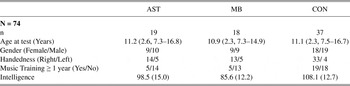
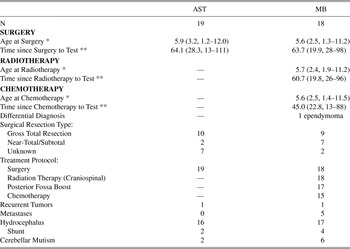
Seventy-four children and adolescents with either benign or malignant cerebellar tumors (n = 37) and a group of age- and gender-matched control children and adolescents (n = 37) participated in the study. Demographic information and psychometric outcome measures are presented in Table 1, treatment protocols and medical variables for the two tumor groups are presented in Table 2.
Participant Demographic Information

Values in table are means (SD, range).
IQ is Full Scale IQ from the Wechsler Abbreviated Scale of Intelligence or WASI (Wechsler, Reference Wechsler1999). There were significant group IQ differences, F(2, 71) = 17.7, p < .001, with the MB (p = .000) and AST (p = .033) groups performed significantly more poorly than the CON group.
Cerebellar Tumor Treatment & Medical Outcome Demographics

Note
Values are means (standard deviation, range).
* Years and decimal months
** Months
Exclusion criteria included previous history of neurological difficulties (e.g., head injuries requiring hospitalization), diagnosed psychiatric disorders, or major developmental disorders. Eligibility in the tumor group required a histologically verified cerebellar tumor, either AST or MB treated at least 1 year before testing. The Control (CON) group consisted of 37 typically developing age- and gender-matched children recruited from local school boards.
Treatment for the 19 children diagnosed and treated for AST involved neurosurgical resection of the tumor without subsequent radiation or chemotherapy.
Treatment for the 18 children diagnosed and treated for MB consisted of surgical resection of the tumor with subsequent craniospinal radiation therapy with or without adjuvant chemotherapy given over a period of several months up to 2 years after diagnosis. All children in the MB group received craniospinal radiation therapy (average = 3100 cGy; range = 2340–5400 cGy), with 17 of the group also receiving an additional radiation boost to the posterior fossa region (average = 2520 cGy; range = 1800–3240 cGy).
This research was conducted with the guidelines and approval of the Hospital for Sick Children Research Ethics Board.
Emotion Identification Task
Music encodes emotion by mode (the specific subset of pitches used to write a given musical excerpt, e.g., major and minor modes) and tempo (the number of beats/min) (Dalla Bella et al., Reference Dalla Bella, Peretz, Rousseau and Gosselin2001). Fast tempi evoke a happy tone, whereas slow tempi evoke a sad tone (Balkwill & Thompson, Reference Balkwill and Thompson1999; Gabrielsson & Juslin, Reference Gabrielsson and Juslin1996; Juslin, Reference Juslin1997; Peretz, Gagnon & Bouchard, Reference Peretz, Gagnon and Bouchard1998). Music played in a major mode is perceived as happy and music played in a minor mode is perceived as sad (Hevner, Reference Hevner1935; Rigg, Reference Rigg1937; Reference Rigg1940). Young (6–8 years) children are as accurate as adults at identifying emotions in music, varying their judgments of emotion with changes in tempo and mode, and identifying unfamiliar music as happy or sad (Dalla Bella et al., Reference Dalla Bella, Peretz, Rousseau and Gosselin2001).
Participants completed four pretests (8 trials each with error correction) to identify visual and auditory happy and sad emotions. The Emotion Identification Task consisted of 96 brief excerpts of piano music from the classical genre reliably rated as either happy or sad by adults and children 6–8 years of age (Dalla Bella et al., Reference Dalla Bella, Peretz, Rousseau and Gosselin2001; Peretz et al., Reference Peretz, Gagnon and Bouchard1998). We included 24 of the original 32 musical excerpts from Peretz et al. (Reference Peretz, Gagnon and Bouchard1998), shortened to create equivalent duration (~10 s) for each excerpt.
Four conditions were presented, each with the same 24 excerpts (12 happy and 12 sad) with alterations (in mode, tempo, or both), for a total of 96 trials. Excerpts were randomly presented, with a different randomization sequence for each participant. In the Original condition, the excerpts were played in canonical form. In the Mode Change condition, excerpts were transcribed to the opposite mode (i.e., from major to minor, or from minor to major). In the Tempo Change condition, all tempi were set to the median of the original tempi. In the Mode + Tempo change, excerpts were transcribed to the opposite mode of the original song and all tempi were set to the median of the original tempi (this manipulation essentially neutralizes the emotion).
Cognitive Control Tasks
The Affective Music Stroop task, which we devised to investigate the cognitive control of emotions, is modeled after the original Stroop task, which is a measure of cognitive inhibition.
The Affective Music Stroop task used the same 48 musical excerpts from the Emotion Identification Task Original condition presented via laptop computer using Eprime (Version 1.1) software except that an a cappella female voice sang the lyric happy or sad, which either matched (congruent) or mismatched (incongruent) the emotion in the music. In the Congruent condition (24 trials, 12 happy and 12 sad), the lyrics matched the emotion in the music (i.e., happy music was sung with the lyric happy, sad music was sung with the lyric sad). In the Incongruent condition (24 trials), the lyrics mismatched the emotion in the music (i.e., happy music was sung with the lyric sad, sad music was sung with the lyric happy).
The Lyric Stroop task had the same format and structure as the Affective Music Stroop task. Participants listened to the same 48 excerpts of music and lyrics, but were instructed to attend to the lyrics, not to the music.
For the Affective Music Stroop, the task was to decide whether the music was happy or sad. Children were told they would hear a person singing music with the words happy or sad and they had to attend only to the emotion in the music and ignore the emotion in the words. For the Lyric Stroop, the task was to decide whether the lyrics were happy or sad, while ignoring the emotion in the music. Excerpts in congruent and incongruent conditions of the Affective Music Stroop and Lyric Stroop tasks were randomized within and across participants. No error correction or feedback was given.
Measures
After listening to each excerpt via laptop computer, participants decided whether the music was happy or sad by pressing one of two laptop buttons. Reaction time (RT) was recorded from the start of each excerpt to button press. The second, untimed measure was the degree of happy or sad. One second after the presentation of the entire musical excerpt, the computer showed a 5-point face rating scale display (Figure 1) and the participant had to point to the face that showed the degree of happy or sad in the music.
Qualitative 5-point face rating scale presented in test proper.

RESULTS
Emotion Identification
Reaction time
Median RT in milliseconds (ms) per condition and group is presented in Table 3. Reaction time data reflect accurate responses only. Statistical analyses for RT were conducted with a 4 × 2 × 3 repeated measures analysis of variance (ANOVA) design considering Music Condition (Original, Mode Change, Tempo Change, and Mode + Tempo Change) and Emotion (happy and sad) as within-subjects factors, and Group (AST, MB, CON) as the between-subjects factor.
Emotion Identification Task – Reaction Times (ms)

Note
Values are medians (SD).
Analyses revealed a significant main effect of music condition RT, F(3,213) = 19.5, p < .001 and emotion, F(1,71) = 41.4, p < .001, but not for Group, F(2,71) = .34, p = .70. There was also a significant two-way interaction between Music Condition RT × Emotion, F(3,71) = 12.3, p < .01, but no significant effect of Music Condition × Group, F(6,213) = .959, p = .45, Emotion × Group, F(2,71) = .198, p = .82, nor a three-way interaction effect of Music Condition × Emotion × Group, F(6,213) = .56, p = .74. Simple effects analyses conducted by least significant difference (LSD) test for the effect of Music Condition showed that RT for the Original condition is significantly faster when compared with every other condition (p < .01), and that RT for the Mode Change condition is significantly slower when compared with the Tempo Change condition (p = .04), and there is no significant difference between the Mode Change condition RT and the Mode+Tempo Change condition RT (p = .14). Furthermore, LSD for emotion RT revealed that happy music RT is significantly faster than sad music RT (p < .01), and that sad music RT is significantly slower than happy music RT only on the Original, Mode Change, and Mode + Tempo Change conditions (p < .01). Overall, children in all three groups performed with similar RT, with faster RT performance on Original, Tempo, Mode, and Mode + Tempo conditions, respectively, and faster RT for happy than sad music.
Accuracy
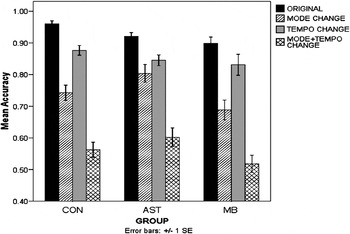
Mean accuracy per condition and group are presented in Figure 2. A 4 (Music Conditions) × 2 (Emotion) × 3 (Group) repeated measures ANOVA reveals significant main effect of within-subjects factors for Music Condition accuracy, F(3,213) = 172.1, p < .001, but not for Emotion, F(1,71) = 5.1, p > .05. Significant interaction effect of Emotion × Group, F(2,71) = 5.1, p < .01 was evident, but not for interactions between Music Condition accuracy × Group, F(6,213) = 1.8, p = .13 or Music Condition accuracy × Emotion × Group, F(6,213) = 1.5, p = .17. Between-subjects effect showed a significant effect of Group, F(2,71) = 3.6, p = .03. Further analyses of simple effects for the significant interaction of Emotion × Group conducted by LSD revealed that the MB group performed significantly less accurately than CON (p < .01) and AST (p < .01) groups on sad emotions only across conditions. When groups and total accuracy per condition are analyzed over both happy and sad emotions, groups perform most accurately on Original condition, then Tempo Change condition, Mode Change condition, and are least accurate on Mode + Tempo Change condition (p < .01).
Emotion Identification Task. Mean accuracy by condition and group.

Rating scale
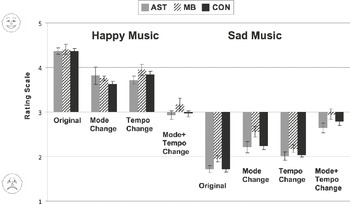
Results for rating scale choices reflect accuracy results (Figure 3). In the Original condition, children in all groups chose faces that corresponded to the correct emotion, such that for happy musical excerpts, they chose the face of “a bit happy” or “very happy” and for sad musical excerpts, they chose “a bit sad” or “very sad.”
Emotion Identification Task. Mean ratings on 5-point face rating scale responses by condition and group; error bars represent standard error.

Overall, groups rated the Tempo Change condition more strongly than the Mode Change condition, reflecting accuracy results. Changes in both Mode and Tempo altered children’s ratings in all three groups, with only slight variations between groups. Children in the MB group were better able to recognize happy emotion than the AST and CON groups in the most emotionally ambiguous condition, Mode + Tempo Change condition. The MB group rated sad music as more neutral than the other groups.
On accurate response trials, children progressively rated their choices toward neutral (e.g., moving from Original to Mode + Tempo Change conditions), and on inaccurate response trials, children across groups rated all music as more neutral (e.g., rating of 3).
Affective Music Stroop
Reaction time
Reaction time data reflect accurate responses only. Statistical analyses for RT were conducted with a 2 × 2 × 3 repeated measures ANOVA design considering Condition (congruent, incongruent) and Music Emotion (happy, sad) as within-subjects factors, and Group (AST, MB, CON) as the between-subjects factor. Analyses revealed a significant main effect of Condition RT, F(1,71) = 19.4, p < .01, a two-way Condition × Group interaction, F(2,71) = 4.5, p = .01, and a three-way Condition × Emotion × Group interaction F(2,71) = 4.9, p = .01. There was not a significant main effect of Emotion, F(1,71) = 2.5, p = .12, or an Emotion × Group interaction, F(2,71) = 1.3, p = .27, nor a significant effect of Group, F(2,71) = .04, p = .95. Simple effects analyses using LSD test for Condition RT within groups showed that groups performed significantly faster on congruent conditions than on incongruent conditions. There was a trend for Condition × Emotion × Group, which showed the MB group tended to perform more slowly than the CON (p = .05) and the AST (p = .06) groups on the Incongruent condition of Happy Music-Sad Word condition.
Accuracy
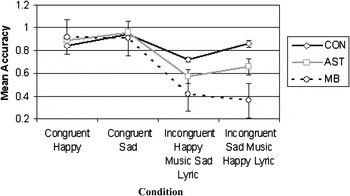
Mean accuracy per condition and group are presented in Figure 4. A 2 (Condition) × 2 (Music Emotion) × 3 (Group) repeated measures ANOVA revealed significant main effect of within-subjects factors for Condition accuracy, F(1,71) = 80.1, p < .01, main effect of Music Emotion, F(1,71) = 13.2, p < .01, a two-way interaction effect of Condition × Group, F(2,71) = 13.2, p < .01, and a two-way interaction effect of Music Emotion × Group, F(2,71) = 8.8, p < .01. Analyses did not show a significant interaction effect of Condition × Music Emotion × Group, F(2,71) = 1.3, p = .27. Between-subjects effect showed a significant effect of Group, F(2,71) = 15.5, p < .01. Further analyses of simple effects for the significant interaction of Condition × Group conducted by LSD revealed that the AST group (p = .02), and the MB group (p < .01) performed significantly less accurately than the CON group on the Incongruent conditions, and the MB group performed significantly less accurately than AST (p < .01) group, again, on the Incongruent conditions. Simple effects showed differences between groups across conditions and emotions. Specifically, the MB group (M = .92) performed significantly more accurately than the CON group (M = .84) on the Congruent happy condition (p = .01). However, on the Incongruent condition of Happy Music Sad Lyric, both the AST (p = .04) and MB (p < .01) groups performed significantly less accurately than CONs. Similarly on the Incongruent condition of Sad Music Happy Lyric, the AST (p = .01) and MB (p < .01) groups were significantly less accurate than the CON group, and the MB group was also less accurate than the AST group (p < .01). Overall results show that both tumor groups performed less accurately than the CON group, and within tumor groups, the MB group had particular difficulty when compared with the AST group on incongruent trials.
Affective Music Stroop Task. Accuracy by condition and group.

Rating scale
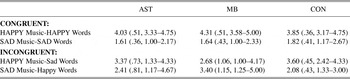
When accurate and inaccurate responses were combined, rating scale choices reflected accuracy results (Table 4). Children in all three groups chose faces that most appropriately corresponded to the correct emotion more strongly in the Congruent condition. For example, in the congruent happy music excerpts, they more often chose the “very happy” face and, in the congruent sad conditions, they more often chose “very sad” face.
Affective Musical Stroop Task – Rating Scale

Note
Values are means (SD, range).
Overall, all groups rated Congruent conditions more strongly than Incongruent conditions, where they rated them as more neutral. On Incongruent inaccurate trials, the MB group continued to rate the lyrics more than the music, when compared with CON and AST groups, who despite their initial inaccurate responses, rated the excerpts as instructed, in better accord with the music.
Lyric Stroop
Reaction time
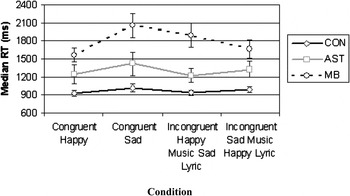
Median RT in milliseconds (ms) per condition and group are presented in Figure 5. Reaction time data reflect accurate responses only. Statistical analyses for RT were conducted with a 2 × 2 × 3 repeated measures analysis of variance (ANOVA) design considering Condition (2 Conditions: congruent, incongruent) and Lyric Emotion (happy lyric, sad lyric) as within-subjects factor, and Group (AST, MB, CON) as between-subjects factor. Analyses revealed a significant main effect of Lyric Emotion RT, F(1,71) = 15.1, p < .01, and a significant two-way Lyric Emotion × Group interaction, F(2,71) = 9.5, p < .01. This was not accompanied by significant main effect of Condition, F(1,71) = 1.0, p = .30, a Condition × Group interaction, F(2,71) = .20, p = .81, or a Condition × Lyric Emotion × Group interaction, F(2,71) = 1.4, p = .23. Between-subjects factor revealed a significant effect of Group, F(2,71) = 16.5, p < .01. LSD showed significant differences in RT where the AST (p = .02) and MB (p < .01) groups performed significantly more slowly than the CON group on both the congruent and incongruent conditions. The MB group (p < .01) also reacted more slowly than the AST group on the congruent and incongruent conditions. Within each condition at each Lyric Emotion, both the AST and MB groups were significantly slower across conditions and emotions than the CON group, with the one exception being on the incongruent condition of Happy Music-Sad Lyric, where the AST group was close to (p = .06) but not significantly slower than CONs. The MB group was slower than the AST group across conditions and emotions. RT for both congruent and incongruent conditions was slower in both tumor groups, but more pronounced in the MB group.
Affective Lyric Stroop Task. Median RT (ms) by condition and group.

Accuracy
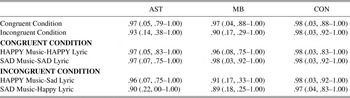
Mean accuracy per condition, group and emotion are presented in Table 5. A 2 (Condition) × 2 (Lyric Emotion) × 3 (Group) repeated measures ANOVA revealed significant main effect of within-subjects factors for Condition accuracy, F(1,71) = 9.2, p < .01, and a significant main effect of Lyric Emotion, F(1,71) = 4.8, p = .03. Analyses did not show a significant two-way interaction effect of Condition × Group, F(2,71) = 2.1, p = .11, Lyric Emotion × Group F(2,71) = 1.0, p = .34, nor a three-way interaction effect of Condition × Lyric Emotion × Group, F(2,71) = 1.08, p = .35. However, there was a significant between-subjects effect of Group, F(2,71) = 3.5, p = .03.
Affective Lyric Stroop Task – Accuracy

Note
Values are means (SD, range).
We considered the results of the simple effects to investigate differences between groups. The LSD test showed no significant differences among groups on the Congruent conditions only, but did show significant differences between the MB (p = .01) and CON groups on the incongruent condition, with the CON group performing better than the MB group. Further analyses by each condition and emotion revealed that the MB group (p = .01) was less accurate than the CON group on Happy Music-Sad Lyric condition, but not on the Sad Music-Happy Lyric Incongruent condition.
Cerebellar Mutism
We investigated whether post-surgical cerebellar mutism affected accuracy on the Emotion Identification and Affective Music Stroop Tasks). Eight children from the tumor groups (two from the AST group and six from the MB group) had been diagnosed with postsurgical cerebellar mutism. This group of eight children formed the cerebellar mutism group in the following analysis. A multivariate analysis of variance (MANOVA) was conducted investigating Group (cerebellar mutism group, tumor without mutism group) as the between-subjects factor, and total accuracy on the Emotion Identification and Affective Music Stroop Tasks. Cerebellar mutism was not significantly associated with differences for total accuracy on the Emotion Identification Task, F(2,34) = 2.5, p = .09, or on the Affective Music Stroop Task, F(2,34) = 2.2, p = .11.
MRI Coding of Cerebellar Tumor Location
A neuroradiologist blind to the neurobehavioral outcomes (author SL) reviewed cerebellar tumor location from a total of 36 available magnetic resonance imaging (MRI) scans acquired for clinical care (19 from AST group and 17 from MB group) before the effect of differing tumor treatments. Each of the two group-typical scans has a vermis tumor location (Figure 6).
Magnetic resonance imaging axial images taken prior to surgical resection of large masses of cerebellar medulloblastoma (MB; left) and astrocytomas (AST; right). Both cases show tumors with a midline cerebellar vermis location.

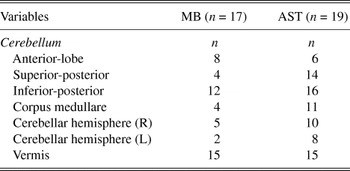
In addition to identifying left hemisphere, right hemisphere, or vermis (Levisohn et al., Reference Levisohn, Cronin-Golomb and Schmahmann2000; Riva & Giorgi, Reference Riva and Giorgi2000; Schmahmann & Sherman, Reference Schmahmann and Sherman1998), tumors were classified using the Pierson et al. (Reference Pierson, Westmoreland Corson, Sears, Alicata, Magnotta and O’Leary2002) cerebellar parcellation into anterior cerebellar lobe, superior posterior cerebellar lobe, inferior posterior cerebellar lobe, and corpus medullare (cerebellar deep white matter). Locations were not mutually exclusive. Group distribution of cerebellar tumor location is shown in Table 6.
Pre-operative MRI coding of tumor location

Note
MB = medulloblastoma; AST = astrocytoma.
More than three-quarters of the AST group tumors involved the cerebellar vermis (79%), with only 21% of cases presenting with clearly lateralized hemispheric tumors. All tumors in the MB group involved the cerebellar vermis, with the majority (70%) located solely within the vermis. The traditional association of MB and a vermal location was strong, with nearly three-quarters of the group having solely a vermal location, but the lateralized location for the AST condition (e.g., Riva & Giorgi, Reference Riva and Giorgi2000) was less apparent.
Tumors involving the vermis occurred equally in AST and MB groups, but hemispheric tumor involvement was more frequent in the AST group (χ2 = 4.48, p = .02), especially in the left cerebellar hemisphere (χ2 = 3.60, p = .05). There was involvement of the superior-posterior lobe of the cerebellum more often in the AST group than in the MB group (χ2 = 5.56, p = .01). Other tumor locations did not differ by groups.
Emotion Identification was unrelated to tumor location in either group. For the Cognitive Control task, a significant positive correlation was observed in the AST group between Cognitive Control and CB right hemisphere, r = .53, p = .02, and in the MB group, between Cognitive Control and anterior lobe, r = .52, p = .03.
DISCUSSION
In children treated for benign and malignant tumors of the cerebellum, emotion identification is largely normal. For the most part, children with cerebellar tumors identified emotion accurately and swiftly, and used the same cues as did typically developing children. Our expectation that children with cerebellar tumors might be relatively insensitive to tempo cues was not supported. Like typically developing children, children with cerebellar tumors were faster and more accurate at identifying happy rather than sad emotion. The combination of Mode and Tempo changes obliterated emotional valence for children with cerebellar tumors, just as for typically developing children. For all children, ratings of emotion were clearer and stronger in the Original condition than in the modulated conditions.
Identification of negative emotion was disproportionately poor in the MB group, who perceive negative emotion to be less negative than do the other groups. The data suggest a relative, rather than absolute, insensitivity to negative emotion in the MB group, who could discriminate happy and sad pretests, identify sad emotions better than chance, but tended to neutralize negative emotions.
The most important difference between tumor and control groups was in the cognitive control of emotions. On the Affective Music Stroop Task in which subjects were asked to ignore the emotion conveyed by the lyric but attend to the emotion in the music, both tumor groups matched controls on congruent condition, but were less accurate in the incongruent condition. On the Lyric Stroop Task, the tumor groups were slower on both conditions, and the MB group was less accurate when the lyrics were sad and the music was happy.
Impairments in emotion and the cognitive control of emotion are dissociable from psychometric test performance and from radiation history. Despite psychometric test performance differences between the tumor and control groups, children in the AST group performed as accurately and as quickly as controls on the Emotion Identification Task, children in the MB group generally performed similarly to controls, and both tumor groups were impaired on the Musical Stroop task, suggesting that impaired cognitive control of emotion occurred regardless of radiation treatment status.
Eye movement disorders may complicate the study of the cognitive functions of the cerebellum (Glickstein, Sultan, & Voogd, Reference Glickstein, Sultan and Voogd2009). Using music for the emotion tasks minimized the role of eye movements. Furthermore, the fact that we found more tumor-related differences on cognitive control than on emotion identification tasks suggests that eye movement deficits contributed relatively little to the cognitive-affective disturbances we have described. Our data therefore provide some support for the idea that the cerebellum is involved in cognition independent of eye movements (Habas et al., Reference Habas, Kamdar, Nguyen, Prater, Beckmann and Menon2009).
Recent studies of cerebellar structure-function relations suggest that the cerebellar anterior lobe is principally engaged in motor control, the posterior cerebellum is important for complex cognitive operations, and the cerebellar vermis is involved in affective processing (Exner, Weniger, & Eva Reference Exner, Weniger and Eva2004; Levisohn et al., Reference Levisohn, Cronin-Golomb and Schmahmann2000; Schmahmann, Reference Schmahmann2004; Schmahmann, Weilburg, & Sherman, Reference Schmahmann, Weilburg and Sherman2007; Schmahmann & Sherman, Reference Schmahmann and Sherman1998; Schoch, Dimitrova, Gizewski, & Timmann, Reference Schoch, Dimitrova, Gizewski and Timmann2006; Stoodley & Schmahmann, Reference Stoodley and Schmahmann2009, Reference Stoodley and Schmahmann2010; Tavano et al., Reference Tavano, Grasso, Gagliardi, Triulzi, Bresolin and Fabbro2007). For the MB group, better cognitive control occurred with tumor involvement in the anterior cerebellum.
The relation between emotion and vermis lesions remains to be compared in congenital and acquired cerebellar disorders. Of interest, affect disturbances are unrelated to vermis lesions in Joubert syndrome (Hodgkins et al., Reference Hodgkins, Harris, Shawkat, Thompson, Chong and Timms2004; Tavano & Borgatti, Reference Tavano and Borgatti2010), an autosomal recessive condition characterized by hypotonia, psychomotor delay, ataxia, and apraxia, and hypoplasia of the cerebellar vermis (Maria et al., Reference Maria, Hoang, Tusa, Mancuso, Hamed and Quisling1997; Valente, Brancati, & Dallapiccola, 2008).
Recent hypotheses have proposed that the right cerebellum differentially processes high pass filtered information (segmental properties) and the left cerebellum differentially processes low pass filtered information, including the prosodic information important for speech prosody, affect, and singing (Callan, Kawato, Parsons, & Turner, Reference Callan, Kawato, Parsons and Turner2007). The fact that AST tumor involvement in the right cerebellar hemisphere preserved cognitive control of emotion may mean that the left cerebellar hemisphere is more important than the right for cognitive control in music, which is the key component of language prosody.
The neuroanatomy of tumor location in relation to cognitive control requires further study. Our analyses of structure-function relations are preliminary, exploratory in nature, and tempered by the fact that most tumors did involve the cerebellar vermis.
Damage to the cerebellum can cause a broad range of cognitive and affective disturbances (Baillieux, et al., 2009), collectively termed the CCAS (Schmahmann & Sherman, Reference Schmahmann and Sherman1998). Our data add to the emerging body of literature showing that these disturbances occur after acquired lesions of the cerebellum in both children and adults, which highlights the lifespan role of the cerebellum in cognitive affective-processing (Tavano, Fabbor, & Borgatti, Reference Tavano, Fabbor and Borgatti2007; Tavano et al., Reference Tavano, Grasso, Gagliardi, Triulzi, Bresolin and Fabbro2007). The new information in our study concerns operationalizing two features of the CCAS, emotion identification and cognitive control of emotion, and demonstrating that the latter rather than the former is disrupted in children with acquired cerebellar tumors.
Developmental perturbations of the cerebellum alter cognitive-affective function. The fact that childhood acquired cerebellar tumors disrupt cognitive control of emotion more than emotion identification provides some support for a model of the CCAS as a disorder, not so much of emotion as of the regulation of emotion by cognition. These data extend into the music affect domain recent research suggesting that cerebellar lesions disrupt cognitive control (Levisohn et al., Reference Levisohn, Cronin-Golomb and Schmahmann2000; Rønning et al., Reference Rønning, Sundet, Due-Tonnessen, Lundar and Helseth2005; Tavano et al., Reference Tavano, Grasso, Gagliardi, Triulzi, Bresolin and Fabbro2007; Vaquero, Gómez, Quintero, González-Rosa, & Márquez, Reference Vaquero, Gómez, Quintero, González-Rosa and Márquez2008); however, whether and how the cognitive regulation of emotion is related to other forms of cognitive control in children with acquired cerebellar tumors remains to be understood.
ACKNOWLEDGMENTS
This research was submitted to the University of Toronto in partial fulfillment of the degree of Doctor of Philosophy for the first author. The research was supported by the Research Unit of the Pediatric Oncology Group of Ontario (POGO) through a research fellowship for the first author. We thank Dr. Eric Bouffet, Director of the Brain Tumour Program at the Hospital for Sick Children, for facilitating patient recruitment, Dr. Isabelle Peretz from the University of Montreal for sharing her music stimuli for the Emotion Identification task, and Mr. Steven Kulikowsky for illustrating the stimuli for this project. The authors have disclosed any and all financial or other relationships that could be interpreted as a conflict of interest affecting this manuscript.