Introduction
Shifting cultivation, also known as jhum, slash and burn, land rotation or swidden is a traditional agricultural method mostly practiced by the tribal communities (Conklin Reference Conklin1961; Fox et al. Reference Fox, Truong, Rambo, Tuyen, Cuc and Leisz2000; Kafle Reference Kafle2011). Shifting cultivation is practiced in about 40–50 countries where it serves as a main source of livelihood (Mertz Reference Mertz2009). In South and Southeast Asia, shifting cultivation is mostly practiced by hill people, ethnic minorities, tribal and indigenous people. In India, shifting cultivation, commonly known as jhum cultivation, is practiced particularly by ‘Adivasis’ of Central and South India and tribal communities of northeast India (Erni Reference Erni and Erni2015). The people who practice jhum cultivation are called as ‘jhumias’.
In northeast India, tribal people have been practicing jhum for millennia and has become a part of their culture. Jhum practice relies on the cyclic use of land in which a period of fallow is maintained for the restoration of soil fertility. However, several current literatures reported a reduction in fallow period due to population pressure impacting the jhum cycle, leading to a decline in soil fertility, crop yield and food security (Grogan et al. Reference Grogan, Lalnunmawia and Tripathi2012). Jhum cultivation is typically practiced in hill slopes that are prone to nutrient loss; therefore, farmers cultivate mixed cropping where various food crops are grown together to get maximum output (Majumder et al. Reference Majumder, Shukla, Arunachalam and Lichtfouse2010). In jhum cultivation, farmers rely on local crops over hybrids because of better performance especially during adverse environmental conditions (Nakabonge et al. Reference Nakabonge, Samukoya and Baguma2018). Jhum system is mainly cultivated for subsistence farming in which upland rice is generally grown as the main crop (Rathore Reference Rathore, Singh, Mandal, Singh and Anantha2011; Sarma Reference Sarma, Shaw, Natori and Edake2022).
Nagaland is inhabited by 17 major tribes and rice is the staple crop of these communities. These tribal communities rely on rain-fed jhum agriculture for subsistence, where rice is grown as the main crop along with varieties of other crops for household nutritional requirements (Dixon Reference Dixon1923; Yano and Lanusosang Reference Yano and Lanusosang2013; Pradheep et al. Reference Pradheep, Soyimchiten and Nayar2014; Prakash et al. Reference Prakash, Roy, Ansari, Sharma, Punitha, Sailo and Singh2017). In Nagaland, the jhum area occupies about 90,496 ha producing 179,227 metric tons of rice (Directorate of Economics & Statistics 2023). Rice productivity was sufficient to meet the farming household requirements when there was enough cultivable land to accommodate all the farm families. Currently, the rice produced in jhum fields is sufficient to meet the needs of farming families only for about 4 months; this is because with the increase in population, the farm is fragmented to share among an increasing number of farming families, thus, rice production declines, resulting in insufficiency to feed the family (Jamir Reference Jamir, Bhardwaj and Chhetri2016). During 2017 and 2019, the area under jhum cultivation declined by 60 ha, while wet terrace fields increased by 510 ha (Directorate of Economics & Statistics 2020). Several factors influence continued practice of jhum cultivation in Mon district; lack of supportive infrastructure, hilly terrain, socio-economic challenges, inadequate access to low-cost sloping agricultural technology and lack of agricultural extension services (Krug et al. Reference Krug, Schlecht and Buerkert2013; Pandey et al. Reference Pandey, Adhiguru and De2019). Despite challenges, Mon district harbours considerable germplasm diversity by continuing traditional agriculture and seed management practices. Therefore, this study was conducted to analyze and document traditional cultivation practices of jhum farmers in Mon district with particular emphasis on conservation of landrace rice as valuable plant genetic resources. By linking the socio-economic profile of jhum cultivators, cultural practices and local ecological knowledge, this study aims to highlight how traditional-based jhum farming systems contribute to in situ conservation of upland rice by the indigenous inhabitants of Mon.
Materials and methods
Study site
The study was conducted in Mon district, located in the northeastern part of Nagaland, India. Mon district is inhabited by the Konyak Naga tribe. It borders Myanmar to the East, Longding district of Arunachal Pradesh to the Northeast and Sivsagar district of Assam to the West. As per the 2011 census, the literacy rate of Mon district was 57% consisting of 60.9% male and 52.6% female of the total population (Directorate of Economics & Statistics 2023). Mon district has a geographical area of 1786 km2 and lies at an altitude of 100–1800 m above mean sea level. The district receives annual rainfall of about 200–300 cm, and an average temperature of 24.4°C (Pradheep et al. Reference Pradheep, Soyimchiten and Nayar2014). The district is divided into three agro-climatic zones: temperate climate in Tobu, Chen, Longching, Mopong and Longwa villages; subtropical climate in Mon, Chi, Aboi villages and tropical climate found in Tizit, Tiru and Naginimora (Pradheep et al. Reference Pradheep, Soyimchiten, Pandey and Bhatt2016). As per the 2023 census, Mon district has 75.9% of its geographical area under forest cover (Forest Survey of India 2023). More than 93% of the people depend on jhum cultivation where rice is the primary staple food crop followed by maize, taro, millets and varieties of vegetables (Krug et al. Reference Krug, Schlecht and Buerkert2013).
Study design and data collection
Field work was conducted during December 2021 to January 2023. A survey method was used to collect primary data on socio-economic profiles, agricultural management practices, farming knowledge, germplasm preservation techniques and customary practice on land use management related to jhum cultivation. Germplasms of landrace rice were collected at the time of primary data collection from the informants. Field surveys were conducted on the cultivation sites for observation of the agricultural landscape, visual observation of the tools used by the farmers and obtaining coordinates. For data collection, a stratified random sampling approach was used; stratification was based on administrative delineation representing eight administrative blocks as strata, viz., Tizit, Mon, Wakching, Tobu, Aboi, Angjangyang, Phomching and Chen block of Mon district. Stratification was used to ensure broader representation of germplasm and cultural diversity of jhum-based rice farming systems, with unique altitudinal and agro-ecological zones in different administrative blocks (Bernard Reference Bernard2017). Within each block, three representative villages were selected randomly, and five farmers (informants) from each village were chosen by the village councils based on their engagements in jhum farming (Newing et al. Reference Newing, Eagle, Puri and Watson2011). This resulted in interaction with a total of 120 informants from 24 villages (Fig. 1). This sampling approach enabled maximizing the efficiency of capturing diversity in socio-economic life of farmers, agricultural practices and germplasm variability in the study location and avoid data saturation considering the limitations in time and cost of collecting data (Guest et al. Reference Guest, Bunce and Johnson2006; Richards et al. Reference Richards, Antolin, Reilley, Poole and Walters2007).
Map indicating study sites in Mon district, Nagaland and location where rice germplasm was collected.

Data collection from informants was performed using a semi-structured interview method including open-ended questions through personal interviews with each informant, separately, followed by a telephonic interview in certain cases as required (Newing et al. Reference Newing, Eagle, Puri and Watson2011). A standardized set of questions was used with all the informants covering demographic profile, agricultural management practices, rice germplasm maintenances and their farming knowledge. In addition, informal discussions on farmer-led narratives were conducted to document traditional knowledge and customary practices in jhum. While this study does not fully qualify for ethnographic study, elements of ethnographic inquiry (De Fina Reference De Fina and Tusting2019) were incorporated to ensure systematic recording of both quantitative socio-economic data as well as qualitative cultural insights. Standard field data recording techniques provided by Way (Reference Way, Guarino, Rao and Reid2011) were followed during data collection. Interviews and discussions were conducted in the local dialect. Free prior informed consent was obtained from the village council ahead of time and with individual informants at the time of the interview. With permission, interviews were recorded using an audio recorder, and transcripts were prepared for further data analysis and interpretation.
Rice seed accession
Rice germplasm was collected from the farmer’s barn, assigned with a unique collection number and was labelled according to Hay and Probert (Reference Hay, Probert, Guarino, Rao and Reid2011). Passport data were recorded according to the format provided by ICAR-NBPGR (Dataset S1) and deposited in the Department of Botany, Kohima Science College, Jotsoma, India.
Results
Demographic profile of informants
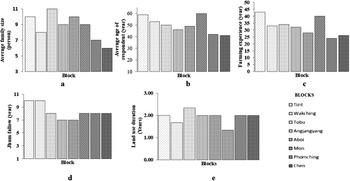
Among the 120 informants, 13.3% were female and 86.7% were male jhum cultivators. The family size varied among the informants and in different administrative blocks. An average number of individuals in a family was highest in the Tobu block with 11 members, followed by Tizit and Aboi with 10 members each, Angjangyang and Mon with 9 members, Wakching with 8 members, Phomching with 7 members and Chen block with 6 members in a family (Fig. 2a). The age range of the informants was 23 to 84 years with an average age of 50.1 years. On average, the informants were older in Mon block (60 years) followed by Tizit (59 years), Wakching (53 years), Tobu (50 years), Aboi (49 years), Angjangyang (46 years), Phomching (42 years) and Chen block with 41 years (Fig. 2b). Farmers with age group of 51–60 constitute 24.2% of the informants, followed by 20.8% (aged 61–70), 18.3% (aged 41–50), 16.7% (aged 31–40), 13.3% (aged 20–30) and 6.7% were aged above 70 (Table 1). The status of formal education differed among the informants. About 27% of the farmers did not receive any formal education, 67% of the farmers received primary education, 2% of farmers had secondary education and 4% had obtained undergraduate education (Table 1). The farming experience of informants varied among the blocks with average of 43, 40, 34, 33, 32, 28, 26 and 24 years of farming for Tizit, Mon, Tobu, Wakching, Angjangyang, Aboi, Chen and Phomching, respectively, (Fig. 2c).
Socioeconomic and agricultural characteristics of jhum farmers across different blocks of Mon district, Nagaland. The figure presents key demographic and agricultural indicators of jhum farming households across eight blocks in Mon district: Tizit, Wakching, Tobu, Angjangyang, Aboi, Mon, Phomching, and Chen. Data collected from a total of 120 respondents. (a) Average family size of the informants. (b) Average age of informants. (c) Farming experience. (d) Jhum fallow period ranging from 7–10 years. (e) Land use duration.

Demographic characteristics of the informants (n = 120). The informants were farmers of Mon district, Nagaland

Land use and field management
Jhum cycle in all blocks was similar with average land use duration of 2 years (Fig. 2e) and the fallow period ranged from 7 to 10 years (Fig. 2d). Jhum fields cultivated by farmers ranged from 0.40 to 2.42 ha of land. The village chiefs of each village generally possessed a larger land area for cultivation. Among blocks, Tizit had the highest land area for jhum cultivation per individual farmer with 1.07 ha followed by Wakching (0.78 ha), Tobu (0.76 ha), Aboi (0.76 ha), Phomching (0.73 ha), Angjangyang (0.59 ha), Chen (0.57 ha) and Mon (0.54 ha).
Jhum fallow sites were left for regeneration without active human intervention post-harvest. Farmers reported leaving crop residues to enhance soil fertility and protect soil from erosion. The majority of the farmers (84 respondents) did not use paid labour because of their larger family size, which enabled them to perform all the farm activities by themselves, thereby reducing farming costs. While 20 respondents required additional labour to cultivate their fields and 16 respondents rely on community contributions (Table 2). Mostly, farm labour was available from within the village, either through daily wage hiring or reciprocal labour exchange systems locally called Aei. On average, farmers in Mon district spent ₹15,300 annually on hired labour. A unique cultural practice observed in all the study villages was the contribution of at least a labour by each family in a particular village to the village chief, usually during forest clearing, weeding and harvesting. The farmers rely on traditional tools such as machete (Chang) for clearing forests, hoe (Zoahun) for weeding and sickle (Tsahzat-changkoih) during harvest. Weeding was considered to be one of the most labour-intensive jhum operations, usually performed three to four times annually, that accounted for the largest share of expenditure on time and resources. Additionally, farmers used salt twice a year to control weeds.
Traditional landrace rice distribution and labour composition in jhum cultivation system across eight administrative blocks in Mon district, Nagaland, India
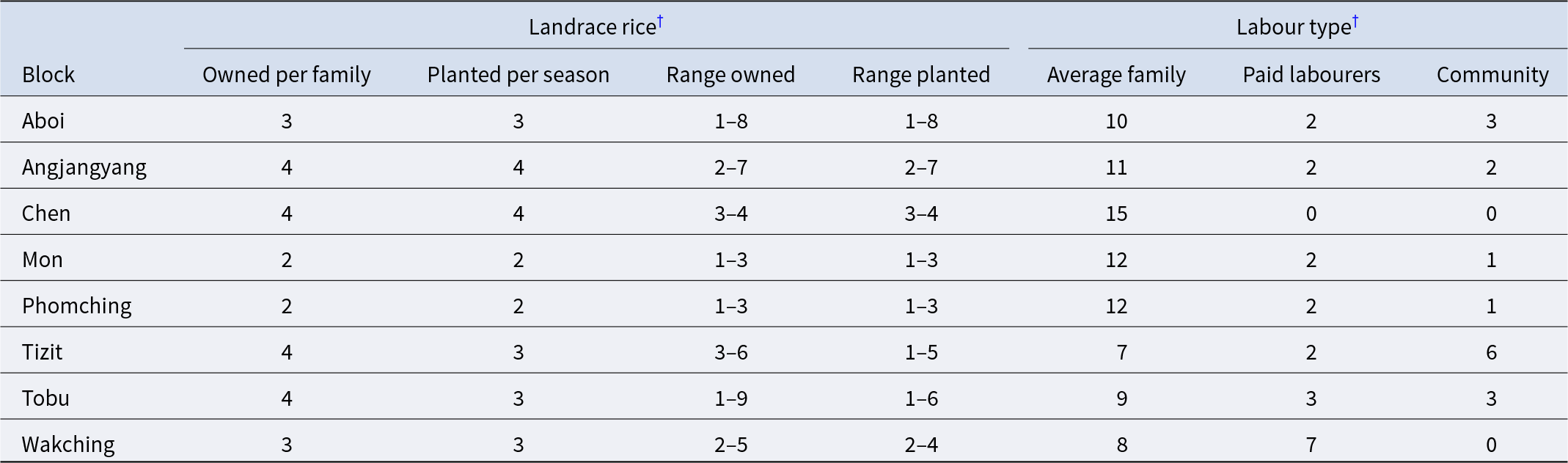
† Data collected from 15 respondents from each block.
Knowledge on pests, diseases and fertilizers
In most of the fields, rats, termites, birds, grasshoppers and white grub were the major pests encountered by the farmers. They did not use any protective measures, however, for rats, farmers used traditional trapping techniques called Tung, traps made of bamboo, as a control measure. Among the pests, white grub was the most problematic, with 89 informants reported severe damage in their fields, followed by damage by rats and birds (4 informants) and grasshoppers (3 informants). In 2019, a localized outbreak of leaf blight of rice was reported by informants in Wakching block. Despite the severity of the disease, farmers did not use any control measures which resulted in a substantial yield loss as reported by the informants. In both the first and second years of jhum fields, fertilizers were not applied due to the apprehension that chemical fertilizers degrade soil fertility over time. They relied on controlled burning of fields as a source of fertilizers. People from the Southern region of the district such as Tobu and Pesao practiced alder-based farming as a source of firewood and for soil nutrient enrichment; however, this method was absent in the other regions of the district.
Traditional jhum practice among the Konyaks
Activities and sequence of events in jhum cultivation were found to be similar among villages based on the information provided by the informants. Jhum cultivation appeared to have a strong cultural significance among the Konyak community of Mon district which exists to this day. Every year, a new jhum area for cultivation was selected with consensus within the community of a particular village. The village chief organized a meeting to decide on the site for jhum cultivation. The farmers started clearing the land in January by cutting down the forest, during which firewood was collected. The cut forest was allowed to dry, followed by controlled burning by late February or early March. During this process, a small temporary farm hut was constructed by each farmer, and final plot preparation was done by collecting and burning wood debris. The farmer informants reported that tree species such as Schima wallichii locally called ‘Zak’ and Macaranga indica, Macaranga peltata and Macaranga denticulata locally known as ‘Poak’ were commonly maintained or cultivated for firewood and timber. During forest clearing, farmers deliberately retained S. wallichii trees, pruning their branches instead of felling them entirely to encourage regrowth. The farmers considered S. wallichii as a high-quality source of firewood and timber. In contrast, Macaranga species were either naturally regenerated or occasionally sown in jhum fields, primarily for firewood purpose. Rice was planted in the months of March and April. To signify the beginning of the new cropping season, the Konyak tribe celebrates ‘Aoleang’, a festival invoking blessings for the new year and bountiful harvest. Farmers of Angjangyang, Tobu, Aboi blocks planted rice using a long hollow bamboo stick to dibble the seed into the ground. In other blocks such as Tizit, Mon, Wakching and Phomching, farmers simply sown the grains by broadcasting method. After a month, weeding and thinning of rice was performed to promote growth. Subsequently, weedings were conducted in the months of May, June and July. Rice harvesting was performed between August and September.
Seed management and storage
According to the informants, each farmer relies on their own seed source for the following cropping season and preserves preferred seed traits to reduce dependence on external sources. They maintain their own seed bank through traditional seed selection and preservation processes. Farmers select seeds in their own field based on phenotypic characters such as larger grain size and uniform maturation. Sufficient plants with larger seed size were marked at the late maturity stage and harvested separately. The grains were then threshed and sun-dried carefully to avoid seed mixing with other landrace rice and were later stored in a traditionally made clay pot (Tikpuh) (Fig. 3a) or woven jute sacks to protect from pests and preserve seed viability until the next sowing season. Rice intended for consumption was stored in the granaries (Fig. 3b). In villages like Wanching, Tanhai and Langmeang, the majority of the granaries were constructed far away from the farmers’ homes, ensuring that the rice was safe in the event of a fire incident. In a village like Langmeang of Aboi block, it was reported that only women folks managed rice in granaries as a tradition, while men only focused on farming.
Traditional methods of grain storage, jhum landscape and agricultural tools used by farmers in Mon district, Nagaland. (a) Seed preservation in clay pot Tikpuh. (b) A newly constructed granary in Pesao village of Tobu block. (c) Soil conservation practices showing pollarded alder trees and contour bunding to prevent erosion in Changlangshu village. (d)Traditional agricultural tools used by jhum farmers across Mon district.

Rice germplasm diversity and cultural significance
In this study, 147 landrace rice accessions were collected from 24 villages in Mon, Nagaland (Table S1). The farmers categorized the rice accessions into non-sticky and sticky (glutinous type) rice based on their uses. A total of 106 accessions were non-sticky, and 41 accessions were sticky rice. Rice diversity across different blocks of Mon revealed variation in the conservation of different landrace rice and the purpose of utilization among farmers. The average number of landrace rice owned per farmer was four in Tizit, Angjangyang, Chen and Tobu blocks, while Aboi and Wakching with three, Mon and Phomching blocks with two rice each. The average number of rice cultivated per season was highest in Angjangyang and Chen block with four rice, followed by Tobu, Tizit, Aboi, Wakching with three rice, while Mon and Phomching block with two each.
Across the rice distribution, eight rice accessions, viz., China yam T (To-R001), Yeamnyak (Uk-R007), Yeamsheang (Lo-R003), China yam U (Uk-R011), Yeamshao (An-R002), Chuhen yeam (An-R005), Yeamkok (An-R007), Yeamnyak (Lo-R002) and Yeamsheang (Lo-R003) were known to be used for medicinal purposes. For medicinal uses, farmers harvested the rice, threshed and sun-dried it, followed by hulling, performed manually. The raw rice grains were then grounded and either made as a paste or cooked to turn watery and used for treating minor ailments such as cuts, burns, wounds and gastrointestinal issues. These medicinal rice were all collected from Tobu and Angjangyang blocks.
Farmers typically cultivated an average of three rice per season including sticky rice in a small land area for self-consumption and ceremonial uses such as Aoleang festival and Lao-ang-mo (post-harvest festival). Some rice like Vumchong (Wa-R006) of Wanching village and Wang-tsahyan (Za-R006) of Zangkham village have cultural significance. Vumchong rice was traditionally used for ancestral rituals to honour and connect with deceased family members and ancestors but is now widely cultivated for consumption. In contrast, Wang-tsahyan remains exclusive for the Ahng clan. Common people do not use this rice for consumption as they are generally not permitted to cultivate it, and it is cultivated only by the village Ahng in a small patch of land to indicate the ownership of that field by the Ahng.
Rice productivity
The data revealed a subsistence rice production system where out of 120 farmers, 116 farmers cultivated rice solely for household consumption, 4 farmers cultivated rice for both family consumption and sale and none of the farmers cultivated it solely for commercial use. Farmers in Mon measure rice grains using a local unit known as ‘tin’ which is a rectangular metal container originally used for storing mustard oil, where 1 tin equals 15 kg of rice. During 2019 – 2020, farmers in Mon sowed an average of 4 tins and harvested 110 tins of rice. A large proportion of farmers (60.8%) responded that their rice production was insufficient to meet household needs. About 47 informants reported yield losses due to inadequate rainfall and 21 informants expressed that yield was affected by rising temperatures (Fig. 4).
Abiotic factors affecting upland rice cultivation as reported by farmers in Mon district, Nagaland (n=120).

Crops diversity in jhum fields
In Mon, along with rice, millets were the most widely cultivated crop as a source of food. Millets were cultivated in the second year jhum fields; however, in Chen block, millets and maize were cultivated in the first year while rice was cultivated in the second year jhum fields because they rely on millets and maize as the main food source. Food crops such as maize, rice, millet, taro, peas, soybean, gourd, pumpkin, cucumber, ginger, chilli, tapioca, watermelon, bitter gourd, mustard, banana, gram, sweet potato, tree tomato, brinjal, coriander, spring onion and Zanthoxylum were some of the widely cultivated crops in the jhum fields of Mon district.
Discussion
The demographic profile of the informant jhum farmers among the Konyak communities indicates the dynamic influence on the current trends of jhum activities in Mon district of Nagaland. The study observed variation among family sizes from 6- to 11-member jhum families that influence the cost of farming. Larger families have more labour availability, thus reducing the need for hiring external workers, but the smaller families often experience labour shortages and face challenges due to a lack of adequate workforce during key agricultural operations such as clearing of vegetation, weeding and harvesting. Weeding was found to be the most labour-intensive and costly activity with 80% of the informants expressed using paid labour during weeding and forest cutting. Gender division of labour was observed, while men generally engage in slash and burn activities, women engage in weeding, harvesting and cleaning.
The age range of informant farmers between 23 and 84 years indicates the involvement of a broad age group in jhum farming that signifies jhum as an important livelihood activity for the community. This importance is reaffirmed by the participation of the younger generation in jhum activities with 30% within the age group of 20–40 years and 42.5% within the ages of 41–60 years. Additionally, 72.6% of the informants received either a primary or higher level of formal education and tend to be actively involved in the farming sector. Despite having formal education, many farmers continue to rely on farming as their primary means of livelihood and income generation by selling various produce from jhum fields. Thus, for the Konyak community, farming is a practice not simply for family sustenance but also a form of self-employment. The coexistence of varied age groups in the farming sector is also suggestive of a close community network in transferring traditional farming knowledge from generation to generation.
Jhum cultivation holds both cultural and livelihood significance among the Konyaks. The annual jhum cultivation site selection led by the village chiefs fosters traditional governance and social cohesion. The preparatory stage of jhum cultivation involves forest clearing and controlled burning that are crucial to maintain favourable conditions for cultivation. Such a process was also reported to be done for nutrient cycling and pests’ control (Yadav Reference Yadav2013). The farmers’ reliance on traditional tools such as machete (chang), hoe (zoahun) and sickle (tsahzat-changkoih) (Fig. 3d) illustrates the persistence of indigenous technologies well-adapted to the terrain and cropping patterns of jhum fields (Jamir and Jha Reference Jamir and Jha2025). According to the informants, the farmers practice measures to reduce soil erosion by placing logs and bamboo poles across slopes (Fig. 3c). Similar practice was reported in other parts of northeast India (Ray et al. Reference Ray, Das and Deka2018). Farmers avoid using synthetic fertilizers but rely on natural processes of decomposition of crop residues, controlled burning and incorporation of alder trees as some adaptation for nutrient enrichment. Additionally, the practice of fallow management reflects some of the ecological knowledge among farmers of Mon district. Tree species such as S. wallichii, M. denticulata, M. indica and M. peltate are integrated in the cultivated field and into the fallow land for timber, soil erosion control, soil fertility enhancement and firewood extraction, thus, demonstrating multifunctional ecosystem services. Although scientific validation is limited, farmers believe these species contribute to higher crop yields and similar practices were reported by Changkija et al. (Reference Changkija, Thakuria, Cynthia and Cairns2023) and Nakro and Konyak (Reference Nakro, Konyak and Cairns2023).
Traditional seed selection and preservation techniques based on uniformity in maturity and larger grain size were found to be common amongst jhum farmers across Mon district. Although visual selection helps maintain locally adapted traits, it is less precise than modern methods which may lead to unintentional genetic drift over time (Soleri and Cleveland Reference Soleri and Cleveland2001). Use of seed storage structures such as clay pots (Tikpuh) and jute sacks is culturally embedded and adapted to local climate and material availability. The exclusive role of women in maintaining granaries in Langmeang village highlights their pivotal role in household food security and genetic resources management.
The occurrence of rich landrace rice germplasm diversity is attributed to the individual farmer’s reliance on their own seed sources and the necessity to grow multiple rice types for their family and customary ritual requirements. Each family grows at least three rice types in a season; this diversification strategy mitigates crop failure and supports dietary needs (Bellon Reference Bellon1996). Farmers preserve landrace rice based on social and cultural practices, historical factors, preference for consumption like texture, taste and aroma, thus influencing crop dynamics (Roy et al. Reference Roy, Patra, Kumar, Sar, Jogi, Konyak, Banerjee, Basak, Mandal and Bansal2024). Such approaches contribute to the maintenance of germplasm diversity. Festivals such as Aoleang and Lao-ang-mo involve specific sticky rice types such as Zamzang (Za-R002), Zamsa (Ya-R002), Yeamnyak (La-R004), Shovem (Wa-R007) and Weamsheang (Ta-R001). Vumchong rice, once ritual specific, is now consumed widely, while Wang-tsahyan remains restricted to the Ahng clan and solely cultivated by the village chiefs. Such cultural restrictions, though valuable, may risk loss of rare landraces if the younger generation loses interest in cultivation. Eight sticky rice accessions were identified for medicinal uses, although the biochemical nature of these rice germplasms has not been scientifically studied. Use of rice for medicinal purposes was also reported from other parts of India (Umadevi et al. Reference Umadevi, Pushpa, Sampathkumar and Bhowmik2012; Chaudhari et al. Reference Chaudhari, Tamrakar, Singh, Tandon and Sharma2018). Notably, these accessions were exclusively collected from the Tobu and Angjangyang blocks, where the altitudes ranged from 1200 to 1700 m. This geographic specificity raises intriguing questions about the relationship between altitude and the accumulation of bioactive compounds in rice.
Despite the persistence of a subsistence-oriented rice production system, 60.8% of respondents reported insufficient annual rice requirements, thereby necessitating dependence on market purchases or government aid, particularly through the public distribution system. This situation underscores food security concerns, suggesting that rice farming under current practices may be unable to guarantee self-sufficiency in rice requirements. With climate change, currently expressed pests and diseases pressure may increase causing additional yield loss. Another insight from the data is that 39% of farmers reported yield losses attributed to erratic rainfall and rising temperatures. These findings resonate with multiple studies indicating that changes in temperature and erratic rainfall patterns during critical growth stages can cause a significant reduction in yields, particularly in upland ecosystems (Gupta and O’Toole Reference Gupta and O’Toole1986; Malabuyoc et al. Reference Malabuyoc, Real and De Datta1993; Dubey et al. Reference Dubey, Verma, Goswami and Devedee2018). Interestingly, the cropping system reveals a diversified and adaptive system tailored to both ecological and household needs. While rice remains the staple food crop, incorporation of other food and horticultural crops such as cereals, legumes, tubers, fruits, vegetables, spices and condiments highlights the multifunctional nature of jhum agroecosystems. This system has the potential to supports nutrition and marketable surplus in small quantities (Graham et al. Reference Graham, Welch, Saunders, Ortiz‐Monasterio, Bouis, Bonierbale, De Haan, Burgos, Thiele, Liria, Meisner, Beebe, Potts, Kadian, Hobbs, Gupta and Twomlow2007; Sharma and Wardhan Reference Sharma, Wardhan, Sharma and Wardhan2017). Furthermore, common intercropping practices in jhum, such as growing legumes with cereals or vegetables, enhance soil fertility through nitrogen fixation (Kebede Reference Kebede2021).
Overall, the agricultural system in Mon district reflects a strong linkage between traditional knowledge and ecological sustainability. The rich diversity of landrace rice offers valuable genetic traits for crop improvement under changing climates. Revitalizing traditional systems with modern agricultural practice may offer the most viable and effective strategy to enhance the productivity and sustainability of the present agricultural method (Altieri and Nicholls Reference Altieri and Nicholls2017). These approaches not only reinforce food sovereignty and ecological resilience but also ensure that culturally rooted practices such as the indigenous seed selection and use of landraces are preserved as part of climate adaptation strategies. Such hybrid models, with participatory approaches and agroecological principles, would strengthen food security, ecological sustainability and conservation of plant genetic resources.
Ethical considerations
This study adhered to ethical standards and guidelines outlined by the Indian Council of Social Science Research and the Food and Agriculture Organization (FAO). The objectives of the research were explained to all participating farmers in their local dialect and prior informed consent was obtained verbally where participants were assured that their involvement was entirely voluntary. All data were collected with respect for local customs and indigenous knowledge in line with FAO guidelines. Data were stored securely and used only for the purposes of academic study. Findings will be communicated back to the communities involved, in accordance with the FAO principle of benefit sharing. While a formal ethics committee approval was not required by the host institution at the time of this study, internationally accepted ethical principles were implemented in this study.
Supplementary material
The supplementary material for this article can be found at https://doi.org/10.1017/S1479262125100385.
Acknowledgements
The authors are thankful to the informants, village council and students’ union of 24 villages for their kind assistance and participation in the data collection processes. Authors appreciate the technical support from Longang Luklem, Thaknei Wangsa, Ahat Konyak and A. Khampei Konyak.
Funding statement
The germplasm collection was funded by Kohima Science College, Jotsoma, Nagaland. The first author was supported by NFST fellowship, Ministry of Tribal Affair, Government of India.
Competing interests
None.