


The scholarly literature examining prejudice toward social groups has long considered religion a key determinant (Adorno et al. Reference Adorno, Frenkel-Brunswik, Levinson and Sanford1950; O’Reilly and O’Reilly Reference O’Reilly and O’Reilly1954; Triandis and Triandis Reference Triandis and Triandis1960), although its paradoxical role soon became apparent. As succinctly put by Gordon Allport, “Some people say the only cure for prejudice is more religion; some say the only cure is to abolish religion” (Reference O’Reilly and O’Reilly1954, 413).Footnote 1
Current research acknowledges the political ambivalence of religion (Appleby Reference Appleby2000; Philpot Reference Philpott2007) as both inspiring cooperation and motivating conflict (Norenzayan Reference Norenzayan2014). On the one hand, religious belief is thought to engender compassion towards the unfortunate and to breed values like solidarity, altruism, and charity, which in turn increases positive feelings toward the disadvantaged (Dekker and Halman Reference Dekker and Halman2003; Knoll Reference Knoll2009; Norenzayan Reference Norenzayan2014; Schwartz and Huismans Reference Schwartz and Huismans1995). On the other hand, religiosity is also connected to intolerance, prejudice, and xenophobia (Adorno et al. Reference Adorno, Frenkel-Brunswik, Levinson and Sanford1950; Djupe and Calfano Reference Djupe and Calfano2013a; Gibson Reference Gibson, Wolfe and Katznelson2010; Hunsberger Reference Hunsberger1995; Johnson, Rowatt, and LaBouff Reference Johnson, Rowatt and Labouff2010).
Similar mixed effects of religiosity are found in the literature examining attitudes towards immigration. While some stress the positive effect of religiosity on attitudes towards immigrants (Boomgaarden and Freire Reference Boomgaarden and Freire2009; Knoll Reference Knoll2009; Lubbers, Coenders, and Scheepers Reference Lubbers, Coenders and Scheepers2006), others find it to be associated with support for restrictive immigration policies (Fetzer Reference Fetzer2000) and antipathy toward immigrants (McDaniel, Nooruddin, and Shortle Reference McDaniel, Nooruddin and Shortle2011; Scheepers, Gisbert, and Hello Reference Scheepers, Gijsbert and Hello2002).
We argue that these conflicting findings result mainly from differences in the conceptualization and measurement of religiosity, which involves a complex, multifaceted individual experience. Recent research has shown that religiosity is best understood as having multiple components including belief, behavior, and belonging (Leege and Kellstedt Reference Leege, Kellstedt, Leege and Kellstedt1993; Smidt, Kellstedt, and Guth Reference Smidt, Kellstedt, Guth, Smidt, Kellstedt and Guth2009), which often have diverse and sometimes discrepant effects on political attitudes and behavior (Dekker and Halman Reference Dekker and Halman2003; Kotler-Berkowitz Reference Kotler-Berkowitz2001), and with unique psychological mechanisms underlying the effect of each dimension (Ben-Nun Bloom and Arikan Reference Ben-Nun Bloom and Arikan2013a).
Capitalizing upon this paradigm, we argue that the belief and behavior dimensions of religiosity have divergent effects on attitudes towards immigration, and that these effects are conditional on the extent to which immigrants are different from host society members. First, based on social identity theory, the religion as social identity hypothesis posits that activating one's religious group identification results in stronger anti-immigrant sentiment, especially to the extent that the immigrants are viewed as different from group members, since religious and ethnic “otherness” induces symbolic identity threat (Brader, Valentino, and Suhay Reference Brader, Valentino and Suhay2008; Kinder and Sears Reference Kinder and Sears1981; Tajfel Reference Tajfel1981). Second, the religious compassion hypothesis, taking into account that religious teachings stress the expression of compassion and caring for the needy, anticipates that the activation of religious beliefs contributes to more positive feelings towards immigrants, especially towards those who are perceived as being similar to group members, since the devout often direct their kindness towards their kin and co-religionists (Norenzayan Reference Norenzayan2014).
To test these hypotheses, we primed religious social identity and religious belief using questions-as-treatments (Experiment I) and scrambled-sentences tasks (Experiment II), while varying the religiosity and ethnicity of the target group in three different settings, and among members of different religious traditions: American Catholics, Turkish Muslims, and Israeli Jews. Findings confirm that religion may be related to both anti- and proimmigration sentiments, depending upon the dimension of religiosity stressed as well as the similarities and/or differences between immigrants and natives, with both ethnicity and religion emerging as potent cues for immigrants’ “otherness.” These results are largely consistent across the three different religious and national settings tested. Thus, the effect of religiosity on attitudes towards immigrants is far from being predetermined (Djupe and Calfano Reference Djupe and Calfano2013a; Reference Djupe and Calfano2013b), but rather is sensitive to the informational environment.
THE RELIGION AS SOCIAL IDENTITY HYPOTHESIS: THE EFFECT OF RELIGIOUS SOCIAL BEHAVIOR
The current literature distinguishes between the behavior, belief, and belonging elements of religiosity, in what is widely known as the 3B's approach (Smidt, Kellstedt, and Guth Reference Smidt, Kellstedt, Guth, Smidt, Kellstedt and Guth2009; Wald and Smidt Reference Wald, Smidt, Leege and Kellstedt1993; Wald and Wilcox Reference Wald and Wilcox2006). The social behavior dimension of religiosity refers to participation in organized religious communities, places of worship, and social networks that enable individuals to claim group membership. Thus, the political behavior of religious group members may stem from their group attachment and religious social identity.
Social identity theory (SIT) posits that people derive a sense of self from identification with a social group, and consequently take part in symbolic conflict with other groups, striving to maintain a positive group status (Tajfel Reference Tajfel1981). Studies confirm that activating one's in-group identification results in a heightened tendency to become protective of the group's culture and values (Tajfel and Dawson Reference Tajfel and Dawson1965), and that perceived threat to the group's symbolic resources may result in prejudice toward out-groups (Kinder and Sears Reference Kinder and Sears1981; Tajfel Reference Tajfel1981). Indeed, perceived threat to social identity has been found to be a determinant of intolerance in general (Brewer Reference Brewer1999; Djupe and Calfano Reference Djupe and Calfano2013a; Gibson Reference Gibson, Wolfe and Katznelson2010) and anti-immigration sentiment in particular (e.g., Fetzer Reference Fetzer2000; Kinder and Kam Reference Kinder and Kam2009; Sniderman, Hagendoorn, and Prior Reference Sniderman, Hagendoorn and Prior2004).
People often hold multiple social identities (e.g., Roccas and Brewer Reference Roccas and Brewer2002). While research on immigration attitudes has tended to focus on ethnic and national identities (Wright, Citrin, and Wand Reference Wright, Citrin and Wand2012), we argue that religion, too, is an important source of social identity. Religion supplies a particularly powerful narrative, as it is usually acquired at an early developmental stage (Fowler Reference Fowler1981) and consistently reinforced throughout one's lifetime (Citrin, Reingold, and Green Reference Citrin, Reingold and Green1990). Religion also conveys a sense of security and stability (Kinnvall Reference Kinnvall2004), transmits a set of shared values (Ben-Nun Bloom and Courtemanch Reference Ben-Nun Bloom, Courtemanche and Djupe2015; Schwartz and Huismans Reference Schwartz and Huismans1995), and provides powerful social cues for cooperation and conflict by rendering group boundaries explicit (Norenzayan Reference Norenzayan2014). To the extent that people derive their social identity from their religion, a threat to the religious group's symbolic resources due to incoming immigrants is expected to increase exclusionary attitudes towards immigrants.
Still, not all immigrant groups are equally threatening (Ben-Nun Bloom, Arikan, and Lahav Reference Ben-Nun Bloom, Arikan and Lahav2015). In-group identification results in heightened rejection of outsiders when they challenge the group's values, norms, or cohesiveness (e.g., Brown Reference Brown2000; Turner and Reynolds Reference Turner, Reynolds, Brown and Gaertner2001). This means that any increase in the perceived otherness of immigrants increases the symbolic threat they seem to pose to the majority group's social identity, motivating increased antipathy (Allport Reference Allport1954; Kinder and Sears Reference Kinder and Sears1981; Tajfel Reference Tajfel1981). Indeed, studies have reported differential prejudice towards specially devalued out-groups (Hagendoorn Reference Hagendoorn1993), based on greater ethnic and religious differences (see, e.g., Ben-Nun Bloom and Courtemanch Reference Ben-Nun Bloom, Courtemanche and Djupe2015; Brader, Valentino, and Suhay Reference Brader, Valentino and Suhay2008; Strabac and Listhaug Reference Strabac and Listhaug2008). We thus expect the effect of religious social identity on anti-immigration sentiment to be responsive to group cues (Tolbert and Hero Reference Tolbert and Hero1996), such that antipathy is particularly likely to arise towards immigrants who are especially different from in-group members.
Religion is not the only available group cue that may be used for drawing boundaries between natives and foreigners or between different immigrant groups. In fact, the effect of ethnic cues on anti-immigrant sentiment is well-documented (Brader, Valentino, and Suhay Reference Brader, Valentino and Suhay2008; Kinder and Kam Reference Kinder and Kam2009). Taking into account the potential potency of religion as a source of social identity, and the fact that religious identity is often intertwined with ethnic identity, and thus that religion and ethnicity are sometimes inextricably linked (Abramson Reference Abramson and Thernstrom1980), we expect both ethnic and religious group cues to guide anti-immigration sentiment, with immigrants of a different ethnic or religious group exerting more threat to the in-group and suffering from exclusionary attitudes to a greater extent.
Accordingly, the social identity hypothesis predicts that priming religious social behavior increases opposition to immigration, to the extent that immigrants are perceived as being dissimilar to in-group members in religion or ethnicity (H1 ).
THE RELIGIOUS COMPASSION HYPOTHESIS: THE EFFECT OF RELIGIOUS BELIEF
The belief component of religiosity encompasses the set of fundamental beliefs, values, and symbols associated with an understanding of the divine and humanity's relationship to it – such as belief in God, heaven, or life after death (Layman Reference Layman2000). Religious beliefs affect political attitudes through the cultivation of relevant values and cognitive habits, such as benevolence or conservatism (Schwartz and Huismans Reference Schwartz and Huismans1995; Wald and Smidt Reference Wald, Smidt, Leege and Kellstedt1993).
Since all major religious traditions emphasize the responsibilities of the devout towards fellow human beings, promote benevolence, and preach caring for others, religious beliefs are often said to evoke compassion towards the disadvantaged (Schwartz and Huismans Reference Schwartz and Huismans1995), which may be expected to extend to attitudes towards immigrants. In fact, a body of research finds religious belief to be associated with positive attitudes towards immigrant populations, as the devout tend to have internalized values like solidarity, religious compassion, and altruism (Boomgaarden and Freire Reference Boomgaarden and Freire2009; Knoll Reference Knoll2009; Lubbers, Coenders, and Scheepers Reference Lubbers, Coenders and Scheepers2006).
Nonetheless, the tendency of religion to evoke compassion is not universal, as individuals are more empathetic towards in-group members than out-group members (Perdue et al. Reference Perdue, Dovidio, Gurtman and Tyler1990; Saroglou, Delpierre, and Dernelle Reference Saroglou, Delpierre and Dernelle2004). More particularly, although religious belief is a potent motivator of compassion, the devout typically direct their kindness towards their kin and co-religionists (Norenzayan Reference Norenzayan2014). Indeed, a recent meta-analysis suggests that the positive association of religiosity with prosocial tendencies is limited to in-groups (Saroglou, Delpierre, and Dernelle Reference Saroglou, Delpierre and Dernelle2004). Taking a cue from these findings, we expect religious compassion to be expressed most readily towards individuals and groups perceived as similar to in-group members. Thus, the religious compassion hypothesis predicts that priming the belief dimension of religiosity increases support for immigration to the extent that immigrants are perceived as having similar characteristics to the in-group (H2 ).
Further, individuals may differ in their susceptibility to religious compassion, depending on their ideology. Research demonstrates that conservatives are motivated by social dominance and in-group loyalty (Graham, Haidt, and Nosek Reference Graham, Haidt and Nosek2009), and view social inequalities as legitimate (Jost et al. Reference Jost, Glaser, Kruglanski and Sulloway2003). Conservatives also have less sympathetic self-images compared to those of liberals (Eisenberg-Berg and Mussen Reference Eisenberg-Berg and Mussen1980), who base their moral values on caring for the indigent and protecting vulnerable individuals from harm (Graham, Haidt, and Nosek Reference Graham, Haidt and Nosek2009). Liberals also exhibit a stronger tendency towards humanitarian and universalistic values (Caprara et al. Reference Caprara, Schwartz, Capanna, Vecchione and Barbaranelli2006), expanding their moral circle by applying empathy and compassion to broader segments of humanity (Singer Reference Singer2011). As a result, we expect ideology to moderate the extent to which the compassion prime decreases anti-immigration sentiments, such that conservatives will be less sensitive than liberals towards compassion primes (H2a ).
RELIGIOUS BELONGING: CONTROLLING FOR MAJOR TRADITIONS AND IMMIGRATION CONTEXT
In the theoretical framework employed in this study, belonging is typically conceptualized as membership in a major religious tradition (such as Catholicism, Judaism, or Islam) where adherents share common beliefs and values, myths, and symbols (Guth et al. Reference Guth, Green, Kellstedt and Smidt1995; Leege and Kellstedt Reference Leege, Kellstedt, Leege and Kellstedt1993; Steensland, Robinson, and Wilcox Reference Steensland, Robinson and Wilcox2000). The belonging dimension may influence political attitudes above and beyond the belief and behavior dimensions.Footnote 2 Still, the primary goal of this study was to test whether the hypothesized effects of religious belief and religious social behavior hold across different religious traditions and contexts. Theological, psychological, and sociological perspectives on religion suggest that the major religious traditions all emphasize compassion and caring for those who are in need (Schwartz and Huismans Reference Schwartz and Huismans1995). Major religions also provide a strong source of group identification and encourage identifiers to make distinctions between in-group and out-groups (Norenzayan Reference Norenzayan2014; Saroglou, Delpierre, and Dernelle Reference Saroglou, Delpierre and Dernelle2004). Therefore, the hypothesized effects of religious compassion and religious social identity are expected to hold across diverse religious traditions. We thus carried out the experiment in three different contexts and among members of three Abrahamic religions: Catholics in the United States, Jews in Israel, and Muslims in Turkey.
Operationalizing belonging as membership in a major tradition may conceal variance at the level of sects or congregations (Djupe and Calfano Reference Djupe and Calfano2013b; Djupe and Gilbert Reference Djupe and Gilbert2006; Jelen Reference Jelen1992; Wald, Owen, and Hill Reference Wald, Owen and Hill1988),Footnote 3 due to differences in elite cues and social network effects.Footnote 4 While our study was not designed to address denominational or sectarian diversity, we chose to minimize within-tradition variation by selecting religious traditions with relatively less internal diversity (as opposed to Protestants in the United States, for instance). Catholic religious leaders adhere to centralized governance, with a clear church hierarchy and “a self-contained tradition. . . easy to identify” (Djupe and Calfano Reference Djupe and Calfano2013b, 51). American Catholic leaders are expected to carry relatively similar messages on immigration policies, due to the multiculturalist stance of the Church (Dougherty and Huyser Reference Dougherty and Huyser2008). In Turkey, the provision of religious services is regulated by a state agency, the Directorate of Religious Affairs, which interprets religious scriptures, issues fatwas, and distributes the sermons to be given during Friday prayers by local imams, thus contributing to the homogeneity of the messages received by Turkey's Sunni Muslims (Yilmaz Reference Yilmaz2005, 390). Finally, while nontrivial differences exist among Jewish movements in the United States, Israeli Jewry relies predominantly on Orthodoxy (Beit-Hallahmi and Sobel Reference Beit-Hallahmi, Sobel, Sobel and Beit-Hallahmi1991, 4; Kedem Reference Kedem, Deshen, Liebman and Shokeid1995). Both the Ultra-Orthodox (Haredi) party, Shas, and the Orthodox (Dati) party, Habayit Hayehudi (Jewish Home), have been particularly vocal on the issue of incarcerating and deporting the non-Jewish foreign born, while simultaneously supporting Jewish immigration.
The three cases differ not only in religious tradition but also in terms of political and immigration contexts. Within the United States, the largest immigrant group overwhelmingly practices Catholicism (Lugo Reference Lugo2008),Footnote 5 and the Catholic religious elite is generally very supportive of protecting their rights (McDaniel, Nooruddin, and Shortle Reference McDaniel, Nooruddin and Shortle2011). Some Catholic leaders openly admit to being at least partly driven “by the reality that many Latino immigrants are Catholics and represent a critical demographic for the Church” (Parker and Shear Reference Parker and Shear2013). In contrast, while Jewish religious leaders in Israel have traditionally welcomed and encouraged immigration, given that most immigrants to the country have been Jewish (Lustick Reference Lustick1999), the recent influx of non-Jewish Eastern European, Asian, and African workers, as well as Eritrean and Sudanese refugees, has led the Orthodox elite to publicly support the deportation of non-Jewish immigrants while concomitantly welcoming Jewish immigrants, voicing concern that non-Jewish immigrants might not integrate into the country through marriage or naturalization (Lustick Reference Lustick1999). Finally, Turkey has only recently become a destination for regional economic migrants, professionals and retirees from the EU, refugees, and asylum-seekers (Kirisci Reference Kirisci2007), yet immigration remains a relatively less salient issue on the national political agenda, and one on which Muslim leaders typically remain silent.
Overall, these three cases represent a wide variance in religious traditions and in the level and type of incoming immigration,Footnote 6 while minimizing denominational variation. Conducting the experiments in these three contexts thus allowed us to examine the robustness of the proposed effects of religious belief and religious social identity.
EXPERIMENT I
Participants
Experiment I was carried out at three academic institutions: a private Roman Catholic college in New England (American/Catholic setting, N = 154, over the course of two semesters, in 2012–2013), a Turkish university (Turkish/Sunni Muslim setting, N = 158, fall and spring semesters of 2012–2013), and an Israeli university (Israeli/Jewish setting N = 157, spring semester of 2013), for a total of 469 respondents. Demographics for the pooled sample as well as the subsamples are presented in Online Appendix A.
Design and Procedure
The mixed factorial design consisted of a between-Ss factor (Religion prime: religious social behavior prime/religious belief prime/control) and two within-Ss factors for the immigrant type (Similar/dissimilar: immigrants different from main group/immigrants same as main group X; Group type: racial group/religious group).
Between-Ss Manipulation
Priming the different dimensions of religiosity was accomplished by using a questions-as-treatments framework (Chong, Citrin, and Conley Reference Chong, Citrin and Conley2001; Transue Reference Transue2007), wherein the accessibility of related objects in the respondents’ memory was manipulated by exposing them to certain questions upon presenting the dependent variable. Following several experimental studies that report priming effects using religion questions as treatments (e.g., Laurin et al. Reference Laurin, Shariff, Henrich and Kay2012; McFarland Reference McFarland1981), we primed different dimensions of religiosity by slightly adjusting the batteries in Ben-Nun Bloom and Arikan (Reference Ben-Nun Bloom and Arikan2013b).
Participants were randomly assigned to one of three between-Ss experimental conditions. In the religious belief condition, participants were first presented with a prompt regarding their private religious beliefs and a battery of religious belief questions, and then immediately answered items on immigration attitudes, followed by control variables, and finally questions concerning religious social behavior. In the religious social behavior condition, participants first read a short prompt regarding religious social networks and activities, and then were given the social religious behavior and immigration attitudes questions, respectively. The participants were then presented with the controls and religious belief items. In the control group, items tapping anti-immigration attitudes were presented first, and control variables and religious belief and behavior items were presented subsequently. For prompts and measures, see Online Appendix A.
Within-Ss Manipulation
We measured two different types of attitudes towards immigrants. Preference for social distance items asked to what extent respondents would mind an immigrant being appointed as their boss, as well as the extent to which they would mind a relative marrying an immigrant. Support for anti-immigration policies items concerned the extent to which respondents supported restricted immigration policies, including desired level of permitted immigration, and level of support for the deportation of undocumented immigrants.Footnote 7 Each of the two batteries was presented separately for four different types of immigrants, formed by crossing the two within-Ss factors (similar/dissimilar X ethnicity/religion): (1) same ethnicity immigrants, (2) different ethnicity immigrants, (3) same religion immigrants, and (4) different religion immigrants (order randomized).Footnote 8
Measures
Measures were largely adopted from the World Values Surveys and European Social Survey. See Online Appendix A for wordings, descriptive statistics, and scale reliabilities. All measures are coded to vary between 0 and 1, except for age, which is measured in years. Higher values indicate higher levels of anti-immigration sentiment.
Analytic Approach
Our data have a hierarchical structure, with four repeated observations for immigration attitudes towards different types of immigrants (level 1, within-Ss treatments), nested within participants (level 2, between-Ss treatment). To simultaneously examine our hypotheses concerning the between-Ss and the two within-Ss factors, and directly test cross-level interactions, we employed Multilevel Modeling for Repeated Measures data (MLM-RM).Footnote 9
RESULTS–EXPERIMENT I
Difference of Means Analysis
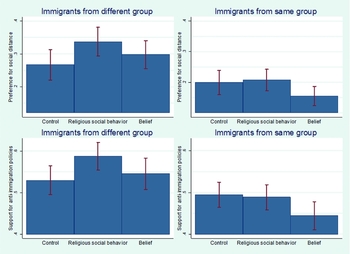
We started with a simple difference-of-means test for four dependent variables: preference for social distance from immigrants of a different race/religion (upper left panel) and of the same race/religion (upper right panel); support for anti-immigration policies towards immigrants of a different race/religion (lower left panel) and of the same race/religion (lower right panel). Figure 1 plots means of these variables in the control, religious social behavior, and religious belief prime conditions, along with the 95% confidence interval bars.
The Effect of Religious Belief and Religious Social Behavior on Immigration Attitudes—Experiment I

The mean response of opposition to immigration varied systematically across the three experimental conditions.Footnote 10 When immigrants are different in terms of ethnicity and religiosity from most members of the society (left-hand side panels), the religious social behavior prime significantly increases both preference for social distance (pttest = .03) and support for anti-immigration policies (pttest = .02) compared to the control condition, whereas the effect of the religious social behavior prime did not significantly differ from the control group for ethnically and religiously similar immigrants, supporting the religion as social identity hypothesis (H1).
When immigrants are of the same ethnic and religious group as most members of the society (right-hand side panels), the religious belief prime decreases both preference for social distance (pttest = .08) and support for anti-immigration policies (pttest = .03) compared to the control condition, but the effect of the religious belief prime is not statistically distinguishable from the control group for ethnically and religiously dissimilar immigrants, providing empirical evidence in favor of the religious compassion hypothesis (H2).
These findings show that the effect of religiosity on immigration attitudes is governed by both the dimension of religiosity and the similarity or difference of immigrant groups to the target groups in terms of ethnicity and/or religion. The religious belief prime decreases preferences for social distance and anti-immigration sentiment, specifically when immigrants are perceived as belonging to the same ethnic or religious group. Activating the social behavior dimension of religiosity induces greater preference for social distance from immigrants and support for more restrictive immigration policies, but this is mainly true when immigrants are different in ethnicity or religion.
Repeated Measures Analysis
To directly test the interactive effect of the dimension of religiosity and the similarity/difference of immigrant groups on immigration attitudes, we employed MLM-RM, wherein repeated items (within-Ss factors: different/same, religion/ethnicity) are embedded in individuals (between-Ss factors: religious social behavior/religious belief/control).Footnote 11
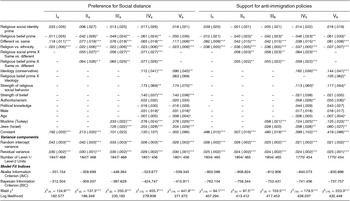
Table 1 presents the main effects of the religion primes (between-Ss factors) and two immigrant type factors (different/same and religion/ethnicity; within-Ss) on preferences for retaining social distance from immigrants and support for anti-immigration policies (Models Ia and Ib); the cross-level interactions of the between-Ss experimental treatments with group type (similar vs. dissimilar) (Models IIa and IIb), and their interactive effects when controlling for context (Models IIIa and IIIb) and for individual-level predispositions (Models IVa and IVb).Footnote 12
Multilevel Models of the Effect of Immigrants Type, Religious Belief, and Religious Social Behavior on Preference for Social Distance—Experiment I

Notes: Table entries are estimated parameters (with standard error in parentheses) of multilevel modeling. * = one-tail 95%, ** = two-tail 95%, *** = two-tail 99% confidence level (note that one-tail significance tests were more appropriate where hypotheses were directional). The models report variances for the variance components, rather than standard deviations (the latter are the square root of the former), since they are employed for the ICC and explained variance estimations.
In the noninteractive models (Ia and Ib),Footnote 13 the two within-Ss experimental treatments have statistically significant main effects. Holding group type and the religion prime manipulation constant, being a “different” (as opposed to “same”) immigrant adds a sizable 12 percent on average to one's social distance preferences, and about 8 percent to her support for anti-immigration policies. Compared to judgment based on ethnicity, judgment based on religion is associated with a 2 percent decrease in social distance preferences (Ia) and a 4 percent decrease in support for anti-immigration policies (Ib), indicating that ceteris paribus, religious group cues are slightly more related to proimmigration sentiment than ethnic group cues.
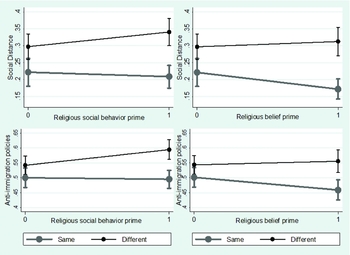
Moving to the between-Ss treatments, the religious social behavior prime and the religious belief prime affect immigration attitudes in opposite directions as expected, but these main effects are not statistically significant. Still, H1 and H2 suggest that the effect of religious belief and social behavior on immigration attitudes is conditional on immigrants being different from the natives. Thus, Models IIa and IIb specify the interactive terms between immigrants who are dissimilar (vs. similar) from most citizens and the two religious primes. Supporting H1 and H2, both interactive terms returned statistical significance, and their coefficients retained their significance when controlling for the context (Models IIIa and IIIb) and for additional individual-level predispositions (Models IVa and IVb). Figure 2 plots the effects of the interaction coefficients to facilitate interpretation.Footnote 14
Moderation of Religious Belief and Religious Social Behavior by Different vs. Same Immigrants—Experiment I

The top-left panel of Figure 2 shows that the religious social behavior prime increases social rejection (compared to control condition) by about 5 percent when immigrants are different from most society members (b = .05, p = .08), but has no significant effect when immigrants are similar (b = −.01, p = .53). In contrast, the top-right panel indicates that the belief prime diminishes rejection of immigrants similar to most society members by about 5 percent (b = −.05, p = .03), but holds a null effect on rejection of immigrants with dissimilar characteristics (b = .02, p = .45).
Results for support for anti-immigration policies show a similar moderation effect. The interaction effect displayed in the bottom-left panel of Figure 2 indicates that religious social behavior boosts support for anti-immigration policies for dissimilar immigrants by about 5 percent (b = .05, p = .02), but has no significant effect for similar immigrants (b = − .01, p = .55). The religious belief prime, on the other hand, does not affect support for anti-immigration policies for dissimilar immigrants (b = .01, p = .61), but decreases support for anti-immigration policies for immigrants with similar characteristics (b = −.05, p = .03). These results provide support for the hypothesis that social behavior increases anti-immigrant sentiment for groups that are religiously or ethnically different, while religious belief decreases anti-immigrant sentiment only when immigrants are perceived as having similar characteristics to those of the in-group.
Note that the type of group cues—religious vs. ethnic—does not have a moderating effect on the religious primes. The interactions between group type and each of the religion primes did not yield statistical significance for either dependent variable, and the three-way interactions between different/same, religion/ethnicity, and each of the religion primes returned a null effect, with only one exception.Footnote 15 This is tentative evidence that both religion and ethnicity are important group cues that affect immigration sentiments. This point was further examined in Experiment II.
Next, we examined whether ideology moderates the effect of the religious belief prime (H2a), by adding an interaction term to each of the two main models (Models Va and Vb). In partial corroboration of H2a, the interaction reached marginal significance for support for anti-immigration policies (p = .09) but not for social distance preferences (p = .37). Figure 3 plots the predicted values of the belief prime for the minimum, midpoint, and maximum levels of ideology, and for both dependent variables. In both cases, primed religious belief alleviated anti-immigration sentiment among supporters of the political left (b social-distance = −.05, p = .16; b policies = −.06, p = .06), but either did not affect or slightly increased it among supporters of the political right (b social-distance = .01, p = .76; b policies = .04, p = .27). The more liberal nature of college students (e.g., EQ \O(x,¯) Conservatism-Study1 = .42, EQ \O(x,¯) Conservatism-Study2 = .57; see Online Appendix A) may have increased their sensitivity to the religious belief manipulation, yielding an overall effect for the belief prime. We thus took up this question in the next experiment.
The Interactive Effect of Ideology and Religious Belief on Immigration Attitudes—Experiment I

Contextual Effects
Both the Turkish and the Israeli samples are more strongly opposed to immigration than the American sample, as indicated by their significant positive coefficients in Models IIIa and IIIb of Table 1. This is in line with the current literature, suggesting that the United States shows greater tolerance of diversity than most European countries (Citrin and Sides Reference Citrin and Sides2008). Alternatively, it may be due to the minority status of American Catholics, who may feel more positively towards other minority groups, such as immigrants, than members of majority religious traditions (Fetzer Reference Fetzer2000).Footnote 16
To test whether contextual factors moderate the effect of the primes, we specified three-way interactions between each of the two religious primes (religious belief/religious social behavior vs. control), immigrant similarity, and context (Turkey/Israel vs. U.S.), for both of the dependent variables, for a total of eight three-way interactions (four for each outcome variable). Six of the eight interactions did not return statistical significance, indicating that the effect of the primes typically did not depend on the country context, and pointing to the robustness of our findings (see models as well as a cursory discussion of the two statistically significant interactions in Online Appendix B).
Robust Analyses
We tested the hypotheses using alternative estimation techniques (three-level MLM analysis and OLS) and found the models to be overall robust to the altered specifications. Our results also indicate that the MLM normality assumption was not violated. See Online Appendix C for detailed results and discussion.
DISCUSSION AND DESIGN OF EXPERIMENT II
Experiment I had several advantages. By using a factorial mixed design, the manipulations facilitated direct comparisons across settings and disentangled the effects of similarity from difference and those of race from religion. Thus, the immigrant type probes in Experiment I did not mention specific groups, but rather referred abstractly to same/different groups of immigrants, and to difference or similarity in terms of ethnicity or religion, keeping the wording identical across settings. Experiment I also followed the extant literature in using questions as treatments for priming religion, and allowed us to fit in two different measures for immigration attitudes, concerning social distance and immigration policies.
Experiment II was designed to address several limitations of Experiment I. First, given the student samples in the first study, we were interested in collecting data from adult populations.Footnote 17 College students are typically more secular, liberal, and educated than the general population, and these characteristics may affect the functioning of the religion primes. We conducted three original web-based survey-embedded experiments of a largely religious adult sample during the summer of 2013.Footnote 18 To ensure a religious sample, we used three local web-surveying services with large active panel members (Qualtrics in the U.S., N = 175; Infakto RW in Turkey, N = 144; iPanel in Israel, N = 163), and defined strata sampling by level of religiosity and ethnic group,Footnote 19 limiting the samples to white Catholics, Turkish (Sunni) Muslims, and white Jews. On average, the respondents were significantly more conservative, authoritarian, and older than the student samples in Experiment I (see Online Appendix A for descriptive statistics).
Second, to facilitate cross-country comparisons by keeping the wording identical across settings, Experiment I did not mention specific groups of immigrants, but rather referred abstractly to same/different groups of immigrants on either religion or ethnicity. However, organic groups are typically cross-categorized on religion and ethnicity, and both dimensions of group membership may be salient simultaneously (Crisp, Walsh, and Hewstone Reference Crisp, Walsh and Hewstone2006). Consequently, different respondents in the same country may have had different types of immigrants in mind when answering the questions in Experiment I. For instance, when being asked about same-religion respondents in the United States, some might have pictured “white” Catholics while others might have envisioned “Latino” Catholics. It is thus difficult to establish whether individual responses were driven by the immigrants’ ethnicity or their religion.
To tap specific cross-categorized groups relevant to each country in Experiment II, we named four types of immigrants in each experimental setting: (1) immigrants of a different religion and a different ethnicity (non-Catholic Latinos in the US, non-Muslim Africans in Turkey, and non-Jewish Africans in Israel); (2) immigrants of a different religion and the same ethnicity (non-Catholic Europeans, non-Muslim Europeans, non-Jewish Eastern Europeans); (3) immigrants of the same religion and different ethnicity (Catholic Latinos, Muslim Africans, Jewish Ethiopians); and (4) immigrants of the same religion and ethnicity (Catholic Europeans, Muslim Europeans, Jewish Eastern Europeans). Note that the four group blocks were randomized in the experimental settings.
Recent studies suggest that composite groups such as these are often evaluated in an additive fashion, as a function of the degree of shared group membership (Urban and Miller Reference Urban and Miller1998), since the need to maintain a positive identity by making favorable comparisons to the in-group remains active in the context of crossed categorizations (Hagendoorn Reference Hagendoorn1993, 41). That is, groups that differ from the in-group in both categories (double out-groups) are more negatively evaluated than groups that differ on one or none of the dimensions (single out-groups or double in-group; Hagendoorn and Henke Reference Hagendoorn and Henke1991; Urban and Miller Reference Urban and Miller1998). We thus expect an additive pattern of anti-immigrant sentiment, such that social rejection is highest for religiously and ethnically different immigrants and minimal for religiously and ethnically similar ones.
Third, we were interested in developing more direct manipulations of religious social identity and religious compassion. To that end, we used the scrambled sentence paradigm (Srull and Wyer Reference Srull and Wyer1979), in which participants were asked to construct coherent and grammatically correct four-word sentences out of eight sets of five words presented in random order by eliminating one of the words.Footnote 20 See Online Appendix D for further discussion of this experimental paradigm.
Participants were randomly assigned to one of three between-Ss experimental conditions. In the religious belief condition, four of the eight sentences contained words that stress the compassionate dimension of religious belief. Each sentence included one word tapping the belief aspect of religion and one compassion word, taken from the Views of God scale (Shariff and Norenzayan Reference Shariff and Norenzayan2011).Footnote 21 To prime religious social identity, four of the eight sentences contained one of the designated pronouns—“us,” “we,” and “ours” (see Perdue et al. Reference Perdue, Dovidio, Gurtman and Tyler1990), as well as a word that stresses the group dimension of religion.Footnote 22 Participants in the control condition were presented with four sentences with no religious connotation (as in Ahmed and Salas Reference Ahmed and Salas2008), which were all presented in the other two conditions as well.Footnote 23
Overall, Experiment II was a 3 (between Ss: religious social identity prime/religious compassion prime/control) × 4 (within Ss: immigrants different from Ss in religion and ethnicity/ same in ethnicity and different in religion/same in religion and different in ethnicity/same in religion and ethnicity) mixed factorial design. While the experimental treatments were different than in Experiment I, all other measures were the same, except that Experiment II focused on preference for social distance.
RESULTS: EXPERIMENT II
Difference of Means Analysis
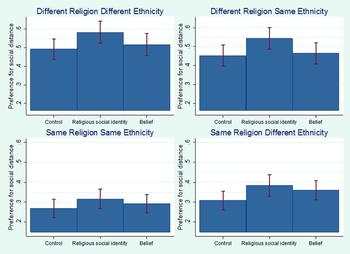
Figure 4 plots the mean levels of preference for social distance broken down by the religious primes, along with the respective 95% confidence interval bars. In line with the predictions of H2, preference for social distance towards immigrants, indicated by rejection of them as potential bosses or relatives, increases as the immigrants in question become more different from the participants. In addition, as is anticipated in the literature on cross-categorizations, the strongest preference for social distance emerges when immigrants are of a different religion and ethnicity (EQ \O(x,¯) DRDE = .53); it decreases for immigrants of a different religion but the same ethnicity (EQ \O(x,¯) DRSE = .49), or the same religion but a different ethnicity (EQ \O(x,¯) SRDE = .35); and is at the minimum level for immigrants of the same religion and ethnicity as the participant (EQ \O(x,¯) SRSE = .29). The t tests indicate that all the differences in means are statistically significant at the 95% level.
The Effect of Religious Belief and Religious Social Identity on Preference for Social Distance from Immigrants—Experiment II

Similarly, the religious social identity prime significantly increases preference for social distance from immigrants who are different in religion and ethnicity (pttest = .03), different in religion but not ethnicity (pttest = .03), or different in ethnicity but not religion (pttest = .04), compared to the control condition. This effect is not statistically significant for immigrants who are of the same religion and ethnicity (pttest = .16). This finding supports the religion as social identity hypothesis (H1), and replicates the results from Experiment I. Activating religious social identity increases the inclination to distance oneself from immigrants perceived as different from one's in-group. It does not have this effect when the immigrants are perceived as similar to the in-group.
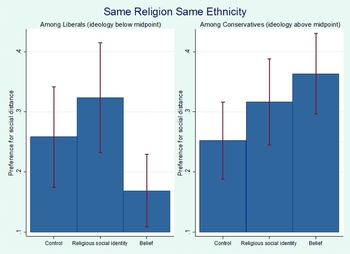
The compassion prime was expected to decrease social rejection of immigrant groups that are similar to the respondents in ethnicity and religion (H2); however, it had no statistically significant effect on the dependent variable. Still, we were interested in further examining the religious compassion hypothesis and particularly the moderation by ideology (H2a). Accordingly, Figure 5 plots the effect of the religion primes on same-religion, same-ethnicity immigrants by ideology, carving up the sample above and below the ideology midpoint (0.5 on a 0–1 scale). While the means in the control and religious identity conditions were by and large similar across ideological groups, the religious compassion manipulation was strongly affected by ideology. Among liberals, the religious compassion prime decreased preference for social distance from immigrants who are similar in religion and ethnicity compared to the control condition (pttest = .08). However, the religious compassion prime backfired with conservatives, significantly increasing social rejection (pttest = .02). Attempting to retain a well-defined group identity, conservatives often direct their empathy exclusively towards the most proximal targets or towards their own kin (Norenzayan Reference Norenzayan2014; Graham, Haidt, and Nosek Reference Graham, Haidt and Nosek2009). It is thus possible that the religious compassion prime activated group boundaries for conservatives along with overall intolerance towards anyone outside of their immediate moral circle, which may have led to a reversal in the effect of the prime (de Zavala et al. Reference De Zavala, Cislak and Wesolowska2010; Roccas and Amit Reference Roccas and Amit2011). Further research is needed in order to investigate this point.
The Effect of Religious Belief and Religious Social Identity on Preference for Social Distance from Same Religion/Same Ethnicity Immigrants, by Ideology—Experiment II The graphs include 95% statistical significance bars.

Repeated Measures Analysis
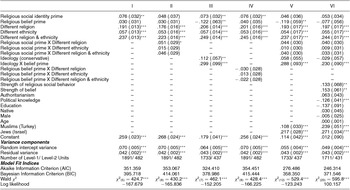
As in the previous experiment, we provided a more direct test of the hypotheses by employing the RM-MLM framework, with four repeated observations for social distance towards different types of immigrants (level 1, within-Ss factors: immigrant different in religion only/ethnicity only/both religion and ethnicity; vs. immigrants same in both religion and ethnicity as baseline) nested within participants (level 2, between-Ss factors: religious social identity/religious compassion; vs. control as baseline).Footnote 24
Table 2 presents the main effect of the between-Ss religion primes and the within-Ss immigrant type factors on preference for retaining a social distance from immigrants (Model I), the cross-level interactions of the between-Ss and within-Ss experimental treatments (II, IV), the interactive effect of the religious belief prime and ideology (III), and the interactive effects when controlling for the context (V) and for individual-level predispositions (VI).Footnote 25
Multilevel Model of the Effect of Immigrants Type, Religious Belief, and Religious Social Behavior on Preference for Social Distance—Experiment II

Notes: Table entries are estimated parameters (with standard error in parentheses) of multilevel modeling. * = one-tail 95%, ** = two-tail 95%, *** = two-tail 99% confidence level.
Starting with Model I, social rejection increases for immigrants who are different from the respondents in religion, ethnicity, or both, as expected. Yet, all else being constant, preference for social distance for immigrants who are ethnically different but the same in religion increases by 6%, and social rejection of immigrants who are religiously different but ethnically similar increases by the sizable figure of 19%. A Wald test indicates that the effect of the religion-only condition is significantly larger than the effect of the ethnicity-only condition.Footnote 26 While the current literature often stresses the effect of ethnic cues in immigration attitudes, this result speaks to the important role of religious cues, especially among religious audiences.
Further, being both ethnically and religiously different from the respondents adds 24% to the likelihood of an immigrant's social rejection, suggesting an additive effect of group differences in religion and ethnicity, an effect that is significantly larger than that of religion or ethnicity alone.Footnote 27 This hierarchy in the social rejection of immigrants based on their perceived differences in religion and ethnicity may explain cross-context variations in the positions of religious elites. For instance, unlike Catholic religious leaders in the United States, who are typically pro-immigration, in a country where most immigrants are similar in religion though different in ethnicity (Lugo Reference Lugo2008), Catholic religious leaders in Western Europe are not as supportive of liberal immigration policies as pertains to Muslim immigrants, who constitute a double out-group as they differ in both religion and ethnicity (Foner and Alba Reference Foner and Alba2008).
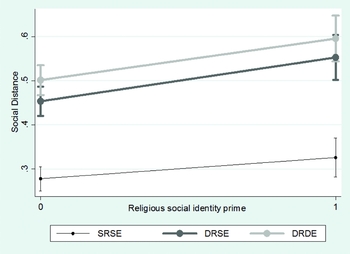
We now move to the effect of the religion primes. Priming religious social identity increased preference for social distance by about 8 percent, all else constant (Model I). To examine whether the main effect of the prime is moderated by the particular immigrant type (ethnically and/or religiously different vs. same), we specified the interactive terms between the three types of immigrants and the religious social identity prime (Model II). Out of the three interactions, depicted in Figure 6, two reached marginal statistical significance: one involving religiously different immigrants (p = .08), and one with immigrants differing both religiously and ethnically (p = .11).
Moderation of Religious Social Behavior by Type of Immigrants—Experiment II

In support for H1, the religious social behavior prime increased social rejection compared to the control condition by about 9 percent when immigrants were religiously different (p = .03), and by 9 percent when they differed in both religion and ethnicity (p = .03). The effect of the religious social behavior prime is substantively smaller, and is statistically null when immigrants are both religiously and ethnically similar (p = .16). Overall, this finding implies that activating religious social identity boosts social rejection, particularly of religiously dissimilar immigrants.
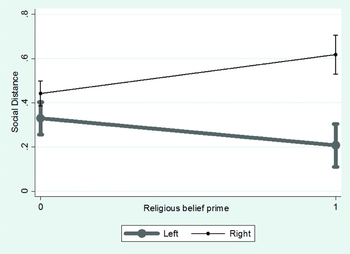
Next, the religious compassion prime had no statistically significant main effect (Model I) or interactive effect with immigrant type (Model IV). To test for moderation by ideology, Model III specifies a statistically significant interaction between ideology and the religious compassion prime,Footnote 28 and Figure 7 plots the predicted values of the religious compassion prime for the minimum and maximum levels of ideology, that is, the political left and right, respectively, with 95% confidence intervals.
The Interactive Effect of Ideology and Religious Belief on Preference for Social Distance from Immigrants—Experiment II

As depicted in Figure 7, the effect of the religious compassion prime is conditional upon the ideological orientation of the respondents. Induced religious compassion decreases preference for social distance from immigrants among supporters of the political left (the thick gray line, b = −.12, p = .04), but increases it among supporters of the political right (the thin black line, b = .17, p = .00). These results partly support H2a. Religious compassion indeed decreases anti-immigration sentiment, but this effect is contingent on ideology, and emerges only for the relatively liberal. For the conservative devout, the religious compassion prime works in the opposite direction by increasing intolerance towards immigrants. This finding suggests that a pro-immigration movement based on a strategy of arousing compassion among conservatives stands a risk of generating even greater opposition.
Next, we tested the effect of the experimental treatments and their interactions, when controlling for the context (Model V) and additional background variables (Model VI). Both the Turkish and the Israeli samples are more strongly opposed to immigration than the American sample, as in Experiment I. Adding covariates in the models generally did not change the key results, except that the interactive effects of religious social identity and immigrant type lost their marginal significance.Footnote 29
Contextual Effects
To examine potential disparities in the key results across the three different settings, we specified interactions between (1) religious primes and the context, (2) religious belief, ideology, and the context, and (3) religious social identity, immigrant type, and the context, for a total of four two-way, and eight three-way interactions. None of the 12 interactions returned statistical significance, indicating that the effect of the primes did not depend on the country context (see Appendix Table A6 for models).
Robust Analysis
As in Experiment I, we retested the hypotheses using alternative estimation techniques (i.e., three-level RM-MLM, OLS regression) and found the key results to be overall robust to changes in specification. Also, normality assumptions were not violated. Full models and a cursory discussion are presented in Online Appendix E.Footnote 30
CONCLUSIONS
As immigration continues to present various challenges to host societies, policy-makers are being pressed hard to cultivate public support for policies that address the question of who should be allowed entrance as well as how the newly admitted will be treated (Cornelius and Rosenblum Reference Cornelius and Rosenblum2005). Therefore, disentangling what underlies public attitudes toward immigration is of great importance. Interestingly, despite the fact that religion plays a significant role in shaping public opinion in general (e.g., Djupe and Calfano Reference Djupe and Calfano2013b; Guth et al. Reference Guth, Green, Kellstedt and Smidt1995; Smidt, Kellstedt, and Guth Reference Smidt, Kellstedt, Guth, Smidt, Kellstedt and Guth2009) and beliefs individuals hold toward social groups in particular (e.g., Allport Reference Allport1966; Djupe and Calfano Reference Djupe and Calfano2013a; Gibson Reference Gibson, Wolfe and Katznelson2010), its potential influence on attitudes towards immigration has been understudied, with existing research presenting mixed results. Consequently, we know relatively little about the impact of religiosity and the role of religious group cues in shaping attitudes towards immigration.
This article was intended to fill this gap by building on a multidimensional operationalization of religiosity and testing the differential effects of two key religious dimensions across three contexts. We find that the social identity dimension of religiosity increases the inclination to distance oneself from immigrants and to support anti-immigration policies, specifically towards immigrants who are perceived as having dissimilar characteristics. Religious beliefs, by stressing compassion and caring, increase both social acceptance of immigrants and support for proimmigration policies, conditional upon the similarity of the immigrant groups, and among the more liberal devout. Tested in a comparative experimental framework, designed to optimize external and internal validity, these effects emerge across Catholic, Muslim, and Jewish identifiers in the U.S., Turkey, and Israel, countries among which the salience of immigration in the current national political agenda varies. Still, despite our efforts to increase the external validity of our work, the nonprobability samples do not allow for confidently generalizing our estimates to the populations in question.Footnote 31
While the effect of racial group cues in immigration attitudes is well-established, we attempted to broaden this focus by examining the relevance of religious and ethnic group cues simultaneously. In line with the findings of other researchers on the effect of ethnic cues (Brader, Valentino, and Suhay Reference Brader, Valentino and Suhay2008; Kinder and Kam Reference Kinder and Kam2009), our results demonstrate the sensitivity of natives to the immigrants’ religion. In fact, among the more religious samples in Experiment II, we found religious dissimilarities to have a greater effect than ethnic differences on the rejection of immigrants. We also found that immigrants who are different from host society members in both religion and ethnicity arouse stronger anti-immigration sentiments than immigrants who are different in only one of these dimensions. This suggests that the salience of religious identity has the potential to influence attitudes toward other social groups above and beyond a salient ethnic identity, a finding that we believe deserves further research.
The interplay between dimensions of religiosity and immigrant groups suggests that different elements of the religious experience may give rise to different considerations in different times and places. This supports an understanding of religion as dynamic and flexible, accounting for the differences in religious groups’ and individuals’ political positions across contexts and over time. These results may help illuminate why, for example, Israeli religious leaders originally accepted Ethiopian Jews, yet currently struggle to incarcerate and deport African non-Jewish refugees and labor migrants. It may further explain why Muslim immigrants, typically dissimilar in both religion and ethnicity from the members of their host countries, are the objects of greater exclusionary rhetoric, while Christian immigrants, typically similar to the natives in religion (and in some cases ethnicity) do not arouse as much pushback (on Muslim immigrants as an “indigestible” minority, see Huntington Reference Huntington2004, 188).
We also see this complex perspective as cause for optimism, in the sense that it is not religiosity in and of itself, but rather the activation of certain elements in the rich religious experience that makes or unmakes intolerance. Politicians seeking to appeal to particular constituencies to cultivate support for their policies might best succeed by emphasizing certain dimensions of their religious tradition over others, and highlighting either immigrant similarities or differences from the in-group. Thus, for example, political elites who seek greater support among more liberal constituencies could emphasize the importance of compassion and caring and stress the resemblance of the immigrants to the host society at large. In the U.S., such religious leaders and organizations as the United States Conference of Catholic Bishops, and political leaders such as President Obama in his amnesty speech,Footnote 32 appear to be doing exactly this by emphasizing Biblical teachings in a way that is designed to arouse empathy for immigrants, while at the same time stressing immigrants’ similarity to members of the society in their key values, such as their dedication to their religion, their work ethic, and their traditionalism (Parker and Shear Reference Parker and Shear2013). However, our findings also imply that attempts at invoking compassion may not be enough to convince the more conservative devout, which may explain why, for example, despite religious leaders’ backing for immigration reform in the United States, the devout are not always supportive (Lipka and Martinez Reference Lipka and Martínez2013). Still, if the results of our research are suggestive, religion could play a tremendous role in influencing the current and future immigration debate.
Supplementary materials
To view supplementary material for this article, please visit http://dx.doi.org/10.1017/S0003055415000143





Comments
No Comments have been published for this article.