INTRODUCTION
Cephalopods play an important role in marine ecosystems (Rodhouse & Nigmatullin, Reference Rodhouse and Nigmatullin1996; Coll et al., Reference Coll, Navarro, Olson and Christensen2013a). The reduction in abundance of large marine predators such as sharks, mammals, large fish and seabirds is altering ecosystems, promoting the expansion and increase of the biomass and abundance of cephalopods, increasing their importance in marine ecosystems (Caddy & Rodhouse, Reference Caddy and Rodhouse1998; Rosas-Luis et al., Reference Rosas-Luis, Salinas-Zavala, Koch, del Monte-Luna and Morales-Zárate2008; Coll et al., Reference Coll, Navarro, Olson and Christensen2013a; Navarro et al., Reference Navarro, Coll, Somes and Olson2013). This is the case for Illex coindetii (Vèrany, 1839), an Ommastrephid squid widely distributed throughout the Mediterranean Sea, eastern Atlantic and western Atlantic (Nesis, Reference Nesis1987). An increase in its abundance in the Mediterranean during the last few decades, and its importance as both prey and predator, have made I. coindetii an important organism in the ecosystem (Rosas-Luis et al., Reference Rosas-Luis, Villanueva and Sánchez2014). Thus, knowledge of its trophic ecology is important in understanding the interaction between I. coindetii and other species in the ecosystem (Clarke & Kristensen, Reference Clarke and Kristensen1980; Rosas-Luis et al., Reference Rosas-Luis, Villanueva and Sánchez2014). Different diet patterns of I. coindetii were found in previous studies in the Mediterranean Sea. Although Sánchez (Reference Sánchez1982), Sánchez et al. (Reference Sánchez, González, Jereb, Laptikhovsky, Mangold, Nigmatullin, Ragonese, Rodhouse, Dawe and O'Dor1998) and Petric et al. (Reference Petric, Mladineo and Sifner2011) indicated that fish was the main prey for adult I. coindetii, followed by crustaceans and molluscs, recently Rosas-Luis et al. (Reference Rosas-Luis, Villanueva and Sánchez2014) indicated that the diet of adult squid was composed mainly by crustaceans followed by fish. These results suggest an apparent change in the main trophic habits of I. coindetii over the last three decades, making clear the necessity to confirm this trend with additional studies and more specific analyses. Furthermore, there is no information about the diet habits of small-sized juveniles, which may be important in order to understand the trends and variability of feeding behaviour of this species.
The study of the feeding ecology of marine predators has traditionally been based on stomach content analysis (Stergiou & Karpouzi, Reference Stergiou and Karpouzi2001). Although this analysis permits high levels of taxonomic resolution, cephalopods often have empty stomachs and it is sometimes difficult to identify stomach contents, because squid macerate their prey with their beaks (Castro & Hernández-García, Reference Castro and Hernández-García1995). The use of stable isotopes of nitrogen (δ 15N) and carbon (δ 13C) has been applied as an alternative and complementary tool to study the feeding ecology and trophic position of predators including squid (Cherel & Hobson, Reference Cherel and Hobson2005, Reference Cherel, Ridoux, Spitz and Richard2009; Stowasser et al., Reference Stowasser, Pierce, Moffat, Collins and Forsythe2006; Guerra et al., Reference Guerra, Rodríguez-Navarro, González, Romanek, Álvarez-Lloret and Pierce2010; Ruiz-Cooley et al., Reference Ruiz-Cooley, Villa and Gould2010; Navarro et al., Reference Navarro, Coll, Somes and Olson2013). This approach is based on the fact that δ 15N and δ 13C values are transformed from dietary sources to consumers in a predictable manner (Kelly, Reference Kelly2000) and indicate the diet of the consumer over a longer time period (i.e. from several weeks to months; Ruiz-Cooley et al., Reference Ruiz-Cooley, Markaida, Gendron and Aguiñiga2006). δ 15N values show a stepwise enrichment between 2–5‰ with each trophic level and are reliable indicators of the consumer's trophic position (Layman et al., Reference Layman, Araujo, Boucek, Hammerschlag-Peyer, Harrison, Jud, Matich, Rosenblatt, Vaudo, Yeager, Post and Bearhop2012). δ 13C values show little change due to trophic transfer, but are useful indicators of dietary sources of carbon (Layman et al., Reference Layman, Araujo, Boucek, Hammerschlag-Peyer, Harrison, Jud, Matich, Rosenblatt, Vaudo, Yeager, Post and Bearhop2012). Moreover, with the use of isotopic mixing models we can estimate the relative contribution of each prey item to the diet of the consumer. These models combine the stable isotope values for consumers with those of their potential prey (e.g. Stable Isotope Analysis in R [SIAR] isotopic mixing model; Parnell et al., Reference Parnell, Inger, Bearhop and Jackson2010). While caution is needed when interpreting the outcomes of both types of analyses and they may not be directly comparable, their combination is highly useful to better understanding the trophic ecology of marine predators (Navarro et al., Reference Navarro, López, Coll, Barría and Sáez-Liante2014; Albo-Puigserver et al., Reference Albo-Puigserver, Navarro, Coll, Aguzzi, Cardona and Sáez-Liante2015).
In the present study, we examined the diet habits of I. coindetii in the Catalan Sea (north-western Mediterranean Sea; Figure 1) by combining stomach content and isotopic analyses. Specifically, we examined whether the diet differs between ontogenetic sizes (juveniles and adults) and seasons (summer and winter). Our study provides new insights into the ecological role of this species within the north-western Mediterranean ecosystem, providing new data on how this abundant cephalopod exploits available resources.
Map of the study area (north-western Mediterranean Sea), indicating the area where squids were collected.

MATERIALS AND METHODS
Study area and sampling procedures
Samples were obtained from the continental shelf and slopes associated with the Ebro River delta (north-western Mediterranean Sea; Figure 1) during winter and summer of 2013. This area is highly productive due to the contributions of organic matter at the mouth of the Ebro River, and the effect of the northern current along the continental slope (Salat, Reference Salat1996). A total of 292 individuals were sampled in this area during two experimental fishing cruises as well as from commercial demersal trawlers. After the catch, we measured the mantle length (ML), total weight, sex and maturity of each individual. Moreover, a small portion of flesh from the mantle from 62 individuals was collected (24 samples were from winter and 38 from summer of 2013) and stored at −20°C until their isotopic determination. Based on the size at first maturity (following Jereb & Ragonese, Reference Jereb and Ragonese1995), we grouped all individuals into two groups: adult individuals (11–22 cm mantle length) and juvenile individuals (4–10 cm mantle length).
Stomach content analysis
The stomach of all individuals was extracted after dissection. Each stomach was weighed in a digital balance at a precision of 0.001 g to calculate the stomach content weight (SCW) and fullness weight index (FWI) following the Rasero et al. (Reference Rasero, Gonzalez, Castro and Guerra1996) equation: FWI = (SCW × 100)/(BW-SCW), with BW being the body weight.
Stomach content identification was determined under a binocular microscope (60–120×). All prey items were weighed to the nearest 0.001 g. The otoliths of fish, the beaks of cephalopods and the exoskeletons of crustaceans were used to identify the prey, following different reference classification guides (Clarke, Reference Clarke1986; Zariquiey-Álvarez, Reference Zariquiey-Alvarez1986; Boshi et al., 1992; Smale, Reference Smale1996; Tuset et al., Reference Tuset, Lombarte and Assis2008). We did not measure the length of the prey items.
Frequency of occurrence (%FO) and numeric (%N) and gravimetric (%W) methods were used to quantify the diet. %FO was calculated as the percentage of stomachs with a certain prey relative to the total number of stomachs analysed; %N is the number of individuals of a certain prey relative to the total number of individual prey items; %W is defined as the weight of a certain prey relative to the total weight of the stomachs (Cailliet, Reference Cailliet, Simenstad and Lipovsky1976). Index of relative importance (IRI): IRI = (%N + %W)*(%FO) (Pinkas et al., Reference Pinkas, Oliphant and Iverson1971) was calculated for each season (winter and summer) and ontogenetic-size (juveniles and adults). To allow comparisons between groups, the IRI was expressed as a percentage (
 $\% {\rm IR}{{\rm I}_i}{\rm = 100} \cdot {\rm IR}{{\rm I}_i}/\sum\nolimits_{i = 1}^n {{\rm IR}{{\rm I}_{\rm I}}} $
; Cortés, Reference Cortés1997).
Stable isotope analysis and isotopic mixing model
All fresh samples collected randomly from the capture individuals were subsequently freeze-dried and powdered, and 0.28–0.33 mg of each sample was packed into tin capsules. Isotopic analyses were performed at the Laboratorio de Isótopos Estables of the Estación Biológica de Doñana (LIE.EBD, Spain; www.ebd.csic.es/lie/index.html). All samples were combusted at 1020°C using a continuous flow isotope-ratio mass spectrometry system by means of a Flash HT Plus elemental analyser coupled to a Delta-V Advantage isotope ratio mass spectrometer via a CONFLO IV interface (Thermo Fisher Scientific, Bremen, Germany). The isotopic composition is reported in the conventional delta (δ) per mil notation (‰), relative to Vienna Pee Dee Belemnite (δ 13C) and atmospheric N2 (δ 15N). Replicate assays of standards routinely inserted within the sampling sequence indicated analytical measurement errors of ±0.1 and ±0.2‰ for δ 13C and δ 15N, respectively. The standards used were: EBD-23 (cow horn, internal standard), LIE-BB (whale baleen, internal standard) and LIE-PA (feathers of Razorbill, internal standard). These laboratory standards were previously calibrated with international standards supplied by the International Atomic Energy Agency (IAEA, Vienna). Since C:N values were lower than 3.5, we did not correct the δ 13C for the effect of lipids (following Logan & Lutcavage, Reference Logan and Lutcavage2010).
To estimate the potential contribution of the different prey groups to the diet of I. coindetii, we adopted a Bayesian multi-source isotopic mixing model (SIAR 4.2; Parnell & Jackson, Reference Parnell and Jackson2013). The SIAR model estimates the potential contribution of each prey in the diet based on their isotopic values and those of the potential prey. This model runs under the free software R (R Development Core Team 2009) and allows the inclusion of sources of uncertainty in the data, in particular the variability in the stable isotope ratios of the predator and the potential prey (Parnell et al., Reference Parnell, Inger, Bearhop and Jackson2010). To run the model SIAR, values of the potential prey were taken from a reference isotopic library that contains up to 128 species collected in the area of study during 2013 (IsoLibrary; ECOTRANS project; Barría et al., Reference Barría, Coll and Navarro2015). Main potential prey groups were selected according to the stomach information. Thus, three main groups were selected: crustaceans (δ 15N = 6.19 ± 0.25‰; δ 13C = −19.47 ± 0.27‰), cephalopods (δ 15N = 9.7 ± 1.44‰; δ 13C = −18.79 ± 0.67‰) and fish (δ 15N = 8.12 ± 0.30‰; δ 13C = −19.53 ± 0.58‰). Diet tissue discrimination factors of 2.14‰ for δ 15N and 0.30‰ for δ 13C were used following Caut et al. (Reference Caut, Angulo and Courchamp2009).
Statistical analysis
Differences in %W, δ15N and δ13C between adult and juvenile individuals and seasons were tested using two-way semi-parametric permutation multivariate analyses of variance tests (PERMANOVA test) on the Euclidean distance matrix (Anderson et al., Reference Anderson, Gorley and Clarke2008). In the case of a significant result, pairwise tests were carried out. PERMANOVA allows for the analysis of complex designs (multiple factors and their interaction) without the constraints of multivariate normality, homoscedasticity and greater numbers of variables than sampling units, as in traditional ANOVA tests. The method calculates a pseudo-F-statistic directly analogous to the traditional F-statistic for multifactorial univariate ANOVA models, using permutation procedures to obtain P values for each term in the model (Anderson et al., Reference Anderson, Gorley and Clarke2008). PERMANOVA tests were performed with the PRIMER-E 6 software (Anderson et al., Reference Anderson, Gorley and Clarke2008). Significance level for all tests was adopted at P < 0.05.
RESULTS
Stomach content results
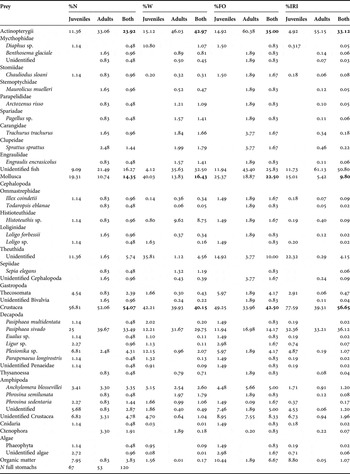
Of the 292 individuals analysed, 172 stomachs were empty. Overall, the stomach contents of the remaining 120 individuals of Illex coindetii were composed mainly by crustaceans (%IRI = 56.65), followed by fish (%IRI = 33.12) and molluscs (%IRI = 9.80) (Table 1). Cnidarians and ctenophores were also found in the stomachs but in a very low proportions (%IRI < 1) (Table 1). At a specific level, the most important crustacean species were the shrimp Pasiphaea sivado (Risso, 1816), the amphipod Anchylomera blossevilleii (Milne Edwards, 1830), and the pandalid Plesionika sp. (Spence Bate, 1888) (Table 1). In relation to fish, the most important species were the clupeid Sprattus sprattus (Linnaeus, 1758) and the perciform Trachurus trachurus (Linnaeus, 1758) (Table 1). Within the molluscs group, the cephalopod order Teuthida was the most abundant, and the most important cephalopod species were the squid Histioteuthis sp. (d'Orbigny, 1841) and species of the clade Thecosomata (Table 1).
Percentage of number (%N), frequency of occurrence (%FO), weight (%W) and relative importance (%IRI) of the different prey identified in the stomach contents of Illex coindetii individuals collected during 2013 in the North-western Mediterranean.

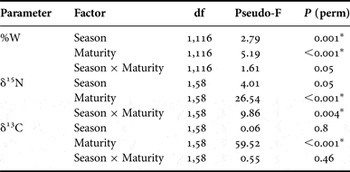
Based on the %W, the diet of I. coindetii differed between adult and juvenile individuals (Table 3). Juveniles showed a diet composed mainly of crustaceans (%IRI = 77.59), followed by molluscs (mostly squid; %IRI = 15.01) and fish (%IRI = 4.92). In contrast, adults showed a diet composed mainly of fish (%IRI = 55.14), followed by crustaceans (%IRI = 39.31) and molluscs (%IRI = 5.41) (Table 1).
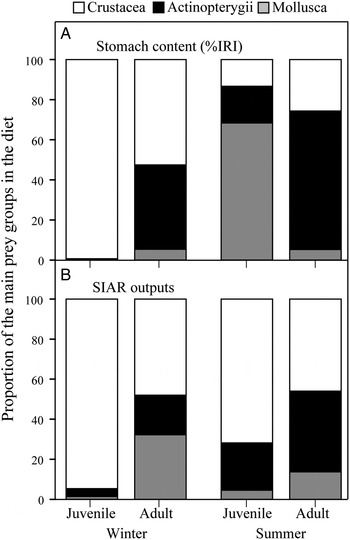
The PERMANOVA tests showed differences between juveniles between summer and winter seasons (P < 0.01; Table 3). During winter, juveniles fed mainly on crustaceans (%IRI = 99.09) with the shrimp P. sivado (IRI% = 74.06) as the most important crustacean prey. The second group was fish (%IRI = 0.33), followed by the mollusc groups. In summer, molluscs were the most important group for juveniles (%IRI = 62.26) followed by fish (%IRI = 16.67) and crustaceans (IRI% = 12.10) (Figure 2A). In contrast to juveniles, adults showed similar diets between seasons (P = 0.52) (Table 3). During winter, adults fed on crustaceans (%IRI = 52. 35) followed closely by fish (%IRI = 41. 96) and molluscs (%IRI = 5.33). During summer, adults fed mainly on fish (%IRI = 69.12) followed by crustaceans (%IRI 25.64) and molluscs (%IRI = 5.24)
Mean proportional contributions of fish (Actinopterygii), crustaceans (Crustacea) and molluscs (Mollusca) to the diets of Illex coindetii in relation to the size and season based on (A) stomach content analysis and (B) SIAR models.

.
Isotopic results
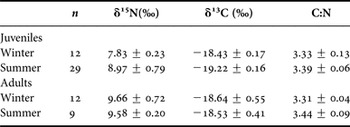
δ15N values differed significantly between adults and juveniles, and between winter and summer (Tables 2 and 3) and δ 15N values of juveniles differed significantly between winter and summer (Figure 3). In contrast, δ 13C values did not differ between seasons but did differ between adults and juveniles (Tables 2 and 3; Figure 3). SIAR outputs indicated a high contribution of crustaceans in juveniles (mean contribution = 94.6%) during winter, followed by fish (3.9%) and molluscs (1.4%) (Figure 2B). In summer, the mean contribution of crustaceans to the total diet of juvenile individuals represented 71.8% followed by fish (23.5%) and molluscs (4.6%). For adult individuals, the importance of the different prey groups between summer and winter was similar. The mean contribution of crustaceans in summer and winter, respectively, was 45.9 and 47.9% (Figure 2B). The group of fishes represented 40.2% in summer and 19.8% in winter. Finally, molluscs represented 13.7% in summer and 32.3% in winter (Figure 2B).
Mean and standard deviation of δ 15N and δ 13C values of Illex coindetii by size and season.

Number of samples (n), mean and standard deviation of δ 15N, δ 13C and C:N ratio values of Illex coindetii by ontogenetic stage (juveniles and adults) and season.

PERMANOVA test results on the presence of significant differences of %W, δ 15N and δ 13C values between seasons (summer and winter) and ontogenetic stages (juvenile and adult) of Illex coindetii from the NW Mediterranean.

*Statistical significance, P(perm) <0.05.
DISCUSSION
In this study, the trophic ecology of Illex coindetii was analysed using two complementary methods, stomach content and stable isotope analysis. The use of both methodologies offers an integrated perspective of the diet of I. coindetii at different temporal scales. Stomach content analysis allows the determination of the main prey up to the species level (Sánchez, Reference Sánchez1982; Castro & Hernández-García, Reference Castro and Hernández-García1995; Petric et al., Reference Petric, Mladineo and Sifner2011; Rosas-Luis and Sánchez Reference Rosas-Luis and Sánchez2014; Rosas-Luis et al., Reference Rosas-Luis, Villanueva and Sánchez2014). However, this method only allows for information on the most recent prey ingested. Additionally, in the case of squid, difficulties in finding soft prey in stomachs and the high proportion of empty stomachs indicate the limitations of this methodology. Despite its use mostly over the last decade, stable isotope analysis has great potential for trophic ecology studies in cephalopods as it offers information about the diet at a larger temporal scale (~1 month for mantle tissue; Takai et al., Reference Takai, Onaka, Ikeda, Yatsu, Kidokoro and Sakamoto2000; Cherel & Hobson, Reference Cherel and Hobson2005; Navarro et al., Reference Navarro, Coll, Somes and Olson2013).
The results of the present study highlight the importance of crustaceans in the diet of I. coindetii, in particular the decapods Pasiphaea sivado and Anchylomera blossevillei. These results could suggest that crustaceans have been increasing in importance as a prey item for I. coindetii in recent years, since being reported as a secondary prey in older studies (Sánchez, Reference Sánchez1982; Castro & Hernández-García, Reference Castro and Hernández-García1995; Sánchez et al., Reference Sánchez, González, Jereb, Laptikhovsky, Mangold, Nigmatullin, Ragonese, Rodhouse, Dawe and O'Dor1998) to becoming the most important prey in the feeding habits of this species in the western Mediterranean (Rosas-Luis et al., Reference Rosas-Luis, Villanueva and Sánchez2014). This apparent change in the diet was confirmed with both stomach content and stable isotopic results. Probably, this change of feeding behaviour of I. coindetii can be related to a reduction in the abundance of pelagic fish due to the increase in the fishing pressure in the Northwestern Mediterranean during the last decade (Coll et al., Reference Coll, Navarro and Palomera2013b). Fish was the group second in importance in the diet of I. coindetii, including species such as Sprattus sprattus, not reported previously in the diet of I. coindetii, and Trachurus trachurus (Sánchez, Reference Sánchez1982; Castro & Hernández-García, Reference Castro and Hernández-García1995; Sánchez et al., Reference Sánchez, González, Jereb, Laptikhovsky, Mangold, Nigmatullin, Ragonese, Rodhouse, Dawe and O'Dor1998; Petric et al., Reference Petric, Mladineo and Sifner2011; Rosas et al., Reference Rosas-Luis, Villanueva and Sánchez2014). Similar to previous studies, we found that cephalopods are present in the diet of I. coindetii (e.g. Sánchez, Reference Sánchez1982; Castro & Hernández-García, Reference Castro and Hernández-García1995; Rosas-Luis et al., Reference Rosas-Luis, Villanueva and Sánchez2014). In particular, cephalopods of the genera Histioteuthis and the clade Thecosomata were the most abundant cephalopods found in the stomachs. However, the presence of other cephalopods was very low, confirming the low incidence of this feeding behaviour in I. coindetii (Sánchez, Reference Sánchez1982; Sánchez et al., Reference Sánchez, González, Jereb, Laptikhovsky, Mangold, Nigmatullin, Ragonese, Rodhouse, Dawe and O'Dor1998; Rosas-Luis et al., Reference Rosas-Luis, Villanueva and Sánchez2014).
Both stomach content and isotopic mixing models indicated differences in the feeding habits between juveniles and adults. The importance of fish was greater for adults than juveniles, whereas crustaceans were more important for juveniles, especially during winter. These diet differences may be related to the ontogenetic development of the beak of squids as the individual grows (Castro & Hernández-García, Reference Castro and Hernández-García1995), allowing the larger adult individuals to prey upon the larger species such as fish (Costalago et al., Reference Costalago, Navarro, Álvarez-Calleja and Palomera2012; Pereira et al., Reference Pereira, Barros, Zemoi and Ferreira2014).
Crustaceans were the most important prey during winter. This result may be due to the I. coindetii migration during winter when this squid is found in deeper waters (Omori, Reference Omori1974), and preying on crustaceans such as P. sivado (Sánchez & Martín, Reference Sánchez and Martin1993; Castro & Hernández-García, Reference Castro and Hernández-García1995). On the contrary, in summer, I. coindetii moves to shallower waters (Sánchez et al., Reference Sánchez, González, Jereb, Laptikhovsky, Mangold, Nigmatullin, Ragonese, Rodhouse, Dawe and O'Dor1998) where it feeds on a wide range of prey represented in the higher number of molluscs and fish prey identified as a consequence of an increase in the availability of prey in shallow waters.
Regarding seasonal differences, according to the stomach content analysis, molluscs were the most important prey for juveniles of I. coindetii in summer, but the SIAR analysis results did not reflect this preference. Results of the stomach content analysis agree with those of Sánchez (Reference Sánchez1982), Sánchez et al. (Reference Sánchez, González, Jereb, Laptikhovsky, Mangold, Nigmatullin, Ragonese, Rodhouse, Dawe and O'Dor1998), Petric et al. (Reference Petric, Mladineo and Sifner2011) and Rosas-Luis et al. (Reference Rosas-Luis, Villanueva and Sánchez2014) and are related to the generalist feeding behaviour of small-sized squid and the abundance of this prey during summer. However, as suggested by Keller et al. (Reference Keller, Quetglas, Valls, Ordines, de Mesa, Olivar and Massutí2012), hard structures (such as beaks) are difficult to digest and may accumulate in the stomachs, promoting an overestimation of their importance in the diet of juveniles of I. coindetii. Thus, the large increase of molluscs in the diet of juveniles in summer indicated by the stomach contents should be interpreted with caution. According to the isotope values, the higher values of δ 15N found in juveniles during summer are probably related to a slightly greater presence of fish and molluscs than in winter.
Furthermore, regarding the bathymetric distribution of prey, this study agrees with Sánchez et al. (Reference Sánchez, González, Jereb, Laptikhovsky, Mangold, Nigmatullin, Ragonese, Rodhouse, Dawe and O'Dor1998) as juveniles and adults share the same bathymetric range during the year and, moreover, confirms that although I. coindetii comes very close to the seabed during its daily vertical migrations, it never seeks food there but feeds mainly on prey swimming off the bottom.
In summary, based on stomach and stable isotopic results, we confirmed the wide range of prey in the diet of I. coindetii, with the importance of crustaceans of the genus Pasiphaea in their feeding habits, and the change in diet between seasons and between juveniles and adults. These results provide new insights into the ecological role of this species in the Mediterranean ecosystem and, from a technical perspective, the use of both stomach content and isotopic analyses present new opportunities to examine the trophic ecology of other Mediterranean cephalopods.
ACKNOWLEDGEMENTS
The authors would like to acknowledge Raquel Sáez and the crew of the ECOTRANS oceanographic cruises for help during the sampling. José Xavier provided useful comments in a first version of the manuscript. This study forms a contribution to the project ECOTRANS (CTM2011-26333, Spanish Ministry of Economy and Competiveness, Spain) and to the Master-thesis of FM. The authors declare that all experimental procedures were conducted in strict accordance with good animal practice as defined by the current Spanish, Catalonian and European legislation.
FINANCIAL SUPPORT
J.N. was funded by ESFRI LifeWatch project. M.A.-P. was supported by a predoctoral contract of the FPI program (Spanish Ministry of Economy and Competitiveness).