On September 24, 1877, Saigō Takamori, the leader of a massive rebellion against the new national government of Japan, died on the hills of Shiroyama in Kagoshima. His demise was suffused with tragic irony: Saigō died fighting a government he had helped to create. Saigō was a central figure in the movement to overthrow the shogunate, and, after the Meiji Restoration of 1868, he emerged as one of the three most powerful men in the new Meiji state. But Saigō grew increasingly estranged from his colleagues and resigned from the government in 1873. In his final years, during a period of tectonic cultural change, he was celebrated as a model of traditional samurai virtue. In January 1877, Saigō assumed command of a rebellion started by his impulsive followers and led an army of roughly 20,000 disgruntled samurai northeast toward Tokyo. The failure of the rebellion was obvious by April, but the rebels, retreating through the mountains of Kyushu, managed to evade the advancing imperial army for another five months.
Saigō's death was a resonant historical moment, replete with powerful, contradictory expectations. More than the death of a single individual, his tragic end represented the death of the samurai class. The failure of Saigō's rebellion, known as the Satsuma Rebellion in English and the War of the Southwest (Seinan sensō) in Japanese, foreclosed the possibility that samurai would ever recover their hereditary privileges, such as stipends and a monopoly on government offices. For the government and its supporters, this was a moment of celebration: it was described as a triumph of the forces of reason and progress over backwardness and “feudalism.” Outside the government, however, Saigō's death marked the end of the exhilarating, if frenzied, sense of possibility that suffused early Meiji politics. Among both intellectuals and the general public, Saigō represented an alternative to a statist, bureaucratic, and centralizing vision of modern Japan. An implausible range of critics, from proponents of Rousseau's social contract to defenders of samurai tradition, identified with Saigō's rebellion and mourned his death as a triumph of autocracy. His heroic stature as a leader of the Restoration, and his fierce reticence about his own dissenting views, combined to make Saigō a symbol for all forms of principled resistance to the Meiji state. His death, therefore, represented the end of an era of revolutionary possibilities.
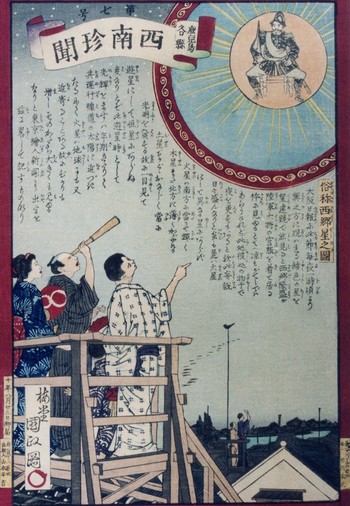
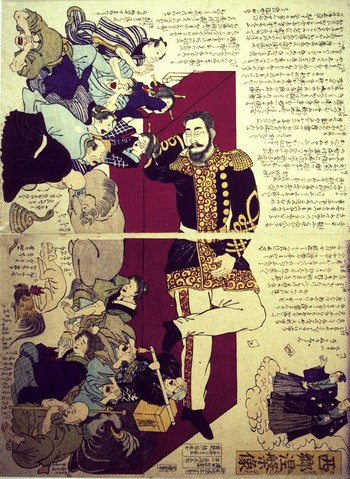
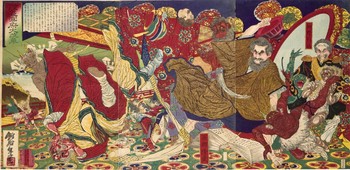
This was a heavy symbolic burden, and the quotidian details of Saigō's last days and death could not convey such powerful expectations. Thus, when artists and commentators depicted Saigō's rebellion and defeat, they produced a rich body of fantasies and legends. Some envisioned Saigō, or at least his head, ascending to the heavens and lodging in the planet Mars (see figure 1, Seinan chinbun). These stories were prompted, in part, by the close proximity of Mars to Earth in 1877: Mars was especially bright in the night sky that year, aiding the discovery of the Martian moons Phobos and Deimos in August 1877. Others depicted Saigō, reclining peacefully, attaining nirvana while surrounded by weeping disciples (see figure 2, Saigō nehan zō). This print was a visual quote from a long tradition of Buddhist painting and sculpture, except that Saigō took the place of Shakyamuni, the historical Buddha. An opposite vision was a fanciful print entitled Saigō's Revolution in the Netherworld showing Saigō, a powerful rebel to the last, overthrowing the King of Hell (see figure 3, Takamori Myōfu daikaikaku).
Seinan chinbun (西南珍聞) by Baidō Kunimasa (梅堂国正), printed in Tokyo in July 23, 1877. Kagoshima City Museum of Art.

Saigō nehan zō (西郷涅槃像) by Nagashima Mōsai (永嶋孟斎), printed in Tokyo in October 5, 1877. Kagoshima City Museum of Art.

Takamori Myōfu daikaikaku (隆盛冥府大改革) by Suzuki Kunimoto (鈴樹国基), printed in Tokyo on December 10, 1877. Collection of Sheldon and Heather Siegal.

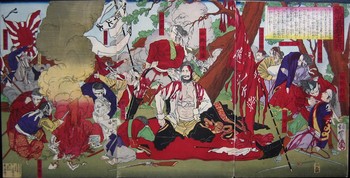
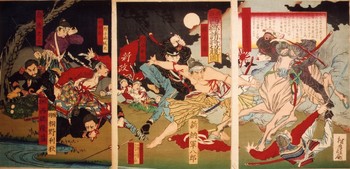
Also popular was the story that Saigō, surrounded by his followers, committed seppuku, or ritual samurai suicide. A tabloid print from October 11, 1877, for example, shows Saigō plunging his sword into his abdomen; blood spurts from his belly just above a cartouche with his name (see figure 5, Shiroyama Saigō shoshō seppuku no zu). Behind him, Oku Yoshinosuke, his second (kaishaku), waits to cut off his head. Saigō is surrounded by loyal followers, who, despite serious wounds, continue to fight until the end. The title of the print, Saigō and His Officers Commit Seppuku at Shiroyama, reinforces the visual message.
Shiroyama saigo no kessen (城山最期之決戦) by Yamazaki Toshinobu (山崎年信), printed in Tokyo in October, 1877. Collection of the author.

Saigō shoshō seppuku no zu (西郷諸将切腹図) by Matsuzuki Hosei (松月保誠), printed in Tokyo on October 11, 1877. Ryōzen rekishikan.

Tales of Saigō's seppuku have enjoyed remarkable longevity and popularity. The spectacular suicide scene in the Warner Brothers film The Last Samurai, for example, is among the latest, and certainly the most expensive, depictions of Saigō's seppuku. Footnote 1 Mentions of Saigō's seppuku or suicide also appear in major Japanese and American historical reference books, including the one-volume Columbia Encyclopedia (2000), the one-volume Kadokawa Nihonshi jiten (Takayanagi and Takeuchi 1974), the Kodansha Encyclopedia of Japan (1983), and both major multivolume encyclopedias of Japanese history: the Kokushi daijiten (1979–97) and Nihonshi daijiten (1992). Saigō's suicide is also noted in several major American textbooks on Japan, including Andrew Gordon's A Modern History of Japan (Reference Gordon2003) and Peter Duus's Modern Japan (Reference Duus1998), as well as the two major Japanese-language biographies of Saigō by academic historians (Reference KiyoshiInoue 1970; Tamamuro Reference Taijō1960).
The story of Saigō's seppuku is often juxtaposed with fantastic legends of his death. Ivan Morris, for example, in his influential Nobility of Failure, wrote that Saigō “bowed in the direction of the Imperial Palace and cut open his stomach.” This heroic death helped inspire amazing stories of Saigō's valor, including “the fantastic legend according to which Saigō would reappear in 1891 on a Russian warship in order to rescue his country from foreign danger” (Morris Reference Morris1975, 267, 273). In their study of early Japanese newspapers, The Birth of the News (Nyūsu no tanjō), Kinoshita Naoyuki and Yoshimi Shun'ya contrasted the association of Saigō and Mars with the seemingly objective details of his death: “rumors of the appearance of a ‘Saigō star’ had already become a topic of popular conversation before Saigō stabbed himself to death (jijin) on September 24th” (Reference Naoyuki and Shun'ya1999, 229).
These juxtapositions are misleading. Saigō's seppuku is merely another Saigō legend, not an empirically grounded account of his death. Saigō did not “cut open his stomach” or “stab himself to death.” These tales of suicide, like stories of Saigō's ascent to Mars, were attempts to represent the enormous implications of Saigō's death. If, for example, Saigō was the last true samurai, then he needed a spectacular and iconic death. What is fascinating about Saigō's seppuku is how it has morphed into something else: a standard account of Saigō's demise, reproduced in reference works and textbooks.
How and why did this happen? The transformation of Saigō's seppuku from fantasy to history coincided with the rise of bushidō as a national ideology. Connecting Saigō to bushidō allowed ideologues both inside and outside the Meiji state to embed him in a longer narrative of Japanese martial heroes. A glorious death by seppuku also meant that critics could both venerate Saigō and criticize his insurrection: a proper suicide ensured that Saigō was dead, but honorably dead. This was a fitting end for a man who was both a leader of the Restoration and a major threat to the Meiji state. The legend of Saigō's seppuku was thus most amenable to late Meiji nationalism and its emphasis on bushidō. Seppuku turned Saigō into a forerunner of Japanese militarism, rather than a dangerous challenger to the state.
My purpose in this essay is thus twofold. First is a narrow empirical project: demonstrating that tales of Saigō's “suicide” are speculative, if not blatantly false. Second is a broader inquiry into the politics of historiography. Cultural critics such as Ivan Morris and Kawahara Hiroshi (Reference Hiroshi1971) have connected Saigō legends to recurrent tropes in Japanese history. Morris, for example, invoked Saigō as an example of the Japanese love of stalwart and principled but doomed heroes: the nobility of failure. My biography of Saigō includes a preliminary exploration of the legends of Saigō's death (Reference Ravina2004, 1–12, 206–14), and Ikai Takaaki's recent essay (Reference Takaaki and Masahito2004) explores the politics of Saigō lore in the 1870s. The present essay is an attempt to show how Saigō legends, over decades, were rewritten in accordance with changing political positions and visions of Japanese history. Exponents of Saigō's “suicide” used this act to link him with a lineage of Japanese heroes. Saigō, in this narrative, was great because of his connection to a Japanese warrior tradition. In their enthusiasm for this project, Saigō's biographers produced increasingly detailed and implausible accounts of Saigō's seppuku. At the same time, the canonization of Saigō's suicide as “fact” has generated a curious distinction. Rather than treat Saigō's suicide and, for example, his ascent to Mars as rival legends, we have treated the former as an event and the latter as myth. In doing so, we have, however unwittingly, reproduced a nationalistic and militaristic interpretation of Saigō and marginalized alternative visions of Saigō and of Japan.Footnote 2
Heroes and Heroic Deaths
How did Saigō die? Because so many eyewitnesses died themselves in the Battle of Shiroyama, there are no surviving firsthand accounts. Saigō's last moments and last words thus will remain a subject of fascination and speculation. Yet the surviving records are sufficient to arrive at a negative conclusion: Saigō did not cut his own abdomen, and it is implausible that he sat erect in a formal suicide ritual. We can establish this through forensic evidence: three independent accounts of Saigō's body. One is from the diary of Kawaguchi Takesada, an accountant with the Imperial Japanese Army. Kawaguchi's observations are detailed and clinical, almost a parody of an accountant's mind-set. His account of Saigō's death is terse and detached:
When our troops (soldiers from each brigade) approached from all sides and breached the rebel stronghold, all the rebel leaders (Saigō Takamori, Kirino Toshiaki, etc.) were already dead. A summary follows:
Saigō Takamori: shot through the hip, head missing, later recovered.
Kirino Toshiaki: head and face ripped apart, many sword wounds.
Murata Shinpachi, Beppu Shinsuke, Henmi Jūrōta, Ikegami Shirō, Takashiro Jūji, Iwamoto Heihachi, Hirano Masasuke, Ishizuka Chōsaemon, Gamō Hikojirō, Katsura Shirō, Yamanoda Hikosuke, etc., total of 106 people. The rebels were all clad in red loincloths (fundoshi) and most were wearing [traditional] Japanese clothes. (Kawaguchi [1878] Reference Takesada1988, 2:356–57)
Kawaguchi noted that Kirino had many sword wounds, but reported none for Saigō, besides the gunshot wound to the hip and his missing head.
A parallel account is found in a letter by John Capen Hubbard, a ship captain providing noncombat military support for Mitsubishi. As the captain of a support ship, Hubbard watched the final assault on the rebels from the deck of his ship and arrived on the scene soon after the rebels had been defeated. In a letter to his wife, he described Saigō's corpse:
When we arrived we found eight bodies laid out in two rows. The first was Saigo. He was a large powerful looking man, his skin almost white. His clothing had been taken off and he lay there naked. It was a few seconds before I realized his head was cut off. Next to Saigo lay Kirino, then Murata. Saigō's was the only headless body, but the others were a fearful sight to look at. Their heads were dreadfully cut up and it was quite evident that they killed each other. No doubt their heads would all have been cut off by their own people had time permitted. While looking at the bodies, Saigō's head was brought in and placed by his body. It was a remarkable looking head and any one would have said at once that he must have been the leader. (Nock Reference Nock1948, 372–75)
Hubbard's account differs from Kawaguchi's in small points of detail. For example, was Saigō's corpse naked, or still wearing a red loincloth? On the central point of Saigō's injuries, however, both accounts agree: Kirino was covered with sword wounds, but Saigō had none. Hubbard, notably, conjectured that Murata and Kirino had killed each other, but not Saigō. He made no reference to seppuku or to an abdominal wound consistent with ritual suicide.
Finally, Saigō's injuries are confirmed by the government's autopsy report (shitai kensasho). This document describes Saigō's body as follows:
Clothing: Pale yellow striped unlined summer kimono, blue gaiters Injuries: Head severed from body. Shot from the right femur through the bone to the left. Old sword wound on bone of right forearm. Hydrocele.
This medically detailed account notes Saigō's childhood sword wound as well as his hydrocele, an accumulation of fluid in the testicles as a result of a parasitic infection.Footnote 3 It makes no mention, however, of any sword wounds to the abdomen.
Can this forensic evidence be reconciled with stories of suicide or jisatsu? If, by suicide, we mean causing one's own death, then Saigō did not commit suicide. The proximate cause of Saigō's death was decapitation, and it is difficult to image him cleanly cutting off his own head. Nor did Saigō stab himself to death (jijin) or cut open his abdomen: he had no abdominal or stab wounds. The question of seppuku is more complex. Since Saigō's day, the term seppuku has had two primary meanings.Footnote 4 First, it referred to ritual suicide by cutting open one's abdomen. This is the literal meaning of the component characters “cut” and “belly,” and this interpretation is reflected in the quotes from Morris and from Kinoshita and Yoshimi earlier. Seppuku could also refer to an early modern form of execution reserved for samurai. This was a formal proceeding, distinguished from ordinary executions by rules of etiquette. Commonly, the condemned bathed, dressed in white, and sat upright in front of a small stand bearing a dagger. As the accused reached forward to grasp the weapon, the kaishaku would cut off his head. Only rarely did convicts actually cut themselves. In some instances, self-injury was impossible: they were provided with wooden dirks or fans rather than actual weapons. In such “fan seppuku” executions (ogibara), the emphasis was on facing death with calm resolution and on ritual process rather than self-injury (Chiba Reference Chiba1991, 153–84; Ikegami Reference Ikegami1995, 253–57).
Many accounts of Saigō's death feature this form of seppuku. Perhaps the earliest is a vivid print from October 1877 (see figure 5, Saigō shoshō seppuku no zu). The nishikie shows Saigō sitting upright in the posture associated with seppuku. He has removed his coat, an Imperial Army uniform, and has pulled open his shirt to expose his abdomen. His left hand rests on his belly, while the other hand holds a short sword. Murata Shinpachi, one of Saigō's loyal followers, stands behind him with a long sword, drawn and ready, at the level of Saigō's neck. The Imperial Army is seen advancing from the left, but Saigō's men are burning paper and wet clothes to create a smokescreen. This image emphasizes Saigō's stalwart courage but does not show him actually cutting his own abdomen. A similar depiction of formal seppuku appears in Mushanokōji Saneatsu's biography of Saigō, known in English through a 1942 translation by Sakamoto Moriaki. In Mushanokōji's account, Saigō, shot in the thigh and abdomen, called Beppu to his side and declared, “comrade, this would be a good place.” Saigō then sat up, quietly composed himself, and bowed toward the east to show respect for the emperor. Beppu apologized to his master and cleanly severed his head (Mushanokōji Reference Saneatsu1938, 455–57).
Such a formal seppuku would not have left an injury to Saigō's abdomen. But these accounts of Saigō's “seppuku” still sit uneasily with forensic evidence. The government's autopsy report explains that a bullet passed through Saigō's thigh and femur, so the bullet would likely have shattered Saigō's femur, making it impossible for Saigō to sit or walk without help—what is colloquially described as a “broken hip” is actually a break in the upper femur near the hip socket. Saigō's severely swollen scrotum would have further limited his ability to sit upright. Indeed, Saigō's hydrocele and advanced heart disease were so severe that by 1877, he often had trouble walking under normal circumstances. Given his injuries and general physical condition, it is difficult to envision how Saigō could have gotten to his knees and sat erect without assistance. Saigō could have been pulled to a sitting posture by his comrades and held in place, but this undignified vision is not found in any Japanese Saigō legend.
In short, we can speak of Saigō's seppuku only under a narrow range of hypothetical conditions. If the gunshot wound to the femur did not hit the femoral artery, and if Saigō's thigh muscles were robust (despite likely atrophy from advanced angina and hydrocele), and the break in the femur was simple rather than compound, then Saigō, with support from compatriots, might have been able to hold himself briefly in a sitting position. Perhaps such an act could fit within an expansive definition of seppuku. But it utterly improbable that Saigō could have managed the regal carriage and calm demeanor that appear in period images and later biographies.
The nishikie artists of the 1870s who depicted Saigō's death, however, were unconcerned with physiological accuracy, or even plausibility. Rather, they were interested in producing suitably spectacular images of Saigō. Depictions of Saigō's seppuku were, like accounts of his descent to hell or ascent to the heavens, metaphorical and evocative rather than empirical.Footnote 5 Indeed, nishikie artists were largely unconcerned with the internal coherence of their prints. Although nishikie sometimes quoted from newspaper accounts, the cartouches and the images were often unrelated or even contradictory. Figure 5, Saigō and His Officers Commit Seppuku (Saigō shoshō seppuku no zu), for example, is strikingly internally inconsistent. The text describes not Saigō's suicide, but the courage of an Imperial Army officer, Yasumura Harutaka, who tried to take Saigō alive and succeeded in stripping him of his pistol. In the image, however, Saigō is committing seppuku, there is no pistol, and Yasumura is unable to reach Saigō because a rebel samurai blocks his way. Figure 4 (Shiroyama saigo no kessen) is only slightly less confused. The text describes how a police officer named Yasumura almost reached Saigō, but that Saigō managed to get off one shot, slightly wounding him. Saigō, Kirino, Murata, Ikegami, Beppu, and other key officers then committed suicide. The image, however, shows no gun, no one named Yasumura, and only Saigō is committing seppuku.
Such tensions between word and image were common, not only in prints of Saigō's demise, but in prints of the Satsuma Rebellion in general. A print by Matsuyama from March 8, 1877 (Kagoshima seitō no zu, printed in Tokyo), for example, shows Saigō, but his face is obscured by an exploding red sphere, presumably an artillery shell. The cartouche, however, describes how the Imperial Army broke the siege of Kumamoto Castle, and makes no mention of Saigō at all, much less a severe and disfiguring injury. The cartouche confesses that, while details of the battle are hard to come by (hō wa shirigatashi to iedomo), it is certain that government forces won a resounding victory. Saigō's obliteration by a shell thus represents the government's victory, not the details of the battle. In this way, nishikie images were thematically related to prose accounts, but were intended as evocations of social meaning rather than transparent representations of material details.
After this brief explosion of fantastic images, tales of Saigō's seppuku all but vanished. In the 1880s, for example, most biographies of Saigō avoided discussion not only his death, but of the entire Satsuma Rebellion. Saigō was remembered, in this period, for his contributions to the Meiji state, rather than for his rebellion against it. Beginning in the 1890s, however, biographers and historians began to embellish accounts of Saigō's death, and by the early 1900s, accounts of Saigō's suicide had become a fixture of biographies and textbooks. These biographies, however, claimed to describe the material conditions of Saigō's death, and therefore could not contain large internal contradictions. We thus find an increasing emphasis on Saigō's determination, loyalty, and calm demeanor—affective qualities that cannot be disproven through material evidence.
Further, these biographies of Saigō were produced under different ideological conditions. The nishikie of 1877 sought to represent a momentous contemporary change: the consolidation of the Meiji state and the disappearance of the samurai class as a coherent political force. By the early 1900s, however, the disappearance of the samurai class was already a historical phenomenon, and biographers sought to embed Saigō and the samurai into a new national narrative. Central to this reinterpretation of Saigō was the invention of modern bushidō and its emergence as a national ideology. The idea that samurai practices constituted Japan's national heritage, rather than a feudal impediment to progress, prompted a reevaluation of Saigō's life and death.
The Rediscovery of Bushidō
Bushidō as a national ideology emerged in the 1890s and represented a striking reversal of earlier government policy. The formation of the conscript army in the 1870s was an explicit rejection of the idea of a warrior elite, which was derided as inimical to the ideal of equal service to the emperor. In the November 28, 1872, Dajōkan proclamation explaining conscription, samurai were denounced as hereditary idlers (sesshū zashoku), while conscription was celebrated as part of “restoring the balance between high and low, and granting equal rights (jinken) to all” (Yui, Fujiwara, and Yoshida Reference Yui Masaomi and Yutaka1989, 67–68). The development of bushidō reversed this attitude toward samurai tradition. Traditional warrior virtue became part of the common cultural heritage of all Japanese subjects. With the samurai estate safely dead, select aspects of warrior culture could be recast as Japan's common cultural heritage. Notably, bushidō became a national tradition only a generation after samurai had lost their hereditary powers and privileges. So striking was this new appraisal of samurai tradition that in Reference Chamberlain1912, Basil Hall Chamberlain dismissed bushidō, and much of the modern emperor system, as “inventions.”Footnote 6
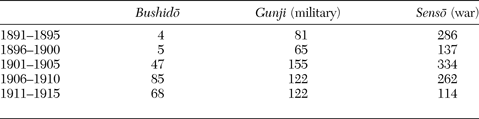
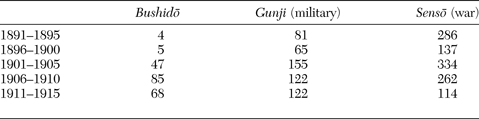
Bushidō was a fairly obscure term before the 1890s, but surged in popularity after 1905. The National Diet Library's Modern Digital Library (Kindai dijitaru raiburarii) allows for a simple but objective measure of the term's usage: the database indexes Meiji-era texts by title, author, publisher, and table of contents (see table 1). The database produced no hits for the term bushidō prior to 1893, and during the 1890s, citations for bushidō appeared roughly once a year. This rate increased tenfold after 1901 to nearly ten titles per year, and to more than fifteen titles between 1906 and 1910. This growth in citations was attributable, in part, to general growth in the publishing industry and to increased interest in military affairs during the Sino-Japanese and Russo-Japanese wars. But while hits for terms such as “military” (gunji) also increased, the bushidō boom was without parallel.
Citations of bushidō and related terms.
Compiled June 2, 2008, at http://kindai.ndl.go.jp/index.html.
Modern bushidō ideology had several major sources. It was a product largely of what Carol Gluck has termed minkan ideologues: “journalists, intellectuals, and public figures who produced a disproportionate amount of ‘public opinion’ (yoron) of the period” (1985, 10). Many minkan ideologues held government positions, and their views enjoyed increased currency because of those positions, but they were not simply state ideologues. A prime example is Inoue Tetsujirō, a professor of philosophy at Tokyo Imperial University. Intensely prolific, Inoue was central to the creation of Meiji state ideology, particularly through his 1891 commentary on the Imperial Rescript on Education. In that commentary, of which some 4 million copies were eventually printed, Inoue “fabricated the rudiments of the family-state ideology,” giving a modern, quasi-utilitarian gloss to the morals of loyalty and filial piety (Gluck Reference Gluck1985, 128–30; Pyle Reference Pyle1969, 127–28). Because Inoue's commentary was written at the explicit request of the Ministry of Education, his views had quasi-official status. Some of his interpretations, however, were at odds with those of the authors of the rescript. Most striking was Inoue's assertion that the rescript constituted a state religion for modern Japan. This was in direct conflict with the thinking of one of the rescript's prime architects, Motoda Eifu, who had hoped to define the rescript as a “national teaching,” independent of any religion. The prime authors of the Meiji constitution, Itō Hirobumi and Inoue Kowashi, had similarly advocated a separation of church and state. For Inoue Tetsujirō, however, the rescript provided an opportunity to advance his campaign against Christianity, which he considered dangerously un-Japanese (Nolte and Onishi Reference Nolte and Onishi1983). Because the Meiji state was not univocal, Inoue could speak both independently and with semi-official status.
Inoue was one of the earliest and most active proponents of bushidō as a national ideology, and his views were especially influential because of his prominence in academic and government circles. In the early 1900s, Inoue began to emphasize the importance of bushidō as a distinctly Japanese philosophy. In a 1901 lecture to the teachers at a Japanese military academy (Rikugun chūō yōnen gakkō), Inoue argued that bushidō was “central to the spirit of the Japanese people” and a sui generis spiritual system. It “developed together with the martial spirit of the Japanese people” and the Japanese people themselves “originated together with that spirit.” Although military in origin, bushidō was not primarily about violence. Rather, it was a moral code that emphasized both self-cultivation and self-sacrifice, appropriate to many modern situations (Inoue Reference Tetsujirō1901, 2–3, 8, 46–65).
In a series of publications in the early 1900s, Inoue developed an influential genealogy of bushidō. Although the tradition was rooted in the practical experience of generations of warriors, the progenitor of bushidō as a written body of knowledge was Yamaga Sokō (1622–85), and Sokō's thought was at the root of the brave self-sacrifice of the forty-seven Akō rōnin, immortalized in the play Chūshingura. In the bakumatsu era, according to Inoue, bushidō ideology was further honed by Yoshida Shōin (1830–59), who was, according to Inoue, a disciple of Yamaga (Inoue Reference Tetsujirō1901, 30–31). Inoue's genealogy of bushidō was extremely influential and reproduced in numerous texts on history, literature, and philosophy, as well as government tracts on national ethics. The famous 1937 government pamphlet Kokutai no Hongi (Cardinal Principles of Our National Polity), for example, reproduced Inoue's emphasis on Yamaga and Yoshida. Inoue's status as a quasi-official spokesman for Japan's martial spirit was further cemented in 1941 when War Minister Tōjō Hideki provided a calligraphic epigram for Inoue's Instruction for Warfare (Senjinkun) (Tucker Reference Tucker2002).
Inoue was unparalleled in the vehemence with which he promoted bushidō as a national ideology, but other state-affiliated intellectuals were active as well. The prominent historian Shigeno Yasutsugu, for example, coauthored a 1909 volume that traced the origins of the doctrine from the dawn of time to the present (Shigeno and Kusaka Reference Yasutsugu and Hiroshi1909). Shigeno, widely considered one of the founders of modern historical writing in Japan, developed a close association with the Meiji state in 1881 when he was appointed deputy editor of Dai Nippon hennen shi (Chronological History of Japan), an official state-sponsored history covering 1392 to 1867 (Ketelaar Reference Ketelaar1990, 191–94; Numata Reference Numata, Beasley and Pulleyblank1961; Tao Reference Tao, Hardacre and Kern1997).
In his historical writings, Shigeno was deeply committed to historicizing Japan's ancient chronicles. For Shigeno, the creation of Japan by the gods Izanagi and Izanami marked the beginning of historical time in Japan, and national history needed to be measured and explained through the genealogy of the imperial line. In their study of bushidō, Shigeno and his coauthor, Kusaka Hiroshi, similarly linked the origins of bushidō to Japanese creation myths. “If we are to trace the distant beginnings of our country's bushidō,” they wrote, “we find that its origins were already present in the age of the gods, occurring together with the founding of the country, when the two gods Izanagi and Izanami created Ōyashima [Japan] with their jeweled spear, when Amaterasu bequeathed the country with a precious sword [Kusanagi], thus adding it to the three sacred regalia.” Thus, according to Shigeno and Kusaka, the origins of bushidō antedated the emergence of samurai warriors by some 1,500 years. Therefore, it was not a warrior code but a timeless national ideology, “something that the people (kokumin) should not forget even for an instant” (Shigeno and Kusaka Reference Yasutsugu and Hiroshi1909, 1, 424).
What is remarkable about the sudden explosion of bushidō studies is how political rivals contested the meaning of bushidō, but not its importance as a uniquely Japanese corpus of thought. Japanese Christians, for example, embraced bushidō and used their support for bushidō to refute accusations of disloyalty to the throne. Thus, although Inoue argued publicly that Japanese Christians could not be loyal subjects, one of the most widely read books on bushidō was Bushido: Soul of Japan, written by Nitobe Inazo, a Christian convert. Nitobe treated bushidō as analogous to European chivalry and, intriguingly, saw seppuku as analogous to Roman stoicism and Christian martyrdom (Nitobe [1900] Reference Nitobe1905, 122–23). Indeed, Nitobe argued that bushidō had allowed Japan to attain a Christian level of civilization in the absence of Christianity. The samurai, Nitobe claimed, were cultured men of arts and letters and their appreciation of the arts restrained them from brutality even in combat (49). Further, a samurai's sense of duty was comparable to the Christian doctrine of service, “the sacred key-note of His [Christ's] mission” (147). Indeed, the parallels between Christianity and bushidō were so strong as to “confirm the moral identity of the human species” (125). Nitobe's Bushido was key in shaping Western perceptions of Japan, and became influential in Japan as well, running through eight Japanese editions before 1905 (Yorimitsu Reference Yorimitsu, Wolff, Marks, Meenings, van der Oye, Steinberg and Shinji2007). Inoue felt compelled in his 1901 lecture on bushidō to refute the parallels between chivalry and bushidō (Inoue Reference Tetsujirō1901, 8–9).
The ubiquity of bushidō reflected the plasticity of the concept. The noted liberal activist Ōzaki Yukio, for example, argued that bushidō was important primarily for Japanese commerce. In an 1893 treatise on political reform, Ōzaki argued that bushidō was essential, but not for military reasons. Echoing Samuel Smiles and Horatio Alger, Ōzaki claimed that successful men pursued not fleeting profit but respectable prosperity. English businessmen were successful, Ōzaki argued, because they were gentleman, and therefore were reliable, trustworthy, and temperate. Because bushidō emphasized loyalty, trustworthiness, and restraint, it was essential to the success of the Japanese economy. Bushidō would save Japanese businessmen from rank materialism and guide them toward lasting honor and prosperity (Ōzaki Reference Yukio1893, 25–28).
For most commentators, however, bushidō was a martial doctrine. Central to the rise of modern bushidō were Japan's victories in the Sino-Japanese War (1894–95) and the Russo-Japanese War (1904–5). Both events focused attention on the military as an emblem of Japanese national pride and accomplishment. Japan's success in modern warfare sparked, ironically, a revival of traditional martial arts techniques and prompted the founding in 1895 of the Greater Japan Martial Virtue Society (Dai Nihon Butokukai). The society was devoted to the revival of traditional swordsmanship and archery, but also the cultivation of a traditional warrior ethos. Fencing, they claimed, was the quintessence of the Japanese spirit, and it led to the cultivation of the mind, body, and soul (Ozeki Reference Norimasa1910, 1). The group's early marital arts expositions were observed by the emperor, giving it a state imprimatur, and it later received indirect support from the army, the police, and the Home Ministry. Local chapters of martial arts societies linked bushidō to patriotism, arguing that “the great principles of loyalty and patriotism are special characteristic of martial virtue” (Ozeki Reference Norimasa1910, 5).
The Japanese military grew interested in bushidō in the aftermath of the Russo-Japanese War. Japanese military strategists concluded that Japan had defeated Russia because Japanese “fighting spirit could make up for, if not replace, shortages of manpower and some deficiencies in advanced armament.” This belief stemmed, in part, from distorted reports of battlefield events, but it led nonetheless to an emphasis on “motivating the rank and file to fight to the point of exhaustion and to sacrifice their lives” (Kowner Reference Kowner and Kowner2007, 34). Based on this perception that Japan's victory had come from its spiritual ascendancy, the army became concerned with “the moral quality of the soldier and of the people from whom they came.” Urbanization meant that new recruits came increasingly from “morally suspect urban areas,” and the expansion of national primary education meant that conscripts were better educated and thus less malleable. In order to meet these challenges, the army had to become “the school of the people” and shape the character of the Japanese populace. This goal required new institutions, such as the Imperial Military Reserve Association (Teikoku zaigō gunjinkai), an organization designed to foster patriotism and martial valor, with local branches down to the village level (Humphreys Reference Humphreys1995, 12–16). Bushidō was central to this new project. In 1911, for example, General Tanaka Giichi, future army minister, prime minister, and a major architect of the reserve association, declared that “the roots of the spirit of Japan and of bushidō lie deep within the Japanese people.” Tanaka proposed using the reservists organization to spread the spirit of bushidō and combat national moral decay (Smethurst Reference Smethurst1971, 823).
Perhaps the most striking public example of the new veneration of bushidō was the 1912 suicide (junshi) of General Nogi Maresuke, hero of the Russo-Japanese War. According to his last note, he sought both to follow his lord, the Meiji emperor, into death and to atone for losing his regimental banner during the War of the Southwest. Although some observers considered Nogi's junshi bizarre and retrograde, it was a dramatic example of how Japanese military officers were rethinking bushidō as an emblem of Japanese culture, rather than an embarrassing vestige of a feudal past (Gluck Reference Gluck1985, 221–25).
This new emphasis on bushidō can be understood in the broader context of social management after the Russo-Japanese War. The war was enormously expensive and, unlike the Sino-Japanese War, the economic costs were not defrayed by an indemnity. Thus, as Sheldon Garon has observed, “postwar management quickly assumed the form of social management, as officials strove to persuade the public to bear the new burdens of the nation's great power status.” Public campaigns to raise Japan's international competitiveness were described as preparation for “peacetime economic war”—a conflict requiring diligence, frugality, discipline, and self-sacrifice. These goals dovetailed with many of the tenets of modern bushidō: selfless service, self-restraint, and loyalty. These campaigns were supported by a range of groups, including the national bureaucracy, public intellectuals, local government, and civic groups. The Hōtokusha, for example, were private mutual aid societies dedicated to the principles of Ninomiya Sontoku, but they were, in theory, coordinated by a central agency created by the Home Ministry. The Home Ministry also relied on Christian relief groups, despite official suspicions about the loyalties of Japanese Christians (Garon Reference Garon1997, 9, 13, 46–47). In a parallel fashion, a wide range of civic organizations and individuals (including ideologically suspect Christians) worked with government agencies to promote bushidō as a national ideology. Indeed, it was this diversity of advocates, ranging from martial arts masters to Christian educators and from Diet members to army officers, that secured the ubiquity of bushidō in popular discourse.
Bushidō and Biographies of Saigō
Saigō's posthumous pardon in 1889 removed any concern that praise for Saigō might be seen as disloyal. But until the rise of bushidō, few authors chose to focus on the details of Saigō's death. In an account published in November 1877, for example, Ogamino Naka detailed the last days of the rebel army and their march into a hail of Imperial Army gunfire and artillery. They died, he wrote, heroically, their spirits ascending to heaven like gun smoke. Skipping any details of Saigō's exact death, he then moved to an evaluation of Saigō's life, reporting that Saigō, despite his opposition to the government, was a great man, unrivaled in his courage, ingenuity, and popularity. “There has never been and will never be,” he concluded, “another Saigō” (Ogamino Reference Naka1877). Eliding the specifics of Saigō's death was a fairly common practice. A biography of Saigō by Yasuda Naotaka, for example, made no mention of Saigō's death, but reproduced a letter in which he exhorted his followers to die with honor (Yasuda Reference Naotaka1889, 28–31).
Some biographers saw fit to skip not only the details of Saigō's death, but the entire War of the Southwest. In a detailed three-volume biography of Saigō published from 1899 to Reference Gensai and Chikutei1903, for example, authors Murai Gensai and Fukura Chikutei concluded their story in 1874, with Saigō's return to Kagoshima and his involvement in the shigakkō network of samurai academies. Rather than praise Saigō's death, biographers focused on his achievements. In a collection of biographies on the theme of risshin (personal advancement), for example, Saigō was celebrated for his rise from humble origins to national prominence and success, including his receipt of a 2,000 koku award for loyal service in the Restoration (Shinoda Reference Shōsaku1892, 13–15).Footnote 7
In the mid-1890s, however, authors began to experiment with various means of giving Saigō a more bushidō-like death. A seminal example was an 1894 biography by Katsuta Magoya. According to Katsuta, Saigō and his men marched resolutely into a hail of gunfire. Saigō was hit by a stray bullet, collapsed, and ordered Beppu to take his head. Beppu, seeing no alternative, cut off Saigō's head, put it in a felt bag, and buried it at the roadside. He then announced that Saigō was dead and that the end was at hand. Thirty-nine of Saigō's men, including Murata, Ikegami, Beppu, and Henmi, then stabbed themselves to death (jijin). Katsuta's account gave Saigō volition in his own death: he asked Beppu to cut off his head (Katsuta Reference Magoya1894, 8:148–49). Katsuta's work was, for its time, remarkably well documented, and, according to his citations, he based his account of Saigō's death on several published sources. Nonetheless, it seems clear that Saigō's request to Beppu was Katsuta's invention: none of Katsuta's sources mention Saigō asking Beppu to take his head. According to Teichū rangai, a history published by Kagoshima prefecture in 1879, “a bullet passed through Takamori's thigh and he could not move, so Beppu Shinsuke quickly cut off his head, put it in a felt bag, and buried it” (Kagoshima-ken Reference Kagoshima-ken1879, 2:28). Seinan seitōshi, published by the Japanese navy in 1885, gives a similar account: “Saigō suffered a bullet wound and Beppu, realizing that Saigō would never fight again, cut off his head and secretly buried it” (Kaigunshō Reference Kaigunshō1885, 4:46). Seinan senki reports that a lieutenant Yasumura in the Imperial Army was closing in on Saigō, so Beppu attacked Yasumura and then “rushed to Saigō, cut off his head and ran off with it” (Kosuge Reference Ren1897, 99). Senpō nikki, the wartime journal of a Kagoshima partisan, reports only that on the evening of September 24, “we received a report that Master Saigō, Kirino, Murata, and the others had died in battle on Shiroyama and that the fighting was completely over” (Sassa [1891] Reference Tomofusa and Kazuto1986, 199).
Katsuta's intervention was a creative solution to the inelegance of Saigō's death. It gave Saigō volition in his own demise without openly contradicting any of Katsuta's sources. Katsuta did not have Saigō sit, or even move, so his description is consistent with a bullet penetrating and shattering Saigō's femur. But Katsuta made Saigō an agent in his own demise, and although his account was still far from even a loose definition of seppuku, it was consonant with broader notions of an honorable death. Accordingly, Katsuta's depiction of Saigō's last moments was picked up by authors such as Kakuroku Yashi (Reference Yashi1900, 100–101; Reference Yashi1909, 100–101) and Yamaji Aizan (Reference Aizan1915, 57–58), and it became a fairly standard account of Saigō's death.
At the same time, other sources began describing Saigō's death as suicide, without particular explanation. This trend was particularly striking in schoolbooks. A 1902 school textbook by Fujioka Sakutarō, for example, linked Saigō to obstinate opponents of progress, but claimed that he committed suicide (jisatsu) at Shiroyama (Fujioka Reference Sakutarō1902, 2:142–44). A textbook by Honda Asajirō from the same year took this further and noted that Saigō and his followers stabbed themselves to death (jijin) (Honda Reference Asajirō1902, 2:200). In 1903, the Japanese government changed its policy of approving textbooks from private publishers to a more restrictive system of official textbooks issued by the Ministry of Education (Monbushō). The first elementary school history text issued under the new policy, Jinjō shōgaku Nihonshi (1909), described Saigō's death as suicide (jisatsu), and thus gave official government approval to this new account of Saigō's demise (Kaigo Reference Tokuomi1961–67, 19:551, 609).
The earliest detailed account of a seppuku scene I have found is a 1909 excerpt from Shiroyama rōjō chōsa hikki, notes for a history of the siege of Shiroyama by Kajiki Tsuneki. A veteran of the War of the Southwest, Kajiki spent a year in prison after his capture by government troops in 1877. An ardent nationalist, he traveled to Korea in 1882, hoping to join up with other Japanese forces in a violent struggle at the Korean court, the Imo mutiny. Arriving too late, he returned to Japan and joined the Fukuoka police force. Around 1902, Kajiki became active in the Kokuryūkai, a militant nationalist group. Founded in 1901 by Uchida Ryōhei, the Kokuryūkai was committed to the military subjugation of China and Korea, and its members saw in Saigō's fragmentary comments on Korea a precedent for their own beliefs. Kajiki began working on the Kokuryūkai's history of the War of the Southwest, Seinan kiden (Reference Kokuryūkai1908–11), which included a snippet of Kajiki's work in progress. According to that excerpt, Saigō was shot through the hip, called Beppu to his side, and then sat upright and faced east toward the Imperial Palace while waiting for Beppu to take his head (Kokuryūkai 1908–1911, vol. 2, pt. 2, 702–3; Kajiki Reference Tsuneki1912, appendix 1–3).
When Kajiki published his own history of the war three years later (Satsunan ketsurui shi), the seppuku was still more involved and dramatic. Saigō and his men assembled in front of their cave on Shiroyama and marched out proudly into a hail of gunfire. Noticing the rapid approach of the enemy, Henmi asked Saigō, “Is this a good place?” meaning, should the group kill themselves on the spot? Saigō responded, “not yet,” meaning that they needed to advance further and compose themselves. As they advanced, their number shrank, some killed in enemy fire, some falling on their own swords. Finally, Saigō was hit by a gunshot, from the shoulder through the breast. He calmly called for Beppu, announcing that this was indeed the right time and place. He then sat upright, tucked his knees under his torso (kiza), solemnly adjusted his collar, looked east, and paid his last respects to the emperor. Beppu, himself badly injured, came to Saigō's side, begged his forgiveness, and cut off his head (Kajiki Reference Tsuneki1912, 833–35).
Kajiki's account is remarkable for its bold revisionism. In order to have Saigō sit upright with composure and bow toward the Imperial Palace, Kajiki changed the nature of Saigō's injuries. Instead of the hip, Saigō was now shot through the shoulder. This made Saigō's seppuku scene more plausible, but it contradicted published accounts familiar to Kajiki from his work on Seinan kiden. Indeed, it also contradicted the research notes that Kajiki had published only three years earlier. But these empirical problems were overshadowed by outside events. Satsunan ketsurui shi was published one month after General Nogi Maresuke committed suicide. Because Nogi had fought against Saigō thirty-five years earlier, the parallels could not have been stronger: two great Japanese martial heroes, formerly enemies, were now united in death through their devotion to the emperor and their dedication to the spirit of bushidō. This was nationalist bushidō at its most effective, and it generated enough interest in Kajiki's history to warrant a second printing later that year.
In subsequent years, Kajiki's narrative became a fairly standard account of Saigō's death. A version of Kajiki's account appeared in 1926 in the biographical section of Dai Saigō zenshū, a three-volume collection of Saigō's letters. As in Kajiki's version, Saigō strode into enemy fire, looking for the right spot to die. Shot in the thigh and abdomen, he sat upright (tanza) and bowed to the Imperial Palace before Beppu took his head. This version changed Kajiki's dialogue slightly: rather than seeking a composed (shōyō) death, for example, Saigō sought a magnificent (rippa) death. It also changed Saigō's injuries, deleting the shoulder, restoring the thigh, and adding the abdomen. These differences aside, the account clearly derived from Kajiki (Dai Saigō zenshū henshū iinkai Reference Dai Saigō zenshū henshū iinkai1926, 3:1026–27). A 1927 biography of Saigō, published to commemorate the fiftieth anniversary of the founding of Saigō Shrine, reproduced, without attribution, several key details of Kajiki's version, including much of the dialogue between Saigō and his followers, and his bow to the Imperial Palace (Nanshū jinja gojūnen-sai hōsankai 1927, 455–57). Virtually the same account appeared in 1938 as part of a popular biography series entitled Jinbutsu saikentō sōsho (Ōhara Reference Kenji1938, 331–32) and in a one-volume biography by the prolific novelist and essayist Mushanokōji Saneatsu (Reference Saneatsu1938, 455–57).Footnote 8
Mushanokōji's biography of Saigō warrants special attention because it highlights the connection between Saigō's seppuku and Japanese militarism. Mushanokōji began his literary career as a Tolstoian idealist and pacifist, and he was a key member of the Shirakaba (White Birch) literary magazine. In 1912, he dismissed the ritual suicide of General Nogi as an embarrassing anachronism: “General Nogi's death can be adored only by those with unhealthy reason … Unfortunately, there is nothing in the death of Nogi which appeals to humanity, whereas the death of Van Gogh is a loss to humanity” (Arima Reference Arima1969, 107–8). In the 1930s, however, he began to support Japanese militarism, influenced perhaps by his elder brother, who was Japan's ambassador to Nazi Germany. By the 1940s, Mushanokōji was an outspoken proponent of the war effort, and as late as November 1944, he was writing of coming victory against the United States (Keene Reference Keene1964, 212). After the war, he was purged by the U.S. occupation for his strident support of the war effort. Mushanokōji's biography of Saigō falls at the beginning of his passage from idealistic pacifism to an enthusiastic embrace of militarism.
Mushanokōji's biography is also important for its impact on American writing. Although his work on Saigō was a minor part of his massive oeuvre, it was translated into English in 1942 by Moriaki Sakamoto under the title Great Saigo. Sakamoto lovingly detailed the legend of Saigō's seppuku for English-language readers. Striding into gunfire, Saigō urged Beppu and Henmi forward: “No, let us go farther up to the main road, where we shall die glorious deaths.” After proceeding further, Saigō was shot in the thigh and abdomen, asked Beppu to prepare to take his head, “calmly squatted down, and turning towards the east, worshipped the Imperial Palace.” As Beppu moved “with consummate skill” to take his master's head, “Saigo was equanimity itself” (Mushakoji Reference Mushakoji and Sakamoto1942, 479–80). Sakamoto's translation was, until 1987, the only English-language biography of Saigō, and it had a definitive impact on American writing. In his influential Nobility of Failure (1975), Ivan Morris relied heavily on Sakamoto, thus bringing Kajiki's story to generations of college students and general readers. The more recent Columbia Encyclopedia (2000) still cites Sakamoto as its reference for Saigō. These works helped inscribe Saigō's suicide into American discourse as history.
Saigō thus committed “suicide” only decades after his death. Although some nishikie described Saigō's death as seppuku in 1877, the story did not appear in more respectable print media until some two decades later. After 1894, however, biographies of Saigō gave him increasing agency in his own death. At first he merely asked Beppu to take his head, but after 1912, it became increasingly common for Saigō to carefully choose the place of his death and calmly show his respect to the emperor before having Beppu end his life. Through widespread dissemination and reproduction, these accounts of Saigō's death became reference work facts.
It is worth noting that although the Ministry of Education's 1909 textbook described Saigō's death as a suicide, the government published contradictory versions of Saigō's death. The 1920 revision of the textbook (and subsequent 1934 revision) reported that Saigō died in battle (senshi) (Kaigo Reference Tokuomi1961–67, 19:608, 20:103–4). Textbooks after 1940 elided Saigō's death, mentioning that he was defeated and focusing instead on the emperor's concern for civil order (Kaigo Reference Tokuomi1961–67, 20:214, 349). Clearly the government remained ambivalent about turning a rebel into a hero. Indeed, in order to celebrate Saigō as a Japanese hero, textbooks needed to downplay his role as a rebel against the imperial government. The 1909 text, for example, reported that in 1874 Saigō “retuned home to Kagoshima and opened a private academy to nurture [local] children. Among them were many who were unhappy with government policy and, in February 1877, they turned to Saigō as their leader (Saigō o yōshite) and raised an army.” Saigō accepted command of this army, but the initial rebellion was launched by his reckless followers. In general, the Ministry of Education remained skittish about glorifying rebels. The text of Kokutai no hongi, for example, followed Inoue Tetsujirō's overall interpretation of bushidō, but omitted his valorization of the forty-seven Akō rōnin. Those men had attacked an officer of the national government, and, whatever their courage, insubordination was not something the Ministry of Education was prepared to endorse.
Lost Legends and Counternarratives
The most glorious legends of Saigō's suicide were developed by the Japanese right, which sought to fit Saigō into an extended narrative of the Japanese military. The state, with inconsistency and trepidation, accepted Saigō's suicide as part of remaking Saigō as a national hero. But this redaction of Saigō lore required the exclusion of Saigō legends that might challenge the Meiji state. In order for the Meiji state and its defenders to venerate Saigō, he needed to be noble, but dead; his vitality, whether metaphorical or real, was a challenge to the political establishment. The reproduction of Saigō as a national hero thus required that some legends be relegated to fantasy while others be redeployed as history.
One outcome of this process was the loss of Saigō as a proponent of radical change. In 1877, tabloids represented this aspect of Saigō's persona by giving him a flag with the phrase shinsei kōtoku, “A New Government, Rich in Virtue.” This slogan combined both a desire for revolutionary transformation—“a new government”—and a desire to maintain the paternalism of the early modern order—“rich in virtue.” The slogan harkened back to the notion that the state should be benevolent rather than bureaucratic. Implicit in the phrase was the contradictory but compelling desire for the vitality of a free society combined with the security of Confucian paternalism. The banner appeared in scores of nishikie, and was fairly standard in depictions of battle scenes by the summer of 1877. It is unclear whether Saigō actually flew such a standard. The nishikie tradition stemmed from a single mention of such a banner, based on hearsay, in the Yūbin hōchi shimbun on March 3, 1877 (Sasaki Reference Suguru, Naohiro, Yoshihiko, Susumu, Masanao, Shōhachi and Yoshio1994, 331). There are no eyewitness accounts of such a flag, nor any surviving examples. In the nishikie tradition, however, shinsei kōtoku was the official manifesto of the rebel cause.Footnote 9
The image of shinsei kōtoku was popular because it captured the dualistic appeal of Saigō's cause. When Edward Morse wrote that Saigō was “beloved by all Japanese,” he was not too far off the mark (Morse Reference Morse1917, 1:269). Saigō, in 1877, represented both the virtues of the traditional order and the possibility of revolutionary transformation. This duality generated widespread sympathy. In Kumamoto, for example, the countryside erupted in rebellion as thousands of peasants voiced their grievances against the Meiji government. The commoners were suspicious of the new land tax and angry over new local levies designed to pay for national mandates, such as public education and land surveys. Across the prefecture, they both petitioned and physically attacked local officials, demanding delays in the new land tax and reductions in levies. In Katamata village, violence erupted when one Fujii Ihei returned from Kumamoto City on February 25 and reported the arrival of Satsuma troops. If the rebels came to Katamata, he declared, villagers would not have to pay taxes and would be able to choose their own village officials. Local officials managed to contain the situation for a week, but by early March, they were confronted by death threats and fled the village (Kumamoto junsatsuchō Reference Kumamoto junsatsuchō1877). Order was not restored until the rebel army was driven from Kumamoto in the fall.Footnote 10
The rebels also drew support from a range of disaffected samurai groups. In Fukuoka and Nakatsu, for example, there were sympathetic uprisings by traditionally minded samurai. But the rebels were also supported by groups such as the Kyōdōtai, a Kumamoto samurai brigade formed by members of the Ueki gakkō, a radical school in Ueki town. The core curriculum at the Ueki gakkō included translations of Rousseau's Social Contract, Mill's On Liberty, and Montesquieu's The Sprit of Laws, and the school's founder, Miyazaki Hachirō, was an important participant in Itagaki Taisuke's campaign for an elected national assembly (Shindō Reference Toyō1982, 25–26).Footnote 11 In Kōchi, police arrested a group of former samurai as they collected guns and ammunition. Under interrogation, the leader complained that the government was arrogating political power, “plunging the people into misery, and recklessly oppressing the people's rights (minken), and bringing the Japanese empire to the brink of ruin” (Kagoshima-ken ishin shiryō hensanjo 1978–80, 1:672).
Saigō's appeal as a progressive was also reflected in period newspapers. The Ōsaka nippō, for example, was an outspoken advocate of representative government and ran afoul of censorship laws in 1876 for asserting that “the government is a government of the people (jinmin), not a government of the monarch (kunshu)” (Inoue Reference Kiyoshi1966, 436–37). Reporting Saigō's death on September 25, 1877, the newspaper again pushed the bounds of censorship and celebrated his accomplishments, comparing him to a range of world heroes: Kusunoki Masashige, the Qin general Ding Yu, and Napoleon Bonaparte. By contrast, conservative newspapers dismissed Saigō as a reactionary. The Yūbin hōchi shinbun, for example, lambasted Saigō for his dictatorial ambitions and military incompetence. Saigō wanted to turn back the clock and reverse the progress of the Meiji era: “Saigō's last battle was not just the end of Saigō, but a battle announcing the end of feudal power (hōken seiryoku)” (September 25, 1877). This critique reflected the newspaper's role as a quasi-governmental organ: the Yūbin hōchi shinbun had been founded in 1872 by Maejima Hisoka, the official who pioneered Japan's modern postal system.
Saigō also received the support of leading intellectuals such as Fukuzawa Yukichi, who wrote a lengthy essay in his defense in late 1877 (Fukuzawa Reference Fukuzawa and Takao2002, 9:31–74, 301–7).Footnote 12 Fukuzawa rejected the idea that Saigō was a reactionary who would restore feudal society. On the contrary, he argued, Saigō had been instrumental in the dissolution of the domains. While some of Saigō's followers had reactionary notions, “Saigō certainly did not despise freedom and progress, [but] was, in reality, a follower of the spirit of civilization (bunmei no seishin)” (9:44). While Fukuzawa lamented Saigō's use of force, he was equally critical of the autocracy of the Meiji government, which, he argued, had invited Saigō's rebellion through its repressive policies. “We should feel compassion for Saigō, for it was the government that drove him to his death” (9:72). In a brief draft manuscript written during the war, Fukuzawa was still bolder: “if the Satsuma forces win, they will certainly establish a new government and grant the people rights.” But such a government would founder because men like Saigō, with their lack of concern for administrative detail, would be deceived by the existing bureaucracy. Thus, Fukuzawa concluded, while the war was a huge setback for Japan, there was no reason to favor one side over the other (9:78).
This vision of Saigō as a revolutionary inspired the legend that he did not die in battle, but had fled Japan and was waiting to return. Such stories began to circulate in the summer of 1877, as the rebel army retreated through the mountains and dense forests of Kyushu. Saigō disappeared from public view, generating fantastic rumors. On August 4, for example, the Yomiuiri shinbun reported rumors that Saigō had fled to China or to Korea, and that the government was offering a reward of 150 yen for news of his whereabouts. The story continued after Saigō's death, and rumors that he was hiding in China appeared in the Kinji hyōron and the Niigata shinbun. On July 13, 1878, the Chōya shinbun reported that an amazing number of people believed that Saigō was still alive. Three years later, the Yūbin hōchi shinbun reported widespread belief in a rumor that Saigō was hiding on an island in India, and that he was going to return to Japan to set things right. This story was spread by street peddlers selling pamphlets (Ikai Reference Takaaki1992, 5–6).
These rumors dissipated in the late 1880s, but they returned with unexpected vibrancy in the spring of 1891. The occasion was the planned visit to Japan of Russian Crown Prince Nikolai, and the legend was now revised so as to place Saigō in Russia. The story, as reported on March 31 in the illustrated tabloid Nihon, ran as follows: Saigō and his key lieutenants (Kirino Toshiaki, Murata Shinpachi, etc.) had fled to Koshiki Island on the eve of the Battle of Shiroyama. There, they had been picked up by a Russian warship and taken to Siberia, where they then helped train Russian troops. During his trip to Russia in 1884–85, Kuroda Kiyotaka (prime minister, 1888–89) had visited Saigō and the two had discussed the future of Japan. Saigō had promised to return in 1891, after the establishment of a national assembly, and the Russian crown prince had agreed to accompany him back. The details of this rumor reveal the complexities of Saigō's public persona as both a samurai and a progressive leader: Saigō was in Russia training troops, but was to return to Japan after the opening of the Diet. The legend was picked up by other newspapers and became the basis for a nishikie published on April 8 (Sasaki Reference Suguru, Naohiro, Yoshihiko, Susumu, Masanao, Shōhachi and Yoshio1994, 333–38).
The idea that Saigō was alive and returning to Japan from Russia was absurd, and much newspaper reporting was tongue-in-cheek. The Niigata newspaper Hokushin shinbun, for example, sponsored a contest in which readers could vote for whether Saigō was alive or dead. (Kusunoki Reference Seiichirō1997, 23). Fukuzawa Yukichi, writing in the Jiji shinpō on April 10, ridiculed the legend but used it as an opportunity to critique the Meiji government. While some were terrified that Saigō might exact vengeance on his old enemies, Fukuzawa did not think that Saigō would stay for long: he would take one look at the Meiji government and flee in disgust. The spendthrift decadence of the Meiji elite would drive Saigō, a man of genuine simplicity and humility, straight back to hell (Fukuzawa Reference Fukuzawa and Takao2002, 9:95–98). This arch tone was attributed even to the Meiji emperor. According to the April 7 Chōya shinbun, the emperor joked that if Saigō were indeed still alive, the throne would have to take back the medals awarded after the War of the Southwest (Sasaki Reference Suguru, Naohiro, Yoshihiko, Susumu, Masanao, Shōhachi and Yoshio1994, 335).
These glib remarks had unexpectedly violent consequences. On May 11, Tsuda Sanzō, a constable and decorated veteran of the War of the Southwest, attacked Nikolai as he was being escorted through the town of Ōtsu on Lake Biwa. Tsuda struck Nikolai twice, cutting two long gashes in the prince's head, before being subdued by police. Tsuda's motivations were complex, and reflect possible mental illness as well as the rise of fervent anti-Russian rhetoric. In pretrial hearings, however, Tsuda explicitly stated his belief that Saigō was returning with Nikolai and that this threatened his military honors (Kusunoki Reference Seiichirō1997, 22–23). A veteran of some of the fiercest fighting of the war, Tsuda had received not only a medal, but an award of 100 yen (Ōtsu-shi rekishi hakubutsukan 2003, 42–43).Footnote 13
Tsuda's spectacular outburst, together with widespread reports that he was insane, helped relegate Saigō survival stories to the realm of novelty and mythology. Tales of Saigō's survival gradually became associated with other Japanese fantasies of escape and transformation, such as the legend that Minamoto no Yoshitsune fled to Mongolia and became Chingis Khan. Nonetheless, they survived in alternative media, such as adventure novels for young boys. In Oshikawa Shunrō's Shin Nihon tō (1906), for example, Saigō survives the Battle of Shiroyama and leads a liberation army against American imperialism in the Philippines (Karlin Reference Karlin2002, 74–75; forthcoming).
Popular fiction kept alive the dual meanings of Saigō as both a progressive leader and a militarist. A 1912 article in the boys' magazine World of Adventure (Bōken sekai) posed the question, “what if Saigō had won?” Saigō, the author argued, would have quickly built a continental empire, conquering not only Korea, but also Manchuria and northern China. At the same time, however, Saigō would have pushed for constitutional government, including a representative assembly. “Didn't Saigō submit a memorial for a representative assembly (minsen giin) in 1873? He was an associate of Fukuzawa Yukichi and he thought seriously and with firm convictions about civil government.” Saigō's concern for ordinary people, his lack of interest in noble titles, and his ardent patriotism made him a natural advocate for representative government. This essay was full of factual flaws. Saigō did not submit a memorial for a representative assembly and was not in close contact with Fukuzawa, but these problems did not blunt the author's enthusiasm (Fukumoto Reference Fukumoto1912).
The power of these counternarratives to inspire antigovernment attitudes is revealed in the autobiography of anarchist Ōsugi Sakae. Ōsugi recalled a middle school class in which the students were asked by their ethics teacher to name their heroes. While the other students offered standard choices, such as Kusunoki Masashige and Tokugawa Ieyasu, Ōsugi declared that his hero was Saigō. His teacher was not amused. The teacher allowed that Saigō was “possibly the greatest man in modern Japan,” but he had nonetheless rebelled against the emperor, and this made him unworthy of admiration. Ōsugi found this criticism upsetting. The biography of Saigō that he had read said nothing about treason, but described Saigō as a hero who sought to drive out wicked officials. Ōsugi resolved to read further about Saigō and found him still more appealing.
Ōsugi's recollections reflect two polar views of Saigō. His teacher, whom his classmates mockingly nicknamed Confucius for his beard and devotion to Confucian aphorisms, offers an orthodox Confucian view of Saigō: his act of rebellion outweighed his other accomplishments. Ōsugi, by contrast, was inspired by popular biographies and considered Saigō a principled opponent of the status quo. For Ōsugi, Saigō was a “modern” man whose struggle against an evil government resonated with Ōsugi's own revolutionary aspirations (Ōsugi [1921–22] Reference Sakae1961, 77–81; [1921–22] Reference Sakae and Marshall1992, 50–51).
Conclusions
My central interest here is not to establish a single “true” account of Saigō's death, but to resituate Saigō's suicide as one of many Saigō legends. The legend of Saigō's seppuku reflects a conservative consensus on Saigō's position in the broader sweep of Japanese history. Saigō's noble death symbolizes how the samurai class is, like Saigō, irrecoverably dead, but how select aspects of samurai practice are today widely celebrated as part of Japan's common cultural heritage. Saigō's glorious suicide thus not only is a good story, but also fits within a conservative narrative of Japanese cultural and political history. If Saigō is dead, but died by his own sword, then he has a stable place in a Japanese national narrative that runs from samurai rule to the present. By contrast, lesser-known legends, such as Saigō's shinsei kōtoku banner, express the revolutionary potential of Saigō's rebellion. This vision of Saigō was threatening not only to the Meiji state, but to the broader metanarrative of Japanese history.
Given the prevalence of Saigō myths and legends, it is not surprising that they have found their way into textbooks and reference works. What is troubling about the appearance of Saigō's suicide in Japanese and American historiography is that it reflects the triumph of a distinctly conservative and militaristic interpretation of Saigō over alternative visions. Our standard short biographies of Saigō are remarkably similar to those found in Japanese textbooks of the early 1900s: a revolutionary leader who, outpaced by his revolution, led a futile but valiant rebellion. This suggests that in our efforts to explain the Meiji state, we have, however unwittingly, adopted some of its own historiographic conventions.
Saigō legends of the early Meiji era merit special attention. These legends embodied a vast and sometimes contradictory range of political ideas, including populism, republicanism, imperial loyalism, pacifism, and militarism. Yet, as Ikai Takaaki (Reference Takaaki and Masahito2004) has shown, anger at the autocracy of the Meiji government created unexpected political allies who shared Saigō as their champion. We can find traces of this resistance in manifestos and editorials, but sources such as nishikie are strikingly articulate expressions of these inchoate, contradictory hopes. The appeal of Saigō's legendary shinsei kōtoku banner reflects the passionate, if utopian, aspiration that the Restoration would lead to a new world of freedom, prosperity, and harmony. Precisely because these hopes were impassioned and utopian, the fantastic images of nishikie are uniquely valuable sources. In highlighting these alternative legends, I am not suggesting that we rewrite our textbooks, replacing legends of Saigō's suicide with stories of his flight to the Philippines or his ascent to Mars. But we need to understand Saigō's suicide as a legend and interpret it, along with other Saigō legends, as traces of how the Japanese public contested the present by contesting the past.
Acknowledgments
Research for this project was completed with the support of the Fulbright Program of the Japan-United States Educational Commission and the International Research Center for Japanese Studies in Kyoto (Nichibunken). Earlier versions were presented at the Nichibunken, the Tokyo Fulbright Seminar, Bowdoin College, Agnes Scott College, the University of Pittsburgh, the University of Florida, and East Carolina College. I much appreciate the comments received at each venue. I thank the JAS editors and reviewers, Martha Chaiklin, Peter Duus, Rob Eskildsen, Haraguchi Izumi, Jason G. Karlin, Kimura Takehito, and Ronald Toby for their helpful suggestions. I offer special thanks to Henry D. Smith II for sharing his extensive knowledge of early modern and Meiji prints.