INTRODUCTION
Movement through a rain-forest canopy poses challenges for arboreal animals exploiting substrates that are discontinuous and oriented at all angles to the ground (Poorter et al. Reference POORTER, BONGERS and BONGERS2006). Many species of small arboreal primate use lianas and small lateral branches as corridors through rain-forest canopies. One group of primates, the tamarin monkeys (Saguinus spp., subfamily Callitrichinae), conducts much of its foraging activities among thin branches of forest canopies to satisfy the nutritional demands associated with small body size (adult body mass 400–500 g) and high metabolic rate (Garber Reference GARBER1992). Optimal foraging activities for nutrients must meet a tamarin's physiological demands, while selection of suitable canopy runways is crucial for safety and avoidance of aerial and terrestrial predators (Smith Reference SMITH2000).
Tamarins often forage in fragmented forests with canopies interconnected by lateral branches and by lianas and other vegetation that drape over trees and extend into forest gaps (Garber Reference GARBER and Rylands1993). Gaps in the forest create an ecological edge effect that fosters high species diversity and an abundance of food for many animals (Putz & Windsor Reference PUTZ and WINDSOR1987, Sanford et al. Reference SANFORD, BRAKER and HARTSHORN1986, Schnitzer & Carson Reference SCHNITZER and CARSON2001). Tamarins spend much of their day in fragmented habitats, moving through the lower branches of tree canopies searching for fleshy fruits, plant gums (exudates), large insects such as grasshoppers, crickets, cockroaches and other food items that can be visually detected among branches (Garber Reference GARBER1988, Nickle & Heymann Reference NICKLE and HEYMANN1996).
Tamarin movement through the forest has been described as ‘trap-lining’ with several individual trees of the same species being used during the same day as these primates forage for food (Garber Reference GARBER1988). Behavioural foraging patterns of Geoffroy's tamarin (Saguinus geoffroyi Pucheran) have been examined in previous field studies; however, it is not clear precisely what aspects of the canopy habitat might be of greatest importance to this small primate. Habitat selection that determines the course of a foraging trap line might be a response to high concentrations of food, such as clusters of ripening fleshy fruits and congregations of large insects. Alternatively, habitat selection by Geoffroy's tamarin may be driven primarily by the physical characteristics of the route and associated with frequent contacts between tree canopies (canopy connectivity) and other aspects of the forest not directly relating to the abundance of food. In proposing a canopy-connectivity hypothesis for tamarin habitat preferences, concentrations of food is suggested to be secondary to the potential for efficient mobility through a rain-forest canopy. We address this hypothesis by examining two forests in Panama inhabited by different populations of Geoffroy's tamarin.
METHODS
Tamarin habitats examined in this study were historically influenced by the damming of the Chagras River in 1921, and the opening of the Panama Canal in 1914. Rising waters formed Gatun Lake, isolated landforms such as Barro Colorado Island (BCI), and formed new shorelines and peninsulas, such as that of Aqua Clara, along the newly created Canal Zone. Several species of primate, including Geoffroy's tamarin (group size ranges from 4–10 individuals), inhabit forested habitats along the Canal Zone. In areas of the Canal Zone such as BCI, some of the resident primates are descendents of populations that were originally trapped by the flood waters of 1912 (Milton & Hopkins Reference MILTON, HOPKINS, Estrada, Garber, Pavelka and Luecke2006). Many species of animal were hunted and collected without record on BCI, and no attempts were made to preserve this island until 1923. Aqua Clara peninsula and nearby BCI today have both old- and new-growth tropical forests, lakeshore habitats, clearings of natural and human origins, and both are located at approximately 9°N, 79°W (Croat Reference CROAT1978).
A pilot study of tamarin habitats conducted on Agua Clara, during the December/January dry season of 1987, was part of a larger study of tamarin demography, movements and gut parasites. In the field study, one to three researchers began 1 h before sunrise, quietly walking forest trails while listening for the calls and searching for movements of tamarins in canopies along trail systems. Upon sighting a tamarin, researchers marked the location on a topographic map, noting time, date, and number of individual tamarins. A stopwatch was used to record time intervals during observations of primate behaviours, and a hand-held clinometer was used to measure the height of tamarin in trees.
Duration of time that tamarins spent in different habitats was determined through an observational instantaneous sampling, comprised of a series of 30-s intervals. Instantaneous sampling commenced the instant that a tamarin was observed in the forest, with the individual categories of observed behaviour recorded on a prepared data sheet at the instant the 30-s interval ended (Suen & Ary Reference SUEN and ARY1984). A number ‘1’ was recorded if a behaviour was occurring at the first instant of a 30-s interval. Behaviours recorded were: (1) foraging, (2) social interaction within the troop, (3) vocalization and (4) interaction with other animals. Blank space on data sheets allowed for notes, such as brief description of physical structure (and taxonomic family if discernable at a distance) of plants that tamarins used so that these plants could be located later and marked for study. If a behaviour was not occurring at the first instant of the next 30-s interval, a ‘0’ was recorded, regardless of what occurred during the previous interval (Suen & Ary Reference SUEN and ARY1984). Researchers followed tamarins, if walking could be accomplished quietly along an established trail. Researchers did not actively pursue these primates through the forest. Most frequently, tamarins departed the area quickly, rarely allowing for more than 10 30-s intervals of observations in 1 h of fieldwork.
Instantaneous sampling ceased the instant that tamarins were not clearly visible. At this time, the researcher walked back to the base of each plant that had been occupied by a tamarin during the sampling session that had just ended. Each of these plants was flagged with tape numbered in indelible ink to match the number on the behavioural data sheet. On subsequent days, each of the mapped sites was approached at random times during the periods 5h30–11h30 and 16h30–sunset (when tamarins were most active). In this sampling method, one site might yield observational data for different days and times during the field study. Tamarins on Agua Clara wore beaded collars (from an earlier research project), which made it possible to establish accurate sample sizes of tamarins visiting forest plots, and to establish independence of observations. Tamarins on BCI lacked identifying collars, which required researchers to make field notes and photo files for identifying tamarins by fur pattern, coloration, and other markings. To conduct valid independent observations, researchers used the photo-files in the field and communicated daily about their observation of three troops of tamarins observed on BCI (14 individuals in total). Data from seven forest plots in total were not included in the final analyses because data sheets for these plots indicated possible instances of invalid observations (repeated observations of the same individual tamarin recorded within 80 min of sampling).
During the middle of the day, when primate sightings were rare, researchers returned to flagged vegetation where tamarins had been observed. A tape measure laid out at 5 m from the base of each flagged tree was used to establish four corners of a 100-m2 quadrat, with a flagged tree situated at the centre of each plot. These quadrats made it possible to sample the space around flagged vegetation, including branches and lianas of adjacent vegetation that was part of a single extensive canopy (Kershaw & Looney Reference KERSHAW and LOONEY1985). Plot sampling also reduced the impact of mistakes if researchers could not ascertain the precise branch a tamarin was travelling along in a tangled canopy of branches from different plants. What resulted from this plot sampling method was a series of 100-m2 habitat plots along a tamarin's course of travel through the forest where behavioural observations had been recorded. After one series of tamarin plots had been established, a random-numbers sheet was used to select the number of paces to walk away from one of the tamarin plots to where a 100-m2 control plot was measured out and flagged (with black tape indicating no tamarins were observed in the plot).
For each flagged plant, the following data were recorded: trunk diameter at breast height (dbh), lowest inter-canopy contact (distance from ground surface to where adjacent tree canopies first made contact), nearest adjacent canopy (shortest distance to branch tips of the nearest adjacent trees for canopies <5.5 m in height) and life-form of the nearest woody plant up to 30 m from plot centre (30 m was recorded when nearest woody plant was >30 m away from plot centre). In plant life-form assessment, dicot shrubs were <5 m tall with multiple stems, dicot trees were >5 m tall with one to few main stems, herbs were recorded if they were robust herbaceous plants with stem circumference >7 cm, palms were monocots in the family Arecaceae (Palmae) except when they were recorded as a long-stemmed woody liana or a flexible non-woody climber that rooted into the ground and used trees as a means of support. Plant life-form data were converted into frequencies through the following formula: sum of each type of sampled plant life-form in a plot/sum of all sampled plants in a plot). These data were rendered into woodland categories for each plot based upon the most prevalent plant life-form frequencies, as in a palm–liana woodland (Kershaw & Looney Reference KERSHAW and LOONEY1985, Milewski & Madden Reference MILEWSKI and MADDEN2006). In mixed woodlands more than three of the six plant life-forms identified in this study were present in a plot, with no single form having >60% frequency. Light penetration through the overhead canopy was converted to per cent from a hand-held densiometer. Flagged vegetation was identified to species according to Croat (Reference CROAT1978), and confirmed later with herbarium samples on BCI. Tape measures were used to determine mean distance to nearest forest clearing (≥75% light penetration determined by densiometer), which were typically gaps in the overhead canopy caused by treefalls, physical processes such as stream action or human activity (Sanford et al. Reference SANFORD, BRAKER and HARTSHORN1986, Schnitzer & Carson Reference SCHNITZER and CARSON2001).
At each 100-m2 plot, a SLR camera braced and levelled on a tripod was used to photograph the area around each flagged tree. White sheets of 1.5 × 3 m were draped vertically like a wall on one side of each plot, about 5 m from the base of each flagged tree. In this manner, the flagged tree and nearest adjacent tree canopy was photographed and illustrated. This drape made it possible to illustrate cross-sections of the forest to characterize habitats. Vegetation within each plot was randomly examined for spines (modified leaves), thorns (modified branches with axillary buds at base) and prickles (spiny out-growths of epidermis and cortex), which were measured and counted on randomly selected stems within each plot. Pole clippers were used to remove fleshy fruits from branches. These fruits were carried in bags, and examined the same day for organisms living on or in the fruit. Larvae that were difficult to identify were reared on fruit pulp. Dry weight of organisms and fruits were recorded.
Insect nets with 2-mm mesh, and attached to 1.5-m wooden poles were used to sample invertebrates for 10 min in each 100-m2 quadrat. Use of a 3-m ladder allowed insect sampling to occur to a maximum height of 5.5 m. This height was selected because the majority of insect foraging in Geoffroy's tamarin occurs at a height of ≤5 m above the ground (Garber Reference GARBER1980). Sweep-net techniques included brushing the net along the underside of leaves where organisms might be concealed and along leaf litter where some insects land as they drop from trees in predator avoidance. Acari (mites and ticks) were treated with Hoyers’ solution and examined at 45× (Madden & Harmon Reference MADDEN and HARMON1998). Insects captured in sweep nets were placed into plastic zip-lock bags with ethanol and cotton, and later measured, weighed and identified to taxonomic order and family. Sampling was also conducted in the 100-m2 control plots that had no record of tamarin sightings.
Data from randomly sampled 100-m2 plots used by tamarins were compared with nearby control plots that tamarins did not choose on Agua Clara. Means for parameters studied in each 100-m2 plot were entered as data points into a statistical program as belonging to a control (no record of tamarin use) or experimental group (tamarins observed in the plot). Thus, overall means for parameters statistically analysed were based upon the sum of collective sample means from each forest plot. Habitat use by tamarin was determined by total duration of instantaneous sampling intervals recorded for each 100-m2 plot, calculated from the total number of intervals scored by ‘1’ in that plot (primate was present at the onset of a 30-s interval), divided by the total number of intervals (Suen & Ary Reference SUEN and ARY1984). Agua Clara and BCI data were analysed separately; with each of these studies having its own dividend for calculating per cent tamarin use in each sampled plot
Hypothesis testing was done by repeating the Agua Clara study on BCI during the dry season of 2008. Mammal census data from the Smithsonian Tropical Research Institute collected from 1985 to 2009 were used to confirm sightings of tamarins made during this study. Data analysis for the BCI study was conducted with Akaike's information criterion (AIC) that ranked categories, based on the formula: -2(log-likelihood) + 2K + 2K(K+1)/(N-K-1) where N = number of data points, K = number of parameters, and likelihood is RSS, the residual sum of squares. In comparing parameters, AIC weight (wi) could be converted into a percentage to provide a measure of strength of evidence for each category (Burnham & Anderson Reference BURNHAM and ANDERSON2002, Madden et al. Reference MADDEN, BALLESTERO, CALVO, CARLSON, CHRISTIANS and MADDEN2008).
RESULTS
Data acquired from 100-m2 forest plots during the 28-d pilot study (N = 59 plots, 32.25 h of observations) on Agua Clara revealed associations between Geoffroy's tamarins and various aspects of their canopy habitat (N = 27 tamarins in total). Several forest plots were also visited by primate species including spider monkey (Ateles geoffroyi) and white-faced capuchin (Cebus capucinus Linnaeus). Each time a troop of these primates entered a tamarin's foraging area, the tamarins quietly departed when the sounds of breaking branches, vocalizations, and appearance of these larger primates were detected by researchers (N = 17 tamarins total). In 82.0% of these interspecific situations, the tamarins moved downward into low tiers of the canopy, and then travelled away from the troop of advancing primates by moving along horizontally oriented branches and lianas. Tamarins did not appear to alter their foraging behaviour or change their direction of travel in response to the presence of the howler monkey (Alouatta palliata Gray) when these primates were foraging or perched in upper tiers of the canopy.
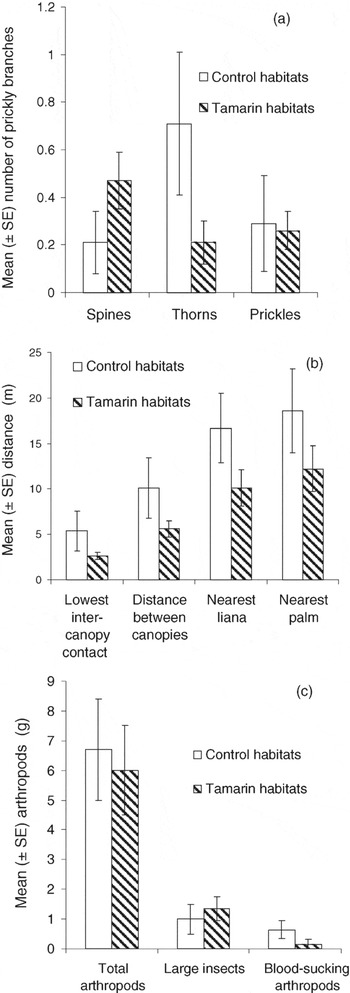
In the study of plant structures having the potential to cause physical injury to mammals, spiny vegetation was associated with 100-m2 tamarin plots, but not significantly so (P = 0.058, t = 1.93). Bactris spp., Astrocaryum standleyanum L. H. Bailey, and several unidentified palms comprised the spiny plants observed in tamarin plots (N = 41 plants). Thorny vegetation was significantly more abundant in control plots than in tamarin plots (P = 0.044, t = 2.06, SE of the difference = 0.194, df = 58). Acacia acanthophylla (Britton & Rose) Standl., Acacia glomerosa Benth and several unidentified woody dicots constituted the thorny vegetation sampled (N = 31). Trees with prickly bark were randomly distributed (P = 0.485, t = 0.703) in control and tamarin plots in the Agua Clara forest (Figure 1a). Prickly vegetation included Ceiba pentandra (L.) Gaertn., Poulsenia armata (Miq.) Standl., Pachira spp., Spirotleca spp. and several unidentified plant species (N = 44).
Random samples in 100-m2 plots in the Agua Clara forest compared with plots that tamarins chose (59 100-m2 plots, 27 tamarins in total). Mean (± SE) frequency of branches in forest plots with spines (modified, needle-like leaves), thorns (pointed, modified branches), and prickles (pointed outgrowths from cortex and stem epidermis) (a). Mean (± SE) distance between canopies of trees (nearest adjacent canopy), distance from the ground to the first contact between canopies of different trees (lowest inter-canopy contact) and distance from plot centre to nearest liana and palm (b). Mean (± SE) mass of arthropods captured in sweep-net samples (N = 1619 total arthropods) (c). Large insects included grasshoppers, crickets, katydids (Orthoptera), cockroaches (Blattaria) and cicadas (Homoptera). Blood-sucking arthropods included ambush bugs (Phymatidae), assasin bugs (Reduviidae), mosquitoes (Culicidae), mites and ticks (Acari).

Using linear regression analysis, we examined the possible association between fleshy fruits and tamarins on Agua Clara. Correlation coefficient was r = 0.67, and the coefficient of determination was r 2 = 0.449, thus a 55.1% chance that tamarin use of a habitat was due to variables other than fruit abundance. In the study of organisms on and in fruits, as possible sources of dietary protein, the fleshy figs of Ficus popenoei Standl. were found to contain relatively large populations of insects. Figs contained numerous wasp larvae (mean ± SE = 0.00548 ± 0.0002 g of wasps per fig), and occasionally the larvae of moths, flies or other insects. Fig weight was 5.19 g fresh, 3.50 g dry (SE = 0.073 g). Wasp larvae comprised 0.156% of the total mass of a single fresh fig.
Low tree canopies (N = 284 trees in total, df = 58) in tamarin habitats were closer together (nearest adjacent canopy: P = 0.032, t = 2.19, SE of the difference = 2.044), adjacent canopies made contact closer to the ground (lowest inter-canopy contact: P = 0.029, t = 2.23, SE of the difference = 1.069), and there were shorter distances to lianas than in control habitats (lianas: P = 0.025, t = 2.30, SE of the difference = 2.89). Palms were associated with tamarin habitats, but not significantly so (P = 0.089, t = 1.73). Tamarins were also observed frequently in fragmented forests with rusting barbed wire, rotting boards, various relicts of an abandoned banana plantation and numerous nearby clearings in the forest canopy (Figure 1b). These clearings were a result of human activities (34.5%), uncertain origin (28.3%), erosion/physical factors (18.5%) and treefalls (18.7%).
There were no statistically significant associations between Geoffroy's tamarins and insect mass from sweep-net sampling (N = 1619 total insects, Figure 1c). Sampling did yield significantly more blood-sucking arthropods in control than in tamarin plots (P = 0.042, t = 2.06, SE of the difference = 0.705, df = 58). Insects with a body length greater than 1 cm, captured in sweep net sampling of tamarin plots (N = 531 large insects), were: 22.2% Orthoptera (grasshoppers, katydids, crickets and long-horned grasshoppers), 5.1% Blattaria (cockroaches), 28.4% Hymenoptera (ichneumonons, vespid wasps, sphecid wasps, halictid, andrenid and anthophorid bees), 19.0% Coleoptera (scarabs, long-horn beetles and wood borers), 4.3% Homoptera (cicadas), and 21.0% other (walking sticks, crane flies, mantids and uncertain).
When the Agua Clara field methods were used in 100-m2 forest plots for 49 d on BCI (N = 29 plots, 14 tamarins, 29.6 h observations, 3869 30-s instantaneous sampling intervals, N = 145 trees in total), AIC analysis, based upon linear regression of tamarin frequencies and forest parameters, revealed the following parameters to be the most plausible explanation for tamarin frequency: (1) mixed woodlands comprised of woody dicot trees and shrubs, palms, lianas and robust herbs, with none of these plant life-forms having >60% frequency, (2) canopy-connectivity (based on lowest inter-canopy contact and nearest adjacent canopy), (3) insects, (4) fruits and exudates and (5) potential injury (thorns and biting arthropods).
Akaike weight (Wi) indicated that mixed vegetation (36.0%) was the strongest among the whole set of five candidate scenarios explaining tamarin frequency, followed in rank by canopy-connectivity, insects and fruits (Table 1). Evidence ratios (Wj/Wi) revealed that mixed vegetation was only 1.3 times more likely than canopy-connectivity (the second-highest Akaike weight) to be the strongest scenario, given the set of five candidate scenarios from the BCI study. Scenario comparison indicated a degree of uncertainty regarding mixed vegetation as being the sole factor that explained tamarin frequency in forested plots. Evidence for this uncertainty came from the sum of the competing Akaike weights (0.642) which exceeded the weight of mixed vegetation alone (0.360). One of the plausible scenarios, thorns and biting arthropods, was excluded by confidence intervals, Wi − (Wj × 0.10).
Akaike information criterion analyses of the linear regression of major parameters studied in 100-m2 plots (N = 29 plots, 29.6 h observations, 3869 30-s instantaneous sampling intervals of tamarins in total) on Barro Colorado Island, Panama, 2008. Included in the analysis are Akaike weights (Wi), evidence ratios (Wj/Wi) based on the greatest Akaike weight (Wj) divided by the Akaike weight of each category, and confidence intervals Wi − (Wj × 0.10) for each category. Lowest inter-canopy contact is the mean distance from ground surfaces to where adjacent tree canopies first contact each other. Nearest adjacent canopy is the mean shortest distance between a random branch tip and branch tips of the nearest tree canopy.

DISCUSSION
Given that habitats used by tamarins had concentrations of large insects and fleshy fruits similar to randomly sampled habitats, and the fact that tamarins have a mixed feeding strategy exploiting ripe fruits, insects and plant exudates (gums) throughout the year, this may help to explain why Geoffroy's tamarins did not base habitat selection primarily upon food resource distribution. One advantage of foraging in habitats with a high degree of canopy-connectivity is the number of available routes for travel, foraging and predator avoidance (escape and concealment). Diverse forests may support high concentrations of diverse primate communities, and permit species co-existence through niche partitioning and the exploitation of different subsets of the environment (Peres Reference PERES1991, Reference PERES1993).
Tamarin adaptation to an aboreal lifestyle includes the presence of claw-like nails on all digits except their hallux (big toe) as well as grasping hands and feet, which may enable these small primates to range efficiently through the forest canopy by ascending large tree trunks and other vertical supports as well as by descending to lower branches and moving along horizontal branch runways. This manner of movement was frequently observed when tamarin foraging areas were approached by troops of spider and capuchin monkeys. It is not clear why these troops of primates did not harass or follow the small tamarins as they departed their foraging site, but it may be that a tamarin's small body makes it efficient at using extremely small branches as escape routes. Geoffroy's tamarin weighing only 400–550 g (capuchins have prehensile tails but weigh 3000–3500 g) often travels on thin flexible branches, with about 75% of feeding and foraging taking place on supports that are less than 5 cm in diameter (Garber Reference GARBER1980, Reference GARBER, Boinski and Garber2000).
There are probably many reasons why Geoffroy's tamarin was regularly associated with spiny vegetation. Claw-like nails may allow tamarins to use trunks as a foraging platform to locate insects, scan the leaf litter, and to cling to trunks (Garber Reference GARBER1992, Reference GARBER and Rylands1993). Claw-like nails may also allow for deft movement around spines, and may be coupled with positional behaviours that lessen the impact of spines on epithelial surfaces. Spiny vegetation is a recurring phenomenon in tropical vegetation, and many animals, in addition to tamarins, effectively deal with spines when travelling or foraging. For example, Malagasy indriids often travel on spiny branches, which may cause these primates to reposition a hand or foot occasionally, but otherwise spiny branches do not appear to seriously hamper arboreal movement (Demes et al. Reference DEMES, JUNGERS, FLEAGLE, WUNDERLICH, RICHMOND and LEMELIN1996). We are uncertain about the precise ways in which Geoffroy's tamarins deal with spines, but on many occasions we saw their movements across spiny branches accomplished quickly and gracefully.
Few tamarins were observed in areas where the vegetation had numerous hooked thorns that snagged our clothing, and where thorny Acacia hosted colonies of biting ants. Thorns were structurally different from spines, with thorns often being concealed at the base of leaves, their shape frequently hooked near the tip and the thorns being situated on branches as pairs facing outwards in different directions, rather than most facing in one direction which was common for many of the spiny palms. It is possible that tamarins avoid potential sources of injury and infection by travelling around habitats with abundant thorny branches and biting arthropods. Thorns and colonies of biting insects that inhabit plants are potential sources of irritation that discourage many animals from coming in contact with the branches of these plants (Janzen Reference JANZEN1966, Milewski & Madden Reference MILEWSKI and MADDEN2006).
Why not completely avoid spiny vegetation altogether? Spiny palms were a recurring component of mixed vegetation in tamarin habitats, suggesting that benefits derived from such habitats outweighed problems associated with plant spines. Several species of spiny neotropical palm produce fruits consumed by primates (Croat Reference CROAT1978). Through various postures and small movements of hands and feet that place vulnerable aspects of their anatomy out of harm's way, tamarins may travel through spiny vegetation in ways that cumulatively result in maximized foraging success. In addition, many insects are found in palm fronds and bromeliad whorls, and given the fact that insects account for as much as 50% of tamarin feeding and foraging time (Garber Reference GARBER and Rylands1993), these microhabitats are reported to represent important tamarin foraging substrates (Peres Reference PERES1991).
Confidence intervals, Wi − (Wj × 0.10), indicated that there was a negative association between tamarin frequency and abundance of thorns and biting arthropods, which may be a result of tamarins avoiding places with abundant sources of injury. Ticks are known to infest tamarins, and it is likely that many primates in the wild adopt behaviours that reduce the risk of exposure to parasitic acari and biting insects that negatively impact host fitness (Nunn & Heymann Reference NUNN and HEYMANN2005, Wilson et al. Reference WILSON, DIETZ and WHITAKER1989). Predator avoidance is probably a major factor that influences a tamarin's decision to avoid some habitats, for there are a variety of species that will prey upon these small primates (Caine Reference CAINE and Rylands1993). However, from data acquired, and from our personal discomforts caused by thorns and biting arthropods, it is plausible that these sources of irritation deter tamarins to some extent.
An information-theoretical approach to the data analysis simultaneously accounted for various statistical errors in the assessment of sampled habitat parameters (Burnham & Anderson Reference BURNHAM and ANDERSON2002, Madden et al. Reference MADDEN, BALLESTERO, CALVO, CARLSON, CHRISTIANS and MADDEN2008). From this multi-model approach presented in Table 1, mixed vegetation of lianas, palms and woody dicots was frequently associated with tamarin visitation to rain-forest plots, given the data and the whole set of candidate parameters that were examined. Mixed vegetation was structurally complex, with frequent contacts between canopies of different trees, extensive lianas and spreading growth of understorey palms that collectively enhance vertical and horizontal canopy-connectivity. Emmons & Gentry (Reference EMMONS and GENTRY1983) have argued that relative to Asian forest communities, the increased frequency of lianas in the Neotropics induces extensive canopy-connectivity that may have contributed to the independent evolution of prehensile tails and suspensory postures in several mammalian lineages.
A tamarin's trap-line foraging method probably requires deft vertical and horizontal travel to avoid predators, biting arthropods, and sources of injury such as thorny branches, while the tamarin must simultaneously remain alert to new patches of food. It seems likely that tamarins select parts of the canopy they move through most easily – the less time they spend in travelling the better. Thus, plots with canopy conducive to travel will appear poorly used by the monkeys because they spend little time in them. Foraging strategies of small neotropical primates are complex and include wide-ranging activities such as foraging in holes, consuming plant gums, searching for prey in rotting bark, palm fronds and bromeliad whorls, gleaning food from leaves, selecting fruits and snatching insects from the ground (Garber Reference GARBER and Rylands1993, Reference GARBER, Boinski and Garber2000; Rylands et al. Reference RYLANDS, DA CRUZ and FERRARI1989). All of this manoeuvring requires complex canopy habitats with access to scattered resources that can be safely exploited.
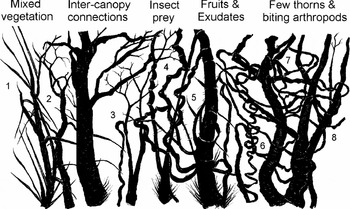
A tamarin's canopy-connectivity-centred habitat selection emphasizes access, with food being harvested or captured spontaneously as it is encountered along runways or in patches of canopy. Future studies on tamarins might examine fine-grained ecological distinctions in the manner in which arboreal animals disperse seeds and use canopies, to determine whether canopy guilds exist in the Neotropics. Additional control plots conducted at greater distances from tamarins sites may have resulted in statistical significance for parameters such as distance to forest gaps, light penetration through the canopy, abundance of palms, branch angles and stem diameters, all of which showed trends in this study (controls in the current study accounted for 1300 m2 of tropical forest, typically situated within 30 m of tamarins plots). What might Geoffroy's tamarin habitats look like? Based on our data and the illustrations of forest plots, this tamarin's preferred foraging habitat might be a place of mixed plant life-forms providing multiple tiers for vertical travel, with palms providing fleshy fruits, lianas that provide inter-canopy travel, and a place with few biting arthropods but with scattered populations of large insects to be captured (Figure 2).
Profile of tamarin habitats, based upon available data combined with actual photographs of these habitats on Agua Clara and BCI, Panama. Numbers refer to woody vegetation: 1 = Synechanthus warscewiczianus H. Wendl., 2 = Pouteria sapota (Jacq.) H. E Moore & Stearn, 3 = Bauhinia guianensis Aubl., 4 = Scheelea zonensis L. H. Bailey, 5 = Spondias mombin L. with grasshoppers, katydids, crickets and cicada, 6 = Socratea durissima Oerst., 7 = Cordia spinescens L. and 8 = Anacardium excelsum (Bertero & Balb. ex Kunth) Skeels.

ACKNOWLEDGEMENTS
We are grateful for assistance in fieldwork from Roland Kays, Jackie Willis, Patrick Jansen, Joan Sharpe, and students of the School for Field Studies primate project. Logistics were made possible through support from the Smithsonian Tropical Research Institute, and the Yosemite Community College District. PAG wishes to thank Sara, Jenni and Chrissie for their love, support and for allowing me to spend time in the forest with monkeys. Two anonymous reviewers greatly improved the manuscript.