Introduction
Meals-on-Wheels services have been developed in a number of countries to provide nutritious meals and social contact to community-dwelling older people who are deemed to need such supports. Despite the fact that Meals-on-Wheels services evidently embody both nutritional and social aspects, the social context and objectives of the service have rarely been investigated and remain poorly understood. This article defines three social objectives of Meals-on-Wheels, originally identified from the relevant literature, then extracted from in-depth interviews with 66 Irish Meals-on-Wheels recipients. These can be further developed into a set of criteria for evaluating the extent to which Meals-on-Wheels services fulfil their social objectives.
The social dimensions of food in older age
Food and the consumption of food have important social functions. It has been argued that food is a prime constituent of human relations (Douglas & Gross, Reference Douglas and Gross1981), and that mealtimes can be used as a mirror of a society as well as provide insights into social structures and social change (Fernandez-Arnesto, Reference Fernandez-Arnesto2002). The meaning of eating and mealtimes changes through the life course; while children are recipients of food, by adulthood, they have usually grown into the role of “providers” (Lumbers, Reference Lumbers and Mc Givern2006).
Numerous studies have explored the physiological factors that affect an individual’s nutritional status (Lee & Frongillo, Reference Lee and Frongillo2001; Pirlich & Lochs, Reference Pirlich and Lochs2001; Stuckey, Darnton-Hill, Ash, Brand, & Hain, Reference Stuckey, Darnton-Hill, Ash, Brand and Hain1984). Much less attention has been paid to the impact of social factors – such as gender, marital status, living arrangements, levels of social connectedness, and employment status – on the nutritional status of older people. Many studies have highlighted the relationship between social contact and nutritional status or food intake. De Castro’s study of 515 American adults indicated that meals eaten with other people tended to be larger and longer in duration compared to meals eaten alone, regardless of the relationship to the eating companion (de Castro, Reference de Castro1994), a finding that has been replicated in studies with older people (de Castro, Reference de Castro2002; McIntosh, Shifflett, & Picou, Reference McIntosh, Shifflett and Picou1989; Nijs, de Graaf, Siebelink, Blauw, Vanneste, Kok, et al., Reference Nijs, de Graaf, Siebelink, Blauw, Vanneste and Kok2006). Adjusting levels of social contact can therefore improve food intake for older people, and eating in pleasant, congregate settings can encourage older people who live alone to eat more (Davidson & Fennell, Reference Davidson and Fennell2004).
The presence of a spouse also affects the nutritional status of older people. Researchers have argued that married older people were less likely to skip meals and were in a better position to prepare and afford home-cooked food (Locher, Ritchie, Roth, Baker, Bodner, & Allman, Reference Locher, Ritchie, Roth, Baker, Bodner and Allman2004). In contrast, Locher et al. (Reference Locher, Ritchie, Roth, Baker, Bodner and Allman2004) have suggested that older men who were not married were vulnerable to experiencing poor nutritional health because they often did not know how to shop or cook for themselves. This observation highlights the gendered dimension tied up in cultural understandings of food and mealtimes, whereby women are regarded throughout the world as primarily responsible for the preparation of meals. Sidenvall, Nydahl, and Fjellstrom (Reference Sidenvall, Nydahl and Fjellstrom2000) argued that retired women who cook for others perceived this activity as preparing a gift, a long process that involved deciding what food to serve, sourcing fresh ingredients, presenting the food, and enjoying the “gift” together (Sidenvall et al.,). While cooking can be rewarding, sole responsibility for routine preparation of meals can also become burdensome and even oppressive (deVault, Reference deVault1991).
Research has also highlighted how the sudden absence of an eating companion through bereavement can have a significant impact on older people. Individuals may experience a diminished appetite and a lack of enjoyment of food after the death of a loved one and also via the practical aspect of losing a partner in the task of food provision and preparation (Shahar, Schultz, Shahar, & Wing, Reference Shahar, Schultz, Shahar and Wing2001). Sidenvall et al. (Reference Sidenvall, Nydahl and Fjellstrom2000) have suggested that the meaning of cooking was lost among women who no longer had anyone to cook for, and they indicated that such women were at risk of poor nutritional intake.
Loneliness and loss of status following retirement from paid work may lead to depression or low mood, a loss of interest in food, and a disruption in the patterns of food procurement and consumption (Lilley, Reference Lilley1996). Socio-economic status, social isolation, and disability can also increase the prevalence of food insecurity, and can lead to related problems, such as the onset of mental health problems, particularly where social supports are limited (Jeromey, Reference Jeromey2006; Pierce, Sheehan, & Ferris, Reference Pierce, Sheehan and Ferris2002). Such findings highlight the benefits of a service such as Meals-on-Wheels, which can provide older people with easily accessible, free, or low-cost nutritious meals; the opportunity to regularize both mealtimes and food intake; and to reduce the need to shop for food.
The social dimensions of Meals-on-Wheels
Meals-on-Wheels are used in several countries to provide meals to older people and are usually one of a range of services designed to support older people to continue living in their own homes. Older people take up Meals-on-Wheels for a variety of reasons, including the onset or deterioration of health problems, poor mobility, or the loss of a partner (Krassie, Smart, & Roberts, Reference Krassie, Smart and Roberts2000). Meals-on-Wheels services have been shown to improve significantly the nutritional status of older people, particularly those who have difficulties shopping for food or cooking meals as a result of mobility problems, reduced income, or a loss of appetite (Administration on Aging, 2004). Many studies have reported that Meals-on-Wheels recipients are predominantly older, female, living alone, widowed, less mobile, more socially isolated, and have lower incomes than the general population (De Graaf, Van Staveren, Sneeuw, & Stam, Reference De Graaf, Van Staveren, Sneeuw and Stam1990; HDG Consulting Group, 2004; Lee & Frongillo, Reference Lee and Frongillo2001; Office of the Public Advocate, 2002).
Little attention has been paid to the social objectives of Meals-on-Wheels services. There is some evidence to suggest that Meals-on-Wheels help to increase the social connectedness of those who use the service. Millen, Ohls, Ponza, and McCool (Reference Millen, Ohls, Ponza and McCool2002) reported that Elderly Nutrition Program participants in the United States achieved higher levels of socialisation when compared with non-participants. In addition, Meals-on-Wheels staff or volunteers were an important point of contact with meals recipients and were often the first to find out about the recipients’ declining health or to arrive on the scene after a fall or other emergency. Knowing they will receive a regular visit can help an older person (particularly those who are housebound) to feel more secure and less socially isolated. An Australian study found a relatively low level of loneliness among clients using the Meals-on-Wheels service and also revealed that two out of three respondents valued the personal contact with the volunteers providing the service as highly as the meal itself (Grant & Jewell, Reference Grant and Jewell2004). Seventy-four per cent were happy with the amount of contact they had with the person who delivered their meal (although data on the time spent by delivery staff/volunteers with meal recipients were not provided). We suggest that Meals-on-Wheels can play a role in providing recipients with a “social context” in which to eat their meals and can minimise the emotional stress placed upon many older people in having to prepare a meal that will be eaten alone.
Research has shown that older people tend to suffer from reduced appetite for a wide variety of factors, including loneliness, food insecurity, and as a result of physiological changes (Coulston, Craig, & Voss, Reference Coulston, Craig and Voss1996; Forster and Gariballa, Reference Forster and Gariballa2005; McIntosh et al., Reference McIntosh, Shifflett and Picou1989). As many older people living alone skip meals or do not take “main meals” (Locher, Burgio, Yoels, & Ritchie, Reference Locher, Burgio, Yoels and Ritchie1997; Pierce, Reference Pierce2000), Meals-on-Wheels have the potential to re-stimulate recipients’ enjoyment of food and regular mealtimes through the provision of a tasty, well-presented meal, delivered at a set time. Although many recipients will still be eating their main meal alone, the service has the potential to re-introduce meaning to mealtimes, particularly for those who used to cook for a partner or family. In addition, as shopping and cooking can be difficult for older people with disabilities and mobility problems (Gollub & Weddle, Reference Gollub and Weddle2004), Meals-on-Wheels can remove much of the stress associated with mealtimes.
While Meals-on-Wheels have been shown to have nutritional benefits, some individuals feel that the service is unsuited to their needs for a variety of social or attitudinal reasons and thus decline the opportunity to use the service or discontinue using it. For example, “stigma”, or a reluctance to use means-tested or “charitable” services, can discourage individuals from availing themselves of Meals-on-Wheels (O’Hanlon, McGee, Barker, Garavan, Hickey, Conroy et al., Reference O’Hanlon, McGee, Barker, Garavan, Hickey and Conroy2005). In addition, individuals may refuse Meals-on-Wheels or other support services if they feel that the quality of the service is low or if they have not accepted that they need additional help and support (Howse, Ebrahim, & Gooberman-Hill, Reference Howse, Ebrahim and Gooberman-Hill2004).
From the literature, we therefore surmise that Meals-on-Wheels, in theory and in practice, aim to fulfil the following social objectives:
Provision of a degree of social contact to recipients;
Stimulating an interest in food and regularising mealtimes; and
Helping recipients to develop an acceptance of Meals-on-Wheels (and, by extension, of other support services where relevant).
This article analyses the social objectives of Meals-on-Wheels in the Irish context, both exploring the extent to which our interview data match these categories and developing them further. The original contribution of this article lies in the fact that the social objectives of Meals-on-Wheels services have not previously been articulated and explored in-depth within a single source.
Our primary data stems from the Irish context. While Meals-on-Wheels services differ between countries (or even territories within countries) and are placed within the context of highly variable social care and welfare systems, it is arguable that our findings would be replicable in other contexts where Meals-on-Wheels are provided. In addition, detailed documentation of our methods, fieldwork, and analytical procedures allows for the replication of this study elsewhere. However, as our sample was ethnically homogeneous (White Irish), we are not in a position to discuss how greater ethnic and cultural heterogeneity in the recipient population might affect the findings.
Research method
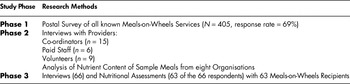
The findings presented in this article were drawn from a large, national study on Meals-on-Wheels in Ireland conducted in 2007–2008, which aimed to develop a plan for improving the service for recipients. Data were collected in three phases to develop an understanding of the supply and use of Meals-on-Wheels in Ireland. “Supply” data included a postal survey of all known service providers and in-depth interviews with a total of 30 service providers from 13 services selected with the help of a stratified sampling technique, taking into account the providers’ size (number of clients), sector (public or non-profit), and location (urban vs. rural). Data on service users were collected through interviews and nutritional assessments with 66 recipients, sampled through the 13 service providers.
The findings presented in this article were based on face-to-face, semi-structured interviews undertaken with a non-probability sample of 66 individuals in receipt of Meals-on-Wheels in Phase Three of the study (see Table 1). The respondents were accessed both via Meals-on-Wheels organisations and through other channels (placing notices in congregate settings such as church halls). A quota sampling approach was used to ensure maximum heterogeneity across gender, marital status, and geographic location. Ethical approval was obtained from a university ethics committee prior to commencement of interviewing.
Summary of data collection and methods used

The central purpose of the interviews was to examine the recipients’ experiences and opinions of the meals and the service in general, including its social importance. In addition, the interviews probed into a number of areas related to food procurement and consumption, such as shopping patterns and eating habits, in order to provide contextual information on respondents’ overall relationship with food, including the impact of other people and major life events, such as retirement or bereavement, on food consumption.
On the basis of the literature review, some of the findings of a postal survey of meals providers (N = 280), interviews with Meals-on-Wheels organisers and volunteers (N = 30), and pilot interviews with two recipients, an interview guide for the service user interviews was developed which aimed to gain insight into: (a) pathways to the service; (b) views on the service; (c) meaning and importance of the social aspects of Meals-on-Wheels; (d) use of other services; and (e) eating habits (including whether respondents ate alone or with others and possible changes in food-related behaviour as a result of major life changes). Interviewees were also asked to make recommendations on how Meals-on-Wheels could be improved in the future.
The interview guide was informed by literature and the earlier stages of the research project, but the questions posed were open-ended and non-directive: for instance, “What do you think of the Meals-on-Wheels overall?”, “What aspects of the service do you like the most?”, “Has Meals-on-Wheels made any difference to how and when you take your meals?” Given the semi-structured nature of the interviews, although all of the above topics were covered in each of the interviews, the extent to which they were covered varied from respondent to respondent. Interviews lasted, on average, 45 minutes. The data from the interviews with meals-recipients were voice-recorded and transcribed verbatim.
Data analysis was conducted by both authors using the framework approach as outlined by Pope, Ziebland, and Mays (Reference Pope, Ziebland and Mays2000). This method of analysis involves five stages: (a) familiarisation with the raw data; (b) identification of a thematic framework; (c) indexing of the data while applying the thematic framework; (d) “charting” or rearranging the data in line with the thematic framework; and finally, (e) mapping and interpretation of the data with the use of charts, tables, and typologies. This method of analysis yields itself to qualitative studies that commence analysis with the help of some pre-conceived categories that are also reflected in the interview guides (“interpretive induction” as outlined by Kuczynski & Daly, Reference Kuczynski, Daly and Kuczynsky2003, p. 383). In this case, the main categories were simply the three social objectives of Meals-on-Wheels. The transcripts were coded separately by the authors, and consensus was reached over coding, categorization, and themes in the course of data analysis and write-up.
Results
Respondent Characteristics
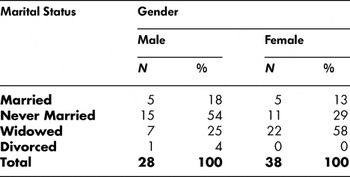
Almost 60 per cent of the respondents were female, and the average age of respondents was 78.5 years. Therefore, the composition of this sample reflected the broader population of Meals-on-Wheels recipients as characterised by the national postal survey of provider organisations (O’Dwyer and Timonen, Reference O’Dwyer and Timonen2008). The majority (81%) lived alone. Sixty per cent of respondents lived in an urban area (classed as an area with population ≥ 5,000), and 40 per cent lived in a rural area (population ≤ 5,000). Fifteen per cent of all respondents were married. This included four couples, of whom both husband and wife received Meals-on-Wheels. The majority of male respondents (54%) had never married and one quarter were widowed. In comparison, 29 per cent of female respondents had never married and 58 per cent were widowed (Table 2).
Breakdown of sample by gender and marital status

N = 66
Interviewees had taken up Meals-on-Wheels for a variety of reasons, the most common one being an offer of the service following hospital discharge. A quarter of respondents stated that they were not able to cook their own meals due to deterioration in their health. Approximately one third of respondents indicated that they were in receipt of Meals-on-Wheels as it was available in their area and the service had been offered to them on vaguely defined (but largely “social”) grounds, despite good health status and mobility. Over half of these respondents were men who had in most cases started to receive the service after their wife had become ill or died. This is highly significant as it indicates, in a system that does not use any formal assessment tools, the importance of (perceived) social reasons as qualifying conditions for receipt of Meals-on-Wheels.
Provision of Social Contact
The extent to which Meals-on-Wheels services provided the respondents with social contact varied from service to service, and within services by delivery staff. Some differences in the extent to which male and female recipients interacted with the delivery staff were observed. Female recipients were more likely to have developed friendships with individuals delivering the meals and spoke of the meaning that this had added to their lives, while few men regarded the social element of the service as important. However, the following quote illustrates that men also enjoyed the social aspect of the service:
[the delivery staff] are great … they have a chat – there’s a couple of them and it is hard to get rid of them! [laughs]
(Male Meals-on-Wheels recipient, age 78, no. 50)
Both male and female recipients indicated that they missed the social element of mealtimes. Many indicated that they were lonely and lacked companionship. For some, Meals-on-Wheels helped to alleviate this sense of loneliness:
Well, it is nice to see someone coming in. It’s great to have somebody coming in and having a bit of a chat for a few minutes …. You get to know the person and they get to know you. It’s very important to have callers coming to you when you are retired.
(Female Meals-on-Wheels recipient, aged 79, no. 29)
With the exception of a small minority, the amount of time volunteers spent with recipients as they dropped off the meal tended to be extremely short. Several instances where drivers spent less than five seconds with recipients were witnessed by the interviewers. A small number of respondents indicated that the delivery staff only rang the doorbell and left the meal outside the door without waiting for the recipient to turn up in person. However, this did not appear to have impinged on most recipients’ views of the social element of the service. The following quotations are illustrative of the reassurance that the recipients derived from the service despite the brevity of visits:
What I appreciate about it [is that] on Christmas, they handed me a box of biscuits and they wanted to know how was I organised for Christmas. Well I was alright … [spending Christmas with sisters] but they were good enough to think about me.
(Male Meals-on-Wheels recipient, age 87, no. 10)
I just go to the door when they call, say hello and give them €2 if I have it and that’s it. I enjoy it now, it’s very nice, they’re good … they’re nice people that come with it. They don’t just leave it on the door or anything; they make sure I’m here.
(Male Meals-on-Wheels recipient, aged 70, no. 40)
Approximately one third of the respondents (mostly men) did not place a strong emphasis on the social element of the service, with many indicating that they neither expected nor needed any friendly interaction with the drivers. To some recipients, it appeared that not only were the drivers busy, but the provision of social contact was not part of the remit of the service, which may have discouraged some recipients from trying to chat with the drivers. In spite of this, many men did appear to be lonely and several comments, such as in the following quote, suggested that they may value more social contact with the drivers despite being reluctant to admit it:
And what do you think is more important to you? Is it the fact there is somebody calling or that you’re getting your meal?
Well I, I, I think that [the social call is] an essential part of the service.
(Male Meals-on-Wheels recipient, aged 79, no. 56)
Some respondents explicitly stated that they did not need the social element of the service and felt that it was something only for the socially isolated:
I’m usually quite adequately provided with chat [with family and friends] so I don’t require it.
(Female Meals-on-Wheels recipient, aged 83, no. 1)
This view may also reflect some pride in one’s independent social life and extreme reluctance to admit any (unmet) need for social interaction.
In summary, the length of time drivers spent chatting with each recipient did not appear to be as important as the fact that recipients had the opportunity to have regular social contact, however brief. Many recipients derived reassurance from the caring nature of the delivery staff and volunteers, particularly when the service made a special effort to anticipate or respond to their social needs. However, it is important to make reference to the limited time spent by many drivers with each recipient; this is perhaps an indication that the service itself did not place an emphasis on the importance of providing social contact to recipients.
Role of Meals-on-Wheels in stimulating an interest in food and regularising mealtimes
Very few recipients explicitly stated that mealtimes were occasions to be enjoyed. Rather, eating was seen as a “functional” activity:
I eat to live, I don’t live to eat.
(Female Meals-on-Wheels recipient, aged 86, no. 17)
This may be related to the fact that most respondents lived alone and ate most meals by themselves. However, many recipients who received well-presented, tasty meals had regained their interest in food and started to invest more of themselves in mealtimes. For example, some chose to eat the meal in a room they associated with socialisation and enjoyment, laid the table properly, or ate in a room where they could see passers-by:
I normally eat in here [in the kitchen], except on Sunday if any of the family were coming or birthdays – I’ve a dining room and we’d eat in there. But I’m happy here because I can see out and see people going by all the time. Because I find it lonely … since I had a big family … I’m not as lonely when I can see everything … I can see my neighbour going in with the little one …
(Female Meals-on-Wheels recipient, aged 82, no. 18)
I would set the table and everything for myself. I set out my knife and fork and a glass of water or a glass of Seven Up or maybe sometimes I have Lambrusco.
(Female Meals-on-Wheels recipient, aged 83; no. 42)
Some recipients acknowledged that the meals they received gave them a “focus” on eating, helped by the lack of stress previously associated with shopping and food preparation:
Having the meals gives you nearly a focus … it’s there for you … the fact that the meal is there [means that] I don’t have an option [but to eat]. … You’d be amazed at the amount of effort that it does save … it’s not all the cooking … it’s the fact that it eliminates the shopping and the cooking and the constant housekeeping and of course, it also saves a huge amount of work, and it’s easier to keep my kitchen. My kitchen has never been so sparkling as it is now!
(Female Meals-on-Wheels recipient, age 87, no. 9)
However, as with the appreciation of social contact, the extent to which Meals-on-Wheels stimulated respondents’ interest in food varied considerably. For some, this was related to the loss of a dining companion. Both men and women who ate alone as a result of being bereaved had lost interest in food and mealtimes:
I used to love cooking but I hate it now, because getting a meal, preparing it, cooking it, sitting down, eating it on your own and washing up, it’s no fun.
When did that all change for you?
When all of the family left, my husband died and that was it.
(Female Meals-on-Wheels recipient, aged 86, no. 17)
Indeed, for some, receiving Meals-on-Wheels acted as a painful reminder of the loss of a loved one:
The poor ’aul wife … she was a first-class cook …. Food is not the same if you’re not getting it home-cooked, you know…
(Male Meals-on-Wheels recipient, aged 87, no. 8)
Respondents, particularly women, who were used to cooking (family) meals on a daily basis, found it difficult to accept that they were no longer capable of making all their meals from scratch. They compensated for this by personalising the meal they received from Meals-on-Wheels, thereby proactively making it more “interesting” for themselves:
Well I nearly always use the stuff that they send me and make it into something else, cook it up into something with a bit of flavour … I’ve a whole row full of herbs and things that I can put in …
(Female Meals-on-Wheels recipient, aged 83; no. 1)
The basic operation of the service counteracted the regularisation of mealtimes. Traffic, long delivery routes, and unforeseen delays meant that meals were not delivered at the same time each day. Some individuals received their meal as early as 11 a.m. while others received their meal as late as 2 p.m., with little predictability in the exact delivery time:
Well the meals were coming between twelve and half past kind of, but … the traffic is such that they just can’t get here. It’s long after one now when they come … It would be now twenty-five past one sometimes and you’d be wondering what on earth is keeping them.
(Female Meals-on-Wheels recipient, aged 85, no. 52)
The fact that few services delivered meals every day meant that recipients still had to try to cook on other days. However, many did not cook (or receive from other sources) a proper main meal on the days that Meals-on-Wheels were not delivered due to poor mobility or other health-related problems, or a loss of interest in food. Some did not eat a main meal at all on the days they did not receive Meals-on-Wheels, or skipped other meals, making do with “convenience” food they could prepare easily, or simply did not eat at all. Few respondents were prepared to admit this openly, suggesting that they were unwilling to express the difficulties they faced in planning, sourcing, and preparing meals, resulting in questionable eating habits:
I had the Meals-on-Wheels at about half-twelve and then I had nothing until I think nine o’clock last night.
Right. And do you remember what that was?
Oh yes. I, I was after buying a packet of Boasters down in Dunnes. The biscuits …. And that’s what I had.
Alright. So how many biscuits did you have?
I, I finished the packet …. It was enough. I, I felt happy with them.
[…] And how many cups of tea would you have every day?
Oh I might go through sixteen, eighteen.
(Male Meals-on-Wheels recipient, aged 73, no. 37)
Overall, this respondent had little interest in food and the meals he received from his Meals-on-Wheels service were too small, and lacking in variety and taste. While it can be argued that he regarded food as of little importance in general, it is arguable that an opportunity to avail of tastier food through the Meals-on-Wheels service may have stimulated a greater interest in food.
Our findings indicated that Meals-on-Wheels, where well-presented, and responsive to individual tastes, can help to stimulate older people’s interests in food and mealtimes. In contrast, “regularising” mealtimes with the help of Meals-on-Wheels provision may be neither possible in practice nor desirable, and indeed this aim could even be argued to amount to inadvertent “institutionalisation” of older people, many of whom prefer to retain freedom in their daily schedules. The aim of regularising mealtimes, as derived from the literature, did not resonate with our sample; rather, Meals-on-Wheels were seen as an important component of a new routine within a personalised framework that sometimes involved adjusting the meal and having control over the time when it was consumed.
Helping recipients to develop an acceptance of support services
While Meals-on-Wheels in Ireland are generally not means-tested, some respondents had had initial reservations about availing of a “charity”:
I did feel there was charity in the beginning and I was kind of … not very accepting of it.
(Female Meals-on-Wheels recipient, age 87, no. 9)
As the following quote shows, in the minds of some individuals, Meals-on-Wheels were for the “old” and “dependent”; by implication something which they had suddenly become:
So how did you feel then about getting the Meals-on-Wheels?
I felt a bit funny. I felt “oh I’m old”. This is me, I got old. My age never struck me because I was working but when you suddenly have to do all of these things .... But however I’m very happy … It was so easy; before I left hospital they had arranged it.
(Female Meals-on-Wheels recipient, aged 79, no. 29)
Others indicated that they had been grateful and relieved when offered the service, as having meals delivered was convenient and saved a lot of trouble. Reservations initially experienced by this respondent disappeared once she came to accept her need for some support:
So how did you feel about getting the Meals-on-Wheels then?
Well, I wasn’t madly enthusiastic but we had to face the fact that we had no choice.
Ok, and how do you feel about it now?
Oh I think it’s great. See I can’t do anything, I’m in a wheelchair and all the table tops are all up high and anyway my Occupational Therapist won’t allow me to do anything or cook or anything so it’s not a possibility for me.
(Female Meals-on-Wheels recipient, aged 72, no. 61)
Thus, it is possible that a difficulty in accepting a decline in independence, rather than the “stigma” of accepting charity, may be responsible for reluctance to take up the service. The fact that Meals-on-Wheels in Ireland is a “complete” service in the sense of delivering fully prepared meals to the recipients’ doorstep may contribute to this difficulty: if (at least some of the) recipients were offered assistance in food procurement (for instance, shopping for groceries together with a care assistant) and in food preparation instead, the service might become more acceptable to people who are still mobile and wish to maintain their independence. Some respondents had indeed taken action to limit what they saw as a creeping dependence on Meals-on-Wheels:
I try and go without [the Meals-on-Wheels] at weekends because I feel I should try and do a bit for myself as much as I can … I make the effort to not having people wait on me all the time.
(Female Meals-on-Wheels recipient, age 84, no. 23)
In light of our findings, the quality of the service played an important role in respondents’ acceptance of the service, and this was in many cases, but not always, linked to the level of payment for the service. Those who were paying more than average for their meal were generally more satisfied with the service, compared with those paying a minimal amount or receiving the service for free. This outcome is probably a combination of services that charge higher fees investing more in the meals and in the service, and recipients feeling more entitled to complain about a service that they perceive themselves as having paid for. Worryingly, many of those with a low opinion of the service were reluctant to raise their concerns with service co-ordinators. They linked the low quality of food to the fact that they paid very little for it and felt that it would not be appropriate to complain, given that they were in receipt of a low-cost or free service:
What can they do for that much money really?
(Female Meals-on-Wheels recipient, age 80 no. 15)
No, I’m not really [happy], but what do you expect when you’re only paying €1.50? You can’t grumble at that price …
(Female Meals-on-Wheels recipient, aged 75, no. 2)
Clients of organisations that charged higher prices and had more formal feedback structures in place were more likely to complain, again reinforcing the fact that many recipients saw themselves, or wished to be seen, as consumers of a fee-paying service. Many recipients who paid only minimal charges stated that they would be willing to pay more in exchange for a better meal:
I think, I personally would feel better if I was able to put another few quid extra in now and then, that if there was something that I could say “well, I have enjoyed that …”
(Female Meals-on-Wheels recipient, aged 87)
The willingness to complain about a service for which recipients paid a larger amount, in contrast to a cheaper service is encapsulated by the following statement about one respondent’s readiness to specify his preferences in a restaurant – in stark contrast to the fact that he had never explained his preferences to the Meals-on-Wheels provider:
Generally speaking most of the food is a little disappointing … I don’t eat green beans and they are very fond of [incorporating] green beans [into the meals] … if I’m out eating in a restaurant I tell them I don’t like green beans.
(Male Meals-on-Wheels recipient, age 72, no. 62)
The limited variety of dishes provided by the service, confined to old-fashioned food, also influenced some recipients’ acceptance of the service. One couple thus dissociated themselves from the majority of recipients whose tastes they saw as more limited than their own:
[the meals] are varied enough but they’re the old style … that’s what we would have been used to all right, but never anything new at all …. But then whether [these] poor frail old people [laughs] want something different or not, I don’t know.
… the people they’re delivering to are the old-fashioned people, and they probably want what their mother supplied years ago and they’re not up to pasta … and Chinese and any of these things.
(Female and male Meals-on-Wheels recipients, ages 86 and 87, nos. 30 and 31)
These findings indicated that many older people struggled with accepting the Meals-on-Wheels service. Adjusting to the idea that they were deemed to need services was difficult for those whose health and mobility had declined. However, there were many who were arguably unnecessarily attempting to adjust to the role of a “passive” recipient of services as they could have benefited from a different approach, one aimed at developing or restoring their capacity to shop for and prepare food.
Discussion
A review of the literature suggested that the social objectives of Meals-on-Wheels include providing recipients with some social contact; stimulating interest in food and regularising mealtimes; and encouraging acceptance of support services among recipients by providing them with a service that is flexible, of a high quality, and suitable to their needs. Little attention has been paid to the nature of these social objectives in the literature to date. Our study did not set out to “test” the existence of these social objectives (which are characterised only in very cursory terms in the existing literature), but rather to explore them further. The study also explored the extent to which Meals-on-Wheels services in Ireland meet these aims in the light of the recipients’ experiences of the service. The purpose was therefore both to provide a richer description of the social objectives and to explore possible modifications and additions to them.
The findings from our interviews with Irish Meals-on-Wheels recipients suggested that virtually all did derive some social contact from the service, but this tended to be very limited in duration and often took an entirely perfunctory form. This resonates with the finding in research by both Grant and Jewell (Reference Grant and Jewell2004) and Millen et al. (Reference Millen, Ohls, Ponza and McCool2002) that delivery staff can play a role in alleviating social isolation. However, the extent to which delivery staff and volunteers were cognizant of this aspect of the service varied considerably, suggesting that service providers may not fully recognise the importance of this element of the service for some older people. Meals-on-Wheels services could be developed in a way that allows for greater tailoring and targeting of the service so that persons who experience loneliness offered more time and scope for social interaction in accordance with their preferences (possibly through the provision of some meals in well-designed, approachable congregate settings). This calls for considerable restructuring of the service, staff training, and increased funding. Another alternative is to use the Meals-on-Wheels services more effectively as a conduit for further help and support, through other service providers, for individuals who are socially isolated. This, too, calls for considerable innovation and collaboration with other services but may have fewer resources implications for Meals-on-Wheels providers.
Another way in which Meals-on-Wheels services have the potential to benefit recipients, according to the literature, is by stimulating recipients’ interests in food, a benefit of the service that is particularly important, given that people’s appetites often diminish as they age (Coulston et al., Reference Coulston, Craig and Voss1996) and also after bereavement (Locher et al., Reference Locher, Ritchie, Roth, Baker, Bodner and Allman2004). Our study indicated that interest in food could be re-stimulated through the provision of a convenient cooked meal. This can also help to provide routine and structure that often disappear after the death of a regular eating companion (Davidson, Arber, & Marshall, Reference Davidson, Arber, Marshall, Raats, van Staveren and Groot2008). However, few of the respondents benefited from more-regular mealtimes as meals were rarely delivered at the same time and as many recipients did not receive meals throughout the week. Furthermore, many respondents felt somewhat resentful about being tied down to their home in anticipation of the meal delivery. In spite of this, some recipients made efforts to make mealtimes enjoyable and semi-social, which is indicative of the need to build a new ritual around mealtimes and to retain autonomy and freedom of choice over the time and manner in which the meal is consumed. A possible policy lesson to be drawn from this finding is the desirability of cook-chill or frozen meals, at least for some recipients, which would increase their freedom over the timing of meals. However, organisations considering switching to this method of cooking should bear in mind the importance of frequent deliveries in order to maintain social contact with recipients.
The third social objective of the service, that of encouraging acceptance of social services among those who could benefit from them, was inadequately met among our group of respondents. Many were struggling with the notion that they had been referred to a service for “older people” due to a perceived decline in independence. Although this finding has been noted in relation to other services aimed specifically at older people (Gooberman-Hill, & Ebrahim, Reference Gooberman-Hill and Ebrahim2007), it has not previously been discussed in the context of Meals-on-Wheels. A possible response to this issue is the provision of assistance with shopping and meal preparation for those individuals who still retain these abilities and would be able to cope with the help of some assistance with food procurement and meal preparation, rather than “ready to go” meals. Food shopping can allow opportunities for socialisation (Hare, Kirk, & Lang, Reference Hare, Kirk and Lang2001) and help older people to maintain independence (McKie, Reference McKie1999; Sidenvall, Nydahl, & Fjellstrom, Reference Sidenvall, Nydahl and Fjellstrom2001). However, it is also important to remember that food shopping can be a stressful event, particularly when stores are crowded and poorly laid out (Aylott & Mitchell, Reference Aylott and Mitchell1999), highlighting the benefits of online grocery shopping (Morganosky & Cude, Reference Morganosky and Cude2000). Grocery stores could provide in-store assistance for older people, as well as others with mobility problems (Meneely, Strugnell, & Burns Reference Meneely, Strugnell and Burns2009). Such services are not currently available in Ireland; we recommend that they be piloted with the view to possible wider scale adaptation.
The low expectations that were prevalent among recipients were detrimental to improving the quality of the food because recipients felt that they could not expect anything better and did not have the right to complain about poor quality of food or other shortcomings of the service. A higher quality service for which recipients pay more than a nominal amount, and are actively encouraged to comment on, may entice more individuals to take up and continue to use the service. Conversely, it is, however, also arguable that a more universalist approach to service entitlement (i.e., lack of means-testing and low, uniform charges across the country) could also make Meals-on-Wheels more acceptable, thereby increasing take-up rates and serving the “acceptability of services” objective of Meals-on-Wheels.
The findings from our study also indicated that recipients’ characteristics played a role in the extent to which they reap social benefits from the service. There were some differences between men’s and women’s attitudes towards the social objectives of the service. This is perhaps unsurprising, given that many studies have shown that a traditional, gendered division of labour in household work can influence older men’s and women’s attitudes to food and mealtimes and also their ability to shop for and prepare meals (Davidson et al., Reference Davidson, Arber, Marshall, Raats, van Staveren and Groot2008; Locher et al., Reference Locher, Burgio, Yoels and Ritchie1997; Sidenvall et al., Reference Sidenvall, Nydahl and Fjellstrom2000). Recipients’ marital status, past experience of providing for themselves nutritionally, and their overall level of social contact also appeared to have an impact on their experience of the service. In the light of this finding, it is important to bear in mind the heterogeneity of the population in receipt of Meals-on-Wheels, and hence the need to explore further ways of reaching and assisting older people with a diversity of needs and approaches to eating, mealtimes, and receipt of meals services. In particular, older men should be given additional encouragement to take up and utilize the service.
Conclusion
This article has identified and explored three core social objectives of Meals-on-Wheels services. This task was accomplished with the help of a literature review and semi-structured interviews with Meals-on-Wheels recipients. The core social objectives are (a) the provision of social contact; (b) stimulation of interest in food and regularising mealtimes; and (c) developing an acceptance of support services. Each objective was further elaborated and qualified, and we hypothesise that all are only minimally met in the Irish context. While the research methods are replicable, the results of our study are not necessarily transferable to other contexts, especially more ethnically heterogeneous ones. Further research, both qualitative and quantitative, is clearly warranted, and the social objectives identified here provide a useful starting point for such additional investigations. The findings of our study and further research on this topic should be used to develop criteria to measure the extent to which Meals-on-Wheels fulfil their social objectives within a service that uniquely and closely combines social and nutritional aims.