1. Introduction
This research has its genesis in ongoing work as a musician, producer and composer, in various musical genres: contemporary classical music composition; jazz, blues and funk band performance; DJ-ing hip hop music and turntablism; film, dance and theatre music composition; producing pop songs, folk albums and electronic dance music; and experimenting with field recordings and sound manipulation to create sound art and electroacoustic music. Because these different worlds seldom interacted, the composer wore ‘a different hat’ for every new project, assuming genre-specific techniques, technologies and musical elements.
Exploration of ways of combining these divergent areas of interest and expertise into new musical forms gave rise to an intuitive sense of the potential for genre crossing: writing music in one area and subconsciously importing musical elements or technologies from others. Composing film music in an established realm where pop songs and sound design meet contemporary classical works provided an ideal space to explore these ideas. Drawing equally from film score narrative and a diversity of musical experience, both technical skills and compositional voice were further refined. An intuitive response to genre crossing was also further realised in my own composition of a number of orchestral works (such as Symphony No.1 for orchestra and turntables, Electric Bass Concerto for electric bass and orchestra, and Fanfare for a New Generation for orchestra, drum kit, turntables, theremin and rapper).
From these experiences, the realisation grew that a more systematic method for combining genres in the composition of new works would be useful, providing the means with which to control some of the intuitive elements that had informed previous works. The design and exploration of a systematic method for genre combination would create both new compositional tools and assist the development of a more consistent compositional voice.
1.1. Contextual background
Contemporary composers who work in different genres, across acoustic and electronic instruments, require divergent executant skills necessitating knowledge of different musical genres, together with techniques and technologies for their realisation. Technology permits immediate online access of different musics from any time and place. Accordingly, composers may readily be inspired by multiple genres in an individual piece, adopting or adapting ideas and processes from other sources, either as a simple stylistic influence, or juxtaposing genres within a single work.
No existing rules or systems for the composition of cross-genre musics have been determined. The creation of a system to explore concepts, techniques and structures would enable a composer to engage fully in hybrid genre composition. Currently, composers approach this boundary-crossing field largely intuitively, combining influences either consciously or subconsciously, to support their own compositional voice in the resultant composition.
When any composer works within a genre, selection of which conventions to employ and which to ignore subtly alters the way in which that genre will be perceived. Every work will add to in some way, and thus alter, the genre to which it belongs (Kallberg Reference Kallberg1988: 245–6). There is often an intuitive play involving expectations of, and departures from, any given genre. The systematic method of genre hybridity explored in the present research offers an alternative that is more consciously determined. An unexpected genre combination may provide a certain newness when presented in the hybrid work. For example, in my own piece The Foggy Field, the familiar sound of the muted jazz trumpet creates a new ‘musical idiolect’ when deconstructed within a compositional framework of electroacoustic sound manipulation and electronic dance music (EDM) rhythms (Pareyon Reference Pareyon2011: 192) in a new context.
This intuitive approach is typically acknowledged by the composer and may be presented as a unique response to a specific artist, musical work, or genre. Intuition and influence should not be removed from a system for hybrid composition, but rather be clarified to determine a system to guide genre use in the compositional process, thus leading to the likelihood of a more balanced combination.
2. Hybridity Table
Hybridity is a term generally used in reference to things of mixed ancestry. In music composition, hybridity may describe the combination of elements and sources where genre conventions are still present, but no one genre dominates (Kallberg Reference Kallberg1988: 245). The principle of hybridity is at the core of this research, enabling possible genre combination through both juxtaposition and synthesis in composition.
The principal challenge in creating hybrid music is to integrate diverse genre elements into a coherent, blended and balanced musical whole, because in many cases important elements from different genres do not gel readily with each other. To facilitate hybridisation, and genuine balancing of possibly conflicting musical elements, an algorithmic table based on key genre elements was developed. The resultant clarity offered by the hybridity table directs the creation of poly-genre hybrids towards equilibrium between the selected genre elements in each piece. To do this, a taxonomy of elements within a genre needed to be found, and then the relative weight of each genre element calculated. This taxonomy and the hybridity table were both developed throughout my own compositional research practice.
2.1. Genre as a starting point
In the early stages of creating this system, the concept was developed through researching existing explorations of musical genre (e.g. Pascall Reference Pascall1989; Samson Reference Samson1989; Moore Reference Moore2001; Brackett Reference Brackett2002) and also the work of Franco Fabbri. Fabbri defines genre as ‘a set of musical events (real or possible) whose course is governed by a definite set of socially accepted rules’ (Fabbri Reference Fabbri1981: 52). These rules consist of five subsets: formal and technical, semiotic, behavioural, social and ideological, and commercial and juridical (Fabbri Reference Fabbri1981: 54–9). These subsets include musical sounds and noise; musical time; musical elements such as melody and harmony; levels of complexity; gestural, such as dance, posture, movement; dress; semiotics; sociological function; and community (Fabbri Reference Fabbri1981: 52–62).
Fabbri further explains how each genre uses and addresses the importance of these rules:
No specific hierarchical order is given to the rules presented here. On the other hand, in the description of each single genre some rules are more important, and a few much more important than others, to the point where these others can sometimes be considered marginal and ignored. (Fabbri 1982: 55)
These genre rules apply equally, in different arrangements, to popular and art music:
In any case the formal and technical rules, on a compositional level, play a major role in all musical genres, not only in the so called ‘cultivated’ ones. There are rules which have a written code, in theoretical treatises or teaching manuals, and others, no less important, which are passed on by oral tradition or through model works. (Fabbri Reference Fabbri1981: 55)
A number of scholars make reference to Fabbri’s work (e.g. Negus Reference Negus1999; McLeod Reference McLeod2001; Moore Reference Moore2001; Brackett Reference Brackett2002). Keith Negus asserts that Fabbri’s definition, though insightful, is overtly deterministic and relatively static, emphasising constraints in terms of ‘walls’ surrounding individual genres, rather than possibilities (Negus Reference Negus1999: 26). Thus, Fabbri’s ‘set of rules’ defines existing genres rather than offering a field of inquiry into the creation of new ones. The hybridity table developed in this research proposes constructive use of genre elements from Fabbri’s ‘constraints’, taking genre-specific elements and reworking them into a new context between and across genre boundaries.
2.2. Musical qualities of genre
It is important to note here that while musical genres are developed socially between musician and audience, and genre definitions also contain elements that address social, cultural and political ideas, this systematic method for composers of cross-genre music is designed to focus purely on the musical elements of genre. The elements selected for inclusion in the hybridity table have been determined to aid in the composition of music. This method is focused on the musical elements of genre for a composer, and as such purposefully neglects the social and political elements of genres, apart from compositional considerations of musical meaning and presentation space. This system has been designed for the composer to simply address the necessary tools for musical composition if they choose, and so one can approach music with an ear for only those things that contribute to the musical or sonic qualities of that genre.
2.3. Cross-genre music
‘Hybridity’ together with ‘stylistic pluralism’, ‘polystylism’, ‘eclecticism’ and ‘fusion’ are terms suggesting the combination of different genres within a single musical composition. The differences between, and boundaries around, these terms, if there are any, seem fluid and ill-defined. A comparable vagueness surrounds the terms ‘genre’ and ‘style’.
John Webb defines stylistic pluralism as ‘any type of stylistic manipulation, be it Prokofiev’s use of classical elements in the First Symphony, or the incongruous foxtrots in Maxwell Davies’s St. Thomas Wake’ (Webb Reference Webb1992: 19). Polystylism, he says, ‘is a subset of stylistic pluralism. Styles are combined disruptively, in a way that exploits their incongruity’ (Webb Reference Webb1992: 19). He points out that before polystylism in the twentieth century, usually any use of a foreign style would be seamlessly integrated into the composer’s own work. One could extrapolate this seamless integration to eclecticism.
In ‘Where Next? New Music, New Musicology’, Simon Emmerson suggests that there are differences between polystylism, eclecticism and hybrid which may be interpreted as a continuum based on compositional practice and intent. Moving from appropriation ‘quotation and reference of [sic] a variety of musical genres with little attempt at integration into existing practice’ (Emmerson Reference Emmerson2007: 1), to polystylism ‘in which a central traditional practice “plays with” other genres and styles’ (Emmerson Reference Emmerson2007: 5), often through the means of ‘juxtaposition and superposition of different musical styles [to create] a kind of cultural tension’ (Emmerson Reference Emmerson2007, 1), to eclecticism ‘a music not alluding to but drawing on the experience of other genres – often born of personal practice’ (Emmerson Reference Emmerson2007: 2), to hybridity where ‘it may be more than simply combination-interpenetration and may involve strong forces of attraction or repulsion – what is rejected may be as important as what is accepted’ (Emmerson Reference Emmerson2007: 5).
Emmerson further discusses eclecticism:
Many of today’s younger composers do not ‘play at a distance with’ the styles and musics they hear, it is their primary practice. The world has always been (for them) a mix of musics – if any practices are dominant this is transitory.
The composer may be attempting simply to bring together (maybe to integrate, maybe not) the various components, not playing with any of the elements as iconic of something else, just as ‘material’. (Emmerson Reference Emmerson2007: 2)
Hybrid music can be described as a continuation and variation of these terms for cross-genre music. For the purposes of this research, hybrid music is that created through the selection and systematically planned synthesis of multiple genre sources to create an equal balance between constituent blended parts. Put in terms of a culinary metaphor, whereas stylistic pluralism, polystylism or eclecticism resemble tossed salad, hybridity is slow-cooked gumbo (Williams Reference Williams2011). Individual salad ingredients are either eaten together or easily separated; but gumbo ingredients are interfused and separating them will destroy the dish.
2.4. Development of the hybridity table
The hybridity table contains a selection of musical genre elements selected to guide the composition of cross-genre hybrid music. The initial design of the hybridity table explored fewer musical elements, but as pieces were written and reworked, it became clear when a necessary element was not addressed. Consequently, the hybridity table was developed through a cyclic process of creative action, review, definition and further re-application. The final hybridity table layout has subsequently been utilised in the composition of hybrid genre music, but could be further refined through widespread usage in the composing community.
The structure of each composition is generated by the hybridity table and based on genre comparison. The genre definitions placed in the hybridity table can be continually refined through trial and error during the composition and research process. Using the table, it is possible to outline the elements, aesthetics and ancestry of the source material essential in the creation of a unique hybrid. The genre comparison process consists of:
-
1. Filling the hybridity table with key genre elements, determined from relevant genre literature and critical listening to genre repertoire.
-
2. Selecting elements for juxtaposition or case-specific synthesis.
-
3. Addressing aesthetic and cultural considerations within respective genres.
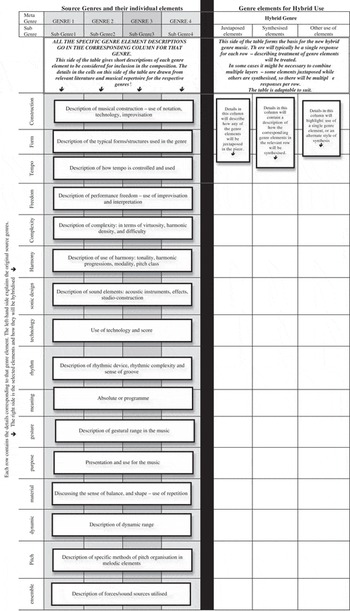
The genre elements addressed on the left-hand side of the hybridity table (Table 1) are: compositional construction (method of scoring/notation, use of improvisation, loops, etc.); form; tempo; musical freedom (both in interpretation and in construction); complexity; harmony; sonic design; use of technology; rhythm; meaning; gesture; purpose; musical material (use of repetition, motivic development); dynamics; pitch; and ensemble. These elements have been chosen to address the key elements of a genre and are developed from Fabbri’s original definition of genre.
Hybridity table guide (Mayall Reference Mayall2015: 55)

2.5. Guide to the hybridity table
The hybridity table is used as a compositional tool to guide the composer through the hybridity balance. Each source genre element is described on the left of the solid black line, and the compositional use of these elements on the right, either as juxtaposition, synthesis or some other use of elements. The right side thus facilitates a systematic approach to the hybrid music composition. The process of composition continues to draw on traditional compositional methods and allows for intuition and spontaneous invention.
The flexibility inherent in the design of this systematic approach to composition permits differing applications to different works in different situations, balancing the genre elements both as a pre-compositional planning tool and as a reference point during the compositional process. This could be considered a form of algorithmic composition, although algorithmic composition often informs the micro-decisions relating to specific pitches and musical details. Here, the algorithm is the hybridity table which informs the macro-structure and textural elements of the piece, rather than micro-musical elements. The focus is on the interrelationship of parts rather than on the structuring of each specific element.
3. Using the Hybridity Table
The composer who wishes to explore this systematic method for cross-genre hybridity should complete the hybridity table during the pre-composition process. The composer then works systematically within the hybridity table by delineating key musical elements in each genre from which the composer selects, juxtaposes and synthesises to hybridise a new set of genre parameters. These parameters address musical, aesthetic and technical matters and are designed to be uniquely appropriate to each individual work. The hybridity table provides the composer with a genre map from which the organisation of pitch, rhythm, timbre, notation and formal design of works may be determined to suit artistic ends on a case-by-case basis. The hybridity table provides a new clarity for the creation of balanced, hybrid genre music, whilst still allowing room for intuition and creativity in the compositional process.
The sense of balance gained through use of the hybridity table is found in the individual hybridisation of each genre element. The hybridity table allows the composer to select those genre elements most useful in composition. This means that any problems of apparently incompatible genres can be addressed immediately, and by breaking down each genre into its constituent parts, the composer is able to utilise each part on a purely musical level. The hybridity table also identifies the techniques, tools and technology required for each individual piece. This means that the compositional approach is developed on a case-by-case basis depending on the arrangement of the hybridity table. The inclusion of specific performers, multimedia elements and the artistic goals for each piece can also be addressed through the creation of the hybridity table.
3.1. Exploring the hybridity table
Certain elements in the hybridity table are self-explanatory. Elements such as form, tempo, harmony, rhythm, dynamics, and pitch organization are all things that need to be addressed when composing music. Other elements, such as freedom (improvisation and interpretation), sonic design, use of technology, gesture and purpose (presentation and use of the music) may not be typically considered in some genres of music.
For composers using the hybridity table, after selecting the genres they wish to explore, they must develop working definitions for those genres according to each element in the hybridity table. These definitions are just short explanations that are drawn from genre-specific readings, musical listening and any other genre-informed composition or performance practice. The more developed an understanding of each genre the composer has, the more they are able to properly address these elements, and ultimately result in a hybrid music composition that feels more than pastiche. These definitions can, and often will, be refined throughout the process as one delves into more depth for each selected genre.
3.2. Tracking Forward: an example.
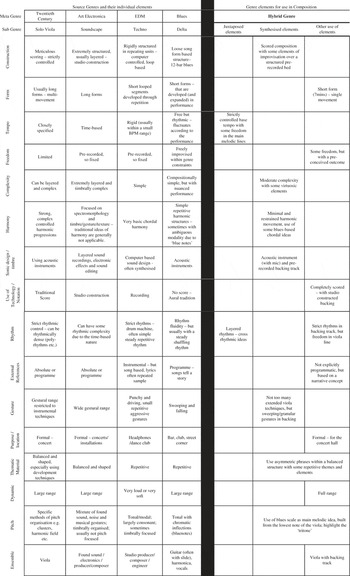
Tracking Forward (hereafter, TF) is a short work for solo viola and backing track with video. It was the first piece composed utilising the hybridity table as a compositional tool, hybridising late twentieth-century solo viola music, electroacoustic soundscape, electronic dance music and blues.
The hybridity table in Table 2 forms a compositional guide for how each of the genre elements from the included source genres are utilised as compositional tools and approaches in TF. The source genres are: twentieth century chamber music, drawing from repertoire for solo viola; blues music, with particular reference to the Delta blues; electroacoustic soundscape, using studio editing techniques to transform the pre-recorded viola parts, harmonica parts, and other sound effects; and electronic dance music, mostly through the use of programmed drum machine sounds and some synthesiser beds.
Tracking Forward hybridity table (Mayall Reference Mayall2015: 73)

3.2.1. Reflections on hybridity
This table served as the pre-compositional tool for TF. Being the first piece composed using the hybridity table as a pre-compositional planning tool, the systematic process deployed for this piece was in its earliest stages of development. The perceived balance of hybridity in TF does fluctuate between densely layered hybridity in the climax to almost solo viola lines. Basing the melodic material on the blues scale, together with the harmonica sound, emphasises the intended genre focus on the blues. The other genre elements derive from the studio-based electroacoustic and EDM genres and so they exist purely in the backing track. The balance of hybridity here is achieved by constantly shifting the balance of sounds and effects between the foreground and background textures, as well as through the inclusion of the pre-recorded and manipulated viola parts to morph the two separate sound worlds together. The balance of hybridity reaches its peak through the control of specific effects and transformations as the synth and rhythmic textures become most prevalent in the climactic parts (a performance recording is available at: http://vimeo.com/jeremymayall/trackingforward).
4. Important Considerations in Composing Hybrid Music
Throughout the design process of this hybridity table, and its implementation in my own compositional practice, certain elements seemed to become paramount in achieving the balanced sense of hybridity that was intended. Those elements are: ensemble, sound and technology, borrowing, and notation/improvisation.
4.1. A unique ensemble
One of the central issues raised during the application of this hybrid music system to my compositional process was that of ensemble selection. To achieve a clear sense of hybridity in the resulting music, it seemed necessary to write for a unique ensemble of musicians. Many genre elements are specific to the timbres and performance traditions of certain instruments, and so selecting these instruments for the hybrid work provides a clearer sense of the intended hybridity. This issue also prevailed in composing for ensembles with an established tradition: composition of hybrid music for orchestra or string quartet was complicated by the need to accommodate traditions, extended repertoire and cultural context of those ensembles. In these contexts, hybridity can become lost or seem a parody. It is more difficult to radicalise the traditional orchestra but adding an electric guitar or turntables to the orchestral ensemble makes an immediate and powerful difference.
The presentation of hybrid music relies as much on genre-informed performance practice as it does on compositional structure. The inclusion of a unique instrumental ensemble is vital to the compositional hybridity, and the GIP practice vindicates the considered and careful use of genre clichés; if those elements are removed, the hybridity and genre-balance may be lost. The necessary inclusion of genre cliché in a hybrid composition was not apparent at the beginning of the research process; rather, it developed during the composition process.
4.2. Sound and technology
Ensemble selection is related to issues of timbre, which leads to the second consideration of sound and technology. Sounds can be distinctive within genres, so the hybrid music composers should address ‘sound’ in the composition process. The combinations of sounds from different genres can help to solidify the sense of hybridity. For example, in TF the sounds combined include solo viola, blues harmonica and drum machine – all representative of different genres. The inclusion of sound (in live electronics or fixed media parts) can also influence the shape and texture of the composition, supplanting the role of melodic shape in thematic material.
Ongoing creative practice-based research into hybrid genre music composition seems to thrive on the composer’s ability to craft recorded sound with traditional musical notation, expanding traditional concepts of orchestration and instrumental timbre, and to embrace sound design, audio mixing, and the internal manipulation of sound files through various effects and editing techniques. The manipulation of ‘sound’ plays an equal part in the creation of hybrid music compositions. The hybridity table encourages the composer to address approaches to technology, sonic design and timbral elements in the pre-compositional stage.
4.3. Borrowing and collage
This focus on sound as a central element in hybrid music also places some focus on the concept of musical borrowing. Specific genre elements and sonic characterisations are crucial in the systematic compositional process; without drawing on the musical traditions and repertoire of selected genres it would be impossible for the composer to address the generic contract central to engagement with any specific genre.
In this research, hybrid genre music has not been created by extracting abstract genre principles, then formulating the new hybrid genre from those; rather, specific genre elements and characteristic features of the chosen genres are selected and recombined in a systematic way. This means that while the individual elements may be familiar, the resultant sound created will be new. The familiarity of certain genre elements can, at times, reach the point of cliché, where the musical element becomes an excessively clear representation of a musical genre, which is then placed in new contexts to take on a new meaning.
Musical borrowing is used here as an umbrella term for quotation, stylistic allusion, genre cliché and audio sampling (Burkholder Reference Burkholder1994: 861–2). In general, borrowed material is altered to fit a new context, thus transforming the original identity. Musical borrowing therefore has two distinct parts:
-
1. The original, prior to any alterations.
-
2. The transformation, involving ‘any alterations made to the original as well as the changed form it assumes in its new context’ (Metzer Reference Metzer2003: 6).
Conscious musical borrowing enables the composer to produce hybrid music through intra-genre dialogue which is highlighted by tropes in the genre construction. In this context the term ‘trope’ refers to the figurative use of a word or expression, or a common or overused theme or device. A trope ‘twists words away from their usual meanings’ (Wales Reference Wales1989: 468). Musical tropes act as signifiers of a genre, but are also transformed by their new context. Their systematic positioning within the hybrid texture renders them readily recognisable as genre signifiers and as active new elements referring to their new musical context within each piece. They can also be used to created inter-textual relationships between genres and between specific pieces if the musical borrowing is more direct.
Careful, considered use of musical borrowing in new music composition provides the composer with additional tools to make the familiar seem unfamiliar. Many composers have drawn from elements they found interesting or appealing, and by unique compositional means these familiar musical elements are transformed into new music. Thus new compositions can be created with a discernable link to the music and genre traditions of music which has directly influenced or intrigued the composer. Selecting specific genres, based on musical traditions, sonic elements or instrumental choices, the composer directly addresses the musics that have influenced the development of his or her compositional voice.
4.4. Improvisation
The final consideration to emerge from the ongoing creative research application of the hybridity table is the importance of openness towards interpretation of the score in hybrid music. Because genre-informed performance is essential to the success of hybrid music, the composer must be receptive to including performance suggestions and guidelines in the score rather than definitively prescribing performance elements. Successful hybrid music is achieved through collaboration. The score acts as a guide, sometimes quite specifically, to the outcome of the piece; the performer freely interprets the rest of the music.
This freedom inherent in hybrid music also allows room for improvisation. Composition itself may be described as improvisatory at its core (Benson Reference Benson2003: 2). Many composers include improvisations in their working practice. John Zorn regularly includes improvisation as part of his compositions. Michael Daugherty ‘often begins composing with improvisation and collaborates with instrumentalists to explore frontiers of timbre and technique … and only in the later stages of his work converts the results to notation’ (Clague Reference Clague2013). Composers can improvise with the rules and conventions of musical genres: ‘composers do not merely work within a given discourse: the act of composition inevitably involves going beyond the lines’ (Benson Reference Benson2003: 52). Composition of hybrid music develops through new combinations of genre material, and requires a new structure to guide musical creation and improvisation, and the systematic method for hybridity developed in this article helps achieve that.
5. Further Recommendations and Closing Remarks
The continuation of this research could progress in two ways. First, it should ideally address audience perception of hybridity in relation to composer intention. This has the potential to further refine the process of composing hybrid music and assessing the success of genre combinations. This process would, in turn, provide the tools and techniques to continue refining the hybridity table, and determining best possible utilisation of various elements.
Second, the use of the hybridity table has also been limited to the compositional process of just one composer; introducing this tool to other composers has the potential for further refinement of the table in the provision of other elements and alternative approaches to the control of intuitive elements inherent in the composition process.
Composing cross-genre hybrid music has been occurring intuitively for a long time. But a systematic method for this compositional approach seemed to be lacking. For the hybridity table to be utilised, the composer needs to have an understanding of the genres they wish to explore. Each genre refers to a specific set of musical events including musical sounds and noise, musical time, musical elements such as melody and harmony, levels of complexity, and musical gestures. In working with genres, a composer can also choose to address social, cultural or semiotic explorations of genre, or simply focus entirely on the creation of music from genre specific musical elements.
The application of the hybridity table as a compositional tool relies, in part, on an individual’s interpretation of genre. So far, this composer has approached genre in broad, ‘umbrella’ fashion. Such classification is deemed necessary because recently developed genres have been generated as subgenres from established genres (Ennis Reference Ennis1992; Fornäs Reference Fornäs1995; McLeod Reference McLeod2001; Neill Reference Neill2002; Lena and Peterson Reference Lena and Peterson2008). The distinction between these new subgenres is so minute that it requires acute listening to identify the single specific elements separating one subtype from the other. It is, therefore, cumbersome to dwell on specific intricacies and differences when a holistic approach to key genre-signifiers is more beneficial to this composition method.
The hybridity table explored in this article presented one potential method for composing cross-genre hybrid music. This systematic method allows for the composer of any type of music to draw upon a variety of genre elements in the creation of new music from familiar sources. Application of the hybridity table to the compositional process facilitates the composition of balanced hybrid music. This music is informed by ideas of musical borrowing, draws on a range of existing technologies, blurs the line between the composer and producer, and relies for its success on the inclusion of improvisatory performance techniques and genre-specific musical awareness. The practical applications of this research into creative practice can be heard in J. Mayall – Hybrid Philosophies (https://jeremymayall.bandcamp.com/album/hybrid-philosophies).