


1. Introduction
The interaction between biological organisms and their surrounding environments may profoundly influence their migration and ever their collective behaviour. A particularly striking though simple example is formed by populations of Bacillus subtilis, in which individuals exhibit reduced motility in nutrient-poor environments, and for which experimental findings witness a rich variety of multiply branched colony structures spontaneously arising in such circumstances ([Reference Fujikawa and Matsushita5], [Reference Fujikawa4], [Reference Matsushita and Fujikawa13]). To capture the essence of this bacterial behaviour, modelling efforts ([Reference Kawasaki, Mochizuki, Matsushita, Umeda and Shigesada7], [Reference Leyva, Málaga and Plaza8]) have resulted in the parabolic system
 \begin{equation}
\left\{\begin{array}{ll}
u_t = \nabla\cdot (uv\nabla u) - \chi\nabla\cdot (u^2 v\nabla v)+ f(u,v),
\\[1mm]
v_t = \Delta v -uv,
\end{array} \right.
\end{equation}
where  $u$ denotes the respective population density,
 $v$ describes the nutrient concentration,
 $f$ characterizes the cell kinetics, and
 $\chi$ is a given nonnegative constant.
As suggested by numerical studies undertaken in [Reference Kawasaki, Mochizuki, Matsushita, Umeda and Shigesada7] and [Reference Leyva, Málaga and Plaza8], due to the inclusion of signal-dependent cross-degeneracies systems of this form indeed may quite accurately describe such pattern formation processes far from diffusion-dominated behaviour. While thus recognized as a key characteristic, this model element of cross-degenerate diffusion, on the other hand, considerably diminishes regularizing effects typically expected in contexts of parabolic evolution. This goes along with significant challenges for a corresponding mathematical analysis, as underscored by the scarcity of results in the literature: In the proliferation-free case when  $f\equiv 0$, global weak solutions for widely arbitrary initial data so far seem to have been constructed only in one- and two-dimensional domains ([Reference Zhang and Li26], [Reference Winkler and Wu21], [Reference Li and Winkler11]); results on global solvability in higher-dimensional scenarios seem either restricted to the case when
 $\chi=0$ and hence no taxis effects are included ([Reference Winkler19]), or to rely on suitable enhancement of dissipative mechanisms or saturation effects in cross-diffusion by addressing modified variants of (1.1) ([Reference Xiang-Mao, Huang and Wang25], [Reference Huang and Wang6], [Reference Wu22], [Reference Li9], [Reference Black, Kohatsu and Wu2], [Reference Winkler20]).
More importantly, for this proliferation-free case when  $f\equiv 0$, some analytical evidence for the capability of such cross-degeneracies to induce nontrivial asymptotic behaviour has been provided: Under appropriate smallness assumptions on the initial data and especially on smallness of the initial signal distribution, namely, solutions to (1.1) have been found to stabilize towards nonconstant states in the large time limit when either
 $\chi=0$ and
 $n\le 5$ ([Reference Winkler19]), or
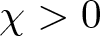 $\chi \gt 0$ and
 $n\le 2$ ([Reference Zhang and Li26], [Reference Winkler and Wu21], [Reference Li and Winkler11]); similar observations have been made for some close relatives, partially also in higher-dimensional frameworks ([Reference Huang and Wang6], [Reference Xiang-Mao, Huang and Wang25], [Reference Wu23], [Reference Li and Lou10]).
Now, recent literature has indicated that, in contrast to this, the inclusion of sufficiently strong zero-order damping may reduce this tendency towards heterogeneity: When  $n\ge 2$ and
 $f(u,v)=u - u^\kappa$ for
 $(u,v)\in [0,\infty)^2$ with some
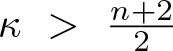 $\kappa~ \gt ~\frac{n+2}{2}$, for nontrivial initial data a global very weak solution of (1.1) can always be found, and when resorting to a suitably weak topological setting, this solution can be seen to approach the constant equilibrium
 $(1,0)$ ([Reference Pan15]). For the case
 $\kappa=2$, as corresponding to the most prototypical logistic source given by
 \begin{equation}
f(u,v)=u-u^2,
\qquad (u,v)\in [0,\infty)^2,
\end{equation}
however, only a statement on global existence of continuous weak solutions seems available up to now ([Reference Li and Winkler12]; cf. also [Reference Zhang and Li27] and [Reference Xiang24]).
Main results. The present manuscript aims at supplementing this knowledge by an analysis of the large time behaviour exhibited by these global solutions. Indeed, building on the global solution theory established in [Reference Li and Winkler12], the main objective of this paper is to confirm a dominant role of logistic kinetics in shaping the evolution of the solutions, especially enforcing the stabilization of cell populations towards constant steady states, also in the classical scenario determined by (1.2).
To this end, we shall consider the initial-boundary value problem
 \begin{equation}
\left\{\begin{array}{ll}
u_t = \nabla\cdot (uv\nabla u) - \nabla\cdot (u^2 v\nabla v) + u - u^2,
\qquad & x\in\Omega, \ t \gt 0, \\[1mm]
v_t = \Delta v -uv,
\qquad & x\in\Omega, \ t \gt 0, \\[1mm]
(uv\nabla u - u^2 v \nabla v)\cdot\nu=\nabla v\cdot \nu=0,
\qquad & x\in\partial\Omega, \ t \gt 0, \\[1mm]
u(x,0)=u_0(x), \quad v(x,0)=v_0(x),
\qquad & x\in\Omega,
\end{array} \right.
\end{equation}
in a bounded domain 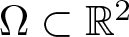 $\Omega\subset\mathbb{R}^2$ with smooth boundary, and recall from [Reference Li and Winkler12] the following result on global solvability and regularity available in this planar setting; for a slightly sharper statement, we refer to Lemma 2.2 below.
Proposition 1.1. Let 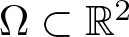 $\Omega\subset\mathbb{R}^2$ be a bounded domain with smooth boundary, and assume that
 \begin{equation}
\left\{\begin{array}{l}
u_0\in W^{1,\infty}(\Omega)~\text{is nonnegative, and that} \\[1mm]
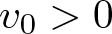
v_0\in W^{1,\infty}(\Omega)~\text{is such that}~v_0 \gt 0~\text{in}~\overline{\Omega}.
\end{array} \right.
\end{equation}
Then the problem (1.3) admits at least one continuous weak solution, in the sense specified in Definition 2.1, with
 \begin{equation}
\left\{\begin{array}{l}
u\in C^0(\overline{\Omega}\times [0,\infty)) \cap L_{loc}^\infty(\overline{\Omega}\times (0,\infty)) \qquad \text{and} \\[1mm]
v\in C^0(\overline{\Omega}\times [0,\infty)) \cap C^{2,1}(\overline{\Omega}\times (0,\infty)) \cap L^\infty_{loc}([0,\infty);W^{1,\infty}(\Omega)),
\end{array} \right.
\end{equation}
and with  $u\ge 0$ and
 $v \gt 0$ in
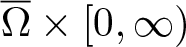 $\overline{\Omega}\times [0,\infty)$. This solution can be obtained as limits of solutions to the regularized problems (2.5) below, in the sense that there exists
 $(\varepsilon_j)_{j\in\mathbb{N}}\subset (0,1)$ such that
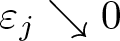 $\varepsilon_j\searrow 0$ and
 $(u_{\varepsilon_j},v_{\varepsilon_j})\to (u,v)$ in
 $C^0_{loc}(\overline{\Omega}\times [0,\infty))$ as
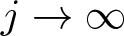 $j\to\infty$.
In this framework, under an additional positivity assumption on  $u_0$, coinciding with a core hypothesis underlying the previous studies in [Reference Zhang and Li26] and [Reference Winkler18], the main result of this manuscript reveals the pivotal role of the logistic-type source in governing the long-term dynamics, hence leading to the convergence of the solutions to spatially homogeneous steady states and thus suppressing any potential pattern formation that might otherwise be induced by cross-degeneracies.
Theorem 1.2. Let 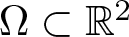 $\Omega\subset\mathbb{R}^2$ be a smoothly bounded domain, and suppose that
 $u_0$ and
 $v_0$ are such that (1.4) holds, and that
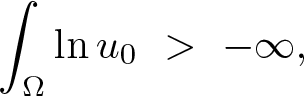
 \begin{equation}
\int_\Omega \ln u_0 ~ \gt ~ -\infty.
\end{equation}
Then the continuous weak solution  $(u,v)$ obtained in Proposition 1.1 satisfies
 \begin{equation}
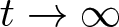
u(\cdot,t) \rightharpoonup 1
\quad \text{in } L^1(\Omega)
\qquad \text{as } t\to\infty
\end{equation}
and
 \begin{equation}
v(\cdot,t)\to 0
\quad \text{in } L^\infty(\Omega)
\qquad \text{as } t\to\infty.
\end{equation}
Main ideas. The first step of our approach consists in deriving a strong  $L^2$ precompactness property enjoyed by the gradients
 $\nabla u_\varepsilon$ of solutions to the regularized systems (2.5); this will be achieved by means of an Aubin-Lions type argument (Lemmas 3.4-3.6), primarily focused on deriving an a priori estimate involving a second-order derivative of
 $u_\varepsilon$ by tracing the evolution of the weighted functionals
 \begin{equation}
\int_\Omega u_\varepsilon^\gamma(\cdot,t) |\nabla u_\varepsilon(\cdot,t)|^2,
\end{equation}
for arbitrary 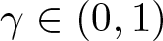 $\gamma\in (0,1)$ (Lemma 3.4).
To further utilize this information under the additional assumption in (1.6), we delve deeper into the dissipative features of (2.5), resulting in the identification of two energy functional structures inherent in (2.5), the first (Lemma 4.1) of which provides bounds for
 \begin{equation}
\int_{0}^{\infty}\int_\Omega (u_\varepsilon-1)^2
\qquad\text{and}\qquad
\int_{0}^{\infty}\int_\Omega |\Delta v_\varepsilon|^2
\end{equation}
(Lemma 4.1 and Corollary 4.2) and, moreover, for
 \begin{align*}
\int_{0}^{\infty}\int_\Omega v_\varepsilon
\end{align*}
(Lemma 4.3), thus already leading to the convergence statement (1.8).
In proving the stabilization of  $u$, we draw upon these bounds and derive from a second energy structure not only an
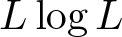 $L\log L$ estimate for the population density, but furthermore also a favourable decay property of the migration-related flux, as expressed in bounds for
 \begin{align*}
\int_0^\infty \int_\Omega |\sqrt{v_\varepsilon}\nabla u_\varepsilon - u_\varepsilon\sqrt{v_\varepsilon}\nabla v_\varepsilon|^2
\end{align*}
(Lemma 5.1). Thanks to the strong convergence property of  $\nabla u_\varepsilon$ from Section 3, this will be seen to imply stabilization of
 $u$ with respect to the norm in
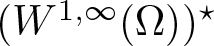 $(W^{1,\infty}(\Omega))^\star$ (Lemmas 6.1-6.3), from which (1.7) will be inferred using a contradiction-based argument.
2. Preliminaries. Approximation and some basic regularity features
We begin by specifying the concept of the solutions formulated in Proposition 1.1, which will serve as the basis for our asymptotic analysis in this manuscript.
Definition 2.1. Let  $u$ and
 $v$ be nonnegative functions such that
 \begin{equation}
\left\{\begin{array}{l}
u\in C^0(\overline{\Omega}\times [0,\infty))
\qquad \text{and} \\[1mm]
v\in C^0(\overline{\Omega}\times [0,\infty)) \cap C^{2,1}(\overline{\Omega}\times (0,\infty))
\end{array} \right.
\end{equation}
and that
 \begin{equation}
u^2 \nabla v~\text{and }~\nabla u^2~\text{belong to }~\in L^1_{loc}(\overline{\Omega}\times [0,\infty);\mathbb{R}^2).
\end{equation}
We then call  $(u,v)$ a continuous weak solution of (1.3) if
 \begin{align}
-\int_0^\infty \int_\Omega u\varphi_t
- \int_\Omega u_0 \varphi(\cdot,0)
&= - \frac{1}{2} \int_0^\infty \int_\Omega v \nabla u^2 \cdot \nabla \varphi
+ \int_0^\infty \int_\Omega u^2 v \nabla v\cdot\nabla \varphi \nonumber\\
&\quad + \int_0^\infty \int_\Omega u\varphi
- \int_0^\infty \int_\Omega u^2 \varphi\end{align}
holds for all  $\varphi\in C_0^\infty(\overline{\Omega}\times [0,\infty))$, and if
 \begin{equation}
\left\{\begin{array}{ll}
v_t = \Delta v -uv,
\qquad & x\in\Omega, \ t \gt 0, \\[1mm]
\frac{\partial v}{\partial\nu}=0,
\qquad & x\in\partial\Omega, \ t \gt 0, \\[1mm]
v(x,0)=v_0(x),
\qquad & x\in\Omega,
\end{array} \right.
\end{equation}
is satisfied in the classical sense.
In order to let our analysis be compatible with the outcome of Proposition 1.1, following ([Reference Li and Winkler12]) we shall consider the regularized variants of (1.3) given by
 \begin{equation}
\left\{\begin{array}{ll}
u_{\varepsilon t} = \nabla\cdot (u_\varepsilon v_\varepsilon\nabla u_\varepsilon) - \nabla\cdot (u_\varepsilon^2 v_\varepsilon \nabla v_\varepsilon) + u_\varepsilon - u_\varepsilon^2,
\qquad & x\in\Omega, \ t \gt 0, \\[1mm]
v_{\varepsilon t} = \Delta v_\varepsilon -u_\varepsilon v_\varepsilon,
\qquad & x\in\Omega, \ t \gt 0, \\[1mm]
\frac{\partial u_\varepsilon}{\partial\nu}=\frac{\partial v_\varepsilon}{\partial\nu}=0,
\qquad & x\in\partial\Omega, \ t \gt 0, \\[1mm]
u_\varepsilon(x,0)=u_0(x)+\varepsilon, \quad v_\varepsilon(x,0)=v_0(x),
\qquad & x\in\Omega,
\end{array} \right.
\end{equation}
for 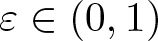 $\varepsilon\in (0,1)$. For convenient later reference, let us extract from [Reference Li and Winkler12] those statements on solvability, regularity and behaviour in the limit
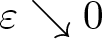 $\varepsilon\searrow 0$ that will be of significance here.
Lemma 2.2. Assume (1.4). Then given any 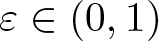 $\varepsilon\in (0,1)$, one can find functions
 \begin{equation}
\left\{\begin{array}{l}
u_\varepsilon \in C^0(\overline{\Omega}\times [0,\infty)) \cap C^{2,1}(\overline{\Omega}\times (0,\infty)) \qquad \text{and} \\[1mm]
v_\varepsilon \in C^0(\overline{\Omega}\times [0,\infty)) \cap C^{2,1}(\overline{\Omega}\times (0,\infty))
\end{array} \right.
\end{equation}
which are positive in 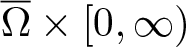 $\overline{\Omega}\times [0,\infty)$, that (2.5) is solved in the classical sense, and that
 \begin{equation}
\|v_\varepsilon(\cdot,t)\|_{L^\infty(\Omega)}
\le \|v_0\|_{L^\infty(\Omega)}
\qquad~\text{for all }~t \gt 0.
\end{equation}
Moreover,
 \begin{equation}
\sup_{\varepsilon\in (0,1)} \sup_{(x,t)\in\Omega\times (0,T)} |u_\varepsilon(x,t)| \lt \infty
\qquad~\text{for all }~T \gt 0,
\end{equation}
and
 \begin{equation}
\inf_{\varepsilon\in (0,1)} \inf_{(x,t)\in\Omega\times (0,T)} v_\varepsilon(x,t) \gt 0
\qquad~\text{for all }~T \gt 0
\end{equation}
as well as
 \begin{equation}
\sup_{\varepsilon\in (0,1)} \sup_{(x,t)\in\Omega\times (0,T)} |\nabla v_\varepsilon(x,t)| \lt \infty
\qquad~\text{for all }~T \gt 0
\end{equation}
and
 \begin{equation}
\sup_{\varepsilon\in (0,1)} \sup_{(x,t)\in\Omega\times (\tau,T)} |\Delta v_\varepsilon(x,t)| \lt \infty
\qquad~\text{for all}~\tau \gt 0~and~T~ \gt ~\tau
\end{equation}
and there exist  $(\varepsilon_j)_{j\in\mathbb{N}}\subset (0,1)$ and a continuous weak solution
 $(u,v)$ of (1.3) such that (1.5) holds with
 $u\ge 0$ and
 $v \gt 0$ in
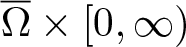 $\overline{\Omega}\times [0,\infty)$, that
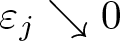 $\varepsilon_j\searrow 0$ as
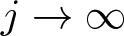 $j\to\infty$, and that
 \begin{equation}
\!\!\!\!\!\!\!\!\!\!\!\!\!\!\!\!\!\!\!\!\!\!\!\!\!\!\!\!\!\!\!\!\!\!\!\!\!\!\!\!\!\!\!\!\!\!\!\!\!\!\!\!\!\!\!\!\!\!\!\!\!\!\!\!\!\!\!\!\!\!\!\!\!\!\!\!\!\!\!\!\!\!\!\!\!\!\!\!\!\!\!\!\!\!\!\!\!\!\!u_\varepsilon \to u
\qquad~\text{in}~C^0_{loc}(\overline{\Omega}\times [0,\infty)),
\end{equation}
 \begin{equation}
v_\varepsilon\to v
\qquad~\text{in}~C^0_{loc}(\overline{\Omega}\times [0,\infty))
~\text{and in}~C^{2,1}_{loc}(\overline{\Omega}\times (0,\infty))
\quad \quad \text{and}
\end{equation}
 \begin{equation}
\!\!\!\!\!\!\!\!\!\!\!\!\!\!\!\!\!\!\!\!\!\!\!\!\!\!\!\!\!\!\!\!\!\!\!\!\!\!\!\!\!\!\!\!\!\!\!\!\!\!\!\!\!\!\!\!\!\!\!\!\!\!\!\!\!\!\!\!\!\!\!\!\!\!\!\!\!\!\!\!\!\!\!\!\!\!\!\!\!\!\!\!\! \nabla v_\varepsilon\rightharpoonup \nabla v
\qquad~\text{in}~L^2_{loc}(\overline{\Omega}\times 0,\infty))
\end{equation}
as 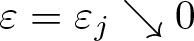 $\varepsilon=\varepsilon_j\searrow 0$.
3. A strong  $L^2$ precompactness property of
$\nabla u_\varepsilon$


Our qualitative analysis of (1.3) will crucially depend on the estimates for its regularized systems (2.5) that will be derived below in Sections 4 and 5. To facilitate the transition of these estimates to their counterparts in (1.3), proving the strong convergence of  $\nabla u_\varepsilon$ in
 $L^2$ appears to emerge as a core step in this process. This, in turn, requires additional regularity features of
 $\nabla u_\varepsilon$ which go beyond those established in Lemma 2.2, and the derivation of which will form the objective of this section. We begin with the following elementary result, obtained by means of a standard
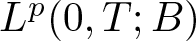
 $L^p$ testing procedure for
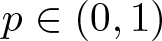 $p\in(0, 1)$.
Lemma 3.1. For all 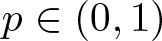 $p\in (0,1)$ and
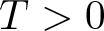 $T \gt 0$, there exists
 $C(p,T) \gt 0$ such that
 \begin{equation}
\int_0^T \int_\Omega u_\varepsilon^{p-1} |\nabla u_\varepsilon|^2 \le C(p,T)
\qquad~\text{for all }~\varepsilon\in (0,1).
\end{equation}
Proof. Let 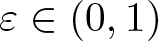 $\varepsilon\in (0,1)$. Then again drawing on the strict positivity of
 $u_\varepsilon$ in
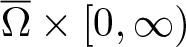 $\overline{\Omega}\times [0,\infty)$, we may integrate by parts in the first equation from (2.5) to confirm that
 \begin{align}
\frac{1}{p} \frac{d}{dt} \int_\Omega u_\varepsilon^p
&= (1-p) \int_\Omega u_\varepsilon^{p-1} v_\varepsilon |\nabla u_\varepsilon|^2
- (1-p) \int_\Omega u_\varepsilon^p v_\varepsilon\nabla u_\varepsilon\cdot\nabla v_\varepsilon \nonumber\\
&\quad + \int_\Omega u_\varepsilon^p - \int_\Omega u_\varepsilon^{p+1}
\qquad~\text{for all }~t \gt 0,\end{align}
and here Young’s inequality implies that
 \begin{align}
\bigg| -(1-p) \int_\Omega u_\varepsilon^p v_\varepsilon\nabla u_\varepsilon\cdot\nabla v_\varepsilon \bigg|
\le \frac{1-p}{2} \int_\Omega u_\varepsilon^{p-1} v_\varepsilon |\nabla u_\varepsilon|^2 \nonumber \\
+\ \frac{1-p}{2} \int_\Omega u_\varepsilon^{p+1} v_\varepsilon |\nabla v_\varepsilon|^2 \qquad~\text{for all }~t \gt 0,
\end{align}
because 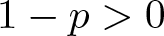 $1-p \gt 0$. Now for fixed
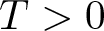 $T \gt 0$, Lemma 2.2 provides
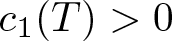 $c_1(T) \gt 0$ and
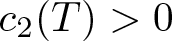 $c_2(T) \gt 0$ such that
 \begin{align*}
v_\varepsilon\ge c_1(T)
\quad \text{and} \quad
|\nabla v_\varepsilon| \le c_2(T)
\quad~\text{in}~\Omega\times (0,T)
\qquad~\text{for all }~\varepsilon\in (0,1),
\end{align*}
whence a combination of (3.2) with (3.3), (2.7) and the nonnegativity of  $u_\varepsilon^p$ for
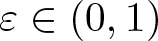 $\varepsilon\in (0,1)$ shows that
 \begin{align}
\frac{1}{p} \frac{d}{dt} \int_\Omega u_\varepsilon^p
\ge
c_3(p,T)
\int_\Omega u_\varepsilon^{p-1} |\nabla u_\varepsilon|^2
- c_4(p,T)
\int_\Omega u_\varepsilon^{p+1} \nonumber \\
\qquad~\text{for all}~t\in (0,T)~\text{and}~\varepsilon\in (0,1)
\end{align}
with  $
c_3(p,T)
:=\frac{(1-p)c_1(T)}{2}$ and
 $
c_4(p,T)
:=\frac{1}{2}(1-p) c_2^2(T) \|v_0\|_{L^\infty(\Omega)} +1$. Therefore,
 \begin{align*}
c_3(p,T)
\int_0^T \int_\Omega u_\varepsilon^{p-1} |\nabla u_\varepsilon|^2
\le \frac{1}{p} \int_\Omega u_\varepsilon^p(\cdot,T) - \frac{1}{p} \int_\Omega (u_0+\varepsilon)^p
+ c_4(p,T)
\int_0^T \int_\Omega u_\varepsilon^{p+1} \nonumber \\
\qquad~\text{for all }~\varepsilon\in (0,1),
\end{align*}
so that (3.1) follows upon using Young’s inequality to estimate
 \begin{align*}
\frac{1}{p} \int_\Omega u_\varepsilon^p(\cdot,T) - \frac{1}{p} \int_\Omega (u_0+\varepsilon)^p
\le \frac{1}{p} \int_\Omega u_\varepsilon(\cdot,T) + \frac{|\Omega|}{p} \nonumber \\
\qquad~\text{for all }~\varepsilon\in (0,1)
\end{align*}
as well as
 \begin{align*}
c_4(p,T)
\int_0^T \int_\Omega u_\varepsilon^{p+1}
\le
c_4(p,T)
\int_0^T \int_\Omega u_\varepsilon^2
+ c_4(p,T)
|\Omega| T
\qquad~\text{for all }~\varepsilon\in (0,1),
\end{align*}
and employing (2.8).
Combined with the boundedness of  $u_\varepsilon$ recorded in Lemma 2.2, this readily extends the applicability of the estimates (3.1) to any
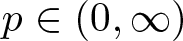 $p\in(0,\infty)$, which, among others, entails weak convergence of
 $\nabla u_\varepsilon$ to
 $\nabla u$ in
 $L^2$.
Corollary 3.2. For all  $\lambda \gt 0$ and
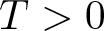 $T \gt 0$ there exists
 $C(\lambda,T) \gt 0$ such that
 \begin{equation}
\int_0^T \int_\Omega u_\varepsilon^{\lambda-1} |\nabla u_\varepsilon|^2 \le C(\lambda,T)
\qquad~\text{for all }~\varepsilon\in (0,1).
\end{equation}
In particular, if  $u$ and
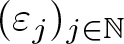 $(\varepsilon_j)_{j\in\mathbb{N}}$ are as in Lemma 2.2, then
 \begin{equation}
\nabla u \in L^2_{loc}(\overline{\Omega}\times [0,\infty);\mathbb{R}^2).
\end{equation}
and
 \begin{equation}
\nabla u_\varepsilon\rightharpoonup\nabla u
\quad~\text{in}~L^2_{loc}(\overline{\Omega}\times [0,\infty))
\qquad~\text{as}~\varepsilon=\varepsilon_j\searrow 0.
\end{equation}
Proof. We fix any 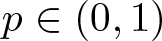 $p\in (0,1)$ such that
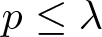 $p\le\lambda$, and given
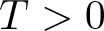 $T \gt 0$ we employ Lemma 2.2 to pick
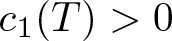 $c_1(T) \gt 0$ such that
 \begin{align*}
u_\varepsilon\le c_1(T)
\quad~\text{in}~\Omega\times (0,T)
\qquad~\text{for all }~\varepsilon\in (0,1).
\end{align*}
Then
 \begin{align*}
\int_0^T \int_\Omega u_\varepsilon^{\lambda-1} |\nabla u_\varepsilon|^2
\le \int_0^T \int_\Omega u_\varepsilon^{\lambda-p} \cdot u_\varepsilon^{p-1} |\nabla u_\varepsilon|^2
\le c_1^{\lambda-p}(T) \int_0^T \int_\Omega u_\varepsilon^{p-1} |\nabla u_\varepsilon|^2 \nonumber \\
\qquad~\text{for all }~\varepsilon\in (0,1),
\end{align*}
whence Lemma 3.1 ensures (3.5). Applying this to 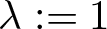 $\lambda:=1$, we moreover obtain both (3.6) and (3.7) as evident consequences of Lemma 2.2.
In preparation for Lemma 3.4, let us include the following consequence of an elementary comparison argument on relaxation behaviour in a superquadratically damped ODI.
Lemma 3.3. Let  $a \gt 0$,
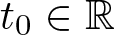 $t_0\in\mathbb{R}$ and
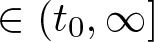 $\in (t_0,\infty]$, and suppose that
 $y\in C^1((t_0,T)) \cap L^\infty_{loc}([t_0,T))$ and
 $g\in C^0([t_0,T))$ are nonnegative and such that
 \begin{equation}
y'(t) + ay^2(t) \le g(t)
\qquad~\text{for all }~t\in (t_0,T).
\end{equation}
Then
 \begin{equation}
y(t) \le \frac{1}{a(t-t_0)} + \int_{t_0}^t g(s) ds
\qquad~\text{for all }~t\in (t_0,T).
\end{equation}
Proof. Writing  $G(t):=\int_{t_0}^t g(s) ds$,
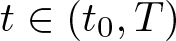 $t\in (t_0,T)$, and
 \begin{align*}
\overline{y}(t):=\frac{1}{a(t-t_0)} + G(t),
\qquad t\in (t_0,T),
\end{align*}
we know that  $G$ is nonnegative with
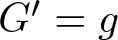 $G'=g$, and that hence
 \begin{align}
\overline{y}'(t) + a\overline{y}^2(t) - g(t)
&= - \frac{1}{a(t-t_0)^2} + G'(t)
+ a\cdot\Big(\frac{1}{a(t-t_0)}+G(t)\Big)^2 - g(t) \nonumber\\
&\ge - \frac{1}{a(t-t_0)^2} + a\cdot \frac{1}{a^2(t-t_0)^2} \nonumber\\
&= 0
\qquad~\text{for all }~t\in (t_0,T).
\end{align}
Since the inclusion  $y\in L^\infty_{loc}([t_0,T))$ warrants that
 \begin{align*}
\limsup_{t\searrow t_0} y(t) \lt \infty
= \lim_{t\searrow t_0} \overline{y}(t),
\end{align*}
a comparison argument based on (3.8) and (3.10) readily leads to (3.9).
To facilitate an Aubin-Lions type of argument leading to the intended precompactness property of  $u_\varepsilon$, we now seek to establish higher regularity estimates of
 $u_\varepsilon$ through an analysis of the functional appearing in (1.9).
Lemma 3.4. Let 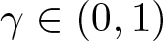 $\gamma\in (0,1)$. Then for all
 $\tau \gt 0$ and any
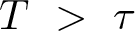 $T~ \gt ~\tau$ there exists
 $C(\gamma,\tau,T) \gt 0$ such that
 \begin{equation}
\int_\tau^T \int_\Omega u_\varepsilon^{\gamma+1} |D^2u_\varepsilon|^2 \le C(\gamma,\tau,T)
\qquad~\text{for all }~\varepsilon\in (0,1)
\end{equation}
and
 \begin{equation}
\int_\tau^T \int_\Omega u_\varepsilon^{\gamma-1} |\nabla u_\varepsilon|^4 \le C(\gamma,\tau,T)
\qquad~\text{for all }~\varepsilon\in (0,1).
\end{equation}
Proof. For 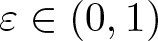 $\varepsilon\in (0,1)$, we rewrite the first equation in (2.5) according to
 \begin{equation}
u_{\varepsilon t} = u_\varepsilon v_\varepsilon\Delta u_\varepsilon + v_\varepsilon |\nabla u_\varepsilon|^2
+ a_\varepsilon(x,t) u_\varepsilon,
\qquad (x,t)\in\Omega\times (0,\infty),
\end{equation}
and note that for
 \begin{align*}
a_\varepsilon(x,t):=\nabla u_\varepsilon\cdot\nabla v_\varepsilon
- u_\varepsilon v_\varepsilon \Delta v_\varepsilon - u_\varepsilon |\nabla v_\varepsilon|^2
- 2v_\varepsilon\nabla u_\varepsilon\cdot\nabla v_\varepsilon
+ 1-u_\varepsilon, \nonumber \\
\qquad (x,t)\in\Omega\times (0,\infty),
\end{align*}
according to Lemma 2.2 and (3.5) we know that given any  $\tau \gt 0$ and
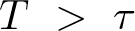 $T~ \gt ~\tau$ we can find
 $c_1(\tau,T) \gt 0$ such that
 \begin{equation}
\int_{\frac{\tau}{2}}^T \int_\Omega a_\varepsilon^2 \le c_1(\tau,T)
\qquad~\text{for all }~\varepsilon\in (0,1).
\end{equation}
To derive (3.11) and (3.12) from this, for fixed 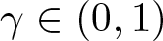 $\gamma\in (0,1)$ and
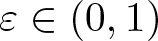 $\varepsilon\in (0,1)$ we use (3.13) and integrate by parts to develop
 $\nabla u_{\varepsilon t}$ into
 $u_{\varepsilon t}$ in coupling
 \begin{align}
\frac{d}{dt} \int_\Omega u_\varepsilon^\gamma |\nabla u_\varepsilon|^2
&= 2 \int_\Omega u_\varepsilon^\gamma \nabla u_\varepsilon\cdot\nabla u_{\varepsilon t}
+ \gamma \int_\Omega u_\varepsilon^{\gamma-1} |\nabla u_\varepsilon|^2 u_{\varepsilon t} \nonumber\\
&= - 2\int_\Omega u_\varepsilon^\gamma \Delta u_\varepsilon \cdot u_{\varepsilon t}
- \gamma \int_\Omega u_\varepsilon^{\gamma-1} |\nabla u_\varepsilon|^2 u_{\varepsilon t} \nonumber\\
&= - 2 \int_\Omega u_\varepsilon^\gamma \Delta u_\varepsilon \cdot \big( u_\varepsilon v_\varepsilon\Delta u_\varepsilon + v_\varepsilon |\nabla u_\varepsilon|^2 + a_\varepsilon u_\varepsilon \big) \nonumber\\
&\quad - \gamma \int_\Omega u_\varepsilon^{\gamma-1} |\nabla u_\varepsilon|^2 \cdot \big( u_\varepsilon v_\varepsilon\Delta u_\varepsilon + v_\varepsilon |\nabla u_\varepsilon|^2 + a_\varepsilon u_\varepsilon \big) \nonumber\\
&= - 2 \int_\Omega u_\varepsilon^{\gamma+1} v_\varepsilon |\Delta u_\varepsilon|^2
- (\gamma+2) \int_\Omega u_\varepsilon^\gamma v_\varepsilon |\nabla u_\varepsilon|^2 \Delta u_\varepsilon \nonumber\\
&\quad - \gamma \int_\Omega u_\varepsilon^{\gamma-1} v_\varepsilon |\nabla u_\varepsilon|^4 - 2 \int_\Omega a_\varepsilon u_\varepsilon^{\gamma+1} \Delta u_\varepsilon \nonumber\\
&\quad - \gamma \int_\Omega a_\varepsilon u_\varepsilon^{\gamma} |\nabla u_\varepsilon|^2
\qquad~\text{for all }~t \gt 0.\end{align}
Based on the identity  $\nabla u_\varepsilon\cdot\nabla\Delta u_\varepsilon=\frac{1}{2} \Delta |\nabla u_\varepsilon|^2 - |D^2u_\varepsilon|^2$, on differentiating (3.13) we alternatively obtain that
 \begin{align}
\frac{d}{dt} \int_\Omega u_\varepsilon^\gamma |\nabla u_\varepsilon|^2
&= 2 \int_\Omega u_\varepsilon^\gamma \nabla u_\varepsilon \cdot \Big\{u_\varepsilon v_\varepsilon \nabla\Delta u_\varepsilon + v_\varepsilon\Delta u_\varepsilon \nabla u_\varepsilon + u_\varepsilon\Delta u_\varepsilon \nabla v_\varepsilon \nonumber \\
& \quad + \nabla\big(v_\varepsilon |\nabla u_\varepsilon|^2 + a_\varepsilon u_\varepsilon \big) \Big\} \nonumber\\
& \quad + \gamma \int_\Omega u_\varepsilon^{\gamma-1} |\nabla u_\varepsilon|^2 \cdot \big( u_\varepsilon v_\varepsilon\Delta u_\varepsilon + v_\varepsilon |\nabla u_\varepsilon|^2 + a_\varepsilon u_\varepsilon\big) \nonumber\\
&= \int_\Omega u_\varepsilon^{\gamma+1} v_\varepsilon \Delta |\nabla u_\varepsilon|^2
- 2 \int_\Omega u_\varepsilon^{\gamma+1} v_\varepsilon |D^2u_\varepsilon|^2 \nonumber\\
&\quad + 2 \int_\Omega u_\varepsilon^\gamma v_\varepsilon |\nabla u_\varepsilon|^2 \Delta u_\varepsilon
+ 2 \int_\Omega u_\varepsilon^{\gamma+1} (\nabla u_\varepsilon\cdot\nabla v_\varepsilon) \Delta u_\varepsilon \nonumber\\
&\quad +2 \int_\Omega u_\varepsilon^\gamma \nabla u_\varepsilon \cdot \nabla \big( v_\varepsilon |\nabla u_\varepsilon|^2 + a_\varepsilon u_\varepsilon\big) \nonumber\\
&\quad + \gamma \int_\Omega u_\varepsilon^\gamma v_\varepsilon |\nabla u_\varepsilon|^2 \Delta u_\varepsilon
+ \gamma \int_\Omega u_\varepsilon^{\gamma-1} v_\varepsilon |\nabla u_\varepsilon|^4 \nonumber\\
&\quad + \gamma \int_\Omega a_\varepsilon u_\varepsilon^\gamma |\nabla u_\varepsilon|^2
\qquad~\text{for all }~t \gt 0,\end{align}
where three integrations by parts show that
 \begin{align*}
\int_\Omega u_\varepsilon^{\gamma+1} v_\varepsilon \Delta |\nabla u_\varepsilon|^2
&= -(\gamma+1) \int_\Omega u_\varepsilon^\gamma v_\varepsilon\nabla u_\varepsilon \cdot \nabla |\nabla u_\varepsilon|^2
- \int_\Omega u_\varepsilon^{\gamma+1} \nabla |\nabla u_\varepsilon|^2 \cdot\nabla v_\varepsilon \nonumber \\
& \quad + \int_{\partial\Omega} u_\varepsilon^{\gamma+1} v_\varepsilon \frac{\partial |\nabla u_\varepsilon|^2}{\partial\nu} \\
&= \gamma(\gamma+1) \int_\Omega u_\varepsilon^{\gamma-1} v_\varepsilon |\nabla u_\varepsilon|^4
+ (\gamma+1) \int_\Omega u_\varepsilon^\gamma v_\varepsilon |\nabla u_\varepsilon|^2 \Delta u_\varepsilon \\
& \quad + (\gamma+1) \int_\Omega u_\varepsilon^\gamma |\nabla u_\varepsilon|^2 \nabla u_\varepsilon\cdot\nabla v_\varepsilon \\
& \quad - \int_\Omega u_\varepsilon^{\gamma+1} \nabla |\nabla u_\varepsilon|^2 \cdot\nabla v_\varepsilon \\
& \quad + \int_{\partial\Omega} u_\varepsilon^{\gamma+1} v_\varepsilon \frac{\partial |\nabla u_\varepsilon|^2}{\partial\nu}
\qquad~\text{for all }~t \gt 0
\end{align*}
and
 \begin{align*}
2 \int_\Omega u_\varepsilon^\gamma \nabla u_\varepsilon \cdot \nonumber \\
\nabla \big( v_\varepsilon |\nabla u_\varepsilon|^2 + a_\varepsilon u_\varepsilon\big)
&= - 2 \int_\Omega \big( u_\varepsilon^\gamma \Delta u_\varepsilon + \gamma u_\varepsilon^{\gamma-1} |\nabla u_\varepsilon|^2\big) \cdot
\big( v_\varepsilon |\nabla u_\varepsilon|^2 + a_\varepsilon u_\varepsilon\big) \\
&= -2 \int_\Omega u_\varepsilon^\gamma v_\varepsilon |\nabla u_\varepsilon|^2 \Delta u_\varepsilon
- 2\gamma \int_\Omega u_\varepsilon^{\gamma-1} v_\varepsilon |\nabla u_\varepsilon|^4 \\
&\quad - 2 \int_\Omega a_\varepsilon u_\varepsilon^{\gamma+1} \Delta u_\varepsilon
- 2\gamma \int_\Omega a_\varepsilon u_\varepsilon^\gamma |\nabla u_\varepsilon|^2
\qquad~\text{for all }~t \gt 0.
\end{align*}
Therefore, (3.16) implies that
 \begin{align*}
\frac{d}{dt} \int_\Omega u_\varepsilon^\gamma |\nabla u_\varepsilon|^2
&= - 2\int_\Omega u_\varepsilon^{\gamma+1} v_\varepsilon |D^2u_\varepsilon|^2
+ (2\gamma+1) \int_\Omega u_\varepsilon^\gamma v_\varepsilon |\nabla u_\varepsilon|^2 \Delta u_\varepsilon \nonumber\\
&\quad + \gamma^2 \int_\Omega u_\varepsilon^{\gamma-1} v_\varepsilon |\nabla u_\varepsilon|^4
+ 2\int_\Omega u_\varepsilon^{\gamma+1} (\nabla u_\varepsilon\cdot\nabla v_\varepsilon) \Delta u_\varepsilon \\
&\quad +(\gamma+1) \int_\Omega u_\varepsilon^\gamma |\nabla u_\varepsilon|^2 \nabla u_\varepsilon\cdot\nabla v_\varepsilon
- \int_\Omega u_\varepsilon^{\gamma+1} \nabla |\nabla u_\varepsilon|^2 \cdot\nabla v_\varepsilon \\
&\quad - 2\int_\Omega a_{\varepsilon} u_\varepsilon^{\gamma+1} \Delta u_\varepsilon
- \gamma \int_\Omega a_\varepsilon u_\varepsilon^\gamma |\nabla u_\varepsilon|^2 \nonumber\\
&\quad + \int_{\partial\Omega} u_\varepsilon^{\gamma+1} v_\varepsilon \frac{\partial |\nabla u_\varepsilon|^2}{\partial\nu}
\qquad~\text{for all }~t \gt 0,
\end{align*}
which when linearly combined with (3.15) leads, due to a favourable cancellation, to the identity
 \begin{align}
&
(2\gamma+1) \frac{d}{dt} \int_\Omega u_\varepsilon^\gamma |\nabla u_\varepsilon|^2
+ (\gamma+2)\frac{d}{dt} \int_\Omega u_\varepsilon^\gamma |\nabla u_\varepsilon|^2 \nonumber\\
& + 2(2\gamma+1) \int_\Omega u_\varepsilon^{\gamma+1} v_\varepsilon |\Delta u_\varepsilon|^2
+ 2(\gamma+2) \int_\Omega u_\varepsilon^{\gamma+1} v_\varepsilon |D^2u_\varepsilon|^2 \nonumber\\
& + \big\{(2\gamma+1)\gamma - (\gamma+2)\gamma^2 \big\} \cdot \int_\Omega u_\varepsilon^{\gamma-1} v_\varepsilon |\nabla u_\varepsilon|^4 \nonumber\\
&= 2(\gamma+2) \int_\Omega u_\varepsilon^{\gamma+1} (\nabla u_\varepsilon\cdot\nabla v_\varepsilon) \Delta u_\varepsilon
+ (\gamma+1)(\gamma+2) \int_\Omega u_\varepsilon^\gamma |\nabla u_\varepsilon|^2 \nabla u_\varepsilon\cdot\nabla v_\varepsilon \nonumber\\
& - (\gamma+2) \int_\Omega u_\varepsilon^{\gamma+1} \nabla |\nabla u_\varepsilon|^2 \cdot\nabla v_\varepsilon \nonumber\\
& + \big\{(2\gamma+1)\cdot (-2) + (\gamma+2)\cdot (-2)\big\} \cdot \int_\Omega a_\varepsilon u_\varepsilon^{\gamma+1} \Delta u_\varepsilon \nonumber\\
& + \big\{(2\gamma+1)\cdot (-\gamma) + (\gamma+2)\cdot (-\gamma)\big\} \cdot \int_\Omega a_\varepsilon u_\varepsilon^\gamma |\nabla u_\varepsilon|^2 \nonumber\\
& + (\gamma+2)\int_{\partial\Omega} u_\varepsilon^{\gamma+1} v_\varepsilon \frac{\partial |\nabla u_\varepsilon|^2}{\partial\nu}
\qquad~\text{for all }~t \gt 0.\end{align}
Here we note that once more going back to Lemma 2.2, given 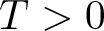 $T \gt 0$ we can fix
 $c_2(T) \gt 0$,
 $c_3(T) \gt 0, c_4 \gt 0$ and
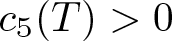 $c_5(T) \gt 0$ such that
 \begin{align}
u_\varepsilon\le c_2(T),
\quad
c_3(T) \le v_\varepsilon \le c_4
\quad \text{and} \quad
|\nabla v_\varepsilon| \le c_5(T)
\quad~\text{in}~\Omega\times (0,T) \nonumber \\
\qquad~\text{for all }~\varepsilon\in (0,1),
\end{align}
whence computing  $(2\gamma+1)+(\gamma+2)=3(\gamma+1)$ and
 $(2\gamma+1)\gamma-(\gamma+2)\gamma^2=\gamma(1-\gamma^2)$ as well as
 $(2\gamma+1)\cdot (-2)+(\gamma+2)\cdot (-2)=-6(\gamma+1)$ and
 $(2\gamma+1)\cdot (-\gamma) + (\gamma+2)\cdot (-\gamma)= -3\gamma(\gamma+1)$, and using that
 $\gamma \gt 0$ and
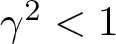 $\gamma^2 \lt 1$, from (3.17) we obtain that
 \begin{align}
& 3(\gamma+1)\frac{d}{dt} \int_\Omega u_\varepsilon^\gamma |\nabla u_\varepsilon|^2
+ c_6(\gamma,T)
\int_\Omega u_\varepsilon^{\gamma+1} |\Delta u_\varepsilon|^2 \nonumber \\
& + c_7(\gamma,T)
\int_\Omega u_\varepsilon^{\gamma+1} |D^2u_\varepsilon|^2 + c_8(\gamma,T)
\int_\Omega u_\varepsilon^{\gamma-1} |\nabla u_\varepsilon|^4 \nonumber\\
&\le 2(\gamma+2) c_5(T) \int_\Omega u_\varepsilon^{\gamma+1} |\nabla u_\varepsilon| \cdot |\Delta u_\varepsilon|
+ (\gamma+1)(\gamma+2) c_5(T) \int_\Omega u_\varepsilon^\gamma |\nabla u_\varepsilon|^3 \nonumber\\
& + (\gamma+2) c_5(T) \int_\Omega u_\varepsilon^{\gamma+1} \Big| \nabla |\nabla u_\varepsilon|^2 \Big| \nonumber\\
& - 6(\gamma+1) \int_\Omega a_\varepsilon u_\varepsilon^{\gamma+1} \Delta u_\varepsilon
- 3\gamma(\gamma+1) \int_\Omega a_\varepsilon u_\varepsilon^\gamma |\nabla u_\varepsilon|^2 \nonumber\\
& + (\gamma+2) \int_{\partial\Omega} u_\varepsilon^{\gamma+1} v_\varepsilon \frac{\partial |\nabla u_\varepsilon|^2}{\partial\nu}
\qquad \text{for all}~t\in (0,T)~\text{and}~\varepsilon\in (0,1)\end{align}
with  $
c_6(\gamma,T)
:=2(2\gamma+1) c_3(T) \gt 0$,
 $
c_7(\gamma,T)
:=2(\gamma+2) c_3(T) \gt 0$ and
 $
c_8(\gamma,T)
:=\gamma(1-\gamma^2) c_3(T) \gt 0$. Now several applications of Young’s inequality reveal that thanks to the first inequality in (3.18),
 \begin{align}
2(\gamma+2) c_5(T) \int_\Omega u_\varepsilon^{\gamma+1} |\nabla u_\varepsilon| \cdot |\Delta u_\varepsilon|
\le
\frac{
c_6(\gamma,T)
}{2} \int_\Omega u_\varepsilon^{\gamma+1} |\Delta u_\varepsilon|^2 \nonumber \\
+\ \frac{2(\gamma+2)^2 c_5^2(T)}{c_6(\gamma,T)} \int_\Omega u_\varepsilon^{\gamma+1} |\nabla u_\varepsilon|^2
\end{align}
and
 \begin{align}
(\gamma+1)(\gamma+2) c_5(T) \int_\Omega u_\varepsilon^\gamma |\nabla u_\varepsilon|^3
\le \frac{c_8(\gamma,T)}{2} \int_\Omega u_\varepsilon^{\gamma-1} |\nabla u_\varepsilon|^4 \nonumber \\
+\ \frac{(\gamma+1)^2 (\gamma+2)^2 c_5^2(T)}{2c_8(\gamma,T)} \int_\Omega u_\varepsilon^{\gamma+1} |\nabla u_\varepsilon|^2
\end{align}
and
 \begin{align}
(\gamma+2) c_5(T) \int_\Omega u_\varepsilon^{\gamma+1} \Big| \nabla|\nabla u_\varepsilon|^2 \Big|
&\le 2(\gamma+2) c_5(T) \int_\Omega u_\varepsilon^{\gamma+1} |\nabla u_\varepsilon| \cdot |D^2u_\varepsilon| \nonumber\\
&\le \frac{c_7(\gamma,T)}{2} \int_\Omega u_\varepsilon^{\gamma+1} |D^2u_\varepsilon|^2 \nonumber\\
&\quad + \frac{2(\gamma+2)^2 c_5^2(T)}{2c_7(\gamma,T)} \int_\Omega u_\varepsilon^{\gamma+1} |\nabla u_\varepsilon|^2\end{align}
as well as
 \begin{align}
-6(\gamma+1) \int_\Omega a_\varepsilon u_\varepsilon^{\gamma+1} \Delta u_\varepsilon
& \le \frac{
c_6(\gamma,T)
}{2} \int_\Omega u_\varepsilon^{\gamma+1} |\Delta u_\varepsilon|^2 + \frac{18(\gamma+1)^2}{
c_6(\gamma,T)
} \int_\Omega a_\varepsilon^2 u_\varepsilon^{\gamma+1} \nonumber\\
&\le \frac{
c_6(\gamma,T)
}{2} \int_\Omega u_\varepsilon^{\gamma+1} |\Delta u_\varepsilon|^2\nonumber\\
& \quad + \frac{18(\gamma+1)^2 c_2^{\gamma+1}(T)}{
c_6(\gamma,T)
} \int_\Omega a_\varepsilon^2\end{align}
and
 \begin{align}
-3\gamma(\gamma+1) \int_\Omega a_\varepsilon u_\varepsilon^\gamma |\nabla u_\varepsilon|^2
&\le \frac{c_8(\gamma,T)}{4} \int_\Omega u_\varepsilon^{\gamma-1} |\nabla u_\varepsilon|^4
+ \frac{9\gamma^2 (\gamma+1)^2}{c_8(\gamma,T)} \int_\Omega a_\varepsilon^2 u_\varepsilon^{\gamma+1} \nonumber\\
&\le \frac{c_8(\gamma,T)}{4} \int_\Omega u_\varepsilon^{\gamma-1} |\nabla u_\varepsilon|^4
+ \frac{9\gamma^2 (\gamma+1)^2 c_2^{\gamma+1}(T)}{c_8(\gamma,T)} \int_\Omega a_\varepsilon^2\end{align}
for all 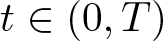 $t\in (0,T)$ and
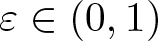 $\varepsilon\in (0,1)$. Moreover, a combination of the one-sided estimate
 $\frac{\partial |\nabla u_\varepsilon|^2}{\partial\nu} \le c_9 |\nabla u_\varepsilon|^2$, valid on
 $\partial\Omega\times (0,\infty)$ with some
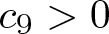 $c_9 \gt 0$ for all
 $\varepsilon\in (0,1)$ according to [Reference Mizoguchi and Souplet14], with a boundary trace embedding inequality ([Reference Alt1]) and Young’s inequality shows that due to (3.18), with some
 $c_{10}(\gamma,T) \gt 0$ we have
 \begin{align*}
(\gamma+2)\int_{\partial\Omega} u_\varepsilon^{\gamma+1} v_\varepsilon \frac{\partial |\nabla u_\varepsilon|^2}{\partial\nu}
&\le c_4 c_9(\gamma+2) \int_{\partial\Omega} u_\varepsilon^{\gamma+1} |\nabla u_\varepsilon|^2 \nonumber\\
&\le
c_{10}(\gamma,T)
\int_\Omega \Big| \nabla\big(u_\varepsilon^{\gamma+1} |\nabla u_\varepsilon|^2\big) \Big|\nonumber\\
&\quad + c_{10}(\gamma,T)
\int_\Omega u_\varepsilon^{\gamma+1} |\nabla u_\varepsilon|^2 \nonumber\\
&= c_{10}(\gamma,T)
\!\int_\Omega \Big| 2 u_\varepsilon^{\gamma+1} D^2u_\varepsilon\!\cdot\!\nabla u_\varepsilon \!+\! (\gamma+1) u_\varepsilon^\gamma |\nabla u_\varepsilon|^2 \nabla u_\varepsilon \Big| \\
& \quad + c_{10}(\gamma,T)
\int_\Omega u_\varepsilon^{\gamma+1} |\nabla u_\varepsilon|^2 \nonumber\\
&\le 2
c_{10}(\gamma,T)
\int_\Omega u_\varepsilon^{\gamma+1} |\nabla u_\varepsilon| \cdot |D^2u_\varepsilon| \nonumber \\
& \quad + (\gamma+1)
c_{10}(\gamma,T)
\int_\Omega u_\varepsilon^\gamma |\nabla u_\varepsilon|^3 \nonumber \\
& \quad + c_{10}(\gamma,T)
\int_\Omega u_\varepsilon^{\gamma+1} |\nabla u_\varepsilon|^2 \nonumber\\
&\le \frac{
c_7(\gamma,T)
}{4} \int_\Omega u_\varepsilon^{\gamma+1} |D^2u_\varepsilon|^2
+ \frac{4 c_{10}^2(\gamma,T)}{c_7(\gamma,T)}
\int_\Omega u_\varepsilon^{\gamma+1} |\nabla u_\varepsilon|^2 \nonumber\\
& \quad + \frac{
c_8(\gamma,T)
}{8} \int_\Omega u_\varepsilon^{\gamma-1} |\nabla u_\varepsilon|^4
+ \frac{2(\gamma+1)^2 c_{10}^2(\gamma,T)}{c_8(\gamma,T)} \nonumber \\
& \int_\Omega u_\varepsilon^{\gamma+1} |\nabla u_\varepsilon|^2 + c_{10}(\gamma,T)
\int_\Omega u_\varepsilon^{\gamma+1} |\nabla u_\varepsilon|^2 \nonumber \\
& \qquad~\text{for all}~t\in (0,T)~\text{and}~\varepsilon\in (0,1).
\end{align*}
In conjunction with (3.19)-(3.24), this shows that there exist  $c_{11}(\gamma,T) \gt 0$ and
 $c_{12}(\gamma,T) \gt 0$ such that writing
 \begin{align*}
y_\varepsilon(t):=\int_\Omega u_\varepsilon^\gamma(\cdot,t) |\nabla u_\varepsilon(\cdot,t)|^2
\end{align*}
and
 \begin{equation}
h_\varepsilon(t):=c_{11}(\gamma,T)\int_\Omega u_\varepsilon^{\gamma+1}(\cdot,t) |D^2 u_\varepsilon(\cdot,t)|^2
+ c_{11}(\gamma,T) \int_\Omega u_\varepsilon^{\gamma-1}(\cdot,t) |\nabla u_\varepsilon(\cdot,t)|^4
\end{equation}
for  $t \gt 0$ and
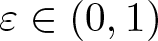 $\varepsilon\in (0,1)$, we have
 \begin{align}
& y_\varepsilon'(t) + h_\varepsilon(t)
\le c_{12}(\gamma,T) \int_\Omega u_\varepsilon^{\gamma+1} |\nabla u_\varepsilon|^2
+ c_{12}(\gamma,T) \int_\Omega a_\varepsilon^2 \nonumber \\
& \qquad~\text{for all}~t\in (0,T)~\text{and}~\varepsilon\in (0,1).
\end{align}
Since Young’s inequality along with (3.18) ensures that here, with  $c_{13}(\gamma,T):=\frac{c_2^{\gamma+3}(T) c_{12}^2(\gamma,T) |\Omega|}{2c_{11}(\gamma,T)}$,
 \begin{align*}
c_{12}(\gamma,T) \int_\Omega u_\varepsilon^{\gamma+1} |\nabla u_\varepsilon|^2
&\le \frac{c_{11}(\gamma,T)}{2} \int_\Omega u_\varepsilon^{\gamma-1} |\nabla u_\varepsilon|^4
+ \frac{c_{12}^2(\gamma,T)}{2c_{11}(\gamma,T)} \int_\Omega u_\varepsilon^{\gamma+3} \\
&\le \frac{1}{2} h_\varepsilon(t) + c_{13}(\gamma,T)
\qquad~\text{for all}~t\in (0,T)~\text{and}~\varepsilon\in (0,1),
\end{align*}
and since by the Cauchy–Schwarz inequality and (3.18) we moreover have
 \begin{align*}
y_\varepsilon^2(t)
\!\le\! \bigg\{\int_\Omega u_\varepsilon^{\gamma+1} \bigg\} \!\cdot\! \int_\Omega u_\varepsilon^{\gamma-1} |\nabla u_\varepsilon|^4
\le c_{14}(\gamma,T) h_\varepsilon(t)
\quad\!\!\!~\text{for all}~t\!\in\! (0,T)~\text{and}~\varepsilon\!\in\! (0,1)
\end{align*}
with  $c_{14}(\gamma,T):=\frac{c_2^{\gamma+1}(T) |\Omega|}{c_{11}(\gamma,T)}$, from (3.26) we infer that
 \begin{align}
& y_\varepsilon'(t) + \frac{1}{4c_{14}(\gamma,T)} y_\varepsilon^2(t) + \frac{1}{4} h_\varepsilon(t)
\le c_{12}(\gamma,T) \int_\Omega a_\varepsilon^2 + c_{13}(\gamma,T) \nonumber \\
& \qquad~\text{for all}~t\in (0,T)~\text{and}~\varepsilon\in (0,1).
\end{align}
In view of (3.14), an application of Lemma 3.3 thus shows that whenever  $\tau \gt 0$ and
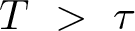 $T~ \gt ~\tau$ one can find
 $c_{15}(\gamma,\tau,T) \gt 0$ such that
 \begin{align*}
y_\varepsilon(t) \le c_{15}(\gamma,\tau,T)
\qquad~\text{for all}~t\in [\tau,T)~\text{and}~\varepsilon\in (0,1),
\end{align*}
whereupon integrating (3.27) and again using (3.14) we infer that
 \begin{align*}
\frac{1}{4} \int_\tau^T h_\varepsilon(t) dt
&\le y_\varepsilon(\tau)
+ c_{12}(\gamma,T) \int_\tau^T \int_\Omega a_\varepsilon^2
+ c_{13}(\gamma,T) \cdot T \\
&\le c_{15}(\gamma,\tau,T)
+ c_1(\tau,T) c_{12}(\gamma,T)
+ c_{13}(\gamma,T)\cdot T
\qquad~\text{for all }~\varepsilon\in (0,1).
\end{align*}
This immediately implies bounds for genuine second-order derivatives of suitably transformed versions of  $u_\varepsilon$:
Corollary 3.5. For all 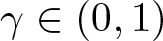 $\gamma\in (0,1)$,
 $\tau \gt 0$ and any
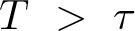 $T~ \gt ~\tau$, there exists
 $C(\gamma,\tau,T) \gt 0$ such that
 \begin{equation}
\int_\tau^T \int_\Omega \Big|D^2u_\varepsilon^\frac{\gamma+3}{2}\Big|^2 \le C(\gamma,\tau,T)
\qquad~\text{for all }~\varepsilon\in (0,1).
\end{equation}
Proof. By Young’s inequality, we see that for  $(i,j)\in \{1,2\}^2$ and
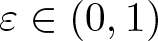 $\varepsilon\in (0,1)$,
 \begin{align*}
\Big| \partial_{x_i x_j} u_\varepsilon^\frac{\gamma+3}{2}\Big|^2
&= \Big| \frac{\gamma+3}{2} u_\varepsilon^\frac{\gamma+1}{2} \partial_{x_i x_j} u_\varepsilon
+ \frac{(\gamma+1)(\gamma+3)}{4} u_\varepsilon^\frac{\gamma-1}{2} \partial_{x_i} u_\varepsilon \partial_{x_j} u_\varepsilon\Big|^2 \\
&\le \frac{(\gamma+3)^2}{2} u_\varepsilon^{\gamma+1} |D^2 u_\varepsilon|^2
+ \frac{(\gamma+1)^2 (\gamma+3)^2}{8} u_\varepsilon^{\gamma-1} |\nabla u_\varepsilon|^4
\quad~\text{in}~\Omega\times (0,\infty).
\end{align*}
In line with the latter, our preparation of the intended Aubin-Lions type argument will furthermore involve information on time regularity of the quantities  $u_\varepsilon^\frac{\gamma+3}{2}$ appearing in (3.28). This will result from the following, actually slightly more general statement in this direction.
Lemma 3.6. Let 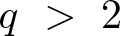 $q~ \gt ~2$ and
 $\lambda \gt 0$. Then for all
 $T \gt 0$ there exists
 $C(q,\lambda,T) \gt 0$ such that
 \begin{equation}
\int_0^T \big\| \partial_t u_\varepsilon^\lambda(\cdot,t)\big\|_{(W^{1,q}(\Omega))^\star} dt \le C(q,\lambda,T)
\qquad~\text{for all }~\varepsilon\in (0,1).
\end{equation}
Proof. Fixing 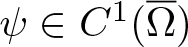 $\psi\in C^1(\overline{\Omega})$, we go back to (2.5) in verifying that
 \begin{align*}
\frac{1}{\lambda} \int_\Omega \partial_t u_\varepsilon^\lambda \cdot\psi
&= \int_\Omega u_\varepsilon^{\lambda-1} \psi \cdot\Big\{\nabla\cdot (u_\varepsilon v_\varepsilon\nabla u_\varepsilon-u_\varepsilon^2v_\varepsilon\nabla v_\varepsilon) + u_\varepsilon-u_\varepsilon^2 \Big\} \\
&= -(\lambda-1) \int_\Omega u_\varepsilon^{\lambda-1} v_\varepsilon |\nabla u_\varepsilon|^2 \psi
+ (\lambda-1) \int_\Omega u_\varepsilon^\lambda v_\varepsilon (\nabla u_\varepsilon\cdot\nabla v_\varepsilon)\psi \\
& - \int_\Omega u_\varepsilon^\lambda v_\varepsilon \nabla u_\varepsilon\cdot\nabla\psi
+ \int_\Omega u_\varepsilon^{\lambda+1} v_\varepsilon \nabla v_\varepsilon\cdot\nabla\psi \\
& +\int_\Omega u_\varepsilon^\lambda \psi - \int_\Omega u_\varepsilon^{\lambda+1} \psi
\qquad \text{for~all}~t \gt 0~\text{and}~\varepsilon\in (0,1).
\end{align*}
Since using (2.7) and Young’s inequality we see that for all  $t \gt 0$ and
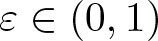 $\varepsilon\in (0,1)$,
 \begin{align*}
\bigg| -(\lambda-1) \int_\Omega u_\varepsilon^{\lambda-1} v_\varepsilon |\nabla u_\varepsilon|^2 \psi \bigg|
\le |\lambda-1| \cdot \|v_0\|_{L^\infty(\Omega)} \|\psi\|_{L^\infty(\Omega)} \int_\Omega u_\varepsilon^{\lambda-1} |\nabla u_\varepsilon|^2
\end{align*}
and
 \begin{align*}
\bigg| (\lambda-1) \int_\Omega u_\varepsilon^\lambda v_\varepsilon (\nabla u_\varepsilon\cdot\nabla v_\varepsilon) \psi \bigg|
&\le \int_\Omega u_\varepsilon^{\lambda-1} |\nabla u_\varepsilon|^2 \\
& + \frac{1}{4} (\lambda-1)^2 \|v_0\|_{L^\infty(\Omega)}^2 \|u_\varepsilon\|_{L^\infty(\Omega)}^{\lambda+1} \|\nabla v_\varepsilon\|_{L^\infty(\Omega)}^2
\|\psi\|_{L^2(\Omega)}^2
\end{align*}
and
 \begin{align*}
\bigg| - \int_\Omega u_\varepsilon^\lambda v_\varepsilon \nabla u_\varepsilon\cdot\nabla\psi\bigg|
\le
\int_\Omega u_\varepsilon^{\lambda-1} |\nabla u_\varepsilon|^2
+ \frac{1}{4} \|v_0\|_{L^\infty(\Omega)}^2 \|u_\varepsilon\|_{L^\infty(\Omega)}^{\lambda+1} \|\nabla\psi\|_{L^2(\Omega)}^2
\end{align*}
as well as
 \begin{align*}
\bigg| \int_\Omega u_\varepsilon^{\lambda+1} v_\varepsilon\nabla v_\varepsilon\cdot\nabla\psi\bigg|
\le \|v_0\|_{L^\infty(\Omega)} \|u_\varepsilon\|_{L^\infty(\Omega)}^{\lambda+1} \|\nabla v_\varepsilon\|_{L^\infty(\Omega)} \|\nabla\psi\|_{L^1(\Omega)}
\end{align*}
and
 \begin{align*}
\bigg| \int_\Omega u_\varepsilon^\lambda \psi - \int_\Omega u_\varepsilon^{\lambda+1} \psi \bigg|
\le \big( \|u_\varepsilon\|_{L^\infty(\Omega)}^\lambda + \|u_\varepsilon\|_{L^\infty(\Omega)}^{\lambda+1}\big) \|\psi\|_{L^1(\Omega)},
\end{align*}
by continuity of the embedding  $W^{1,q}(\Omega) \hookrightarrow L^\infty(\Omega)$ we thereby infer the existence of
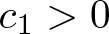 $c_1 \gt 0$ such that
 \begin{align*}
\big\| \partial_t u_\varepsilon^\lambda\big\|_{(W^{1,q}(\Omega))^\star}
\le c_1 \int_\Omega u_\varepsilon^{\lambda-1} |\nabla u_\varepsilon|^2
+ c_1 \cdot \big( \|u_\varepsilon\|_{L^\infty(\Omega)}^{\lambda+1} + 1 \big)\cdot\big( \|\nabla v_\varepsilon\|_{L^\infty(\Omega)} +1 \big)
\end{align*}
for all  $t \gt 0$ and
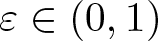 $\varepsilon\in (0,1)$. An integration using Corollary 3.2 and Lemma 2.2 yields (3.29).
In light of the uniform convergence of  $u_\varepsilon$ to
 $u$ asserted by Lemma 2.2, the results of Corollary 3.5 and Lemma 3.6 quite immediately imply strong
 $L^2$ precompactness of
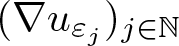 $(\nabla u_{\varepsilon_j})_{j\in\mathbb{N}}$ restricted to open sets in which the continuous limit function
 $u$ is not too small:
Lemma 3.7. Let  $\tau \gt 0, T~ \gt ~\tau$ and
 $\delta \gt 0$. Then
 \begin{equation}
\nabla u_\varepsilon\to \nabla u
\quad~\text{in}~L^2 \Big( \big(\Omega\times (\tau,T)\big)\cap \{u~ \gt ~\delta\}\Big)
\qquad~\text{as}~\varepsilon=\varepsilon_j\searrow 0.
\end{equation}
Proof. We fix an arbitrary  $\gamma\in (0,1)$, and abbreviating
 $S:=\big(\Omega\times (\tau,T)\big)\cap\{u~ \gt ~\delta\}$ we can use Lemma 2.2 to see that then
 \begin{equation}
u_\varepsilon^{-\frac{\gamma+1}{2}} \to u^{-\frac{\gamma+1}{2}}
\quad~\text{in}~L^\infty(S)
\qquad~\text{as}~\varepsilon=\varepsilon_j\searrow 0.
\end{equation}
Apart from that, a combination of Corollary 3.5 and Lemma 3.6 with an Aubin-Lions lemma ([Reference Simon17]) shows that 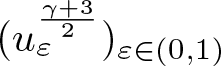 $(u_\varepsilon^\frac{\gamma+3}{2})_{\varepsilon\in (0,1)}$ is relatively compact in
 $L^2((\tau,T);W^{1,2}(\Omega))$, whence again due to Lemma 2.2 we find that
 \begin{equation}
\nabla u_\varepsilon^\frac{\gamma+3}{2} \to \nabla u^\frac{\gamma+3}{2}
\quad~\text{in}~L^2(\Omega\times (\tau,T))
\qquad~\text{as}~\varepsilon=\varepsilon_j\searrow 0.
\end{equation}
Since
 \begin{align*}
\Big(\frac{\gamma+3}{2}\Big)^2 \int\int_S |\nabla u_\varepsilon-\nabla u_{\varepsilon'}|^2
&= \int\int_S \Big| u_\varepsilon^{-\frac{\gamma+1}{2}} \nabla u_\varepsilon^\frac{\gamma+3}{2}
- u_{\varepsilon'}^{-\frac{\gamma+1}{2}} \nabla u_{\varepsilon'}^\frac{\gamma+3}{2} \Big|^2 \\
&\le 2 \Big\| u_\varepsilon^{-\frac{\gamma+1}{2}} - u_{\varepsilon'}^{-\frac{\gamma+1}{2}} \Big\|_{L^\infty(S)}^2
\cdot \int_\tau^T \int_\Omega \Big|\nabla u_\varepsilon^\frac{\gamma+3}{2}\Big|^2 \\
& + 2 \Big\| u_{\varepsilon'}^{-\frac{\gamma+1}{2}}\Big\|_{L^\infty(S)}^2
\cdot \int_\tau^T \int_\Omega \Big| \nabla u_\varepsilon^\frac{\gamma+3}{2} -
\nabla u_{\varepsilon'}^\frac{\gamma+3}{2}
\Big|^2
\end{align*}
for all 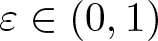 $\varepsilon\in (0,1)$ and
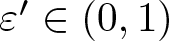 $\varepsilon'\in (0,1)$, and since (3.31) and (3.32) clearly imply that also
 \begin{align*}
\limsup_{j\to\infty} \Big\| u_{\varepsilon_j}^{-\frac{\gamma+1}{2}}\Big\|_{L^\infty(S)} \lt \infty
\qquad \text{and} \qquad
\limsup_{j\to\infty} \int_\tau^T \int_\Omega \Big| \nabla u_{\varepsilon_j}^\frac{\gamma+3}{2}\Big|^2 \lt \infty,
\end{align*}
we thus obtain that indeed (3.30) holds.
Now relying on the singular behaviour of the weight functions  $u_\varepsilon^{p-1}$ appearing in (3.1),
 $L^2$ precompactness of
 $\nabla u_\varepsilon$ also over regions involving small values of
 $u$ can be achieved. In summary, this will lead to the following main result of this section.
Lemma 3.8. If  $\tau \gt 0$ and
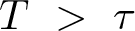 $T~ \gt ~\tau$, then
 \begin{equation}
\nabla u_\varepsilon\to \nabla u
\quad~\text{in}~L^2(\Omega\times (\tau,T))
\qquad~\text{as}~\varepsilon=\varepsilon_j\searrow 0.
\end{equation}
Proof. We pick any 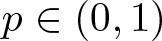 $p\in (0,1)$, and employing Lemma 3.1 we can then find
 $c_1=c_1(T) \gt 0$ such that
 \begin{equation}
\int_0^T \int_\Omega u_\varepsilon^{p-1} |\nabla u_\varepsilon|^2 \le c_1
\qquad~\text{for all }~\varepsilon\in (0,1).
\end{equation}
Given  $\eta \gt 0$, relying on the inequality
 $p \lt 1$ we then choose
 $\delta=\delta(\eta,T) \gt 0$ small enough fulfilling
 \begin{equation}
2\cdot (2\delta)^{1-p} \cdot c_1 \le \frac{\eta}{3},
\end{equation}
and keeping this parameter fixed we can next invoke Lemma 3.7 to see that there exists  $\varepsilon_\star=\varepsilon_\star(\eta,\tau,T)\in (0,1)$ such that
 \begin{equation}
\int\int_{S_\delta} |\nabla u_\varepsilon - \nabla u_{\varepsilon'}|^2
\le \frac{\eta}{3}
\qquad \text{for all}~\varepsilon\in (0,\varepsilon_\star) \cap (\varepsilon_j)_{j\in\mathbb{N}}~\text{and}~\varepsilon'\in (0,\varepsilon_\star) \cap (\varepsilon_j)_{j\in\mathbb{N}},
\end{equation}
where  $S_\delta:=\big(\Omega\times (\tau,T)\big)\cap\{u~ \gt ~\delta\}$. As a final preparation, we once more resort to the uniform approximation property recorded in Lemma 2.2 to find
 $\varepsilon_{\star\star}=\varepsilon_{\star\star}(\eta,\tau,T)\in (0,\varepsilon_\star)$ such that
 \begin{equation}
u_\varepsilon \le 2\delta
\quad~\text{in}~\big(\Omega\times (0,T)\big)\cap\{u\le\delta\}
\qquad~\text{for all}~\varepsilon\in (0,\varepsilon_{\star\star}) \cap (\varepsilon_j)_{j\in\mathbb{N}}.
\end{equation}
Now for each  $\varepsilon\in (0,\varepsilon_{\star\star}) \cap (\varepsilon_j)_{j\in\mathbb{N}}$ and
 $\varepsilon'\in (0,\varepsilon_{\star\star}) \cap (\varepsilon_j)_{j\in\mathbb{N}}$, we may decompose and use Young’s inequality according to
 \begin{align}
\int_\tau^T \int_\Omega |\nabla u_\varepsilon - \nabla u_{\varepsilon'}|^2
&= \int\int_{S_\delta} |\nabla u_\varepsilon-\nabla u_{\varepsilon'}|^2
+ \int\int_{(\Omega\times (\tau,T))\cap\{u\le\delta\}} |\nabla u_\varepsilon- \nabla u_{\varepsilon'}|^2 \nonumber\\
&\le \int\int_{S_\delta} |\nabla u_\varepsilon-\nabla u_{\varepsilon'}|^2 \nonumber\\
& + 2 \int\int_{(\Omega\times (\tau,T))\cap\{u\le\delta\}} |\nabla u_\varepsilon|^2
+ 2 \int\int_{(\Omega\times (\tau,T))\cap\{u\le\delta\}} |\nabla u_{\varepsilon'}|^2,
\end{align}
where by (3.37), (3.34) and (3.35),
 \begin{align*}
2 \int\int_{(\Omega\times (\tau,T))\cap\{u\le\delta\}} |\nabla u_\varepsilon|^2
&\le 2 \int\int_{(\Omega\times (0,T))\cap\{u_\varepsilon\le 2\delta\}} |\nabla u_\varepsilon|^2 \\
&= 2 \int\int_{(\Omega\times (0,T))\cap\{u_\varepsilon\le 2\delta\}} u_\varepsilon^{1-p} \cdot u_\varepsilon^{p-1} |\nabla u_\varepsilon|^2 \\
&\le 2 \cdot (2\delta)^{1-p} \int_0^T \int_\Omega u_\varepsilon^{p-1} |\nabla u_\varepsilon|^2 \\
&\le 2 \cdot (2\delta)^{1-p} \cdot c_1 \\
&\le \frac{\eta}{3},
\end{align*}
and where similarly
 \begin{align*}
2 \int\int_{(\Omega\times (\tau,T))\cap\{u\le\delta\}} |\nabla u_{\varepsilon'}|^2
\le \frac{\eta}{3}.
\end{align*}
Inserting (3.36) into (3.38) we thus conclude that
 \begin{align*}
\int_\tau^T \int_\Omega |\nabla u_\varepsilon-\nabla u_{\varepsilon'}|^2
\le \frac{\eta}{3} + \frac{\eta}{3} + \frac{\eta}{3}=\eta,
\end{align*}
which establishes the claim due to the fact that  $\eta \gt 0$ was arbitrary.
4. Basic decay properties resulting from an energy inequality
A cornerstone of our asymptotic analysis is formed by the following simple identification of a Lyapunov functional for (2.5).
Lemma 4.1. Let 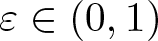 $\varepsilon\in (0,1)$. Then
 \begin{align}
&
\frac{d}{dt} \bigg\{\int_\Omega (u_\varepsilon-1-\ln u_\varepsilon) + \frac{1}{2} \int_\Omega |\nabla v_\varepsilon|^2 \bigg\} \nonumber\\
& + \int_\Omega \frac{v_\varepsilon}{u_\varepsilon} |\nabla u_\varepsilon|^2
+ \int_\Omega |\Delta v_\varepsilon|^2
+ \int_\Omega u_\varepsilon |\nabla v_\varepsilon|^2
+ \int_\Omega (u_\varepsilon-1)^2 \nonumber\\
&= 0
\qquad~\text{for all }~t \gt 0.
\end{align}
Proof. Using the first equation in (2.5) and integrating by parts, we find that for all  $t \gt 0$,
 \begin{align}
\frac{d}{dt} \int_\Omega (u_\varepsilon-1-\ln u_\varepsilon)
&= \int_\Omega u_{\varepsilon t} - \int_\Omega \frac{1}{u_\varepsilon} u_{\varepsilon t} \nonumber\\
&= \int_\Omega u_\varepsilon - \int_\Omega u_\varepsilon^2 \nonumber\\
& - \int_\Omega \frac{1}{u_\varepsilon^2} \nabla u_\varepsilon\cdot \big\{u_\varepsilon v_\varepsilon\nabla u_\varepsilon-u_\varepsilon^2v_\varepsilon\nabla v_\varepsilon\big\} \nonumber\\
& - \int_\Omega \frac{1}{u_\varepsilon} \cdot (u_\varepsilon-u_\varepsilon^2) \nonumber\\
&= - \int_\Omega \frac{v_\varepsilon}{u_\varepsilon} |\nabla u_\varepsilon|^2
+ \int_\Omega v_\varepsilon \nabla u_\varepsilon\cdot\nabla v_\varepsilon
- \int_\Omega u_\varepsilon^2 + 2\int_\Omega u_\varepsilon - |\Omega|,\end{align}
while from the second equation in (2.5) we obtain that
 \begin{align}
\frac{1}{2} \frac{d}{dt} \int_\Omega |\nabla v_\varepsilon|^2
&= \int_\Omega \nabla v_\varepsilon \cdot \nabla(\Delta v_\varepsilon-u_\varepsilon v_\varepsilon) \nonumber\\
&= - \int_\Omega |\Delta v_\varepsilon|^2
- \int_\Omega v_\varepsilon\nabla u_\varepsilon\cdot\nabla v_\varepsilon
- \int_\Omega u_\varepsilon |\nabla v_\varepsilon|^2
\qquad~\text{for all }~t \gt 0.\end{align}
Due to a helpful cancellation and the fact that  $-u_\varepsilon^2+2u_\varepsilon-1=-(u_\varepsilon-1)^2$ in
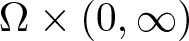 $\Omega\times (0,\infty)$, adding (4.3) to (4.2) yields (4.1).
Making use of the additional assumption (1.6), we can draw natural consequences of (4.1), especially related to the dissipation mechanism expressed therein.
Corollary 4.2. Assume (1.4) and (1.6). Then there exists 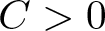 $C \gt 0$ such that
 \begin{equation}
\int_\Omega u_\varepsilon(\cdot,t)\le C
\qquad \text{for~all}~t \gt 0~\text{and}~\varepsilon\in (0,1),
\end{equation}
that
 \begin{equation}
\int_0^\infty \int_\Omega (u_\varepsilon-1)^2 \le C
\qquad~\text{for all }~\varepsilon\in (0,1),
\end{equation}
and that
 \begin{equation}
\int_0^\infty \int_\Omega |\Delta v_\varepsilon|^2 \le C
\qquad~\text{for all }~\varepsilon\in (0,1).
\end{equation}
Proof. Since 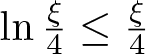 $\ln\frac{\xi}{4} \le\frac{\xi}{4}$ for all
 $\xi \gt 0$ and thus
 \begin{align*}
\xi-1-\ln\xi
\ge \xi-1-\Big(\frac{\xi}{4}+\ln 4\Big)
= \frac{3\xi}{4}-1-\ln 4
\ge \frac{\xi}{2}
\quad~\text{for all }~\xi\ge \xi_0:=4(1+\ln 4),
\end{align*}
and since moreover  $\xi-1-\ln\xi\ge 0$ for all
 $\xi \gt 0$, it follows that
 \begin{align*}
\int_\Omega (u_\varepsilon-1-\ln u_\varepsilon)
&\ge \frac{1}{2} \int_{\{u_\varepsilon\ge\xi_0\}} u_\varepsilon \\
&= \frac{1}{2} \int_\Omega u_\varepsilon - \frac{1}{2} \int_{\{u_\varepsilon \lt \xi_0\}} u_\varepsilon \\
&\ge \frac{1}{2} \int_\Omega u_\varepsilon - \frac{\xi_0 |\Omega|}{2}
\qquad \text{for~all}~t \gt 0~\text{and}~\varepsilon\in (0,1).
\end{align*}
From (4.1) and the initial conditions in (2.5) we therefore obtain that
 \begin{align*}
&
\frac{1}{2} \int_\Omega u_\varepsilon(\cdot,t)
- \frac{\xi_0 |\Omega|}{2} + \int_0^t \int_\Omega |\Delta v_\varepsilon|^2 + \int_0^t \int_\Omega (u_\varepsilon-1)^2 \\
&\le \int_\Omega \big\{u_0+\varepsilon-1-\ln (u_0+\varepsilon)\big\}
+ \frac{1}{2} \int_\Omega |\nabla v_0|^2 \\
&\le \int_\Omega (u_0 - \ln u_0)
+ \frac{1}{2} \int_\Omega |\nabla v_0|^2
\qquad \text{for~all}~t \gt 0~\text{and}~\varepsilon\in (0,1),
\end{align*}
Together with a basic  $L^1$ integrability property of
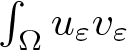 $\int_\Omega u_\varepsilon v_\varepsilon$ over
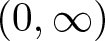 $(0,\infty)$, as implied by the signal consumption mechanism in the second equation of (2.5), the estimate in (4.5) implies a weak decay feature of the
 $v_\varepsilon$:
Lemma 4.3. If (1.4) and (1.6) hold, then there exists  $C \gt 0$ such that
 \begin{equation}
\int_0^\infty \int_\Omega v_\varepsilon \le C
\qquad~\text{for all }~\varepsilon\in (0,1).
\end{equation}
Proof. We first note that a simple integration in the second equation from (2.5) shows that
 \begin{align*}
\frac{d}{dt} \int_\Omega v_\varepsilon = - \int_\Omega u_\varepsilon v_\varepsilon
\qquad \text{for~all}~t \gt 0~\text{and}~\varepsilon\in (0,1),
\end{align*}
from which it follows that
 \begin{equation}
\int_0^\infty \int_\Omega u_\varepsilon v_\varepsilon \le \int_\Omega v_0
\qquad~\text{for all }~\varepsilon\in (0,1).
\end{equation}
To derive (4.7) from this and (4.5), for  $t \gt 0$ and
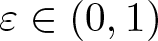 $\varepsilon\in (0,1)$ we split
 \begin{equation}
\int_\Omega v_\varepsilon
= \int_{\{u_\varepsilon\ge\frac{1}{2}\}} v_\varepsilon
+ \int_{\{u_\varepsilon \lt \frac{1}{2}\}} v_\varepsilon
\end{equation}
and note that here, since 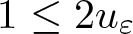 $1\le 2u_\varepsilon$ in
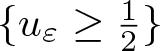 $\{u_\varepsilon\ge\frac{1}{2}\}$,
 \begin{equation}
\int_{\{u_\varepsilon\ge\frac{1}{2}\}} v_\varepsilon
\le 2\int_{\{u_\varepsilon\ge\frac{1}{2}\}} u_\varepsilon v_\varepsilon
\le 2\int_\Omega u_\varepsilon v_\varepsilon.
\end{equation}
On the other hand, in 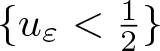 $\{u_\varepsilon \lt \frac{1}{2}\}$ we have
 $4(u_\varepsilon-1)^2 \ge 1$, so that
 \begin{align*}
\int_{\{u_\varepsilon \lt \frac{1}{2}\}} v_\varepsilon
\le 4 \int_{\{u_\varepsilon \lt \frac{1}{2}\}} (u_\varepsilon-1)^2 v_\varepsilon
\le 4\|v_0\|_{L^\infty(\Omega)} \int_\Omega (u_\varepsilon-1)^2
\end{align*}
by (2.7). Therefore, (4.7) indeed is a consequence of (4.8) and (4.5).
5. Flux decay and
$L\log L(\Omega)$ bounds implied by a second energy structure
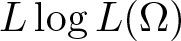
Another pivotal step of our analysis is the identification of a second energy structure inherent in (2.5), which consequently results in uniform 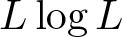 $L\log L$ bounds for
 $u_\varepsilon$ and hence implies the compactness of
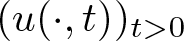 $(u(\cdot,t))_{t \gt 0}$ in
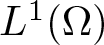 $L^1(\Omega)$. Moreover, this energy-type functional will enrich our knowledge on the decay properties of the solutions of (2.5), particularly by revealing the decay of the associated diffusive flux in population movement.
Lemma 5.1. Assume (1.4) and (1.6). Then with some 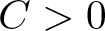 $C \gt 0$, we have
 \begin{equation}
\int_\Omega u_\varepsilon(\cdot,t)\ln \big(u_\varepsilon(\cdot,t)+e\big) \le C
\qquad~\text{for all}~t \gt 0~\text{and}~\varepsilon\in (0,1)
\end{equation}
and
 \begin{equation}
\int_0^\infty \int_\Omega |\sqrt{v_\varepsilon}\nabla u_\varepsilon - u_\varepsilon\sqrt{v_\varepsilon}\nabla v_\varepsilon|^2
\le C
\qquad~\text{for all }~\varepsilon\in (0,1).
\end{equation}
Proof. Let 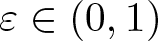 $\varepsilon\in (0,1)$. Then from (2.5) we obtain that
 \begin{align*}
\frac{d}{dt} \bigg\{\int_\Omega u_\varepsilon\ln u_\varepsilon - \int_\Omega u_\varepsilon\bigg\}
&= \int_\Omega \ln u_\varepsilon \cdot u_{\varepsilon t} \\
&= - \int_\Omega v_\varepsilon |\nabla u_\varepsilon|^2
+ \int_\Omega u_\varepsilon v_\varepsilon \nabla u_\varepsilon\cdot\nabla v_\varepsilon \\
& + \int_\Omega u_\varepsilon\ln u_\varepsilon - \int_\Omega u_\varepsilon^2 \ln u_\varepsilon
\end{align*}
and
 \begin{align*}
- \frac{d}{dt} \int_\Omega u_\varepsilon v_\varepsilon
&= - \int_\Omega v_\varepsilon u_{\varepsilon t} - \int_\Omega u_\varepsilon v_{\varepsilon t} \\
&= \int_\Omega u_\varepsilon v_\varepsilon \nabla u_\varepsilon\cdot\nabla v_\varepsilon
- \int_\Omega u_\varepsilon^2 v_\varepsilon |\nabla v_\varepsilon|^2
- \int_\Omega u_\varepsilon v_\varepsilon + \int_\Omega u_\varepsilon^2 v_\varepsilon \\
& + \int_\Omega \nabla u_\varepsilon\cdot\nabla v_\varepsilon + \int_\Omega u_\varepsilon^2 v_\varepsilon
\end{align*}
for all  $t \gt 0$, so that
 \begin{align}
& \frac{d}{dt} \bigg\{\int_\Omega u_\varepsilon\ln u_\varepsilon - \int_\Omega u_\varepsilon - \int_\Omega u_\varepsilon v_\varepsilon \bigg\}
+ \int_\Omega v_\varepsilon |\nabla u_\varepsilon|^2 \nonumber \\
& - 2 \int_\Omega u_\varepsilon v_\varepsilon \nabla u_\varepsilon\cdot\nabla v_\varepsilon
+ \int_\Omega u_\varepsilon^2 v_\varepsilon |\nabla v_\varepsilon|^2 \nonumber\\
&= \int_\Omega \nabla u_\varepsilon\cdot\nabla v_\varepsilon
- \int_\Omega u_\varepsilon v_\varepsilon
+ 2\int_\Omega u_\varepsilon^2 v_\varepsilon \nonumber\\
& + \int_\Omega u_\varepsilon\ln u_\varepsilon
- \int_\Omega u_\varepsilon^2 \ln u_\varepsilon
\qquad~\text{for all }~t \gt 0.
\end{align}
Here,
 \begin{align}
&
\int_\Omega v_\varepsilon |\nabla u_\varepsilon|^2
- 2 \int_\Omega u_\varepsilon v_\varepsilon \nabla u_\varepsilon\cdot\nabla v_\varepsilon
+ \int_\Omega u_\varepsilon^2 v_\varepsilon |\nabla v_\varepsilon|^2 \nonumber\\
&= \int_\Omega \Big| \sqrt{v_\varepsilon} \nabla u_\varepsilon - u_\varepsilon\sqrt{v_\varepsilon} \nabla v_\varepsilon\Big|^2
\qquad~\text{for all }~t \gt 0,\end{align}
while
 \begin{equation}
\int_\Omega u_\varepsilon\ln u_\varepsilon - \int_\Omega u_\varepsilon^2 \ln u_\varepsilon
= \int_\Omega u_\varepsilon(1-u_\varepsilon)\ln u_\varepsilon \le 0
\qquad~\text{for all }~t \gt 0
\end{equation}
due to the fact that  $(1-\xi)\ln\xi\le 0$ for all
 $\xi \gt 0$. As two applications of Young’s inequality show that moreover
 \begin{align*}
\int_\Omega \nabla u_\varepsilon\cdot\nabla v_\varepsilon
&= \int_\Omega \nabla (u_\varepsilon-1)\cdot\nabla v_\varepsilon \\
&= - \int_\Omega (u_\varepsilon-1)\Delta v_\varepsilon \\
&\le \int_\Omega |\Delta v_\varepsilon|^2
+ \frac{1}{4} \int_\Omega (u_\varepsilon-1)^2
\qquad~\text{for all }~t \gt 0
\end{align*}
and, by (2.7),
 \begin{align*}
2\int_\Omega u_\varepsilon^2 v_\varepsilon
&= 2 \int_\Omega (u_\varepsilon-1+1)^2 v_\varepsilon \\
&\le 4\int_\Omega (u_\varepsilon-1)^2 v_\varepsilon + 4\int_\Omega v_\varepsilon \\
&\le 4\|v_0\|_{L^\infty(\Omega)} \int_\Omega (u_\varepsilon-1)^2 + 4\int_\Omega v_\varepsilon
\qquad~\text{for all }~t \gt 0,
\end{align*}
inserting (5.4) and (5.5) into (5.3) and neglecting a nonpositive summand we find that
 \begin{align}
&
\frac{d}{dt} \bigg\{\int_\Omega u_\varepsilon\ln u_\varepsilon - \int_\Omega u_\varepsilon - \int_\Omega u_\varepsilon v_\varepsilon \bigg\}
+ \int_\Omega |\sqrt{v_\varepsilon}\nabla u_\varepsilon-u_\varepsilon\sqrt{v_\varepsilon}\nabla v_\varepsilon|^2 \nonumber\\
&\le \int_\Omega |\Delta v_\varepsilon|^2
+ \Big(\frac{1}{4} + 4\|v_0\|_{L^\infty(\Omega)} \Big) \int_\Omega (u_\varepsilon-1)^2 \nonumber\\
& + 4 \int_\Omega v_\varepsilon
\qquad ~\text{for all }~t \gt 0.
\end{align}
Since 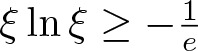 $\xi\ln\xi\ge -\frac{1}{e}$ for all
 $\xi \gt 0$ and
 \begin{align*}
\ln\xi
= \frac{\ln\xi}{\ln (\xi+e)} \cdot \ln (\xi+e)
\ge\! \frac{\ln e}{\ln (e+e)} \cdot \ln (\xi+e)
\ge\! \frac{1}{1\!+\!\ln 2} \cdot \ln (\xi+e)
\quad\!\!~\text{for all }~\xi\ge e,
\end{align*}
and since thus
 \begin{align*}
\int_\Omega u_\varepsilon\ln u_\varepsilon
&= \int_{\{u_\varepsilon\ge e\}} u_\varepsilon\ln u_\varepsilon
+ \int_{\{u_\varepsilon \lt e\}} u_\varepsilon\ln u_\varepsilon \\
&\ge \frac{1}{1+\ln 2} \int_{\{u_\varepsilon\ge e\}} u_\varepsilon \ln (u_\varepsilon+e)
- \frac{|\Omega|}{e} \\
&= \frac{1}{1+\ln 2} \cdot \bigg\{\int_\Omega u_\varepsilon\ln (u_\varepsilon+e) - \int_{\{u_\varepsilon \lt e\}} u_\varepsilon \ln (u_\varepsilon+e) \bigg\}
- \frac{|\Omega|}{e} \\
&\ge \frac{1}{1+\ln 2} \cdot \bigg\{\int_\Omega u_\varepsilon\ln (u_\varepsilon+e) - e\cdot (1+\ln 2) \cdot |\Omega| \bigg\}
- \frac{|\Omega|}{e} \\
&= \frac{1}{1+\ln 2} \int_\Omega u_\varepsilon\ln (u_\varepsilon+e) - e|\Omega| - \frac{|\Omega|}{e}
\qquad~\text{for all }~t \gt 0,
\end{align*}
upon an integration we therefore obtain from (5.6) that
 \begin{align}
& \frac{1}{1+\ln 2} \int_\Omega u_\varepsilon(\cdot,t) \ln \big(u_\varepsilon(\cdot,t)+e\big)
- e|\Omega| - \frac{|\Omega|}{e}
+ \int_0^t \int_\Omega |\sqrt{v_\varepsilon} \nabla u_\varepsilon-u_\varepsilon\sqrt{v_\varepsilon} \nabla v_\varepsilon|^2 \nonumber\\
&\le \int_\Omega u_\varepsilon(\cdot,t)
+ \int_\Omega u_\varepsilon(\cdot,t)v_\varepsilon(\cdot,t) \nonumber\\
& + \int_\Omega (u_0+\varepsilon)\ln (u_0+\varepsilon) - \int_\Omega (u_0+\varepsilon) - \int_\Omega (u_0+\varepsilon) v_0 \nonumber\\
& + \int_0^t \int_\Omega |\Delta v_\varepsilon|^2
+ \Big(\frac{1}{4} + 4 \|v_0\|_{L^\infty(\Omega)}\Big) \int_0^t \int_\Omega (u_\varepsilon-1)^2 \nonumber\\
& + 4 \int_0^t \int_\Omega v_\varepsilon
\qquad~\text{for all }~t \gt 0.\end{align}
As Corollary 4.2 provides 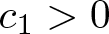 $c_1 \gt 0$ such that
 \begin{align*}
\int_\Omega u_\varepsilon(\cdot,t) \le c_1
\qquad \text{for~all}~t \gt 0~\text{and}~\varepsilon\in (0,1)
\end{align*}
and that therefore also
 \begin{align*}
\int_\Omega u_\varepsilon(\cdot,t)v_\varepsilon(\cdot,t) \le c_1\|v_0\|_{L^\infty(\Omega)}
\qquad \text{for~all}~t \gt 0~\text{and}~\varepsilon\in (0,1)
\end{align*}
by (2.7), in view of (4.6), (4.5), Lemma 4.3 and the evident fact that
 \begin{align*}
& \int_\Omega (u_0+\varepsilon)\ln (u_0+\varepsilon)
- \int_\Omega (u_0+\varepsilon) - \int_\Omega (u_0+\varepsilon) v_0
\le \int_\Omega (u_0+1)\ln (u_0+1) \nonumber \\
& \qquad~\text{for all }~\varepsilon\in (0,1),
\end{align*}
6. Stabilization of
$u$ in
$(W^{1,\infty}(\Omega))^\star$. Proof of Theorem 1.2

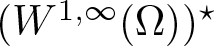
On the basis of the estimates obtained in Sections 4 and 5, we will now focus on verifying the stabilization statement for  $u$ from Theorem 1.2. In view of the weak stabilization features of
 $u$ entailed by Lemma 3.8 and the weak
 $L^1$ compactness property of
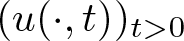 $(u(\cdot,t))_{t \gt 0}$, as implicitly contained in the bound (5.1), we aim at obtaining information reflecting some temporal decay of
 $u_t$. The key step towards this is accomplished by deriving an estimate for the time derivative of the solution component.
Lemma 6.1. Suppose that (1.4) and (1.6) hold. Then there exists 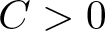 $C \gt 0$ such that
 \begin{align}
\|u_{\varepsilon t}(\cdot,t)\|_{(W^{1,\infty}(\Omega))^\star}
&\le C \int_\Omega \Big| \sqrt{v_\varepsilon(\cdot,t)}\nabla u_\varepsilon(\cdot,t)-u_\varepsilon(\cdot,t)\sqrt{v_\varepsilon(\cdot,t)}\nabla v_\varepsilon(\cdot,t)\Big|^2 \nonumber\\
& + C \int_\Omega \big(u_\varepsilon(\cdot,t)-1\big)^2
+ C\cdot\bigg\{\int_\Omega \big(u_\varepsilon(\cdot,t)-1\big)^2 \bigg\}^\frac{1}{2} \nonumber\\
& + C \int_\Omega v_\varepsilon(\cdot,t)
\qquad \text{for~all}~t \gt 0~\text{and}~\varepsilon\in (0,1).
\end{align}
Proof. For fixed  $t \gt 0, \varepsilon\in (0,1)$ and
 $\psi\in W^{1,\infty}(\Omega)$ such that
 $\|\psi\|_{L^\infty(\Omega)} + \|\nabla\psi\|_{L^\infty(\Omega)} \le 1$, by means of an integration by parts in (2.5) we see that
 \begin{equation}
\int_\Omega u_{\varepsilon t} \psi
= - \int_\Omega \big(u_\varepsilon v_\varepsilon\nabla u_\varepsilon-u_\varepsilon^2v_\varepsilon\nabla v_\varepsilon\big)\cdot\nabla\psi
+ \int_\Omega u_\varepsilon(1-u_\varepsilon)\psi,
\end{equation}
where since 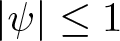 $|\psi|\le 1$ in
 $\Omega$,
 \begin{align}
\bigg| \int_\Omega u_\varepsilon(1-u_\varepsilon)\psi \bigg|
&\le \int_\Omega u_\varepsilon |1-u_\varepsilon| \nonumber\\
&= \int_\Omega |u_\varepsilon-1+1| \cdot |1-u_\varepsilon| \nonumber\\
&\le \int_\Omega (u_\varepsilon-1)^2
+ \int_\Omega |u_\varepsilon-1| \nonumber\\
&\le \int_\Omega (u_\varepsilon-1)^2
+ |\Omega|^\frac{1}{2} \cdot \bigg\{\int_\Omega (u_\varepsilon-1)^2 \bigg\}^\frac{1}{2}\end{align}
by the Cauchy–Schwarz inequality. Moreover, using that 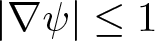 $|\nabla\psi|\le 1$ in
 $\Omega$ we find that according to Young’s inequality,
 \begin{align*}
\bigg| - \int_\Omega (u_\varepsilon v_\varepsilon\nabla u_\varepsilon-u_\varepsilon^2v_\varepsilon\nabla v_\varepsilon)\cdot\nabla\psi\bigg|
&\le \int_\Omega \big|u_\varepsilon v_\varepsilon\nabla u_\varepsilon-u_\varepsilon^2v_\varepsilon\nabla v_\varepsilon\big| \\
&= \int_\Omega u_\varepsilon \sqrt{v_\varepsilon} \cdot \big|\sqrt{v_\varepsilon}u_\varepsilon-u_\varepsilon\sqrt{v_\varepsilon}\nabla v_\varepsilon\big| \\
&\le \frac{1}{2} \int_\Omega \big|\sqrt{v_\varepsilon}\nabla u_\varepsilon-u_\varepsilon\sqrt{v_\varepsilon}\nabla v_\varepsilon\big|^2
+ \frac{1}{2} \int_\Omega u_\varepsilon^2 v_\varepsilon,
\end{align*}
where we once more rely on Young’s inequality and (2.7) in estimating
 \begin{align*}
\frac{1}{2} \int_\Omega u_\varepsilon^2 v_\varepsilon
&= \frac{1}{2} \int_\Omega (u_\varepsilon-1+1)^2 v_\varepsilon \\
&\le \int_\Omega (u_\varepsilon-1)^2 v_\varepsilon + \int_\Omega v_\varepsilon \\
&\le \|v_0\|_{L^\infty(\Omega)} \int_\Omega (u_\varepsilon-1)^2 + \int_\Omega v_\varepsilon.
\end{align*}
From (6.2) we thus infer that
 \begin{align*}
\sup_{\begin{array}{c} \scriptstyle \psi\in W^{1,\infty}(\Omega) \\[-2mm]
\scriptstyle \|\psi\|_{L^\infty(\Omega)} + \|\nabla\psi\|_{L^\infty(\Omega)}\le 1
\end{array}}
\bigg| \int_\Omega u_{\varepsilon t} \psi \bigg|
&\le \frac{1}{2} \int_\Omega \big|\sqrt{v_\varepsilon}\nabla u_\varepsilon - u_\varepsilon\sqrt{v_\varepsilon}\nabla v_\varepsilon\big|^2 \\[-4mm]
& \quad + \big( 1+\|v_0\|_{L^\infty(\Omega)} \big) \int_\Omega (u_\varepsilon-1)^2 \\
& \quad + |\Omega|^\frac{1}{2} \cdot\bigg\{\int_\Omega (u_\varepsilon-1)^2\bigg\}^\frac{1}{2}
+ \int_\Omega v_\varepsilon,
\end{align*}
which by definition of the norm in 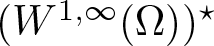 $(W^{1,\infty}(\Omega))^\star$ is equivalent to (6.1).
The following result now makes essential use of the strong  $L^2$ strong convergence properties found in Section 3, and prepares a translation of the information from the previous lemma to the limit functions
 $u$ and
 $v$.
Corollary 6.2. If (1.4) and (1.6) are valid, then whenever  $\tau \gt 0$ and
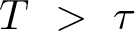 $T~ \gt ~\tau$,
 \begin{equation}
\sqrt{v_\varepsilon}\nabla u_\varepsilon - u_\varepsilon\sqrt{v_\varepsilon}\nabla v_\varepsilon
\to \sqrt{v}\nabla u - u\sqrt{v}\nabla v
\quad~\text{in}~L^2(\Omega\times (\tau,T))
\qquad~\text{as}~\varepsilon=\varepsilon_j\searrow 0.
\end{equation}
Proof. Since
 \begin{align*}
\sqrt{v_\varepsilon}\to\sqrt{v}
\quad \text{and} \quad
u_\varepsilon\to u
\quad~\text{in}~L^\infty(\Omega\times (0,T))
\qquad~\text{as}~\varepsilon=\varepsilon_j\searrow 0
\end{align*}
by (2.13) and (2.12), and since
 \begin{align*}
\nabla v_\varepsilon\to \nabla v
\quad~\text{in}~L^\infty(\Omega\times (0,T))
\qquad~\text{as}~\varepsilon=\varepsilon_j\searrow 0
\end{align*}
In fact, Lemma 6.1 can thereby be turned into the following statement on ultimate smallness of time oscillations in the first component of the weak solution to (1.3), though yet in a topologically quite weak framework:
Lemma 6.3. Assume (1.4) and (1.6), and let  $\eta \gt 0$. Then there exists
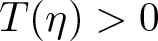 $T(\eta) \gt 0$ such that
 \begin{equation}
\big\|u(\cdot,t)-u(\cdot,t_0)\big\|_{(W^{1,\infty}(\Omega))^\star} \le \eta
\qquad \text{for all}~t_0~ \gt ~T(\eta)~\text{and}~t\in (t_0,t_0+1).
\end{equation}
Proof. An application of Lemma 6.1 yields 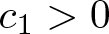 $c_1 \gt 0$ such that writing
 \begin{align*}
h_\varepsilon(t)
&:= c_1 \int_\Omega \Big| \sqrt{v_\varepsilon(\cdot,t)} \nabla u_\varepsilon(\cdot,t) - u_\varepsilon(\cdot,t)\sqrt{v_\varepsilon(\cdot,t)} \nabla v_\varepsilon(\cdot,t)\Big|^2
\nonumber\\
& + c_1 \int_\Omega \Big(u_\varepsilon(\cdot,t) - 1 \Big)^2
+ c_1\cdot\bigg\{\int_\Omega \Big(u_\varepsilon(\cdot,t)-1\Big)^2\bigg\}^\frac{1}{2}
+ c_1 \int_\Omega v_\varepsilon(\cdot,t), \nonumber \\
& \qquad t \gt 0, \varepsilon\in (0,1),
\end{align*}
we have
 \begin{equation}
\|u_{\varepsilon t}(\cdot,t)\|_{(W^{1,\infty}(\Omega))^\star} \le h_\varepsilon(t)
\qquad \text{for all}~t \gt 0~\text{and}~\varepsilon\in (0,1).
\end{equation}
Furthermore letting
 \begin{align*}
h(t)
&:= c_1\int_\Omega \Big| \sqrt{v(\cdot,t)} \nabla u(\cdot,t) - u(\cdot,t)\sqrt{v(\cdot,t)}\nabla v(\cdot,t)\Big|^2 \\
& + c_1\int_\Omega \Big(u(\cdot,t)-1\Big)^2
+ c_1\cdot\bigg\{\int_\Omega \Big(u(\cdot,t)-1\Big)^2 \bigg\}^\frac{1}{2}
+ c_1 \int_\Omega v(\cdot,t),
\qquad t \gt 0,
\end{align*}
from Corollary 6.2 when combined with Lemma 2.2 we know that
 \begin{equation}
h_\varepsilon \to h
\quad~\text{in}~L^1_{loc}([1,\infty))
\qquad~\text{as}~\varepsilon=\varepsilon_j\searrow 0,
\end{equation}
while Lemma 5.1 together with the Cauchy–Schwarz inequality, (4.5) and Lemma 4.3 ensures that
 \begin{align*}
\int_t^{t+1} h(s) ds
&\le c_1 \int_t^{t+1} \int_\Omega \big|\sqrt{v}\nabla u - u\sqrt{v}\nabla v\big|^2 \\
& + c_1 \int_t^{t+1} \int_\Omega (u-1)^2
+ c_1 \cdot \bigg\{\int_t^{t+1}\int_\Omega (u-1)^2 \bigg\}^\frac{1}{2}
+ c_1 \int_t^{t+1}\int_\Omega v \nonumber\\[2mm]
&\to 0
\qquad~\text{as}~t\to\infty.
\end{align*}
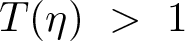
In particular, for fixed  $\eta \gt 0$ this enables us to pick
 $T(\eta)~ \gt ~1$ such that
 \begin{equation}
\int_t^{t+1} h(s) ds
\le \frac{\eta}{2}
\qquad~\text{for all }~t~ \gt ~T(\eta),
\end{equation}
and given any 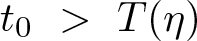 $t_0~ \gt ~T(\eta)$ we may then draw on (6.7) to find
 $\varepsilon_\star=\varepsilon_\star(t_0,\eta)\in (0,1)$ fulfilling
 \begin{align*}
\bigg| \int_{t_0}^{t_0+1} h_\varepsilon(s) ds - \int_{t_0}^{t_0+1} h(s) ds \bigg|
\le \frac{\eta}{2}
\qquad~\text{for all }~\varepsilon\in (0,\varepsilon_\star)\cap (\varepsilon_j)_{j\in\mathbb{N}}.
\end{align*}
Therefore, (6.8) ensures that
 \begin{align*}
\int_{t_0}^{t_0+1} h_\varepsilon(s) ds
\le \frac{\eta}{2} + \frac{\eta}{2}=\eta
\qquad~\text{for all }~\varepsilon\in (0,\varepsilon_\star)\cap (\varepsilon_j)_{j\in\mathbb{N}},
\end{align*}
whence (6.6) implies that
 \begin{align*}
\int_{t_0}^{t_0+1} \|u_{\varepsilon t}(\cdot,s)\|_{(W^{1,\infty}(\Omega))^\star} ds \le \eta
\qquad~\text{for all }~\varepsilon\in (0,\varepsilon_\star)\cap (\varepsilon_j)_{j\in\mathbb{N}}.
\end{align*}
Now if we furthermore fix  $t\in (t_0,t_0+1)$, then from this we infer that
 \begin{align*}
\big\| u_\varepsilon(\cdot,t)-u_\varepsilon(\cdot,t_0)\big\|_{(W^{1,\infty}(\Omega))^\star}
&= \bigg\| \int_{t_0}^t u_{\varepsilon t}(\cdot,s) ds \bigg\|_{(W^{1,\infty}(\Omega))^\star} \\
&\le \int_{t_0}^{t_0+1} \|u_{\varepsilon t}(\cdot,s)\|_{(W^{1,\infty}(\Omega))^\star} ds \\[2mm]
&\le \eta
\qquad~\text{for all }~\varepsilon\in (0,\varepsilon_\star)\cap (\varepsilon_j)_{j\in\mathbb{N}},
\end{align*}
so that since Lemma 2.2 clearly implies that for each  $s \gt 0$ we have
 $u_\varepsilon(\cdot,s)\to u(\cdot,s)$ in
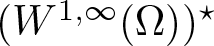 $(W^{1,\infty}(\Omega))^\star$ as
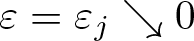 $\varepsilon=\varepsilon_j\searrow 0$, we obtain (6.5) on taking
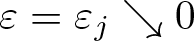 $\varepsilon=\varepsilon_j\searrow 0$ here.
Collecting the results obtained above, we are now equipped to verify the announced statement on asymptotic behaviour in (1.3):
Proof Theorem 1.2
We first note that Lemma 5.1 together with Lemma 2.2 ensures the existence of 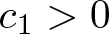 $c_1 \gt 0$ such that
 \begin{align*}
\int_\Omega u(\cdot,t)\ln (u(\cdot,t)+e) \le c_1
\qquad~\text{for all }~t \gt 0,
\end{align*}
which in view of the de La Vallée Poussin theorem ([Reference Rao and Ren16, Theorem 2]) implies that 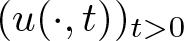 $(u(\cdot,t))_{t \gt 0}$ is uniformly integrable over
 $\Omega$ and hence, by the Dunford–Pettis theorem ([Reference Diestel3, p.93]), relatively compact with respect to the weak topology in
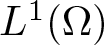 $L^1(\Omega)$. As
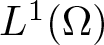 $L^1(\Omega)$ is continuously embedded into
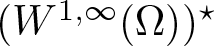 $(W^{1,\infty}(\Omega))^\star$, for the derivation of (1.7) it is therefore sufficient to make sure that
 \begin{equation}
u(\cdot,t)\to 1
\quad~\text{in}~(W^{1,\infty}(\Omega))^\star
\qquad~\text{as}~t\to\infty.
\end{equation}
To verify this, assuming on the contrary that  $c_1:=\limsup_{t\to\infty} \|u(\cdot,t)-1\|_{(W^{1,\infty}(\Omega))^\star}$ was positive we could employ Lemma 6.3 to obtain
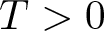 $T \gt 0$ such that
 \begin{equation}
\|u(\cdot,t)-u(\cdot,t_0)\|_{(W^{1,\infty}(\Omega))^\star} \le \frac{c_1}{8}
\qquad \text{for~all}~t_0~ \gt ~T~\text{and}~t\in (t_0,t_0+1),
\end{equation}
and use the definition of  $c_1$ to find
 $(t_k)_{k\in\mathbb{N}} \subset (T,\infty)$ such that
 $t_k\to\infty$ as
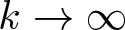 $k\to\infty$ and
 \begin{equation}
\|u(\cdot,t_k)-1\|_{(W^{1,\infty}(\Omega))^\star} \ge \frac{c_1}{2}
\qquad~\text{for all }~k\in\mathbb{N}.
\end{equation}
On the other hand, (4.5) along with Lemma 2.2 and the unlimited growth of 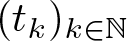 $(t_k)_{k\in\mathbb{N}}$ warrants that
 \begin{align*}
\int_{t_k}^{t_k+1} \int_\Omega (u-1)^2 \to 0
\qquad~\text{as}~k\to\infty,
\end{align*}
whence for 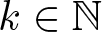 $k\in\mathbb{N}$ choosing
 $\widehat{t_k}\in (t_k,t_k+1)$ in such a way that
 \begin{align*}
\int_\Omega \Big(u(\cdot,\widehat{t}_k)-1\Big)^2
\le \int_{t_k}^{t_k+1} \int_\Omega (u-1)^2,
\end{align*}
due to the continuity of the embedding  $L^2(\Omega) \hookrightarrow (W^{1,\infty}(\Omega))^\star$ we infer that
 \begin{align*}
u(\cdot,\widehat{t}_k) -1 \to 0
\quad~\text{in}~(W^{1,\infty}(\Omega))^\star
\qquad~\text{as}~k\to\infty.
\end{align*}
In particular, we can find 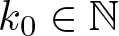 $k_0\in\mathbb{N}$ satisfying
 \begin{align*}
\big\|u(\cdot,\widehat{t}_{k_0})-1\big\|_{(W^{1,\infty}(\Omega))^\star} \le \frac{c_1}{8},
\end{align*}
which together with (6.10) and the inequalities  $\widehat{t}_{k_0} \lt t_{k_0}+1 \lt \widehat{t}_{k_0}+1$ guarantees that
 \begin{align*}
\big\| u(\cdot,t_{k_0})-1\big\|_{(W^{1,\infty}(\Omega))^\star}
&\le \big\|u(\cdot,t_{k_0})-u(\cdot,\widehat{t}_{k_0})\big\|_{(W^{1,\infty}(\Omega))^\star}
+ \big\| u(\cdot,\widehat{t}_{k_0})\\
&\quad -1\big\|_{(W^{1,\infty}(\Omega))^\star} \\
&\le \frac{c_1}{8} + \frac{c_1}{8}=\frac{c_1}{4}.
\end{align*}
As this contradicts (6.11), we have thereby confirmed (6.9), and in order to finally confirm (1.8) we only need to combine standard elliptic regularity theory with a Sobolev inequality associated with the continuous embedding  $W^{2,2}(\Omega) \hookrightarrow L^\infty(\Omega)$ to fix
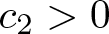 $c_2 \gt 0$ such that
 \begin{align*}
\|\varphi\|_{L^\infty(\Omega)}
\!\le\! c_2 \|\Delta\varphi\|_{L^2(\Omega)}\!+\! c_2 \|\varphi\|_{L^1(\Omega)}
\quad\!\! \text{for~all}~\varphi\!\in\! W^{2,2}(\Omega)~\text{fulfilling}~\frac{\partial\varphi}{\partial\nu}\!=\!0 \ \text{on}~\partial\Omega.
\end{align*}
Therefore, namely, Corollary 4.2 and Lemma 4.3 together with Lemma 2.2 warrant that
 \begin{align*}
\int_t^{t+1} \|v(\cdot,s)\|_{L^\infty(\Omega)} ds
&\le c_2 \int_t^{t+1} \|\Delta v(\cdot,s)\|_{L^2(\Omega)} ds
+ c_2 \int_t^{t+1} \|v(\cdot,s)\|_{L^1(\Omega)} ds \\
&\le c_2 \cdot\bigg\{\int_t^\infty \int_\Omega |\Delta v|^2 \bigg\}^\frac{1}{2}
+ c_2 \int_t^\infty \int_\Omega v \\[2mm]
&\to 0
\qquad~\text{as}~t\to\infty,
\end{align*}
so that since a comparison argument applied to (2.4) shows that  $0\le t\mapsto \|v(\cdot,t)\|_{L^\infty(\Omega)}$ is nonincreasing, (1.8) results upon observing that therefore
 \begin{align*}
\|v(\cdot,t)\|_{L^\infty(\Omega)} \le \int_t^{t+1} \|v(\cdot,s)\|_{L^\infty(\Omega)} ds
\end{align*}
for all  $t \gt 0$.
Acknowledgement
The authors would like to thank the reviewer for valuable comments and suggestions. The first author was supported by the Young Scientists Fund of the National Natural Science Foundation of China (Grant No. 12401262). The second author acknowledges support of the Deutsche Forschungsgemeinschaft (Project No. 462888149).