


Introduction
Rescue workers in general show a higher prevalence of posttraumatic stress disorder (PTSD) than the general population (Berger et al., Reference Berger, Coutinho, Figueira, Marques-Portella, Luz and Neylan2012). Ambulance personnel in particular, with 14.6%, show a current prevalence that is much higher than the 1.3–3.5% reported in the general population (Berger et al., Reference Berger, Coutinho, Figueira, Marques-Portella, Luz and Neylan2012). However, considering that paramedics are subjected to traumatic experiences on a daily basis, their PTSD rates seem relatively low. What factors could underlie these relatively low PTSD rates in paramedics? While it is well known that factors such as gender, intelligence, previous trauma, and social support can be considered as risk factors (Brewin, Andrews and Valentine, Reference Brewin, Andrews and Valentine2000), little knowledge exists about protective factors.
However, one may assume that psychological resistance lowers the risk of PTSD. North et al. (Reference North, Tivis, McMillen, Pfefferbaum, Spitznagel and Cox2002) found a relatively low PTSD rate of 13.6% among fire-fighters after a disaster, compared to the PTSD rate of 22.7% among other male primary victims of the same disaster. This difference was attributed to higher psychological preparedness among fire-fighters. Başoğlu et al. (Reference Başoğlu, Mineka, Paker, Aker, Livanou and Gök1997) studied torture victims in Turkey and found a rate of PTSD among left-wing political activists of 18.2% compared to 58.3% among non-activist Turks arrested for non-political reasons. The authors concluded that the political activists were more psychologically prepared. The aim of the present study is the investigation of psychological resistance in paramedics. Different concepts have been used to describe this ability to cope with stressors. Resilience is a term that was first used in developmental psychology in the 1980s. The concept has since been characterized by various researchers (Anthony and Cohler, Reference Anthony and Cohler1987; Garmezy, Reference Garmezy1993; Garmezy, Masten and Tellegen, Reference Garmezy, Masten and Tellegen1984; Rutter, Reference Rutter, Kent and Rolf1979, Reference Rutter1985, Reference Rutter1987; Werner, Reference Werner1993). For example, Newman (Reference Newman2005) defined resilience as “the human ability to adapt in the face of tragedy, trauma, adversity, hardship, and ongoing significant life stressors” (p. 227). Although a universal definition does not exist, resilience is generally considered a multidimensional construct consisting of behaviours, thoughts and actions that can be learned over time (White, Driver and Warren, Reference White, Driver and Warren2008). In their review on resilience, Agaibi and Wilson (Reference Agaibi and Wilson2005) developed an integrative Person × Situation model that specifies the nature of interactions among five classes of variables: personality, affect regulation, coping, ego defenses, and the utilization and mobilization of protective factors and resources to aid coping.
In a study by Connor, Davidson and Lee (Reference Connor, Davidson and Lee2003) resilience was associated with physical and mental health as well as with lower severity of PTSD symptoms. Various studies have shown that resilience correlates negatively with posttraumatic psychopathology (Ahmed, Reference Ahmed2007; Alim et al., Reference Alim, Feder, Graves, Wang, Weaver and Westphal2008; Bonanno, Reference Bonanno2004, Reference Bonanno2005; Bonnano, Galea, Bucciarelli and Vlahov, Reference Bonanno, Galea, Bucciarelli and Vlahov2006, Reference Bonanno, Galea, Bucciarelli and Vlahov2007; Gold et al., Reference Gold, Engdahl, Eberly, Blake, Page and Frueh2000; Hobfoll et al., Reference Hobfoll, Canetti-Nisim, Johnson, Palmieri, Varley and Galea2008; King, King, Fairbank, Keane and Adams, Reference King, King, Fairbank, Keane and Adams1998; Palmieri, Canetti-Nisim, Galea, Johnson and Hobfoll, Reference Palmieri, Canetti-Nisim, Galea, Johnson and Hobfoll2008; Pietrzak et al., Reference Pietrzak, Johnson, Goldstein, Malley, Rivers and Morgan2010).
In his review of the literature concerning violent and life-menacing events Bonanno (Reference Bonanno2004) concludes that resilience is rather the rule than the exception. Connor and Davidson (Reference Connor and Davidson2003) showed that resilience can be acquired and strengthened in psychotherapy. With respect to high risk professions such as paramedics it thus seems desirable to train resilience in order to improve coping with work-related stressors.
An overlapping concept is Sense of Coherence (SOC), which stems from Antonovsky's (Reference Antonovsky1987) “salutogenesis” concept and has been operationalized in the Sense of Coherence Scale (SOC Scale). Antonovsky defined SOC as the global orientation of a person having a dynamic feeling of confidence to be able to cope with stressful challenges in life.
Various studies have shown that SOC correlates negatively with posttraumatic psychopathology (Eriksson and Lundin, Reference Eriksson and Lundin1996; Frommberger et al., Reference Frommberger, Stieglitz, Straub, Nyberg, Schlickewei and Kuner1999; Fuglsang, Moergeli, Hepp-Beg and Schnyder, Reference Fuglsang, Moergeli, Hepp-Beg and Schnyder2002; Jonsson, Segesten and Mattsson, Reference Jonsson, Segesten and Mattsson2003; Ortlepp and Friedman, Reference Ortlepp and Friedman2002; Schnyder, Wittmann, Friedrich-Perez, Hepp and Moergeli, Reference Schnyder, Wittmann, Friedrich-Perez, Hepp and Moergeli2008; Tagay, Herpertz, Langkafel and Senf, Reference Tagay, Herpertz, Langkafel and Senf2005) and positively with health and life satisfaction (Eriksson and Lindström, Reference Eriksson and Lindström2006; Langeland, Wahl, Kristoffersen, Nortvedt and Hanestad, Reference Langeland, Wahl, Kristoffersen, Nortvedt and Hanestad2007; Ortlepp and Friedman, Reference Ortlepp and Friedman2002). In their 6-month follow-up of persons involved in traffic accidents Schnyder et al. (Reference Schnyder, Wittmann, Friedrich-Perez, Hepp and Moergeli2008) established that an initially high SOC value increased a person's capacity to cope with stressors after an accident, which consequently helped to prevent PTSD developing.
The results of a prospective study (mean follow-up of 6.7 years) with a huge population-based cohort showed that persons with weak SOC reported significantly slower adaptation to adverse effects of a traumatic event than those with strong SOC (Surtees, Wainwright and Khaw, Reference Surtees, Wainwright and Khaw2006). A weak SOC was also associated with a higher mortality rate. Since paramedics are repeatedly confronted with traumatic events, it is essential that programs are developed to strengthen SOC in order to prevent posttraumatic stress and its consequences.
Antonovsky (Reference Antonovsky1987) dismissed the notion of SOC being a state variable and described it as being a dispositional orientation rather than a personality trait. Schnyder, Büchi, Sensky and Klaghofer (Reference Schnyder, Büchi, Sensky and Klaghofer2000) analysed the stability of SOC over time and found it to be relatively stable. Langeland et al. (Reference Langeland, Wahl, Kristoffersen, Nortvedt and Hanestad2007) assumed that SOC in persons with mental disorders could be improved through professional support, thereby improving the individual's life satisfaction.
Nygren et al. (Reference Nygren, Aléx, Jonsén, Gustafson, Norberg and Lundman2005) showed that SOC as well as resilience (measured with Wagnild and Young's, Reference Wagnild and Young1993, RS) remained stable into old age. The authors found no significant difference between old and young persons. In contrast, Schumacher, Wilz, Gunzelmann and Brähler (Reference Schumacher, Wilz, Gunzelmann and Brähler2000) found an age-correlated decrease of SOC. Antonovsky and Sagy (Reference Antonovsky and Sagy1986) found gender differences in SOC in a group of adolescents, in which boys had significantly higher SOC than girls. Other studies also found higher SOC values in men compared to women (Lundin and Jansson, Reference Lundin and Jansson2007; Schumacher et al., Reference Schumacher, Wilz, Gunzelmann and Brähler2000). In contrast, Ekblad and Wennström (Reference Ekblad and Wennström1997) found no gender differences. Relations between age, work experience, sex, and the psychological resistance in paramedics have not so far been investigated.
In sum, previous research has shown an inverse relationship between SOC and PTSD as well as between resilience and PTSD. Until now no studies have investigated the relationship between SOC, resilience, and PTSD in the high risk population of paramedics. However, it seems highly important to examine whether enhanced SOC and resilience are associated with a lower risk for PTSD in paramedics. In case this relationship holds true for this high risk population, intervention programs aiming at improving SOC and resilience should be developed for paramedics. Thus, the main aim of this study was to examine whether SOC and resilience are associated with PTSD. Secondly, we investigated whether paramedics who received some psychological preparation for dealing with traumatic events during their vocational training exhibit higher resilience, SOC, and lower severity of PTSD symptoms than those who were not prepared. Further, we investigated whether paramedics who had the availability of psychological help at work exhibited higher resilience, SOC, and lower severity of PTSD symptoms than those who did not have this opportunity. As subsidiary aims we investigated the relationship between age, years of professional experience, sex, resilience, SOC, and severity of PTSD symptoms.
Method
Sample recruitment
The study was carried out with the support of the Association of Emergency Services Switzerland; 75 of the 76 emergency services in German-speaking Switzerland and the principality of Liechtenstein participated in our study. As a first step, the individual emergency services were informed about the study via e-mail and telephone. At the time of census, a total of 1363 paramedics were employed in German-speaking Switzerland and the principality of Liechtenstein. Only paramedics who had begun or completed their vocational training were accepted into the study; volunteer emergency personnel as well as emergency doctors were excluded from the study. The questionnaires were reviewed and approved by the ethics commission of Basel and sent to the emergency services management to distribute. A prepaid return envelope was enclosed with each questionnaire. The extraordinary high response rate was 49.0% (N = 668).
Sample
The sample consisted of 210 women (31.4%) and 447 men (66.9%). Eleven subjects (1.7%) did not state their sex. The mean age was 36.6 years (SD = 8.3, range 20.0 to 61.0).
The average job experience was 10.4 years (SD = 7.2, range 0.5 to 38.0). Five-hundred and eleven paramedics (76.5%) worked full-time (100%), 93 (13.9%) worked part-time (between 50% and 90%), 47 (7.0%) worked 40% or less, and 17 (2.6%) gave no details. Shift work (including night shifts) was carried out by 640 paramedics (95.8%); 15 (2.2%) only worked during the day (day shift) and 13 (2.0%) gave no information. The average shift duration was 16.0 h (SD = 8.9, range 6.0 to 72.0).Footnote 1 Further details of the sample can be found in Häller, Michael and Balmer Köchlin (Reference Häller, Michael and Balmer Köchlin2009).
Measures
Socio-demographic and occupational information
The data were assessed in a structured manner (e.g. age, sex, years of experience). The questionnaire contained 16 items. Further details can be found in Häller et al. (Reference Häller, Michael and Balmer Köchlin2009).
PTSD symptoms
A German version of the Posttraumatic Stress Diagnostic Scale (PDS; Ehlers, Steil, Winter and Foa, Reference Ehlers, Steil, Winter and Foa1996) was used to assess PTSD symptoms occurring in the aftermath of work-related traumatic events. A 17-item subscale assessed the symptoms of Criteria B (re-experiencing), C (avoidance), and D (arousal) of the Diagnostic and Statistical Manual of Mental Disorders (American Psychiatric Association, Reference Sass, Wittchen, Zaudig and Trans2003) definition of PTSD. If all criteria were fulfilled, full PTSD was diagnosed. According to the definition of Blanchard et al. (Reference Blanchard, Hickling, Taylor, Forneris, Loos and Jaccard1995) partial PTSD was diagnosed if Criterion A1, A2, B, E, and F were fulfilled and additionally Criterion C or D was fulfilled. Paramedics were asked to refer to symptoms occurring in the preceding month. The questionnaire displayed good internal consistency in the current sample (Cronbach's α = 0.91). The discriminatory power of the items was good (coefficients lay between 0.51 and 0.71), with the exception of one item (with a coefficient of 0.31).
Preparation for dealing with traumatic work-related events and availability of psychological help at work
A scale especially created for this study assessed how the subjects were prepared for traumatic work-related events. We assessed the subjects’ level of preparedness by using the following categories: not at all, single training session at work, repeated training at work, single external training session, repeated external training sessions. Furthermore, we asked whether psychological help following a traumatic work-related event was available at work.
Resilience
The RS (RS-25, Wagnild and Young, Reference Wagnild and Young1993; German translation of the RS-25 and construction of the RS-11 by Schumacher, Leppert, Gunzelmann, Strauss and Brähler, Reference Schumacher, Leppert, Gunzelmann, Strauss and Brähler2005) assesses the psychological resilience of an individual when faced with burdening life events. The Cronbach's α of the RS-11 in the current sample was 0.85 and the discriminatory power lay between r = .41 and r = .70.
Sense of coherence
The SOC scale (German translation by Abel, Kohlmann and Noack, Reference Abel, Kohlmann and Noack1995; construction of the Leipziger Kurzskala SOC-L9 by Schumacher et al., Reference Schumacher, Wilz, Gunzelmann and Brähler2000) assesses SOC as defined by Antonovsky (Reference Antonovsky1987). The Cronbach's α in the current sample was 0.86 and the discrimination coefficients lay between 0.47 and 0.63. Eriksson and Lindström (Reference Eriksson and Lindström2005) systematically reviewed and analysed the validity and reliability of the SOC Scale in 32 countries and in 33 different languages. The SOC scale was shown to be a reliable, valid, and cross-culturally applicable instrument.
Results of other questionnaires used have either already been published (Häller et al., Reference Häller, Michael and Balmer Köchlin2009) or will be analysed and published in the future.
Data analysis
Data entry and analysis were performed with SPSS 16.0. Descriptive statistics included the computation of means, standard deviations, and frequencies. Less than 5% of the data was missing and not replaced.
A Pearson's correlation was used to determine the relationship between resilience, SOC, age, years of service, and severity of PTSD symptoms. A multiple regression analysis was conducted to evaluate how well resilience and SOC scores predicted severity of PTSD symptoms. The residuals were distributed normally and no multicollinearity was found.
A t test for independent samples was used to assess whether paramedics who were prepared for dealing with traumatic experiences exhibited higher resilience, higher SOC, and less severe PTSD symptoms than those who were not prepared. To test whether the number (single vs. multiple) and venue (internal vs. external) of training sessions had an effect on SOC, t tests for independent samples were used. To test whether paramedics, for whom psychological help was available at work, differed from those without the availability of such psychological help with regard to resilience, SOC, and severity of PTSD symptoms, t tests for independent samples were implemented. Further t tests for independent samples were used to examine whether gender differences could be found with regard to resilience, SOC, and severity of PTSD symptoms in paramedics. A t test for independent samples with unequal variances was used when required.
Results
Point prevalence of PTSD and partial PTSD and symptoms of PTSD
Twenty-nine paramedics (4.34%) suffered from full PTSD and 64 (9.58%) from partial PTSD (see Table 1; Häller et al., Reference Häller, Michael and Balmer Köchlin2009). Overall, 26.4% of the sample reported suffering from re-experiencing, 23.4% from avoidance, and 29.9% from heightened arousal.
Point prevalence of PTSD, partial PTSD and symptoms of PTSD (Häller et al., Reference Häller, Michael and Balmer Köchlin2009)

Notes: N = 668
a Nine participants without PTSD did not report their sex;
b Two participants with PTSD, respectively partial PTSD did not report their sex
The relationship between age, years of service, resilience, SOC, and severity of PTSD symptoms
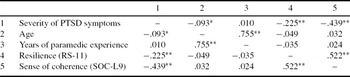
The intercorrelations between the various variables are displayed in Table 2. The variable, years of service, was not associated with severity of PTSD symptoms. A significant yet weak negative correlation was found between the variables age and severity of PTSD symptoms (r = −.09, p < .05). The variables resilience and SOC were significantly correlated with severity of PTSD symptoms and were consequently entered into the regression equation. Resilience and SOC were also correlated significantly with each other (r = .52, p < .01).
Correlations between age, years of paramedic experience, resilience, sense of coherence, and severity of PTSD symptoms

Notes: N = 625
PTSD = Posttraumatic Stress Disorder; RS-11 = Resilience Scale; SOC-L9 = Sense of Coherence Scale
*p < .05 (two-tailed); **p < .01 (two-tailed); ***p < .001 (two-tailed)
The results of the multiple regression analysis are shown in Table 3. The overall model significantly predicted severity of PTSD symptoms (F(2, 647) = 77.09, p < .001). Together, the variables SOC and resilience accounted for 19.2% of the variance in severity of PTSD symptoms. However, only SOC predicted a significant unique amount of variance in severity of PTSD symptoms (R 2 = 0.19, t(645) = −10.50, p < .001), while resilience did not (R 2 = 0.00, t(645) = −0.13, p = .89).
Multiple regression analysis for severity of PTSD symptoms

Note: N = 648
Preparation for dealing with traumatic events, resilience, SOC, and severity of PTSD symptoms
Paramedics who received either internal or external training to deal with work-related traumatic events showed significantly lower severity of PTSD symptoms than those who received no training (Levene test: F = 28.90, p < .001; M = 1.97, SD = 4.08 vs. M = 4.23, SD = 6.75; t(70) = 2.663; p < .05). Paramedics who were prepared for dealing with traumatic events did not differ with regard to resilience from those who were not prepared (Levene test: F = 4.08, p < .05; M = 66.16, SD = 6.41 vs. M = 65.01, SD = 7.88; t(74) = −1.075; p = .286). However, the groups did differ significantly with regard to their SOC (Levene test: F = 4.91, p < .05; M = 53.88, SD = 6.95 vs. M = 50.24, SD = 8.71; t(76) = −3.30, p < .01), with the group prepared for dealing with traumatic events exhibiting stronger SOC scores. Furthermore, paramedics who received one single training session exhibited a significantly smaller SOC than paramedics who completed multiple training sessions (M = 52.99, SD = 6.94 vs. M = 55.60, SD = 6.21; t(339) = −3.629; p < .001). Paramedics who received external training differed marginally significantly with regard to SOC from those who received training at work (M = 53.14, SD = 6.95 vs. M = 54.77, SD = 6.31; t(261) = 1.941; p = .053).
Resilience, SOC, severity of PTSD symptoms and availability of psychological help at work
The t test for independent samples with unequal variances showed that paramedics for whom psychological help was available at work had significantly less severe PTSD symptoms than those with no psychological help at work (Levene test: F = 22.17, p < .001; M = 2.00, SD = 4.21 vs. M = 4.73, SD = 6.49; t(50) = 2.87, p < .01). Paramedics who could avail themselves of psychological help at work also showed a significantly higher SOC mean than those without this opportunity (M = 53.80, SD = 7.09 vs. M = 49.85, SD = 8.03; t(654) = −3.674, p < .001). However, the groups did not differ in regard to their resilience (Levene test: F = 11.14, p < .001, M = 66.20, SD = 6.34 vs. M = 64.21, SD = 8.83; t(51) = −1.54, p = .13).
Resilience, SOC, severity of PTSD symptoms, and gender
The t test for independent samples with unequal variances showed that women had higher resilience scores than men (Levene test: F = 5.80, p < .05; M = 66.91, SD = 6.17 vs. M = 65.60, SD = 6.82; t(441) = −2.46, p < .05). Men and women did not differ in regard to SOC (M = 53.38, SD = 7.43 vs. M = 53.61, SD = 7.13; t(643) = 0.38, p = .70) or severity of PTSD symptoms (M = 2.17, SD = 4.06 vs. M = 2.18, SD = 4.88; t(654) = −0.04, p = .97).
Comparison of resilience and SOC with a representative population sample
The resilience mean of the paramedics (M = 66.04, SD = 6.57) was significantly higher (z = 19.07, p < .05) than the mean of a German representative population sample (M = 58.03, SD = 10.76; N = 2,004; Schumacher et al., Reference Schumacher, Leppert, Gunzelmann, Strauss and Brähler2005). The SOC mean of the paramedics (M = 53.50, SD = 7.25) was also significantly higher (z = 8.06, p < .05) than the mean of a German representative population sample (M = 51.00, SD = 8.00; N = 4,002; Hannöver et al., Reference Hannöver, Michael, Meyer, Rumpf, Hapke and John2003).
Discussion
The correlation analysis revealed that, as expected, both resilience and SOC are associated with PTSD symptoms. The regression analysis showed that 19.2% of the total variance in symptom severity was explained by these variables. However, in the current sample SOC was a better predictor than resilience for severity of PTSD symptoms; SOC accounted for much more unique variance in symptoms than resilience.
The current results underline the importance of SOC in the field of posttraumatic psychopathology that previous studies have indicated (Eriksson and Lundin, Reference Eriksson and Lundin1996; Frommberger et al., Reference Frommberger, Stieglitz, Straub, Nyberg, Schlickewei and Kuner1999; Fuglsang et al., Reference Fuglsang, Moergeli, Hepp-Beg and Schnyder2002; Jonsson et al., Reference Jonsson, Segesten and Mattsson2003; Ortlepp and Friedman, Reference Ortlepp and Friedman2002; Schnyder et al., Reference Schnyder, Wittmann, Friedrich-Perez, Hepp and Moergeli2008; Tagay et al., Reference Tagay, Herpertz, Langkafel and Senf2005).
The variable years of paramedic experience was not associated with severity of PTSD symptoms. The negative correlation between the variables age and severity of PTSD symptoms was significant, yet very weak. Neither age nor years of paramedic experience were associated with resilience or SOC. These results suggest that resilience and SOC remain stable over time. However, this does not exclude the possibility that a specific intervention aimed at increasing SOC and resilience may be effective.
Paramedics who were prepared for dealing with traumatic experiences during their vocational training had significantly less severe PTSD symptoms than non-prepared colleagues. Prepared paramedics did not differ from non-prepared colleagues with regard to the degree of resilience, but they did exhibit a significantly higher SOC than non-prepared colleagues. In addition, paramedics who participated in multiple training sessions showed higher SOC scores than those who participated in a single training session. Langeland et al.'s (Reference Langeland, Wahl, Kristoffersen, Nortvedt and Hanestad2007) assumption, that SOC can be enhanced by professional interventions is strengthened by our results. Thus, paramedics as well as other high-risk professionals could benefit from a specific training to strengthen their SOC. As regards the venue, training at an external location could be more beneficial than training at work, as paramedics who participated in external training sessions showed marginally higher SOC than those who participated in training at work.
Paramedics for whom psychological help was available at work showed less severe PTSD symptoms and higher SOC than those for whom there was no available psychological help at work. This could mean that knowing about the availability of psychological help at work may enhance SOC and thus reduce severity of PTSD symptoms. In contrast, the two groups did not differ with regard to resilience. Considering this, providing psychological help at work for paramedics seems crucial.
Male and female paramedics did not differ with respect to severity of PTSD symptoms or SOC. This contradicts the findings of Lundin and Jansson (Reference Lundin and Jansson2007) and Schumacher et al. (Reference Schumacher, Wilz, Gunzelmann and Brähler2000), who found that men reported higher SOC than women. A plausible explanation for our findings could lie in the fact that only women with high SOC scores chose this kind of occupation and thus are less likely to develop PTSD symptoms. With regard to resilience, we found that female paramedics displayed statistically significantly enhanced resilience compared to male paramedics. However, the extremely small difference in means cannot be considered to be of clinical relevance.
Limitations
Since the present study is a cross-sectional study, statements regarding the stability of resilience and SOC over time, possible changes (e.g. through specific interventions) are limited. Further, the indications of resilience and SOC being able to predict severity of PTSD symptoms can also not be interpreted causally. Both measures may be the product of PTSD symptoms rather than influencing them. For this purpose, prospective studies are not only desirable, but necessary. The results apply to paramedics and cannot be generalized to other occupational groups.
Conclusions
Resilience and SOC are associated with PTSD symptoms. In the current sample SOC was a better predictor than resilience for severity of PTSD symptoms. Thus improving SOC seems a particularly promising approach for lowering PTSD rates. This assumption is chiefly important for the fields of developmental psychology and prevention, where attempts are made to specifically promote psychological resistance. Individuals faced with traumatizing situations on a daily basis (e.g. due to their occupation) should receive specific training, not only to be able to process the traumatic event, but to strengthen and develop their SOC and resilience to prevent them from developing PTSD when being faced with traumatic events. The development of specific methods that especially promote SOC, and thus indirectly lower the risk of PTSD, would be desirable. The recently developed HEDE-Training (Franke and Witte, Reference Franke and Witte2009) appears to be a promising program to strengthen one's sense of coherence, yet an empirical evaluation of this program is still pending.
Acknowledgments
We would like to thank the Association of Emergency Services Switzerland and the principality of Liechtenstein, as well as the emergency services, for their support and participation in our study.





Comments
No Comments have been published for this article.