INTRODUCTION
Despite a complete moratorium on commercial whaling in 1986, low population estimates and mortality of large whales continue to be a concern worldwide. Illegal and scientific whaling, as well as legal aboriginal whaling are obvious threats to certain populations of whales and dolphins, but at least the latter two are more transparent and cause more localized loss to populations than ship strikes, anthropogenic noise or pollution. Ship strikes of large whales have been reported worldwide (Laist et al., Reference Laist, Knowlton, Mead, Collet and Podesta2001; Jensen & Silber, Reference Jensen and Silber2003), however, it is extremely difficult to assess overall impacts on different species when sources are unknown and the status of a particular population may not be well understood. Ship strikes will pose the greatest risk to small or isolated whale populations, as can be seen with the North Atlantic right whales (Eubalaena glacialis) in the western Atlantic, where ship collisions were responsible for 40 per cent of known right whale mortality between 1990 and 2005 (Reynolds et al., Reference Reynolds, Alexander and Dayton2005). Concern for this population prompted the National Oceanic and Atmospheric Administration (NOAA) and the US Navy to consider more restrictive shipping regulations and the development of a remote sensing programme for whales (Stark et al., Reference Stark, Parthasarathy and Johnson2002; Rauch, Reference Rauch2006). Elsewhere, despite interest by the shipping industry, marine mammal managers, and the public, there is limited information on the number and species of whales killed by ships; few are ever recovered for examination. The small number of whales that have been examined represents an unknown proportion of whales and species struck by ships.
The correlation between today's fast ships and the increase of whale ship-strike incidences has been firmly established. Laist et al. (Reference Laist, Knowlton, Mead, Collet and Podesta2001) found that fatal ship strikes were rare before the 1800s, were infrequent until 1950, and have since increased steadily with the number of ships and the greater speeds of ship travel. Washington State in the western United States, has two main arteries of water that lead to major shipping ports. Along northern Washington, the Strait of Juan de Fuca leads to Seattle, Tacoma and Cherry Point (petroleum refinery), as well as Vancouver and Victoria, Canada. Southern Washington is bordered by the Columbia River, which leads to Vancouver, Washington, and Portland, Oregon (Figure 1). Shipping traffic (particularly numbers of container vessels) has increased along the west coast of North America and from the Orient over the past decade (Port of Long Beach, 2007; Port of Seattle, 2007; Port of Tacoma, 2007; Port of Vancouver, 2007). Additionally, there has been an increase in vessels entering the Strait of Juan de Fuca; an estimated 11,000 vessels of greater than 300 gross tons passed through the Strait in 1999, and the number of vessels is expected to reach 17,000 by the year 2025 (Pluta, Reference Pluta2002).
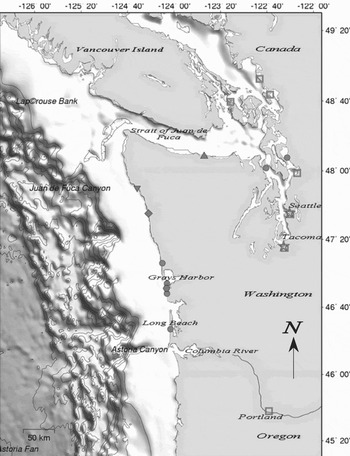
Map of Washington State with necropsy sites of ship-struck fin whales and other species documented with either blunt force trauma or propeller injuries. All fin and blue whales were recorded in inland waters. □, fin whale; ⋆, blue whale; •, grey whale; ★, sperm whale; ⧫, humpback whale; ▾, Baird's beaked whale; ▴, Sei whale. Bathymetric contours are shown at 250 m intervals.

In the United States, Baird's beaked whale (Berardius bairdii), grey (Eschrichtius robustus), humpback (Megaptera novaeangliae), sei (Balaenoptera borealis), sperm (Physeter macrocephalus), blue (Balaenoptera musculus) and fin (Balaenoptera physalus) whales are all protected under the Marine Mammal Protection Act (MMPA). Excluding Baird's beaked whale, the above species are additionally listed as endangered under the Endangered Species Act (ESA). Although the ESA and MMPA protect whales from whaling and intentional harassment, they do not protect whales from high-speed ferries, cargo ships and navy vessels that are increasing in number and speed. Based on confirmed ship collisions from 1997 to 2001, and excluding data presented in this report, annual mortality due to ship strikes in California, Oregon and Washington was estimated to be at least 0.4 fin whales per year (Heyning & Cordaro in Carretta et al., Reference Carretta, Forney, Muto, Barlow, Baker, Hanson and Lowry2006). Although present in lower numbers than fin whales, both blue and humpback whales have been recorded as ship-struck along the US west coast (Carretta et al., Reference Carretta, Forney, Muto, Barlow, Baker, Hanson and Lowry2006). Other than three incidents recorded in Washington State there are no ship strike records associated with Baird's beaked whale, sei or sperm whales along the US west coast (Carretta et al., Reference Carretta, Forney, Muto, Barlow, Baker, Hanson and Lowry2006).
Population estimates for whale species encountered off Washington are generally not available since animals are spread out and often seasonal in their presence, however, to appreciate the significance of ship strikes on these species we have outlined current estimates for US west coast populations. Based on two ship surveys of the US west coast the Baird's beaked whale population is estimated at only 228 (coefficient of variation (CV) = 0.51) animals (Barlow, Reference Barlow1997; Forney, Reference Forney2007). Their recent human-caused and total fishery mortality or serious injury is considered insignificant (Carretta et al., Reference Carretta, Forney, Muto, Barlow, Baker, Hanson and Lowry2006). Eastern North Pacific grey whales were removed from the List of Endangered and Threatened Wildlife in 1994; their most recent abundance estimate was 18,813 (CV = 0.069) for 2001/2002 (Angliss & Outlaw, Reference Angliss and Outlaw2005). The most recent abundance estimate for humpback whales off California, Oregon and Washington is 1391 (CV = 0.22) (Calambokidis et al., Reference Calambokidis, Steiger, Ellifrit, Troutman and Bowlby2004). The Washington coast generally hosts a small portion of humpback whales in the summer; line-transect and photographic mark–recapture data show there are an estimated 100 humpbacks occupying these waters annually, with at least one year (2002) showing a marked increase in numbers (562 humpback whales (CV = 21)) (Calambokidis et al., Reference Calambokidis, Steiger, Ellifrit, Troutman and Bowlby2004). Sei whales were the fourth most common whale caught by California whalers during the 1950s–1960s (Ohsumi & Wada, Reference Ohsumi and Wada1974). Using shipboard survey data Barlow (Reference Barlow2003) estimated the sei whale population off California, Oregon and Washington to be 56 individuals (CV = 0.61). Sperm whales are present year round off the US west coast, and although extremely depleted by whaling they have been reported as the third most abundant large whale off California, Oregon and Washington (Green et al., Reference Green, Brueggeman, Grotefendt, Bowlby, Bonnell, Balcomb and Brueggeman1992). Barlow (Reference Barlow2003) estimated the US west coast sperm whale population at 1233 individuals (CV = 0.41) from shipboard survey data collected during summer/autumn of 1996 and 2001.
Despite their speed and size, fin whales appear to be more susceptible to ship strikes than other species (Laist et al., Reference Laist, Knowlton, Mead, Collet and Podesta2001; Jensen & Silber, Reference Jensen and Silber2003; Panigada et al., Reference Panigada, Pesante, Zanardelli, Caoulade, Gannier and Weinrich2006). Blue whales have similar body size and shape to fin whales, yet there are few ship-strike records for this species (Jenson & Silber, 2003). From 2001 and 2005 summer/autumn ship surveys off California, Oregon and Washington (US west coast), there were an estimated 3454 (CV = 0.27) fin whales (Barlow, Reference Barlow2003; Forney, Reference Forney2007). Based on a combination of line–transect and mark–recapture estimates (Calambokidis & Barlow, Reference Calambokidis and Barlow2004), Carretta et al. (Reference Carretta, Forney, Muto, Barlow, Baker, Hanson and Lowry2006) concludes that the best estimate for blue whale abundance along the US west coast is 1744 whales (CV = 0.28). Given the cessation of whaling it seems likely that world-wide fin and blue whale populations would have increased, however, in California waters there has been no significant increase in fin whale abundance (Barlow, Reference Barlow1997), and there has been no evidence of blue whale population growth in the North Pacific (Carretta et al., Reference Carretta, Forney, Muto, Barlow, Baker, Hanson and Lowry2006). Incidental ship strikes, gill-net mortality (Carretta et al., Reference Carretta, Forney, Muto, Barlow, Baker, Hanson and Lowry2006) and illegal whaling (Yablokov et al., Reference Yablokov, Zemsky, Mikhalev, Tormosov and Berzin1998) are all factors that have affected fin and other whale populations in all oceans.
The Washington coast is especially suited for a study of whale mortality due to ship strikes, given it has two major waterways leading to international ports. For the past 27 years, regional biologists and researchers have frequently cooperated to enable data collection on stranded (beach cast or dead floating) whales in the area. With an apparent increase in ship-struck whales recovered in Washington over the past five years we began to look critically at the number of ship strikes within the stranding data to determine if any trends existed for species, years, or age-classes.
MATERIALS AND METHODS
Since 1980, the Northwest Region Marine Mammal Stranding Network (NWRMMSN) has collected data on stranded marine mammals from Oregon and Washington, USA. Stranding network participants are authorized by NOAA Fisheries to respond to and examine dead marine mammals.
External measurements, photographs and observations were taken on all stranded cetaceans. When present and identifiable, the following tissues were sampled and examined: blubber, skin, internal organs and parasites. Detailed internal examinations were not conducted when the organs could not be identified due to decomposition, or if the carcass was difficult to access, or position, for a complete necropsy. When possible cause of death was determined either at time of necropsy, or was based on results of laboratory diagnostic testing and tissue analyses. Along with data that were collected, we summarized results from other strandings in the region, from other stranding response teams, and scientific journals. To be considered, reports had to include species, total length measurement, location and year of occurrence.
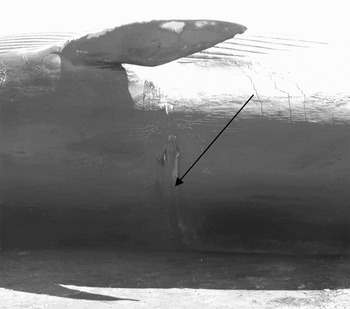
Records were assigned to one of four categories for cause of death: (1) not ship strike or unknown (either no evidence of ship strike or too deteriorated to be able to be diagnosed): category included trauma other than ship strike such as ‘predation’ or ‘entanglement’, also ‘emaciation’, ‘parasitism’, ‘other’, and ‘not determined’; (2) possible ship strike (whale either had severe bruising on the body indicative of blunt force trauma or had propeller scars that may have contributed to the death of the whale but were not determined to be severe enough to cause death): category included superficial propeller marks and injuries which were not clearly sufficient to cause death; (3) probable ship strike (blunt force trauma or deep propeller cuts that could have caused death, but the state of decomposition makes the post- ante-mortem assessment impossible): category included whales that were recovered from ships' bows and/or found near shipping channels or inland ports; and (4) ship strike (significant bruising, oedema, haemorrhaging, and internal bleeding radiating from a specific impact site, all indicating clearly that the animal was alive at the time of collision): category included whales that had all or some of the above injuries and in some cases had been recovered directly from ships' bows or were found near ports and in inland waterways (Figure 2).
Impact site (arrow) on right dorsal side of fin whale (CRC-712). Whale found floating in Puget Sound on 15 May 2006. Necropsy on 16 May found both internal and external bruising and haemorrhaging consistent with ante-mortem ship strike.

Age-class estimates were assigned to ship-struck grey, humpback and fin whales from Washington State based on known age-class data collected in whaling stations in the Atlantic and Pacific Ocean. According to a small set of measurements from a California whaling station, grey whale average total body length at sexual maturity is less than or equal to 12.7 m for females, and 11.9 m for males (Rice, Reference Rice1963). Humpback whales reach sexual maturity at a mean length of 12.0 m for females and 11.7 m for males (Rice, Reference Rice1963). Fin whale length at physical maturity in the north-east Atlantic was estimated as 18.9 m for males and between 20 and 21 m for females, corresponding age at physical maturity is between 20 and 30 years (Aguilar & Lockyer, Reference Aguilar and Lockyer1987). Age-class data for the above species were compared to ship-struck whales recorded from other regions of the world.
RESULTS
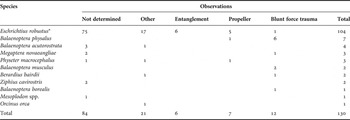
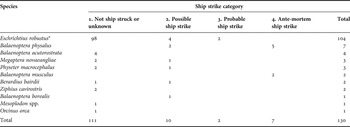
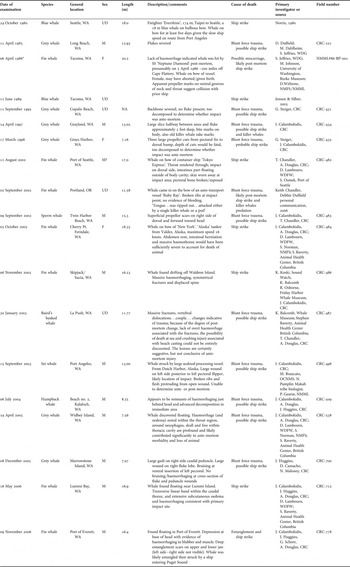
From October 1980 to December 2006 a total of 130 records of large whale strandings from Washington met our criteria of documentation and were included in this study (Table 1A). Of the 130 whales, 111 (85%) were determined as Category 1, signifying that to the degree that the necropsy was completed there was no evidence of ship strike. We found that 19 (15%) of the whales fell in Categories 2–4, indicating that there had been evidence of either blunt force trauma or propeller marks (Table 1B). By species these catagories included seven fin whales, six grey whales, two blue whales, one humpback whale, one sei whale, one sperm whale and one baird's beaked whale. Based on available information, of these 19, 11 were designated Category 2; all had injuries that indicated ship strike, but were ‘possible’ ante-mortem ship strikes due to deterioration, unknown severity of ship strike wounds, and other possible causes of death. One whale was determined to be a Category 3 or probable ship strike, a small grey whale with ‘three large propeller cuts [that ran] from pec[toral] fin to dorsal hump…too decomposed to determine whether impact was post-mortem’ (Table 2). Seven were determined as Category 4, injuries indicated that the ship strikes had occurred ante-mortem and these whales had died from their injuries. Whales were recovered with evidence of ship strike on the outer coast as well as the inland waterways around Washington State (Figure 1). However, location of recovery often does not represent where the animal was struck; some of these whales were documented to have been carried into inland waters after being struck. Fin whales, blue whales and a single sei whale were exclusively recovered in inland waterways, in Puget Sound and in the Columbia River primarily near harbour destinations of shipping traffic. The six grey whales with evidence of ship strike were found throughout the study area. The single humpback whale, one Baird's beaked whale, and a single sperm whale with ship-strike evidence were found on the outer coast.
Large cetacean stranding summary of observations from Washington State 1980–2006. Likely cause of death ‘other’ included emaciation, parasitism, or killer whale attack.

* Additional female grey whale mortality due to propellor wounds is not included in this study, as this occurred before 1980 (S.J. Jeffries, unpublished data).
Certainty of ship strike as cause of death in stranding records from Washington State 1980–2006.

* Additional female grey whale mortality due to propeller wounds is not included in this study, as this occurred before 1980 (S.J. Jeffries, unpublished data).
All whales with evidence of either blunt force trauma or propeller marks from stranding records collected in the surrounding waters of Washington State. Stranding records collected by Northwest Region Marine Mammal Stranding Network (NWRMMSN).

CRC, Cascadia Research Collective; NMFS, National Marine Fisheries Service; NMML, National Marine Mammal Laboratory; OCNMS, Olympic Coast National Marine Sanctuary; WDFW, Washington Department of Fish and Wildlife; WDG, Washington Department of Game. *, Laist et al. (Reference Laist, Knowlton, Mead, Collet and Podesta2001) and Jensen & Silber (Reference Jensen and Silber2003), noted a similar fin whale ship strike ‘in the late 1980s’; total length measurement was within 0.2 m, and location was Seattle instead of Tacoma. We suspect that this is the same incident.
Four fin whales were recovered from ship bows, three in 2002 and one in 1986. After examination, two were designated ante-mortem ship strike, while two had injuries suspected to indicate post-mortem ship strike. Of the post-mortem ship-struck whales, the first (record NMML no. 86-BP-001) was brought into Tacoma, Washington in 1986, with no evidence of haemorrhaging, and propeller marks only on the ventral side of the whale, indicating that the whale had been hit prior to the ship that brought it into port. Death was determined to have been sudden and likely related to the whale having recently given birth or aborted (Table 2). As this animal was thoroughly necropsied it is not included in any subsequent assessments for ante-mortem ship strikes. The second fin whale thought to have been struck post-mortem was brought into the Columbia River on the transport vessel ‘Ruby Ray’ in 2002. The investigating team reported that there were killer whale (Orcinus orca) rake marks on the body, and that the tongue was missing suggesting that the whale had likely been attacked by killer whales prior to being struck and transported on the bow of the vessel (Dr D. Duffield, Department of Biology, Portland State University personal communication). The examination of this animal was cursory however, and to be conservative we have included this individual in assessments of ship-struck whales.
Twelve of 19 (63%) whales in Categories 2–4 were implicated in ship strikes due to blunt force trauma, indicating that the ship's impact point was forward of the propeller. Injury type by species indicated that six fin whales, all blue whales, one grey whale, one humpback, one sei and one Baird's beaked whale suffered blunt force trauma, while five grey whales and one sperm whale had evidence of propeller marks (Table 1).
Of the six likely ante-mortem ship-struck fin whales documented in Washington State, four were males (lengths 17.0, 16.23, 16.9 and 16.43 m), one was female (length 18.35 m) and one was of unknown sex (11.58 m). Compared to physical maturity status of fin whales based on vertebral examination (Aguilar & Lockyer, Reference Aguilar and Lockyer1987), all three males, one female and the unknown whale were ‘immature’. The single post-mortem ship-struck fin whale was determined to be ‘mature’, based on total length (20.2 m), sex (female) and evidence of a recent pregnancy.
Of the six grey whales in the ship-struck category, two males and one female were determined sexually immature by total length measurements (7.56 m, 7.57 m and 7.19 m), two males were determined sexually mature (12.93 m and 13.05 m), and length and sex were not determined for one. The male humpback whale in this study was determined as sexually immature at 8.35 m.
To assess trends in strandings and ship strikes over time, we pooled stranding and ship strike data in three-year bins, beginning in 1980. The number of strandings did not change significantly by year (regression, P = 0.15, r 2 = 0.27), but the number of stranded whales with evidence of ship strike showed a tendency to increase over time (regression, P = 0.04, r 2 = 0.48). The proportion of whales with evidence of ship strike out of the total number of strandings did not change significantly over time (regression, P = 0.36, r 2 = 0.12). However, annual variability of grey whale deaths has likely accounted for much of the variation seen in these data over time.
DISCUSSION
Ship strike, propeller marks and blunt force trauma
Although propeller wounds are easier to detect visually than trauma caused by ship strike, we found that of the 19 whales with evidence of ship strike, 12 (63%) had signs of blunt force trauma and only seven (37%) showed signs of propeller wounds. Haemorrhaging, oedema and broken bones are all signs of ante-mortem blunt force trauma, however, these observations require a fairly fresh animal and some level of expertise in examining the internal anatomy of large cetaceans. One explanation for a greater percentage of blunt force traumas observed is that propeller wounds open the body cavity, which can speed up decomposition, and allow for gases to escape, making the whale less likely to re-float and be recovered. Whales hit by the bow of the ship (causing blunt force trauma and forcing some species of whale to be wedged against the bow bulb during forward ship propulsion) are more likely to be brought to coastal waters where the carcass can be recovered and examined before they sink.
These data show that ship-struck Balaenopterids died of blunt force trauma, while ship-struck grey whales had potentially fatal propeller wounds. This could indicate that fin whales survive propeller wounds that are fatal to grey whales, but we suspect that this is more likely a reflection of our small sample size and differences in level of examination of these two taxonomic groups. In our region, necropsies of cetaceans other than grey whales tended to be more thorough because of their rarity. It is possible that blunt force trauma would be less likely to be detected in grey whales as only 28% of grey whales had complete necropsies, compared to the other ten species represented in these records, where 69% had complete examinations. We suspect that more consistent and thorough necropsies for all species would yield higher ship strike observations.
Species diversity of ship strikes
Though our sample size is small, we found fin whales had the greatest number of records of confirmed ship strike, both by number and proportion of individuals of each species, which corresponds to findings in the literature. Carretta et al. (Reference Carretta, Forney, Muto, Barlow, Baker, Hanson and Lowry2006) used some of the data reported here as well as records collected from Oregon and California to calculate that the average number of mortalities due to confirmed ship strikes for fin whales along the US west coast was 0.4 per year, while the average number for blue and humpback whales off California was estimated as at least 0.2 per year. Worldwide, Jensen & Silber (Reference Jensen and Silber2003) had similar findings for the ratio of fin to humpback whale ship-strike records; out of 292 ship/whale collisions, fin whales had the highest number of incidents (75), followed by humpback whales (44). A study focused on fin whale strandings in the Mediterranean found that for the years 1972–2001, 287 fin whale carcasses were recovered, of which 46 individuals were confirmed to have been killed by ships (Panigada et al., Reference Panigada, Pesante, Zanardelli, Caoulade, Gannier and Weinrich2006). The above authors, as well as Laist et al. (Reference Laist, Knowlton, Mead, Collet and Podesta2001), found that there have been significant increases in ship strike occurrences over the past three decades that is likely linked to the increased number and speed of vessels.
While our results on fin whale susceptibility to ship strikes concur with other studies (Laist et al., Reference Laist, Knowlton, Mead, Collet and Podesta2001; Jensen & Silber, Reference Jensen and Silber2003), the large number of ship-struck grey whales appears somewhat unusual. These data reflect that grey whales are a common species found in and around the waters of Washington from early spring to late autumn, either migrating close to the shore, or feeding along the coast and in Puget Sound (Everitt et al., Reference Everitt, Fiscus and Delong1979; Calambokidis et al., Reference Calambokidis, Steiger, Evenson, Cubbage and Osborne1991), and as Jensen & Silber (Reference Jensen and Silber2003) note, near-shore species may be over represented in ship strike datasets. Grey whales make up 80% (104 records) of our total database of whale strandings, yet it was found that only 5% of grey whale necropsy records suggest that death could be attributed to blunt force trauma and possible ship strike. Heyning & Dahlheim (Reference Heyning and Dahlheim1990) note that from 1975 to 1989 only seven out of 489 grey whales from Mexico to Alaska stranded with propeller wounds. The number of grey whales that suffered blunt force trauma from both these datasets was likely higher than reported, for only a small percentage of these whales had a complete necropsy that would have detected broken bones or haemorrhaging.
In contrast to grey whales, there were few sightings of blue whales off Washington but there were two stranding records, both attributed to ship strike. In the available literature there are ‘few’ records of ship-struck blue whales (Laist et al., Reference Laist, Knowlton, Mead, Collet and Podesta2001; Jensen & Silber, Reference Jensen and Silber2003), even from regions where blue whales are commonly sighted offshore. Blue and fin whales are both large, fast whales, yet one is common in ship strike datasets while the other is practically absent. No estimates for the number of blue and fin whales occurring off Washington State exist, however, based on population estimates noted earlier for the two species off California, Oregon and Washington, there are about twice as many fin whales as there are blue whales (Carretta et al., Reference Carretta, Forney, Muto, Barlow, Baker, Hanson and Lowry2006). Based on these numbers we would suggest that the discrepancy of ship-struck blue and fin whales recorded from Washington is at least partially due to the difference in their population numbers in the north-east Pacific.
The low number of ship-struck humpback whales was surprising given the large number of individual humpback whales that spend spring, summer and autumn in this region of very high density shipping traffic. Humpback whales are present seasonally off Washington State, and are often sighted in feeding groups between the Juan de Fuca Canyon and the outer edge of the continental shelf (Calambokidis et al., Reference Calambokidis, Steiger, Ellifrit, Troutman and Bowlby2004). This rich feeding area is directly west of the entrance to the Strait of Juan de Fuca, and is also centred in the main shipping channel for vessels accessing shipping ports of Bellingham, Seattle, and Tacoma WA, as well as Vancouver and Victoria, Canada. Humpback whales in Hawaii, Alaska and the south-east United States have been documented as having increasing rates of ship collision (Gabriele et al., Reference Gabriele, Jensen, Neilson and Straley2007). Interestingly, a large percentage of ship strikes in these regions were non-fatal, often occurring with pleasure crafts and commercial whale watching vessels, and when age was estimated for the ship-struck whale most were determined to be immature. Lammers et al. (Reference Lammers, Pack and Davis2007) found that in Hawaii 69% of recorded collisions occurred with commercial whale watch vessels, and over half of the whales were calves. In the south-east United States Wiley et al. (Reference Wiley, Asmutis, Pitchford and Gannon1995) reported that all 38 stranded humpback whales recorded from 1985 to 1995 (which included six potential ship strikes) were sexually immature at the time of death. It is worth noting that the single ship-struck humpback whale in our data was determined to be sexually immature based on total length.
It is clear from Hawaii and Alaska that regionally humpback whales have a high rate of collision with vessels, and the virtual absence of ship-struck humpback whales along the Washington coast is difficult to reconcile. Possible explanations for the low number of stranded/ship-struck humpback whales recorded in Washington include: (1) non-fatal and/or fatal ship-strikes are occurring off Washington and are unreported/unnoticed/or not determined as ship-struck; (2) summer abundance estimates of humpback whales off Washington are much lower than those seen seasonally in Hawaii or Alaska, therefore, there are fewer humpback whales to come in contact with vessels; and (3) types of vessels passing through areas occupied by humpbacks off Washington are large, and stay in a defined shipping channel unlike the small crafts and whale watch vessels that are seeking humpback whales in Alaska and Hawaii. We suggest that undocumented/unnoticed ship strikes and the relatively low number of humpback whales off Washington seem to account for our observations.
As we found in the north-west regional stranding records and available literature, there are few records of ship-struck sperm whales from Washington or the eastern Pacific Ocean (Laist et al., Reference Laist, Knowlton, Mead, Collet and Podesta2001; Jensen & Silber, Reference Jensen and Silber2003). However, as with humpback whales in Alaska and off the south-eastern United States (Wiley et al., Reference Wiley, Asmutis, Pitchford and Gannon1995; Gabriele et al., Reference Gabriele, Jensen, Neilson and Straley2007), there are high-risk regions for sperm whales as well. Andre et al. (Reference Andre, Terada and Watanabe1997) wrote that collisions between ships and sperm whales had become such a safety concern in the Canary Islands that shipping industries provided financial support to experiment with artificial playback sounds to deter sperm whales from occupying the ferry routes. On the outer coast of Washington there are three records of stranded sperm whales, one of which was an individual with superficial propeller scars on its right dorsal side. In Jensen & Silber (Reference Jensen and Silber2003), 17 out of 292 (5%) of records of ship-struck whales were sperm whales. Since sperm and right whales (genus Eubalaena) float immediately at death, post-mortem ship strikes are more likely observed for these species. However, the more pelagic offshore distribution of sperm whales would make ship-struck whales less likely to wash up on shore or be propelled into port on the bow of a ship.
The Baird's beaked whale recorded in this study, with evidence of ‘trauma, possible ship strike’ could be the first for this species, however, the carcass was moderately decomposed at the time of the necropsy, and the examining team could not confirm whether the apparent blunt force trauma was antemortem or post-mortem, or even if the sustained injuries could have been acquired at the time when the carcass landed on the shore.
Although sei and minke (Balaenoptera acutorastrata) whales appear in ship-strike databases (Laist et al., Reference Laist, Knowlton, Mead, Collet and Podesta2001), there is only a single record for each species recorded from California/Oregon and Washington. Sei whales are not commonly observed off the US west coast, and before this record, ship strikes on this species had not been documented in the eastern Pacific Ocean. Jensen & Silber (Reference Jensen and Silber2003) report two ship-struck sei whales from the north-western Atlantic, one from the Mediterranean, and Felix & Waerebeek (Reference Felix and Waerebeek2005) report a single ship-struck sei whale brought into the port of Dakar, Senegal. Minke whales are common in both the inland and offshore waters of Washington, and there were four minke stranding records from Puget Sound, yet none have been recorded as ship struck. The single ship-struck minke whale from California/Oregon and Washington was recorded in 1977 (Heyning & Cordaro in Carretta, 2006). It seems likely that small balaenopterid species, such as minke, Bryde's (Balaenoptera edeni) and sei whales are ship struck, but because of their comparatively small size and body shape, slide off the vessel before it reaches port. Laist et al. (Reference Laist, Knowlton, Mead, Collet and Podesta2001) comment that, in comparison, larger whales are more likely to be caught on the bow of a ship and be carried into port than small whales. We suggest that this may contribute to the seemingly disproportionate number of fin whales that are reportedly ship struck world-wide.
Fin whales
Lengths from ship-struck fin whales in other regions also suggest that most of those struck are immature animals. Upon reviewing a larger database of ship-struck fin whales from the northern hemisphere (Laist et al., Reference Laist, Knowlton, Mead, Collet and Podesta2001; Jensen & Silber, Reference Jensen and Silber2003) using all records of fin whales with known ship strike date, precise measurements, and known sex, we found that all males (N = 13) and females (N = 7) were immature whales. A similar finding was recently noted for a population in the Mediterranean, in which 33 out of 35 ship-struck fin whales had not reached sexual maturity (Panigada et al., Reference Panigada, Pesante, Zanardelli, Caoulade, Gannier and Weinrich2006). There are a number of possible explanations for this observation: (1) immature and intermediate age whales may be more naive about ships than adult whales and spend more time at the surface when ships are in the vicinity; (2) larger whales survive strikes at least long enough to become dislodged from the bow; or (3) physical maturity data that we based our age-class assumptions on are no longer correct for these populations. One further explanation offered by Laist et al. (Reference Laist, Knowlton, Mead, Collet and Podesta2001), to explain the high proportion of young animals among stranded ship-struck right and humpback whales, is that younger animals spend more time at the surface and in shallow coastal waters, and are more likely to both be hit by ships approaching the coast, and be recovered from the bow of the ship.
Ante-mortem ship-struck fin whales have been recovered in the spring months (one whale) and late summer to autumn (five whales). These seasons also seem to concur with higher sighting and calling rates off the Washington and Oregon coasts. Sightings and recordings of fin whales indicate they are present offshore Oregon and Washington much of the year. Direct observations place fin whales off Washington from April to December (Green et al., Reference Green, Brueggeman, Grotefendt, Bowlby, Bonnell, Balcomb and Brueggeman1992; Von Saunder & Barlow, Reference Von Saunder and Barlow1999; Chandler & Calambokidis, Reference Chandler and Calambokidis2003; Appler et al., Reference Appler, Barlow and Rankin2004; personal communication, Ron Bates, Marine Mammal Research Group, 2006; personal communication, Susan Berta, Orcanetwork.org, 2006; personal communication, Candice Emmons, National Marine Fisheries Service, 2006; Jackson & Forney, Reference Jackson and Forney2006a,Reference Jackson and Forneyb; Oleson et al., Reference Oleson, Hildebrand, Calambokidis, Schorr and Falcone2007) and bottom-mounted hydrophones have them calling throughout the winter months with annual variation in peak call months (Moore et al., Reference Moore, Stafford, Dahlheim, Fox, Braham, Polovin and Bain1998; Watkins et al., Reference Watkins, Daher, Reppucci, George, Martin, DiMarzio and Gannon2000). Overall, September seems to have the highest number of sightings and call rates for fin whales off Oregon and Washington.
Although we suspect that fin whales are struck by large vessels over or near the continental shelf, as has been the case in situations where crew members have actually been aware of hitting a whale (Laist et al., Reference Laist, Knowlton, Mead, Collet and Podesta2001), we are hesitant to use ship-struck whales as an indication of presence of whales in a specific region. Whales can be caught on a bow and carried great distances, thereby misleading observers in assessing areas of whale/ship collision. In the Atlantic Ocean, a review of a cruise ship's log revealed that a ship had carried a fin whale 1100 km from Massachusetts to Bermuda (Laist et al., Reference Laist, Knowlton, Mead, Collet and Podesta2001).
Ship strike and stranding biases
At best, stranding and ship-strike data underestimate the true number of cetacean mortalities, and the attempt to use a small, detailed set of data from Washington could only partially account for the inherent biases of this type of study. We would like to outline biases that are important to consider with ship-strike data in general, and those that pertain specifically to this set of data.
GEOGRAPHIC BIASES
Ship-struck whales that strand in remote locations are unlikely to be recorded. Even if a ship strike occurs close to shore, currents, winds and tides greatly influence where the carcass will end up and whether the animal will be recovered (Norman et al., Reference Norman, Bowlby, Brancato, Calambokidis, Duffield, Gearin, Gomall, Gosho, Hanson, Hodder, Jeffries, Lagerquist, Lambourn, Mate, Norberg, Osboren, Rash, Riemer and Scordino2004). Tidal movements in the Strait of Juan de Fuca and Puget Sound are particularly strong, and depending on the tide an animal could be washed away from shore. Decomposition can occur faster in tropical waters, and whale carcasses may be quickly consumed by large sharks, and thus may not re-float and be recovered for necropsies. Whales that die in water depths greater than 1000 m are not likely to ‘resurface’ because the hydrostatic pressure will limit the generation of buoyant decompositional gases (Allison et al., Reference Allison, Smith, Kukert, Deming and Bennett1991). This is a particular concern on the west coast of the United States where the continental shelf is narrow, and on average deep water is closer to shore than on the east coast.
BIOLOGICAL BIASES
Timely recovery of dead whales is dependent on the rate of decomposition of the animal. Dead rorquals (whales of the genus Balaenoptera) sink at the time of death, and only rise to the surface (in relatively shallow water) after decomposition begins (Fraser, Reference Fraser, Norman and Fraser1937; Slijper, Reference Slijper1979). Advanced decomposition can make determining the cause of death difficult. In some cases a ship-strike death is instantaneous and there may not be any haemorrhaging, making trauma even more difficult to detect. Moore et al. (Reference Moore, Knowlton, Kraus, McLellan and Bonde2004) found that right whales that died of blunt force trauma with major internal bruising and fractures, often had no obvious external damage.
MORPHOLOGICAL BIASES
Laist et al. (Reference Laist, Knowlton, Mead, Collet and Podesta2001) comments that size and shape of a ship-struck whale may influence the likelihood of it remaining on the bow long enough for discovery. Greater surface area equals a greater chance of the whale remaining on the bow and a greater chance of recovery and examination of the carcass. The shape and position of a lodged whale could determine the duration of time that a carcass will remain wedged on the bow; a fin whale, which has a long, streamlined body may be more likely to drape evenly over the bow, while a humpback whale which has comparatively less evenly distributed body mass could be more likely to wash off the bow after it had been struck. Thereby, both size and shape may influence the apparent proportion of ship strikes by species.
HUMAN BIASES
A thorough necropsy is dependent on the experience of the examiner. Even with seasoned observers, assessing the area of trauma can be difficult since large dead baleen whales typically float and strand ventral side up and are thus difficult to turn over. Some ships are more likely to report/see ship strikes than others; crews of small boats, coast guard, navy or passenger vessels are more likely to report ship-struck whales, than large commercial freight vessels, where visibility directly in front of the bow is limited, and hull speed through water is often more than 18 knots. Ships displacing 1600 gross tons or more that enter navigable United States waters are required to test their forward/astern propulsion (OCS, 2007), increasing the chances that ship struck whales will be dislodged from a ship's bow before entering the port. Additionally, the Puget Sound Harbor Safety and Security Committee requires that ships entering Puget Sound by way of the Strait of Juan de Fuca follow the requirements of 33 CFR including test ahead/astern propulsion and actually back down the vessel (unless weather or sea conditions prohibit; then [they] must report to Cooperative vessel traffic service and Captain of the Port to gain port entry) (Reed, Reference Reed2005). The propulsion test must not occur in the Traffic Separation Scheme or within 12 miles of the coastline (Reed, Reference Reed2005). It seems likely that the ‘backing down’ manoeuvre could dislodge whales caught on the bow of a ship, leaving the carcasses 12 miles offshore and further adding to under-reporting and uncertainty of the total number of whales injured or killed by ships off Washington.
CONCLUSION
Cities and industries continue to grow along the inland waters of Puget Sound, and large vessel traffic is projected to continue to increase in areas that seasonally support blue, fin, sei, grey, humpback, minke and killer whales. Grey whales have experienced a steady population growth since the cessation of whaling (Rugh et al., Reference Rugh, Muto, Moore and DeMaster1999), while humpbacks have had a slower recovery (Calambokidis & Barlow, 2004). Both species have been seen more frequently in the historic feeding grounds close to the Washington coast and occasionally in the inland waters of Washington (Rugh et al., Reference Rugh, Muto, Moore and DeMaster1999; Calambokidis et al., Reference Calambokidis, Steiger, Ellifrit, Troutman and Bowlby2004; Falcone et al., Reference Falcone, Calambokidis, Steiger, Malleson and Ford2005). Fin and blue whale populations are likely recovering from historical whaling, and fishery-related mortality and injury are approaching or have reached zero for fin, blue, minke, and sei whales for the US west coast (Carretta et al., Reference Carretta, Forney, Muto, Barlow, Baker, Hanson and Lowry2006). If these populations begin a significant recovery, it is likely that whales returning to historic feeding regions, such as the approaches to the Strait of Juan de Fuca and Puget Sound, may be subjected to collisions with large vessels, potentially resulting in a rise in both fatal and non-fatal ship strikes in these waters. High-risk areas have been identified to protect North Atlantic right whales along the US east coast. When whales are known to be present in these areas, management could require commercial vessels to be: (1) routed around high-risk areas; (2) routed so that they minimize travel distance within high-risk areas; and/or (3) restricted in speed within the identified high-risk areas (Russell, Reference Russell2001). Management in the Atlantic has been encouraged by developments in the field of passive acoustics; the goal is to monitor designated high-risk areas for whale vocalizations in real time, thereby enabling ships to take precautionary measures only when whales are in the vicinity (IFAW, Reference Leaper and Gillespie2006). In theory, passive acoustics could be used to monitor humpback whale presence in shipping channels approaching the Strait of Juan de Fuca, however, because of fin whales' offshore and dispersed distribution it would be more difficult to identify an exact area to declare ‘high-risk’. World-wide high-risk regions for whale populations have been identified (Laist et al., Reference Laist, Knowlton, Mead, Collet and Podesta2001; Jensen & Silber, Reference Jensen and Silber2003; Gabriele et al., Reference Gabriele, Jensen, Neilson and Straley2007), and the success of mitigation measures on the US east coast should be carefully monitored to assess applicability of these methods to other regions including the Washington coast.
ACKNOWLEDGEMENTS
The authors thank a number of individuals who were involved in data collection or reported stranded animals that were included in this study: Ron L. Bates, Susan Berta, Debbie Duffield, Pat Gearin, Merrill Gosho, Jessie Huggins, Brent Norberg, Steve Osmek, and Whale Museum Staff. Also Todd Chandler, Joe Evenson and Lisa Schlender. Also Dominique Camacho, Candice Emmons, Erin Falcone, Kiirsten Flynn, Nora Maloney and Gregory Schorr. A special thank you to Robin Baird for reviewing multiple versions of the manuscript. Gretchen Steiger and two anonymous referees made valuable suggestions on earlier drafts of the manuscript. A number of shipping companies, captains and crew facilitated data collection. Funding for compilation of information in this report came from a grant from the John Prescott Programme of the NOAA Fisheries.