I. INTRODUCTION
Among contemporary economists, cost-of-living indexes are routinely defined in utility-based terms—e.g., the minimum change in expenditure required to keep a consumer at the same utility level (or indifference surface) in two different situations. Such unanimity is a recent development; at least through the 1940s, numerous economists denied that a cost-of-living index could or should be predicated on concepts such as utility, welfare, or satisfaction (Banzhaf Reference Banzhaf, Klein and Morgan2001; Stapleford Reference Stapleford2009). Still, the utility-based definition of a cost-of-living index—what we can call a “constant-utility index”—can boast a long history of support among neoclassical economists and the early marginalists. In the late nineteenth century, for example, Henry Sidgwick suggested that comparisons of “purchasing power” relied on comparing “the amounts of ability or satisfaction obtainable” from expenditures (Sidgwick Reference Sidgwick1887, p. 63). Francis Edgeworth similarly described a measure that would “afford the consumer a constant value-in-use” or “final utility” (Edgeworth [1887–1889] Reference Edgeworth1925, pp. 208, 210). By 1936, Ragnar Frisch could report that “the only plausible” objective for a price index was finding the change in cost required to be “equally ‘well off’” in two situations, a goal that Frisch ascribed to a wide range of different theorists (Frisch Reference Frisch1936, pp. 12, 11).
Seeing the repeated recourse to utility, welfare, and satisfaction in these definitions, it is easy to assume a deep continuity in the history of constant-utility indexes, to view it as a long-winding tale of periodic progress by economists working on a well-defined, stable problem. Such is the impression given by many histories of price index theory (e.g., Diewert Reference Diewert, Erwin Diewert and Nakamura1993; Stapleford Reference Stapleford2003, pp. 80–147; Banzhaf Reference Banzhaf2004) and by typical literature citations, which often describe Konüs ([1924] Reference Konüs1939) as having established a clear theoretical framework for discussion (e.g., Samuelson and Swamy Reference Samuelson and Swamy1974; Diewert Reference Diewert1998; Triplett Reference Triplett2001).
Yet, how plausible is this vision of continuity? For example, historians recognize that the conception of utility in economic theory underwent dramatic changes during the early twentieth century. Many early neoclassical economists, especially those in the Marshallian tradition at Cambridge, had treated utility functions as producing cardinal values, and had assumed that utility could (in principle) be compared objectively across individuals. By the 1950s, most neoclassical economists would dissent from these propositions, arguing that utility functions should be understood in ordinal terms and that interpersonal comparisons of utility required normative judgments (Schumpeter Reference Schumpeter1954, pp. 1057–1066; Cooter and Rappoport Reference Cooter and Rappoport1984; Hennipman Reference Hennipman1987; Backhouse Reference Backhouse, Samuels, Biddle and Davis2003). Given that prominent contributors to the theory of constant-utility indexes—e.g., Edgeworth, A.C. Pigou, Alexander A. Konüs, R.G.D. Allen, John R. Hicks, and Paul Samuelson—worked on opposite sides of this divide, we might suspect that the “ordinal revolution” (as these collective changes in the treatment of utility are often known) would have important consequences for views on constant-utility indexes.
Indeed, this essay argues that beneath the superficial linearity of the history of neoclassical price index theory lie important conceptual ruptures that are linked to the ordinal revolution, including a radical transformation of the core objective of cost-of-living indexes. Revealing these ruptures produces a more accurate history of neoclassical price index theory, encompassing both its development and its reception within the larger community of economists and statisticians. With such a nuanced history, for example, we can better explain why economists at the U.S. Bureau of Labor Statistics vehemently rejected the constant-utility approach in 1961 only to embrace it less than a decade later. Furthermore, we can retrospectively identify the salience of a major (though often overlooked) division in the applications for cost-of-living indexes; namely, the distinction between adjusting compensation over time to ensure constant “welfare” and measuring aggregate consumer “price change.” As we will see, neoclassical constant-utility indexes began partly as a solution to the former task, but today are better suited for the latter. Recognizing this slippage (and its consequences for current price index theory) is essential if we are to understand and clarify current debates about the appropriate conceptual basis for major statistics such as the US Consumer Price Index (CPI).
II. AN OVERVIEW
The changes to neoclassical price index theory have been subtle, albeit important. Characterizing these shifts, therefore, requires close attention to the details of different texts, especially since individual authors did not always offer coherent expositions of the fundamental concepts behind their methodological arguments. Before immersing ourselves in these twisting pathways, it may be helpful to gather a sense of the larger terrain, the general ways in which changing ideas about utility affected price index theory over the twentieth century.
For cost-of-living indexes, the importance of the ordinal revolution lay in its implications for interpersonal and intertemporal comparisons of utility levels. In the abstract, ordinal values and non-comparability are two distinct concepts (Sen Reference Sen1979, p. 13; Hennipman Reference Hennipman1987). Cardinal utility functions, for instance, can also be non-comparable, and, in fact, some neoclassical economists began to adopt a limited form of non-comparability without committing themselves to ordinal utility values. Nevertheless, the critiques that led to the adoption of ordinal utility also implied either full non-comparability or extreme limitations on any comparisons. In this respect, the historical link between the adoption of ordinal utility and the acceptance of non-comparability is not accidental.
For the sake of analytic clarity (not always consistently present in the historical texts themselves), we can distinguish two basic kinds of revisions to neoclassical price index theory that were prompted by the ordinal revolution. I will label these the “weak” and “strong” revisions, respectively. The weak revision, which emerged rapidly among early progenitors of the ordinal revolution such as R.G.D. Allen (Reference Allen1933) and John R. Hicks (Reference Hicks1940), contended that intertemporal comparisons of welfare had theoretical meaning only when the relevant consumer tastes (represented by indifference surfaces) were identical in the two situations. The strong version, which was not fully articulated until a paper by Franklin M. Fisher and Karl Shell (Reference Fisher, Shell and Wolfe1968), argued that intertemporal comparisons of welfare were impossible under any conditions whatsoever, a conclusion that Fisher and Shell described as a “testament to our ordinalist purity” (Fisher and Shell Reference Fisher, Shell and Wolfe1968, p. 134, n. 2).
Understanding the strong ordinal critique of intertemporal welfare comparisons requires recognizing that the ordinal revolution was (in the main) epistemological, not ontological. In other words, recourse to ordinal utility did not reflect ontological claims about the nature of human welfare or human psychology, but, instead, reflected epistemological judgments about the limits of knowledge and the necessary preconditions for a working theory of consumer demand. Critics insisted that observations of consumer behavior could reveal only preference rankings (ordinal values) and not the relative magnitudes of those desires (cardinal values). Furthermore, they demonstrated that an ordinal utility function (let us call it “UR” for its basis in ordinal rankings) was sufficient to formulate a complete theory of consumer demand. Given a collection of goods and services, X = (x1, . . .,xn), UR could then define a particular indifference curve, μr:

Despite these economists’ commitment to ordinal utility in consumer demand theory, however, many of them also understood that the psychological satisfaction or “welfare” provided by a set of goods—let us call this μw—was determined by more than simply relative preferences, UR:

Here, E represents various exogenous factors that (according to different economists) might affect the form or result of UW, such as mental or physical health, other aspects of the social or economic environment beyond the goods purchased (X), and so forth. The catch was that neither the form of UW nor μw itself could be determined by observing consumer purchases.
For consumer demand theory, the distinction between μr and μw made little difference: consumer choices always depended on the evaluation of goods at a fixed moment in time (when both E and UW would be fixed),and therefore relative preferences were all that mattered. (That was why, of course, it had been possible to eliminate cardinal magnitudes from consumer demand theory in the first place.) At any given instant (for a specific individual), economists could say that bundles of goods on the same indifference surface, μr, provided the same “welfare,” μw, without getting into trouble. But comparisons over time were another matter. The factors beyond UR that determined μw might have changed in the interim. Thus, maintaining constant relative preferences (a constant form for UR) and even purchasing the same set of goods (X) were not sufficient to imply constant welfare. As Fisher and Shell put it, a “man’s efficiency as a pleasure-machine may have changed without changing his tastes [i.e., relative preferences, UR]” (1972, p. 3). Accordingly, even the strictures of the weak ordinal revision (constant UR) were insufficient; intertemporal comparisons of welfare were simply impossible without subjective, normative judgments.
The strong ordinal revision—which was tacitly adopted by leading theorists in foundational texts such as Diewert (Reference Diewert1976) and Pollak (Reference Pollak1989)—necessarily required redefining the goal of a cost-of-living index. Under both the cardinal and weak ordinal versions, neoclassical economists had assumed that a “true” cost-of-living index would show the minimum change in expenditure needed to maintain an individual at the same level of economic welfare in two different time periods or geographical locations. The strong ordinal critique denied the possibility of intertemporal comparisons of welfare, and therefore the possibility of determining the “same level of welfare” in two real situations. Instead, strong ordinalists substituted a different objective: finding the minimum change in expenditure needed to make a given individual (fixed in time and space) indifferent between two systems of prices. This subtle and seemingly minor shift in fact had important implications, particularly when utility functions changed over time.
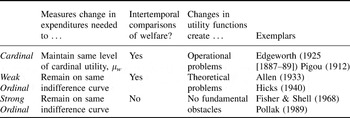
The consequences become evident when we compare how the three major approaches to constant-utility indexes (cardinal, weak ordinal, and strong ordinal) responded to shifts in utility functions (see Table 1). Among the early cardinal utility theorists, who sought (in principle) to maintain a constant μw across the comparison periods, a constant-utility index could be affected not only by changes in prices but also by changes in the form of the functions UR or UW. Since neither of these functions could be directly observed, those economists who sought to create such an index by observing prices and quantities had to assume the stability of E, UR, and UW in order to make their calculations operationally viable.
The Three Major Versions of the Constant-Utility Index

Not all essays on neoclassical price index theory fit neatly into one of these categories, both because authors were ambiguous or perhaps inconsistent, and because these categories do not exhaust all logical possibilities. Thus, Konüs ([1924] Reference Konüs1939) is primarily an example of the cardinal approach but may be read as advocating the kind of non-comparability that is characteristic of the weak ordinal view.
For the proponents of the weak ordinalist revision, where the goal was to maintain a consumer on the same indifference curve, μr, the problems were at once narrower and more extreme. They could ignore E and UW, but differences in the form of UR presented a thorny dilemma: what could it mean to keep a consumer on the “same indifference curve” when the shape of the entire utility function had been altered? Weak ordinalists tended to respond that this question was meaningless, and therefore that comparisons of economic welfare were impossible (without introducing normative judgments) if relative preferences (UR) had changed. The assumption of stable utility functions—which had been an operational necessity for cardinal utility theorists—now became an essential precondition for even the theoretical validity of a neoclassical cost-of-living index. If relative preferences had changed, calculating a true cost-of-living index for those time periods was simply impossible.
The variability of utility functions was therefore the great bugbear of neoclassical price index theory; indeed, through the 1950s it remained the most serious and damming obstacle to the acceptance of the constant-utility ideal as an objective for actual cost-of-living indexes. That view was particularly prevalent among American institutional economists. Steeped in Veblen and interwar American psychology, institutional economists viewed consumer tastes, desires, and consumption-based satisfaction as being constantly in flux, shaped by advertising, emulation, and the demands of a dynamic environment. In the face of such variation, how could one create a constant-utility index, and, indeed, what would be its practical use? Such presuppositions shaped the institutionalist view of neoclassical price index theory and help to explain why US government economists famously rejected the recommendation from a 1959–1961 review committee of the National Bureau of Economic Research to make the constant-utility index into a working ideal for the US Consumer Price Index (National Bureau of Economic Research 1961).
The strong ordinal revision, however, bridged the impasse between theoretical discussion and practical application by redefining the objective of constant-utility indexes, and thereby transforming the challenges that variations in utility functions posed to these calculations. A strong ordinal cost-of-living index avoided intertemporal comparisons of real situations, and, instead, evaluated two price systems (abstracted from their larger economic and social context) from the perspective of a hypothetical consumer fixed in time and space. Accordingly, any given calculation necessarily depended on only a single ordinal utility function, UR. The puzzle created by different utility functions now reduced to this: when drawing prices from two different time periods (0 and 1) in which the relevant consumer might have different utility functions ( and
 ), which function should be used for the calculation?Footnote 1 That decision proved to be far more tractable than the empirical problems posed by the cardinal constant-utility index, and it simultaneously avoided the need to assume the constancy of either UR or UW.
Redefining the objectives of cost-of-living indexes, however, also raised an additional issue: how would the strong ordinal revision affect the functions that cost-of-living indexes served in economics? Significantly, for at least two important applications—estimates of consumer price change and deflation of consumer data in the national accounts—the change to a strong ordinal formulation eased acceptance of the neoclassical perspective. Since the 1920s, many influential economists had argued that, in principle, changes in utility functions ought not to affect comparative estimates of national “economic welfare.” The strong ordinal approach fit neatly with this tradition, and thus few economists engaged in empirical macroeconomic analysis recognized the significance of eschewing intertemporal comparisons. In turn, it was easy to overlook the transformations in the basic objectives of neoclassical cost-of-living indexes that had occurred over the previous half-century.
Yet, for one of the original applications for constant-utility indexes—the calculation of proper compensation to ensure constant economic welfare—the shift to a strong ordinal approach was more consequential. Unfortunately, many contemporary price index theorists have not been quick to recognize these implications nor to appreciate the variety of objectives that can be (and have been) ascribed to a constant-utility index. In turn, public discussion of cost-of-living adjustments for wages or government income payments has been deeply muddled, and important conceptual questions obscured.
III. CARDINAL UTILITY AND COST-OF-LIVING INDEXES, 1880s–1930s
That well-known cardinal utility theorists such as Edgeworth or Pigou extended cardinality to their treatment of constant-utility indexes may seem like a prima facie conclusion. Nevertheless, exploring that connection will help to illustrate the consequences of adopting a cardinal approach. Along the way, we will consider several other examples of utility-based cost-of-living indexes from this period, including oft-cited authors such as Arthur Bowley, Ragnar Frisch, and Alexander A. Konüs.
Cardinal utility treatments of constant-utility indexes are generally characterized by four features. First, there is an explicit or implied presumption that the “utility” in question is some kind of psychic phenomenon. Second, there is a clear belief that the objective of cost-of-living indexes is to make intertemporal or interlocal comparisons of economic welfare (typically described as “utility” or “satisfaction”). Third, authors recognize that the utility that concerns them, μw, may be affected by more than merely a change in relative preferences. Fourth, variations in utility functions (whether UR or UW) present operational challenges to what nevertheless remains a meaningful comparison. Of these four points, all but number two are unique to the cardinal utility approach (the second being shared with the weak ordinal position).
The most systematic treatment of index numbers in the nineteenth century came from Francis Edgeworth in a series of papers written from 1887 to 1889 for the British Association for the Advancement of Science (Edgeworth [1887–1889] Reference Edgeworth1925). Edgeworth, as was his wont, developed an elaborate classification scheme in which “Measurements of Change in Value of Money” were categorized by their objectives and assumptions. A major section dealt with constructing a “standard for deferred payments” that might “afford to the consumer a constant-value-in-use” (pp. 207–208) In the 1880s Edgeworth drew on William Stanley Jevons to characterize “value-in-use” as “final utility”; by the 1920s, he regularly cited Henry Sidgwick as the formal progenitor of this standard, and typically described the goal as constant “satisfaction,” perhaps to make the psychological dimensions of the measurement more clear (e.g., Edgeworth Reference Edgeworth1923, p. 344).
Edgeworth cheerfully acknowledged the uncertainty that must necessarily accompany such “subjective” factors and conceded “that index numbers for the cost of living … have not the objective character of nautical tables or reports of yesterday’s weather” (Edgeworth Reference Edgeworth1925b, pp. 381–382). Even at the end of his career, though, he remained committed to this psychological basis for intertemporal comparisons of the cost of living. When American economist Correa M. Walsh criticized Edgeworth’s equanimity in the face of the “indefiniteness and vagueness” that suffused his writings on index numbers (including the use of utility: Walsh Reference Walsh1921; Walsh Reference Walsh1924, esp. p. 500), Edgeworth defended the scientific character of “mental measurements” and therefore the legitimacy of an economic statistic based (at least in principle) on them (Edgeworth Reference Edgeworth1925a, pp. 558–559). Uncertainty was not a fatal flaw; in the eyes of the reigning master of British mathematical statistics, it was endemic to scientific knowledge itself.
For Edgeworth, the psychological nature of utility had one important practical consequence for cost-of-living comparisons: the marginal utility supplied by a collection of goods and services would depend on the surrounding economic context. As he put it in 1887, “where the total wealth of a people has increased, an equal quantity of utility is represented by a larger quantity of wealth.” Accordingly, Edgeworth distinguished two different standards for deferred payments: one in which “National Wealth” might be assumed to be constant and a second in which it might vary (Edgeworth Reference Edgeworth1925 [1887–1889], pp. 207, 210, cf. 222). In 1894, he approvingly quoted Edward A. Ross’ view that “‘the total well-being we derive from goods depends not only on the positive satisfaction experiences in use or consumption,’ but also ‘on the social satisfactions that flow to us in consequence, the latter largely determined by the relation of our consumption to that of our neighbours.’” As a result, Edgeworth concluded, “in a progressive society,” the ongoing increase in productivity “tends to depreciate goods with respect to utility” (Edgeworth Reference Edgeworth1894, p. 162).
Edgeworth’s reasoning provides a classic illustration of how a cardinal interpretation affects a constant-utility index: relative preferences, UR, might remain the same, but the financial improvement of the larger society means that the same goods now provide less satisfaction, μw. In effect, Edgeworth’s analysis left the distribution of income as an important part of a cost-of-living calculation: if average prosperity improved over time, then the same bundle of goods would actually define a lower standard of living. Similar concerns would later shape the debate over the constant-utility ideal in the United States until the strong ordinal approach eliminated the possibility of intertemporal comparisons of welfare.
Although Edgeworth was a staunch proponent of the constant-utility index, he did little to advance its practical calculation; his greatest attention went towards the applications of probability to index number theory. The most influential early contribution came instead from Pigou, who necessarily wrestled with price indexes while trying to define the “national dividend” over time.
Pigou’s Wealth and Welfare (1912) is the canonical example of the cardinal utility approach. (His later treatments in the many editions of The Economics of Welfare are more complicated; we will return to them at the end of this essay.) The book opened with Pigou’s definition of economic welfare as “the psychic return of satisfaction” [emphasis in original] arising from “those parts of the community’s net income that enter easily into relation with the measuring rod of money” (Pigou Reference Pigou1912, pp. 4, 3). Any attempt to analyze welfare over time in terms of money must necessarily deal with changes to the value of money, which in turn led Pigou to the basic problem of Chapter III: “to devise, if we can, some measure of price changes, … the reciprocal of which shall vary in the same sense as the economic welfare of the group of persons whose fortunes we are at the time considering” (p. 41).
He began by making what would subsequently become a fundamental distinction; namely, between cases in which “the tastes and temperament of the group remain constant” and those “in which they vary” (1912, p. 41). The former was far more amenable to analysis, and Pigou devoted several pages to establishing what he felt to be the most practical and illuminating measure (pp. 42–47, esp. 46). Along the way, he implicitly noted a crucial point. If the welfare delivered by a set of goods remained constant (a condition Pigou believed he had established by assuming constant tastes and temperaments), then consumers could always maintain a constant level of welfare by purchasing the same goods. Of course, there might be less expensive avenues to the same end; consumers might be able to redistribute their expenditures in more efficient ways under a new set of prices. In any event, however, a price index based on the original set of goods (what is today known as a “Lapeyres index”) would form an upper limit to the change in expenditure needed to maintain the original level of welfare,  :

where p and q are prices and quantities, respectively. The task Pigou set himself was to find a lower bound to  , potentially by relating it to a price index that utilized current quantities (today known as a “Paasche index”):

In fact, devising a suitable lower bound for a constant-utility index (based on the original level of welfare) proved quite difficult, even under the assumption of constant “tastes and temperament.” Abandon those, and everything seemed to fall apart entirely, for a given set of goods could no longer be guaranteed to deliver the same level of welfare, and, hence, changes in its cost could not provide an upper limit to  . Pigou recognized two conditions that might violate his basic assumption: “Some of the representative man’s tastes may change relatively to others; or the level of his tastes in general may change absolutely” (1912, p. 48). As these comments suggest, Pigou saw economic welfare, μw, as a function of at least three factors: the goods purchased (X); relative preferences (UR, albeit understood in a cardinal fashion); and the “level of tastes in general,” which we will designate as T. Thus for Pigou:

Unfortunately, Pigou had no straightforward way to account for either changes in UR or changes in T. The latter, in fact, was especially troubling because it seemed unresolvable; as Pigou conceded in a footnote, “The existence of differences in the absolute level of tastes in general between two points of time or space can never be revealed by statistics” (p. 50, n. 1). Despite the operational inaccessibility of “differences in the absolute level of tastes,” however, Pigou continued to believe that they ought properly to be included in a constant-utility index. Accordingly, he regarded his inability to account for changes in “tastes and temperament” as a “failure” (p. 49). A fully accurate constant-utility index would find the minimum cost of maintaining μw, even amidst changes in “tastes,” relative or absolute.
Pigou’s work established a basic pattern that neoclassical economists would follow when they resumed active work on cost-of-living indexes after the war: (a) the distinction between two cases (changing tastes and constant tastes); (b) the focus on situations with constant tastes; and (c) the attempt to find some means of bounding  (given the assumption of constant tastes), typically in relation to both the Laspeyres and Paasche indexes. This project was taken up most persistently by the mathematical economist Arthur Bowley, who led British attempts to produce a working estimate of a neoclassical cost-of-living index during the 1920s.
For Bowley, producing a constant-utility index was both a theoretical and a pragmatic endeavor. Paralleling similar developments in other countries during the First World War, the British Board of Trade had created a Laspeyres index to measure changes in the cost of living for the urban working class. Both the government and private groups used this index to guide wage adjustments in labor negotiations and arbitration. Yet, Bowley argued that consumer substitutions (plus the effects of rationing) produced a lower rise than the Board’s index, thereby costing the British government “over a million pounds” each year (Bowley Reference Bowley1919, pp. 347–348). In place of the Board’s measurement, Bowley advocated the constant-utility standard, which (in 1919) he suggested was best approximated by a Paasche index (pp. 351–353).
Like Pigou and Edgeworth, Bowley forthrightly understood the “satisfaction” that lay at the heart of his measure in psychological terms. In contrast to Edgeworth, he doubted whether “there is any quite definite quantity that can be measured” that would capture his admittedly “vague” term, but that imprecision was due to the intermingling of “many emotions, patriotic and otherwise,” that accompanied wartime consumption, and he left it to “experts in hedonic measurement” to try to distinguish between them all (1919, p. 351). Indeed, within a year Bowley had come to distrust his own mathematical solution, and, instead, faced with the dramatic changes in domestic consumption wrought by the war, offered a radical alternative for a constant-utility index:
It is doubtful whether any algebraic process will give reliable results, and in fact the only practicable method at present appears to be to frame a new budget of goods obtainable, and in fact purchased, by housekeepers with the same skill of adjusting purchases to desires as in the case of earlier budgets. Instead of measuring the satisfaction by formula, we may recognize that it is subjective and a matter of opinion, and obtain from working-class women a budget which in their opinion would now give the same variety and pleasure as a selected budget in 1914, care being taken that the energy value is the same. The result would give a new conventional budget, the ratio of whose cost to the pre-war budget would give a rough measure, perhaps as accurate as any more refined measure, of the change in that vague entity “the cost of living” (Bowley Reference Bowley1920, p. 117).
Here indeed was a logical response to a cardinal cost-of-living index: poll consumers themselves.
Unfortunately, the primary application for these measures—the adjustment of wage rates—posed a formidable practical obstacle to such a proposal, since the “housekeepers” in question would have a strong incentive to inflate the results. At any rate, Bowley returned to algebraic methods with his next foray later that decade, a paper that expressly relied on cardinal values for utility functions in order to justify using an average of the quantities consumed in two periods to weight the price index:

As with Pigou’s earlier work, Bowley’s arguments required assuming a constant form for the utility function, UW (Bowley Reference Bowley1928, pp. 223–229).
Outside Britain, a similar dynamic prevailed. Italian statistician CorradoGini highlighted the “subjective” nature of utility and the problems that changing utility functions could cause for the practical measurement of constant-utility indexes (Gini Reference Gini1924, pp. 139–141). Likewise, efforts to bound a constant-utility index under an assumption of constant tastes appeared in other texts—notably Haberler (Reference Haberler1927) and Bortkiewicz (Reference vonBortkiewicz1932)—so that by the mid-1930s, economists could recognize these projects as comprising a more or less coherent research field (e.g., Staehle Reference Staehle1934, pp. 74–92; Frisch Reference Frisch1936, pp. 11–12).
The most famous contribution to index number theory from the 1920s, Alexander A. Konüs’ 1924 paper in Russian (translated into English in 1939) on “The Problem of the True Index of the Cost of Living,” is a more complicated case. Both Konüs’ clear intention to make intertemporal comparisons and his description of a “standard of living” as the “general state of want-satisfaction” are characteristic of the cardinal utility approach. Not surprisingly, as Henry Schultz later noted, a large portion of Konüs’ paper (namely, his attempt to find two standards of living that were “approximately equal”) rested on an implicit assumption of cardinal utility (Schultz Reference Schultz1939, p. 8, n. 8; Konüs [1924] Reference Konüs1939, pp. 21–29). Like other neoclassical theorists, Konüs also assumed stable utility functions, stipulating that his analysis was “valid only when the habits of consumers, their family compositions, and their environments (exclusive of relative prices and total expenditures) do not change” (p. 13). With this condition in place, Konüs demonstrated that the Laspeyres and Paasche indexes were upper and lower bounds, respectively, on two different “true” indexes (from the base period and current period), and that a third “true” index—which defined a standard somewhere between the base period and current standards—would always lie between the Laspeyres and Paasche boundaries:



In all these respects, Konüs’ paper fell squarely within the cardinal utility tradition. Still, his brief comments about intertemporal comparisons in the absence of stable utility functions potentially suggest a stronger view of non-comparability, one that would later be associated with the weak ordinal revision. Specifically, Konüs warned that “there is no possibility of comparing standards of living in the summer and winter months of any year, since conditions of life differ as between summer and winter” ([1924] 1939, p. 13). It is unclear whether these remarks referred to the operational limits of his own analysis (which followed “the method of the economists of the so-called mathematical school”), or whether Konüs was stating a more general stricture about the impossibility of welfare comparisons (in principle) when environmental conditions had altered utility functions. The published record is ambiguous, though by the late 1960s, Konüs had clearly adopted the weak ordinal view (Konüs Reference Konüs1968, pp. 94–97, 105).
Konüs aside, it seems clear that many neoclassical economists sided with Edgeworth or Pigou (Reference Pigou1912) on this issue—that is, they viewed different utility functions as providing operational rather than theoretical obstacles to intertemporal comparisons of welfare. The clearest evidence on this point comes from the attempts to find some empirical test that could identify two expenditure levels that provided similar “satisfaction” (μw), irrespective of such differences. For example, at the end of Ragnar Frisch’s subsequently famous survey article on index numbers, he developed a cost-of-living comparison based on “monetary flexibility,” which, he suggested, might be applicable to comparisons across different utility functions (Frisch Reference Frisch1936, pp. 31–38, esp. 38). In a presentation to US government economists a year later, Frisch pursued this theme more confidently, now couched in terms of “spending elasticity.” (The latter, conceived as the inverse of monetary flexibility, can be loosely defined as a consumer’s willingness to defer part of his or her expenditures to a later date.Footnote 2) “This elasticity,” Frisch told the Americans, “can be compared from one group to another even though the markets are structurally different and the want constitutions are different. And it may under certain very general conditions be taken as an indicator of well-being, thus solving the problem of computing cost of living indices in these more complicated cases” (Frisch Reference Frisch1937, p. 5). In a similar vein, Hans Staehle (an economist at the International Labour Office in Geneva) likewise sought to identify “an objective criterion” for “determining money incomes which yield equivalent satisfaction” but without imposing an “assumption of identical tastes and milieu” (Staehle Reference Staehle1934; Staehle Reference Staehle1937, p. 205).
Unfortunately, neither of these proposals garnered widespread support. The only theoretically unassailable solution remained bounding a “true” index through standard price indexes such as the Laspeyres or Paasche indexes. Establishing these limits, however, required what Staehle characterized as “the very serious assumption” of stable utility functions; absent that condition, he concluded glumly, “the method of price index numbers must break down altogether” (Staehle Reference Staehle1935, p. 188). Beyond this narrow field, economists lacked an operational technique to find what neoclassical theory told them to seek: expenditures that provided equivalent utility, μw, in two different situations.
IV. NON-COMPARABILITY AND THE WEAK ORDINAL REVISION, 1933–1950
The viability and necessity of cardinal utility as a fundamental concept for economics had been under question since the turn of the century. Yet, it was contributions from three British economists (Robbins Reference Robbins1932; Hicks and Allen Reference Hicks and Allen1934) that brought these critiques to wider notice in the early 1930s and gave them a clear focus (Schumpeter Reference Schumpeter1954, pp. 1057–1066; Cooter and Rappoport Reference Cooter and Rappoport1984; Hennipman Reference Hennipman1987; Weber Reference Weber2001). By mid-century, most young economists and the majority of their elders had accepted that utility need only (and, scientifically speaking, could only) be discussed in ordinal terms and that interpersonal comparisons of utility fell outside science, andtherefore outside economics proper (Backhouse Reference Backhouse, Samuels, Biddle and Davis2003).
For some neoclassical economists, the conceptual upheavals surrounding utility had little effect on price index theory beyond a shift in language. When Ragnar Frisch compiled his 1936 survey, for example, he cobbled together a host of authors who discussed index numbers based on equal “utility” or “well-being,” but did not worry about the different meanings they attached to such terms. In a second survey nearly two decades later, he explicitly adopted an ordinal view of utility, but the change still had no effect on his analysis; he continued, for instance, to suggest that equivalent “money flexibility” could indicate equivalent real income even in the face of differing utility functions (Frisch Reference Frisch1954, pp. 409, 421).
Among other neoclassical economists, however, the shift from μw to μr as the “scientific” version of utility meant that welfare comparisons could now occur only under strict conditions. If utility merely referred to a multi-dimensional surface on a complex utility function, in what sense could you “compare” utility levels when the structure of the underlying function was entirely different? Among early ordinal theorists such as R.G.D. Allen or John Hicks, the answer was simple: you could not; such comparisons were simply meaningless. From being an operational constraint, the assumption of stable utility functions had shifted into a theoretical precondition for the possibility of intertemporal comparisons of welfare, and hence for the possibility of constant-utility indexes.
Demand Theory, the Ordinal Revolution, and Welfare Comparisons: Allen, Hicks, and Samuelson
R.G.D. Allen provided the first, and characteristically incisive, intervention from an ordinal theorist in the midst of a larger article, “On the Marginal Utility of Money and Its Application” (1933). Having constructed a theory of consumer demand based on the use of indifference curves, Allen turned to the problem of what he (following an earlier book by Frisch) called a “price of living” index. The task of such an index, in Allen’s interpretation, was to find the “change in expenditure” that would leave an individual on the same indifference curve under a new set of prices, and thus as “well off” as he or she was before (Allen Reference Allen1933, pp. 200–202). What meaning could such a comparison have, however, if tastes or market conditions had changed?
Allen tackled that question most explicitly near the end of his article, when he turned to “geographical” comparisons across locations, “where individual tastes are different and where the sets of consumers’ goods quoted are of entirely different composition” (1933, p. 207). Here, Allen suggested, “it would be possible to extend the notion of the price of living” only if economists could find “a one-one correspondence … between the indifference loci [indifference curves] of the two systems. Price lines (and the expenditures which go with them), which were previously associated if they touched the same indifference locus in a single diagram, would now be associated if they touched corresponding indifference loci in two distinct diagrams” (p. 207). But, Allen argued, it was impossible to establish such a correspondence, and so price-of-living comparisons could be made only within a stable system of indifference surfaces. “There is, therefore, no theoretical support for the comparison of the price of living in countries or on markets with different modes of living” (p. 208).
In general, Allen repeatedly emphasized the stringent constraints on any price index derived from an ordinal, neoclassical analysis of consumer demand:
The conditions under which such a price of living can be defined must be stressed. P [the index] refers necessarily to one individual only, and this individual is faced with various price situations on a given consumers’ goods market. The concept is in no way a collective one, nor can it refer to the same, or different, individuals at different times, or on different markets. In particular the consumers’ goods themselves are a given and invariable set (1933, p. 201).
These constraints are remarkably binding, and, indeed, they verge on the strong ordinal position. The difference, though, was that Allen believed in the legitimacy of welfare comparisons across time and space; the task of the economic theorist was to determine the conditions under which such comparisons could be justified (just as he had in the case of “geographical comparisons”).
Not surprisingly, Allen found these conditions to be extremely rare. “The practical application of time index numbers to the price of living problem,” he declared, “is confined to the case where tastes, habits and general market conditions vary little, so that changes in relative prices are the only variations of importance” (1933, p. 206). Such stasis was an unusual occurrence, however, since “no matter how short the period of time may be, individual tastes and (more important still) the number, kinds, and qualities of the goods quoted on the market are bound to change” (p. 205). Thus, as he concluded, “there is … a definite but limited connection between the practical price of living index numbers (in their ideal forms) and the theoretical concept of the price of living” (p. 206).
As these excerpts make clear, Allen depicted neoclassical, cost-of-living index theory as having only limited relevance to real-world situations. The justification of price indexes by “price of living” theory could be undercut both by changes in goods (the familiar problem of quality change) but also by changes in tastes (UR), which altered the form of indifference curves and made it impossible to establish meaningful correspondence between two situations. Since these changes occurred almost constantly, the constant-utility index appeared more as a theoreticians’ toy than a practical objective for statisticians.
Other leading figures in the reformulation of consumerdemand theory recognized similar constraints. In a subsequently famous 1940 paper on “The Valuation of Social Income,” for example, John R. Hicks declared that “comparisons of economic welfare must proceed under the hypothesis of constant wants.… If this assumption cannot be granted, the question whether [an individual] is better off in one situation or in the other loses all economic meaning” (Hicks Reference Hicks1940, p. 107). Like Allen, Hicks interpreted “constant wants” to mean a constant set of relative preferences (UR): “We say that tastes are unchanged between two situations if any preference for one collection of goods over another, which holds in one situation, holds also in the other. This assumption can be expressed by assuming a given utility function or sufficiently by assuming given indifference surfaces” (p. 107). Likewise, working from a slightly different theoretical foundation, Paul Samuelson also concluded that the objective behind index number comparisons (“determining which of two situations is higher up on an individual’s preference scale”) “admits of a partial answer if certain rigid assumptions are fulfilled.” The latter included a restriction “to one individual, whose tastes do not change in the period under consideration” (Samuelson Reference Samuelson1947, pp. 146–147).
In light of these requirements, the validity of applying neoclassical theory to real-world situations depended heavily on the likelihood of taste stability during the relevant period. As Hicks described, welfare comparisons “are significant so far, and only so far, as we judge the assumption of unchanged tastes to be a tolerable assumption with reference to any particular actual comparison” (Hicks Reference Hicks1940, p. 107). Whether from the cardinal or weak ordinal perspective, economists through the mid-twentieth century treated constant tastes as an essential precondition for the application of neoclassical, cost-of-living index theory. Unfortunately for the advocates of a utility-based approach, many of their colleagues, especially those in the United States, were as (or more) skeptical than R.G.D. Allen about the existence of such stability, and therefore about the practical value of neoclassical price index theory as well.
V. TASTE CHANGE, INSTITUTIONAL ECONOMICS, AND THE REJECTION OF THE CONSTANT-UTILITY IDEAL, 1930–1965
Although Europeans led the development of neoclassical price index theory during the first half of the twentieth century, US economists became the first to apply that theory vigorously to official statistics, a process that began with a major report from the National Bureau of Economic Research (NBER) in 1961 and culminated in 1996 report from a committee led by Michael Boskin of Stanford University (National Bureau of Economic Research 1961; Boskin, Dulberger et al. Reference Boskin and Dulberger1996). Accordingly, the US is a valuable site for illustrating how close attention to the conceptual shifts in the definition of a constant-utility index can explain much about the reception and use of that theory for practical calculations.
Surprisingly, in light of later developments, the US was not an hospitable environment for neoclassical price index theory at mid-century. Indeed, when the 1961 NBER committee first recommended that the U.S. Bureau of Labor Statistics (BLS) use a constant-utility index as a model for the Consumer Price Index, most government officials and their external advisers reacted with skepticism, if not derision. To some degree, that rejection reflected the much weaker tradition of a utility-based approach to price index theory in the United States. To be sure, several American economists in the late nineteenth century had suggested adjusting debts in accordance with the changes in the utility value of money (e.g., Merrian Reference Merrian1893; Fetter Reference Fetter1895), and Thomas S. Adams explored the viability of a constant-utility index in his turn-of-the-century dissertation at Johns Hopkins University, subsequently published in the Journal of Political Economy (Adams Reference Adams1901; Adams Reference Adams1902). Yet, the most influential American text on price indexes prior to the First World War, Correa M. Walsh’s The Measurement of General Exchange Value (1901), deliberately eschewed subjective concepts of utility in favor of what Walsh deemed a more objective phenomenon: the change in “exchange-value.” Likewise, even the leading American neoclassical economist, Irving Fisher, doubted the viability of a statistic constructed on utility. Not only was “the marginal utility of the same goods … different for different persons,” it was also “different for the same person at different periods of his life” (Fisher Reference Fisher1911, p. 220). Like Edgeworth, Fisher agreed that a rise in prosperity might reduce the marginal utility of a fixed set of goods, yet he was highly skeptical that one could measure the extent of this shift; such an objective, he declared, “seems as fatuous a quest as the search for the philosopher’s stone.” Overall, he concluded, “the ‘utility standard’ [for measuring the change in the value of money] is … impracticable, even if the theory of such a standard were tenable” (p. 222). Accordingly, Fisher ignored the constant-utility approach in his magnum opus on price indexes, The Making of Index Numbers (1922).
The lack of attention to the constant-utility index in the United States (even among neoclassical economists) was reinforced during the interwar years by a heightened cognizance of the dynamic and transient nature of consumer tastes. Given the fatal problems that changing tastes caused for both the cardinal and weak-ordinal versions of neoclassical price index theory, attention to the dynamic qualities of consumer desire necessarily created serious doubts about the practical value of the constant-utility approach, just as had happened for Irving Fisher. Nowhere was this perspective more evident, though, than among American institutional economists.
Taste Change and Institutional Economists
We can best begin to understand the American context by briefly exploring European economists’ perceptions of taste change and then comparing those views to the attitudes of American institutional economists. We have seen that early neoclassical economists saw differences in utility functions as serious obstacles (operational or theoretical) to the calculation of a constant-utility index. However (apart from Allen), they tended to regard major differences as arising only when making comparisons across social classes or geographical locations. For example, both Pigou and John Maynard Keynes (whose views shared certain parallels with Pigou’s)Footnote 3 used social class and national customs to highlight the problems that differences in utility functions could pose for price indexes (Pigou Reference Pigou1912, pp. 48–49; Keynes Reference Keynes1930, pp. 96–98). By contrast, they perceived a greater stability over time. Thus, as Keynes put it, “in actual practice … the problem, arising out of the shifting composition of consumption and out of changes in taste and environment, is not acute,” at least not for “communities not much removed from one another in time or place” (p. 120; cf. Pigou Reference Pigou1912, p. 51).
Such views were commonplace among early theorists. Bowley claimed to have empirical support for the viability of temporal comparisons, arguing that “an interval of time in which customs and desires have not changed” would correspond to “say, 60 years in one country,” a conclusion he justified by (uncited) “general statistics of consumption, which show for England that the changes in habit were slight between 1904 and 1927” (Bowley Reference Bowley1928, pp. 223–224). Others outside Britain, such as Ragnar Frisch, also found comparisons over space to be far more problematic than comparisons over time because of the stark, discontinuous nature of differences in utility functions for the former (cf. Frisch Reference Frisch1954, p. 420). Hans Staehle, summarizing an early survey of neoclassical price index theory, concluded that most authors “whether explicitly or not, deny the possibility of comparisons in space,” but nonetheless accepted the practical viability of comparisons over time that were “separated by a more or less short but effective interval” (Staehle Reference Staehle1934, p. 88).
To my knowledge, no American economists during the interwar period reviewed Bowley’s assertion that “customs and desires” would be largely stable over a sixty-year period, but undoubtedly they would have been bewildered by his claim. Whereas Bowley found stasis in the purchasing habits of British consumers between 1904 and 1926, government statisticians in the US were impressed by the dramatic changes in American consumption over a shorter (but later) time period: 1919–1935. Major BLS surveys of urban, working-class families revealed that proportional expenditure on staples such as food and clothing had fallen by 4 percentage points and 6 percentage points, respectively, indicating (in the common interpretation) a significant rise in material standards of living. More importantly, BLS officials described a range of new products that now appeared in family budgets: radios, washing machines, vacuum cleaners, electric and gas refrigerators, light bulbs, and automobiles (U.S. Bureau of Labor Statistics 1940).
Alongside this empirical evidence of changing consumption patterns, the institutional economists who led most American statistical agencies from the 1930s into the 1960s had a theoretical perspective that linked shifts in consumer behavior to the creation and alteration of consumer desires. Schooled on Veblen and immersed in interwar American psychology (with its attention to instinct, habit, and behavior modification), institutional economists were impressed by the malleability of human desires (Rutherford Reference Rutherford2000, pp. 295–297). As John M. Clark explained in an early article, economists had once “thought of the self as a sovereign will, in some sense independent of the universe. Men had their wants, and the universe granted or denied their gratification.” But “modern psychology” taught that “our wants … are molded by our environment” (Clark Reference Clark1918, pp. 7–8). In contrast to the stasis of traditional economic analysis, Clark touted the “dynamic nature of consciousness” and the consequentially dynamic qualities of consumer demand (pp. 12–16). In contemporary society, Clark found one overwhelming source of transformation in demand: advertising. “In a single business establishment,” he remarked dryly, “one department furnishes the desires which the other departments are to satisfy” (p. 8).
Institutional economists’ view of consumer psychology had important implications for how they would perceive the consequences of structural changes in the economy—especially rising productivity and innovation—on consumer desires and psychological satisfaction. Again, a comparison with the British neoclassical tradition may be helpful. British economists such as Pigou recognized that changes in productivity and novel goods could alter demand. Significantly, though, Pigou viewed these changes as enhancements whereby consumers learned to appreciate novel items, and, hence, improved their ability to derive pleasure from them:
It is true that a cause which augments the supply of some article will often thereby indirectly alter people’s taste for that article. But the alteration will practically always be an enhancement. Thus, when machines are sent out on trial, or articles presented in sample-packets, or pictures exhibited free to the public, the popular desire for these objects tends to be augmented (Pigou Reference Pigou1924, p. 73).
Accordingly, Pigou remained convinced that the increased production of goods would (generally speaking) “carry with it an increase in economic welfare, ultimately as well as immediately” (p. 74). For that reason, he was also unconcerned by the hypothetical conundrum that had given Edgeworth pause in his treatment of a constant-utility index; namely, that an increase in “National Wealth” or productivity might cause the utility delivered by a given set of goods to decrease. Pigou conceded that “if, at a time when production was becoming easier, the level of general tastes was falling, it might happen in reality that economic welfare was growing less, though the reciprocal of our index number would necessarily be increasing.” But he found such a coincidence “not probable, at all events between closely adjacent times” (Pigou Reference Pigou1912, p. 50).
By contrast, institutional economists were more skeptical about the ability of rising productivity and innovation to enhance the psychological satisfaction of consumers who had already reached a level of basic subsistence, even though such changes might boost their material comfort. Whereas Pigou had assumed that increased supply of a good would augment desire, any reader of Veblen would recall that, for the leisure class, it was scarcity, not abundance, that drove desire (Veblen Reference Veblen1899). From that vantage point, the increased availability of a specific good could actually reduce the amount of pleasure derived from its consumption, and the satisfaction provided by novelty would be diminished in proportion to its ubiquity. In general, Veblen’s analysis insisted that consumer desires for particular goods (and any satisfaction that they derived from their purchases) would be highly correlated to their own relative position within a local economic and social environment.
Economists in American statistical agencies applied this logic to the analysis of price indexes from the 1930s through the 1950s. For example, in 1938 (perhaps prompted by Ragnar Frisch’s presentation to government economists the previous summer; Frisch Reference Frisch1937), a BLS staff member concluded that for the bureau’s cost-of-living index, “what we really want is the changing cost of purchasing the same economic well-being.” Yet, she felt it was “impossible” to create such a measure, in part because “standards change” and thereby altered the well-being delivered by specific goods. As she put it, “a model-T Ford is definitely less satisfactory now, even when new, than it was in 1917.”Footnote 4 The economist Louis Bean from the Department of Agriculture took a similar view. Responding to Andrew Court’s 1939 attempt to use a utility framework to adjust the BLS automobile price index for quality change (the first example of what Court dubbed a “hedonic” price index), Bean complained that Court had ignored how “consumers’ appraisal of values and the nature of their satisfactions tend to change simultaneously with improvements,” so that a physically identical car actually delivered less satisfaction over time (General Motors Corporation 1939, p. 118). A postwar article on quality change from BLS economists took a similar view (Williams and Hoover Reference Williams and Hoover1946, p. 361); likewise, a 1951 memo describing the conceptual basis for the CPI reported that “in theory a fixed standard of living is interpreted as ‘constant want satisfaction’ or ‘equal well-being,’” but “in practice, it virtually defies measurement,” in part because “the kinds of goods that … make up a fixed level [of living] change as new products are placed on the markets and influence the tastes and preferences of the consumer.”Footnote 5
Taste Change and Reactions to the 1961 NBER Report on Federal Price Statistics
These examples suggest that BLS economists were likely to regard a neoclassical, constant-utility index as a dubious ideal for working calculations since it required the assumption of constant consumer tastes as either an operational (cardinal utility) or theoretical (weak ordinal) precondition. As it happened, their skepticism —and that of most economists concerned with the practical creation of official statistics—was heightened by the manner in which that proposal was first made.
In 1959, the Office of Statistical Standards in the U.S. Bureau of the Budget commissioned the NBER to review the federal government’s price statistics. The NBER asked University of Chicago economist George Stigler to assemble a committee, and in the spring of 1961, Stigler and his colleagues presented their findings to the Joint Economic Committee of the US Congress (U.S. Congress, Joint Economic Committee 1961).Footnote 6 The report (National Bureau of Economic Research 1961) retrospectively served as a watershed moment in the history of federal price statistics and the history of applications for neoclassical price index theory. In part, this reputation grew from the committee’s 400 pages of detailed staff research papers, which included a subsequently famous paper on hedonic price indexes by ZviGriliches. In part, it derived from the committee’s concerted efforts to use the constant-utility ideal as a framework to guide a range of operational decisions for the US Consumer Price Index, including procedures for introducing novel goods, techniques for translating quality changes into price changes, and methods for handling durable goods and housing.
Despite the sophistication of many of its applied analyses, however, the report’s discussion of the theory behind its recommendations was startlingly, even shockingly, simplistic. Although the report repeatedly referred to “welfare” as a basis for cost-of-living measurements, readers heard nothing about the nearly three decades of debate among economists about the nature of “welfare” and its role in empirical economics; indeed, there was no serious discussion about what the committee meant by that term. Furthermore, even though every major neoclassical treatment of cost-of-living indexes since Konüs ([1924] Reference Konüs1939)—including George Stigler’s own textbook on price theory (Stigler Reference Stigler1952, pp. 64, 88–91)—had discussed the need to assume constant consumer tastes in order to estimate a constant-utility index, the report never mentioned these strictures. It is unsurprising, therefore, that many economists regarded the committee’s theoretical perspective as naïve and unworkable.
BLS commissioner Ewan Clague spoke for many critics when he reported that “it is a little hard for us to get quite clear in mind what this welfare index would be and how you would measure this concept” (U.S. Congress, Joint Economic Committee 1961, p. 637). Lacking guidance from the committee, the BLS understood the report to be calling for a cardinal comparison of the minimum change in expenditure needed to secure a constant level of consumer satisfaction (μw). Understandably, Clague was mystified about how to measure what he called the “cost of living in this psychological sense” (p. 564). In private comments to the Stigler committee, bureau staff members complained that “any attempt to construct an index of this nature would involve such a complex of subjective decisions, assumptions reflecting personal judgments with respect to satisfaction levels, and other abstractions, that the index would lack objectivity….”Footnote 7 The degree to which the bureau interpreted the report in cardinal terms is evident in the summary of the report that one high-level staff member, Sidney Jaffe, offered to union economists on the bureau’s Labor Research Advisory Council: “A price index attempts to measure the pure price change in a fixed basket of goods. A cost of living index would attempt to measure the price or cost of equivalent levels of satisfaction. The major difference between a price index and a cost of living index is the fact that a cost of living index would take into account change of preference patterns by consumers.”Footnote 8
The report’s emphasis on neoclassical price index theory did find some enthusiastic supporters (e.g., U.S. Congress, Joint Economic Committee 1961, pp. 742–745). Nonetheless, most economists and statisticians who were closely involved with official statistics either rejected the constant-utility ideal outright or were unsure how it could be implemented in operational terms.Footnote 9 Moreover, for those familiar with the ongoing debates about the viability of comparing utility levels, the report’s emphasis on “welfare” seemed anachronistic or at least highly vulnerable. George Jaszi (Department of Commerce) told the Joint Economic Committee that “under the heading of ‘New Welfare Economics,’ eminent economists have struggled intensively with these problems [the ‘measurement of welfare changes’] for longer than a decade. Recently there has been some letup, not because the problems have been solved but because some of the principals have quit” (p. 638). More pointedly, in a meeting of the BLS Labor Research Advisory Council, union economist LazareTeper declared that the increasingly common commitment to ordinal utility values made it “difficult or impossible to talk in terms of constant utility or constant satisfaction except on the level of total abstraction.”Footnote 10 Above all, Teper assailed neoclassical price index theory for relying on “rigid hypotheses which are not always in accord with situations in the real world,” and he reserved particular disdain for the assumption of constant tastes: “It is held, for example, that over the period of time involved in the measurement, individual consumers or consuming units do not change their habits—that they do not acquire new tastes, do not change their environment, and do not age, and that they are totally resistant to advertising, salesmanship, and emulation of their neighbors” (p. 674).
The University of Chicago’s economist-turned-senator, Paul Douglas, likewise pointed to the problem of changing tastes as a crucial weakness in any temporal comparisons of consumer welfare. Douglas, who was a member of the Joint Economic Committee, unfortunately had to miss most of the hearings on the day that Stigler and his colleagues presented their findings. Several days later, however, Douglas expressed his skepticism about the NBER committee’s proposed constant-utility index in a brief monologue:
It is bad enough to try to do this [compare utilities] with external objects, common units of utility, but when you have to take into account the fact that people themselves change, it often becomes more difficult. It has been said that one never steps in the same stream twice. It is also true that the same person never steps in the same stream twice. The stream is not only different but the person is different. In 1900 the average education of an American was I think the sixth grade. Today the average education of an American is high school. Now, does this make for greater enjoyment? Do you get more enjoyment? Does a college graduate get more enjoyment out of a hotdog than a sixth grader? On the other hand, he may get more enjoyment from a painting—and probably does…. How can you compare the decrease in satisfaction with the hotdog with the increase in satisfaction on the painting? How can you measure either one to begin with, or how can you equate them after you have measured them, which is, I think, practically impossible … (p. 639).
For Douglas, who had spent his own time wrestling with price indexes back in the 1920s (Douglas Reference Douglas1930), the dynamic quality of utility functions vitiated efforts to construct a constant-utility index.
Following a recommendation of the Joint Economic Committee, the BLS assigned several staff members to pursue further research on the concept of a constant-utility index, but they continued to stumble over the problem of taste change. In 1962, for example, a union economist balked at the use of “hedonic” price indexes to account for quality change (a method recommended by the NBER committee) because such analysis “does not take into account the value of an item as a status symbol.” The BLS concurred with the spirit of this objection, which followed the same logic as Louis Bean’s 1939 critique of hedonic methods for adjusting automobile prices (see above).Footnote 11 In a 1965 report on concepts for the CPI, BLS staff members reiterated that “the calculation of [a constant-utility] index across periods of time which experience changes in tastes and in real income (a determinant of tastes and preferences) conflicts with one of the basic assumptions--that tastes and preferences are fixed.”Footnote 12 Of course, those constraints meant that a constant-utility index would be valid only for an economically and culturally static society, a vision that did not match typical perceptions of the United States during the 1960s. BLS economist Sidney Jaffe felt that utility functions were unlikely to remain stable “over long periods” (such as a decade) and that changes in tastes therefore presented major obstacles to implementing a constant-utility index.Footnote 13 Ewan Clague’s successor as BLS commissioner, Arthur Ross, voiced the same doubts in his testimony before the Joint Economic Committee in the spring of 1966. Ross noted that “some very important restrictions” governed the calculation of a constant-utility index, including the requirement that the consumer’s “environment and tastes” remained unchanged. “Unfortunately,” he continued dryly in a parenthetical commentary, “the persons responsible for calculating actual price index numbers cannot bypass such situations” (U.S. Congress, Joint Economic Committee 1966, p. 72).
VI. TRANSFORMING THE CONSTANT-UTILITY INDEX: THE STRONG ORDINAL REVISION
By the mid-1960s, the status of constant-utility index remained much as it had several decades before: attractive because of its coherence with neoclassical consumer demand theory, but impractical as a working ideal for actual statistics because of its reliance on clearly false presuppositions about the stability of consumer utility functions. Within a few short years, however, the BLS would aggressively but unobtrusively adopt the constant-utility index as the basic theoretical model for the Consumer Price Index. Meanwhile, theoretical and empirical research into the construction of working versions of neoclassical cost-of-living indexes would enjoy a small renaissance. What accounts for this transition?
To some degree, it reflected the larger shift in the economics profession in the United States, as institutional economics faded after the Second World War and neoclassical microeconomic theory became the basic conceptual framework for most American economists (Morgan and Rutherford 1998). That shift was sharper in the BLS, where a wave of retirements hit the agency in the mid-1960s and created a large outflow of older, institutional economists who were replaced by younger scholars trained in the increasingly ubiquitous neoclassical tradition. The staff turnover had a particularly important effect on the bureau’s Division of Price and Index Number Research, which was created in the wake of the 1961 NBER report and would (under the guidance of a host of new, younger staff members) lead the agency in its acceptance of the constant-utility ideal.Footnote 14
Nonetheless, the growing dominance of neoclassical economists does not, in itself, provide a sufficient explanation. Prior to the 1970s, neoclassical economists had always worried about how changes in utility functions might render the calculation of a constant-utility index impossible or meaningless. The widespread acceptance of the constant-utility ideal as a practical model for actual statistics, therefore, required overcoming this fatal weakness. The solution emerged from surprising sources: a reconsideration of how an ordinal approach to utility affected temporal comparisons of welfare, and a related redefinition of the constant-utility index itself.
Formulating the Strong Ordinal Revision
The first steps in this direction came from R.G.D. Allen, who redefined the neoclassical cost-of-living index into a sharply narrower measure, which avoided the hazards posed by changes in utility functions, but who did not take up the larger reconsideration of welfare comparisons in general. Recall that in 1933, Allen had insisted on the need for stringent assumptions about the stability of consumer tastes, and had been the British economist who worried most about the viability of those assumptions over time. When Allen (Reference Allen1949) returned to the topic, however, these concerns had vanished. Though Allen described his paper as a “synthesis” (p. 197) of existing views (giving particular attention to Hicks Reference Hicks1940, and Samuelson Reference Samuelson1947), he in fact (consciously or not) offered a new definition of cost-of-living indexes.
Previous discussions of cost-of-living indexes had always assumed that the ultimate goal was to calculate the cost of achieving the same level of welfare in two different, real situations (geographical locations or time periods). The task of economic theory had been to elucidate the conceptual basis for such a comparison, and describe the conditions under which it might be operationally possible and theoretically valid. By contrast, Allen described the task as calculating the change in expenditures needed to keep a given consumer (selected from a real situation) at the same “indifference level” when facing a set of “hypothetical” prices (1949, p. 197). Though these hypothetical prices might be (and usually were) drawn from a later time period, the cost-of-living index did not involve that subsequent time period directly; it made no pretense to calculating what expenditures might be needed to bring equal “satisfaction” or “welfare” to that individual at a later date.
As Allen put it, “there is no reference to the behavior of the consumer in situation 2; the index is independent of the preference map of situation 2 and of the purchases … made in this situation” (1949, p. 197). Such independence implied that Allen’s previous worries changing consumer tastes were irrelevant to this new version of a cost-of-living index. For those who missed the point, Allen returned to it again more bluntly one page later: “We get no further by making the additional assumption that the preference map remains unchanged from situation 1 to situation 2…. This hypothesis, indeed, has no relevance to price index numbers which (by definition) relate to one indifference map alone” (p. 198). In Allen’s hands, the neoclassical cost-of-living index no longer involved a comparison of real consumer welfare across time periods or places; it was a hypothetical calculation in which an existing consumer (fixed in time and space) suddenly faced a new set of prices (which, implicitly, were not allowed to affect his tastes).
Allen did not derive his redefinition from a deeper consideration of how ordinal utility affected constant-utility indexes (1949, cf. pp. 198–199) or welfare comparisons in general. Indeed, when he turned his attention from “price indexes” to “volume indexes” (quantity indexes), he assumed that the latter did involve a direct comparison between two different time periods. Moreover, he returned to the weak-ordinal view of such comparisons: they required constant utility functions. Thus, in contrast to the independence of price indexes from changes in utility functions, Allen concluded that “the [volume] index has no meaning unless we make the assumption that the preference map is the same in the two situations” (p. 199). As this differential analysis implies, Allen effectively broke the symmetry often ascribed to price indexes and quantity indexes: under his definitions, deflating a change in expenditures through a price index would not necessarily yield a matched quantity index; the former was a hypothetical comparison, while the latter involved real situations and could be applied only under limited circumstances (cf. p. 202).
Perhaps because Allen (for whatever reasons) failed to highlight the novelty of his definition for price indexes and did not link that redefinition to theoretical concerns, his article appears to have had little effect on American approaches to price index theory. A more influential analysis had to wait until the late 1960s, when Franklin M. Fisher and Karl Shell (then both at the Massachusetts Institute of Technology) began to work on the neoclassical foundations of price index theory, courtesy of support from the Federal Reserve Board Committee on Prices and Price Measurement. The fruit of this research, a paper on “Taste and Quality Change in the Pure Theory of the True Cost-of-Living Index,” appeared as Fisher and Shell (1968) and was reprinted along with a second essay on a national output deflator in an oft-cited collection (Fisher and Shell Reference Fisher and Shell1972).
Unlike Allen, Fisher and Shell began their analysis by highlighting the “rather uncomfortable treatment” of “taste and quality changes” in existing theory (Fisher and Shell Reference Fisher, Shell and Wolfe1968, p. 97). “The assumption of an unchanging indifference map,” they explained, “even defined over nonexistent goods is apparently crucial for a theory which is often erroneously thought to answer the question: How much would it cost in today’s prices to make the consumer just as well off as he was yesterday?” Such a formulation was both common (they cited the NBER report as one example) and problematic, since “taste changes do occur.” Behind this dilemma lay what they called “misinterpretation” of the “true cost-of-living index” (pp. 97–98).
Correcting the problem required reconsidering the viability of welfare comparisons in light of an ordinal conception of utility. First, Fisher and Shell highlighted an issue recognized by weak ordinal theorists: “What is meant by [the phrase] ‘just as well off as he was yesterday’ if the indifference map has shifted?” (1968, p. 98). Like the weak ordinalists, they suggested that such a question was meaningless. However, they further insisted that the “same difficulty appears even if tastes do not change…. In both periods, the man’s utility function is determined only up to a monotonic transformation; how can we possibly know whether the level of true utility (whatever that may mean) corresponding to a given indifference curve is the same in both periods?” (p. 99). In their view, intertemporal comparisons were analogous to the interpersonal comparisons criticized by early ordinalists: “One never steps into the same river twice and the comparison between a man’s utility now and his utility yesterday stands on precisely the same lack of footing as the comparison of the utilities of two different men.” Both intertemporal and interpersonal welfare comparisons were “completely without any operational content whatsoever” (p. 99). In essence, Paul Douglas had been right: the cost-of-living index described by the 1961 NBER report was indeed “impossible.”
In place of the unsatisfactory, standard definition, Fisher and Shell offered an alternative that (independently) echoed Allen’s formulation: “‘Given an indifference map, we compare two hypothetical situations, A and B. We ask how much income the consumer in B would require to make him just indifferent between facing B’s prices and facing A’s prices with a stated income.’ Note that the question of whether the consumer has the same utility in A as in B never arises” (1968, p. 99).
Even under this definition, taste change still created certain difficulties for economists. Notably, one had to choose which “indifference map” to use for a calculation: that from A, from B, or from somewhere else entirely. But these issues proved more amenable to theoretical analysis (e.g., Diewert Reference Diewert1976), and, most importantly, they were no longer fatal. In the worst scenario, economists would have two equally valid indexes for a temporal comparison—one using current tastes and one using base period tastes—but under no circumstances would taste change make it impossible to calculate an index (theoretically or operationally). The problems posed by taste change had been tamed.
During the 1970s and 1980s, most leading neoclassical theorists began describing cost-of-living indexes in terms compatible with the strong (rather than weak) ordinal revision (e.g., Samuelson and Swamy Reference Samuelson and Swamy1974, pp. 567, 585–587; Allen Reference Allen1975, pp. 265–266; Diewert Reference Diewert, Diewert and Montmarquette1983, pp. 167–168; Pollak Reference Pollak1989, p. 6). Other economists quickly realized that Fisher and Shell’s analysis had implications beyond price indexes per se. In 1979, AmartyaSen restated their arguments in more formal and general terms during a survey of “The Welfare Basis of Real Income Comparisons,” in which he also noted that even a cardinal utility framework did not necessarily imply the possibility of intertemporal comparisons of welfare (Sen Reference Sen1979, pp. 12–14). Still, though scrupulous price index theorists adopted the strong ordinal formulation, the extent to which they explained or justified that definition varied, and Fisher and Shell’s (1968, 1972) discussion remained the most detailed.
Attitudes within the BLS followed a similar trajectory. In 1967, BLS economist Thomas Gavett argued that changing tastes ought to be excluded from price measurements, even when based on “utility or consumer satisfaction.” One year later, in a paper on “A Constant Utility Cost of Living Index,” staff member Joel Popkin (who would later lead the BLS Office of Prices and Living Conditions) offered a strong ordinal definition of the concept.Footnote 15 Finally, a 1974 article by BLS economist Robert Gillingham, which subsequently became the bureau’s most commonly cited description of the theoretical framework for the Consumer Price Index, firmly established the strong ordinal revision as the working model for BLS calculations (Gillingham Reference Gillingham1974, pp. 246–247).
The bureau’s rapid assimilation of the strong ordinal perspective is partially explained by the presence of Robert A. Pollak, who completed his dissertation under Franklin Fisher in 1964. Pollak worked briefly for the BLS from 1968 to 1969 and then served as a consultant to the bureau over the next decade while a faculty member at the University of Pennsylvania. During that time, Pollak gave a series of seminars on price index theory at the BLS, which formed the basis for published articles and a later book (Pollak Reference Pollak1989), which is now the standard theoretical reference for neoclassical cost-of-living indexes. Pollak’s influence was extensive; Gillingham, for example, described three of Pollak’s essays (two of which were unpublished seminar papers) as the “foundations” for his 1974 article (Gillingham Reference Gillingham1974, p. 246).
By the 1990s, the strong ordinal version of the neoclassical constant-utility index had developed extensive support within both American academic circles and the BLS. Thus, when the 1996 Boskin commission recommended that the bureau adopt the constant-utility index as the official objective for the Consumer Price Index, the bureau could rightly claim that it had already been working within that framework for several decades (Boskin, Dulberger et al. Reference Boskin and Dulberger1996; Greenlees Reference Greenlees2001). Theory and practice had merged, and the neoclassical cost-of-living index, long confined to academic papers alone, now had a home in official statistics.
VII. PRICE CHANGE, THE STRONG ORDINAL REVISION, AND MACROECONOMIC ANALYSIS
Of course, finding that home for neoclassical price index theory had come at a cost: redefining the objectives of a constant-utility index. No longer would economists seek to compare the cost of obtaining a fixed level of satisfaction or welfare in two time periods or locations; instead, they calculated the change in expenditures needed to keep a given consumer (fixed in time and space) on the same indifference curve when faced with a different set of prices. How did this shift in objectives affect the use of cost-of-living indexes? To answer that question, we need to return to the early history of the constant-utility ideal.
Price Change and the Cost-of-Living Index
When Edgeworth had explored various means of measuring the “change in the value of money” for the British Association for the Advancement of Science in the 1880s, he developed the constant-utility index as a “standard for deferred payments,” which would allow the adjustment of payments in long-term contracts to provide “constant value-in-use” to the recipient (Edgeworth [1887–1889] Reference Edgeworth1925, p. 208). Prices were obviously extremely important to such a standard, but Edgeworth recognized that other kinds of shifts could also alter the amount of money needed to sustain constant value-in-use,; hence his concern with changes in National Wealth or productivity.
By contrast, for the purposes of what we might anachronistically call “monetary policy,” Edgeworth offered a different conceptual model (one he drew from William Stanley Jevons): a measure of average price change intended to reveal the effect of “‘causes which operate upon all goods whatever’, or at least upon a considerable group of goods” (Edgeworth [1887–1889] Reference Edgeworth1925, p. 233). In practice, that meant looking for the effects of changes in the money supply. In Edgeworth’s depiction, such a calculation did not directly involve subjective valuations of goods; it was a stochastic measure of price changes rather than an attempt to quantify the shifting cost of “constant value-in-use.” Its theoretical foundations lay in the science of “probabilities” rather than neoclassical microeconomics.
Later economists often blurred or ignored the distinctions that Edgeworth drew between a constant-utility index and a measure of price changes, in part perhaps because Edgeworth’s stochastic approach to index numbers came under sharp criticism and therefore disappeared as a popular alternative (Aldrich Reference Aldrich1992, pp. esp. 679–684). By the late 1920s, many of Edgeworth’s younger colleagues regarded the constant-utility index primarily as a gauge of how price changes might affect consumers. These attitudes manifested themselves in subtle but telling ways. Bowley, for example, described a cost-of-living index as answering the question, “What change in expenditure is necessary after a change of prices to obtain the same satisfaction as before?” (Bowley Reference Bowley1928, p. 233; emphasis added). A similar emphasis on price change appeared in definitions from Allen (Reference Allen1933, p. 200) and Konüs ([1924] Reference Konüs1939, p. 12) among others, and it partially explains Ragnar Frisch’s insistence on calling these statistics “price of living” indexes rather than cost-of-living indexes (e.g., Frisch Reference Frisch1954, p. 407).
Despite this attention to price change, early authors remained committed to finding the changing cost of reaching the same level of utility in two actual situations (time periods or locations),hence their concern about the consequences of differences in utility functions or consumer tastes. But it was surely just a small step to Allen’s (Reference Allen1949) redefinition, to a subtle but crucial conclusion that if the effects of price changes (and price changes alone) were the real variables of interest, then there was no need to worry about changes in utility functions at all.Footnote 16 From this perspective, the advent of the strong ordinal version of the constant-utility index—which compared price systems from a fixed perspective rather than comparing two real situations—represented a resolution towards which many neoclassical price index theorists had long (though seemingly unconsciously) been heading. The final link in the history of neoclassical price index theory during the twentieth century, therefore, requires us to consider the reasons for that trend.
Empirical Macroeconomics and Measures of Price Change
Economists’ attention to price changes (and their corresponding desire to ignore shifts in utility functions within cost-of-living indexes) had its roots in practical concerns, especially concerns arising from empirical macroeconomics. One subsequently important function was the deflation of consumer expenditures (and, through mid-century, the deflation of output for consumer use as well). This application connected cost-of-living index theory with a long-time preoccupation of economists: calculating the real change in national income.
Pigou provides an excellent example of how attention to national income could affect economists’ attitudes towards changes in utility functions. In 1920, Pigou published an almost completely rewritten version of Wealth and Welfare (1912), now titled The Economics of Welfare, which was revised in 1924 and subsequently went through multiple editions. As in the 1912 book, Pigou’s proposed technique for measuring “changes in the size of the national dividend” was applicable only to “a community with constant tastes” (Pigou Reference Pigou1924, p. 52). Yet, Pigou’s attitude towards taste change and its role in evaluating the national dividend had undergone a radical transformation.
Recall that in 1912, Pigou had insisted that a measure of economic welfare ought to account for differences in absolute and relative tastes, though he was often unsure how to accomplish that task (cf. Pigou Reference Pigou1912, pp. 48–50). By 1920, however, he had begun to qualify that judgment (Pigou Reference Pigou1920, pp. 70–72), and by 1924 he had abandoned it entirely:
The dividend is an objective thing, consisting in any period of such and such a collection of goods and services…. Since it is an objective thing, we should naturally wish, if we were able, to define changes in the size of it by reference to some objective physical unit, and without any regard to people’s attitude of mind towards the several items contained in it. I do not mean that changes in public tastes would be thought of as incapable of affecting the size of the national dividend. They are obviously capable of affecting it by causing changes in the objective constituents of the dividend. I mean that, given those objective constituents, the size of the dividend should depend on them alone, and not at all on the state of people’s tastes. This is the point of view which everybody intuitively wishes to take (Pigou Reference Pigou1924, p. 44).
To paraphrase Pigou, changes in tastes might indirectly affect the national dividend (by altering demand and hence production and consumption), but they should not directly affect national dividend calculations (for example, by reducing the value of a given collection of goods because it was less favored under new consumer tastes). For Pigou in 1924, therefore, the adoption of constant tastes when calculating changes in the national dividend was not an assumption required to construct an imperfect operational measure (as it had been in 1912); it was a stipulation about the kinds of factors that ought to affect those calculations.
Pigou recognized that his exclusion of taste change could create interpretive problems: conceivably a comparison might show a decrease in the national dividend when using period 1 tastes but an increase when using period 2 tastes. He concluded that “the only escape from this is to admit that, in these circumstances, there is no meaning in speaking of an increase or decrease in the national dividend in an absolute sense.” There were two different measurements, from two different perspectives, “and there is nothing more to say” (1924, p. 46).
Pigou’s ideal measure is obviously compatible with the strong ordinalist version of a constant-utility index. Note, however, that whereas strong ordinalists such as Fisher and Shell denied the theoretical possibility of intertemporal comparisons of welfare, Pigou’s position reflected his view of what “everybody intuitively” wanted from national dividend calculations. The two positions thus derived from different foundations; but nevertheless, once the constant-utility index was reformulated on strong ordinalist terms, it fit neatly with Pigou’s goals.
A similar compatibility would develop between the strong ordinal cost-of-living index and the tradition of national accounts that emerged in the US after the Second World War, though here the grounds initially looked far more hostile to any price measurement based on utility. Unlike Pigou’s work, the official US system of national accounts deliberately avoided overt references to welfare, in part because the system’s designers in the Department of Commerce (DOC) doubted the viability of comparing welfare when utility functions had changed. This skepticism surfaced explicitly when the interwar master of national income accounting, Simon Kuznets, insisted that national product calculations required normative judgments about the “end-goal of economic activity,” a view that would require major alterations to methodology as national priorities shifted (Kuznets Reference Kuznets1948, p. 151). In response, DOC economists (led by Kuznets’ former student, Milton Gilbert) attacked the “comparisons of economic welfare” that they saw as inherent in Kuznets’ proposals, arguing (on a familiar line) that shifts in “wants” or “tastes” would render such calculations incommensurable and thereby prevent any stable assessment of long-term economic growth. Instead, Gilbert and his DOC colleagues declared, the national accounts should quantify “total production at any given time,” without attempting to link this calculation to any psychic or subjective notion of welfare (Gilbert, Jaszi et al. Reference Gilbert and Jaszi1948, p. 189; cf. Perlman Reference Perlman, Alonso and Starr1987).
In Gilbert’s emphasis on “total production” considered apart from changes in “wants” or “tastes,” we can see shades of Pigou’s insistence that the “[national] dividend is an objective thing” whose alterations could be measured independently of “people’s attitude of mind towards the several items contained in it.” Not surprisingly, Gilbert also rejected calls to base official price indexes on the constant-utility ideal, which he interpreted in cardinal terms (and hence as encompassing alterations in utility functions). Prior to the appearance of the NBER review, for example, Gilbert criticized utility-based assessments of quality because of their potential to introduce “non-economic” factors such as “a change in style or taste” into the “measures of output and price changes that are useful to the study of economic growth.” As he declared, “economic welfare as a measurable idea must be restricted to telling us if we are better off only by our having more goods,” a formula that sounded remarkably like Pigou’s (Gilbert Reference Gilbert1961, pp. 287–288). Basing macroeconomic statistics on psychological states would disconnect them from changes in tangible goods, leading to ambiguous situations: it “would be the same as saying that if someone gives up smoking and gets an equivalent sense of satisfaction from this self-denial, he has maintained his real consumption and benefitted from a price decline” (p. 291).
The shift to a strong ordinal formulation, of course, eliminated the emphasis on psychological states and kept taste changes from directly affecting a price index. (To take Gilbert’s example, one would either use smoking or non-smoking tastes.) Accordingly, the strong ordinal revision thereby made the constant-utility index compatible with the national accounting tradition of the DOC. Moreover, it had a similar effect on another long-standing application for price indexes: measuring aggregate consumer inflation.
The BLS had long treated its “Cost-of-Living Index” (as the CPI was called from its inception in 1919 through 1945) as a measure of retail price change for urban, working-class families. Indeed, with the help of Wesley Mitchell, it had justified the use of a fixed market basket for the index on precisely these grounds: with the basket fixed, the only variables in the index were prices (Banzhaf Reference Banzhaf, Klein and Morgan2001; Stapleford Reference Stapleford2009, pp. 110–113). When labor unions criticized the index during the Second World War because it did not reflect all the increased expenses faced by workers (such as commuting costs to new, war production facilities), the bureau emphasized the index’s isolated focus on changes in retail prices, and eventually (after the war) agreed to rename it the Consumer Price Index. Though staff members (and other experts, cf. Mills, Bakke et al. 1943, p. 402) conceded that the index’s narrow scope limited its suitability for assessing wartime wage adjustments, they noted its utility for other purposes, notably gauging the success of the government’s wartime price control program (Stapleford Reference Stapleford2009, pp. 208–211).
The ties between the index and the U.S. Office of Price Administration during the war foreshadowed the prominence that the CPI would increasingly achieve in macroeconomic analysis and public assessment of the economy. As the federal government took greater responsibility for managing the national economy in the wake of the Second World War (often in a Keynesian framework), consumer inflation developed into a potent political topic in the United States and a crucial variable for debates over monetary and fiscal policy (cf. Collins Reference Collins2000; Jacobs Reference Jacobs2005, pp. 221–261). Naturally, that prominence drove attention to concepts and methods behind the CPI: the 1961 NBER review, for example, was prompted by previous complaints before the Joint Economic Committee that US price indexes were overestimating inflation by failing to account for consumer substitution and by undervaluing quality improvements (cf. U.S. Congress, Joint Economic Committee 1959, p. 109). The NBER committee suggested that a constant-utility approach could overcome these alleged weaknesses, but that suggestion (interpreted in cardinal utility terms) also introduced a host of other factors into index number calculation, including changes in consumer tastes. The strong ordinal revision therefore not only made it possible to calculate a constant-utility index even amidst changes in utility functions; it also apparently brought that concept into alignment with what the bureau had been claiming as its objective all along: the calculation of “the change in the cost of living which is the result of changes in market prices,” as Ewan Clague put it in 1961 (U.S. Congress, Joint Economic Committee 1961, p. 587).
In truth, the strong ordinal cost-of-living index does not provide exactly what Pigou, Gilbert, or even Clague had sought; indeed, interpreting its economic significance requires careful thought.Footnote 17 Likewise, the bureau’s original method of pursuing its goal—tracking the changing cost of a fixed collection of goods and services—had different practical implications for what counted as “price change” than did the neoclassical approach. Neoclassical economists, for example, treated the introduction of popular, novel goods as a deflationary development because consumers could obtain a higher level of utility-per-dollar by redistributing their expenditures (National Bureau of Economic Research 1961, pp. 37–39, 52–53). Under the older model of a fixed market basket, by contrast, new goods (per se) did not change the level of the index. Despite these (often important) operational differences, though, on the broadest level it was easy to envision the strong ordinal cost-of-living index as a more sophisticated version of what the BLS had been pursuing for many years—the calculation of a price index for consumers—but now made coherent (at least to some degree) with neoclassical, microeconomic theory.
VIII. THE HISTORY OF THE CONSTANT-UTILITY INDEX IN RETROSPECT
As we have seen, the history of the neoclassical cost-of-living index is a history of heterogeneous projects. Edgeworth or Pigou (Reference Pigou1912) set themselves a very different task from that of Fisher and Shell (1968), or even Allen (Reference Allen1933). On the level of economic theory, the major transitions in that history were driven by successive reconsiderations of the concept of utility and how welfare could (or could not) be compared over time and space, even for a single individual. From another perspective, however, the history of the constant-utility index is a tale of its realignment from one set of applications to another, from Edgeworth’s advocacy of the constant-utility ideal as a “standard for deferred payments” to its later enshrinement as a mechanism for measuring aggregate consumer inflation and deflating consumer expenditures for national accounts. These two histories did not move in lockstep: Pigou, for example, excluded changes in utility functions from his ideal calculations without having critiqued the possibility of intertemporal comparisons of welfare, much less adopted a concept of ordinal utility.
Only in the 1970s did these two histories completely converge. This recent union begs a question, though: how suitable is the strong ordinal constant-utility index for supplying what Edgeworth called a standard of “constant value-in-use”? Even as the CPI has become a basic tool for empirical macroeconomics, it has also served as an (increasingly powerful) mechanism for adjusting payments and income-based parameters in forms such as cost-of-living escalator clauses in union contracts, U.S. Treasury Inflation-Protected Securities (TIPS), and the widespread indexation of a whole host of federal programs and benefits, including tax brackets, the official poverty threshold, and Social Security payments. How relevant is the strong ordinal cost-of-living index, now the official basis for the CPI, to these tasks?
Answering that question requires deciding how much one wishes changes in utility functions to affect specific adjustments. Would a computer with the same physical and performance characteristics as a mid-range, 1995 desktop bring the same satisfaction to a consumer in 2009 as it had fourteen years earlier? If not, should tax brackets be adjusted by changing cost to purchase a (hypothetical) machine with those 1995 characteristics (the strong ordinal approach), or should it track the average cost of a mid-range desktop (irrespective of overall improvements in speed and storage capacity), a calculation that would show a much smaller decline? Or again, would a patient be equally satisfied receiving 1985-style health care in 2009 as he or she would have been in 1985? If not, does that imply that Social Security payments should also be adjusted for changes in patient expectations arising from overall improvement in treatments and outcomes? What constitutes being equally “well off” (to borrow Frisch’s Reference Frisch1936 phrase) in an environment of rapid technological innovation?
Naturally, those questions cannot be decided by economic theory. They are, as Edgeworth concluded in his own analysis, topics for “la haute politique” (Edgeworth [1887–1889] Reference Edgeworth1925, p. 222). Unfortunately, the tangled history of neoclassical cost-of-living indexes has tended to obscure, rather than illuminate, such issues. The distinctions between the three major formulations of the constant-utility index are important, but they are also subtle. Quick readings of earlier papers with an eye towards mathematical theorems rather than conceptual foundations are apt to perceive continuity rather than change. Bowley’s (Reference Bowley1928) definition—taken out of context—looks much like Allen’s (Reference Allen1933) and not far from Pollack’s (1989). Moreover, despite Fisher and Shell (1968), economists have been liable to slip into older formulations, not recognizing that these definitions can imply much more than contemporary authors may have in mind. Thus, even though the 1996 CPI review committee led by Michael Boskin based its analysis on theoretical papers from the strong ordinal tradition, the committee often discussed its ideal index in much looser terms, stating (for example) that a cost-of-living index tells us “how much would we need to increase (or decrease) initial (period 1) expenditure in order to make the consumer as well off as in the subsequent period (period 2)” (Boskin, Dulberger et al. Reference Boskin and Dulberger1996, pp. 22–23).
That definition, of course, implies a broad scope that the theory cannot and does not support. Such slippage tends to muddle public (and expert) discussion about the methods behind price index calculations and their suitability for various purposes. To the extent that disambiguating the multiple meanings that have been ascribed to a constant-utility index can begin to clarify possible interpretations and their implications, then a history of neoclassical price index theory can have more than historical value.