Since 2016, political contests across Europe and North America have been propelled by a wave of nativism and anti-immigrant resentment (Galston Reference Galston2018; Inglehart and Norris Reference Inglehart and Norris2017). The first of these events was the Brexit referendum in the United Kingdom – a populist victoryFootnote 1 driven, in large part, by fears over immigration (Clarke, Goodwin and Whiteley Reference Clarke, Goodwin and Whiteley2017; Ford and Goodwin Reference Ford and Goodwin2017; Prosser, Mellon and Green Reference Prosser, Mellon and Green2016). In the same year, Donald Trump built a campaign based on anti-immigrant sentiment and was elected president of the United States. Subsequent high-profile elections in the Netherlands, France, Germany, Italy and Austria saw the highest levels of support for far-right parties in decades, while populist governments in Hungary and Poland rose to power with xenophobic rhetoric and appeals to nationalist identities (Charnysh Reference Charnysh2018; Holleran Reference Holleran2018).
There has been a great deal of concern about whether these populist victories would fan the flames of xenophobia. Such fears were widely discussed in the context of the Brexit referendum. Immediately prior to and following the EU referendum, policy makers and media pundits warned that a Brexit victory would give license to rampant anti-immigrant sentiment (for example, Cooper Reference Cooper2016; Dodd Reference Dodd2018; John Reference John2016; Wilkinson Reference Wilkinson2016). A significant increase in the number of reported hate crimes after the referendum seemed to validate these concerns (Sharman and Jones Reference Sharman and Jones2017).
However, longitudinal surveys conducted after the referendum indicated a decline in anti-immigrant sentiments. A study by Ipsos-MORI found increases in positive feelings about immigration and decreases in negative feelings. The report also found a significant drop in those who wanted large reductions in immigration (Ipsos MORI 2017). Similarly, an analysis conducted by the British Election Study panel identified a positive shift in perceptions of the benefits of immigration (Ford Reference Ford2018). The decline in anti-immigrant sentiment following a populist victory, fought precisely on those grounds, suggests a ‘populist paradox’.
In this article, we address this populist paradox head on. We ask: how do populist victories shape anti-immigrant attitudes? In line with conventional wisdom, do populist victories stoke xenophobia and nativism and fuel anti-immigrant sentiments? Or, as evidence from contemporary polls suggests, do attitudes become less hostile? These questions reveal a significant gap in the academic literature. There is extensive research on the origins of anti-immigrant attitudes (for example, Brader, Valentino and Suhay Reference Brader, Valentino and Suhay2008; Hainmueller and Hiscox Reference Hainmueller and Hiscox2010; Hainmueller and Hopkins Reference Hainmueller and Hopkins2014; Scheve and Slaughter Reference Scheve and Slaughter2001) and on the role that anti-immigrant attitudes play in driving support for and policies (Boomgaarden and Vliegenthart Reference Boomgaarden and Vliegenthart2007; Iakhnis et al. Reference Iakhnis2018; Mudde Reference Mudde2013), but the question of how anti-immigrant electoral victories shape attitudes has been largely overlooked.
We address these important questions through an experiment designed around the timing of the EU referendum. Embedded into a panel survey of UK public opinion, we implemented a between-subjects experiment, in which respondents were randomly assigned to participate in the survey two weeks before or two weeks after the Brexit referendum. In contrast with widely held expectations (but in line with other polling), we find no evidence that the EU referendum outcome triggered a spike in anti-immigrant attitudes. Instead, we find that anti-immigrant and anti-refugee sentiments among UK citizens softened after the referendum. This effect is robust across a wide range of indicators, continues for several months after the referendum, and is largely consistent for both Leave and Remain supporters.
Theories of prejudice suggest that these findings may have resulted from competing mechanisms. On the one hand, it is possible that citizens – even if they voted to remain in the European Union (EU) – felt economically or politically threatened by inflows of immigration before the referendum. By promising to ‘take back control’ of the country's borders, the Brexit outcome may have aroused a sense of security and, consequently, reduced scapegoating (Esses, Jackson and Armstrong Reference Esses, Jackson and Armstrong1998; Riek, Mania and Gaertner Reference Riek, Mania and Gaertner2006; Scheve and Slaughter Reference Scheve and Slaughter2001; Stephan, Ybarra and Bachman Reference Stephan, Ybarra and Bachman1999). On the other hand, the softening of anti-immigrant attitudes may have been triggered as an externality of the referendum. The Brexit referendum was immediately followed by widespread accusations that Britain had succumbed to far-right xenophobia and racism. In this context, theory suggests that UK citizens, regardless of their referendum vote, would seek to align themselves with anti-prejudice norms and soften their hostility towards migrants (Blinder, Ford and Ivarsflaten Reference Blinder, Ford and Ivarsflaten2013; Czopp and Monteith Reference Czopp and Monteith2003; Devine et al. Reference Devine1991; Devine Reference Devine1989; Moss-Racusin, Phelan and Rudman Reference Moss-Racusin, Phelan and Rudman2010).
The distinction between these mechanisms is important, as ‘take back control’ mechanisms follow directly from the stated goals of populist parties, while the anti-prejudice norm mechanism is an externality and a direct backlash against populism. Using multiple mediation analysis to disentangle the causal chain, we find that Leave supporters felt a greater sense of control over immigration, which in turn channelled the effects of the Brexit outcome onto anti-immigrant attitudes for Leave but not Remain supporters. Meanwhile, supporters of both Leave and Remain camps appear to have distanced themselves from accusations of xenophobia and racism by softening their attitudes against immigration.
This article makes three important contributions. First, the literature on the effects of anti-immigrant attitudes on populist electoral outcomes is rich and vast, but we know very little about how anti-immigrant attitudes are shaped by electoral outcomes. This article aims to bridge this gap. Secondly, we provide a rigorous explanation of the surprising and important finding that Brexit decreased anti-immigrant attitudes in a meaningful and long-lasting way. Our analysis uncovers the mechanisms driving these results, allowing us to theorize about other populist, right-wing victories. We find that the expected deliverance of populist promises may reduce anti-immigrant hostility, but that attitudes are also driven by externalities: namely, the xenophobic narrative surrounding the vote. Thirdly, these findings have wide-ranging implications for the rise of right-wing parties and populist leaders around the world. Populist parties may capitalize on prejudice (Mudde Reference Mudde2013), but prejudice can also result in a backlash leading the electorate to appeal to ‘the better angels of [their] nature’ (Blinder, Ford and Ivarsflaten Reference Blinder, Ford and Ivarsflaten2013).
Brexit and Immigration Control
To examine how populist victories shape anti-immigrant attitudes, we focus our empirical analysis on the case of the EU referendum. On 23 June 2016, 51.9 per cent of the UK public voted to leave the EU, with a turnout of more than 72 per cent. The official ten-week campaign kicked off on 15 April fronted by the two official lead campaigns, ‘VoteLeave’Footnote 2 and ‘Britain Stronger in Europe’.
Within the context of British politics, the 2016 vote reflected a long-running debate that internally divided both the Labour and Conservative parties. Conservative Prime Minister David Cameron offered the referendum on a promise – first made in 2013 and again in the 2015 election manifesto – to appease Eurosceptic colleagues in his own party and to address the growing popularity of the right-wing United Kingdom Independence Party (UKIP), whose anti-EU, anti-immigrant position was taking votes from the Conservatives. Immigration was a central component of the referendum to leave the EU. For decades, dissatisfaction with the EU was stoked by anti-immigrant resentment (Ford and Goodwin Reference Ford and Goodwin2017), and major surveys showed that immigration attitudes were a key driver of voter preferences during the referendum, especially among Leave voters (Clarke, Goodwin and Whiteley Reference Clarke, Goodwin and Whiteley2017; Prosser, Mellon and Green Reference Prosser, Mellon and Green2016). An analysis using data from the British Election Study shows that support for Brexit was driven by negative perceptions of migrants, even after controlling for important factors such as social class (Goodwin and Heath Reference Goodwin and Heath2016; Goodwin and Milazzo Reference Goodwin and Milazzo2017; Hobolt Reference Hobolt2016).
In some respects, the Brexit referendum differed from other contemporary populist victories. Specifically, it was delivered via a referendum, unlike populist campaigns in Europe and North America, which have emerged in the context of partisan elections. This raises questions of whether Brexit is representative of other populist victories in which party cues (Rooduijn, Van der Brug and De Lange Reference Rooduijn, Van der Brug and De Lange2016; Rooduijn et al. Reference Rooduijn2017) have been shown to shape voters' attitudes – particularly on immigration (Harteveld, Kokkonen and Dahlberg Reference Harteveld, Kokkonen and Dahlberg2017). We contend that it is. First, the key issues in partisan populist electoral campaigns – the winners and losers of globalization, economic recession and the migration crisis (De Vries Reference De Vries2017) – also featured prominently in the EU referendum. Secondly, Brexit is thought to reflect a populist cultural backlash, in which individuals with more traditional values felt left behind and betrayed by post-materialist cultural changes (Inglehart and Norris Reference Inglehart and Norris2017; Mudde Reference Mudde and Abromeit2015). Nationalism, sovereignty and anti-immigrant positions in particular have frequently appeared as a solution to these concerns (Inglehart and Norris Reference Inglehart and Norris2017; Mutz Reference Mutz2018). Finally, like other populist victories, Brexit was anti-elite in nature. In this vein, Brexit reflects a growing trend among parties and politicians to run as anti-establishment outsiders, adopting populist policies delivered on behalf of ‘the people’.Footnote 3
The Brexit campaign addressed two types of migrants: migrants from the EU and refugees from the Middle East and North Africa. By promising to end the free movement of people to and from the EU, the Leave campaign suggested that migration from Europe would change in two fundamental ways. First, Brexit was expected to dramatically reduce the total number of migrants coming into the country. Secondly, by imposing a points system similar to that of Australia, the Leave campaign promised to prioritize cuts in the specific categories of migrants that were perceived to be the most threatening to UK workers. The referendum also had important implications for refugees fleeing to the EU to escape conflict in the Middle East and North Africa. According to former British Foreign Secretary David Miliband, the refugee crisis provided a ‘difficult backdrop’ to the referendum environment (Miliband Reference Miliband2016). With Member States having taken in more than one million asylum seekers and migrants in 2015, pundits suggested the refugee crisis might play a role in voting decisions (Somerville Reference Somerville2016).Footnote 4 The Leave.EU campaign played on voters' concerns through Nigel Farage's ‘Breaking Point’ poster, which associated the EU with the refugee crisis.
As such, the referendum promised an abrupt and decisive change from the status quo on immigration. Data from the British Election Study suggests that individuals expected a Brexit victory to decrease UK immigration and provide greater control over the types of migrants accepted (Fisher and Renwick Reference Fisher and Renwick2018). In the run-up to the referendum vote, the polls suggested a very tight race, but Remain was expected to win by a slim margin. The referendum results surprised pundits, politicians and voters. Overnight, the country shifted its expectations from the status quo to a scenario in which the UK would no longer accept the free movement of people.
Data and Empirical Strategy
We conducted a between-subjects experiment to identify the effects of the EU referendum. This design randomly allocates half of our respondents to the control group, which was interviewed two weeks prior to the vote (6–22 June 2016), and the other half to the treatment group, which was interviewed two weeks after the vote (24 June–7 July 2016). Assignment to the treatment and control groups satisfies the ignorability assumption of experimental designs, as randomization was conducted prior to the event, independently of potential outcomes, and was balanced across pre-treatment covariates (see Appendix A). Through this design, our treatment effects reflect knowledge of the referendum outcome. Treated respondents are identical to control respondents, but unlike their control group counterparts, they observed the country vote to leave the EU and end the free movement of people.
This design has a number of important advantages over observational studies or traditional survey experiments (see Muñoz, Falcó-Gimeno and Hernández Reference Muñoz, Falcó-Gimeno and Hernández2019 for a discussion of related experimental designs that leverage natural events in experiments). Exogenously assigned exposure to the referendum outcome helps alleviate several threats to causal inference, such as reverse causality and endogeneity. The design also alleviates problems resulting from self-selection, as treatment groups were assigned before the referendum and were not conditional on any respondent covariates.
The nature of the treatment provides at least three additional advantages. First, our design assigns exposure to a naturally occurring event, rather than an artificial or fabricated stimulus. Such a real-life treatment enables us to more appropriately identify the effects of a complex political phenomenon with greater external validity. Secondly, we believe there is a low probability of noncompliance – that is, the possibility that control units were knowledgeable of the referendum outcome or that treated units were not. Given the exceptionally high salience of the referendum, we can confidently say that all respondents in the treatment condition were aware of the Brexit outcome. Furthermore, considering the closeness of the polls in the lead-up to the referendum, we are equally confident that respondents in the control group could not have known the outcome in advance. Though our design did not shield us from the possibility that attrition would differ between treatment and control groups, we found differences in attrition to be statistically insignificant.Footnote 5
The experiment was embedded into the online Aid Attitudes Tracker (AAT) panel survey, which mainly focuses on public engagement and attitudes about international development (Clarke et al. Reference Clarke2013). Although the AAT survey included eight waves by the summer of 2017, we are only able to use the four waves that were fielded between November 2015 and August 2017, as these waves included appropriate indicators related to immigrants or refugees.Footnote 6 Respondents were drawn from YouGov's online opt-in panel (c. 750,000). Respondents were sampled and weighted according to regionally specific demographics by age and gender (interlocked), social grade, region, party identification and newspaper readership, making the data representative of the adult population of the country as a whole. See Appendix B for a comparison of the AAT and British Election Study (face-to-face) samples.
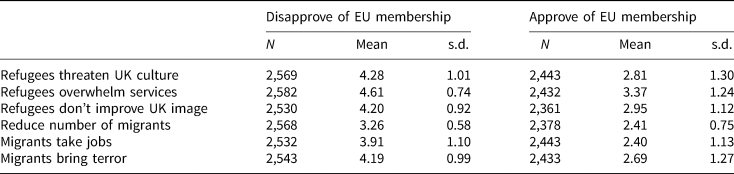
Our dependent variables seek to measure how individuals perceive migrants and refugees, as both groups were directly referenced by the Leave campaign, and both would be directly or indirectly implicated by the referendum outcome. All indicators are coded to reflect increases in anti-immigrant and anti-refugee attitudes as they relate to the economy, culture and national security. See Appendix C for details on our specific items. Table 1 presents the means and standard deviations for these variables. For this table, and for all empirical analyses, we distinguish between Leave and Remain supporters. To identify these subsets, we refer to the question, ‘Overall, do you strongly approve, approve, disapprove, or strongly disapprove of Britain's membership in the European Union?’ Those who approve and strongly approve were coded as Remain supporters, and those who disapprove and strongly disapprove were coded as Leave supporters. To ensure that these subsets were not biased by the treatment, we base these groupings on the pre-referendum measurements of this variable, which were collected in November–December 2015. This lagged measure is very close to the actual referendum result, with 50.53 per cent stating they would support remaining in the EU and 49.47 per cent stating they would support leaving. As is clearly demonstrated in Table 1, approval of EU membership appears to sharply moderate attitudes towards migrants and refugees. Across all dependent variables, Leave supporters express noticeably less immigrant-friendly attitudes.
Descriptive statistics of dependent variables, June/July 2016

The Effects of the EU Referendum on Anti-Immigrant Attitudes
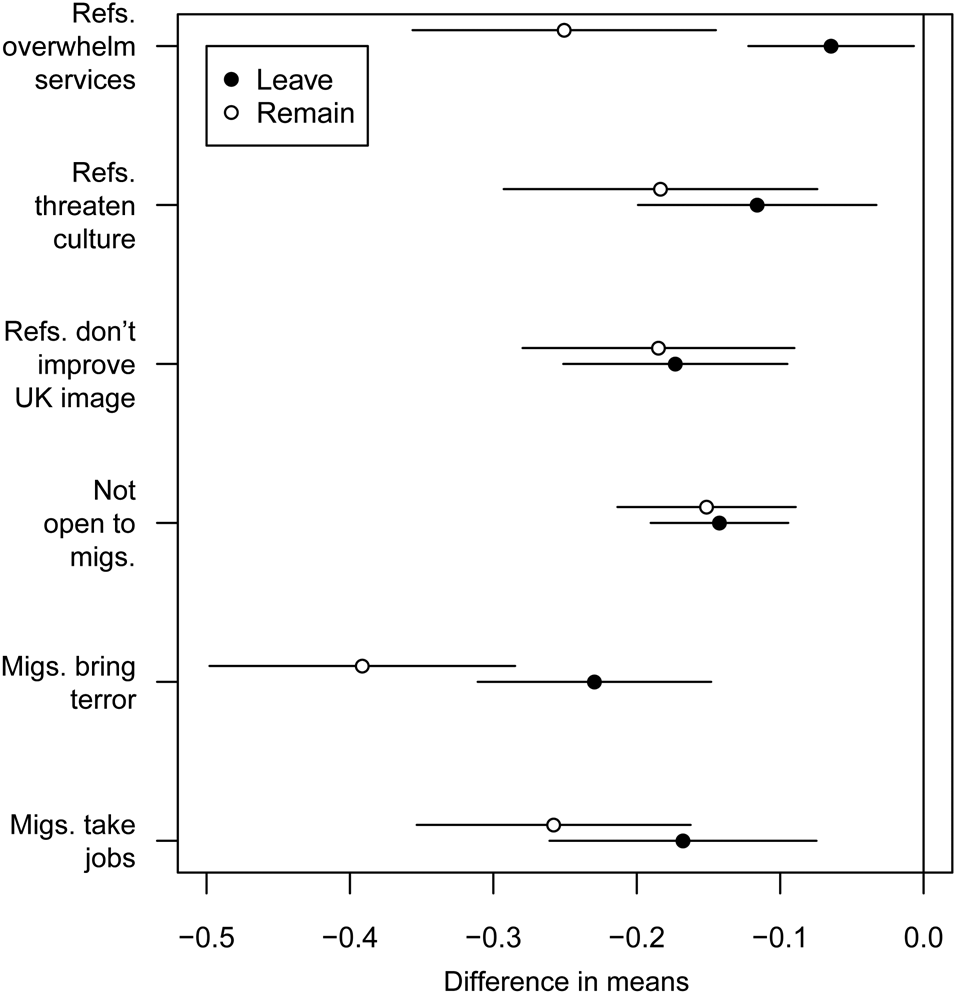
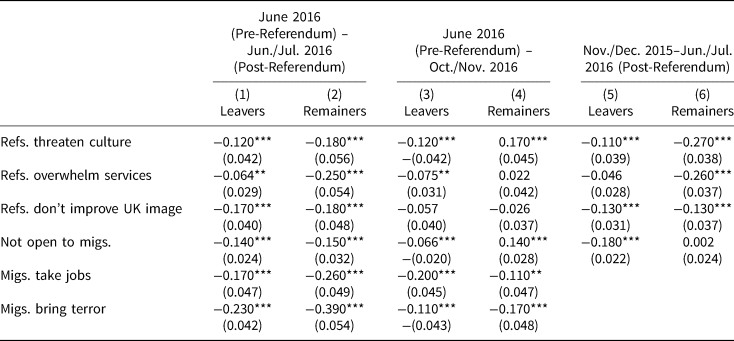
In this section we report how the result of the EU referendum shaped anti-immigrant attitudes. Figure 1 presents the average treatment effects, or the difference in means between pre-referendum and post-referendum samples, for each of our dependent variables. The error bars reflect 95 per cent confidence intervals. Each estimate in Figure 1 represents a separate difference-in-means test, weighted for representativeness. Numerical estimates for Figure 1 may be found in Columns 1 and 2 of Table 2. All models include the following control variables: gender, age, social grade, household income, education, work status, children, marital status and region of residence. These variables are included in the model to account for residual differences between the treatment and control groups that are not due to the treatment.Footnote 7
Effect of Brexit on immigration attitudes, by EU referendum preference (June/July 2016)

Effects of Brexit across different time periods

Note: each cell presents the results of a separate difference-in-means test, weighted for representativeness. All models include control variables: gender, age, social grade, household income (imputed), education, work status, children, marital status and region of residence. Tests in Columns 3–6 are conducted within subjects and SEs are clustered by individual. A detailed output can be found in Appendix G.2. *p < 0.1; **p < 0.05; ***p < 0.01
As shown in Figure 1, the Brexit outcome resulted in less hostile attitudes towards migrants and refugees. The differences in means are consistently negative, and most vary in magnitude from roughly 0.1 to 0.4. Such decreases over a one-month period are noteworthy.Footnote 8 The decrease in means is consistent across the full range of attitudes. The magnitude of the ‘Brexit effect’ is highly comparable across Leave and Remain supporters. The only exception is Refugees Overwhelm Services, for which Remainers were on average 0.18 points less inclined than Leavers to believe refugees are a drain on UK public services.
However, when we examine these differences relative to Leave or Remain camps' baseline values – the mean among the control group – Remainers' anti-immigrant attitudes consistently softened more than those of Leavers. For example, Remainers are 9 per cent less inclined to believe that Migrants Take Jobs after the Brexit outcome, relative to the baseline for this group. Leavers' attitude on this item, however, softened by 4 per cent – about half the amount. Those supporting Remain are 12 and 7 per cent less likely to believe that Migrants Bring Terror and that Refugees Overwhelm Services, respectively, relative to their baseline. Leavers' attitudes on these variables softened by much less – 5 and 2 per cent, respectively. However, the effects of Brexit are relatively comparable in magnitude for the remaining three variables when comparing differences in means to the baseline.Footnote 9
Do these effects represent a genuine and meaningful change in anti-immigrant attitudes, or are the effects short term and quick to disappear? Or did the referendum campaign raise anti-immigrant sentiments to unprecedented levels, making it appear as if there was a decrease in anti-immigrant attitudes when in fact they had simply returned to normal? To test the longevity and substantive importance of our treatment effects, we leverage the panel structure of our data. Table 2 reports a series of within-subject difference-in-means tests for different time periods. Columns 1 and 2 present numerical estimates for the treatment effects shown in Figure 1 for comparison. Odd-numbered columns refer to Leave supporters and even-numbered columns refer to Remain supporters. To test longevity, Columns 3 and 4 compare average attitudes in early June, prior to the referendum, to attitudes among those same respondents 4–5 months after the referendum (October–November 2016). To test campaign effects, Columns 5 and 6 compare average attitudes in November–December 2015, before the referendum campaign, to attitudes among those same respondents 6–7 months after the referendum.
Columns 3 and 4 of Table 2 demonstrate that, for most indicators, anti-immigrant and anti-refugee attitudes were significantly softer even several months after the referendum. This is particularly true of Leave supporters, who were less likely to harbour anti-immigrant attitudes on five of six of the indicators. Some of the differences were quite high in magnitude, such as Migrants Take Jobs, which was 0.2 points on the five-point scale. Among Remainers, the means are significantly different from the pre-referendum period for four out of six indicators. It is also worth noting that, although significant differences in attitudes persist, the magnitudes are not as large as they were straight after the referendum. In Appendix G.2, we show that many effects hold even one year after the referendum, particularly among Leavers. This evidence shows that the effect of the referendum persisted long after the final votes were tallied. As such, the decrease in anti-immigrant attitudes shown in Figure 1 does not indicate a short-lived backlash.
It is also plausible that Figure 1 simply captures a return to normal from a highly contentious and xenophobic campaign. If the referendum campaign was a unique time of heightened anti-immigrant sentiment, the average treatment effects presented in Figure 1 would not signify a post-Brexit decrease in anti-immigrant attitudes. Rather, the increase in anti-immigrant attitudes during the ten-week campaign may have created an artificially high benchmark for comparison. In the last two columns of Table 2, we compare the attitudes of the treatment group – those who were surveyed after the referendum – to the attitudes they reported in November–December 2015. We only present differences in means for the refugee indicators and one migration indicator, as these were the only dependent variables that were asked in the November–December 2015 wave of the survey.Footnote 10 The results show that anti-immigrant attitudes in the post-referendum period are lower than they were six months prior to the start of the campaign. These effects are consistent across all four indicators and among both Leave and Remain supporters. This evidence suggests that the results in Figure 1 do not merely reflect a return to normal after an unusually contentious campaign period.
In summary, we find experimental evidence that individuals in Great Britain exhibited lower levels of anti-immigrant sentiment on a wide range of indicators after the surprising outcome of the EU referendum. These effects are consistent across Leave and Remain supporters alike, despite the fact that Leave supporters were far less favourable towards migrants and refugees on average. Furthermore, these decreases are long-lasting and do not merely reflect campaign effects. In the next section, we ask why these effects occurred and compare three theoretically informed mechanisms.
Mechanisms Channelling the Brexit Effect
In order to understand what these results might mean for other populist victories – such as the election of Donald Trump or the gains made by far-right parties throughout Europe – it is important to explain why individuals softened their anti-immigrant attitudes. In this section, we consider the events of 23 June referendum, suggest theoretical mechanisms that could have driven a decrease in anti-immigrant attitudes, and test them using multiple mediation analysis.
Our experimental design, which randomly assigned individuals to be surveyed either before or after 23 June, may have captured one of two important stimuli. On the one hand, 23 June marked a commitment to reducing the ‘migrant threat’. At the very least, Brexit indicated a shift in public priorities and represented a mandate to politicians in Westminster to take immigration control more seriously. At most, Brexit promised to significantly reduce the number of immigrants in the UK and promised greater control over the types of migrants who would be allowed entry. On the other hand, the referendum outcome was not only met with an anticipation of future changes in immigration; it also triggered sweeping accusations of xenophobia, racism and nationalism (McGurn Reference McGurn2016). We argue that, in the context of this naming and shaming environment, citizens may have sought to distance themselves from xenophobic labels and align themselves more closely with anti-prejudice norms (Blinder, Ford and Ivarsflaten Reference Blinder, Ford and Ivarsflaten2013; Czopp and Monteith Reference Czopp and Monteith2003; Devine et al. Reference Devine1991; Devine Reference Devine1989; Harteveld and Ivarsflaten Reference Harteveld and Ivarsflaten2018; Moss-Racusin, Phelan and Rudman Reference Moss-Racusin, Phelan and Rudman2010).
Attenuating the Migrant Threat
It is axiomatic that individuals become hostile when they feel threatened or unprotected (Esses, Jackson and Armstrong Reference Esses, Jackson and Armstrong1998; Riek, Mania and Gaertner Reference Riek, Mania and Gaertner2006; Scheve and Slaughter Reference Scheve and Slaughter2001; Stephan, Ybarra and Bachman Reference Stephan, Ybarra and Bachman1999). By changing how UK citizens felt about the migrant threat, the EU referendum may have attenuated their anti-immigrant attitudes. Prior studies suggest two ways in which the Brexit referendum may have altered perceptions of the migrant threat: (1) by leading citizens to expect reductions in economic competition from foreign workers and (2) by giving citizens a greater sense of control over political decisions. We will refer to these respective mechanisms as economic insecurity and locus of control. We posit that each mechanism may have been triggered by the Brexit referendum, ultimately shaping anti-immigrant attitudes.
Economic Insecurity
Economic insecurity is a classic driver of immigration attitudes (Hainmueller and Hopkins Reference Hainmueller and Hopkins2014). According to the seminal model by Scheve and Slaughter (Reference Scheve and Slaughter2001), low-skilled migration increases the supply of low-skilled labor, depressing wages and increasing job competition (Mayda Reference Mayda2006; Scheve and Slaughter Reference Scheve and Slaughter2001). Malhotra, Margalit and Mo (Reference Malhotra, Margalit and Mo2013) suggest that economic insecurity also increases opposition to migration among workers in internationally-competitive high-skilled sectors. As such, migrants may present a threat to natives and drive anti-immigrant attitudes.
Economic insecurity can manifest itself in two key ways: as pocketbook insecurity (the threat that migrants will directly affect household finances) or sociotropic insecurity (the fear that immigrants hurt the country's economy). In other words, whereas pocketbook insecurity refers to self-interested concerns, sociotropic insecurity refers to threats affecting the nation as a whole. The Brexit outcome promised to improve the economy in part by changing the volume and composition of immigration from the EU. From a pocketbook perspective, natives may have expected Brexit to deliver lower labor market competition and higher wages. From a sociotropic perspective, many individuals may have expected lower migration to benefit the UK economy (Vasilopoulou Reference Vasilopoulou2016). It follows that, with an anticipated reduction in the migrant threat, individuals may have developed more favourable attitudes towards migrants (Coenders et al. Reference Coenders2008; Lahav Reference Lahav2004). It is important to note that this explanation may apply to both Leave and Remain camps, as Remainers may also have perceived migrants as a threat to the economy, but – on balance – still may have wished to remain in the EU.
Locus of Control
We also consider how the Brexit referendum may have softened anti-immigrant attitudes by giving citizens a greater sense of control. A perceived increase in control over external threats can attenuate or even reverse out-group hostility (Greenaway et al. Reference Greenaway2014; Rothschild et al. Reference Rothschild2012). Within the migration literature, there is a consensus that anti-immigrant sentiments are galvanized when citizens are triggered to view immigrants as external threats (Brader, Valentino and Suhay Reference Brader, Valentino and Suhay2008; Hainmueller and Hopkins Reference Hainmueller and Hopkins2015; Hopkins Reference Hopkins2010; Sniderman, Hagendoorn and Prior Reference Sniderman, Hagendoorn and Prior2004), and there is evidence that these sentiments are softened by an increased sense of control (Harell, Soroka and Iyengar Reference Harell, Soroka and Iyengar2017).
To be sure, locus of control is a more plausible expectation for Leave supporters – the victors of the referendum – for whom Brexit explicitly promised an opportunity to ‘take back control’ (Clarke, Goodwin and Whiteley Reference Clarke, Goodwin and Whiteley2017; Prosser, Mellon and Green Reference Prosser, Mellon and Green2016). However, even those who supported the Remain campaign may have experienced some sense of relief that the UK would soon increase control of its borders. That is, they may have desired to remain in the EU for any number of reasons, while at the same time feeling some level of anxiety about a perceived lack of control over immigration.
There are two ways that the Brexit referendum could have been channelled through a locus of control mechanism: by allowing citizens to feel a renewed sense of personal control over political decisions or by transferring control to a trusted government. Theoretically, any increase in control over perceived threats – whether that control is attributed to the individual or to the state – would reduce out-group hostility (Harell, Soroka and Iyengar Reference Harell, Soroka and Iyengar2017). We operationalize personal control as external efficacy (see Judge et al. Reference Judge2002), with the expectation that individuals who feel a greater sense of power over political processes would feel less inclined to scapegoat migrants and minorities.
Accusations of Xenophobia and Anti-Prejudice Norms
In this section, we demonstrate that the referendum outcome did not take place in a vacuum; it was situated in a context of wholesale accusations of bigotry and xenophobia. Theoretically, individuals may have softened their anti-immigrant attitudes to counteract these accusations.
This expectation follows from the Motivation to Control Prejudice (MCP) theory, which maintains that individuals are averse to breaking anti-prejudice norms and will deliberately seek to control actions, expressions or thoughts that can be deemed to violate these norms (Blinder, Ford and Ivarsflaten Reference Blinder, Ford and Ivarsflaten2013; Czopp and Monteith Reference Czopp and Monteith2003; Devine Reference Devine1989; Dovidio and Gaertner Reference Dovidio and Gaertner2004; Fazio et al. Reference Fazio1986; Moss-Racusin, Phelan and Rudman Reference Moss-Racusin, Phelan and Rudman2010). The theory distinguishes between automatic and controlled processes in prejudice. To a greater or lesser extent, many individuals harbor automatic negative stereotypes about out-groups (for example, Coenders et al. Reference Coenders2008; Sniderman, Hagendoorn and Hagendoorn Reference Sniderman, Hagendoorn and Hagendoorn2007). However, at the same time, they may be motivated to inhibit the influence of these prejudices to avoid being perceived as bigoted, either by others or by themselves (Blinder, Ford and Ivarsflaten Reference Blinder, Ford and Ivarsflaten2013; Monteith et al. Reference Monteith2002). Specifically, Blinder, Ford and Ivarsflaten (Reference Blinder, Ford and Ivarsflaten2013) find that individuals' internal motivation to control manifestations of prejudice significantly softens attitudes towards immigrants. This theory expects that responses to anti-prejudice norms result in meaningful attitudinal changes because they involve a degree of self-reflection about one's level of prejudice.
To test whether or not this mechanism was activated, we examine respondents' aversion to UKIP leader Nigel Farage. Aversion to Farage is a valid proxy for MCP for two key reasons. First, citizens often turn to highly visible anti-immigrant elites to connect immigration to other political issues (Ivarsflaten Reference Ivarsflaten2005). In the UK, it was Farage who successfully linked UKIP's single core issue – leaving the EU – with immigration (Evans and Mellon Reference Evans and Mellon2019) and addressed the concerns of those ‘left-behind’ voters who felt unheard by previous Labour or Conservative governments (Ford and Goodwin Reference Ford and Goodwin2017). Secondly, Farage is a quintessentially xenophobic figure in modern British politics, who can credibly be seen as a ‘messenger’ for anti-immigrant sentiment. According to Blinder, Ford and Ivarsflaten (Reference Blinder, Ford and Ivarsflaten2013, 845), politicians or parties with ‘clear racist or fascist reputations’ can be expected to ‘activate the antiprejudice norm’. Indeed, Farage readily flouted anti-prejudice norms. He is well known for his offensive comments about migrants, associating them with crime, shortage of housing, healthcare, school places and jobs for young people as well as congestion on the M4 highway (BBC 2016). During the referendum, he introduced the prominent ‘Breaking Point’ poster featuring thousands of refugees at the Slovenian border. The poster was widely condemned as xenophobic and racist, and made even fellow Leave campaigner Michael Gove ‘shudder’ (Sommers Reference Sommers2016). Such toxic figures make people ‘aware that a norm is at stake, before they take the cognitive effort to control prejudice and adjust their response in accordance with it’ (Harteveld, Kokkonen and Dahlberg Reference Harteveld, Kokkonen and Dahlberg2017, 372).
Therefore, we expect that aversion to Farage will account for a significant component of the post-Brexit change in anti-immigrant attitudes. We operationalize aversion to anti-prejudice norm breaking with an indicator that measures feelings towards Nigel Farage. In line with our previous mediating mechanisms, we expect the Brexit referendum may have triggered an increase in aversion to this controversial, xenophobic figure. According to the MCP theory, such an averse reaction will result in a softening of anti-immigrant attitudes.
We expect that accusations of xenophobia will not have affected the electorate uniformly. Individuals who do not internalize anti-prejudice norms are unlikely to change their attitudes towards immigrants (Devine et al. Reference Devine1991). However, the mechanism is theoretically relevant for Leave and Remain supporters alike, as accusations of xenophobia were cast indiscriminately across the country. Headlines from pro-Remain British newspapers such as The Guardian and The Independent included, ‘Racism is spreading like arsenic through the water supply’ (Ramesh Reference Ramesh2016) and ‘Xenophobia has become the new normal’ (Cooper Reference Cooper2016). The pro-Leave Daily Mail newspaper lamented that, ‘Those who were concerned about the effects of uncontrolled immigration on jobs, wages, housing, public services and the welfare of their children were smeared as “racists”’ (Daily Mail 2016).
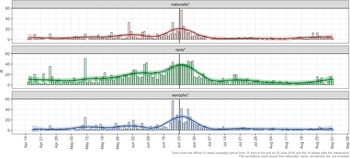
Before conducting statistical tests of this causal mechanism, it is important to demonstrate that such normative judgements and accusations were, in fact, pervasive in the context of the referendum. We conducted a straightforward analysis of newspaper articles published before and after the Brexit referendum.Footnote 11 We collected all UK national newspaper articles from the Nexis archive that mentioned immigra*, migra* or refugee at least three times from 15 April to 1 September 2016. This period covers the 10-week campaign prior to the referendum and a matching 10-week period afterwards. We deliberately maintained a fairly broad search, as we are interested in how UK newspapers framed migration-related news quite generally. See Appendix D for further descriptive information about the dataset and narrower search strategies, which did not substantially change our results.
Using this corpus, we examine whether there is any evidence that the referendum sparked concerns about prejudice. We identify three keywords connoting prejudice that can be linked directly to anti-immigrant attitudes in the UK context: nationalism, racism and xenophobia. These words carry judgemental and negative connotations. As such, we believe they are useful indicators of normative concerns or accusations.
We plot the number of articles per day that contain one of these three keywords in Figure 2.Footnote 12 The plots show that the frequency with which these normatively loaded keywords were mentioned in the context of immigration is highly clustered around 23 June. This suggests that anticipating the Brexit referendum and reflecting on the surprising outcome may have prompted a discussion of prejudice towards migrants.
Number of migration-related UK newspaper articles per day mentioning nationalism, racism and xenophobia
Note: data cover the official 10-week campaign period from 15 April to 23 June 2018 and the 10 weeks after the referendum. The wordstems used means that nationalist, racist, xenophobic etc. are included.

It follows from MCP theory that individuals may have deliberately or inadvertently softened their anti-immigrant attitudes in the face of these normative judgements. This analysis underscores the importance of testing an MCP mechanism as an alternative to locus of control.
Channeling the effects of Brexit
In this section, we test how these mechanisms – economic insecurity (pocketbook or sociotropic), locus of control (political efficacy or government trust), and anti-prejudice norms (aversion to Farage) – channel the effects of the Brexit referendum. We begin by examining the effects of our treatment on each of the theoretical mediators and then use multiple mediation analysis to disentangle the causal chain.
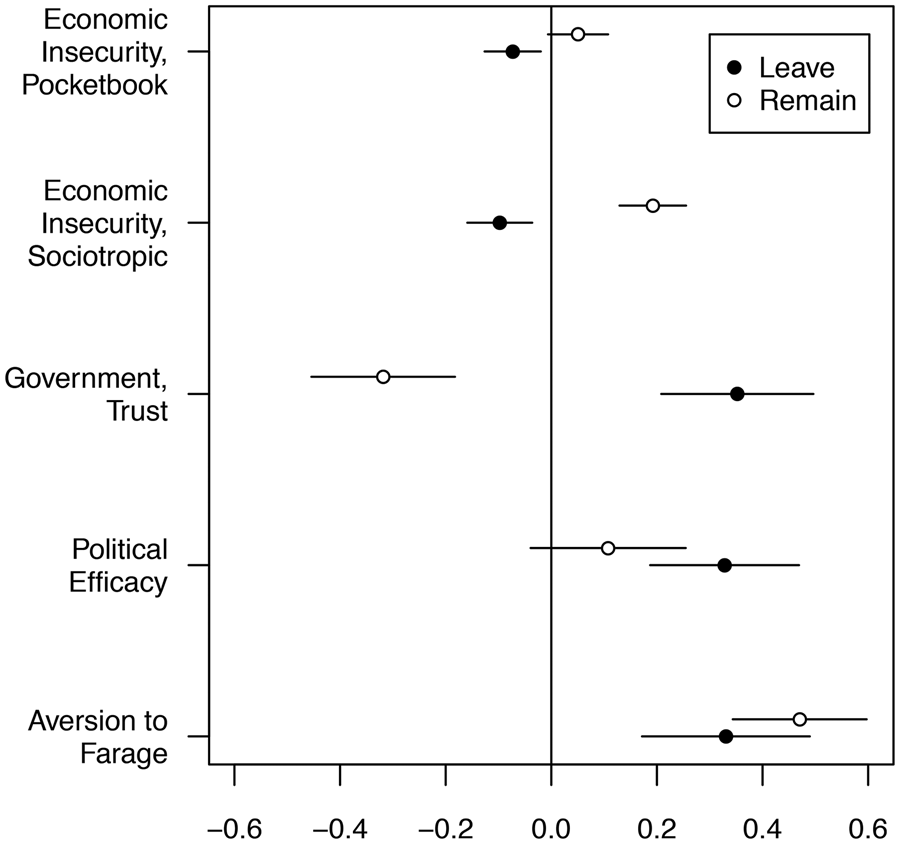
Figure 3 shows the effects of the referendum on each of the potential mediators. For the most part, the Leave and Remain camps responded very differently to the outcome of the referendum. This is particularly true of the mediators relating to economic insecurity and government trust. We turn first to economic insecurity. Among Remainers, pocketbook insecurities increased post referendum, but the magnitude of the change is small (0.05 points) and is not significant at the 0.05 level. Sociotropic insecurity increased by a larger amount, 0.19, and this effect is statistically significant. This outcome is understandable, given that the Remain campaign continuously stressed the negative effect that leaving the EU would have on the British economy. Supporters of the Leave campaign, however, experienced reduced economic insecurity, making them feel somewhat more optimistic about the economy in the aftermath of the Brexit referendum. Post-referendum means decreased by −0.097 for sociotropic insecurities and −0.073 for pocketbook insecurities. While small in magnitude, these values are statistically significant at the 0.05 level.
Effect of Brexit on mediators, by EU membership preference
Note: Each estimate represents a separate difference-in-means test, weighted for representativeness. The full output for each difference-in-means test can be found in Appendix G.3.

We now turn to our locus of control indicators, external efficacy and trust in government. After the referendum, Leave supporters reported much higher levels of efficacy and trust in government. It is plausible that, after long feeling ignored by experts and politicians, the outcome led Leave supporters to feel the government could be trusted to carry out a mandate more in line with their preferences. Remain supporters did not feel the same way. Losing the referendum led them to trust the government less, with a magnitude that closely mirrors the increase in trust among Leave supporters.
In contrast with the other theoretical mechanisms, the effects of Brexit on aversion to breaking anti-prejudice norms were remarkably consistent across Leave and Remain supporters. Dislike of Nigel Farage increased for both Leave and Remain supporters after the referendum, indicating that both camps may have reacted to accusations of xenophobia and racism by distancing themselves from a prominent anti-prejudice norm breaker. The direction of the effects is positive for both groups, and the magnitudes are also roughly similar; Remainers increase their aversion to Farage after the referendum by 0.47 and Leavers by 0.33.
Causal Mediation Analysis
Having estimated the effect of the EU referendum on each mediator,Footnote 13 we estimate the average causal mediation effect (ACME), which quantifies the extent to which the treatment affects the outcome through the mediator. In other words, the mediation effect is a component of the total effect of the treatment on the outcome (Imai et al. Reference Imai2010). In our case, the ACME may be interpreted as the effect of observing the referendum outcome on each migrant/refugee attitude that is due to the mediator in question (economic insecurity, locus of control or anti-prejudice norms).
Of course, it is not likely that only one mechanism is at play. Indeed, we hypothesize several competing mediators. To the extent that our competing mediators are correlated with one another, the mediation effects will be confounded. Therefore, we use multiple mediation analysis to control for alternative mediators. We estimated the ACMEs using the multiple mediation function within the R package mediation, advocated in Imai, Keele and Tingley (Reference Imai, Keele and Tingley2010).
Critical for the estimation of the ACME is the sequential ignorability assumption, which states that (1) the treatment assignment is statistically independent of the outcome and the mediator and (2) the mediator is ignorable given the treatment status and pre-treatment confounders (Imai et al. Reference Imai2011). In our experimental study, the effect of treatment assignment is ignorable even without controlling for the effect of pre-treatment confounders. However, we cannot necessarily assume that there are no confounders affecting the relationship between our mediators and immigration attitudes (Imai et al. Reference Imai2010; Imai et al. Reference Imai2011). To mitigate this concern, we include the lagged values of the mediators measured months before the referendum.
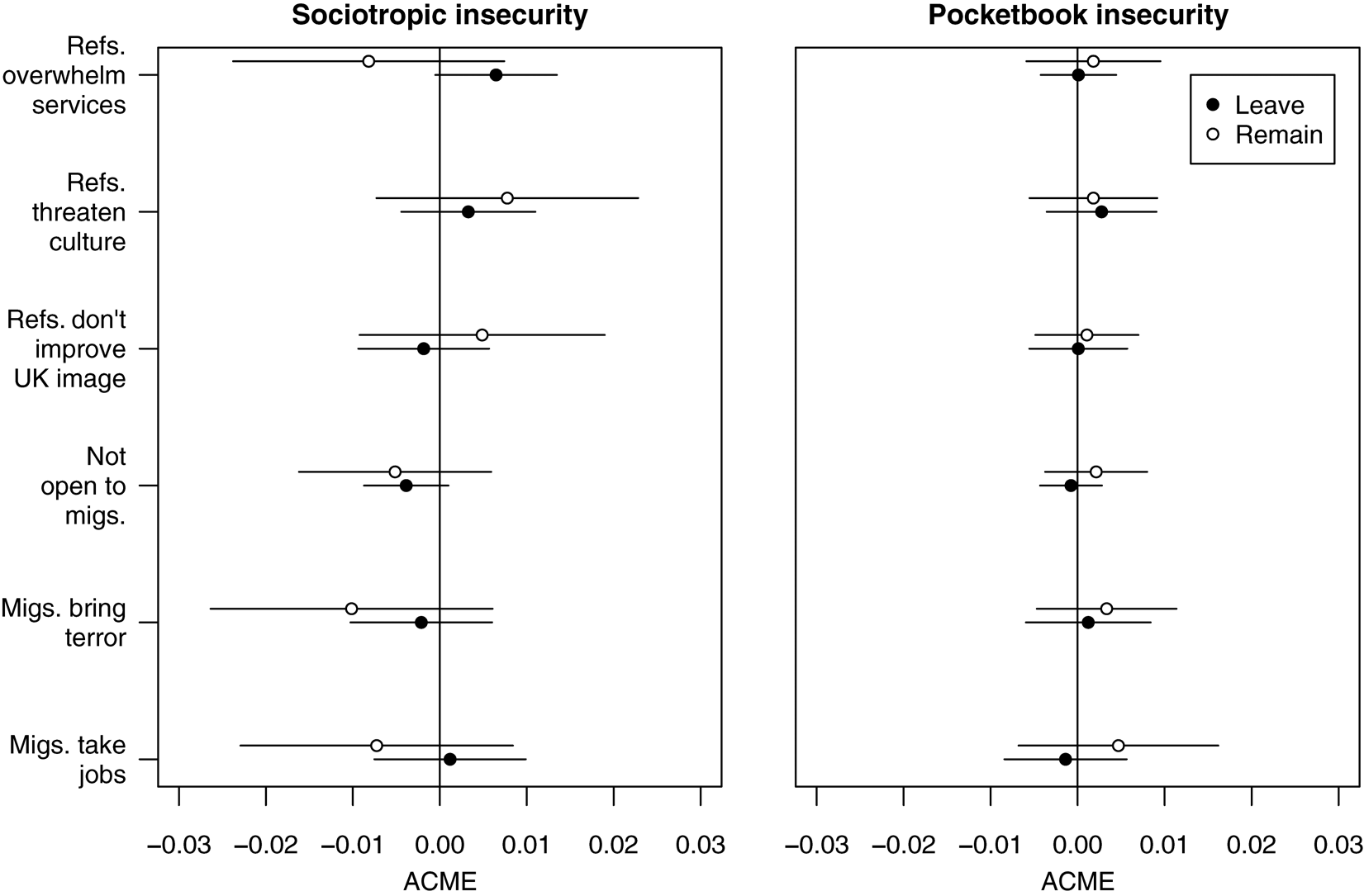
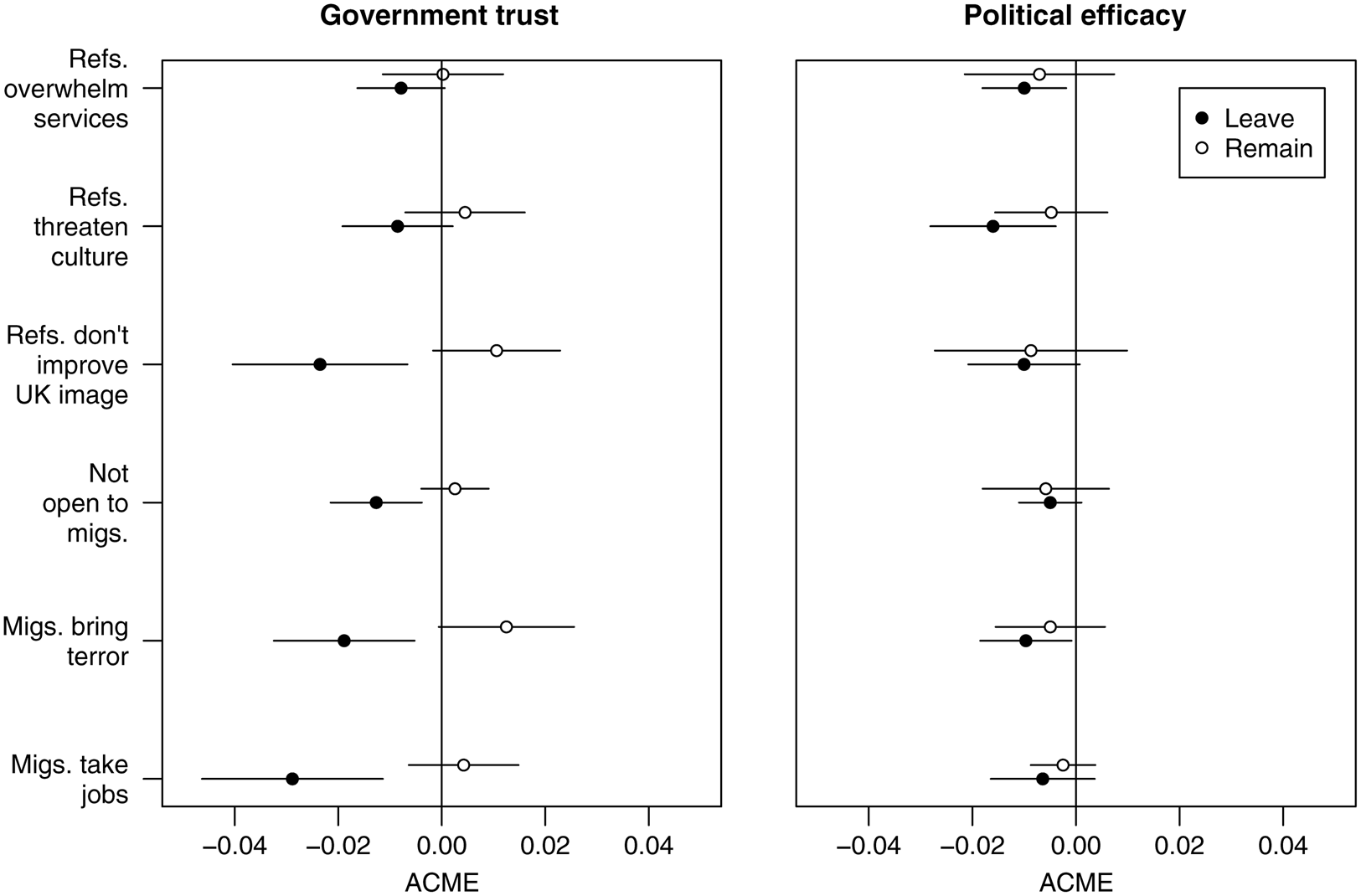
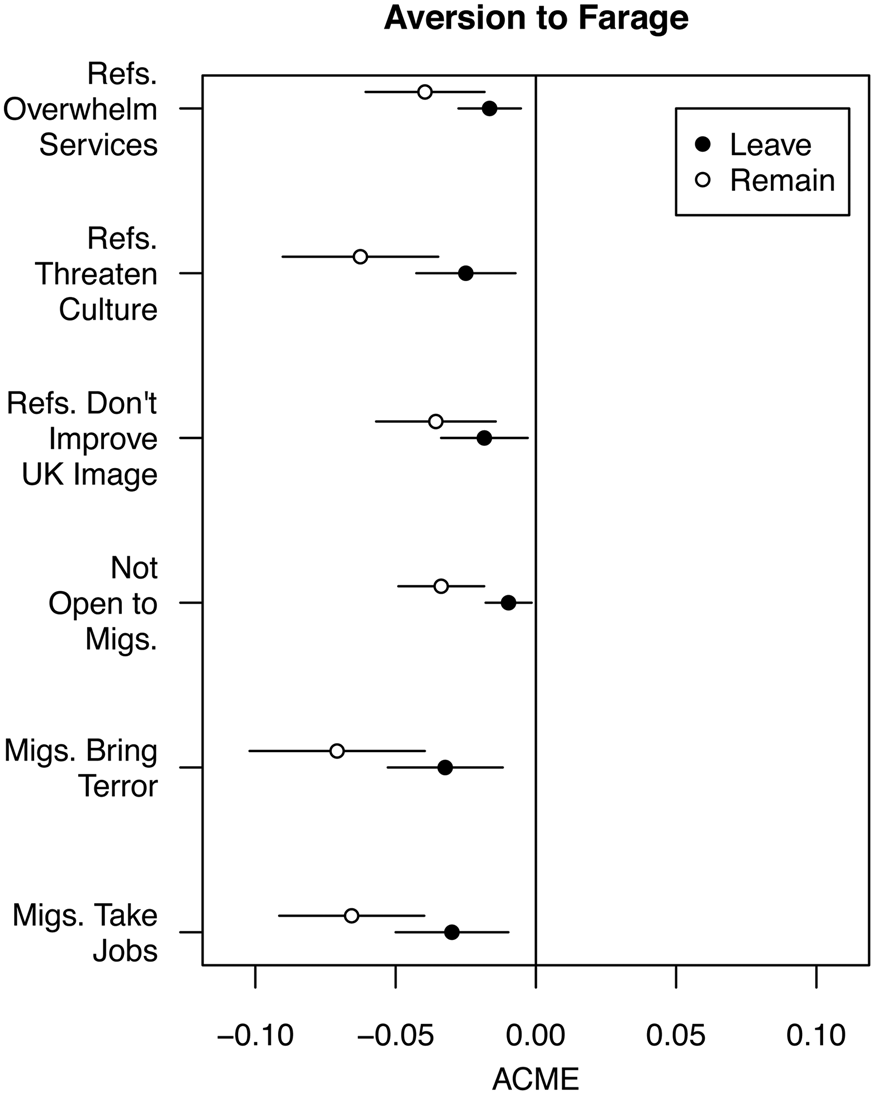
Figures 4–6 show the ACMEs for each mediator. Each estimate within a figure represents a separate multiple causal mediation test: one for each of the six dependent variables. Each model includes the main mediator, all alternative mediators and the lagged values of each mediator. The ACME confidence intervals are based on nonparametric bootstrap with 1,000 resamples. All equations were estimated using least squares and weights are applied for representativeness.Footnote 14
Average causal mediation effect: economic insecurity

Average causal mediation effect: locus of control

Average causal mediation effect: anti-prejudice norms

We begin with the economic insecurity mechanism. Recalling Figure 3, the effects of the Brexit outcome diverged significantly between Leave and Remain supporters, triggering a decrease in insecurities among the former and an increase in insecurities among the latter. Figure 4 clearly shows that economic insecurity was not a significant component of the total effect of the referendum on immigration attitudes. None of the ACMEs for sociotropic insecurity or pocketbook insecurity are significant at the 0.05 level. The ACMEs are also very small in magnitude, particularly for the pocketbook insecurity mechanism.
We now turn to our second mechanism, the impact of locus of control in channelling Brexit's effect on immigration attitudes. This mechanism is operationalized as trust in government and political efficacy. Recalling Figure 3, individuals who preferred to leave the EU generally developed a higher trust in government and a greater sense of efficacy after 23 June. Remainers, however, did not feel an increased sense of efficacy, and their trust in government decreased. Figure 5 shows that the effects of Brexit on anti-immigrant attitudes among Leavers were mediated by government trust and, to a lesser extent, political efficacy. Theoretically, Leavers felt comforted by the perception that their voices were finally heard in Westminster, and this sense of comfort reduced the need to lash out against out-groups. Specifically, the increase in government trust significantly channelled the effects of all of the migrant-related attitudes, but only one out of three of the refugee-related attitudes. Coefficients are relatively small: the highest is 0.03 for the Migrants Take Jobs indicator. The trust and efficacy pathways were not significant for Remainers at the 0.05 level.
Figure 6 shows the anti-prejudice norm mechanism, operationalized as aversion to Nigel Farage. Recalling the results in Figure 3, the Brexit referendum triggered an increase in Farage aversion for both sides of the campaign. When bombarded with accusations of xenophobia and racism, both Leavers and Remainers distanced themselves from the nationalist and xenophobic branch of the Leave campaign. In Figure 6, we see again that both Leavers and Remainers decreased their anti-immigrant attitudes when their aversion to Farage increased. This is the only mechanism we have tested that mediates the effects of Brexit for Leavers and Remainers alike. Of course, the magnitudes of those effects differ, as the ACMEs are somewhat larger for Remainers. The ACMEs among Leavers are smaller, but they are statistically significant at the 0.05 level. Comparing results among Leavers to the government trust mediator, we see larger ACMEs for three out of six dependent variables. For Migrants Bring Terror, the ACME for the anti-prejudice norm mechanism is −0.032, approximately 1.5 times larger than that of government trust; Refugees Overwhelm Services is roughly twice as large (−0.016), and the ACME for Refugees Threaten Culture is 2.5 times as large as that of government trust (−0.025).
Discussion
While there is a wealth of literature on how attitudes towards immigrants increase support for populist parties, academic research provides few clues about how populist victories shape anti-immigrant attitudes. We examine how the Brexit referendum shaped anti-immigrant attitudes using an experimental design. We find that, despite media pundits’ warnings that populist victories would give rise to rampant anti-immigrant sentiment, attitudes actually softened on average, and these results were consistent among both ‘Leave’ and ‘Remain’ supporters.
But how did an electoral victory with populist and anti-immigrant undertones decrease anti-immigrant attitudes? We suggest three competing explanations. First, it is possible that UK citizens felt threatened by immigration, and the Brexit result helped them feel more secure. We test whether these feelings manifested themselves through economic insecurity or through a more general feeling of political control. It is also possible that the context of the referendum triggered a softening in anti-immigrant attitudes by emphasizing anti-prejudice norms. The days immediately surrounding the referendum were saturated with accusations of xenophobia and racism and, in this context, individuals might have felt compelled to distance themselves from prejudiced groups and sentiments. Through multiple mediation, we find evidence for both explanations. The first mechanism significantly channeled the effects of Brexit only among Leave supporters, who softened their anti-immigrant attitudes through an increased sense of control, but not economic security. By contrast, we find that the second mechanism softens anti-immigrant attitudes among supporters of both camps. This results in what we label a ‘populist paradox’, in which an anti-immigrant victory may provoke a backlash against anti-immigrant rhetoric.
We contend that our findings are not limited to the UK experience, but are transferable to other countries – particularly in Europe – where the success of populist, right-wing parties is due, in part, to the flow of migrants from Syria, North Africa and Eastern Europe. Indeed, because we explicitly test key mechanisms that led to a shift in attitudes, we are able to draw two conclusions about which contexts may – or may not – trigger a populist paradox. First, we believe our results could be replicated in a context without a winner-takes-all electoral victory, as in the case of the Brexit referendum or the US election. We expect that populists gaining power through a governing coalition, as has happened in Austria, Switzerland, Norway and Italy, can also provoke accusations of out-of-control xenophobia and prejudice. Strictly speaking, our results imply that a populist victory may not be a necessary or sufficient condition for a cooling of attitudes.
Secondly, we would predict that a populist victory would have limited effects on attitudes in some contexts. Key to the MCP theory is the presence of an anti-populist backlash and pervasive accusations of xenophobia or racism. In the absence of such a backlash, it is not clear that attitude change would take place. Similarly, the anti-prejudice norm mechanism cannot take root in contexts where there is widespread support for politically incorrect or notoriously prejudiced groups. In theory, such contexts would not have a sufficiently liberal cultural base to result in public shaming and accusations. For instance, we found that the MCP mechanism did not significantly channel the effects of Brexit among UKIP supporters (see Appendix F).
We acknowledge three important limitations to the mechanisms we identified and tested in this article. First, we acknowledge that Nigel Farage was a complex figure in British politics, and it is possible that post-referendum aversion to him implied some other mechanism aside from MCP. We believe that MCP is the most compelling explanation for why aversion to Farage accounts for a post-referendum decline in anti-immigrant attitudes, but other explanations – an aversion to political extremism, for example – should also be considered. We are unable to test such nuanced mechanisms here, but we believe this is an important task for future work.
Secondly, it is not obvious whether the response to anti-prejudice norms reflects a real shift in anti-immigrant attitudes or, alternatively, a shift in individuals' willingness to report anti-immigrant attitudes, essentially displaying social desirability bias. We believe that if the referendum, at the very minimum, shifted perceptions of what is deemed socially acceptable, then this shift is important in and of itself. Moreover, individuals' self-reported anti-immigrant attitudes are meaningful indicators. If respondents are less likely to report prejudiced feelings in an anonymous survey, it follows that they might also be less likely to make a prejudiced comment or actively support a prejudiced group in public. In methodological terms, research on mode effects suggests that online surveys – such as ours – have an advantage over traditional face-to-face techniques precisely because they tend to reduce social desirability bias (Kreuter, Presser and Tourangeau Reference Kreuter, Presser and Tourangeau2008; Malhotra and Krosnick Reference Malhotra and Krosnick2007). In future work, the use of experimental techniques, such as list experiments or randomized response techniques, could help tease out the extent of social desirability bias within the anti-prejudice norm mechanism we have identified.
Thirdly, while our evidence suggests that the widely reported rise in hate crimes after the referendum did not represent a widespread increase in anti-immigrant attitudes, many questions remain about the causes and meanings of these reports. On the one hand, it is possible that the surge can be attributed, at least in part, to an increase in reporting rather than an increase in crime. The police commissioner of Gwent, the UK region with the largest post-referendum increase in such crimes, acknowledged this as a possible explanation (Bulman Reference Bulman2017). On the other hand, it is also possible that a small subset of individuals with strong anti-immigrant attitudes may have expressed their feelings more publicly after the referendum, betraying the average trend of softening anti-immigrant attitudes. Indeed, research conducted in the context of the 2016 US presidential election found that Americans who privately held xenophobic positions felt more comfortable about expressing those positions publicly after the election of Donald Trump, but private attitudes towards migrants did not change (Bursztyn, Egorov and Fiorin Reference Bursztyn, Egorov and Fiorin2017). Either of these two explanations could underlie the post-Brexit rise in reported hate crimes, and neither is inconsistent with our evidence. We encourage future research to address this important problem.
To conclude, our findings have a wider implication for future research. There is a tendency in academic scholarship, just as in popular discourse, to focus on negative attitudes towards migrants. There is a wealth of public opinion research on the drivers of anti-immigrant attitudes (see Brader, Valentino and Suhay Reference Brader, Valentino and Suhay2008; Hainmueller and Hopkins Reference Hainmueller and Hopkins2015; Hopkins Reference Hopkins2010; Sniderman, Hagendoorn and Prior Reference Sniderman, Hagendoorn and Prior2004; Wright, Levy and Citrin Reference Wright, Levy and Citrin2016), but far less attention has been devoted to exploring how attitudes towards migrants can become less hostile. Reversing the direction of such attitudes is not a matter of course. A great deal of evidence suggests that intolerance is easier to trigger than tolerance (Gibson and Gouws Reference Gibson and Gouws2005; Kuklinski et al. Reference Kuklinski1991; Stouffer Reference Stouffer1955). Gibson (Reference Gibson1998) suggests this ‘negativity bias’ arises because attitudes towards these groups are more accessible than attitudes towards tolerance. We suggest that researchers should not exclusively reproduce this negativity bias by examining whether or not it is possible for anti-immigrant attitudes to soften, what causes those attitudes to soften and under what conditions. Our evidence suggests that populist surges are not unconstrained, but may face a counter-movement as individuals seek to protect societal norms.
Supplementary material
Supplementary material. Data replication sets can be found in Harvard Dataverse at: https://doi.org/10.7910/DVN/EJWXAO and online appendices at: https://doi.org/10.1017/S0007123419000656.
Acknowledgements
We would like to thank the participants of the Kent-Manchester Brexit Early Career Workshop as well as the research seminars at Royal Holloway's Department of Politics and International Relations and the University of Arizona's School of Politics and Public Policy. We would like to thank Jack Blumenau, Chris Hanretty, Alan Renwick, and our anonymous reviewers for their helpful comments and suggestions. We also thank the Bill and Melinda Gates Foundation for generous support (Award number 24609).