INTRODUCTION
In the Italian language the third person of direct object clitic pronouns marks person (third), number (singular or plural), and grammatical gender (masculine or feminine). In particular, clitic pronouns assume two singular forms (feminine la (1a) and masculine lo (1b)) and two plural forms (feminine le (1c) and masculine li (1d)):
-
(1) a. Singular (feminine): il bambino la mangia ‘the boy eats it’
b. Singular (masculine): la bambina lo mangia ‘the girl eats it’
c. Plural (feminine): il bambino le mangia ‘the boy eats them’
d. Plural (masculine): la bambina li mangia ‘the girl eats them’
Competence in the use of clitic pronouns appears quite late in Italian children with typical development compared to, for example, definite articles and verb inflections (e.g. Dispaldro, Reference Dispaldro2012). Previous studies of both spontaneous and elicited production have shown that, in the initial stages of grammar acquisition, clitic pronouns are often omitted from the sentence (Caprin & Guasti, Reference Caprin and Guasti2009; Dispaldro, Caselli & Stella, Reference Dispaldro, Caselli and Stella2009); two-year-old Italian-speaking children often produce la mangia ‘s/he eats it’ as mangia ‘s/he eats’, omitting the direct object clitic. When the pronoun is present, substitution errors are frequent, especially for plural forms, which are more difficult to acquire than singular forms. With respect to grammatical gender, Dispaldro and his colleagues (2009) noted that Italian children with typical language overused the masculine clitic lo as a substitute rather than using the two feminine clitics la and le; the authors have suggested that lo might initially function as a proto-clitic, that is, essentially as a grammatical place holder, rather than a form with all of the grammatical features reflected in adult grammar (for French, see also Jakubowicz, Nash, Rigaut & Gérard, Reference Jakubowicz, Nash, Rigaut and Gérard1998).
The form of the third person of direct object clitic pronouns (la, lo, le, li) depends on the form of the nouns to which they refer. In the Italian language, the singular and plural of the noun are assigned in the form of a morphological suffix: in general, -a (2a) and -o (2b) mark singular whereas -e (2c) and -i (2d) mark plural. With respect to gender, Italian is a language with a ‘formal gender system’ (Corbett, Reference Corbett1991) in which all nouns are marked for gender (masculine and feminine): in general, most feminine nouns end with -a (2a) or -e (2c), whereas most masculine nouns end with -o (2b) or -i (2d).
-
(2) a. Singular (feminine): mela ‘apple’
b. Singular (masculine): gelato ‘ice-cream’
c. Plural (feminine): mele ‘apples’
d. Plural (masculine): gelati ‘ice-creams’
The antecedent to which a clitic pronoun refers can be introduced either by a direct object mentioned earlier in the sentence (3a), or by an extralinguistic element present in the context (3b), as long as the speakers share the same knowledge about it (Korzen, Reference Korzen2003).
-
(3) a. Il bambino prende la mela e poi la mangia ‘The boy takes the apple and then he eats it’
b. Luca, guarda come il bambino la mangia ‘Luca, look how the boy eats it’ (in a context in which a child is eating an apple)
Despite the fact that the syntactic properties of gender and number of nouns are both stored at the lemma level (e.g. Levelt, Reference Levelt1989), it is well known that they are grammatical features based on different representations: masculine and feminine refer to an intrinsic property of the lexical item that is independent from the natural sex of referents (Corbett, Reference Corbett1991), whereas singular and plural area non-intrinsic feature of nouns based on the conceptual level of quantity (Li, Barner, Ogura, Yang & Carey, Reference Li, Barner, Ogura, Yang and Carey2009). Specifically, at least for Romance and Germanic languages, number information represents a grammatical category that specifies whether a word is singular or plural. However, singular and plural also provide concrete and pragmatically visible information that distinguishes referents in terms of two different categories chosen via the operation of numeration (cardinality): singular is ‘one referent’ whereas plural is ‘more than one referent’. This distinction is dichotomous by nature because knowing the exact number of referents is not important (two or three objects are all more than one referent). Moreover, it is independent of the language itself: Li and colleagues (2009) showed that it is the prelinguistic conceptual distinction ‘one vs. more than one’ that supports the acquisition of singular and plural morphology: using the manual search task, Mandarin-learning infants aged 1;7 successfully distinguished 1 versus 4 but not 2 versus 4; thus, infants succeeded at all singular vs. plural comparisons but failed at comparisons involving two plural sets.
In contrast, the link between gender assignment and the conceptual properties of a referent has been widely recognized as arbitrary (e.g. Aikhenvald, Reference Aikhenvald2000). Masculine and feminine are attributable to a property of the referent only for some animate entities: for example mamma ‘mum’ and mucca ‘cow’ are feminine both for grammatical and biological gender, whereas figlio ‘son’ and toro ‘bull’ are masculine; only in these specific cases is the assignment of gender to a noun transparent and related to a visible property of the referent (its natural gender). However, in the great majority of words, biological sex is irrelevant to grammatical gender (epicene nouns such as topo ‘mouse’). Finally, for all inanimate entities, no correspondence can be established at all as gender is not a property of the referent; in these cases gender assignment is based only on the form of the noun, such as a morphological suffix (examples (2a) to (2d)). Desrochers and Brabant (Reference Desrochers and Brabant1995) found that adult decision-making about gender is faster when nouns refer to human entities rather than to inanimate objects. Moreover, in order to classify animal nouns as masculine or feminine, Italian and English children are mostly influenced by the natural gender of the referent (e.g. cow [feminine referent] vs. crab [epicene noun]) (Belacchi & Cubelli, Reference Belacchi and Cubelli2012). Focusing on studies in Italian (Orsolini, Fanari & Di Giacinto, Reference Orsolini, Fanari and Di Giacinto1994) and Icelandic (Mulford, Reference Mulford1985), it would seem that five-year-old children are not able to identify the referent of a pronoun when the natural gender cannot be easily determined: for example, Chiara lo ferisce is easily attributed to Chiara ferisce Luca (‘Chiara hurts Luca’, i.e. ‘Chiara hurts him’) but not to Chiara ferisce il gatto (‘Chiara hurts the cat’, i.e. ‘Chiara hurts it’). As a contrast, when only one biological gender-matched referent appears, five-year-old children are able to interpret pronouns in English correctly (Arnold, Brown-Schmidt & Trueswell, Reference Arnold, Brown-Schmidt and Trueswell2007) and Dutch (Bergmann, Paulus & Fikkert, Reference Bergmann, Paulus and Fikkert2012).
In summary, while singular and plural can be based on the number of the referents, masculine and feminine are largely arbitrary, especially for inanimate nouns, as they are a property of the noun and not of its referent. As a consequence, our hypothesis is that identification of clitics on the basis of gender morphology only will be more difficult than the identification of clitics on the basis of number morphology only. With respect to number, the referent(s) can be labeled in singular or plural terms on the basis of a simple categorization ‘1- more than 1’, depending on the cardinality of the objects present in the context; as a consequence, in the context of two pictures, one of a single object and the other of a plurality of objects, the referent of a pronoun could be easily identified thanks to the most appropriate condition present in the referential context, that is the number of referent(s) (one object or more than one object) that matches the grammatical number of the pronoun (singular or plural). For example, in a context in which one inanimate X and two inanimate YY are present, given the sentence il bambino la/le mangia ‘the boy eats it/them’, it is more likely that the grammatical information of the pronoun la (singular) is associated with the condition of one X, whereas it is more probable that the grammatical information of the pronoun le (plural) is associated with the condition of two YY (more than one object) instead of one X. In this case, the morphological suffix of the noun (singular -a -o vs. plural -e -i) could not be processed at all by the parser. In contrast, in order to categorize an inanimate referent as masculine or feminine, speakers cannot benefit from the natural gender of the referent and therefore must access their lexical memory at the lemma level (Levelt, Reference Levelt1989); for example, in a sentence such as il bambino la mangia ‘the boy eats it’, the speaker is able to match the pronoun la (feminine) with the referent only via syntactic agreement.
Obviously, in the case of number, referential context assumes a central role (Sperber & Wilson, Reference Sperber and Wilson1986): studies on adults' and children's sentence processing have established that the referential context in which sentences are presented plays an immediate role in their interpretation when it is highly informative and not ambiguous (Crain & Steedman, Reference Crain, Steedman, Dowty, Kartunnen and Zwicky1985; Hamburger & Crain, Reference Hamburger, Crain and Kuczaj1982; Meroni, Reference Meroni2005; Munn, Miller & Schmitt, Reference Munn, Miller and Schmitt2005; Trueswell, Sekerina, Hill & Logrip, Reference Trueswell, Sekerina, Hill and Logrip1999). In particular, a study by Feigenson and Halberda (Reference Feigenson and Halberda2008) suggests that perceptual cues – such as color, shape, and the spatial segregation of objects – may lead very young children to treat objects as members of sets. Recently, Dispaldro and Benelli (Reference Dispaldro and Benelli2012) showed a direct link between the grammatical function of number and referential context: they suggest that if the context is not ambiguous (for example, when objects are perceptually well differentiated by two numerical categories, such as one X [one] and two XX [more than one]) then children establish a correct correspondence between the singular and plural forms of the definite articles and the number of objects present in the context.
In conclusion, on the basis of what we have said so far, the aim of the present research consists in studying the processing of gender and number in the selection of a clitic pronoun inanimate referent in Italian children aged four to seven years. From our point of view, demonstrating that different grammatical functions (gender and number) linked to the same grammatical morpheme (the pronouns) are differently accessible during a linguistic comprehension task could provide knowledge regarding dissociation between the grammatical functions present during the first stages of linguistic development in children.
A visual picture selection task was used: with this technique, the accuracy and speed at which the referent is identified can be tested, as an index of the accessibility of the two kinds of information. Our hypothesis is that, given the lack of a stable and consistent semantic basis for the attribution of natural gender to nouns with inanimate referents, processing of gender features in the selection of a pronoun antecedent is more difficult and requires more time than in the case of number features. Should such a hypothesis be confirmed, credit may be given to the dissociation between grammatical functions during the first stages of child development (Karmiloff-Smith, Reference Karmiloff-Smith1979): the acquisition of each grammatical function (such as gender and number) follows a different path depending on its specific properties.
The age of four is the lowest age level to which this version of the task is applicable, and it is also the age at which children seem to master the production of the pronoun system in Italian (Dispaldro, Reference Dispaldro2012). The adults were added in order to have a lifespan point of reference, and the intermediate age levels were added in order to pinpoint the age at which gender and number may be considered to be acquired.
METHOD
Participants
Sixty-nine children and twenty adults participated in the study. Children were divided into four age groups: four-year-old children (mean = 4;6, range = 3;8 – 4;11, N = 18, female = 12), five-year-old children (mean = 5;6, range = 5;2 – 5;11, N = 16, female = 11), six-year-old children (mean = 6;3, range = 6;0 – 6;10, N = 19, female = 7), seven-year-old children (mean = 7;5, range = 7;4 – 7;8, N = 16, female = 6). The adult group consisted of twenty individuals (mean = 24;10, range = 22;5 – 27;9, female = 14).
The participants were all monolingual Italian speakers. The adults were undergraduate students recruited from the University of Padova. The children were recruited from nurseries and primary schools serving the middle socioeconomic class of an urban area of north-eastern or southern Italy. None of the children showed evidence of language disorders and none had any known certified articulatory, hearing, neurological, cognitive, or psychiatric deficit, as reported by parents and teachers. Normal hearing was tested by pure-tone hearing screening bilaterally (20 dB HL) at 500 Hz, 1000 Hz, 2000 Hz, and 4000 Hz (American Speech-Language-Hearing Association, 1997). Finally, a standardized non-word repetition task was administered to the children (Bertelli & Bilancia, Reference Bertelli and Bilancia2006), revealing age-appropriate performance. In Italian, a non-word repetition task is an accurate means of identifying children as language impaired or free of language impairment (Dispaldro, Leonard & Deevy, Reference Dispaldro, Leonard and Deevy2013).
Ethical approval and parental consent were obtained prior to any inclusion of a child in the experiment.
Materials and procedure
The experiment aims at evaluating real-time comprehension of the exact matching of gender and number to the third person of direct object clitic pronouns and one of two visual pictures presented simultaneously with auditory stimuli. The visual pictures were always inanimate referents (food, see ‘Appendix’). The dependent variables were accuracy and the time needed for choosing the correspondence between the pronouns heard in a sentence and the visual stimulus.
In the task, two pictures (visual stimuli) were presented simultaneously on a computer screen, one (or two) on the left side and one (or two) on the right side, and remained visible on the screen for the entire duration of the trial. Only one of the two pictures displayed on the screen matched the target sentence. The task required the participants to choose, between two projected visual pictures, the picture that matched the sentence they heard. Each exact visual stimulus was presented together with a distracting stimulus.
The pairs of visual stimuli varied according to the grammatical gender of the noun (masculine vs. feminine), or the number (singular vs. plural) (examples (4a) to (4d)):
-
(4) a. masculine (singular) vs. feminine (singular), e.g. 1 gelato [1 ice-cream] vs. 1 mela [1 apple]
b. masculine (plural) vs. feminine (plural), e.g. 2 salami [2 salamis] vs. 2 frittate [2 omelettes])
c. singular (masculine) vs. plural (masculine), e.g. 1 formaggio [1 piece of cheese] vs. 2 carciofi [2 artichokes]
d. singular (feminine) vs. plural (feminine), e.g. 1 cioccolata [1 chocolate] vs. 2 arance [oranges])
Gender and number of pronouns were manipulated separately. When a distinction in number was required, the singular referent was depicted by a single food, whereas the plural referent was depicted by two identical foods (examples (4c) and (4d)). In order to stress the correspondence of singular vs. plural forms, two different foods were used: for example, one apple (feminine, mela) on one side of the screen and two bananas (feminine, banane) on the other side. This procedure was adopted in order to avoid an underestimation of the children's singular comprehension. Recently, Dispaldro and Benelli (Reference Dispaldro and Benelli2012) have shown that when preschool children look at a pair of pictures with identical objects (for example, one apple vs. two apples), they choose the picture with more items (two apples) even if they are thinking about only one of them; this is because each single object is a possible candidate for the singular request. When a distinction in gender was required, the masculine and feminine referents were either one food each (e.g. one apple [feminine, mela] vs. one ice-cream cone [masculine, gelato]) or two foods each (e.g. two sweets vs. two rock melons [feminine, caramelle vs. masculine, meloni]) (examples (4a) and (4b)).
For all the trials, the participants listened to target sentences with the same syntactic structure and the same words (e.g. il bambino [Subject] + la [3rd person direct object clitic pronoun] + mangia [Verbal Predicate]; ‘the boy [S] eats [VP] it [Clitic pronoun]’). The only word that changed between the trials is the pronoun (examples (1a) to (1d)). As we have already said, the third person of the direct object clitic pronoun in Italian marks both number and gender, and assumes two singular forms (gender: masculine lo and feminine la) and two plural forms (gender: masculine li and feminine le); as a consequence, only four possible target sentences were presented (see examples (1a) to (1d)).
Given a sentence such as il bambino la mangia ‘the boy eats it’, listeners can understand what kind of food the boy is eating (e.g. apple or ice-cream) only by processing the clitic pronoun. In this example, the clitic pronoun la denotes a feminine noun, therefore the apple. No ambiguous nouns, which are frequent in Italian, are presented (for example, the word mano ‘hand’ is feminine even though the morpheme -o usually marks the masculine gender).
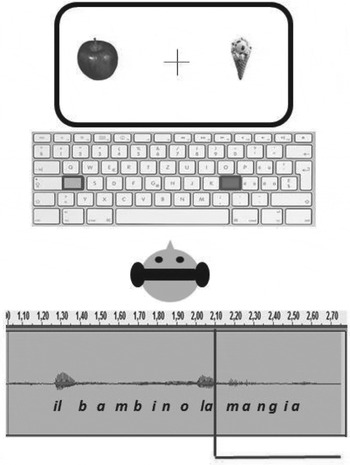
Given the young age of the children, in order to make sure that they paid attention to the pictures and that they recognized them, at the beginning of each trial the examiner described the two visual stimuli (e.g. questa è una mela e queste sono due banane ‘this is an apple and these are two bananas’). The child was seated in front of the screen and listened to a recorded target sentence (Figure 1) (the auditory stimuli were presented binaurally by computer over Sony headphones at 60 dB). The participants were instructed to rest their forefingers on two keys and to respond, as quickly and as accurately as possible, by striking the specific key on the keyboard that matched the appropriate picture (/a/, marked with a pink dot, coincided with the picture on the left side of the screen, whereas /l/, marked with a green dot, coincided with the picture on the right side of the screen) (Figure 1). A set of practice trials preceded each task. The examiner repeated the practice trials as many times as necessary to ensure that the child understood the task.
A schematic representation of the pronoun comprehension task.

For each trial, response times (RT) were measured immediately after the pronoun (Figure 1). For example, for the sentence il bambino la mangia, timing began immediately after the clitic la. Responses occurring prior to the end of the pronoun were scored as false alarms, and those responses in which children were not focused on the trial (e.g. the child spoke while the target sentence was presented) were considered as not scorable.
The task consisted of 32 trials (4 word pairs × 4 clitic pronouns × 2 blocks), that is, 16 trials for gender and 16 trials for number. The order of item presentation was random. Across the 32 trials, the location of the target picture appeared equally as often on the left and right side of the screen. Moreover, each word pair was presented twice, in two different spatial locations: for example, in the first presentation the apple appears on the left side of the computer screen and the ice-cream on the right side, whereas in the next presentation the position of the two pictures was inverted (apple on the right and ice-cream on the left). This design feature was intended to avoid any effects of a child's preference for one of the two pictures, or for one side of the screen over the other. No control prevented the same word pairs from appearing consecutively.
RESULTS
Accuracy
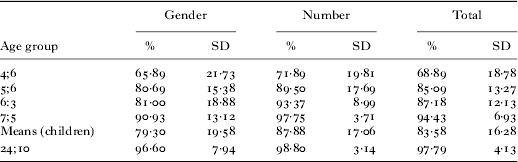
Preliminary analyses of the data revealed that no significant difference was present between singular (la and lo) and plural forms (le and li) at each age level (ts ⩾·209, ps⩾·102). Moreover, no significant difference was present between feminine (la and le) and masculine forms (lo and li) at each age level (ts ⩾·620, ps ⩾·85). The means of correct responses and standard deviations are shown in Table 1.
Mean percentage accuracy and standard deviation in matching operation between direct object clitic pronouns and inanimate visual referents on the basis of number or gender information

We checked the accuracy level in order to know when children are able to identify the visual picture. We assumed an accuracy of at least 90% of correct responses was a good level of performance. Data in Table1 show that seven-year-old children reached the ‘acquisition criterion’. Considering gender and number separately, in the case of number, data in Table1 show that children reached the criterion at the age of five; however, in the case of gender they reached it at the age of seven.
A mixed ANOVA was used to test whether there is a significant change in the mean percentage of correct responses (dependent variable), with grammatical information (two levels: gender and number) as a within-subjects factor, and age (five levels: 4;6, 5;6, 6;3, 7;5, and 24;10) as a between-subjects factor. A significant effect for age was observed (F(4,84) = 15·51, p < ·001, ηp 2 = ·43). Bonferroni post-hoc tested at ·01 level revealed that four-year-old children differ from all the other groups; moreover, a marginal difference was found between five-year-old children and adults (p = ·026). A significant effect of the grammatical information was also found (F(1,84) = 18·82, p < ·001, ηp 2 = ·18), showing that gender (83%) was harder to understand than number (90%). The interaction between the grammatical features and group was not significant (F(4,84) = 1·10, p = ·36, ηp 2 = ·05).
Response time
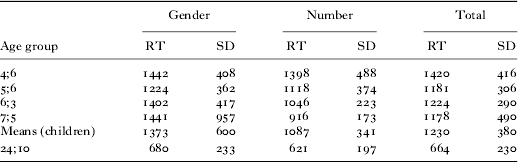
Prior to the analysis of RTs, two types of response were excluded from the children's performances. The first type derives from trials in which the response was incorrect. The second type involved RTs less than 10 ms, which were considered too short to be genuine responses to the stimuli. The mean of the remaining RTs for each participant was then calculated and outliers removed (Kail, Reference Kail1994). Outliers were defined as any RTs greater than 2 SD above or below the mean. This procedure was repeated until no outlier was present. Finally, since RT is not a meaningful measure if children's accuracy is at chance levels, we included only those children performing above the level of chance both on gender and number (⩾ 65%; binomial test, α = ·10, one-tailed). Given our requirement for above-chance accuracy for inclusion in the analysis of RTs, only 9 four-year-olds (5 female), 13 five-year-olds (9 female), 15 six-year-olds (5 female), and 15 seven-year-olds (6 female) were included in RT analyses. All adults scored above chance levels and were therefore included. The means of RT and standard deviations are shown in Table 2.
Mean response time (RT ms) and standard deviation in matching operation between direct object clitic pronouns and inanimate visual referents on the basis of number or gender information

A mixed-design ANOVA was performed on RTs (dependent variable), with grammatical information (two levels: gender and number) as a within-subjects factor, and age (five levels: 4;6, 5;6, 6;3, 7;5, and 24;10) as a between-subjects factor. The results showed a significant effect of age (F(4,67) = 11·24, p < ·001, ηp 2 = ·40). Bonferroni post-hoc tested at the ·01 level showed that adults performed faster than all children. The grammatical information was also significant (F(1,67) = 12·58, p < ·001, ηp 2 = ·16): gender (1186 ms) was processed more slowly than number (958 ms). Finally, there was a significant interaction between grammatical information and age (F(4,67) = 2·044 , p = ·05, ηp 2 = ·13): RT for number decreased at a steady rate with increasing age. In contrast, this relationship was not linear for gender: the rate of decrease as a function of age remained flat until the age of seven, and only later did it become strong. A Bonferroni post-hoc revealed that number was faster to process than gender at the age of six (p = ·001, d = –1·60) and in adults (p = ·005, d = –0·29); no difference was present between at the two preschool groups (p > ·285) and at the age of seven (p = ·054, d = –3·04).
DISCUSSION
The main question we tried to address in this study was how children correctly matched Italian direct object clitic pronouns to inanimate visual referents on the basis of number or gender information. Our hypothesis was that both gender and number is information which is differently available during sentence processing: grammatical gender refers to a lexical property of the referent that is independent from its natural sex (Corbett, Reference Corbett1991), whereas number is a non-intrinsic feature of nouns based on the conceptual level of quantity (Li et al., Reference Li, Barner, Ogura, Yang and Carey2009). Rather than focus on the question of when clitic pronouns are acquired or by which process gender and number are acquired, this study investigated the speed and accuracy or processing these two grammatical features at an age when both are known to be already acquired (Dispaldro, Reference Dispaldro2012).
Our results suggest that in the initial stage of pronoun acquisition, an age-related dissociation is present between number and gender. Even when the number of the referent(s) is correctly associated with the pronoun, children appear to be less accurate and slower in processing gender: children stop making errors in processing number at an earlier age than for gender. Moreover, the results show different times of accessibility to the referent during the task: high accessibility means that information is quickly retrievable, whereas low accessibility means that the information needs time to be available. Children, as well as adults, respond more quickly in the case of number than for gender. This means that the matching operation between pronoun and referent is more accessible, and therefore easier in the case of number than gender.
In our opinion, the agreement by number between the pronoun and the inanimate visual referent(s) seems to be a purely matching operation in which children identify the number of the referent(s) according to the spatial segregation of objects present in the referential context (Dispaldro & Benelli, Reference Dispaldro and Benelli2012; Feigenson & Halberda, Reference Feigenson and Halberda2008): children probably know that certain spatial arrangements of objects (e.g. one vs. more than one) are more appropriate than others for indicating singular and plural. However, the present study also showed that number was faster to process than gender for school-aged children but not in the two preschool groups. The fact that singular and plural information about the referent(s) is highly accessible when children enter primary school but not earlier suggests that at the age of six something happens. Most likely, at the age of six, children, like adults, expect their interlocutors to be relevant when communicating (Grice, 1975). Children might infer that the two configurations of the visual objects (one vs. more than one) were offered to reduce the listener's uncertainty in detecting the referent(s) intended by the speaker (singular or plural). Of course, our interpretation of the child's performance in terms of ‘Gricean maxims’ is tentative and needs further research and more empirical data.
On the other hand, gender agreement is a linguistic operation in which the grammatical features of the pronouns (masculine vs. feminine) are linked to the lexical features of the visual referent only by a syntactic process. With respect to this goal, the child first has to discover whether the referent has a natural gender, and, if not (as was in the present experiment), to determine the grammatical gender of the noun via lexical process. Only later can a child match referent and pronoun. Obviously, gender processing requires a great cognitive demand. For this reason the matching operation by masculine or feminine is slow in terms of response time, independent of the level of accuracy.
Several Italian studies have stressed that gender and number are accessible in different ways during sentence processing. For example, De Vincenzi (Reference De Vincenzi1999) and De Vincenzi and Di Domenico (Reference De Vincenzi and Di Domenico1999) investigated the processing of gender and number features in the selection of a pronoun antecedent confirming that gender information is used later than number information to select the antecedent (see also Gernsbacher, Reference Gernsbacher1989; Nicol, Reference Nicol1988). Carminati (Reference Carminati2005), testing the effect of number and gender information on the resolution of the Italian null-subject pronoun, found that number behaves better than gender in allowing the speaker to select the appropriate antecedent. Recently Adani and colleagues (Adani, van der Lely, Forgiarini &Guasti, Reference Adani, van der Lely, Forgiarini and Guasti2010) investigated the comprehension of object relative clauses with Italian children, where number and gender features on subjects and objects were manipulated. They found that number conditions were always more accurate than gender conditions.
Following the ‘Feature Hierarchy Hypothesis’ (Harley & Ritter, Reference Harley and Ritter2002), morphological features are organized hierarchically according to their degree of cognitive significance (Person > Number > Gender). Following this assumption, Carminati (Reference Carminati2005) suggested that “the more cognitively important the feature is, the better it should be at disambiguating the pronoun that carries it” (Feature Strength Hypothesis). Feature strength should interact with the strategies of pronoun resolution employed by the processor. In our opinion, the present study is in line with these hypotheses, confirming that number is semantically more salient than gender. This is due to the cardinality of nouns, which allows children to process singular and plural information thanks to the immediate discrimination of one vs. more than one object in the reference discourse context.
In conclusion, the present study shows that the grammatical information of gender and number are differently available during a pronoun comprehension task, in terms of both time and accuracy. During the initial stages of development, children approach morphemes as if each grammatical function is separate (Karmiloff-Smith, Reference Karmiloff-Smith1979). This does not mean that younger children cannot use and understand different grammatical functions present is the same grammatical morpheme, but that this information follows an independent trend, as the present study shows. As children get older they gradually treat them in an equal way. This, however, is only a conjecture, which requires further study.
APPENDIX: list of items used in the pronoun comprehension task (the target is reported in capitals)
Gender
1 MELA (feminine) vs. 1 gelato (masculine) ‘1 APPLE vs. 1 ice-cream’
1 PANINO (masculine) vs. 1 pesca (feminine) ‘1 SANDWICH vs. 1 peach’
1 pizza (feminine) vs. 1 POMODORO (masculine) ‘1 pizza vs. 1 TOMATO’
1 biscotto (masculine) vs. 1 CAROTA (feminine) ‘1 cookie vs. 1 CARROT’
2 pesci (masculine) vs. 2 SALSICCE (feminine) ‘2 fish vs. 2 SAUSAGES’
2 SALAMI (masculine) vs. 2 frittate (feminine) ‘2 SALAMIS vs. 2 omelettes’
2 patate (feminine) vs. 2 FUNGHI (masculine) ‘2 potatoes vs. 2 MUSHROOMS’
2 CARAMELLE (feminine) vs. 2 meloni (masculine) ‘2 LOLLIES vs. 2 rockmelons’
Number
2 carciofi (masculine) vs. 1 FORMAGGIO (masculine) ‘2 artichokes vs. 1 CHEESE’
2 ARANCE (feminine) vs.1 cioccolata (feminine) ‘2 ORANGES vs. 1 chocolate’
1 uovo (masculine) vs. 2 LIMONI (masculine) ‘1 egg vs. 2 LEMONS’
1 zucchina (feminine) vs. 2 CIPOLLE (feminine) ‘1 zucchini vs. 2 ONIONS’
2 FINOCCHI (masculine) vs. 1 cavolo (masculine) ‘2 FENNELS vs. 1 cabbage’
1 TORTA (feminine) vs. 2 banane (feminine) ‘1 CAKE vs. 2 BANANAS’
1 POLLO (masculine) vs. 2 peperoni (masculine) ‘1 CHICKEN vs. 2 capsicums’
2 fragole (feminine) vs. 1 BISTECCA (feminine) ‘2 strawberries vs. 1 STEAK’