1. Introduction
Teaching English to Speakers of Other Languages (TESOL) teacher educators and their work are vitally integral to the operation and development of second language teaching and teacher education (Barkhuizen, Reference Barkhuizen2021a; Yuan & Yang, Reference Yuan and Yang2022). Working as scholars, practitioners, and researchers (Peercy & Sharkey, Reference Peercy and Sharkey2020), they constitute the main force for preparing and developing language teachers at pre- and in-service levels in a wide range of English as a Second or Foreign Language (ESL/EFL) contexts where language teacher education (LTE) is often housed in higher education institutions (Yuan & Lee, Reference Yuan, Lee, Yuan and Lee2021).
Back in 2010, Tony Wright published his seminal article in Language Teaching, which analyzed the existing studies on policies, practice, and innovations in LTE. While Wright acknowledged the crucial role of language teacher educators in modelling effective teaching practice and facilitating language teachers’ reflective engagement, he pointed out a lack of research and reflection on the lived experiences of teacher educators who need to engage in continuous learning amidst the rapidly shifting and potentially challenging landscape of LTE (Deroo et al., Reference Deroo, Ponzio, De Costa, Tian, Aghai, Sayer and Schissel2020; Peercy et al., Reference Peercy, Sharkey, Baecher, Motha and Varghese2019). In other words, who language teacher educators are, how they practice and develop, as well as what impacts they have on language teaching and learning have remained a ‘black box’, which urgently calls for research attention. Since then, there has been a steady growth of literature on this topic. Drawing on a variety of research methodological approaches, TESOL researchers and practitioners have made valuable attempts to investigate important issues related to language teacher educators, ranging from their daily practice, such as classroom teaching, practicum supervision, and academic publishing, to their professional knowledge, beliefs, and identities in various geographical settings. Such a line of inquiry echoes the wide recognition of the significance and complexities of teacher educators’ work and development in general education (Loughran & Menter, Reference Loughran and Menter2019; Richter et al., Reference Richter, Lazarides and Richter2021), as reflected by the burgeoning research interests in who they are, what they know and believe, as well as how they practice and seek continuing professional development (Ping et al., Reference Ping, Schellings and Beijaard2018).
Situated in the context of TESOL, this systematic review paper presents a critical review of previous studies on language teacher educators from 2010 to 2020. By taking stock of this important and emergent line of research, this article intends to contribute to the hitherto limited understanding of language teacher educators and their personalized, practice-oriented, context-specific network of knowledge, values, and practice. The review can also provide valuable insights into how we can support language teacher educators to enhance their professional practice and expertise as they navigate the constantly evolving TESOL and higher education worlds.
2. The scope and significance of the review
While the significance of language teacher educators’ work has been widely celebrated, it is difficult to precisely define who they are owing to the complexity and heterogeneity of LTE influenced by complex institutional, social, and historical factors (Yuan & Lee, Reference Yuan, Lee, Yuan and Lee2021). As observed by Barkhuizen (Reference Barkhuizen2021a, p. 2):
In language teacher education, educators can vary from those who have very little classroom experience, if any at all, to those who are deeply connected to classroom life, either through their own concurrent practice and employment as a language teacher, or through the supervision or mentoring of student teachers during their teaching practice (practicum), for example. … They are also involved in scholarly activities, such as reading and doing research, participating in workshops and conferences, and even studying for further qualifications.
Being aware of the complex and shifting landscapes of LTE and the various stakeholders involved, this review chooses to focus on language teacher educators who are formally engaged in pre- and in-service teacher education in higher education institutions (Yuan, Reference Yuan2019). Specifically, the scope of this review encompasses not only higher education-based language teacher educators who practice teacher education in ESL (e.g., Singapore) and EFL (e.g., Argentina, China, Japan, and Turkey) settings, but also those who are based in TESOL/TEFL programs in English-dominant countries (e.g., Australia and the USA) and prepare teachers for ESL/EFL teaching. The teacher education programs in this review vary in terms of their geographic location, level (and duration) (e.g., undergraduate degree programs that may last for five years or master's programs based on one-year coursework), as well as orientation (e.g., primarily practice-based or theory-driven). We intentionally exclude the group of school-based mentors (usually experienced language teachers), who have been examined and reviewed in published articles about student teacher learning, teaching practicum, and mentoring in language education and general education (e.g., Farrell, Reference Farrell2016; Lawson et al., Reference Lawson, Çakmak, Gündüz and Busher2015).
Research on university-based language teacher educators dates back to the 1990s when early researchers (e.g., McGrath, Reference McGrath1997; Thomas & Wright, Reference Thomas, Wright and Budd1999) challenged the technical, behaviorist model of knowledge transmission in traditional LTE programs (Burns & Richards, Reference Burns, Richards, Burns and Richards2009). Instead, they argued for a social and constructivist view that recognized the idiosyncratic, dynamic, and contextual nature of teachers’ professional learning in relation to their evolving practice, cognition, and identities (e.g., Johnson, Reference Johnson2009; Nazari & De Costa, Reference Nazari and De Costa2021; Richards, Reference Richards2021). They also highlighted the critical need for language teacher educators to draw on a wide range of published teacher education literature and develop their teaching competence in organizing and managing the learning process of language teachers in a dialogic, collaborative manner. Nevertheless, this small cohort of studies mostly covered specific activities and procedures in promoting language teacher development, with scant attention paid to language teacher educators’ personal histories, professional experiences, and mental worlds against the complex institutional, social, and political milieu. Therefore, the role of language teacher educators has remained vaguely defined and poorly understood in higher education settings. Following the emergence of practice-based research paradigms (e.g., action research and self-study) in both general education and TESOL (e.g., Burns, Reference Burns2005; Loughran, Reference Loughran2005; Richards, Reference Richards2008), research on language teacher educators has gradually picked up the pace over the past decade, exploring their situated practice and inner worlds within and across diverse professional communities (e.g., Banegas, Reference Banegas2020a; Barkhuizen, Reference Barkhuizen2021b; Yuan & Lee, Reference Yuan and Lee2014). More importantly, a growing number of language teacher educators (e.g., Peercy, Reference Peercy2014; Yazan, Reference Yazan2019) have made endeavors to actively and reflectively investigate, understand, and improve their professional work with the dual aim of seeking their own self-transformation and facilitating language teachers’ learning to teach. Such positive developments give impetus to the present review, which seeks to summarize, analyze, and critique the current state of research on and by university-based language teacher educators.
The significance of this systematic review lies in the following aspects. Firstly, employing a qualitative, inductive analytic approach, the review seeks to critically examine the empirical studies on language teacher educators published in international peer-reviewed journals over the last decade. This specific scope allows us to build on Wright's (Reference Wright2010) influential review, which has covered important ground on second language teacher education, and provides a detailed portrait of language teacher educators in terms of their professional backgrounds and their lived experiences (i.e., responsibilities and challenges). More crucially, we present a focused, up-to-date appraisal of the major themes and trends of existing literature on university-based language teacher educators to unearth various dimensions of their actions, thinking, and being at the intersection of language education, teacher education, and higher education. Additionally, considering that the professional group of language teacher educators has not received much attention until recent years, it is worth drawing readers’ attention to different methodological approaches adopted so far and the future directions in terms of research topics and methodologies. Thus, the review also offers a critical methodological review, in which we discuss the strengths and weaknesses of the employed research approaches, identify potential methodological gaps, and propose a new research agenda in order to stimulate and deepen future investigations on language teacher educators in TESOL.
3. Methodology for the systematic review
The systematic review is guided by the following research questions:
1. What is the general profile of university-based language teacher educators as reported in the existing studies?
2. What are the major themes of current research literature on university-based language teacher educators?
3. What research methodologies have been used by previous researchers and what are their strengths and limitations?
In light of the three questions, we formed a team of reviewers with different years of research and practical experience in LTE in diverse educational contexts. In this way, the review team members brought different perspectives to analyze the empirical studies, which stimulated critical discussion and minimized potential bias during the process of review, analysis, and critique. To ensure transparency and clear procedures during the review process, a review plan was written, shared among the review team, and was agreed by all before the review commenced.
3.1. Selection criteria
Five inclusion/exclusion criteria were followed to select relevant studies on language teacher educators in the present review, based on the advice provided by Evans and Benefield (Reference Evans and Benefield2001) and Macaro (Reference Macaro, McKinley and Rose2020) on conducting systematic reviews. First, this review paper includes studies conducted between 2010 and 2020 (including published and forthcoming papersFootnote 1 available online) to track and analyze recent developments in this line of research. The second criterion is that the study needs to have an empirical base. Conceptual or opinion papers without empirical data were thus excluded. Third, the study must be published in peer-reviewed journals and indexed in the online databases or journal archives (e.g., Google scholar, ERIC, or Scopus). Fourth, the study must focus on English language teacher educators. Studies that were not within this scope (e.g., Spanish or Chinese language teacher educators) were excluded. Finally, the study needs to be reported and written in English owing to the review team's language backgrounds.
3.2. The review process
The review consisted of two main stages: (1) literature search and selection; and (2) data analysis and critique. In the first stage, we carried out a comprehensive literature search in Google Scholar, ERIC, Scopus, JSTOR, Linguistics Abstracts Online, and the authors’ university libraries to identify research works that fit the scope of the review. A combination of keywords was used for the initial literature search, including ‘language teacher educator’, ‘teacher educator’, ‘teacher education’, ‘EFL’, ‘ESL’, ‘second language (L2)’, ‘TESOL’, ‘ESOL’, and ‘ELT’. In light of the selection criteria listed above, the title, abstract, and keywords of each study were screened to decide if the study was relevant to the scope of the present review. When the title and the abstract of the study did not provide enough information, we conducted detailed reading to ascertain its relevance to the review.
In the process of paper selection and identification, we also constructed a table using Excel spreadsheet, which served as a ‘systematic map’ (Macaro, Reference Macaro, McKinley and Rose2020, p. 234) to capture the key information about the studies, including the author(s) and the year of publication, the participants, the research context, methodology, and theoretical framework. In total, the initial search and screening process resulted in 69 relevant articles for our systematic map. With reference to previous state-of-the-art review articles (e.g., Rose et al., Reference Rose, McKinley and Galloway2021; Vanassche & Kelchtermans, Reference Vanassche and Kelchtermans2015) published in Language Teaching and other international journals, we believed that 69 studies constitute a manageable database for a systematic review, which could generate comprehensive and meaningful insights into our research questions.
In the second stage, we delved into the 69 studies for an in-depth read, analysis, and synthesis of the research results. First, based on the first research question, we extracted the basic information about the research participants in terms of their gender, work experiences, qualifications, and work contexts. This allowed us to analyze and generate a profile of university-based teacher educators in diverse educational settings. Then, an inductive coding approach was adopted to review the findings of all the studies in an iterative manner to identify and ascertain their content themes and contributions to the existing knowledge of language teacher educators. Following this, the papers were grouped into different categories according to their foci, such as general responsibilities and challenges, quality, teaching, research, cognition, and identities. Worthy of note is that some papers were put into more than one category as they may report findings regarding different dimensions (e.g., teaching, research, and continuous learning) of language teacher educators’ professional experiences. Through ongoing comparisons and contrast among the different categories and the related papers, four major themes emerged to reflect the general trends in the existing literature on language teacher educators (i.e., the second research question). The themes are:
1. A general professional state (including their responsibilities, challenges, and quality);
2. professional engagement (including teaching, practicum supervision, and research and publishing);
3. cognition (including beliefs, knowledge, and expertise); and
4. continuous learning and identity development.
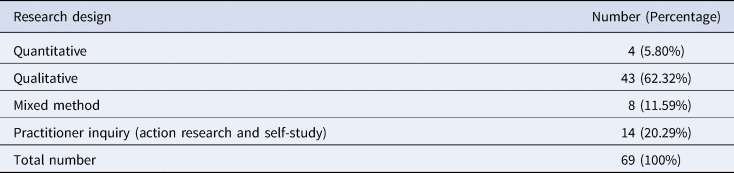
To answer the third research question, we further compiled a table about the methodologies adopted in the 69 studies in terms of the research duration, contexts, and participants, as well as the data collection and analytic methods. Such information was then analyzed to discuss the strengths and limitations of the research methods prevalent in this line of research while outlining directions for future research. To enhance the reliability of the research results, intercoder checking was conducted in the review team through independent screening and analysis as well as ongoing discussion to resolve potential differences.
3.3. Limitations of the review
The limitations of the review need to be acknowledged. First, since our review focused on empirical studies published in peer reviewed journals, research works in other forms, such as non-empirical papers, unpublished doctoral dissertations, and un-indexed book chapters, were not included. Additionally, the review excluded empirical works that were not written in English. This decision might prevent the inclusion of perspectives from language teacher educators who preferred to publish in non-English outlets in their localized contexts.
4. Profiling language teacher educators in TESOL
To answer the first research question, this section presents a profile of language teacher educators based on all the available biographical information extracted from the 69 papers. Our analysis demonstrates that language teacher educators are a diverse professional group located in different parts of the world with different qualifications (e.g., educational backgrounds and teaching certification) and years of professional experience (in terms of language teaching and/or teacher education). In total, 639 language teacher educators have been studied in the 69 papers during the period from 2010 to 2020, including 136 male, 214 female, and 289 unspecified. In terms of their professional experiences, we have only been able to detect a general trend based on the available data, since not all studies provided detailed background information about their research participants. First, 200 teacher educators were reported to have between 6 to 20 years of language teaching experience in primary/secondary schools, language learning institutes or agencies, or universities. In addition, 77 research participants were experienced language teachers, owning more than 20 years of classroom teaching experience. This result echoes existing literature in general education (e.g., Murray & Male, Reference Murray and Male2005), suggesting that the traditional route has been taken by the majority of teacher educators who transitioned from school teaching to university-based teacher education based on their accumulated subject-related teaching expertise and further education.
However, it is interesting to note that a small group of research participants had not taught English before they became language teacher educators in the tertiary sector. This small group of participants, referred to as ‘nontraditional teacher educators’ (Newberry, Reference Newberry2014), may be recruited owing to their strong research profiles (e.g., in terms of research publications) in current higher education institutions, which place an overt emphasis on research competitiveness and international rankings (Yung, Reference Yung2020). In addition to language teaching, we have also looked at the participants’ experience of LTE in university settings. Based on the available data retrieved from the database, the majority of the participants were mid-career teacher educators (36 with 6 to 10 years of experience), followed by novice (25 with less than 5 years of experience) and experienced teacher educators (22 with over 10 years of experience). This suggests that extant studies have taken a relatively balanced outlook to examine language teacher educators at different career stages with potentially diverse needs and challenges in their situated work.
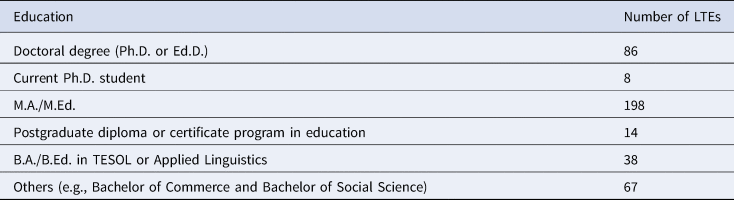
Similar to their professional experience, the language teacher educators’ qualifications also vary. Among them, 198 of the research participants have a M.A./M.Ed. degree in TESOL or related fields. The second largest group (n = 86) involves language teacher educators with a doctoral degree (Ph.D. or Ed.D.). Some language teacher educators (n = 14) also hold a postgraduate diploma of education (PGDE). A first degree such as a B.A./B.Ed. degree in TESOL or related fields is also reported in the studies. Although information about the research participants’ educational backgrounds was missing in some papers, the numbers presented in Table 1 illustrate that many language teacher educators chose to advance their professional learning after getting a first degree by proceeding to the postgraduate level. This trend indicates that language teacher educators may see furthering their academic studies as a crucial way to top up their knowledge and skills for educating language teachers. Meanwhile, it is likely that some language teacher educators chose to further their education because of institutional expectations or requirements, but this information remains unknown and requires future research.
Language teacher educators’ educational backgrounds

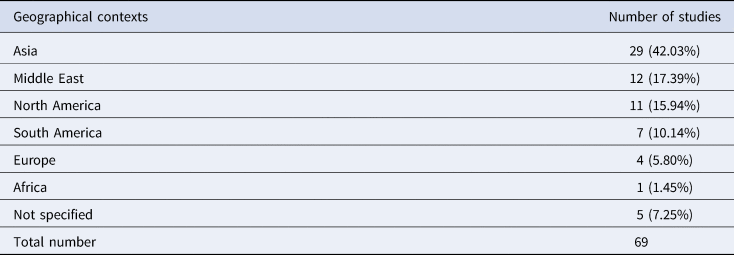
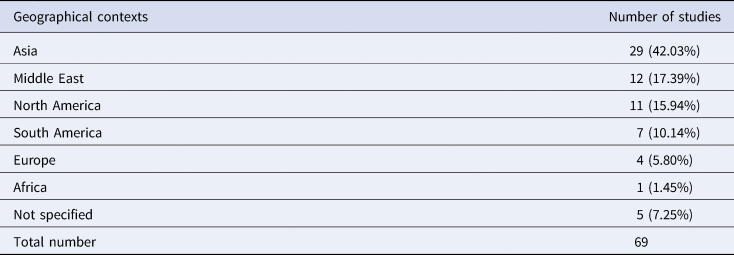
In terms of geographical settings, almost half of the empirical studies on language teacher educators conducted between 2010 and 2020 took place in Asia (29 among 69 studies; 42.03%) (see Table 2). Among those Asian regions, more than half of the studies were conducted in the Chinese mainland and Hong Kong (16 among 33 studies), followed by Indonesia (7 among 33 studies). In these Asian contexts, English is regarded not only as a school subject but also as a powerful semiotic tool for students’ academic and social advancement in the society. Therefore, language teacher educators who shoulder the responsibilities of nurturing effective language teachers naturally become a vital group to be studied to provide insights into quality language teaching and teacher education. The other half of language teacher educators being studied were located in the Middle East (12 studies; 17.39%), North America (11 studies; 15.94%), and other regions such as South America, Europe, and Africa.
Geographical contexts of the empirical studies
Overall, language teacher educators are a varied and heterogeneous group involving those who possess diverse qualifications and experiences and work in a wide range of geographical settings including English-speaking countries as well as EFL/ESL regions.
5. Major themes of current research on language teacher educators
Following the profile of language teacher educators, this section provides answers to the second research question by delineating the four main themes that can capture the essence of language teacher educators’ professional practice and continuing development at the nexus of language education, teacher education, and higher education.
5.1. Language teacher educators’ general state
In view of the diversity and heterogeneity of language teacher educators, some researchers have taken a macro perspective to investigate the professional state of language teacher educators in various geographical settings, including Cuba (Smith, Reference Smith2016), Malaysia (Vethamani, Reference Vethamani2011), Turkey (Çelik, Reference Çelik2012), the Chinese mainland (Yan et al., Reference Yan, He, Guo and Wang2020), and Hong Kong (Yuan & Lee, Reference Yuan and Lee2014). Utilizing data collected from different research methods (e.g., questionnaire survey, narrative frames, and interviews), this group of studies (n = 5) highlighted the unique contribution of language teacher educators as ‘gatekeepers’ in selecting and preparing teacher candidates as well as ‘change agents’ in pedagogical innovations in their specific settings (Smith, Reference Smith2016; Yan et al., Reference Yan, He, Guo and Wang2020; Yuan & Lee, Reference Yuan and Lee2014). More pointedly, they sketched a vivid portrait of language teacher educators’ major responsibilities and challenges in higher education.
5.1.1. Responsibilities
Characterized as ‘conscientious’ (Vethamani, Reference Vethamani2011, p. 103) and even ‘self-sacrificing’ (Yan et al., Reference Yan, He, Guo and Wang2020, p. 7), the language teacher educators in the five studies were expected to take on five types of responsibilities, entailing a multitude of tasks such as classroom teaching, practicum supervision, academic research, and program management (see Table 3). Such a wide scope of work required the teacher educators to socialize with various stakeholders including pre- and in-service teachers, school leaders, and educational authorities, while it also placed a new demand on them – that is, seeking continuous learning individually and collaboratively – in order to enhance their professional competence and fulfill their responsibilities.
Language teacher educators’ responsibilities

5.1.2. Challenges
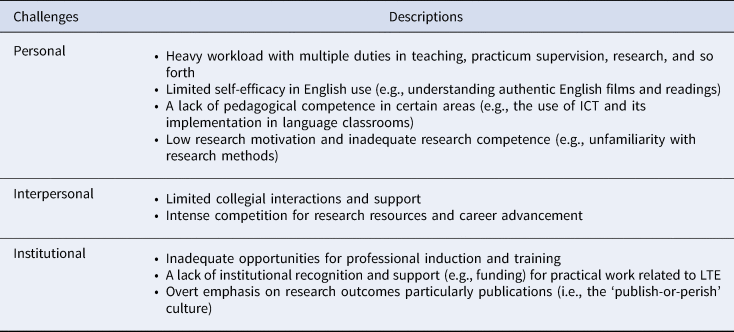
While engaging in the various types of work can be intellectually stimulating and emotionally rewarding (e.g., gaining a sense of connection with student teachers) (e.g., Çelik, Reference Çelik2012), it can also pose challenges to language teacher educators at personal, interpersonal, and institutional levels. Table 4 presents a summary of the challenges reported by the participants in the five studies reviewed in Section 5.1.
Language teacher educators’ challenges
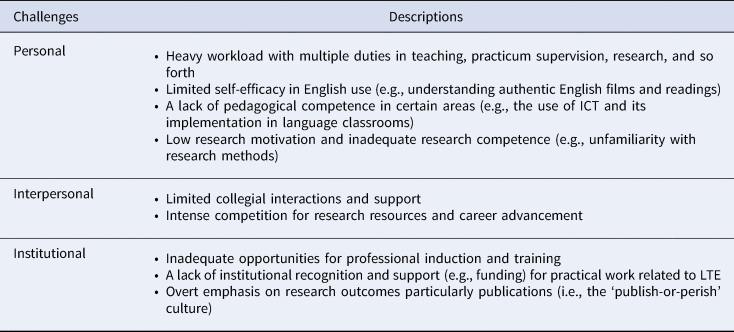
It is interesting to note that while language teacher educators are generally believed to be pedagogical experts with a high level of language proficiency, some of them, as reported by Yan et al. (Reference Yan, He, Guo and Wang2020), might still feel inadequate in their own language use and teaching as language is alive and keeps changing. This also reflects the dynamic and shifting nature of English as a lingua franca, which requires language teacher educators to constantly update and refine their linguistic and pedagogical knowledge (Smith, Reference Smith2016). However, their pursuit for continuous learning in teacher education was disrupted by different contextual obstacles, including a lack of opportunities for professional training and support. This was particularly problematic for novice teacher educators who just entered the profession of teacher education in university contexts (Çelik, Reference Çelik2012; Yuan & Lee, Reference Yuan and Lee2014). Most of them had to become self-reliant in an isolating and competitive work culture to explore what it meant to be a language teacher educator. More seriously, in the face of the prevailing ‘publish-or-perish’ system, many language teacher educators as suggested by the studies were compelled to direct their attention to publishing in order to meet the institutional demands, while they might be constrained by their inadequate research competence (see Section 5.2.3 for a detailed review of language teacher educators’ research and publishing). This finding resonates with the notion of ‘fundamental dualism’ (Murray et al., Reference Murray, Swennen, Shagrir, Swennen and van der Klink2009, p. 30) as observed in general teacher education, denoting that teacher educators are embroiled in a tug of war between their practical commitment towards classroom teaching and the world of academic research that emphasizes knowledge discovery and theory building. How to navigate and balance such potentially conflicting demands requires their reflective thinking and practical knowledge, which constitute a key part of language teacher educators’ quality, as discussed below.
5.1.3. Quality
In TESOL, the quality of language teacher educators seems to be an overlooked issue as only three studies were identified through our review (Al-Issa, Reference Al-Issa2017; Yuan & Hu, Reference Yuan and Hu2018; Zein & Haing, Reference Zein and Haing2017). This situation is in striking contrast to that of general teacher education, where systematic attention has been paid to the quality of teacher educators in the past decades. For instance, the Association of Teacher Educators in the United States has stipulated ‘Standards for Teacher Educators’ (revised and adapted between 2005 and 2008; see Houston, Reference Houston, Klecka, Odell, Houston and McBee2009) in terms of teaching, cultural competence, scholarship, professional development, collaboration, public advocacy, teacher education profession, and vision. In Europe, the Dutch Association of Teacher Educators has also developed its own standards, shedding light on five necessary competency areas for teacher educators, including content competencies, pedagogical competencies, organizational competencies, group dynamic and communicative competencies, and developmental and personal growth competencies (Koster & Dengerink, Reference Koster and Dengerink2001).
The three empirical studies (i.e., Al-Issa, Reference Al-Issa2017; Yuan & Hu, Reference Yuan and Hu2018; Zein & Haing, Reference Zein and Haing2017), drawing on views from different stakeholders including language teacher educators, student teachers, and school teachers, presented a host of key features that a high-quality language teacher educator is expected to possess in their everyday work. In Yuan and Hu's (Reference Yuan and Hu2018) study, the inductive analysis of focus group interviews with different groups of teachers in China revealed the multilayered nature of language teacher educators’ quality in terms of their rich content and pedagogical knowledge, vision (i.e., critical insights about the direction of language education), as well as social and emotional competence (e.g., connecting with student teachers). Similar results were observed in Al-Issa (Reference Al-Issa2017), whose findings underscored the ‘empowering’ (p. 9) attribute of language teacher educators in attending to the cognitive and affective needs of student teachers. More crucially, their willingness and abilities to push the boundaries and promote social justice were also considered essential in helping student teachers become informed change agents in language classrooms. While a pedagogy focus was equally evident in Zein and Haing's (Reference Zein and Haing2017) research, their findings further reveal the importance of ‘qualifications’ and ‘experiences’ in defining quality, credible language teacher educators. In terms of ‘qualifications’, the study highlighted that language teacher educators must exhibit a mastery of the subject (i.e., English) they are teaching with a relevant academic background (e.g., TESOL or Applied Linguistics). As for ‘experiences’, the study specified that language teacher educators should be equipped with experience of language teaching, which enabled them to identify what pedagogical approaches and techniques could work well with language learners in authentic classroom situations.
Taken together, the crucial attributes of language teacher educators revealed by the three aforementioned studies share great similarities (e.g., in terms of subject and pedagogical knowledge, professional vision, and classroom experiences) with the professional standards developed by the teacher educator associations. However, given the small number of studies with relatively limited sample sizes, the results may not be able to shed full light on what constitutes a high-quality language teacher educator. In addition, since the standards reviewed above focus on teacher educators in general, it is uncertain whether they are equally applicable to EFL teacher educators in different geographical contexts, and whether subject-specific standards are needed in line with their practices in educating EFL teachers. These issues still warrant further attention in the field of second language teacher education.
5.2. Language teacher educators’ professional engagement
Moving from a macro perspective in depicting language teacher educators’ professional state, a large pool of studies have explored specific aspects of their professional engagement including teaching, practicum supervision, research, and publishing.
5.2.1. Teaching
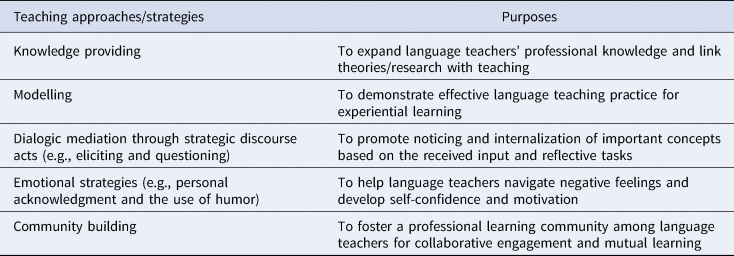
Given language teacher educators’ primary role as teachers of language teachers, considerable attention has been paid to their classroom practice. In terms of teaching content, this bulk of studies looked into how teacher educators addressed critical issues regarding language teaching pedagogy (Farías & Véliz, Reference Farías and Véliz2019), critical thinking (Veliz & Veliz-Campos, Reference Veliz and Veliz-Campos2019), as well as language proficiency and culture (Banegas, Reference Banegas2020b; Smith, Reference Smith2016). How to instruct language teachers and organize their learning – LTE pedagogy – has also been a major area of research in the field, shedding light on a wide range of teaching strategies and tasks employed by language teacher educators with an aim to promote language teachers’ linguistic competence and pedagogical knowledge as well as stimulate their reflective and agentive thinking. As shown in Table 5, five major strategies were identified to capture the various pedagogical dimensions of language teacher educators’ classroom practice.
Teaching approaches/strategies employed by language teacher educators

Three studies (Kaur, Reference Kaur2015; Peercy, Reference Peercy2014; Vetere, Reference Vetere2020) described how language teacher educators managed to deliver abstract content knowledge in teacher education classrooms. By selecting appropriate materials with necessary modification and drawing on their own personal observations and stories, they tried to guide the teachers to discover the link between the course content and the classroom reality. One notable example is Kaur (Reference Kaur2015), in which the teacher educator provided the in-service teachers with a set of instructional ground rules for writing instruction. Such rules thus served as a frame of reference, which informed the teachers’ exploration and experimentation in their teaching of writing. On the other hand, while Vetere (Reference Vetere2020) made attempts to introduce to a student teacher an innovative teaching method (i.e., drama-based instruction) with reference to his own experiences and reflections, he came to realize that his input was not successfully picked up by the student teacher as reflected in her teaching performance. Thus, he critiqued the traditional mode of knowledge transmission in teacher education classrooms, for it failed to mirror the communicative, task-based approach advocated by language teacher educators.
Indeed, given that learning to teach is a social, experiential process of meaning negotiation and sense-making, language teacher educators need to ‘practice what they preach’ by helping language teachers approach the complexities of language teaching through direct observation, experimentation, and reflections. This view gives rise to the teaching strategy of modelling as reported in Lucero and Scalante-Morales (Reference Lucero and Scalante-Morales2018), Peercy (Reference Peercy2014), as well as Yuan (Reference Yuan2018). The findings of the three studies suggest that language teachers are strongly susceptible to language teacher educators’ modelling practice, which can directly or indirectly shape the ways they perceive and engage in classroom teaching. Yuan (Reference Yuan2018), drawing on data from interviews and class observation, further illustrated three different patterns of modelling (i.e., explicit, implicit, and incidental) provided by a language teacher educator in Hong Kong. Explicit modelling can immerse student teachers in direct experiences with the important pedagogical principles and practice enacted by the teacher educator, who can provide follow-up justification, explanation, and reflection to help student teachers dissect and internalize such authentic experience. In contrast to explicit modeling, Implicit modelling is embedded in language teacher educators’ daily practice, where they demonstrate the attributes of an effective language lesson in delivering knowledge, organizing activities, asking questions, giving feedback, and so on. Incidental modelling, which tends to be unpredictable and spontaneous, arises from teacher educators’ instant decision-making and actions in practice. It allows teacher educators to demonstrate ‘how to make use of unexpected classroom situations and create learning experiences’ (Yuan, Reference Yuan2018, p. 422) for language learners.
Dialogic mediation, which is often embedded in various reflective activities (e.g., joint lesson planning, micro-teaching, and group reflection), functions as another important strategy in LTE classrooms. Employing a mixed method research design, Zolghadri et al. (Reference Zolghadri, Atai and Babaii2019) showed how language teacher educators used questioning (i.e., a combination of display and referential questions) to facilitate student teachers’ conceptualization of course content. Johnson and Dellagnelo (Reference Johnson and Dellagnelo2013) examined the teaching of a teacher educator as she worked with a team of novice teachers to help them take up and use a set of pedagogical tools (e.g., instructional paraphrasing and orienting) in language instruction. One particularly useful activity was ‘practice teach’, in which the student teachers individually constructed a lesson plan and taught it in front of the team members, who regularly halted the instruction to ask questions, provide feedback, and make suggestions. Such dialogic interactions led to a mediational space, where the student teachers could seek clarification, exchange views, and propose new ideas, while the teacher educator could elaborate on the pedagogical tools with concrete suggestions. In another paper contributed by Johnson (Reference Johnson2015), she illustrated how dialogic mediation can manifest through conscious efforts (e.g., providing a rationale or inserting an academic definition in discussion) made by the teacher educator in guiding her student teachers to learn how to teach 'parallel structure' in language classrooms. In Yuan and Yang's (Reference Yuan and Yang2020a) study, the language teacher educator used some translanguaging acts – that is, the frequent switch between academic discourse and everyday discourse – to help his student teachers unpack the nuances and intricacy of language teaching. Specifically, not only did he draw on everyday discourse (e.g., narratives) to explain difficult concepts, but he also elicited the student teachers’ personal sharing about certain academic topics and then reframed their ideas in light of the academic theories he had introduced. This translanguaging act thus mediated student teachers’ cognitive processing of the academic concepts, contributing to their personalized theory about language teaching.
Our review has also identified some strategies adopted by language teacher educators to cater for student teachers’ emotional needs. At the task level, Kaur (Reference Kaur2015) presented how he helped a group of language teachers cope with negative feelings of uncertainty and anxiety when innovating their practice of teaching writing. He emphasized the importance of ‘drafting teacher participation’ (p. 381) by breaking a complex task down into manageable parts with sub-goals. As the teachers started small with realistic goals in mind, they became less hesitant and anxious in implementing new ideas in their classrooms. At the discourse level, Johnson and Dellagnelo (Reference Johnson and Dellagnelo2013) showcased how a teacher educator verbally acknowledged the student teachers’ ideas and efforts, followed by guided questions and elaboration to shape their contribution and stimulate their thinking. Such techniques mitigated the student teachers’ unease and frustrations, thereby opening up their minds for new input and critique. Further, student teachers’ first language and the sharing of personal anecdotes and jokes were used to create an emotionally relaxing and safe environment, as reported by the teacher educator in Yuan and Yang's (Reference Yuan and Yang2020a) study.
Related to the emotional dimension of language teacher educators’ pedagogical practice is an emphasis on ‘community building’, which seeks to promote collaborative engagement and mutual learning in teacher education classrooms. Peercy (Reference Peercy2014), for instance, detailed her course design that involved opportunities for student teachers ‘to share lessons they were designing at various stages of planning, to teach them to peers, and to receive peer feedback’ (p. 154). Kaur (Reference Kaur2015) also reported the continuous and intense interactions between a teacher educator and language teachers through a series of practical tasks, which encompassed idea exchange and brainstorming about writing instruction, simulated writing lessons, actual lesson design and implementation, as well as post-lesson discussion. Such practices can bring language teacher educators and teachers together to form a professional learning community in classroom settings. As the community emerges and develops, different ideas, resources, and practices may be introduced and synergized, thus exerting a collective impact on individual members’ professional learning in various ways.
With the advancement of educational technology and situated in the era of post COVID-19 pandemic, it has become imperative for language teacher educators to plan, organize, and deliver teacher education courses in a virtual environment. Several studies (Rubadeau, Reference Rubadeau2018; Solihati & Mulyono, Reference Solihati and Mulyono2017) have been identified with a direct focus on language teacher educators’ engagement with educational technology in educating teachers. Based on the qualitative data from classroom observations, interviews, and reflections, their results show that the language teacher educators displayed a willingness to learn about new technologies and actively apply them in classroom teaching. However, a close analysis of the findings reveals that their technology use mainly stayed at the general pedagogical level (e.g., distributing learning resources, offering instant feedback, and promoting student participation) without examining how technology could work with other resources and tasks in a holistic and interconnected manner to promote effective teacher learning. Issues regarding the integration of technology into teacher education practice to illustrate abstract concepts, organize dialogic reflections, and model exemplary teaching practice have not been examined in depth in the current research literature (Green-Eneix & De Costa, Reference Green-Eneix, De Costa, Kayi-Aydar and Reinhardt2022). In view of the ongoing COVID 19 pandemic that has moved teaching and teacher education online across the globe, the exigencies of effective technology integration into teacher education practice do merit attention.
5.2.2. Practicum supervision
In addition to classroom teaching, language teacher educators also assume the role of ‘supervisor’ by offering clinical guidance and support to pre-service teachers during their teaching practicum in field schools. Teaching practicum has long been a widely researched topic in language teaching and teacher education, with a large bulk of studies (e.g., Farrell, Reference Farrell2008; Trent, Reference Trent2010) looking into student teachers’ cognitive engagement and socialization processes in complex school environments. Surprisingly, this line of inquiry has paid scant attention to the perspectives and practices of language teacher educators, with only seven empirical studies identified through our literature search.
The first two papers contributed by Ochieng’ Ong'ondo and Borg (Reference Ochieng’ Ong'ondo and Borg2011) and Sulistiyo et al. (Reference Sulistiyo, Mukminin, Rahman and Haryanto2017) painted a general and somehow grim picture about language teacher educators’ engagement in practicum supervision. As opposed to the expectations from many LTE programs that advocate a collaborative and sustained university-school partnership in supporting student teachers’ field learning (e.g., Barahona, Reference Barahona2015; Chan, Reference Chan2019), the teacher educators in the two studies had limited contact and communication with school-based mentors, and the supervision they provided for student teachers turned out to be brief, unstructured, and even superficial. As further probed by Ochieng’ Ong'ondo and Borg (Reference Ochieng’ Ong'ondo and Borg2011) through in-depth interviews, this could be partially attributed to the time constraints as the teacher educators faced a tight schedule to conduct multiple school visits. Additionally, a detailed analysis of the teacher educators’ class observation forms suggests that some participants lacked pedagogical knowledge about English language teaching, and therefore they merely commented on general issues such as classroom management.
In Arshavskaya (Reference Arshavskaya2014), Golombek (Reference Golombek2015), San Martín (Reference San Martín2018), and Vetere (Reference Vetere2020), a more nuanced, situated focus was adopted to explore how teacher educators engaged in dialogic interactions with student teachers during the teaching practicum. The four studies, informed by a socio-cultural perspective that foregrounds the power of mediation in shaping human cognition (Johnson, Reference Johnson2009; Vygotsky, Reference Vygotsky1978), exhibited various strategies adopted by the teacher educators to mediate their student teachers’ acquisition of new pedagogical concepts and reflections on their classroom practice. For example, San Martín's (Reference San Martín2018) study demonstrated two critical phases – that is, diagnosis and intervention – embedded in the post-lesson meetings between a teacher educator and a student teacher during the teaching practicum. As revealed in the findings, the diagnostic strategies, such as questioning and clarification check, informed and mediated the teacher educator's decisions and actions as to how much and what kind of support the student teacher required, thus speaking to the dialogic and negotiated nature of teacher learning.
As claimed by Vygotsky (Reference Vygotsky, Rieber and Carton1987), a socio-cultural perspective also highlights a dialectic unity of cognition and affect, which collaboratively shapes human learning through social interactions. This view was observed in Arshavskaya's (Reference Arshavskaya2014) study, in which the teacher educator attended to both cognitive (by providing concrete suggestions) and emotional challenges (by showing her understanding and approval) faced by the student teacher in a hybrid mode that combined dialogic blogging and face-to-face meetings. The intertwined relationship between cognition and emotion was further examined in Golombek's (Reference Golombek2015) self-inquiry, which detailed her emotional dissonance regarding her mediation of the reflection journals of a student teacher during an internship. The results sounded a note of caution against the culturally constructed notion of ‘classical professionalism’ (Hargreaves & Goodson, Reference Hargreaves, Goodson, Goodson and Hargreaves1996), which prescribes teachers to act as if they were impassive clinicians when interacting with students. The study stressed the need for language teacher educators to carefully and critically explore emotional dissonance brought forth by their own deeply held beliefs and previous lived experiences, and embrace such dissonance as catalyst for promoting emotional exchanges and meaning negotiation with student teachers.
Aligned with the previous section that depicts the use of educational technology and its associated multimodal resources in teacher education classrooms, technology can also be employed by language teacher educators in the teaching practicum, as documented in Baecher et al. (Reference Baecher, McCormack and Kung2014). Adopting a qualitative case study design, the paper reported on a collaborative reflective experience in which student teachers were required to video-record their classroom teaching and submit the videos to teacher educators for joint discussion and analysis. By (re)playing and viewing the videos together, the teacher educators drew student teachers’ attention to concrete instances of instruction with detailed prompting questions and feedback to stimulate student teachers’ critical reflection. However, some problems also arose in relation to student teachers’ complex (and even negative) feelings (e.g., unease, embarrassment, and defensiveness) in viewing and critiquing their own teaching videos. This finding speaks to the studies (e.g., Arshavskaya, Reference Arshavskaya2014) reviewed above, which urged language teachers to provide strategic mediation to help student teachers reflexively regulate and manage their emotions as an essential part of learning to teach (Wolff & De Costa, Reference Wolff and De Costa2017). On the other hand, as the study only drew on the teacher educators’ self-report data (interviews and written vignettes), it might not be able to account for the meaning negotiation process between the teacher educators and student teachers in the video-based reflection meetings, thus pointing to a direction for future research.
5.2.3. Research and publishing
Nowadays, research has become an inevitable part of language teacher educators’ professional work and development. Our review has identified five empirical studies that specially focused on language teacher educators’ research (i.e., Banegas, Reference Banegas2020b; Barkhuizen, Reference Barkhuizen2021b; Yuan, Reference Yuan2017a; Yuan & Mak, Reference Yuan and Mak2016; Yuan & Yang, Reference Yuan and Yang2020b). For example, Banegas (Reference Banegas2020b) conducted an action research (AR) study in his English-as-a-medium-of-instruction linguistics course taken by pre-service English teachers. Through ongoing data collection and analysis (i.e., a group interview and his own teaching artifacts and journals), Banegas gradually adjusted his teaching, which led to the student teachers’ improvement of their English language proficiency, comprehension of linguistics knowledge, and ability to link the acquired knowledge to their future teaching practice. In addition, Yuan and Mak's (Reference Yuan and Mak2016) study documented the collaborative action research (CAR) experience between three language teacher educators and school teachers in China. Although the teacher educators encountered various challenges in collaborating with the teachers (i.e., difficulties in orienting teachers towards research, teachers’ reliance, and sustainability of AR), they actively engaged the teachers in open communication to grant them more autonomy in AR and created opportunities for them to share their AR with the wider community of LTE.
Besides AR, self-study can serve as another powerful medium to promote the integration of research and practice in LTE. Employing different names such as self-study (Geursen et al., Reference Geursen, de Heer, Korthagen, Lunenberg and Zwart2010; Peercy, Reference Peercy2014; Peercy & Troyan, Reference Peercy and Troyan2017; Spiteri, Reference Spiteri2010), narratives (Peercy et al., Reference Peercy, Sharkey, Baecher, Motha and Varghese2019), autoethnography (Yazan, Reference Yazan2019), and reflective account or reflection-on-action (Solihati & Mulyono, Reference Solihati and Mulyono2017; Wyatt, Reference Wyatt2014), a group of language teacher educators investigated their own practice and the underlying beliefs and assumptions. Their critical self-examination has enhanced their understanding of language teaching and learning as well as their own identities in higher education. This line of inquiry is reviewed and analyzed in detail in Section 5.4.1, focusing on language teacher educators’ continuing development.
Language teacher educators’ research is not free from external constraints and challenges, as seen in Barkhuizen (Reference Barkhuizen2021b), Yuan (Reference Yuan2017a), and Yuan and Yang (Reference Yuan and Yang2020b). First, as residents of the higher education academe, they are influenced by the performance-based appraisal system of their university and thus need to meet the stringent requirements on their academic and research outputs. For example, Yuan and Yang (Reference Yuan and Yang2020b) found that the language teacher educators often had to spend more time on research than teaching, as forcefully explained by a participant that their contract renewal or promotion depended on ‘the number of SSCI publications and external grants’ they had (p. 203). Such a situation is particularly true for novice and mid-career language teacher educators who have not been granted a tenured position at their university.
Second, language teacher educators’ practice-based research (e.g., AR) may not be favored by the higher education academe, for it may not be regarded as rigorous research with generalizable findings. Barkhuizen's (Reference Barkhuizen2021b) study depicted the dilemma that a language teacher educator (i.e., Ana) encountered in research and publishing as she started doing a Ph.D. degree and later tried to secure an academic position at her university. Being an experienced teacher educator, Ana committed herself towards meaningful, practice-oriented research that could inform and improve teaching practice. However, to enter the university community, she had to meet the institutional standards, which prescribed the type of research, number of paper publications, and frequency of publications. Focusing on a novice EFL teacher educator's publishing experience, Yuan's (Reference Yuan2017a) narrative inquiry found that although many academic journals have claimed to publish research with an international perspective, a lot of them are still dominated by an Anglocentric ideology and practice. Therefore, research topics based in peripheral EFL contexts (e.g., Hong Kong), as the participant explained, were deemed irrelevant by some journal gatekeepers, rendering it difficult for language teacher educators’ research manuscripts to be accepted in international journals.
In response to such challenges, language teacher educators can exert self-agency by devising a variety of coping strategies to tackle the challenges as a few studies reported (Yuan, Reference Yuan2016; Yuan & Yang, Reference Yuan and Yang2020b). First, they can adopt concrete strategies to bridge the gap between academic and practice-based research, using one to inform the other. For example, the language teacher educators in Yuan and Yang (Reference Yuan and Yang2020b) employed the following strategies: (1) referring to relevant research literature when designing their courses for pre-service teachers, (2) conducting research on different practical topics in their classrooms to inform teaching and scholarship, and (3) writing textbooks and delivering workshops based on their practice-based research. Also, to address the challenge of writing and publishing in English and meeting the standards of the journal gatekeepers (e.g., reviewers and editors), the language teacher educator in Yuan (Reference Yuan2017a) exploited two practical strategies. One strategy was to enhance his research competence and academic writing skills by collaborating with experienced teacher educators. The other strategy for improving his academic writing skills was to seek help from language editors, learn from reviewers’ comments, and serve as a journal reviewer himself. Through learning by doing, he managed to publish practice-based research works in international journals to disseminate his research insights for language education.
Overall, the existing literature has done a solid job by generating valuable insights into language teacher educators’ classroom teaching, practicum supervision, and research and publishing. The myriad of demanding roles that language teacher educators need to play to some extent demands them to be ‘supermen/superwomen’, who are expected to possess not only a diverse set of competencies but also enduring passion and unwavering energy for their job. As will be detailed in Section 7.1, we argue against this ‘have-it-all’ mentality and propose humanizing language teacher educators as whole people. Our review also identifies a dearth of research in certain aspects of language teacher educators’ roles. In fact, language teacher educators’ professional engagement often extends to other important areas such as research student supervision, program management and reform, as well as community service (e.g., providing consultations and outreach support for local schools). Such forms of practice, however, have received scant attention in the current research. Our review reveals only one study conducted by Wyatt (Reference Wyatt2014), who shared his reflective account of supervising an in-service language teacher in conducting a research project. Since research has become an important component of LTE curricula owing to the continuing movement of teacher research in both general education and language education (Burns, Reference Burns2005; Richards, Reference Richards2008; Yuan & Burns, Reference Yuan and Burns2017), the under-investigated issue of how language teacher educators guide pre-service teachers to do research remains an important area for future research.
5.3. Language teacher educators’ cognition
Parallel to the research interest in language teacher educators’ professional engagement, a number of studies have also investigated their cognition, that is, what they think, know, and believe (Borg, Reference Borg2003), which function as a ‘filter’ in influencing their pedagogical decision-making and actions in relation to various social-cultural influences (Johnson, Reference Johnson2009). ‘Teacher cognition’, as noted by many scholars (Borg, Reference Borg2003; Kubanyiova & Feryok, Reference Kubanyiova and Feryok2015), is widely used as an inclusive term to characterize the unobservable dimension of language teaching/teacher education. Under this umbrella term, a range of conceptual lenses have arisen, including ‘beliefs’, ‘perceptions’, and ‘knowledge’. These constructs, in turn, have lent valuable analytical power to researchers in exploring the complexity of language teacher educators’ mental and affective lives in their respective teaching contexts and situated practices. In this section, two main sub-themes – namely (1) beliefs, perceptions, and attitudes and (2) knowledge and expertise – are reviewed and analyzed in detail. The former category focuses on the general perceptual level, which tends to be diverse and idiosyncratic, while the latter looks into the essential components and structures of language teacher educators’ cognition that informs and guides their practice.
5.3.1. Language teacher educators’ beliefs, perceptions, and attitudes
In total, the review has identified 11 papers that provide insights into language teacher educators’ beliefs, perceptions, and attitudes about different dimensions of their professional work. Based in the higher education context of Hong Kong, Yuan's (Reference Yuan2017b) paper is probably the most comprehensive one as it depicts the general types of teaching beliefs held by two teacher educators regarding how English should be taught and learned, how English teachers learn to teach, as well as how teacher educators teach English teachers. While Yuan's study sheds light on the multiple dimensions of language teacher educators’ beliefs, one limitation is that it fails to capture the intricacy of how they perceive and engage with specific aspects of their daily work. As illustrated below, this gap has been addressed by other researchers with a diversity of foci.
Zein (Reference Zein2017), following a grounded theory approach, investigated the general teaching beliefs held by a group of language teacher educators about the need to develop student teachers’ linguistic proficiency (particularly pronunciation and accent), and foster their pedagogical competence in terms of textbook adaptation and materials analysis. However, the study was limited by the lack of in-depth analysis about the possible reasons behind such beliefs held by the teacher educators. In another study (Byrd et al., Reference Byrd, Hlas, Watzke and Valencia2011) that adopted a survey design, the foreign language teacher educators (around half with an ESL background) were depicted as strong advocates for the integration of culture into teacher education practice in the United States. The findings also indicated the strong influence of the curriculum guidelines (‘National Standards for Foreign Language Learning in the 21st Century’) prescribed by the educational authority as an important external factor that contributed to the participants’ beliefs and practice about teaching culture in teacher education classrooms. In the mixed-method study conducted by Habibi et al. (Reference Habibi, Razak, Yusop and Mukminin2019), the analysis of questionnaire and interview data demonstrated a high level of appreciation toward an ICT component held by the teacher educators, who, on the other hand, reported a lack of confidence and competence to help student teachers develop ICT-based lessons. For example, while they had a firm belief about the usefulness of modeling as an instructional strategy to explicitly demonstrate the application of ICT in front of student teachers, they showed uncertainty and doubts owing to their self-perceived limited ICT competency in instruction. Recognizing such conflicting beliefs, the participants thus expressed the desire for continuous learning through peer collaboration in the future.
While the above-reviewed belief papers vary in their foci such as linguistic proficiency, culture, and ICT, it is interesting to note that a handful of studies (n = 6) have specifically examined language teachers’ attitudes and reflections about LTE curriculum reforms in higher education contexts. In Izadinia's (Reference Izadinia2012) study, the participants split into two camps, namely, a traditional, skill-based orientation versus a critical, transformative approach to preparing reflective and creative language teachers. Similarly, Yavuz and Zehir Topkaya's (Reference Yavuz and Zehir Topkaya2013) research revealed a divide in content knowledge and pedagogical content knowledge. To be specific, while some teacher educators emphasized language proficiency and content knowledge through the provision of linguistic-related courses in the revised curriculum, others advocated the training of teaching pedagogy in specific language skills (e.g., reading and writing).
The emphasis on linguistic proficiency and subject-matter knowledge (in relation to English linguistics and culture) in LTE curriculum building was also shared by the Iranian teacher educators in Gholami and Qurbanzada's (Reference Gholami and Qurbanzada2016) survey, which highlighted the need for student teachers to develop a high level of English proficiency (e.g., native-like pronunciation) in order to meet the market demands in their future job. These results thus reflected the potential influence of ‘native-speakerism’ (Holliday, Reference Holliday2006) on current LTE curricula enacted by language teacher educators with their individualized beliefs and values. As a deeply entrenched ideology which contradicts the multilingual and multicultural reality we are situated in, the notion of ‘native-speakerism’ should be critically examined by language teacher educators, who need to acknowledge the power of non-native English speaker teachers (NNESTs) and advocate an equitable, inclusive, and empowering approach to language teaching (De Costa et al., Reference De Costa, Green-Eneix and Li2021; Moussu & Llurda, Reference Moussu and Llurda2008). This, nonetheless, does not mean disregarding the focus on linguistic competence and content knowledge in preparing language teachers. As illustrated in Zein's (Reference Zein2015) research in Indonesia, the teacher educators embraced a balanced curriculum view, encompassing both a linguistic and practical component in their LTE program. In particular, some participants proposed a content-based approach in the process of learning to teach. In this way, student teachers can gradually enhance their language abilities while being exposed to content-based courses (in relation to English language culture, communication, and pedagogy), in which they can cultivate their subject matter knowledge and develop their critical thinking and teaching competence.
With an enhanced understanding about the complexities and dynamics involved in teacher learning, current LTE curricula have become increasingly diverse to meet student teachers’ multiple and shifting needs. As a result, some researchers have paid attention to language teacher educators’ beliefs towards different modes and approaches in LTE curricula. Knox (Reference Knox2017) reported an international survey about teacher educators’ perceptions about online LTE programs, which provided an alternative route for a large population of teacher candidates to enter the teaching profession. In general, the participants held a favorable attitude towards offering LTE by distance, pointing to the advantages including a culturally diverse cohort, self-driven learners and more opportunities for immediate practice of what student teachers learn. Meihami and Husseini's (Reference Meihami and Husseini2020) study investigated how teacher educators perceived an identity-oriented teacher education curriculum in Iran. Their results revealed a series of pedagogical strategies and tasks (e.g., reflective writing and action research) perceived by the teacher educators as facilitative to pre-service language teachers’ identity construction as ‘decision makers’ and ‘curriculum developers’ in their future contexts. Their research focus spoke to the pivotal role of identity as a reflective lens in guiding language teachers’ daily practice and continuous learning (Yazan, Reference Yazan2019).
Furthermore, some studies have identified the challenges perceived by language teacher educators during curriculum reforms. Banegas (Reference Banegas2016) reported his participants’ lack of awareness about the overarching curriculum formulated by the government in Argentina, as they mainly knew about the aims, content, and assessment practices of the courses they were expected to lead. The information gap resulted in a marginalized and invisible status, which prevented the participants from full engagement with the reform. In a similar vein, the participants from Yavuz and Zehir Toplaya (Reference Yavuz and Zehir Topkaya2013) shared their confusion and disrupted engagement as they received conflicting information from two important stakeholders of the Turkish LTE curriculum reform. These studies argued for the need to respect the voices of language teachers and teacher educators as the end users of LTE programs.
Notably, the majority of the papers (n = 5) have adopted a comparative perspective to explore teacher educators’ and their students’ views about their situated curricula. In other words, they collected data from the two parties to compare and contrast their beliefs about specific curriculum components and their subsequent implementation in different LTE programs. Such a research angle is commendable because it generates insights into the congruence and disparities between the intended (perceived by language teacher educators) and enacted teacher education curriculum (experienced by pre- and in-service language teachers), and provides practical implications on curriculum reform and transformation. That said, in addition to language teacher educators and teachers, it might also be interesting to take the views of other stakeholders (e.g., school management and students) into consideration.
5.3.2. Language teacher educators’ knowledge and expertise
Despite the popularity of research on language teachers’ professional knowledge and expertise, surprisingly only five studies have been dedicated to language teacher educators. In Iran, Moradkhani and his colleagues (Reference Moradkhani, Akbari, Samar and Kiany2013) made a meaningful attempt to identify the major categories of language teacher educators’ pedagogical knowledge. Relying on data from semi-structured interviews, they proposed a tentative knowledge model that comprised eight critical components, such as ‘knowledge of language and related disciplines’, ‘knowledge of ELT theories, skills, and techniques’, and ‘knowledge of context and social relations’, to name a few. In a follow-up study, Moradkhani (Reference Moradkhani2017) continued to validate this model through a questionnaire survey. By conducting an exploratory factor analysis of the collected data, the study indicated that the participants rated certain knowledge components (e.g., ‘knowledge of teacher education’ and ‘knowledge of ELT-related theories’) as highly relevant to their daily practice, whereas they seemed to downplay ‘knowledge of critical/moral issues’ in LTE. This finding, to a certain degree, contradicts previous research (e.g., Kohli, Reference Kohli2019) in mainstream education, which underscores the critical, emancipatory, and transformative power of teacher education. One limitation of the study is the lack of explanation about the teacher educators’ low ratings on this knowledge component (i.e., critical/moral issues) in relation to particular social, cultural, and political factors.
In the United States, Liu (Reference Liu2013) provided an ethnographic account of a language teacher educator's pedagogical knowledge and teaching practice. At the heart of the participant's knowledge base was his practice-based, experiential teaching approach, which he constantly applied in his teaching of language teachers. Considering that the course participants were all native English speakers who would teach non-native English learners after graduation, the teacher educator also provided detailed guidance to help them explicitly sense and analyze how English functions as a language for non-native speakers. This example thus revealed a strong sense of student-centeredness and contextual sensitivity embedded in his pedagogical knowledge as a teacher educator. Furthermore, as opposed to the Iranian teacher educators reported in Moradkhani (Reference Moradkhani2017), the participant in this study embraced a critical lens in his classroom practice, which allowed his students to interrogate, investigate, and understand complex issues related to culture, race, and ethnicity in TESOL. This may be explained by the context change because such issues have been an important subject of discussion and research in the United States (De Costa, Reference De Costa2021), and consequently they have been deemed as a vital part of language teacher educators’ pedagogical knowledge and practice.
The most comprehensive study on language teacher educators’ knowledge is Banegas (Reference Banegas2020a) who conducted interviews and developed an arts-based form instrument called significant circle that was used in the context of Argentina. Besides identifying and acknowledging the knowledge components (e.g., knowledge of ELT and knowledge of LTE pedagogy) that were deemed critical for language teacher educators to fulfill their multiple duties, his study took a further step to shed light on the funds of teacher educators’ knowledge at personal and community levels. Particularly noteworthy were the language teacher educators’ reflexive and critical dispositions, which cut across all types of knowledge and helped inform and guide their professional practice and knowledge construction.
Lastly, Asaba (Reference Asaba2018) focused on an experienced language teacher educator's expertise, which was manifested in his endeavor to provide useful learning resources, promote cooperative learning, and link theories and practice in his language pedagogy courses. One important attribute of his expertise was a strong reflective awareness, which guided him to engage in academic research and knowledge dissemination in response to the situated linguistic and socio-cultural reality. This suggests that language teacher educators’ expertise is organic, flexible, and adaptive, which is open to new input and changes through self-reflections and collaborative experiences. The study, however, was limited as it mostly depicted the behavioral traits that reflected the language teacher educator's expertise without offering a systematic analysis of its constituent components and their interrelationships. In addition, it lacked a process perspective to track and explore expertise transformation, which generated an unanswered question: how did the participant foster his expertise over time?
Overall, the five studies in this category have brought forth meaningful insights about the inner world of language teacher educators in terms of what they know, believe, and value. The final note we would like to make is the lack of attention to language teacher educators’ emotions in the existing literature. Among all the studies reviewed, only one (Golombek, Reference Golombek2015) explicitly explored the interplay between a language teacher educator's cognition and emotions, which became deeply integrated to inform her interactions with a student teacher during the teaching practicum. This study challenges the instrumental, technical view that places an overt emphasis on knowledge transmission and skill building, and stresses the importance of recognizing and embracing language teacher educators’ emotions as catalysts for stimulating meaning negotiation and construction in LTE. In line with the emotional turn in applied linguistics and TESOL (De Costa et al., Reference De Costa, Rawal, Li and de Dios Martínez Agudo2018; Richards, Reference Richards2020; White, Reference White and de Dios Martínez Agudo2018), emotions should also be brought to the forefront in language teacher educator research in the future.
5.4. Language teacher educators’ continuous learning and identity development
As language teacher educators need to develop multiple skillsets in performing their demanding roles in the work context, scholars began their explorations on institutional programs and individual practices that serve to promote language teacher educators’ continuous learning in higher education. Meanwhile, informed by the notion of identity as a conceptual and reflective lens, a small number of studies have looked into language teacher educators’ identity construction as an essential part of their professional development.
5.4.1. Institutional programs and individual efforts for professional development
Perry and Boodt (Reference Perry and Boodt2019) looked into a government-funded professional development program for teacher educators operated by the Further Education and Skills section in England. The six-section program encompassed skills including observation, collaboration, curriculum design, feedback, technology, and reflection. Through surveys and interviews, the study shows that the 34 participants confirmed the need of such a program, which could give rise to a professional learning community for idea exchange and mutual support.
Apart from examining official programs, teacher educators’ individual efforts for seeking their continuing development have also been closely examined in diverse contexts. Drawing on the social theory of learning, Yuan (Reference Yuan2015) investigated the process in which three Chinese Ph.D. students learned to become teacher educators through teaching, collaboration, and research in China. In the process of socialized learning, the three potential teacher educators were given rich opportunities to observe experienced teacher educators’ classroom teaching, participate in university-school CAR projects, and conduct academic research that enriched their knowledge base about LTE. Despite having no previous teaching experience, the participants received cognitive and affective support from their supervisors and peers, which added fuel to their becoming teacher educators. Still in the context of China, but with practicing teacher educators, Liu (Reference Liu2019) focused on the micro-processes of teacher talk in a language teacher professional community. Through the detailed analysis of an excerpt on different understandings of ‘creativity’ from two teacher educators, his findings revealed how distributed tacit knowledge of individual teacher educators can be externalized and mobilized through interactions of teacher talk. The findings underlined the importance of the creation of a dialogic space for teachers and teacher educators to effectively negotiate and transform their tacit knowledge into explicit knowledge for collective professional development. Both studies confirm the need of dialogic and practice-based training for teacher educators and highlight the importance of a collaborative and supportive community when it comes to teacher educators’ sustained engagement and learning.
Adopting the approach of self-study, a number of scholars have also looked into the process and conditions of their own continuing development in specific work environments. In a collaborative self-study, Peercy and Troyan (Reference Peercy and Troyan2017) explored how to improve their practice of guiding novice teachers to discern and understand theoretical concepts (e.g., comprehensible input and scaffolding) in practice, and their findings pointed to the limitations of episteme-based approaches to LTE. The authors’ direct experience in authentic classrooms of the gap between episteme (expert abstract knowledge) and phronesis (perceptual knowledge) led to their advocate of a four-step cyclical relationship for phronesis and episteme. The cyclical process that involves examining existing conceptual knowledge, reflection on practice, refining conceptual knowledge, and rearticulation of practice could serve as a powerful model in reframing teacher educators’ approach to facilitating the cognitive learning of novice teachers.
In another collaborative self-study, Catalano et al. (Reference Catalano, Shende and Suh2018) identified and analyzed their multilingual pedagogies in LTE. Through writing journals and participating in collaborative sessions, the authors unearthed the importance of cultivating metalingual awareness, consideration of individual motivation, as well as empathy for language students, which comprised multilingual pedagogies in educating language teachers. Spiteri's (Reference Spiteri2010) self-investigation was situated in the context of boundary crossing, in particular, to an all-male secondary school in Malta. Taking a sabbatical leave to return to teaching 25 students English for one semester, she experimented with different strategies and found a middle ground that balanced her teaching beliefs and the actual classroom context. Her direct experience in the school helped her gain insights into authentic problems faced by language teachers, thus contributing to her practice of preparing student teachers for the challenging workplace. A similar experience was also reported by Yung (Reference Yung2020) who adopted the approach of autoethnography to investigate his own professional learning as he returned to secondary school as an intern teacher to enhance his pedagogical knowledge about language teaching in local classrooms.
Acknowledging the vitality and potential of boundary crossing, Yuan and Yang (Reference Yuan and Yang2020b) further explored how six Hong Kong-based teacher educators moved back and forth between universities and schools and between local and external contexts in their everyday work. The study found that multiple forms of boundary crossing could support teacher educators’ professional development, as ‘the gains in one form […] support their practice in another’ (p. 207). Despite the potential benefits, some teacher educators may feel a lack of impetus to move out of their comfort zone and show signs of inaction and ‘plateauing’. Yan et al.'s (Reference Yan, He, Guo and Wang2020) mixed method study, for example, revealed that 18 female mid-career teacher educators felt a sense of constrained autonomy because of personal and contextual obstacles (e.g., limited self-efficacy and lack of institutional support). Based on their findings, the authors called for external stimulus and support in facilitating teacher educators’ boundary crossing and continuing development.
The pool of seven studies discussed in this section have examined different professional development opportunities, ranging from macro governmental programs (e.g., Perry & Boodt, Reference Perry and Boodt2019) to micro discursive exchanges between individual teacher educators (e.g., Liu, Reference Liu2019). Teacher educators also engage in self-studies, both individual (e.g., Spiteri, Reference Spiteri2010) and collaborative (e.g., Peercy & Troyan, Reference Peercy and Troyan2017) in nature, with the goal of examining, refining, and transforming their own professional experiences. Congruent with the existing literature (Livingston, Reference Livingston2013; Loughran & Menter, Reference Loughran and Menter2019) in general education, the results of the studies tend to depict language teacher educators as motivated and agentive learners who continuously seek to refine and update their professional competence in spite of contextual challenges. Such a positive theme celebrates and emphasizes the power and potential of individual teacher educators (see Section 7.1), whereas relatively limited research and discussion has been given to the provision of policy, social, and resource support in preparing and developing language teacher educators at different stages of their career. Issues such as whether there is a need for formal programs in educating language teacher educators and how such programs can be designed and implemented warrant attention from TESOL researchers and policy makers.
5.4.2. Using ‘identity’ as a conceptual lens to understand language teacher educators’ professional development
One distinctive theme emanating from our review is the emergence of identity as a conceptual lens for examining and understanding language teacher educators’ lived experience and professional development. Identity, conceptualized to be a sociocultural product arising from the dynamic interactions of the individual with the social and cultural milieu (De Costa & Norton, Reference De Costa and Norton2017; Yuan, Reference Yuan2020), is essential in the continuous learning and growth of a teacher educator. As shown above, language teacher educators assume multiple responsibilities, which have naturally brought them a variety of identities such as teachers, practicum supervisors, collaborators, researchers, and learners. This resonates with the notion of ‘identity in practice’ as individuals enact and transform their identities through concrete, embodied engagement in situated communities (Wenger, Reference Wenger1998). Apart from revealing the multi-facetedness of language teacher educators’ identities, this cohort of studies (n = 15) have added new knowledge to the dynamic interactions (particularly the alignment and tensions) between different identities to account for their sense-making and professional development as language teacher educators.
5.4.2.1. Identity alignment
In Trent's (Reference Trent2013) study, two of his Hong Kong participants entered the profession of LTE owing to their desire to teach with more flexibility and constantly improve themselves. This suggests the alliance between their identities as ‘teacher’ and ‘learner’, which served as a motivating force for their transition from language teaching in school settings to university-based teacher education. Another form of alignment is between language teacher educators’ identities as ‘collaborator’ and ‘learner’ as they work with others (e.g., their colleagues and students) to enrich and update their pedagogical knowledge and bring positive changes to their continuing practice. Geursen et al. (Reference Geursen, de Heer, Korthagen, Lunenberg and Zwart2010) reported a collaborative self-study in developing student teachers’ reflective awareness and abilities in teacher education classrooms. The second author, Heer, cultivated and strengthened his identity as a co-learner with his students as they engaged in joint reflection to negotiate and construct meaning about different topics related to language education. In another self-study, Peercy and her colleagues (Reference Peercy, Sharkey, Baecher, Motha and Varghese2019) also critically examined the transformation and impacts of their teacher education pedagogies. In particular, the five co-authors reflected on how their racial, linguistic, and economic backgrounds influenced their personal and professional identities, which in turn shaped what and how they chose to teach in specific situations. Their identities as ‘collaborator’ and ‘researcher’ thus became deeply integrated as an important feature of language teacher educators’ sense-making and continuous learning through self-studies.
5.4.2.2. Identity tensions
In addition to identity alignment, identity tensions are part and parcel of language teacher educators’ everyday practice and ongoing development. First, identity tensions can arise from their classroom teaching, especially when their instructional choices were in conflicts with their personal beliefs because of institutional demands. Gandana and Parr (Reference Gandana and Parr2013) documented such identity tensions of an Indonesian teacher educator, when she was required to teach content that she considered irrelevant to the cultural context of the students (e.g., ‘correct’ Western dining etiquette). In a similar study, Manara (Reference Manara2013) revealed the identity struggles of four Indonesian teacher educators when native speaker standards were upheld institutionally. One of the teacher educators expressed identity struggles as she was expected to teach certain varieties of English accents stipulated by the institution. It felt like a ‘torture’ to her to conform to the standards with which she did not identify. Similar institutional policies also created a divide between the teacher educators’ personally cherished and externally prescribed identities, including having their materials screened by native speakers to ensure ‘correct’ (p. 1202) language use and differentiated recruitment procedures (e.g., hiring native speakers without teaching qualifications). These institutional practices of belittling the value of non-native English teachers pose threats to the legitimacy of Indonesian teacher educators’ professional identity, and institutions are thus suggested to reexamine their policies and norms to be more inclusive and supportive for language teacher educators and teachers within them.
Another form of identity tension stems from the ‘publish or perish’ culture in higher education settings. While the institutional pressure for publishing has been reviewed in Section 5.2.3, the studies included here shed further light on the identity conflicts and crisis faced by language teacher educators in their research and publishing experiences. Mannes (Reference Mannes2020), for instance, highlighted the identity dilemmas faced by the four Israeli participants. Despite their lack of personal interest in research, these teachers felt the need to assume a researcher identity owing to the institutional demand for publication. A more telling example is from Yuan (Reference Yuan2020), which reported a novice teacher educator in Hong Kong who had to put his teacher identity on hold to prioritize his research identity for the sake of survival at his institution. Despite his deep care of teaching, he had no other alternative than to delay the development of his teacher educator identity and concentrate on publishing to keep his job. The other side of the extreme was reported in Tan (Reference Tan2021). The teacher educators, who served as ‘teaching fellows’ in the Singaporean context, had to reject a researcher identity and assume a teacher identity. These teachers were temporarily hired for the sole purpose of taking heavy teaching loads from the foreign academic staff who could not teach because of a lack of localized knowledge. Therefore, assuming a researcher identity was neither practical nor expected of them, resulting in identity tensions and struggles for a few participants who desired to conduct research for professional and career advancement. While these former two studies (Mannes, Reference Mannes2020; Yuan, Reference Yuan2020) portrayed the identity conflicts faced by language teacher educators in different contexts because of the stringent requirement in terms of how to research, write, and publish in higher education, Tan's (Reference Tan2021) study showed language teacher educators’ identity conflicts that arose from the need to balance their institutionally-endowed responsibility and personal goals for professional development.
Apart from external factors such as institutional policy, some of the sources for identity tensions are internal and individual, deeply rooted in language teacher educators’ life histories in particular socio-cultural settings. Gandana and Parr (Reference Gandana and Parr2013), for example, documented an interesting case where the teacher educator's identities appeared to be inconsistent and even contradictory. To be specific, she expected an informal relationship with her students, while at the same time valued the ‘respect’ (p. 236) shown by students. In terms of teaching, her apparent liberal attitude towards varieties of English seemed to contradict her insistence on ‘good pronunciation’ in her teacher education classrooms. These inconsistent identities were related to her unique personal history of having study abroad and being brought up in the Indonesian culture. Similarly, Yazan (Reference Yazan2019), in a revealing autoethnography, presented his core identities as a non-native English-speaker teacher (NNEST) and an early-career transnational language teacher educator in the United States. This unique personal background created turmoil throughout his journey of being a language teacher in Turkey and a doctoral student in the United States. In particular, he was denied a graduate assistantship for a doctoral position in the literature department because he was not a native speaker, and this created tensions in his professional identity construction and continuous learning. As he analyzed in his self-study, his personal background and life stories remained the source of tensions and power in his identity construction, and fundamentally shaped his pedagogical practice as a language teacher educator.
5.4.2.3. Identity negotiation
In the face of different identity conflicts, our review shows that language teacher educators can exercise self-agency through critical reflection and experimentation, which facilitate the negotiation of their identities into a dynamic balance. This is perhaps why despite the inconsistent identities, the teacher educator in Gandana and Parr (Reference Gandana and Parr2013) still demonstrated a robust identity that propelled her to seek ongoing changes and improvement. Similarly, for Yazan (Reference Yazan2019), the tensions he had experienced because of his NNEST identity helped him take agentive actions in creating professional development opportunities for his students and himself. In particular, he experimented with the approach of ‘autoethnography’ in his course, guiding the student teachers to investigate the relationship between their personal identities and professional learning. He also envisioned a future that critical autoethnographic narrative would be implemented as a program-wide activity, suggesting the need to develop identity-oriented pedagogies in current LTE. Yazan's story echoes the bidirectional nature of agency and identity highlighted in Green and Pappa (Reference Green and Pappa2021), a study on Finnish teacher educator identities. The findings showed that through fostering and enacting their agency, the teacher educators augmented and transformed their professional identities, which in turn nourished their agency in coping with unanticipated challenges. A distinct case was illustrated in Teng's (Reference Teng2020) narrative inquiry, which documented how a teacher educator's self-agency facilitated his self-transformation from a middle school teacher to a Ph.D. student, and later a teacher educator despite some personal and contextual constraints (e.g., family expectation and institutional demands).
In addition to the cyclical relationship between agency and identity, this cohort of studies also reveals that language teacher educators’ agentive negotiation of identity is strongly mediated by their ethical and moral values. O'Dwyer and Atlı (Reference O'Dwyer and Atlı2015) identified five forms of identity-related engagement Turkish teacher educators embrace in their daily work, that is, developing trust, active counselling, responding to practice, imparting knowledge and experience, and establishing role identity. These five quadrants collectively underlined the centrality of affective factors and interpersonal skills in defining who language teacher educator are and how they work. Similarly in Trent (Reference Trent2013), the participants engaged in boundary crossing from language teaching to teacher education because of the emotional rewards of ‘helping individual and groups of students develop as teachers’ (p. 270). The moral values and rewards that nourish self-agency in teacher educator identity construction is thus worth noting. Particularly in the situations of severe contextual constraints, the ethical and moral dimension of being a teacher educator could be activated and sustained to support one's professional agency and continuing identity development.
Overall, how language teacher educators practice and develop can be understood as a process of crafting and negotiating their identities in relation to ‘past experiences, future ideals, competency, agency and marginalization’ (Trent, Reference Trent2013, p. 262) over time. It needs to be pointed out that most of the identity studies were conducted through interviewing individual teacher educators. As identity is ‘being recognized as a certain kind of person’ (Gee, Reference Gee2001, p. 99) not only by teacher educators themselves but also by others, perspectives from other stakeholders (e.g., students, administrators, school leaders, and policy makers), which are part of the complex ecology in which teacher educators are situated, may need to be taken into consideration by future researchers. Additionally, as identities develop and evolve over time, longitudinal research designs should also be encouraged to generate rich and in-depth findings.
6. A methodological review on language teacher educator research
Our review has not only analyzed language teacher educators’ situated experience and continuing development based on existing research results, but also tapped the methodological issues in this important line of research. In general, a large pool of previous studies on and by language teacher educators are theoretically underpinned by a socio-cultural perspective (Vygotsky, Reference Vygotsky1978, Reference Vygotsky, Rieber and Carton1987; Wertsch et al., Reference Wertsch, Tulviste, Hagstrom, Forman, Minick and Stone1993), which highlights the interactive relationships between individuals’ cognitive and affective learning and their situated socio-cultural environments. In particular, in the studies reviewed above (e.g., Golombek, Reference Golombek2015; Johnson & Dellagnelo, Reference Johnson and Dellagnelo2013), some important theoretical notions such as ‘zone of proximal development’, ‘mediation’, and ‘perezhivanie’, have been employed to unveil the complexities of language teacher educators’ social practice (e.g., classroom teaching and practicum supervision) and mental processes (e.g., belief change and knowledge construction) entangled with their personal feelings and life histories.
In addition, a variety of theoretical frameworks have been witnessed in identity research as a major theme derived from the review. For instance, in Trent's (Reference Trent2013) study, Wenger's (Reference Wenger1998) social theory of learning was used in tandem with Fairclough's (Reference Fairclough2013) critical discourse analysis approach to offer an in-depth analysis of beginning language teacher educators’ identity construction in both discourse and practice. To understand the contested process of language teacher educators’ identity building and continuous learning, Yuan (Reference Yuan2020) drew on self-discrepancy theory (Higgins, Reference Higgins1987) and identity conflict theory (Baumeister, Reference Baumeister1986) to shed light on how language teacher educators interpret and navigate the congruence and disparity between their multiple identities. Derived from various disciplinary and research fields including sociology, psychology, and discourse analysis, such diverse theoretical underpinnings worked collaboratively to contribute new knowledge to this emergent field of inquiry. This trend should therefore be encouraged to bring about more cross-disciplinary dialogue and research with an aim of moving the current scholarship forward. One viable direction is to incorporate a post-structuralist, critical view (De Costa et al., Reference De Costa, Rawal, Li and de Dios Martínez Agudo2018; Zembylas, Reference Zembylas, Day and Lee2011) into the current research on language teacher educators. This can enable researchers to broaden the research agenda with a new focus on the ideological and socio-political beliefs, discourses, and structures that mold, manage, and control current practices of LTE, and to identify possible ways to empower language teacher educators to seek transformation in their daily engagement and embedded systems.
Looking back at what has been done in terms of the research approaches, we have identified four major types of studies in our database. As illustrated in Table 6 below, the majority of empirical studies (n = 43; 62.32%) followed a qualitative, interpretative tradition, while only four adopted a pure quantitative research design. A relatively small cohort of studies (n = 8; 11.59%) chose to draw on both qualitative and quantitative approaches through a mixed-method research design. Further, moving beyond the traditional positivistic research, 14 (20.29%) studies employed the approach of practitioner inquiry in the forms of action research (n = 2) and self-study (n = 12) with exploratory-interpretive and action-oriented underpinnings (Burns, Reference Burns2005; Vanassche & Kelchtermans, Reference Vanassche and Kelchtermans2015).
A review of research methodologies
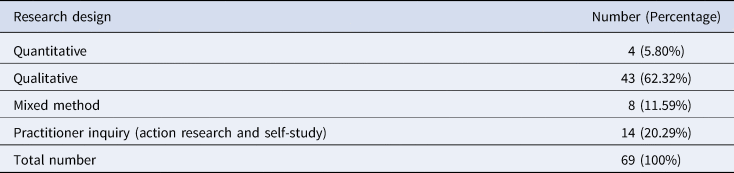
Firstly, the four quantitative studies have unanimously resorted to the use of questionnaire survey to explore language teacher educators’ general perceptions about their situated programs (e.g., Gholami & Qurbanzada, Reference Gholami and Qurbanzada2016; Knox, Reference Knox2017) as well as their specific beliefs about the inclusion of culture (Byrd et al., Reference Byrd, Hlas, Watzke and Valencia2011) and multimodal texts (Farías & Véliz, Reference Farías and Véliz2019) in teacher education classrooms. This demonstrates the value of questionnaires in allowing researchers to examine and report on the attitudes and experiences of a large number of participants and to duplicate studies in different educational settings. In addition, given that LTE operates in a diverse and complex community resided by different stakeholders such as student teachers and teacher educators, questionnaire surveys can function as a convenient and useful means to collect their perspectives, which can be subject to further comparisons and contrast to generate insights that can help resolve potential conflicts and promote teaching innovations and curriculum reforms.
The use of questionnaire can also be found in the group of mixed method studies, which should be credited for their efforts to provide empirical accounts of the general state (e.g., Yan et al., Reference Yan, He, Guo and Wang2020) and professional attributes (e.g., Al-Issa, Reference Al-Issa2017) of language teacher educators: as seen by pre-service teachers, school teachers, educational administrators, and language teacher educators themselves. Such statistical evidence was complemented by qualitative data collected through open-ended questions and semi-structured interviews, which provided contextualized explanations about the sources of their perceptions and the influencing factors in specific social environments.
It is not surprising that a qualitative approach has occupied a central stage in our database. The prominence of the qualitative research paradigm, which is characterized by its inductive, exploratory, participant-oriented, and locally situated nature (Richards, Reference Richards2009), mirrors the multi-facetedness and context specificity of language teacher educators’ lived experiences. To illustrate, qualitative research is essentially a process of discovery and learning, and it requires researchers to immerse themselves in an ongoing process of data collection and interpretation to discover how people think, believe, and behave in specific time and space (Creswell, Reference Creswell2007). Considering that research on language teacher educators is an emergent area, qualitative approaches, including case study (e.g., Asaba, Reference Asaba2018; Yuan & Yang, Reference Yuan and Yang2020a) and narrative inquiry (e.g., Yuan, Reference Yuan2017a; Barkhuizen, Reference Barkhuizen2021b), allow the researchers to march into this unchartered territory, investigating language teacher educators’ cognition (e.g., Banegas, Reference Banegas2020a), collaboration (e.g., Yuan & Mak, Reference Yuan and Mak2016), and identities (e.g., Trent, Reference Trent2013) with an open and exploratory lens. More pointedly, compared with the survey-based quantitative studies, which depict general patterns of language teachers’ perceptions, the utilization of qualitative research data (e.g., interviews and field observation) shows sensitivity and respect towards the personalized, situated meanings constructed by language teacher educators through their social engagement and interactions in particular socio-cultural environments.
Nevertheless, it is noteworthy that the majority in the qualitative research category have relied on self-report data – that is, interviews, written responses (e.g., see Yuan & Lee, Reference Yuan and Lee2014 for the design of narrative frames), and journal entries – to elicit stories and reflections from the research participants. Only a handful of studies (e.g., Asaba, Reference Asaba2018; Johnson & Dellagnelo, Reference Johnson and Dellagnelo2013; Yuan, Reference Yuan2017b; Yuan & Yang, Reference Yuan and Yang2020a) made use of observation data to address their research questions. The shortage of studies using field observations is surprising, particularly in view of the multiplicity of language teacher educators’ professional practice within and across different communities of practice (e.g., university classrooms and practicum schools). To learn more about this unique group of professionals with various hats (e.g., teacher, supervisor, and researcher) and their contributions to language teaching and teacher education, there is an urgent need for more systematic, in-depth studies that utilize multiple sources of data including field observations. Such a research design not only can enhance the trustworthiness and validity of the results via data triangulation, but may also shed light on language teacher educators’ actual engagement in different forms of practice as an essential part of their cognitive growth and identity construction.
In terms of data interpretation, a large portion of the qualitative studies followed the approach of thematic analysis to analyze the content meaning embedded in the research data (e.g., interviews and written reflections) constructed by the research participants. In view of the discursive nature of social reality where language serves as a crucial medium of communication, control and power (Fairclough, Reference Fairclough2013), current research lacks a discourse lens to account for the mediating role of language in shaping language teacher educators’ daily practice, social relationships and professional identities. A few studies (e.g., Trent, Reference Trent2013; Yuan, Reference Yuan2016) reviewed above have analyzed the intricate process of language teacher educators’ identity transition and transformation from a linguistic perspective. However, the potential of a discourse analysis approach can be maximized to examine how language teacher educators provide discursive modeling and scaffolding, how they engage in dialogic mediation with student teachers, and how they negotiate meaning with collaborators (e.g., school teachers and leaders) in research projects and other professional activities.
Another important and encouraging finding about research methodologies in our review is the growing trend of practitioner inquiries conducted by language teacher educators in their own professional settings. According to Cochran-Smith and Donnell (Reference Cochran-Smith, Donnell, Green, Camilli and Elmore2006), practitioner inquiry refers to ‘the array of educational research genres where the practitioner is the researcher, the professional context is the research site, and practice itself is the focus of study’ (p. 503). Lying at the heart of practitioner inquiry is its commitment to participation, reflection, and transformation initiated and owned by practitioner researchers (including language teacher educators) with a critical and action-oriented mindset. Under the umbrella term of practitioner inquiry, two action research studies and 12 self-studies were retrieved from our database. A close analysis of their research questions and design reveals a strong practical focus embraced by language teacher educators who uphold a sense of ‘pedagogical responsibility’ (LaBoskey, Reference LaBoskey, J. J., M. L., V. K. and T2004, p. 839) in continuously evaluating, monitoring, and transforming their thinking and actions to address real-life problems and facilitate teacher learning.
Aligned with such a practical, problem-based orientation is the prominent use of qualitative data sources to explore questions related to language teacher educators’ pedagogical practice in university classrooms (e.g., Peercy, Reference Peercy2014) and field schools (e.g., Golombek, Reference Golombek2015) as well as their sense-making and identity construction over time (e.g., Yazan, Reference Yazan2019). These data, including interviews, journaling, videotapes of teaching, teaching artefacts, and email exchanges, emerge out of language teacher educators’ professional engagement and social interactions, thus blurring the boundary between practice and research in LTE, an observation also made by Peercy and Sharkey (Reference Peercy and Sharkey2020). In some cases, a collaborative approach has also been adopted for language teacher educators (e.g., Peercy & Troyan, Reference Peercy and Troyan2017; Peercy et al., Reference Peercy, Sharkey, Baecher, Motha and Varghese2019) who work concertedly to address practical issues of mutual concern and seek collective learning. In this way, different perspectives on teaching and learning situations can be sought and considered to minimize possibilities for self-justification or rationalization (Loughran, Reference Loughran2007) and enhance the democratic validity (honoring the perspectives and interests of different stakeholders) of practitioner inquiries by language teacher educators (Anderson et al., Reference Anderson, Herr and Nihlen1994; Cochran-Smith & Donnell, Reference Cochran-Smith, Donnell, Green, Camilli and Elmore2006).
However, it has to be pointed out that in some reviewed practitioner inquiry papers the research process was described in a rather general and linear manner without reflecting the interactive and possibly ‘messy’ relationships between research, practice, and the researcher. This may be owing to the traditions and norms prevalent in the world of academic publishing, which tend to value the rigor, logic, and objectivity of academic writing in a traditional, positivistic sense while dismissing the messiness and uncertainties as inherent features of practitioner inquiry (Goodnough, Reference Goodnough2008). This tradition needs to be treated with great caution as it weakens the ecological validity and transferability of action research and self-studies conducted by language teacher educators. As Rose (Reference Rose2019) elaborated, the approach of practitioner inquiry is ‘a valid reflection of real-world practices, which are not found in sanitized experiments’ (p. 899) and the practices that make practitioner inquiries ‘messy’ are the very reasons it should be valued and celebrated in the field of LTE. Therefore, in future research, language teacher educators should be encouraged to report their research contexts and processes in a candid and expansive manner, detailing the processes of data collection and analysis together with the continuing changes in how they think and act in educating language teachers in specific settings. Meanwhile, they also need to provide a critical account about how they make sense of their own positionings and navigate potential ethical issues in the research process (De Costa et al., Reference De Costa, Li, Lee, Rawal, McKinley and Rose2020). Such rich information, on the one hand, can make practitioner inquiries transparent and open the process and outcomes of research to broader public critique and debates; on the other hand, it can help interested readers (such as language teacher educators in similar contexts) come to appreciate the relevance and value of the research for their daily work and continuous learning.
Overall, the field of language teacher educator research has gained great momentum over the past decade with the support of different research traditions and paradigms. The most promising finding according to our analysis is the growing recognition and popularity of practitioner inquiry, particularly self-study. Nevertheless, we also note that the majority of the reviewed studies were relatively short in terms of data collection with some solely relying on retrospective data (e.g., questionnaire surveys and interviews). This led to the absence of a historical, institutional, and socio-political understanding of language teacher educators’ lived experiences and professional growth across different stages of their career. It is thus recommended that future language teacher educators, regardless of their research approaches, track and explore the continuing process of becoming and being a language teacher educator over time.
7. Discussion and implications
Our review has depicted a detailed profile of language teacher educators, outlining their professional backgrounds, qualifications, and experiences. The various forms of responsibilities and challenges have been presented, followed by a more nuanced analysis of their professional engagement and cognition (e.g., beliefs, knowledge, and expertise). Close attention has also been paid to language teacher educators’ continuous learning at organizational and individual levels. In particular, a cohort of identity-focused studies has illustrated how different language teacher educators interpreted, constructed, and refined their identities by balancing their personal values/commitments and the external demands, which constituted an essential part of their professional development.
One crucial observation we made about the reviewed studies is an emergent overarching discourse that characterizes language teacher educators as ‘supermen/superwomen’ who appear to have a diverse and sophisticated set of competencies and skills to take up new responsibilities, cope with contextual obstacles, and meet institutional and social expectations on a continuing basis (see Section 5.1 about language teacher educators’ responsibilities and challenges). Aggravating the demanding situation are the lack of professional preparation and induction (especially for novice teacher educators), isolating work environments, as well as the increasing pressure on teacher educators’ research outputs (Çelik, Reference Çelik2012; Gandana & Parr, Reference Gandana and Parr2013; Mannes, Reference Mannes2020; Yuan & Lee, Reference Yuan and Lee2014). In other words, in current higher education settings dominated by a neoliberal, corporatized system and managerial culture, language teacher educators are assumed to work independently and competently in various ‘battlefields’ such as individual classrooms, LTE programs, as well as the academic world (Yuan & Yang, Reference Yuan and Yang2020b). Not only are they held accountable for language teachers’ professional learning in initial and in-service programs, but they also have to conduct high-quality research for knowledge creation and exchange in the academic field (Yan et al., Reference Yan, He, Guo and Wang2020). Meanwhile, they are supposed to foster and apply new types of knowledge and skills (e.g., technological teaching competence and emotional intelligence) in their daily practice, and find effective ways to cater for student teachers’ cognitive and affective needs in complex and shifting teaching situations (Peercy & Troyan, Reference Peercy and Troyan2017; Yuan & Hu, Reference Yuan and Hu2018).
This line of thinking is evident not only in the research findings synthesized above, but also in the practical implications and recommendations made by previous researchers in the reviewed literature (e.g., Trent, Reference Trent2013; Yuan, Reference Yuan2017a; Yung, Reference Yung2020), who adopted either an encouraging or commanding tone in advocating for language teacher educators’ continuing pursuit of self-improvement while actively seeking available institutional support and resources (e.g., funding and teaching relief) to meet the various demands that arise from their work environments. In other words, the current research discourse seems to embrace an individualistic perspective by highlighting the need for a high level of self-independence, self-agency, and self-reflectivity in the complex journey of becoming and being a TESOL teacher educator. In fact, the ‘supermen/superwomen’ discourse is not particular to TESOL but is inherent in general education (e.g., Loughran & Menter, Reference Loughran and Menter2019), where teacher educators in different subject areas are called upon to develop their professional competence and expertise, show resilience and commitment, as well as take on multiple identities, despite the fact that they are often underprepared and work in unsupportive situations. In the section below, by problematizing and discussing such a discourse, we argue for a humanized perspective in preparing and developing teacher educators in both TESOL and other disciplines.
7.1. Humanizing language teacher educators in TESOL
Admittedly, the dominant discourse in which language teacher educators are conceived as ‘supermen/superwomen’ is tempting and in some way even plausible in view of their rich practical experience and high academic degrees (as seen in many cases reviewed above) that can facilitate their multiple undertakings and continuous learning. However, as we engaged in the review and analysis, we could not help but wonder: Are we asking too much of language teacher educators? The existing research has already indicated the potential identity conflicts and crises accompanied by emotional turmoil and burnout experienced by language teacher educators (Barkhuizen, Reference Barkhuizen2021b). In some cases, teacher educators may be forced to give up their practical commitment and instead focus on research for the sake of survival in higher education (Yuan, Reference Yuan2020). More seriously, some may experience exhaustion and burnout because they always have immeasurable commitments, and oftentimes they are looked upon as knowers, givers, leaders, mentors, and rescuers in their situated communities (Yan et al., Reference Yan, He, Guo and Wang2020). Therefore, it is not realistic or sustainable to promote the ‘supermen/superwomen’ discourse with a ‘have-it-all’ mentality, because language teacher educators, like professionals in other disciplines, need time and space to learn, practice, and reflect in an incremental, self-generative manner. Not only should we recognize their challenges and provide policy and logistic support accordingly (as recommended by the reviewed studies), but we also need to humanize language teacher educators by regarding them as whole people with their unique strengths, struggle, desires, and limitations shaped by their accumulated life experience, which altogether define who they are at the intersection of language education, teacher education, and higher education.
Such a view concurs with Ushioda (Reference Ushioda, Dörnyei and Ushioda2009) who conceptualized language learners as thinking and feeling human beings embedded in a fluid and complex system of social relations. If students are to be humanized and viewed as whole people, why such attention was exempt from language teacher educators? As Freire (Reference Freire1970) rightfully argued, teaching is a ‘mutual humanization’ (p. 56) process. Therefore, apart from the widely promoted discourse in humanizing learners, language teacher educators should also be viewed with such a humanized orientation. In particular, language teacher educators should value and be valued for their entire repertoire – including their life histories and experiences, their skills, abilities, and dispositions, their rational thinking and affective experiences, as well as their identity construction and the associated conflicts – brought forth by their socio-cultural backgrounds and ongoing practice, be it empowering or debilitating, glorious or gloomy.
Central to this ‘whole person’ discourse is an emphasis on empowering language teacher educators to actively engage in social, emotional, and ethical learning grounded in their daily practice and in collaboration with significant others (e.g., language teachers and university management) in different communities, particularly through practitioner inquiries. Practitioner inquiries should therefore be institutionally recognized and supported as a viable form of research for language teacher educators to open up their vulnerabilities, dig their inner feelings and reflections, and try out innovative ideas in LTE programs. This does not mean adding a new task to the existing long list of language teacher educators’ job description. Quite contrary, our intention is that time, space, and resources should be afforded for language teacher educators to embrace practitioner inquiries, which can become a way of living supported by the larger communities and institutions in various forms. Through robustly designed and systematically implemented practitioner inquiries, language teacher educators can fulfil their multiple responsibilities (e.g., teaching, research, and community engagement) with a diagnostic eye on their actions, cognition, and emotions, integrate their diverse and potentially conflicting identities, and analyze their limitations and explore new directions by themselves and in collaboration with others. It is indeed reassuring to see that practitioner inquiries (particularly self-studies) have gained popularity and recognition in recent years as disclosed by our review. We hope this trend can continue and further contribute to the emergence of a humanized discourse in which language teacher educators are afforded time, space, and resource to work as whole people (rather than ‘supermen/superwomen’) based on their personal motives, identities, and personalities, as well as unique life histories and backgrounds.
7.2. Setting a future research agenda
Having reviewed the relevant studies on language teacher educators from 2010 to 2020, we now present and discuss some unanswered questions identified from the review and outline the agenda for future research. First, the research endeavors on quality issues often progress in tandem with discussion and debates about standardization and certification in a profession. Thus, building on previous studies such as Zein and Haing (Reference Zein and Haing2017) (also see Section 4), do we need to take a further step and formulate specific standards with respect to the qualifications and experiences in the recruitment, preparation, and evaluation of language teacher educators? In the mainstream education, the two professional standards introduced by teacher educator associations in the United States and the Netherlands serve dual functions. On the one hand, they can be used as reflective instruments for teacher educators’ self-evaluation and self-improvement; on the other hand, they can work in conjunction with systematic certification procedures to guarantee a certain level of professional competency and quality of teacher educators (Koster & Dengerink, Reference Koster and Dengerink2001). Therefore, the standardization of language teacher educators’ work may contribute to quality management and assurance of current LTE programs; however, will such a practice pose new challenges to language teacher educators who have already been struggling with multiple responsibilities and difficulties as reviewed above? In addition, the two professional standards also caution against the over-generalization of teacher educators’ core qualities and practice, which may run the risk of dismissing the idiosyncratic and contextualized nature of teacher education as well as reducing teacher education to mere technical drills (Burns & Richards, Reference Burns, Richards, Burns and Richards2009; Richards, Reference Richards2008). This issue gives rise to another question: how can we strike a balance between the standardization orientation and contextual sensitivity in defining a qualified language teacher educator in TESOL? These questions, which concern the effectiveness of language teacher educators and their situated LTE programs, call for systematic research attention at individual, collaborative, and organizational levels.
Another important realm that needs investigation is some critical yet underexplored areas of language teacher educators’ professional engagement, such as program management, curriculum reforms, as well as community service. Language teacher educators do not simply practice in isolated classrooms; with accumulated experience and expertise, they are often involved in designing, managing, and reforming initial and in-service teacher education programs while reaching out to external communities for knowledge exchange and transfer (Yuan & Lee, Reference Yuan and Lee2014). There is thus a need to explore such dimensions of language teacher educators’ work in future research, whose results can in turn inform the preparation and development of language teacher educators particularly at the novice stage. Meanwhile, while the current literature has provided an in-depth analysis of language teacher educators’ classroom teaching, practicum supervision, and research, some questions remain:
• In the process of providing knowledge input (e.g., via modelling) and engaging student teachers in dialogic mediation in university classrooms or field schools, how can language teacher educators enhance their own knowledge and skills in technology-integrated teacher education and maximize the power of technology to stimulate and deepen teacher learning (Habibi et al., Reference Habibi, Razak, Yusop and Mukminin2019; Rubadeau, Reference Rubadeau2018)?
• Considering the socio-political dimension of language teaching deeply entangled with complex issues of power differentials as well as learner diversity and equity, how can language teacher educators bring such issues to the forefront of their classrooms? For example, how can language teacher educators engage themselves in a critical thinking process to challenge the dominant ideologies and social order to promote critical and equity-oriented LTE (De Costa et al., Reference De Costa, Green-Eneix and Li2021; Veliz & Veliz-Campos, Reference Veliz and Veliz-Campos2019)?
• In the face of the ‘publishing game’ (Lee, Reference Lee2014; Li & De Costa, Reference Li and De Costa2021) dominant in the academia, how do language teacher educators in peripheral EFL contexts navigate the potential bias against their research topics and contexts (Yuan, Reference Yuan2017a)? How do they engage in collaboration to enhance the visibility and impacts of their research in the wider community of language teaching and teacher education?
• While language teacher educators put great effort in their professional work, do they receive support from the significant others in their local context, such as other language teacher educators, program leaders, or department heads? Besides engaging in collaborative research or reflective practice (Catalano et al., Reference Catalano, Shende and Suh2018; Peercy & Troyan, Reference Peercy and Troyan2017), how do they seek opportunities to interact with these players to improve their practice?
All these questions are borne out of the complex and dynamic profile of language teacher educators with multiple responsibilities, thus pointing to directions for continuing research. A third arena of future research relates to language teachers’ inner worlds where their cognition, emotions, and identities are intertwined and shape how they work and develop in higher education. In view of a relatively large volume of studies on language teacher educators’ perceptions about different aspects of their work, we need more specific and robust research investigating their cognition in situated practice. For instance, it is meaningful to explore the constituents of their knowledge/expertise as well as how such constituents interact with each other as a complex, adaptive, and evolving system in interactions with the larger socio-cultural environment (Yuan & Yang, Reference Yuan and Yang2022). More importantly, how language teacher educators’ cognition informs their daily practice and influence student teachers’ professional learning is a crucial topic for future research. Furthermore, research cannot overlook the powerful influences of emotions on language teacher educators. As claimed by Swain (Reference Swain2013), ‘the relationship between cognition and emotion is, minimally, interdependent; maximally, they are inseparable/integrated’ (p. 196). In other words, language teacher educators’ cognitive functioning and engagement are fraught with complex emotions, which influence their apparently rational real-world decision-making, actions, and learning (Golombek, Reference Golombek2015; Immordino-Yang et al., Reference Immordino-Yang and Damasio2007). An emotional focus is thus warranted in research on language teacher educators to shed light on the mind–body connection in their lived experiences as shaped and produced by material, embodied, and affective forces.
The emergence of identity research on/by language teacher educators speaks to the potential of identity as a reflective, conceptual lens with great analytical power in unpacking who language teacher educators are, how they practice and learn, and where they are heading in the complex landscape of higher education. To further tap the dynamic, social process of language teacher educators’ identity negotiation and construction, researchers can consider adopting a long-term perspective and incorporating multiple sources of data from the perspective of pre- and in-service teachers, other colleagues, and even university administrators. Facilitated by a rich dataset, researchers can move beyond a content-based analysis and embrace a discursive perspective to make sense of how language teacher educators foster, refine, and display their identities through various discourse acts and moves embedded in their classroom teaching and social interactions. Further, in addition to a few identity-focused self-studies as shown in our review (e.g., Yazan, Reference Yazan2019), it would be interesting to see more collaborative self-studies among teacher educators at different career stages or between teacher educators and their student teachers, who jointly narrate and interpret their lived experience and identity making over time. Lastly, aligned with the social and distributed nature of identities and in response to the call for identity-oriented pedagogies in LTE (De Costa & Norton, Reference De Costa and Norton2017; Yazan, Reference Yazan2019; Yuan, Reference Yuan2019), language teacher educators may also consider conducting more practitioner inquiries of a longitudinal nature, through which they can design and implement concrete actions to help their students examine and construct their own identities with ongoing evaluation and adjustment.
8. Conclusion
Inspired by Wright's (Reference Wright2010) influential work on second language teacher education, our systematic review has taken stock of important studies that focus on language teacher educators in TESOL from 2010 to 2020. On the one hand, the review has proved that research on language teacher educators has been fruitful over the past decade, yielding insights into a wide array of important topics concerning the ‘what’, ‘how’, and ‘why’ in the process of becoming and being a language teacher educator in TESOL. On the other hand, we have pointed out some limitations (e.g., in terms of research topics and methodologies) and have outlined important directions for future research. It is difficult to predict the future of language teacher educator research as myriad factors concerning English language, institutional polices, socio-cultural changes, as well as technological advancement are constantly at play. Nevertheless, we argue for a humanized approach to researching, understanding, and supporting TESOL teacher educators (and probably teacher educators in other disciplines) as whole people with their unique values and dispositions as well as diverse learning needs to be acknowledged in higher education. Such a perspective shows respect towards language teacher educators’ life histories and localized practices, encourages their self-discovery and self-improvement, and promotes meaning negotiation and understanding at community and institutional levels, thus contributing to the sustainable reforms and development of LTE in the long run.
To conclude, we have conveyed the message that research on language teacher educators is advancing rapidly not only in terms of research topics and results, but also in the adoption of diversified research methodological approaches. We hope our review can help pave the way for more rigorous and enlightening research on the multiple layers that constitute a language teacher educator in various linguistic, institutional, and socio-political settings in the future.
9. Questions arising
1. While language teacher educators take responsibilities for fostering the next generation of language teachers, who are involved in preparing and developing language teacher educators? Do language teacher educators need formal education and induction, particularly at the novice stage?
2. Do we need specific standards in preparing, recruiting, and evaluating TESOL teacher educators? If so, what should be considered in setting up the standards, who ‘owns’ the standards, and how can the standards be applied to guide language teacher educators’ practice and development?
3. The current review points to the complex, emergent nature of language teacher educators’ work entangled with shifting historical, social, and cultural forces. How can language teacher educators manage and regulate their cognition to cope with the complexities (e.g., in relation to equity and ethical issues) and changes (e.g., the advancement of educational technology) embedded in their everyday practice?
4. How do the constituents of language teacher educators’ cognition (e.g., different types of knowledge) interact with each other and inform their practice? How does their cognition as a complex system adapt and evolve across different career stages?
5. How can an emotional focus on language teacher educators help us understand the mind-body connection of their lived experiences at personal and professional levels? How can language teacher educators create an emotionally safe and conducive environment to enhance teacher learning?
6. What can be revealed through investigating the longitudinal process of language teacher educators’ identity negotiation and construction?
7. Considering the multiple responsibilities and identities of language teacher educators, how do they seek out opportunities for their own professional development – for example, through collaborative research and boundary crossing?
8. In view of the entrenched research-practice divide in second language teacher education, how can language teacher educators bridge such a gap, especially when they face the ‘publish or perish’ system in higher education? How do they plan and design teacher education courses and activities to help teacher learners strengthen the research-practice nexus?
9. In what ways can language teacher educators maximize the power of practitioner inquiry, especially the approach of self-study, to improve their professional practice and facilitate teacher learning? When language teacher educators, particularly those situated in the peripheral EFL contexts, conduct and publish their practitioner research, how can they cope with the potential bias against their research work in the academic world dominated by the traditional positivist paradigm?
10. What can language teacher educators do to navigate the dominant ‘supermen/superwomen’ discourse and seek their whole person development in higher education settings? What roles can other important stakeholders (e.g., institutional leaders and policy makers) play in such a conflicted and power-laden process?
Rui Yuan is an Associate Professor at the Faculty of Education of the University of Macau. His research focuses on second language teacher education and English-medium instruction in higher education. His publications have appeared in a number of international journals such as TESOL Quarterly and Teaching and Teacher Education.
Icy Lee is a Professor at the Faculty of Education of the Chinese University of Hong Kong. Her publications have appeared in international journals such as the Journal of Second Language Writing, TESOL Quarterly, System, and Language Teaching Research. She is currently Principal Associate Editor of The Asia-Pacific Education Researcher.
Peter I. De Costa is an Associate Professor in the Department of Linguistics, Languages & Cultures and the Department of Teacher Education at Michigan State University. His research areas include emotions, identity, ideology, and ethics in educational linguistics. He also studies social (in)justice issues. He is the co-editor of TESOL Quarterly and the second Vice-President of the American Association for Applied Linguistics.
Min Yang is an Assistant Professor in The Department of Foreign Languages and Literature at National Chung Cheng University. Her research focuses on academic writing and language teacher education.
Shuwen Liu is a Ph.D. student at the Faculty of Education of University of Macau. Her research focuses on language teacher identity and emotions.