1 Introduction: Paths and motion in space and time
Motion in space and ‘motion’ in time (the latter notion refers to the experience of time as an eternally-evolving present) raise questions that intrigue linguists working in several areas of grammar. Among them are questions about tense, aspect, event structure, lexicalization patterns of motion, and expressions known as motion metaphors of time, e.g. Christmas is COMING , New Year’s Eve FOLLOWS Christmas, The holiday season is AHEAD , We are HEADED TOWARDS difficult times. Many grammatical elements have both spatial and temporal uses, and temporal uses are often analyzed as metaphorical extensions (e.g. Lakoff & Johnson Reference Lakoff and Johnson1980, Reference Lakoff and Johnson1999, Moore Reference Moore2014a) or grammaticalizations (e.g. Heine, Claudi, and Hünnemeyer Reference Heine, Claudi and Hünnemeyer1991, Haspelmath Reference Haspelmath1997) of spatial ones. In the above examples, motion verbs and prepositions with a basic spatial function are used to designate the lapse of time: come, follow, be ahead of, be headed, towards (for details, see Lakoff & Johnson Reference Lakoff and Johnson1980, Reference Lakoff and Johnson1999, Evans Reference Evans2004, Reference Evans2013, Tenbrink Reference Tenbrink2007, Reference Tenbrink2011, Moore Reference Moore2014a).
As far as semantic classes of prepositions are concerned, the emphasis in the works listed above has been on projective prepositions, such as ahead (of), before, in front of and behind. When designating relationships of time, these evoke reference systems known as temporal frames of reference, which then determine how ‘front’ and ‘back’ are assigned to the participating entities and whether these are conceptualized as (metaphorically) moving or stationary (for spatial frames of reference, see e.g. Svorou Reference Svorou1994, Talmy Reference Talmy2000, Levinson Reference Levinson2003; for temporal frames of reference, Tenbrink Reference Tenbrink2011, Evans Reference Evans2013, Moore Reference Moore2014a). In contrast, path prepositions, such as through, over, past and towards, have received little attention in the literature. This gap is one the present work attempts to fill by analyzing the central functions of path prepositions in the expression of paths in time.
While time is in many ways linguistically represented analogously to space (see e.g. Haspelmath Reference Haspelmath1997, Moore Reference Moore2014a, Jackendoff Reference Jackendoff1983: 189–191; a recent summary is Bender and Beller Reference Bender and Beller2014), it is conceptuallyFootnote [2] very different (see in particular Evans Reference Evans2013). Radden & Dirven (Reference Radden and Dirven2007: 317–318) list the following topological differences between space and time: (i) dimensionality – space is three-dimensional while time is (conceptualized as) linear and thus one-dimensional; (ii) the nature of the Trajector (the entity to be located)Footnote [3] – in space this is typically an object (but sometimes an event), while in time it is a situation; (iii) the nature of the Landmark (the entity with respect to which the Trajector’s position is indicated) – in space this is an object, in time a period; (iv) the nature of the search domain (i.e. the area where the Trajector can be located relative to the Landmark) – in space this is a spatial region, in time a time sphere; (v) the nature of a stationary relationship – in space the Trajector occupies a fixed location, in time a fixed position in time; and (vi) the nature of a dynamic relationship – in space this is motion, in time the scanning of a duration.
In this article I analyze spatial and temporal uses of English path prepositions such as through, over, toward (
 $s$
), and past, as well as the less prototypical all through, all over, throughout, which specialize in the expression of a subjectively construed path along which something exists or occurs (for cognitive-linguistic approaches to different path expressions, see e.g. Talmy Reference Talmy2000: Chapter 3; Dewell Reference Dewell2007; Huumo Reference Huumo2013; for formal accounts, e.g. Zwarts Reference Zwarts2005, Gawron Reference Gawron2007). These prepositions represent a spatial or temporal span, i.e. a one-dimensional extent of space or time, as a path along which something either moves or is located and encountered when the conceptualizer scans the path (consider Jane jogged through the park vs. There were mushrooms all through the park). The entity advancing along the path may be a concrete or metaphorical mover, which, according to a standard definition of a path, proceeds in such a way as to occupy different positions on the path at subsequent points of time. Such a definition is unproblematic for most expressions of actual spatial motion, where the duration of the motion event can be measured against time, as in Jane jogged through the park in ten minutes. However, the definition appears to run into circularity when applied to expressions of time paths, such as The baby slept through the afternoon. Can advancement along the path (through the afternoon), which in this case constitutes a change of position in time (conceptualized metaphorically as a path), then be measured against time (conceptualized as duration)? Apparently not, as shown by the unacceptability of *The baby slept through the afternoon in four hours and *The baby slept through the afternoon for four hours. Since the through phrase already delimits the temporal extent of the event, it cannot be again delimited by durative (in/for) adverbials. Does this suggest that metaphorical motion along a time path and duration are one and the same thing, or are they in fact conceptually different manifestations of time?
The frameworks used in this analysis will be cognitive-linguistic, notably Cognitive Grammar (see Langacker Reference Langacker1987, Reference Langacker1991a, Reference Langackerb, Reference Langacker2008) and the Cognitive Semantics model of Talmy (Reference Talmy2000), together with notions of metaphorical motion adopted from the Conceptual Metaphor Theory (see e.g. Lakoff & Johnson Reference Lakoff and Johnson1980, Reference Lakoff and Johnson1999, Moore Reference Moore2014a). Based on earlier cognitive-linguistic analyses of path expressions such as Cuyckens Reference Cuyckens1995, Dewell Reference Dewell2007, and Huumo Reference Huumo2013, I identify four main ontologically distinct types of spatial paths, to be discussed in Sections 3–6, together with an assessment of potential time-path counterparts for each type. These path types are: (i) paths of locomotion, which are traversed by a moving entity, as in John jogged through the park (Section 3); (ii) paths of growing extent, which are gradually filled by an expanding entity, as in The tree we had planted quickly grew past my second-floor window (Section 4); (iii) paths of location, which are fictive-motion paths continuously filled by one stationary and typically elongated entity (for fictive motion in general, see Talmy Reference Talmy2000), as in The jogging path goes through the park (Section 5), and (iv) frame-setting paths, which are paths continuously filled by a homogeneous mass or by a multiplicity of entities, as in There is fog all along the coast and There are mosquitoes all through the park (Section 6). Path types (i) and (ii) relate to an actual change where something is advancing along the path, while path types (iii) and (iv) represent stationary situations as directional. This is typical in expressions of fictive motion, which in general represent a stationary arrangement as though it involved motion (for a detailed account, see Talmy (Reference Talmy2000): Chapter 2). In Sections 3–6, I set out to find temporal counterparts for each of these path types. First, however, in Section 2, I introduce the semantics of the relevant prepositions, as well as different conceptualizations of time that play a role in the analysis.
In discussing temporal instantiations of the path types listed above, the following six research questions (Q1–Q6) will be addressed:
Q1. In those path types related to an actual change, can there be advancementFootnote [4] along the path by a single participant (typically the subject referent or object referent), or is the advancing entity necessarily a whole situation, with all its participants?
Q2. Can the advancing participant be a concrete entity, such as a person or an artefact, or must it be an abstract entity such as an event, and if so, what kind of an abstract entity can it be?
Q3. Does the construal of the path reflect actual change (as in actual motion) or merely a scanning operation (as in fictive-motion expressions)?
Q4. Can the distance traversed along the path be conceptually distinguished from the duration of the event?
Q5. Which path prepositions are able to express the path in each scenario?
Q6. Can the path be freely scanned in both directions, with the change affecting only the way of conceptualizing the content, not the content expressed (as is typical in fictive motion; see Langacker Reference Langacker1991a: Chapter 5; Talmy Reference Talmy2000: Chapter 2)?
This last-mentioned difference is illustrated by Langacker (Reference Langacker2008: 43) with the example of a glass containing water that occupies only half of its volume (the content to be expressed). Depending on the conceptualization chosen by the language user, such a glass can be portrayed linguistically as half-full or half-empty. Likewise, in a fictive-motion expression such as The highway goes from Paris to Berlin (vs. from Berlin to Paris), the content expressed is the stationary location of a highway between two cities. The choice of the prepositional expressions of a source and a goal then reflects a way of conceptualizing this content as directional and as involving a scanning that starts from one end of the highway and proceeds towards its other end.
It can easily be seen that the six questions above have been selected so as to assess the nature of advancement in time against the standard of spatial motion. As far as spatial motion is concerned, the answers to the questions are obvious, presented, respectively, in A1–A6:
A1. Yes, a single participant can move along a path while others are stationary, as in George entered the office through the rear door, where only subject referent is moving, and Jane threw a ball over the fence, where only object referent is moving.
A2. Yes, the mover can be, and typically is, a concrete entity (as in the examples just given), but it can also be a whole event with all its participants, as in John pushed the cart through the park, which instantiates ‘extended causation of motion’ in terms of Talmy (Reference Talmy2000: 415–418).
A3. Both actual and non-actual (fictive) motion can be expressed, as in John jogged through the park vs. The jogging path goes through the park.
A4. Distance is clearly different from duration: a spatial distance is measured in spatial terms, and the duration of spatial motion can be measured in temporal terms, as in Jane ran a mile in seven minutes.
A5. In principle, all path prepositions are capable of expressing paths of both actual and fictive motion, though the frame-setting path prepositions all through, all over and throughout specialize in the latter kind of meaning.
A6. Yes, the path can be freely scanned in both directions in fictive-motion expressions such as The jogging path goes through the park.
As regards time-path expressions, it is less easy to give simple answers. For instance, consider Q1: Under what conditions can the mover be a single entity? Can, for instance, a subject referent cause ‘motion in time’ by the object referent alone, without ‘moving’ itself, even though time inevitably elapses for all? If a path expression allows the (atypical) later
 $\rightarrow$
earlier directionality, then does the direction selected contribute to the cognitive content expressed? Is the distance advanced by the mover in time always equal to the duration of the event, now that both occur ‘in time’, or can the two be distinguished? If they can, do they occur in the same conceptualization of time, or are there multiple conceptualizations of time interacting with each other? Under what conditions can time be scanned without following an unfolding event? Can the scanning proceed ‘backwards’, i.e. from the present towards the past (in an Ego-orientedFootnote
[5]
conceptualization of time), or from a later towards an earlier time (in a non-Ego-oriented conceptualization)? The last-mentioned question is relevant, since canonical motion metaphors of time display the direction of the motion differently depending on the choice of the mover. If the mover is Ego, then the motion proceeds towards the future and the metaphor is referred to as moving Ego (We have passed the deadline, We are coming to a new era, Christmas is ahead
Footnote
[6]
). By contrast, the metaphorical motion of temporal entities often proceeds in the opposite direction (‘pastwards’), approaching Ego from the future and passing her on their way towards the past. This can be illustrated by metaphors known as Ego-centered moving time (Spring is coming, Christmas has passed), following the classification of temporal metaphors by Moore (Reference Moore2014a).
2 Prepositions and notions of time
2.1 The prepositions considered
The prepositional expressions to be discussed in this work include through, all through, throughout, over (in its path sense), past, towards, and from–to. All of these have spatial as well as temporal uses, but they differ in their way of construing the path, their selection of the Landmark (e.g. whether it is container-like or point-like), and in the kind of search domain they establish (whether situated inside or outside the Landmark). There are also differences in the conceptual nature of the path the prepositions designate. The concise definitions of the (relevant) spatial meanings of the prepositions given below are based on Lindstromberg (Reference Lindstromberg2010).
The preposition through has, according to Lindstromberg (Reference Lindstromberg2010: 35; see also Zwarts Reference Zwarts2005), two central spatial meanings: (i) ‘into [the Landmark], then out the other end or side, such that part of a path is surrounded by a Landmark’, e.g. The pump moves the water through the filter and the aerator; and (ii) ‘along a path within the Landmark, without crossing its boundaries’, e.g. Fish move through the water by waving their fins back and forth. Throughout is related to through but means ‘everywhere in [the Landmark]’ or, in expressions of time, ‘continuously or continually from beginning to end’, stressing continuity or frequency of occurrence within a period of time (Lindstromberg Reference Lindstromberg2010: 130–131). Note that Talmy (Reference Talmy, Hickmann and Robert2007: 216): characterizes throughout as indicator of ‘dense dispersion with multiple Figures [Trajectors] as adjacent to or coincident with the Ground [Landmark]’. The preposition past describes a more or less straight path which comes close to a Landmark and then continues beyond it (for semantic illustrations with figures, see Lindstromberg Reference Lindstromberg2010). Over (in the sense relevant here; Lindstromberg Reference Lindstromberg2010: 111–112) profiles a path that lies outside a point-like Landmark (not coinciding with it), vertically higher than the Landmark, and extending beyond it in both directions. Towards designates a directional path oriented to a point-like Landmark which the path may never reach, while the combination from–to designates the terminal points of onset and offset of a path, respectively.
The status of throughout as a path preposition is somewhat debatable. For instance, according to the Merriam-Webster online dictionary (https://www.merriam-webster.com/dictionary/throughout), throughout has two spatial meanings: (i) ‘all the way from one end to the other of’ (i.e. a path meaning); and (ii) ‘in or to every part of’ (not a path meaning), while the Cambridge English online dictionary (http://dictionary.cambridge.org/dictionary/english/throughout) mentions only meaning (ii). According to Lindstromberg (Reference Lindstromberg2010: 130), throughout is closely related to all across and all over, which likewise have the meaning ‘everywhere’. He also points out that in the expression throughout the ocean vs. all over (
 ${\sim}$
all across) the ocean, only throughout includes the depth dimension in addition to distribution everywhere on the surface. In the typology of paths presented in Section 1, such expressions designate frame-setting paths: they are not traversed by a mover but occupied by something over their full length and then scanned through by the conceptualizer (e.g. There were mushrooms growing throughout the forest). In contrast, prototypical path prepositions such as through, past, or over (in its ‘path’ sense) are more compatible with meanings involving a path of locomotion (e.g. Jane jogged through the park), a path of growing extent (e.g. The workers dug a canal through the park) or a path of location (e.g. The jogging path goes through the park).
Since metaphorical time paths are often more similar to spatial frame-setting paths than to spatial paths of locomotion, I have included all these prepositions in the study. The discussion in Sections 3–6 concerns the spatialization of time, conceptualized as a path, as well as similarities and differences between advancement in space and time. The discussion is not confined to motion metaphors but is intended to cover a wider array of expressions where advancement in time is conceptualized in a way that has a counterpart in motion in space. Motion in space is of course itself not a purely spatial notion but a spatiotemporal one, since the spatial position of a moving entity changes with respect to time (for detailed accounts of the frames involved, see Moore Reference Moore2011). I pursue the space-time analogy to different kinds of path expressions, with particular focus on the construal of paths.
2.2 Conceptualizations and notions of time
Before proceeding to the analysis, a few important notions of time need to be defined. In the following analysis, ‘time’ is not a monolithic notion; the starting point is that a clause-level expression may include different conceptualizations of time interacting with each other. In addition to lexical resources, such as nouns, verbs, or prepositions, there are other kinds of linguistic systems designating temporal notions and conceptualizations of time, most obviously tense and aspect. Metaphorical expressions of time are in most cases based on lexical resources, such as verbs, nouns, and prepositions, while tense and aspect relate to a veridical (non-figurative) conceptualization of time.
I adopt the more specific term veridical time (VT, see Huumo Reference Huumo2017) for the conceptualization of time to which tense and aspect relate, and which, in Cognitive Grammar terms, hosts the processual profile of a clause-level predication. According to Cognitive Grammar, a clause-level predication designates a process, which is a relationship that unfolds in time and is tracked through time by a conceptualizer engaged in sequential scanning (for details, see e.g. Langacker Reference Langacker1987: 248–253). Sequential scanning refers to the act of scanning through the component relationships in the order of their temporal manifestation (Langacker Reference Langacker, Filipovic and Jaszczolt2012: 205). In other words, an event fills an extent of veridical time, which is then scanned through by a conceptualizer engaged in a linguistic usage event.
In Langacker’s writings (e.g. Reference Langacker1987, Reference Langacker1991a, Reference Langacker2008), the notion of conceived time (CT) is often used for the conceptualization of time that hosts the processual profile of a clause-level predication. However, conceived time is a very broad notion, defined as ‘time as an object of conceptualization’; it thus comprises many kinds of time expressions, extending from nouns such as Christmas or weekend to purely grammatical systems such as tense. This is why I use the more specific term veridical time, which is the subtype of conceived time that hosts the processual profile of the clause and is the conceptualization of time within which tense and aspect operate. Tense positions the designated relationship with respect to the speaker’s present, while aspect comprises its internal time structure, including duration.
According to Langacker (Reference Langacker, Filipovic and Jaszczolt2012: 207), the role of time as the dimension through which events unfold is actually peripheral compared to its function in temporal prepositions such as before and after, where time is ‘the domain in which the profiled relationship is manifested, just as space is with spatial prepositions’. This distinction further motivates the postulation of different subtypes of conceived time. One conceptualization (VT) serves as the dimension through which an event unfolds, while another one serves as the domain where the profiled relationship is manifested. An important example of the latter is the metaphorical conceptualization of time as a path. This conceptualization will be referred to as a metaphorical path (MP), and it is typical in metaphorical expressions where the passage of time is expressed as motion, as in Christmas is coming. In this example, the MP is an element of the profiled metaphorical motion scenario, a path along which Christmas is moving closer to Ego. The duration of the motion event is then tracked against veridical time, VT, by sequentially scanning the event. As noted in Huumo (Reference Huumo2017), in most cases these two conceptualizations of time correlate, but there are also expressions where this is not the case. For instance, Christmas is two weeks away means that there is a metaphorical distance between Ego and (the future) Christmas, but no motion is indicated. In aspectual terms, however, the example designates a state which has an unbounded duration in VT. In other words, there is duration in VT without motion on the MP. The opposite is true of Next Wednesday’s meeting has been moved forward two days (an ambiguous test sentence often used in psycholinguistic experiments; see Duffy & Feist Reference Duffy and Feist2014 and the literature they cite), where two days designates the distance moved by the (future) meeting on a MP, while the VT duration of the event of ‘moving’ the meeting (i.e. making the decision to reschedule it) is presumably of a much shorter duration. Such examples demonstrate the need to distinguish MP and VT from one another, and show that distance on a MP does not always correlate with duration in VT.
Another important difference is the one between absolute time and relative time. The notion of absolute time (see also Huumo Reference Huumo2017) refers to a conceptualization of time consisting of the actual past, the ceaselessly shifting present, and an expectation of such future entities as have an immutable position on the timeline (such as next Christmas, the year 2057, Easter 2089, i.e. historic and calendric events). Conventional time-reckoning systems, such as calendars or clocks, are representations of absolute time. The passage of absolute time takes place at a constant rate. The notion of veridical time, introduced above, is one conceptualization of absolute time, but metaphorical conceptualizations of time as a path can likewise be about absolute time. For example, the sentence Christmas is coming indicates the imminence of a future absolute-time entity metaphorically as motion towards Ego along a path which is thus a conceptualization of absolute time.
The notion of relative time refers to time-like conceptualizations without a conventionally agreed position in absolute time. These include events or activities, as in activity path metaphors (e.g. We are halfway through the job, an example from Moore Reference Moore2014a), where phases of an activity have a certain temporal order but progression from one phase to the next depends on the efforts of the participants (see e.g. Fauconnier Reference Fauconnier1997: 25–29; Moore Reference Moore2014b). When an event is actually carried out, advancement from one phase to the next is mapped onto absolute time. In this process, the event acquires an immutable position as part of the past (absolute time). As opposed to past events, future relative-time entities are non-factual (fictive in terms of Talmy Reference Talmy2000), and their position in future absolute time can only be anticipated and – to an extent – manipulated: we can, for instance, cancel pre-planned activities or re-schedule them, as in the ‘next Wednesday’s meeting’ example above.
Linguistically, elements of absolute time are typical reference points for localizing entities of relative time – consider The meeting took place in the afternoon, World War II broke out on 1 September 1939, I was born on September 14th, or John washed the dishes in the evening. In these expressions, entities of absolute time serve as Landmarks in prepositional expressions that specify the time of occurrence of relative-time entities. It is often less natural (though not impossible) to use a relative-time entity as a reference point for localizing an absolute-time entity, as in Afternoon arrived during the meeting or September 1st 1939 was dawning when World War II broke out. Absolute-time entities can also be related to other absolute-time entities (e.g. The Advent Sundays are before Christmas, May Day is the 1st of May), and relative-time entities to other relative-time entities (e.g. Mary left after Jane had arrived). In each case, the important factor is that the speaker assumes the hearer to be familiar with the time of occurrence of the entity that serves as the Landmark.
In sum, veridical time is the conceptualization of absolute time that hosts the processual profile of the clause, tracks its duration (in aspectual terms), and positions it with respect to the speaker’s present (by means of tense). Absolute time can alternatively be conceptualized metaphorically as a path on which something moves, as in Christmas is coming. Since a future Christmas is a conventional absolute-time entity, its metaphorical motion is inevitable and ultimately leads to its ‘occurrence’ (to Ego).
Such path-like conceptualizations can also involve relative times, which include events and event structures without a conventionally established position in absolute time. For instance, the expression We are halfway through the job, which is an activity path metaphor (or a purposeful activity in the terminology of Moore Reference Moore2014a), represents the position of a mover on a path of relative time which consists of the ordered phases of ‘the job’. Unlike the lapse of absolute time, motion along the activity path is not inevitable but depends on the efforts of the participants (see also Moore Reference Moore2014b). The motion may thus not proceed at a constant rate, and may even cease, if the agent stops the activity. It is likewise possible to form expressions where two or more metaphorical movers are at different stages of an activity path while sharing the same ‘now’ in VT. Consider Lisa and I were eating a sliced pizza together, but she was two slices ahead of me. In this example, there are two agents cooperatively performing an activity directed towards an incremental theme (the pizza) in Dowty’s (1991) terms. The preposition ahead of evokes a motion metaphor with an activity path, with the two agents situated at different points of that path (Lisa is further advanced than I am) while they share the same ‘now’ in VT.
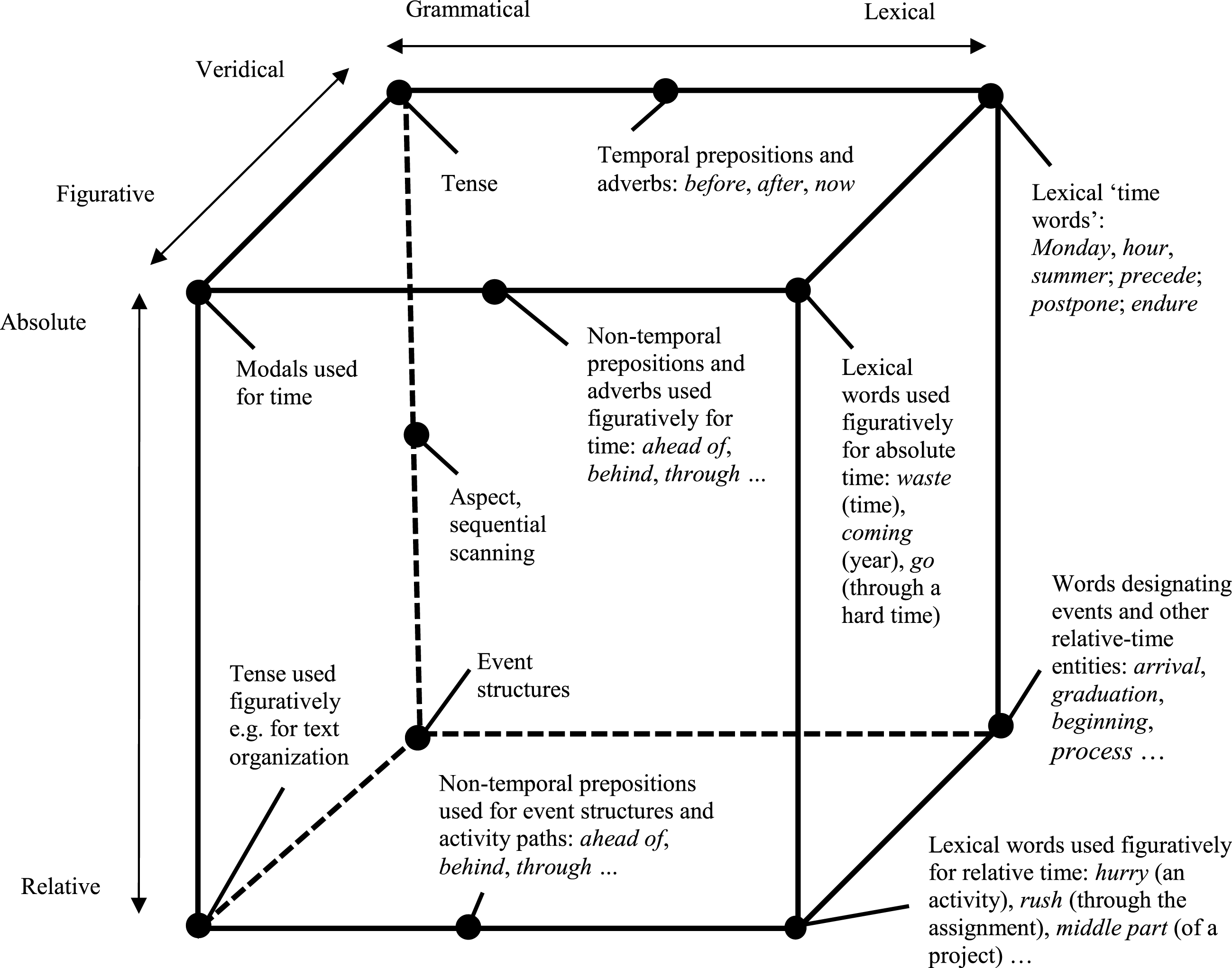
Figure 1 represents the notions of time introduced above (absolute–relative vs. veridical–figurative) as well as their linguistic expressions on the continuum from lexical to purely grammatical, illustrated by some examples of linguistic elements used to express these relations.
In this figure, the three distinctions made above are represented as three dimensions: absolute vs. relative time (vertical dimension), veridical vs. figurative conceptualizations (front–back dimension), and lexical vs. grammatical expressions (lateral dimension). The figure also gives some examples of how linguistic elements (when used in a particular way) relate to the system. For instance, tense in its typical use is a fully grammatical, veridical expression for absolute time, but it can also be used figuratively for relative time, as in text organization (Above I have discussed
 $\ldots$
). An event structure as such (as an abstraction) is a relative-time entity that acquires a fixed position in absolute time when the event is carried out. Between the two, aspectual expressions are grammatical elements that relate event structures to a veridical conceptualization of absolute time. Situated between fully grammatical and lexical resources are lexico-grammatical constructions, such as prepositional phrases and adverbs. Again, there are literal temporal prepositions, such as during, before, and after, and non-temporal (spatial) prepositions, which can be used figuratively for absolute time (Christmas is ahead) or for relative time (Lisa is ahead of me in her studies). Lexical words, such as nouns and verbs, include literal expressions for absolute-time and relative-time notions, while metaphorical expressions rely on figurative uses of such words.
Central concepts of time and their linguistic expressions, with some examples.

In more traditional terms, the notions of absolute and relative time have to do with the referents being expressed; the notions of veridical and figurative time relate to the way of conceptualizing these referents (i.e. linguistic meaning); and the notions of lexical, constructional and grammatical relate to the linguistic forms used in the expressions. These dimensions thus correspond to the classical division into form, meaning (as conceptualization), and reference.
In the sections that follow I analyze spatial and temporal path expressions against these notions of time and the typology of paths introduced in Section 1. I start with the assumption that such uses are metaphorical: in other words, they evoke a metaphorical motion scenario involving an MP with something moving on it, and this motion is then tracked against VT. Section 3 deals with spatial paths of locomotion and their time-path counterparts, Section 4 with paths of growing extent, Section 5 with paths of location, and Section 6 with frame-setting paths. Each section begins with an introduction of the respective path type. Some of the path types have subcategories, discussed in subsections.
3 Paths of locomotion
In existing cognitive linguistic classifications of path expressions (e.g. Cuyckens Reference Cuyckens1995, Dewell Reference Dewell2007, Huumo Reference Huumo2013), one main division lies between paths construed so as to follow the actual progression of an entity (motion in space) and paths construed on a subjectiveFootnote [7] basis for configurations where no motion takes place. Paths of the former type will be discussed in this section and Section 4, while paths of the latter type will be discussed in Sections 5 and 6.
I begin with paths referred to as paths of locomotion (Huumo Reference Huumo2013) or factive paths (Dewell Reference Dewell2007). This path type is illustrated by the example Jane jogged through the park, in which the path is accessed and scanned by the conceptualizer so as to follow the advancement of the mover, Jane, along the path as her position changes against time (VT). Motion along a path of locomotion is typically designated by a motion verb (discussed in Section 3.1 below). In such expressions, the prepositional phrase elaborates a schematic path that is part of the meaning of the motion verb. This means that the prepositional phrase is grammatically a complement of the verb in terms of Cognitive Grammar: it elaborates a salient substructure of the verb (for complements vs. modifiers in Cognitive Grammar, see Langacker Reference Langacker2008: 203–204). The sense of motion can alternatively be evoked by a path expression alone, in a context where the verb does not designate motion but another kind of event that coincides with the motion. This event can be homogeneous, as in John slept from Frankfurt to Berlin (see Section 3.2), or non-homogeneous, e.g. an internal change experienced by the mover during the motion event, as in The train with the broken heating system got colder and colder towards Berlin (see Section 3.3). In the two last-mentioned types, the path expressions are not complements of the verb but free modifiers. The path expressions are unable to elaborate a salient substructure of the meaning of the verbs, since the verbs do not incorporate the schematic notion of a path in their meaning.
3.1 Motion designated by motion verbs
The canonical function of a path expression is to elaborate the schematic trajectory which is part of the meaning of the verb. In terms of Cognitive Grammar, this means that the path expression is a complement of the verb. Prototypical verb classes in such expressions are verbs of motion (intransitive) and of caused motion (transitive). In expressions of spatial motion, the path coincides with the trajectory of a point-like mover, which occupies successive points on the path at subsequent points of VT. The mover may be designated by the grammatical subject, as in (1), the object, as in (2), or both, as in (3).

These examples are simple and their meaning is self-evident as regards the conceptualization of the motion along the path. In (1), the subject designates a mover that gradually traverses the path, occupying adjacent points on the path at subsequent points of VT as the unfolding of the event is sequentially scanned. In (2), the subject referent is not a mover but causes the motion of the object referent on the path. In (3), both participants are moving, as the subject referent continues to cause the motion of the object referent (such relationships are referred to as ‘extended causation’ by Talmy Reference Talmy2000: 415–418).
The closest temporal equivalents for examples (1)–(3) are metaphors that designate the lapse of time as self-propelled motion. In such metaphors, the mover can be Ego, in which case the path expression has a temporal entity as its Landmark, as illustrated in examples (4)–(6). (The examples in (5) and (6) are from the Internet.)

In (4), Ego’s metaphorical motion along the time path ‘through a hard winter’ is profiled by the verb go. In Cognitive Grammar terms, the prepositional expression is a complement of the motion verb. Examples (5) and (6) illustrate uses of the prepositions past and over in metaphors of moving Ego. They differ from (4) in that in (5) and (6) the search domain (i.e. the area where the Trajector is situated when it traverses the path) is not located within the Landmark but outside it. Example (6) is a special case of moving Ego, where the Landmark (Christmas) has a metonymic reading: it stands for activities associated with a calendric event, such as festivities. By not participating in the festivities the mover metaphorically skips over Christmas, as though not experiencing it at all. This would be impossible if Christmas were understood non-metonymically as an absolute-time entity (i.e. December 25). In the metonymic reading, Christmas has features of a relative-time entity, and the Ego can then choose whether or not to participate in it (e.g. I skipped my birthday ‘did not celebrate it’).
Alternatively, in an Ego-centered moving time metaphor, the mover is a temporal entity which moves with respect to a stationary Ego coded as the (implicit) Landmark; see examples (7)–(8).

Examples (7) and (8) illustrate uses of path prepositions in metaphors of Ego-centered moving time (Moore Reference Moore2014a), where Ego is stationary and temporal entities move with respect to her in the general direction future
 $\rightarrow$
present
 $\rightarrow$
past. In these examples, Ego is the Landmark; as is often the case, however, in (7) and (8) it is not overtly expressed. A semantic constraint for prepositions in such expressions is that they must select a point-like entity as their Landmark. For instance, the preposition through, which requires a three-dimensional Landmark, is not felicitous in such metaphors (e.g. ??The days went through us).
In examples (4)–(8), the mover is in each case designated by the grammatical subject. For temporal equivalents to (2) above, where only the object referent is moving, and (3), where both subject and object referents are moving, consider (9) and (10):

Example (9) can be considered the temporal equivalent of (2) (‘throwing a rock over the fence’; see also Jackendoff Reference Jackendoff1983: 190). It designates a temporal manipulation whereby the position of a future relative-time entity, the appointment, is changed on a path-like conceptualization of future absolute time. The manipulation is linguistically represented as the meeting’s caused motion along the path and past the Landmark of over. As in (2) (‘throwing a rock over the fence’), the subject referent does not accompany the object referent in its motion: only the position of the future appointment on the metaphorical path changes. The duration of the event in VT is confined to the interval it takes to make the decision to postpone the appointment. This has the consequence that the ‘motion’ of the meeting is conceived of as abruptFootnote [8] and is not tracked in a part-by-part manner.
In (10), the subject referent (the plenary speaker) causes the metaphorical motion of the object referent (the closing of the conference) while both advance on the path. The subject referent achieves this by keeping up an activity (of speaking) that delays the closing more and more. Note that the path expression past dinner time has two readings, depending on whether it is understood as a complement of the caused-motion verb drag or as a free modifier. In the former case, the prepositional expression elaborates the schematic path that is inherent to the meaning of the verb drag: ‘the plenary speaker caused the closing of the conference to move past dinner time’. In this reading, the prepositional phrase relates to metaphorical motion along the MP evoked by the verb. In the second reading, the prepositional phrase is a modifier relating to the (VT) duration of the ‘dragging’ event: ‘the speaker caused the closing to move (along a metaphorical path) until the time was past dinner time’. In the latter reading, the mover is the processual profile of the clause advancing in VT. This is in fact a prototypical function for time-path expressions, and such examples will be further discussed in Section 3.2.
In examples such as (9) and (10), the subject referent can be a concrete, agentive entity but the object referent has to be a point-like (‘punctual’ in aspectual terms) relative-time entity, with no fixed (unchangeable) position in absolute time. An entity of absolute time cannot undergo such manipulation, as shown by the ill-formedness of *Lisa moved Thursday over the weekend (recall (9) above) or *Lisa dragged Christmas past New Year’s Day (recall (10) above). A non-punctual relative time entity, such as vacation or meeting, may alternatively be conceptualized as extending or expanding in time, in which case it is not moving as a whole; such examples will be discussed in Section 4.
3.2 Verbs not designating motion
The expressions of metaphorical motion discussed in Section 3.1 are in fact a special case as regards the use of path prepositions in expressions of time. A more typical use is the one already illustrated by the second reading of example (10) above, where the time path relates to the advancement of the event’s processual profile in VT, rather than to a distance metaphorically traversed. In such uses the mover is the evolving temporal profile of a process, not the individual participants in the process. Moore (Reference Moore2014a: 44–45) calls such expressions a situation is a mover metaphors. Consider the following two examples:

In (11) and (12), the time-path expressions are not complements of the verbs. The verbs sleep and read do not designate motion, and there is no schematic trajectory in their meaning. The prepositional expressions relate to the duration of the event in VT – in other words, the activities designated by the verbs in (11) and (12) coincide with a time-span conceptualized as a path. Examples (11) and (12) are thus fundamentally different from those discussed in Section 3.1, where the time-path expressions were complements of motion verbs.
The uses illustrated in (11) and (12) have counterparts in spatial path expressions, which can likewise be used for situations where advancement along the path is not propelled by the (linguistically expressed) activities of the participants. Consider the next two examples:

In (13), John is traversing a spatial path but his activity, sleeping, is not motion; the verb does not contribute semantically to the path, which rests solely on the prepositional phrases. In his typology of motion-event descriptions, Talmy (Reference Talmy2000) uses the term ‘concomitance’ for such expressions: the co-event (‘sleep’) is concomitant with the motion event, and it is an activity or state that the Figure of the Motion event (i.e. the mover in our terms) manifests independently of its motion or locatedness. In the transitive example (14), the tour guide’s talking likewise coincides with motion toward the border (for instance of a tourist bus), but the verb does not designate this motion and the path is thus construed independently of it. In both (13) and (14), the path metonymically specifies the duration of the activity, which coincides with the traversing of the path and potentially ends after that (though this is not explicitly stated). In grammatical terms such path expressions are free adverbials, not complements of the verb. This argument finds support in the possibility of using frame-setting prepositions, such as throughout and all through, as paraphrases for through (in (13), John slept
all through
 ${\sim}$
throughout Central Germany). In contrast, when through is used with a motion verb to indicate a path of locomotion, it typically cannot be paraphrased by such frame-setting prepositions (consider *We went throughout a hard winter).
Spatial path expressions in motion descriptions of the concomitance type often have a metonymic temporal function: the activity designated by the verb coincides in (veridical) time with the motion on the path. This meaning is especially strong in the from–to (source
 $+$
goal) specification in (13), which is a felicitous answer to a ‘when’ question, as in the following mini-dialogue:
Speaker A: When did John say he slept on the train?
Speaker B: I think it was from Frankfurt to Berlin.
In this respect the spatial ‘from–to’ path in (13) again differs from a path of locomotion, such as John drove from Frankfurt to Berlin, which is apparently not a felicitous answer to the question When did John drive? – at least if the ‘from–to’ specification is understood as a complement of the motion verb. However, if it is understood as a free modifier, as in example (13), the metonymic temporal reading is again possible. A context that foregrounds such a reading is the one where John and his companions took turns driving. In such a context, from Frankfurt to Berlin does not necessarily designate a source
 $+$
goal combination but an intermediate section of a longer trip, with both spatial and temporal implications (‘John drove when the car and its passengers were between Frankfurt and Berlin’). In this case, Frankfurt and Berlin are not only points of space but additionally have a metonymic temporal function specifying ‘the span of time between leaving Frankfurt and arriving in Berlin’ when John’s driving takes place.
From the point of view of a passenger, the motion of a vehicle along its route, as in (13), can be thought of as inevitable and unstoppable, and in this sense similar to the inevitable and unstoppable flow of time. For instance, the progression of a train along its track provides a metonymic frame for locating events that take place during the trip, against the changing position of the train (consider Since the train was very crowded, Jane stood up well BEFORE her station to make sure she could exit ‘earlier than the time when the train arrived at her station’).
3.3 Verbs designating a gradual change
In Section 3.2, the events coinciding with the motion were internally homogeneous and continuous, and the issue was whether the verb designates motion along the metaphorical path (MP) or whether the path is merely associated with the temporal profile of the event (its duration in VT) in a situation is a mover metaphor. In this section, I briefly discuss expressions that designate a gradual change undergone by an entity that moves along the path and maintains its identity throughout the event. Such a meaning is apparently less naturally expressed by a spatial path expression than by a temporal one. Consider the following two temporal examples:

In (15), the Trajector, ‘the pain’ undergoes a change while the temporal profile of the event progresses along the time path. In (16), the Trajector ‘the neighbors’ children’ undergo a change as time evolves. Possible spatial counterparts for this time-path type are expressions that designate actual motion in space by an entity simultaneously undergoing a change. Such expressions likewise belong to Talmy’s concomitance type, as illustrated in the following two examples:

The prototypical path preposition through in (17) and both through and along in (18) are infelicitous. On the other hand, the frame-setting preposition throughout and the directional towards work better in (17). This suggests that a prototypical path preposition whose basic function is the expression of a path of locomotion is not felicitous with a verb that indicates a gradual change undergone by the entity moving along the path.
4 Paths of growing extent
In addition to expressions where a point-like entity advances on a path, there are other types of path expressions with different kinds of Trajectors. One such type consists of expressions designating an actual change in the extent of the Trajector, which expands until it fills the path. I refer to such paths as paths of growing extent. They share one important facet with paths of locomotion: the fact that there is actual advancement along the path. However, on a path of growing extent, the Trajector is not advancing as a whole but is expanding its extent on the path until it fills the path completely. Such a Trajector is not a point-like mover (as in the examples discussed in Section 3 above), but might be called a grower. Both spatial and temporal expressions are possible, as illustrated in (19)–(20) and (21)–(22), respectively:

In (19), the growing tree gradually fills a vertical path in space, measured from the ground and extending higher than the second-floor window. The tree as a whole is not moving, but its upward-growing trunk gradually fills the path. In (20), the subject designates an agent which is causing the object referent (an incremental theme in terms of Dowty Reference Dowty1991) to gradually come into existence until it fills the path. Examples (21) and (22) are temporal counterparts of (19) and (20). The Trajector filling the time path is a temporal entity, a time-span designated holistically by a noun phrase. In Cognitive Grammar terms, this means that what is sequentially scanned in (21) and (22) is not the span of time designated by the NPs the meeting and her vacation, but rather the processes ‘go on’ and ‘continue’, involving the gradual expansion of these spans in time. Again, there are two conceptualizations of time: one in which the profiled relationship is manifested (i.e. where the extent of the entities ‘meeting’ and ‘vacation’ is growing and passes the Landmarks of the prepositional expressions) and another one that hosts the processual profile of the clause-level expression (VT). The difference between the two is clearest in (22), where the act of expanding the vacation can be understood as an instantaneous decision of temporal manipulation (as in the ‘next Wednesday’s meeting’ example discussed in Section 2.2 above). In other words, what ‘passes’ Christmas in (22) is the growing extent of the vacation, not the process of (making the decision of) ‘continuing’ the vacation, which may have a very short duration. Grammatically, in (21) the gradually growing entity is designated by the subject and in (22) by the object.
As usual, there are also important differences between the spatial and temporal examples. These concern in particular the durability of the resulting state. After the event of ‘growing’, the spatial Trajectors remain where they are in (19) and (20), and continue to fill the path, which consequently becomes a path of location (for these, see Section 5 below). In contrast, the temporal Trajectors in (21) and (22) cease to exist after ‘growing’ in time – in fact, it can be argued that there is no point of (veridical) time at which they exist as wholes, since they are non-punctual sequences of time, and time itself ‘exists’ (
 $=$
is experienced) only in a gradual manner. Linguistically, however, the phrases the meeting in (21) above and her vacation in (22) designate non-punctual spans of time as entireties, in their full extent. More precisely, these Trajectors are entities of relative time which are mapped by the clause-level expression onto a path conceptualization of absolute time by indicating their extent on the path. Path-like arrangements in space can likewise be scanned in part-by-part manner, making it possible to attribute to their Trajector a quality that actually concerns only some parts of it, as in (23), or to represent a difference between the parts as a fictive change, as in (24).

In (23) and (24), the subject phrases designate the road as a whole, but the verbal predications concern only some parts of it, as in (23), or compare different parts of the whole to each other and represent a difference as a change, as in (24). For yet another possible temporal equivalent to these examples, consider Last September was rainy for the first half of the month, where the subject phrase designates a period of time as a whole but the predication concerns only the first part of it.
5 Paths of location
The third type of path distinguished in the Introduction is the path of location, which hosts a stationary, elongated Trajector fictively moving along the path. A typical spatial example is The jogging path goes through the park and past the lighthouse. Paths of location resemble paths of growing extent, in the sense that the path is filled by the Trajector and construed so as to track the contour of the Trajector. The difference is that in a path of location the Trajector is not a grower but fills the path continuously. Dewell (Reference Dewell2007) uses the term ‘static location with extended Trajector’ for such expressions, while Talmy (Reference Talmy2000: 128–139) calls them coextension paths. A coextension path, according to Talmy, is ‘a depiction of the form, orientation, or location of a spatially extended object in terms of a path over the object’s extent’. In such expressions, the spatial extent of an elongated Trajector is expressed as though the Trajector were moving along the path it fills (e.g. The railroad goes from Warsaw to Berlin). Consider the following four examples:

Example (25) designates a spatial coextension path where the Landmarks of the path prepositions are fictively passed by the Trajector. Example (26) demonstrates that a spatial entity as such cannot establish a coextension path with a temporal Landmark. However, (27) shows that a time-path expression is felicitous if the temporal Landmark serves to designate the time of existence of the spatial fictive-motion arrangement as a whole, i.e. the duration of the spatial arrangement in VT. In grammatical terms, the difference between (26) and (27) is that (26) attempts to use the time-path expression as a complement of the motion verb go, which then results in ill-formedness, since go with a concrete entity as its subject can only designate fictive motion in space, not in time. In (27), on the other hand, the path expression is a free adverbial: the spatial fictive-motion arrangement constitutes a state that continues in VT, and what advances past the temporal Landmark is the temporal profile of this state (a situation is a mover metaphor). In (28), the fictively moving Trajector is itself a temporal entity (a span of time), which is why the time-path expression can now be used as a complement of the motion verb. It specifies a Landmark on the time path filled by the temporal Trajector.
What resembles spatial fictive motion in (28) is that a motion verb together with a dynamic prepositional expression designates the position of an elongated and internally homogeneous entity. This position is represented as motion past a temporal Landmark which is part of the conventional calendric system. There is thus a similarity between spatial fictive-motion expressions such as (25) and the temporal example (28). The question is whether (28) instantiates not only metaphorical motion but also some form of temporal fictive motion. Before answering this question, we need to elaborate the conceptual nature of (28): Does it more closely resemble expressions of (spatial) fictive motion or the earlier examples of temporal paths of growing extent, such as (21) above, The meeting went on past dinner time?
The difference between (21) and (28) lies in the way the temporal Trajector (a span of time) is conceptualized in the two expressions. The resemblance between (28) and spatial examples of fictive motion such as (25) is due to the nature of (28) as an abstract or virtual conceptualization (for this notion, see Langacker Reference Langacker1999). This means that (28) can be understood as a predication of the generic year cycle, in which the period of Daylight Saving Time occupies a conventionally specified position. This generic-level (virtual) period is actualized by a different span of actual time every year. In other words, ‘the period of Daylight Saving Time’ sets up a role in the generic concept of the year cycle (in the sense of Fauconnier Reference Fauconnier1985: 39–42), and this role has individual, actual sequences of time as its fillers: the periods of Daylight Saving Time of individual years. Since the role only exists at a virtual level, it is conceptualized as existing continuously in VT and can accordingly be scrutinized as such. The arrangement whereby the period ‘goes’ (extends) past September thus has an unbounded duration in VT. The generic nature of (28) is highlighted by its present tense. In contrast, the past-tense predication The period of Daylight Saving Time went on past September may imply a single experience of an actual period of Daylight Saving Time; the generic reading, however, is likewise possible, if the example means that in some earlier calendric system the period was positioned that way.
It is also important to consider the grammatical and lexical elements in (28) that express advancement in time. A noun phrase such as the period of Daylight Saving Time profiles a span of time holistically, as an entity. This entity is then conceptualized as occupying a certain position in calendric time. It can be scrutinized alternatively as a stationary configuration (e.g. The Daylight Saving Time period is between March and October) or, perhaps more commonly, in a directional manner (e.g. The Daylight Saving Time period extends/goes on from March till October). Such an opposition between stationary and directional descriptions is again similar to the one that distinguishes stationary and fictive-motion descriptions of spatial arrangements (e.g. The Cabrillo Highway lies between Los Angeles and San Francisco vs. The Cabrillo Highway goes from Los Angeles to San Francisco).
In addition, there are a number of ‘extent verbs’ (for these, see Gawron Reference Gawron2007) that specialize in the expression of spatial or temporal spans as directional. These include extend, go (when used for fictive motion), reach and continue (which can be used for both space and time), as well as last and endure (which can be used for time only). In the temporal uses of these verbs, however, there are important differences that concern the direction in which each verb allows the designated span of time to be scrutinized. Consider the following examples:

In spatial fictive motion, the scanning can proceed either way without altering the content expressed but only the way of conceptualizing it, as in This railroad goes from Frankfurt to Berlin vs. This railroad goes from Berlin to Frankfurt. Examples (29) and (30) demonstrate that a similar alternation is sometimes possible in the scanning of a temporal Trajector. In these examples, the Trajector is a span of time designated by the noun history, and the examples indicate the extent of this span in time and scrutinize it directionally. In (29) the Trajector is scrutinized in the earlier
 $\rightarrow$
later direction, while (30) illustrates the later
 $\rightarrow$
earlier direction. The possibility of scanning the Trajector in alternate directions is a common feature in expressions of spatial fictive motion. This feature is not shared by (28), which only allows a scanning in the canonical earlier
 $\rightarrow$
later direction; in other words, it cannot mean that the period of Daylight Saving Time is scrutinized ‘past September’ from its later stages (in October) towards its earlier ones (in March).
A relevant feature in (30), which allows the later
 $\rightarrow$
earlier scan, is that the starting point of the scan is Ego’s ‘now’. Ego’s ‘now’ in the example is again left implicit, but it is implied by the adverb back: since Ego is facing the future, the direction ‘back’ must be ‘pastwards’. The scan then proceeds from Ego’s ‘now’ towards an earlier time. In contrast, a temporal sequence between two equal points in time, neither of which enjoys the status of Ego’s now’, can only be scanned in the earlier
 $\rightarrow$
later direction. For instance, an attempt to change the directionality of the path in (30) to from the Early Middle Ages to the heyday of the Roman Empire is awkward, considering that the heyday of the Roman Empire is a temporal Landmark earlier than the Early Middle Ages. Examples (31) and (32) show that a later
 $\rightarrow$
earlier scan is likewise infelicitous with verbs of extent such as continue or last. While the verb extend in (29) and (30) allows a scan in both directions, continue (31) and last (32) do not allow the later
 $\rightarrow$
earlier scan.
In sum, the data considered in this section suggest that spatial expressions of a coextension path have temporal equivalents, as illustrated by examples (25) and (28). However, while a spatial coextension path can be linguistically represented and scanned in both directions, a span of time can in most cases only be scanned in the earlier
 $\rightarrow$
later direction. Only a span that is conceptualized holistically can sometimes be scanned in the opposite direction, with the prerequisite that the starting point of the scan is Ego’s ‘now’.
6 Frame-setting paths
A fourth type of path is what Huumo Reference Huumo2013 calls a frame-setting path (‘distributive location’ in Dewell Reference Dewell2007), which provides a directional setting within which something exists or occurs. Expressions of a frame-setting path are semantically autonomous, while in grammatical terms they are clause-level modifiers: a frame-setting path (unlike paths of locomotion) does not coincide with the trajectory of a mover, nor (unlike paths of growing extent or of location) does it coincide with the contour of a single entity, but is based on a fully subjective construal. It is a path occupied by a mass (e.g. There was rubbish floating all across the lake), a mass-like, unbounded quantity of discrete entities (e.g. There were mushrooms throughout the park), or events (e.g. It rained all across northern Europe). Such expressions, like paths of location, instantiate a scanning operation: nothing actually advances on the path and there is thus no actual temporal order in which the points of the path need to be accessed, which is why such examples allow a scanning to proceed in any direction, as the Trajector fills any random path across the search domain (Dewell Reference Dewell2007: 278–279). Below, Section 6.1 discusses paths of event occurrence, Section 6.2 paths of entity comparison, and Section 6.3 paths of entity occurrence, in space and time.
6.1 Paths of event occurrence
A frame-setting path of event occurrence scans a search domain within which a similar event is taking place at every point on the path. In such expressions, the path – unlike the paths of location discussed in Section 5 – is not conceptualized so as to track the (spatial or temporal) contour of a pre-existing Trajector, but in purely subjective terms. Such clause-level expressions often have an existential meaning, where the conceptualizer construes the path and then indicates what exists along the path (see Huumo Reference Huumo2013). Consider examples (33) (space) and (34) (time):

Example 33 designates a geographical area directionally, following the progression of a scanning by the conceptualizer. When the focus of the conceptualizer advances in the search domain, the process of raining is encountered everywhere within it. No particular direction is specified, and the path can be understood as extending in any chosen direction across the search domain (see Dewell Reference Dewell2007). Note in particular that the example lacks a reading with actual motion: it does not mean that a rainy area was proceeding directionally over Northern Europe (actual motion) but that the rain was taking place everywhere within the region selected as the Landmark at a time (in VT) designated by the sentence.
In (34) there is a seemingly similar predication about rain, distributed over a time span conceptualized as a path. However, while the prepositions throughout and all through are acceptable in (34), all over and all across make the sentence ill-formed. In semantic terms, the difference between (33) and (34) is that in (33) the rain is understood as occurring at (approximately) the same time at each point along the spatial path, while in (34) the rain has a duration over a stretch of time. Since the path is a conceptualization of absolute time, the Trajector’s occurrence at different points on the path obviously cannot be simultaneous. Rather, the indicated time path hosts a process which is designated by the finite verb and then sequentially scanned. In this sense, (34) does not differ essentially from the examples of temporal paths of (metaphorical) locomotion, such as John slept through the afternoon, discussed in Section 3.2 above. Both instantiate a situation is a mover metaphor, where the mover is the event expressed by the finite verb. More precisely, the event has a temporal profile sequentially scanned in VT, and it is this profile that advances on the time path specified by the prepositional expression.
6.2 Paths of entity comparison
Another subtype of frame-setting path consists of expressions where a difference between individuals is represented linguistically as though it were a change (see Sweetser Reference Sweetser, Nuyts and Pederson1997). Such a comparison may be based on the scanning of a spatial area, as in (35), or on the scanning of a span of time, as in (36)–(39):

In (35), get shorter does not designate an actual change undergone by individual trees but a difference between trees growing in more southern locales, as opposed to those located further to the north. The change predicate get shorter is motivated by a scanning operation (as in fictive motion): the conceptualizer moves his focus of attention through space, encounters entities of the same category at different locations, observes a difference between them, and represents this linguistically as though the entities were moving and undergoing a change. Example (36) is an attempt to form a similar temporal example with concrete entities as Trajectors. Without a suitable context it appears awkward, but (37) illustrates a more specific context where such a predication is felicitous – that the average height of Christmas trees for sale differs from one day to the next, for instance because taller trees are sold first. Example (38) has as its Trajector an abstract, role-like entity with individual fillers at different times (the prices effective at a certain time): the closer a time is to Christmas, the higher the prices in effect at that time. Example (39), like the spatial (35), compares successive temporal entities and presents a difference as change.
Like spatial paths of location (Section 5), spatial frame-setting paths of entity comparison allow the scan of a spatial range to proceed in any direction along the path, in which case the quality assigned to the individuals being compared alternates with its opposite. Thus (35) can have (40) as a counterpart, representing a conceptualization of the same extra-linguistic situation but with the opposite directionality.

In time, however, a scan in the later
 $\rightarrow$
earlier direction is again clearly more restricted in scope than the canonical earlier
 $\rightarrow$
later scan. Examples (37)–(39) above, as well as (41) and (42) below, only allow an earlier
 $\rightarrow$
later scan, with the conceptualizer scrutinizing time proceeding towards later but not earlier times. A special case, allowing the later
 $\rightarrow$
earlier scan, is found in (43):

Examples (41) and (42) suggest that a scan of time that proceeds in the direction specified by further away from must be understood as proceeding in an earlier
 $\rightarrow$
later direction. Example (43) illustrates an exception to this general principle, but lacks a path expression.
6.3 Paths of entity occurrence
Now consider the following examples, representing paths of entity occurrence. In such expressions, the Trajectors are entities that fill the search domain. In (44) and (45), events conceptualized as entities occur everywhere within the search domain, while in (46) and (47) there are concrete entities occupying the search domain.

As is generally the case in expressions of frame-setting paths, the Trajectors in (44)–(47) do not traverse the path but are situated along it. In (44), the explosions are distributed in space so as to that fill the search domain specified by throughout. In (45) a similar distribution in time is indicated, which means that the (punctual) events occur in succession and gradually fill the entire span of time. Such events or their participants are not advancing or extending in space or time but are encountered in a point-like fashion when the conceptualizer’s focus of attention reaches their position on the path.
Examples (46) and (47) designate the presence of entities (mushrooms) in space and time, respectively. Since mushrooms are concrete entities rather than events, the existence of individual mushrooms in (46) is not punctual; some of them may in fact continue to exist for the whole span of time indicated. However, the conceptualizer does not follow the individual entities through time (as in the examples discussed in Section 3.2) but scans the span of time and observes the existence of the Trajectors at every point on the scanned path. This is why (46) does not predicate the duration of the existence of any individual mushroom. In a figurative description, the indefinite nature of the bare plural mushrooms (see Carlson Reference Carlson1977) renews itself throughout the process, and the point of view is not on the individual referents but on the path and what it contains (see Huumo Reference Huumo2013).
7 General discussion
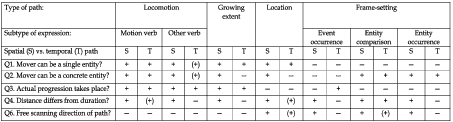
Having investigated the different path types and their potential temporal counterparts in Sections 3–6, we are now in a position to give the following answers to the research questions listed in Section 1. Table 1 below summarizes the main results of the study regarding the research questions Q1–Q4 and Q6 for each path type and its subtypes (Q5 concerns the use of individual prepositions in the expressions and is not included in the table).
The main results of the study. The columns represent the four different path types analyzed and their possible subtypes. The rows represent answers to the research questions Q1–Q4 and Q6. The symbols used:
 $+$
affirmative, – negative,
 $(+)$
conditionally affirmative.

Q1. In those path types related to an actual change, can there be advancement along the path by a single participant (typically the subject referent or object referent), or is the advancing entity necessarily a whole situation, with all its participants?
In most cases what advances along a time path is an unfolding event with all its participants. There are, however, uses of time-path expressions where it is possible to argue that the entity moving along a time path is an individual. These include metaphors where ‘motion’ in time is represented as self-propelled, as in He went through a hard winter or We are rushing towards Christmas. Furthermore, in expressions of temporal manipulation, the future position of a relative temporal entity may be manipulated by metaphorically moving it on the timeline (e.g. John moved the meeting over the weekend). In such cases, it is again an individual entity (the meeting) and not the temporal profile of the process (‘moving’) that traverses the time path. In a wider perspective, and disregarding the requirement of actual progression on the path, individual entities can serve as Trajectors for the path types of growing extent and location: in both, there is a single entity as the Trajector that fills the whole path. In general, such uses are exceptional and marginal compared to the abundance of similar expressions of caused motion in space. The (unsurprising) result is that spatial advancement is first and foremost motion by individuals, while temporal advancement is ‘motion’ by processes and events.
Q2. Can the advancing participant be a concrete entity, such as a person or an artefact, or must it be an abstract entity such as an event, and if so, what kind of an abstract entity can it be?
Again excluding canonical motion metaphors, what moves along a time path is a temporal entity, a process or an event. Since concrete individuals participate in events that then evolve in time, they can likewise be argued to be traversing the time path while participating in the events (hence the (
 $+$
) symbols in Table 1 for Q1 and Q2 as regards paths of locomotion in expressions with a non-motion verb). Furthermore, the conceptualization of temporal entities depends on the linguistic expressions used in referring to them. Consider, for instance, the differences between the following three sentences: John read a Harry Potter novel past midnight (a verbally expressed process evolving in time), The meeting went on past midnight (an evolving event expressed by a noun phrase, with a gradually growing contour in time, designated metaphorically as gradual growth), The period of Daylight Saving Time goes on past September (the unchanging temporal position of a conventional span of time designated as fictive motion). Additionally, concrete entities can occur as Trajectors that occupy spatial (but not temporal) paths of growing extent and location, and function as fillers for two subtypes of frame-setting paths, i.e. paths of entity occurrence and entity comparison (in both space and time).
Q3. Does the construal of the path reflect actual change (as in actual motion) or merely a scanning operation (as in fictive-motion expressions)?
Both are possible, but distinguishing them from each other is less easy in time than in space. This is because the conceptualization of a time span is typically based on a part-by-part scanning, while a spatial span can also be conceptualized holistically. In space, the scanning of a path can follow the trajectory of an actually moving participant, or the path can be construed subjectively. In time, a sequential scanning accompanies the conceptualization of processes that evolve in time along the time span indicated by the prepositional phrase. On the other hand, time can alternatively be conceptualized as ‘the domain in which the profiled relationship is manifested’ (Langacker Reference Langacker, Filipovic and Jaszczolt2012: 207), in which case a time path is subject to the same operations as a spatial path. Clear instances of a subjective scanning of time paths include expressions that scrutinize time in the atypical later
 $\rightarrow$
earlier direction, as in The history of this town extends back to the Roman era or Lisa and Bill go back 20 years (see also research question Q6 below).
Q4. Can the distance traversed along the path be conceptually distinguished from the duration of the event?
Sometimes it can, and in such cases it can be argued that there are two conceptualizations of time interacting, just as space and time are interacting in expressions of spatial motion. For instance, in John moved the meeting over the weekend, the duration of the ‘moving’ event is punctual and does not coincide with the meeting’s metaphorical trajectory past the temporal Landmark (the weekend), which is in John’s future when the act of ‘moving’ is performed. It can also be argued that in expressions such as The period of Daylight Saving Time goes on past September the temporal profile of the prevailing virtual state does not coincide with any particular occurrence of a period of Daylight Saving Time or any particular September. In Bombs exploded throughout the day any event of ‘exploding’ is punctual but the iterative process has a duration that fills the temporal path for its full length.
Q5. Which path prepositions are able to express the path in each scenario?
This is an important question that can be only partially answered without an extensive corpus study; among the prepositions analyzed in the present work, however, the ones that express a frame-setting path seem to be well compatible with the meanings of time paths. Such prepositions include throughout and all through. Canonical path prepositions, such as through, past, or over, tend to express paths of locomotion and thus have more restricted use in expressions of time paths, such as those in motion metaphors where the conceptualization of time most resembles that of space. A case in point is the temporal towards, which, among the prepositions studied above, is most compatible with the expression type where the difference between individuals is represented as a fictive change (The days get longer towards summer, Prices rise towards Christmas).
Q6. Can the path be freely scanned in both directions, with the change affecting only the way of conceptualizing the content, not the content expressed (as is typical in fictive motion)?
A clear restriction concerning paths of time is that in most cases they can only be scanned in the earlier
 $\rightarrow$
later direction. A later
 $\rightarrow$
earlier scan is contrary to our natural experience of time as evolving from the past towards the future, not vice versa. A scan of a time path in the later
 $\rightarrow$
earlier direction is sometimes possible when the conceptualizer is scrutinizing the history of concrete entities such as people or places. In such expressions, the span of time is designated by nouns such as history or past, which can then extend or go back (‘pastwards’) in time (in a temporal path of location). In some instances, entity-comparing expressions such as The prices get lower the earlier you buy your tickets are possible. However, processes designated by finite verbs, as well as gradually evolving events designated by nouns (e.g. The concert went on past midnight), can only be scanned in the direction earlier
 $\rightarrow$
later.
8 Conclusion
The foregoing analysis has shown that all four path types discussed (paths of locomotion, paths of growing extent, paths of location, and frame-setting paths) have parallels in temporal expressions where the Landmark of the path preposition designates a span or a point in time. While there are good reasons to consider paths of locomotion the basic type of path in space, it is less easy to name a basic path type in time. In time, the combination of a path of locomotion with a motion verb that actually designates the Trajector’s advancement along the path is confined to motion metaphors, such as We are rushing towards Christmas. A more typical function for a time path expression is to designate a path traversed by a Trajector while engaged in an activity that as such does not constitute advancement along the path, for example, John slept through the night. Even the combination of a motion verb and a time-path expression does not guarantee a metaphorical reading where the verb specifically designates the Trajector’s way of advancing on the path. For instance, Jane skied through the winter does not mean that Jane advanced through the winter by skiing (as in the spatial Jane skied through the forest) but simply that her skiing coincided in time with the winter. This reflects the greater autonomy of temporal path expressions as opposed to spatial ones: temporal path expressions are typically free clause-level adverbials rather than complements elaborating the schematic notion of a trajectory present in the meaning of a motion verb.
Differences were also observed between spatial and temporal paths of growing extent, paths of location, and frame-setting paths. The first two types have an elongated Trajector which is either gradually growing to fill the whole path or occupies the path continuously. In time, such Trajectors can be expressed by nominals that designate spans of time holistically (e.g. Lisa’s vacation, the period of Daylight Saving Time, or the history of this town). An important difference compared to temporal paths of locomotion is that such Trajectors are expressed by nominals, not by finite verbs. In terms of Cognitive Grammar, this means that they do not evoke a sequential scanning of the designated section of time (this is the function of a finite verb) but can be conceptualized holistically.
A key difference between (temporal) paths of growing extent and paths of location is whether the Trajector is conceptualized holistically or gradually. In the former case, the position of the Trajector can be represented in terms of fictive motion that motivates expressions called temporal paths of location (e.g. The period of Daylight Saving Time goes on past September). In the latter case, the Trajector is observed locally and is conceptualized as gradually growing in time, as in Lisa’s party went on past midnight. In Section 5, I argued that the former type of conceptualization is possible if the Trajector is conceived of at a virtual level, by asserting its calendric position, abstracted away from any of its particular instantiations. On the other hand, Trajectors without such a conventional status (e.g. Lisa’s party in the latter example) can only be observed as incrementally growing to fill a path in absolute time.
It is worth noting that frame-setting paths in time (Section 6) in fact resemble non-metaphorical temporal paths of locomotion: they are gradually scanned and do not follow the temporal contour of a Trajector. The difference is that in a temporal path of locomotion there is a specific Trajector (a process) advancing in time along the path (e.g. John slept through the night), whereas a frame-setting path is scanned subjectively to observe what it contains (e.g. There are mosquitoes throughout the summer, It rained all through October). But it is easy to see that in the domain of time this difference is fine-grained and fuzzy rather than abrupt: we might alternatively argue that the two last-mentioned examples track the duration of the events ‘there are mosquitoes’ and ‘it rained’ along the time path specified, in much the same way as do temporal paths of locomotion. The possibility of using dedicated frame-setting path prepositions such as throughout and all through for both path types is additional evidence for their similar nature.