If we accept that a set of fundamental human goods can be secured only in conditions of political order, it would seem to follow that individuals have obligations to support such orders when they are organized to provide these goods. However, it has proven exceedingly difficult to defend the view that individuals have political obligations to support the states they have legal membership in.Footnote 1 The difficulty is not to show that individuals have moral obligations that regularly coincide with much of what states require within their territories, such as laws against murder or theft. Likewise, where political order is necessary for securing a set of essential goods, individuals will often have moral reasons to offer some kind of support or at least not frustrate the state. Still, political obligations are typically taken to involve more than acting on moral requirements that happen to correspond with state dictates.
Sharing in a system of political obligations is usually thought to mean that each member or resident within a state's jurisdiction has obligations to accept the full range of directives and activities that are part of the state's efforts to secure a political order on fair terms. This requirement entails that those under the state's jurisdiction have at least pro tanto obligations to satisfy what the state requires of them because it is the state that requires it. This is typically called the requirement of universality. Moreover, it is also usually thought that if individuals have political obligations, they have them chiefly in relation to the state in which they live and enjoy membership status. This is typically called the requirement of particularity. For those committed to the premise of moral equality between all individuals, the challenge is to offer a justification of political obligations that is general enough to apply to all members of a state on equal terms but not so general that political obligations do not bind individuals to “their” political community.
The main approaches to trying to manage this tension between universality and particularity are based in consent, fairness, associative values, and natural duty. What is somewhat less common in the existing literature is to question whether satisfying both the universality and particularity requirements as they are currently conceived is necessary for justifying political obligations. Does it make good sense to try to find some way to offer simultaneously a general and an exclusive justification of political obligations? I defend a theory of political obligations based in natural duties that is similar to existing accounts. However, I argue that the difficulties such approaches have had in satisfying the particularity requirement demonstrate a problem with that requirement as opposed to a weakness in the natural-duty argument. This reasoning represents a clear challenge to prevailing views on the relationship between the natural-duty theory of political obligations and the problem of particularity.
Christopher Heath Wellman is the strongest proponent of the natural-duty theory of political obligations. He argues that the key to defending this theory is to show that it can satisfy the particularity requirement.Footnote 2 Massimo Renzo argues that Wellman's model necessarily entails a weakening of the particularity requirement. According to Renzo, the implication is that there is no prospect for natural-duty approaches to justify political obligations to the members of a political order. This is because weakening the particularity requirement produces a model of political order that gives no special concern to domestic interests.Footnote 3 I agree with Renzo's diagnosis that a weakening of the particularity requirement is embedded in any natural-duty theory of political obligations, but I argue that he draws the wrong conclusion from this observation. Instead, I maintain that 1) only natural-duty approaches have any prospect of justifying political obligations, and that 2) weakening the particularity requirement contributes to rather than detracts from the theory's ability to justify political obligations among compatriots.
The argument proceeds in three sections. Section I challenges the view that satisfying the requirements of both universality and particularity as they are conventionally conceived is the appropriate burden of justification for a theory of political obligations. To make this case, I show how the structure of consent, fairness, associative, and natural-duty theories prevents these approaches from successfully managing the tension between universality and particularity. Each approach is instead provoked into weakening one of these requirements. Given a commitment to standards of moral equality, I argue that a natural-duty approach that weakens the particularity requirement is singled out as the most plausible way forward for developing a justification of political obligations.
In Section II, I show how weakening the particularity requirement better coincides with the normative premises of the natural-duty approach. However, this modification of the theory also makes a justification of political obligations among compatriots dependent on their political community making some meaningful effort to ensure that needy outsiders have access to the essential goods that political order is intended to help secure. The first objection to this type of reasoning is that accepting state dictates would be contingent on promoting the most overall good. This type of contingency is thought to be incompatible with having political obligations. The second main criticism is that weakening the particularity requirement entails obligations that are far too demanding. This demandingness is thought to rule out one of the central purposes of sharing in a system of political obligations, namely, giving some level of special priority to the interests of fellow citizens. In Section III, I argue that neither of these objections succeeds against my contractualist approach to weakening the particularity requirement.
I. UNIVERSALITY AND PARTICULARITY?
In this section, I show that not consent, nor fair reciprocity, nor associative, nor natural-duty theories can satisfy the requirements of both universality and particularity. This suggests that a satisfactory theory of political obligations will require some modification of these requirements. I claim that weakening the particularity requirement is singled out as the right modification and that natural-duty approaches are best placed to incorporate this modification.
To begin, it will be helpful to break the universality requirement down into three features: generalness, comprehensiveness, and jointness.Footnote 4 These features of universality, combined with particularity (particularness), give us four conventional requirements for a theory of political obligations:
1. A general system of obligations: Each member/resident has political obligations to support the political order together with all members/residents.
2. The comprehensive prerogative of the state: Individual members have pro tanto obligations to obey the full range of dictates that are part of the state's efforts to secure political order on fair terms. If we accept that a morally justifiable form of political order requires democratic control, then political obligations involve accepting the political community's prerogative to determine comprehensively the terms of political order via the instrument of the state. Note that the obligation to give deference to the state is qualified by the obligation only to give deference to the state contingent on it fulfilling its function of securing political order on fair terms. In addition to this contingency qualifier, the pro tanto qualifier indicates that a political obligation can be outweighed by some other independent moral obligation that is weightier than the moral grounds for having political obligations. Consequently, giving deference to the state involves content-independent but not exclusionary reasons to accept state dictates.Footnote 5
3. Ongoing joint commitment: Having genuinely political obligations involves more than giving deference to state dictates. In addition, the content of political obligations should be publicly shared in common, as opposed to reflecting a series of private codes of conduct in relation to the state.Footnote 6 Thus the content of my political obligations should not be a function of the degree to which I am in a position to avoid state sanctions, secure special exemptions, or exert influence on the general terms of political order that reflect my personal bargaining advantages. Ongoing joint commitment entails that the demands and privileges embodied in a system of shared political obligations should apply to all subjects in a like manner. This requirement does not preclude that different individuals will have different obligations under the law or that they be required to support the state in different ways. However, such differences must reflect joint commitment by treating like cases alike.
4. Particularness: Particularized political obligations require of individuals that they support the proper functioning of the political order in which they chiefly have access to essential collective goods as members or residents.
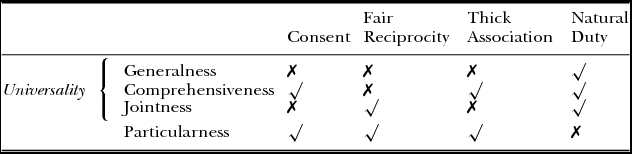
In the upper row of Table 1 are four approaches to justifying political obligations. Along the left column are the four criteria for establishing such obligations.
Consent
Liberals in the social-contract tradition have relied on direct, tacit, or hypothetical consent as the source of subjects’ political obligations. However, in states as we know them, most people do not actively consent to citizenship but are born into this status.Footnote 7 Moreover, individuals do not give consent to the territorial scope of states while they simply, to good measure, find themselves with strong attachments and dependencies to the circumstances and communities they are born into. Add to these facts restrictions on movement within our system of states, and the Lockean notion that continued residence amounts to tacit consent is also undermined.Footnote 8 The difficulty for hypothetical-consent theories is that they do not get their justificatory force from what we have committed ourselves to. Instead it is some other consideration, such as rational self-interest or natural duty, that justifies political obligations.Footnote 9
These well-known problems for consent theory are not, however, conclusive. John A. Simmons argues that the generalness requirement can be weakened domestically in a way that allows actual consent to determine which residents have political obligations to support the state. The idea is that states could accommodate full or partial “resident nonmember” status and much more open systems of intermigration. Such reforms would make it possible for states to be organized around genuine choice procedures for acquiring citizenship.Footnote 10
A basic premise for justifying systems of political authority and coercion is that they are necessary for securing human security, welfare, and respect for individual rights and freedoms. The claim is that achieving the benefits associated with modern forms of large-scale cooperation and meaningfully limiting exposure to the threat that others’ interests will be in conflict with our own well-being requires that social order be arranged though political institutions. Justifications of the state thus point to disastrous coordination problems and the inability effectively to legislate, adjudicate, and enforce the protection of individuals’ rights and welfare in the absence of a system of political authority. On this view, achieving the goods associated with exchange, cooperation, community, and respect for the moral value of individuals requires some form of political order.
Simmons describes the essential collective goods justification of political order outlined above as “quite plausibly offered in support of having states.” However, he insists that such a justification of political order does not translate into a justification of political obligations. This is because “all of the problems of life without states can be solved without unanimous participation.”Footnote 11 It is true that states can and commonly do accept a certain degree of free riding and exempt some individuals or groups from many of the demands of political society. Law is never obeyed fully, and the enforcement of law does not in practice aim at full compliance. Moreover, I may very well be able to do more to promote others’ well-being as a resident nonmember of my state, forgoing as far as possible goods that the political order secures and dedicating resources to the world's most needy instead of paying a citizen's fair share of the tax burden.Footnote 12 However, the fact that the proper functioning of the state is not dependent on universal support is not the same thing as showing that a system of shared political obligations is workable where residents can unilaterally decide if, when, and how they will support the political order.
Individuals’ reasoning regarding their obligations to others is regularly affected by incentives for free riding, shortsightedness, limits of judgment, and misrepresentations of others’ needs. If a political community were bound to accept unilateral claims regarding agents’ willingness to support the political order, those with relative power could use this robust right of exit to pick and choose those aspects of the political order they want to support. Alternatively, those with relative power could use their right of exit to influence the terms of participation or enforcement in ways that secure comparative advantages. When ongoing joint commitment is undercut in these ways, there is an expectation that essential collective goods will not be provided, be underprovided, or be provided in morally objectionable ways.Footnote 13 As Wellman puts it, the threat of disorder can be eliminated only “by virtually everyone foregoing their individual discretion in favor of the laws of their state, and hence . . . part of the sacrifice is having virtually no say in determining how one must sacrifice.”Footnote 14
Of course Simmons's influential “philosophical anarchism” claims only that when individuals can contribute their fair share to security and welfare as partial or full nonmembers, they should be at liberty to do so. The theory does not sanction exploiting the voluntaristic terms of a morally legitimate political order. Yet pointing this out only highlights the internal inconsistency of accepting the essential-goods argument for why we need systems of political order as “quite plausible” while at the same time advancing a voluntaristic model of social order. If residents of a territory can peacefully and productively supply the goods associated with political order in a way that does not require general or ongoing joint commitment, it is difficult to understand Simmons's claim that some possible state could be justified. The premium that consent theorists place on voluntarism should logically lead them to argue for a strong form of anarchism over weak philosophical anarchism.
One might instead claim that consenting to membership is consent to ongoing joint commitment. However, a contract to alienate one's right of exit from political associationFootnote 15 cannot make the political relationship consensual anymore than it could make marriage or church membership on such terms consensual.Footnote 16 This claim is not paramount to prohibiting individuals from entering into associations that limit them from exercising some of their rights.Footnote 17 Rather, the point is that if an association is said to secure the moral legitimacy to limit its members’ rights from the consensual nature of the relationship, participants cannot alienate from themselves a robust right of exit from the association.
A final attempt to make voluntarism and ongoing joint commitment compatible is to argue that consent to joint commitment is not consent to something ongoing, vague, and potentially in conflict with individual rights. Instead, one consents only to what is necessary for the state to secure essential collective goods on fair terms.Footnote 18 However, this means that it is not the ongoing consensual nature of the political relationship but the state's ongoing realization of its function that justifies political obligations.Footnote 19 The more we emphasize the state's function of securing essential collective goods rather than the consensual nature of political order in justifying members’ political obligations, the weaker the case for rejecting generalness. Yet the whole point of philosophical anarchism is to weaken the generalness requirement in order to establish a consensual model of political order.
Philosophical anarchism rightly challenges the idea that we can have a justification of political obligations that is simultaneously general and exclusive, and for this reason it is able to mount a powerful criticism of conventional theories of political obligation. However, the positive account in philosophical anarchism shows us why genuine voluntarism cannot be combined with a justification for genuinely political obligations. Making political obligations dependent on voluntary consent undermines the ongoing joint commitment necessary for political order. Efforts to address this problem require that one justify ongoing joint commitment to those who consent to political obligations. However, any such justification forces one to appeal to something other than the consensual nature of the political relationship. As soon as the justification of political obligations shifts away from appealing to the consensual nature of the political relationship, the consequence is that we no longer have strong grounds for weakening the generalness requirement.
Fair Reciprocity
What about the argument that benefiting from the state generates political obligations to a particular political community grounded in fair reciprocity?Footnote 20 The first commonly noted difficulty for this approach is that over the course of their lives residents will regularly not benefit from some of the things the state does to secure collective goods. This is especially true if access to collective goods for each resident is what it takes to respect every subject's moral importance. Where this is the purpose of political order, one's fair share of support cannot be simply a function of mutual advantage. This is because “reciprocity for received benefits” suggests the corollary that only those who can reciprocate are candidates to receive benefits.Footnote 21 Thus it is difficult for the fair-reciprocity approach to justify a comprehensive system of political obligations that applies to all residents. The second commonly noted concern is that individuals will find themselves with obligations to support all kinds of ventures simply because benefits have been paternalistically imposed on them.Footnote 22 Even if we envision collective goods that are plausibly needed by most people, acquiring nonvoluntary obligations to support the production of goods one needs instead of goods one agrees to is difficult to reconcile with commitments to individual liberty.
George Klosko's main strategy to address these problems for the fairness approach is to weaken comprehensiveness and generalness in a safer way. He argues that political order is the only entity that can provide a certain set of nonexcludable collective goods and that most people need these goods most of the time. The implication according to Klosko is that each member presumptively benefits from the system.Footnote 23 There are people with deeply held religious or philosophical views who will not actually benefit from central aspects of the system. According to Klosko, these people should be exempted from demands of fair reciprocity that would normally apply.Footnote 24 Still, on his theory each member has obligations of fair reciprocity unless the individual subject can show that his case is exceptional.Footnote 25
Think of an isolationist community that rejects public health measures to control dangerous communicable diseases as morally abhorrent interferences with nature's “plan.” Their claims to be exempt from associated regulations and taxes would not be an attempt to free ride. They lack the beliefs and attitudes necessary to benefit from the control of communicable diseases. Under the right conditions there is a strong case for making room for nonparticipation options for this group as one of the means for the state to respect individual liberty. However, if groups and individuals could unilaterally formalize such special exemptions, we would create conditions in which free riding, errors in judgment, or exploitation of relative power would undermine the collective provision of essential goods. To avoid these problems Klosko leaves it up to the state to decide if someone has demonstrated special status and he conceives of this status in such a way that only a very small group of people would not have political obligations.
The question to ask is: What reasons do members of the isolationist community have for accepting the burden of proof and the state's role as adjudicator of special exemptions? They do not have these obligations based in the receipt of benefits. Instead they have these nonvoluntary political obligations because they are necessary to secure the political order that others need. This means that the presumptive-benefits approach does not actually weaken universality among residents. Instead, it allows for some variation in the way residents satisfy their political obligations.
Imagine that a third of the population sees measures to control communicable diseases as perversions of nature. This level of nonbenefiting from presumptive benefits is certainly conceivable but it is also incompatible with the state fulfilling its function. As a result, we are forced to choose between giving a third of the population a special exemption and failing to protect public health or insisting that this minority has nonvoluntary obligations to support the provision of public health for the sake of others. If we go the first route, we do not have the safe presumptive-benefits theory but a weakening of universality in a way that undermines the state's ability to provide essential collective goods. If we go the second route, we do not have any weakening of the universality requirement but a theory that appeals to natural duty at the foundational level to ensure that the state provides essential goods in a morally acceptable way. The implication is that fair-reciprocity theories seem compelled to appeal to some more foundational principle to justify a general system of political obligations.Footnote 26
Association
Associative theories justify political obligations by appealing to standards of mutual care entailed in the relationship between citizens that are said to be like those among family members.Footnote 27 These obligations do not have their source in voluntary acts or in universal moral obligations owed to anybody but in the values that are constitutive of family or political community. Recent versions of this view argue for the compatibility of a commitment to individual moral equality and giving special priority to the relationship between compatriots on the grounds that such relations are sources of human identity and value that are owed universal respect.Footnote 28
The main difficulty for associative approaches is that they aim to but clearly do not dissolve the tension between universality and particularity. Instead, this tension is relocated to the identification of features of the relationship between citizens that generate universal and egalitarian political obligations among citizens that are at the same time not owed to outsiders. Some associative theories see simple membership in a political community as the source of political obligations. However, the notion that we could have weighty group-based obligations and privileges simply by virtue of ascriptive characteristics such as state, nation, race, or gender fails even to attempt the kind of justifications a commitment to moral equality necessitates.Footnote 29
In thicker associative approaches, sharing in a network of obligations is limited to people with attitudes of group identification or kinship with the identities and values the group relations enable. Here the problem is that there will be residents who do not identify in the right way or those who at various points in their lives abandon (partially or wholly) the attitudes that are said to be the source of political obligations. Either these residents do not have political obligations or they have them for some other, more foundational reason. If members can make claims on each other to support a shared system of political obligations only if and when the subjects in question have the right associative attitudes, then general and ongoing joint commitment is undermined.Footnote 30 One could, of course, adopt a justification for political order in which communitarian values generate political obligations for all the members of the state irrespective of whether individual subjects endorse or identify with these values. However, treating individual subjects as means to communitarian ends in this way undermines the compatibility of an associative theory of political obligations with respect for individual moral equality and freedom.
Associative theories appear to be like consent theories in that they identify a credible source of obligations but not a credible source of political obligations. Social relations shape the makeup of associative obligations, but their bindingness on us is dependent on our ongoing endorsement of our role in these relations.Footnote 31 As a result, thick associativism inadvertently weakens universality by weakening the generalness requirement. For association actually to generate obligations in a way that does not violate a commitment to individual equality and freedom, those subject to the obligations must have a robust right of exit from their associative roles. As with voluntaristic theories of political obligations, this robust right of exit undercuts ongoing joint commitment and the political order's ability to fulfill its function.Footnote 32
Natural Duty
In natural-duty theoriesFootnote 33 the benefits of political order justify political obligations on the grounds that others depend on this system for achieving human goods.Footnote 34 The negative effects we can have on each other in the absence of political society and the goods that can be secured in political society generate a duty to support the creation and maintenance of political order. Respecting others as moral equals requires that I support the political order I find myself subject to if this order is fulfilling its function in some minimally just fashion.Footnote 35
Because political society is a cooperative project with clear benefits over disorder, we can expect most individuals often to have self-interested reasons to obey state dictates. At the same time, this self-interested form of reciprocity will recurrently fail to motivate in specific cases.Footnote 36 Still, individuals will regularly accept the benefits of political society as members of a cooperative venture they themselves value. As a consequence, they ought to recognize moral reasons to contribute their fair share to the political project. Yet we see above that reciprocity based in fairness is not enough fully to establish comprehensiveness and generalness. When fair reciprocity is not sufficient, there remains an obligation to support the state because others depend on this system.
Self-interest, fair reciprocity, and other-regarding natural duties produce a package of reasons individuals have for accepting political obligations. Still, it is natural duty that lies at the foundation of the claim that there is for all individuals within a just political community a pro tanto obligation to support the full range of demands involved in a system of political order (i.e., generalness, comprehensiveness, and jointness).
On the natural-duty account, particularized systems of shared political obligations have been necessary to escape the perils of lawlessness and disorder.Footnote 37 However, once a state is well established, it is unclear why an individual subject should give special priority to domestic improvement when she can better meet her universal natural duties by supporting the provision of essential collective goods to people outside her political community. Those who defend the natural-duty approach tend to argue that once a justifiable political order is in place, the “moral landscape” is changed. The argument usually appeals to the way in which the state creates a set of cooperative and coercive institutions that give rise to egalitarian distributive obligations among members that are not owed universally.Footnote 38
Let us accept for the sake of argument that moral-landscape arguments go some way to justifying special priority for the demands of domestic distributive justice over global standards of equal concern. Nevertheless, we should notice the more basic point that moral-landscape arguments always justify strongly particularized political obligations to comembers on the grounds that they are comembers, not because they satisfy one's natural duty. Yet, when faced with conditions in which large groups of people live in circumstances of tyranny or the kind of disorder that leads to crushing poverty, moral-landscape reasoning is necessarily insufficient. In our world, universal natural duties to ensure that all individuals have access to the essential goods associated with political order can and do come into conflict with obligations to give priority to domestic interests and improvement.Footnote 39 This means that the foundational justification for political obligations domestically comes into conflict with the claim that a demarcated political order creates special obligations to prioritize the interests of fellow citizens. The implication, which is further developed in the next section, is that natural-duty theorists cannot justify the kind of particularized political obligations they envision because of a conflict of normative reasons that is internal to these theories.
Moving Forward
When philosophical anarchists or associativists weaken the generalness requirement, they also undermine ongoing joint commitment, which would in practice undercut the ability of a political order adequately to fulfill its function. Theories grounded in fairness have difficulties justifying comprehensiveness, resulting in a model of political order that is underinclusive in morally objectionable ways (Table 2). The ultimate concern with each of these theories is that they do not adequately safeguard the essential-goods political order is designed to secure and on which the large majority of people depend.
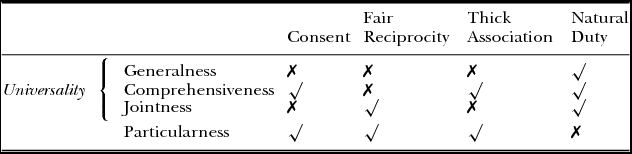
Natural-duty theories can satisfy the universality requirement and thus propose a model of political order that respects moral equality between all individuals. Yet, as a consequence, the approach appears to be unable to particularize political obligations in a strong way. This is troubling because a theory of political obligations is supposed to justify to residents and members the system of political obligations they share in. In the next section, I argue that a weakening of the particularity requirement does follow from the normative premises of a natural-duty approach and in turn challenges common presumptions about political obligations. I argue that this actually contributes to rather than detracts from our ability to justify political obligations among compatriots.
II. WEAKENING THE PARTICULARITY REQUIREMENT
Proponents of the natural-duty approach appeal in part to the perils of a lawless environment when justifying a state's demarcated system of political obligations. However, they also tend to imagine a counterfactual context where all people have access to the goods associated with political order in their respective states. Thus they imagine a context where there is no clear conflict between a demarcated system of political obligations and universal duties to rescue any individual from disorder.Footnote 40
Likewise John Rawls argues with regard to immigration that political communities can, for the most part, legitimately exclude outsiders.Footnote 41 He recognizes that many people wish to escape the persecution of minorities, political persecution, starvation and poverty, and the subjection of women. However, he argues that this type of immigration “is eliminated as a serious problem in a realistic utopia.”Footnote 42 There are no outlaw or burdened societies in a realistic utopia, and limits on free movement are mutually agreed to between political communities. These limits are justifiable to each individual because their own political communities are providing them with a well-ordered system of political order.
Once we move away from idealizations of a world populated by fair and effective political communities, strongly particularized political obligations among compatriots can come into conflict with natural duties we owe to all others. For example, in current conditions it seems entirely plausible that I can better satisfy universal natural duties by contributing resources to support the interests of outsiders than by paying taxes to support my political order. How can my fellow citizens justify compelling me to give priority to our own political community's interests?
Of course, many of the ways in which I have obligations to support political order are not transferable or not easily transferable. In addition, a political order is not just a vehicle for satisfying our natural duties but also enables other cooperative and individual goals. There is thus a reasonable question about how demanding our natural duties are. However, the important thing to notice is that this same question about demandingness is present within a political order following the natural-duty approach. There is a reasonable question about how much a political community can require from its members to secure the goods of political order to fellow citizens on other-regarding grounds.
I address this problem of demandingness in the following section. For current purposes, let us accept for the sake of argument that even in a fairly unequal world, members of a political community could be in a position to claim that they have done enough for outsiders to satisfy their members’ universal natural duties. However, if my political community has not done enough to satisfy its universal natural duties, one implication is that individual citizens could be in a position justifiably to withdraw some of their financial support from the state and direct it toward providing essential collective goods to outsiders. It could be permissible or maybe even obligatory for individuals to respond to their state's indifference by unilaterally prioritizing needy outsiders. This is not just because it would be morally good for more local wealth to be dedicated to securing the conditions for human welfare everywhere.
If the moral legitimacy of a system of shared political obligations can be justified at the foundational level only by appealing to universal natural duties, my state's efforts to prevent me from redressing my political community's lack of concern for outsiders undermine the state's moral legitimacy. This is because the political community's lack of external concern and efforts to compel me to prioritize internal interests suggest that the demands the state is making on me are grounded not in natural duty but in some other principle, such as fair reciprocity or shared identity. Yet if these other principles cannot ultimately justify political obligations, my political community's efforts to block me from redirecting collective resources to satisfy universal natural duties undermine its internal legitimacy to some extent.
Shifting some of my support from my own state to outsiders does not mean that I do not have political obligations. Rather, having political obligations is compatible with some justifiable shifting of support externally because of the deficiencies of legitimacy within my own political order. This shifting of resources to outsiders does not violate standards of fair burden-sharing internally because it simply moves out of the political order a very small portion of the resources that should have been collectively dedicated to needy outsiders.
Of course, individuals could not be justified in shifting support externally in ways that threaten political stability. This puts limits on the aggregative extent to which directing resources to outsiders could be morally legitimate. Moreover, there may be limits on the justifiability of unilaterally redirecting resources that appeal to the same reasons that natural-duty theorists reject giving individuals a robust right of exit from political society. Note, however, that there is a disanalogy between the cases. The shifting of support externally is justified only to a limited extent and for the aim of satisfying natural duties to help secure the essential goods associated with political order.
A corollary to the reasoning above is that the state's internal legitimacy is dependent on not giving too much priority to the perfection of political order, justice, and prosperity domestically. Once a political order provides its members with essential collective goods, dedicating resources to further domestic improvement must be balanced against the political community's universal natural duties to support the provision of essential collective goods.Footnote 43 This again raises the question of how demanding these natural duties are in relation to reasonable interests in domestic improvement. Still, the point is that on a natural-duty approach there could not be a case for focusing exclusively on domestic improvement until all people enjoy effective political order on fair terms. An exclusive focus on domestic improvement would undermine the plausibility that natural duty is the foundation of political obligations internally.
The reasoning above identifies the consistency between Rawls's view that we have a natural duty to support our own political community and his claim that “well-ordered peoples have a duty to assist burdened societies.”Footnote 44 Even on Rawls's restricted view of what can be done to assist in this regard, important implications follow. A well-ordered society can dramatically improve access to essential collective goods for individuals in outlaw or burdened societies by allowing and even assisting them to immigrate into their country. Given a natural-duty justification of the state, on what grounds can a well-ordered political community reject a request of entry of this kind?
The problem for the Rawlsian view is that justifying limits to entry are made to individuals via what has been agreed to between well-ordered political communities. Yet, when a political community is burdened, it is not a partner to this agreement and it does not fulfill its function sufficiently for its citizens. As a result, a well-ordered state must give a justification directly to the individual that wants to escape a burdened society. A political community can relatively uncontroversially restrict immigration for the sake of maintaining political order domestically. However, this is a limited form of particularization and would in practice entail large levels of legitimate claims to entry into safe states. Another position is that a political community's chief duty is to assist people in burdened societies where they are. Yet, even if states are actually satisfying their duties of assistance, justifying restrictions to entry on such grounds is clearly insufficient.
There is a valid expectation that the process of moving from a burdened society to a well-ordered one takes a considerable amount of time. This leaves the question of how to weigh our natural duties toward those individuals who suffer from conditions of disorder and tyranny against any claims we have to prohibit them from securing membership in our political community.Footnote 45 Given that a justification is owed directly to those individuals who are suffering from the consequences of political disorder, appeals to support for a long-term project of political reform cannot close the issue. Following a natural-duty account of political obligations, the normative grounds on which the domestic system of political obligations is justified to its members also requires some level of access to membership for needy outsiders. The upshot is that both assistance to burdened societies and limits on the extent to which a political community can exclude needy outsiders are necessary to establish the internal legitimacy of states and the legitimacy of a system of states.Footnote 46 Of course, proponents of strongly particularized political obligations almost invariably argue for humanitarian duties to help the destitute wherever they are. However, the key point is that what is at stake is more than an imperfect duty of assistance.
The moral legitimacy of individual political communities, their systems of political authority, and the state system are all dependent on the provision of external support and on limits to exclusion. Without them it is not plausible to claim that political obligations among citizens are ultimately grounded in natural duties. Crucially, when the internal moral legitimacy of a state is brought into question in this way, there are real consequences for the state's political authority. The few examples I am highlighting here suggest that members can be justified in disobeying some of their state's laws, that outsiders can be justified in disregarding some of a state's claims to control over its borders, and that the domestic legitimacy of a state can be undermined when it prioritizes domestic interests in ways that are currently viewed as part of its fiduciary responsibilities.
Note that there is an equally important and positive way of making the same point. By providing some level of external support and accepting limits on exclusion, a political order is better able to demonstrate to its own members that their system of political obligations is grounded in a genuine and universal commitment to the moral equality of each individual. Thus the surprising implication of weakening the particularity requirement is that a state is actually in a better position to justify to its own citizens that they have political obligations to support their political order.
III. OBJECTIONS TO WEAKENING THE PARTICULARITY REQUIREMENT
The main objections to weakening the particularity requirement are that this approach makes political obligations overly contingent and overly demanding.
Too Contingent
Robert Goodin argues that we should understand systems of political obligations within our own states as efficient means to promoting the welfare of all agents.Footnote 47 Goodin's “assigned responsibility” approach is the most prominent example of a theory that weakens the particularity requirement, and he argues that sharing in systems of political obligations “cannot bar the way to our discharging the more general duties from which they are derived. In the present world system, it is often—perhaps ordinarily—wrong to give priority to the claims of our compatriots.”Footnote 48 For Wellman this theory makes obligations to obey the state strongly contingent on promoting overall well-being and thus incompatible with giving meaningful deference to the state. Such contingency in turn undermines the state's ability to fulfill its function.Footnote 49 However, weakening the particularity requirement should not raise this worry.
Goodin, like Wellman, argues that other-regarding and universal obligations can justify particularized political obligations. Yet Goodin also argues that grounding a political community's moral legitimacy in universal obligations can in nonideal conditions lead to requirements to accept refuges and dedicate resources to outsiders in the ways described in the previous section. These types of implications are compatible with giving enough deference to the prerogative of state to secure political order. If one accepts Wellman's premises that such deference is a necessary prerequisite for political order and that political order is a necessary prerequisite for securing human goods, then consequentialist reasoning should instruct agents to accept what the state requires because the state requires it. Consequentialist reasoning should also instruct agents to give enough priority to domestic interests to ensure that the essential goods associated with political order are in fact provided.
Contingency does, of course, arise in a theory like Goodin's when there is some conflict between what the state requires of its members and satisfying one's universal natural duty to rescue any agent from the perils of disorder. However, this same contingency necessarily arises in Wellman's theory. Having a content-independent political obligation entails that any judgments a subject may have with regard to the merits of specific state requirements will always need to be weighed against the recognition that the state can fulfill its function only if subjects accept its prerogative to determine the means and terms of securing political order overall.Footnote 50 However, because this general reason to accept state dictates is grounded in a natural duty to support the provision of political order, there is some extent of state failure to secure essential goods that will partially or fully outweigh the general reason we have for giving deference to the state.
On Wellman's theory, if a capable political community simply refused on unjust grounds to secure essential goods like security for the “bottom” 10 percent of society, individual citizens could very well be justified or even morally required to unilaterally disregard state dictates in ways that would redress this exclusion of the bottom 10 percent. Weakening the particularity requirement simply amounts to admitting that because natural duties entail universal obligations, there can arise circumstances in which a political community's indifference to the interests of outsiders can also weaken one's obligations to give deference to the state. Thus, because the contingency in strongly and weakly particularized natural-duty theories is almost identical, contingency is not a plausible objection to weakening the particularity requirement. Instead, the real objection is that weakening the particularity requirement would be too demanding.Footnote 51
Too Demanding
There are two related concerns about advancing a natural-duty justification of political obligations that is too demanding. The first is that this demandingness would precariously ground political obligations on a contentious moral standard. The second is that a demanding version of the natural-duty approach would rule out the possibility of giving special attention to individual and domestic projects and the bonds with their compatriots that agents value.
The first concern is apparent in Klosko's recent incorporation of natural-duty reasoning into his fairness-based theory in order to make it sufficiently inclusive.Footnote 52 Klosko argues that obligations grounded in natural duty can serve as a reinforcing compliment to his mutual benefit theory but that natural duties cannot be foundational. This is because other-regarding duties to support political order can be only weakly demanding. Klosko bases this claim in Rawls's position that we have natural duties to support just institutions as long as the cost to us is not unreasonable.Footnote 53
Justifying a natural duty to support political society is dependent on political order being central to achieving important human goods. Having political obligations is thus dependent on the benefits of political order regularly generating for members reasons to support the state grounded in self-interest and fair reciprocity. For Klosko this suggests that we must appeal to reciprocity at the foundational level to make the demands of mutual care justifiable.Footnote 54 To the person who questions full inclusion of all residents on equal terms Klosko replies that “only if the poor and unfortunate members of his society regularly obey the law can there be an overall atmosphere of law and order that is essential to his own well-being.”Footnote 55 It is this type of reasoning that produces a truly problematic form of contingency.
Klosko makes full inclusion on equal terms contingent on the majority of members seeing mutual aid as a more worthwhile way of ensuring that the poor, weak, and unfortunate do not undermine the system of political order compared to oppressive and exclusionary alternatives to realizing this end. This contingency is itself a failure to recognize the inherent moral equality of each individual and as such fails to achieve the inclusiveness an appeal to natural duty was supposed to provide. Thus we should draw the opposite of Klosko's conclusion with regard to the demandingness of natural duties. If invoking natural duties is going to make political society inclusive in a way that respects the moral equality of each resident, these duties must be at least demanding enough that they justify including the poor, weak, and unfortunate even when they do not represent any threat to political stability.
Contrary to Klosko, Wellman does see natural duty as the foundational justification of political obligations. Yet one of the main purposes of Wellman's Samaritan version of the natural-duty argument at least echoes Klosko's approach. Wellman suggests that, “since samaritan duties are both less intrusive to the duty-bearer and so profoundly important to the beneficiary, they are much more intuitively compelling than the more general duty to promote happiness.”Footnote 56 The idea seems to be that a justification of political obligations is on safer ground the less demanding it is. Wellman often points to the benefits that individuals receive from political order as ensuring that obligations to support political order are a form of “easy rescue” and thus not overly demanding. Thus both Klosko and Wellman seem to be working with an underlying assumption that what is important is to identify a justification of political obligations that is as uncontroversial as possible for those who share in a well-ordered state. However, because establishing such a justification is dependent on appealing to universal standards of equal concern, such assumptions about the perspective from which a principle should be uncontroversial are problematic.
For Wellman's theory it is essential that his justification not break down into a mutual-benefit account. This means that it is reasonable to expect agents to take on some level of cost for the sake of others in supporting an inclusive political order. Importantly, setting the justifiable level of cost just high enough to make political society inclusive of all residents is also deeply problematic for Wellman's theory. This would amount to endorsing the duplicity of justifying political obligations by appeal to universal equality while in practice operating on a principle of “universal equality for us.” Thus, built into a natural-duty theory of political obligations is at least the possibility that the other-regarding reasons we have to support political order can be demanding enough that the internal legitimacy of political society is dependent on also supporting the provision of essential goods for outsiders.
Once the above possibility is recognized, it also becomes clear that appealing to the weakest possible other-regarding duty to ground political obligations is not inherently “safer.” Such a move can unjustifiably suggest very weak obligations to the world's most needy. Still, Goodin does treat the limits to justifiable prioritization of conationals’ interests as a function of the most efficient means of bringing about the greatest good. The demandingness involved in this type of approach is clearly a great deal more than a duty to perform easy rescue. What I want to highlight is that presenting the debate as a choice between a very undemanding easy rescue theory or a very demanding consequentialist theory is misleading.
Recall that natural duties to support political order are just one manifestation of what is required in general to respect the moral equality of all individuals. Thus, unless we think there is some obvious answer to the general problem of moral demandingness, there is no reason simply to posit as a premise that our natural duties to support political order can involve only very weak demands. Likewise, it does not follow from accepting that we have universal natural duties that these involve doing as much as is possible to promote others’ interests.
In thinking about the demandingness of moral obligation to support political order, we should, I suggest, look to the contractualist reasoning that underlies most natural-duty approaches. Following contractualist reasoning, accepting each individual's inherent moral equality entails accepting that judgments about what we owe to each other should be made from an impartial stance. As a result, being motivated by pure partiality for one's own interests is clearly ruled out as normatively unreasonable. Yet because there are impartial reasons to respect each individual's interests in pursuing her own projects, expecting any agent to value his own interests in a purely impartial manner along with others’ interests is also unreasonable.Footnote 57
It is true that contractualists sometime use this reasoning to develop principles that sound weakly demanding, such as “assist others when the costs to yourself are not unreasonable.” However, contractualist accounts are notable for the difficulty they have in determining what should count as “unreasonable” between the extremes of pure partiality and pure impartiality.Footnote 58 Nevertheless, the point I want to emphasize is that if one appeals to a universalistic theory of morality that is compatible with giving special priority to one's own interests, then weakening the particularity requirement to match the universalistic demands of a natural-duty theory of political obligations will also be compatible with giving some level of special priority to personal and domestic interests. Moreover, it seems that the natural-duty theory of political obligations is especially conducive to a form of contractualist reasoning that is able to be somewhat more specific about how demanding our obligations to others are.
Garrett Cullity argues that if I have clear grounds to assist others so that they can enjoy lives that will not be altruistically focused, it could not be morally wrong for me to lead a nonaltruistically focused life for myself. The idea is that we should give an account of what kind of lives we are morally obligated to assist others in having. Once this account is in place, it will also serve as a limit to the level of assistance we are required to provide to promote others’ interests. On Cullity's view, we do not have obligations continually to take on new burdens of assistance until the point at which there are no other agents who are worse off than we ourselves are. Such a moral standard for what we owe to each other would prevent us from living the kind of lives all agents have moral reason to assist others to enjoy; namely, the kind of life that allows for a set of nonaltruistically directed aims.Footnote 59 Cullity's argument requires a much subtler treatment than can be offered here. However, the broad outline above is clear enough to show how this reasoning can be applied to the problem of political obligations.
On a contractualist natural-duty theory of political obligations, the whole point of having other-regarding obligations to support political order is to create conditions that are safe and supportive for individuals and groups to pursue the projects they value. On such an account it could not be wrong for members of a political community to limit the amount of resources they dedicate to helping others secure the goods associated with political order. Dedicating resources to enjoying personal aims and domestic improvement is justifiable from an impartial perspective on the grounds that 1) each individual has obligations to support political order so that others can enjoy the personal and collective projects made possible in such conditions; and 2) it cannot be wrong for individuals in general to enjoy ways of life that they have an obligation to assist others in having.
The demandingness of weakening the particularity requirement depends on an account of the kinds of individual, collective, and associative interests that give rise to other-regarding obligations to support political order in the first place. Unfortunately, I am to a significant extent still following in the contractualist tradition of being frustratingly resistant about specifying what should count as reasonable partiality. However, I hope to have given a general outline of a theory of political obligations that is not strongly particularized but at the same time does not suffer from the objection that it involves demands that are incompatible with giving special priority to domestic interests.
The implication of the above reasoning could be that current levels of aid and current immigration policies in many states satisfy or even exceed their members’ universal natural duties. Although I strongly doubt this, it is admittedly an open question. Even so, the central claim of this work is still valid. The burdens of justification for demonstrating the moral legitimacy of a shared system of political obligations are not what we thought they were. The question is not only how we can justify political obligations among those that reside within a political order but also what obligations we must satisfy to outsiders if we are to justify the internal legitimacy of our own political order.
Not Demanding Enough
The natural-duty approach as I describe it here can appear to defend Rawls's view that there are no demands of distributive justice globally but only fairly weak duties of assistance. However, I do not adopt or reject Rawls's view or the view that demands of distributive justice apply at the global level. What I show is that the internal moral legitimacy of a state is dependent on giving meaningful weight to the interests of outsiders in enjoying the essential goods that political order is designed to help secure. Because my argument does not need to appeal to theories of global distributive justice to arrive at this conclusion, it should be treated as 1) an additional line of evidence that supports cosmopolitanism, but 2) only a compliment to important empirical and theoretical work on the problems of global poverty and global justice.
IV. CONCLUSION
A comparison of recent attempts to address the tension between universality and particularity in developing a theory of political obligations shows that most approaches intentionally or inadvertently weaken the universality requirement. However, this undermines individuals’ access to essential collective goods in morally objectionable ways. Weakening the particularity requirement is, on the other hand, compatible with justifying range-limited systems of shared political obligations and universalistic moral commitments. Still, this modification brings with it integral limits on the ways in which members of a political community can legitimately prioritize their domestic interests over the interests of needy outsiders. The argument is that the main challenge to addressing the problem of political obligations is not theoretical but lies with us—in our unwillingness to accept that the internal moral legitimacy of our respective political communities is undermined in important ways when outsiders do not enjoy the goods that political order is devised to provide.
In response, one may worry that the argument advanced here misunderstands what a theory of political obligations is supposed to be about. It is first and foremost about justifying the laws, taxes, and other demands that a morally satisfactory state imposes on individuals under its jurisdiction. Once this justification is established, we can then start to ask questions about what a system of states must be like in order to be morally justifiable. There is a clear problem with this two-step approach.
Once we become committed in the first step to developing a justification of political obligations that respects the inherent moral equality of members, we are ultimately forced to ground political obligations in universal duties to help ensure that any person has access to the basic goods that political order is designed to secure. Introducing a universal duty in this way requires that we abandon to some extent the local prioritarianism implicit in a strict two-stage process of justifying political orders and political obligations. It is this shift in our understanding of the normative status of our own political order that leads to the types of implications defended in this work. Still, many will take the implications I defend to be examples of reductio that prove against the natural-duty theory. The question is, “how much of this discomfort is due to our bad faith about justice rather than to any specific difficulty about the duties we owe” to each other?Footnote 60