1 Introduction
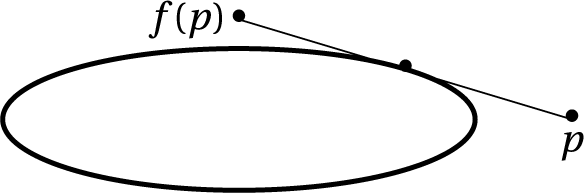
The outer billiard for a convex closed curve in the (oriented) plane associates with an exterior point, that exterior point for which the line segment between these two points is tangent to the curve at its mid-point (and has the curve to its left, say) (see Figure 1). With suitable adaptation (omitting points that lie on a line through a side), this definition extends to polygons as ‘repeated reflection about the vertices’ [Reference Tabachnikov77–Reference Tabachnikov79, Reference Tabachnikov82, Reference Tabachnikov and Dogru85]. This defines a much-studied dynamical system. Pertinent articles often briefly remark on the origins of the subject, mostly by mentioning Neumann as its originator. The short version of that early history is that Wikipedia (https://en.wikipedia.org/wiki/Outer_billiards) is correct (text in indented quote font indicates that the text is reproduced verbatim from elsewhere):
Most people attribute the introduction of outer billiards to Bernhard Neumann in the late 1950s, though it seems that a few people cite an earlier construction in 1945, due to M. Day. Jürgen Moser popularized the system in the 1970s as a toy model for celestial mechanics.
The purpose of this paper is to dig a little deeper. It includes biographical snippets for some of the early actors.
Definition of the outer billiard map.

2 1944—Mahlon Marsh Day
Mahlon Day (1913–1992) was a functional analyst known for a 1973 monograph [Reference Day24]. He was a faculty member (and, for a time, chair) at the University of Illinois from 1940 to 1983 and a mathematical ‘brother’ of James Andrew Clarkson (Robinson Professor of Mathematics at Tufts University 1949–1970, known for Clarkson’s inequalities [Reference Clarkson20, Reference Friedrichs29], who received the Medal of Freedom (before it became the Presidential Medal of Freedom) and was an invited speaker at the 1932 International Congress of Mathematicians, https://en.wikipedia.org/wiki/James_A._Clarkson, https://mathscinet.ams.org/mathscinet/author?authorId=426490) and Nelson James Dunford. Day ‘was the first American mathematician to study normed spaces from a geometric standpoint and, for a number of years, he and R. C. James were the only American mathematicians working on the structure of Banach spaces’ [Reference Bartle, Tenney Peck, Peressini and Uhl9, p. ix]. To quote Halmos: ‘He is a Banach spacer, who served for many difficult years as head of the math department at Illinois’ [Reference Halmos40, item 386].
Wikipedia provides a good bibliography for outer billiards, but as of this writing, its entry on outer billiards includes no reference to the relevant paper by Day. It is not hard to find. Mathematical Reviews and the bibliographies of [Reference Bialy14, Reference Del Magno, Gaivão and Gutkin25, Reference Dogru and Tabachnikov27, Reference Gaivão32, Reference Tabachnikov77, Reference Tabachnikov and Dogru85] refer to a 1947 article [Reference Day23] about circumscribing polygons in particular ways (‘presented to the Society April 28, 1944 and September 15, 1945’ [Reference Day23, front matter]) (the theorem is quoted verbatim from this article; in case ‘P circumscribed about C’ sounds unclear, the intention is that the sides of P are tangent to C):
Theorem 1. Given a symmetric closed convex curve C in the plane, there exists a parallelogram P circumscribed about C so that the midpoint of each side of P is on C.
The motivation for Day’s work is the study of properties of unit spheres in normed linear spaces (specifically, the corollary that in any two-dimensional normed space, there exist two points of norm one, each normal to the other). However, in the language of outer billiards, this produces a (symmetric) period-4 orbit for a center-symmetric outer billiard. Moreover, one proof (of three provided in the article) uses what the author calls Poincaré’s ring theorem (and which is otherwise known as Poincaré’s (last) geometric theorem [Reference Birkhoff16] and [Reference Moser56, Theorem 2.10]) from dynamics. Indeed, the way in which it is applied is a precursor of a later part of our story: the map in question is defined and area-preserving on the exterior of the defining curve and recast as a twist map on a ring around infinity [Reference Katok and Hasselblatt45, Exercise 9.3.5]. Thus, it appears that at the time of this writing, the subject can be deemed to be 80 years old.
However, in other ways, it is clear that this article is not exactly an inception of outer billiards. First, the ‘arrow of time’ is missing. More importantly, the aforementioned proof is not based on the outer billiard map, but (effectively) its second iterate composed with reflection in the center of symmetry. Indeed, this leads to a generalization in [Reference Day23] which strays from outer billiards:
Theorem 2.3. If C is a closed convex curve with no flat sides and if
 $\unicode{x3bb} _1\cdot \ldots \cdot \unicode{x3bb} _n= 1$
,
 $n\ge 3$
, then there exists an n-sided convex polygon P circumscribed about C such that, counting from a properly chosen vertex, the point
 $x_i$
which divides the ith side in the ratio
 $\unicode{x3bb} _i:1$
is on C for
 $i = l,\ldots ,n$
. If, moreover, C is symmetric and
 $n\ge 2$
, then a symmetric
 $2n$
-sided polygon with the same property can be circumscribed about C.
(Presumably,
 $\unicode{x3bb} _i\ge 0$
.) Of course, when
 $\unicode{x3bb} _i=1$
for all i, this produces periodic orbits of all periods for strictly convex outer billiards; maybe this adds to the temptation to make this article part of the origin story of outer billiards.
Another proof Day gives of Theorem 1 is variational and comes with reference to an independent such proof by Angus Ellis Taylor [Reference Taylor87] (which also does not lend itself to interpretation as a precursor to outer billiards). That proof leads to a higher-dimensional generalization in [Reference Day23]—which strays further from outer billiards in a different direction.
Theorem 4.1. If
 $C^n$
is a symmetric, closed, convex body in the Euclidean n-space
 $E^n$
,
 $n\geqq 2$
, there exists an n-parallelopiped [sic]
 $P^n$
circumscribed about
 $C^n$
in such a way that the midpoint of each face of
 $P^n$
is on
 $C^n$
.
This last theorem may serve to underscore that the definition of outer billiards is very much two-dimensional, much more so than the usual billiards. Already, a three-dimensional convex body has a one-parameter family of tangent lines through a given exterior point, and indeed, no line divides the ambient space into two parts.
It appears that few who study outer billiards are aware of Day’s paper, and the preceding discussion shows that this may be fitting. Indeed, one purpose of discussing this work and related ones at such length is to make clear that omitting it from accounts of the origins of outer billiards is not a matter of neglect. That subject seems to have properly started 15 years later, and Day’s (and Taylor’s) work is part of its prehistory—and only incidentally at that: most citations of Day’s article are in work related to Banach space geometry and applications.
One might describe Day’s article as easy to obtain and yet unknown. The next item is quite the opposite.
3 1959—Bernhard Hermann Neumann
Bernhard H. Neumann (1909–2002) [Reference Conder21, Reference Cowling, Jones, Morris and Oates-Williams22, Reference Gani and Newman33, Reference Kim and Shum46, Reference Newman64–Reference Praeger69, Reference Stanton76] (https://en.wikipedia.org/wiki/Bernhard_Neumann, https://mathscinet.ams.org/mathscinet/author?authorId=130535 https://www.science.org.au/learning/general-audience/history/interviews-australian-scientists/professor-bernhard-neumann-1909) was born in Berlin-Charlottenburg, obtained a D.Phil. from the Friedrich Wilhelm (now Humboldt) University of Berlin in 1932(!) with Issai Schur, and left for England in August 1933. No job was available, so Neumann became a research student with Philip Hall, earning a PhD from Cambridge in 1935. After teaching preparatory courses at Cambridge (including one for a class by Olga Taussky—not yet Taussky-Todd at the time; https://en.wikipedia.org/wiki/Olga_Taussky-Todd), he took a temporary assistant lectureship at University College, Cardiff. As an enemy alien, he was interned in 1940, and when Cardiff chose not to ask for him to be released to return there, he volunteered for the Army. Upon demobilization in 1945, he took a lectureship at Hull, and in 1948, he was recruited to Manchester by M. H. A. Newman, where he was lecturer, senior lecturer, and then reader until 1961. Finally, he was professor, department head, and emeritus at the Institute of Advanced Studies of Australian National University 1962–2002. His wife Hanna (https://en.wikipedia.org/wiki/Hanna_Neumann, https://mathscinet.ams.org/mathscinet/author?authorId=247526) (a student of Olga Taussky-Todd) as well as four of five children were mathematicians [Reference Praeger68] (Peter Michael (https://en.wikipedia.org/wiki/Peter_M._Neumann, https://mathscinet.ams.org/mathscinet/author?authorId=215354), Barbara (Cullingworth) (taught at Saint Bernard’s Convent School in Slough, specializing in statistics; active in the Mathematical Association), Walter David (https://en.wikipedia.org/wiki/Walter_Neumann, https://mathscinet.ams.org/mathscinet/author?authorId=130560), and Daniel (degrees in ancient Greek and pure mathematics from Monash University, and in psychology from the University of New England and Swinburne University; worked as a musician and as a psychologist).
By contrast with Day’s article, the work viewed as the origin of the subject of outer billiards is well known, but impossible to obtain—even the exact ‘publication’ date is not self-evident. The way in which this item is typically cited suggests that few who cite it have seen it. On January 29, 1959, Neumann gave a colloquium talk in Manchester, of which he then wrote a summary. This appeared (‘was published’ would seem like an overstatement) under the title ‘Sharing Ham and Eggs’ in iota, the Magazine of the Manchester University Mathematical Colloquium, no. 1, 14–18 (once noted, it is hard to unsee that this article on ‘Sharing...’ is succeeded by an article by Shearing); see Appendix A. This is not a magazine one expects to find in the stacks of every decent research library. Indeed, it is tempting to speculate whether the number of copies of it ever exceeded single digits. There are a very few mathematicians who happen to possess a photocopy of the article. In 2011, Mark Pollicott, formerly of the University of Manchester, kindly sent me a scan of a photocopy which had been made long before then. The pages included in that photocopy do not provide a date for this issue, but per Dr James Peters, Archivist at the John Rylands Research Institute and Library of the University of Manchester, the three issues of iota appear to have been issued between 1959 and 1961. Given that this is No. 1 (see Figure 2), the creation date of this number must be 1959. More recently, I was sent another scan by Sergei Tabachnikov, which reproduces the text better and is appended to this paper.
Mark Pollicott’s photocopy of the cover of No. 1 of iota, the Magazine of the Manchester Mathematical Colloquium.

The title ‘Sharing Ham and Eggs’ gives no hint at the appearance of outer billiards, and one may wonder how many readers of a reference to it have puzzled over possible connections. As it happens, the titular problem quickly leads Neumann to what he calls Dupin curves, the main subject of the colloquium. (From the first page of Neumann’s article: ‘Because it is the two-dimensional analogue from the studies of Dupin on the surface enveloped by the plane of the water surface in its different possible positions relative to a floating body’. Neumann’s terminology did not stick—the envelope of the hyperplanes that cut off a fixed volume from a body has long been called a ‘floating body’. This is, of course, the three-dimensional counterpart, and the most prominent questions are different. An example is the 1935 floating-body problem by Stanislaw Ulam known as Problem 19 of the Scottish Book [Reference Ryabogin71]. There are articles on this subject in the field of convex geometry and affine differential geometry. See, e.g., Lecture 11 ‘Segments of equal areas’ in [Reference Fuchs and Tabachnikov31, Ch. 3].) At the end of the article ‘Sharing Ham and Eggs’, he poses the open problem ‘What curves can be Dupin curves?’, and the last paragraph of this article moves on to ‘a related problem’. The paragraph contains seven (or six?) lines which introduce outer billiards in the plane and pose the problem of whether an invariant circle exists. These seven lines are:
Let D be a curve with just one tangent in each direction and a single point of contact on each tangent. From a point P (far enough from the curve), there is a unique tangent that leaves D on its left. Let T be the point of contact, and produce
 $PT$
to
 $P'$
so that
 $PT=TP'$
, so that T becomes the mid-point of
 $PP'$
. Is there a curve C such that to every point P on C, the corresponding
 $P'$
is also on C? This is also an unsolved problem.

For a circular outer billiard, the answer to Neumann’s question is evidently affirmative; concentric circles are invariant. Since the outer billiard map commutes with affine transformations, the same goes for ellipses. Neumann’s summary asks whether there are always invariant circles.
The paradox that a publication may be both largely unseen and widely known at the same time is resolved by subsequent events.
4 1961—Preston Clarence Hammer
Preston C. Hammer (1913–1986) had a varied career centered on computation. An online posting and web page by Jonathan Allen Rees (https://mumble.net/~jar/hammer/biography.html, also https://mathscinet.ams.org/mathscinet/author?authorId=457995) note that Hammer did numerical programming at Los Alamos in the late 1940s and throughout the 1950s, and that he started the computer science departments at University of Wisconsin and Penn State. MathSciNet lists 58 publications of which 45 appeared between 1955 and 1970. Only 11 are in numerical analysis, but most citations refer to them. Twenty-eight publications are in topology, and another 11 in convex and discrete geometry. In 1959–60, he was on sabbatical in Zürich. It may be that this provided an opportunity to meet Neumann.
Soon after Neumann’s colloquium, Hammer published the following among a 1961 list of unsolved problems contributed by various mathematicians [Reference Klee47, p. 498]; see Figure 1:
Reflection over a convex curve in the plane (B. H. Neumann). Let C be a closed convex curve in the plane with no line segments in its boundary. From a point p exterior to C, choose that line of support through p which has C on its left (looking from p). Let
 $q=fp$
be the reflection of p through the point of contact on the line of support.
Problem. Is there a simple closed curve B (other than C) such that
 $fB = B$
?
In what seems to be the first publication of research ideas on outer billiards since Day, Hammer remarks on what can be done about this question and related ones (see [Reference Hammer41, p. 498]):
It may be shown that there are n-point sets X for each
 $n\ge 3$
such that
 $fX = X$
and that the union of all of these is unbounded in the plane. Moreover, if Y is an open ‘annulus’ bordering C, then
 $X=\bigcup \{f^nY\colon -\infty <n<\infty \}$
is an open set and its boundary is fixed under f. However, is X bounded and if so, is its boundary a simple closed curve for some Y? That there is a large class of convex curves C with solution curves B may be seen as follows.
Let B be a closed convex curve and in each family of parallel chords of B, take the two which cut a fixed smaller area
 $\alpha $
from B (
 $a < 4/9$
area B). Then, the intersection C of all closed strips between such parallel chords determine a convex curve C such that
 $fB = B$
.
However, it is easy to construct a convex curve C such that
 $\{f^np\}\;n\ge 1$
, for certain points p, converges to a point on C. Whether or not one may find a curve C such that
 $\{f^np\}$
is unbounded for some p we have not settled.
Note that the transformation f is area preserving and that the problem is actually affine.
This whole item is, in particular, the first publication of Neumann’s problem statement. Unfortunately for bibliographical referencing, it is not a standalone article, but one entry in a problem list to which a number of people contributed individually. This makes it slightly awkward to cite [Reference Hammer41], but more importantly, it means that it is not listed in Mathematical Reviews (nor apparently other databases). This hides it from literature searches and makes citations of it hard to find as well. However, armed with a proper citation, it is not hard to obtain.
5 1972—Jürgen Kurt Moser
Jürgen Moser (1928–1999) [1, Reference Adler2, Reference Belbruno12, Reference Chierchia19, Reference Giorgilli35, Reference Hasselblatt and Katok42, Reference Lax50, Reference Mather, McKean, Nirenberg and Rabinowitz53, Reference Moser59, Reference Veselov91, Reference Zehnder93, Reference Zehnder94] was born in Königsberg (East Prussia, now Kaliningrad in Russia), drafted into the military at age 15 as Flakhelfer [Reference Schlesier72], and subject to great privation until the end of the war. Denied admission to East German universities because his father was not a farmer or a worker, he managed to get into the University of Göttingen and, in time, became one of the most prominent dynamicists of the 20th century, with a career anchored principally at Göttingen, New York University, MIT, and the ETH Zürich. He put the ‘M’ in KAM theory, ‘one of the great mathematical achievements of the 20th century’ [Reference Rabinowitz70, p. 11], when he proved the existence of invariant circles for area-preserving twist maps of an annulus [Reference Moser55, Reference Moser60] (inspired by Kolmogorov [Reference Kolmogorov48]—‘The present paper originated from the attempt to verify Kolmogorov’s theorem for which a proof is not available yet’ [Reference Moser55, p. 3]; that proof is credited to Vladimir Igorevich Arnold [Reference Arnold7]; hence, KAM theory [Reference Rabinowitz70]), a mechanism deeply connected to the stability problem in dynamics [Reference Moser58, Reference Moser62]—including outer billiards, as we shall see. (Indeed, Moser further showed that this leads to stability of elliptic fixed points of general type for area-preserving mappings [Reference Rabinowitz70].) This put Moser on the map, and he was invited to present the result at the 1962 International Congress of Mathematicians in Stockholm.
On February 7, 14, and 21, 1972, Jürgen Moser gave a series of five Hermann Weyl lectures at the School of Mathematics of the Institute for Advanced Study and wrote the book Stable and Random Motions in Dynamical Systems based on them [Reference Moser56], which is described as ‘one of the best entrées to the fascinating worlds of order and chaos in dynamics’ [Reference Moser61, p. xi]. Of the three main chapters, the first (‘Introduction’) presents the stability problem, makes historical comments, and then devotes a section to ‘Other Problems’. The first of those is Duffing’s equation, and the second is outer billiards, introduced without a name as ‘a geometrical problem in the plane’ [Reference Moser56, p. 11]. Indeed, [Reference Moser56, §II.4] reads as if it is destined to end with the answer to the Neumann question. A footnote states:
This problem was suggested by B. H. Neumann about 1960. See also: P. C. Hammer, Unsolved Problems, Proc. Symp. Pure Math. vol. VII, Convexity, Am. Math. Soc. 1963.
In January 1975, Moser gave the Pauli lectures at the ETH Zürich. The first of them was published in the Neue Zürcher Zeitung(!) of May 14, 1975, and then, translated from German to English, in the first volume of The Mathematical Intelligencer [Reference Moser57, p. 66]:
The equations of motion for the n body problem are very easy to write down, but impossible to comprehend intuitively. Therefore, it may be useful to describe a very simple geometrical problem that actually contains some of the difficulties of the n body problem and may serve as a crude model for planetary motion.
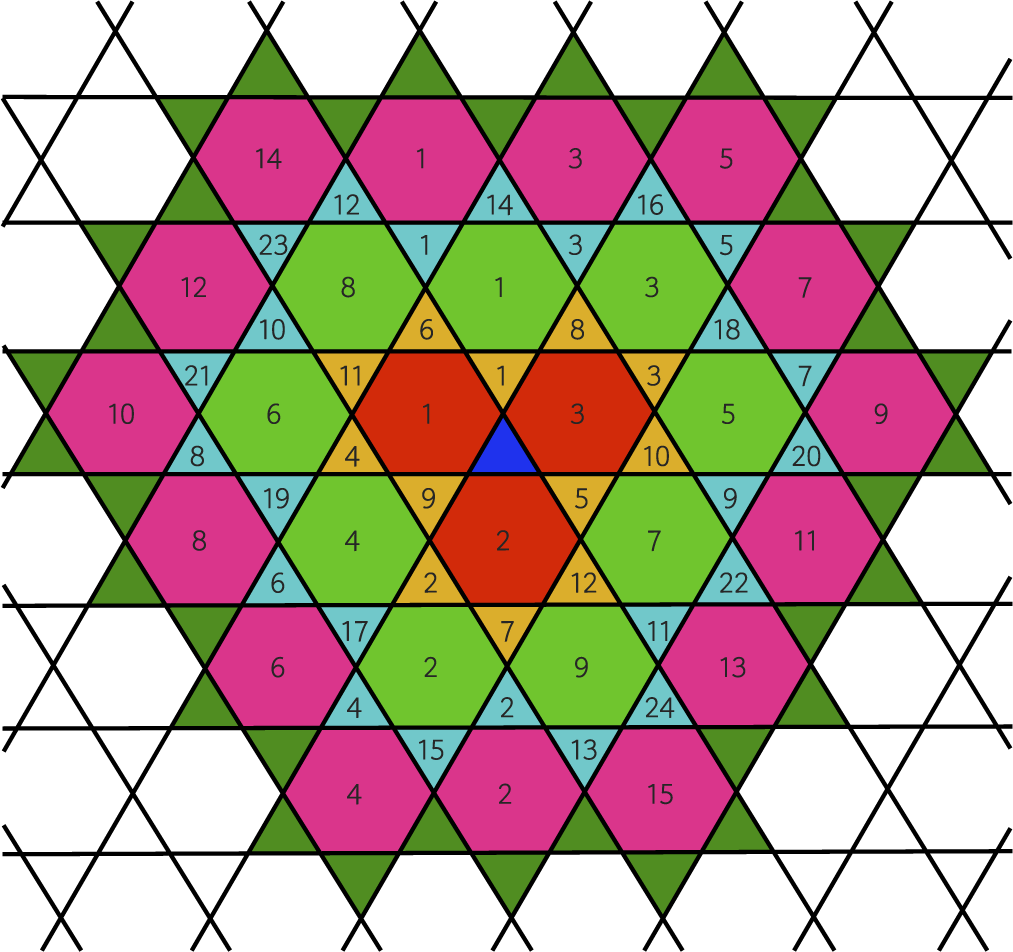
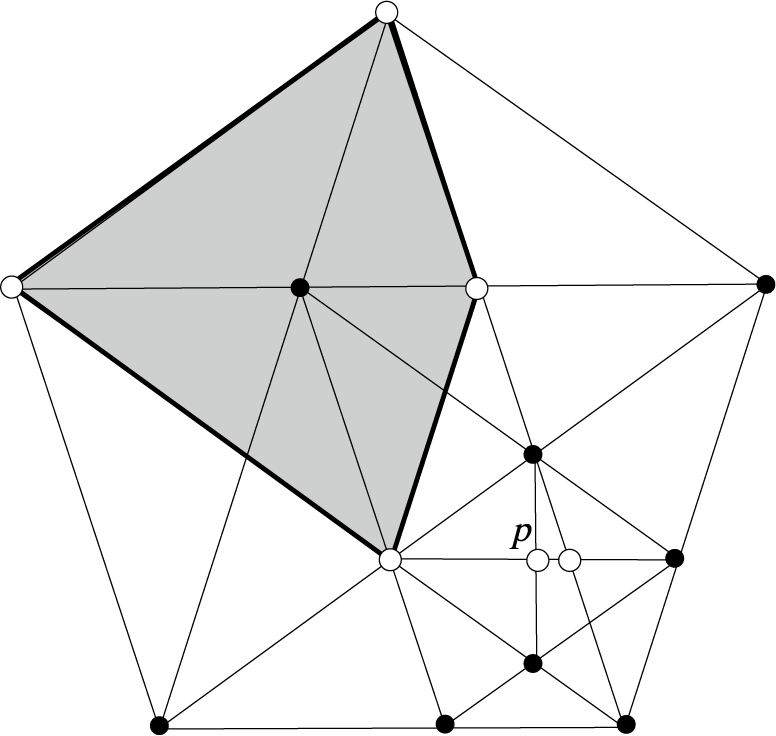
Thus begins a half-page digression on outer billiards (still without a name) for both smooth and polygonal defining curves, including a discussion of a triangle; see Figure 3. (Since the outer billiard map commutes with affine transformations, one can without loss of generality study equilateral triangles.) Specifically, Moser asks ‘Can this sequence of points be unbounded? This would be the analogue of the stability problem’ and notes that ‘even for a general quadrilateral, the above question is open’ [Reference Moser57, p. 66]. (More about quadrilaterals later.)
Triangular outer billiard (after [Reference Moser57, Figure 3]): ‘… all orbits are closed but they have different periods. Points belonging to orbits of the same period form hexagons and triangles which constitute an interesting tessellation of the plane. Points in the hexagons have periods 3, 9, 15, 21, … , in general
 $3(2j-1)$
,
 $j = 1,2, \ldots .$
Those of the triangles have period 12, 24, 36, … , in general
 $12j$
,
 $j = 2, 3, \ldots . $
For a square, the problem can also easily be handled, but even for a general quadrilateral, the above question is open’ [Reference Moser57, p. 66]. (Color online.)

So, Moser knew about Neumann’s question and Hammer’s problem statement, but he surely had not seen Neumann’s colloquium summary. He did not need to. In 1961–62, Neumann spent a year at the Courant Institute of Mathematical Sciences (at New York University) (see https://science.org.au/our-focus/history-australian-science/conversations-australian-scientists/professor-bernhard-neumann-1909-2002-mathematician), while the Mosers had come ‘to New York in the fall of 1960 and found a sizable house they liked, replete with a large garden and tall trees, in the suburb of New Rochelle, where several of the senior members of the Mathematics Department—Courant, Lipman Bers, Kurt Friedrichs, Fritz John, and Wilhelm Magnus—also resided’ [Reference Rabinowitz70, p. 9]; see also [Reference Morawetz, Abikoff, Corillon, Kra, Weinstein and Gilman54]. (I presume many of the conversations among the group took place in German.) In light of the common theme of invariant circles, on which Moser was working at that time, it is natural to believe that Neumann must have told Moser about outer billiards as well as Hammer’s account. Indeed he did. In 1999, Keith Burns was thinking about the comments in Moser’s book and aimed to get an explanation while it was still possible to ask Neumann himself. Neumann was a Senior Research Fellow at the Commonwealth Scientific and Industrial Research Organisation (CSIRO), Australia’s national science agency. His email was sent Wed, 29 Sep 1999 12:12:47 +1000; minor typographical errors are corrected here. To let the reader know what query was being answered, here is that email from Keith Burns:
Dear Bernhard,
I have a question that I have been meaning to ask you for years. In his book ‘Stable and Random Motions in Dynamical Systems’ (Princeton University Press, Annals of Mathematics Studies #77, page 11), Juergen Moser describes the following problem:
‘Let Gamma be a closed oriented smooth curve in the plane with positive curvature. We define a mapping phi in the exterior E of Gamma by drawing from any point p of E a tangent and extend it to a point q such that the distances from the point of contact to p and q are equal. To make the construction unique, we select one of the two possible tangents in accordance with the orientation of Gamma. Setting phi(p) = q, we have defined a mapping phi of E into itself
 $\ldots \ldots $
. The problem is to decide whether every orbit is bounded’.
Moser remarks in a footnote: ‘This problem was suggested by B. H. Neumann about 1960’.
Do you remember why you were interested in this problem? Does it have connections with group theory?
The problem has been studied quite extensively by people in dynamical systems. It goes under the name of exterior billiards (or dual billiards). Moser showed that if the curve Gamma is sufficiently smooth, then every orbit is bounded. It is still unknown if all orbits must be bounded if Gamma is only piecewise smooth and has corners.
I am sure that people in the dynamics community would be interested in any recollections that you have about the history of this problem.
Best regards, Keith Burns
Neumann responded to the query as follows:
Dear Keith,
I am delighted to hear from you.
The problem you mention arose from a popular talk I gave many times to varied audiences. A short version was published in the Manchester University Mathematics students’ journal Iota in 1958, under the title ‘Sharing ham and eggs’. When I told Juergen Moser [and other mathematicians] at the Courant Institute of Mathematical Sciences, NYU, about it [I may even have given the popular lecture there and elsewhere in the USA], especially also the question whether the sequence of points can run off to infinity [which it can’t, I conjecture], he proved that it does not if the original curve is four times differentiable [I seem to remember that he first proved it for six times differentiable, but then reduced the six to four]. I later asked him when I saw him in Zurich, but he had not made any further progress. The problem lends itself to experiments with computers, and with the help of some computer boffins at CSIRO, I carried out such experiments, with results that have never been fit for publication.
With kind regards from house to house:
Bernhard
Naturally, Moser’s interest in stability would lead him to embrace this aim ‘to decide whether every orbit is bounded’. It is closely related to Neumann’s written statement of the question as one about the existence of invariant circles because if there are arbitrarily large invariant circles, then these preclude unbounded orbits (the invariant circles one looks for have the defining curve in their interior and hence bound invariant disks). This formulation is what Wikipedia calls the Moser–Neumann question. As we will see, the answer is a resounding ‘yes and no’, with proofs.
Although this is not apparent from the published record, Moser and Neumann long retained an interest in outer billiards—unlike, presumably, Day and Hammer.
6 Thereafter
Between Moser’s book and the Intelligencer article, as well as the proselytizing by Neumann and Moser, outer billiards were now firmly ‘on the map’ (including, likely owing entirely to Tabachnikov, citations of Day’s work). One might now say that the rest is history. Just the same, a coda seems in order.
While in these early days, outer billiards lacked a name, a surfeit of names soon emerged: dual billiards, anti-billiards, cobilliards, outer billiards, and more. One can make a good argument for ‘dual billiards’ [Reference Tabachnikov and Dogru85, p. 21ff], but ‘outer billiards’ has become predominant. This is deliberate: Sergei Tabachnikov remembers a 2008 Banff conference (on Low Complexity Dynamics, see https://www.birs.ca/events/2008/5-day-workshops/08w5046) which discussed this matter, and whereupon he pledged to henceforth use only ‘outer billiards’.
6.1 The Moser–Neumann question
With respect to answering the Moser–Neumann question, history provides a most fitting instance of coming full circle (as it were) in that KAM theory turned out to be central, in fact, specifically Moser’s theorem about invariant circles for maps on an annulus. It can be applied to the question of invariant circles ‘near infinity’ much in the way in which Day applied Poincaré’s last geometric theorem—by treating the system as an area-preserving twist map around a circle at infinity. This duality is explained by Sergei Tabachnikov and Filiz Dogru in [Reference Tabachnikov and Dogru85, p. 21ff]. For strictly convex
 $C^6$
curves, KAM theory implies the existence of arbitrarily large invariant circles and, hence, the boundedness of orbits; this was outlined by Moser [Reference Moser56] and proved in the dissertation of Raphaël Douady (Theorem III.2 in [Reference Douady30]; see also [Reference Zharnitsky95]). In the other direction, Philip Boyland [Reference Boyland18] constructed
 $C^1$
-curves with outer-billiard orbits that converge to a point of the curve (‘crash orbits’)! (This is dual to strange billiard phenomena discovered by Benjamin Halpern [Reference Halpern39].)
Misha Bialy reached a high point of developments along this line [Reference Bialy14]: only elliptic outer billiards are completely integrable. Additionally, his Figure 4 from [Reference Bialy, Mironov and Shalom15], reproduced in Figure 4 here, shows that invariant (smoothly embedded) circles do not preclude complicated dynamics: on a finite number of invariant circles, the outer billiard map is conjugate to a shift and with complicated dynamics between them. This underscores that while outer billiards for strictly convex curves are a subject in elliptic dynamics, regions of instability and, hence, hyperbolic phenomena can also occur [Reference Hasselblatt and Katok43, Reference Katok44]. Whether there is a differentiable strictly convex curve with only finitely many invariant circles seems unknown and hard to decide. (Although the examples so far have a primarily elliptic or parabolic flavor, outer billiards can be hyperbolic [Reference Genin34].) Or, one might ask whether there is a
 $C^1$
(rather than piecewise
 $C^1$
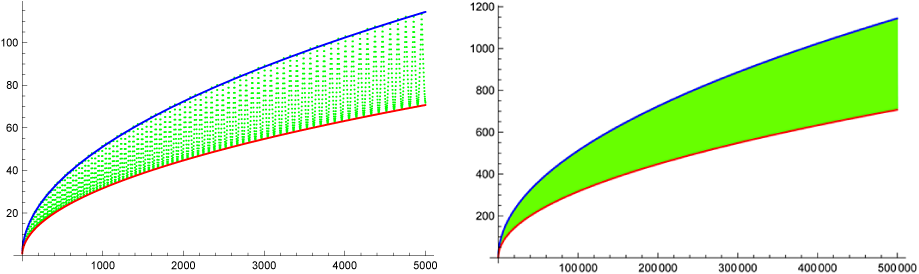
) outer billiard with orbits escaping to infinity. Oliver Knill (unpublished) has numerical evidence that the stadium has this property; the computations for a well-chosen orbit suggest an escape rate
 $\sqrt n$
, see Figure 5.
Outer billiard with complicated dynamics on finitely many invariant circles [Reference Bialy, Mironov and Shalom15]. (Color online.)

Escape in an outer billiard about a stadium (Knill). The plotted distance of the nth iterate from the origin fills the space between the graphs of
 $\sqrt n$
and
 $(({1+\sqrt 5})/{2})\sqrt n$
. (Color online.)

Accordingly, one should expect the story to be different for regions whose boundary is not smooth, such as polygons (this belongs to parabolic dynamics [Reference Hasselblatt and Katok43, Reference Katok44]). In the Intelligencer article, Moser had already noted that ‘when the oval degenerates into a 2-gon, every orbit goes to infinity along a pair of straight lines’ [Reference Moser57, p. 66]. However, boundedness of orbits of polygonal outer billiards was proved in a number of cases. For instance, all orbits of the outer billiard for a rational polygon are periodic; Figure 6 illustrates this for a square (and Moser’s Figure 3 for a triangle). For regular polygons (and trapezoids [Reference Li51]), all orbits are bounded. This is illustrated in Figures 3 and 6.
Interestingly, Christopher Culter proved that the outer billiard for any convex polygon has infinitely many periodic islands (maximal open convex sets consisting entirely of periodic points of the same period) [Reference Tabachnikov83], while Alexander Tumanov and Vadim Zharnitsky showed that the set of 4-periodic orbits for an outer billiard with piecewise smooth convex boundary has empty interior unless four corners of the boundary form a parallelogram [Reference Tumanov89, Reference Tumanov and Zharnitsky90]. For (mainly) the regular pentagon, Bedaride and Cassaigne provided a complete symbolic description, explicitly spelling out the allowed words and the complexity (a specific quadratic rate) [Reference Bedaride and Cassaigne11].
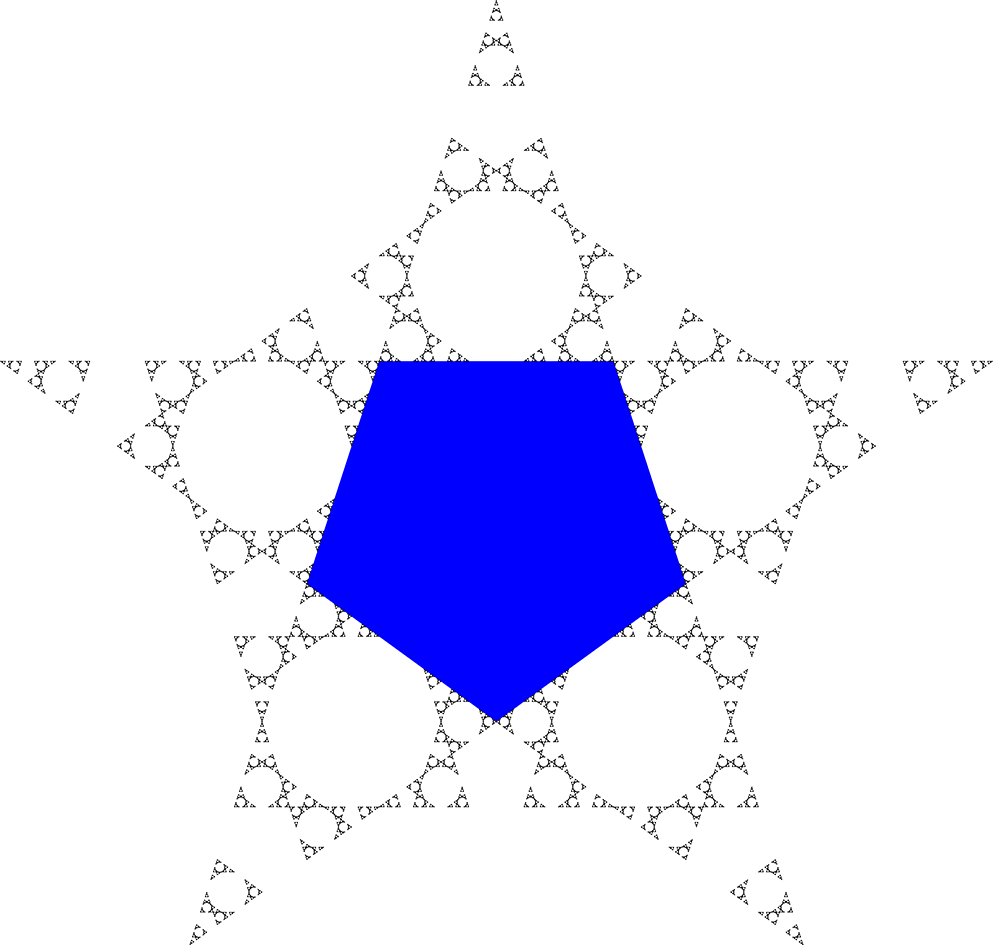
For the pentagon, almost all orbits are periodic [Reference Tabachnikov79]. Figure 6 shows sets of periodic points consisting of multiple polygonal regions. However, there is room for non-periodic orbits. Figure 7 shows a non-periodic orbit of the pentagonal outer billiard. Indeed, Anton Belyi, Alexei Kanel-Belov, Philipp Rukhovich, and Vladlen Timorin recently showed that with the exceptions of the triangle, square, and hexagon, the outer billiard on a regular polygon has aperiodic points, that is, points where all iterates of the outer billiard map are defined and pairwise distinct [Reference Belyi, Kanel-Belov, Rukhovich and Timorin13]. As the bottom left of Figure 6 and the periphery of Figure 7 suggest, instead of invariant circles, the boundedness proof involves invariant necklaces of polygons connected at their vertices.
Periodic domains of outer billiards for various (blue) polygons. For the square, the reader can check that each point in a square labeled n will cycle through the
 $4n$
squares with the same label and return to its starting position. The other polygons (figures by Richard Schwartz) feature color-coding of periodic sets. (Color online.)

A non-periodic orbit of the pentagonal outer billiard. (Color online.)

Among the most significant results about outer billiards is that the pattern of necklaces generalizes to quasirational polygons [Reference Bedaride10] (these include all lattice polygons as well as all regular polygons). In three independent groups, Eugene Gutkin, Rafał Kołodziej, Anna V. Shaidenko, Nándor Simányi, and Franco Vivaldi developed a discrete KAM theory to establish the existence of such necklaces, in close analogy to the arguments for smooth convex curves [Reference Blatter17, Reference Gutkin and Simányi38, Reference Kołodziej49, Reference Vivaldi and Shaidenko92].
Thus, the Moser–Neumann question has a positive answer (all orbits are bounded) for smooth convex curves as well as for quasirational polygons.
However, Richard Evan Schwartz has shown that, nonetheless, the Moser–Neumann question has a negative answer for polygonal outer billiards, and spectacularly so—even just for quadrilaterals, the first case Moser mentioned as open [Reference Schwartz75]. The outer billiard map on the Penrose kite has an uncountable number of unbounded orbits (each of which returns densely to a certain Cantor set according to the dynamics of the dyadic adding machine) [Reference Schwartz73], and this is not an isolated example. The outer billiard for any irrational kite has unbounded orbits [Reference Schwartz74]. In fact, the dynamics is rather wild. Schwartz found many invariant sets with an open dense set of periodic orbits and all other orbits unbounded in both directions, plus uncountably many orbits which are unbounded, both forward and backward, but which also return to every neighborhood of a vertex of the kite [Reference Schwartz74, Reference Tabachnikov84] (see Figure 8).
Schwartz’s solution of the unbounded-orbits conjecture: a specific shape (Penrose kite) and a specific point p with an unbounded orbit. The forward orbit of p is unbounded and has no accumulation points in the plane. The backward orbit of p is unbounded and returns infinitely often to every neighborhood of the vertices of the kite [Reference Schwartz73]!

The semicircular outer billiard has long received attention. A semicircle combines features of convex curves and polygons, and this hybrid nature suggests that here, the Moser–Neumann question is a difficult problem. So it is. Unbounded orbits of its outer billiard map were observed numerically quite early on by Sergei Tabachnikov and Itrel Monroe [Reference Tabachnikov and Monroe86] (see Figure 9). (Some pertinent articles by Sergei Tabachnikov are easier to find [Reference Tabachnikov78, Reference Tabachnikov82, Reference Tabachnikov and Dogru85]. References [Reference Tabachnikov77, Reference Tabachnikov79] were written in 1991 and owe to computations by Itrel Monroe.) A rigorous proof, however, took over a quarter-century to emerge. This breakthrough was achieved by Dmitry Dolgopyat and Bassam Fayad, who proved that there is an open disk escaping to infinity [Reference Dolgopyat and Fayad28]. (In fact, their theorem covers domains obtained by nearly cutting a disk in half; however, this does not extend to disks with small arcs sliced off [Reference Li52].) Indeed, this result and the one for irrational kites remain the only known instances of outer billiards with orbits escaping to infinity, though Knill’s stadia experiments are suggestive.
Outer billiard about a semicircle. Periodic trajectories and surrounding elliptic islands coexist with chaotic orbits. Small escaping domains are between elliptic islands. (After Oliver Knill, from www.mathematik.com; see also [Reference Tabachnikov and Dogru85, Figure 4]. Knill’s computations suggest an escape rate between
 $\frac 34\sqrt n$
and
 $\frac 32\sqrt n$
.) (Color online.)

For more, see [Reference Schwartz75].
6.2 Extensions
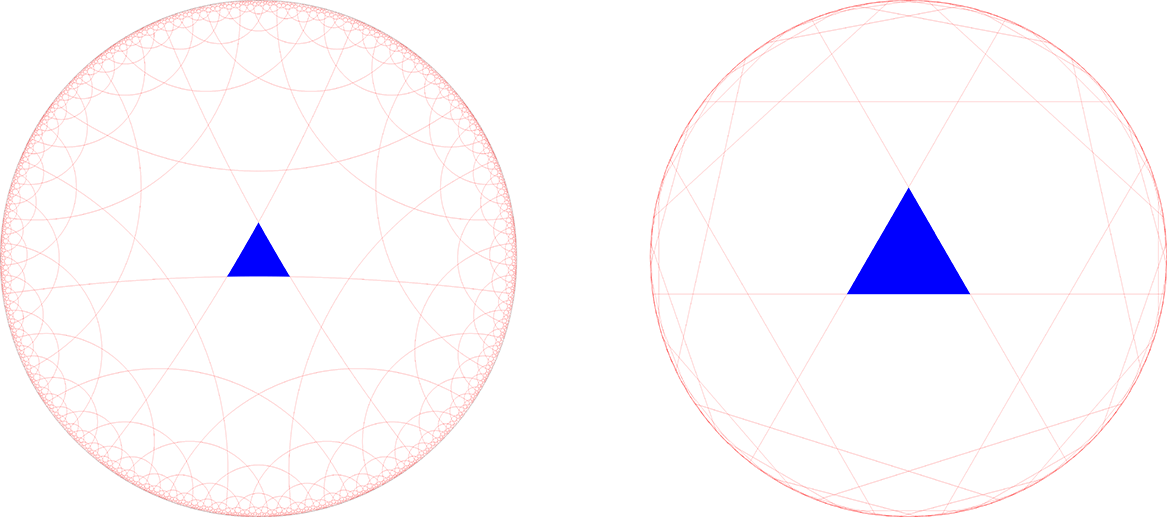
Without changing the definition of outer billiards per se, Filiz Dogru and Sergei Tabachnikov implement it beyond Euclidean space [Reference Dogru and Tabachnikov27, Reference Tabachnikov80], replacing ‘line’ by ‘geodesic’ throughout. Those investigations have focused on surfaces of constant curvature. On the sphere, there is no question of whether any orbits go to infinity. However, for hyperbolic surfaces, that is, for the Poincaré disk or the Klein model, the question can be asked and some phenomena are strikingly different. On one hand, for a circle or ellipse, the outer billiard map is integrable, and the invariant curves are ellipses from the pencil of conics generated by the billiard boundary and the circle at infinity. A triangular outer billiard in the plane has only periodic orbits, but a triangular outer billiard in the hyperbolic plane has unbounded orbits, as shown in Figure 10. Indeed, for ‘large’ convex polygons, all orbits of the outer billiard map escape to infinity [Reference Dogru and Tabachnikov27, Theorem 2]. (The outer billiard map induces a continuous self-map of the circle at infinity of degree 1, and the continued-fraction expansion of its rotation number provides interesting dynamical information.) On the other hand, every orbit of the outer billiard map around a right-angled regular n-gon is periodic when
 $n\ge 5$
[Reference Dogru and Tabachnikov27, Theorem 4]. This hints at a close connection to tilings. Indeed, for every
 $n,m\in \mathbb N$
with
 $1/n + 1/m < 1/2$
, there is an
 $l(n,m)$
such that the singularity diagram of the regular hyperbolic n-gon with side length l forms the edge set of a quasiregular tiling of the hyperbolic plane with n-gons and m-gons, and every point is periodic [Reference Dogru, Fischer and Munteanu26]. This is illustrated in Figure 11. On the sphere, there are two quasiregular tilings, and both are the singularity diagrams (the union of all lines that include sides of the defining polygon) of the outer billiard defined by one of their tiles (Lael Shelton Costa, personal communication, 2025). However, when the side length is not chosen just right, the singularity sets for a triangle will be rather complicated, as shown in Figure 12. Quite recently, outer billiards have also been defined in complex hyperbolic space [Reference Godoy and Salvai37].
An orbit of a triangular outer billiard in the hyperbolic plane. Left, Poincaré disk; right, Klein model. (Color online.)

Quasiregular tiling of the hyperbolic plane as singularity set of a triangular outer billiard. Left, Poincaré disk; right, Klein model. (Color online.)

Singularity set of a triangular outer billiard. Left, in the hyperbolic plane (Poincaré disk); middle, in the hyperbolic plane (Klein model); right, on the sphere. (Color online.)

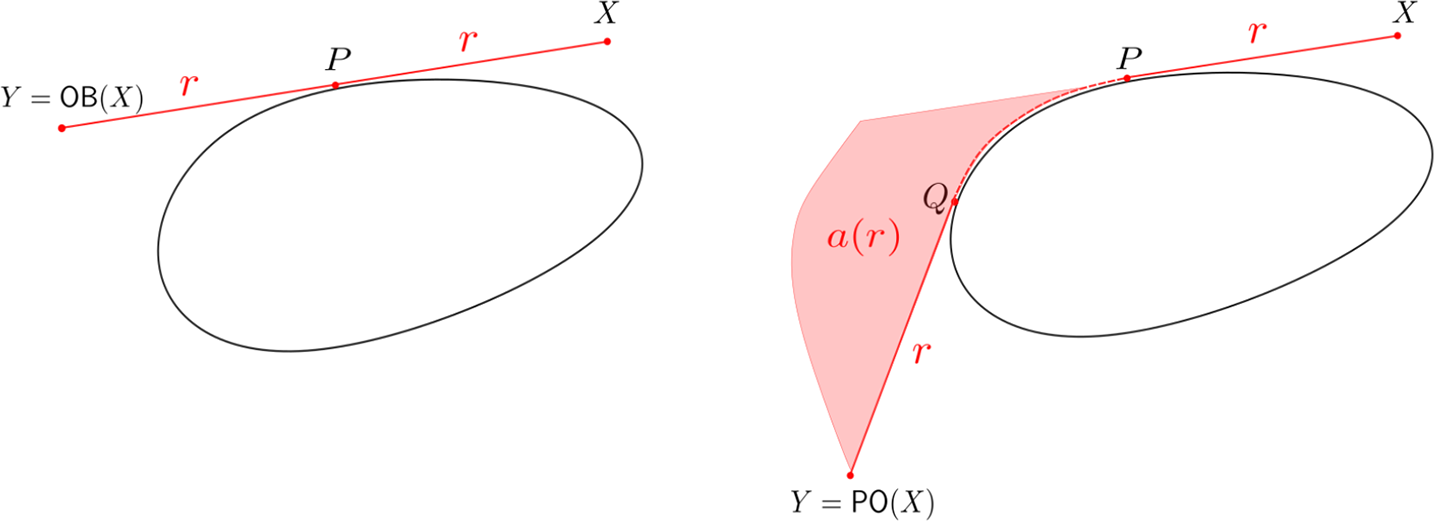
There have been extensions of the notion of outer billiards itself. Pensive outer billiards are due to Theodore D. Drivas, Daniil Glukhovskiy, and Boris Khesin [Reference Theodore, Drivas and Khesin88, Definitions 5.1 and 5.2], and it seems natural to see these as a generalization of an ‘outer billiard flow’ wherein a point X moves with (say) unit speed along the tangent line and then continues equally far beyond the point of tangency (that final point being denoted
 $\mathit{OB}(X)$
in Figure 13). In a pensive outer billiard, there is first linear motion to the point of tangency, then motion along the defining curve, then motion outward (by the same amount) along the new tangent line; the ending point of this procedure being denoted by
 $\mathit{PO}(X)$
in Figure 13. Like (the usual) outer billiards, the pensive outer billiard map is a symplectomorphism of the exterior of the defining curve. (Properties such as the twist property, generating functions, and periodic orbits have yet to be investigated.) It can be defined on a sphere as well.
Outer billiard
 $X\mapsto \mathit{OB}(X)$
and pensive outer billiard
 $X\mapsto \mathit{PO}(X)$
, from [Reference Theodore, Drivas and Khesin88, §5]. (Color online.)

More recent yet, outer length billiards [Reference Albers, Edwards-Costa and Tabachnikov5, Reference Baracco, Bernardi and Fierobe8] arise from first framing both inner and outer billiards in variational terms: the former involves extremals of a length functional, the latter can be cast in terms of extremals of an area functional. An ‘inner area billiard’ is a known symplectic billiard and cast in terms of extremals of an area functional, so it seems natural to define an outer length billiard in terms of extremals of a length functional for configurations outside a given region [Reference Albers and Tabachnikov6].
Finally, in light of Day’s multidimensional theorems, it does well to mention that there are higher-dimensional generalizations of outer billiards. On one hand, Peter Albers, Ana Chavez Caliz, and Serge Tabachnikov introduce symplectic outer billiards [Reference Albers, Caliz and Tabachnikov3, Reference Albers, Caliz and Tabachnikov4, Reference Tabachnikov79, Reference Tabachnikov81], which use the symplectic structure to make a canonical choice for sending a point across a point of contact. By contrast, Yamile Godoy, Michael Harrison, and Marcos Salvai make a generalization to outer billiards around a convex surface in 3-space with curvature
 $0,\pm 1$
, which maintains the codimensions of the various objects involved: the outer billiard map acts on the space of oriented geodesics not intersecting a given smooth closed strictly convex surface [Reference Godoy, Harrison and Salvai36].
7 Conclusion
In tracing the origins of outer billiards, there is no indication that Day’s article had any effect on the inception of outer billiards as a research subject. Therefore, it seems fair to view those earlier works as part of the prehistory of the subject and Neumann’s lectures and conversations as its true origin. Indeed, Neumann’s account in the correspondence with Burns makes clear that his 1959 Manchester colloquium was preceded and followed by numerous other lectures and conversations about the subject. This may be related to his misremembering the relevant year as 1958 (the iota item has a footnote on the first page which reads ‘Summary of an address to the Manchester Mathematical Colloquium, 29 Jan 59’, which, together with the Manchester library records, indicates that the item did not appear before 1959), and his statement ‘This is also an unsolved problem’ in the written colloquium summary [Reference Neumann63] suggests that he had had significant conversations on the subject by then. Likewise, Moser’s statement ‘even for a general quadrilateral, the above question is open’ [Reference Moser57, p. 66] indicates significant prior discussion and consideration of the subject. It appears, however, that none of these led to publications until Moser put the subject on record and placed it in the larger context of the stability problem in dynamical systems. So, Neumann is due credit for the broad promotion of the subject of outer billiards, while Moser should be credited with the creation of outer billiards as a ‘serious’ subject of study by recasting it as a toy model for a much harder one and doing so both in a book, which for decades remained among the premier references in dynamics [Reference Moser56], and in an article for the broad audience of the Intelligencer [Reference Moser57].
Those wishing to refer to the early history of the subject may now feel equipped to decide which publications from among [Reference Day23, Reference Hammer41, Reference Moser56, Reference Moser57, Reference Moser61, Reference Neumann63] to cite.
We close with a few questions about the early days.
It is not clear whether Day’s work was truly the first related to the subject. Is there any earlier work which can be described as concerning or foreshadowing outer billiards?
Are there additional traces or recollections of informal interactions as described by Neumann on outer billiards before the second half of the 1970s?
Were any articles on outer billiards published between those of Hammer and of Moser?
Does any physical copy of No. 1 of iota remain in existence?
Acknowledgements
I am most grateful to Sergei Tabachnikov and Richard Schwartz, leading authorities on outer billiards, for consultations, notably on developments since 1990, and for sending me many figures. I am grateful to Mark Pollicott for sharing a scan of his photocopy of Neumann’s colloquium summary in 2011, the only one I know of that includes the magazine cover, to Sergei Tabachnikov for sending his scan, which was done with enough care to be appended here, and to Keith Burns for sharing his 1999 correspondence with Neumann, as well as for locating informative additional materials on Neumann. I am grateful to Paul Rabinowitz for pointing to his beautiful NAS biography of Moser and the salient passage. Misha Bialy provided helpful comments on this paper. Figures 7, 10, 11, and 12 were made for this article by Lael Shelton Costa with his Bespoke program at https://github.com/Lael/Bespoke; I am most grateful for them, and to Oliver Knill (pronunciation note: the K is not silent) for consultations and permission to use his illustrations.
Dr James Peters, Archivist at the John Rylands Research Institute and Library of the University of Manchester, went through considerable lengths to locate the volume of iota with Neumann’s colloquium summary. On August 24, 2024, he wrote:
There was a proper reference for this periodical but the last definite location was somewhere we have not used for many years. Initial checks of the stores did not locate the item.
On May 1, 2025, he added:
It wasn’t possible to locate the copy in the Library and I must presume it was disposed of. I can ask the Department of Maths about the possibility of a former staff member having a copy. Unfortunately, they did not have a departmental library and I don’t think they would have kept a copy.
I am deeply grateful for those efforts, but it appears that this text now exists only in old photocopies and scans thereof. The community owes great thanks to those who have preserved these, to those students who labored to produce those three issues of iota, the Magazine of the Manchester University Mathematical Colloquium, and to Keith Burns for obtaining Neumann’s first-hand account.
Finally, it does well to note that the Wikipedia article on the subject is correct for an excellent reason: in its present form, it was mainly written by Richard Schwartz. We owe thanks to him and the many other editors of Wikipedia who make it so useful for mathematics.
A Appendix. Neumann’s article
Reproduction of B. H. Neumann’s 1959 colloquium‘Sharing Ham and Eggs’ in iota, the Magazine of the Manchester University Mathematical Colloquium, no. 1, 14–18.