1. Introduction
Appeals to top-down effects are common in biology as well as philosophy, but the notion of downward causation is often considered problematic or superfluous. Critics have argued that if macroscale phenomena comprise nothing but molecular entities and processes, downward causation would result in causal overdetermination (e.g., Kim Reference Kim1998). Accordingly, higher-level causation and downward causation either collapse into lower-level causation or result in a violation of the physical laws that apply to lower-level constituents (Kim Reference Kim, Andersen, Emmeche, Finnemann and Christiansen2000). From this perspective, talking of downward causation seems misguided, in science as well as philosophy. This article stresses that a different interpretation of downward causation is required for understanding scientific practice. By drawing on insights from multiscale modeling, I defend a kind of downward causation that differs in important ways from the usual target of philosophical criticism.
Downward causation in the context of biology typically refers to top-down effects or control relations between parts and wholes in compositional hierarchies that span different levels (Campbell Reference Campbell, Ayala and Dobzhansky1974; Noble Reference Noble2012).Footnote 1 Importantly, not all appeals to downward causation are equally metaphysically suspicious. The target of Kim’s criticism is what Emmeche, Køppe, and Stjernfelt (Reference Emmeche, K⊘ppe, Stjernfelt, Andersen, Emmeche, Finnemann and Christiansen2000) refer to as strong downward causation. Strong downward causation is understood as causal relations between levels that are sharply distinguished and autonomous; that is, it is based on a claim about the existence of qualitatively different domains or levels. Thus understood, downward causation may be subject to criticisms akin to those held against substance dualism and vitalism that defend a too radical divorce between levels. Emmeche et al. argue that strong downward causation is incompatible with a scientific viewpoint that accepts constitutive (or ontological) reduction in the broad sense (see also Brigandt and Love Reference Brigandt, Love and Zalta2017).Footnote 2
Yet, an alternative to the strong account is to interpret top-down effects as operating via constitutive or constraining relations given by the boundaries and organization of the system as a whole (Emmeche et al. Reference Emmeche, K⊘ppe, Stjernfelt, Andersen, Emmeche, Finnemann and Christiansen2000; see also Craver and Bechtel Reference Craver and Bechtel2007; Bechtel Reference Bechtel2017). Downward causation thus understood is a synchronic or nontemporal constraining relation. Constraints are features that delimit the degree of freedom of system behavior, for example, by reducing and directing the available free energy or the possible states of the system (Pattee Reference Pattee1971; Hooker Reference Hooker2013). By setting boundaries that organize and restrain causal processes, constraints make some states inaccessible but also enable other dynamic states. Having a rigid skeleton, for instance, limits functional flexibility of body parts but also enables upright movement on land (see Hooker [Reference Hooker2013] and Bechtel [Reference Bechtel2017] for more elaborated and additional examples). Whereas macroscale systems can always be broken down into lower-level constituents, the organizational and relational features necessary for functional capacities may not be reducible to properties of lower-level constituents. Downward causation in this sense is less metaphysically suspicious, but the significance of downward causation as a type of constraining relation needs to be further specified.
The alternative approach to downward causation can be further distinguished into a weak and a medium account (Emmeche et al. Reference Emmeche, K⊘ppe, Stjernfelt, Andersen, Emmeche, Finnemann and Christiansen2000). Both appeal to top-down effects as constraining relations between parts and wholes in an organized system or mechanism, but they differ in their emphasis on the autonomy of higher-level (or higher-scale) entities. Weak downward causation can be exemplified by dependence relations between system parameters in a phase space. A phase space may describe the possible states of a network of interactions at a molecular level, but the dynamic structure of the network as a whole is considered a higher-level entity. Because the interactions between system components constrain the degree of freedom or scope of possible interactions between network components, these behave differently from they would outside the system. Similarly, Bechtel (Reference Bechtel2017) has argued that top-down effects in biology can be exemplified through the use of graph theoretical representations of networks in systems biology and neuroscience. In these contexts, network models are used to identify functional modules, interconnections between different mechanisms, and organizational constraints that influence how individual components react to external stimuli. Network properties, such as stable attractors, bifurcations, functional modules, organizational constraints, and so on, cannot be ascribed to molecular entities in isolation but are properties of the system as a whole.Footnote 3
I will focus on what Emmeche et al. (Reference Emmeche, K⊘ppe, Stjernfelt, Andersen, Emmeche, Finnemann and Christiansen2000) call medium downward causation. This position more explicitly defends the autonomy of higher-level entities by highlighting the role of functional language or boundary conditions. One version of medium downward causation stresses that the ascriptions of functions to biological parts and systems are irreducible to physics. The argument is that accounting for living systems requires an understanding of the constraining relations and informational patterns that control, select, order, and delimit the activity of lower-scale processes (Moreno and Umerez Reference Moreno, Umerez, Andersen, Emmeche, Finnemann and Christiansen2000). Instead, I focus on an interpretation of downward causation that emphasizes how boundary conditions “select and delimit various types of the system’s possible developments” (Emmeche et al. Reference Emmeche, K⊘ppe, Stjernfelt, Andersen, Emmeche, Finnemann and Christiansen2000, 25). This notion of downward causation is not necessarily limited to biology. Boundary conditions are generally understood as mathematically defined restrictions that specify the domains and conditions under which a given mathematical model or equation holds (e.g., by specifying a value interval for the possible solution). In this context, boundary conditions are understood as representations of the “conditions by which entities on a high level constrain the activity on the lower focal level” (25).
To exemplify medium downward causation, Emmeche et al. mention the boundary effect of natural selection in delimiting the frequency of genotypes in an ecosystem and how an organism provides organizational constraints that influence its constituent molecules and tissues. My aim in this article is to further clarify and expand on this interpretation of downward causation by drawing on insights from multiscale modeling in both physics and biology that support the autonomy and explanatory importance of higher-level parameters and models. I argue that attention to scale dependency, the role of boundary conditions, and the indispensability of macroscale models and parameters in such contexts can contribute to clarifying and demystifying downward causation. Thus, the argument is not restricted to the biological domain but points to more general limitations for a reductionist approach to account for macroscale phenomena.
I begin with some general reflections on the philosophical implications of what has been called the tyranny of scales problem in physics for discussions on downward causation and reductionism (sec. 2). The notions of constraints and boundary conditions will be clarified through concrete examples of multiscale modeling in developmental and systems biology (sec. 3). Section 4 further defends the explanatory importance of top-down constraining relations.
2. The Tyranny of Scales
2.1. Limits of Reductionism in Physics and Biology
If we accept that all physical and biological systems are made up of nothing but physical lower-level components (molecules, atoms, etc.), it seems intuitive that a description of how things work at lower levels should suffice for explaining macroscale systems also. For instance, Oppenheim and Putnam find it “natural to suppose that the characteristics of the whole can be causally explained and microreduced by a theory involving only characteristics of the parts” (Reference Oppenheim, Putnam, Feigl, Maxwell and Scriven1958, 15; see also Kim Reference Kim, Andersen, Emmeche, Finnemann and Christiansen2000). However, as we will see below, the reductionist dream has proved difficult even within physics itself.
Philosophers of physics have appealed to the tyranny of scales problem, that is, the scientific challenge that physical behaviors, and the models and concepts we use to describe them, vary with spatial scales (Oden Reference Oden2006; Batterman Reference Batterman and Batterman2012; Wilson Reference Wilson and Batterman2012). The concept of a material’s surface, for instance, attains a different meaning as we move from the macroscale to the nanoscale. At the nanoscale, the surface takes up most of the material that significantly changes the chemical properties and reactivity of the material. We therefore need different mathematical models and conceptual frameworks to account for the dominant behaviors at different scales (Bursten Reference Bursten2015). The problem is equally relevant in biology. Scholars investigating constraints on form and function of organisms have long been aware of how physical properties are scale dependent. The significance of gravity, surface tension, inertia, electrical charges, and so on, changes across spatial scales. Whereas gravity places a strong constraint on the possible form of large organisms, gravity is a much weaker or even negligible force in the world of insects or bacteria. Their worlds are instead dominated by forces such as surface tension and the viscosity and resistance of the medium (Thompson Reference Thompson1917/1992; Purcell Reference Purcell1977; Schmidt-Nielsen Reference Schmidt-Nielsen1984; Vogel Reference Vogel2003).
An important consequence of the challenge is that we cannot uncritically apply macroscale models to describe microscale processes and vice versa. Macroscale models can often successfully ignore surface tension of materials, but this strategy becomes unfeasible when modeling nanomaterials (Bursten Reference Bursten2015). Similarly, we should be aware that mechanistic diagrams depicting molecular processes such as protein synthesis present an idealized picture of biological processes that, due to the small spatial and temporal scales, are characterized by stochastic dynamics in response to thermodynamic fluctuations (Skillings Reference Skillings2015). Thus, conceptual frameworks adapted to the macroscopic physical world face limitations when applied to a microscopic world. Similarly, it is not possible to scale up microscopic models to describe all macroscopic processes because some macroscale properties are literally invisible if we zoom in on constituents at lower scales.
A simple example is how the properties described by the ideal gas law—describing the relation between the gas volume, pressure, and temperature—cannot be attributed to individual gas molecules (Christiansen Reference Christiansen, Andersen, Emmeche, Finnemann and Christiansen2000). In analogy, many biological properties can only be understood through the integrated effects of cell populations or tissues and cannot be accounted for at the molecular scale. For instance, the mechanical properties of skeletal structures like the notochord backbone in developing chordate embryos cannot be derived “bottom-up” but are analyzed by measuring the macroscale physical forces acting on the structure as a whole. The biophysicist Lance Davidson and colleagues contend that “the capacity of the notochord to resist bending as it extends the embryo comes from the structure of the whole notochord. Measurements at the level of the individual collagen fiber or fluid-filled cell[s] that make up the structure would not reveal the mechanical properties of the whole notochord” (Davidson, von Dassow, and Zhou Reference Davidson, von Dassow and Zhou2009, 2157). Similarly, in the physical context, the bending properties and buckling strength of a steel beam cannot be derived from modeling the microstructure of steel (Batterman Reference Batterman and Batterman2012). Such observations have important implications for our ability to describe multiscale systems through a unified framework targeting only a lower and more “fundamental” scale.
An important consequence of the tyranny of scales problem is that no single mathematical framework can account for the behaviors of multiscale systems at all scales (Oden Reference Oden2006). Because the concepts and models used to account for system behavior are “multivalued” across scales (Wilson Reference Wilson and Batterman2012), scientists must identify the most relevant models and system parameters to account for processes at different scales. As we will see, boundary conditions play a central role in the combination of models and in accounting for how system-level constraints influence the dynamics of lower-scale processes.
2.2. Boundary Conditions and Constraining Relations
When modeling processes across multiple scales, researchers must combine different mathematical models that are each suited for handling processes at a characteristic scale. To illustrate the role of boundary conditions in this process, we consider how the sound production in a violin is modeled (see Bursten [Reference Bursten2015] and Batterman [Reference Batterman2017] for more detailed analyses). The model of the violin’s harmonics relates the lengths of sound waves to lengths of the segment of the string via a (partial differential) wave equation. This model is a continuum model that requires that the end points of the vibrating string be treated as zero-dimensional boundaries. If, however, the string remained fixed at the boundary of the nut and bridge of the violin, sound production and amplification by the sound box would be impossible. To account for the transfer of vibrational energy to the sound box, one needs to completely shift scales and consider the molecular interactions between the string and the bridge. This requires a structural model of a different mathematical type (ordinary differential equations).
Although the violin is a relatively simple example compared to many in biology, it makes the point that there is no fundamental lower or higher level at which all relevant aspects can be described. Physical details must sometimes be ignored at characteristic scales, and accounting for the whole system requires complementary models. Bursten (Reference Bursten2015) argues that the models stand in a nonreductive interaction in which they intersect at the point where boundary conditions for each model can no longer be ignored. The situation is similar in biology. For instance, describing the development of the vertebrate limb requires developing models at multiple scales. The partial differential equations used to model morphological deformations at the tissue scale require treating cells as static entities fixed in time and space (Newman et al. Reference Newman, Christley, Glimm, Hentschel, Kazmierczak, Zhang, Zhu, Alber, Schatten, Schnell, Maini, Newman and Newman2011). The macroscale model thus ignores the details and discrete nature of cells and biomolecules. Microscale processes can, however, influence cell states and cell motility, and the continuum model must be combined with discrete models that capture microscale details such as instance kinetic rates of particular proteins or movement of specific cells. These models, in turn, fail to account for macroscale biomechanical features, and bridging between scales is a difficult challenge (Davidson et al. Reference Davidson, von Dassow and Zhou2009).
To model macroscale properties, one must often ignore some microscopic details. One may think that microscale structures are primarily ignored because of practical limitations such as tractability of models or lack of knowledge on microscale processes. Although practical implications are important, it should be stressed that macroscale models are often applicable precisely because they ignore certain microscale details that are irrelevant or even misleading to include in the modeling process at macroscales (see Batterman Reference Batterman2017). Macroscale regularities are often not derived from microscale ones, and microscale details are not always necessary or wanted. Tracking the specific dynamics of individual molecules in a gas would, for instance, not improve most applications of the ideal gas law because the microscopic fluctuations average out at higher scales.
It is not just that the microscale details sometimes do not add anything. Studies of lower-level components and processes are often blind to central macroscale properties. Understanding phenomena such as the temperature of a gas requires taking seriously the boundary conditions provided by the gas container. The physicist Peder V. Christiansen (Reference Christiansen, Andersen, Emmeche, Finnemann and Christiansen2000, 52) argues that boundary conditions in such contexts “determine the laws on the macroscopic level of the whole, that is, the thermodynamic relations that are appropriate to the system, and they restrict the motion of the microscopic parts.” He argues that if the microscopic features, such as the shape and rigidity of the gas molecules, can be understood as “upward” causation, then boundary conditions represent horizontal causation (by determining how the laws are applied at a given scale) as well as downward causation (by restricting influence of the wall on the motion of the molecules). Attention to boundary conditions can thus provide insights to which aspects are most relevant at characteristic scales and to top-down effects resulting from the embedding of microscale processes in larger systems or macroscale structures.
In multiscale modeling in developmental biology, boundary conditions are used to represent biomechanical constraints that influence the movement of epithelial sheets in the developing embryo (Davidson Reference Davidson2012). The movement of cells in developmental processes are directed by mechanical forces such as stress and strain, and understanding the influence of biomechanical forces and constraints involves the identification of macroscale parameters such as the material’s elastic modulus. These physical constraints and forces are not “visible” at a microscale because they result from the integrated effects of cell population dynamics (Davidson et al. Reference Davidson, von Dassow and Zhou2009). Boundary conditions in this context can thus reveal how the bending behavior and deformations of epithelial sheets are dependent on biomechanical features of the system as a whole, which may be interpreted as a form of downward causation (Green and Batterman Reference Green and Batterman2017). The following section examines how these aspects are compatible with a notion of downward causation proposed in the context of multiscale cardiac modeling in systems biology.
3. Multiscale Modeling and Downward Causation
Cardiac models are currently the most developed “virtual organs,” benefiting from decades of experimental work and mathematical modeling (Kohl and Noble Reference Kohl and Noble2009). A reductionist may assume that since the heart rhythm is constituted by electrical potentials determined by the quantity of ion flow across the cell membrane, bottom-up modeling of the heart rhythm should be possible. Closer attention to the modeling procedure, however, reveals that this is not the case. When developing multiscale cardiac models, systems biologists also face the problem of scale dependency that requires the combination of multiple mathematical models (Qu et al. Reference Qu, Garfinkel, Weiss and Nivala2011).
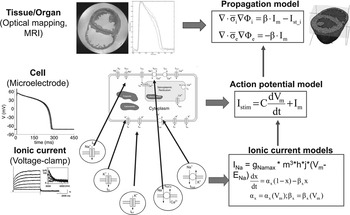
Modeling often does start from a lower level. In this context models of ionic currents (molecular level) provide information to action potential models (cell level), as shown in figure 1. However, the systems biologist Denis Noble (Reference Noble2012) demonstrates that before one can solve the differential equations accounting for the kinetics of ion channels, one must specify the initial and boundary conditions. An important boundary condition in this context is the cell voltage that influences the gating of the channels. The cell potential is a cell parameter that cannot be measured via the techniques used to measure ion flow, because voltage-clamp techniques isolate individual channels or cells from their native environment. The boundary conditions for these models therefore need to be identified via microelectrode measurements on intact or (preferably) coupled cells (see fig. 1).
Measurement techniques and model types used at different scales in the development of cardiac models. Reprinted by permission from the American Physiological Society, from Carusi, Burrage, and Rodríguez (Reference Carusi, Burrage and Rodríguez2012).

There is a similar feedback between modeling of action potentials (based on the Hodgkin-Huxley model) and propagation models describing features at the tissue level via partial differential equations. To arrive at a complete solution for a propagated action potential, one must account not only for the flow of ions and the capacitance of the membrane but also for how biophysical features of the tissue structures influence the speed of conduction and propagation of electrical currents (Qu et al. Reference Qu, Garfinkel, Weiss and Nivala2011). Examples of macroscale parameters are the radius of axons and the specific resistance and geometry of different tissue types. These parameters cannot be measured at lower scales but are defined via imaging technologies and manipulations of the whole tissue or organ (top of fig. 1; see Carusi, Burrage, and Rodríguez Reference Carusi, Burrage and Rodríguez2012).
A possible response from the reductionist in the face of such models may be that the explanatory power still lies in the protein mechanisms involved in the gating of ion channels, and that the initial and boundary conditions just provide physical background conditions for the ionic current models.Footnote 4 Yet, Noble’s (Reference Noble2012) example from multiscale cardiac modeling offers resistance to this view. First, he argues that the oscillatory dynamics constituting the pacemaker rhythm cannot be accounted for without the boundary conditions given by the cell structure. He refers to a computer experiment in which the feedback from the membrane potential (cell voltage) to the ion channels is blocked. He observes that “without the downward causation from the cell potential, there is no rhythm” (58). Since the boundary conditions are essential to understanding and modeling the phenomena, it seems misleading to downgrade their explanatory relevance to background conditions.
The second reason to resist the reductionist conclusion relates to the tyranny of scales problem. The idea that macroscale parameters (or boundary conditions) only offer background conditions for explanatory models presupposes that a lower-level model can unify all relevant aspects of multiscale systems. However, as the example of cardiac modeling illustrates, it is not possible to use ordinary differential equations (that here constitute the lower-scale models) as a framework of unification. The problem is that these are not well suited for capturing the electrophysiological and biomechanical properties of tissue structures. As seen in the examples from physics and biology, macroscale properties are often modeled via continuum models (partial differential equations). These models are not just inputs to lower-scale models but capture phenomena that lower-scale models fail to account for. Moreover, they require parameters that cannot be measured at lower scales.
In the context of cardiac modeling, the different models are brought together via simulation software. But this integration should not be considered a unifying framework in the traditional sense. Because processes at different scales influence each other in complex feedback relations, this must be done in an integrated fashion in which the models inform each other in many iterative steps (Carusi et al. Reference Carusi, Burrage and Rodríguez2012). That is, the simulation is not constructed as a bottom-up process. Rather, modelers must construct a system of models in which the results of one model may identify the initial and boundary conditions for another model.Footnote 5 Multiscale modeling is particularly challenging in biology because living systems have active boundaries that change over time, and various complex and nonlinear feedback relations crosscut processes at different spatial and temporal scales.Footnote 6
If we wish to account for these aspects of multiscale modeling and biological functioning, we should not abandon the notion of downward causation but try to clarify its meaning and significance. Noble explicitly defends a view akin to what Emmeche et al. (Reference Emmeche, K⊘ppe, Stjernfelt, Andersen, Emmeche, Finnemann and Christiansen2000) call medium downward causation when arguing that “downward causation is necessary and that this form of causation can be represented as the influences of initial and boundary conditions on the solutions of the differential equations used to represent the lower level processes” (Noble Reference Noble2012, 55). The following section returns to the philosophical discussion of downward causation as a constraining relation and responds to the possible objection that this reinterpretation weakens the importance of top-down effects.
4. The Explanatory Importance of Constraints
This article has aimed to clarify the interpretation of downward causation as the influence of constraining relations between structures and processes at higher scales to those at lower scales (or levels). Given the emphasis in science and philosophy of science on laws and temporal causal relations, an objection to the account presented here may be that redefining downward causation through constraining relations weakens its explanatory importance. In concluding, I further defend the importance of constraints modeling and explanation.
Sections 2 and 3 presented resistance to the view that a lower level should always be granted higher explanatory priority. The tyranny of scales problem in both physics and biology makes macroscale parameters and models indispensable because lower-scale measurements and models cannot account for all relevant aspects of multiscale systems. More generally, considering constraints merely as explanatory background conditions overlooks the fact that constraints can provide access to dynamic states or trajectories that are inaccessible to the unconstrained system (Hooker Reference Hooker2013; Bechtel Reference Bechtel2017). Constraints delimit the possible relationships between system variables, and they thus define boundaries and limits for causal processes (or for solutions to mathematical equations describing such processes). Many phenomena cannot be understood, or would not even be physically possible, without boundaries that organize and constrain lower-scale processes (Noble Reference Noble2012). If boundary conditions are indispensable for describing and constituting lower-level processes, such as the oscillatory dynamics of ionic channeling in the heart rhythm, it confounds the assumption that these cannot be granted an explanatory role.
The importance of constraining relations for understanding the properties and functioning of natural systems raises an interesting question. Why have constraints and boundary conditions not figured more prominently in philosophical accounts of modeling and explanation? The failure of the covering-law model of explanation to account for the explanatory role of boundary conditions has been discussed by Bursten (Reference Bursten2015), and I will here mainly guess why constraints have not been more adequately discussed by philosophers of biology (see, however, Pattee Reference Pattee1971; Bechtel Reference Bechtel2017).
One possible answer is that models in biology often background constraints because empirical studies typically require that these are ignored or held fixed. To exemplify, data on genetic difference making are typically acquired through experimental designs and models that require biomechanical constraints and environmental conditions to be constant. Accordingly, it is not surprising that these factors are not prioritized in explanations of genetic difference making in molecular developmental biology and related fields (Rosenberg Reference Rosenberg1997). But the fact that backgrounding or fixing such conditions is a methodological requirement also reveals that the resulting models and explanations cannot be used to dismiss the explanatory relevance of these factors for understanding the overall system (see also Laubichler and Wagner Reference Laubichler and Wagner2001; Robert Reference Robert2004; Brigandt and Love Reference Brigandt, Love and Zalta2017). Multiscale modeling can help identify which aspects are central (or can be ignored) at different scales and to provide a more systemic examination of whether there is a more fundamental causal level when attempting to examine a system as a whole.
Multiscale modeling in biology provides insights into the importance of macroscale (biomechanical) constraints for biological functions. In the context of developmental biology, new experimental techniques allow for investigating the effects of altered biomechanical constraints on the course of development. By altering the mechanical signals from the environment, the coupling of cell layers, as well as the .pngness of substrates, researchers have found that biomechanical properties of macroscale structures can influence gene expression, signaling pathways, and cell differentiation (Miller and Davidson Reference Miller and Davidson2013). If the fate and movement of cells depend on biomechanical properties of macroscale structures, the assumption that such factors are just nonexplanatory background conditions is severely challenged. Similarly, we have seen that modeling of the propagation of electrical signals in the heart requires identification of macroscale parameters such as the biomechanical properties and geometry of tissue types, because such boundary conditions are required to solve the equations describing lower-level processes. Downward causation may thus be important not only for understanding the system as a whole but also for adequately capturing lower-level processes.
To summarize, I have defended the view that downward causation can be reinterpreted as constraining relations that are mathematically expressed via boundary conditions on lower-level models. I have argued that such conditions cannot be reduced to explanatory background conditions for lower-level models. The tyranny of scale problem implies that lower-level models cannot provide a unifying framework for understanding multiscale systems as a whole. Rather, different mathematical models are needed to represent features characteristic of specific scales. Moreover, whereas lower-scale models can provide microscale components to meso- or macroscale models, the behavior of lower-level processes is also influenced and constituted by macroscale constraints. Downward causation, thus understood, is not mysterious but an important feature of multiscale systems that practicing scientists are continuously developing challenges to account for.