Mastitis is a financially important disease of sheep. It causes a variety of adverse effects, including the death of the affected animal. Downgrading of the quality of milk produced is also important and results from (a) presence of bacteria therein, (b) altered physicochemical properties of milk and (c) presence of antibiotic residues during the treatment stage (Bergonier & Berthelot, Reference Bergonier and Berthelot2001). The objective of this work was to describe the compositional changes during the early phase of mastitis and to associate them with pathological findings.
Materials and Methods
Experimental design
In total, 25 lactating multiparous (3–4-year-old) Karagouniko-breed ewes were included in the study and monitored from immediately after lambing until the day of inoculation (22 d after lambing). Lambs of these ewes were taken away from their dams at the age of 18 d and subsequently, the ewes were hand-milked thrice daily. All animals were challenged with a Mannheimia haemolytica strain (VSM08L) isolated from the teat duct of a clinically healthy ewe in Greece and of known pathogenicity for the mammary gland (Mavrogianni et al. Reference Mavrogianni, Fthenakis, Brooks, Papaioannou, Cripps, Taitzoglou, Brellou and Saratsis2005, Reference Mavrogianni, Cripps, Papaioannou, Taitzoglou and Fthenakis2006b). Conditions prescribed by EU legislation in relation to animal experimentation procedures were met during this work. A licence for animal experimentation was obtained from the Greek Ministry of Agriculture.
The identity of the organism was initially established by means of conventional bacteriological techniques (Barrow & Feldman, Reference Barrow and Feltham1993; Euzeby, Reference Euzeby1997). The identity was then confirmed by using molecular techniques (Fragkou et al. Reference Fragkou, Mavrogianni, Cripps, Gougoulis and Fthenakis2007a). Briefly, DNA was isolated from a blood-agar colony of the organism using a commercial kit (Gentra Systems, Minneapolis, USA) according to the manufacturer's instructions. PCR amplification was carried out according to the guidelines described by Kwok & Higuchi (Reference Kwok and Higuchi1989). The sequence of the primers and the PCR conditions to amplify a part of 350 bp of 16S r-RNA gene, were the same as previously described (Angen et al. Reference Angen, Mutters, Caugant, Olsen and Bisgaard1999). Following amplification, 10 μl of each PCR product was analysed by electrophoresis on 2% agarose gel and stained with ethidium bromide (0·5 mg/ml). A 100 bp DNA ladder was analysed on the same gel to serve as a size marker. As a negative control, DEPC-treated H20 (RNA free) was used instead of DNA in PCR assay to exclude any contamination. As positive control, we used strain ES26L, Man. haemolytica serotype A9, which has been isolated and typed in England (El-Masannat et al. Reference El-Masannat, Jones and Scott1991). The specificity of the PCR products was verified after direct PCR product sequencing (MWG Biotech AG, Ebersberg, Germany).
Inoculation procedure was as described before (Fragkou et al. Reference Fragkou, Mavrogianni, Cripps, Gougoulis and Fthenakis2007a, Reference Fragkou, Skoufos, Cripps, Kyriazakis, Papaioannou, Boscos, Tzora and Fthenakisb). Briefly, ewes were challenged 2 mm deep into the teat duct by means of a sterile plastic fine catheter 20 G (Abbocath; Abbott Laboratories Inc., Abbott Park IL, USA). Average inoculum per teat was 1250 cfu. (range: 1210–1280 cfu), as estimated by the method of Miles & Misra (Reference Miles and Misra1938).
Clinical examination
Detailed clinical examinations, as previously described (Fthenakis, Reference Fthenakis1994; Mavrogianni et al. Reference Mavrogianni, Fthenakis, Brooks, Papaioannou, Cripps, Taitzoglou, Brellou and Saratsis2005) and sample collections were performed 2 d before challenge (D−2) and on D−1. Subsequent to challenge, such examinations were performed at 2 h, 4 h, 8 h, 12 h and 18 h after challenge, then on D1 and daily thereafter up to D5 (unless a ewe had been euthanized before). Five animals were euthanized at each of the following time-points: 4 h, 12 h, 1 d (D1), 3 d (D3) and 5 d (D5) after challenge.
Bacteriological and cytological examination
Teat duct material and mammary secretion were collected by using established sampling techniques (Fthenakis, Reference Fthenakis1994; Mavrogianni et al. Reference Mavrogianni, Fthenakis, Brooks, Papaioannou, Cripps, Taitzoglou, Brellou and Saratsis2005, Reference Mavrogianni, Cripps and Fthenakis2006a) for bacteriological examination. All samples were cultured onto Columbia blood agar incubated aerobically at 37°C for up to 72 h. Throughout this study, bacterial identification was carried out by conventional techniques, by the API SYSTEM (BioMerieux, Marcy-l'-Etoile, France) quick identification strips (Barrow & Feldman, Reference Barrow and Feltham1993; Euzeby, Reference Euzeby1997).
The California Mastitis Test (CMT), which is a reliable proxy measurement for somatic cell counts, was carried out in mammary secretion samples as previously described (Fthenakis, Reference Fthenakis1995). Secretion films were stained by the Giemsa method and a differential count of macrophage, polymorphonuclear neutrophil (PMN) and lymphocyte subpopulations was determined.
Milk composition
Milk pH was measured within 30 min of sample collection with a digital pH-meter (PH 525, LAB pH meter; WTW, Weilheim, Germany) calibrated in buffer solutions before use. Milk composition (fat, total protein and lactose content) was determined by means of an infra-red milk analyser (Milkoscan FT120; Fosselectric, Hillerød, Denmark).
Pathological examination
Dissection of the mammary glands and the teats was performed immediately after euthanasia as previously described (El-Masannat et al. Reference El-Masannat, Jones and Scott1991; Mavrogianni et al. Reference Mavrogianni, Fthenakis, Brooks, Papaioannou, Cripps, Taitzoglou, Brellou and Saratsis2005) at the time-points detailed above. An electronic cutimeter (Hauptner Instrumente GmbH, Dietlikon-Zurich, Switzerland) was used to measure 2 mm from the teat orifice to determine the precise site within the teat where the inoculum had been deposited. By using separate sterile blades, scrapings were obtained from the mucosa of the duct and the cistern of each teat. Samples from each of these two sites, as well as samples from the mammary parenchyma and the supra-mammary lymph nodes, were plated onto Columbia blood agar and incubated aerobically at 37°C for up to 72 h. Bacterial identification was performed as above, as well as by using molecular techniques (PCR amplification).
Tissue samples were fixed in 10% neutral-buffered formalin and embedded in paraffin wax, using conventional techniques. Haematoxylin and eosin (HE) standard staining procedures were performed for histopathological studies.
Data management and analysis
A scoring system for the pathological findings in the experimental animals, previously developed and described (Fragkou et al. Reference Fragkou, Mavrogianni, Cripps, Gougoulis and Fthenakis2007a) was used to assign numerical values for severity. A separate score (0–4 scale) based on the extent and severity of lesions was given for macroscopic and for histological findings in the teat and the mammary gland; these were then added to a 0–16 scale to produce a total pathology score for the findings in each ewe. For data recorded in paired samples, differences between results of treated glands and their matched controls were examined for each time-point. Two-sided statistical significance was evaluated using the Wilcoxon signed-rank test or the Sign test as appropriate. For each variable where the sample had been taken from a live animal, the number of post-challenge measurement occasions was used to apply a Bonferroni-style adjustment for multiple tests.
Statistical analyses were performed in Minitab 15 (Minitab Inc., State College, PA, USA) and Stata 9 (Stata Corp, College Station, TX, USA). Statistical significance was set at P<0·05.
Results
Pre-inoculation examinations
The mammary glands and the teats of all ewes were clinically healthy prior to inoculation; the teats were uniformly soft with no external abnormalities and no bacteria were isolated from teat duct material or from milk samples. CMT was negative and in Giemsa-stained secretion films only a few macrophages were observed. Prior to challenge, pH was not significantly different between milk from the glands to be challenged and from the contralateral ones to be used as the negative controls with median (Interquartile range, IQR) 6·70 (0·15) and 6·69 (0·11) respectively (P=1·000). Respective results for milk composition, for which there were also no significant differences, were as follows; fat: 6·95% (0·72%) and 7·03% (0·55%) (P>0·5); total proteins: 5·63% (0·73%) and 5·65% (0·75%) (P>0·5); lactose: 4·60% (0·40%) and 4·55% (0·38%) (P>0·4).
Post-inoculation clinical findings
Mild clinical signs (swelling of the teat, reaction during palpation) were recorded in challenged teats 2 h after inoculation. By 8–12 h after challenge abnormal mammary secretion was also evident in some ewes. No abnormal findings were seen in the contralateral teats and mammary glands. Transient increases in rectal temperature (up to 41·3°C) was also recorded. However, by the end of D1, all clinical signs had subsided and thereafter no clinical signs were seen.
Post-inoculation bacteriological and cytological findings
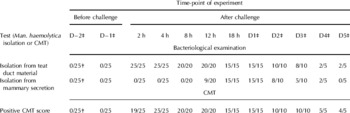
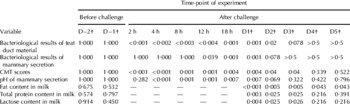
Man. haemolytica was isolated in pure culture from teat duct material from challenged teats from 2 h to D5 after challenge (in total, 140 of 150 samples). It was also isolated in pure culture from mammary secretion from 12 h after challenge and up to D4 (in total, 50 of 150 samples). Bacteria were not isolated from teat duct material or milk from the contralateral side and comparisons were statistically significant (P⩽0·02 up to and including D2 from teat duct material; P<0·05 at 12 h and 18 h after challenge and on D1 for mammary secretion) from the contralateral mammary glands (Tables 1 and 2).
ResultsFootnote † of bacteriological examination and California Mastitis Test after challenge of Man. haemolytica into the teat duct of ewes

† Numerator=number of samples positive, denominator=number of samples tested
‡ D−2, D−1=days before challenge, D1, D2, etc.=days after challenge
Levels of statistical significance, after Bonferroni-style adjustment for multiple tests, in comparisons of results between inoculated or control glands (P=) after challenge of Man. haemolytica into the teat duct of ewes

† D−2, D−1=days before challenge; D1, D2, etc.=days after challenge
CMT increased (>1) 2 h after challenge in samples from most (19 of 25) and 4 h after challenge in samples from all challenged sides; in total, 143 of 150 samples were positive. Leucocytes were seen in Giemsa-stained secretion films. Up to D1, ⩾85% of leucocytes were PMNs with a few macrophages and lymphocytes (5–10%) also present; subsequently, the percentage of PMNs decreased to between 40 and 50% whilst that of macrophages and lymphocytes increased (5–20% and 10–40%, respectively). Cellular debris was first observed in secretion films 12 h after challenge. No positive CMT scores (⩾1) were recorded in any sample from a contralateral mammary gland injected with PBS (P<0·05 up to and including D3). Occasionally, macrophages were seen in Giemsa-stained secretion films from these glands (Tables 1 and 2).
Post-inoculation changes in composition of mammary secretion
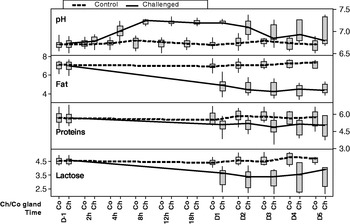
There was a sharp increase of pH values in mammary secretion samples from the challenged sides from 8 h after challenge until D2. Median values (IQR) were 6·82 (0·32) up to 8 h after challenge, 7·20 (0·60) from 12 h after challenge up to D1 and 6·95 (0·43) from D2 up to D5; respective figures for milk from control sides were 6·70 (0·16), 6·72 (0·13) and 6·73 (0·15) (P<0·01 from 4h after challenge up to D2) (Table 2, Fig. 1).
Boxplots of pH and composition (% fat, % total proteins, % lactose) of mammary secretion samples against time after challenge of Man. haemolytica into the teat duct of ewes

Compared with pre-challenge values, fat, total protein and lactose content of mammary secretion decreased significantly after challenge (Fig. 1). Moreover, fat content of mammary secretion from inoculated sides was significantly smaller than that of the contralateral sides. Median (IQR) fat content of secretion from challenged sides was 4·50% (0·95%) and that of control sides 7·00% (0·55%) (P<0·045 throughout; Table 2). Similarly significant smaller values in mammary secretion of challenged sides were observed for total protein and lactose content (Fig. 1). Median total protein content of secretion from challenged sides was 5·00% (0·90%) and that of control sides was 5·65% (0·85%) (P<0·03 up to and including D3); respective values for lactose content were 3·55% (1·05%) and 4·55% (0·45%) (P<0·03 up to and including D3) (Table 2, Fig. 1).
Gross pathological and histopathological findings
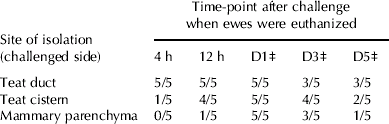
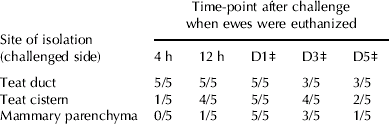
The measurement of the length of the internal teat structures after dissection of the teats showed that the inoculum had always been deposited within the teat duct. Man. haemolytica in pure culture was confirmed from duct scrapings of challenged (in total, 21 of 25 samples) but not of contralateral (0 of 25 samples) teats (P=0·031 up to D1, P>0·1 thereafter). It was also isolated in pure culture from teat cistern scrapings (in total, 16 of 25 samples) (significance v. contralateral teats: P=0·031 on D1, P>0·05 at other time-points) and from mammary parenchyma (10 of 25 samples) (significance v. contralateral glands: P=0·031 on D1, P>0·05 at other time-points) (Table 3).
Post-mortem isolation of Man. haemolytica Footnote † after challenge into the teat duct of ewes
† Numerator=number of samples positive, denominator=number of samples tested
‡ D1, D2, etc.=days after challenge
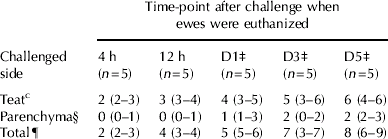
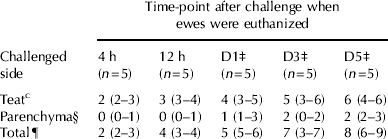
The presence of a few folds and hyperaemia was recorded in the teat ducts of ewes during the initial stages (up to D1) after challenge. Subsequently (D3 and D5) the internal lining of the teat appeared rough, whilst petechiae were seen in the mucosa of teat cistern. The teat duct and the teat cistern were regarded as two separate anatomical structures. Histologically, there was prominent leucocytic (PMNs, lymphocytes, plasma cells) infiltration, in clusters under the epithelium of the teat. On D3 and D5 a follicle-like area, characterized by accumulation of lymphocytes and plasma cells, was observed in the lamina propria between the teat duct and the teat cistern. Lesion scores in challenged teats were significantly higher than in contralateral teats: depending on time-point after challenge, P=(0·025–0·046) for gross pathological scores and P=(0·039–0·042) for histopathological scores (Table 4).
Total mammary pathology scoresFootnote † after challenge of Man. haemolytica into the teat duct of ewes
† Median value (range)
‡ D1, D3, etc.=days after challenge
§ Maximum possible: 8
¶ Maximum possible: 16
Histological lesions were observed in the mammary parenchyma of ewes euthanized on D1, D3 or D5 and consisted of leucocytic (PMNs and lymphocytes) infiltration, lysis of PMNs, extravasation and destruction of epithelial cells. Lesion scores in glands from the challenged side were not significantly higher than in contralateral glands: P>0·1 for gross pathological or histopathological scores (Table 4).
Discussion
There is a conflict in the literature regarding the effects of mastitis on fat and protein contents of milk of ewes. Burriel (Reference Burriel1997a) and Leitner et al. (Reference Leitner, Chaffer, Caraso, Ezra, Kababea, Winkler, Glickman and Saran2003) reported an increase in the fat and protein concentrations in milk from mastitic glands, whilst Leitner et al. (Reference Leitner, Chaffer, Shamay, Shapiro, Merin, Ezra, Saran and Silanikove2004) and Santos et al. (2007) reported a decrease. All those papers report field studies where many factors were probably outside the control of the workers and could have affected the findings. Furthermore, none of those papers associated compositional with pathological findings.
The present results confirm that the reduction of milk constituents is the effect of cellular damage and can occur soon after infection. Man. haemolytica is a confirmed mammary pathogen, of special importance in suckling ewes. Reduced milk yield during mastitis results in suboptimal growth of lambs (Fthenakis & Jones, Reference Fthenakis and Jones1990) but, obviously, reduced nutrient value of milk would further contribute. Gougoulis et al. (Reference Gougoulis, Kyriazakis, Papaioannou, Papadopulos, Taitzoglou and Fthenakis2008) recorded a marked sucking-behaviour change in ewes with unilateral mastitis; lambs sucked more frequently the unaffected gland. Although this was attributed to reduced milk yield of the affected gland, one may suggest that physicochemical changes in milk (pH change due to ionic alterations) lead to a salty, unpleasant taste of milk, which could further affect lamb preference.
Deposition of Man. haemolytica into the teat duct elicited an inflammatory reaction by 2 h after challenge as denoted by the increased cellular content of the mammary secretion. Persson-Waller et al. (Reference Persson-Waller, Colditz and Seow1997) showed an early PMN response (4–8 h after challenge) after inoculation of Escherichia coli into the teat of ewes. One may suggest that sucking would contribute to removing the invading bacteria; in an attempt to simulate that, ewes were milked thrice a day and their mammary glands were completely emptied. Nevertheless, the bacteria successfully ascended to the mammary parenchyma, as established by the results of bacteriological and cytological tests.
Decrease in lactose content of mammary secretion is due to reduced biosynthesis as a consequence of tissue damage, confirmed by the histological findings. As lactose is a major determinant of milk osmolality, its decrease requires changes in concentrations of ions within the mammary gland in order to maintain normal osmolality (Pyörälä, Reference Pyörälä2003). Consequently, there is an influx of sodium and chloride ions and an exit of potassium ions. Increase in milk pH as early as 8 h after challenge would be the effect of the above ionic changes and/or of milk protein degradation and/or of presence of inflammatory mediators (Baeker et al. Reference Baeker, Haebel, Schlatterer and Schlatterer2002). However, tissue changes, which occur in mastitis, facilitate leucocyte diapedesis from the blood to the mammary tissue and coincide with the presence of immature PMNs in blood. Increased pH (>6·8) of mammary secretion enhances Man. haemolytica growth and leucotoxin production (Van Rensburg et al., Reference Van Rensburg, Du Preez and Ellis2006) and thus promotes mammary infection. Influx of lymphocytes, which takes place 2–3 d after challenge, is important for limiting the infection. It is noteworthy that the return of pH values to normal 3 d after challenge is associated with a decrease in isolation rates of Man. haemolytica.
In a previous study of milk composition after bacterial challenge (Fthenakis, Reference Fthenakis1988) no significant changes were reported between secretions from affected and controlateral glands. There are differences in the experimental design between the present study and that one, which had been carried out in Welsh Mountain breed ewes inoculated with Staphylococcus simulans. One may thus suggest that virulence differences among pathogens possibly influence milk composition consequences.
Furthermore, the production type of the ewes may also be a factor in determining the outcome of infection and the extent of tissue damage. The results support a theory that production effects in dairy ewes could be more severe than in mutton-type animals. This was first suggested by Saratsis et al. (Reference Saratsis, Alexopoulos, Tzora and Fthenakis1999) who reported a 55% milk yield reduction in dairy ewes during subclinical mastitis, whilst Fthenakis & Jones (Reference Fthenakis and Jones1990) in a similar study in mutton-type ewes in Great Britain had found a smaller reduction (up to 25%). Differences among sheep breeds in response to mammary infection have already been documented. In general, low-producing animals respond better than high-yielding ones (Burriel, Reference Burriel1997b; Fragkou et al. Reference Fragkou, Skoufos, Cripps, Kyriazakis, Papaioannou, Boscos, Tzora and Fthenakis2007b). Obviously, the consequent tissue damage and the production effects are related to the response to mammary infection.
Conclusion
Man. haemolytica-induced mastitis in ewes results in altered physicochemical properties of mammary secretion. These are closely associated with the disease process. In conjunction with the results of previous studies, it is suggested that virulence of the disease agent and production type of the affected sheep might well be important in determining the extent of the tissue damage and the consequent production effects.