I MONEY, COINAGE AND CULTURE
Money was central to the Roman world. It mediated not only the state redistributive cycle but also a high level of commoditization. The widespread provision of good-quality consumer goods beyond the élite was a distinctively Roman phenomenon. The creation of this material complexity has been variously analysed as the Roman Consumer Revolution or the Roman Cultural Revolution, and the end of it is central to models of the Decline and Fall of the Roman Empire and of the transition to the Middle Ages.Footnote 1
There was an intimate link between the creation of this material complexity and the liquidity boom of the second and first centuries b.c., consequent upon imperial expansion and exploitation.Footnote 2 The effects were cultural as much as economic. Material forms of being Roman became increasingly important as a dimension of Roman identity.Footnote 3 A consumer boom was driven by an aspiration to social status in a hierarchically ordered society. The debris of this economic and cultural change is found scattered across the Roman world in the form of buildings and monuments, container amphorae, fine pottery, lamps, glass, metalwork, and the like. This new Roman provincial culture should not be seen as a ‘Roman’ phenomenon exported to the provinces; its creation was a process in which the provinces were complicit.Footnote 4
The commercialization of Rome's Cultural Revolution was critically underpinned by the extension of monetization. Indeed the eventual demise of Roman material culture has been linked to the fate of the distinctively Roman provision of small change.Footnote 5 So the spread of Roman-style monetization to Temperate Europe is a major phenomenon. Without it, the northern provinces could not have participated in a whole complex of changes which have often been grouped under the problematic heading of ‘Romanization’.Footnote 6
Roman expansion into Temperate Europe saw the meeting of societies constructed in very different ways, that is with different regimes of value, ‘where value is primarily defined not in economic or monetary terms, but rather through the broadest range of social and cultural links people have to the material world’.Footnote 7 Contexts where different regimes of value meet bring out the importance of the cultural dimension to money. The approach puts the focus on forms of monetization and commoditization (the assignment of economic value to things, a process not confined to monetized exchange) rather than on neo-classical economics.Footnote 8
What is money? It can be characterized by its multiple functions: as a means of payment, a means of exchange, a measure of value, a unit of account, and a store of wealth. Some would confine the word to all-purpose money, which combines all these functions. No definition is sufficient without consideration of context. The use of certain types of money may be confined with narrow spheres of exchange (say, bride-price), and in no context is it universal (we do not buy and sell people as such). The extent of commoditization is a variable in itself. It is unhelpful to define money too precisely here as the aim is to consider from a historical perspective how money develops.Footnote 9
It is desirable to look at money in all its aspects, but that is scarcely possible. To take an obvious example, credit may be an important part of the money supply, the significance of which is rightly acknowledged and debated for the Roman world.Footnote 10 The evidence for credit is essentially documentary so it is not possible to trace whatever rôles it may have had in prehistoric societies.Footnote 11 The extension of monetized credit to Temperate Europe might well have been one of the major developments in the confrontation of different societies. There is a tantalizing hint that this might have been the case. According to Dio, insistence by the procurator that grants to the British élite by Claudius had to be repaid provided one of the reasons for the Boudiccan revolt.Footnote 12 This is exactly the kind of ‘misunderstanding’ to be expected when a regime of value embracing commoditized credit meets one where forms of gift exchange fulfil some of the same needs. Unfortunately it is not possible to progress from the anecdotal to the testable.
There is a similar problem when trying to look for forms of money which are not familiar. The identification of money-use is largely dependent on documentary sources. For non-literate societies it can be virtually impossible to know from archaeology alone whether certain artefacts were used as money or not. For example, Caesar noted that the Britons used iron bars of standard weights as money, but from archaeological evidence it is hard to be sure whether such iron bars, which are found across France, Belgium, Germany, and Switzerland, as well as in Britain, were indeed used as money and, if so, in what way.Footnote 13
There is a huge anthropological literature on ‘primitive money’ and ‘primitive valuables’ (prestige gifts exchanged in a ceremonial way), but that is precisely because there have been anthropologists, ethnologists, colonial administrators, and travellers present to observe and record money in action.Footnote 14 There is little by way of external observation recorded in Greek or Latin which might provide a surrogate anthropology of money in Iron Age Europe, and what there is tends to conform to Graeco-Roman stereotypes, may not be accurate, and cannot be verified. All anthropology can do is to raise the possibility that objects like iron bars might have been used as limited-purpose monies in Iron Age societies, alongside who knows what else.Footnote 15
Although there are important areas which cannot be investigated satisfactorily there is much that can be done. We recognize coin as a form of money in the Roman world, and know a lot about how it was used. As a means of exchange and measure of value coinage is particularly important in the archaeological record. It stands for systems of doing things, for ways people relate to each other and to things, and for ways of conceptualizing the world.Footnote 16 In other words it helps to signify regimes of value, the confrontation of which we are attempting to understand. As coinage was also a feature of Temperate Europe in the Iron Age, it can in principle be used to compare different ways of doing things.
The increased emphasis on materiality within archaeology offers new ways to look at coins. Some archaeologists now stress the effect of the material world on human relations, provocatively reversing traditional descriptions of agency.Footnote 17 ‘Styles of objects set up universes of their own into which people need to fit.’ Artefacts bring about ‘repeated sets of actions implemented by type’. ‘Those who embraced new forms found themselves over time created as social beings with new sensibilities and forms of relatedness.’ Objects create peoples. Not all historians or anthropologists will be ready to cede agency to things, but it is easy to see how this approach is particularly illuminating for coinage.Footnote 18 It also helps to bring out how much is at stake. Coinage was not simply a reflection of identities; it was active in creating them.Footnote 19 And that applies to the use of coins, as well as to the designs and inscriptions which they display.
The scope for using numismatic evidence to address major issues of cultural history in this way is considerable, and has not gone unnoticed. There have been calls by Aarts to apply an anthropological approach to coinage in the Roman world,Footnote 20 and by Kemmers and Myrberg to reintegrate coins into material-culture studies.Footnote 21 This paper is one attempt to answer these calls, although it does not do so in terms advocated by either. Ideally all coinages should be interpreted in their full material-culture context, including patterns of settlement.Footnote 22 The scope and aims of this paper do not permit that level of detail. The point argued here is that monetization also needs a higher-level treatment, embracing the Iron Age and Roman periods as a whole and geographically both the East and West of Temperate Europe. In this way some major structures and developments become apparent, and it is possible to think about them.
II THE STRUCTURE OF COINAGES IN TEMPERATE EUROPE
Rome expanded into a world which already had coinage. The Iron Age coinages of Temperate Europe, the earliest of which date to the late fourth or early third century b.c., had their origins in an adaptive borrowing from the Greek and Roman worlds long before the Roman conquest.Footnote 23 Iron Age societies incorporated Graeco-Roman iconography in their own terms, making incremental changes to it: initially they rendered images less ‘realistic’ and more ambiguous, with a greater emphasis on pattern, in conformity with the rest of their material culture, which is known especially from metalwork.Footnote 24 Coinage was also put to different uses within Iron Age societies, as will be explored in more detail in the next section. The key feature is that the idea of coinage was borrowed and internalized to produce something new. If Graeco-Roman coins were imported in quantity they were presumably melted down, perhaps in part to produce local coinages. At any rate most regions are not characterized by numerous finds of imported coin prior to conquest by Rome.
This model of coinage is in marked contrast to the reaction of the peoples who lay to the north of the Roman Empire under the Principate and Dominate. Coinage there was characterized by the sporadic influx and deposition of quantities of Roman silver coin from the second half of the second century a.d. onwards, and then of gold coin beginning in the second half of the third century a.d.Footnote 25 The pattern of finds is patchy but with significant concentrations in certain regions, including the valley of the Vistula in Poland, north-western Ukraine, Denmark, and the Baltic islands of Gotland and Bornholm. Denarii are often found in assemblages which date a few centuries later than when the coins were minted, including fourth-, fifth-, and even sixth-century contexts. What little coin was struck to the north of the Roman Empire during the imperial period consisted mostly of imitations of denarii, which are found from Scandinavia to the Crimea, and from the Rhine to the Danube. In some cases these coins were copied directly by taking impressions for the dies from original Roman coins.Footnote 26 Roman coin was incorporated in a way quite different from the Iron Age model of adaptation and transformation seen earlier.
The pattern of coinage to the north of the Roman Empire during the imperial period is remarkably consistent. The most significant variation is the import of base-metal sestertii into the West Balt Circle.Footnote 27 This is likely to reflect the targeted export of this denomination from the Roman world as well as a culturally defined local requirement, both of which deserve greater consideration. Here it is sufficient to note that it is still a case of the import and use — whatever that was — of Roman coin. This variation also serves to emphasize the remarkable consistency elsewhere north of the Roman Empire.
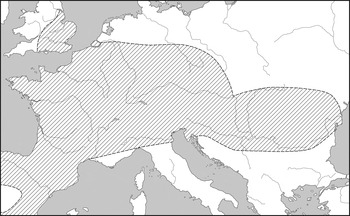
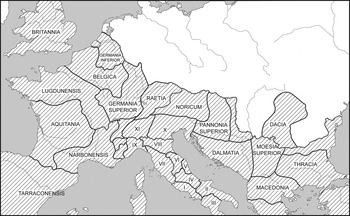
The contrast between the Iron Age model of coinage and the pattern outside the Roman Empire from the second century a.d. onwards is important because the area of adoption of the Iron Age model seems to delimit, in a very general way, the eventual expansion of the Roman Empire in the north (Figs 1–2). The comparison between the maps is all the more enticing as a partial mismatch — the more northerly high-water mark of Iron Age coinages in western Central Europe — is something of an illusion. The ‘Germanic’ expansion from the north-east which put an end to the oppida culture across much of Central Europe had already caused a retraction of Iron Age coinages from the Middle Rhine to the Upper Danube in Bavaria and Bohemia during the first half of the first century b.c.Footnote 28 The correlation between the extent of coinage on the Iron Age model and the Roman Empire has been noticed before.Footnote 29 But is it significant?
Iron Age coinages c. 100 b.c. (Based on D. Allen, The Coins of the Ancient Celts, edited by D. Nash (1980), 7).

The Roman Empire at the death of Trajan (a.d. 117). (Based on R. Talbert (ed.), Barrington Atlas of the Greek and Roman World (2000), map 100).

Obviously no single phenomenon will account for the limits to growth of direct Roman rule and there are many different ways of approaching the question. These might include geographical features, ecology, agricultural productivity, demography, local cultures, and political, social, and economic development in the north, and the internal dynamics of the Empire itself, not least the need for military glory.Footnote 30 So was coinage, or perhaps rather money, relevant? In order to test this it is best to look at the margin, where the limits to direct Roman rule were challenged. Britain and Dacia provide suitable test cases, as the last provinces to be added to the Roman Empire in the north and as marking the limits to the west and east within Temperate Europe.
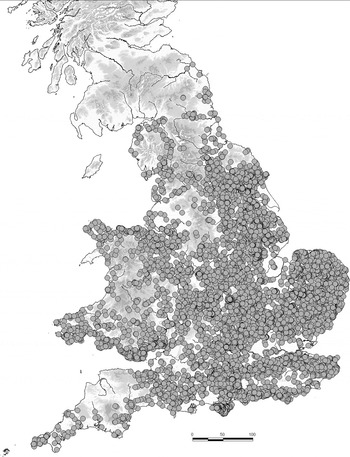
The evidence for Britain is particularly propitious as it allows comparisons of coin distributions generated by the Portable Antiquities Scheme with evidence for settlement patterns derived from developer-funded archaeology.Footnote 31 Coin-use in the Iron Age was confined to the south-east of the line from the Severn to East Yorkshire, roughly along the Fosse Way (Fig. 3).Footnote 32 It is perhaps safer to speak more neutrally of non-use of coin in the North-West rather than of ‘resistance’ to it.Footnote 33 There is, however, a hint from Wales to support the idea that the Fosse Way line in some way marked a cultural limit to coinage. Wales had no locally-produced coinage in the Iron Age and coins from outside were not used there.Footnote 34 The few finds of Iron Age coins may well have been imported in the Roman period. There is, however, a distinctive pattern of single finds of gold coins from the hills above the River Wye on the border. This is suggestive of deliberate selection for deposition as a reaction to a culturally defined barrier along the Wye. Such patterns might reflect different regimes of value or different exchange systems on either side of the coin-using/non-coin-using boundary. The plausibility of this geographical divide is increased by its appearance in other aspects of material culture, including the definition of settlement territories, building types, burial traditions, ritual deposition, and pottery styles.Footnote 35
Finds of Iron Age coins. (Courtesy of John Naylor. Based on data from the Portable Antiquities Scheme 2010).

After the Roman conquest coin-finds are recorded across the whole province of Britannia (Fig. 4). The division either side of the Fosse Way persisted but in a different way. The North-West had a relatively higher incidence of silver coin as opposed to bronze.Footnote 36 This does not necessarily mean that such areas were not ‘properly’ monetized under Rome — the English Middle Ages had a monetized economy with the silver penny as the lowest regular denomination — but rather that areas where silver dominated were monetized in a different way. It may also be significant that the pattern of coin finds in the North-West is similar in some ways to that to the north of the Roman Empire, and to Scotland in particular.Footnote 37
Finds of Roman coins. (Courtesy of John Naylor. Based on data from the Portable Antiquities Scheme 2010).

Why should regional patterns of coin-use under Rome have echoed Iron Age patterns? The answer seems to be that both reflected the underlying geographical realities and cultural differences of a persistent ‘North–South divide’.Footnote 38 To some extent the line of the Fosse Way marked the division between highland and lowland, and military and civilian. Proximity to the coin-using Continent will have promoted the use of coinage in the South-East. Cultural differences between the two regions were manifested in differing forms of rural settlement and different architecture. In the Roman period the region to the north and west of the Fosse Way, where coinage had not been used in the Iron Age, was characterized by small, dispersed farmsteads or clusters of farmsteads. The South-East, by contrast, had a developed rural settlement hierarchy which included villages, villas, and complex farmsteads. Rectilinear buildings in general, not just villas, were also largely confined to the South-East.Footnote 39 These contrasts imply a different way of organizing life (a different regime of value?) and hence a different need for money. This was materialized in differing patterns of coin finds either side of the same geographical divide in both periods. The North-West had no need for coinage in the Iron Age, and only for a relatively unsophisticated one in the Roman period.
So the argument might be that in Britain Rome pushed on beyond a culturally defined boundary marked by Iron Age coin-use to find an easily controllable frontier, but that there were costs attached to the creation of a militarized zone and limits to what could be achieved. Dacia is interesting in a different way, as prior to Roman conquest it was characterized by a unique mixture of the Iron Age model of coinage with the pattern found later to the north of the Roman Empire during the imperial period. It is surely relevant that it was also marginal to the Roman Empire, in that it was the last province to be gained by Rome in the north, after several savage wars, and the first to be lost.
Dacia had an adaptive coinage on the Iron Age model, beginning in the third century b.c.Footnote 40 The region had a long-standing tradition of the ritual deposition of precious metals, which was dominated by silverwork in the La Tène period, at least when coinage was introduced.Footnote 41 This may explain why it was silver rather than gold coinage which was adopted in the region, and coins are indeed found in some of the same hoards as silverwork. Following periods of import of Greek coins and the adaptive imitation of them, but still long before conquest by Rome, there was a substantial switch towards using Roman coin in Dacia.Footnote 42 There was a major influx of Roman denarii over a relatively short period, about 75–65 b.c.Footnote 43 These denarii then continued to circulate, supplemented by locally-made copies. The start of copying may plausibly be linked to the cessation of supply of denarii. These were true copies, sometimes very hard to tell from genuine Roman coins. In some cases the dies for them were made by taking impressions in bronze directly from original Roman coins. This is not at all the type of creative adaptation seen elsewhere in the Iron Age world or in Dacia earlier, and foreshadows the pattern seen later to the north of the Roman Empire from the second century a.d. onwards. The choice by the Dacians to copy an external form might be compared with their decisions to employ Hellenistic fortification techniques and to monumentalize their sacred places in stone.Footnote 44
So Dacia is marginal both to models of coinage and to the Roman Empire. To some extent this marginality for the Romans was geographical: the Carpathian mountains served to isolate the region, with the consequent problems of communication, supply, and defence. But there was surely a cultural dimension too. The province of Dacia was not like those which developed elsewhere in the North in important respects.Footnote 45 Onomastic evidence indicates the substantial transplantation of a population from outside. There is no evidence that the Dacian élite was co-opted into running the province, or even that it continued to exist, or for the persistence of local gods. Such differences will have been caused in part by the putative extermination (or suicide) of the élite and general depopulation as a result of the wars against Rome, along with the destruction of Dacian religious centres. But it is doubtful that massacre could have been on a scale sufficient to account for such dramatic and long-lasting variations from the norm. Excavated undefended rural sites display continuity into the Roman period.Footnote 46 Differences were rooted in the structure of Dacian society and the ideology of its élite.
That the examples of Britain and Dacia both prove highly interesting when viewed in this way suggests that the general approach is worth pursuing. Iron Age Britain was characterized by a boundary between the use of coin on the Iron Age model and non-coin-use, and Dacia by a unique mixture of coinages on the Iron Age model and on the pattern seen later to the north of the Roman Empire under the Principate. The marginality of both provinces in relation to Roman rule supports the idea that there might be something in the connection between the spread of the Iron Age model of coinage and the later limits to empire. There are hints at the complexity of how this might have worked in relation to settlement patterns in Britain and the rôle and ideology of the élite in Dacia. So it is worth exploring the Iron Age model of coinage a bit further.
III IRON AGE COIN-USE
In some ways it is paradoxical to generalize about Iron Age coinage as regional and local variation is characteristic.Footnote 47 Such diversity is not surprising. It is apparent in almost every aspect of material culture in the Iron Age. Political and social fragmentation was characteristic, with communities distinguished by distinctive combinations drawn from a common stock of technologies and cultural resources.Footnote 48 Generalization puts the emphasis on the common stock to allow broader comparisons to be made.
The challenge is to discern the function of coinages on the Iron Age model. The use of Celts as mercenaries has a significant part to play in the conventional story of the spread of coinage in Iron Age Europe.Footnote 49 The iconographies of the earliest Iron Age coinages were almost all derived from coinages struck by known employers of ‘Celtic’ mercenaries. Macedonia was particularly prominent. Mercenary pay may have played an important rôle in the early contact of Iron Age peoples with coinage, but it is quite inadequate in itself to explain the spread of coin production across Temperate Europe.
It is worth asking why Iron Age peoples were able to adopt coinage. The explanation which emerges most naturally from the archaeology is that they were able to internalize it because it could be incorporated into their existing cultural patterns involving the social circulation and structured deposition of metalwork.Footnote 50 Torcs, as symbols of high-status individuals and of divinity, are one of the classic expressions of that world. The argument is reinforced by the fact that coins are found in conjunction with torcs across Central and Western Europe.Footnote 51 In other words adaptation applied to the use of coins as much as to the imagery. Just because the coinage of Iron Age Europe was superficially similar to Graeco-Roman coinage does not necessarily mean that it was used in the same way.Footnote 52 The initial incorporation of coins as primitive valuables might have been driven by the convenience of their small size, their capacity to carry iconography, and by the tendency for Iron Age deposits to become more stereotyped and standardized.Footnote 53 Such incorporation fits into a widely observed pattern of mimicry and adaptation in material entanglements.Footnote 54
The social circulation and structured deposition of metalwork in the Iron Age was located in a much earlier tradition.Footnote 55 The circulation and ritual deposition of bronze artefacts, including axes, were significant features of the Bronze Age.Footnote 56 Purely utilitarian explanations will not do: the high-tin bronze composition of axes in some Late Bronze Age hoards gave them a silvery patina but also left them highly brittle and unsuitable for functional tasks such as woodworking.Footnote 57 The ‘materialization’ of social relations through social circulation and ritual deposition may be traced earlier with stone artefacts.Footnote 58
A key feature of such behaviour in the Iron Age is structured deposition, ‘the placing of artefacts or combinations of artefacts (or other archaeological material) in particular contexts as part of ritual acts and following prescribed rules’.Footnote 59 The shift of deposition from weaponry and human remains to coins and items such as brooches brings out the tradition to which coin deposition belonged.Footnote 60 Spatial analysis of coin finds reveals a strong pattern of ritual deposition, with finds being associated with wet places (stream beds, wetlands), boundaries (entrances, ditches, pits), and sacred places, including sanctuaries and temples.Footnote 61 Such ritual sites and practices served to create and maintain identities.
Ritual behaviour in relation to coinage was not confined to deposition. Coins were defaced with cut-marks in particular contexts in Britain and on the Continent.Footnote 62 Although this has sometimes been explained as a monetary phenomenon, it is part of a wider practice which included the breaking of weapons, torcs, and the like. Such ‘ritual killing’ may have its origins in substitution for human sacrifices. Analysis of ritual deposition and chop-marks on coins in the sanctuaries of the Treveri has drawn attention to the placing of defaced coins and damaged fibulae in the same context at the Martberg.Footnote 63 The similar treatment of coins and brooches argues strongly for a ritual rather than a monetary explanation.
Archaeology allows us to trace phenomena such as ritual deposition and ritual killing. These features need not define coin-use, which was presumably diverse. No doubt coins also fitted into other patterns of cultural, social, and economic exchange. Mundane and ritual are not mutually exclusive categories — indeed the power of ritual deposition ultimately derives from function.Footnote 64 The ritualization of coin might even be taken as positive evidence of its functional importance, if the ritualization of weapons is anything to go by.Footnote 65 Economic functionality is suggested by the fact that coins were made to weight standards and might be struck in different denominations and on a considerable scale.Footnote 66 Just because a coin ended its life as a ritual deposit does not mean it spent its whole life as a ritual object.Footnote 67
So a key question is whether coinage in the Iron Age was routinely used in exchange for goods and services. The problem is that it is difficult to define prehistoric coin-use in the absence — by definition — of internal documentary evidence. Nor is there much by way of external Greek or Roman observation of money in Iron Age societies.Footnote 68 There are references to the use of gold or money in the mustering of military forces in Iron Age contexts, although it is not always clear if coins were involved.Footnote 69 In any case, external observations may, of course, be misreported or misunderstood.Footnote 70 There is not much to go on.
Statements such as ‘the use of coinage spread among the Celts themselves primarily in the context of their own military relationships’ and ‘Celtic coinage was used primarily for payments by nobles to dependents in their capacity as warriors’ are hard to prove or disprove.Footnote 71 The concentration and substantial scale of Iron Age gold coinages in Belgic Gaul and Britain at the time of Caesar's Gallic Wars support a connection with warfare, although reviews of chronology based on archaeological context make the case less clear.Footnote 72 Analysis of the evidence from Bibracte also demonstrates an increase in the volume of silver coinage in Central Gaul at the time of the Gallic Wars.Footnote 73 However, the force of the general argument rests not on occasional external references or on the Gallic War associations, but primarily on the observation that the Mediterranean prototypes for the earliest Iron Age coinages almost all belonged to known employers of ‘Celtic’ mercenaries.Footnote 74 This is an argument worth taking seriously, but it is not mandatory. Later coinages are less easy to interpret in this way, as the Romans did not normally use mercenaries, although pay for native units may well explain some silver coinages in the first century b.c.Footnote 75
The inter-regional movement of Iron Age coins, particularly on the Continent, may sometimes be linked to military activity, but it is hard not to ascribe a rôle to trade as well, in some form. Certainly a broadening of circulation correlates with Caesar's Gallic Wars, as can be seen from the finds at Bibracte.Footnote 76 On the other hand the long distance movement of Iron Age coinage was already a feature of some of the earliest gold coinages of western Temperate Europe in the third century b.c., and some silver and potin coinages circulated widely already in the second century.Footnote 77 Troop movements associated with Caesar's Gallic Wars cannot be used as a catch-all explanation, although that does not exclude earlier military explanations. Perhaps more significantly, stratified deposits show that low-value coins from Gallia Comata began to reach the Celtic-speaking trading settlement at Lattara on the Mediterranean from about 100 b.c.Footnote 78
Material evidence provides the only viable path to progress. The quality of the archaeology of Iron Age coin-use in some areas is impressive.Footnote 79 There does seem to be some correlation between the development of oppida and of the use of silver and bronze coinage.Footnote 80 On the other hand, where it has been studied, more specific spatial analysis of coin finds does not give much encouragement to a strongly market-oriented view. In Britain and Belgic Gaul there is a significant concentration of coin finds on religious sites. A study of the South Midlands of Britain shows coins largely absent from domestic sites. Nor are they concentrated at sites which might have been markets, whatever that means in an Iron Age context.Footnote 81 Belgic Gaul has little coin at production sites.Footnote 82 Coins cannot be found in shops as there were none. ‘Shops’ (tabernae, which were often places of production too) were a Roman locus for monetized exchange which spread only later.Footnote 83 Of course, it is always possible to speculate that monetized exchange took place largely at religious sites, but, as will become apparent, it is noteworthy that coin finds in the Roman world look distinctly different. Moreover, at the transitional Iron Age and Roman oppida at Bibracte in Central Gaul and on the Magdalensburg in Noricum ritual deposition is a distinctive feature but coins are also found in workshops and homes.Footnote 84 It will be interesting to see if future contextual studies suggest correlations of any kind between coin finds on production and domestic sites and increasing proximity to the Graeco-Roman world.
So there is a major question here which remains open. It is best stated by quoting from two judicious summaries:
There is now a significant amount of evidence to suggest that Iron Age coinages — unlike their Mediterranean prototypes — remained largely bound up in various kinds of ceremonial and religious usage quite distinct from those with which we are familiar today, never breaking out from the confines of traditional societies and their existing value systems. (Haselgrove and Wigg-Wolf)Footnote 85
We must first rethink our notions of trade and its connection with social exchange, power, authority and ritual before social purposes of Celtic coinages are separated from economic functions. (von Reden)Footnote 86
It is not so much that Iron Age coinage was socially embedded — even modern money is — but that it was embedded in societies very different to the Roman one.Footnote 87 It is easy to imagine coins used as a store of wealth, for gift exchange of various kinds, including diplomatic gifts, for payments to military retainers, distributions to dependents, bridewealth, tribute, compensations, and the like.Footnote 88 Coin might also have been used in market exchange in some contexts, perhaps initially with outsiders.Footnote 89 It may well be that Iron Age coinage is best seen as limited-purpose money with different metals sometimes operating in different spheres of exchange.Footnote 90 Whatever view one takes, it is probably common ground that money-use in the Iron Age was more involved with reproducing social and religious orders and Roman money-use more involved with market exchange, relative to each other.Footnote 91 A significant extension of market exchange is in any case a plausible consequence of Roman peace and the need to pay taxes.Footnote 92
IV ROMAN COIN-USE
To see the force of the contrast with Iron Age practice it is necessary to characterize the Roman style of money-use which was spreading throughout Europe. This was grounded in the use of coin, and the Romans certainly viewed coinage as characteristic of their world. Absence of coinage was something the Romans alleged of ‘others’, from the past, from distant lands, or from idealized primitive contexts.Footnote 93 Money was not, however, confined to coin; credit played a significant rôle in extending liquidity.Footnote 94
Documentary sources, admittedly with a very uneven geographical coverage, allow us to establish a normative model of money-use in the Roman world.Footnote 95 Money was the dominant means of exchange for goods in all provinces, and was used in rural as well as urban settings. Money was embedded in the structure of the economy: it played a rôle alongside agricultural produce, particularly corn, in taxation, rents, wages, and credit. Money was critically linked to the Roman state redistributive cycle of taxation and expenditure, as can be seen from the fate of coinage when that cycle disappeared.Footnote 96 Clearly there is a need to generate a more differentiated approach to variations in monetization by time and place within the Roman world, a project for which archaeology supplies the only common denominator, but this is the model against which data need to be tested.
Our ability to characterize Roman money-use through documentary sources and structural arguments presents a problem in trying to compare Roman with Iron Age practice. In default of documentary sources, the use of coin in the Iron Age has to be approached archaeologically, but there is a distinct lack of comparable contextual archaeological studies of the Roman material for comparison. Roman coins have often been published as a list in excavation reports, rather than with contextual information and analysis. Some major sites with huge quantities of coin for which the contexts have been recorded would lend themselves to this type of study, among them Augusta Raurica and Carnuntum, but sufficiently detailed analysis remains to be done.Footnote 97
The potential for such work has been demonstrated by an important study of the canabae of X Gemina at Nijmegen of a.d. 71–104.Footnote 98 The spatial distribution of coin finds was generally in line with the distribution of all finds. Coins were spread over the whole site, without any social differentiation. They were principally found associated with waste disposal sites or with roads and road ditches. In other words the coin finds reflected the cleaning up after people and the location of shops on roads. This was a community based on trade and production for a legion, which may not have been typical even of urban sites. Nonetheless, the Roman pattern identified for the canabae of X Gemina at Nijmegen is strikingly different from that found in the northern world of the Iron Age, where ritual disposition of coin in special places is characteristic.
To be provocative, it is tempting to compare the finds at Nijmegen with those at Pompeii.Footnote 99 Pompeii is the nearest to a snap-shot that survives, although it is important not to over-state this: the coins on bodies may reflect attempts at salvage rather than normal use, and a good proportion of the population escaped.Footnote 100 But perhaps the frozen-in-time Roman association of coins with houses, shops, inns, and bodies at Pompeii would have left archaeological traces different in scale, to be sure, but not so very different in kind from those at Nijmegen, if the Vesuvian city had been abandoned in a more gradual way? A detailed study of one insula does indeed show the heaviest coin loss in areas of commercial transactions (bars, workshops, shops), with coins present, but in smaller numbers, in domestic spaces.Footnote 101 There is huge potential to use such contrasts between Iron Age and Roman patterns to trace the spread of Roman-style money-use archaeologically, instead of relying on the mere presence of Roman coin as an indicator.
That said, we must beware of our almost subliminal desire to ‘other’ the Iron Age world and to ‘familiarize’ the Roman. Ritual deposition has been seen as characteristic of the Iron Age and has been used as an example of the location of money in the long-term transactional order. But ritual deposition was practised by the Romans too. The Romans deposited coins in rivers, springs, temples, and human burials.Footnote 102 Some of this ritual behaviour was distinctively Roman. The deposition of coins in graves, for example, was a practice which grew under Roman influence. It was not generally a feature of the Iron Age.Footnote 103 The offering of coins at hot and cold springs was again an Italian custom which was only later imported into the provinces.Footnote 104 The deposition of large numbers of coins at spas associated with springs in the North-West tracked the spread of Roman bathing culture.Footnote 105
It is probably wise to resist the temptation to dismiss such Roman offerings as casual, like throwing coins into a fountain now.Footnote 106 After all curse tablets were also thrown into springs, as at Bath.Footnote 107 At Rome itself, in the Lacus Curtius in the Forum, people of all classes threw coins down a monumental shaft over a former swamp every year for the welfare (Salus) of Augustus.Footnote 108 The Romans made offerings of coins in temples too. The word stips denoted a monetary offering which was testament to an agreement with a deity, a distinctively Roman formulation of the relationship with the divine.Footnote 109 Our ability to trace such practices archaeologically is limited by the practice of the re-use of the coins for religious expenditure, which was facilitated by the introduction of collecting boxes.Footnote 110
It is a matter for debate whether some Roman coin hoards represent depositions of a sacred nature, and, if so, whether or not this should be located in the Iron Age tradition.Footnote 111 Whatever may be the case with hoards, it is certain that ritual deposition of coins continued in the West as long as the supply of low-value Roman coins.Footnote 112 Ritual deposition may have been rather different in Iron Age and Roman contexts, but there was some commonality of practice. We need to be aware of how much our interpretation is influenced by our preconceptions.
On the other hand, there is also a danger of going too far in the other direction. It has been suggested that Roman coinage in different metals represented limited money within defined spheres of exchange, as has been argued more widely for Iron Age coinages.Footnote 113 Obviously different coins were used for different purposes: one could not use a gold coin everywhere.Footnote 114 Nonetheless, Roman gold, silver and bronze operated as an integrated system with a hierarchy of value. The bringing together into a single system of discrete elements in the Roman currency system operating in different spheres of exchange is the story of the middle of the third century b.c.Footnote 115 By the time of the introduction of the denarius system c. 214–212 b.c., or a little later, the value marks on the denarius system indicate clearly that gold, silver and bronze coins belong to the same system. The correct Roman term for their principal gold coin introduced in the late Republic was, after all, denarius aureus (‘gold denarius’: the denarius was a silver coin, its underlying meaning is ten bronze coins).Footnote 116 Moreover, there is abundant evidence for the circulation of Roman gold, silver and bronze alongside each other.Footnote 117
While it is important to bear in mind the issues outlined above, the transition to Roman money-use marked a significant change. The argument is that the adoption of the Iron Age model of coinage was characteristic of an area which became viable for direct Roman rule, that one can see the merging of the different regimes of value by tracking the spread of Roman-style coin-use prior to conquest, and that there is at some level a meaningful link between these two things.
V THE MERGING OF REGIMES OF VALUE
Did the internalization of coinage on the Iron Age model simply imply, or itself help to create, the cultural and social complex which permitted provincialization?Footnote 118 It is plausible that the production of such coinages correlated with the existence of larger socio-political groupings with a structured social hierarchy, on varied scales and models, of the kind the Romans needed for direct rule.Footnote 119 The relative slimness of the Roman provincial administrative apparatus normally required reliance on local élites. The emergence of a more pronounced structure of élite control may well itself have been promoted by the spread of Rome. But a case can be made that familiarity with the form of coins also helped to merge regimes of value and so facilitated Roman imperial expansion. The Roman Empire was limited by regions where such merging did not, and arguably could not, take place.Footnote 120
Rome was expanding in northern Europe into worlds which were changing massively. The Late Iron Age in Britain saw the redefinition of the Sacred from distribution across the landscape towards a focus on architecturally-defined centres for cult and ritual, the appearance of territorial oppida, and the rise of a new kind of powerful individual.Footnote 121 The power of the kings was based partly on their ability to manipulate local and external forms of material culture, of which coinage was certainly one.Footnote 122 It is of significance that this categorization of change in Britain would probably also be broadly acceptable as a description of what was happening in Dacia in the first century b.c. and the first century a.d., although its manifestations were different and appropriate to the distinctive Dacian culture emerging there.Footnote 123 In neither Britain nor Dacia were developments fully autonomous. In both they were consequent upon the merging of regimes of value.
These changes were manifested in both the iconography and the use of coins. Britain provides one of the most dramatic and best-studied patterns of iconographic change. From about 20/15 b.c. onwards the coinage borrowed increasingly from Roman iconography and presented its imagery in a more realistic, Roman, way. One view stresses the adoption of the language of power from the Augustan court and the agency of British client kings.Footnote 124 Another approach demonstrates how Roman imagery was appropriated selectively to express changes within the Iron Age societies themselves.Footnote 125 This can be seen from the structured nature of the borrowings, which relate to ritual, sacrifice, and dynastic kingship — reflecting key areas of change. These two views are not formally incompatible. Rome ‘provided a model for other élites to make their power more concrete and material’.Footnote 126
A critical development was the introduction of writing. The earliest evidence of writing of any kind in Britain is found on coins from the 30s and 20s b.c., and subsequently inscriptions became widespread on the coinage.Footnote 127 Writing was surely a key development in the merging of regimes of value, and it is instructive to witness it first introduced in the context of coinage, at least as far as the evidence allows us to see. These developments in Britain broadly, if rather more spectacularly, track those found on the Continent earlier.Footnote 128 Belgic Gaul, for example, saw the occasional use of inscriptions on coins between 125 and 60 b.c. and their more general use from 60 to 20 b.c.Footnote 129
Changes in the use of coin are perhaps even more germane to the argument here. It will be interesting to see if these can be traced from future contextual studies, which will allow the testing, inter alia, of the putative correlation between coin finds on production or domestic sites and the approach of Rome. For the moment the nature of change must largely be inferred from the nature of the coinage itself. Iron Age peoples adapted their forms of coinage to the changing structure of their societies and changing ways of doing things, partly under the influence of Rome. Proximity to Rome correlated with increased complexity, in the form of a coinage in multiple metals and structured denominations, and with a tendency for gold to give way to silver. These are both Roman features. In the Roman world of the time the high-value coinage was silver. A few issues apart, Rome had a gold coinage only from the 40s b.c., and it took time for it to become a regular and important component of the coinage. So increases in complexity and in the prevalence of silver trace some incorporation of ‘the Roman way of doing things’, or regime of value, prior to annexation.Footnote 130
To trace these processes in any detail it is essential to have sound reviews of the chronology grounded in archaeological evidence, such as that for Central Gaul based on the finds from Bibracte and those which have been performed systematically for Belgic Gaul, Western Central Europe, and Britain. Stylistic analysis and a priori assumptions have been shown to be quite misleading.
At Bibracte coinages in gold, silver and potin (cast high-tin bronze, sometimes with a significant amount of lead) were all being used by c. 120 b.c., and were joined by struck bronze from c. 60 b.c.Footnote 131 Gold had ceased to be the preferred metal for coinage in most of Central Gaul before the Roman conquest.Footnote 132 Silver was more prevalent in the south, reflecting the proximity of Rome; to the north of Burgundy both the minting and the use of silver were patchy.Footnote 133 In the first century b.c. the standard of the silver was widely aligned to the Roman quinarius.Footnote 134 The transition from potin to struck bronze is a further Roman feature.Footnote 135
To the north, the revised chronology for Belgic Gaul shows that there was no longer just gold coinage before the conquest.Footnote 136 There was gold from the third century b.c. and potin from the second, with some peoples beginning to strike silver or bronze already in the late second century. The period between 60 and 20 b.c. saw the introduction of trimetallic sets and the replacement of potin by bronze. Western Central Europe, that is southern Germany and the adjacent regions of Switzerland, followed the same general trajectory — gold coin only from the end of the third century b.c. to the middle of the second century, with silver and potin from the second half of the second century b.c., and bronze from the second half of the first century b.c. — except that the progression was put into reverse or ended in places by the ‘Germanic’ expansion from the north-east beginning in the first half of the first century b.c.Footnote 137
Britain too re-ran the story with some variations, but rather later.Footnote 138 Gallo-Belgic gold coins reached Britain in quantity c. 150–100 b.c., British potin began in the late second century b.c. (or possibly earlier),Footnote 139 and an indigenous gold coinage commenced between 80 and 60 b.c.Footnote 140 The period from 50 to 20 b.c. saw the end of potin, and the introduction of struck bronze and silver.Footnote 141 Trimetallic sets appeared early in the first century a.d.Footnote 142 There was even some coinage in brass, recently introduced as a coinage metal to Rome from the East.Footnote 143 In addition, it now appears that there was some limited and episodic import of Roman coins during the Iron Age, although it was not a regular feature before conquest (unless it was all melted down or traded back).Footnote 144
A clear pattern emerges in relation to Central and Belgic Gaul, Western Central Europe, and Britain: the selective appropriation of Roman iconography and of writing, the tendency for gold coinage to give way to silver, and greater complexity in the form of coinages in multiple metals and structured denominations. These features bear witness to the merging of regimes of value prior to conquest and form part of a wider pattern of social change which underpinned subsequent incorporation into the Roman Empire.
VI SYSTEMATIC MONETIZATION UNDER ROME
In the imperial period Roman coin proper was introduced within a generation or two following conquest, no matter what the context. This had not been the case earlier, for example in Spain or Gallia Transalpina.Footnote 145 The timing of the change is important to the argument here. It is revealed by the contrasting trajectories of coinage in Gaul and Britain after conquest: broadly the continuity of Iron Age coinage and a slow influx of Roman coin in the former, the cessation of Iron Age coinage and the rapid influx of Roman coin in the latter.Footnote 146 The differences between Gaul and Britain are only in part to do with narratives of annexation.Footnote 147 They belong within a wider chronological pattern of change bound up with Rome's Cultural Revolution.Footnote 148 The Triumviral and Augustan periods saw the creation and dissemination of a compelling model of Roman material culture, driven by colonization, the settlement of veterans, and the sheer strength of Augustan imperial ideology.Footnote 149 The dissemination of Roman coinage in the West was a part of that process. It is hard not to see the spread of Roman coinage as a broad indicator of the definitive spread of Roman-style money-use, which was required by the commercialization implicit in Rome's Cultural Revolution, although it is certainly possible to have the one without the other.
The introduction of Roman coinage proper has been studied in great detail for the Rhine and Gallia Belgica, helped by the precise chronology of coin assemblages from accurately-dated military contexts.Footnote 150 Obviously there was some variation between regions but the overall picture is that coin circulation intensified between 50 and 15 b.c., but with minimal penetration of Roman coin itself.Footnote 151 Iron Age coinages continued after the conquest, in precious metal at first, followed by large quantities of bronze. Roman influence had a real impact on the iconography of these coinages from 30 to 20 b.c. However, the decisive change came with the permanent stationing of substantial numbers of Roman troops on the Rhine from 19 b.c. onwards.Footnote 152 This period saw a large influx of Roman base metal coinage, its composition rapidly changing. Gold and silver are under-represented in ordinary losses, but the Varus disaster site at Kalkriese, where gold and silver amounted to 98 per cent of the total coin by value, demonstrates the importance of precious metal coinage.Footnote 153 Iron Age bronze disappeared from military sites by about a.d. 40, and from native contexts by the Flavian period. Both military and urban centres had functioning monetary systems at an early stage.Footnote 154 In some areas even rural settlements became acquainted with Roman coins in the Augustan period, but this may be a reflection of army service by the local population.Footnote 155
In Britain very few Iron Age coinages were produced after the conquest (although they again continued to circulate into the Flavian period) and there was a rapid influx of Roman coinage into new areas as the conquest proceeded.Footnote 156 Wales provides the limiting case: there had been no coin-use there before the Roman conquest. If there were cultural limits to Roman coin it should have been there. But again the army brought Roman coinage. Wales became coin-using within one or two generations after the conquest.Footnote 157 At the other end of Europe, notwithstanding its different trajectory earlier, Dacia also saw Roman coin flood in with the army after conquest in a.d. 106.Footnote 158
Accounts of the supply of Roman coin to Temperate Europe put heavy emphasis on the army, and rightly so. Rome's expansion was not driven by commercial considerations, unlike the imperialism of eighteenth- and nineteenth-century European empires.Footnote 159 Analyses of the coin supply in the northern military provinces in the early Empire consistently and persuasively argue that the supply of coinage to the army was critical, although it is worth emphasizing that most such work is confined to base metal coinages.Footnote 160 The huge quantities of coin recovered from army camps along the Rhine are hard to ignore. Countermarks applied by the army along the Rhine and Danube show the regulation of base metal coinages within camps, and the localized circulation of such coins away from the camps.Footnote 161 Where the presence of the army was not continuous its effect on coin supply to the surrounding region may be demonstrated. Thus the withdrawal of Legion XI from Vindonissa in a.d. 101 ended the supply of bronze coinage to much of Upper Germany and Raetia.Footnote 162 The relative importance of the army may also be seen by contrasting the rapid importation of coinage in military zones with the generally slower penetration of Roman coins elsewhere, for example in Southern and Central Gaul and western Belgic Gaul.Footnote 163 Importantly, this time in relation to silver coins, it has been argued from the age structure within hoards that when denarii were injected into circulation in Roman Britain during the first century after annexation they were released mainly in military zones.Footnote 164 The behaviour of coinage thus falls into a broader pattern of Roman material goods following the army.Footnote 165 The influence of the army on coin supply was variable in time as well as in place. Fresh supplies of coin to the army appear less important from the Flavian period onwards, perhaps because there were now more adequate quantities in circulation and hence more scope for local recycling.Footnote 166 The key rôle of the army in the initial supply of Roman coin, however, seems assured.
But is that a balanced picture? After all the military is highly visible archaeologically through its camps. Perhaps the army has been over-emphasized owing to the excellent work on the Rhine?Footnote 167 Arguably the military and official versus the commercial and private dichotomy is somewhat misleading given the way the Roman state worked.Footnote 168 Urbanization and trading activities have been advanced as explanations for the monetization of Spain and for the extensions of monetization in the Roman East.Footnote 169 What about Temperate Europe? How can one begin to get at the rôles of merchants, money-lenders, tax collectors, and local élites? While variations or changes in the rôle of the army might be visible from the material evidence, agency beyond the army is not easy to specify in this way. In the circumstances it would be unwise to disregard some key literary evidence.
The classic text on the rôle of Roman businessmen in a relatively new province relates to Gallia Transalpina in the late 70s b.c.:
Gaul is packed with businessmen, full of Roman citizens. No Gaul is able to transact business without the involvement of a Roman citizen; no coin in Gaul changes hands without being recorded in the account books of Roman citizens. (Cicero, Pro Fonteio 11)
For all its rhetorical exaggeration, the passage serves to bring out the rôle of commercial activity in monetization, in this context presumably involving a mixture of Roman and local silver coinages.Footnote 170 The fate of merchants, businessmen, and supply-contractors at the time of revolts suggests that their rôle was not seen as entirely benign.Footnote 171 The revolt of Vercingetorix in 52 b.c. included the killing of Romans who had settled for commerce and that of Florus and Sacrovir in a.d. 21 the massacre of Roman businessmen. In a.d. 61 Boudicca sacked Londinium, the business centre, and in a.d. 69–70 the Batavians fell upon Roman supply-contractors and merchants. It is possible to dismiss these events in a variety of ways: these groups were simply in the wrong place at the wrong time, they were strategic targets involved with supply, or they were victims of looting by those who had been taught to value the new Roman material goods but not how to afford them. These motives are not to be excluded, but the simplest explanation may be the best. The process of commercialization (with associated debts?) was not necessarily comfortable: such figures might be hated. It would probably be wrong to take the further step of arguing that such attacks demonstrate defence of traditional regimes of value, except in the general sense that tensions created by rapid cultural change can provide a context for revolt.Footnote 172 After all, large numbers of Roman businessmen were massacred in Asia too, by Mithridates in 88 b.c., despite long-established Graeco-Roman-style monetization.Footnote 173
The same line of reasoning applies to money-lending.Footnote 174 Here the key text relates to Seneca in Britain:
Seneca, in the hope of receiving a good rate of interest, had lent to the islanders 40,000,000 sestertii that they did not want,Footnote 175 and had afterwards called in this loan all at once and had resorted to severe measures in exacting it. (Dio 62.2.1)
The sum said to be involved was enormous. 40 million sestertii was equivalent to 10,000 pounds of gold, enough to pay nearly nine legions for a year.Footnote 176 Some models have built nummularii into the picture of the supply of coinage, but money-lending on this scale was surely far more important, even if not all the money loaned was physically delivered.Footnote 177 Again this does not sound like a benign process. According to Dio, Seneca's harsh recovery of his loans, alongside the insistence by the procurator that grants to the élite by Claudius had to be repaid, provided the reasons for the Boudiccan revolt.Footnote 178 And rates of interest are mentioned by Tacitus as one cause of the revolt under Florus and Sacrovir.Footnote 179
It is not surprising that taxation is also linked to revolt.Footnote 180 The issue here would be to try to estimate the rôle of taxation in monetization. That is not easy to do without documentation, or any clear understanding of how taxation actually worked on the ground, or of the extent of money taxes in the period concerned. But it is perhaps worth bearing in mind that on the basis of documentary evidence the Ptolemaic state's demand for tax payments in coin has been seen as the principal engine of Ptolemaic monetization.Footnote 181 That was a very different context, but it draws attention to the possibilities.
So far intrusive, and possibly unpopular, agents of Roman-style monetization have been considered, but things will not have been as simple as that. There is a need to write back a rôle for local élites. The creation of Roman provincial culture was something in which local élites were active agents. They surely had a rôle in Roman-style monetization, just as they had in Iron Age coinages.Footnote 182 At the very least it is worth asking who was borrowing the money and who was initially buying the new consumer goods and forming the new local tastes and fashions. In addition the élites needed money for new styles of euergetism, including building projects, which arguably replaced ritual deposition in the creation and maintenance of status. All of this reinforced local hierarchy and control.Footnote 183 It is also worth asking to what extent the local élites themselves became involved as principals in the activities discussed, that is in military service, in money-lending, in trade, and in tax collecting. There is much that will be difficult to test in this picture, but by combining different sources a more balanced picture emerges of the drivers of Roman-style monetization.
It is also worth considering the impact and timescale of associated cultural change. The period of transition to the use of Roman coin saw some continuity in the ritual deposition of coin. In Britain the practice continued at some of the same places after annexation, and might now include Roman coins.Footnote 184 Indeed an intensification of deposition of Iron Age coins on religious sites in Belgic Gaul and Britain after conquest may have been a reaction to annexation in itself, representing a need to reinforce identity, rather than evidence for the demonetization of Iron Age coin.Footnote 185 In Britain the deposition of coin at religious sites with an Iron Age tradition finally fell off only in the Flavian to Hadrianic period.Footnote 186 On the other hand the increasing tendency to deposit base metal coins at temples may be seen as a Romanizing feature.Footnote 187 Too simplistic a dichotomy between Iron Age and Roman may be unhelpful here. There was sufficient commonality of practice to permit a shift in meaning. The shift towards base metal may be the trace of a change between Iron Age deposition as a form of conspicuous consumption and the Roman conception of offering as payment for services rendered.Footnote 188 Alongside ritual deposition, there was also some continuation in defacement.Footnote 189 Of course, as possibly with ritual deposition too, the practice may have come to be regarded as a ‘Roman’ one, especially where there was no earlier Iron Age tradition.
There were also cross-overs between traditions. In Upper Germany copies of Roman coins were produced in former native oppida. Such copies might be very light and of poor quality. In some sense they represent a late Iron Age imitative coinage.Footnote 190 On the other hand Iron Age coins were used as small denominations in Roman military contexts on the Rhine and in Britain.Footnote 191 Such cultural cross-overs had parallels in complexity on the ground, for example in the stationing of Roman troops in native oppida before the main camps were established and in the use of ‘native’ troops as auxilia. Footnote 192
It is plausible that in some contexts, notably in rural areas, Roman coins were for some time used in Iron Age ways, say as limited purpose currencies and in ritual spheres.Footnote 193 The same people may have used coins in different ways in different contexts.Footnote 194 But evidence of resistance to coinage in itself after conquest is hard to find, although it may lie behind remaining gaps on distribution maps and behind the fact that in some areas the use of small change outside military contexts is very limited.Footnote 195 But one way or another Roman coin was introduced within a generation or two following conquest.
In principle later developments can be documented from coin finds and validated statistically, as they have been for Roman Britain.Footnote 196 Military sites in Britain have an above-average percentage of early coin, reflecting the initial import of coins to pay the army. The earliest coinage did not generally reach the countryside, but was concentrated in civitas capitals and military sites. There followed a pattern of expansion of the use of coinage from ‘towns’ to ‘villas’ and then to ‘rural sites’. This pattern is more or less as expected, but it remains important as a validated trajectory of change. It also helps to bring out the place and importance of urbanization in the process of Roman monetization.
VII CONCLUSION
The processes considered here have been studied in detail by anthropologists in very different contexts, such as the introduction of colonial currencies into Africa. Anthropologists have the advantages of being able to observe money in action and to draw on detailed colonial and ethnographic records. By contrast, some aspects of Iron Age societies are now largely opaque, such as forms of debt or non-coined money. On the other hand both Iron Age societies and Rome had coinages, so that the material evidence may be used to make comparisons between them. And the archaeological and historical approach has its own advantage, that of time depth.
The traditions of social circulation and structured deposition within Temperate Europe going back to the Bronze Age and beyond are important. It is argued here that they provided a way by which Iron Age peoples were able to adopt and internalize the form of coinage with which they came into contact as mercenary pay in the Mediterranean world. Iron Age coin-use was meaningfully different from Roman coin-use, not least because it was embedded in very different societies, but there is no simple contrast between pristine Iron Age and Roman practices. Iron Age peoples had connections with the Mediterranean at all periods, and coinage itself was one form of borrowing.
The geographical spread of Iron Age coinages had a relationship to the eventual extent of the Roman Empire. The production of coinage implied the existence of a structured social hierarchy of the kind the Romans needed for direct rule. More than that, familiarity with the form of coins allowed the partial adoption of Roman styles of coin-use prior to annexation, and also the borrowing and adaption of elements of the Roman iconography of power and of writing. These are features of the merging of regimes of value which facilitated eventual incorporation into the Roman Empire. From the Triumviral period onwards Roman coinage proper was systematically introduced to new provinces within a generation or two after annexation. Roman-style monetization became crucial not only to the fiscal cycle of state expenditure and taxation but also to the commercialization implicit in Rome's Cultural Revolution and to the creation of Roman provincial culture. One can also discern some aspects of transformation in regimes of value through changes in the ritualization of coin. Arguably the deliberate destruction of wealth itself gave way to euergetism and Roman materialism as a way to construct and maintain élite status.
The army had a demonstrably important rôle in the introduction of Roman coin proper, a reflection of the nature of Roman imperialism and its distance from the commercially-driven imperialisms of eighteenth- and nineteenth-century European empires. It has been argued that nonetheless there is a need to write back a rôle in monetization and the associated cultural changes for merchants, money-lenders, tax collectors, and importantly also for the local élites, who had played a key rôle in coinage in the Iron Age. Coins provide important evidence for the confrontation of Rome with the very different regimes of value to the north. Emphasis on materiality has drawn out the cultural importance of the Roman consumer boom. Without Roman-style monetization the provinces could not have participated in Becoming Roman.