Introduction
Acetolactate synthase (ALS, EC 2.2.1.6; also referred to as acetohydroxyacid synthase [AHAS])-inhibiting herbicides have been used worldwide for over 30 yr to control monocotyledonous and dicotyledonous weeds in various crops (Yu and Powles Reference Yu and Powles2014b). There are five chemical classes of ALS-inhibiting herbicides: sulfonylureas (SU), imidazolinones (IMI), triazolopyrimidines (TP), pyrimidinylthiobenzoates (PTB), and sulfonylamino-carbonyl-triazolinones (SCT) (Heap 2017). These herbicides interfere in the biosynthesis of the branched-chain amino acids valine, leucine, and isoleucine (Singh and Shaner Reference Singh and Shaner1995; Yu and Powles Reference Yu and Powles2014b).
One weakness of ALS-inhibiting herbicides is their potential to select for resistant weed populations (Yu and Powles Reference Yu and Powles2014b). This herbicide group has the highest number of resistant weeds: more than 160 species (Heap Reference Heap2018). In most cases, resistance to ALS-inhibiting herbicides is due to amino acid substitutions in the ALS gene, disrupting the binding of the herbicide with the enzyme (Corbet and Tardif Reference Corbett and Tardif2006; Lee et al. Reference Lee, Rustgi, Kumar, Burke, Yenish, Gill, von Wettstein and Ullrich2011; Rosario et al. Reference Rosario, Cruz-Hipolito and De Prado2011). At least 28 amino acid substitutions in eight conserved positions of the ALS gene (Ala-122, Pro-197, Ala-205, Asp-376, Arg-377, Trp-574, Ser-653, and Gly-654) were described as target-site resistance mechanisms (Li et al. Reference Li, Barclay, Jose, Stefanova and Appels2008; Yu and Powles Reference Yu and Powles2014b). The transition from target-site resistance to cross-resistance lacks flawlessness and continuity. Cross-resistance patterns depend on the codon mutated and the specified amino acid replaced at the codon (Rey-Caballero et al. Reference Rey-Caballero, Menéndez, Osuna, Salas and Torra2017). The Trp-574-Gly or Trp-574-Leu mutations confer cross-resistance to the five classes of ALS-inhibiting herbicides; the Pro-197-Ser or Pro-197-Ala mutations resistance to the SU class; and the Ala-122-Thr, Ala-205-Val, Ser-653-Asn, and Ser-653-Thr mutations resistance to the IMI class (Yu and Powles Reference Yu and Powles2014b). The Ala-122-Thr mutation confers higher resistance to IMI herbicides than the mutations occurring in Ser-653 position, but does not confer resistance to SU herbicides (Li et al. Reference Li, Barclay, Jose, Stefanova and Appels2008).
Additionally, other non–target site mechanisms, such reduced herbicide absorption and translocation, and herbicide metabolism may also contribute to ALS resistance in some species (Scarabel et al. Reference Scarabel, Pernin and Délye2015). However, these mechanisms remain poorly understood due to their complexity and diversity (Mei et al. Reference Mei, Si, Liu, Qiu and Zheng2017).
Wild mustard (Sinapis arvensis L.) is an annual weed distributed in temperate regions around the world with a persistent seedbank, competitive growth habits, and high fecundity (Warwick et al. Reference Warwick, Beckie and Thomas2000). This weed was reported as being resistant to ALS-inhibiting herbicides for the first time in New South Wales, Australia, in 1996. Since then, ALS-resistant S. arvensis has also been found in the United States, Italy, Iran, Turkey, Spain, and Canada (Heap Reference Heap2018).
Failure to control S. arvensis with tribenuron-methyl (TM, SU class) in winter wheat (Triticum aestivum L.) from the Golestan province, Iran, motivated this research. The objectives were: (1) to determine the resistance level to TM of 14 putatively resistant (PR) S. arvensis populations collected from winter wheat fields in Golestan province, Iran, in comparison to one susceptible (S) population; (2) to evaluate the potential cross-resistance in putative S. arvensis populations to five classes of ALS-inhibiting herbicides and characterize the target-site and non–target site mechanisms involved in the resistance to TM in three populations (AL-3, G-5, and Ag-Sr) confirmed as being resistant (R) to this herbicide.
Material and Methods
Plant Material
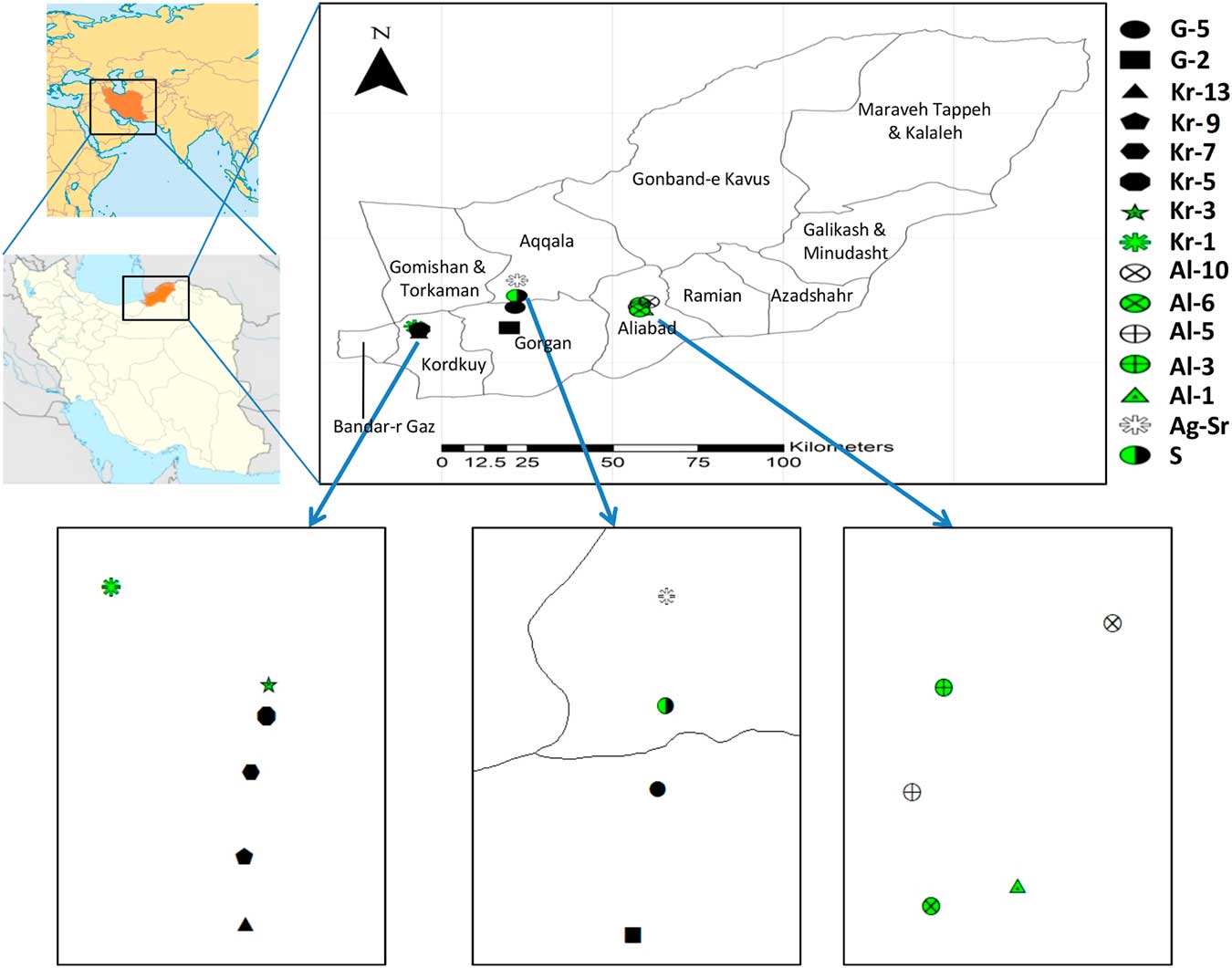
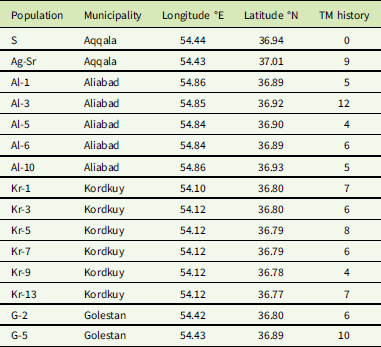
Fourteen S. arvensis populations PR to TM were collected from different winter wheat fields in Golestan province, Iran, during the 2012, 2013, and 2014 spring seasons (Table 1; Figure 1). These fields had been under continuous wheat cropping (monoculture condition) for more than two decades, with a history of TM usage for weed control ranging from 4 to 12 yr. Seeds of one S population with no history of ALS-inhibiting herbicide application were collected in a field from the same area. Seeds of the PR and S populations were collected from 30 to 50 plants that survived to the final TM treatment of 15 g ai ha−1 (recommended field dose). Seeds of each S. arvensis population were stored in paper bags, dried in a stove with forced airflow for 48 h at 40 C, and then were kept at 4 C until use.
Geographical locations in Golestan province, Iran, where the Sinapis arvensis populations putatively resistant to tribenuron-methyl (TM) were collected in different winter wheat fields. The susceptible population (S) was collected in a field from the same area with no history of TM application.

Name (Population), municipality of harvest, geographic coordinates, and tribenuron-methyl usage history (TM history) of the Sinapis arvensis populations collected during 2012, 2013, and 2014 from winter wheat fields in Golestan province, Iran.

Dormancy Breaking, Seed Purification, and Experimental Conditions
Sinapis arvensis seeds were floated in 2,000 ppm gibberellic acid for 24 h and then kept in petri dishes containing moist filter paper for 24 h to break dormancy. Both steps were conducted at 4 C (Hatami et al. Reference Hatami, Gherekhloo, Rojano-Delgado, Osuna, Alcántara, Fernández, Sadeghipour and De Prado2016). Petri dishes with germinated seeds were taken to a growth chamber calibrated for a 26/18 C day/night, 16-h photoperiod at 850 µmol−2 s−1 of light intensity and 60% relative humidity until transplanting. Five seedlings (fully expanded cotyledons) were transplanted into 3-L pots (10 to 15 pots population−1) with a manure–loam–sand mixture (1:2:1 v/v/v) and watered as required until herbicide treatment. Sinapis arvensis plants with 3 to 4 true leaves were used for all experiments.
Seed purification was conducted on the PR populations to eliminate S individuals from the field-collected seeds (S plants were treated as control). Sinapis arvensis plants were treated with 15 g ai ha−1 of TM (Granstar® 50 SX, 50% TM, DuPont Ibérica, Barcelona, Spain), using a Generation III Research Track Sprayer chamber (DeVries Manufacturing, Hollandale, MN, USA) equipped with a 8002EVS flat-fan nozzle (TeeJet® Spraying System Spain, Madrid, Spain) calibrated at 200 kPa to deliver 250 L ha−1 at a height of 50 cm. Surviving individuals of each PR population were grown to maturity, bulked, and allowed to produce seeds. These new seeds were used for the subsequent experiments. They were germinated, and seedlings were transplanted individually into 250-ml pots. The media were the same as those used during the seed purification.
Dose–Response Assays
Sinapis arvensis plants from the PR and S populations were treated with the following TM rates: 0, 3.75, 7.5, 15, 30, 60, 120, 240, and 480 g ha−1. Aboveground biomass from the plants was harvested individually at 4 wk after treatment, dried at 75 C for 48 h, and weighted. Dry weights were expressed as a percentage of the untreated control within each population. A randomized experimental design with 10 replicates per application rate was used, and the experiments were repeated.
Three PR populations (Al-3, G-5, and Ag-Sr), confirmed as being R to TM, were used as representatives for the following experiments, in comparison to the S population. The R populations were selected based on their resistance level to TM (low, moderate, or high), as will be described later.
[14C]TM Absorption and Translocation
Sinapis arvensis plants were treated with an emulsion of [14C]TM (Du Pont de Nemours, Paris, France)+commercial TM. The emulsion applied contained a specific activity of 0.834 kBq µl−1 and a TM concentration of 15 g ha−1 dissolved in distilled water 250 L ha−1 (Hatami et al. Reference Hatami, Gherekhloo, Rojano-Delgado, Osuna, Alcántara, Fernández, Sadeghipour and De Prado2016). A single 1-μl droplet of this emulsion was applied to the adaxial surface of the first or second fully expanded, youngest leaf of each plant. The treated leaf was washed three times with 1 ml of water–acetone (1:1 v/v) to recover the nonabsorbed [14C]TM at 24, 48, 72, and 96 h after treatment (HAT). The washing solution was mixed with 2 ml of scintillation liquid (Ultima Gold®, Packard BioScience BV, Groningen, the Netherlands) and analyzed by liquid scintillation spectrometry (LSS) in a scintillation counter (LS 6500, Beckman Coulter, Fullerton, CA, USA). After being washing at each time point, whole plants were removed from the pot, divided into treated leaf, the remainder of the plant’s shoots and stem, and roots. The latter plant section (i.e., the roots) was carefully washed with distilled water, and excess moisture was removed with paper towel. Plant sections of each plant were stored individually in flexible combustion cones (Packard BioScience BV), dried in a stove at 60 C for 1 wk. and combusted in a biological oxidizer (Packard Tri Carb 307, Packard Instrument, Downers Grove, IL, USA). The CO2 released from the combustion was captured in 18 ml of a mix of Carbo-Sorb E and Permafluor (9:9 v/v) (Packard BioScience BV). The radioactivity of individual sample was quantified by LSS. The experiment had a completely random design with five replications per population for each period evaluated. Percentage of [14C]TM absorbed was expressed as [kBq in combusted tissue/(kBq in combusted tissue+kBq in leaf washes)] × 100.
[14C]TM translocation by Phosphor Imaging
Sinapis arvensis plants were treated and handled at 24, 48, 72, and 96 HAT using the same media as those used for [14C]TM absorption and translocation. However, after the [14C]-TM non-absorbed was removed by washing the treated leaf three times with water–acetone (1:1 v/v), the plant was preserved whole. Roots of these whole plants were carefully washed with distilled water, and excess moisture was removed with paper towel. Plants were fixed on filter paper (25 by 12.5 cm), dried at room temperature for 4 d, and placed on a phosphor storage film for 6 h. The [14C]TM translocation was visualized using a phosphor imager (Cyclone®, PerkinElmer Life and Analytical Sciences, Shelton, CT, USA). Three plants from each S. arvensis population were used at each harvest time.
TM Metabolism
Sinapis arvensis plants were treated (0.834 kBq plant−1) and handled at 96 HAT using the same media as those used for [14C]TM absorption and translocation. TM metabolism was determined according to Cruz-Hipolito et al. (Reference Cruz-Hipolito, Rosario, Ioli, Osuna, Smeda, González-Torralva and De Prado2013). Whole plants were divided into roots and aerial parts and stored at −40 C until extraction. Frozen tissues were ground in a mortar with 3 ml of distilled water:methanol (4:1 v/v). The homogenate residue was washed twice with 3 ml of distilled water:methanol (4:1 v/v), and placed in a AvantiJ-25 centrifuge at 20,000 × g and 4 C for 10 min (Beckman Instruments). Both supernatants were mixed, and the total radioactivity of 100-μl aliquots was quantified by LSS. Mixtures of supernatants were dried at room temperature under a flow rate of liquid nitrogen (0.25 atm). The dry extract was suspended in 200 μl of isopropanol. The [14C]TM and its metabolites were separated by thin-layer chromatography on a 20 by 20 cm silica gel plate (silica gel 60, Merck, Darmstadt, Germany), with isopropanol, ethyl acetate, ammonia, and distilled water (10:6:3:1 v/v/v/v).
The radioactive zones were detected by scanner to obtain radiochromatograms. The radioactivity of each product was quantified with linear analyzer plate equipment (Berthold LB 2821, Wildbald, Germany), while the separate products were determined by comparison with standards (TM, metsulfuron-methyl, metsulfuron-methyl hydroxylated). The experiment was performed with three plants, each with three technical replicates.
ALS Enzyme Activity
Three samples (3 g each) of young foliar tissue from 20 to 30 plants from each S. arvensis population were taken and immediately frozen in liquid N2 until use. ALS enzyme activity was determined according to Hatami et al. (Reference Hatami, Gherekhloo, Rojano-Delgado, Osuna, Alcántara, Fernández, Sadeghipour and De Prado2016). Five chemical classes of ALS-inhibiting herbicides were analyzed to determine possible cross-resistance to herbicides of this group. TM (SU), bispyribac-sodium (PTB), flucarbazone (SCT), flazasulam (TP), and imazamox (IMI) were used as representatives for each chemical class. Increasing concentrations (0, 0.1, 1, 5, 10, 50, 100, and 1,000 µM) of ALS-inhibiting herbicides were used. Absorbance of samples was measured with a spectrophotometer (Beckman DU-640, Beckman Instruments) at 520 nm. The total content of ALS in raw extract was measured at 595 nm with a colorimetric method using the Modified Lowry Kit for Protein Determination (Sigma-Aldrich, Madrid, Spain), following the manufacturer’s instructions. Three technical replicates were assays of young foliar tissue samples.
ALS Gene Sequencing
Leaf sections (≈100 mg) from 12 S. arvensis plants of four populations (Al-3, G-5, Ag-Sr, and S) at the 3– to 4–true leaf stage, were taken and stored at −20 C until use. DNA extraction was conducted using the Speedtools Plant DNA Extraction Kit (Biotools, B&M Labs, Madrid, Spain), following the manufacturer’s instructions. Two pairs of primers—ALS3B: 5′-TCARTACTWAGTGCKACCATC-3′ and ALS3F: 5′-GGRGAAGCCATTCCTCC-3′; and P1: 5′-GAAGCCCTCGARCGTCAAGG-3′ and P2: 5′-ATAGGTTGWTCCCARTTAG-3′ (Cruz-Hipolito et al. Reference Cruz-Hipolito, Rosario, Ioli, Osuna, Smeda, González-Torralva and De Prado2013)—were used to amplify fragments of 501 bp and 639 bp, respectively, of the CAD and BE domains of the ALS gene. DNA amplifications were carried out in a reaction mix containing 10 ng of DNA, 0.2 mM of each sense and antisense primer pair (detailed above for each domain), 200 μM dNTPs, 2 μl of PCR buffer, 1.5 mM MgCl2, and 2.5 U of Taq DNA polymerase (Genet Bio, Nonsan, South Korea) per 20 μl of reaction mix. PCR conditions were detailed by Cruz-Hipolito et al. (Reference Cruz-Hipolito, Rosario, Ioli, Osuna, Smeda, González-Torralva and De Prado2013). PCR products were resolved on 1.5% agarose gels and viewed under UV light. PCR products were purified using the Speedtools PCR Clean-Up Kit (Biotools, B&M Labs). Sanger sequencing was carried out by the Genomic Unit Investigation Central Service of Extremadura University, Spain.
Statistical Analyses
Dose–response and ALS activity data were subjected to a nonlinear regression analysis to estimate the dose/amount of TM needed to reduce the dry weight (GR50) and/or to inhibit ALS activity (I50) of a S. arvensis population by 50%. The analyses were conducted using the ‘drc’ package in the R program, adjusting the data to the following log-logistic model of four parameters (Ritz et al. Reference Ritz, Baty, Streibig and Gerhard2015):
 $$Y{\,\equals\,}c{\plus}\left\{ {\left( {d{\,\minus\,}c} \right)/\left[ {1{\rm }{\plus}{\rm }\left( {x/g} \right)^{b} } \right]} \right\}$$
where c and d are coefficients corresponding to the upper and lower asymptotic limits, respectively, b is the Hill slope, g is the inflection point between the upper and lower asymptote (i.e., GR50 or I50), and x is the independent variable (TM doses). Resistance factors were calculated based on the GR50 or I50 values as: RF=R/S.
The data from the [14C]TM absorption and translocation and [14C]TM metabolism assays were subjected to ANOVA. When required, the LSD test at 5% probability was used to separate means. A statistical analysis was performed using Statistix v. 9.0 software (Analytical Software, Tallahassee, FL, USA).
Results and Discussion
Dose–Response Assays
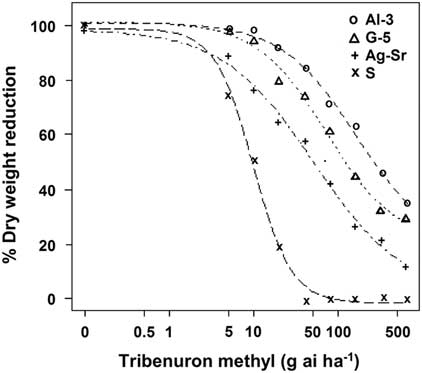
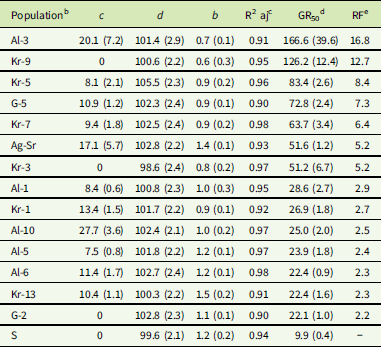
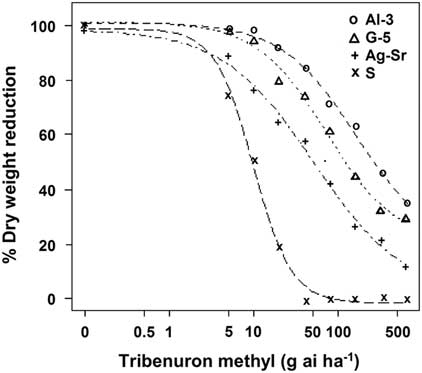
The 14 PR populations were characterized as R to TM. The dose of herbicide needed to reduce the dry weight by 50% (GR50) of the S population was 9.9 g ha−1. Based on this parameter, the R populations were between 2.2 to 16.8 times more resistant to TM than population S. The R populations were grouped as: low, moderate, and high resistance when GR50 values ranged from 15 to 60, 61 to 120, and more than 121 g ha−1 of TM, respectively. One population of each group R (Al-3, Ag-Sr, and G-5) was selected as representative of each to show the dose–response curves compared with the S population (Table 2; Figure 2), and these populations were used for subsequent experiments.
Dose–response curves of tribenuron-methyl (TM)-susceptible and TM-resistant populations of Sinapis arvensis, collected from winter wheat fields in Golestan province, Iran (n=10).
Parameters of the sigmoidal equationFootnote a used to estimate the tribenuron-methyl dose (g ai ha−1) needed to reduce the weight of a population by 50% (GR50) in susceptible and resistant populations of Sinapis arvensis collected from winter wheat fields in Golestan province, Iran.

a Y=c+{(d – c)/[1+(x/g) b ]}, where c and d are the lower and upper limits, respectively, b is Hill slope, g is herbicide dose at the inflection point (i.e., GR50), and x is herbicide dose (independent variable).
b Populations are listed from major to minor GR50 values.
c R2 aj=1−(sum of squares of the regression/corrected total sum of squares).
d RF, resistance factor=GR50R/GR50S.
e SE±standard error of the mean (n=10).
The low TM efficacy on the 14 PR S. arvensis populations confirmed that they evolved resistance to this herbicide, because they presented GR50 values higher than the field dose of TM (15 g ai ha−1). This is worrying, because the herbicide dose required to kill 50% (LD50) of individuals of one R population is usually greater than its GR50 (Burgos 2013). In winter wheat fields of Golestan province, Iran, sterile oat (Avena sterilis L.) (Aghajani et al. Reference Aghajani, Zand, Baghestani and Mirhadi2009) and turnipweed [Rapistrum rugosum (L.) All.] (Hatami et al. Reference Hatami, Gherekhloo, Rojano-Delgado, Osuna, Alcántara, Fernández, Sadeghipour and De Prado2016) were reported as being resistant in 2009 and 2014 to iodosulfuron+mesosulfuron and TM, respectively. Those herbicides belong to the SU class. These results show that farmers continue to exert strong selection pressures on weed communities in the wheat fields of this province through use of herbicides of this chemical group. Satisfactory initial levels of weed control and reasonable price encouraged farmers to use this herbicide over the years. Unfortunately, when weed control failures were observed, the farmers increased the TM doses, rather than applying herbicides with different modes of action (HR Sadeghipour, personal observation), which resulted in the appearance of weeds with different TM resistance levels.
Absorption and Translocation
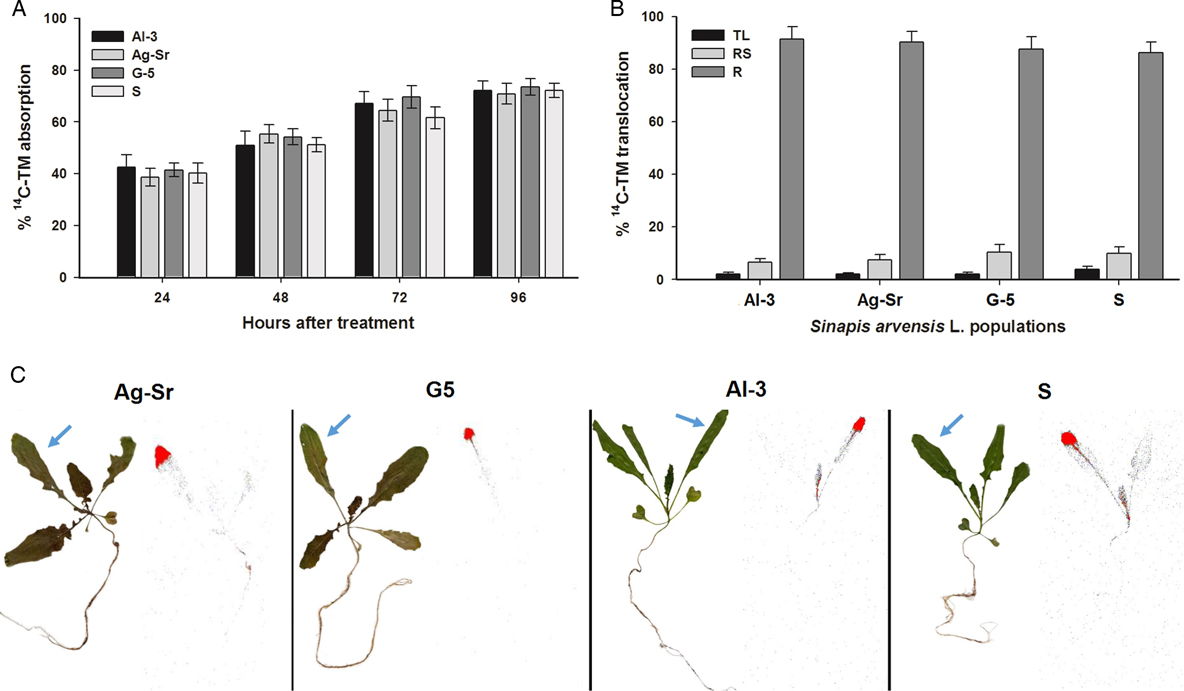
There were no differences in [14C]TM absorption and translocation between the R and S S. arvensis populations. The [14C]TM absorption rate ranged from 39.2% to 42.5% at 24 HAT and from 68.4% to 73.5% at 96 HAT. Most of the herbicide was retained in the treated leaves (86.2% to 91.4%). The [14C]TM translocation from the treated leaf to the rest of the shoots ranged from 6.5% to 10.3%, and less than 4% of the herbicide had moved to the roots over all of the populations at 72 to 96 HAT. The phosphor imaging corroborated these results (Figure 3).
[14C]Tribenuron-methyl (TM) absorption and translocation in susceptible and resistant Sinapis arvensis plants. (A) [14C]TM absorption from 24 to 96 h after treatment (HAT). Vertical bars±standard error (n=5). (B) [14C]TM translocation at 72 HAT. Percentage of herbicide in: R, roots; RS, the remainder of the plant's shoots and stem; TL, treated leaf. Vertical bars±standard error (n=5). (C) Digital images (right) and autoradiograph images (left) of [14C]TM translocation in S. arvensis plants of the TM-susceptible and TM-resistant populations at 72 HAT. The highest concentration of [14C]TM is highlighted in red. Arrows indicate the treated leaves.

The similar absorption and translocation patterns of [14C]TM among the Al-3, Ag-Sr, G-5, and S populations suggested that these mechanisms were not involved in the resistance of these R S. arvensis populations. R and S R. rogusum plants (Hatami et al. Reference Hatami, Gherekhloo, Rojano-Delgado, Osuna, Alcántara, Fernández, Sadeghipour and De Prado2016), a Brassicaceae similar to S. arvensis, and corn poppy (Papaver rhoeas L.) (Rey-Caballero et al. Reference Rey-Caballero, Menéndez, Osuna, Salas and Torra2017), showed similar absorption and translocation patterns of [14C]TM. Reduced absorption and translocation are important resistance mechanisms to other herbicides such as glyphosate (Dominguez-Valenzuela et al. Reference Dominguez-Valenzuela, Gherekhloo, Fernández-Moreno, Cruz-Hipolito, Alcántara-de la Cruz, Sánchez-González and De Prado2017; Shaner Reference Shaner2009); however, they only play a secondary role in the resistance to ALS-inhibiting herbicides compared with target-site insensitivity or metabolic inactivation (Yu and Powles Reference Yu and Powles2014b). Only a few species have presented reduced absorption and/or translocation as resistance mechanisms. For example, downy brome (Bromus tectorum L.) showed reduced absorption of propoxycarbazone-sodium (SCT) (Park et al. Reference Park, Fandrich and Mallory-Smith2004), wild poinsettia (Euphorbia heterophylla L.) of imazethapyr (SU) (Plaza et al. Reference Plaza, Osuna, De Prado and Heredia2006), and kidney bean (Phaseolus vulgaris L.) of imazamox (SU) (Bukun et al. Reference Bukun, Nissen, Shaner and Vassios2012), among other species.
TM Metabolism
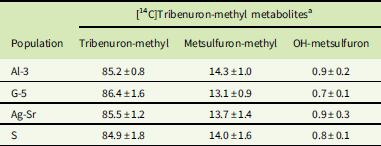
Both S and R S. arvensis plants showed similar metabolic patterns of [14C]TM. Two metabolites (metsulfuron-methyl and OH-metsulfuron methyl) were detected at 72 HAT. The major metabolite found from N-demethylation of [14C]TM was metsulfuron-methyl (13.1% to 14.3%). However, more than 85% of [14C]TM was recovered (Table 3).
Percentage of [14C]tribenuron-methyl metabolites detected by thin-layer chromatography at 96 h after foliar application in susceptible and resistant Sinapis arvensis plants collected from winter wheat fields in Golestan province, Iran.

a ±indicates standard error of the mean (n=3).
Contrary to absorption and translocation, the altered metabolism of herbicides is a non–target site mechanism that may play an important role in resistance to ALS-inhibiting herbicides (Yu and Powles Reference Yu and Powles2014a). However, the non–target site resistance mechanisms of absorption, translocation, and/or metabolism of [14C]TM were not responsible for the resistance of the R populations Al-3, Ag-Sr, and G-5 of S. arvensis collected from winter wheat fields in Golestan province, Iran.
ALS Enzyme Activity
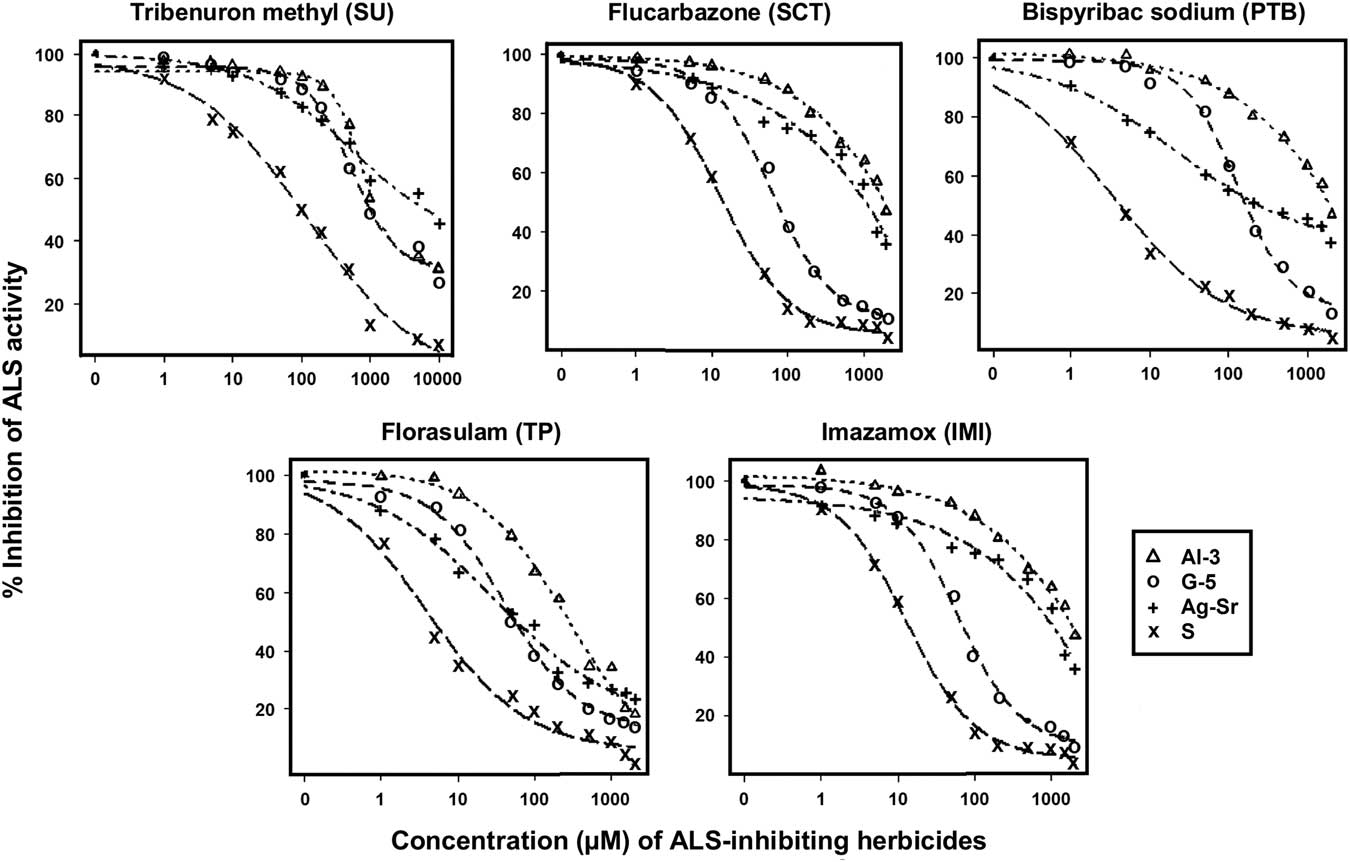
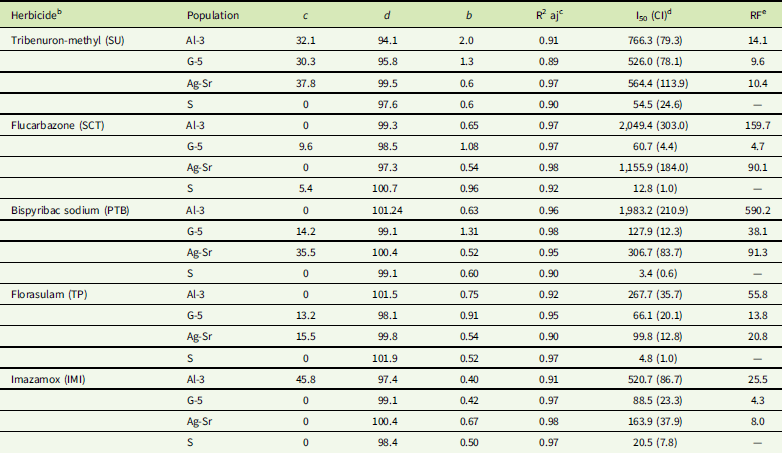
The specific ALS activity showed no differences between R and S S. arvensis plants, with values from 514 to 532 µmol acetoin mg−1 protein min−1 being recorded. The concentrations of the ALS-inhibiting herbicides needed to reduce the ALS activity by 50% (I50) were greater in the R populations (Al-3, G-5, and Ag-Sr) in comparison to the S population (Table 4). R population G-5 was not resistant to SCT inhibitors, considering the large amounts of flucarbazone needed to inhibit ALS enzyme in the Al-3 and Ag-Sr populations. In addition, the G-5 and Ag-Sr populations presented moderate resistance to IMI, with I50 values of 88.5 and 163.9 µM of imazamox, being 4.3 and 8.0 times more resistant, respectively, than the S population. The Al-3 population was the only one that presented a defined pattern of cross-resistance to the five classes of ALS-inhibiting herbicides, showing the following ranking of susceptibility based on its I50 values: imazamox (IMI)<TM (SU)<florasulam (TP)<flucarbazone (SCT)<bispyribac-sodium (PTB) (Figure 4; Table 4).
Log-logistic curves of the acetolactate synthase (ALS) activity in tribenuron-methyl (TM)-susceptible and TM-resistant populations of Sinapis arvensis (n=3). Chemical classes of ALS-inhibiting herbicides: sulfonylureas (SU), imidazolinones (IMI), triazolopyrimidines (TP), pyrimidinylthiobenzoates (PTB), and sulfonylamino-carbonyl-triazolinones (SCT).

Parameters of the sigmoidal equationFootnote a used to estimate the concentration (µM) of ALS-inhibiting herbicides needed to inhibit ALS activity by 50% (I50) in tribenuron-methyl (TM)-susceptible and TM-resistant of Sinapis arvensis populations collected from winter wheat fields in Golestan province, Iran.

a Y=c+{(d−c)/[1+(x/g) b ]}, where c and d are the lower and upper limits, respectively, b is Hill slope, g is herbicide concentration at the inflection point (i.e., I50), and x is herbicide concentration (independent variable).
b ALS chemical classes: sulfonylureas (SU), imidazolinones (IMI), triazolopyrimidines (TP), pyrimidinylthiobenzoates (PTB) and sulfonylamino-carbonyl-triazolinones (SCT).
c R2 aj=1−(sum of squares of the regression/corrected total sum of squares).
d CI values are the 95% confidence intervals (n=3).
e RF, resistance factor=I50R / I50S.
The similar basal ALS activities in the absence of TM between R and S S. arvensis populations were consistent with several studies, because although there may be several ALS genes (Iwakami et al. Reference Iwakami, Shimono, Manabe, Endo, Shibaike, Uchino and Tominaga2017), their expression and transcription to ALS isozymes is very stable, and they have even been used as reference genes to study the expression of other genes such as EPSPS (Gaines et al. Reference Gaines, Zhang, Wang, Bukun, Chisholm, Shaner, Nissen, Patzoldt, Tranel, Culpepper, Grey, Webster, Vencill, Sammons, Jiang, Preston, Leach and Westra2010). Differences in basal ALS activity have occasionally been observed between R and S plants of water starwort [Myosoton aquaticum (L.) Moench] (Liu et al. Reference Liu, Bai, Jia, Guo, Zhang, Li and Wang2017). The different cross-resistance patterns observed between the Al-3, Ag-Sr, and G-5 populations indicated that the target site was involved in resistance to TM and other ALS-inhibiting herbicides. These results suggest that cross-resistance has not been fully established in the winter wheat fields of Golestan, except in the field where the Al-3 population was collected. However, it is difficult to establish clear patterns of cross-resistance to ALS-inhibiting herbicides among these populations, as the differences can be due to the presence of heterozygous individuals within the R S. arvensis populations (Warwick et al. Reference Warwick, Beckie and Thomas2000), as will be described later. Therefore, measures must be taken to delay the selection and establishment for cross-resistance to these herbicides in Golestan province. Similar cross-resistance patterns based on ALS activity were reported in several species (Hatami et al. Reference Hatami, Gherekhloo, Rojano-Delgado, Osuna, Alcántara, Fernández, Sadeghipour and De Prado2016; Liu et al. Reference Liu, Yuan, Du, Guo, Li, Bi and Wang2015; Ntoanidou et al. Reference Ntoanidou, Madesis, Diamantidis and Eleftherohorinos2017).
ALS Gene Sequencing
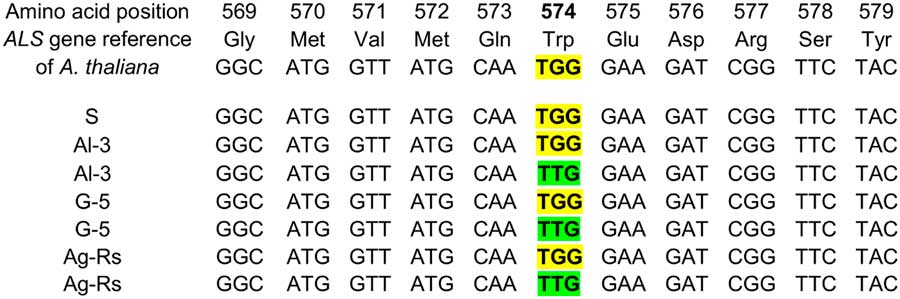
Highly conserved ALS gene regions, covering potential mutation sites previously shown to confer resistance to ALS inhibitors, were amplified in R and S S. arvensis populations. The ALS gene sequences of the S population showed a high homology compared with the ALS gene of Arabidopsis thaliana, based on their predicted proteins. Mutations were not found in the A-C-D and E domains of the ALS gene, but an amino acid substitution at the 574 position was identified in domain B of the ALS gene from R populations. The codon change consisted from TGG (tryptophan=Trp) to TTG (leucine=Leu). From each R population, two consensuses of the ALS gene were obtained, because not all sequenced individuals had this mutation. Only 10, 7, and 5 individuals (from 12) of the Al-3, G-5, and Ag-Rs populations, respectively, presented the Trp-574-Leu mutation (Figure 5).
Nucleotide sequence of the acetolactate synthase (ALS) gene from tribenuron-methyl (TM)-susceptible and TM-resistant Sinapis arvensis plants collected from winter wheat fields in Golestan province, Iran. The boxed codons indicate a change at the 574 position from TGG (tryptophan=Trp) to TTG (leucine=Leu), associated with conferring cross-resistance to ALS-inhibiting herbicides. Numbering of amino acids is based on the ALS gene sequence alignment of Arabidopsis thaliana.

The Trp-574 amino acid position is highly conserved in all known ALS sequences (Tranel et al. Reference Tranel, Wright and Heap2017); however, its mutation to Leu in the ALS gene of the R S. arvensis populations resulted in the cross-resistance to the ALS-inhibiting herbicides. In addition, the Trp-574-Leu mutation does not represent fitness cost on the normal plant growth system (McCourt et al. Reference McCourt, Pang, King-Scott, Guddat and Duggleby2006). That the Trp-574-Leu mutation leads to resistance to ALS-inhibiting herbicides has been well established (Yu and Powles Reference Yu and Powles2014b), with enhanced resistance in ALS activity (10- to 10,000-fold) displayed (McCourt et al. Reference McCourt, Pang, King-Scott, Guddat and Duggleby2006). This mutation has been reported in R S. arvensis populations from Canada (Warwick et al. Reference Warwick, Sauder and Beckie2005), the United States (Christoffers et al. Reference Christoffers, Nandula, Howatt and Wehking2006), and recently from Greece (Ntoanidou et al. Reference Ntoanidou, Madesis, Diamantidis and Eleftherohorinos2017). In all cases, cross-resistance to ALS-inhibiting herbicides with a resistance factor 10 times greater was observed. Therefore, it can be concluded that the Trp-574-Leu mutation was responsible for resistance to TM and other ALS-inhibiting herbicides in the R populations Al-3, Ag-Sr, and G-5 of S. arvensis from the winter wheat fields of Golestan province.
That the Trp-574-Leu mutation was not found in all sequenced R plants suggested the presence of heterozygous individuals within the R S. arvensis populations. This heterozygosity could be attributed to the self-incompatibility of S. arvensis (Warwick et al. Reference Warwick, Beckie and Thomas2000). In addition, resistant ALS gene alleles, which participate in resistance to ALS-inhibiting herbicides, are partially dominant (Yu and Powles Reference Yu and Powles2014b). Therefore, different resistance levels observed in the R S. arvensis populations could be mainly attributed to varying frequencies of homozygous and heterozygous individuals within populations (Ntoanidou et al. Reference Ntoanidou, Madesis, Diamantidis and Eleftherohorinos2017). Similar results were reported in S. arvensis from Greece resistant to TM and imazamox that presented a mutation at the Trp-574 position to Leu or Ser (Ntoanidou et al. Reference Ntoanidou, Madesis, Diamantidis and Eleftherohorinos2017). Variations in resistance levels have been observed more frequently in cases of cross-resistance to ALS-inhibiting herbicides associated with the conserved position Pro-197 (Liu et al. 2015, Reference Liu, Bai, Jia, Guo, Zhang, Li and Wang2017; Ntoanidou et al. Reference Ntoanidou, Kaloumenos, Diamantidis, Madesis and Eleftherohorinos2016). Flixweed [Descurainia sophia (L.) Webb ex Prantl] populations with Pro-197-Thr+Trp-574-Leu mutations in the ALS gene also showed different resistance levels to TM (Li et al. Reference Li, Barclay, Jose, Stefanova and Appels2008).
The R S. arvensis populations for which resistance mechanisms were not characterized may present non–target site mechanisms or other mutations that confer resistance to only some chemical classes of ALS-inhibiting herbicides. However, our results suggest that they have great potential to develop cross-resistance to all ALS chemical classes. In addition, seeds of R weed populations could be easily dispersed (Alcántara-de la Cruz et al. Reference Alcántara-de la Cruz, Romano, Osuna-Ruíz, Domínguez-Valenzuela, Menéndez and Rafael De2016), and it has been demonstrated that S. arvensis seeds are dispersed by combine to other winter wheat fields during harvesting (Warwick et al. Reference Warwick, Beckie and Thomas2000). Alternative herbicides with different mechanisms of action that are available on the Iranian market should be used for weed control in winter wheat fields in Golestan, such as synthetic auxins (2-4-D, MCPA, dichlorprop-p, mecoprop-p, dicamba), photosystem II inhibitors (bromoxynil, isoproturon, diflufenican), and/or herbicide mixtures (2-4-D+MCPA, dichlorprop-p+MCPA+mecoprop-p, 2-4-D+dicamba, isoproturon+diflufenican, bromoxynil+MCPA). Sinapis arvensis collected from Fars, Golestan, and Khuzestan showed no resistance to these herbicides (Gherekhloo et al. Reference Gherekhloo, Oveisi, Zand and De Prado2016). In addition, based on the climate and characteristics of the region, canola (Brassica napus L.) could also be used for crop rotation purposes with wheat, using selective herbicides never used in wheat (Hatami et al. Reference Hatami, Gherekhloo, Rojano-Delgado, Osuna, Alcántara, Fernández, Sadeghipour and De Prado2016), such as haloxyfop-p methyl+clopyralid (Miri and Rahimi Reference Miri and Rahimi2009), trifluralin+haloxyfop-p methyl+isoxaben (Bijanzadeh et al. Reference Bijanzadeh, Ghadiri and Behpouri2010), and propaquizafop (Valaie et al. Reference Valaie, Kazemeini and Hamzehzarghani2012), to reduce the spread and seedbank level of resistant S. arvensis.
The Trp-574-Leu mutation in the ALS gene was the responsible for resistance to TM and other ALS-inhibiting herbicides in S. arvensis collected from winter wheat fields in Golestan, Iran. This is the first TM-resistance case confirmed in this species in Iran. Alternative herbicides to ALS inhibitors must be used to control weeds, as well as other management strategies such as crop rotation, to delay/stop the evolution and spread of cross-resistance of S. arvensis.
Acknowledgments
The authors declare no competing financial interests. This work was funded by the AGL2016-78944-R (MICINN-Spain) project. The authors are grateful to Rafael A. Roldán-Gómez for technical assistance and Antonia Rojano-Delgado and Maria D. Osuna for their insightful and important comments. Phillip Villani (University of Melbourne) revised and corrected the English language used in this article.