Rationale
Children who are experiencing family violence often have minimal opportunities to participate in research, talk about their experiences and to be heard within the context of their families’ crisis. The lack of involvement of children in research has been critiqued in the literature. As discussed by Alderson (Reference Alderson2007), when adults participate in research, they are assumed to be competent contributors unless circumstances are otherwise. On the other hand, children are often assumed incompetent or excluded completely from research due to the possible risks associated with their involvement. While it is undeniably important for children's participation in research to be safe, ethical, respectful and child-centred, this does not mean that they should not be given the same opportunities and rights to have their voices heard, understood and responded to. Lundy McEvoy and Byrne (Reference Lundy, McEvoy and Byrne2011) have argued that under the United Nation Conventions of the Rights of the Child, it should not be the child's responsibility to ‘prove’ that their contributions are valid. Instead, what is needed is an understanding of what it means to contribute capably to research and to adapt research methodologies, so that they offer appropriately creative and child-centred conditions that enable children to express their views in a way that is meaningful to them.
The authors are music therapists and researchers with a commitment to collaborative, creative and participatory approaches with children and young people within fields of child welfare, education and mental health. The first author completed her doctoral research within a community organisation that supports children and families experiencing family violence, and the second author supervised this doctoral research and has been involved in extensive research exploring young people's healthy and unhealthy uses of music in their everyday lives. Throughout our experiences of collaborating with children and young people in these contexts, we have witnessed the potential for music to provide creative opportunities for children's voices to be heard. This article will share our experiences of using a collaborative songwriting research method with children in the family violence system to understand their resources from the perspective of children themselves.
Music therapy is a professional form of practice that was established in the 1950s. Music therapy typically involves supporting people to achieve non-musical goals such as increasing self-esteem, promoting emotional development and encouraging the acquisition of communication and social skills (Bruscia, Reference Bruscia2014). These goals may be achieved through music therapy methods such as songwriting, music listening, playing instruments, musical improvisation and spontaneous music making, music relaxation and guided imagery to music. Contemporary approaches to music therapy support the use of participatory, collaborative and strengths-based approaches, with an inherent focus on privileging and strengthening the existing resources that participants bring to therapy (Rolvsjord, Reference Rolvsjord2010; Stige & Aarø, Reference Stige and Aarø2012; Stige, Ansdell, Elefant, & Pavlicevic, Reference Stige, Ansdell, Elefant and Pavlicevic2010). Many children identify music as an important resource in their everyday lives, and children experiencing family violence have discussed how music offers an escape from the outside world while instilling a sense of hope for the future (Fairchild & McFerran, Reference Fairchild and McFerran2018). Researchers within the child welfare field have explored how music supports children to tell their stories, represent their identity, develop healthy coping strategies and to express their difficult emotions (Krüger & Stige, Reference Krüger and Stige2014; Zanders, Reference Zanders2012). Since music is already a central resource in children's lives, we consider that music has the capacity to be a meaningful, safe and collaborative medium for engaging children in participatory research methods.
Songwriting is a method that many music therapists use in their everyday practice and in research as a way of helping people to tell their stories and to talk about their own experiences. Songwriting creates the conditions for people to develop, discover or reinforce a sense of self and personal identity (Baker & MacDonald, Reference Baker and MacDonald2013), and to describe life narratives and reflect on what is important to them (MacDonald & Viega, Reference MacDonald, Viega, Hadley and Yancy2012). Within music therapy, a sense of achievement, pride and satisfaction is often observed through the process of writing a song and creating something meaningful to the participant (Baker, Reference Baker2015). Therefore, songwriting as a collaborative research method in this project was adopting to provide similar opportunities for children to express themselves and to represent what is important to them.
The participatory approach that we describe draws upon the understanding that children are the experts in their own lives, therefore they should have the right to contribute meaningfully and to be regarded as equals within the research process (Christensen & James, Reference Christensen and James2008). Stige and McFerran (Reference Stige and McFerran2016) have described participatory research as an opportunity for previously unheard voices to be heard, while simultaneously addressing the inequalities that exist in our society. The participant take on the role of co-researchers, while the researcher adopts the crucial role of facilitating the dialogue and providing a space for their voices to be heard and understood. Bolger (Reference Bolger2015) adopted a participatory approach to her music therapy research with young people experiencing marginalisation and sought to understand the process of collaboration. Her research demonstrated how collaboration with young people provided opportunities to achieve positive growth through increasing self-worth and offering opportunities for empowerment of the participants, researchers and the wider community. The participatory approach in this article sought to amplify the voices of children and to co-construct knowledge together in order to shed light on the resources and capacities of children in this context.
The literature regarding research with children in the context of family violence often focuses on the potential dangers and risks of their involvement; however, Överlien (Reference Överlien2010) has suggested that equal emphasis needs to be placed on the significance and opportunities that arise from children's collaborative inputs. Similarly, Morris, Hegarty and Humphreys (Reference Morris, Hegarty and Humphreys2012) have explored how research with children who have systematically been unheard within the context of their families’ experience may lead to positive outcomes in children's lives as well as more broadly in the wider community. While ethical challenges may be prevalent in the context of research with children, this challenge presents opportunities to consider innovative, creative and safe research methods for collaborating with children. Participatory approaches have the potential to capture children's views in child-centred ways using a range of different methods such as drama, stories, music and visual art (Pinter & Zandian, Reference Pinter and Zandian2015). As suggested by Lundy and colleagues (Reference Lundy, McEvoy and Byrne2011), these collaborative approaches offer creative ways of knowing and provide a space for children to contribute in a way that is meaningful and relevant to them.
As we have previously identified in a critical review of the literature, there has been a vast amount of research focusing on the myriad of challenges faced by children throughout their experiences of family violence (Fairchild, McFerran, & Thompson, Reference Fairchild, McFerran and Thompson2017). Through a critical analysis of 17 articles that described programmes for children in this context, we noted that children were often portrayed through the lens of risk, by using language such as ‘ongoing crisis’, ‘fear’ and ‘problems’ (Malchiodi, Reference Malchiodi and Malchiodi2008; Mudaly, Graham, & Lewis, Reference Mudaly, Graham and Lewis2014). Children were also described as having ‘symptoms’ such as ‘anxiety’, ‘depression’, ‘problems at school’ and displaying ‘oppositional behaviour’ (Madan, Reference Madan and Brooke2008; Tutty & Wager, Reference Tutty and Wager1994). On the other hand, only one author included in the review acknowledged that ‘some children may be resilient’ in the face of adversity (Malchiodi, Reference Malchiodi and Malchiodi2008). While previous research in this area has demonstrated the need for additional services and support for children in this context, we believe that the dominant narrative focusing on difficulties only represents one part of children's experiences.
The research exploring children's experiences of family violence has been integral for building our knowledge and evidence base about the possible risks for children living in these situations, and trauma-informed practice has been described as an important framework for professionals working in this field (Evans & Coccoma, Reference Evans and Coccoma2014; Hopper, Bassuk, & Olivet, Reference Hopper, Bassuk and Olivet2010). Överlien (Reference Överlien2016) has similarly critiqued the predominant descriptions of children as victims or bystanders in the face of family violence because this assumption fails to acknowledge children's own resistance to violence. In order to balance the representation of children as victims in this context, the present article aims to explore the range of resources that children describe drawing upon throughout their experiences of family violence, and to highlight the value of collaborating with children and giving them voice through participatory processes.
Methods
Participatory Design
Arts-based research
Recent advances in research with children and young people have highlighted the need for innovative, creative and adapted approaches that emphasise children's capacities and competencies. The use of songwriting as a collaborative research method is informed by principles of arts-based research. Viega and Forinash (Reference Viega, Forinash, Wheeler and Murphy2016) have defined arts-based research as an umbrella term that encompasses art as a primary method in the research process as well as an overall methodology. Leavy (Reference Leavy2015) has described arts-based research as a process that usually leads to an artistic representation of the research findings, and Piercy and Benson (Reference Piercy and Benson2005) portrayed this process as bringing research findings ‘to life’. Beer (Reference Beer2016) recommended songwriting for or with research participants as one possible approach to arts-based research. In this research, the songs co-created with the children represent the essence of the research findings.
The children and the first author were collaborators in the development of the songs that explored children's resources in the context of family violence. Barone and Eisner (Reference Barone and Eisner2012) have articulated how arts-based research extends the capacity of research as it provides a way of expressing meaning and knowledge through creative means. While arts-based research has the capacity to provide a deeper level of knowing, Barone and Eisner (Reference Barone and Eisner2012) have stressed that it does not aim to provide concrete truths. Instead, in their view, arts-based research seeks to understand often complex and critical perspectives by creating arts-based representations and shedding a new light on hidden and previously unspoken concepts. The songs written by the children in this research represent the subjective and diverse elements of their experiences, while enhancing our understandings about the internal and external resources that help them in their lives.
Participatory approach to the research
Participatory approaches with children seek to provide opportunities for children to speak openly and freely about their experiences. Clark and Richards (Reference Clark and Richards2017) have advocated for greater attention to be given to the notions of collaboration and reciprocity within participatory research, with equal weight given to the children's and the researcher's contributions. Similarly, Kraftl (Reference Kraftl2013) recommends an expansion on the concept of voice within research, indicating that researchers need to embrace the co-construction of voice in order to emphasise the shared responsibility in research in stimulating, interpreting, understanding and representing people's ideas. Therefore, the inclusion of the collaborative songwriting approach was intended to provide a mutual space to co-construct knowledge together while ensuring that the children's views and voices were being represented in the ways that they wanted them to be.
Setting
This project took place within a community organisation where the first author worked as a music therapy group facilitator with children and families experiencing family violence. The organisation is based in regional Victoria, Australia, and offers a range of supports for children and families experiencing adversities such as family violence, homelessness, family separation, problem gambling and poverty. Ethics approval was obtained through The University of Melbourne (Ethics ID: 1544921) as well as approval from the Department of Health and Human Services due to the engagement of children within this setting.
Recruitment
The children were invited to participate in this research following their participation in a music therapy group with the first author. Therefore, the inclusion criterion was that the children had experienced family violence, which was the reason they were initially referred to the music therapy group. The use of songwriting as a research method sought to provide a creative way for children to explore their resources, as opposed to a typical interview involving questions and answers which may have lacked personal meaning for the children. As recommended by Grieg and colleagues (Reference Greig, Taylor and MacKay2012), we took the utmost care to ensure that children understood the purpose of the research and what would be expected of them during the interviews. Throughout the recruitment and research process, children were reminded that their participation was voluntary and that they were the experts in their own lives so there were no right or wrong answers. As the first author had previously worked with the children in a music therapy group, she felt that the initial rapport they had developed and their existing interests in music contributed to their willingness to participate in the project. Nevertheless, it was important to establish a sense of safety and to create an open and collaborative space to co-construct knowledge together.
Representing the co-researchers
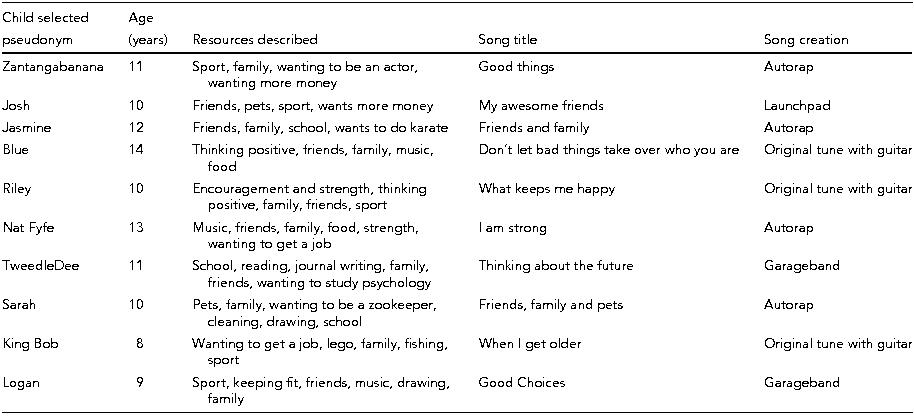
There were 10 children who chose to be co-researchers in this project and table above illustrates their contributions through exploring their resources and writing their own song (Table 1). As we have outlined in a critical review of the homelessness and family violence literature (Fairchild, McFerran, & Thompson, Reference Fairchild, McFerran and Thompson2017), there is a need to consider the ways that children are represented throughout the entire research process so that we do not further stigmatise those who have already experienced marginalisation. This table demonstrates an alternative to the often problem-focused representation of children in the family violence context, by purposefully thinking about what was important to include (and not include) to respectfully represent the co-researchers. Therefore, as we adopted a resource-oriented approach within the research as well as in our everyday music therapy practices with young people, we felt that it was important to represent the children in a way that was congruent with this. The first column includes the child-selected pseudonyms that children chose to represent them in this project. The children's favourite fictional characters, friends, colours or sporting heroes often inspired the names that they chose to use as pseudonyms. The second column represents the children's ages, which we felt was important to showcase the diverse ages of the participants. The third column has intentionally been represented as the largest column, to show how the resources that the children identified were integral to this whole research project. The fourth column communicates the song title each child chose, which was often the main message of their song. The final column shows the various musical methods that children decided to use to create the melody and accompaniment for the song, which included Garageband, Launchpad, Autorap, or an original song accompanied by the first author on the guitar.
Co-researchers.

Collaborative Songwriting Process
Influenced by earlier experiences of songwriting with children in our work as music therapists, we have developed a collaborative songwriting research method that actively involves children throughout the research process. This collaborative approach to research mirrors the typical songwriting process in music therapy practice, which involves brainstorming on a theme, choosing the main ideas, developing song lyrics, creating melodies, beats and harmonies and ultimately recording or performing the song (McFerran, Reference McFerran2004). What separates the practice approach to the research approach is a focus on co-constructing knowledge with children for research purposes in response to the guiding question of ‘what helps you to do well in your life?’ Within the collaborative research process, brainstorming becomes a form of data generation, choosing the main ideas and developing the song lyrics involves collaborative analysis, and creating the melody and recording the song involves the presentation of the findings (see Figure 1). The songs were written in a single session with each child, which lasted between 50–120 minutes. The following section describes the collaborative songwriting process and includes an example of one young person's participation to bring life to the method.
The young person identified as Blue (child-selected pseudonym) and was 14 years old. Blue had a long history of involvement in the homelessness and family violence service system with her mother and her younger siblings. Blue was an articulate young person who was proud to talk about her achievements since participating in the music therapy group, including becoming school captain at her school and writing songs with her friend. Blue said she was looking forward to writing her song as part of the collaborative process. Blue also identified some challenges that were happening in her life, including her violent stepfather re-entering her family's life due to being released from prison and described recent family violence incidents in her home. Blue portrayed these incidents in a matter-of-fact tone and did not report feeling unsafe, however expressed a sense of frustration that her stepfather had re-entered their lives after they were starting to feel settled. Throughout the interview, Blue took ownership over the process and chose to write down all of the ideas herself.
Collaborative songwriting process.

Brainstorming on the Research Question (Data Generation)
The brainstorming phase involved writing down all of the child's ideas on a large piece of paper. Children were asked to share any ideas, words, feelings or thoughts about the theme in response to questions such as ‘What helps you to do well in your life? What are some things that you like to do? What helps you to cope? Who do you go to for support? What are some good things in your life? What else would help you to do well?’ Some children chose to write down their own ideas, and others preferred for their ideas to be written for them while they talked. The ideas were then grouped together under headings in consultation with the child. The exact phrasing and wordings reflected the child's own language as much as possible. The brainstorming phase generally lasted about 20–30 minutes for each child and the act of having their ideas written down in front of them seemed to make it an engaging and fun activity. The children knew that the purpose of the brainstorming was to generate material for their song and they appeared to enjoy talking about their own experiences. Nonetheless, some children required several prompts and encouragement that supported them to expand on their ideas and express what they wanted to say. This was congruent with our experiences of songwriting in practice, where some children have a larger repertoire of words to describe their experiences, and others have very little language. This is part of the reason that an arts-based approach is so relevant in the family violence sector, because it provides a bridge between experience and expression:
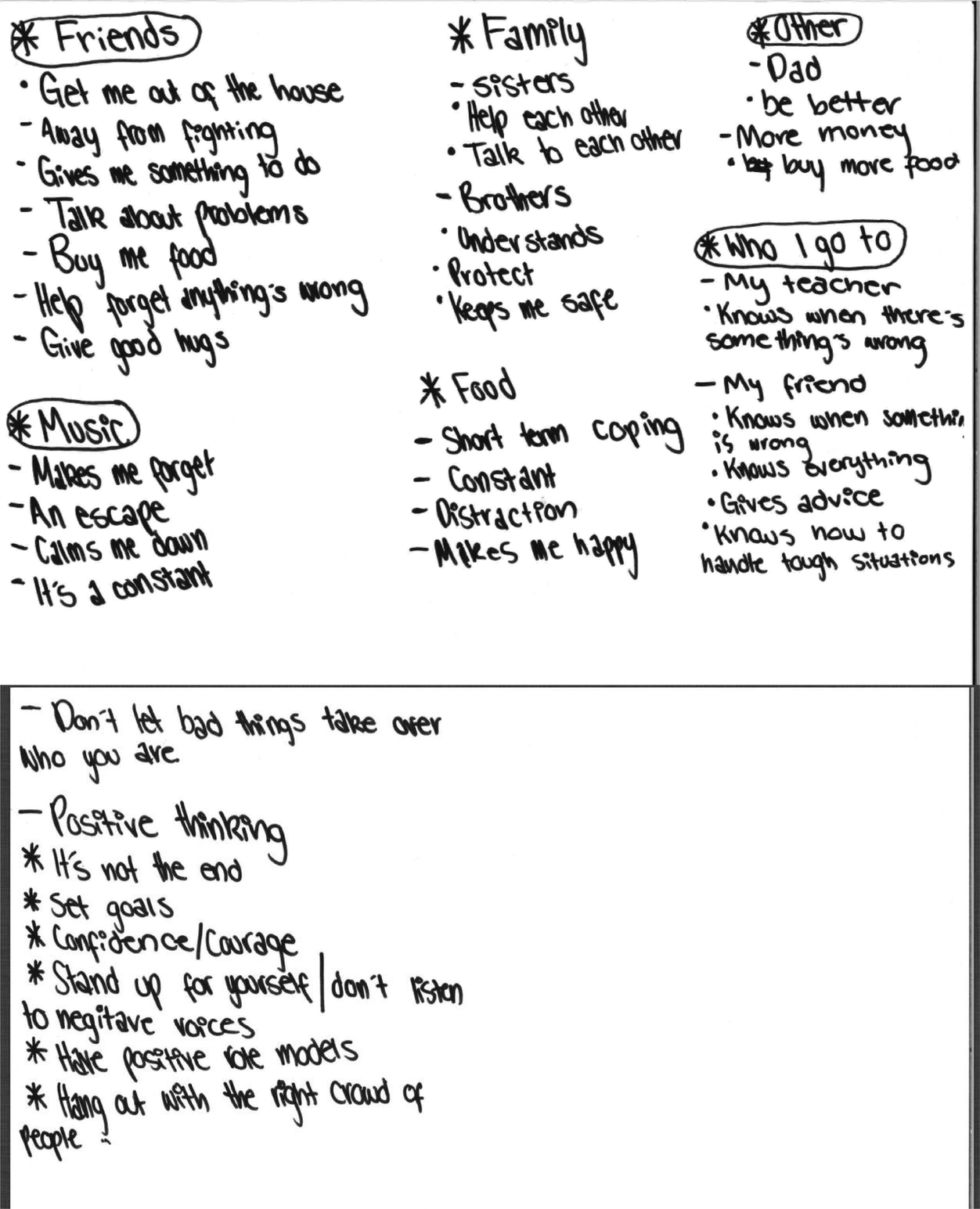
In the brainstorming phase, Blue talked about the people who helped her in her life and identified her friends as a resource because they ‘get me out of the house’ when her mother and ex-partner are fighting. She said that she can talk to her friends about her problems and that they ‘help forget anything's wrong’, ‘give good hugs’ and ‘give me something to do’. Blue identified her family as a resource and that they help her, but that they also ‘help each other’. Blue talked about how listening to music was the main activity that she could think of that she liked to do, and that music ‘makes me forget’ and is ‘an escape’ from the outside world. She discussed how music ‘calms me down’ and labelled music as a ‘constant’ because it has always been there for her. When exploring what else would help her to do well in her life, Blue talked about how she wished she had a better dad. She talked about how she wished her biological dad, who she had minimal contact with, was ‘better’, so that she had somewhere to go when her mum and step-dad were fighting or when she felt like she needed to get away. The ideas generated through the brainstorming phase can be found in Figure 2.
Blue's brainstorming.

Choosing the main ideas (collaborative analysis)
After they had exhausted the expression of ideas, the children were asked to look at all of their words and to think about what they would like the main message of their song to be. This is a critical juncture in songwriting, both as practice and as research, since the decision informs what the key message will be. For this reason, the role of the researcher is critical in fostering reflection, aiding selection and ensuring that our ideas and preconceptions about what will be most powerful and interesting are not too strongly conveyed. At this point, some children came up with other ideas that became the main message of their song. This main message usually became the chorus and was often chosen as the title of the song. The children then chose the other main ideas that they wanted to include in the remainder of the song and these usually became the verses. These main ideas were circled and given a heading to describe what the verse was about and these ideas were then expanded upon if needed. In this way, children were engaged throughout the interpretation and analysis by deciding together with the researcher what main ideas they wanted to include in the song and through the development of the themes that described what they wanted to talk about in their song:
After Blue had written down most of her ideas, the first author asked her how she thought she was able to be so resilient and successful despite what she had experienced. Through this discussion she decided to make the main idea for her song ‘Don't let bad things take over who you are’. She described how ‘positive thinking’ was really important to her and that she knew ‘it's not the end’. Blue thought that it was helpful to have ‘confidence’ and ‘courage’ and to ‘stand up for yourself’. Blue talked about not wanting people to think there was a stigma on her because she had experienced family violence, and she wanted to prove to everyone that she was more than the label placed upon her. The main ideas that Blue chose to include in her song were circled and were given the following headings: The way friends are, people who help, what I want and music is a constant.
Co-creating the song lyrics (collaborative analysis)
Once we had decided on the main ideas and the main message of the song, we worked together to co-create the song lyrics. Working together is a key phrase in this research project, since it points to a shared responsibility rather than being exclusively expert led or child led. Bolger's research (Reference Bolger2015) shows that collaboration involves a combined effort on the part of therapist and the child, warning against the inclination to ‘buy out’ of responsibility in order to hear the child's voice. Therefore, co-creating the song lyrics was a creative and collaborative process, and the researcher and the child shared ideas for lyrics with one another. Some children were confident in this task and needed little input to create their song lyrics, while other children needed much more guidance and direction. The child's original wording was included in the song lyrics as much as possible. However, sometimes due to aesthetic reasons, such as the child wanting the song to rhyme, it was necessary to change the wording slightly when creating the song lyrics. It was interesting at this point to note what children chose to include in their songs, as well as what they purposefully chose to exclude:
Blue was hesitant in the beginning to come up with ideas for song lyrics, stating that it was ‘harder than (she) thought’. However, after some modelling from the first author about how to incorporate her ideas from the brainstorming into the song lyrics, she became more confident to make suggestions for the song lyrics and to put her ideas together. The wording that Blue used in the brainstorming phase was reflected as much as possible in her final song lyrics, however at times she chose to adapt this wording so it would better fit into the phrasing of the song. Blue's song lyrics can be found in Figure 3.
Blue's song lyrics.

Co-creating the style and melody (presentation of the findings)
After we had developed the song lyrics we worked together to decide on the musical aspects of the song. Some children already had a preconceived idea about how they wanted their song to sound, and other children wanted to try out several options before making a decision. The children had the option of using Ipad apps such as Autorap, Garageband and Launchpad, or to create an original melody with the researcher accompanying them on the guitar. As music therapists, our role is to foster creative expression by people who do not have musical skills. Therefore, the first author's training as a music therapist was crucial at this point, to ensure that the child's musical influences and interests were reflected in their final song:
When talking about the style of the song, Blue said she didn't really have any idea for how she wanted the song to sound other than ‘slow-ish. . . but not super slow and depressing’. Blue chose to create an original song with the guitar by saying ‘I like guitar’ and worked together with the first author to develop a style, chord progression and melody for the song. This was a collaborative process, with the first author providing several musical options at each point and Blue having the opportunity to choose from these or to offer other suggestions for how she would like her song to sound.
Recording the song (presentation of the findings)
The children's voices were captured on the recordings as much as possible; however, some children required support to sing their song. The children received a copy of the recording either immediately after the interview, or a few days later in person or by post. Children were encouraged to consider if they were planning to share their song with anyone and most of the children thought they would share their song with their family members:
After practicing the song several times, Blue and the first author recorded the song together, they both sang the vocals and the first author played the guitar. Blue reported that she was proud of herself for writing the song and that she found the process ‘a lot easier than what [she] thought it would be’. At the end of the interview, Blue stated ‘I usually listen to music, not make it. But now I make it!’ and she indicated that she had more confidence to write songs in the future. The recording of Blue's song can be found at https://soundcloud.com/anon-662958196/dont-let-bad-things-take-over-who-you-are-blue/s-xOa3y
Results and Discussion
Hearing children's perspectives and fostering their voices through participatory methods was an integral part of this project. However, it is equally important to consider the appropriate responses that are needed to address these new understandings. Within the resilience discourse, Hart and colleagues (Reference Hart, Gagnon, Eryigit-Madzwamuse, Cameron, Aranda, Rathbone and Heaver2016) have introduced an approach that involves uniting principles of resilience with theories of social justice. In this way, researchers are called to address the numerous systemic issues that contribute to children's exposure to adversity in the first place and to think critically about how their research can contribute at a wider systemic level. The following section will discuss the resources that children identified, the approach to fostering these ideas, and our suggestions for responding to what we have learnt through the research.
Hearing Children's Voices
Seeking refuge
The children described a range of resources such as music, friends, journaling, cleaning, food and sport that provided an escape, outlet and distraction from what was happening in their lives. Josh stated that he liked to play sports because it ‘takes my mind off things that I don't want to think about’. Blue said that music ‘makes you forget’ and TweedleDee identified journaling as an opportunity to ‘let everything off’. Blue described her friends as a positive resource because they ‘get me out of the house if mum and [ex-partner] are fighting’ and that friends ‘make [her] forget anything is wrong’.
Wanting to feel safe
Some of the children reflected on how the people in their lives helped them to feel safe and protected. Jasmine identified that she wanted to do karate to ‘protect myself in a fight’ and also mentioned that friends ‘stick up for me’ and that her family ‘keep [her] safe’. Blue talked about how her brother ‘protects’ her; however, it is important to note that her brother was incarcerated at the time of the interview so would not have actually been able to physically protect her.
Hoping for a better future
Themes of hope were present in many of the interviews, with children talking about how they wanted to finish school, to get a job and to travel the world when they were older. Some children had particular ideas for what they wanted to do when they were older, such as TweedleDee wanting to study psychology, Zantangabanana wanting to be an actor and Sarah wanting to be a zookeeper. Other children such as King Bob and Nat Fyfe had an idea that they wanted to get a job so that they could earn more money to be able to buy more toys and clothes or live in a bigger house.
Feeling cared for
The children identified a range of people such as friends, family members and teachers, as well as animals in their lives, that helped them to feel cared for and supported.
Josh said ‘my friends make me happy when I'm sad’. Sarah noted that she has one friend at school as well as her teacher who she can talk to, stating that ‘when I come in all sad they ask what's wrong and I tell them’, and Nat Fyfe indicated that she can talk to her friends ‘about anything’. Blue described her best friend as the ‘one person who knows when something's wrong’ and that they ‘give the best advice’. Riley discussed how his ‘parents encourage’ him all the time and help him to make the right decisions for what to do. Logan described concrete ways that his parents looked after him such as ‘feeding us’ and ‘taking us to school’. Sarah talked about how her pet lizard and turtle make her happy when she is ‘feeling scared or sad’.
Being self-determined
Four of the children's interviews had distinct themes of self-determination that carried throughout their songs. Nat Fyfe's song was titled ‘I am strong’ and included lyrics such as ‘I can do anything’ and ‘music helps me to be a strong person’. Blue's song was called ‘Don't let bad things take over who you are’ and included song lyrics such as ‘keep being positive and don't think it's the end’ and ‘stand up for yourself and be confident in who you are’. TweedleDee's song focused on ‘thinking about the future’ and how she wants to study psychology when she gets older. Riley came into his interview with a preconceived idea that he wanted to write a song about ‘how encouragement and strength keeps me happy and keeps me going’ and included lyrics in his song such as ‘I won't show any fear and I'll try my best’, ‘thinking positive keeps me strong’ and ‘I'll give it a go and I won't give up’.
Fostering Children's Voices
The participatory approach to songwriting was framed within a child-centred and fun way; however, the children required some support at times to feel comfortable and safe to express their ideas. Throughout the research, the first author took on a questioning role, regularly asking children to further elaborate and clarify what they were trying to say. Often responses from the children were quite brief, including responses such as ‘I don't know’, ‘Not sure’ and simple ‘yes’ or ‘no’ responses. Therefore, encouragement and space were important to provide opportunities for child to reflect more deeply on what they wanted to contribute. As suggested by Powell and Smith (2009), children often provided non-verbal cues that they were feeling uncomfortable or unsure such as becoming quiet, looking distracted or changing the topic. While the first author was able to draw upon her previous experiences of therapeutically engaging with children in this context, it was also important to reflect on children's changing presentations and adapt ways of being with children so that they could contribute in a way that was meaningful and supportive.
We also noticed that it was important to reflect on our embodied responses throughout the interviews, as well as during the subsequent analysis and write up of the results. We sensed that it was just as important to reflect on what had been unsaid or not included in the songs, as it was to consider the resources that the children spoke at length about. For example, Josh mentioned that sport ‘takes my mind off things that I don't want to think about’, however he shut down when asked if he would like to expand on what these things were. Several children appeared to be adopting protective strategies when they felt like they might have been revealing too much about what was worrying them in their lives. While they were able to reflect on the positive aspects of their lives such as their friends, sporting activities, music and healthy coping strategies, it became clear that some children could not fully escape from feelings of fear and uncertainty that accompanied their experiences of family violence.
Responding to Children's Voices
Establishing safety
An important part of working in the family violence system is safety planning with children so that they can identify positive people in their lives who they can go to for emotional support. Hines (Reference Hines2015) has observed that building supportive networks is crucial for children in this context and interventions should work towards building a network of formal and informal supports including friends, extended family, pets and other important adult figures. However, we note that it is equally important to ensure that these external resources are emotionally available and able to act supportively as required. MacMillan, Wathen and Varcoe (Reference MacMillan, Wathen and Varcoe2013) have recommended that safety discussions with children go beyond physical safety, reflecting that children have a right to emotional safety that protects them from exposure to any type of abuse that instils feelings of fear, self-blame, guilt and uncertainty. This highlights the responsibility of adults and the service system to keep children safe and to hold perpetrators of violence accountable, rather than placing the responsibility on the child to protect themselves. However, it is equally important for the service system to ensure that children remain connected to the positive resources in their lives that are often lost due to their experiences of displacement following family violence.
Navigating resources
Children within the family violence context have reported that they think it is important to let their feelings out, and creative mediums such as music and art have been identified as helpful strategies for containing and expressing difficult emotions (Callaghan et al., Reference Callaghan, Fellin, Alexander, Mavrou and Papathanasiou2017). Music has been described as a way for children to escape from the outside world (Fairchild & McFerran, Reference Fairchild and McFerran2018) and to forget difficult memories of the past (Zanders, Reference Zanders2012). Överlien and Hydén (Reference Överlien and Hydén2009) have reported that children experiencing family violence recounted listening to loud music as a way of blocking out the sounds of family members fighting. While the children in our research identified conscious attempts to use music and other resources as a way of coping, we must also recognise a tendency for children in this context to dissociate and distance themselves emotionally as a form of self-protection. This highlights the importance of working collaboratively with children to understand the ways that they are using these protective strategies and to bring awareness to the possible long-term implications of escapism and distraction in the future if their support needs are not recognised and understood.
Strengthening family relationships
The children in this research identified the important role that family members and supportive people played in their lives. Some children described ways that their family members helped them to feel safe, provided practical assistance and supported them. However, it became clear that children were receiving various levels of emotional support from family members, and this was not always described as helpful or positive. Family violence research has emphasised the importance of children having a close relationship with an attuned and responsive adult (Humphreys, Thiara, & Skamballis, Reference Humphreys, Thiara and Skamballis2011). Therefore, it is becoming clear that in order to create change in children's lives, we need to include their family and supportive systems wherever possible. Identifying and talking about children's resources with mothers could be a useful starting point for engaging them in conversations about their children, and creative approaches to practice might create a space for working together to rebuild their relationship.
Recommendations for Research and Practice
Using songwriting as a collaborative research method offered a way out of silence and an opportunity for children to identify the resources that they draw upon in their lives. The songs were written in a single session with each child. Future studies might consider writing the song over more than one session, to allow more space for reflection and discussion, to provide more time to focus on the aesthetic quality of the song, and for participants to be able to contribute with more confidence to the recording. The children were provided with a copy of the song recording after the interview; however, it would have added depth to the process to allow time and space to share the song with children's non-violent family members if it was safe to do so. Due to many of the children living in complex family situations, it would be important for researchers to ensure that safeguards are put in place to protect children from the possible implications of sharing their song. This approach has the potential to provide a supportive opportunity for families to develop an understanding about their child's identified resources and to foster these resources as children grow up.
Writing the songs provided a way of drawing out children's voices and representing them in meaningful and respectful ways, and this is also an approach that could be useful in the initial stages of engagement with children in this context in music therapy practice. King Bob reported that he found the process of exploring his resources through songwriting helpful, describing it as ‘good. . . getting to know what's good in your life’ and Riley discussed that he ‘felt really good about [himself]’ after he had finished writing the song. The resource-oriented approach to songwriting provided a way to engage the children creatively, while also understanding them within their individual context and identifying the resources they already have as well as what they want, hope for and need to assist them to thrive in the face of adversity. Finkelstein and colleagues (Reference Finkelstein, Rechberger, Russell, VanDeMark, Noether, O'Keefe and Rael2005) have suggested how discussions that help children to identify resources, supports and strategies may act as a buffer and increase their capacity to cope with the challenges associated with family violence. Therefore, it seems there is a greater role that music therapists could play within this context by using the resource-oriented songwriting method in practice as a way of identifying children's existing resources and subsequently facilitating access to additional resources as required.
Conclusion
This research sought to give voice to children's experiences through the use of collaborative and arts-based approaches. When Mullender and colleagues (Reference Mullender, Hague, Iman, Kelly, Malos and Regan2014) explored children's perspectives on their experiences of family violence, they identified two critical issues that contributed to children's ability to cope in the face of adversity. Firstly, children need to be listened to and taken seriously in regard to their perspectives and experiences of family violence. And secondly, children need opportunities to be actively involved in decisions regarding issues that affect them and in finding strategies for managing what is happening in their lives. By providing a creative medium for children to explore and identify the resources that were important in their lives, we sought to shift the focus to children's resources in this research, rather than focusing on the challenges that resulted in them entering the family violence system.
Contrary to the dominant narratives regarding the challenges experienced by children, this project has demonstrated how children are able to be active and valued collaborators in research. It is important to consider the creative resources that children can bring to research, as well as the resources that they draw upon in the face of adversity. Co-constructing knowledge through participatory methods provides further opportunities for embedding children's voices into current discourses and it is hoped that this will impact on the ways that children are viewed, understood and responded to within family violence research and practice in the future.
Acknowledgements
This research was completed as part of the first author's doctoral research, which was supervised by the second author. The authors would like to acknowledge Bethany Community Support for their support in completing this research. This research was supported through an Australian Government Research Training Program Scholarship at The University of Melbourne.