I. INTRODUCTION
In the past decade, multifunctional films combining environmental protection and economic issues are widely studied since the limitation of single-function films in the new generation film industry.Reference Gibson1,Reference Balgude and Sabnis2 Especially for construction and conveyance whose surfaces are directly exposed to the complex chemical corrosion and physical injuries, the fast depreciation of equipment occurred.Reference Jackson, Hariskos, Lotter, Paetel, Wuerz, Menner, Wischmann and Powalla3 Although the new layers made of advanced ceramic or alloy materials with wear-resistant and high hardness can effectively protect the metal substrate from injuries, the preparation of coatings with high density are difficult. The traditional petroleum-derived polymers/resins with low density such as phenolic, epoxy, and polyurethane (PU) are still the most commonly used.Reference Balgude and Sabnis2,Reference Song, Zhang and Luo4–Reference Wang, Wu, Qi, Cai and Jiang13 However, it is difficult for them to satisfy the multifunctional requirements of various outdoor equipment in light weight, high hardness, thermal insulation, and environmental protection. Therefore, it is urgent to develop the lightweight and multifunctional alternatives to meet the needs of industrial development.Reference Balgude and Sabnis2
To combine the advantages of ceramic and polymers, the particulate-filled polymer composite film was the effective way. PU has attracted great interest in membrane industry, owing to its controllable surface properties such as hardness, adhesion, flexibility, and machinability.Reference Balgude and Sabnis2,Reference Ge and Luo14–Reference Lu and Larock17 However, traditional volatile solvent-based PU denoted as VOCs (volatile organic compounds) will emit various toxic chemicals which are potentially harmful pollutants to the living and working environment.Reference Destaillats, Maddalena, Singer, Hodgson and McKone18,Reference Huybrechts and Dusek19 Thus, nontoxic water-based polyurethane (WPU) with significant abrasion resistance and impact strength has attracted particular attention.Reference Ge and Luo14,Reference Kim and Lee16,Reference Blank and Tramontano20 Many of its properties can be tailor-made by adjusting the ingredients such as paint, solvent, catalyst, and other auxiliary materials, to meet different requirements.Reference Lee, Wu and Jeng10,Reference Chattopadhyay and Raju11,Reference Philipp and Eschig21 There are two kinds of WPU, thermoplastic and thermosetting, both of which are widely used as the matrix of the films. Because the thermosetting polymer will be dissolved by some organic solvents, the thermoplastic WPU was usually chosen as the matrix of the films to enhance the resistance to organic solvents.Reference Destaillats, Maddalena, Singer, Hodgson and McKone18–Reference Philipp and Eschig21 However, WPU is sensitive to ultraviolet radiation. Although the majority of the ultraviolet radiation has been absorbed through the atmosphere, long-term exposure to the outdoor lighting still makes molecular chains in polymers break. This effect is shown macroscopically as the aging of the films. The mechanical properties of the films will decrease ultimately. Polymers have lower scratch and wear resistance than metals. The mechanical properties of polymers such as Young’s modulus and hardness can be improved by the inclusion of fillers.Reference Brostow, Lobland, Hnatchuk and Perez22,Reference Krishnaveni, Sankara Narayanan and Seshadri23
Functional fillers are used to improve the mechanical properties of pristine WPU films, to overcome the drawbacks of the polymers mentioned above.Reference Bigg24 For enhancing the mechanical properties of the films, several kinds of fillers have been chosen to be the reinforcement of the films such as metals,Reference Brostow, Lobland, Hnatchuk and Perez22,Reference Kiser, He and Zok25 plastics,Reference d’Almeida7 and ceramics.Reference Brostow, Lobland, Hnatchuk and Perez22,Reference Chen, Zhou, Yao, Qin and Zhang26 Although the polymer films with metals or ceramics have high hardness and scratch resistance, these fillers with high density increase the weight of the films drastically.Reference Chen, Zhou, Yao, Qin and Zhang26–Reference Cairo, Graça, Silva and Bressiani28 As for the plastic, it is lighter than the majority of reinforcements and has certain wear resistance. However, as a kind of organic polymer materials, plastics can be degraded as the PU matrix because of ultraviolet radiation.Reference Li, Li and Wang29 When the films are exposed to ultraviolet rays for a long time, the functional groups in plastics will be destroyed, which will accelerate the aging of the composite films.Reference Wang, Ma and Cheng30
Herein, hollow alumina microsphere (hAl2O3) was chosen as the reinforcement of the WPU-based composite films. As a kind of lightweight and wear-resistant material, hAl2O3 can not only improve the mechanical properties of the pristine WPU film but also make the composite films show new functional properties such as light transmittance, wettability, and infrared emissivity. An important characteristic of the particulate-filled polymer composite material is that their inherent properties can be modified by the addition of certain fillers, while retaining their original characteristics. The as-synthesized WPU-hAl2O3 composite films can not only give full play to the properties of WPU but also take full advantages of hAl2O3 with light weight, high hardness, low thermal conductivity, and scratch resistance. In addition, there is also an interaction between the filler and the matrix through the interface. The filler hAl2O3, present in varying degrees, will affect the basic mechanical properties of the matrix WPU. The obtained WPU-hAl2O3 composite films can show microstructure tailorablity to meet functional requirements in different environments. On one hand, the composite film can be used to protect outdoor equipment from the scratch of hard objects and chemical corrosion. On the other hand, it will effectively improve internal thermal environment and extend the service life of the equipment. Furthermore, WPU-hAl2O3 films also have the advantages of low cost, simple, and controllable preparation process.
II. EXPERIMENTAL
A. Synthesis of alumina hollow microspheres
All chemicals were of analytical grade and used directly without further purification. Hollow Al2O3 microspheres were synthesized by the hydrothermal process and thermal treatment.Reference Han, Yin, Cheng, Ren and Li31 In a typical procedure, 5.0 g of glucose and 2.0 g of Al(NO3)3·9H2O were dissolved in 70 mL deionized water. And then the solution was treated with ultrasonic for 15 min. The treated solution was transferred into a 100 mL Teflon-lined stainless steel autoclave and kept at 160 °C for 24 h. After cooling down to room temperature, the brown gelatinous precipitate was washed and filtrated with deionized water until the filtrate became clear. The washed precipitate was dried at 60 °C for 24 h. At last, the dried precipitate was sintered under air atmosphere at 1200 °C for 2 h. The white powder was hAl2O3.
B. Preparation of WPU-hAl2O3 films
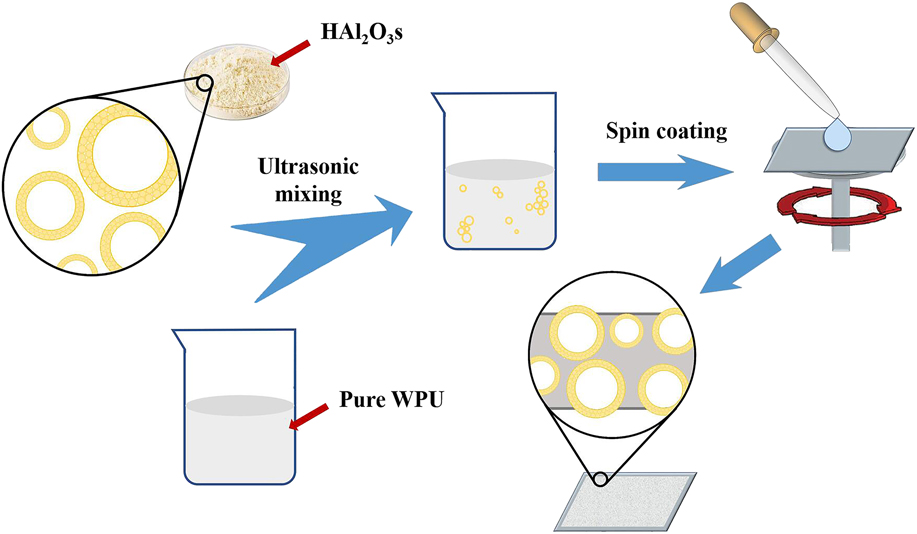
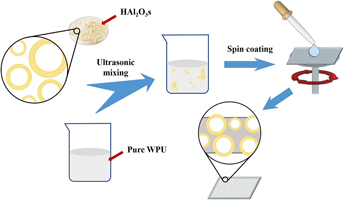
The synthesis process of WPU-hAl2O3 films is illustrated in Fig. 1. First, hAl2O3s were mixed with WPU (HK175, Hongming Chemical Reagent Co., Ltd., Jining, China) according to the mass ratio of 0, 5, 10, 20, and 30 wt% followed by magnetic stirring and ultrasonic for 24 h to obtain homogeneous solution. The density of WPU is 1.03 g/cm3, solid content is 35%, and viscosity is 75 MPa⋅s at room temperature. The WPU used in this experiment is thermoplastic and its softening point is 217 °C. The mixture was daubed evenly on the square aluminum substrate with the length of 43 mm that was adsorbed on the spin coater in advance. During the spin coating process, the low rotary speed was 50–100 rpm/min for 30 s at first, and the high rotary speed was 160–200 rpm/min for 20 s. Different thicknesses of wet films could be obtained by adjusting the rotational speed. And then the obtained wet film was dried at 80 °C for 15 min.
Schematic illustration of the synthesis process of WPU-hAl2O3 films.

C. Characterization
The microstructure of the samples was observed by using a field emission scanning electron microscope (SEM; S-4700, 15 kV, Hitachi, Tokyo, Japan). The infrared emissivity of the samples was characterized by using an infrared emissivity radiometer (TSS-5X, Japan Sensor Corporation, Tokyo, Japan). The films were coated on the square aluminum substrate for the infrared emissivity measurement. The average emissivity of the samples was measured in the 2–22 μm band at 25 °C and the measurement accuracy is ±0.01 μm. The measurement of infrared emissivity is based on the mechanism of blackbody radiation. The infrared emissivity can be explained by the following equation:
 $$\varepsilon = {{{E_{\rm{g}}}} \over {{E_{\rm{b}}}}}\quad ,$$
where ε is the emissivity of graybody; E g is the radiation energy emitted by graybody; E b is the radiation energy emitted by blackbody. The sensor head was first calibrated on the standard specimen (blackbody) for each measurement and then placed on the test samples (graybody) to measure. The Vickers hardness of the square samples with dimensions of 30 × 30 mm2 was measured by the micro Vickers hardness tester (Wolpert-401MVD, Wilson Hardness, Buehler, Lake Bluff, Illinois). The kinetic coefficient of frictions (COFs) were measured using a pin-on-disc tribometer (CETR UMT ver.1.55.0, Bruker, Campbell, California). The tribological tests were performed at the rotating speed of 500 rpm/s with a diameter of 20 mm under a load of 5 N. The light transmittance of the films was measured by the UV/Vis/NIR spectrophotometer (Agilent Cary 5000, Agilent, Santa Clara, California). The wetting angle of the samples was measured using the contact angle meter (Kino SL200KB, KINO Industry Co. Ltd, Norcross, Georgia).
III. RESULTS AND DISCUSSION
A. Microstructure
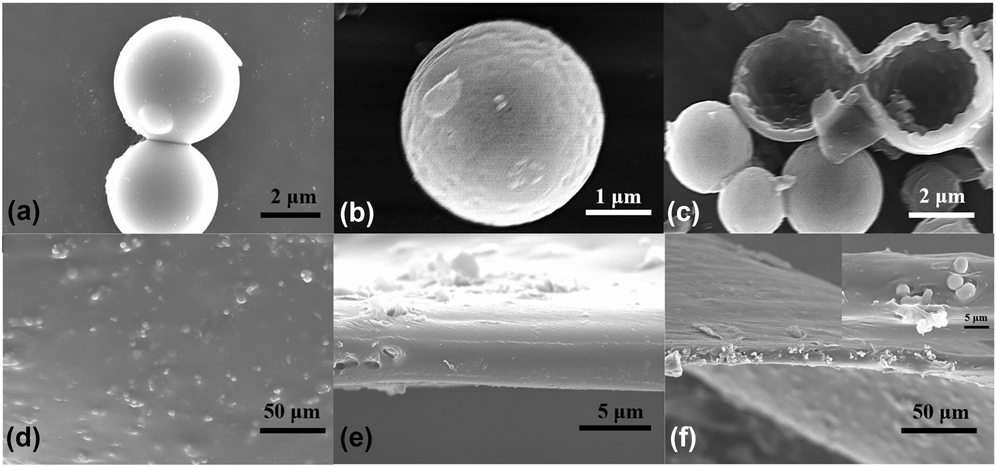
Figure 2 shows SEM micrographs of C@Al2O3 microspheres, hAl2O3, and WPU-hAl2O3 films. As shown in Fig. 2(a), C@Al2O3 microspheres which were synthesized through a hydrothermal process are observed. The surface of the microspheres is smooth and the average diameter is about 5 μm. Figure 2(b) shows a monodisperse hAl2O3 with a diameter about 3 μm, which was obtained from a C@Al2O3 microsphere after sintering at 1200 °C for 2 h. It is noticed that the diameter of hAl2O3 is smaller than that of the C@Al2O3 microsphere. The external surface of the C@Al2O3 microsphere was an amorphous layer, and Al3+ was absorbed by the hydroxyl groups on the outer surface of microspheres.Reference Han, Yin, Cheng, Ren and Li31 Thus, this kind of loose structure would become dense during sintering, which lead to the reduction of diameter of microspheres. The hollow structure of hAl2O3 is confirmed by the cross section of the cracked hAl2O3s, as shown in Fig. 2(c). The formation of the hollow structure was owing to the carbon which was in the core area of the microspheres previously and reacted with oxygen under air atmosphere during sintering.Reference Han, Yin, Cheng, Ren and Li31,Reference Sevilla and Fuertes32 The shell thickness of hAl2O3 can be measured through Fig. 2(c), and the estimated density of hAl2O3 powder is ∼42% of the alumina powder density (3.99 g/cm3) at the same size. The density of hAl2O3 powder and WPU is 1.68 and 1.03 g/cm3, respectively. According to the rule of mixtures, the density of the 30 wt% composite film is 1.08 g/cm3. Figure 2(d) shows the uneven surface of WPU-hAl2O3 films because there are many hAl2O3s standing out beneath the surface of the composite films. Figures 2(e) and 2(f) are the cross sections of the pristine WPU film and the composite film, respectively. The thickness of the pristine WPU films is uniform, and the specific value is about 8–10 μm. In addition, it can be intuitively found that the cross section is smooth compared with the composite films in Fig. 2(f) except for the incorporation of some air bubbles which are unavoidable and few during the spin coating process. The small parcels or spherical protuberances as shown in Figs. 2(d) and 2(f) are hAl2O3s spreading both in the internal and external surface of the composite films, which make the surface of the composite films become rougher.
SEM images of (a) C@Al2O3, (b) hAl2O3, (c) cracked hAl2O3s, (d) surface of WPU-hAl2O3 films, (e) cross section of pristine WPU films, and (f) cross section of WPU-hAl2O3 films.

B. Mechanical properties of WPU-hAl2O3 films
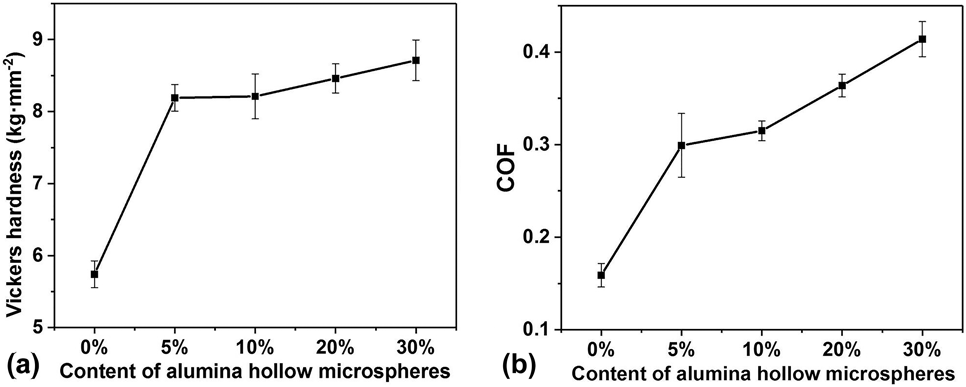
The influence of different additions of hAl2O3 on Vickers hardness and COF of WPU-hAl2O3 films are shown in Fig. 3. The films with different mass ratios of hAl2O3 were tested for the Vickers hardness on 0, 5, 10, 20, and 30 wt%, respectively. It can be seen from Fig. 3(a) that Vickers hardness increases along with the rising of mass ratio of hAl2O3. The hardness of the composite mainly depends on the type of matrix polymer, the stiffness of filler, and the interfacial bond between the filler and the polymer. The average value changes from 5.74 to 8.71 kg/mm2 when the addition increases from 0 to 30 wt%. This indicates that hAl2O3 can effectively enhance the hardness of WPU-based films because hAl2O3 has high hardness and high compressive strength. These properties make it play a certain supporting role in WPU-hAl2O3 films.Reference Han, Yin, Cheng, Ren and Li31,Reference Hu, Chen, Fang and Wu33 HAl2O3s will fill the pores of the film surface, which can make the surface of the films more close-packed and thereby have higher hardness.Reference Feng, Zhang, Mai, Ma, Liu, Jiang and Zhu34,Reference Chou, Yu and Huang35 The groove area of the polymer surface is an exponential decay function of its Vickers hardness in the scratch-resistance tests. The polymers with higher hardness have shallower and smaller scratch areas than those with low hardness.Reference Brostow, Chonkaew, Rapoport, Soifer, Verdyan and Soifer36,Reference Brostow37 According to the hardness test in Fig. 3(a), the hardness of hAl2O3 is higher than that of the pristine WPU film. Therefore, the scratch resistance of the composite films is improved owing to the addition of hAl2O3.Reference Brostow, Lobland, Hnatchuk and Perez22,Reference Burnett and Rickerby38
(a) Vickers hardness and (b) COF of films with different mass ratios of hAl2O3.

Figure 3(b) gives a data map of tribological tests performed on the films with different mass ratios of hAl2O3. As the result shows, the kinetic COF of the WPU-hAl2O3 films is positively related to the content of hAl2O3 in the films. It will increase with the rising content of microspheres in the film. As shown in Fig. 2(d), hAl2O3s are evenly distributed beneath the film surface. According to the preparation process of this composite film, the distribution of hAl2O3s in the matrix WPU is random and disordered. Hence the higher the content leads to the larger the surface roughness of the film. Because the kinetic COF of films is related to the roughness of the film surface, the increasing roughness of the film surface leads to the increase of COF.Reference Hayward, Singer and Seitzman39,Reference Nanbu, Yasuda, Ushijima, Watanabe and Zhu40 However, although COF of the composite films increases as the rising content of hAl2O3, WPU-hAl2O3 films still have lower COF, compared with some other alloy films on the metal surface. (COF of Ni–B coatings electrodeposited at 1 A/dm2 is 0.75.Reference Krishnaveni, Sankara Narayanan and Seshadri23 COF of Ni–P coatings electroless is 0.70.Reference Balaraju, Narayanan and Seshadri41)
The WPU-hAl2O3 film is a kind of particulate-filled composites. As for this kind of material, the matrix WPU is a continuous phase and the main body bearing the load. Therefore, the failure mechanism and strength of these composites mainly depend on the matrix and interface.Reference Lewis and Nielsen42,Reference Rothon43 The surface of hAl2O3s will adsorb hydroxyl groups which are hydrophilic.Reference Han, Yin, Cheng, Ren and Li31 Because the matrix WPU is a kind of PU that water is used as the dispersing medium instead of organic solvent, there will be chemical interaction between the filler and the matrix.Reference Rothon43 On the other hand, sufficient bonding between the filler and the matrix can increase the order of the matrix around the filler and reduce the defects.Reference Pukánszky and Vörös44 Because of the increase of interfacial strength and the decrease of matrix density around the filler, the stress concentration of the WPU-hAl2O3 film is reduced.Reference Lewis and Nielsen42 Hence the introduction of hAl2O3 into the WPU films can enhance the mechanical properties of the composite films.
C. Functional properties of WPU-hAl2O3 films
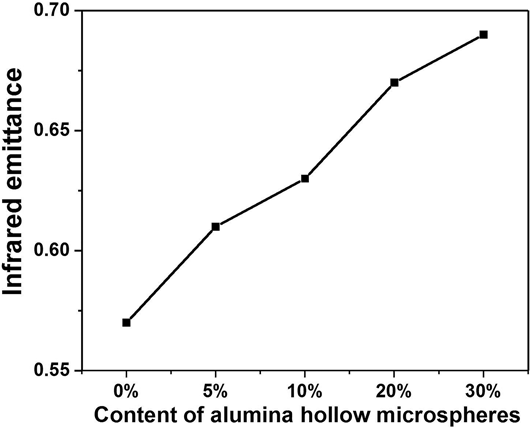
Figure 4 summarizes the infrared emissivity of the composite films with different mass ratios of hAl2O3. The polished aluminum substrate is used as the carrier. The polished aluminum sheet has lower emissivity, 0.11, and the emissivity of the composite films in the experiment is more than 0.60, so the little effect of the carrier on the emissivity of the films can be neglected. As the matrix of the film, the infrared emissivity of pristine WPU films is 0.57, while that of 30 wt% WPU-hAl2O3 films is 0.69. The infrared emissivity of the films increases obviously with the rising concentration of hAl2O3 at room temperature. The addition of hAl2O3s leads to the increase of the infrared emissivity of the films. On one hand, hAl2O3 has a higher infrared emissivity of 0.65 compared with the pristine WPU. The addition of hAl2O3 will increase the infrared emissivity of the composite films. On the other hand, the infrared emissivity is also related to the surface roughness of the film.Reference Huang, Zhou, Tang, Zhu and Luo45 When the content of the fillers increases, the hAl2O3s will no longer be arranged in order, the direct consequence of which is the increase of the surface roughness of the composite film. The infrared ray will be absorbed more easily on the rough surface, and the reflectance will decrease. According to Kirchhoff’s law that the absorptivity and emissivity are equal in the thermodynamic equilibrium state, compared with the film with the smooth surface, films with rough surface have higher infrared emissivity.Reference Yu, Xu, Shen, Yan and Cheng46 By utilizing the high infrared emissivity of the films, the heat of the equipment surface can be timely diffused by means of thermal radiation.Reference He, Li, Wang, Sun and Zhang47
Infrared emissivity of the composite films with different mass ratios of hAl2O3 (2–22 μm).

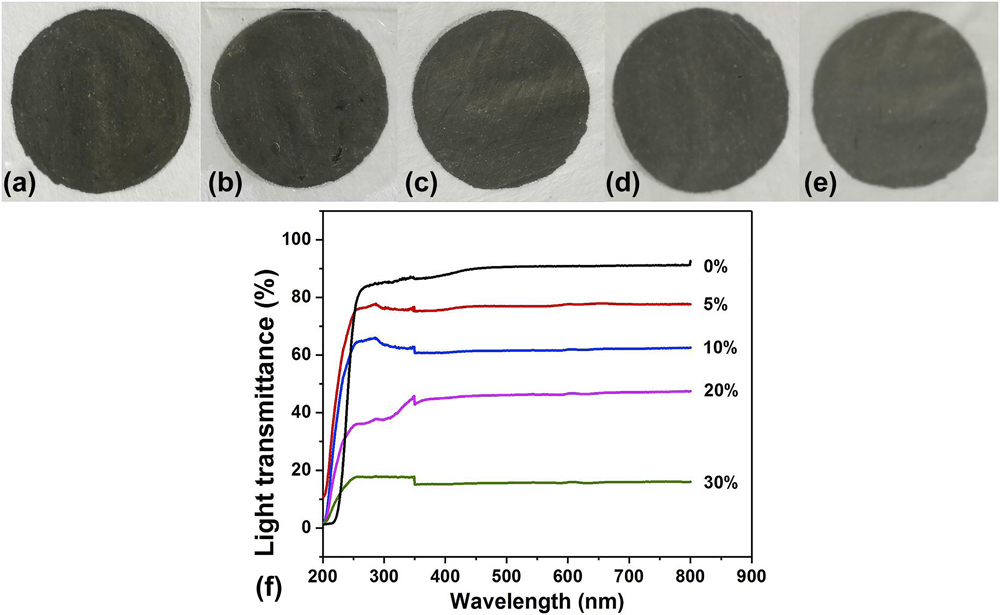
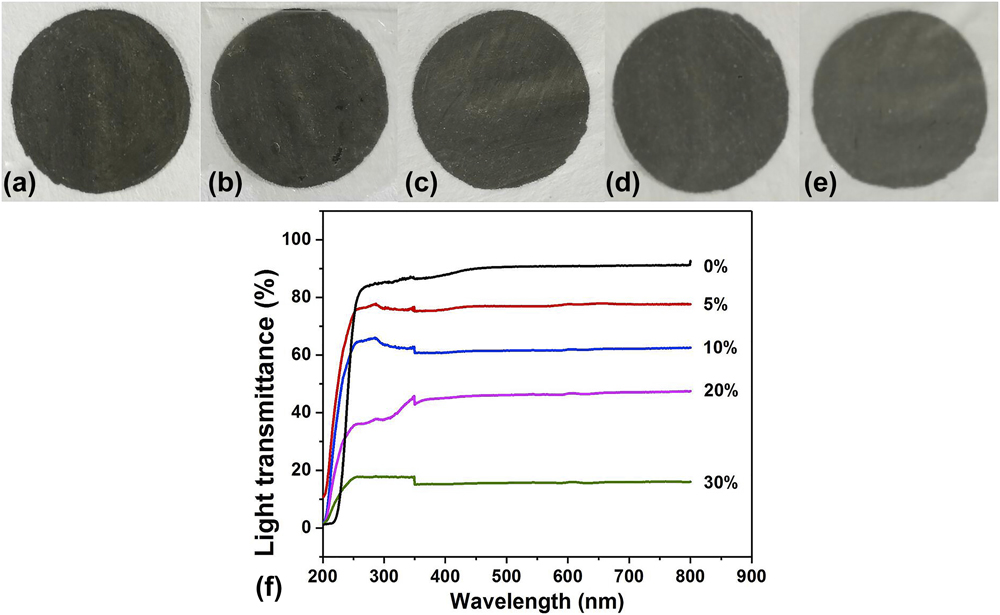
Figure 5 shows the light transmittance data of the coated samples with different mass ratios of hAl2O3. After adding hAl2O3s to the pristine WPU films, the light transmittance of the films is bound to be affected because of the micron-sized hAl2O3s. The digital photographs of apparent effects after adding fillers to the films are displayed in Figs. 5(a)–5(e). These photographs were obtained by putting the films with different mass ratios of hAl2O3 taken off the substrate over the black circular substrate. Especially, the substrate has obviously become somewhat blurred compared with the pristine WPU [Fig. 5(a)] in Fig. 5(e) (30 wt% film). As shown in Fig. 5(f), adding hAl2O3s to pristine WPU films will reduce the transmittance of the films in the entire test wavelength range (200–800 nm). In the range of UV wavelength (≤400 nm), the transmittance of WPU-hAl2O3 films is greatly reduced, which means the composite film can effectively prevent the outdoor equipment from UV rays. Because of the UV rays with short wavelength, high frequency, and high energy, the long exposure will accelerate the aging of the surface of the equipment, leading to the scrapping of equipment. Hence the service life of the equipment can be extended under the protection of WPU-hAl2O3 films. In the visible light part (400–800 nm), the transmittance of pristine WPU films is about 90%, whereas that of the composite films with the content of 5%, 10%, 20%, and 30% is about 77%, 62%, 47%, and 16%, respectively. Compared with oxide films such as indium oxide,Reference Islam, Mou, Roy, Hossain, Julkarnain and Khan48 vanadium dioxide,Reference Fleer, Pelcher, Zou, Nieto, Douglas, Sellers and Banerjee49 and zinc oxide,Reference Yoo, Lee, Kim, Yoon, Park, Dhungel, Karunagaran, Mangalaraj and Yi50 the WPU-hAl2O3 films have better blocking effect in visible light and near infrared wavelengths. Radiation reflects on the surface of the film when it is irradiated to the surface. The reflection of radiation at the surface is related to the roughness of the film surface. The experimental results of the kinetic friction coefficient indicate that the roughness of the film surface increases with the rising content of hAl2O3. Because of the increase of surface roughness, the irregular protruding of the film surface will increase the diffuse reflection of radiation on the film surface, which will lead to the decrease of the film’s light transmittance.
Digital photographs of (a)–(e) physical test of the light transmittance of the composite films with different mass ratios of hAl2O3 from 0 to 30 wt%; (f) light transmittance of the composite films.
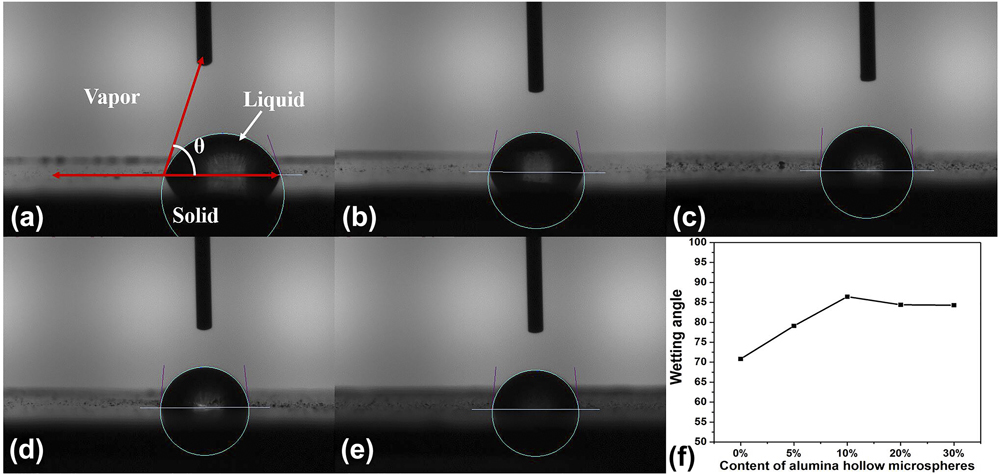
Figures 6(a)–6(e) are the photographs of the actual wetting angle test of the composite films with different mass ratios of hAl2O3 from 0 to 30 wt%. θ = 90° is the boundary between the hydrophily and hydrophobicity. When θ < 90°, the film is hydrophily. After the correction of the later drawing, Fig. 6(f) summarizes the wetting angle of the composite films with different contents of hAl2O3. As shown in the diagram, there is a trend that the wetting angle of the films increases with the rising of the filler content of the composite films, which indicates that the film is gradually transited from hydrophily to hydrophobicity. When the mass ratio of the hAl2O3 is in the range of 10–30%, the value of the wetting angle is basically the same. Wettability of films with water is mainly governed by chemical properties and microstructure of the films.Reference Teshima, Sugimura, Inoue, Takai and Takano51,Reference Tadanaga, Kitamuro, Matsuda and Minami52 When the liquid drops on the rough surfaces, the microscopic contours of the rough surface hinder the diffusion of liquid.Reference Shuttleworth and Bailey53 So the increase of surface roughness results in the increase of wetting angle of the film surface when the amount of hAl2O3 added is in the range of 0–10%.Reference Wenzel54 However, as far as the chemical properties of a surface is concerned, the surface of hAl2O3s will absorb a distribution of hydroxyl groups which are hydrophilic when it is wet with water.Reference Pak and Cho55,Reference Han, Yin, Ren, Duan, Zhang and Cheng56 Therefore, when the addition of hAl2O3 is between 10 and 30%, the wetting angle of the composite film is slightly decreased with the increase of the hAl2O3 content.
(a–e) Digital photographs of the physical test of the wetting angle of the composite films with different mass ratios of hAl2O3; (f) wetting angle of the composite films with different contents of hAl2O3.

IV. CONCLUSION
In this work, a series of WPU-hAl2O3 films with different mass ratios of hAl2O3 have been successfully synthesized. The hAl2O3s with a diameter of about 2–5 μm were obtained via the simple hydrothermal process and thermal treatment under air atmosphere at 1200 °C for 2 h. Compared with the pristine WPU films, the Vickers hardness of WPU-hAl2O3 films had an apparent increase from 5.69 (pristine WPU films) to 8.74 (30 wt% of the composite films). The infrared emissivity of the composite films (0.69) was higher than that of the pristine WPU films (0.57). With the increasing content of hAl2O3, both COF and wetting angle showed a sign of rising trend. As for the light transmittance of the films, when the content of hAl2O3 increased from 0 to 30%, the film’s light transmittance reduced from 90.9 to 15.9%. WPU filled with hollow ceramic microspheres puts forward a feasible method to synthesize polymer-based composite films with light weight, high hardness, thermal protection, and scratch resistance.
ACKNOWLEDGMENTS
This work was funded by the National Natural Science Foundation of China (Grant Nos. 51332004, 51372204, and 51521061), the National Science Fund for Distinguished Young Scholars (51725205), and National College Students Innovation and Entrepreneurship Training Program (201610699291).