1. Introduction
The constitutional theory of money is a new contribution to the existing literature on the nature of money and provides important theoretical and methodological insights that will challenge both neoclassical and heterodox economists. Drawing on Christine Desan's pioneering work the current article analyzes this new monetary framework, in particular its focus on how a unit of account is established, and extends it in several ways. Specifically, this article deals with the issues of power and market instability, two topics of central concern for heterodox political economists who, however, do not analyze these issues through the lens of legal analysis.
The literature on money is dominated by the neoclassical barter-based approach in which the central bank adds money at its discretion ‘to reduce the inconvenience of barter’ and keep inflation in check, i.e., money is exogenous. Heterodox economists, drawing on both Marx and Keynes, have long rejected this view, emphasizing instead the fundamentally monetary nature of markets and the fact that money is endogenous, i.e., money is created by the need to produce and circulate commodities.Footnote 1 A further theoretical development in heterodox economics, Modern Monetary Theory (MMT), has gained considerable influence in recent years. By emphasizing the public nature of the unit of account, MMT explicitly introduces public authority into the creation of high-powered money. An important inspiration of MMT is George Friedrich Knapp who took the position that ‘Money is a creature of law. A theory of money must therefore deal with legal history.’Footnote 2
While sharing common ground with the MMT approach, it will be argued in this article that the constitutional money framework, rooted in the broad CLS tradition, is quite distinct from that of the MMT since it is based on a different methodological approach. Money can be treated in both contract and property terms and thus involves a complex bundle of rights that require public authority for enforcement. MMT scholars would not dispute this argument. However, while stressing the role of money as a governance project, this article also stresses the centrality of private decision making as well as conflict, power, and instability in the legal foundations of markets.Footnote 3 Thus the capitalist political economy is at the heart of the constitutional theory of money, as the former provides the context which determines the existence and relative stability of the unit of account.
Basing itself on Hohfeld's legal relations framework,Footnote 4 Section 2 discusses money's relationship to governance and how currency instability can occur. Section 3 discusses the political/legal foundations of the unit of account and its ‘fiscal value’, and how its stability is determined or undermined by expectations, power struggles, tax contestations, and broader policy frameworks. A central issue underlined here is the indeterminacy of laws as emphasized by the CLS tradition. Section 4 elaborates on how the state-enforced currency could be destabilized via power struggles in the context of a longue durée analysis, a framework pioneered by Fernand Braudel. It is argued that in the longue durée monetary instability is intimately connected to the Keynesian notion of uncertainty and that the latter is reinforced by the indeterminacy of laws.Footnote 5 Finally, this section deals with open economy considerations. It is argued that since industrialization by definition involves monetary flows and capital accumulation, the constitutional theory of money completes the literature on export-led industrialization. Section 5 rebuts the New Institutionalist claim that the Glorious Revolution provided an appropriate set of legal ‘handcuffs’ to restrain public authority and thus created the basis for ‘clear and well-defined’ private property rights as a recipe for industrialization and development. Section 6 is the conclusion.
2. Governance, Hohfeld, and instability
Money can be characterized in terms of both property and contracts. However, these are not self-defining categories and Hohfeld's seminal contribution was to challenge the lay view of property as something that arises from the fruits of one's labour or ‘contract-as-agreement’ between private parties. For Hohfeld property and contracts are aggregates of ‘abstract legal relations’Footnote 6 that are enforced via public authority, which allocates power to each individual or institution vis-à-vis others. Which of Hohfeld's state-enforced jural relations prevails is ‘ultimately a question of justice and policy’Footnote 7 and in making laws:
. . .judges may appeal to “natural justice” or some similar abstraction, to public policy, to “eternal” justice, to the “right” as opposed to wrong, to the settled convictions of the community, to business and social custom, to the mores of the time.Footnote 8
Finally, as Arthur Corbin observed, the jural relations may themselves lead to conflict and disagreement:
Of course, people do not agree in their notions of right and justice. They do not agree on the policies that make for general welfare and for individual survival. The interests of nations and of individuals are often necessarily in conflict. We can therefore expect war and litigation; and in many important fields the living law will continue to be inconsistent and uncertain.Footnote 9
Thus, by implication, instability and uncertainty are inevitable in property and contract regimes. This insight is of vital significance to the current article.
Hohfeld is central to the constitutional theory of money.Footnote 10 A core implication of his framework is that monetary movements are structured by the state-enforced jural relations that determine all property and contracts. Money is central to governance in the constitutional money view, and like all property and contracts, the politically enforced background lawsFootnote 11 determine what makes an asset a ‘safe’ one and confer liquidity on it.Footnote 12 Economists generally take for granted the characteristics of money (unit of account, store of value, medium of exchange, and means of payment) without interrogating what makes something legally money with all the qualities which we attribute to it. The general assumption seems to be that ‘market forces’ create these qualities but this is an empty assertion which, by being devoid of legal content, essentially naturalizes money and markets. On the other hand, law is constitutive of markets in the Legal Realist and CLS traditions, quite simply because property and contractual relations need to be cemented in order to be stable. Thus, what constitutes money in a given polity has undergirding it a complex structure of jural relations, themselves the results of politics, policies, and ideology. This is where Hohfeld comes in.
Naturally, the preferences of people with regards to currency holdings may at times clash with the official currency, generating changes in the bundle of jural relations. For example, in the American colonies residents of one province would either be granted a privilege by the legislature to use another one's paper currency or have it taken away. Alternatively, as in Pennsylvania, there could be a wholesale adoption of another province's (Delaware) currency.Footnote 13 Such currency substitutions have an exact parallel in the contemporary world outside the US when dollarization occurs.Footnote 14 What emerges from this discussion, as elaborated below, is that currency emitted by a state will be readily accepted by the population provided that it is not deemed to be ‘excessive’ (i.e., as long as the government is committed to retiring that money as taxation at some future date) and/or there are no inflationary pressures, growing trade deficits and foreign debt, or political uncertainty. Currency depreciation under such circumstances can have negative feedback effects on the economy, thereby possibly increasing its economic problems and raising uncertainty.Footnote 15 For example, a loss of trust in the currency by major investors could influence others and spark a currency crisis, as in Venezuela, and pressures for dollarization by business groups, as in Nigeria or Mexico.Footnote 16 Clearly, a rejection of the currency by large segments of the population can destabilize current political and legal institutions, requiring some political response by the state regarding the future legal foundations of the monetary system.
It must be emphasized here that HohfeldFootnote 17 does not discuss how a particular combination of jural relations is established. The technical nature of the jural relations should not give the false impression that the legislature necessarily has full autonomy in putting in place the particular bundle of rights it desires. For example, Christine Desan points out, in discussing rights and privileges in the context of the private creation of money in the American colonies:
As in the case of rights, the distribution of privileges in constituting money affected both monetary value and related conceptions. Private parties inventing their own exchange could influence amounts of public money demanded by supplementing it with another currency. On another level, their struggle over the power to produce money played out a debate over the character of public and private authority. Footnote 18
It could be inferred here that since an existing bundle of jural relations determines the current distribution of money, and thus of power, the latter could in turn shape the future content of the bundles of rights. As Warren Samuels wrote in his classic article on Robert L. Hale:Footnote 19
Who will use government as a source, ratifier or general supporter or reenforcer of private coercive power? In other words, every economic system inevitably comprises the problem of control of the government. Hale's analysis makes it abundantly clear that the state (government or law) is not something exogenous to economic life, but rather, that law is a dependent as well as independent variable, that the realization of economic interests is a function of government, and that the role of government is also a function of economic interests, that is, of those interests which are able to get into a position to use government.
We will come to the question of the law-power nexus later on in the essay and how, to use Robert W. Gordon's pithy expression, when ‘another set of interests gets its paws’Footnote 20 on the law, the latter may (or may not) change. Suffice it to say here that the political economy and ideational contexts determine the nature of the jural relations and thus the fate of a currency.
3. Sovereignty, currency (in)stability, and indeterminacy
As its very name suggests, in the constitutional theory of money the unit of account is the culmination of profoundly political processes. One could conceptualize any society which is more or less devoid of liquidity, say fifth- or sixth-century England, when economic activity and the centralized state structure collapsed after the departure of the Roman forces, or the American colonies which confronted an acute shortage of gold and silver because of England's policies.Footnote 21 Under such circumstances a unit of account cannot arise and establish itself to mark property and contracts as a purely spontaneous private initiative for two reasons. First, such a situation in a given polity would produce multiple privately created and rival units of account, thereby making stable market transactions impossible. Profit-making from production activities requires that input costs and output prices should be in the same unit of account. With multiple units of account in the same polity this would, at the very least, be extremely challenging. There has to be one unit of account, but that can only be created and maintained if there is some political authority which can enforce the legal institution of that unit of account. After all, how otherwise would the bundle of rights undergirding property relations and contracts between strangers get created and enforced, or conflicts between creditors and debtors get adjudicated?
Such a political authority (or stakeholder) could be a local religious potentate, tribal head, landlord, or central state (whether democratic or despotic).Footnote 22 But if money arises and establishes itself only in a collectivity then the stakeholder at the political center has to ensure the defence of the territory and provide for the ‘common good’ (however that is defined), including with fortifications, roads, canals, etc. The stakeholder, therefore, has to extract material resources from the society to even exist. In a society parched of liquidity, the latter has to be legally created as a political project so that public authority can purchase goods and services from the population and stable market transactions between private individuals can take place.
If one considers paper money that is not backed by specie (as in the American colonies), what determines citizens’ willingness to hold it?Footnote 23 In the American colonies, the ‘good as gold’ quality of paper depended on a stable state–citizen consensus or agreement that the paper issued by the public authorities would be absorbed back at some determinate future date in the form of taxes. In the stakeholder model, in short, when private individuals sell goods and services to the sovereign authority they, in effect, extend the latter a credit which is redeemed when they pay the latter taxes. This is what constitutes the money's ‘fiscal value’. Thus, at its heart this future taxation constitutes an anchoring demand for the currency. However, the money also has to have a cash premium by providing all the advantages of holding currency, notably giving holders purchasing power.Footnote 24 This abstract theoretical argument, which determines the foundational anchor of money, is grounded in the way that it actually originated and evolved in England and later on in the American colonies.Footnote 25
The strategy described above is at the core Footnote 26 of the monetary system. Of course, in the constitutional money view the fiscal actions of the public authorities cannot possibly provide for all the monetary needs of the society given the potentially erratic and uncertain nature of fiscal policy. Thus, in the case of England, by the tenth century, sovereign authorities established the practice of creating money on demand via the so-called ‘free minting’ system. This is an early example of endogenous money creation in which those with silver bullion had the right to bring it in to the royal mint and the latter had the duty to return a certain number of coins after charging a minting fee. The officially minted coins then became the basis of tax payments, market transactions, and legal tender. Similarly, in the American colonies supplementary money was created via publicly established land banks which provided credit on demand to those with land. The paper bills created via the loans were used to pay debts and taxes, and circulated as money.Footnote 27 Of course – and this is an important point – despite free minting and later monetary developments, the English suffered from a chronic shortage of money until the eventual legal establishment of paper currency and bank credit.Footnote 28
Since the fiscal actions of public authority anchor the value of the currency, what determines its potential instability, involving the relationship between money supply and demand, in this framework? This is an important question and relevant to a longue durée perspective of money. For example, in his tax-based model of money Charles CalomirisFootnote 29 provides data on currency depreciation and instability in the American colonies. However, Calomiris uses a rational expectations-monetarist framework to give a theoretical explanation for depreciation, an approach that would be contested by all heterodox economists. On the other hand, the MMT literature does not analyze the currency over-issuance/depreciation nexus. Yet the data provided by Calomiris needs to be explained, given the reality of currency instability throughout the history of capitalism.
The ex ante-ex post distinction, pioneered by the Stockholm SchoolFootnote 30 and also central to Keynes's framework, is crucial to the following discussion. Given the prevalence of fundamental uncertaintyFootnote 31 in a decentralized market economy, it would be coincidental if the net money injected into the economy on the basis of ex ante plans and expectations would necessarily equal the ex ante demand for money or what the actual ex post outcomes would be. The question is what effects do monetary disequilibria have? In what follows I propose two related scenarios pertaining to net money growth from a growing budget deficit, one of which pertains to uncertainty and the other to power relations and the macroeconomic effects of budget deficits. Both scenarios relate centrally to the indeterminacy criterion emphasized by the CLS tradition, since they point to the possibility, but not the certainty, of currency instability.
3.1. Uncertainty and tax contestation
In the constitutional money view, if a government emits currency and is credibly committed to its citizenry to remove it from circulation at some point in the future, then the latter's state of confidence about the currency would be maintained. This condition is, however, strongly dependent on expectations and citizens’ trust in the political system.
In The General Theory, John Maynard KeynesFootnote 32 related the current state of confidence to their expectations, in which future market conditions are fundamentally unknown and economic variables such as prospective rates of return on investments cannot be calculated in a probabilistic sense. Especially in hard times, people's expectations will be subject even more to ‘waves of optimistic and pessimistic sentiment’Footnote 33 and investor confidence in both good and bad times will depend on the broader economic, political, and institutional climateFootnote 34 which shapes policies. As with Michal Kalecki,Footnote 35 Keynes advocated ‘full employment’ policies but was very aware of the problem of capital flight that such policies could provoke given their political implications:
I see no reason to feel confidence that the more stable conditions [of the post-war era] will remove the more dangerous movements [of capital]. These are likely to be caused by political issues. Surely in the post-war years there is hardly a country in which we ought not to expect keen political discussions affecting the position of the wealthier classes and the treatment of private property. If so, there will be a number of people constantly taking fright because they think the degree of leftism in one country looks for the time being likely to be greater than somewhere else.Footnote 36
Since wealth and private property are ultimately functions of the law, one may infer from Keynes's observation that the legal-institutional frameworks and political climates prevailing in different countries are fundamental to the shaping of investor expectations.
Capital flight, of course, involves the abandonment of the domestic currency and the flows of money to other countries, and this is how Keynes meant it in the above context. However, growing uncertainties, which Keynes also argued generated an increase in liquidity preference,Footnote 37 could involve increased dollarization without money flowing overseas, i.e., the domestic substitution of foreign for local currency. In either case, the value of the domestic currency would drop. But whether or not the above outcomes happen depends on the bundles of jural relations undergirding money. For example, does the law give foreign currency the attributes of liquidity? Does it allow capital outflows? The current and future state of these laws will thus affect economic decisions, either increasing or reducing uncertainty, and thus also the currency's stability.
Keynes's insight regarding expectations can be linked to Mick Moore's distinction between different tax governance polities.Footnote 38 Moore distinguishes between coercive and contractual tax regimes. In the former the state has little credibility vis-à-vis the citizenry and extracts taxes coercively; in the latter taxes are generated by more accountable public authorities generating the possibility of state–citizen revenue bargaining.
Combining Keynes's and Moore's insights, one could argue that while prolonged slumps can certainly destabilize taxpayers’ expectations even under contractual systems, an unaccountable government's credibility falls even more in such circumstances. With a rising degree of uncertainty, the attractiveness of the currency is likely to fall. One can thus understand why it took British colonial authorities almost 50 years to root out pre-colonial currencies in Nigeria and establish the sterling as the sole unit of account,Footnote 39 and why in recent years the poor governance and economic performance of Nigeria have made it challenging for the government to maintain the naira as the sole currency faced with the pressures of dollarization emanating from economic elites.Footnote 40
Moore's argument suggests that the politics of taxation need to play a central role in the constitutional theory of money. Thus, it is important to account for both the economic desirability and the political feasibility of an appropriate tax structure to stabilize a currency, while satisfying other goals such as boosting investor confidence or reducing inequality. Joseph Schumpeter, Lord Nicholas Kaldor, and German sociologist Rudolf Goldscheid were among the first scholars to stress the importance of the need for a fiscal sociology of taxation,Footnote 41 a framework that calls for an interdisciplinary analysis of taxation. Lord Kaldor in particular emphasized the links between the state's taxation capacity and power relations in society:
But the advocacy of fiscal reform is not some magic potion that is capable of altering the balance of political power by stealth. No doubt, expert advice on tax reform can be very useful . . . But what can actually be accomplished does not depend merely on the individual good will of ministers or on the correct intellectual appreciation of the technical problems involved. It is predominantly a matter of political power.Footnote 42
In short, the fiscal value of a currency is shaped by all the factors that determine the fiscal sociology of taxation.
3.2. The effects of budget deficits
‘Fiscal profligacy’, fueling inflation from budget deficits, is a core theme in the neoclassical framework of authors such as Calomiris and Sargent.Footnote 43 While this is not the place to critique this framework it suffices to say that with widespread unemployment, a growing budget deficit could provide an economic stimulus and thus generate a robust demand for money. Thus, there is no question of ‘over-issuance’ of the currency here and thus no depreciation. However, this is but one scenario and there could be other situations of a growing budget deficit/currency depreciation nexus with no inflationary pressures in which all are reliant on the underlying legal-institutional framework of the economy. Such situations may lead to incomplete fiscal stimuli.
3.2.1. Capitalist opposition to ‘full employment’ policies
As James Crotty states,Footnote 44 Keynes was very aware of capitalist opposition to state-led ‘full employment’ policies, producing the potential for capital flight. However, Michal Kalecki,Footnote 45 and Robert Lee HaleFootnote 46 were the ones who explicitly linked such public-sector jobs programs to workers’ increased bargaining power vis-à-vis capitalists. Like Karl Polanyi,Footnote 47 Kalecki emphasized the fact that capitalists would oppose such policies since ‘under a regime of permanent full employment, the “sack” would cease to play its role as a disciplinary measure. The social position of the boss would be undermined, and the self-assurance and class-consciousness of the working class would grow’.Footnote 48 In short, faced with rising budget deficits and other progressive policies, there could possibly be a decline in the state of business confidence and, as a consequence, capital flight. As discussed above, the ‘capital flight’ could involve a greater domestic demand for foreign currency relative to the local currency. Taken together, there would be currency depreciation.
Post-Keynesian authors, perhaps some in the MMT tradition, would probably contest such an outcome. From their perspective, only a win-win situation can arise from higher budget deficits since the latter will boost effective demand and thus growth and employment. But business investment is motivated by the expectation of profitabilityFootnote 49 and both expectations and unit production costsFootnote 50 are determined by the bundle of jural relations that undergird property, contracts, and torts, and thus the nature of markets.Footnote 51 Duncan Kennedy observed in his analysis of Robert Hale's framework that the particular combination of background laws determines distributive outcomes.Footnote 52 So an increase in employment may or may not raise wages or lower work effort (e.g., how hard or long are workers made to work?) because of the multiple combinations of background laws that shape workers’ coercive power vis-à-vis capitalists. For example, an increase in worker militancy from lower unemployment could lower profit expectations and, by provoking capital flight, put downward pressure on the currency.Footnote 53 On the other hand, one can clearly imagine other scenarios where rising budget deficits are consistent with background laws that stabilize or raise expected profits, e.g., import tariffs for sectors adversely affected by foreign competition, subsidies, industrial policies, and active labor market policies to train skilled workers. There is indeterminacy at the core in terms of the effects of budget deficits leading to the possibility, but not the certainty, of adverse consequences to the value of the currency.Footnote 54
Finally, given the budget deficit, the value of the currency can still fall because of growing foreign debt stocks.Footnote 55 In particular for poorer countries, increased difficulties in paying back foreign debt with interest could make investor confidence fall and induce capital flight because of declining creditworthiness. These pressures would depreciate the currency, unless the state manages to implement countervailing export promotion policies, and perhaps quasi-protectionist ones too, to shore up the currency's value,Footnote 56 bolster foreign exchange reserves, and thus lower foreign debt. Many authors have advocated such policies.Footnote 57 However, this is hardly a straightforward issue since several authors in this tradition have emphasized the fact that both domestic political factors and international legal battles (e.g., in the World Trade Organization) determine the viability of such policies.Footnote 58
In short there are numerous policy scenarios, which are themselves undergirded by the law, linking the budget deficit to the strength of the currency. There may or may not be currency depreciation. Monetary flows, per the constitutional money approach, are profoundly shaped by public authority, and in unpacking money ‘we find a veritable hive of legal work’.Footnote 59 As Daniel Tarullo argues,Footnote 60 there is no ‘natural state’ of the market since public policies always structure business monetary costs and thus markets. Thus, the key issue is to understand how the law may or may not be successful in stabilizing (roughly, anyway) the currency. As Robert W. Gordon put it: ‘The same body of law, in the same context, can always lead to contrary results because law is indeterminate at its core, in its inception, not just in its applications.’Footnote 61
4. The public/private ‘divide’, drama, and longue durée analysis
There is a theoretical tension in the broad anti-neoliberal perspective which advocates ‘bringing the state back in’ in economics. The first approach, or what Duncan Kennedy calls social legal thought,Footnote 62 comes from the administrative state perspective adopted by Landis (in his early phase) and others.Footnote 63 Implicitly, policymakers in this view are seen as a ‘committee of experts’ who can deliver economic efficiency and social justice in an apolitical ‘command-and-control’ manner; the politics of the incentivization of those with wealth and power, not to mention the politics of policymaking more generally, play no role in this approach. I would locate MMT in this tradition. While currency instability in this literature arises from Minsky's debt accumulation model, there is no analysis of how the fiscal value of the unit of account can be destabilized because of uncertainty and power struggles around the background laws.Footnote 64
On the other hand, Landis in his later phase explicitly accounted for the importance of business power in the policymaking process and thus questioned the effectiveness of administrative knowledge assumed by SLT scholars.Footnote 65 Louis L. Jaffe also voiced skepticism about Landis's earlier perspective since the latter assumed ‘the existence in each case of relevant, value-free concepts, and an administration located at any given moment of time outside the political process, that is to say, outside or insulated from the power structure’.Footnote 66
None of this implies that laissez-faire is a desirable or, even more fundamentally from the CLS perspective, attainable policy. Neither does it imply that the ‘power structure’ can mechanically shape economic policy. It merely asserts that the publicly anchored economic system has built into it structures of unequal power relations, both within the private sphere and between it and the public sphere. Writing about Hale, Duncan KennedyFootnote 67 observed:
What he has to teach us is that the legal ground rules of economic struggle constitute the economic bargaining power of the combatants. But he was aware that the ground rules are themselves at least in part the product of the conflicts they condition. The process of circular causation works between the private economic system and the public lawmaking system as well as within the economy . . . .
As Kennedy discussed in this article, it is this tension that constitutes the potential for instability in the underlying legal framework and for the background rules to recrystallize over time with one of many different new configurations. In a careful reading of Kennedy's analysis of the stabilization and destabilization of background laws,Footnote 68 with his discussion regarding their circular causal relations, cumulative feedback effects, dynamic disequilibria, and constantly changing context, the attentive reader cannot help but notice the non-linearities built into the framework. There is thus a high level of unpredictability about the future course of the economy, because the indeterminacy criterion teaches us that there are many combinations of laws which constitute markets. I would argue that it is this indeterminacy which undergirds Keynesian uncertainty since the composition of the laws that ultimately get stabilized (if only for a while) cannot be deterministically predicted ex ante.
The second anti-neoliberal perspective is this CLS approach. The course of English monetary history, as discussed by Christine Desan and other historians, from the ‘free minting’ period to the enlistment of Bank of England (BoE) investors via the profit motive, fits solidly in this perspective. It is a longue durée analysis par excellence with its layered historical narrative, spanning several centuries and producing a dynamic, often turbulent, and generally unpredictable process of money creation. While money had a legal base enforced by public authority, the latter needed to enlist the support of merchants and financiers at every step of the way, incentivizing them as well as constraining them in the longue durée involved in going from metallic coin to paper money.
In order to create a viable political economy public authority was necessary to irrigate it with a tax-based monetary system. In the free minting system the injection of coins was demand-driven by the private sector.Footnote 69 This endogenous expansion of money was the result of the right of bullion holders to be returned coins that the sovereign authority had a duty to satisfy. However, the mint price charged in this transaction was administratively determined, underscoring the public nature of money creation and a right on the part of the state. Very importantly, the unit of account was politically determined so that money did not travel on the basis of its precious metal content, i.e., the principle of nominalism ruled. And yet, the legal framework underpinning this system had the twin objectives of maintaining sovereign authority while eliciting political co-operation on the part of merchants who had bullion. Merchants would only bring in the bullion if the mint price (the number of coins returned to them) was high enough. Clearly the cash premium of the coins was an important factor in private sector decision-making about their own coin/bullion portfolio choice.Footnote 70 If the mint price and/or alloy content of coin were unsatisfactory and/or another country's government offered a ‘better deal’ to merchants, the flow of bullion to the mint could slow down. Thus the possibility of capital flight was a real one,Footnote 71 an outcome that was a privilege granted by the government to merchants (i.e., to hold domestic or foreign coin), which the former had a no-right to stop. Put simply, given a particular bundle of entitlements undergirding money, ‘groups in a community may strategize methods of accounting in order to escape from an official unit of account to another anchoring coin that they prefer’.Footnote 72 Domestic individuals could also attempt to bring in foreign coin but, parallelling protectionist industrial policiesFootnote 73 foreign coin was prevented by the government from entering the country.Footnote 74 Here then, the jural relations were such that private individuals were disallowed from importing foreign coin and the government implemented its right to enforce protectionism.
The Case of Mixed Money, a landmark case with far-reaching power beyond commodity money, upheld the principle of nominalism. This makes theoretical sense since governance ultimately has to rest on a viable political economy with the latter undergirded by uniform monetary measures of property, contracts, and torts. Even in a commodity money system, the count value of money, as opposed to its metal content, has to prevail since if the precious metal content of coin changed, the relative appreciation or depreciation of the currency (count value relative to metal content) would destabilize contracts such as debts, taxes, or rents, thereby destroying the principle of equality in contracts.Footnote 75
The principle of nominalism also prevails under fiduciary currencies; ignoring dollarization, the exchange rate with respect to foreign currencies is generally of no import in domestic debt contracts (e.g., mortgages). In short:
The foundational nature of public obligation comports with the government's primary role in setting the prevailing standard or unit of account. It suggests as well the imperative that the government maintain that unit uniformly over time. Otherwise, people (as well as businesses and even governments) could be paid in one unit of account and taxed in another. The bait and switch would hurt people holding money individually and upset the system more generally by undermining the existence of a stable currency.Footnote 76
Power inequalities played a central role in English monetary history. This is particularly true with regard to taxation. The free minting period relied on ‘strong money’ (i.e., coin with high metal content) with heavy taxes to undergird their fiscal value. As a mutually beneficial political arrangement between landowners and the Crown, such a policy doubly disadvantaged the poor, who faced a chronic shortage of small-denomination coins and bore the brunt of the taxes.Footnote 77 Recourse to private credit was thus a major imperative for the poor and excessive debt was the consequence, with disputes and litigation taking place in the courts.Footnote 78 In short, political authority spread artery-style through the body economic with the legal design of money structuring class relations and the distribution of wealth and power.
The chronic shortages of cash persisted for centuries even as money creation evolved in a different direction, culminating in non-interest-bearing currency. The centrality of public authority persisted but the latter was hardly omnipotent. Various forms of public debt arose to finance the government's growing fiscal needs, however, the Crown (under Charles I for one) faced challenges in obtaining relatively low interest rate loans in credit markets: ‘sovereign immunity combined with the possibility of default made the monarch a bad risk’.Footnote 79 Treasury Orders (TOs) incentivized investors to loan to the government at a profit and were tied to revenue streams which gave them credibility as debt instruments. While TOs furnished some liquidity to the acute, cash-parched seventeenth-century economy,Footnote 80 they did not have the legal backing as cash to be used to pay taxes.Footnote 81 Thus, the government faced a fiscal crisisFootnote 82 with its combination of growing expenditures and insufficient tax revenues.
The growth of public debt, via the sale of bonds by the government to private investors, was the ‘solution’ to the problems of public finance and the economy's cash shortage issue, although this result was itself the culmination of a long turbulent process. Over time this enlistment of the private sector began to be coupled with a new ideational framework which sought to recast profit-seeking behavior (via the provision of loans to the government) as a patriotic duty.Footnote 83 Here then we have the origins of the familiar market ideology that equates the pursuit of self-interest with the social good.
The ideational framework must have also created a legal consciousness that elevated the political power of financiers, culminating in The Case of the Bankers. This landmark case, in which creditors successfully sued the government, arose from a set of delayed debt payments by the Crown, beginning with Charles II's Stop of the Exchequer (1672).Footnote 84 By setting the stage for fiduciary currency, The Case of Mixed Money and The Case of the Bankers are jointly of enormous theoretical significance. If the former case reinforced sovereign prerogative to determine the nature of money,Footnote 85 the latter legitimated the political power of capitalist investors by, more broadly, stabilizing contracts and thus giving them the confidence to engage in profit-making activities. Thus, at last, over a period spanning several centuries, a model of money creation involving both the incentivization as well as the disciplining of investors had been installed, albeit in a highly turbulent manner. This fundamental logic became the basis of money creation with the enlistment of the BoE by the government.
To summarize, the harnessing of the profit motive for a public purpose had become central to the money creation process in England by the seventeenth century. In the new system, the Crown borrowed from the BoE, paid the latter back in its own note with interest, and also injected it into circulation when undertaking public expenditures. Citizens were willing to hold this note, which was non-interest bearing, because it satisfied the need for liquidity and was accepted as taxes, both features determined by the state-enforced jural relations.Footnote 86 The public debt of the Crown to the BoE had now assumed the characteristic of money, a denouement that was the culmination of many centuries of unexpected twists and turns. In the same vein, in the American context after independence private bankers were incentivized by the legislature to augment the money supply by creating interest-earning credit on demand. Thus, then as now, banks sat atop a public base as Morgan Ricks and others have argued.Footnote 87
In the eighteenth century, the British government's borrowing capacity was undergirded by a tax system in which excise, customs, and land taxes made up the lion's share of revenue collected; of these, excise taxes (which are generally considered regressive) constituted ‘the most important source of revenue’.Footnote 88 On the other hand, public debt promoted enormous wealth accumulation, especially by financiers. In short, the legal foundation of the new public finance system allocated wealth and power in a particular way.
But the story of constitutional money does not end here. It was only in the early to midnineteenth century that the decisions of a number of court cases (e.g., Carr v. Carr) allowed banks to treat funds attracted via deposits as their own as opposed to remaining the property of the depositor.Footnote 89 In the absence of this legal permission to engage in fractional reserve banking, the use of depositors’ funds to make further loans would have constituted theft. Thus, as the CLS tradition has emphasized, property is not a self-defining category but one which can take many forms because of varying bundles of jural relations underpinning them.Footnote 90 Finally, and crucially, the ability of banks to create money ‘at the stroke of a pen’ rested atop the fiscal-backed supply of high-powered money. In short, the private incentivization/public discipline nexus persisted with this new institutional form of money creation.
Scholars who study the history of industrialization will find in the legal history of money in England a fascinating parallel to the literature on state-led industrialization, pioneered by authors such as Alice Amsden, Ha-Joon Chang, and Peter Evans, which has also emphasized the selective disciplining and incentivization of capitalists by the state. As with the public/private enmeshment in this literature, consider the relationship between the government and the BoE investors who were granted monopoly privileges to issue legal tender over and above rival investors of the National Land Bank.Footnote 91 In fact the government ‘planned for its [the Land Bank's] demise’.Footnote 92 In the meantime, ‘in the spring of 1697, the directors of the Bank of England capitalized on the National Land Bank's failure. Demanding relief from future competition, they obtained legislation that granted the Bank monopoly stature as long as its charter lasted’.Footnote 93 Thus:
While the practices that constituted the novel way of representing value were rooted in public debt, they licensed a new agent, an investment consortium, to issue notes at a profit. ‘Making money’ thus depended directly on the decisions of investors. In those circumstances, the matter that later generations might call monetary policy seemed to be a function of the market, although it stood atop a public base.Footnote 94
At the end of the day, the Whig promoters of the BoE were ‘more adept than their Tory competitors at financing war, enlisting the aid of the manufacturing and commercial classes, and developing the industry of public and private credit’.Footnote 95 In short BoE investors were able to exploit their power, a phenomenon that would resonate with scholars in the state-led industrialization literature.Footnote 96 In fact, one can imagine that the political power of BoE investors went up the more the BoE became the ‘central nervous system’ of public finances and financial markets – even though public authority undergirded those markets. We are far away here from the MMT methodology in which neither power struggles nor the incentivization and political power of private investors play any central role.
The MMT framework follows a logic that places enormous power, ability, and autonomy in the state to orchestrate the capitalist economy according to policymakers’ choices. But this is precisely the methodology criticized by Morton Horwitz in his discussion of New Deal historians:
By and large, the New Deal historians were much more concerned with finding evidence of governmental intervention than they were in asking in whose interest these regulations were forged. To a surprisingly great extent, they treated all instances of state intervention as equally proving their point . . .
One of the most important consequences of this approach is that the historical writing of the last generation tended to ignore all questions about the effects of governmental activity on the distribution of wealth and power in American society. They tended to assume that virtually all regulation was in the public interest without ever providing any real criteria for such conclusion.Footnote 97
In a vein that parallels Christine Desan's work, Horwitz noted:
During the eighty years after the American Revolution, a major transformation of the legal system took place, which reflected a variety of aspects of social struggle. That the conflict was turned into legal channels (and thus rendered somewhat mysterious) should not obscure the fact that it took place and that it enabled emergent entrepreneurial and commercial groups to win a disproportionate share of wealth and power in American society.
The transformed character of legal regulation thus became a major instrument in the hands of these newly powerful groups.Footnote 98
After all, as Horwitz observed with regard to the American case, it is not as though the state taxed the wealthy to finance its activities; instead it borrowed from them, thereby enabling them to increase their wealth.Footnote 99 This observation by Horwitz would, of course, resonate with Marxist authors. However, with the notable exception of Ellen Meiksins Wood, who draws in part on E.P. Thompson and Robert Brenner in criticizing the base/superstructure approach,Footnote 100 the Marxist tradition, for the most part, accepts the separation of the ‘economic’ from the ‘political’ (or the ‘private’ from the ‘public’ spheres). On the other hand, for Horwitz and the CLS tradition the law is constitutive of markets as Gordon, also drawing in part on Thompson and Brenner, discussed in his classic article.Footnote 101
There is a long tradition in intellectual history, spanning Aristotle and Nicholas Oresme to the Mercantilists and the Physiocrats, which has likened money to blood, or as Jerah Johnson put it in his review essay, seemingly quoting these authors, ‘Money is the Blood of the State’.Footnote 102 This metaphor emphasizes the fact that money is integral to the body politic and economic. One can thus understand, from this perspective, the intellectual antecedents of the constitutional theory of money which locates money creation as the deliberate act of a polity to promote both political governance and private production and exchange.Footnote 103
And yet there is also a parallel strand in money's intellectual history which treats money not as the product of a political community but rather as something apolitical and natural. This view, generally identified with David Ricardo and David Hume in their analysis of international trade, equated gold with money which, like water, would find its own level under free trade. Via the operation of the quantity theory of money (QTM) free trade in these authors’ view would also bring about balanced trade with the appropriate market-driven distribution of specie. Monetary inflows into trade surplus countries would raise prices there; conversely, monetary outflows from trade deficit countries would lower their prices. This was also the position of the Currency School.Footnote 104 The consequence of these relative international price movements would be balanced trade.
This money-price linkage was rejected by authors in the Banking School, Marx, and later on Harrod and Keynes.Footnote 105 For these authors, international money flows impact interest rates, which would fall in surplus countries and rise in deficit ones because surplus countries’ banks would accumulate foreign exchange reserves while those of deficit countries would experience the opposite. Finally, given the absence of relative international price variations, a major implication of this alternative framework is that trade imbalances are likely to be persistent.Footnote 106 International money will not find its own level.
Here again, insights from the constitutional money approach are important. With the BoE and UK commercial banks at the heart of the Gold StandardFootnote 107 it is no surprise that bankers profited enormously from the country's balance of payments transactions. During periods when England experienced trade deficits, the bankers benefited from charging high domestic interest rate on loans; during surplus periods they charged high foreign interest rate on loans to countries experiencing deficits and shortfalls of foreign exchange. The legal monetary architecture clearly benefited the financial sector, which public authorities had promoted over several centuries.
Finally, the likening of money to either water or bloodFootnote 108 is significant in two further respects. First, the water characterization of money by Hume and others essentially naturalizes the market as a fundamentally barter system. Money does not need to be created so that law and politics evaporate in this framework. On the other hand, the money-interest rate link centralizes the role of banks and thus the politics and the jural relations undergirding these institutions.
Second, contra the tendency by the Bullion Committee and others to naturalize markets,Footnote 109 trade performance and industrialization were always a function of public policies and not spontaneous ‘market forces’.Footnote 110 This is essentially consistent with the argument made by Daniel TarulloFootnote 111 regarding the fundamental embeddedness of public policies in markets. Thus, given the monetary nature of markets, money creation is logically profoundly political. For example, an examination of the Corn Laws, before and after their repeal, would reveal the politics of the British government's development strategy vis-à-vis agriculture and manufacturingFootnote 112 and thus, implicitly, the jural relations undergirding trade policy and foreign exchange accumulation. Quite simply, in regard to money, ‘there was no invisible hand at work in the dawn of modern capitalism; the fingerprints of public authority, along with those of its business allies and the larger community, were all over the new medium’.Footnote 113 Thus ‘making money’ in the international economy was also always a function of public policies and the law; there was no ‘natural flow of commerce’ as the Bullion Committee claimed.Footnote 114 Significantly then, the constitutional money approach fills an important lacuna in the state-led industrialization literatureFootnote 115 since the latter is silent about how the ‘blood’ that animates markets and industrialization gets created. To conclude this discussion, such a synthesis points to a constitutional money theory of industrialization.
5. ‘Clear and well-defined’ property rights versus legal indeterminacy
In line with the New Institutionalist framework, North and WeingastFootnote 116 argue that The Glorious Revolution was crucial to the creation of ‘clear and well-defined’ property rights and contracts by limiting the power of the state to interfere in the economy. Abuse of power in this framework arises primarily from public authorities and thus appropriate legal ‘handcuffs’ are needed to limit state action, restrain ‘fiscal profligacy’ and create efficient markets.Footnote 117
It is, of course, true that the stability of contracts and property is necessary for development. But the New Institutionalist view is off the mark for a number of reasons.Footnote 118 First, the relatively stable free minting system, tallies, and Treasury Orders pre-dated the Glorious Revolution and the onset of the laissez-faire period. Further, as discussed by Ha-Joon ChangFootnote 119 in regards patent laws and David KennedyFootnote 120 more generally, there are no fundamental legal-institutional principles which are prerequisites to development. Instead, following the CLS view, for economic development to take place there are ‘multiple trajectories of possibility’,Footnote 121 each the consequence of political struggles and compromises. The post-Glorious Revolution produced one set of institutional prerequisites for economic development, i.e., one of the other types of bundles of rights which existed before.
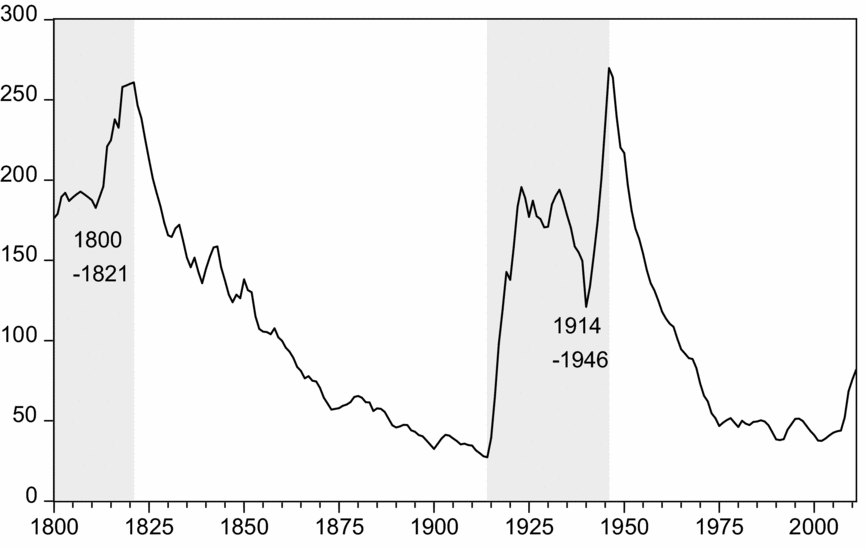
Perhaps the post-Glorious Revolution set of rights was the most ‘efficient’? This brings up the second problem with the North and Weingast argument. In the neoclassical view excessive public debt/GDP growth implies ‘fiscal profligacy’. However, empirically one sees dramatic increases in public debt in the period 1800 and 1821 and again between 1914 and 1946 (see Figure 1), long after the English had established the ‘efficient’ political/legal infrastructure as defined by the New Institutionalists. In both those periods the public debt/GDP ratio went up to 250 per cent.
British Public Debt/GDP (%) 1800–2011. Source: P. Mauro et al., ‘A Modern History of Fiscal Prudence and Profligacy’, (2013) 13/5 IMF Working Paper, International Monetary Fund, Washington, DC (data downloaded from www.imf.org/external/np/fad/histdb/).

In fact, if the attainment of central bank independence is the epitome of market efficiency, the data in Figure 1 is a puzzle from the orthodox view: The BoE remained in private hands, although functioning like a publicly regulated utility, until it was nationalized in 1946 and then eventually granted operational independence in 1997. From a neoliberal perspective, one would have expected high or rising public debt/GDP for much of its history prior to 1997 given its lack of independence – especially under Labour governments. From a CLS perspective, on the other hand, Figure 1 is not at all a puzzle: One would clearly expect multiple legal and political trajectories, not to mention macroeconomic ones, over the 1694–1997 period, which would explain both rising, falling, and relatively stable public debt/GDP ratios. Public choice theory, which informs North and Weingast's argument, is fairly limited in its belief that optimal legal structures can impose discipline on politicians and create ‘efficient’ markets.
Third, the post-Glorious Revolution political and legal settlement involved the stabilization of one set of private property rights but, as North and Weingast point out,Footnote 122 this privileged the wealthy. These elites benefited inordinately from the new system of public finance and the broader thrust of public policies which by mid-nineteenth century led to Britain's global dominance. But this reinforcement of private property and the creation of ‘efficient’ markets were selective as the post-Glorious Revolution settlement also produced the disastrous government-sponsored South Sea venture (which involved slave trading) as well as draconian taxation measures imposed on the working class and peasantry.Footnote 123
It may be pertinent to mention here that North and Weingast's view regarding the post-Glorious Revolution settlement is also selective given that the development of capitalism was intimately connected to the growth of the slave economy, in particular in the American South because of the centrality of cotton, as a number of authors have discussed.Footnote 124 The basic argument here is that capitalist industrialization was fueled by cotton production, and this in turn increased the demand for slaves who grew the cotton. Thus, slavery and capitalism were mutually constitutive.
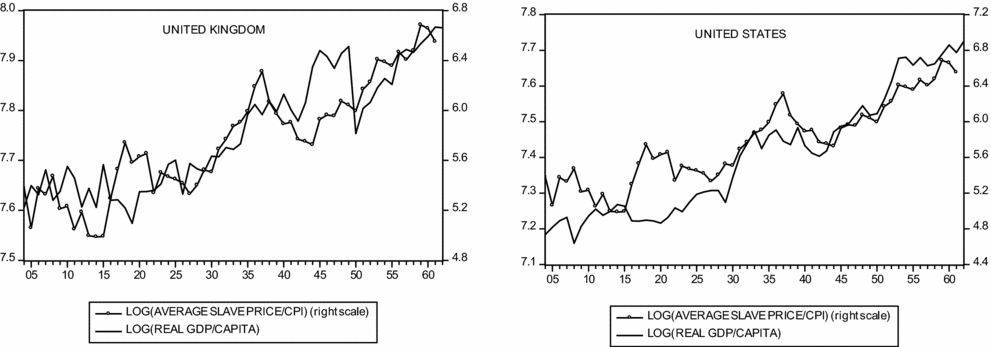
One would therefore expect to see an increase in the relative price of slaves as industrialization proceeded in the UK and US. See Figure 2, which plots real GDP/capita in the UK and US versus the relative price of slaves in the American South (all in natural logs):
Average Slave Price/CPI and Real GDP/Capita in the United Kingdom and United States, 1804–1861. Sources: (a) Slave and CPI data from Historical Statistics of the United States (b) Real GDP per capita data from “Maddison Project Database” (www.ggdc.net/maddison/maddison-project/home.htmwww.imf.org/external/np/fad/histdb/)

What theoretical lessons can be drawn from these striking correlations?Footnote 125 Per the constitutional money view, the creation of money is intimately connected to governance and the politics of the former legally allocate wealth and power in particular ways. Contrary to the New Institutionalist view, the creation of representative democracy in both countries did not lead to the spontaneous development of ‘free markets’ with liberty of property and contracts for all. In fact, the capitalist market economy was interlaced with the development of slavery and the politics of money penetrated and undergirded both types of economies, one with free wage labour, and the other with slavery. The jural relationships at the heart of slaveryFootnote 126 can only have been possible if human beings were commodified (i.e., bought and sold in money form) which, of course, was a political project all the way through. The fact that slavery was eventually banned does not take away from the basic CLS principle that there simply is no ‘pure’ form of capitalism with a unique set of laws functionally engineered onto it. Capitalist markets are built on varieties of politically determined legal foundations:
In fact, a community determines which goods and services can be alienated, and thus what counts as a ‘commodity’, when it decides what items or services money can buy . . . [T]ransactions involving money would not be enforced if they were improperly made or inappropriately targeted a resource that could not be considered a ‘commodity’. Later societies would decide, notoriously, to allow the sale of Africans . . . Those debates are joined by a myriad of others, contests over what else is ‘for sale’, from honours to votes, sex to kidneys.Footnote 127
6. Conclusion
Monetary history shows that the nominalist principle, in which the political authority legally created the unit of account, was the ruling one because a stable monetary system is central to governance. Such a stable unit of account, becoming the basis of property, contracts, and torts, cannot arise through spontaneous ‘market forces’ and maintain itself without a prior legal and political foundation. This view challenges the opposite one in which the law is epiphenomenal and accommodates itself to the ‘needs’ of the market system as it teleologically converges from commodity money to fiat money. In fact, this article has critiqued the New Institutionalist focus on ‘clear and well-defined’ property rights to promote efficient markets and economic development.
Nothing in the constitutional money framework suggests that the state has the autonomy to dictate market outcomes. This is particularly true because money creation has always entailed incentivizing the private sector; with the rise of capitalism it specifically involved harnessing the profit motive for the public goal of promoting a monetary economy. Such a process necessarily led to private wealth accumulation and power struggles over the legal foundations of the economy:
Legal forms and practices are political products that arise from the struggles of conflicting social groups that possess very disparate resources of wealth, power, status, knowledge, access to armed force, and organizational capability.Footnote 128
For example, if the current laws allocate money and power in a particular way, then that could potentially entail future political challenges to the status quo ante. In short:
If the program of Realists was to lift the veil of legal Form to reveal living essences of power and need, the program of the Critics is to lift the veil of power and need to expose the legal elements in their composition.Footnote 129
Given the above, this article has explored the various ways by which monetary instability can occur, an instability that is of course at the heart of Fernand Braudel's longue durée framework, with its focus on turbulence and change. Following Duncan Kennedy's analysis, it has been argued that the indeterminacy criterion, coupled with potential challenges to the background laws, produces non-linear outcomes. Such non-linearities, discussed by several law scholars,Footnote 130 provide very limited information about the future. Simply put, the indeterminacy criterion is the basis of Keynesian uncertainty since it is very difficult to predict ex ante what sets of combinations of background laws will recrystallize when current ones begin to dissolve.
Business opposition to ‘full employment’ policies, the fiscal sociology of taxation, capital flight, and foreign debt are further themes discussed here to analyze the various mechanisms that can destabilize a currency, including creating pressures for currency substitution. Here too the indeterminacy criterion plays a key role in (de)stabilizing the currency.
Finally, the longue durée framework underpinning the constitutional theory of money is strikingly resonant with EP Thompson's observation regarding the ubiquity of legal complexity:
For I found that law did not keep politely to a “level”, but was at every bloody level; it was imbricated within the mode of production and productive relations themselves (as property-rights, definitions of agrarian practice) . . . it was an arm of politics and politics was one of its arms . . . it contributed to the definition of the self-identity both of rulers and of ruled; above all, it afforded an arena for class struggle, within which alternative notions of law were fought out.Footnote 131
In fact, the constitutional monetary approach captures a methodology, both in EP Thompson as well as Robert Brenner's classic work on the European peasantry.Footnote 132 What is evident in all these classic studies is that the prior historical legacy of legal structures – both constituted by and constitutive of political struggles – accumulated over centuries, provides the context to the current nature of markets, power struggles, and thus the bundle of jural relations undergirding money. This longue durée framework denaturalizes markets and thereby reveals the profoundly political and legal anchoring of money as it changes historically. For example, given the centrality of taxation in anchoring the value of money, the relevance of politics and power struggles for the latter can clearly be seen in the political history of taxation.Footnote 133 In short, if MMT is a freeze frame image of the tax-money nexus, the constitutional money view describes an ongoing moving image; the latter is a process analysis with the potential for instability built into its ‘genetic composition’, so to speak.
At the end of the day, if a country's monetary system is a reflection of its governance capacity, theoretical analysis has to explore how such a monetary system and thus sovereignty can be both created and, at times, destabilized. This investigation is at the heart of the current article.