1 Introduction
The turnpike theory investigates an important property of dynamical systems. It can be considered as a theory that justifies the importance of some equilibrium/stationary states. For example, in macroeconomic models, the turnpike property states that regardless of initial conditions, all optimal trajectories spend most of the time within a small neighborhood of some optimal stationary point when the planning period is long enough. Obviously, in the absence of such a property, using some of optimal stationary points as a criterion for “good” policy formulation might be misleading. Correspondingly, the turnpike property is in the core of many important theories in economics.
Many real-life processes are happening in an optimal way and have the tendency to stabilize; that is, the turnpike property is expected to hold for a broad class of problems. It provides valuable insights into the nature of these processes by investigating underlying principles of evolution that lead to stability. It can also be used to assess the “quality” of mathematical modeling and to develop more adequate equations describing system dynamics as well as optimality criteria.
The first result in this area is obtained by von Neumann [Reference von Neumann35] for discrete time systems. The phenomenon is called the turnpike property after Chapter 12 of [Reference Dorfman, Samuelson and Solow9] by Dorfman, Samuelson, and Solow. For a classification of different definitions for this property, see [Reference Carlson, Haurie and Leizarowitz2, Reference Makarov and Rubinov22, Reference McKenzie28, Reference Zaslavski36], as well as [Reference Damm, Grüne, Stieler and Worthmann6] for the so-called exponential turnpike property. Possible applications in Markov Games can be found in a recent study [Reference Kolokoltsov and Yang16].
The approaches suggested for the study of the turnpike property involve continuous and discrete time systems. Some convexity assumptions are sufficient for discrete time systems [Reference Makarov and Rubinov22, Reference McKenzie28]; however, rather restrictive assumptions are usually required for continuous time systems. The majority of them deal with the (discounted and undiscounted) integral functionals. We mention here the approaches developed by Rockafellar [Reference Rockafellar32, Reference Rockafellar33], Scheinkman, Brock, and collaborators (see, for example, [Reference Magill and Scheinkman21, Reference Scheinkman34]), Cass and Shell [Reference Cass and Shell4], Leizarowitz [Reference Leizarowitz18], Mamedov [Reference Mamedov24], Montrucchio [Reference Montrucchio29], and Zaslavski [Reference Zaslavski37–Reference Zaslavski39] (we refer to [Reference Carlson, Haurie and Leizarowitz2, Reference Zaslavski36] for more references).
In this paper, we consider an optimal control problem in discrete time. It extends the results obtained in [Reference Mamedov23] where a special class of terminal functionals is introduced as a lower limit at infinity of utility functions. This approach allowed to establish the turnpike property for a much broader class of optimal control problems than those involving integral functionals (discounted and undiscounted).
Later, this class of terminal functionals was used to establish a connection between the turnpike theory and the notion of statistical convergence [Reference Mamedov and Pehlivan25, Reference Pehlivan and Mamedov31]; as a result, the convergence of optimal trajectories is proved in terms of the statistical (“almost”) convergence. These terminal functionals also allowed the extension of the turnpike theory to time delay systems; the first results in this area have been established in several recent papers [Reference Ivanov, Mammadov and Trofimchuk13, Reference Mammadov26]. Moreover, some generalizations based on the notion of the A-statistical cluster points have been obtained in [Reference Das, Dutta, Mohiuddine and Alotaibi7].
The main purpose of this paper is to formulate the optimality criteria by using the notion of ideal convergence. As detailed in the next section, the ideal convergence is a more general concept than the statistical convergence as well as the A-statistical convergence. In this way, the turnpike property is established for a broad class of nonconvex optimal control problems where the asymptotical stability of optimal trajectories is formulated in terms of the ideal convergence.
Recently (and independently) Leonetti and Caprio in [Reference Leonetti and Caprio19] considered turnpike property for ideals invariant under translation in the context of normed vector spaces. We discuss our approaches in Section 4.
The rest of this article is organized as follows. In the next section, the definition of the ideal, its properties, and some particular cases, including the statistical convergence, are provided. In Section 3, we formulate the optimal control problem and main assumptions. The main results of the paper—the turnpike theorems—are provided in Section 4. The proof of the main theorem is provided in Section 5.
2 Convergence with respect to ideal versus statistical convergence
Let
 $x=(x_n)_{n\in \mathbb {N}}$
be a sequence of elements of
 $\mathbb {R}^m$
. For the sake of simplicity, we will consider the Euclidean norm
 $\left \|\cdot \right \|.$
The classical definition of convergence of x to a says that for every
 $\varepsilon>0$
, the set of all
 $n\in \mathbb {N}$
with
 $\left \|x_n-a\right \|\geq \varepsilon $
is finite, i.e., it is “small” in some sense. If we understand the word “small” as “of asymptotic density zero,” then we obtain the definition of statistical convergence (Definition 2.4). The same method can be used to formulate the definition of statistical cluster point. The classical one says that a is a cluster point of x if for every
 $\varepsilon>0$
the set of all
 $n\in \mathbb {N}$
with
 $\left \|x_n-a\right \|<\varepsilon $
is infinite, i.e., it has “many” elements. If “many” means “not of asymptotic density zero,” then we obtain the definition of statistical cluster point (see, e.g., [Reference Fridy12]).
One of the possible generalizations of this kind of being “small” (having “many” elements) is “belonging to the ideal” (“be an element of co-ideal”).
The cardinality of a set X is denoted by
 ${\#{}X}$
.
 $\mathcal {P}(\mathbb {N})$
denotes the power set of
 $\mathbb {N}$
.
Definition 2.1 An ideal on
 $\mathcal {P}(\mathbb {N})$
is a family
 $\mathcal {I}\subset \mathcal {P}(\mathbb {N})$
which is nonempty, hereditary, and closed under taking finite unions, i.e., it fulfills the following three conditions:
-
(1)
 $\emptyset \in \mathcal {I}$
.
-
(2)
$A\in \mathcal {I}$
if
$A\subset B$
and
$B\in \mathcal {I}$
. -
(3)
$A\cup B\in \mathcal {I}$
if
$A,B\in \mathcal {I}$
.


Example 2.1 By
 $\mathrm {Fin}$
, we denote the ideal of all finite subsets of
 $\mathbb {N}=\{1,2,\ldots \}$
. There are many examples of ideals considered in the literature, e.g.:
-
(1) the ideal of sets of asymptotic density zero
$$\begin{align*}\mathcal{I}_d=\left\{A\subset\mathbb{N}\ :\ \overline{d}(A)=0\right\},\end{align*}$$
where
$\overline {d}\colon \mathcal {P}(\mathbb {N})\to [0,1]$
is given by the formula
$$\begin{align*}\overline{d}(A)=\limsup_{n\to\infty} \frac{{\#{}(A\cap\{1,2,\ldots,n\})}}{n}\end{align*}$$
is the well-known definition of upper asymptotic density of the set A;
-
(2) the ideal of sets of logarithmic density zero
$$\begin{align*}\mathcal{I}_{\mathrm{log}}=\left\{A\subset\mathbb{N}\ :\ \limsup_{n\to\infty}\frac{\sum_{k\in A\cap\{1,2,\ldots,n\}}\frac{1}{k}}{\sum_{k\leq n}\frac{1}{k}}=0\right\};\end{align*}$$
-
(3) the ideal
$$\begin{align*}\mathcal{I}_{1/n}= \left\{A\subset\mathbb{N}: \sum_{n\in A}\frac{1}{n}<\infty\right\};\end{align*}$$
-
(4) the ideal of arithmetic progressions free sets
$$\begin{align*}\mathcal{W}=\left\{W\subset\mathbb{N}\ :\ W\ \mathrm{does\ not\ contain\ arithmetic\ progressions\ of\ all\ lengths}\right\}\!.\end{align*}$$


Ideals
 $\mathcal {I}_d$
and
 $\mathcal {I}_{\mathrm{log}}$
belong to the wider class of Erdős–Ulam ideals (defined by submeasures of special kind; see [Reference Just and Krawczyk14]). Ideal
 $\mathcal {I}_{1/n}$
is a representant of the class of summable ideals (see [Reference Mazur27]). The fact that
 $\mathcal {W}$
is an ideal follows from the nontrivial theorem of van der Waerden (this ideal was considered by Kojman in [Reference Kojman15]). One can also consider trivial ideals
 $\mathcal {I}=\mathcal {P}(\mathbb {N})$
,
 $\mathcal {I}=\{\emptyset \}$
, or principal ideals
 $\mathcal {I}_n=\{A\subset \mathbb {N}\colon n\notin A\}$
; however, they are not interesting from our point of view. If not explicitly said, we assume that all considered ideals are proper (i.e.,
 $\mathcal {I}\not =\mathcal {P}(\mathbb {N})$
) and contain all finite sets (i.e.,
 $\mathrm {Fin}\subset \mathcal {I}$
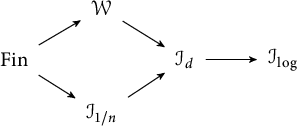
). The inclusions between the abovementioned families are shown in Figure 1. The only nontrivial inclusions are
 $\mathcal {I}_{1/n}\subset \mathcal {I}_d$
(a folklore application of Cauchy condensation test),
 $\mathcal {W}\subset \mathcal {I}_d$
(the famous theorem of Szemerédi), and
 $\mathcal {I}_d\subset \mathcal {I}_{\mathrm{log}}$
(by well-known inequalities between upper logarithmic density and upper asymptotic density). It is easy to observe that
 $\mathcal {I}_{1/n}\not \subset \mathcal {W}$
, but the status of the inclusion
 $\mathcal {W}\subset \mathcal {I}_{1/n}$
is unknown (“Erdős conjecture on arithmetic progressions” says that the van der Waerden ideal
 $\mathcal {W}$
is contained in the ideal
 $\mathcal {I}_{1/n}$
.)
Inclusions of ideals, implications between
 $\mathcal {I}$
-convergence, and inclusions of sets of
 $\mathcal {I}$
-cluster points for ideals from Example 2.1. Arrow “
 $\mathcal {I}\longrightarrow \mathcal {J}$
” means that “
 $\mathcal {I}\subset \mathcal {J}$
,” and for every sequence x, “
 $x\to _{\mathcal {I}} a \Rightarrow x\to _{\mathcal {J}} a$
,” “
 $\Gamma _{\mathcal {I}}(x)\supset \Gamma _{\mathcal {J}}(x)$
.”

2.1
$\mathcal {I}$
-convergence and
$\mathcal {I}$
-cluster points


The notion of the ideal convergence is dual (equivalent) to the notion of the filter convergence introduced by Cartan in 1937 [Reference Cartan3]. The notion of the filter convergence has been an important tool in general topology and functional analysis since 1940 (when Bourbaki’s book [Reference Bourbaki1] appeared). Nowadays, many authors prefer to use an equivalent dual notion of the ideal convergence (see, e.g., frequently quoted work [Reference Kostyrko, Šalát and Wilczyński17]).
Definition 2.2 A sequence
 $(x_n)_{n\in \mathbb {N}}$
of elements of
 $\mathbb {R}^m$
is said to be
 $\mathcal {I}$
-convergent to
 $a\in \mathbb {R}^m$
(
 $a = \mathcal {I}-\lim x_n$
, or
 $x_n\to _{\mathcal {I}} a$
, in short) if and only if for each
 $\varepsilon>0$
,
 $$\begin{align*}\left\{n\in\mathbb{N}\ :\ \left\|x_n-a\right\|\geq\varepsilon\right\}\in\mathcal{I}.\end{align*}$$
The sequence
 $(x_n)$
is convergent to a if and only if it is
 $\mathrm {Fin}$
-convergent to a.
It is also easy to see that for any sequence
 $x=(x_n)$
and two ideals
 $\mathcal {I}$
,
 $\mathcal {J}$
, if
 $\mathcal {I}\subset \mathcal {J}$
, then
 $x\to _{\mathcal {I}} a$
implies that
 $x\to _{\mathcal {J}} a$
(see Figure 1).
Definition 2.3 The
 $a\in \mathbb {R}^m$
is an
 $\mathcal {I}$
-cluster point of a sequence
 $x=(x_n)_{n\in \mathbb {N}}$
of elements of
 $\mathbb {R}^m$
if for each
 $\varepsilon>0$
,
 $$\begin{align*}\{n\in\mathbb{N}\colon \left\|x_n-a\right\|<\varepsilon\}\notin\mathcal{I}.\end{align*}$$
By
 $\mathcal {I}$
-cluster set of x, we understand the set
 $$\begin{align*}\Gamma_{\mathcal{I}}(x)=\left\{a\in\mathbb{R}^m\colon a\mathrm{\ is an\ }\mathcal{I}\mathrm{-cluster point of\ }x\right\}.\end{align*}$$
Recall that
 $\Gamma (x)=\Gamma _{\mathrm {Fin}}(x)$
is a set of classical cluster (limit) points of x.
Proposition 2.2 For any bounded sequence
 $x=(x_n)$
:
-
(1)
$\Gamma _{\mathcal {I}}(x)\not =\emptyset $
[Reference Nuray and Ruckle30], -
(2)
$\Gamma _{\mathcal {I}}(x)$
is closed [Reference Kostyrko, Šalát and Wilczyński17], and -
(3)
$\Gamma _{\mathcal {I}}(x)=\{a\}$
if and only if
$x\to _{\mathcal {I}} a$
.


Moreover, if
 $\mathcal {I}\subset \mathcal {J}$
, then
 $\Gamma _{\mathcal {J}}(x)\subset \Gamma _{\mathcal {I}}(x)$
([Reference Nuray and Ruckle30], see Figure
1).
Part
 $(3)$
follows from the folklore argument: a is the unique
 $\mathcal {I}$
-cluster point of x, iff
 $\{n\colon ||x_n-a||\geq \varepsilon \}\in \mathcal {I}$
for every
 $\varepsilon>0$
, iff
 $x_n\to _{\mathcal {I}} a$
.
2.2
$\mathcal {I}$
-convergence versus statistical convergence

The notion of the ideal convergence is a common generalization of the classical notion of convergence and statistical convergence. The concept of statistical convergence was introduced by Fast [Reference Fast10], and then it was studied by many authors.
Definition 2.4 [Reference Fast10]
A sequence
 $x=(x_n)_{n\in \mathbb {N}}$
of elements of
 $\mathbb {R}^m$
is said to be statistically convergent to an
 $a\in \mathbb {R}^m$
if for each
 $\varepsilon>0$
the set of all indices n such that
 $\{n\in \mathbb {N}\colon \left \|x_n-a\right \|\geq \varepsilon \}$
has upper asymptotic density zero, i.e.,
 $$\begin{align*}\overline{d}(\{n\in\mathbb{N}\colon \left\|x_n-a\right\|\geq\varepsilon\})=0, \quad\mathrm{for\ all\ } \varepsilon>0.\end{align*}$$
Obviously, x is statistically convergent to a if and only if
 $x\to _{\mathcal {I}_d}a$
. Following the concept of a statistically convergent sequence, Fridy in [Reference Fridy12] introduced the notion of a statistical cluster point, which—using our notation—is equal to the notion of
 $\mathcal {I}_d$
-cluster point. Proposition 2.2 in case of statistical convergence was proved in [Reference Fridy12]. Since statistical convergence is a particular case of
 $\mathcal {I}$
-convergence, each theorem that has an ideal variant is also true in its statistical version. However, in the sequel, we will use some lemmas which were formulated in the literature for the case of statistical convergence and statistical cluster points.
An open
 $\varepsilon $
-neighborhood of a given set
 $A\subset \mathbb {R}^m$
will be denoted by
 $$\begin{align*}B(A,\varepsilon) = \{y\in\mathbb{R}^m\colon \exists_{a\in A} \left\|a-y\right\|<\varepsilon\}.\end{align*}$$
For each
 $a\in \mathbb {R}^m$
, we do not distinguish between
 $B(\{a\},\varepsilon )$
and
 $B(a,\varepsilon )$
.
Lemma 2.3 [Reference Pehlivan and Mamedov31]
Let
 $x = (x_k)_{k\in \mathbb {N}}$
be a bounded sequence. Then, for any
 $\varepsilon> 0$
,
 $$\begin{align*}\overline{d}\Big(\left\{k \in\mathbb{N} \colon x_k\notin B(\Gamma_{\mathcal{I}_d} (x),\varepsilon) \right\}\Big)=0.\end{align*}$$
The ideal version of the above lemma can be proved using the same method as in [Reference Pehlivan and Mamedov31], but we give a short proof using [Reference Činčura, Šalát, Sleziak and Toma5, Lemma 3.1].
Lemma 2.4 [Reference Činčura, Šalát, Sleziak and Toma5]
Suppose that
 $\mathcal {I}$
is an ideal,
 $(x_n)$
is a sequence, and
 $K\subset \mathbb {R}^m$
is compact. If
 $\{n\in \mathbb {N}\colon x_n\in K\}\notin \mathcal {I}$
, then
 $K\cap \Gamma _{\mathcal {I}}(x)\not =\emptyset $
.
Lemma 2.5 (Ideal version of Lemma 2.3)
Let
 $x = (x_k)_{k\in \mathbb {N}}$
be a bounded sequence. Then, for any ideal
 $\mathcal {I}$
and
 $\varepsilon> 0$
,
 $$\begin{align*}\left\{k \in\mathbb{N} \colon x_k\notin B(\Gamma_{\mathcal{I}} (x),\varepsilon) \right\}\in\mathcal{I}.\end{align*}$$
Proof
Since x is bounded, there exists a compact set C such that
 $x_n\in C$
for all n. If we assume that
 $\left \{k \in \mathbb {N} \colon x_k\notin B(\Gamma _{\mathcal {I}} (x),\varepsilon ) \right \}\notin \mathcal {I}$
, then the set
 $K=C\setminus B(\Gamma _{\mathcal {I}} (x),\varepsilon )$
is compact and
 $\{n\in \mathbb {N}\colon x_n\in K\}\notin \mathcal {I}$
. By Lemma 2.4,
 $K\cap \Gamma _{\mathcal {I}}(x)\not =\emptyset $
, a contradiction.
2.3 Ideals invariant under translations
By
 $\mathbb {Z}$
, we denote the set of all integers.
Definition 2.5 We say that an ideal
 $\mathcal {I}$
is invariant under translations if for each
 $A\in \mathcal {I}$
and
 $i\in \mathbb {Z}$
,
 $$\begin{align*}A+i\in\mathcal{I}, \mathrm{\ where\ } A+i=\left\{a+i\ :\ a\in A\right\}\cap\mathbb{N}.\end{align*}$$
All ideals considered in Example 2.1 are invariant under translations. For the proof of this fact and other examples, see [Reference Filipów and Szuca11].
Our main results from Section 4 are valid for ideals invariant under translations. The key argument for this fact is the following property of
 $\mathcal {I}$
-cluster sets for such ideals.
Lemma 2.6 Suppose that
 $\mathcal {I}$
is invariant under translations, and that
 $x=(x_k)_{k\in \mathbb {N}}$
is a sequence in
 $\mathbb {R}^m$
. Then, for any nonempty
 $G\subset \Gamma _{\mathcal {I}}(x)$
,
 $i\in \mathbb {Z}$
and
 $\delta _1,\delta _2>0$
:
 $$\begin{align*}\left\{k\in\mathbb{N}\colon x_k\in B\left(G,\delta_1\right)\mathrm{\ and\ }x_{k+i}\in B\left(\Gamma_{\mathcal{I}}(x),\delta_2\right)\right\}\notin\mathcal{I}.\end{align*}$$
In particular, this set is nonempty.
Proof
Let
 $K^1_{\delta _1}=\{k\in \mathbb {N}\colon x_k\in B(G,\delta _1)\}$
and
 $K^2_{\delta _2}=\{k\in \mathbb {N}\colon x_k\in B(\Gamma _{\mathcal {I}}(x),\delta _2)\}$
. Since
 $G\subset \Gamma _{\mathcal {I}}(x)$
and
 $G\not =\emptyset $
,
 $K^1_{\delta _1}\notin \mathcal {I}$
. By Lemma 2.5,
 $\mathbb {N}\setminus K^2_{\delta _2}\in \mathcal {I}$
. Consider the set
 $K^1_{\delta _1}+i=\{k+i \colon k\in K^1_{\delta _1}\}$
.
 $\mathcal {I}$
is invariant under translations, so
 $K^1_{\delta _1}+i\notin \mathcal {I}$
. Let
 $K=(K^1_{\delta _1}+i) \cap K^2_{\delta _2}$
. Since K is an intersection of two sets, one from the co-ideal (i.e., not from the ideal) and the second from the dual filter (i.e., its complement belongs to the ideal),
 $K\notin \mathcal {I}$
. Consider the set
 $K-i=\{k-i\colon k\in K\}$
. Again, since
 $\mathcal {I}$
is invariant under translations,
 $K-i\notin \mathcal {I}$
. For each
 $k\in K-i$
,
 $x_k\in B\left (G,\delta _1\right )\mathrm {\ and\ } x_{k+i}\in B\left (\Gamma _{\mathcal {I}}(x),\delta _2\right )$
.
If
 $\mathcal {I}$
is invariant under translations, then either
 $\mathcal {I}$
is a trivial ideal
 $\{\emptyset \}$
, or
 $\mathcal {I}$
contains all finite sets (i.e.,
 $\mathrm {Fin}\subset \mathcal {I}$
). Indeed, if there is a nonempty set
 $F\in \mathcal {I}$
, then
 $\{n\}\in \mathcal {I}$
for each
 $n\in F$
. From the invariance of
 $\mathcal {I}$
, it follows that
 $\{k\}\in \mathcal {I}$
for every
 $k\in \mathbb {N}$
. Since
 $\mathcal {I}$
is closed on finite unions, each finite set belongs to
 $\mathcal {I}$
.
3 Optimal control problem and main assumptions
Consider the problem
 $$ \begin{align}x_{n+1}=f(x_n,u_n), x_1=\zeta^0, u_n\in U,\end{align} $$
 $$\begin{align} J_{\mathcal{I}}(x)=\mathcal{I}\mathrm{-}\liminf \phi(x_n) \rightarrow \max.\end{align} $$
Here,
 $\zeta ^0$
is a fixed initial point, function
 $f\colon \mathbb {R}^m\times \mathbb {R}^t\to \mathbb {R}^m$
is continuous,
 $U\subset \mathbb {R}^t$
is a compact set,
 $\phi \colon \mathbb {R}^m\to \mathbb {R}$
is a continuous function, and for any sequence of reals
 $y=(y_n)$
,
 $$\begin{align*}\mathcal{I}\mathrm{-}\liminf y=\sup\left\{y_0\in\mathbb{R}\colon\left\{n\in\mathbb{N}\colon y_n<y_0\right\}\in\mathcal{I}\right\}.\end{align*}$$
The pair
 $\langle u,x\rangle $
is called a process if the sequences
 $x = (x_n)$
and
 $u = (u_n)$
satisfy
 $(*)$
for all
 $n\in \mathbb {N}$
(x is called a trajectory and u is called a control).
In the sequel, we will use the following characterization of the functional
 $J_{\mathcal {I}}$
[Reference Das, Dutta, Mohiuddine and Alotaibi7, Lemma 4.1] that is a generalization of Lemma 3.1 in [Reference Pehlivan and Mamedov31] established for the statistical convergence, as well as the corresponding result from [Reference Lyapunov20] established for classical convergence (see also [Reference Leonetti and Caprio19, Corollary 3.3]).
Lemma 3.1 For any bounded trajectory
 $x = (x_n)_{n\in \mathbb {N}}$
, the following representation is true:
 $$\begin{align*}J_{\mathcal{I}}(x)=\min\Gamma_{\mathcal{I}}(\phi(x))=\min_{\zeta\in\Gamma_{\mathcal{I}}(x)}\phi(\zeta).\end{align*}$$
We assume that there is a compact (bounded and closed) set
 $C\subset \mathbb {R}^m$
such that
 $x_n\in C$
for all trajectories; that is, we assume that trajectories are uniformly bounded.
 $\zeta \in \mathbb {R}^m$
is called a stationary point if there exists
 $u_0\in U$
such that
 $f(\zeta ,u_0) = \zeta $
. We denote the set of stationary points by M. It is clear that M is a closed set.
 $\zeta ^\star \in M$
is called an optimal stationary point if
 $$\begin{align*}\phi(\zeta^\star)=\phi^\star ~\dot{=}~ \max_{\zeta\in M}\phi(\zeta).\end{align*}$$
We will assume that the set of all optimal stationary points is nonempty. This is not a restrictive assumption since function
 $\phi $
is continuous and the set M is closed; for example, it is satisfied if M is in addition bounded.
Define the set
 $$\begin{align*}M^\star=\left\{\zeta^\star\in M\colon ~\zeta^\star \mathrm{\ is\ an\ optimal\ stationary\ point}\right\}\!,\end{align*}$$
and
 $$\begin{align*}D^\star=\left\{\zeta\in C\colon ~\phi(\zeta)\geq\phi^\star\right\}\!.\end{align*}$$
We assume that the set C is large enough to accommodate
 $M^\star ;$
that is,
 $M^\star \subset C$
. Then clearly,
 $M^\star =M\cap D^\star $
.
Consider the following three conditions.
-
(C1): Optimal stationary point
$\zeta ^\star $
is unique, i.e.,
$M^\star =\{\zeta ^\star \}$
. -
(ℐ/C2): There exists a process
$\langle u^\star ,x^\star \rangle $
such that
$\Gamma _{\mathcal {I}}(x^\star )\subset D^\star $
. -
(C3): There exists a continuous function
$P\colon \mathbb {R}^m\to \mathbb {R}$
such that and
$$\begin{align*}P(f(x_0,u_0))<P(x_0) ~~~~~ \mathrm{for~all}~~ x_0\in D^\star\setminus M^\star, u_0\in U, \end{align*}$$
$$\begin{align*}P(f(x_0,u_0))\leq P(x_0) ~~~~~ \mathrm{for~all}~~ x_0\in D^\star, u_0\in U. \end{align*}$$


One can also consider condition
 $(C2)=(\mathrm {Fin}\mathrm {/}C2)$
:
-
$(C2)$
: There exists a process
$\langle u^\star ,x^\star \rangle $
such that any limit point of the sequence
$x^\star $
is in
$D^\star $
.


Note that if the (unique) optimal stationary point
 $\zeta ^\star $
belongs to the interior of
 $D^\star $
, then the proof of turnpike property is not difficult and can be regarded as a “trivial” case where condition
 $(C3)$
ensures the existence of some Lyapunov function, with derivative
 $P,$
defined on a small neighborhood of
 $\zeta ^\star .$
The most interesting case is when an optimal stationary point
 $\zeta ^\star $
belongs to a boundary of
 $D^\star $
; that is, both the sets
 $D^\star $
and
 $D^{\star -} = \left \{\zeta \in C\colon ~\phi (\zeta )<\phi ^\star \right \}$
have nonempty intersection with any small neighborhood of
 $\zeta ^\star $
. In this case, the inequality
 $P(f(x_0,u_0))>P(x_0)$
may hold for some
 $x_0 \in D^{\star -}$
; that is, condition
 $(C3)$
does not guarantee the existence of Lyapunov functions.
Note also that condition
 $(\mathcal {I}\mathrm {/}C2)/(C2)$
can be formulated equivalently “there exists a process
 $\langle u^\star ,x^\star \rangle $
such that
 $J_{\mathcal {I}}(x^\star ) \geq \phi ^\star $
” (see [Reference Leonetti and Caprio19, equation
 $(A6)$
]), or stronger “there exists a process
 $\langle u^\star ,x^\star \rangle $
such that
 $x^\star \to _{\mathcal {I}} \zeta ^\star $
” (see [Reference Mamedov23, Reference Mamedov and Pehlivan25, Reference Pehlivan and Mamedov31]),
Recall that if
 $\mathcal {I}\subset \mathcal {J}$
, then
 $\mathcal {I}$
-convergence is stronger than
 $\mathcal {J}$
-convergence; thus, by Proposition 2.2,
 $(C2)$
is stronger than
 $(\mathcal {I}\mathrm {/}C2)$
for each nontrivial
 $\mathcal {I}$
which is invariant under translations. Example 3.2 shows that these two conditions are really different; i.e., there exists a system for which
 $(C1)$
,
 $(\mathcal {I}_d\mathrm {/}C2)$
, and
 $(C3)$
hold, but
 $(C2)$
does not hold (see also [Reference Leonetti and Caprio19, Example 2.5]).
Example 3.2 Consider the middle-third Cantor set T. It is homeomorphic to the space
 $\{0,1\}^{\mathbb {N}}$
with the product (Tychonoff) topology; for example, the formula
 $$ \begin{align} \sum_{i=1}^\infty \frac{2\cdot a_i}{3^i} \mathrm{\ for\ any\ } a=\langle a_1,a_2,\ldots\rangle\in\{0,1\}^{\mathbb{N}} \end{align} $$
gives us a homeomorphism between
 $\{0,1\}^{\mathbb {N}}$
with Tychonoff topology and middle-third Cantor set. In this example, we will not distinguish between T and
 $\{0,1\}^{\mathbb {N}}$
with appropriate topologies.
For any
 $a=\langle a_1,a_2,\ldots \rangle \in \{0,1\}^{\mathbb {N}}=T$
, consider the shift map
 $\sigma $
given by the formula [Reference Devaney8]:
 $$\begin{align*}\sigma(a)=\langle a_2,a_3,\ldots\rangle.\end{align*}$$
Since T is a closed subspace of
 $[0,1]$
, by Tietze’s extension theorem, it can be extended to some continuous function
 $f_0\colon [0,1]\to [0,1]$
.
Let
 $$\begin{align*}S=\left\{\frac{1}{2}\cdot 1, \frac{1}{2}\cdot\frac{1}{3}, \frac{1}{2}\cdot\frac{1}{9}, \ldots\right\};\end{align*}$$
that is, it is the set of centers of most left intervals removed from
 $[0,1]$
during the classical construction of the middle-third Cantor set. Since
 $\sigma (0)=0$
and
 $\sigma $
is continuous, we can assume also that
 $f_0(s)=0$
for each
 $s\in S$
(we can multiply original
 $f_0$
by the continuous function which is equal to identity on T and equals 0 on S).
Let
 $m=t=1$
,
 $C = [0,1]$
, and
 $U=\{0\}$
. Define
 $f\colon C\times U\to C$
by the formula
 $$\begin{align*}f(x_0,u_0) = f_0(x_0).\end{align*}$$
Additionally, let
 $\zeta ^0\in \{0,1\}^{\mathbb {N}} = T\subset C$
be given by the formula
 $$\begin{align*}\zeta^0=\langle 1,0,1,0,0,1,0,0,0,1,0,0,0,0,\ldots\rangle\end{align*}$$
(the sequence of n zeros and one, followed by
 $n+1$
zeros and one, and so on). In terms of mapping (3.1),
 $$\begin{align*}\zeta^0 = 2\cdot\sum_{i=2}^\infty \left(\frac{1}{3}\right)^{\frac{i\cdot (i-1)}{2}} \in [0,1].\end{align*}$$
Let
 $P(x_0)=x_0$
for each
 $x_0\in [0,1]$
, and let
 $\phi \colon [0,1]\to [0,1]$
be a continuous function such that
 $\phi (x_0)=1$
for
 $x_0\in S\cup \{0\}$
, and
 $\phi (x_0)<1$
otherwise.
Note that for the problem defined in Section 3:
-
•
$0\in M$
and
$S\cap M=\emptyset $
. -
•
$\zeta ^\star =0$
and
$M^\star =\{\zeta ^\star \}$
. -
•
$D^\star =S\cup \{0\}$
.


Thus:
-
(1) The condition
$(C1)$
holds: the optimal stationary point
$\zeta ^\star $
is unique, i.e.,
$M^\star =\{\zeta ^\star \}$
. -
(2) The condition
$(C3)$
holds: for every
$\zeta \in S$
and
$u \in U$
,
$$\begin{align*}\hspace{-17pt}P(f(\zeta,u))=f(\zeta,u)=0<\zeta=P(\zeta) \mathrm{\ and\ } P(f(\zeta^\star,u))=f(\zeta^\star,u)=0=\zeta^\star=P(\zeta^\star).\end{align*}$$


Observe that for any path x for the system
 $(*)$
:
-
•
$\Gamma (x)=\{0,\langle 1,0,0,0,\ldots \rangle ,\langle 0,1,0,0,0,\ldots \rangle ,\langle 0,0,1,0,0,0,\ldots \rangle ,\ldots \}$
; in terms of mapping (3.1),
$\Gamma (x)=\{0, 2/3, 2/9, 2/27, \ldots \}$
. -
•
$\Gamma _{\mathcal {I}_d}(x)=\{0\}=\mathcal {I}_d\mathrm {-}\lim x$
.


Therefore, the condition
 $(\mathcal {I}_d\mathrm {/}C2)$
holds (take
 $x^\star =\langle \zeta ^\star ,\sigma (\zeta ^\star ), \sigma (\sigma (\zeta ^\star )),\ldots \rangle $
), but
 $(C2)=(\mathrm {Fin}\mathrm {/}C2)$
does not hold.
4 Main results
The main result of this paper is presented next. The proof of this theorem is provided in Section 5.
Theorem 4.1 Suppose that
 $\mathcal {I}$
is invariant under translations, that
 $(C1)$
,
 $(\mathcal {I}\mathrm {/}C2)$
, and
 $(C3)$
hold, and that
 $\langle u^{\mathrm{opt}},x^{\mathrm{opt}} \rangle $
is an optimal process in the problem
 $(*), (\mathcal {I}\mathrm {/}\!**)$
. Then
 $x^{\mathrm{opt}} \to _{\mathcal {I}} \zeta ^\star $
, where
 $\zeta ^\star $
is the unique optimal stationary point from
 $(C1)$
.
Note that from part
 $(3)$
of Proposition 2.2, the assertion “
 $x^{\mathrm{opt}} \to _{\mathcal {I}} \zeta ^\star $
” is equivalent to “
 $\Gamma _{\mathcal {I}}(x)=\{\zeta ^\star \}$
.”
It is also easy to see that the assertion of Theorem 4.1 is true if
 $D^\star $
is a singleton (i.e.,
 $D^\star =\{\zeta ^\star \}$
). However, the following example shows that if
 $\zeta ^\star $
is an isolated point of
 $D^\star $
(if we assume only the first part of condition
 $(C3)$
), then Theorem 4.1 may not be true.
Example 4.2 Let
 $\mathcal {I}=\mathrm {Fin}$
,
 $m=1$
, and
 $C = U = [0,1]$
, and for each
 $x\in C$
:
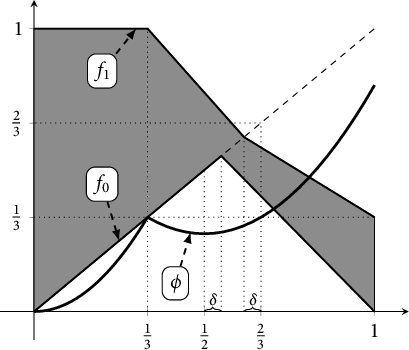
 $$\begin{align*}f_0(x)=\left\{\begin{array}{ll} x, & \mathrm{for\ } 0\leq x\leq\frac{1}{2}+\delta,\\ \frac{\left(0-\left(\frac{1}{2}+\delta\right)\right)\cdot\left(x-\left(\frac{1}{2}+\delta\right)\right)}{1-\left(\frac{1}{2}+\delta\right)}+\left(\frac{1}{2}+\delta\right), & \mathrm{for\ } \frac{1}{2}+\delta<x\leq 1,\\ \end{array} \right.\end{align*}$$
 $$\begin{align*}f_1(x)=\left\{\begin{array}{ll} 1, & \mathrm{for\ } 0\leq x\leq\frac{1}{3},\\ \frac{\left(\left(\frac{2}{3}-\delta\right)-1\right)\cdot\left(x-\frac{1}{3}\right)}{\left(\frac{2}{3}-\delta\right)-\frac{1}{3}}+1, & \mathrm{for\ } \frac{1}{3}<x\leq\frac{2}{3}-\delta,\\ \frac{\left(\frac{1}{3}-\left(\frac{2}{3}-\delta\right)\right)\cdot\left(x-\left(\frac{2}{3}-\delta\right)\right)}{1-\left(\frac{2}{3}-\delta\right)}+\left(\frac{2}{3}-\delta\right), & \mathrm{for\ } \frac{2}{3}-\delta<x\leq 1,\\ \end{array} \right.\end{align*}$$
where
 $\delta <\frac {1}{12}$
(for example, in Figure 2,
 $\delta =0.05$
). Define
 $f\colon C\times U\to C$
by the affine formula
 $$\begin{align*}f(x,u) = f_0(x)\cdot (1-u) + f_1(x)\cdot u.\end{align*}$$
Additionally, let
 $\zeta ^0=\frac {1}{3}$
and
 $P(x)=x$
for each
 $x\in C$
. For the definition of
 $\phi $
and visualization of
 $f_0,f_1$
, see Figure 2.
Graph of the quantity
 $\phi $
and
 $f_0,f_1$
for Example 4.2.

Note that for the problem defined in Section 3:
-
•
$M=[0,\frac {2}{3}-\delta ]$
. -
•
$\zeta ^\star =\zeta ^0=\frac {1}{3}$
,
$\phi ^\star =\frac {1}{3}$
, and
$M^\star =\{\frac {1}{3}\}$
. -
•
$D^\star =\{\frac {1}{3}\}\cup [\frac {2}{3},1]$
.


Thus:
-
(1) Optimal stationary point
$\zeta ^\star $
is unique. -
(2) The condition
$(C2)$
also holds; for example, for
$x^\star =(\zeta ^0,\zeta ^0,\zeta ^0,\ldots )$
,
$u^\star =(0,0,0,\ldots )$
. -
(3) The first part of condition
$(C3)$
holds: for every
$\zeta \in [\frac {2}{3},1]$
and
$u \in U$
,
$$\begin{align*}P(f(\zeta,u))=f(\zeta,u)\leq f_1(\zeta)<\zeta=P(\zeta).\end{align*}$$


In this example, the process
 $\langle u^{\mathrm{opt}},x^{\mathrm{opt}} \rangle ,$
where
 $x^{\mathrm{opt}}=(\frac {1}{3},1,\frac {1}{3},1,\frac {1}{3},1,\ldots )$
and
 $u^{\mathrm{opt}}=(0,1,0,1,0,1,\ldots ),$
is an optimal process; however,
 $x^{\mathrm{opt}}$
does not converge to
 $\zeta ^\star $
in the sense of
 $\mathcal {I}$
-convergence (which is equivalent to
 $\mathrm {Fin}$
-convergence).
Example 4.2 works for classical convergence, statistical convergence, and for general ideal convergence. It shows that additional assumption about “density” of
 $D^\star $
in
 $\zeta ^\star $
(i.e., the second part of condition
 $(C3)$
) is necessary in [Reference Das, Dutta, Mohiuddine and Alotaibi7], as well as in [Reference Mamedov and Pehlivan25].
Recently, Leonetti and Caprio in [Reference Leonetti and Caprio19] proposed another way to bypass the problem indicated in Example 4.2:
-
$(C3{\mathrm {-LC}})$
: There exists a linear (and therefore continuous) function
$P\colon \mathbb {R}^m\to \mathbb {R}$
such that
$$\begin{align*}P(f(x_0,u_0))<P(x_0) ~~~~~ \mathrm{for~all}~~ x_0\in D^\star, u_0\in U, \langle x_0,f(x_0,u_0)\rangle\not=\langle \zeta^\star,\zeta^\star\rangle, \end{align*}$$


where
 $\zeta ^\star $
is an optimal stationary point. It follows from the above condition that
 $\zeta ^\star $
is the unique optimal stationary point, and it is easy to see that
 $(C3{\mathrm {-LC}})$
implies
 $(C3)$
. However, we do not have any example of the system with
 $(C1)+(C3)$
and without
 $(C3{\mathrm {-LC}})$
.
4.1 Special cases
In this section, we consider two special cases of the ideal convergence, that is, classical convergence and statistical convergence.
4.1.1 Classical convergence
Consider the classical convergence in the problem
 $(*)$
,
 $(\mathcal {I}\mathrm {/}\!**)$
. In this case,
 $$\begin{align*}\Gamma(x)=\Gamma_{\mathrm{Fin}}(x)=\left\{a\in\mathbb{R}^m\colon (x_{n_k})_{k\in\mathbb{N}}\to a\ \mathrm{for\ some\ subsequence\ }(x_{n_k})\mathrm{\ of\ }x\right\}\end{align*}$$
is the set of
 $\omega $
-limit points. Condition
 $(\mathcal {I}\mathrm {/}C2)$
is in the form
 $(C2)$
, and functional
 $(\mathcal {I}\mathrm {/}\!**)$
is represented in the form
-
$(**)$
:
$J(x)=J_{\mathrm {Fin}}(x)=\liminf _{k\to \infty } \phi (x_k) \rightarrow \max $
.


Corollary 4.3 Let
 $(C1)$
,
 $(C2)$
, and
 $(C3)$
hold, and
 $\langle u^{\mathrm{opt}},x^{\mathrm{opt}}\rangle $
is an optimal process in the problem
 $(*), (**)=(\mathrm {Fin}\mathrm {/}\!**)$
. Then
 $x^{\mathrm{opt}}$
converges to
 $\zeta ^\star .$
4.1.2 Statistical convergence
Now, consider the statistical convergence instead of ideal convergence in the problem
 $(*), (\mathcal {I}\mathrm {/}\!**)$
. Functional
 $(\mathcal {I}\mathrm {/}\!**)=(\mathcal {I}_d\mathrm {/}\!**)$
in this case can be defined as follows:
-
$(\mathcal {I}_d\mathrm {/}\!**)$
:
$J_{\mathcal {I}_d}(x)=\mathcal {C}-\liminf _{k\to \infty }\phi (x_k) \rightarrow \max ,$


where
 $\mathcal {C}-\liminf _{k\to \infty }\phi (x_k)=\mathcal {I}_d-\liminf x$
stands for the minimal element in the set of statistical cluster points. Recall also that according to Example 3.2, condition
 $(C2)$
is stronger than
 $(\mathcal {I}_d\mathrm {/}C2)$
.
Corollary 4.4 Let
 $(C1)$
,
 $(\mathcal {I}_d\mathrm {/}C2)$
, and
 $(C3)$
hold and
 $\langle u^{\mathrm{opt}},x^{\mathrm{opt}}\rangle $
is an optimal process in the problem
 $(*), (\mathcal {I}_d\mathrm {/}\!**)$
. Then
 $x^{\mathrm{opt}}$
statistically converges to
 $\zeta ^\star .$
5 Proof of Theorem 4.1
For every
 $r\in \mathbb {R}$
, define the set
 $$\begin{align*}D_r=\left\{\zeta\in C\colon ~\phi(\zeta)\geq r\right\}.\end{align*}$$
Clearly,
 $D^\star =D_{\phi ^\star }$
. For any continuous function
 $P\colon \mathbb {R}^m\to \mathbb {R}$
, let
 $$\begin{align*}E_P=\left\{\zeta\in\mathbb{R}^m\colon P(f(\zeta,u_0))<P(\zeta)\mathrm{\ for\ all\ }u_0\in U\right\},\end{align*}$$
and
 $$\begin{align*}\overline{E}_P=\left\{\zeta\in\mathbb{R}^m\colon P(f(\zeta,u_0))\leq P(\zeta)\mathrm{\ for\ all\ }u_0\in U\right\}.\end{align*}$$
It is clear that
 $M\cap E_P=\emptyset $
. If
 $A\subset \mathbb {R}^m$
is compact, then
 $$\begin{align*}\arg\min_{\zeta\in A}P(\zeta) \dot{=} \left\{\zeta_1\in A\colon P(\zeta_1)=\min_{\zeta\in A} P(\zeta)\right\}.\end{align*}$$
Analogously, we define operator
 $\arg \max $
.
Lemma 5.1 Assume that
 $\mathcal {I}$
is invariant under translations,
 $r\in \mathbb {R}$
, and
 $\langle u,x\rangle $
is a process in the problem
 $(*), (\mathcal {I}\mathrm {/}\!**)$
with
 $J_{\mathcal {I}}(x)\geq r$
. If
 $P\colon \mathbb {R}^m\to \mathbb {R}$
is a continuous function, then
 $$\begin{align*}\arg\min_{\zeta\in\Gamma_{\mathcal{I}}(x)}P(\zeta)\subset D_r\setminus E_P.\end{align*}$$
Proof
As
 $J_{\mathcal {I}}(x)\geq r$
, by Lemma 3.1,
 $J_{\mathcal {I}}(x)=\min _{\zeta \in \Gamma _{\mathcal {I}}(x)}\phi (\zeta )\geq r$
. Thus,
 $\Gamma _{\mathcal {I}}(x)\subset D_r$
, and so
 $\arg \min _{\zeta \in \Gamma _{\mathcal {I}}(x)}P(\zeta )\subset D_r$
.
Let
 $$\begin{align*}F(\zeta)=\max_{u_0\in U} P(f(\zeta,u_0))-P(\zeta).\end{align*}$$
It is clear that
 $F\colon \mathbb {R}^m\to \mathbb {R}$
is continuous, and
 $$ \begin{align} F(\zeta)<0 ~~~~ \mathrm{for ~ all }~~ \zeta\in E_P. \end{align} $$
Suppose that there exists
 $\zeta _1\in \Gamma _{\mathcal {I}}(x)$
such that
 $\zeta _1\in E_P$
and
 $$\begin{align*}\min_{\zeta\in\Gamma_{\mathcal{I}}(x)} P(\zeta)=P(\zeta_1).\end{align*}$$
Denote
 $\delta = - F(\zeta _1)/8.$
Clearly,
 $\delta>0$
thanks to (5.1).
Since functions F and P are continuous and
 $\Gamma _{\mathcal {I}}(x)$
is a compact set, there exists
 $\gamma>0$
such that
 $$ \begin{align} \forall_{\zeta\in B(\zeta_1,\gamma)} F(\zeta) \leq -4\delta, \mathrm{\ } \end{align} $$
 $$ \begin{align} \forall_{\zeta\in B(\zeta_1,\gamma)} P(\zeta) \leq P(\zeta_1)+\delta, \mathrm{\ } \end{align} $$
 $$ \begin{align} \forall_{\zeta\in B(\Gamma_{\mathcal{I}}(x),\gamma)} P(\zeta) \geq \min_{y\in \Gamma_{\mathcal{I}}(x)}P(y)-\delta. \end{align} $$
If
 $x_k\in B(\zeta _1,\gamma )$
, then
 $F(x_k)\leq -4\delta $
, i.e.,
 $P(f(x_k,u_0))\leq P(x_k)-4\delta $
for each
 $u_0\in U$
and in particular for
 $u_k\in U$
that leads to
 $P(x_{k+1})\leq P(x_k)-4\delta .$
Moreover, from (5.3), we have
 $P(x_k)\leq P(\zeta _1)+\delta $
and therefore
 $$\begin{align*}P(x_{k+1}) \leq P(\zeta_1)-3\delta.\end{align*}$$
On the other hand, (5.4) implies
 $$\begin{align*}\forall_{\zeta\in B(\Gamma_{\mathcal{I}}(x),\gamma)} P(\zeta)\geq \min_{y\in \Gamma_{\mathcal{I}}(x)}P(y)-\delta = P(\zeta_1) -\delta> P(\zeta_1)-3\delta.\end{align*}$$
Thus,
 $x_{k+1}\notin B(\Gamma _{\mathcal {I}}(x),\gamma )$
. By the above considerations, we get
 $$ \begin{align} x_k\in B(\zeta_1,\gamma) \Longrightarrow x_{k+1}\notin B(\Gamma_{\mathcal{I}}(x),\gamma). \end{align} $$
This contradicts with Lemma 2.6.
Lemma 5.2 Assume that
 $\mathcal {I}$
is invariant under translations,
 $r\in \mathbb {R}$
, and
 $\langle u,x\rangle $
is a process in the problem
 $(*), (\mathcal {I}\mathrm {/}\!**)$
with
 $J_{\mathcal {I}}(x)\geq r$
. If
 $P\colon \mathbb {R}^m\to \mathbb {R}$
is a continuous function and
 $D_r\setminus E_P\subset \overline {E}_P$
, then
 $$\begin{align*}\arg\max_{\zeta\in\Gamma_{\mathcal{I}}(x)}P(\zeta)\cap\left( D_r\setminus E_P\right) \not=\emptyset.\end{align*}$$
Proof
As in the proof of Lemma 5.1, observe that
 $\Gamma _{\mathcal {I}}(x)\subset D_r$
,
 $\arg \max _{\zeta \in \Gamma _{\mathcal {I}}(x)}P(\zeta )\subset D_r$
, and define
 $$\begin{align*}F(\zeta)=\max_{u_0\in U} P(f(\zeta,u_0))-P(\zeta).\end{align*}$$
Again,
 $F\colon \mathbb {R}^m\to \mathbb {R}$
is continuous, and
 $$ \begin{align} F(\zeta)<0 ~~\mathrm{for ~ all }~~ \zeta\in E_P, \end{align} $$
 $$ \begin{align} F(\zeta)\geq 0 ~~\mathrm{for ~ all }~~ \zeta \notin E_P, \end{align} $$
 $$ \begin{align} F(\zeta)= 0 ~~\mathrm{for ~ all }~~ \zeta \in \overline{E}_P\setminus E_P. \end{align} $$
The last equality follows from the previous ones and the fact that F is continuous.
Denote
 $$\begin{align*}Z_1 = \Gamma_{\mathcal{I}}(x)\setminus E_P\subset D_r\setminus E_P, ~~ Z_2 = \arg\max_{\zeta\in\Gamma_{\mathcal{I}}(x)}P(\zeta),\end{align*}$$
and assume (contrary to the lemma assertion) that
 $Z_1\cap Z_2=\emptyset $
. Note that
 $Z_1,Z_2$
are compact and, from the assumption that
 $Z_1\cap Z_2=\emptyset $
, it follows that
 $\max _{\zeta \in Z_1}P(\zeta )<\min _{\zeta \in Z_2}P(\zeta )$
(in fact,
 $P\restriction Z_2$
is constant and equal to the maximum value of P on
 $\Gamma _{\mathcal {I}}(x)$
; if it is equal to
 $\max _{\zeta \in Z_1}P(\zeta )$
, then it follows from the definition of
 $Z_2$
that
 $Z_1\cap Z_2\not =\emptyset $
). Since (by the assumption of the lemma)
 $D_r\setminus E_P\subset \overline {E}_P$
, (5.8) gives us
 $F\restriction Z_1=0$
.
Denote also
 $$\begin{align*}p_1 = \max_{\zeta\in Z_1}P(\zeta), ~~ p_2 = \min_{\zeta\in Z_2}P(\zeta).\end{align*}$$
Let
 $$ \begin{align} a = \frac{p_2-p_1}{8}> 0. \end{align} $$
1. Since functions
 $F, P$
are continuous and
 $F\restriction Z_1=0$
, there exists
 $\gamma>0$
such that
 $$ \begin{align} \forall_{\zeta\in B(Z_1,\gamma)} F(\zeta) \leq 4 a, \mathrm{\ } \end{align} $$
 $$ \begin{align} \forall_{\zeta\in B(Z_1,\gamma)} P(\zeta) \leq p_1+a, \mathrm{\ } \end{align} $$
 $$ \begin{align} \forall_{\zeta\in B(Z_2,\gamma)} P(\zeta) \geq p_2-a. \end{align} $$
Let
 $x_{k-1} \in B(Z_1,\gamma )$
. Then, from (5.10) and (5.11), the following two relations hold:
 $$\begin{align*}P(x_k) - P(x_{k-1}) = P(f(x_{k-1}, u_{k-1})) - P(x_{k-1}) \le F(x_{k-1}) \le 4 a,\end{align*}$$
 $$\begin{align*}P(x_{k-1}) \le p_1 + a.\end{align*}$$
From these inequalities, we have
 $$\begin{align*}P(x_k) \le p_1 + 5 a .\end{align*}$$
From (5.9), it follows that
 $p_1 = p_2 - 8 a$
and then
 $$\begin{align*}P(x_k) \le p_2 - 8 a + 5 a < p_2 - a.\end{align*}$$
According to (5.12), this means that
 $x_k \notin B(Z_2,\gamma )$
. Therefore, we conclude that
 $$ \begin{align} x_k\in B(Z_2,\gamma) \Longrightarrow x_{k-1}\notin B(Z_1,\gamma). \end{align} $$
2. We fix the number
 $\gamma $
and consider the set
 $$ \begin{align} \Gamma ~ = ~ \Gamma_{\mathcal{I}}(x) \setminus B(Z_1,\gamma). \end{align} $$
From (5.9), (5.11), and (5.12) and the fact that
 $Z_2\subset \Gamma _{\mathcal {I}}(x)$
, it follows that
 $Z_2\subset \Gamma $
. Moreover,
 $\Gamma \subset D_r\cap E_P$
, and (5.6) implies that
 $F(\zeta ) < 0$
for all
 $\zeta \in \Gamma $
. Denote
 $$\begin{align*}\delta = - \max_{\zeta \in \Gamma} F(\zeta)> 0.\end{align*}$$
Take any number
 $\varepsilon>0$
satisfying
 $$ \begin{align} 4 \varepsilon < \delta. \end{align} $$
Since functions
 $F, P$
are continuous, there exists a sufficiently small number
 $\eta \in (0, \gamma )$
such that
 $$ \begin{align} \forall_{\zeta\in B(\Gamma,\eta)} F(\zeta) \leq - \delta + \varepsilon, \mathrm{\ } \end{align} $$
 $$ \begin{align} \forall_{\zeta\in B(Z_2,\eta)} P(\zeta) \geq p_2 - \varepsilon, \mathrm{\ } \end{align} $$
 $$ \begin{align} \forall_{\zeta\in B(\Gamma_{\mathcal{I}}(x),\eta)} P(\zeta) \leq p_2 + \varepsilon. \end{align} $$
We show by contradiction that there is no k such that
 $$ \begin{align} x_k\in B(Z_2,\eta) \mathrm{\ and\ } x_{k-1}\in B(\Gamma,\eta). \end{align} $$
Suppose that k fulfills (5.19). From (5.16), we have
 $$\begin{align*}P(x_k) - P(x_{k-1}) \le F(x_{k-1}) \le - \delta + \varepsilon\end{align*}$$
or
 $$\begin{align*}P(x_{k-1}) \ge P(x_k) + \delta - \varepsilon.\end{align*}$$
Then, from (5.17), it follows
 $$\begin{align*}P(x_{k-1}) \ge (p_2 - \varepsilon) + \delta - \varepsilon =p_2 + \delta - 2\varepsilon,\end{align*}$$
and by (5.15),
 $$\begin{align*}P(x_{k-1})> p_2 + 2 \varepsilon.\end{align*}$$
On the other hand, (5.18) yields
 $$\begin{align*}P(x_{k-1}) \le p_2 + \varepsilon.\end{align*}$$
The last two inequalities lead to a contradiction. This proves that the relations
 $x_k\in B(Z_2,\eta )$
and
 $x_{k-1}\in B(\Gamma ,\eta )$
cannot be satisfied at the same time. Therefore, the following is true:
 $$ \begin{align} x_k\in B(Z_2,\eta) \Longrightarrow x_{k-1}\notin B(\Gamma,\eta). \end{align} $$
3. Now, since
 $\eta < \gamma $
, it is not difficult to observe that the relation
 $$\begin{align*}B(\Gamma_{\mathcal{I}}(x),\eta) \subset B(\Gamma,\eta) \cup B(Z_1,\gamma)\end{align*}$$
holds. Then (5.13) and (5.20) imply that
 $$ \begin{align} x_k\in B(Z_2,\eta) \Longrightarrow x_{k-1}\notin B(\Gamma_{\mathcal{I}}(x),\eta). \end{align} $$
The above implication contradicts with Lemma 2.6.
Proof of Theorem 4.1
Let
 $r=\phi ^\star $
. Then
 $D_r=D_{\phi ^\star }=D^\star $
. By
 $(\mathcal {I}\mathrm {/}C2)$
for the process
 $\langle u^\star ,x^\star \rangle $
,
 $J_{\mathcal {I}}(x^\star )\geq r$
.
Fix the function P like in
 $(C3)$
. Then
 $$\begin{align*}D_r\setminus E_P=D^\star\setminus E_P\subset M^\star\subset \overline{E}_P\setminus E_P.\end{align*}$$
Since
 $J_{\mathcal {I}}(x^\star )=r$
, the maximal value of the functional
 $(\mathcal {I}\mathrm {/}\!**)$
is not less than r. As
 $\langle u^{\mathrm{opt}}, x^{\mathrm{opt}} \rangle $
is an optimal process,
 $J_{\mathcal {I}}(x^{\mathrm{opt}})\geq r$
. Thus, by Lemma 5.1,
 $$\begin{align*}\arg\min_{\zeta\in\Gamma_{\mathcal{I}}(x^{\mathrm{opt}})} P(\zeta) \subset D^\star\setminus E_P \subset M^\star=\{\zeta^\star\},\end{align*}$$
where
 $\zeta ^\star $
is the unique optimal stationary point from
 $(C1)$
. Then, by Lemma 5.2,
 $$\begin{align*}\zeta^\star\in \arg\max_{\zeta\in\Gamma_{\mathcal{I}}(x^{\mathrm{opt}})} P(\zeta) \cap M^\star.\end{align*}$$
Thus,
 $P(\zeta )=P(\zeta ^\star )$
for all
 $\zeta \in \Gamma _{\mathcal {I}}(x^{\mathrm{opt}})$
. It follows that
 $$\begin{align*}\Gamma_{\mathcal{I}}(x^{\mathrm{opt}})=\arg\min_{\zeta\in\Gamma_{\mathcal{I}}(x^{\mathrm{opt}})} P(\zeta)\subset M^\star=\{\zeta^\star\}.\end{align*}$$
From part
 $(3)$
of Proposition 2.2, we obtain
 $x^{\mathrm{opt}}\to _{\mathcal {I}}\zeta ^\star $
.
Acknowledgment
The authors are indebted to Paolo Leonetti for his critical reading of the manuscript.