Introduction
Polyamines are polycationic molecules that contain two or more amino groups (–NH3 +) and are present in all eukaryotic and prokaryotic cells (Coffino et al., 2011; Tiburcio et al., Reference Tiburcio, Altabella, Bitrián and Alcázar2014). The positively charged amino groups in polyamines are critical for their biological effects as they allow polyamines to interact with cellular components such as DNA (deoxyribonucleic acid), RNA (ribonucleic acid), ATP (adenosine triphosphate), and phospholipids that have a negative charge. The ability of polyamines to interact with cellular anions depends mainly on the number of positive charges associated with each polyamine, with spermine being the most active in generating anionic interactions and putrescine being the least active because it has the fewest number of positive charges (Moinard et al., Reference Moinard, Cynober and de Bandt2005). Polyamines are synthesized from arginine, ornithine, proline, and methionine, through the ‘classical pathway’ in which arginine is the product that arginase converts to ornithine. Once ornithine is generated, it is decarboxylated by ODC1 to produce putrescine that, in turn, is the substrate for spermidine synthase for generating spermidine, which can then be catabolized to spermine by spermine synthase (Wang et al., Reference Wang, Wei, Dunlap, Lin, Satterfield, Burghardt, Wu and Bazer2014).
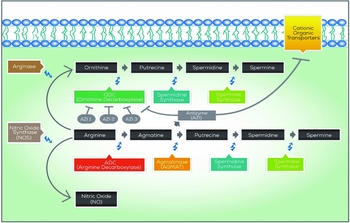
For many years, it was believed that this ‘classical pathway’ was the only one in mammals for the synthesis of polyamines. However, recent results from our group have indicated the presence of an alternate pathway in the ovine conceptus whereby arginine is decarboxylated by arginine decarboxylase (ADC) to produce agmatine which is then converted to putrescine by agmatinase (Wang et al., Reference Wang, Wei, Dunlap, Lin, Satterfield, Burghardt, Wu and Bazer2014). The cellular metabolism of polyamines is regulated by a family of antienzymes (AZI) that inactivates ODC1 and maintain homeostasis for polyamines within cells. Three main AZIs (AZI1, AZI2, and AZI3) exist and each has the ability to bind, inactivate and degrade ODC1 via proteasome 26S, a protease. Alternatively, the molecular activities of AZI are regulated by inhibitors of AZI, which catabolize AZI to allow the abundance of polyamines in cells to increase through actions of ODC1 and favor cellular homeostasis of polyamines (Coffino et al., Reference Coffino2001; Lefèvre et al., Reference Lefèvre, Palin and Murphy2011) (Fig. 1).
Molecular pathway for transport and synthesis of polyamines. Arginine is hydrolyzed to ornithine by ornithine decarboxylase (ODC1). Arginine can also be converted to nitric oxide by one of three isoforms of nitric oxide synthase (NOS1, NOS2, NOS3). The enzymatic activity of ODC1 is regulated by antyzimes (AZI, AZI2 and AZI3), which control the activity and abundance of ODC1 and its capacity to convert ornithine to putrescine and, therefore, spermidine and spermine.

The function of polyamines has been investigated in the angiogenesis, reproductive, digestive, endocrine, and other systems (Kalač, Reference Kalač2013). Additionally, in cancer, polyamines regulate metabolic processes and are central to evaluating development, metastasis, and control of different types of tumours. Such processes include cell division and proliferation, gene expression, DNA and protein synthesis, regulation of apoptosis, oxidative stress, angiogenesis, and regulation of cell-to-cell communication (Takigawa et al., Reference Takigawa, Enomoto, Nishida, Pan, Kinoshita and Suzuki1990a; Moinard et al., Reference Moinard, Cynober and de Bandt2005).
From the perspective of cellular functions and viability, two effects of polyamines, oxidative stress and angiogenesis have been of greatest interest because of their vital importance to sustain physiological processes in all organ systems of mammals. During embryonic development, the existing equilibrium between mitosis, apoptosis and neovascularization is critical for improving reproductive performance. Therefore, a proper understanding and further study of the effects of polyamines on the metabolic processes of mitosis, apoptosis and neovascularization, during the peri-implantation period of pregnancy, is vital to enhance reproductive performance in mammals.
History of polyamines
The history of polyamines began in 1674, when Antonie Van Leeuwenhoek discovered crystalline substances in human semen. It was not until 1924 that Rosenheim and others determined the exact composition of polyamines and synthesized them in their laboratories (Dudley et al., Reference Dudley, Rosenheim and Rosenheim1924). After this discovery by Leeuwenhoek, many contributions to the field of polyamines were generated. For example, Vauquelin (Reference Vauquelin1791) and Boettcher (Reference Boettcher1865) presented ideas regarding the crystals in semen (Bachrach, Reference Bachrach2010). Vauquelin proposed that the crystals were calcium phosphate, whereas Boettcher hypothesized that they were proteins (Vauquelin, Reference Vauquelin1791; Boettcher, Reference Boettcher1865). It was in 1888 that Ladenburg & Abel described the organic crystals and gave them the Latin name ‘spermine’ (Ladenburg & Abel, Reference Ladenburg and Abel1888). Approximately 250 years after Leeuwenhoek's report, the chemical composition of spermine was discovered.
The joint work of Rosenheim, Dudley, and Starling did not elucidate the exact atomic number of spermine, but they were able to synthesize it. In 1924, Rosenheim confirmed the findings of Leeuwenhoek and concluded that the chemical formula for spermine, isolated from most tissues, was identical to that found by Leeuwenhoek in human semen (Dudley et al., Reference Dudley, Rosenheim and Rosenheim1924; Vauquelin, Reference Vauquelin1791). The function of polyamines remained unknown for many years, but it was believed that they only maintained cellular structure (Dudley et al., Reference Dudley, Rosenheim and Rosenheim1924; Bachrach, Reference Bachrach2010). Polyamines in mammals are putrescine, spermidine, spermine, and cadeverine, all of which vary in structure due mainly to differences in carbon number and amine groups. However, some scientists do not consider cadeverine a classic polyamine, but a member of the oligoamine family that includes histamine, agmatine, and termine (Moinard et al., Reference Moinard, Cynober and de Bandt2005).
After having established the structure of polyamines, research was directed toward understanding their physiological functions using in vitro studies on different cell types. However, primary cell cultures were quite difficult to maintain under aseptic conditions, therefore bacteria culture became the model for evaluation of polyamine functions. The effect of polyamines on bacterial growth depended on their amount in the culture medium and the type of bacteria being evaluated, as polyamines stimulated the growth of some strains of Haemophilus, Neisseria, and Pasteurella, while inhibiting growth of Gram-negative bacteria, and a few viruses. These conclusions were supported by Herbst, who discovered lower amounts of polyamines in culture of Gram-positive bacteria, compared with that in the culture of Gram-negative bacteria (Herbst & Edmund, Reference Herbst and Esmond1948; Tabor et al., Reference Tabor, Celia and Sanford1961). A major discovery in elucidating the effects of polyamines was their capacity to bind DNA and change the charge of nucleotides, which culminated in the growth of some bacterial strains (Ames et al., Reference Ames, Donald and Sanford1958). Later, it was discovered that this interaction between polyamines and DNA had a protective effect on cells.
Biochemistry of polyamines
Structure
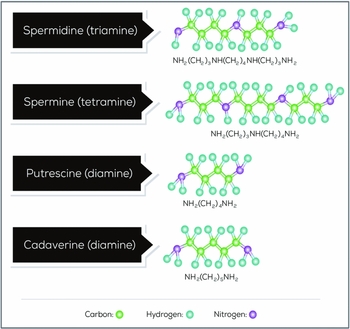
Polyamines are small, aliphatic, polycationic biogenic molecules having carbon chains of varying lengths and different numbers of amino groups. In mammals, the four major polyamines of scientific interest are spermine, spermidine, putrescine, and cadaverine. The amine molecules in physiology are of great interest and importance as many neurotransmitters and hormones (dopamine, epinephrine, norepinephrine, serotonin, thyroid hormones, among others) are characterized by their aliphatic structures and for having amino groups. The number of amino groups in a biogenic molecule provides it with different biochemical and physiological characteristics. Spermine has four amino groups in its lineal structure and is classified as a tetramine. Spermidine, also known as triamine, has three amino groups. Putrescine and cadaverine are diamines with two amino groups (Tiburcio et al., Reference Tiburcio, Altabella, Bitrián and Alcázar2014; Igarashi & Kashiwagi, Reference Igarashi and Kashiwagi2015) (Fig. 2).
Biochemistry and structure of polyamines. Spermine has four amino groups in its lineal structure and is classified as a tetramine. Meanwhile, spermidine is a triamine, and putrescine and cadaverine are diamines.

Synthesis of polyamines
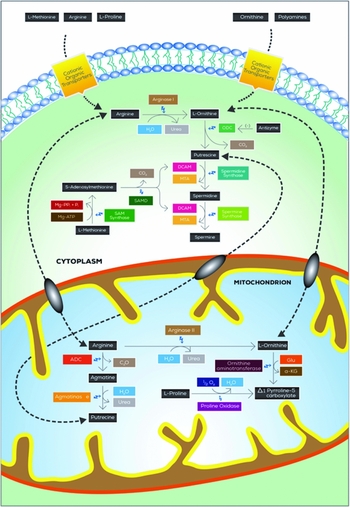
In mammals, the established pathway for synthesis of polyamines is through the actions of arginase and ODC1 on arginine. Arginase is a metalloenzyme with three subunits that hydrolyze arginine to yield two important products: ornithine and urea. This enzyme is found mainly in the cytoplasm of cells as isoform type I and in the matrix of mitochondria as isoform type II (Grillo & Colombatto, Reference Grillo and Colombatto2004; Wang et al., Reference Wang, Wei, Dunlap, Lin, Satterfield, Burghardt, Wu and Bazer2014). Once ornithine is generated, it is decarboxylated by ODC1 to produce putrescine that, in turn, is the substrate for spermidine synthase for generating spermidine. The latter becomes spermine by action of spermine synthase. Independently of the arginase/ODC1 pathway, the enzyme lysine decarboxylase is responsible for the synthesis of cadaverine (Pegg, Reference Pegg2009). It was believed that in mammals this ‘classic arginase/ODC1 pathway’ was the only pathway for the synthesis of polyamines whereas in plants and in some microorganisms there is an ‘alternate pathway’, for the production of polyamines. The so-called ‘alternate pathway’ requires decarboxylation of arginine by arginine decarboxylase (ADC) to yield agmatine. Agmatine can then be catabolized by agmatinase (AGMAT) to generate putrescine (Lefèvre et al., Reference Lefèvre, Palin and Murphy2011; Wang et al., Reference Wang, Wei, Dunlap, Lin, Satterfield, Burghardt, Wu and Bazer2014) (Fig. 3).
Synthesis of polyamines from arginine, proline, and methionine in mammals. Arginine is hydrolyzed to ornithine plus urea by arginase I and arginase II in many cell types (with possible exceptions being porcine placentae and neonatal small intestine). Synthesis of putrescine from ornithine is catalyzed by ornithine decarboxylase (a cytosolic enzyme) in all cell types. In placental mitochondria, arginine may be decarboxylated to form agmatine by arginine decarboxylase (ADC) and agmatine is then converted into putrescine by agmatinase. DCAM, decarboxylated 5-adenosylmethionine; α-KG, α-ketoglutarate; MTA, methylthioadenosine; SAMD, S-Adenosyl-methionine decarboxylase; SAM, S-Adenosylmethionine.

Our recent studies revealed that the alternative pathway (ADC/AGMAT) is functional and activated in response to inhibition of translation of ODC1 mRNA for synthesis of polyamines. When ovine conceptuses (embryo and associated extra-embryonic membranes) were subjected to a morpholino antisense oligonucleotide knockdown of translation of ODC1 mRNA to ODC1 protein, there was a compensatory increase in the ‘alternative pathway’ characterized by expression of ADC and AGMAT mRNAs and AGMAT protein increased significantly to increase the synthesis of polyamines (Wang et al., Reference Wang, Wei, Dunlap, Lin, Satterfield, Burghardt, Wu and Bazer2014). Interestingly, the compensatory alternate pathway was activated only in one-half of the ovine conceptuses that developed normally, but not in the other half of conceptuses, which failed to activate this alternate compensatory pathway and failed to develop normally. This finding suggests some variation in expression of genes in the alternate pathway linked to the sex of conceptus or genetic polymorphisms.
Polyamines are not only produced by the arginase/ODC1 metabolic pathway. Other amino acids can contribute to the synthesis of polyamines including l-proline and l-methionine. l-Methionine is decarboxylated to form S-adenosyl-l-methionine (AdoMet), which donates aminopropyl groups to putrescine to produce spermidine and spermine. In a different way, l-proline can be biotransformed to ornithine through proline oxidase, which produces Δ1-l-pyrroline-5-carboxylate, which is then modified by ornithine aminotransferase to generate ornithine. The latter is decarboxylated by ODC1 to generate putrescine (Kalač, Reference Kalač2013). Spermine and spermidine can be converted to putrescine, through oxidation reactions mediated via polyamine oxidase and the transfer of acetyl groups (Lefèvre et al., Reference Lefèvre, Palin and Murphy2011) (Fig. 3).
Early development of ovine conceptus
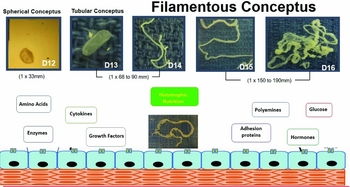
Embryonic mortality reduction is important to getting excellent reproductive performance. In most mammals, embryonic deaths (ED) range from 20 to 40% and two-thirds of embryonic losses occur during the peri-implantation period of pregnancy (Bazer et al., Reference Bazer, Wu, Johnson, Kim and Song2011). During peri-implantation in sheep, the conceptus undergoes dramatic morphological transitions from the spherical to the tubular to the filamentous form. These changes require histotrophic nutrition, which includes molecules secreted, or transported, into the uterine lumen by uterine epithelia. Endometrial glands are present in all mammals and play an important role in the synthesis of histotroph, which is critical for the maternal support of conceptus (Gray et al., Reference Gray, Taylor, Ramsey, Hill, Bazer, Bartol and Spencer2001). Histotroph is formed by molecules such as: amino acids, glucose, growth factors, hormones, cytokines, enzymes, adhesion proteins and polyamines. Trophectoderm cells produce IFNT from Day 10 to 21 of pregnancy. The amount of IFNT in uterine lumen is an indicator of embryo integrity and functionality during the peri-implantation period of pregnancy (Fig. 4).
Morphological changes in ovine conceptus during peri-implantation. During the peri-implantation period of pregnancy in sheep, the conceptus undergoes dramatic morphological transitions from spherical to tubular to filamentous form. Morphological changes between days 12 (1 × 33 mm), days 13 to 14 (1 × 68 to 1 × 90 mm), and days 15 to 16 (1 × 150 to 1 × 190 mm).

Effects of polyamines on cells
The polycationic nature of polyamines allows them to bind anionic complexes such as DNA, RNA, ATP and phospholipids. Spermidine and spermine are mostly associated with intracellular molecules, but most putrescine in the cell is in a free state. One of the most important cellular effects of polyamines is stimulation of cell proliferation, which requires an increase in gene expression, mRNA content, translocation of RNAs to ribosomes, ribosomal assembly, and utilization of ATP and magnesium. This situation suggests that polyamines contribute to each one of those cellular processes to promote cell proliferation (Igarashi and Kashiwagi, Reference Igarashi and Kashiwagi2000). The physiologic effect of polyamines in cells requires adequate transporters through the cellular membrane in most of cells (Wang et al., Reference Wang, Wei, Dunlap, Lin, Satterfield, Burghardt, Wu and Bazer2014).
The effects and transport of polyamines into cells has been studied in bacteria as a cellular model (Moinard et al., Reference Moinard, Cynober and de Bandt2005). In mammals, polyamines are transported by organic cationic transporters, such as solute carrier family 22 (organic cation transporter), member 2 (SLC22A2), which increases the ability of cells to incorporate polyamines when the intracellular level of polyamines is low. However, transporters such as SLC22A2 can also be inhibited when the abundance of polyamines in cells increases and this process allows cells to maintain stable concentrations of polyamines (Kwon et al., Reference Kwon, Wu, Bazer and Spencer2003; Kim et al., Reference Kim, Burghardt, Wu, Johnson, Spencer and Bazer2011) (Figs 1 and 3).
Function of polyamines in angiogenesis
Angiogenesis is the physiological process by which new blood vessels are generated from existing blood vessels in tissues. This process is the sum of important cellular events including migration, proliferation and growth of endothelial cells (Billington, Reference Billington1991; Jasnis et al., Reference Jasnis, Klein, Monte, Davel, de Lustig and Algranati1994). Functionality and metabolism of tissues and cells are directly dependent on the rate of perfusion of tissues by blood. Angiogenesis is a critical factor for growth of the conceptus, endometrial and placental functions, muscle contraction, and growth and development of all tissues. Polyamines play an important role in the physiology of neovascularization of tissues; however, their role in angiogenesis also relates to growth, proliferation and migration of cancer cells, which are a suitable model for studying the effects of polyamines on angiogenesis (Takigawa et al., Reference Takigawa, Enomoto, Nishida, Pan, Kinoshita and Suzuki1990a, Reference Takigawa, Nishida, Suzuki, Kishi, Yamashita and Hayakawab; Li et al., Reference Li, Meininger, Kelly, Hawker, Morris and Wu2002). Polyamines regulate molecules that promote migration, proliferation, and growth of cells, increase translation, protein synthesis, and modify gene expression to exert direct effects that activate pro-angiogenic molecules in cells. However, the molecular pathways by which polyamines are involved in angiogenesis are unclear (Codoñer et al., Reference Codoñer, Valls, Codoñer and Eulalia2011; Weis & Cheresh, Reference Weis and Cheresh2011).
Due to the ability of polyamines to stimulate tissue growth, including tumours, an irreversible inhibitor of ODC1 (alpha-difluoromethylornithine: DFMO) was developed to decrease synthesis of polyamines at the cellular level (Medina et al., Reference Medina, Quesada, de Castro and Sánchez1999). Research has focused on the effects of this inhibitor on the pathophysiology of various types of tumours and its possible therapeutic use against cancer (Jasnis et al., Reference Jasnis, Klein, Monte, Davel, de Lustig and Algranati1994; Codoñer et al., Reference Codoñer, Valls, Codoñer and Eulalia2011; Arısan et al., Reference Arısan, Ajda and Narçin2012). Jasnis et al. (Reference Jasnis, Klein, Monte, Davel, de Lustig and Algranati1994) determined whether blocking ODC1 affected vascularization in two cell lines: one derived from tumour-bearing mice and the other from tumour-free mice. The former cell line had a significantly greater degree of angiogenesis, compared with the latter one (3.2 vessels/mm2 versus 1.2 vessels/mm2, respectively).
In the presence of DFMO, the level of angiogenesis in cells from tumour-bearing mice was greatly reduced. Additionally, results from this study showed a greater effect of putrescine for reversing the effects of the ODC1 inhibitor, as exogenous putrescine increased vascularization in cells derived from tumour-bearing mice not treated with DFMO (Jasnis et al., Reference Jasnis, Klein, Monte, Davel, de Lustig and Algranati1994).
The anti-angiogenic effects of low concentrations of polyamines at the cellular level were reported by Takahashi et al. (Reference Takahashi, Mai and Nishioka2000). In that study, the average number of blood vessels in gastric tumours of mice treated with DFMO was lower than for tumours not subjected to DFMO inhibition of ODC1. Collectively, published results have indicated important roles for polyamines and enzymes related to their synthesis in tissues and in the stimulation of angiogenesis (Takigawa et al., Reference Takigawa, Enomoto, Nishida, Pan, Kinoshita and Suzuki1990a, Reference Takigawa, Nishida, Suzuki, Kishi, Yamashita and Hayakawab; Takahashi et al., Reference Takahashi, Mai and Nishioka2000). Takigawa et al. (Reference Takigawa, Enomoto, Nishida, Pan, Kinoshita and Suzuki1990a) used the chicken yolk-sac model to demonstrate that spermine and spermidine increase angiogenic activity while histamine and putrescine do not. These findings suggest that both spermine and spermidine could be considered to be angiogenesis factors in a yolk-sac model. Additionally, the study determined that spermine had a major effect on the formation of new blood vessels in comparison with spermidine (Takigawa et al., Reference Takigawa, Enomoto, Nishida, Pan, Kinoshita and Suzuki1990a, Reference Takigawa, Nishida, Suzuki, Kishi, Yamashita and Hayakawab). The role of histamine is controversial as results of other studies have indicated that it promotes angiogenesis in corneal cells in rabbits (Zauberman et al., Reference Zauberman, Michaelson, Bergmann and Maurice1969; Medina et al., Reference Medina, Quesada, de Castro and Sánchez1999).
Another important molecule related to the metabolic activity of arginine and polyamines is NO. NO is a free radical that regulates multiple physiological processes in a variety of cells including endothelial cells and is synthesized from l-arginine by isoforms of nitric oxide synthase (NOS) (Knowles and Salvador, Reference Knowles and Salvador1994; Lefèvre et al., Reference Lefèvre, Palin and Murphy2011). The role of NO in angiogenesis is controversial. Some studies have suggested that it promotes angiogenesis in tumours, but in vitro studies with chorioallantoic membranes have suggested that NO has important anti-angiogenic effects, and that it can be used therapeutically to control tumour growth in the early stages (Pipili et al., Reference Pipili, Sakkoula, Haralabopoulos, Andriopoulou, Peristeris and Maragoudakis1994; Hirst & Flitney, Reference Hirst, Flitney, Bicknell, Lewis and Ferrara1997; Joshi, Reference Joshi1997; Lenis et al., Reference Lenis, Olivera and Tarazona2010).
Angiogenesis is the result of proliferation, migration and growth of endothelial cells. These processes are not regulated by NO and, conversely, the results of other studies have suggested that angiogenesis can be inhibited by this free radical (Pipili et al., Reference Pipili, Sakkoula, Haralabopoulos, Andriopoulou, Peristeris and Maragoudakis1994; Joshi, Reference Joshi1997). In contrast, other research has shown that NO has significant potential to stimulate proliferation of endothelial cells in vivo in rabbits, and in corneal cells, coronary endothelial cells, and human endothelial cells. Also, NO was higher in endothelial cells from umbilical cord in women with preeclampsia, suggesting that NO increases in response to hypoxia. Thus the effects of NO in angiogenesis are unclear and there is a possibility that the effects of this free radical are different among cell types (Ziche et al., Reference Ziche, Morbidelli, Masini, Amerini, Granger, Maggi, Geppetti and Ledda1994; Morbidelli et al., Reference Morbidelli, Chang, Douglas, Granger, Ledda and Ziche1996; Papapetropoulos et al., Reference Papapetropoulos, García, Madri and Sessa1997; Demircan et al., Reference Demircan, Küçük, Nergiz Avcıoğlu, Zafer, Altınkaya, Bıçakçı and Kurt2015).
Although the molecular pathway by which polyamines stimulate angiogenesis remains to be completely elucidated, polyamines may share similar cellular pathways to vascular endothelial growth factor (VEGF) as an important mitogenic factor for migration and proliferation of endothelial cells (Neufeld et al., Reference Neufeld, Cohen, Gengrinovitch and Poltorak1999). VEGF regulates neovascularization in body tissues through molecular pathways that activate MEK1–ERK1/2 cell signaling for stimulating angiogenesis. VEGF is initially activated by prostaglandin synthase 2 which is expressed in response to the binding of epidermal growth factor by its receptors on endothelial cells. Once VEGF receptors are activated, cellular changes occur that activate other pro-angiogenic molecules (Venuti et al., Reference Venuti, Paolini, Nasir, Corteggio, Roperto, Campo and Borzacchiello2011).
In order to have successful neovascularization, endothelial cells must undergo several processes. First, there is vasodilation; second, there is an increase in cellular permeability. Third, there is degradation of the extracellular matrix. Nitric oxide (NO) is the main vasodilator in the initiation of angiogenesis and, along with VEGF, it activates processes that increase capillary permeability and redistribute a set of adhesion molecules, such as platelet-derived endothelial adhesion molecule 1 and cadherin. Subsequently, various changes and modifications are made in the cell membrane by these processes that are mediated by kinases (Conway et al., Reference Conway, Désiré and Peter2001; Weis & Cheresh, Reference Weis and Cheresh2011).
Research conducted in a controlled environment is important for advances in the study of functions of polyamines. However, epidemiological studies are also valuable for investigating the role of polyamines in angiogenesis. Observational studies in humans revealed that obese children, between 7 and 14 years of age, had higher concentrations of polyamines in plasma than lean children of the same age. There was an important relationship between the amounts of VEGF and polyamines in obese compared with control children. It was concluded that polyamines might be related to the angiogenic factors that promote vascularization and increase blood flow to fat depots in obese children (Codoñer et al., Reference Codoñer, Valls, Codoñer and Eulalia2011).
Function of polyamines in oxidative stress
Oxidative stress is a physiological process in all anaerobic cells, as cellular metabolism produces compounds called free radicals (Allen & Tresini, Reference Allen and Tresini2000). Free radicals are biochemically unstable molecules that react easily with other compounds, enabling the degradation of endogenous proteins, phospholipid membranes, carbohydrates, nucleic acids and other cellular compounds. The more common free radicals are hydrogen peroxide (H2O2), superoxide anion (O−), nitric oxide (NO), and hydroxyl radicals (OH–). Some of these can activate cell death pathways. For example, H2O2 mediates cell death through the activation of the flavokavain B–p53 pathway for apoptosis. Flavokavain B is a natural chalcone isolated from the rhizomes of Alpinia pricei hayata that induces oxidative stress, ROS generation and DNA damage, these effects together induce GADD153 up-regulation (GADD153), which activates cellular apoptosis (Allen & Tresini, Reference Allen and Tresini2000; Finkel & Nikki, Reference Finkel and Nikki2000; Tarazona et al., Reference Tarazona, Olivera and Lenis2010).
Molecules that may control free radicals, either by eliminating them or converting them into more stable structures, are called antioxidants. They are involved in mechanisms protecting cells by reducing membrane and DNA damage and ensuring their functionality and viability (Rhee et al., Reference Rhee, Kim and Lee2007). Polyamines are potent antioxidants with cell protective effects, as they control free radicals generated during cellular metabolism (Tadolini et al., Reference Tadolini, Cabrini, Landi, Varani and Pasquali1984; Rider et al., Reference Rider, Hacker, Mackintosh, Pegg, Woster and Casero2007). As mentioned above polyamines interact with cellular molecules such as DNA. The strong interaction between DNA and polyamines occurs due to the negative charge of the DNA nucleotides, and polyamines prevent structural and functional damage to DNA because they block free radicals from binding DNA (Rider et al., Reference Rider, Hacker, Mackintosh, Pegg, Woster and Casero2007). Polyamines also inhibit lipid peroxidation in cell membranes. Lipid peroxidation is a process whereby unsaturated phospholipids are transformed into saturated phospholipids, affecting the functionality and structure of lipids in the cell membrane. Prevention of lipid peroxidation is important as the fluidity and permeability of the membrane depends on the number of unsaturated fatty acids (Tadolini et al., Reference Tadolini, Cabrini, Landi, Varani and Pasquali1984; Drolet et al., Reference Drolet, Dumbroff, Legge and Thompson1986).
Studies with E. coli revealed that putrescine improved the survival rate of strains subjected to free radicals in the culture medium by increasing expression of genes such as oxyR, Kate, and katG for protection from oxidative stress. In this same study, a specific inhibitor of putrescine (1,4-diamino-2-butanone) decreased expression of oxyR under conditions of oxidative stress. Thus, the ability of polyamines to bind DNA and promote expression of genes is considered protective against oxidative stress in bacterial models (Tkachenko et al., Reference Tkachenko, Nesterova and Pshenichnov2001).
The metabolism of polyamines at the cellular level also generates a high degree of toxicity under non-physiological conditions such as heat stress and various pathologies. Research with Chinese hamster ovary (CHO) cells subjected to heat stress, revealed that the rate of oxidation of polyamines increased and generated a significant rise in free radicals that affected viability of cells (Harari et al., Reference Harari, Fuller and Eugene1989).
The potential of polyamines to control free radicals was investigated and it was found that spermine, in comparison with spermidine, had a greater ability to control H2O2 in cultured cells. Genetically modified mouse fibroblasts (cells lacking the gene for spermine), were compared with normal fibroblasts cultured in vitro and exposed to 1 or 2 mM H2O2. The results indicated that the genetically modified cells had a higher sensitivity to H2O2 than normal cells. Additionally, when 10 μM spermine was added, compared with the same dose of spermidine, spermine had greater biological activity for protection of cells from H2O2 (Rider et al., Reference Rider, Hacker, Mackintosh, Pegg, Woster and Casero2007).
The roles of polyamines in scavenging free radicals remains unclear. Recent studies have confirmed the capacity of polyamines to scavenge reactive oxygen species. When the levels of biogenic amines are high within the cells, the activity of amine oxidases increases, which generates new free radicals (Grancara et al., Reference Grancara, Zonta, Ohkubo, Brunati, Agostinelli and Toninello2015).
Systemic effects of polyamines
The physiological effects of polyamines are diverse. At physiological concentrations, polyamines stimulate proliferation in most of cells in reproductive tissues by activating the mechanistic target of rapamycin (mTORC1) pathway (Kim et al., Reference Kim, Burghardt, Wu, Johnson, Spencer and Bazer2011). Polyamines were initially considered to be exclusively structural at the cellular level as they are cationic and interact effectively with anionic proteins. However, it was later found that polyamines impact important cellular functions such as proliferation, gene expression, DNA and protein synthesis, apoptosis, cell-to-cell communication, and many other important functions (Lefèvre et al., Reference Lefèvre, Palin and Murphy2011, Tiburcio et al., Reference Tiburcio, Altabella, Bitrián and Alcázar2014). To date, research has shown that polyamines play important roles in all systems.
Role of polyamines in the immune response: a comprehensive view involving regulation of angiogenesis
The role of polyamines in the immune response is largely based on indirect evidence from a series of experiments performed in mice models of liver [i.e. liver injury caused by lipopolysaccharide (LPS)] (Liu et al., Reference Liu, Hou, Jin, Xiao, Fan, Yang, Yan and Liang2015) and bone trauma/hemorrhage (Li et al., Reference Li, Fan, Zheng, Yang, Liu, Gong and Liang2013). The authors found a beneficial effect of agmatine in those models of trauma. Agmatine treatment significantly reduced the production of pro-inflammatory cytokines in mice with LPS-induced acute liver injury, whereas agmatine significantly reduced inflammation, neutrophil infiltration and necrosis of the liver. The authors suggested an effect of agmatine to reduce tumour necrosis factor (TNF)-α, interleukin (IL)-6, and IL-1β in hepatocytes that was mediated by interference of NF-κB signaling resulting in a reduction in production of cytokines (Li et al., Reference Li, Fan, Zheng, Yang, Liu, Gong and Liang2013).
Effects of polyamines in the reproductive system
Polyamines have effects on the reproductive physiology of both males and females by regulating processes vital to reproductive success. In males, Sertoli and Leydig cells synthesize and store polyamines which regulate differentiation of spermatogonia during spermatogenesis. Spermine is considered a vital polyamine for fertility, as mice failing to produce spermine are infertile due to meiotic arrest of spermatogonia and primary spermatocytes resulting in failure of differentiation of sperm (Wang et al., Reference Wang, Ikeguchi, McCloskey, Nelson and Pegg2004; Lefèvre et al., Reference Lefèvre, Palin and Murphy2011). The importance of polyamines in the testis is evident based on concentrations of spermine and spermidine being greater in seminal plasma than in any other body tissue or fluid. This finding suggests the importance of polyamines for sperm motility and the capacity of sperm to fertilize ova. Moreover, spermine and spermidine improve the utilization of glucose by sperm cells (Lefèvre et al., Reference Lefèvre, Palin and Murphy2011).
In females, polyamines regulate mechanisms for ovarian functions during the pre-pubertal and post-pubertal stages, modulate ovulation and luteinization of theca and granulosa cells, enhance oocyte maturation by increasing of putrescine amount involved in meiotic maturation, and affect blood flow to reproductive tissues, including the placenta (Kwon et al., Reference Kwon, Wu, Bazer and Spencer2003; Lefèvre et al., Reference Lefèvre, Palin and Murphy2011). Research with pregnant ewes revealed that concentrations of polyamines in reproductive tissues vary due to the stage of gestation with concentrations of polyamines being greater during the first half of gestation in placentomes, intercotyledonary placenta and endometrial caruncles (Kwon et al., Reference Kwon, Wu, Bazer and Spencer2003).
Based on the recent findings that NOS3 mRNA is highly expressed in conceptuses and placentomes, we propose that NO has a critical role in the development of the conceptus during the peri-implantation and implantation periods of pregnancy. In pregnant females, polyamines are associated with proliferation, migration and adhesion of ovine trophectoderm cells, processes that are vital for organogenesis, and, in some species, they are also related to enhanced synthesis of molecular signals for maternal recognition of pregnancy (Wang et al., Reference Wang, Su, Wu, Xu, Lu, Liu and Li2005). These positive effects improve embryonic survival during the peri-implantation period of pregnancy in mammals. Embryonic losses range from 20 to 40% during the peri-implantation period of pregnancy and generally do not alter length of the estrous cycle of the female (Bazer et al., Reference Bazer, Wu, Johnson, Kim and Song2011). These early losses could be associated with insufficient amounts of polyamines in the reproductive tract (Wang et al., Reference Wang, Ikeguchi, McCloskey, Nelson and Pegg2004; Kim et al., Reference Kim, Burghardt, Wu, Johnson, Spencer and Bazer2011).
The importance of polyamines in embryonic tissue of sheep was investigated by Wang et al. (Reference Wang, Wei, Dunlap, Lin, Satterfield, Burghardt, Wu and Bazer2014). They demonstrated that 50% of sheep conceptuses in which transcription of ODC1 was blocked, failed to develop morphologically and functionally, but 50% did develop normally. Conceptuses that were normal were found to exhibit an increase in transcription of AGMAT and ADC genes and a significantly higher abundance of AGMAT protein. Results of the study by Wang et al. (Reference Wang, Wei, Dunlap, Lin, Satterfield, Burghardt, Wu and Bazer2014) demonstrated:
-
1. the significance of polyamines for development of the ovine conceptus;
-
2. the existence of the ‘alternate pathway’ for synthesis of polyamines in the mammalian conceptus;
-
3. activation of the compensatory ADC–AGMAT pathway to rescue the phenotype of 50% of conceptuses when the classical ODC1 pathway in conceptus trophectoderm was inhibited (Wang et al., Reference Wang, Wei, Dunlap, Lin, Satterfield, Burghardt, Wu and Bazer2014).
It is important to remember that reproductive function in animals depends on multiple systems and factors. Nutrition is of vital importance to ensure proper synthesis and metabolism of polyamines. Wu et al. (Reference Wu, Pond, Flynn, Ott and Bazer1998) reported a decrease in ODC1 activity and a lower abundance of polyamines in endometria and placentae of primiparous sows subjected to dietary protein restriction. Thus, altering the content of polyamines in the female reproductive tract negatively affects reproductive performance of sows (Wu et al., Reference Wu, Pond, Flynn, Ott and Bazer1998). This new area of research is defining the roles of polyamines in reproduction in domestic animals which influence the physiology of reproduction under normal and pathological conditions.
In summary, physiological levels of arginine, agmatine and finally polyamines play a critical role in the functionality of cells, regulating biological effects such as: cell division and proliferation, gene expression, DNA and protein synthesis, apoptosis, oxidative stress, angiogenesis, and the cell communication. In the reproduction field polyamines stimulate the adequate secretion of interferon tau (IFN-τ) during the peri-implantation period of pregnancy, enhancing the outcome of pregnancy in mammals.
Acknowledgements
This work was supported by Sustainability Strategy 2013–2014, from CODI University of Antioquia (UdeA), Medellín, Colombia Scholarship ‘Becas Doctorado UdeA 2014’ (to Yasser Lenis Sanin, a student in Veterinary Science, Faculty of Agrarian Science, Antioquia University, Colombia).