Low birth weight (LBW), defined as a newborn weighing less than 2500 g in the first hour after birth, affects 14·7 % of newborns worldwide(1). It significantly contributes to infant mortality, child morbidity and future health risks, including metabolic syndrome, CVD, type 2 diabetes, hypertension and even cancer(Reference Lawn, Cousens and Zupan2–Reference Reyes and Manalich5). Early nutritional interventions may prevent LBW and reduce these adverse outcomes(Reference Lutter, Pena-Rosas and Perez-Escamilla6).
Despite its important role in the immune system, growth and development and neurological function, Zn deficiency remains a widespread problem, especially in developing countries. It is estimated that up to 2 billion people worldwide are affected by inadequate dietary Zn intake(Reference Lewicka, Kocylowski and Grzesiak7,Reference Mocchegiani, Romeo and Malavolta8) . Pregnant women are particularly vulnerable to borderline Zn deficiency, which affects approximately 82 % of pregnant women worldwide(Reference Caulfield, Zavaleta and Shankar9). Zn deficiency during pregnancy can lead to pregnancy hypertension and preeclampsia, as well as adverse pregnancy outcomes like LBW(Reference Karimi, Bagheri and Nematy10). Mn is found in extremely low levels in the human body and is an indispensable cofactor in the enzymatic response of bone formation and metabolic regulation(Reference Williams, Todd and Roney11). However, the balance of Mn in the body is delicate. Both Mn deficiency and excessive exposure disrupt the growth hormone/insulin-like growth factor and insulin metabolism(Reference Clegg, Donovan and Monaco12–Reference Keen, Ensunsa and Watson14). Therefore, it is essential to maintain Mn levels within a narrow optimal range.
Maternal micronutrient status is crucial for pregnancy outcomes. The dietary structure of residents in Northwest China is relatively monotonous, and their diets place more emphasis on fat and protein intake, with micronutrient deficiency being prevalent(Reference Wang, Chen and Tang15,Reference Liu, Cheng and Dang16) . Most existing studies have focused on the association between the intake of a single micronutrient and LBW, and most of them have not covered continuous exposure from pre-pregnancy to the entire pregnancy period(Reference Negandhi, Negandhi and Zodpey17–Reference Zhang, Chen and Xia24). The studies related to Mn and birth weight are particularly scarce and have insufficient precision(Reference Eum, Cheong and Ha22–Reference Zhang, Chen and Xia24). In addition, the potential synergistic effects among micronutrients have not been fully explored. To address this issue, we conducted a nested case–control study based on a birth cohort from Lanzhou City, Northwest China. We systematically and consecutively collected and analysed dietary Zn and Mn intake data throughout the first, second and third trimesters of pregnancy. Restricted cubic splines were used to visualise the potential dose–response relationship and the possible appropriate intake range. Furthermore, we analysed the synergistic effects of Zn and Mn, which may have potential metabolic interactions, aiming to explore in depth the association between maternal dietary Zn and Mn intake levels and the risk of LBW.
Materials and methods
Study population
This study was a non-matched nested case–control study based on a birth cohort. We established a prospective birth cohort at the Gansu Provincial Maternal and Child Health Care Hospital from January 2018 to June 2019. Eligible study participants were pregnant women who had regular prenatal visits, were ≥18 years of age and had no history of psychiatric disorders. During the cohort follow-up period, all newly diagnosed cases of LBW were assigned to the case group, while all members with normal birth weight (NBW) in the same cohort served as the control group. Pregnant women with singleton live births with complete preconception and pregnancy dietary data were included in this study (n 8696), which included 7497 NBW infants, 605 LBW infants and 594 macrosomic infants (Figure 1). This study was conducted according to the guidelines laid down in the Declaration of Helsinki, and all procedures involving human subjects/patients were approved by the institutional review boards of Gansu Provincial Maternity and Child Care Hospital (No. 2018 (029)). Written informed consent was obtained from all subjects.
Flow diagram of participants included in the analysis. A total of 605 pregnant women whose infants were of LBW (birth weight <2500 g) and 7497 pregnant women whose infants were of NBW (2500 g <= birth weight <4000 g) were included in the final analysis. LBW, low birth weight; NBW, normal birth weight.

Low birth weight
LBW infants, weighing less than 2500 g in the first hour after birth, were included in the case group, while NBW infants, weighing between 2500 g and 4000 g, were included in the control group for analysis. LBW was classified into two subgroups: very low birth weight (VLBW) (≤1500 g) and non-VLBW (>1500 g)(Reference Harris, Bray and Troughton25). Considering the influence of different gestational ages on birth weight, cases of small for gestational age (SGA) were further extracted for analysis, and the LBW cases were divided into SGA and non-SGA groups. Gestational age was calculated in completed weeks based on the date of the self-reported last menstrual period. SGA was defined as birth weight below the 10th percentile of a sex- and gestational-age-specific reference birth weight distribution(Reference Christian, Lee and Donahue Angel26).
Dietary surveys, zinc and manganese daily intake
Daily surveys and dietary Zn and Mn intakes were collected by face-to-face semi-quantitative FFQ. The FFQ was derived from a previously established and validated framework for assessing the diet of pregnant women(Reference Liu, Lv and Zhang27–Reference Huang, Wang and Ding29) and was further validated in another independent Chinese cohort study(Reference Zhao, Wu and Cui30). As the primary dietary sources of Zn and Mn (e.g. whole grains, red meat, legumes, nuts) substantially overlap with those of other validated nutrients (e.g. Fe, Cu), the demonstrated ability of this FFQ to accurately capture intakes of these key food groups provides a valid basis for estimating Zn and Mn intake in our study population. Specific surveys include social characteristics, disease history, physiological reproductive history and dietary surveys. Dietary status was investigated by trained medical personnel through the 24-h dietary recall method. All questionnaires were completed by specialised investigators. The types and quantities of various food items consumed over three consecutive days were investigated, mainly including twelve common food groups such as grains, fats and oils, vegetables, fruits, poultry meat and products, eggs, animal meat and products, aquatic products, legumes and legume products, milk and milk products, mushrooms and algae, snacks and beverages.
Water is an important source of Mn intake, and drinking water Mn concentrations vary significantly across different regions of China(Reference Ma, Ding and Bian31). All participants in this study were recruited from urban areas of Lanzhou and used the same water source. According to monitoring data released by official authorities(32,33) , the Mn concentration in the local water supply during the study period was reported as ‘not detected’ (i.e. below the method detection limit of 10 μg/L). This concentration is considerably lower than the limit of 100 μg/L set by the Chinese ‘Environmental Quality Standards for Surface Water’ (GB3838-2002)(34) and is also markedly below the weighted geometric mean (GMw) for Mn in Chinese water sources (54·91 µg/L)(Reference Ma, Ding and Bian31) as well as the global average (2562·15 µg/L)(Reference Kumar, Parihar and Sharma35). Therefore, Mn exposure from drinking water is considered a constant and extremely low-level background in this population. Given that both cases and controls shared this homogeneous water source, any exposure variation introduced by differences in individual water consumption is expected to be distributed randomly between the two groups and is unlikely to introduce directional bias into the study findings. Consequently, individual water intake was not measured in this study, and the assessment was focused on individual dietary intake of Zn and Mn.
Dietary intake information for nutrients covers the following four periods: preconception (one year before pregnancy), first trimester (1∼13 weeks), second trimester (14∼27 weeks) and third trimester (>27 weeks). Missing data have been excluded during the baseline data collection period. After completing all dietary surveys, the daily dietary micronutrient intakes of each pregnant woman at different trimesters were calculated according to the second edition of the Chinese Food Composition Table (36). This calculation has been validated in previous birth cohorts in Lanzhou and Taiyuan regions(Reference Liu, Lv and Zhang27–Reference Zhao, Wu and Cui30). Data on pregnancy-related complications and delivery outcomes were extracted from medical records.
Statistical analysis
For data comparisons of selected characteristics between women with low and normal birth weight infants, the t-test or Wilcoxon rank-sum test was used for differences in continuous variables, and the χ 2 test or Fisher’s exact test was used for categorical variables. According to the quartile of dietary Zn and Mn intake in the control group, the dietary intake levels of all subjects before pregnancy and at different stages of pregnancy were consecutively processed by per quartile decrease. This was conducted to examine whether the risk of LBW exhibited a significant linear trend of change as the intake of Zn/Mn gradually decreased from Q4 to Q1. The receiver operating characteristic curve was used to determine the optimal cut-off values of Zn and Mn. Based on the maximum Youden index, the final cut-off values determined were 2·66 mg/d before pregnancy and 3·41 mg/d during pregnancy for Zn and 5·05 mg/d before pregnancy and 7·36 mg/d during pregnancy for Mn. Accordingly, the subjects were divided into low (intake below the cut-off value) and high (intake equal to or above the cut-off value) groups for unconditional logistic regression analysis. A further analysis was performed by grouping dietary Zn intake based on the latest Chinese Recommended Nutrient Intake (8·5 mg/d before pregnancy and 10·5 mg/d during pregnancy)(37). The Recommended Nutrient Intake is defined as the nutrient intake level sufficient to meet the nutrient requirements of 97·5 % of the population.
Restricted cubic spline curves were used to further analyse the nonlinear relationship between dietary Zn and Mn intake and the risk of LBW. The number of nodes was determined to be three by comparing the criterion of Bayesian information and Akaike information.
The multiplicative interaction parameter [OR = OR11/(OR01 × OR10)] and 95 % CI were also estimated to assess the relative excess risk due to interaction (RERI) on an additive scale (RERI = RR11-RR10-RR01 + 1), the attributable proportion due to interaction (AP = RERI/RR11) and synergy index [S = (RR11–1)/[ (RR01–1) + (RR10–1)](Reference Andersson, Alfredsson and Kallberg38). This study estimated 95 % CI for these measures, with null values of 0 for RERI and AP and 1 for S.
Potential confounding variables included pre-pregnancy BMI (weight (kg)/height (m2)), weight gain during pregnancy (kg), father’s BMI (weight (kg)/height (m2)), total energy intake (kcal/d), monthly income per capita (<3000 RMB/≥3000 RMB), maternal education level (<college/≥college), smoking during pregnancy (passive and active), maternal employment (No/Yes), multivitamin supplement (<=12 week/>12 week), gestational hypertension (No/Yes), history of premature birth (No/Yes), reproductive history (Primipara/Multipara) and dietary Zn/Mn intake (mg/d). Adjustments for maternal age (years), maternal nation (Han/Minority), alcohol use during pregnancy (No/Yes), gestational diabetes (No/Yes), anaemia during pregnancy (No/Yes), history of miscarriage (No/Yes) and newborn’s sex (Male/Female) had no materially affect on the observed associations and therefore were not part of the final models. Passive smoking was defined as exposure to another person’s tobacco smoke for more than 15 min/d. Anaemia during the first trimester was diagnosed by the physicians using the criteria of Hb concentration lower than 110 g/L.
All statistical tests were two-sided. Analyses were performed with SAS 9.4 (SAS Institute, Inc.). All restricted cubic spline models were performed with R software version 4.3.3 (packages ‘Hmisc’, ‘rms’ and ‘survival’).
Results
Basic characteristics of the study population
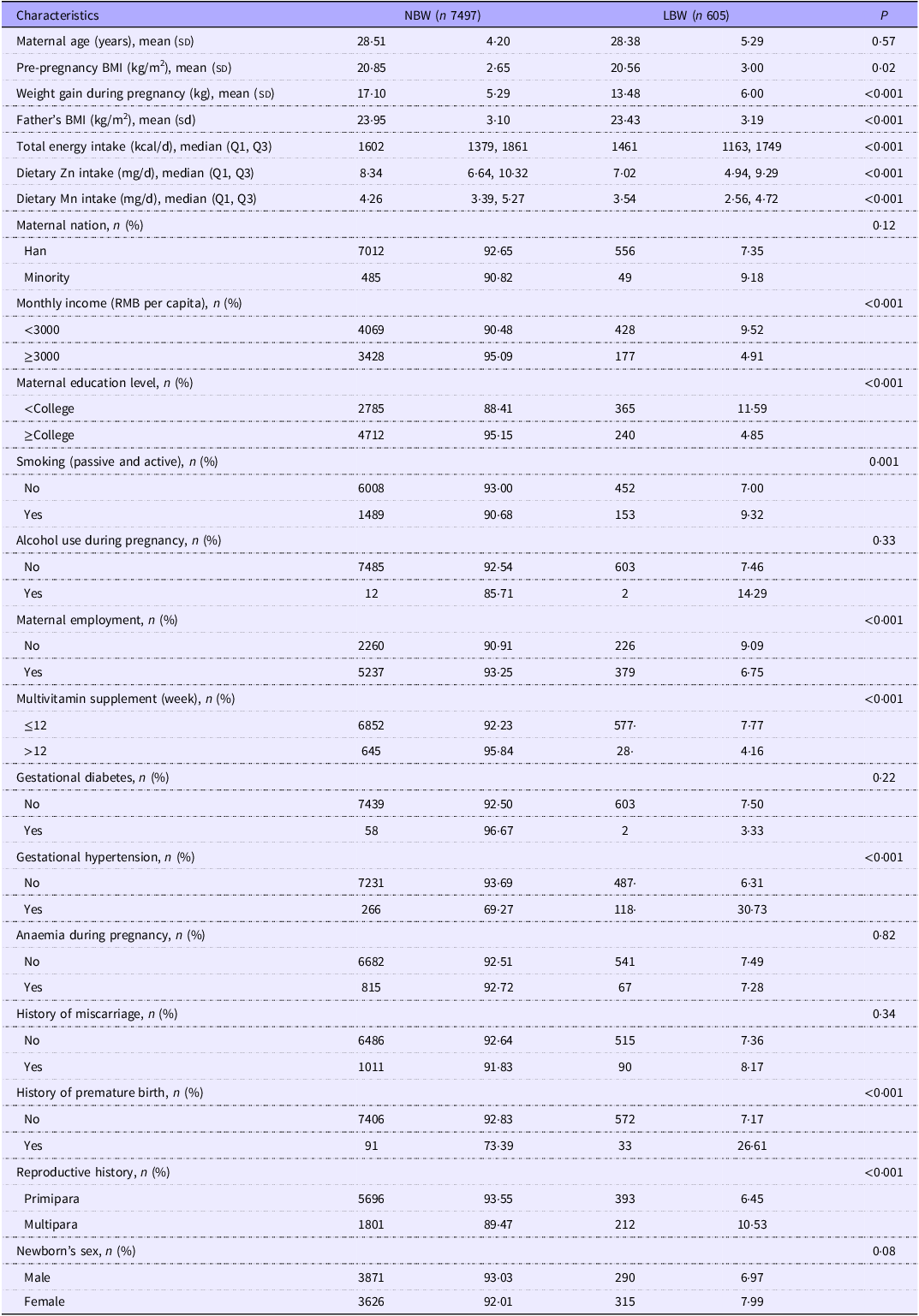
A total of 8102 women were included in the final analysis, and 7·47% (n 605) of newborns were diagnosed with LBW. Among the 605 cases of LBW, 20·50 % (n 124) were VLBW and 40·99% (n 248) were SGA infants. As shown in Table 1, mothers of LBW infants were more likely to have lower pre-pregnancy BMI and higher percentages of smoking (passive and active) than women with NBW infants (P < 0·05). In addition, mothers in the case group had significantly less weight gain during pregnancy, lower total energy intake, lower dietary Zn and Mn intake during pregnancy, lower monthly income, lower education level, less employment, lower multivitamin supplementation, higher prevalence of gestational hypertension and more history of premature birth and reproductive (P < 0·001). There were no significant differences in the distribution of mothers between the two groups in terms of maternal nation, drinking during pregnancy, gestational diabetes, anaemia during pregnancy and history of miscarriage (P > 0·05).
Distributions of selected characteristics of the study population

LBW, low birth weight; NBW, normal birth weight.
Associations of maternal dietary zinc intake with the risk of low birth weight
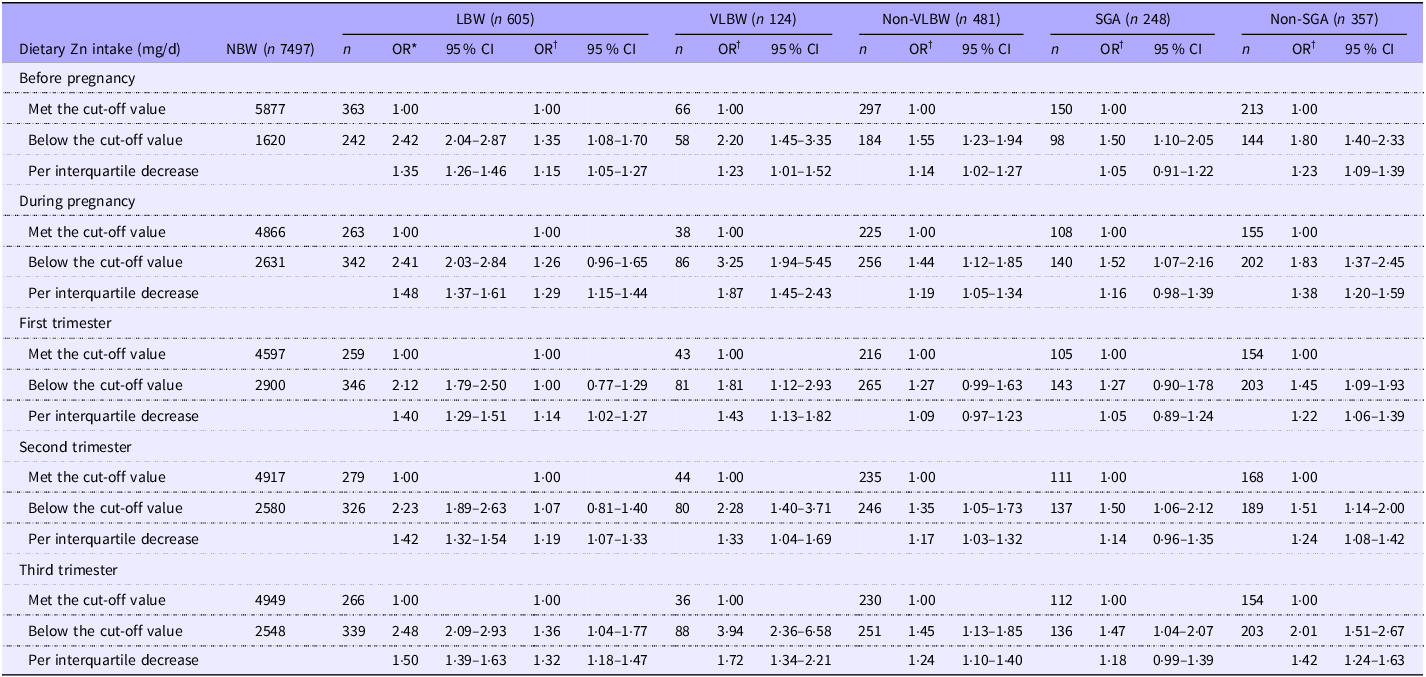
In Table 2, as the quartile of maternal dietary Zn intake levels decreased, the risk of LBW was observed to increase by 14–32 % over each period. Mothers with Zn intake below the cut-off value (<5·05 mg/d before pregnancy and <7·36 mg/d during pregnancy) had a significantly increased risk of LBW before pregnancy and during the third trimester, with adjusted OR of 1·35 (1·08–1·70) and 1·36 (1·04–1·77) for LBW, respectively. After grouping by quartiles of Zn intake, and using quartile 4 (the highest) as the reference group, the adjusted OR for quartile 2 (the second lowest) were 1·30 (1·08–1·56) during pregnancy and 1·27 (1·07–1·52) during the third trimester (Supplementary Table 1).
Maternal dietary Zn intake categorised by cut-off value and the risk of LBW

LBW, low birth weight; NBW, normal birth weight.
* OR used univariate analysis.
† OR adjusted for pre-pregnancy BMI, weight gain during pregnancy, father’s BMI, total energy intake, monthly income per capita, maternal education level, smoking, maternal employment, multivitamin supplement, gestational hypertension, history of premature birth, reproductive history and dietary Mn intake.
Low Zn intake was found to be a risk factor for LBW in all subtypes at all periods except the first trimester. In the SGA group, low Zn intake compared with high intake levels was associated with significant risk before, during, second and third trimester, with adjusted OR of 1·50 (1·10–2·05), 1·52 (1·07–2·16), 1·50 (1·06–2·12 and 1·47 (1·04–2·07), respectively. Furthermore, in the VLBW group, low dietary levels of Zn increased the risk of LBW by 81–294 % and in the SGA group by 45–101 %. Stratification by the Recommended Nutrient Intake revealed that Zn intake below the Recommended Nutrient Intake level during the third trimester (<10·5 mg/d) was associated with an increased risk of VLBW and preterm-LBW groups, with adjusted OR of 1·44 (1·16–1·92) and 1·38 (1·07–1·60), respectively (Supplementary Tables 5 and 6).
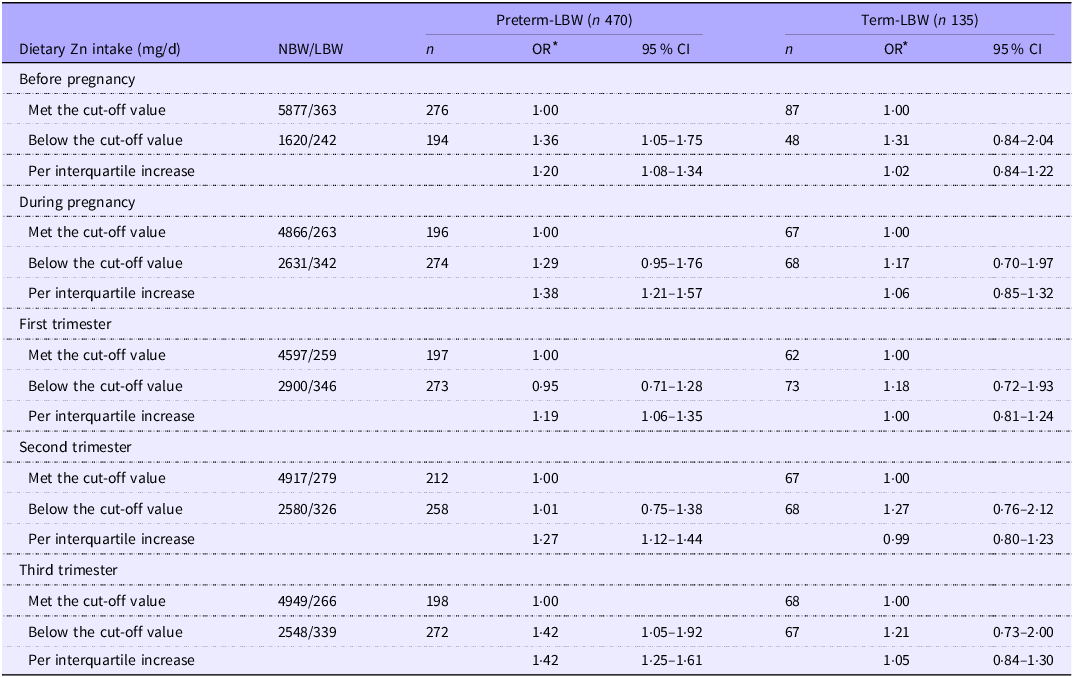
Further stratification of LBW infants by gestational age showed that statistical significance was only observed in the preconception and third trimesters in the preterm-LBW group (<37 gestational weeks) (Table 3). In the quartile analysis, Zn intake in quartile 2 (the second lowest) during pregnancy was associated with a significantly increased risk of preterm-LBW compared with quartile 4 (the highest) (Supplementary Table 2).
Association between maternal dietary Zn intake and risk of LBW stratified by gestational age

LBW, low birth weight; NBW, normal birth weight.
* OR adjusted for pre-pregnancy BMI, weight gain during pregnancy, father’s BMI, total energy intake, monthly income per capita, maternal education level, smoking, maternal employment, multivitamin supplement, gestational hypertension, history of premature birth, reproductive history and dietary Mn intake.
Associations of maternal dietary manganese intake with the risk of low birth weight
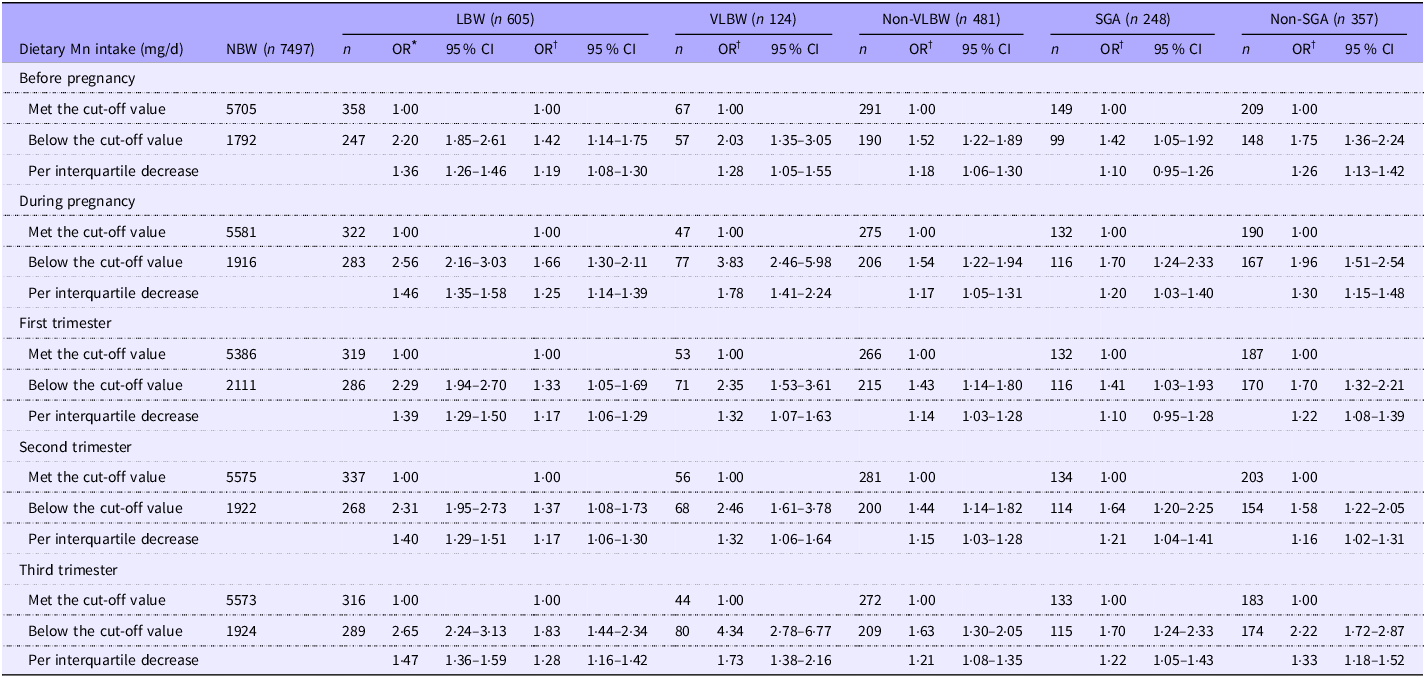
As shown in Table 4, as the quartile of maternal dietary Mn intake levels decreased, the risk of LBW was observed to increase by 17–28 % over each period. Mothers whose Mn intake below the cut-off value (<2·66 mg/d before pregnancy and <3·41 mg/d during pregnancy) had a significantly increased risk of LBW at all periods, with adjusted OR of 1·42 (1·14–1·75) before pregnancy, 1·66 (1·30–2·11) during pregnancy, 1·33 (1·05–1·69) during the first trimester, 1·37 (1·08–1·73) during the second trimester and 1·83 (1·44–2·34) during the third trimester, respectively.
Maternal dietary Mn intake categorised by cut-off value and the risk of LBW

LBW, low birth weight; NBW, normal birth weight; VLBW, very low birth weight; SGA, small for gestational age.
* OR used univariate analysis.
† OR adjusted for pre-pregnancy BMI, weight gain during pregnancy, father’s BMI, total energy intake, monthly income per capita, maternal education level, smoking, maternal employment, multivitamin supplement, gestational hypertension, history of premature birth, reproductive history and dietary Zn intake.
Low Mn intake was a risk factor for LBW in all subtypes before and throughout pregnancy. In the SGA group, the adjusted OR of low Mn intake compared with high intake were 1·42 (1·05–1·92) before pregnancy, 1·70 (1·24–2·33) during pregnancy, 1·41 (1·03–1·93) during the first trimester, 1·64 (1·20–2·25) during the second trimester and 1·70 (1·24–2·33) during the third trimester, respectively. The risk of Mn at low dietary levels increased approximately 2–4 times in the VLBW group, 43–63 % in the non-VLBW group and 58–122 % in the non-SGA group. After grouping according to the quartile of Mn intake, the risk of Mn in the quartile 1 (the lowest) compared with the quartile 4 (the highest) was increased by 30–57 % in the VLBW group (Supplementary Table 3).
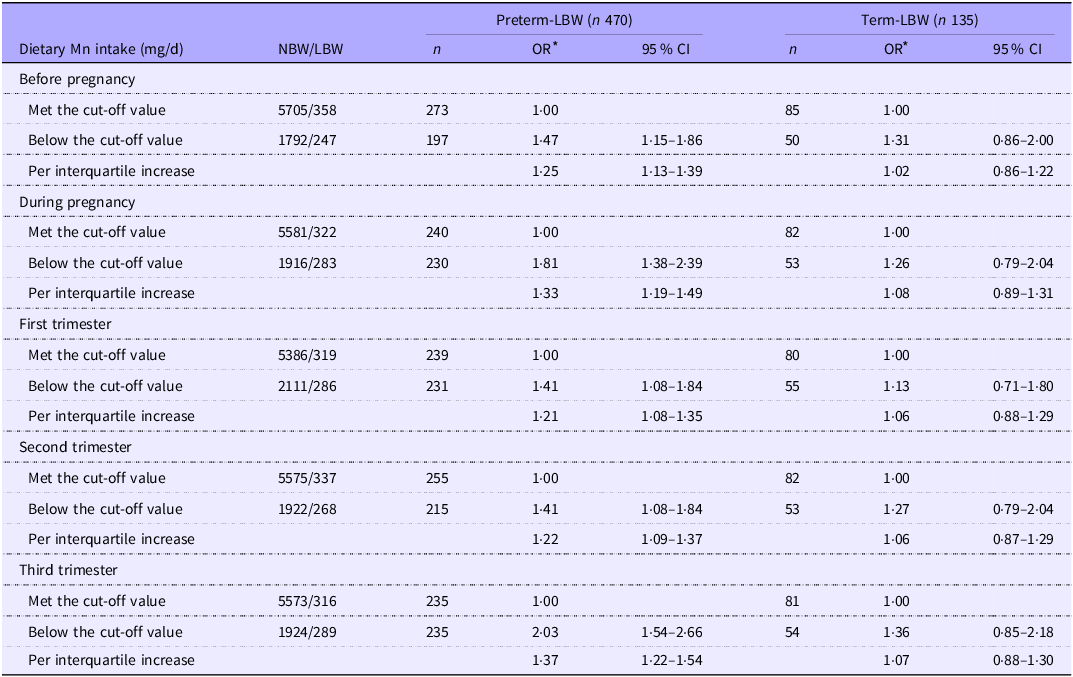
Further stratification of LBW infants by gestational age showed that the risk of low Mn intake on LBW in each trimester in the preterm-LBW group (<37 gestational weeks), but no statistical significance was observed in the term-LBW group (≥37 gestational weeks) (Table 5). Except for the second trimester of pregnancy, quartile 1 (the lowest) of Mn intake was associated with a higher risk of the Preterm-LBW group compared with quartile 4 (the highest) in all other pregnancy trimesters (Supplementary Table 4).
Association between maternal dietary Mn intake and risk of LBW stratified by gestational age

LBW, low birth weight; NBW, normal birth weight.
* OR adjusted for pre-pregnancy BMI, weight gain during pregnancy, father’s BMI, total energy intake, monthly income per capita, maternal education level, smoking, maternal employment, multivitamin supplement, gestational hypertension, history of premature birth, reproductive history and dietary Zn intake.
The nonlinear relationship between dietary zinc and manganese and the risk of low birth weight
Figure 2 depicts four restricted cubic spline curves of the association between Zn intake and the risk of LBW before and during pregnancy. With the increase of daily Zn intake, the risk of LBW decreased rapidly and then levelled off. Zn might have been a protective factor against LBW when the intake was between (6·66–18·15) mg/d before pregnancy, (8·08–23·07) mg/d during the first trimester, (8·28–35·67) mg/d during the second trimester and (8·41–39·08) mg/d during the third trimester, respectively (P < 0·001). Figure 3 depicts four restricted cubic spline curves of the association between Mn intake and the risk of LBW before and during pregnancy. With the increase of daily Mn intake, the risk of LBW decreased rapidly and then increased slowly. Mn might have been a protective factor against LBW when the intake was between (3·39–7·05) mg/d before pregnancy, (4·06–8·12) mg/d during the first trimester, (4·27–8·21) mg/d during the second trimester and (4·25–10·91) mg/d during the third trimester, respectively (P < 0·001). The upper limit levels of Zn and Mn as protective factors in this study were less than the tolerable upper intake level of Chinese dietary standards(37).
RCS models of LBW risk associated with Zn intake before pregnancy (a), first trimester (b), second trimester (c) and third trimester (d). With the increase of daily Zn intake, the risk of LBW decreased rapidly and then levelled off, showing a nonlinear relationship (P < 0·001). The solid green line represents the estimated risk of LBW, and the light green area represents the 95 % CI. The daily Zn intake levels indicated in each curve, ranging from low to high, corresponded to when the OR value was 1 and when the upper limit of the 95 % CI was 1. Within this range, Zn served as a protective factor against the occurrence of LBW. OR adjusted for pre-pregnancy BMI, weight gain during pregnancy, father’s BMI, total energy intake, monthly income per capita, maternal education level, smoking, maternal employment, multivitamin supplement, gestational hypertension, history of premature birth, reproductive history and dietary Mn intake. RCS, restricted cubic spline; LBW, low birth weight.

RCS models of LBW risk associated with Mn intake before pregnancy (a), first trimester (b), second trimester (c) and third trimester (d). With the increase of daily Mn intake, the risk of LBW decreased rapidly and then increased slowly, showing a nonlinear relationship (P < 0·001). The solid green line represents the estimated risk of LBW, and the light green area represents the 95 % CI. The daily Mn intake levels indicated in each curve, ranging from low to high, corresponded to when the OR value was 1 and when the upper limit of the 95 % CI was 1. Within this range, Mn served as a protective factor against the occurrence of LBW. OR adjusted for pre-pregnancy BMI, weight gain during pregnancy, father’s BMI, total energy intake, monthly income per capita, maternal education level, smoking, maternal employment, multivitamin supplement, gestational hypertension, history of premature birth, reproductive history and dietary Zn intake. RCS, restricted cubic spline; LBW, low birth weight.

Interaction effects of maternal dietary zinc and manganese intake on the risk of low birth weight
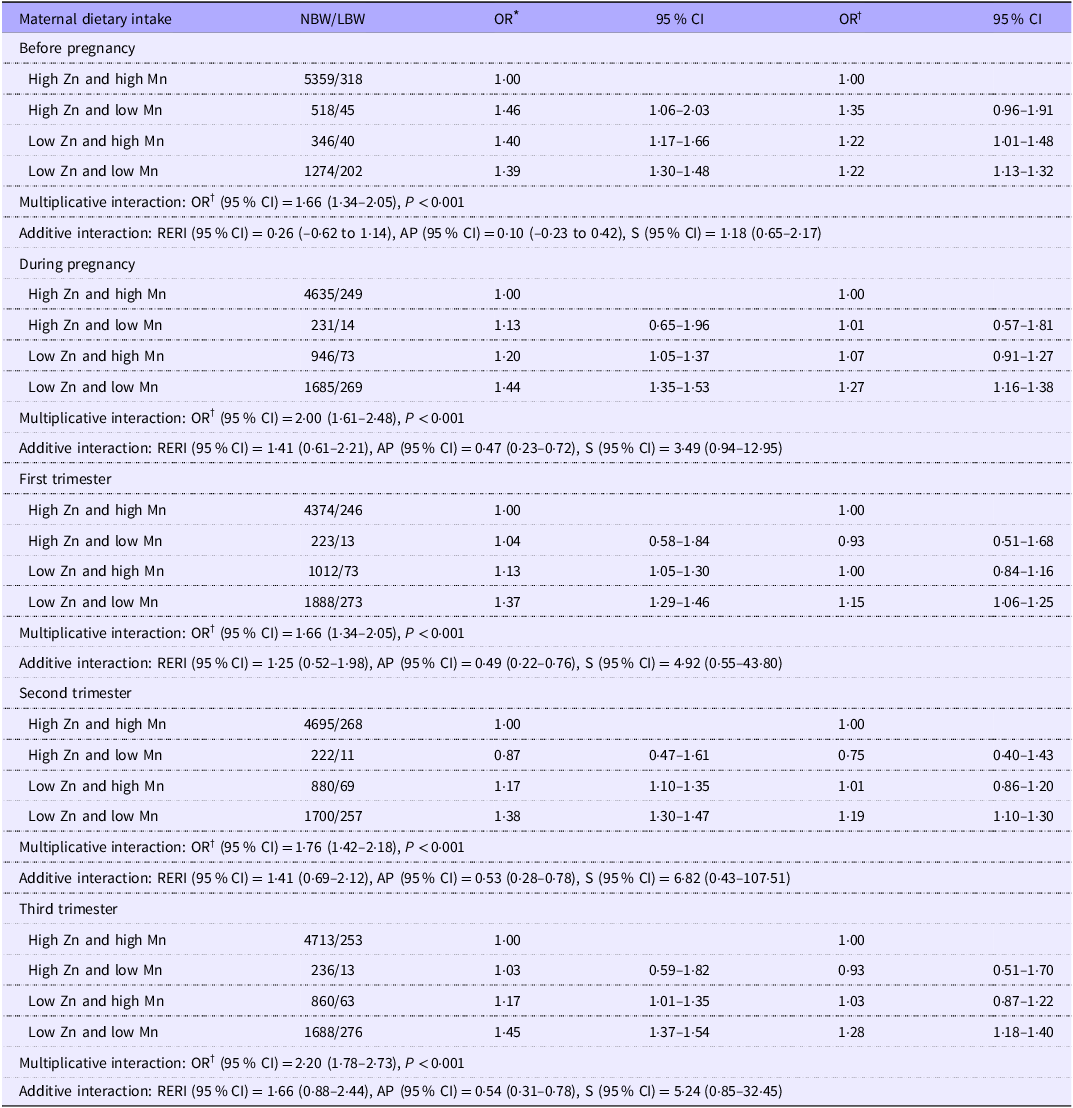
As shown in Table 6, interaction analysis showed that there was an additive interaction between low Zn and low Mn intake during pregnancy, and the RERI was 1·41 (RERI = 1·41, 95 % CI: 0·61–2·21). In addition, 47 % (AP = 0·47, 95 % CI: 0·23–0·72) of the risk of LBW was attributed to the interaction between low maternal dietary intake of Zn and Mn. At the same time, we found that there was a multiplicative interaction between low dietary intake of Zn and low Mn during pregnancy (OR = 2·00, 95 % CI: 1·61–2·48). These results suggest that low dietary intake of Zn and Mn during pregnancy significantly increases the risk of LBW. Similar findings were obtained after stratifying by time periods of the trimester of pregnancy.
Interaction effects of maternal dietary Zn and Mn intake on the risk of LBW

LBW, low birth weight; NBW, normal birth weight; S, synergy index; RERI, relative excess risk due to interaction; AP, the attributable proportion due to interaction.
* OR used univariate analysis.
† OR adjusted for pre-pregnancy BMI, weight gain during pregnancy, father’s BMI, total energy intake, monthly income per capita, maternal education level, smoking, maternal employment, multivitamin supplement, gestational hypertension, history of premature birth and reproductive history.
Discussion
Through this nested case–control study, we confirmed that maternal dietary Zn and Mn intake levels were associated with the occurrence of LBW and that there was a synergistic effect of low Zn and low Mn intake on the risk of LBW. Pregnant women with low dietary Zn or Mn intake before and during pregnancy had a significantly increased risk of LBW, and this association showed a clear dose–response relationship, particularly in the case of VLBW (Tables 2 and 4). In addition, the interaction between Zn and Mn on LBW was present before and during pregnancy (Table 6). To our knowledge, this is the first time the association between dietary Zn and Mn intake levels and LBW has been explored before and throughout pregnancy.
The need for vitamins and minerals increases during pregnancy, with deficiencies having serious health consequences. Zn is the second most abundant trace element in the human body(Reference Kambe, Tsuji and Hashimoto39), which plays a vital role in normal growth and development. The transport of Zn to the fetus is completely dependent on its concentration in the mother’s blood(Reference Paterson, Mas and Sarkar40). During pregnancy, hemodilution and lower albumin levels result in a decrease in serum Zn concentration(Reference Giroux, Schechter and Schoun41), necessitating increased maternal intake to meet pregnancy demands.
According to data from the WHO, inadequate dietary Zn intake is common and ranks as the fifth leading cause of mortality in developing countries(Reference Brundtland42). Due to variations in living conditions, dietary habits and economic conditions, there exist regional differences in Zn deficiency among pregnant women in China, with a particularly high rate of dietary Zn deficiency in western regions(Reference Liang, Wu and Huang43,Reference Mao, Wang and Li44) . Zn deficiency can reduce the activity of Cu-Zn superoxide dismutase and increase the level of serum homocysteine, which may be the pathological basis of LBW(Reference Abolbashari, Darroudi and Tayefi45,Reference Jing, Rech and Wu46) . Regarding the relationship between Zn and LBW before and during pregnancy, the current research results are controversial. A nested case–control study in India(Reference Negandhi, Negandhi and Zodpey17) showed that low Zn intake was significantly associated with the risk of LBW (P < 0·001). This is consistent with the results of this study but was not analysed separately for each pregnancy. A study conducted in the USA has found that women with low plasma Zn concentrations during early pregnancy who supplemented with 25 mg of Zn sulfate daily had heavier newborns (P = 0·03)(Reference Goldenberg, Tamura and Neggers18). This may reveal a potential positive association between Zn intake and birth weight. However, some studies have not found a statistically significant effect of Zn on newborn birth weight. According to a randomised controlled trial in Iran(Reference Zahiri Sorouri, Sadeghi and Pourmarzi19), supplementation of 15 mg of Zn daily from 16 weeks of gestation to delivery did not affect the incidence of LBW. A study from the second trimester to delivery also failed to find an improvement in neonatal birth weight with 30 mg of Zn daily(Reference Osendarp, van Raaij and Darmstadt20). Of note, neither study included complete trimesters. Besides, a meta-analysis stated that there was insufficient evidence to suggest that Zn supplementation during pregnancy improved newborn birth weight(Reference Carducci, Keats and Bhutta21).
Mn is crucial for organismal growth and the formation of bone matrix(Reference Palacios47). Severe deficiency of Mn can lead to growth retardation and skeletal abnormalities in animals, and maternal Mn levels may influence the formation and growth of fetal bones(Reference Bolze, Reeves and Lindbeck48). Although few studies have investigated the effects of Mn on LBW, some studies have revealed an association between maternal Mn levels and newborn birth weight. A Korean study found that birth weight was reduced if maternal blood Mn levels were too low or abnormally high(Reference Eum, Cheong and Ha22). In addition, a study in Shanghai, China, found a U-shaped relationship between maternal Mn levels and newborn birth weight(Reference Chen, Ding and Gao23). A similar U-shaped relationship was found in another study from China(Reference Zhang, Chen and Xia24), where women in the lowest quartile of plasma Mn levels had a nearly 2-fold increased risk of LBW delivery (OR = 2·93, 95 %CI: 1·67–5·17). One study found that maternal blood Mn levels increase throughout pregnancy(Reference Arbuckle, Liang and Morisset49). Meanwhile, the restricted cubic spline models of this study (Figure 3) showed that the upper limit of Mn as a protective factor increased with the increase of trimesters, indicating that Mn plays an important role in fetal development and that higher concentrations of Mn are required during pregnancy. For the general population, dietary intake is the main source of Mn. Relative to Zn, Mn has a more complex effect on pregnancy outcomes. It is a micronutrient necessary for health but potentially toxic if exposed above a certain level, making it crucial to keep its intake balanced.
Maintaining adequate antioxidant activity is crucial for preventing adverse pregnancy outcomes. During placental vascularisation, trophoblast cells invade the maternal decidua, causing oxidative stress that necessitates antioxidant regulation(Reference Mistry and Williams50). The placenta contains antioxidant enzymes like superoxide dismutase, which depend on micronutrients such as Zn and Mn to protect against oxidative stress. Zn helps neutralise free radicals and promotes antioxidant formation like metallothionein(Reference Tainer, Getzoff and Richardson51). Zn acts as a cofactor for over 300 enzymes and enables transcription factors to bind DNA by forming Zn finger proteins(Reference Gower-Winter and Levenson52). Its deficiency is linked to higher reactive oxygen species production and increased oxidative DNA damage(Reference Kraus, Roth and Kirchgessner53). Matrix metalloproteinases are calcium-dependent Zn-containing endopeptidases belonging to the metzincin proteinase superfamily that play a key role in embryo implantation, placenta, cervical dilation and fetal lysis(Reference Tu, Goldenberg and Tamura54). As inflammation and oxidative stress markers, some matrix metalloproteinases have proved to be associated with LBW(Reference Kumarathasan, Vincent and Bielecki55). Mn may affect birth weight through the matrix metalloproteinase-mediated pathway(Reference Au, Bielecki and Blais56). In addition, Mn may prevent oxidative damage by reducing the formation of free radicals, which can affect newborn birth weight(Reference Bocca, Ciccarelli and Agostino57). It follows that both Zn and Mn have important antioxidant effects during pregnancy, which may explain the synergistic effect between low Zn and low Mn levels in this study.
On the whole, Chinese women pay more attention to the intake of macronutrients, such as protein, fat and sugar, and do not pay attention to the reasonable supplementation of micronutrients(Reference Hao, Yan and Liu58). This study provides a reference for targeted nutritional intervention for pregnant women in this region and even in areas with a similar development level to a certain extent.
However, there are some limitations to this study. First, the dietary Zn and Mn intake information of the study subjects was all from the 24-h dietary review survey, which may be affected by recall bias. Therefore, strict quality control was carried out during the whole process from questionnaire design to data entry. Second, this study mainly explored the effect of dietary Zn and Mn on the risk of LBW and did not measure maternal tissue levels of Zn or Mn. Third, we did not measure individual water consumption. However, as a nested case–control study where all subjects originated from the same locale and shared a homogeneous water source, the variation in Mn exposure from drinking water was minimised between cases and controls. Finally, our study subjects were all from a hospital in Lanzhou, China, and the extrapolation of the study results was limited due to dietary differences in different regions.
Conclusions
Our study suggests that low dietary intake of Zn and Mn before and during pregnancy may increase the risk of LBW. In addition, low intake of these minerals during pregnancy has a synergistic effect on the risk of LBW, and maintaining appropriate Zn and Mn intake levels may reduce the risk of LBW. However, further research is needed to confirm these findings and elucidate the underlying mechanisms.
Supplementary material
For supplementary material/s referred to in this article, please visit https://doi.org/10.1017/S0007114525106090.
Acknowledgements
The authors thank all medical staff involved in the study for recruiting the participants. The authors also thank all mothers and infants who participated in the study and all investigators who contributed to data collection.
This work was supported in part by Gansu Provincial Health Commission Research Project (No.GSWSKY2024-14; GSWSKY2024-49) and the Traditional Chinese Medicine Management Project of Gansu Province (No. GZKG-2024-43).
Y.L.: Writing – original draft, Visualisation, Validation, Methodology, Investigation, Formal analysis, Data curation, Conceptualisation. L.C.: Validation, Visualisation, Investigation, Formal analysis, Data curation. Z.W.: Validation, Formal analysis, Data curation. S.D.: Methodology, Investigation. J.W.: Methodology, Investigation. L.Y.: Writing – review & editing, Supervision, Project administration. B.M.: Writing – review & editing, Supervision, Resources, Methodology, Funding acquisition, Conceptualisation.
The authors declare that there are no conflicts of interest.