Introduction
Ireland has made significant progress in reducing the incidence of suicide, with the crude suicide death rate decreasing from 12.9 per 100,000 people in the year 2000, to 9.2 per 100,000 in 2021 (Department of Health 2025; Central Statistics Office 2024). However, Ireland’s current suicide rate remains a public health concern, with 512 deaths from suicide recorded in 2021, and the true burden likely underestimated (Central Statistics Office 2024; Indecon International Research Economists 2024). Suicide has a profound and far-reaching impact on families, friends, and communities, with each death estimated to impact up to 135 individuals (Cerel et al. Reference Cerel, Maple, Aldrich and van de Venne2016, Reference Cerel, Brown, Maple, Singleton, van de Venne, Moore and Flaherty2019). For each death by suicide, it is estimated that there are an additional 20 suicide attempts, with non-fatal self-harm amongst the strongest predictors for suicide (World Health Organization 2025; Health Service Executive National Office for Suicide Prevention 2025).
Reducing suicide and self-harm is a core objective of national policy in Ireland, including Connecting for Life and Sharing the Vision, and remains a priority within wider health system planning (Health Service Executive 2025a, 2025b, 2025c; Health Service Executive Healthy Ireland 2025).
Although most suicides in Ireland occur in a private setting, research from the Irish Probable Suicide Death Study (IPSDS) 2015-2018, estimates that almost one third of suicides occur in a public place, including bridges and other high locations (Cox et al. Reference Cox, Benson, O’Neill, Sinyor, McMahon and Arensman2022). Suicide by jumping represents a smaller but important proportion of these deaths, though accurate estimates are limited due to inconsistencies in data collection (Rocos and Chesser Reference Rocos and Chesser2016). Internationally, jumping accounts for between 3 and 26% of suicide attempts, and is associated with risk factors including younger age, male gender, mental illness, and access to unprotected heights (Beautrais Reference Beautrais2007; Reisch et al. Reference Reisch, Michel and Znoj2008; Qiao et al. Reference Qiao, Song, Wang, Liu, Wang and Chen2022).
There is consistent international evidence that restricting access to means, particularly through barriers or safety nets, reduces suicide by jumping ( Merli and Costanza Reference Merli and Costanza2024; Okolie et al. Reference Okolie, Wood, Knipe and Gunnell2020; Shin et al. Reference Shin, Lee and Kim2025; Sinyor et al. Reference Sinyor, Schaffer and Nishikawa2017). These interventions are associated with a significant reduction in suicide attempts and there is little evidence of site displacement (Berman et al. Reference Berman, Silverman, Silverman and Mann2022; Dwyer et al. Reference Dwyer, Barrett, Quinlivan and Arensman2023; Hemmer et al. Reference Hemmer, Meier and Reisch2017; Sinyor et al. Reference Sinyor, Schaffer and Nishikawa2017). Evidence also suggests that restricting access to means is highly cost-effective (Bandara et al. Reference Bandara, Page, Gunnell, Wetherall, Clapperton, Milner and Niederkrotenthaler2022). Non-structural measures, such as crisis support signage and fixed telephones, may provide additional benefit when combined with structural interventions, although evidence for their standalone effectiveness is more limited (Kõlves et al. Reference Kõlves, Crompton, De Leo and Cheung2023; Belur et al. Reference Belur, Taylor, Westmarland, McGinley and Holmes2024). Other influences, including media reporting and public memorials, remain under-researched (O’Neill et al. Reference O’Neill, McCaughan, McDaid, Benson and Arensman2021; Sinyor et al. Reference Sinyor, Schaffer and Nishikawa2017).
‘Frequently used locations’ are sites where repeated suicide attempts have been identified (Owens et al. Reference Owens, Lloyd-Tomlins, Emmens and Aitken2019). In Ireland, such locations are often brought to the attention of agencies including the HSE National Office for Suicide Prevention (NOSP), An Garda Síochána (AGS), Local Authorities (LAs) and TII, with an expectation that preventative action will be considered (Health Service Executive 2025d; Owens et al. Reference Owens, Lloyd-Tomlins, Emmens and Aitken2019).
HIA is a structured and collaborative approach used to evaluate the potential health effects of policies, programmes, or projects on a population before they are implemented (World Health Organization 1999). Originating from the WHO Gothenburg Consensus Paper, HIA emphasises key principles including equity, transparency, participation and the ethical use of evidence, and has become an established tool for integrating health considerations into decision-making across sectors (World Health Organization 1999; Winkler et al. Reference Winkler, Viliani, Knoblauch, Cave, Divall, Ramesh, Harris-Roxas and Furu2021). As such, HIA is recognised as an important mechanism for operationalising a Health in All Policies (HiAP) approach by ensuring that the potential health implications of non-health sector decisions are systematically assessed (World Health Organization 2017).
HIA has been increasingly applied across a range of policy and project settings, and recent work has highlighted both the diversity of HIA frameworks internationally and the importance of transparent reporting of how guidance is applied in practice (McDermott et al. Reference McDermott, Douglas, Haigh, Takemon and Green2024; O’Mullane et al. Reference O’Mullane, Kenny, Nash, Ryan, Fitzsimons, Connolly, Green, Purdy, Cave and Harris-Roxas2025).
HIA is particularly useful where proposals originating outside the health sector may influence population health and where decisions involve multiple agencies and competing priorities (Institute of Public Health 2025). Unlike other forms of health analysis that primarily examine existing health outcomes, HIA is designed to prospectively assess how proposed actions may influence population health and health equity, thereby informing decision-making before implementation (World Health Organization 1999; Winkler et al. Reference Winkler, Viliani, Knoblauch, Cave, Divall, Ramesh, Harris-Roxas and Furu2021).
Despite this growing body of work, published examples of applying HIA within Ireland remain limited, and there is little published literature describing the use of HIA in suicide prevention specifically. To our knowledge, this represents the first published application of HIA to a suicide prevention proposal in Ireland and the United Kingdom.
In this context, concerns had been raised by local residents and public representatives regarding suicidal behaviour at Bridge A, a site identified as a frequently used location. A proposal was developed to implement structural modifications to reduce the risk of suicide by jumping. As TII receives requests for interventions at multiple locations, robust evidence was required to inform decision-making. HSE Public Health was therefore asked to assess the potential population health impacts of the proposed measures through a Health Impact Assessment (HIA). This approach aligns with the HSE’s Preventing suicide in public places: A best practice toolkit (2025) which emphasises the value of a collaborative multi-agency approach to suicide prevention (Health Service Executive 2025d). This was a voluntary, project-level HIA undertaken to inform decision-making regarding a proposed infrastructure modification; HIA is not mandatory for such projects in Ireland.
The aim of this study was to apply HIA methods to the proposed structural suicide-prevention interventions at Bridge A to assess their potential impacts on population health, while also examining the utility of HIA as a framework for informing suicide prevention decision-making in this context. By integrating epidemiological data, scientific evidence on means restriction, and local population characteristics, the study also illustrates how HIA can support evidence-informed, multi-agency decision-making for suicide prevention at frequently used locations.
Methods
Study design
This HIA was conducted between April and July 2025, using the IPH’s Health Impact Assessment Guidance: A Manual (Pyper et al. Reference Pyper, Cave, Purdy and McAvoy2021). This guidance was selected because it represents the principal HIA framework developed for use in Ireland and provides a structured project-level methodology suitable for time-bounded assessments conducted collaboratively with public-sector stakeholders.
Setting
The HIA focused on Bridge A, a site identified locally as a frequently used location for suicidal behaviour.
Governance and participants
The process was led by the Health Service Executive (HSE) National Health Improvement team and supported by a multi-agency steering committee comprising representatives from the HSE NOSP, TII, AGS, the relevant Local Authority (LA), and the regional Department of Public Health. In total, the steering committee comprised eleven members: two from HSE National Health Improvement, two from NOSP, three from TII, two from AGS, one from the LA, and one from the regional Department of Public Health. A Resource Officer for Suicide Prevention (ROSP) was invited to participate but was unable to attend.
The steering committee was chaired by a member of the HSE National Health Improvement team. Community perspectives were represented indirectly through a local elected representative on the steering committee, although formal community consultation was not undertaken as part of the HIA process. The steering committee provided oversight of the HIA, directed the scope of the assessment, supported evidence gathering, and reviewed and approved the final HIA report.
Four formal steering committee meetings were held between April and July 2025, in addition to a multi-agency site visit to Bridge A during the scoping stage. Terms of Reference were developed to guide the governance of the process, including decision-making procedures and mechanisms for resolving disagreement among participating agencies.
The final HIA report was disseminated to relevant stakeholders, including TII and local public health and suicide prevention services. Due to concerns regarding suicide contagion and the sensitive nature of the location, the report has not been made publicly available.
Procedures
The HIA followed the four stages outlined in IPH guidance; screening, scoping, analysis, reporting (Pyper et al. Reference Pyper, Cave, Purdy and McAvoy2021). Although the IPH framework also includes subsequent stages relating to implementation, monitoring and evaluation, these stages occur after completion of the HIA and were outside the scope of this assessment. The present study therefore focuses on the stages undertaken to inform decision-making regarding the proposed structural interventions.
Screening
Screening is the first HIA stage, used to determine if the HIA is warranted (Pyper et al. Reference Pyper, Cave, Purdy and McAvoy2021). This decision is based on whether the proposal has the potential to alter ‘risks to human health’ in a manner ‘likely’ to ‘significantly’ affect population health (Pyper et al. Reference Pyper, Cave, Purdy and McAvoy2021). A ‘likely’ effect is one which is both plausible based on the literature and probable according to professional judgement (Pyper et al. Reference Pyper, Cave, Purdy and McAvoy2021). A ‘significant’ effect is one deemed important or unacceptable (Pyper et al. Reference Pyper, Cave, Purdy and McAvoy2021). The steering committee convened in April 2025, to decide whether to proceed with the HIA. Initial evidence from a review of the scientific literature on suicide prevention at frequently used locations, together with local intelligence regarding incidents at the site, informed the assessment of plausibility. The IPH’s Health Assessment Screening Tool for Case-by-Case Decisions was used to aid decision making (Pyper et al. Reference Pyper, Cave, Purdy and McAvoy2021, pp.110–111). This screening tool identifies relevant health determinants, and a HIA is warranted if the proposal is likely to have an impact on one or more of these (Pyper et al. Reference Pyper, Cave, Purdy and McAvoy2021).
Scoping
The scoping stage identified the population groups and determinants of health for analysis. This included a multi-agency site visit to Bridge A. To systematically assess which population groups might be affected by the proposal, the IPH’s Scoping Tool for Population Groups was adapted for this HIA (Pyper et al. Reference Pyper, Cave, Purdy and McAvoy2021, p. 130). To identify relevant health determinants, each determinant listed in the IPH’s Project-level Scoping Tool for Health Determinants was assessed using the IPH’s Scoping Guide (Pyper et al. Reference Pyper, Cave, Purdy and McAvoy2021, pp. 123–129). This tool includes a broad range of health determinants relating to lifestyle, community, environmental, socioeconomic and health service factors. To support a consistent approach during scoping the ‘source-pathway-receptor-significance’ conceptual model from the IPH guidance was applied (Pyper et al. Reference Pyper, Cave, Purdy and McAvoy2021, pp. 115–117). Health effects considered ‘likely’ and ‘potentially significant’ were scoped in for further analysis, while those considered to be ‘unlikely’ or ‘not significant’ were scoped out (Pyper et al. Reference Pyper, Cave, Purdy and McAvoy2021). This approach ensured the assessment remained focused and proportionate to the available time and resources (Pyper et al. Reference Pyper, Cave, Purdy and McAvoy2021).
Analysis
The analysis stage involves an in-depth assessment of the ‘significance’ of health changes associated with the proposal (Pyper et al. Reference Pyper, Cave, Purdy and McAvoy2021). This stage focused specifically on the two health determinants scoped in during the previous stage: Injury Risk and Road or Route Safety. The decision to scope in these determinants was agreed by the steering committee during the scoping stage, based on the application of the IPH scoping tools and professional judgement regarding the likely and potentially significant health effects of the proposal.
In line with IPH guidance, ‘Significance’ was assessed by considering two key factors: the ‘sensitivity’ of the population to health changes and the ‘magnitude’ of potential health changes. Conceptual models for both ‘sensitivity’ and ‘magnitude’ were used to guide the analysis (Figures A1 and A2, Appendix A) (Pyper et al. Reference Pyper, Cave, Purdy and McAvoy2021, pp. 141–147). The conclusions drawn from the health ‘sensitivity’ and health ‘magnitude’ models informed the final assessment of health ‘significance’ (Figure A3, Appendix A). Not all criteria in these models apply to every proposal, and a proportionate analysis was conducted, based on evidence quality, relevance and availability (Pyper et al. Reference Pyper, Cave, Purdy and McAvoy2021, pp. 147–151).
To support analysis of population health ‘sensitivity’, health ‘magnitude’, and the overall health ‘significance’ of the proposal, the best available evidence was gathered through the following steps:
-
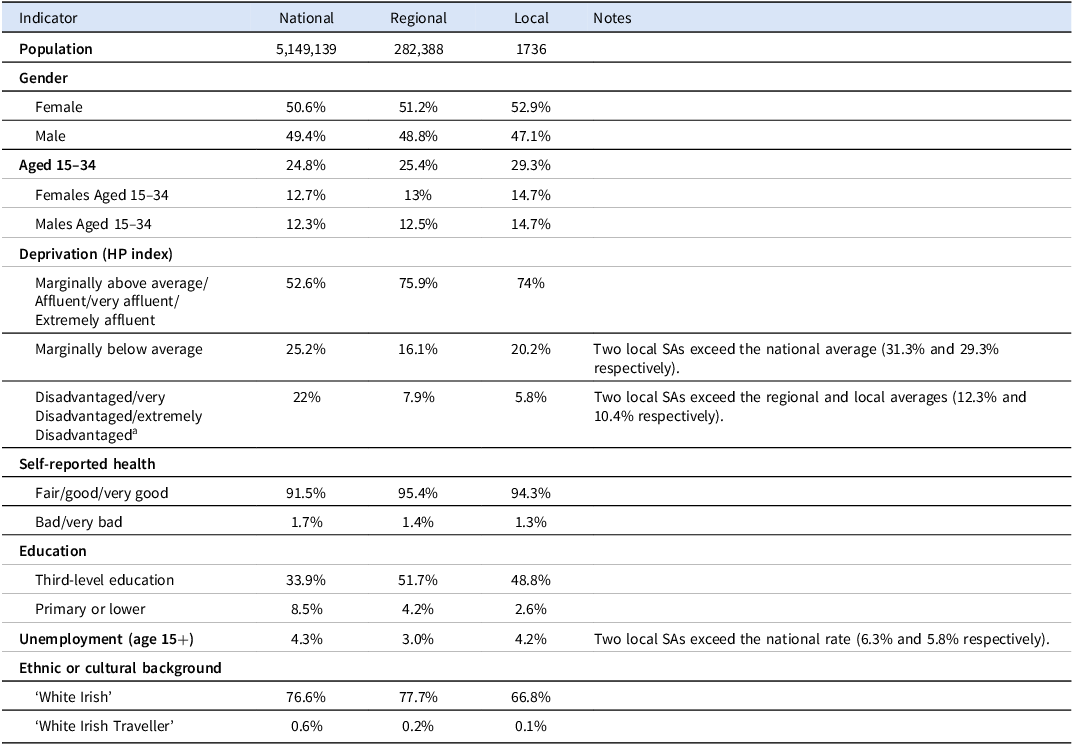
• Population health profiling: A demographic and health profile of both the regional and local populations was developed using Health Atlas Ireland (Health Service Executive 2025e). These profiles are based on CSO data from the 2022 census (Central Statistics Office 2025). The CSO measures the relative social advantage or disadvantage of areas using the Pobal Haase-Pratschke (HP) Deprivation Index (Furlong Reference Furlong2023). In line with the IPH guidance, only baseline data relevant to the analysis were included (Pyper et al. Reference Pyper, Cave, Purdy and McAvoy2021).
-
• Incident data on suicidal behaviour: Anonymised data relating to suicidal behaviour at Bridge A was requested from AGS.
-
• Review of scientific literature and policy context: The scientific literature, health policy context, regional and local priorities and stakeholder views were reviewed to contextualise the potential impact of the proposal.
The analysis was completed by the HIA lead on behalf of the steering group. The results of these analyses are presented in the Results section below.
Reporting
The aim of the reporting stage was to present the conclusions and recommendations, supported by the evidence that informed them (Pyper et al. Reference Pyper, Cave, Purdy and McAvoy2021). Findings were presented to the steering committee and recommendations were finalised through a facilitated discussion led by the chair of the steering committee, Figure 1 below (Pyper et al. Reference Pyper, Cave, Purdy and McAvoy2021). Technical and non-technical summaries were produced, which were reviewed and amended by the steering group before dissemination to stakeholders, including the CEO of TII, the local county council, NOSP, the local ROSP, and the local Community Mental Health Team.
Flow diagram of the IPH scoping guide process (reproduced with permission from the Institute of Public Health (Pyper et al. Reference Pyper, Cave, Purdy and McAvoy2021)).

Ethical consideration
The HIA was informed by the core principles outlined in the WHO Gothenburg Consensus Paper and subsequent best-practice guidance, including equity, participation, transparency and the ethical use of evidence (World Health Organization 1999; Winkler et al. Reference Winkler, Viliani, Knoblauch, Cave, Divall, Ramesh, Harris-Roxas and Furu2021). These principles are also reflected in the Institute of Public Health (IPH) HIA guidance applied in this assessment (Pyper et al. Reference Pyper, Cave, Purdy and McAvoy2021). Equity considerations informed the analysis of population health sensitivity and potential differential impacts across groups. Transparency was maintained through documentation of methods and review by the multi-agency steering committee. Participation occurred through engagement with relevant stakeholder organisations; however, formal community consultation was not undertaken due to concerns regarding suicide contagion and the sensitive nature of the location. Formal ethical approval was not required as the assessment did not involve direct contact with patients or the collection of identifiable personal health information.
Results
Screening stage
The steering committee concluded that the proposal was ‘likely’ to ‘significantly’ affect population health by influencing the determinants of health identified in the IPH’s Health Assessment Screening Tool for Case-by-Case Decisions (Pyper et al. Reference Pyper, Cave, Purdy and McAvoy2021, pp. 110–111). Accordingly, the HIA was screened in by the steering committee.
Scoping stage
Site visit
A multi-agency site visit was undertaken to gain an understanding of the bridge location. The bridge has pedestrian access via footpaths on both sides. The existing 1.25m high parapet include a steel mesh on its inner face. Features noted to potentially facilitate suicide attempts included toe-hold points in the mesh and incomplete mesh coverage along the full length of the parapet, potentially making climbing easier at certain points. Four formal Samaritans Ireland crisis support signs were fixed to both parapets, along with two informal crisis support signs as part of the ‘teddy bear campaign’. The presence of two memorial plaques was also noted.
Population scoped in for analysis
Most individuals attempting suicide at the site were reported by AGS to be from the surrounding area. Accordingly, two levels of population were defined for analysis: the regional population (based on the catchment area of three local General Adult Mental Health Teams as defined by Health Atlas Ireland), and the local population (based on ‘Small Area (SA)’ boundaries in Health Atlas Ireland). The site-specific (neighbouring) population was very limited in size and was not included for separate analysis. The at-risk population was defined as individuals vulnerable to suicidal behaviour at the bridge, while road users were also included as the bridge overlies a major road (Pyper et al. Reference Pyper, Cave, Purdy and McAvoy2021).
Determinants of health scoped in for analysis
Two physical determinants of health were scoped in for detailed analysis: injury risk and road or route safety. These were identified using the IPH’s Project-level Scoping Tool for Health Determinants, under the domain of safe and cohesive communities (built environment and transport) (Pyper et al. Reference Pyper, Cave, Purdy and McAvoy2021, pp. 124–125).
A reduction in suicide attempts at the bridge was considered both plausible and probable, with impacts judged as significant due to the vulnerability of users and the national priority placed on suicide prevention. The road below the bridge carries a high volume of road users and a suicide attempt on the bridge poses risks to road users via Road Traffic Accidents, thus road safety was also included (Road Safety Authority 2025; Transport Infrastructure Ireland 2025). Risk reduction is considered probable, and the proposal aligns with Vision Zero, Ireland’s National Road Safety Strategy (Road Safety Authority 2025).
Analysis stage
Population demographic and health profile
Table 1 below summarises key demographic, socioeconomic, and health indicators for the national, regional, and local populations, highlighting factors relevant to suicide risk and population ‘sensitivity’.
Population demographic and health profile (Central Statistics Office 2025)

a Deprivation categories are based on the Pobal HP Deprivation Index. For reporting purposes, the categories ‘disadvantaged,’ ‘very disadvantaged,’ and ‘extremely disadvantaged’ are grouped together under the term ‘disadvantaged’.
Incident data on suicidal behaviour at Bridge A
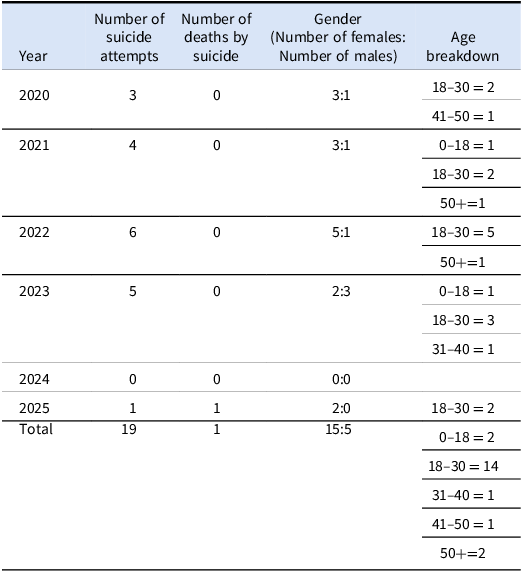
High-level data on incidents of suicidal behaviour at Bridge A between January 1st, 2020, and April 30th, 2025, was provided by AGS and is presented in Table 2 below. Specific age ranges corresponding to each gender were not disclosed. Five of the incidents involved repeat attempts by the same individual.
AGS data on suicide attempts and deaths by suicide at Bridge A

Injury risk: assessment of significance
The population was judged to have medium ‘sensitivity’ to injury risk, based on IPH conceptual model criteria, including life-stage vulnerability, socioeconomic deprivation, inequalities and capacity to adapt (Pyper et al. Reference Pyper, Cave, Purdy and McAvoy2021 pp. 141–144). This assessment was agreed by the steering committee.
A significant proportion (29.3%) of the population in the local area are aged 15–34, which is higher than the national average (Central Statistics Office 2025; World Health Organization 2025). Adolescents and young adults are known to be particularly sensitive to mental-health-related risks due to developmental and psychological factors (Pyper et al. Reference Pyper, Cave, Purdy and McAvoy2021). This age group is also overrepresented in local data on suicide by jumping, with the majority of suicide attempts at Bridge A occurring in those under the age of 35. Although the broader area is relatively affluent, certain SAs adjacent to the bridge show indicators of socioeconomic deprivation, a known risk factor for suicide (McClelland et al. Reference McClelland, Khan, Johnson and Fearn2024; Tio et al. Reference Tio, Harper, Lewis and Lynch2024).
The magnitude of impact was assessed as high, based on criteria including severity and irreversibility of outcomes, exposure to a known hazard, and likelihood of sustained benefit (Pyper et al. Reference Pyper, Cave, Purdy and McAvoy2021, pp. 145–147). This assessment was agreed by the steering committee following review of the available evidence.
The literature provides consistent evidence for the effectiveness of structural barriers in reducing deaths by suicide and suicide attempts by jumping from a height, and the proposal is well aligned with current mental health policy and national priorities (Dwyer et al. Reference Dwyer, Barrett, Quinlivan and Arensman2023; Okolie et al. Reference Okolie, Wood, Knipe and Gunnell2020). Overall, the proposal was assessed as likely to reduce injury risk in a way that is potentially significant (Pyper et al. Reference Pyper, Cave, Purdy and McAvoy2021, pp. 148–151) (Figure 2).
Injury risk: health significance (reproduced with permission from the Institute of Public Health (Pyper et al. Reference Pyper, Cave, Purdy and McAvoy2021)).

Figure 2. Long description
A diagram illustrating the assessment of health significance based on various factors. The diagram is structured in concentric circles, with the center labeled Centre is a significant health effect. The circles are divided into sections with labels such as Sensitivity of population, Magnitude of change, Health policy context, Regulatory thresholds of acceptability or desirability of change, Consultation Responses, Health baseline change, Health priorities, and Scientific literature. Each section contains sub-labels indicating different levels of impact or evidence, such as Negligible, Low, Medium, High, and Substantial. Red circles highlight specific areas within the diagram, indicating significant health effects and consensus. The diagram visually represents the interplay between these factors in assessing health significance.
Road or route safety: assessment of significance
The population of road users was judged to have low ‘sensitivity’ to the proposal, based on the IPH conceptual model criteria (Pyper et al. Reference Pyper, Cave, Purdy and McAvoy2021, pp. 141–144). This assessment was agreed by the steering committee.
The magnitude of impact was assessed as high, reflecting the large volume of daily traffic on the road below the bridge, and the potential for serious or fatal road traffic accidents arising from an incident at the bridge (Pyper et al. Reference Pyper, Cave, Purdy and McAvoy2021, pp. 145–147). This assessment was also agreed by the steering committee.
The proposal aligns with a HiAP approach, and aligned with national and local priorities and policy, including Vision Zero ( Road Safety Authority 2025; World Health Organization 2017). Overall, the proposal was assessed as likely to positively influence road safety in a way that is potentially significant (Pyper et al. Reference Pyper, Cave, Purdy and McAvoy2021, pp. 148–151) (Figure 3).
Road or route safety: health significance (reproduced with permission from the Institute of Public Health (Pyper et al. Reference Pyper, Cave, Purdy and McAvoy2021)).

Reporting stage
Based on the best available evidence, and the professional judgement of the HIA team, the assessment concluded that the proposed structural interventions were likely to have a positive and significant impact on public health by reducing the risk of suicide and injury at Bridge A. Accordingly, the HIA lead and steering committee recommended that the proposal be implemented. Complementary measures were also recommended, aligned with the site-specific suicide prevention framework outlined in the HSE’s Preventing Suicide in Public Places: A Best Practice Toolkit (Health Service Executive 2025d). These include provision of suicide prevention training for local gatekeepers, formalised crisis support signage, sensitive handling of memorials, and removal of informal signage.
Discussion
Main findings
The aim of this study was to conduct a HIA of proposed structural modifications at Bridge A. The evidence presented in this HIA provides support for the proposal and the expected change in population health as a result of the interventions is assessed as both ‘likely’ and ‘significant’ (Pyper et al. Reference Pyper, Cave, Purdy and McAvoy2021). In total, there were 20 verifiable incidents of suicidal behaviour at Bridge A between January 1st, 2020 and April 30th, 2025, 16 of which involved individuals under the age of 35. This is consistent with international trends where suicide by jumping is more frequent in those under the age of 35 (Beautrais Reference Beautrais2007; Qiao et al. Reference Qiao, Song, Wang, Liu, Wang and Chen2022; Reisch et al. Reference Reisch, Michel and Znoj2008). Notably, there were no verifiable incidents recorded for 2024, although the reasons for this remain unclear. Fifteen of the 20 incidents involved females, diverging from both national and international patterns, where suicide by jumping occurs more frequently in males than females (Beautrais Reference Beautrais2007; Central Statistics Office 2025; Reisch et al. Reference Reisch, Michel and Znoj2008).
The overrepresentation of females in suicide incident data at Bridge A cannot be explained by the local population distribution, and other social factors may be at play. While local health outcomes are generally better than national averages, a factor considered protective against suicide, pockets of disadvantage exist. This includes higher unemployment rates and a greater proportion classified as ‘disadvantaged’ on the Pobal HP Deprivation Index; established risk factors for suicide (Furlong Reference Furlong2023; McClelland et al. Reference McDermott, Douglas, Haigh, Takemon and Green2024; Tio et al. Reference Tio, Harper, Lewis and Lynch2024). The available incident data does not provide a breakdown by ethnicity. Minority ethnic groups are often underrepresented in official statistics, yet experience elevated suicide risk (Health Service Executive 2025a; National Suicide Research Foundation 2015). This underscores the importance of developing suicide surveillance systems that embed equity stratifiers to better identify populations experiencing health inequalities and increased suicide risk (Health Service Executive 2025f).
Addressing environmental and behavioural risk factors is central to effective suicide prevention (CDC 2024). The health determinants examined in this HIA, ‘Injury Risk’ and ‘Road or Route Safety’, are directly relevant, as both demonstrate how suicide attempts can cause harm to the individual and the wider public. The application of a standardised HIA scoping tool provided a structured and transparent approach to identifying relevant population groups and health determinants, supporting consistency in decision-making across the assessment. While the tool was generally straightforward to apply in this context, it required professional judgement to interpret relevance and proportionality, particularly given the site-specific nature of suicide risk and limitations in granular local data. This reflects wider findings that, although HIA frameworks provide structure, their application in practice is shaped by contextual, data and resource constraints, and benefits from multidisciplinary input. To our knowledge, this represents the first published application of HIA to a suicide prevention proposal in Ireland, contributing to the limited literature on HIA application in practice in Ireland (O’Mullane et al. Reference O’Mullane, Kenny, Nash, Ryan, Fitzsimons, Connolly, Green, Purdy, Cave and Harris-Roxas2025). It is anticipated that the proposed interventions will reduce the incidence of suicidal behaviour at Bridge A and ultimately save lives. However, while the proposed interventions are expected to reduce the incidence of suicidal behaviour at Bridge A, the HIA team acknowledges that addressing the wider incidence of suicide across Ireland requires ongoing, coordinated action at both national and regional levels (Health Service Executive 2025a). In this context, this study contributes to the limited published literature on the application of HIA in suicide prevention, particularly within an Irish setting.
Implications
This assessment highlights the complementary roles of HIA and Public Health in suicide prevention, particularly through shared strengths in multi-agency coordination and evidence-based advocacy and policy influence. Given the multifactorial nature of suicide, multi-sectoral collaboration is essential if national strategies such as Connecting for Life and Sharing the Vision are to be realised (Health Service Executive 2025a, 2025b). While retrofitting all bridges would be unfeasible, there is evidence that restricting access to means is cost-effective (Bandara et al. Reference Bandara, Page, Gunnell, Wetherall, Clapperton, Milner and Niederkrotenthaler2022). Considering the high economic burden of suicide, this HIA should be considered for adaptation at other high-risk locations across Ireland (Bandara et al. Reference Bandara, Page, Gunnell, Wetherall, Clapperton, Milner and Niederkrotenthaler2022). This is in line with the HSE’s Preventing Suicide in Public Places: A Best Practice Toolkit (Health Service Executive 2025d).
Suicide prevention measures need to be integrated into planning processes to prevent new high-risk locations from emerging. The HSE Suicide Prevention Impact Assessment Toolkit provides practical guidance for embedding suicide prevention into policy design and review (Health Service Executive 2025g). In the case of bridges, whilst 1.25m is the global standard height for bridge parapets, consideration should be given for bridge parapets to be higher in areas where the risk of suicide by jumping is known to be higher (Beautrais Reference Beautrais2007; Qiao et al. Reference Qiao, Song, Wang, Liu, Wang and Chen2022; Reisch et al. Reference Reisch, Michel and Znoj2008; Swanepoel Reference Swanepoel2023; TII 2025). Similar approaches could be applied to other public places such as cliffs, railways, and parks.
Following the HIA, the proposed structural interventions at Bridge A are due to be implemented in 2026, with complementary measures (e.g. crisis support signage, training) already underway. Monitoring their impact will be critical. While local Gardaí can informally track suicidal behaviour at the bridge, the absence of a real-time national suicide surveillance system remains a significant gap. Being able to produce robust real-time data would strengthen the case for intervention, not just at Bridge A, but at other emerging locations of concern. Developing such a system would also enable timely identification of clusters and trends, facilitate evaluation of interventions, and support evidence-based decision-making at national level (Benson et al. Reference Benson, O’Neill, McCaughan and McDaid2022, Health Service Executive 2025a). Evaluating the impact of the interventions will be essential for understanding their effectiveness in reducing suicidal behaviour and for generating evidence to guide future suicide prevention strategies.
Strengths and limitations
This study benefited from strong multi-agency collaboration and the use of a clear, standardised, transparent process, ensuring that recommendations were evidence based, grounded in both local intelligence, and international best practice. The structured application of HIA methods supports the reproducibility of the approach in similar contexts, although transferability may depend on local data availability, resources and stakeholder engagement.
Limitations include reliance on AGS data, which may have led to underestimation of incidents due to inconsistencies in data collection, recording and reporting. Five out of the 20 incidents were repeat attempts by the same individual, which may overstate the number of unique individuals affected. Due to data protection concerns, specific age ranges by gender were not disclosed.
Formal community consultation was not undertaken as part of the HIA process. Although community perspectives were represented indirectly through a local elected representative on the steering committee, direct engagement with people affected by the proposal did not occur. In participatory HIA, ‘community’ typically refers to those who may be directly affected by the proposed intervention (den Broeder et al. Reference den Broeder, Uiters, Ten Have, Wagemakers and Schuit2017). Direct engagement with people with lived experience of suicide at this location was not undertaken due to concerns regarding suicide contagion. The absence of formal community consultation therefore represents a limitation, as participation is a core principle of HIA (Winkler et al. Reference Winkler, Viliani, Knoblauch, Cave, Divall, Ramesh, Harris-Roxas and Furu2021, World Health Organization 1999).
Finally, this assessment was conducted within a defined timeframe to inform a real-world decision-making process. As such, while the HIA process was completed through the screening, scoping, analysis and reporting stages, implementation, monitoring and evaluation will occur following completion of the HIA and were outside the scope of this study.
Future research
Further research is needed to evaluate the effectiveness of suicide prevention measures, including restricting access to means, within an Irish context. The effectiveness of complementary non-structural measures, such as crisis support signage and the influence of memorials, should also be explored in an Irish context. Systematic evaluation of these interventions will be critical for informing future national suicide prevention strategies.
Further work is also warranted to evaluate the application of HIA methodologies in suicide prevention, including testing the IPH guidance across different settings and contexts. The development or adaptation of HIA frameworks tailored to suicide prevention may support more consistent and context-sensitive application in practice.
Conclusion
This HIA indicates that structural interventions at Bridge A are likely to significantly reduce suicidal behaviour at the site, and align strongly with national suicide prevention strategies (Connecting for Life and Sharing the Vision) (Health Service Executive 2025a, 2025b). The findings demonstrate the value of HIA in supporting structured, evidence-informed, multi-agency decision-making for suicide prevention in public places.
HIA offers a useful, context-dependent framework for assessing site-specific suicide risk and informing interventions. Embedding HIA within public health and planning processes may support more systematic consideration of suicide risk and health equity, and this study highlights its potential as a model to inform decision-making at other high-risk locations, subject to local adaptation.
Supplementary material
The supplementary material for this article can be found at https://doi.org/10.1017/ipm.2026.10209.