1. Introduction
The Upper Famennian sedimentary rocks have been extensively explored in southern Belgium since the work of Dumont (introducing the ‘Système Condruzien’ in Reference Dumont1830, now the Famennian Stage in Reference Dumont1855), Gosselet (Reference Gosselet1880), Mourlon (Reference Mourlon1875–1886) and more recently by Thorez, Dreesen, Streel and colleagues (e.g. Bouckaert, Streel & Thorez, Reference Bouckaert, Streel and Thorez1968; Bouckaert et al. Reference Bouckaert, Streel, Thorez and Mound1969; Thorez et al. Reference Thorez, Streel, Bouckaert and Bless1977; Thorez & Dreesen, Reference Thorez and Dreesen1986, Reference Thorez and Dreesen2002; Thorez, Dreesen & Streel, Reference Thorez, Dreesen and Streel2006). Thorez, Dreesen & Streel (Reference Thorez, Dreesen and Streel2006) produced the most synthetic work that summarizes long-term research and gives a complete overview of the historical background of the Famennian Stage. Thorez et al. (Reference Thorez, Streel, Bouckaert and Bless1977) and Thorez, Goemaere & Dreesen (Reference Thorez, Goemaere, Dreesen, de Boer, van Gelder and Nio1988) dealt mostly with the sedimentary and palaeoenvironmental reconstructions of the Namur–Dinant Basin during Famennian times. Besides these syntheses, detailed local and regional studies conducted by Thorez et alii have resulted in a huge amount of unpublished stratigraphic and sedimentary data. However, very few studies were published on the area situated outside the Dinant Synclinorium. The aim of this paper is to give a geological and stratigraphic framework for the current research on the Famennian strata of the ‘Namur Synclinorium’ with a particular focus on the Upper Famennian formations, which have yielded a diverse fauna and flora, including seed-plants (i.e. Stockmans, Reference Stockmans1948; Prestianni et al. Reference Prestianni, Streel, Thorez, Gerrienne, Steemans and Javaux2007), tetrapods (Clément et al. Reference Clément, Ahlberg, Blieck, Blom, Clack, Poty, Thorez and Janvier2004; Blieck et al. Reference Blieck, Clément, Blom, Lelièvre, Luksevics, Streel, Thorez, Young, Becker and Kirchgasser2007), placoderms (Olive, Reference Olive2013), sarcopterygian fishes (Lohest, Reference Lohest1888; Leriche, Reference Leriche1931; Clément, Reference Clément2002; Clément & Boisvert, Reference Clément and Boisvert2006; Clément, Snitting & Ahlberg, Reference Clément, Snitting and Ahlberg2009), eurypterids, branchiopod and malacostracan crustaceans (Gueriau, Charbonnier & Clément, Reference Gueriau, Charbonnier and Clément2014a , Reference Gueriau, Charbonnier and Clément b ) and a putative complete insect (Garrouste et al. Reference Garrouste, Clément, Nel, Engel, Grandcolas, D’Haese, Lagebro, Denayer, Gueriau, Lafaite, Olive, Prestianni and Nel2012, Reference Garrouste, Clément, Nel, Engel, Grandcolas, D’Haese, Lagebro, Denayer, Gueriau, Lafaite, Olive, Prestianni and Nel2013; Hörnschemeyer et al. Reference Hörnschemeyer, Haug, Béthoux, Beutel, Charbonnier, Hegna, Koch, Rust, Wedmann, Bradler and Willmann2013).
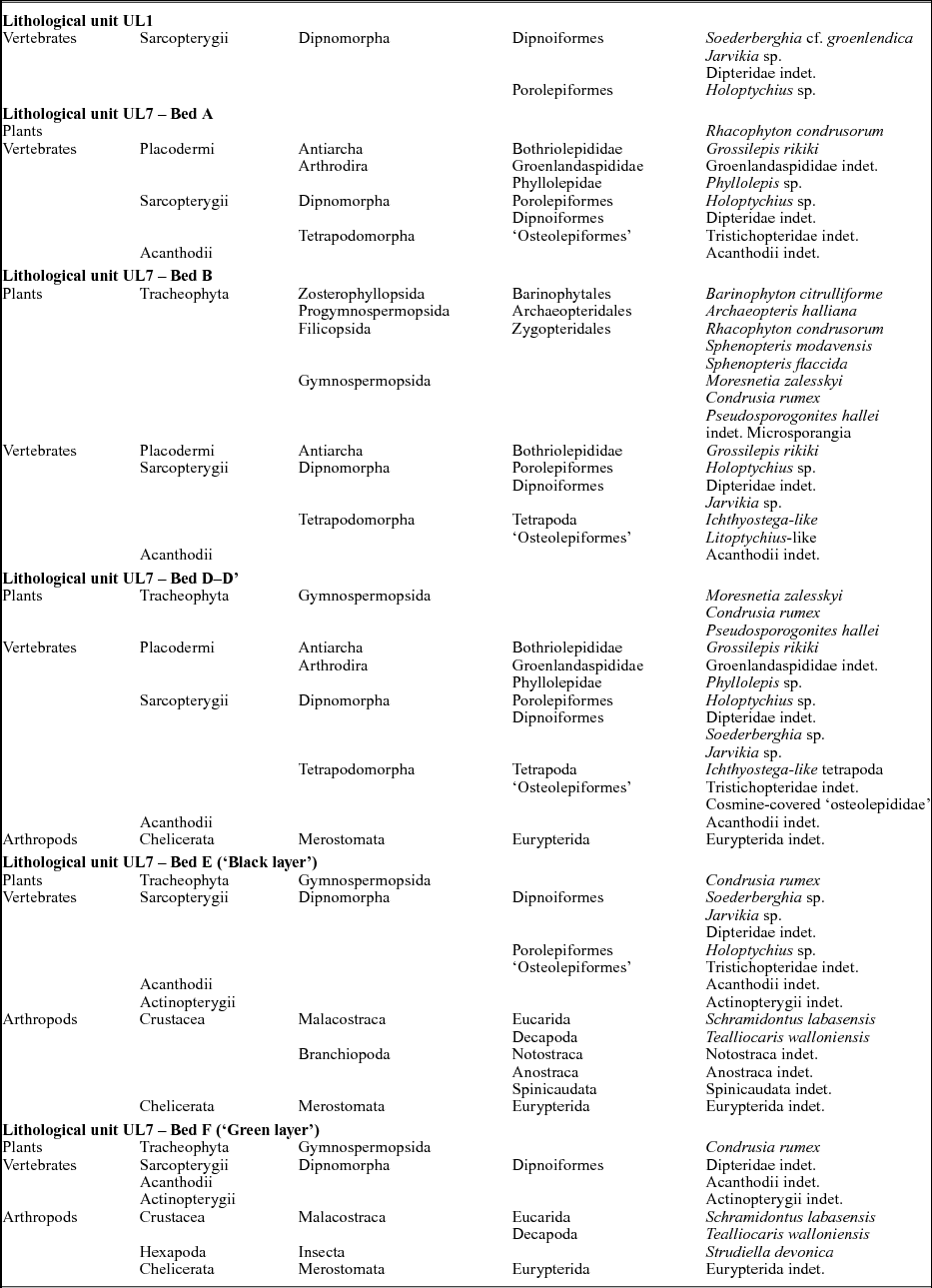
The floral and faunal taxonomic diversity of the Upper Famennian Strud locality (exemplified by Table 1) suggests a particular environment as well as depositional and preservation processes that need to be understood. Moreover, the study of the palaeoenvironment of this locality is fundamental because it records one of the earliest and most important phases of tetrapod evolution (i.e. after the emergence of the tetrapods and most probably before their terrestrialization). It raises the question of the ecology of the Devonian aquatic tetrapods and the selection pressures that occurred at the onset of their terrestrialization (see Clack, Reference Clack2007, Reference Clack2011).
Plant, invertebrate and vertebrate taxa recorded in the Strud fossil-bearing locality*

* Taxa currently under examination are provisory in open nomenclature.
2. Geological setting
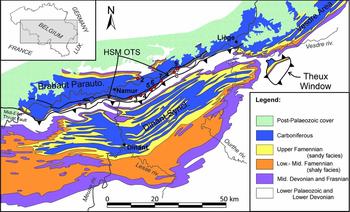
The studied area belongs to the Brabant Parautochthon (Belanger et al. Reference Belanger, Delaby, Delcambre, Ghysel, Hennebert, Laloux, Marion, Mottequin and Pingot2012; previously described as the ‘northern limb of the Namur Synclinorium’), to the Haine–Sambre–Meuse overturned thrust sheets (HSM OTS, previously described as the ‘southern limb of the Namur Synclinorium’) and to the Dinant Synclinorium (Fig. 1). These Variscan structural elements constituted the Namur–Dinant Basin, which developed along the southeastern margin of Laurussia, and in particular the London–Brabant Massif, during Devonian and Carboniferous times. During Late Famennian times, this area was a shallow-water siliciclastic shelf. The Namur–Dinant Basin was subdivided into several sedimentation areas characterized by a typical lithostratigraphic succession. These areas correspond most probably to tectonic blocks (faulted and tilted blocks) limited by synsedimentary faults (Thorez & Dreesen, Reference Thorez and Dreesen1986). The resulting architecture of the basin greatly influenced the facies distribution pattern.
Geological map of southern Belgium and surrounding areas (redrawn after de Béthune, Reference Béthune1954) with the location of the key sections (red dots). Abbreviations: HSM OTS – Haine–Sambre–Meuse Overturned Thrust Sheets; Parauto. – Parautochthon; Syncl. – Synclinorium. Key sections: 1 – Bois-des-Mouches section (stratotype); 2 – Marche-les-Dames disused quarry; 3 – Wierde section; 4 – Jausse section; 5 – Strud section and disused quarries; 6 – Haltinne section; 7 – Coutisse section; 8 – Huy (citadelle) section; 9 – Huy-Nord section.

The Upper Famennian succession is particularly well developed and exposed in the Dinant Synclinorium, from its eastern part in the Ourthe area to its central (Hoyoux valley) and western (Meuse valley, Bocq and Ciney areas) parts (Fig. 1). It is composed of predominantly siliciclastic sediments with some calcareous intercalations. The depositional setting approximately corresponds to a ramp with both an increase in the marine influence and a deepening southwards (Thorez et al. Reference Thorez, Streel, Bouckaert and Bless1977). The proximal facies (northwards) frequently show a continental influence and are thus dominantly sandy and silty, whereas the distal facies (southwards) are more mixed with frequent carbonate intercalations (Ciney area and southwards) indicating deposition in a ‘deeper’ part of the basin (c. 50 m deep after Thorez & Dreesen, Reference Thorez and Dreesen1986).
The HMS OTS are characterized by a lithostratigraphic succession thinner than their equivalent in the Dinant Synclinorium owing to a more proximal position and the occurrence of depositional gaps. The observed facies are typically continental (Thorez, Dreesen & Streel, Reference Thorez, Dreesen and Streel2006) and have yielded numerous fossils belonging to various continental communities such as fluvial vertebrate and arthropod assemblages associated with plants. The Famennian lithostratigraphic succession of the HSM OTS is shared with that of the Vesdre area. The latter displays a proximal facies (Thorez & Dreesen, Reference Thorez and Dreesen1986) where alluvial facies are more common.
The Brabant Parautochthon corresponds to the most proximal part of the Namur–Dinant Basin where the Famennian succession is very incomplete. The Lower Famennian shales are very reduced in thickness (Hennebert & Eggermont, Reference Hennebert and Eggermont2002; Delcambre & Pingot, Reference Delcambre and Pingot2008) and the upper part of the succession (Bois-de-la-Rocq Formation) is poorly known and its Upper Famennian age is poorly constrained (Bultynck & Dejonghe, Reference Bultynck and Dejonghe2002; Delcambre & Pingot, Reference Delcambre and Pingot2008).
3. Lithostratigraphy
The lithostratigraphic units were summarized by Bultynck & Dejonghe (Reference Bultynck and Dejonghe2002) and Thorez, Dreesen & Streel (Reference Thorez, Dreesen and Streel2006). One must note that the Upper Famennian lithostratigraphic units are currently under consideration by the Belgian sub-commission on Devonian stratigraphy: a new yet unnamed formation will be erected to replace the Monfort and Evieux formations, which would be considered as members while the numerous members of the latter two formations would be considered as facies. As the present paper focuses on the HSM OTS, the classical lithostratigraphic succession of the Dinant Synclinorium is not specified herein (see Thorez, Dreesen & Streel, Reference Thorez, Dreesen and Streel2006 and references therein for details).
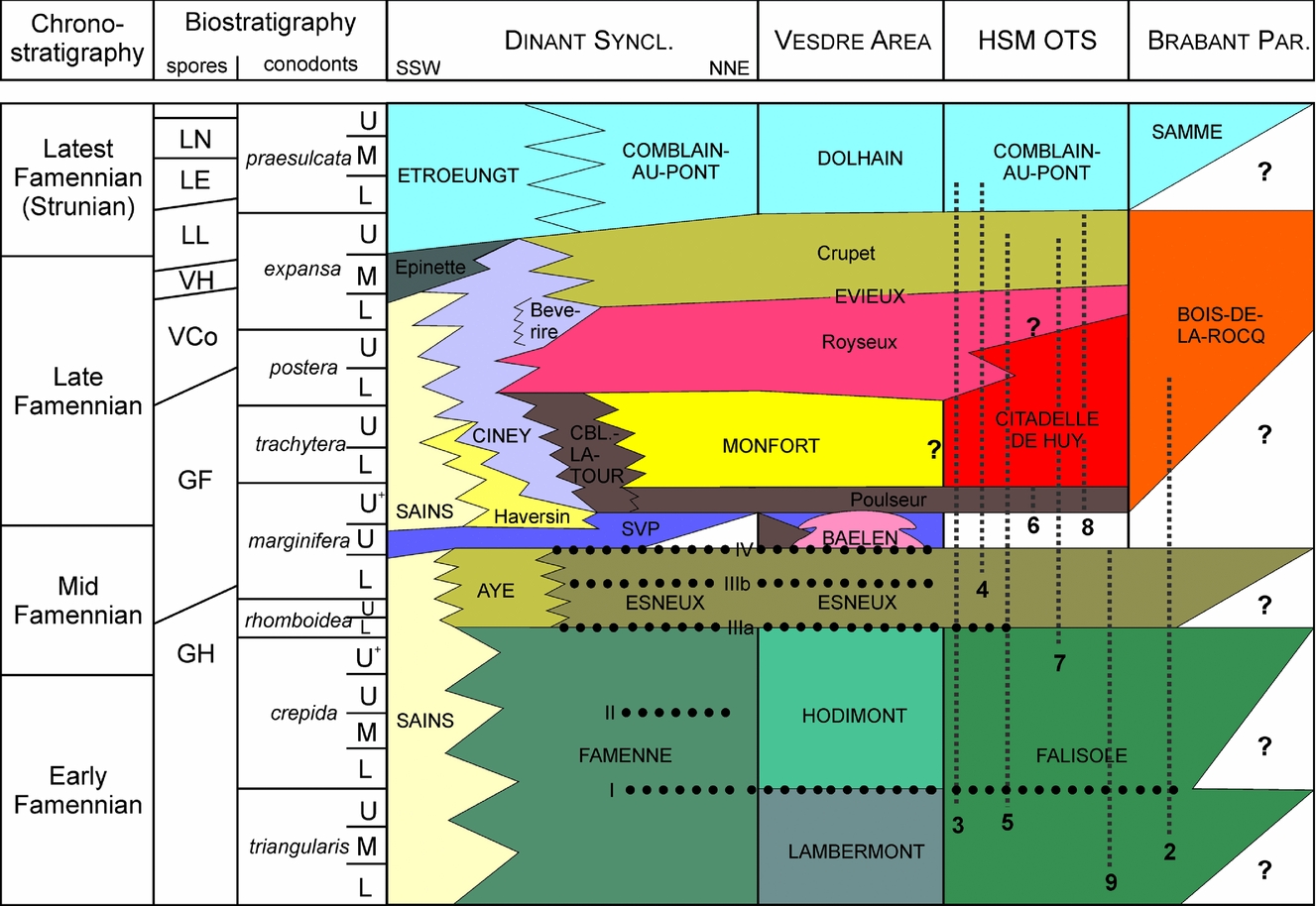
The studied area exposes a 100 m thick succession of Famennian sedimentary rocks (Fig. 2). The succession begins with the Upper Frasnian to Lower Famennian grey to green-coloured shale of the Falisole Formation including one or several horizons of oolitic ironstone deposited as tempestites in a muddy shallow marine environment (Dreesen, Reference Dreesen1982). The ironstone horizons are 10 cm to 85 cm thick lenticular beds separated by several metres of green to reddish shale. Dreesen (Reference Dreesen1982) recognized three oolitic ironstone horizons in the Falisole Fm, namely horizon I, in the lower part of the formation; II, in its upper third; and IIIa at the top. The Falisole Fm is well exposed in the Strud and Wierde sections. The lower oolitic ironstone horizon is also particularly well exposed in the Huy-Nord section (point 9 on Fig. 1). The faunal association of the Falisole Fm is not diverse: spiriferid brachiopods and pectinid pelecypods demonstrate a poorly oxygenized muddy marine environment slowly recovering after the Frasnian–Famennian crisis (Mottequin & Poty, in press). The Famennian regressive facies begin with the deposition of micaceous siltstone, with brachiopods, forming the Esneux Fm. In the investigated area, this formation is 12 m thick and occurs in all the sections, making it useful as a marker level for geological mapping. The Bois-des-Mouches Formation is a term introduced by Delcambre & Pingot (Reference Delcambre and Pingot2000) to describe the sandy strata overlying the shaly Falisole Fm in the type section (Bois-des-Mouches, north of Landelies, Sambre valley). According to these authors, the formation begins with thick-bedded brownish micaceous sandstone with cross-stratification (‘Grés de Watrissart’ local equivalent of the Esneux Fm) followed by silty sandstone intercalated with thin shaly or micaceous sandy levels. The upper part of the formation includes several beds of calcareous sandstone and coarse crinoidal limestone. The Bois-des-Mouches Fm was mapped throughout the HSM OTS from the Landelies area westwards and eastwards up to the Haltinne area by Delcambre & Pingot (Reference Delcambre and Pingot2000, Reference Delcambre and Pingot2008, in press a,b). Nevertheless, east of the Meuse valley, it also incorporates several lithologies that were not noted in the type area. These are red sandstones, dolomitic sandstones and yellowish dolomite beds, and grey to green silty-shaly units demonstrating fluvial and floodplain facies that correspond to the Citadelle de Huy Fm and Evieux Fm sensu Thorez et al. (Reference Thorez, Streel, Bouckaert and Bless1977), respectively. Consequently, the Bois-des-Mouches Fm has to be replaced by the latter two formations in the investigated area.
General stratigraphic framework of the Famennian succession in the Namur–Dinant Basin (southern Belgium, Northern France; modified from Thorez, Dreesen & Streel, Reference Thorez, Dreesen and Streel2006), with position of the key sections described herein (vertical dotted lines: 2 – Marche-les-Dames disused quarry; 3 – Wierde section; 4 – Jausse section; 5 – Strud section and disused quarries; 6 – Haltinne section; 7 – Coutisse section; 8 – Huy (citadelle) section; 9 – Huy-Nord section). Names in capital letters are formations, other names are members. Legend: Syncl. – Synclinorium; HSM OTS – Haine–Sambre–Meuse Overturned Thrust Sheets (former ‘southern limb of the Namur Synclinorium); Brabant Par. – Brabant Parautochthon (former ‘northern limb of the Namur Synclinorium); CBL.-La-Tour – Comblain-la-Tour Formation; L, M, U, U+ – lower, middle, upper and uppermost conodont zones (after Dreesen, Sandberg & Ziegler, Reference Dreesen, Sandberg and Ziegler1986). Spore zonation of Streel et al. (Reference Streel, Higgs, Loboziak, Riegel and Steemans1987). Roman numerals represent the oolitic haematite horizons of Dreesen (Reference Dreesen1982).
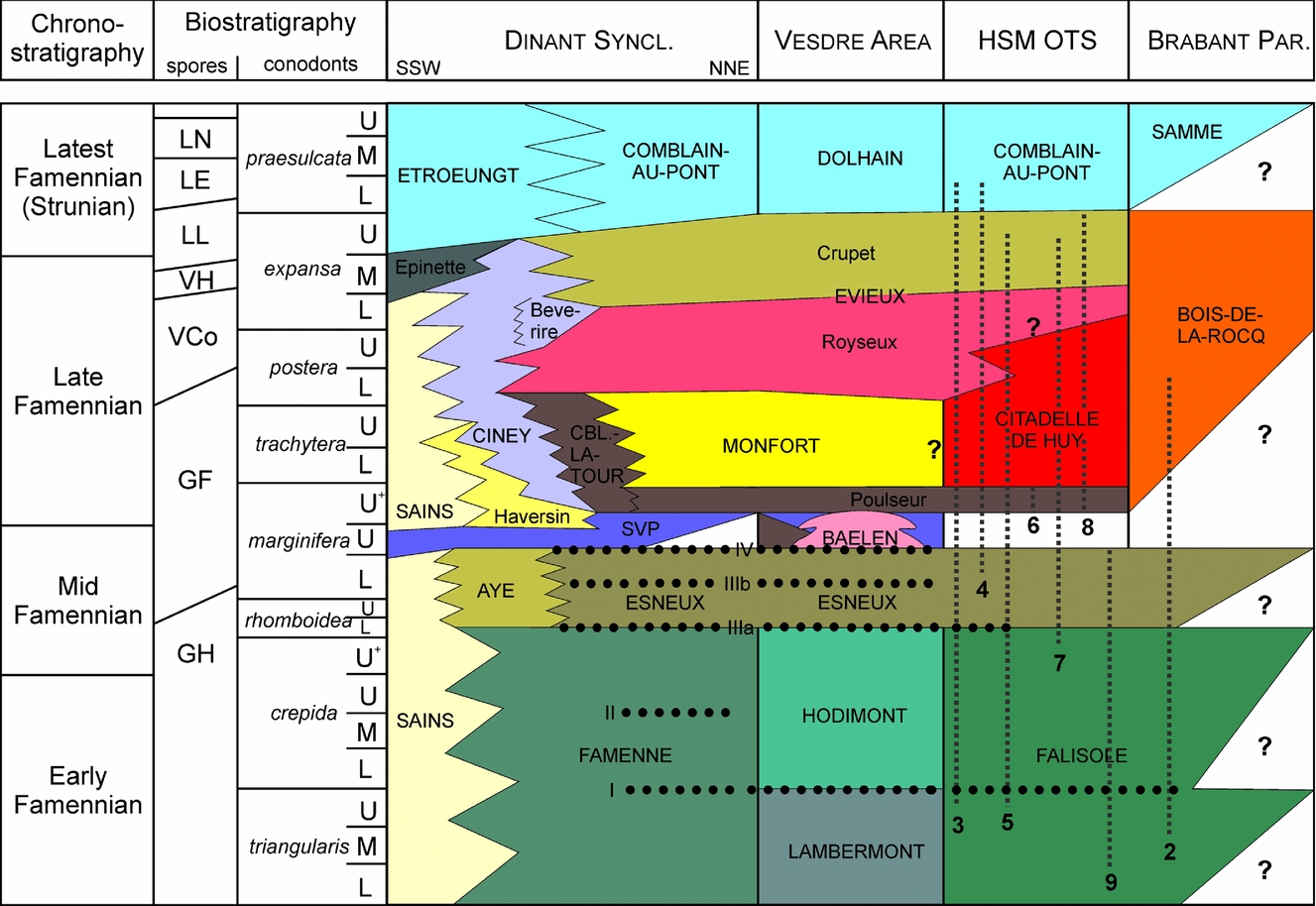
The Upper Famennian lithological succession investigated here begins first with a sandy and silty unit overlying the Esneux Fm. It is composed of thin-bedded bioturbated sandstones and intercalated silty levels, grey to greenish in colour, containing some brachiopod shells, often dissolved. This unit – 5–20 m thick – fits with the definition of the Poulseur Member (Comblain-la-Tour Fm). This first member is overlain by a 10 to 60 m thick unit of red sandstone and arkosic sandstone in metre-thick beds. These beds, known in the old literature as the ‘Grès amarantes de Huy’ (Mourlon, Reference Mourlon1875–1886), correspond to the Citadelle de Huy Fm, introduced but not defined by Thorez, Dreesen & Streel (Reference Thorez, Dreesen and Streel2006, Fig. 2). This unit is cited as a formation by Thorez, Dreesen & Streel (Reference Thorez, Dreesen and Streel2006, p. 31) but also as a member in the same paper (p. 32). Being thick enough and sufficiently distinct from the other Famennian units, we consider this sandstone to be a formation rather than a member. The overlying strata form the ‘palaeosol complex’ composed of red and green sandstone, arkosic sandstone, siltstone and shale alternating with palaeosols and centimetre-thick layers of yellowish, partly sandy, dolomite. The alternations form metre-scale cycles, the dolomite being less frequent upwards. The ‘palaeosol complex’ is identified with the Royseux Mbr of the Evieux Fm (Bultynck & Dejonghe, Reference Bultynck and Dejonghe2002; Thorez, Dreesen & Streel, Reference Thorez, Dreesen and Streel2006). This unit varies in thickness from 20 to 55 m. The ‘channel complex’ overlies the ‘palaeosol complex’ in almost every investigated section. It consists of a 25–35 m thick unit of grey to green, sometimes red, sandstone, arkosic sandstone and siltstone intercalated with dark shale and siltstone, rare dolomite and several conglomerate levels. The latter corresponds to lag deposits at the base of channels. These lithologies correspond partly to the Crupet Mbr of the Evieux Fm. These strata are the most fossiliferous of the Belgian Upper Famennian succession and yielded plants, arthropods and vertebrates in numerous localities including the Strud northern disused quarry.
The uppermost Famennian corresponds to the Strunian regional substage, and a new transgressive pulse, marked by the reappearance of mixed marine facies (carbonated sandstone and siltstone, crinoidal limestone, shale) in which the carbonate part increases upwards. This 10 m thick unit is the Comblain-au-Pont Fm, beginning at the base of the first decimetre-thick crinoidal limestone bed of the succession. It is topped by lower Tournaisian limestone and dolostone of the Hastière Fm.
4. Description of the key sections
4.a. Strud section
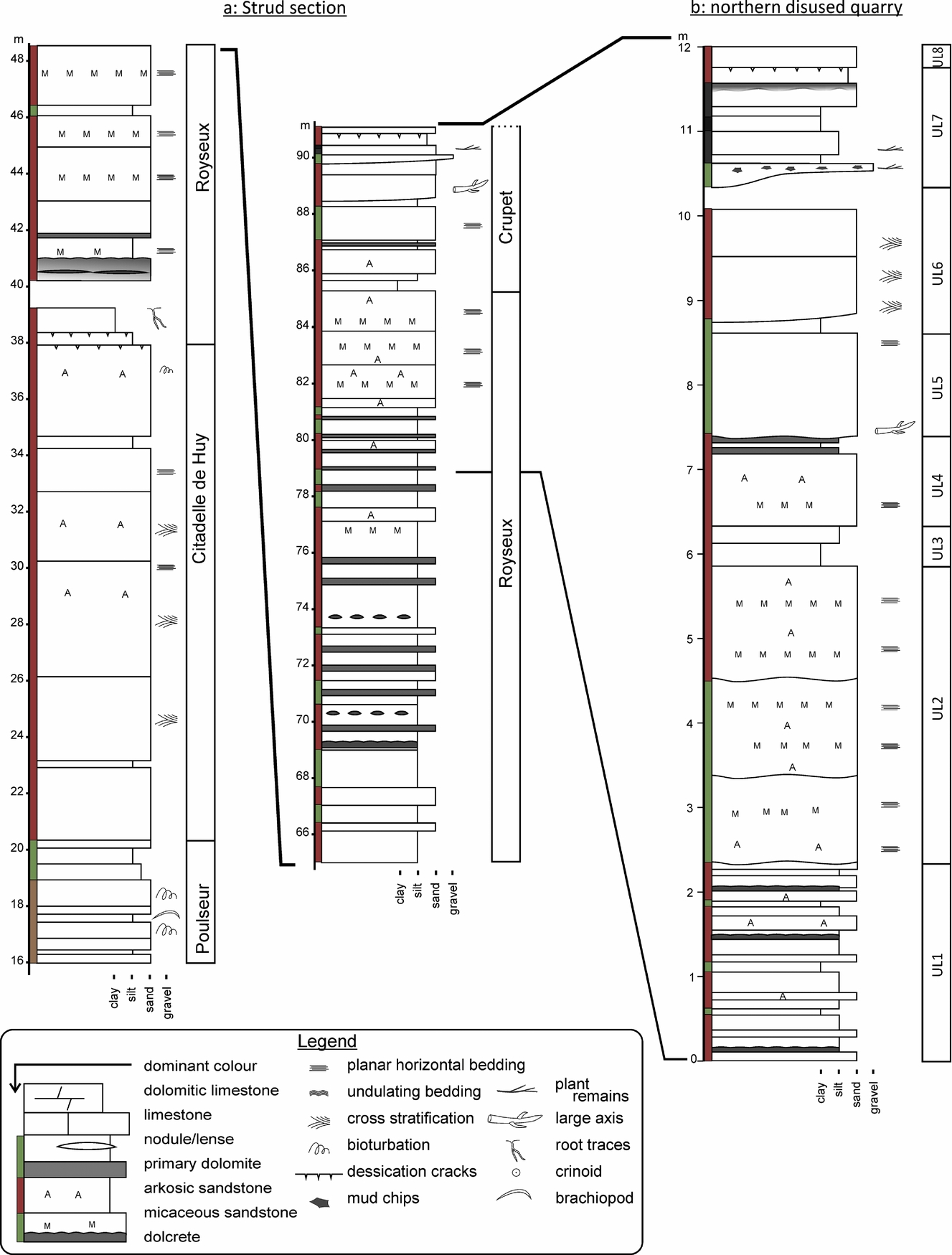
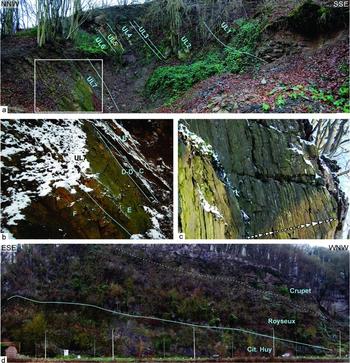
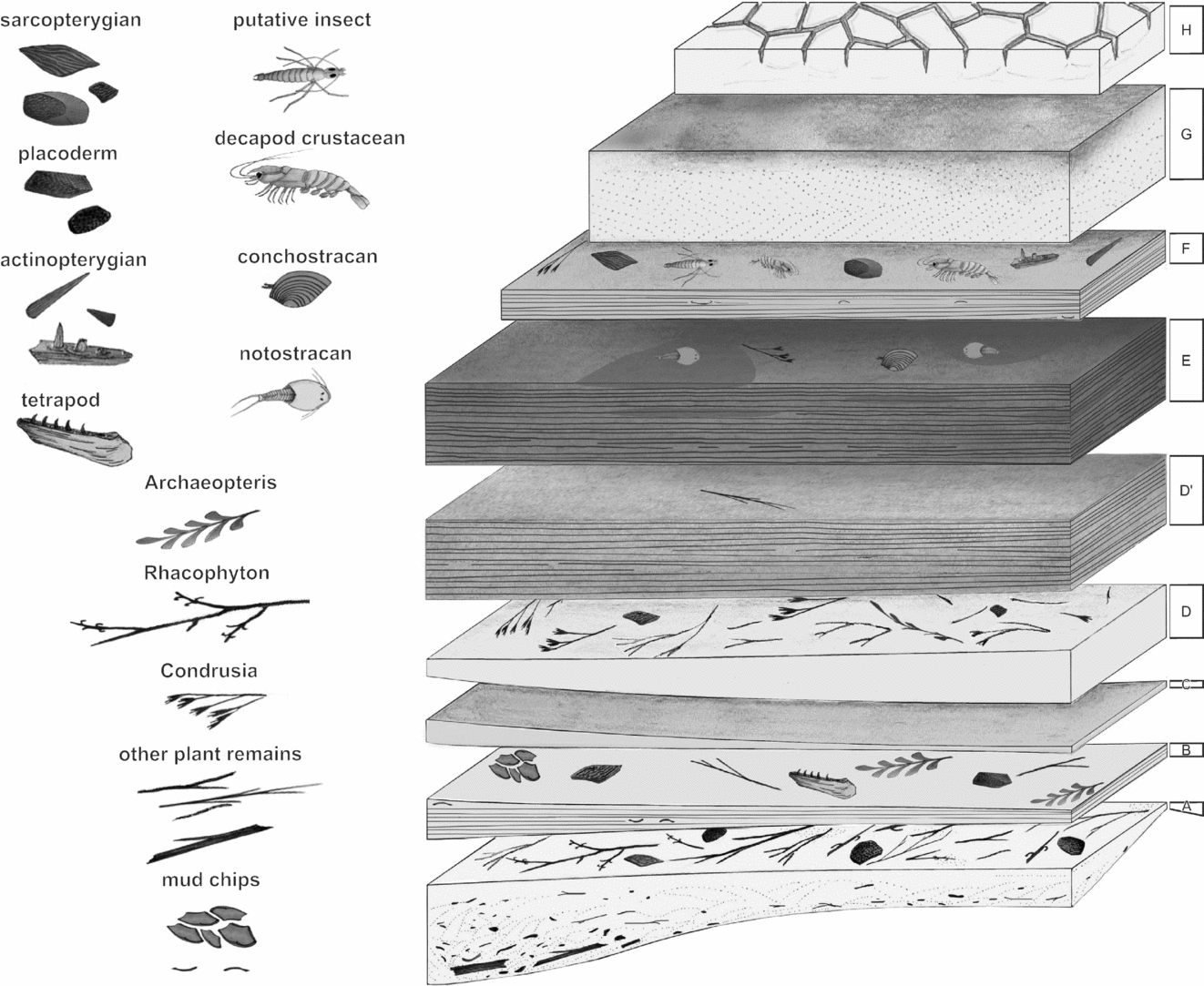
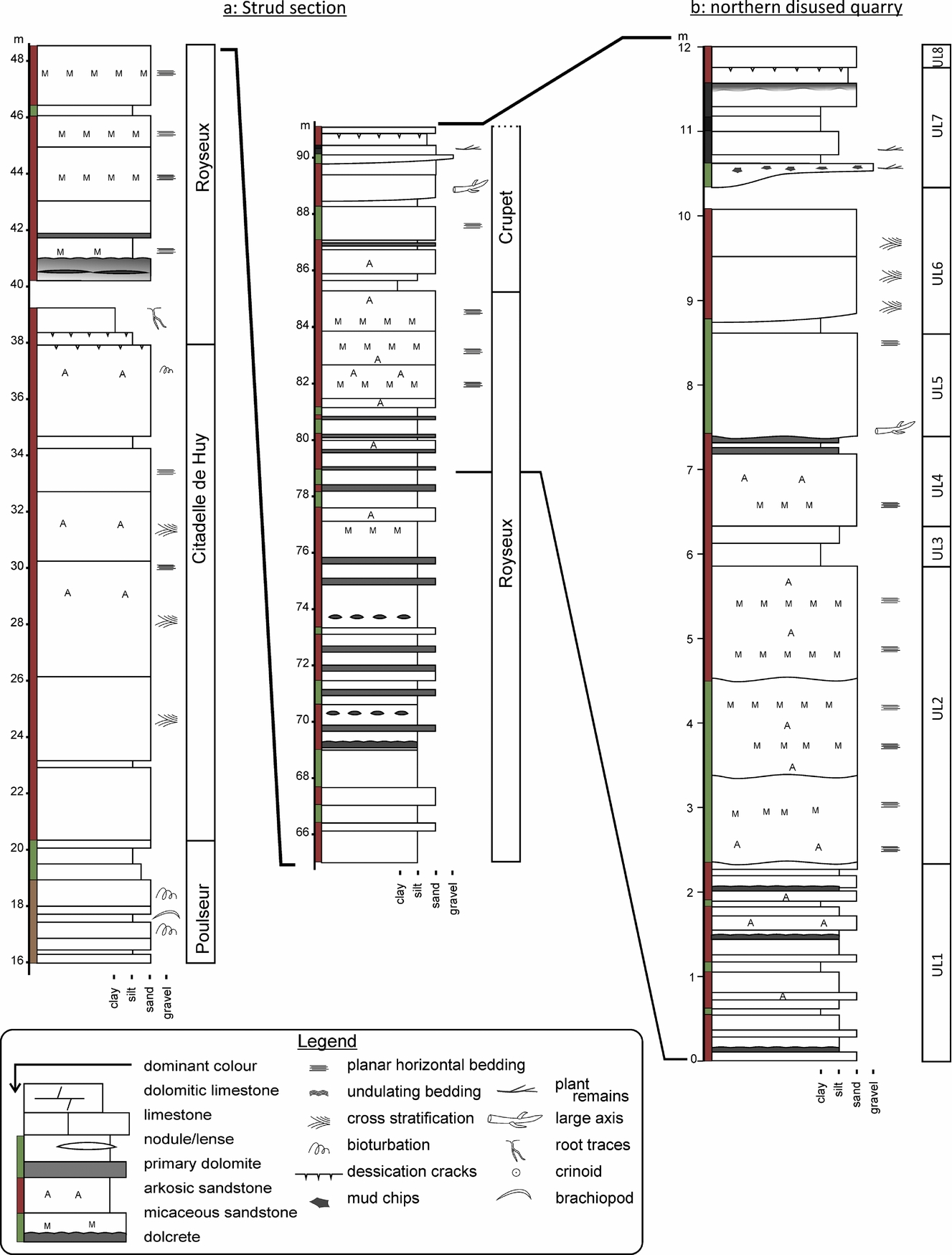
The Strud section (point 5 on Fig. 1) is located along the Bounon road, 300 m south of Strud (or Stru) village. The rocks crop out partly in the embankment of the road and partly in disused quarries. The beds are inverted with a dip of 80° to the south. From south to north, the section exposes 1 m of violet shale with brachiopods and one thin level of oolitic ironstone, corresponding to the Falisole Fm. The top of the formation is not exposed but the overlying outcrop exposes brown micaceous siltstone of the Esneux Fm. Except for some rocks present in the embankment of the road, the section is discontinuous until the southern disused quarry where the succession is better exposed. It begins with 4–5 m of grey to brown bioturbated sandstone with rare brachiopod and bivalve imprints. These facies are identified as the Poulseur Mbr (Fig. 3a). The quarry is opened mainly in the massive red sandstone and arkosic sandstone forming a 16 m thick unit corresponding to the Citadelle de Huy Fm. This sandstone is topped by a palaeosol in which rootlets are well preserved. The following 40 m (Royseux Mbr) are unfortunately badly exposed and the section is only present again near the southern margin of a second disused quarry. This northern disused quarry (Fig. 4a, b) is the locality from where many of the fossils were collected, so its lithological succession is detailed as follows. The lithological unit (UL) 1 is made of 2.3 m of thin-bedded shale, siltstone and sandstone, mainly reddish including several centimetre-thick horizons of yellowish dolostone. The overlying UL2 is a homogeneous 3.4 m thick package of sandstone, beige and micaceous at the base, red and arkosic at the top (Fig. 3a). UL3 is made of a 0.55 m thick red shale passing to bioturbated siltstone up-section. UL4 is a single 0.85 m thick bed of greenish micaceous and arkosic coarse sandstone marked at its top by two horizons of yellow dolomitic sandstone separated by 5 cm of siltstone. UL5 begins with the ‘trunk level’, composed of 20 cm of coarse sandstone that is micaceous and arkosic, mainly yellowish, and contains large fragments of undetermined plant axes (Fig. 5a). Upwards, it passes progressively to finer arkosic sandstone that is greener coloured and parallel laminated. UL6 is a 0.8 m thick level composed of 15 cm of greenish siltstone passing to red arkosic and micaceous sandstone with cross-stratifications. UL7 is the ‘Strud channel’ of Garrouste et al. (Reference Garrouste, Clément, Nel, Engel, Grandcolas, D’Haese, Lagebro, Denayer, Gueriau, Lafaite, Olive, Prestianni and Nel2012) (Figs 3b, 6). It begins with a 5–20 cm thick lenticular bed (bed A) of dolostone passing into sandstone containing fragments of Rhacophyton aligned N–S. This bed thickens towards the west where a conglomeratic character is well marked (Fig. 6). It has yielded large fragments of bone and fish remains in various states of preservation, embedded in a weathered reworked dolomitic matrix. The following bed (bed B in Fig. 6) is a silty sandstone, light grey in colour, slightly micaceous and arkosic, containing chips of greenish shale. Its thickness varies from 12 cm in the upper part of the quarry to 5 cm in the lower part. This level yielded many plants and vertebrate remains, including the rare Ichthyostega-like tetrapod remains (Table 1). Bed C is a 6 cm thick level of non-fossiliferous dark grey micaceous sandstone. Bed D–Dʹ is 10 cm of grey shale (D on Fig. 6) passing up to 10–15 cm of dark fine siltstone containing sandy layers and numerous, well-preserved plant remains and isolated complete vertebrate bones and eurypterid arthropods (Dʹ). The transition from bed D to bed Dʹ is not sharp and both beds form a single unit. Bed E (‘Black layer’) is made of 23 cm of dark shale and siltstone including millimetric sandy laminae and small (a few dozens of centimetres-large) lenses of fine shale with rare branchiopod and arthropod remains. Fragile and well-preserved vertebrate remains, seed-plants such as Condrusia rumex and complete arthropods were found in this bed. The arthropod fauna is composed of well-preserved crustaceans (decapods, conchostracans, notostracans and anostracans; Gueriau, Charbonnier & Clément, Reference Gueriau, Charbonnier and Clément2014a , Reference Gueriau, Charbonnier and Clément b ; Lagebro et al. Reference Lagebro, Gueriau, Hegna, Rabet, Butler and Budd2015). Bed F (‘Green layer’) is a fine micaceous greenish shale, slightly bioturbated with exceptionally well-preserved eumalacostracans, together with the putative fossil insect Strudiella devonica (Garrouste et al. Reference Garrouste, Clément, Nel, Engel, Grandcolas, D’Haese, Lagebro, Denayer, Gueriau, Lafaite, Olive, Prestianni and Nel2012) and isolated actinopterygian fish elements. Some centimetre-thick lenses of silty sandstone are present in the upper part of this bed. Its thickness (6 cm) seems constant. Bed G (20–25 cm thick) is an arkosic sandstone, grey to yellowish in colour, stratified and passing upwards to dolostone. Bed H is a 2–3 cm thick red shale layer topped by desiccation cracks (Fig. 5b). This latter level ends the ‘Strud channel’ and is overlain by UL8, made of red sandstone and poorly exposed in the northern part of the northern disused quarry (Figs 3b, 4a, b). The first level of greenish to yellowish rocks and the first channelized structures mark the base of the Crupet Mbr, here 11 m thick, following the Royseux Mbr composed of red to green rocks alternating with palaeosols and dolostone. The top of the Crupet Mbr does not crop out in the section, nor does the contact with the overlying Tournaisian dolostone.
Lithological and lithostratigraphic column of the Strud section (a) with a close-up detailed log of the succession exposed in the northern disused quarry (b). UL1 to 7 – lithological units described in the text.
General and detail views of the Strud, Wierde and Huy sections. (a) General view of Strud northern disused quarry (UL2–8), beds are in reverse position (photo c. 8 m wide). (b) ‘Strud channel’ lithological unit (UL) 7 in Strud northern disused quarry, beds in reverse position (photo c. 2 m wide). (c) Royseux Mbr (‘palaeosols–dolcretes complex’) in the Wierde section, beds are in reverse position, triangles indicate the red beds – dolomite couplets (photo c. 2.5 m wide). (d) General view of the Citadelle de Huy sandstone Fm, Huy section (photo c. 160 m wide).

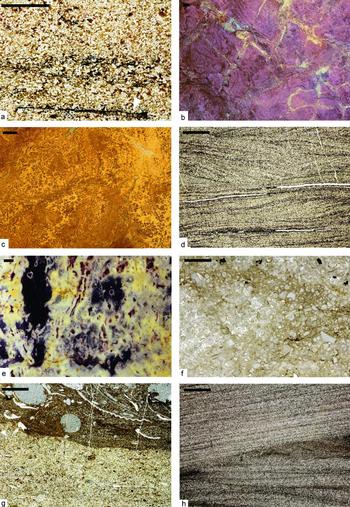
Facies and microfacies of the Upper Famennian formations. (a) Poorly sorted feldspathic sandstone with weathered ferruginous dolomitic cement and plant remains (black compression, arrow) in thin-section, Crupet Mbr, base of channel with plants, Strud northern disused quarry. (b) Desiccation cracks in red siltstone, top of the UL7, Strud northern disused quarry (macroscopic view). (c) Weathered micritic dolomite with ferruginous dendrites, Royseux Mbr, Wierde section (polished slab). (d) Poorly sorted sandstone with micaceous horizons and wavy bedding in thin-section, top of Esneux Fm, Wierde section. (e) Dolcrete with pedogenitization and root moulds, Royseux Mbr, Jausse section (polished slab). (f) Crinoidal packstone in thin-section, Comblain-au-Pont Fm, uppermost Famennian (Strunian), Jausse section. (g) Calcareous horizon with brachiopod shells and large horizontal burrows in poorly sorted fine micaceous sandstone in thin-section, Poulseur Mbr, Strud southern disused quarry. (h) Red sandstone with cross-stratifications in thin-section, Citadelle de Huy Fm, Huy section. Scale bars are 5 mm across in all figures.

Schematic bloc-diagram of the ‘Strud channel’ with the main fossiliferous content of beds A to G described in the text. Fossils not to scale.

4.b. Wierde section
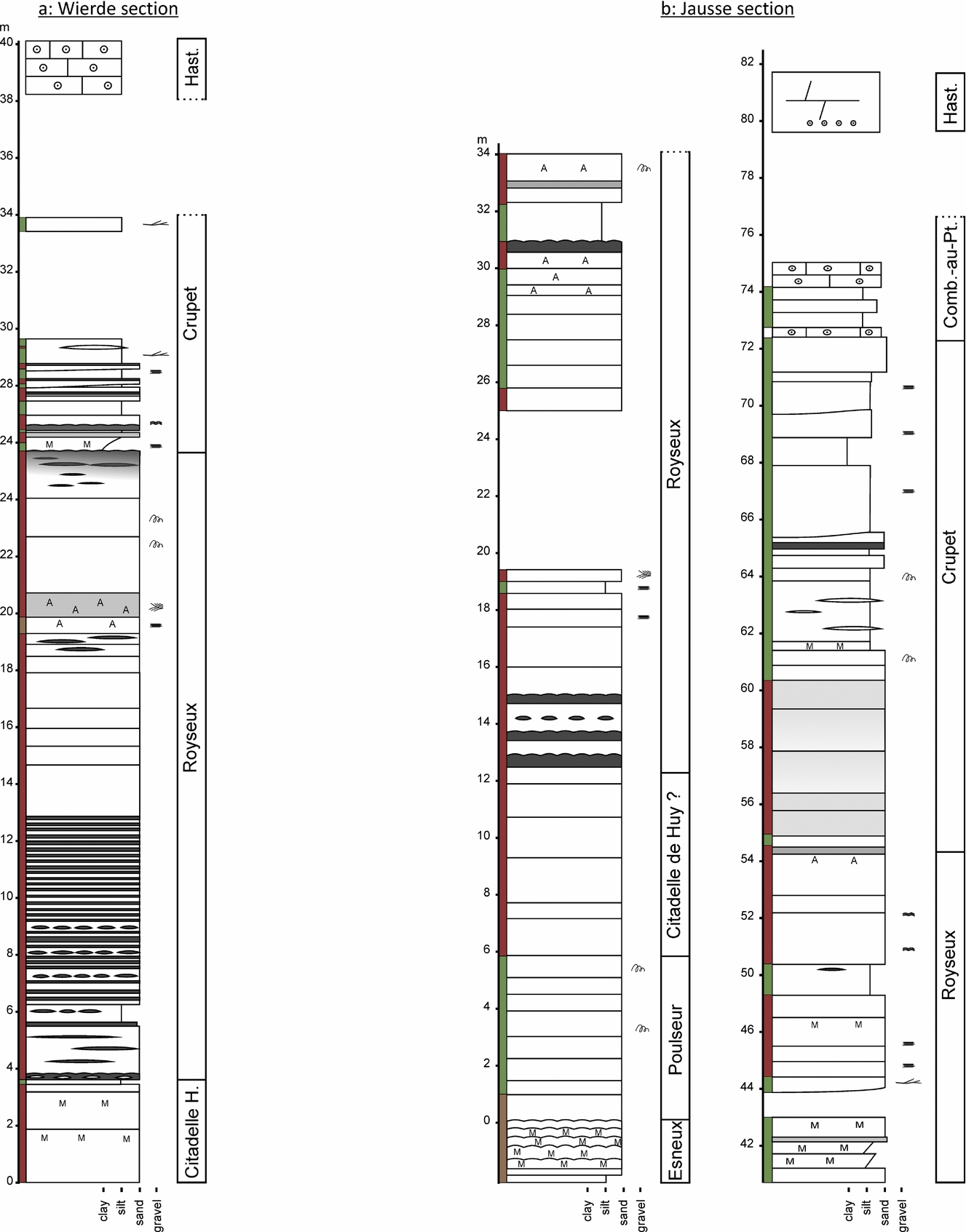
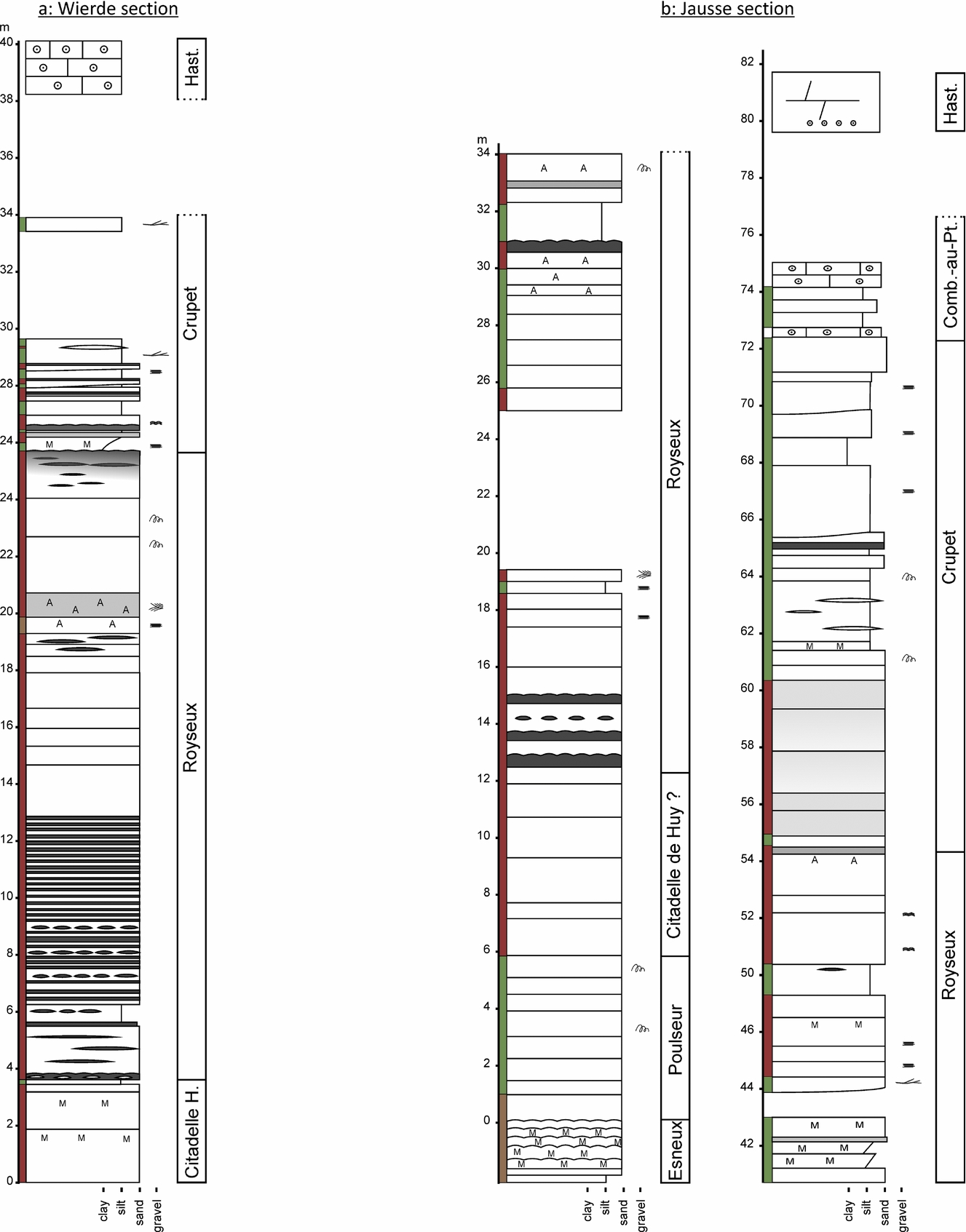
The Wierde section (point 3 on Fig. 1) is a discontinuous succession of natural outcrops along the western bank of the Wierde Creek in the Bois Ferrare, 700 m SW of Wierde village. The beds are almost vertical with a strong dip southwards. The section begins with one 2 m thick bed of red micaceous sandstone topped by three 6–18 cm thick levels of yellowish sandy dolomite incorporating thin lenses of red siltstone. These first dolomite horizons are overlain by a 9 m thick palaeosol complex made of an alternation of red siltstone, yellowish dolomite (in beds, lenses or nodules) and greenish palaeosols with rootlet prints. The cyclicity of this unit is particularly well marked in the upper 4 m (Figs 4c, 7a). The overlying 5.8 m are made of red sandstone, slightly dolomitic in the upper 1 m (Fig. 7a). It is overlain by 1.5 m of light grey to beige sandstone, dolomitic at the base becoming progressively arkosic up-section. Cross-stratification is common in the arkosic parts. A 2 m thick bed of red sandstone tops the arkosic sandstone. A further palaeosol, 1.4 m thick, makes the transition to a complex unit of dolomitic sandstone passing up-section with dolomite lenses to a sandy dolomite to pure yellow dolomite (Fig. 5c) topped by an irregular (erosive?) surface. It is followed by a 45 cm thick bed of red shale passing to micaceous siltstone, then by two 15 cm thick beds of yellow to reddish sandy dolomite separated by a 5 cm thick level of red siltstone. The upper 2.5 m of the section present the same siltstone–dolomite alternation of the palaeosol complex. The top of the Citadelle de Huy Fm (red massive sandstone) at the base of the section and the entire Royseux Mbr (palaeosol and dolcrete complex) are exposed. Several small discontinuous outcrops observed north of the main section represent the Crupet Mbr.
Lithological and lithostratigraphic columns of the Wierde section (a) and Jausse section (b). Hast. – Hastière Fm (part.); Comb.-au-Pt. – Comblain-au-Pont Fm (part.). Legend: see Figure 3.
4.c. Jausse section
The Jausse section (point 4 on Fig. 1) is located in the embankment of road N942, 1 km N of Faulx-les-Tombes, in the Samson valley. This section is discontinuous but well exposed (Fig. 7b). The bedding dips 75° southward. The section begins with 4 m of thin-bedded brownish micaceous siltstone and sandstone corresponding to the Esneux Fm (Fig. 5d). It is followed by 6 m of bedded grey to beige or greenish fine sandstone with siltstone intercalations containing brachiopod shells and is attributed to the Poulseur Mbr. The following 6 m are constituted by massive red sandstone that corresponds probably to the Citadelle de Huy Fm, here very reduced in thickness. It is topped by an initial palaeosol in which rootlet traces are filled with yellow dolomite (Fig. 5e). The dolomite appears, up-section, as nodules and lenses in reddish sandstone and as thin horizons. The following 5 m are made of red siltstone and sandstone with plane parallel stratifications in the lower part, passing to cross-stratifications in the upper part. After a 5 m observation gap, the next 6 m are composed of the same red beds but become arkosic in the last metre. It is topped by a red and green sandy palaeosol with dolomite nodules followed by 1.5 m of green siltstone passing to sandstone with dolomitic intercalations and ending with a 1 m thick bed of brown arkosic sandstone that is highly bioturbated. After a 15 m gap, the section begins with 4 m of red and green sandstone, more or less micaceous, passing to siltstone with sandy lenses and is topped by a 2 m thick bed of red sandstone. A 1.5 m thick bed of bioturbated sandstone finishes this sandy episode. The latter is overlain by a 15 m thick unit of sandstone, mainly reddish, usually dolomitic, arkosic and micaceous, and often bioturbated in the upper part, including several centimetre-thick levels of yellow dolomite. All the facies overlying the Citadelle de Huy Fm red sandstone are included in the Royseux Mbr. The following 7 m are composed of grey to green siltstone alternating with shale in which are intercalated two levels (a lower one, 2 m thick and very micaceous at the top, and an upper bed, 50 cm thick) of green sandstone and arkosic sandstone. This lithofacies corresponds to the Crupet Mbr. It is followed by greenish siltstone, with variable carbonate content, including lenses and levels of crinoidal limestone (Fig. 5f). The first bed of limestone defines the base of the Comblain-au-Pont Fm, which is here reduced to 5–6 m. The Tournaisian dolostone of the Hastière Fm occurs a couple of metres above the last crinoidal limestone.
4.d. Coutisse section
The Coutisse section (point 7 on Fig. 1, not logged) is a road-cutting section that discontinuously exposes the Frasnian, Famennian and the base of the Tournaisian in the Andennelle Creek valley between Andenne and Haillot. The Lower Famennian Falisole shale crops out in the embankment of the road but the oolitic haematite level is here reduced to a 2 cm thick sandy crinoidal limestone with haematitic cement. As everywhere, the Esneux Fm is well exposed but is here particularly thin (less than 10 m). The rest of the section is exposed in the bed of the Andennelle Creek, beneath the road. The Poulseur Mbr was not recognized. Massive red sandstones, sometimes arkosic, are well exposed along the creek. They most probably represent the Citadelle de Huy Fm (c. 20 m thick). The red beds and yellowish dolomite of the Royseux Mbr crop out poorly; their thickness is estimated as 18 m. The rest of the succession is poorly exposed but the facies known in the previously described sections can be recognized: green siltstone alternating with red sandstone, greenish siltstone with shale and micaceous layers of the Crupet Mbr. The thickness of these facies is estimated as 25 m. Neither the Comblain-au-Pont limestone nor the Tournaisian dolostone were observed.
4.e. Marche-les-Dames section
The disused Marche-les-Dames quarry (point 2 on Fig. 1, not logged) is an isolated quarry on the eastern bank of the Gelbressée Creek. The bedding dips 10° to the south and the main part of the succession is not easily accessible. The Bois-de-la-Rocq Mbr of the Samme Formation (covering the whole Upper Famennian) crops out. The main facies is a coarse beige arkosic sandstone in decimetre- to metre-thick beds topped by a 40 cm thick palaeosol level that is partly dolomitic.
4.f. Haltinne section
The Haltinne outcrop (point 6 on Fig. 1, not logged) along the road between Goyet and Coutisse villages, exposes only the Poulseur Mbr with typical greenish bioturbated marine sandstone and siltstone (Fig. 5g).
4.g. Huy-Nord section
The Huy-Nord section (point 9 on Fig. 1, not logged), along the Namur–Liège railroad, 800 m NE of Huy station, exposes only the Lower Famennian Falisole and Esneux formations with a well-developed oolitic haematitic level.
4.h. Citadelle de Huy section
The Citadelle de Huy section (point 8 on Fig. 1, Fig. 4d, not logged) is a long discontinuous outcrop in the south bank of the Meuse River near the Mont Picard hill. This section exposes along the Namur–Huy road the top of the Poulseur Mbr and the massive beds of the Citadelle de Huy Fm (at least 70 m thick after Mottequin & Marion, in press; 60 m thick after Mourlon, Reference Mourlon1875–1886). In the slope of the hill, it exposes very discontinuously the ‘palaeosols–dolcretes complex’ of the Royseux Mbr and the uppermost part of the Comblain-au-Pont Fm, the Crupet Mbr (‘channel complex’) being poorly exposed.
5. Discussion
5.a. Palaeoenvironmental succession
The subsequent interpretations result from new observations of the Famennian facies. Nevertheless, almost all of them are in accordance with the previous palaeoenvironmental views of Thorez et alii (e.g. Thorez et al. Reference Thorez, Streel, Bouckaert and Bless1977, Reference Thorez and Dreesen1986; Thorez & Dreesen, Reference Thorez and Dreesen1986).
Poulseur Mbr: After Thorez et al. (Reference Thorez, Streel, Bouckaert and Bless1977), wavy and flaser bedding are frequent and suggest an intertidal character. However, in the investigated area, the flaser bedding is poorly developed, but abundant bioturbation (mainly horizontal burrows) and shell accumulations suggest shallow subtidal conditions. The transition from the underlying marine Esneux Fm is progressive and marked by a decrease in the mica contents and a thickening of the beds. The appearance of red beds marks the transition to the overlying Citadelle de Huy Fm. The faunal assemblage of this member is reduced to brachiopod fragments collected in the Haltinne section and some large bivalves in the Strud section. No plant remains were recovered from this member.
Citadelle de Huy Fm: The characteristics of the Citadelle de Huy massive red sandstone are poorly known, and have not been analysed in detail. Its reddish colour is owing to a ferruginous coating of the quartz grains (Fig. 5h). Thorez & Dreesen (Reference Thorez and Dreesen1986) signalled the formation's presence in the Huy area, interpreting it as a possible alluvial fan. However, its massive and homogeneous aspect, together with the well-developed cross-stratification (Fig. 5h) and the absence of any channel rather suggest a more hydrodynamic depositional environment. Moreover, rhynchonellid brachiopods, locally abundant but not broken, suggest a more marine environment. The Citadelle de Huy Fm corresponds possibly to a local sandbar, similar to the Monfort Fm but relatively near-shore. This unit is restricted to the Huy area and disappears in a few hundreds of metres eastwards (Mottequin & Marion, in press). Westwards, its thickness rapidly decreases (more than 60 m in Huy, around 15 m in Strud and only 5 m in Wierde) and it integrates more restricted facies such as the dolcretes of the Royseux Mbr. It is possibly a lateral equivalent of the Monfort Fm rather than of the Evieux Fm as stated by Thorez, Dreesen & Streel (Reference Thorez, Dreesen and Streel2006). The palynological content (see Section 5.b) indicates the Late Famennian GF and VCo zones (Thorez et al. Reference Thorez, Streel, Bouckaert and Bless1977). The member consequently covers the Monfort and Evieux formations. The fossil content includes rare brachiopods (rhynchonellids) and unidentifiable plant remains.
Royseux Mbr: This member (Evieux Fm) is defined as a lagoonal deposit in a back-barrier position. It consists of fining-upwards sequences associated with red beds, evaporitic dolomite (sabkha sequence) and anhydrite pseudomorphs, locally with dark shale (Thorez, Goemaere & Dreesen, Reference Thorez, Goemaere, Dreesen, de Boer, van Gelder and Nio1988). In the investigated area, no dark shales were observed and the evaporite pseudomorphs are equivocal. The wide development of dolcretes, including palaeosols, is also a striking character. The Barse Mbr of the Montfort Fm (not observed in the investigated sections) also shows the same facies assemblage, bearing witness to a supratidal environment, but the latter is never reddened (Thorez, Goemaere & Dreesen, Reference Thorez, Goemaere, Dreesen, de Boer, van Gelder and Nio1988). The typical red arkosic sandstone–dolcrete binomes forming 4–6 m thick sequences are observed in the Jausse, Wierde and Strud sections (Fig. 4c). They correspond to the back-barrier lagoonal sequences as defined by Thorez & Dreesen (Reference Thorez and Dreesen1986). The great development of the ‘palaeosol–dolcretes complex’ (c. 6 m of vertically continuous palaeosols in the Wierde section) indicates a long-lasting emergence with temporary flooding, possibly indicating the presence of an island in this area as suspected by Thorez & Dreesen (Reference Thorez and Dreesen1986). No fossils were observed in this member, except root moulds in palaeosols (Fig. 5e).
Crupet Mbr: This upper member of the Evieux Fm is composed of various lithologies assembled in fining-upwards sequences in which channels developed. The corresponding environment is a ‘distal alluvial tidal delta’ after Thorez & Dreesen (Reference Thorez and Dreesen1986). A channel-filling sequence is particularly clear in the Strud northern disused quarry where all the typical elements of the member are present. It begins with a conglomeratic sandy dolomite containing reworked remains of plants (trunks, axes, fronds) and rare fish bone beds. This bed (A) has a low-angle erosive base and is interpreted as a lag deposit of the channel reworking material from the floodplain. The overlying beds (B to Dʹ, Figs 3, 4) consist of the shallowing- and fining-upwards sequence of arkosic and micaceous sandstone, passing to green siltstone and shale. The E level yielded the majority of the fossil plants and arthropods. It corresponds to the finest part of the infilling sequence with slower sedimentation in the channel. The floral and faunal remains, well preserved, have seemingly been less transported than those from the underlying beds. The uppermost part of the succession is made of green or black shale and siltstone at the base becoming red up-section. It likely corresponds to the fine floodplain sediments accumulated on a flat area topping the filled channel after migration of the main stream and containing some fresh or brackish water ponds that were alternately dried and flooded. This interpretation is supported by the occurrence of branchiopod crustaceans, nowadays typical of temporary pond habitats. Some plant remains, in particular seeds, floated or were brought by wind and are exquisitely preserved in these levels, suggesting a very low-energy environment. The later facies are topped by mud-cracks, bearing witness to a final emergence and desiccation of the sediments (Fig. 5b).
In the distal alluvial tidal delta of Thorez & Dreesen (Reference Thorez and Dreesen1986) and Thorez, Goemaere & Dreesen (Reference Thorez, Goemaere, Dreesen, de Boer, van Gelder and Nio1988), the alluvial deposits are inter-fingered with tidal deposits, but in the investigated area, the latter are only present at the base of the member while its upper part only shows fluvial deposits. The sequence-capping ostracodal limestone is, however, entirely lacking. Finning-upwards sediments beginning commonly with conglomerates typically fill the channels. The conglomerate includes mud chips, dolomitic clasts, large plant fragments (Callixylon axis, up to 20 cm in diameter) and reworked dolomite and soil (Prestianni et al. Reference Prestianni, Decombeix, Thorez, Fokan and Gerrienne2010). These basal sediments are here interpreted as the result of high-energy deposits linked with flooding events.
The Upper Famennian succession from Belgium is interpreted as a current-dominated tidal flat deposit with a sandy barrier isolating a back-barrier inter- to supratidal lagoon that received sediments both from offshore (tide and currents) and, to a lesser extent, from continental alluvial input (Thorez et al. Reference Thorez, Streel, Bouckaert and Bless1977; Thorez & Dreesen, Reference Thorez and Dreesen1986). The synthetic model proposed by these authors excluded the area documented here (HSM OTS) in which the facies bear witness to a more continental environment dominated by fluvial and alluvial environments. However, the present interpretation does not differ fundamentally from that of Thorez et al. (Reference Thorez, Streel, Bouckaert and Bless1977) and Paproth et al. (Reference Paproth, Dreesen and Thorez1986). The sediments deposited in the fluvial and deltaic environments are likely to have originated from the continent situated north of the Namur–Dinant Basin (London–Brabant Massif) but a more marine origin is not dismissed as tides and storms can contribute to the local input. Thorez et al. (Reference Thorez, Streel, Bouckaert and Bless1977) explained the occurrence of feldspars by a source of sediments outside the basin (Mid-Netherlands Crystalline High). The arkosic sandstones observed in the investigated sections might bear witness to such a type of marine input during the deposition of the Royseux and lower Crupet members.
5.b. Biostratigraphy
The fossiliferous horizons have been investigated for palynology (Prestianni et al. Reference Prestianni, Streel, Thorez, Gerrienne, Steemans and Javaux2007). They were considered to be late Mid Famennian in age (GF biozone, Clément et al. Reference Clément, Ahlberg, Blieck, Blom, Clack, Poty, Thorez and Janvier2004; Blieck et al. Reference Blieck, Clément, Blom, Lelièvre, Luksevics, Streel, Thorez, Young, Becker and Kirchgasser2007; Prestianni et al. Reference Prestianni, Streel, Thorez, Gerrienne, Steemans and Javaux2007) because the typical Late Famennian palynological markers (Grandispora cornuta, Retusotriletes philipsii and Rugospora radiata) were lacking. However, from a lithostratigraphic point of view, these horizons are very high in the succession, c. 5 m below the appearance of the first limestone marking the base of the Comblain-au-Pont Fm, i.e. the top of the Upper Famennian succession, with no clues of any depositional hiatus.
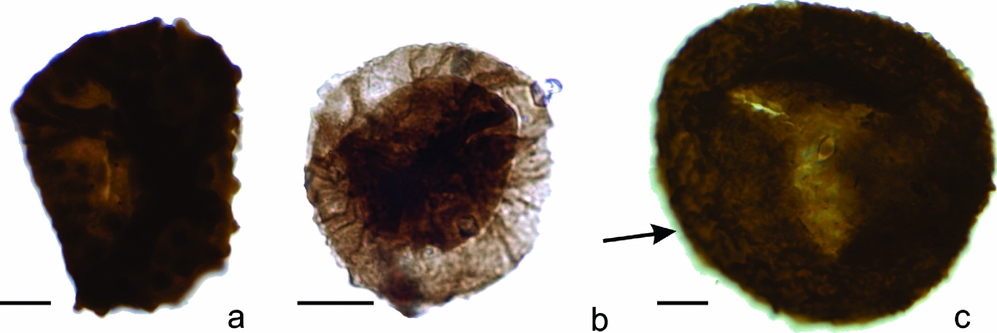
New palynological analyses have been done and the following spore assemblage has been recovered at the Strud locality: Aneurospora greggsii, Auroraspora hyalina, Convolutispora major, Corbulispora cancellata, Grandispora gracilis, Grandispora famennensis var. minuta, Grandispora famennensis var. famennensis (Fig. 8a), Diducites versabilis (Fig. 8b), Diducites mucronatus, Diducites plicabilis, Diducites poljessicus, Plicatispora scolecophora, Plicatispora quasilabrata, Retusotriletes incohatus, Retusotriletes sp., Retusotriletes planus, Rugospora radiata (Fig. 8c), Teichertospora torquata, Verrucosisporites sp. This assemblage is more diverse than previously described. One important addition is the identification of Rugospora radiata. The first occurrence of this spore together with the first occurrences of Retusotriletes phillipsii and Grandispora cornuta mark the base of the VCo Oppel zone (Streel, Reference Streel and Königshof2009). This zone is further marked by a relative abundance of Diducites versabilis indeed observed in our material. The absence of Retusotriletes phillipsii seems to be characteristic of western European Famennian assemblages (Higgs et al. Reference Higgs, Prestianni, Streel and Thorez2013). Recently, the VCo Oppel zone was reinvestigated and subdivided into two interval zones: the Rugospora radiata (‘rad’) and Grandispora cornuta (‘Cor’) interval zones (Higgs et al. Reference Higgs, Prestianni, Streel and Thorez2013). Following the spore assemblage given earlier, the Strud locality can now be attributed with confidence to the ‘rad’ interval zone that is Late Famennian in age.
Selected spores from the assemblage found in the ‘Strud channel’ (see Fig. 6). (a) Grandispora famennensis var. famennensis. Specimen ULg-62464/E42–2 (b) Diducites versabilis. Specimen ULg-62464/E42–2 (c) Rugospora radiata note the occurrence of radially aligned ridges on the margin of the spore body.

In addition, the plant remains are typical of the Upper Famennian succession from Belgium (Evieux Flora of Stockmans, Reference Stockmans1948) and suggest an age identical to the one provided by palynology.
5.c. Taphonomy and exceptional preservation of arthropods from the Strud locality
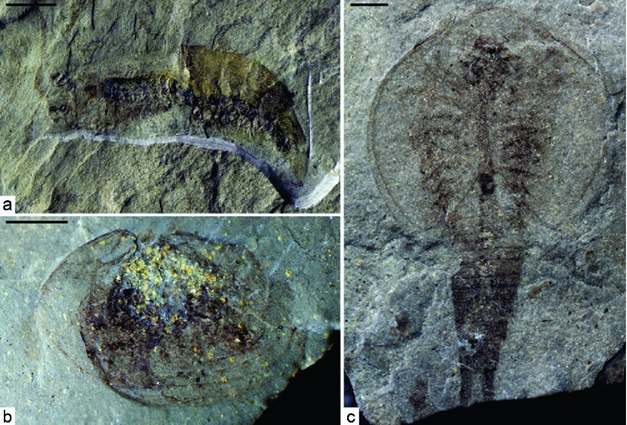
Fossils of non-calcified arthropods are uncommon in Upper Palaeozoic rocks owing to their low preservation potential. The occurrence of well-preserved eurypterids, crustaceans (decapods, conchostracans, notostracans and anostracans, Table 1) and of a putative insect in the Upper Famennian sedimentary rocks of Belgium is thus remarkable and attests to the exceptional depositional and taphonomic processes. The components of this rare arthropod assemblage have been recovered from the shale of beds E (‘Black layer’) and F (‘Green layer’) corresponding to the final channel-filling phases (upper fossiliferous layers in Fig. 6) of the Strud locality. These arthropods, preserved as pale to dark brown carbonaceous films, seem to have been instantaneously fossilized, according to the well-known ‘Medusa effect’ (Martill, Reference Martill1989). A large majority of the specimens present a dorso-ventral compression, although some have also been preserved in lateral aspect. These arthropods are mostly disarticulated but many were found largely complete in the finer green-grey shales (carapace, pleon and telson articulated, Fig. 9), which is evidence for the absence of – or very limited – transport in a calm and confined environment of the floodplain. Such conditions allowed the minute preservation of delicate anatomical structures such as the cephalic and thoracic appendages; the best-preserved legs or antennae have been found isolated whereas their morphologies and connections with the body are often hardly distinguishable in the articulated specimens owing to superimposition of the different anatomical structures.
Exceptional preservation of arthropods from the Strud fossil-bearing locality. (a) Decapod crustacean Tealliocaris walloniensis. (b) Conchostraca indet. with preserved trunk appendages. (c) Notostraca indet. with preserved appendages. Scale bars are 5 mm across in (a) and 1 mm across in (b) and (c).

Proposing a long-term taphonomic scenario for the Strud locality unfortunately still remains difficult, but the calm, confined and fine-grained depositional environment together with very limited decay were definitely essential in the exceptional preservation of these rare arthropods.
6. Conclusions
Although considered as well known, the Famennian succession of Belgium still presents some unclear or unknown points. The palaeogeography of the northern and eastern parts of the Namur–Dinant Basin are still poorly understood. These areas received much attention recently after the discovery of a diverse fauna of vertebrates (including tetrapods), a rare decapod and branchiopod crustacean assemblage, and also a putative insect (Garrouste et al. Reference Garrouste, Clément, Nel, Engel, Grandcolas, D’Haese, Lagebro, Denayer, Gueriau, Lafaite, Olive, Prestianni and Nel2012). As suggested by the taxonomic diversity (plants, vertebrates and invertebrates, Table 1) and the exceptional preservation of the arthropods, the Strud locality could be considered as a Konservat-Lagerstätte of the Upper Famennian continental (fluvial) environment. The recent search for new fossiliferous sections as well as correlation studies and precise dating of the Strud locality led to the description of new key sections in the Meuse–Samson area. The most complete sections are situated in Strud, Wierde and Jausse and are completed by the Haltinne, Huy and Coutisse sections. The observed lithostratigraphy differs from the ‘classic’ Famennian succession by being less thick and by having largely developed supratidal and fluvial facies. The lithostratigraphic units previously defined by Thorez and colleagues are nonetheless recognized. The succession was described as the Bois-des-Mouches Formation by Delcambre & Pingot (in press a,b), but the latter should not be used since it is a synonym of the Montfort and Evieux formations. Finally, the age of the fossiliferous horizon at Strud is reviewed and is now definitely considered as Upper Famennian with better confidence thanks to the revision of the Late Famennian spore assemblages.
Acknowledgements
The authors particularly acknowledge Jean-Marc Marion and Bernard Mottequin (University of Liège) who were of great help in the field, and Bernard Delcambre (University of Louvain-la-Neuve) who informed us on several sections in the investigated region. We greatly thank Jacques Thorez and Edouard Poty (University of Liège) for stimulating discussions. We also thank the Gesves commune staff. This work is a contribution to the French National Agency for Research TERRES Project (ANR-2010-BLAN-607–03 grant), which supports P.G., G.C. and the Strud fieldwork. This paper benefits from the review of two anonymous reviewers.