Choices about political institutions in the European Union (EU) have tremendous consequences for policymaking. Because institutions are difficult to change, decisions to alter them have lasting impacts. Ever since the founding Treaties of Rome, many of the EU's most important institutional changes have come at intergovernmental conferences (IGCs), the negotiations where member states draft the EU's governing treaties. Institutional changes that member states have made at IGCs include the reform of legislative procedures,1
changes to EU Council of Ministers' weighted voting system,2 and the creation of an investiture process for the European Commission.3Hix 2002.
Of the major theories of European integration, only intergovernmentalism, which explains integration through interstate negotiations, directly examines IGCs.4
This approach asserts that bargaining strength is related to all nonmilitary resources, such as population size and economic might, and negotiations between large member states at IGCs have shaped the course of EU history.5Moravcsik 1998, 7–8. This is, of course, a mere characterization of Moravcsik's much more elaborate liberal intergovernmental theory, which accounts for domestic politics and views supranational organizations as a method for creating credible commitments among states. Nevertheless, I feel this is an accurate depiction of one of intergovernmentalism's main tenets.
Haas 1958.
Pierson 1996.
Marks, Hooghe, and Blank 1996.
Stone Sweet and Sandholtz 1997.
Institutionalism contrasts with intergovernmentalism because it suggests that small states can affect IGC outcomes through veto power. Intergovernmentalism holds that only larger member states (Germany, France, and the United Kingdom) shape bargaining outcomes and they force their preferences onto smaller member states. Smaller states, because of their size, lack an outside option (that is, leaving the organization) presumably available to larger member states and therefore must acquiesce to the larger states' wishes.
I formalize institutionalism and intergovernmentalism to demonstrate that they offer competing theories of bargaining power at IGCs, and then test these theories against one another using data from the negotiations leading to the EU's 1997 Treaty of Amsterdam. This approach provides answers to important puzzles that plague traditional analyses of IGC bargaining, such as why institutional reforms necessary for EU enlargement, like reweighting votes in the EU Council of Ministers, have been so difficult even though there has long been a consensus among large member states that change is necessary? And under what conditions do small states get what they want in negotiations with larger states?
I first review the current state of the literature on bargaining in the EU. Next, I formally demonstrate when institutional and intergovernmental sources of power make competing predictions about IGC bargaining outcomes, and I present a statistical model to discern which type of power is more important at international treaty negotiations. To test models of bargaining power, I use data on member-state preferences from the EU's IGC leading to the 1997 Treaty of Amsterdam. This IGC is of particular interest because member states addressed many of the most important issues of institutional design in the EU, including giving more power to the directly elected European Parliament and drafting more efficient legislative decision-making rules. Moreover, member states felt that streamlining institutions was of particular consequence at the time, because, following the fall of communism in Eastern Europe, EU enlargement was already looming on the horizon. Despite the importance of the issues on the table, member states accomplished only a small portion of what they set out to do. My findings suggest that this is because each member state has the right to veto the draft treaty. Veto rights are a much more important source of power than resources at IGCs, confirming institutional theory while casting doubt on intergovernmentalism. In the discussion section, I demonstrate how my approach explains the EU's inability to make vital changes to one particularly important EU institution, the weighted voting scheme in the EU Council of Ministers, both at Amsterdam and at the subsequent Nice IGC. I also discuss the relevance of my results for both EU bargaining and the design of international institutions.
EU Integration and Intergovernmental Conferences
Of theories explaining EU integration, intergovernmentalism and institutionalism are the most applicable to the study of bargaining power at IGCs. Neofunctionalism makes fewer predictions about IGC bargaining because it seeks to explain EU integration by examining the creeping competences of EU institutions.11
See Haas 1958; Burley and Mattli 1993; Marks, Hooghe, and Blank 1996; Pierson 1996; and Stone Sweet and Sandholtz 1997. I use the term “neofunctionalism” here in a broad sense to refer to all work drawing upon the tradition of Haas's 1958 seminal study. These works are generally viewed as counterarguments to intergovernmentalism, and include supranational, historical institutionalist, and multilevel governance theories.
Studies in the neofunctionalist tradition, which argue that examining intergovernmental negotiations is insufficient for understanding EU integration, often recognize that EU treaty negotiation is member state-driven and intergovernmental in nature. Stone Sweet and Sandholtz write that, “EC summits, intergovernmental conferences, and meetings of the Council of Ministers are practically defined by tough, interest-driven negotiations” just as intergovernmentalist literature suggests.13
Stone Sweet and Sandholtz 1997, 306.
Marks, Hooghe, and Blank 1996, 346.
Other studies in the neofunctional tradition, however, do attempt to address IGCs. This research suggests that intergovernmental negotiations are best understood using a path dependent or historical institutionalist approach because previous interactions between supranational actors and member states shape member-state preferences regarding IGC outcomes.15
It may indeed be the case that the institutionalized interaction occurring between member states and supranational actors before and after IGCs affects member-state positions at negotiations. However, fully examining these claims would require a model of preference formation, which is beyond the scope of this article.Studies in the intergovernmental tradition, on the other hand, focus almost exclusively on IGCs but pay significantly less attention to the role of EU institutions in daily politics. Instead, these studies explain EU integration on basis of “grand bargains” between the largest, and by virtue of their size, most powerful, member states.16
See Magnette and Nicolaïdis 2004; Moravcsik 1993 and 1998; and Moravcsik and Nicolaïdis 1999. Other studies in the intergovernmentalist tradition have examined the legislative decision-making process in the EU, but instead of analyzing the interaction between EU institutions, they focus on the EU Council of Ministers and make predictions based on power indices. See Brams and Affuso 1985; Hosli 1993; and Widgrén 1994. This approach has been subject to critiques by institutionalists because it overlooks the role of other actors integral to the legislative process such as the European Parliament and the Commission. See Garrett and Tsebelis 1996.
Moravcsik 1998.
Pollack 2003.
Garrett 1992.
Institutionalist scholars, who analyze EU politics as a function of actors' preferences and institutional constraints, offer strong critiques of both neofunctional and intergovernmental approaches. Tsebelis and Garrett argue that neofunctionalism focuses on institutions as actors who drive integration forward, but they fail to examine institutional constraints, which, along with actors' strategies, lead to equilibrium outcomes. In addition, neofunctionalism, precisely because it is unconcerned with institutional constraints, often overlooks IGC bargaining where the member states negotiate these constraints.21
Tsebelis and Garrett 2001.
Drawing on the literature from comparative and American politics, institutionalism to date has almost exclusively examined how EU institutions work, without examining how member states design institutions.22
See Crombez 1996; Moser 1996; Schulz and König 2000; Tsebelis 1994, 1996, and 1997; Tsebelis and Garrett 2000 and 2001.
Tsebelis and Garrett 2001, 386.
Outside the EU, international relations literature has recently moved beyond simply explaining the existence of international organizations to examine how rational member states make collective choices about the institutional rules that govern international organizations.24
For studies examining why international organizations exist, see Axelrod 1984; Keohane 1984; and Oye 1986. For examples of recent work examining the institutional design of international organizations, see Bräuninger and König 2000; Koremenos 2001 and 2005; and Koremenos, Lipson, and Snidal 2001.
Baron and Ferejohn 1989.
Nevertheless, work on IGCs, following the institutional design literature, has begun to study how member states make choices over the rules that govern the EU. These studies tend to examine which member states perform well at the bargaining table and which perform poorly.26
Much of this literature has been based on spatial models, while other studies have drawn on the intergovernmentalist tradition, but there have been few serious efforts to test these approaches against one another. In this article, I present a method for extending institutional analyses beyond daily EU politics to IGCs. I test these institutional predictions about the design of EU institutions against intergovernmental predictions. In doing so, I also present methods for formalizing intergovernmental arguments about IGCs, which, to date, have not been formalized. In addition, my analysis adds to the growing literature on the rational design of international organizations by identifying the relevant sources of bargaining power for member states designing international organizations, and by presenting a method for examining bargaining in settings where researchers have little information about the formal bargaining rules.A Spatial Model of Bargaining
Although institutionalism and intergovernmentalism often make competing predictions about IGC outcomes, these approaches are best understood as special cases of one general spatial model. When member-state preferences are sufficiently close to one another and sufficiently far from the status quo, the predictions of institutionalism and intergovernmentalism are likely to be indistinguishable, at least on the noninstitutional issues discussed by both theories. However, when one or more member states lie close to the status quo relative to the other member states, the predictions made by the two models diverge.
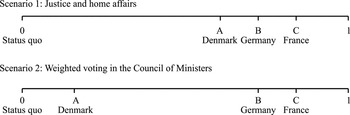
Figure 1 portrays a one dimensional space where three actors, A, B, and C, are bargaining over how to alter the status quo. Imagine that B and C are large member states, Germany and France, while A is a small member state, Denmark. I present two preference scenarios to demonstrate when intergovernmentalism and institutional theory make different predictions. In Scenario (1) of Figure 1, all member states have relatively cohesive preferences and wish to make substantial changes to the status quo. This matches the preference configuration of member states with regard to Justice and Home Affairs at the Amsterdam IGC, the negotiations I use to test these bargaining theories. Issues such as the communitarization of asylum policy and immigration policy met with little resistance and member states moved decision making on these issues from the national level to the community level at Amsterdam. Under this preference configuration, no member state has an incentive to object to a change to the status quo proposed by any other member state. Both institutionalism and intergovernmentalism would also make a prediction on the bargaining line between A and C, making it very difficult to distinguish between these two theories.

A spatial model of institutionalism and intergovernmentalism
In Scenario (2), Denmark (actor A) is located much closer to the status quo than Germany and France (actors B and C). This mirrors the preferences of member states regarding the revision of voting weights in the Council of Ministers. At the time of the Amsterdam negotiations, much legislation could pass in the Council of Ministers by receiving a qualified majority of weighted votes, where large states had more votes than small states, but small states were overrepresented per capita.27
The use of qualified majority voting has continually expanded over time. At the time of Amsterdam, it applied to all decisions regarding the implementation of the single market, economic and monetary union, and several other issue areas. The Amsterdam Treaty expanded qualified majority voting even further. Prior to Amsterdam, Germany, France, Italy, and the UK had 10 votes, Spain had 8, the Netherlands, Greece, Belgium, and Portugal had 5, Sweden and Austria had 4, Denmark, Finland and Ireland had 3, and Luxembourg had 2, for a total of 87 votes. 62 votes were needed for legislation to pass under qualified majority rule.
See Appendix 1 for a more technical examination of the conditions under which these models make competing predictions.
From this spatial model, I derive a statistical model that I apply to data collected on the IGC leading to the Treaty of Amsterdam. I examine the probability that negotiators choose a specific constitutional outcome from the set of possible outcomes on each issue discussed at the negotiations. Each member state faces the following choice problem: choose to support alternative x on issue i or choose to support the status quo. In the data I use, there is usually only one alternative to the status quo. This means member states can choose to support the status quo or support the proposed alternative. For example, member states can either choose to support the communitarization of asylum policy or to support the status quo of making decisions regarding asylum at the national level.
Institutional theory suggests that when a state, such as Denmark in Scenario (2) of Figure 1, is located closer to the status quo relative to the alternative, the states supporting the alternative over the status quo will have to somehow gain Denmark's support on that particular issue. This is because Denmark will suffer a loss relative to the status quo if that issue is eventually included in the treaty. Other larger states cannot simply ignore Denmark because if Denmark's total losses are too great, it can veto the entire treaty. As more states, regardless of their size or resources, locate on or near the status quo for a particular issue, it becomes more difficult to gain their support for that issue and more likely that negotiations will fail to alter the status quo. My data does not show member states' exact positions relative to the status quo and alternative. Instead, I know only whether they stated a preference for the status quo or issue inclusion. Therefore, I simply count the number of states preferring the status quo for each issue as the operationalization of institutionalism.
Intergovernmental theory, on the other hand, suggests that the bargaining outcome should reflect both member states' relative bargaining power and preferences. I use Bueno de Mesquita's model of bargaining in the EU Council of Ministers to capture intergovernmentalist logic.29
Bueno de Mesquita 1994.

In this equation, CA captures member state A's relative capabilities or resources. For example, C is much greater for Germany than it is for Denmark because Germany is larger than Denmark. The second term, SA, reflects how salient a particular issue is for member state A. If a member state cares more about an issue than another member state, its S term is higher. The last part of the equation assumes quadratic utility functions to capture member state A's preference, A, relative to the alternative, X, and the status quo. This term is positive if member state A prefers the alternative over the status quo and negative if the opposite is true. Because the model is multiplicative, VA is always positive whenever member state A's true preference is closer to the alternative X than to the status quo, and negative otherwise. The absolute magnitude of VA reflects a member state's relative influence over this particular issue. Again, because the model is multiplicative, there are three ways for a member state to have no influence over a particular issue. The state may have no capability to affect change (C is small), it may not care about the issue (S is small), or it may be indifferent between the proposed alternative and the status quo so the difference in utilities is 0. To make a prediction about whether the status quo remains, V is summed across all member states ([sum ]V). If [sum ]V is positive, the member states collectively choose to alter the status quo; if negative, the status quo prevails. Unlike the institutional model, this approach defines power as the relative capabilities of member states in addition to accounting for member state's preferences. Throughout the rest of the article I refer to this model as the weighted preference model.
To give a concrete example of how these two approaches differ, consider the case of Council voting weights again. In the actual data, a majority of member states (nine of fifteen), all small, prefer the status quo. However, because all of the large member states prefer change, [sum ]V for this issue is relatively positive (2.73 on a scale that ranges from −4 to 4).30
See the analysis section below for a complete description of how I calculate the weighted preference variable to arrive at this number.
In addition to the prediction of the above model, I use two additional operationalizations of intergovernmentalism in my statistical analysis to be certain that my findings do not hinge upon how I formalize the intergovernmental argument. First, I take the average position of the four largest member states (Germany, France, the UK, and Italy) on each issue. Second, I include two dummy variables that capture when the three largest states (Germany, France, and the UK) either agree to support the status quo or support issue inclusion on each issue.
Case Selection and Data
To examine which sources of power best explain IGC negotiations, I use a data set on the 1996 IGC leading to the 1997 Treaty of Amsterdam. Unlike previous IGCs, which member states called voluntarily according to their own timetable, the 1992 Treaty on European Union stipulated that the member states hold an IGC in four years to continue the difficult institutional reforms postponed at the previous Maastricht IGC. This all but guaranteed that at least some member states would prefer the status quo on important issues on the table at Amsterdam, making this a particularly good setting to test institutionalism and intergovernmentalism against each other as they are more likely to make competing predictions.
At the Amsterdam IGC, member states addressed institutional reforms necessary for eastern enlargement, such as reducing the size of the Commission and changing voting weights in the Council to increase legislative efficiency. In addition, Amsterdam provided member states with an opportunity to strengthen the Common Foreign and Security Policy (CFSP) and reduce the democratic deficit by enhancing transparency in the decision-making process and providing the European Parliament, the only directly elected branch of EU government, with more power. The IGC was launched at the Turin Council meeting in March 1996 and concluded at the Council meeting in Amsterdam on 16–17 June 1997. Negotiations fell well short of expectations in several respects. First, as mentioned above, the treaty failed to alter the system of Council voting weights and reduce the number of Commissioners. Second, it did not make significant progress on changing the CFSP. However, the treaty did appoint the secretary general of the EU Council of Ministers as the EU's “high representative” for the CFSP. It also paved the way to move decision making on asylum and immigration politics away from pure intergovernmentalism to allow the involvement of the European Parliament and the Commission, although it stipulated that many decisions in these areas would still require unanimity in the Council. Finally, the treaty granted the European Parliament new powers, as a result of both new investiture rules for the European Commission and the reformed co-decision procedure.31
Hix 2002.
My data set includes the preferences of member states, the Commission, and the European Parliament on 228 issues discussed at the Amsterdam IGC, as well as the location of the status quo and the outcome of negotiations for each of these issues. These data cover the full set of issues discussed over the course of the IGC, including reform of the common foreign and security policy, justice and home affairs, the EU's major institutions (the European Parliament, the Commission, and the European Court of Justice), and the Economic and Monetary Union. The data are constructed from two primary sources. First, I use a report written by the European Parliament taskforce responsible for monitoring and documenting the IGC process. In February 1995, the European Parliament set up a taskforce to monitor the preparatory stages of the 1996 IGC. One of the taskforce's primary goals was to collect member-state and supranational positions on all issues discussed at the IGC. On the basis of publicly available documents, such as memorandums, press reports, and parliamentary committee and plenary sitting hearings, the taskforce summarized the positions of member states and supranational actors on 252 issues.32
See the European Parliament's “Summary of the Positions of the Member States and European Parliament on the 1996 Intergovernmental Conference,” Document No. JF/bo/290/97, 12 May 1997. The positions listed in this document are based on analysis of the member-state white papers and public statements that have been summarized in the European Parliament's “White Paper on the 1996 Intergovernmental Conference, Volume II.” 1996. Available at 〈http://www.europarl.eu.int/igc1996/pos-toc_en.htm〉. Accessed 11 October 2007. In an email conversation, Jose Javier Fernandez-Fernandez, the taskforce secretary and coordinator, has confirmed that these position papers, along with other public statements, were the primary sources for the taskforce report.
I have reviewed the original coding and I do not alter it here. The 228 issues in my analysis retain all the information from the original 252 issues in the European Parliament taskforce report but collapse several issues together that are clearly not independent.
To check the validity of the European Parliament data, I compare the positions listed in the taskforce report with actor positions collected in a separate research project on the Treaty of Amsterdam. Researchers at the Mannheim Center for Social Research conducted a study of the Amsterdam IGC, also collecting data on member-state and supranational positions over issues discussed at the IGC.34
Thurner, Pappi, and Stoiber 2002.
Ibid., 22.
I am unable to match more issues both because the Mannheim data are less extensive than the European Parliament data, and because of the way that the Mannheim data are constructed.
I first reread the governments' white papers summarized in the European Parliament report. If no further information is found there, I conduct a LexisNexis search. If I still find no further information on these preferences, my default is to choose the European Parliament taskforce preference because these are often better documented in the European Parliament report compared to the documentation in the Mannheim report.
These new data are among the best available on the preferences of member states and supranational actors at IGCs, and perhaps international negotiations more generally, but the data are not perfect. Specifically, there is a problem of missing data. Of the 3,876 possible preferences (seventeen actors times 228 issues), 1,065 are missing (approximately 27 percent). Moreover, the vast majority of the recorded preferences support changing the status quo. Of the 2,811 reported preferences, 1,995 preferences support altering the status quo while only 816 prefer the status quo. It appears that member states are much more likely to explicitly support an issue's inclusion than its exclusion from the final treaty. In the original coding of the European Parliament data, König has assumed that a missing preference is the same as favoring the status quo. This, however, is an assumption that must be tested. I test this assumption by handling the missing preferences in a variety of ways.
The most frequent method for handling missing data in political science is simply list-wise deletion.38
King et al. 2001.
Methods for imputing missing data employing EM algorithms, such as Amelia,39
Ibid.
König, Finke, and Daimer 2005.
Rather than imputing the missing data using Amelia, I first examine variables that explain the missing values. This will help underscore the reasons why preferences are missing. Moreover, if I am able to predict the missing preferences, I can show that list-wise deletion is inappropriate. Second, I run the analysis on the data varying the assumptions I make about missing values and demonstrate that my results hold across the various assumptions.
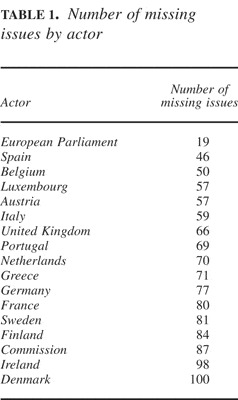
First, I present a Poisson model to examine the underlying reasons for missing preferences. My unit of analysis is the actor, and the dependent variable, presented in Table 1, is simply the number of missing observations per actor. Actors vary greatly in their number of missing preferences. Clearly the European Parliament was able to assess its preferences quite well. Surprisingly, it was much less successful at determining the preferences of the other supranational actor, the Commission. Spain, Belgium, and Luxembourg had relatively clear positions, while Ireland and Denmark had missing preferences more frequently. A missing value implies that both the European Parliament taskforce and the Mannheim research team were unable to determine an actor's preference on a given issue. This could occur for several reasons. First, an actor may honestly not have a position, something likely related to issue salience. Actors may simply not care enough to take a stance on issues of little importance to them. For example, landlocked states such as Luxembourg and Austria are not likely to care about fisheries policy. If this is true, assuming that a missing value is the same as the status quo may be a reasonable assumption. If the actors truly do not care about an issue, they should not be willing to spend their limited political capital to attempt to change the status quo. Unfortunately, I cannot test this argument directly because the data do not contain a measure of issue salience. However, this may be related to an actor's size. Smaller member states are not affected by as many issues as large member states. This would imply that small states should have more missing preferences than large states.
Number of missing issues by actor

Second, member states may not have a preference because the members of government are unable to agree on a position. If the governing coalition cannot agree on a position, they may simply choose to not state a preference. One may also interpret this as supporting the status quo because implicitly it means that the government actors cannot agree on a position that would alter the status quo. To test this, I examine missing preferences as a function of government composition. Specifically I examine whether the member state has a single-party government or a governing coalition.
Third, member states may have a preference but they may strategically hide that preference if they feel that their position is unpopular. They may not want to take a losing position for fear that being on the wrong side too often may somehow hurt their bargaining position on other issues. Alternatively, they may not want to publicly state an unpopular position for fear that this could somehow hurt their reputation either with the public at home or with other negotiators. This, again, may be related to member-state size. If intergovernmental theories are correct, and size is a source of strength, small countries are likely to hide their preferences if they feel they cannot influence the outcome over the position of the large countries. It does not, however, imply that missing positions should be coded as preferring the status quo.
Lastly, the original coding of the data implies that if actors prefer the status quo, they are less likely to report their preference, or the taskforce will be less likely to ascertain their preference. Perhaps actors wish to avoid the appearance that they are laggards, and thus prefer to make only positive statements rather than negative statements. To test this directly, I simply examine the relationship between missing preferences and the average position of member states on the issues for which they do have a reported preference. If the number of missing preferences increases as member states favor the status quo more often, this would provide justification for the assumption that a missing preference is in fact the same as preferring the status quo over change.
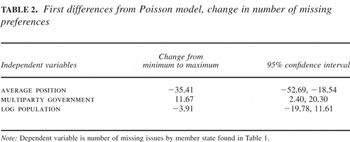
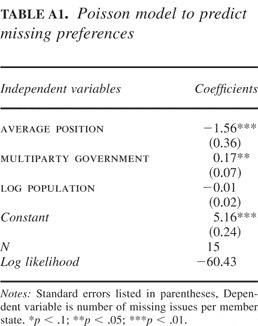
Using a Poisson model, I examine the number of times a member state's preference is missing. As independent variables, I use the log of the member states' populations, a dummy variable that is one for member states with a multiparty government at the time of Amsterdam, and the average position of the member states on the issues for which they do have a stated preference. I drop the supranational actors from the analysis because they clearly have neither populations nor governments; however, I discuss the Commission's missing values below. The results show that the single best predictor of a missing value is the average stated preference. Member states frequently located on the status quo also have a higher number of missing preferences. Coalition governments lead to a greater number of missing preferences as well. Population, on the other hand, has no effect on how often an actor has missing values. Table 2 presents first differences generated from my Poisson models.41
The Poisson model can be found in Appendix 2. I use the Clarify program to create the first differences. See King, Tomz, and Wittenberg 2000; and Tomz, Wittenberg, and King 2003.
First differences from Poisson model, change in number of missing preferences

To create the first differences, I set log population and average position to their means and multiparty government to 0. I then vary the log population from its minimum value to its maximum value holding the other variables constant. I do the same for average position and multiparty government. The analysis demonstrates that, all else equal, moving from the average position of the member state furthest from the status quo to the position of the member state closest to the status quo increases the number of missing preferences by approximately thirty-four issues. Likewise, member states with multiparty governments have, on average, thirteen more missing preferences than member states with single-party governments. Population size has virtually no effect on how often a member state's preference is missing.
The Poisson model offers strong evidence that König's original assumption that a missing position is equivalent to a status quo position is valid. Member states closer to the status quo clearly have more missing preferences, and a member state's status quo bias is the strongest predictor of missing preferences. Moreover, the variable most likely to cast doubt on the validity of this assumption, log population, is not statistically significant, and has no substantive impact.
Unfortunately, because the Commission lacks a population and government, the Poisson model does not provide any insight into why the Commission has so many missing preferences. It is nevertheless worthwhile to consider why its preferences are missing so often, especially when most models of EU legislative politics assume that the supranational actors have relatively similar preferences.42
See, for example, Tsebelis 1994.
Dehousse 1999, 9.
Analysis
I run several probit models using whether or not an issue was included in the treaty as my dependent variable. My independent variables are the number of member states on the status quo (which capture the institutional argument), and the weighted preference model along with the average position of the largest states and the two dummy variables (which operationalizes intergovernmentalism). The results demonstrate that institutional theory outperforms the intergovernmental model regardless of how I operationalize intergovernmentalism.
Testing these theories in this way may lead to some objections. Namely, this method treats negotiations that are clearly multidimensional and probably involve both issue linkage and log-rolls as a series of independent decisions. Moreover, I do not provide a model of log-rolling. Nevertheless, given the nature of the data, the method I present is the best way to test these theories against each other. First, because the data lack a measure of saliency other than simple missing preferences, developing and testing a model that takes issue linkage into account would be nearly impossible. Without clearer knowledge of what member states care about the most and the least, it is impossible to determine what trade-offs they might be willing to make.
Secondly, empirical tests that try to reproduce the multidimensionality of the issue space are difficult and suffer from different drawbacks. Often researchers use scaling techniques to extract the two or three most prominent dimensions, then use these dimensions to test multidimensional theories rather than treating each observation as an independent event.44
See, for example, König and Pöter 2001.
Although not perfect, the approach presented in this article offers an improvement over other existing approaches to testing bargaining theories. Leaving further concerns aside, I discuss how the variables are constructed. While operationalizing institutionalism by counting the number of member states expressing support for the status quo is straightforward, constructing the weighted preference model, which captures intergovernmentalism, is less so. First, to capture the member states' relative capabilities, I divide each member state's 1997 gross domestic product (GDP) by total EU GDP in 1997.45
GDP data are taken from Eurostat: 〈www.eu.int/comm/eurostat/〉. Accessed 14 March 2006.
I have also calculated the variable using the proportion of member-state population and proportion of Council voting weights to capture capabilities and my results do not change.
Although member states are reported to have binary preferences on the vast majority of issues, there are some issues in the data where member states have intermediate preferences between the status quo and issue inclusion.
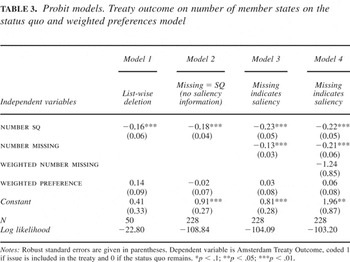
To further test my assumptions about missing preferences I run my primary model, the outcome of treaty negotiations as a function of the number of actors on the status quo and the weighted preference model, making different assumptions about missing preferences. First, I simply use list-wise deletion. Next, I make two different assumptions about the nature of missing preferences to impute the missing data. I first assume that missing preferences are identical to status quo positions and missing data provide no information about issue saliency. Here the saliency term drops out of the weighted preference model. Second, I assume that a missing position implies a less intense status quo preference. In this model I construct three variables: the number of member states truly preferring the status quo (that is, those member states not missing and indicating a preference for the status quo), the number of member states missing, and the prediction of the weighted preference model using missing preferences to indicate issue salience. Finally, I rerun the model assuming missing preferences provide information about issue intensity, but I also include a variable that weighs the number of missing member states by the percent GDP those states contribute to the EU's total GDP. If significant, this variable would support intergovernmentalism because it would suggest that large states' missing preferences are more important than those of small states. Table 3 presents the results of these various models. All models are run with robust standard errors so I do not inflate statistical significance as a result of the possible nonindependence of the observations due to log-rolling.
Probit models. Treaty outcome on number of member states on the status quo and weighted preferences model

Looking at Table 3, there are two questions to be answered. First, which variable best explains the treaty outcome, and second, do the assumptions about missing data affect the results? Although the Poisson model has demonstrated that MCAR is an inappropriate assumption given these data, I first run a model with list-wise deletion. The subset of issues that do not contain any missing data is clearly not a random sample of all issues. Instead, as one might expect, it includes many of the most important and contentious issues on the table, such as extending qualified majority voting to various issue areas including Justice and Home Affairs, changing the voting weights in the Council of Ministers, and altering the number of commissioners. Even though this may not be a random sample of issues, it is an interesting sample to examine as it contains the issues that member states arguably cared most about. Running the model on this subset of issues ameliorates concerns that my results are due to small states getting their way on issues that large states do not care about. In this model, number sq has a strong effect, both substantively and statistically, while weighted preference is not statistically significant.
Rather than dropping issues with missing data, Models 2, 3, and 4 make reasonable assumptions about the nature of missing preferences. Model 2 assumes that a missing value is exactly the same as a preference for the status quo, while Models 3 and 4 assume that a missing preference contains information about issue saliency. In all three models number sq is statistically significant and weighted preference is never significant. Interestingly, in Model 3 when the number of missing preferences is separated out from the number of preferences for the status quo, both variables are significant, but the effect of number sq becomes stronger compared to Model 2 and it is larger than the effect of number missing. This comparison provides further evidence that a missing preference is a less intense preference for the status quo. Finally, the GDP-weighted missing preferences variable in Model 4 is not statistically significant, further indicating that weighting preferences by member-state size does not provide any additional information about bargaining outcomes.
Because these are probit models, it is difficult to determine the substantive effect of the coefficients directly. Instead, to demonstrate the effect of member-state size on the probability of issue inclusion, I run simulations examining the case of Council voting weights. On this issue the nine smallest member states preferred the status quo while the six larger states (Germany, France, the UK, Italy, Spain, and the Netherlands) preferred a double majority voting rule. For the moment, assume a hypothetical scenario in which Denmark decided to join the coalition of large states on this issue, leaving only eight member states on the status quo. I examine the predicted drop in the probability that the double majority proposal is implemented when Denmark moves from supporting the proposal to supporting the status quo and when Germany moves from supporting the proposal to supporting the status quo. If intergovernmentalism is correct, one would expect a much larger change in probability when Germany shifts its position compared to when Denmark shifts its position.
According Model 2, if Germany switched its position to support the status quo rather than the double majority proposal, the probability that the proposal would be included in the treaty would drop by 0.046 from 0.288 to 0.242. On the other hand, if Denmark switched to support the status quo instead of Germany, the probability of including the proposal would fall by 0.054, a slightly greater decrease than the hypothetical situation in which Germany switched positions. Models 1, 3, and 4 provide similar results. The coefficients from Model 3 suggest that when Germany switches from supporting the proposal to supporting the status quo, the probability of issue inclusion decreases by 0.06. Likewise, when Denmark shifts to support the status quo, the probability of issue inclusion decreases by 0.05, an almost identical change compared to when Germany shifts. Model 4 suggests that Germany switching position decreases the probability of issue inclusion by 0.09 compared to 0.07 for Denmark. Only Model 1, the list-wise deletion model, suggests that perhaps there is a larger effect for Germany switching positions compared to Denmark (a decrease of 0.13 compared to a 0.05 decrease). However, a simulated 95 percent confidence interval suggests that one cannot rule out that the effect of Germany's shift is 0, while one can rule this out for Denmark. In no instance is there a statistical difference between the changes in the probabilities when the two states switch positions. As institutionalism suggests, the preferences of all states, both large and small, seem to matter equally.
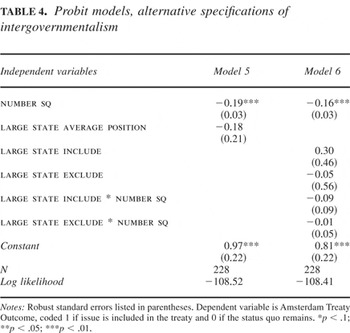
To test these results further, I pit two different operationalizations of intergovernmental theory against the number sq variable. Because the above results demonstrate that a missing preference is similar to a preference for the status quo, I calculate all variables here assuming a missing preference is equivalent to a preference for the status quo. First, I operationalize intergovernmentalism as the average position of the four largest member states, Germany, France, the UK, and Italy, on each issue. Second, I examine whether issues are more likely to be included in or excluded from the final treaty if the three largest member states take a common position. I include two dummy variables in the analysis: large state include, which equals 1 if Germany, France, and the UK agree to include an issue in the treaty and 0 otherwise, and large state exclude, which equals 1 if Germany, France, and the UK agree to exclude an issue from the treaty. I also interact these dummies with number sq. Intergovernmental theory would suggest that number sq should matter less if the three largest member states prefer change and more if they prefer the status quo. This would imply a positive coefficient on the interaction large state include * number sq and a negative coefficient on the interaction large state exclude * number sq. Table 4 presents the results of my analysis.
Probit models, alternative specifications of intergovernmentalism

The models demonstrate that my findings hold for various operationalizations of intergovernmentalist theory. Regardless of how I conceptualize intergovernmentalism, the variable associated with institutionalism, number sq, best explains the treaty outcome. It is the only variable in either model to achieve statistical significance. Both large state average and large state include have the wrong sign, meaning that, if anything, large states have less power than small states. The dummy variables and interaction terms in Model 6 are not statistically significant. A likelihood ratio test reveals that they are also not jointly significant either (χ2 (4) = 0.98, p = 0.91).48
I have also run Model 6 without the interaction terms and the result is virtually identical to the result with the interaction terms.
Threshold Effects
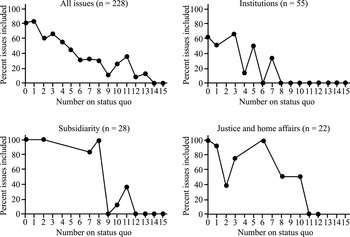
The above analysis has provided strong evidence for the institutional model over the intergovernmental model; however, there are other implications of the institutional model to explore. While the final treaty is subject to unanimity, it is not the case that each issue negotiated at the IGC requires unanimous support to become part of the final document. Instead, there is likely an informal qualified majority rule. For example, suppose there is de facto two-thirds qualified majority rule. Once ten out of fifteen member states support an issue, the issue is likely to be included in the final document. Such a qualified majority rule would suggest a steplike probability function. For example, the probability that an issue is included in the treaty should be the same if all fifteen member states support the issue and if only ten member states support it. However, when nine member states support an issue, the probability that the issue is included should fall. To determine whether such a threshold exists, Figure 2 plots the relationship between the number of member states on the status quo and the number of issues included in the treaty for the entire treaty and then for various issue areas.

Percent issues included in treaty by number of member states preferring the status quo
Examining the upper-left graph that presents the entire issue space, it is notable that even when there is unanimous consent among the member states to include an issue, some issues are left out of the treaty. While puzzling at first, this is easily explained. There are fifteen issues where all fifteen member states agree to alter the status quo. In two of these cases the status quo remains.49
On a third issue, the extension of qualified majority voting in the Council, most member states preferred a compromise position where certain criteria for extending qualified majority voting would be established rather than extending qualified majority voting to many issues at once. This compromise solution was also the outcome of negotiations and is coded as 0.25.
One could make the case to exclude these issues from the analysis entirely because, unlike almost every other issue in the data set, these are not clear-cut items that either can be included or excluded from a final written treaty. In fact, discussion of the EMU, rather than being included or excluded from the treaty, is an issue of inclusion or exclusion from the negotiations. Likewise, there would not be one single issue that the negotiators could include in the treaty to simplify the structure of the treaty.
Next, one notices that when fourteen or fifteen actors are on the status quo, change never occurs. One state desiring change is not enough to move the status quo. However, one state on the status quo appears to be enough, at least in one instance, to prevent change from occurring. The probability of issue inclusion drops below 0.5 when five or more member states prefer the status quo, and once nine states are located on the status quo, the probability of change becomes quite low. Nevertheless, when looking at the entire issue space, the relationship between the percent issues included in the treaty and number sq appears quite linear. There is no clear threshold to indicate a constant de facto qualified majority voting rule.
A plausible explanation for the lack of a threshold is that different types of issues were subject to different thresholds. When averaging over these various thresholds, the overall effect is lost. The three remaining graphs in Figure 2 provide support for this hypothesis. These plots demonstrate that changes to the EU's institutions (the Parliament, the Commission, the Council, and the European Court of Justice) were more controversial and required higher support compared to other issues. Institutional changes are more difficult to reverse, have longer, more unpredictable consequences, and are more likely to alter interactions between member states than other types of reform so they may require a higher degree of consensus to change. Once six member states prefer the status quo, institutional change becomes virtually impossible. Even when fewer than six member states prefer the status quo, change is far from guaranteed. For issues involving changes to subsidiarity, such as strengthening the Committee of Regions or increasing the voice of national parliaments, and issues involving Justice and Home Affairs, such as border security and visa policies, the threshold for change is lower. Unlike with institutional issues, change on these issues is likely when nine or fewer member states prefer the status quo. For issues dealing with subsidiarity, change is almost guaranteed when fewer than nine states prefer the status quo. Together these plots demonstrate that although there may not be one single threshold for all issues, one can identify different thresholds across different types of issues.
Discussion
The findings in this article provide an explanation for why important EU institutions have been so difficult to reform, something that previous studies of IGCs have overlooked. Consensus among a few large member states is insufficient to produce major institutional change at IGCs. While the above results demonstrate this with a large-n statistical model, the case of Council voting weights reform illustrates this more concretely. Member states had known since the early 1990s that they would ultimately need to change institutional arrangements, including the sensitive issue of Council voting weights, as the EU expanded from twelve member states at the time of the 1992 Maastricht Treaty to twenty-seven member states as of 1 January 2007. Nevertheless, reform of the most important institutional issues has been excruciatingly slow and difficult. Although the Treaty of Amsterdam created an investiture process for the Commission and altered the co-decision procedure, increasing the power of the European Parliament, member states could not come to an agreement on the more contentious and, given enlargement, arguably more important reforms of weighted voting in the Council of Ministers. My analysis has demonstrated that this was not because of a lack of consensus between large member states such as Germany and France, but because small states fiercely guarded the status quo.
The issue of voting weights in the Council of Ministers took on new importance after the 1986 Single European Act, which finally instituted qualified majority voting after decades of de facto unanimity rule in the Council.51
In 1965, French President Charles De Gaulle argued that the qualified majority-voting provisions in the Treaty of Rome were flawed and for six months the French boycotted Council meetings in what became known as the “Empty Chair Crisis.” In 1966, the member states agreed to the Luxembourg Compromise, which stated that a member state could veto legislation it deemed of “very important national interest” regardless of what the Treaty of Rome said about qualified majority voting. This essentially put an end to qualified majority voting until the 1986 Single European Act.
In White Papers published during the run-up to the Amsterdam negotiations, member states laid out their positions with regard to new Council voting schemes. Small states, Greece and Ireland in particular, made clear that they opposed any change to the status quo. They strongly desired to protect their overrepresentation in the Council and viewed the Council as the branch of EU government that should protect the interests of small states, even making analogies to the U.S. Senate. Large states, on the other hand, put forward proposals that consisted of a double majority of either weighted votes or the number of member states and member-state population.52
See the European Parliament's “Summary of the Positions of the Member States and European Parliament on the 1996 Intergovernmental Conference,” Document No. JF/bo/290/97, 12 May 1997.
“European Council: Mini-Breakthrough on Institutional Reform at Noordwijk Summit.” European Information Service, European Report, 28 May 1997.
Press Conference of Jacques Chirac and Lionel Jospin. Amsterdam, 18 June 1997. Available at 〈www.ena.lu〉.
At the Nice IGC, these issues again proved the hardest to resolve with small states fighting to retain their overrepresentation in the Council. In the end, this led to an unwieldy triple majority rule of qualified majority votes, number of member states, and member-state population. The most contentious bargaining of the Nice IGC occurred at 10:30 in the evening on the last day of negotiations. As at Amsterdam, Jacques Chirac, President of France, introduced a controversial voting scheme that would have substantially increased the power of the large states. The small states balked, with Belgium and Portugal threatening to veto the whole package. Chirac was then forced to make concessions to the smaller states in negotiations that lasted until 4:30 in the morning, the latest into the morning an IGC had ever run. In an attempt to please everyone, the untenable and very complicated triple majority rule emerged. Although the Nice IGC did formally alter the voting rule, it did not produce significant change. The triple majority rule does not allow for easier policymaking compared to the pre-Nice qualified majority rule, essentially preserving the institutional status quo.55
Tsebelis 2006.
Tsebelis and Yataganas 2002.
The failure of the Amsterdam and Nice IGCs to produce adequate institutional reform due to the status quo bias inherent in intergovernmental bargaining led EU leaders to ultimately abandon the IGC format in favor of the recent constitutional convention. The inability of member states to reach an agreement at Amsterdam and Nice caused frustration among member states, and some members of the European Parliament complained that the entire IGC process was broken.57
Church 2001, 81.
Duff 2001.
Presidency Conclusions, European Council Meeting in Laeken, 14–15 December 2001, SN300/1/01.
Analyses of IGCs that ignore the preferences of smaller states and their veto power are unable to explain this deadlock on institutional issues, a major impetus for creating the EU's constitutional convention. That small states were able to credibly threaten to veto such vital institutional reforms at both Amsterdam and Nice underscores the importance of examining the full range of actors, issues, and rules when studying intergovernmental bargaining. The ramifications for EU negotiations are clear. Despite the clear need for institutional change before eastern enlargement, the nature of IGCs made major reform difficult and led states to search for a new way produce institutional change. The less status quo-biased constitutional convention format did produce institutional reform with respect to major institutional issues such as Council voting weights, however, the constitution has faced far greater ratification difficulties than earlier IGC agreements.60
König and Slapin 2006.
These results also have implications for studies of international bargaining and institutional design more generally. Scholars must take into account the preferences of all member states when studying negotiations and they must examine whether states have veto power as EU member states have at IGCs. The institutional logic presented in this article will hold as long as states do not have a legitimate outside option, such as simply not taking part in the organization or treaty under negotiation. If negotiating partners decide that states with a status quo bias are unnecessary for a treaty to go forward, that laggard state's threat to veto parts or all of the agreement will ring hollow. In other words, status quo-biased states should have more power when negotiating treaties within a long-standing international institution from which it would be difficult to simply walk away. When designing a new international regime, status quo-biased states may not have as much power because pro-integration states may simply prefer to exclude the laggards from the organization than to water down the rules for them.
Conclusions
My analysis has provided strong evidence that institutional theory, which accounts for veto power, outperforms intergovernmental theory, which conceptualizes power as a function of size and resources at EU IGCs. I have presented a method for directly extending institutionalism to the study of IGCs, and I have tested this theory against various operationalizations of intergovernmentalism, none of which perform as well as the institutional model. I also find evidence for varying threshold effects across issue areas, as predicted by the institutional model. Issues that alter important EU institutions and legislative processes require more support to include in the final treaty than other issues. In addition, this article advances the study of IGCs by exploring the full range of issues on the bargaining table and does not ignore bargaining over institutions as intergovernmental studies often do. Lastly, instead of ignoring problems of missing data, I examine various methods for handling missing preferences and demonstrate empirically that missing preferences are similar to preferences for the status quo and that my findings are robust to how I handle missing data.
My results help explain why member states were unsuccessful in making important institutional changes at Amsterdam and Nice and moved away from intergovernmental settings when negotiating the latest EU constitution. Of course, given the failure of France and the Netherlands to ratify the EU's constitution, it is not clear that the constitutional convention was a better method for negotiating institutional change. Normatively, the results imply that should member states want to change EU institutions to create more efficient decision-making processes, they would need to develop a forum for negotiating institutional change that both relaxes the unanimity requirement and ensures that member states set clear and transparent guidelines for ratification. This would eliminate the status quo bias present at IGCs and reduce the chance of a ratification failure such as occurred following the recent Constitutional Convention. Even many European leaders have complained that it is unfair that the current rules prevent constitutional change when the vast majority of member states support and have ratified the constitution. Such alterations to the way institutions are negotiated are even more important in an EU where twenty-seven member states must agree to constitutional change, compared to a union with only fifteen members at the time of the Amsterdam and Nice IGCs.
Appendix 1. Conditions Under Which Institutionalism and Intergovernmentalism Make Competing Predictions
Assume a uni-dimensional space as in Figure 1 where the status quo is located at 0 and all actors have Euclidean preferences between 0 and 1. When 2 * |A − SQ| > B, institutionalism predicts a bargaining outcome somewhere on the bargaining line between points A and 2 * |A − SQ|. If 2 * |A − SQ| > C, institutionalism predicts the outcome will lie on the bargaining line between A and C. If it were possible to identify an agenda setter, one could make a more precise prediction about the location of the bargaining outcome. Unfortunately, identifying an agenda setter at IGCs is exceedingly difficult. Intergovernmentalism also predicts an outcome on the bargaining line between A and C, likely the average of bargaining positions weighted by member states' resources. Because both theories make a prediction between points A and C, it is impossible to distinguish between the theories, at least without knowing the identity of the agenda setter.
When 2 * |A − SQ| < B, institutionalism and intergovernmentalism make competing predictions. Institutionalism suggests that unless member state A is somehow compensated by B and C for its loss relative to the status quo, the bargaining outcome will lie within the win-set of the status SQ, 2 * |A − SQ| < B, making all states better off compared to the status quo. The price B and C have to pay for A's support for an outcome located outside the win-set can be captured with a variable P. Assuming quadratic utility functions, A will support a treaty outcome, X, over the status quo whenever A > (SQ + X)/2. This inequality can be rewritten as the following equation:

For P > 0, A prefers X, otherwise A prefers SQ. Institutional theory suggests that when P < 0, the magnitude of P represents the “cost” to the other member states for buying A's support on this issue. As A moves closer to the status quo, P grows more negative, all else equal, meaning A's negotiating partners must compensate A more if A is to support the inclusion of this issue in the final treaty. In the empirical analysis, I count the number of actors stating a preference for the status quo for each issue as an approximation of P. Equation (1) demonstrates that as more actors locate on the status quo, the cost to those who want to change policy becomes greater. Assume A = SQ = 0. Equation (1) reduces to (X/2) + P = 0. For all positive X, P must be negative. Thus counting the number of actors located at SQ is very similar to summing the Ps for actors located on the status quo. Intergovernmentalism suggests P should not matter for bargaining outcomes. As long as A has insufficient resources relative to B and C to influence the bargaining outcome, B and C should not have to compensate it for a outcome lying outside the win-set of the status quo.
Appendix 2
Poisson model to predict missing preferences