In a spoils system, the bureaucrats tasked with implementing policies are closely aligned with the party that endorses those policies. A major development in 20th century politics was the introduction of civil service reforms, which introduced professionalized civil service careers, filled by merit rather than by party loyalty, where bureaucrats had tenure across ruling administrations and protections against political interference.
This paper investigates the causes of these reforms, with two major contributions. First, we provide a simple model that emphasizes the policy delegation preferences of unified and divided principals under different bureaucratic systems, predicting stronger incentives to enact a civil service reform under divided government. Second, we report empirical evidence that, indeed, civil service reforms in US states have occurred with significantly greater frequency during periods of divided government.
Rather than looking at divided versus unified government, previous studies have focused on incentives of incumbents likely to lose the next election as the main trigger of civil service reform. In one major strand of the literature (the “insurance” view), an incumbent party accrues private benefits from the patronage system but entrenches the bureaucracy through reform when it is about to lose (Ting et al., Reference Ting, Snyder, Hirano and Folke2013). In the other major strand (the “investment” view), an independent civil service is introduced to increase the efficiency of public goods production by government agencies (Huber and Ting, Reference Huber and Ting2016). Incentives to invest in an independent bureaucracy will be higher if the opposition has preferences that are not so far from those of the incumbent party's (Huber and Ting, Reference Huber and Ting2016). Our model produces results in line with these in terms of the role of party polarization, but the main mechanism involves divided government policymaking rather than electoral incentives. Moreover, our model bridges the gap between these bureaucratic delegation models and recent studies on political conflict and rule-making, where it is found that under divided government bureaucrats are freer to act more independently (Boushey and McGrath, Reference Boushey and McGrath2019).
Our model highlights that under standard assumptions on asymmetric information between principals and agents, the delegation of policymaking to a Governor or the bureaucracy will be chosen by the principals (the parties controlling the two chambers) only under specific conditions. In particular, delegation to the Governor happens in equilibrium only under unified government, whereas delegation to the bureaucracy happens in equilibrium only when the principals are divided and the bureaucracy is independent. Thus, if in the status quo the bureaucracy is not independent, it is precisely under divided government that both parties unanimously prefer a civil service reform. We also show that under divided legislative chambers the preference for an independent bureaucracy is unconditional, whereas, in the case of unified legislative chambers and a different-party governor, the incentives to introduce a merit system depend on party polarization, in a manner consistent with previous findings.
We test the main implication of our model by looking at the relation between introducing an independent bureaucracy and divided government in US states during the 20th century. These reforms had three major components: meritocratic recruitment, political independence, and tenure. As a result of these reforms, the direct influence politicians had exerted on bureaucrats under the spoils system decreased drastically.Footnote 1 Our panel data approach uses state and year fixed effects to address the major sources of selection bias at the state level. We find that states with divided control of state government were more likely to introduce civil service reforms. The result is robust to different measures of divided government and to the inclusion of a range of time-varying state-level covariates. The divided-legislative-chambers case proves to be the most relevant, as the theory suggests.
This study bridges the gap between studies on legislative policy delegation and those on policy conflict and rule-making. Traditional studies in political science and political economy look at the private and public incentives to reform the civil service and delegate powers to the bureaucracy. The studies in public administration look at how political conflict and gridlocks can lead to more discretion by the bureaucracy. In this study, we find in the same setting that private and public incentives to delegate are important, but also consideration on political gridlocks matter.
1. Background and literature review
1.1 A brief history
In 1801, the presidency changed hands for the first time in history and the issue emerged of how to deal with politically affiliated public servants (Congress, 1976). The newly elected president Thomas Jefferson opted for a strategy of equal division of government offices between parties, which was then followed by his successors (Congress, 1976). Until the 1830s, relatively low turnover and high stability characterized the federal civil service. In the mid-1830s, patronage criteria started to dominate the recruitment of civil servants and arbitrary removal for political reasons became a widespread practice (Theriault, Reference Theriault2003). At the end of the 19th century, as Hoogenboom (Reference Hoogenboom1959, 301–302) put it, “a civil servant would almost certainly be removed if he ceased his political activities or if his patron lost his influence”. Civil servants with varied and irrelevant backgrounds were hired on a temporary basis and their morale was very low (Hoogenboom, Reference Hoogenboom1959). This led to very low levels of professionalization of civil servants, high instability in the provision of public goods and disproportionate power of politicians (Hoogenboom, Reference Hoogenboom1959; Congress, 1976).
After the civil war, several attempts at reforming the civil service were made, but they all failed. In the 1870s, some minor provisions were passed through executive orders (Naff et al., Reference Naff, Riccucci and Fox-Freyss2001; Shafritz, Reference Shafritz2012). During the Hayes presidency, various civil service reform associations were established, with the New York Civil Service Reform Association as the first one (Congress, 1976). In 1881, the newly elected President Garfield was shot by a job seeker disappointed by the patronage system (Hoogenboom, Reference Hoogenboom1959; Dresang, Reference Dresang1982; Naff et al., Reference Naff, Riccucci and Fox-Freyss2001; Theriault, Reference Theriault2003; Shafritz, Reference Shafritz2012). This sparked national attention to the issue of civil service reform. In the same year, Senator Pendleton presented a bill to the Senate, which was approved two years later (Hoogenboom, Reference Hoogenboom1959; Congress, 1976; Naff et al., Reference Naff, Riccucci and Fox-Freyss2001; Theriault, Reference Theriault2003). The Pendleton Act established three principles in civil service: competitive examination, political neutrality, and security of tenure (Hoogenboom, Reference Hoogenboom1959; Congress, 1976; Skowronek, Reference Skowronek1982; Shafritz, Reference Shafritz2012). In other words, civil servants started to be hired and promoted based on examination and no removal on political (and religious) grounds was allowed (Hoogenboom, Reference Hoogenboom1959).
As reported by Hoogenboom (Reference Hoogenboom1959), almost half of the entire federal civil service was covered by this act by 1900, and a good portion of the civil servants covered by the act were top-level bureaucrats. Beginning in the 1880s through the 1920s, Congress passed a series of minor laws that sought to strengthen the merit system. These included the 1912 Lloyd-La Follette Act, which improved protection from dismissal (Huber and Ting, Reference Huber and Ting2016). Finally, in the 1930s, two main pieces of legislation were enacted. First, the 1939 Hatch Act sought to restrict political activity by civil servants (Congress, 1976). Second, in 1939, the Congress amended the Social Security Act, requiring the establishment of merit systems in those state departments cooperating with the administration of the Act. By the beginning of WWII, a strong merit system was in place at the federal level. This was reinforced by the 1947 Taft-Hartley Act, which further reduced political activism among civil servants, and Eisenhower's creation of the “Schedule C”, enacted as a reaction to the proposals by the Hoover Commission, which extended the size and scope of the federal bureaucracy (Lewis, Reference Lewis2010). More recently, the Civil Service Reform Act in 1978 established performance review and merit pay and the 1993 National Performance Review continued along the line of increasing public servants’ accountability and reducing their independence (McGrath, Reference McGrath2013).
Civil service reforms at the federal level triggered an active debate at the state level.Footnote 2 Nonetheless, 50 years after the Pendleton Act, only nine states had introduced comprehensive merit systems in the spirit of that act, namely, systems characterized by meritocratic recruitment, bureaucratic tenure, and political independence. The real push came with the 1939 amendment to the Social Security Act. In response to this, states adopted limited merit systems covering all agencies administering funds under this act (Ujhelyi, Reference Ujhelyi2014). Simultaneously and in some cases independently from the pressure from the federal level, states started to reform their civil service radically. New York and Massachusetts were the first states to implement a comprehensive merit system at the end of the 19th century. These were followed by some states before WWII and other states in the 1950s and 1960s. More recently, starting with Georgia in 1996, several states have undergone a process of decentralization of the state personnel system (McGrath, Reference McGrath2013), to improve accountability and performance, along the line of the 1993 National Performance Review.
1.2 Public goods and private benefits
Several factors are considered relevant for civil service reform across the US states. Traditional explanations focus on the reformist movement for good government of the 19th century (Johnson and Libecap, Reference Johnson and Libecap1994; Kernell and McDonald, Reference Kernell and McDonald1999; Weber and Brace, Reference Weber and Brace1999; Ruhil and Camões, Reference Ruhil and Camões2003; Theriault, Reference Theriault2003; Folke et al., Reference Folke, Hirano and Snyder2011; McGrath, Reference McGrath2013; Housel, Reference Housel2014; Ujhelyi, Reference Ujhelyi2014). At the end of the 19th century, a militant minority composed of politicians from both parties and civil society members started to exert increasing pressure on the federal government to improve the efficiency of bureaucracy (Johnson and Libecap, Reference Johnson and Libecap1994).
Similar dynamics were in place at the state level. In the 1950s in Oklahoma, for example (Housel, Reference Housel2014), an advocacy coalition composed of newspapers, educators, a few legislators, and the League of Women Voters was behind the governor's efforts to introduce a comprehensive civil service reform. The reform extended merit principles to most state employees.
The reason for the emergence of this progressive movement was arguably the perceived inefficiency of the patronage system. A spoils system meant a bureaucratic system characterized by high turnover (especially for high-level positions) and mismanagement of human resources (Johnson and Libecap, Reference Johnson and Libecap1994; Folke et al., Reference Folke, Hirano and Snyder2011; McGrath, Reference McGrath2013; Housel, Reference Housel2014; Ting et al., Reference Ting, Snyder, Hirano and Folke2013). Under a patronage system, at every change in government, a high share of employees used to be fired and new ones hired. In the 1950s in Pennsylvania, more than two-thirds of public employees in highway positions changed jobs when Democrats took power (Sorauf, Reference Sorauf1959).
High turnover was coupled with the serious mismanagement of human resources. Civil servants were not hired or allocated according to efficiency criteria, but according to political affiliation and also other aspects, such as friendship and ethnicity (Sorauf, Reference Sorauf1959; Johnston, Reference Johnston1979). Civil servants were supposed to spend a good portion of their working time (as well as their salary) participating in political activities, such as attending political meetings, canvassing voters, and so on (Hoogenboom, Reference Hoogenboom1959; Ting et al., Reference Ting, Snyder, Hirano and Folke2013).Footnote 3 In this spoils system, the power of politicians on state civil servants was strong, much stronger than that of business.
The consequences of this system were: a loss of resources, amounting to millions of dollars in some states (Housel, Reference Housel2014); loss of trust in the government (Housel, Reference Housel2014); a very low consideration for public service as an occupation (Stahl, Reference Stahl1956); a strong sense of insecurity in public employment (Sorauf, Reference Sorauf1959); low salaries, especially compared with the private sector (Folke et al., Reference Folke, Hirano and Snyder2011). The traditional explanations focusing on the reformist movement for a good government were later incorporated into a more contemporary public management approach to civil service reform (McGrath, Reference McGrath2013).
While the explanations discussed above focus on the incapacity of patronage systems to create public goods, other explanations looked at the private benefits the patronage system used to create for specific constituents (Moe, Reference Moe1989). Some studies emphasize the variation in preferences between different constituencies to which different bodies were accountable as a crucial factor determining the introduction of the merit system. As Housel (Reference Housel2014) points out for the introduction of comprehensive civil service in Oklahoma, traditionally the legislature used to represent the rural part of the state, whereas the governor the urban part, which used to benefit the most from the patronage system. These dynamics are also found at the federal level, where the introduction of rural-free delivery routes, a central part of the program which replaced the patronage system in the postal office, became central for Republicans to gain the support from farmers in key areas (Kernell and McDonald, Reference Kernell and McDonald1999).
Recent studies in political economy have tried to make sense of these two contrasting views by looking at the electoral incentives behind legislators’ behavior. Huber and Ting (Reference Huber and Ting2016) distinguish between the so-called “insurance” and “investment” views.
The “insurance” view suggests that incumbents will favor civil service reform when they are electorally vulnerable (Skowronek, Reference Skowronek1982; Geddes, Reference Geddes1994; Ruhil and Camões, Reference Ruhil and Camões2003; Ting et al., Reference Ting, Snyder, Hirano and Folke2013). According to Ting et al. (Reference Ting, Snyder, Hirano and Folke2013), the incumbent party will create an independent bureaucracy when it is losing ground, to avoid that the other party gets in control of the bureaucracy under a spoils system. The intuition of this model is that, for the incumbent party, an independent civil service is preferable to a spoils system controlled by the opposing party. This follows from an electoral advantage to incumbency due to a spoils system. With a merit system, moreover, the incumbents can lock in both policies and loyal employees as agents, at least in the short term (Ruhil and Camões, Reference Ruhil and Camões2003; Ujhelyi, Reference Ujhelyi2014).Footnote 4 It should be noticed that uncertainty about leadership succession was already discussed in the traditional political science approach in the 1990s (Silberman, Reference Silberman1993)
Conversely, the “investment” argument says that incumbents will favor delegation when they are electorally secure, as politicians need the assurance of remaining in power to reap the benefits of delegation (Gailmard and Patty, Reference Gailmard and Patty2007, Reference Gailmard and Patty2012a, Reference Gailmard and Patty2012b; Huber and Ting, Reference Huber and Ting2016). This logic is in line with those explanations discussed above that focus on the efficiency of the bureaucratic system in creating public goods. For instance, Lewis (Reference Lewis2007) finds that those federal programs administered by political appointees perform worse than those administered by civil servants.
Both views miss the important incentive role determined by the different types of divided government situations, to which we turn in the following section. It should be noticed that, instead, the role played by the different types of divided government situations is present in recent accounts of bureaucratic rule-making (Boushey and McGrath, Reference Boushey and McGrath2019). The latter find that state bureaucracies engage in more rule-making where the two chambers are split.Footnote 5
2. A simple model
We model civil service reform from a principal-agent perspective (McCubbins et al., Reference McCubbins, Noll and Weingast1987). For policy-making and legislative activity, a state legislature can have different active players depending on the context. We can think of potentially two principals—the two main parties—and potentially two agents—the governor and the bureaucracy. Denote by L and R the two potential principals and by G and B the two potential agents.Footnote 6 The reason for using the term “potential” is that under unified government there is effectively only one principal (the party controlling the majority in both chambers), whereas under divided government there are two principals and in a spoils system G and B are one agent (because B is chosen by G), whereas they are two separate agents in a merit system.
In periods of divided government such that the House and the Senate are controlled by different parties, which we will call the divided chambers case, there is at least one principal with high distance from the ideology of the Governor, and hence we should expect intuitively less policy-making and legislative activity delegated to the Governor. Also in the other type of divided government, where the chambers are controlled by one party but the Governor belongs to the other party, which we will call the divided Governor case, we should expect low levels of policy-making and legislative activity delegated to the Governor. However, these two subcases of divided government may behave differently, as we shall see, in terms of delegation to the bureaucracy when it is an independent agency.
The formal model captures these ideas in the simplest possible way. Denote by H ∈ {L, R} and S ∈ {L, R} the House and Senate majority, respectively. Assume that each policy decision that needs to be made has the following features. Given the realization of a state of the world $\theta \in \Theta \equiv [ 0,\; \bar \theta ]$ , the ideal point for party L would be θ − k, whereas the ideal point for R would be θ + k, for some k > 0 capturing bias. This holds for both legislative chambers, the governor, and, under a spoils system, the bureaucracy. Under a merit system, however, the independent bureaucracy B has ideal point θ. Assume that all players have linear loss functions from the respective bliss point: given any chosen policy $x\in {\cal R}$
 , and denoting by b j(θ) the bliss point for player j,

Assume that the House legislators and Senators have a uniform prior over Θ.Footnote 7 B can observe perfectly the realization of the state of Nature θ, whereas G observes a noisy signal (intermediate information between the chambers and B).Footnote 8
Consider any period with a spoils system status quo and a triple (H, S, G) ∈ {L, R}. A specific state of the world θ ∈ Θ materializes; B observes θ, whereas H and S remain uninformed about θ and G receives a much more precise signal. The timeline of the game in each pre-reform period, characterized by an electoral realization of H, S, G, is as follows:
1. H can propose a civil service reform or not; if S accepts, the civil service reform takes place at a cost c for all; otherwise, the game continues maintaining the spoils system.
2. Then H can either
(a) propose a delegation choice (G or B) to S; or
(b) propose to choose the policy or legislation without delegation.
3. If H chooses the former, then S can accept or reject; when they accept, the proposed delegation obtains; in the case of rejection, the policy has to be chosen by political compromise as in the latter case.
If H has chosen to go for no delegation or proposed a delegation that was rejected, in both cases the policy chosen is the one that generates equal expected utility gains for H and S, in the spirit of Nash bargaining.Footnote 9
4. In the case of proposed and accepted delegation, whoever is delegated, G or B, decides the policy.
The equilibrium choices are obtained with the standard backward induction logic.
Unified government case: H = S = G = j, j = L, R.
In the subgame where the spoils system is kept at stage 1, H proposes delegation to G or B, and S accepts.Footnote 10 The chosen policy would then match the bliss point of the principals.
In the other subgame where civil service reform is chosen at stage 1, on the other hand, the legislature would strictly prefer to delegate to the governor if G's information disadvantage w.r.t. the bureaucrat is small enough, as the bureaucrat has a different ideal point. In this subgame the chosen policy does not match the bliss point of the principals with probability 1 under any circumstance. Hence at stage 1 it must be the case that the spoils system is kept.
Divided Governor case: H = S = j, G = −j, j = L, R.
Under a spoils system, we have G = B and both governor and bureaucracy have the opposite preference bias to the legislatures. Therefore no delegation can occur in equilibrium if $k> \bar \theta /8$ . To see this, note that without delegation the principal—L without loss of generality—would choose the policy $x_{nd} = \bar \theta /2-k$
 , determining an expected utility of

Delegation on the other hand would yield

Given that the expected information loss by not delegating is $\bar \theta /4$ , delegation is never chosen if $\bar \theta /4< 2k$
 , that is, if $k> \bar \theta /8$
 . Thus, for k above that threshold, the final policy in the spoils system subgame is the uninformed expected utility maximizer of the unified chambers.
In the merit system subgame, the bureaucrat is unbiased and therefore closer to the legislature than the governor. Hence delegation to bureaucracy is strictly preferred to delegation to governor under the merit system for every value of k. With no delegation, the policy choice equals $\bar \theta /2-k$ (still considering that the chambers are controlled by L). With such an uninformed choice, the expected loss for the principal w.r.t. an informed choice is again $\bar \theta /4$
 . On the other hand, delegating to an independent bureaucrat yields a loss of k. Thus, delegation to an independent bureaucracy obtains only if

Comparing the two subgames, it is clear that for small enough c a civil service reform is strictly preferred for $k\in ( \bar \theta /8,\; \bar \theta /4)$ .
Divided chambers case: H = j and S = −j.
In this case, condition (3) is a necessary condition for the existence of an equilibrium with delegation in the spoils system subgame.Footnote 11
In the merit system, subgame delegation to G is dominated (even when (3) holds) by delegation to B, even ignoring the information difference. The reason is that B will choose θ without bias, hence eliminating the tradeoff for the divided principals: the information improvement would come at no bias cost, hence H and S must prefer such a delegation and it becomes the unique equilibrium of the subgame. Comparing the two subgames, for c not too large the civil service reform is preferred at stage 1.
In conclusion:
PROPOSITION 1
(I) Under unified government, a civil service reform is not chosen.
(II) Delegation to B is the only equilibrium with a merit system under divided chambers, and a civil service reform is therefore chosen if c is not too large.
(III) In the divided governor subcase, delegation to B with a merit system obtains if and only if (3) holds. For even lower values of k, $k< \bar \theta /8$
 , delegation to B would happen in equilibrium even under a spoils system. A civil service reform is chosen if c is small enough and the polarization parameter k is intermediate.

For direct empirical evidence of the policy subgame delegation results of Proposition 1(I), see Epstein and O'Halloran (Reference Epstein and O'Halloran1999); Franchino (Reference Franchino2004); Vannoni et al. (Reference Vannoni, Ash and Morelli2020).Footnote 12 Under a unified government, the equilibrium delegation for policy choices is such that a civil service reform is never chosen. On the other hand, under divided chambers, there would be always consensus to go for a civil service reform for sufficiently small c. Finally, a threshold value of c below which civil service reform is chosen exists also under a divided governor, but subject to the additional polarization condition.
Some caveats could be introduced when considering the future. If in the divided governor case they expect that with high probability the next elections will bring about a unified government, then, with a sufficiently high discount factor, a civil service reform would not be chosen even if c is low. However, the static contrast between unified and divided government in terms of incentives to reform is sharp enough that even the introduction of various types of dynamic caveats would not likely alter our testable prediction. For the dynamic considerations to reverse the static prediction in terms of overall incentives one would have to argue that the probability of reverting back to unified government next period when today we have a divided government is much higher than the probability of facing divided government next period when today we have divided government. Interestingly, one of our empirical findings below is that the significance of divided government for reform incentives are particularly strong when both chambers have a large majority, implying a larger probability of continuation of divided government in the next legislature.
Given a recent study by Caughey et al. (Reference Caughey, Xu and Warshaw2017) that finds a minimal partisan difference in state policymaking, we could venture to say that the parameter k of polarization in our model should be thought of as quite small.
An alternative theory that could lead to the same prediction we make is that both parties would like to reform and modernize state government but no party is willing to unilaterally forego patronage. Divided government presents the opportunity to solve this dilemma. This mechanism is slightly different from the one we propose in the formal model but is in the same general spirit.Footnote 13
3. Evidence on divided government and civil service reform
The model described in the previous section generates a prediction that civil service reform is more likely under divided government. This section takes this prediction to the data.
3.1 Data
This subsection describes the data used for the analysis of divided government and civil service reform. First, we define civil service reforms as the extension to US state agencies of the principles established by the Pendleton Act. These include meritocratic recruitment, bureaucratic tenure, and political independence.Footnote 14
The argument that these civil service reforms created an “independent” bureaucracy, as defined in our theory, requires some discussion. First, Schuster (Reference Schuster2018) shows that the introduction of bureaucratic tenure, one of the principles in the reforms we study, has a strong effect on the principal–agent relation in place between political patrons and appointee-clients. Tenure protections reshape the incentive structure under which bureaucrats act, as legislators lose their power over their career and remuneration (Schuster, Reference Schuster2016, Reference Schuster2018). As a result, bureaucrats become less responsive.Footnote 15 The same can be argued for political independence, as bureaucrats no longer have to be associated with a party to keep their job and make a career, and meritocratic recruitment, as parties no longer can use recruitment as a mechanism to control current and future bureaucrats. To summarize, civil service reform selects for less partisan-driven bureaucrats and imposes weaker political incentives once they are in office. Therefore we argue that the bureaucrat is better able and more incentivized to choose the policy that best matches the state of Nature, even if that means going against the policy bias of the party in power.Footnote 16
Second, we also look at another dimension of the independence of bureaucracy. Indeed, it might be that although independent bureaucrats can more easily follow Nature, their role is attenuated by the presence of politically appointed top-level bureaucrats. In this vein, we consider the appointment rules for the personnel executive, namely whether the personnel executive is appointed by the governor or an independent body (Ujhelyi, Reference Ujhelyi2014). Under the governor's appointment, there is less independence.
The time period under analysis is 1965 through 1983. The pre-1980s reforms are more comparable in this regard (Ujhelyi, Reference Ujhelyi2014). Also, the 19th century and early 20th century reforms at the state level were strongly influenced by top–down policy diffusion from the federal level. For instance, the 1939 Hatch Act represented an important piece of legislation for the civil service, restricting the ability of civil servants to take part in political activities at the federal level. It had a strong effect on the civil service reforms enacted after that year at the state level. Also, in 1939, the Congress amended the Social Security Act, requiring the establishment of merit systems in those departments cooperating with the administration of the Act. As such, in the study of the causes of civil service reform, it is advisable to concentrate on the reforms which started after these waves of policy diffusion from the federal level.Footnote 17 In any case, we include year fixed effects to control any nationwide federal level influences.
We have the following variables for variation in civil service rules. First, we have a dummy variable for the introduction of a comprehensive merit system in the state bureaucracy. Second, we consider the appointment rules for the personnel executive.Footnote 18 In those states that require the chief personnel executive to be selected by an independent board the power of the governor over the civil service is further reduced (Ujhelyi, Reference Ujhelyi2014). In the preferred specification, we combine these two variables, deriving a single index to summarize independence. This variable takes value 0 where no comprehensive merit system is in place, value 1 where a comprehensive merit system (with no independent personnel executive) is in place, and value 2 where a comprehensive merit system (with an independent personnel executive) is in place. We also use the introduction of a comprehensive merit system as a dichotomous dependent variable in one specification. Over this period, 12 states with patronage systems introduced comprehensive merit systems as defined above. Additionally, looking at reforms that changed appointment rules for the personnel executive, there were 38 changes in 26 states (Ujhelyi, Reference Ujhelyi2014). Overall, we have variation in the dependent variable for 30 states. Moreover, it should be noticed that variation does not only go one way: in the period under analysis, some states moved from a merit system with an independent personnel executive to one without.
Our data on divided government comes from the partisan balance dataset in Klarner (Reference Klarner2003). First, we have Divided Any, which means any division of party control across the two legislative chambers and the governorship. Formally, it takes value 0 where there is unified Democratic or Republican control of both the legislature and governor's office and value 1 otherwise. A variant of this measure is Divided Government Veto, which captures a more divisive situation where the legislative party has a veto-proof majority.Footnote 19 Also, we have Divided Governor, which means that the legislature is politically unified, but the governorship is controlled by the other party. Finally, we define Divided Chambers as the case where the two legislative chambers are controlled by different parties.Footnote 20 The model highlights the important differences between these forms of divided government.
Control variables are taken from Ujhelyi (Reference Ujhelyi2014), which include the following. Citizen ideology measures how liberal congressional candidates are, irrespective of their parties, and use their vote share to measure the ideology of the electorate (Berry et al., Reference Berry, Ringquist, Fording and Hanson1998). The fraction of the urban population measures the percentage of the total population in a state living in urban areas, according to the US Census. We also take into consideration the number of full-time state employees, according to the US Census, and income. For more information on these variables, see the appendix in Ujhelyi (Reference Ujhelyi2014). To some extent, these control variables allow accounting for the alternative explanations the literature has so far put forward. The number of full-time public employees might influence the introduction of a merit system, as a higher number of civil servants employed under a patronage system might lead to a stronger opposition to reform. Conversely, it might also be that the increasing number of patronage positions raises the cost of maintaining the spoils system, as happened at the federal level (Johnson and Libecap, Reference Johnson and Libecap1994). The online appendix shows the descriptive statistics of the variables used in this analysis.
3.2 Empirical strategy
Our empirical approach relies on fixed effects estimation using ordinary least squares (OLS).Footnote 21 We use state fixed effects to control for any time-invariant state-level confounding factors.Footnote 22 We use year fixed effects to control nationwide time-varying factors. We use state-level time trends to allow for preexisting confounding trends.
We estimate a linear model of MeritIPEst, which equals zero for no reforms, one for a merit system (but no independent personnel executive), and two for a merit system with an independent personnel executive. The model is

where DividedGovernmentst measures divided government, X st is a vector of time-varying state characteristics, γs and δt are state and year fixed effects, and ϕst represents state time trends.
We cluster standard errors by state to allow serial correlation within state over time (Bertrand et al., Reference Bertrand, Duflo and Mullainathan2004). Consistent estimation of treatment effects follows from the standard assumptions on parallel trends. We use the reghdfe Stata package.Footnote 23
Results
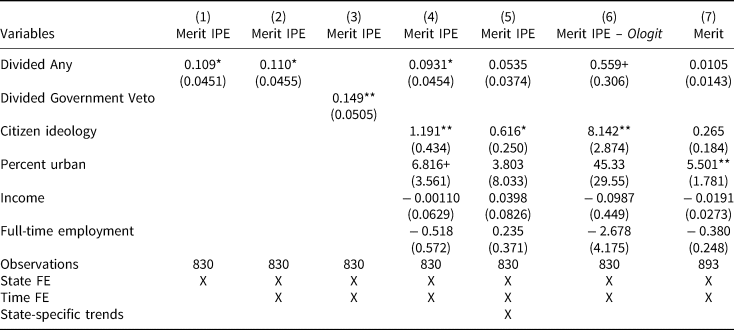
Our first results are reported in Table 1. We look at the effect of any divided government on merit reform choice probability using the fixed-effects model in (4). We can see that with state fixed effects or with state and year fixed effects, there is a positive and significant effect. Before getting to other specifications, we also report in Column 3 the same specification as Column 2 with Divided Veto as the explanatory variable. This is a more divisive partisan condition (legislators have a veto-proof majority), and we would expect a larger effect.Footnote 24 As can be seen, it is a larger coefficient and it is significant at the 1 percent level. Overall, these results support the prediction that merit reform is more likely under divided government.Footnote 25
Divided government and civil service reform

Notes: Column 1 shows the results of the OLS regression model with state fixed effects. Column 2 adds year fixed effects. Column 3 is the same as Column 2, but with Divided Government Veto as the explanatory variable rather than Divided Any. Column 4 goes back to Divided Any and adds time-varying controls (citizen ideology, urban population, (logged) number of state employees, and (squared) income). Column 5 uses these controls and adds state-specific time trends. Column 6 uses ordered logistic regression and includes state and time fixed effects and controls. Column 7 uses the same specification of Column 4, but uses the introduction of a comprehensive merit system as (dichotomous) dependent variable, without taking into consideration the appointment rules for the personnel executive. In all models standard errors are clustered by state. **p<0.01; *p<0.05; +p<0.1.
Next, we see that the effect of Divided Any is robust to the inclusion of controls (Column 4), but not to the inclusion of state trends (Column 5). The effect is marginally significant (p < 0.1) in the ordered logit model, which relaxes the linearity assumption in the outcome variable (Column 6). Finally, there is no effect of Divided Any on the binary merit system outcome which disregards the IPE reform (Column 7).
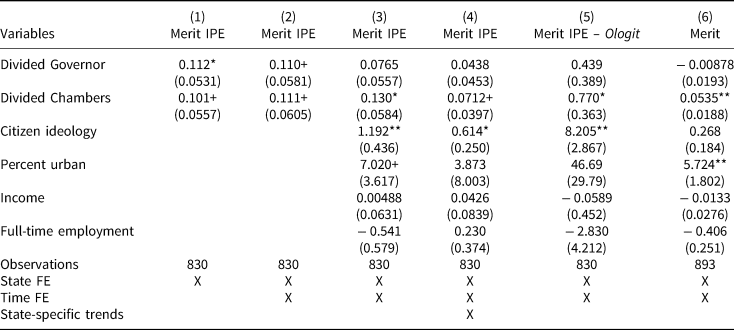
Our second set of results, reported in Table 2, unpack the divided government effects separately by Divided Governor (unified legislature and opposing governor) and Divided Chambers (divided legislature). With state fixed effects (Column 1) or state and year fixed effects (Column 2), there is a positive effect of both variables on civil service reform (marginally significant at p < 0.1). After adding controls (Column 3), the effect of Divided Governor is reduced to zero, whereas the effect of Divided Chambers is increased and becomes statistically significant. A larger and more significant effect for Divided Chambers (relative to Divided Governor) is seen when including state trends (Column 4), and in the ordered logit specification (Column 5). Finally, in Column 6, we see that in the case of basic merit reform disregarding IPE (Column 6), there is no effect of Divided Governor but a strong and statistically significant effect (p < 0.01) of Divided Chambers.
Divided governor, divided chamber, and civil service reform

Notes: Column 1 shows the results of the OLS regression model with state fixed effects. Column 2 adds year fixed effects and Column 3 time-varying controls (citizen ideology, urban population, (logged) number of state employees and (squared) income). Column 4 uses these controls and adds state-specific time trends. Column 5 uses ordered logistic regression and includes state and time fixed effects and controls. Column 6 uses the same specification of Column 3, but uses the introduction of a comprehensive merit system as a (dichotomous) dependent variable, without taking into consideration the appointment rules for the personnel executive. In all models standard errors are clustered by state. **p<0.01; *p<0.05; +p<0.1.
Before summarizing the results, we calculate the margins from the model in Column 5 in Table 2 for our two main independent variables. We find that, holding everything else constant, Divided Chambers (where the chambers are divided and where one chamber and the governor come from the same party) has a stronger effect than Divided Governor on the probability that Merit IPE equals 2 (the governor loses all control on the bureaucracy as they cannot appoint the personnel executive). The reason is that the chamber controlled by the other party will agree to a civil service reform only if the bureaucracy is to be made truly independent (avoiding the risk of having the other chamber, the governor and bureaucracy controlled by the other party).
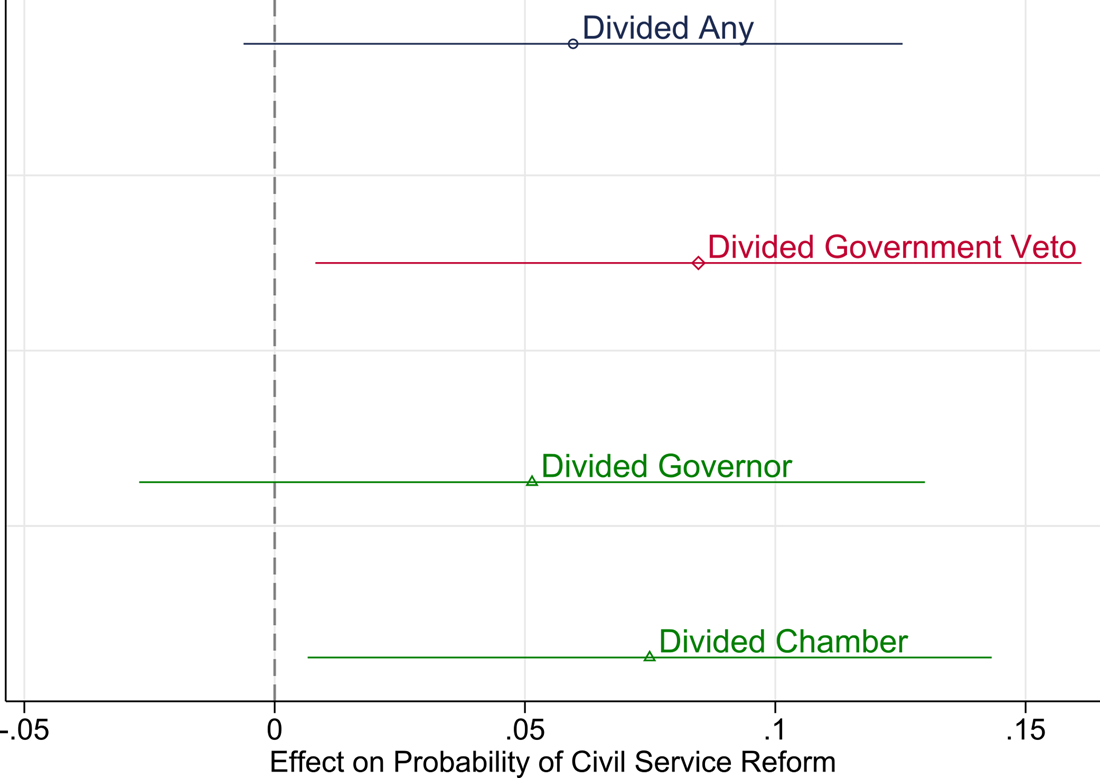
The main results are summarized by the coefficient plot in Figure 1. There is a generally positive effect of divided government on the probability of civil service reforms. That effect is the largest and most significant for the Divided Government Veto and Divided Chambers treatments. Overall, these findings support the main predictions in Proposition 1. Not only does divided government generally increase the frequency of merit reform, but that effect is significantly stronger under Divided Chambers.
Summary of results
Notes: Coefficient plot for main regression results. Estimates are from regressions of Merit IPE on Divided Any (first line, in blue), Divided Government Veto (second line, in red), and Divided Governor + Divided Chamber (third/fourth lines, in green). Regressions include state fixed effects, year fixed effects, and state-specific trends, with standard errors clustered by state. Error spikes give 90% confidence intervals.

In the online appendix, we show that our results are robust to controlling the shares of the governor party in both chambers and the share of votes for democratic governor in the previous election. This regression-discontinuity specification accounts for potential confounding factors in the multiple elections that produce unified or divided government in separation-of-powers systems (Kirkland et al., Reference Kirkland and Phillips2018). This is not our preferred specification as previous studies show manipulation around the cutoff in the legislative seat shares (Caughey and Sekhon, Reference Caughey and Sekhon2011). Finally, we checked whether results hold when dropping Southern states. Again, results are robust.
4. Conclusion
The analysis in this paper shows that when the government is divided, it is more likely that a strong civil service reform takes place. Under unified government, we predict that only delegation to the Governor can be rationalized. Under divided chambers, both parties would like to delegate as much as possible to the bureaucracy but only if such a bureaucracy is independent, hence the preference for delegation to an independent agency generates also the incentive to push for a civil service reform if the status quo displays a spoil system.
The previous literature stressed the very different possibility that a party in power would want to create a merit system if they are about to lose power, to avoid that the opposing party gets hold of the spoils system or sets policies ideologically disliked. Other studies suggest that it is when the party in government is sure about maintaining control over the state institutions for the foreseeable future that they create a merit system, to reap the benefits of an efficient bureaucracy. Both strands rely on the assumption that there is a single party in power (i.e. unified government). Our theory is different, emphasizing, on the contrary, the crucial role played by divided government of various kinds and strength, both in terms of delegation incentives and reform incentives. The empirical evidence supports our novel view.
This study bridges the gap between studies on legislative policy delegation and those on policy conflict and rule-making and is thus relevant for contemporary issues that affect bureaucracy in many countries. Today, with increasing polarization and political conflict, more and more policy-making is in the hands of bureaucrats. In this study, we look at the causes of these dynamics.
Supplementary Material
The supplementary material for this article can be found at https://doi.org/10.1017/psrm.2020.51.
Acknowledgments
We acknowledge financial support from the European Research Council Advanced Grant 694583 and the Framework for Attraction and Strengthening of Excellence Grant. We also acknowledge support from the Dondena and IGIER centers. We thank Jake Brounstein and Tiziano Toniolo for research assistance and Gabriele Gratton, Russell Mills, and Moritz Osnabruegge for helpful comments. We also wish to thank seminar participants at Bocconi University, the Fifth Columbia Political Economy Conference, the Charting New Directions in Public Management Research at SDA Bocconi School of Management, and MPSA 2018 for helpful comments.