




No CrossRef data available.
Article contents
Amiodarone-induced 2 to 1 atrioventricular block in association with prolongation of the QT interval
Published online by Cambridge University Press: 24 May 2005
Abstract
The potential for development of 2 to 1 atrioventricular conduction in children with prolongation of the QT interval has been previously reported secondary to electrolytic disturbances. We report here a child who developed 2 to 1 atrioventricular conduction with prolongation of the QT interval following treatment with amiodarone for refractory supraventricular tachycardia. We highlight the importance of electrocardiographic monitoring to assess for those at risk of amiodarone toxicity, which may be manifested by prolongation of the QT interval and the simultaneous loss of atrioventricular conduction, and of equal importance the need for prompt conversion to an alternative anti-arrhythmic agent.
Information
- Type
- Brief Report
- Information
- Copyright
- © 2003 Cambridge University Press
The potential for 2 to 1 atrioventricular conduction in patients with the congenitally prolonged QT syndrome has been well documented.1 In these patients, prolonged ventricular repolarization prevents successive conduction of atrial impulses to the ventricle. Acquired causes of prolonged ventricular repolarization may also result in 2 to 1 atrioventricular conduction. These causes include electrolytic imbalance, in addition to the side effects of medication.2 To our knowledge, however, there are no previous reports of 2 to 1 atrioventricular block developing in association with prolongation of the QT interval secondary to treatment with amiodarone.
Case report
An Afro-american boy was born at term weighing 2.7 kg. On physical examination, he was cyanosed, with a saturation of oxygen measured at 88% in room air in samples taken from the right arm, a single first and second heart sound, and a 2/6 systolic ejection murmur audible at the left upper sternal border. Praecordial echocardiography demonstrated heterotaxy syndrome with isomerism of the right atrial appendages, a left-sided heart, atresia of the right-sided atrioventricular valve, pulmonary atresia, a nonrestrictive defect in the oval fossa, obstructed infra-diaphragmatic totally anomalous pulmonary venous connection, and a patent arterial duct. The infant was started on an intravenous infusion of prostaglandins to maintain patency of the arterial duct.
On the third day of life, the child underwent anastomosis of the pulmonary venous confluence to the left-sided atrium, ligation of the vertical ascending vein, and creation of a 3.5 mm modified Blalock-Taussig shunt. On the first postoperative day, the child developed supraventricular tachycardia at a rate of 280 beats/min, which was successfully terminated with intravenous adenosine, following which he was commenced on an intravenous infusion of procainamide at 20 mcg/kg/min after being loaded with 5 mg/kg of procainamide over 15 min.
The tachycardia recurred within 6 hours, so the procainamide was discontinued and the patient was loaded with amiodarone given intravenously at 5 mg/kg. He was then started on a standard infusion of amiodarone at a dosage of 10 mg/kg/day. He developed further tachycardia within 24 h, and the dosage of amiodarone was increased to 15 mg/kg/day. An electrocardiogram on the third day after surgery while being treated with amiodarone demonstrated sinus rhythm, with a corrected QT interval of 410 ms.
He remained in normal sinus rhythm on the infusion of amiodorane until the tenth day after surgery, when tachycardia recurred at a rate of 250 beats/min. He was converted to sinus rhythm with a bolus of adenosine of 100 mcg/kg, and a further dose of 3 mg/kg of amiodarone was administered. Three hours later, he experienced sudden bradycardia, with a ventricular rate of 75 beats/min, an atrial rate of 150, and 2 to 1 atrioventricular conduction. The corrected QT interval was prolonged, measuring 650 ms (Fig. 1). Pacing was attempted but unsuccessful, and isoproterenol was commenced at a dose of 0.02 mcg/kg/min, with resolution of the bradycardia and 1 to 1 atrioventricular conduction. An electrocardiogram performed on the 24th day after surgery showed a corrected QT interval of 540 ms. There were no ventricular arrhythmias during this time. Amiodarone was discontinued, and propranolol started at a dose of 1 mg/kg/day given six hourly. The corrected QT interval had normalized to 410 ms when he was reviewed 2 months later (Fig. 2).

Figure 1. The electrocardiogram demonstrates 2 to 1 atrioventricular conduction, and a prolonged QT interval of 650 ms, after initiation of treatment with amiodarone.

Figure 2. The electrocardiogram now demonstrates restoration of normal sinus rhythm, with a corrected QT interval of 410 ms, after discontinuation of the amiodarone and commencement of beta blockade.
Discussion
The occurrence of 2 to 1 atrioventricular block in association with long QT syndrome has been well-recognized.1 The long QT syndrome encompasses a wide variety of both congenital and acquired etiologies underlying prolonged ventricular repolarization, with several gene deletions determined over the last decade to be responsible for the congenital variants of the syndrome.3–7 Atrioventricular block results not from an abnormality of the atrioventricular node, but rather from prolonged repolarization of the His-Purkinje system or ventricular myocardium, such that successive atrial impulses find the ventricles refractory to conduction. A recent review of this association found affected patients to have markedly prolonged QT intervals, to an average of 650 ms, during 2 to 1 atrioventricular conduction.2 Ventricular tachycardia, or torsades de pointes, occurred in half of these patients, with a reported mortality rate of 50% by 6 months and 67% by 2 years of age.2
Previous reports have described 2 to 1 atrioventricular block occurring with prolongation of the QT interval in the setting of hypocalcemia and hypokalemia.8, 9 This arises secondary to prolongation of phase 2 of the action potential, resulting in prolongation of the ST segment and QT interval on the electrocardiogram, occasionally being sufficiently significant to produce atrioventricular block. To our knowledge, this occurrence has not previously been described in association with the use of amiodarone.
Amiodarone is a class III antiarrhythmic agent currently used in the treatment of multiple disturbances of rhythm arising both from atrium and ventricle, with potential side effects including torsade de pointes.10 Our patient had isomerism of the right atrial appendages, representing an additional underlying potential for dysfunction of the atrioventricular node. The presence of a normal corrected QT interval prior to initiation of amiodarone, in addition to normalization of the interval following discontinuation of the drug, however, supports its toxic nature in our patient.
This case serves to illustrate the potential toxicity of amiodarone, especially when used at higher doses in infants proving refractory to medical conversion. It also additionally highlights the importance of frequent electrocardiographic monitoring of patients receiving intravenous amiodarone, and the need for early conversion to an alternative medication should there be excessive prolongation of the corrected QT interval.
References
Garson A, Dick M, Fournier A, et al. The long QT syndrome in children: an international study of 287 patients. Circulation 1993; 87: 1866–1872.Google Scholar
Trippel DL, Parsons MK, Gillette PC. Infants with long-QT syndrome and 2:1 atrioventricular block. Am Heart J 1995; 130: 1130–1134.Google Scholar
Li H, Fuentes-Garcia J, Towbin JA. Current concepts in long QT syndrome. Pediatr Cardiol 2000; 21: 542–550.Google Scholar
Splawski I, Shen J, Timothy KW, et al. Spectrum of mutations in long-QT syndrome genes. KVLQT1, HERG, SCN5A, KCNE 1 and KCNE 2. Circulation 2000; 102: 1178–1185.Google Scholar
Towbin JA, Vatta M, Li H. Genetics of Brugada, long QT, and arrhythmogenic right ventricular dysplasia syndromes. J Electrocardiol 2000; 33: 11–22.Google Scholar
Towbin JA, Vatta M. Molecular biology and the prolonged QT syndromes. Am J Med 2001; 110: 385–398.Google Scholar
Huang TC, Cecchin FC, Mahoney P, Portman MA. Corrected QT interval (QTc) prolongation and syncope associated with pseudohypoparathyroidism and hypocalcemia. J Pediatr 2000; 136: 404–407.Google Scholar
Akiyama T, Batchelder J, Worsman J, Moses HW, Jedlinski M. Hypocalcemic torsades de pointes. J Electrocardiol 1989; 22: 89–92.Google Scholar
Kubota T, Shimizu W, Kamakur S, Horie M. Hypokalemia-induced long QT syndrome with an underlying novel missense mutation in S4-S5 linker of KCNQ1. J Cardiovasc Electrophysiol 2000; 11: 1048–1054.Google Scholar
Drago F, Mazza A, Guccione P, Mafrici A, Di Liso G, Ragonese P. Amiodarone used alone or in combination with propranolol: a very effective therapy for tachyarrhythmias in infants and children. Pediatr Cardiol 1998; 19: 445–449.Google Scholar

The electrocardiogram demonstrates 2 to 1 atrioventricular conduction, and a prolonged QT interval of 650 ms, after initiation of treatment with amiodarone.
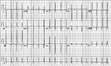
The electrocardiogram now demonstrates restoration of normal sinus rhythm, with a corrected QT interval of 410 ms, after discontinuation of the amiodarone and commencement of beta blockade.
 You have
Access
- 3
- Cited by