Introduction
Medullary thyroid cancer is a rare calcitonin-secreting malignant tumour arising from thyroid C cells. It occurs sporadically in approximately 75 per cent of patients and as an autosomal dominant inherited disorder in around 25 per cent. The incidence of medullary thyroid cancer in the UK is approximately 0.4 new cases per million per year; in comparison, the incidence in the USA is approximately 1.1 new cases per million per year.Reference Harrison, Watkinson and Gilbert1, Reference Aschebrook-Kilfoy, Ward, Sabra and Devesa2 Patients usually present with a thyroid mass; however, metastasis to regional lymph nodes occurs at an early stage, and up to 40–50 per cent of patients present with cervical lymphadenopathy.
Surgical intervention is currently the only effective, curative treatment for medullary thyroid cancer.Reference Sippel, Kunnimalaiyan and Chen3, Reference Pacini, Castagna, Cipri and Schlumberger4 Serum calcitonin levels can be used to assess surgical outcome. Post-operative normalisation of serum calcitonin is the best prognostic indicator: it predicts a 10-year survival rate of 97.7 per cent.Reference Modigliani, Cohen, Campos, Conte-Devolx, Maes and Boneu5 Unfortunately, it is unclear which precise surgical strategy offers patients at each stage of the disease the best chance of a biochemical cure.
The American Thyroid Association and British Thyroid Association guidelines offer differing surgical strategies.Reference Kloos, Eng, Evans, Francis and Gagel6, 7 Both associations agree that curative surgery should include total thyroidectomy and central lymph node dissection, but differ in their approach to lateral lymph node dissection. The American Thyroid Association guidance recommends targeted dissection of image- or biopsy-proven compartments,Reference Kloos, Eng, Evans, Francis and Gagel6 whereas the British Thyroid Association guidance recommends bilateral selective neck dissection for all patients with tumour–node–metastasis (TNM) T2-4 disease or palpable lymph nodes.7
This contradictory advice is confusing to both clinicians and patients. It reflects a lack of consensus not only between the American Thyroid Association and British Thyroid Association but also, as is frequently and openly highlighted in both documents, within the expert panels that formulated both guidelines.Reference Modigliani, Cohen, Campos, Conte-Devolx, Maes and Boneu5, Reference Kloos, Eng, Evans, Francis and Gagel6 The disagreement no doubt stems from a lack of evidence upon which opinion must be based. Medullary thyroid cancer is a rare condition, making well-designed, large-scale prospective studies difficult to realise.Reference Moley and Fialkowski8 This study aimed to determine whether retrospective analysis of the surgical management of patients can provide a better understanding of which guidelines should be followed.
Methods
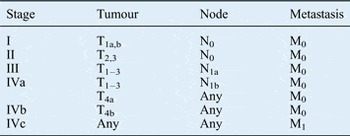
A retrospective analysis was performed of the surgical management of 47 patients with medullary thyroid cancer diagnosed between 1994 and 2013 within the Greater Manchester Cancer Network, UK. The seventh edition of the TNM classification system was used for disease staging (Table I).Reference Sobin, Gospodarowicz and Wittekind9 Surgical management was compared with current American Thyroid Association and British Thyroid Association guidelines. Surgical outcome was assessed by measuring the first post-operative serum calcitonin levels. A biochemical cure was considered to be achieved if post-operative serum calcitonin levels had returned to the reference range. Timing of the first post-operative calcitonin measurement was variable (median four months), but subsequent calcitonin levels were also examined to ensure its validity. Four patients who initially showed normalisation but with a subsequent increase in calcitonin levels to outside the normal range were not considered to have achieved a biochemical cure.
Tnm classification staging system for medullary thyroid cancer9

TNM = tumour–node–metastasis
Post-operative follow up comprised a three-monthly clinical evaluation and calcitonin measurement. When indicated by clinical evaluation or a rise in calcitonin levels, ultrasound and computed tomography scanning were performed.
Statistical analysis was performed using IBM SPSS Statistics software version 21.0 (Armonk, New York, USA). Categorical variables were examined using chi-square, Fisher's exact and Spearman's rank correlation analyses. Continuous variables were examined using the Mann–Whitney U test. Statistical significance was set at a p value of 0.01 or lower because of the small sample size.
Results
Forty-seven patients with medullary thyroid cancer diagnosed between 1994 and 2013 were identified from the central thyroid cancer database at the Christie Hospital, Manchester, UK. Thirty-nine patients (83 per cent) underwent surgery with curative intent. Eight patients who had palliative surgery were excluded from further analysis. Of the remaining 39 patients, 3 were found to have germline RET mutations after surgery. One patient who was symptomatic at presentation was known have a RET mutation prior to surgery.
The group of patients who had surgery with curative intent comprised 20 women and 19 men, aged 53 ± 16 years (mean ± standard deviation) at diagnosis. Neither age nor gender differed significantly amongst outcome groups.
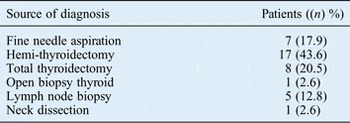
Thirty patients (77 per cent) presented with a thyroid mass; the remaining nine patients (23 per cent) presented with cervical lymphadenopathy. Seven patients (18 per cent) had a medullary thyroid cancer diagnosis confirmed by fine needle aspiration (FNA) cytology prior to surgical intervention; the remaining patients were diagnosed by histological analysis of surgical specimens. A range of diagnostic procedures was performed (Table II). Once a diagnosis of medullary thyroid cancer was established, all patients underwent total thyroidectomy. For the 17 patients (43.6 per cent) diagnosed by hemi-thyroidectomy, this took the form of second-stage completion thyroidectomy. Since many of the patients had surgery prior to the development of guidelines regarding the surgical management of medullary thyroid cancer, the extent of lymph node dissection was variable (Table III). The development of lateral lymph node metastases was significantly associated with failure to achieve biochemical cure (p < 0.01).
Route to diagnosis for patients who had surgery with curative intent*

*n = 39
Staging, surgical strategy and post-operative biochemical cure rate

Cent = central; LND = lymph node dissection; ipsi = ipsilateral; cont = contralateral
The overall biochemical cure rate was 44.7 per cent. The biochemical cure rate for patients who underwent surgery with curative intent was 53.8 per cent. A significant association between disease stage and biochemical cure was observed (p < 0.01). All patients with stage I–III disease achieved post-operative biochemical cure. The development of lateral lymph node metastases was significantly associated with a failure to achieve biochemical cure (p < 0.01). In all, 66.6 per cent of patients who presented with a thyroid mass achieved a biochemical cure. In contrast, only 11.1 per cent of patients who presented with cervical lymphadenopathy achieved a biochemical cure. No patients with extralymphatic metastases achieved a biochemical cure.
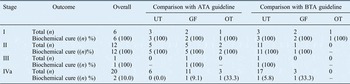
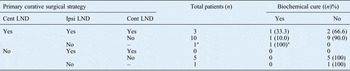
To examine how the surgical strategy influences the biochemical cure rate, each patient's surgical management was compared with strategies outlined in the American Thyroid Association and British Thyroid Association guidelines. It was then determined whether patients had been under- or over-treated with respect to each set of guidelines, or had undergone treatment that followed the guidelines (Table IV). Since all patients underwent total thyroidectomy, the extent of lymph node dissection determined adherence to guidelines. This enabled the influence of lymph node dissection extent on outcome to be explored. All patients with stage I–III disease achieved a post-operative biochemical cure regardless of the lymph node dissection extent or guidelines followed. The overall biochemical cure rate was significantly reduced to 10 per cent for stage IVa disease (p < 0.01), but this rate appeared to be influenced by surgical strategy (Tables IV and V). The biochemical cure rate in stage IVa disease patients who had bilateral lateral lymph node dissection (as recommended by the British Thyroid Association) was 33.3 per cent.
Biochemical cure rate, by disease stage and surgical strategy*

*Comparing actual surgical strategy with both ATA and BTA guidelines. ATA = American Thyroid Association; BTA = British Thyroid Association; UT = under-treated; GF = guideline followed; OT = over-treated
The impact of surgical strategy on biochemical cure in stage iva disease

*This patient was the only within the group to have N1a disease; all others had N1b disease. Cent = central; LND = lymph node dissection; ipsi = ipsilateral; cont = contralateral
Discussion
The demographic profile of this group of sporadic medullary thyroid cancer patients reflects those described in larger studies.Reference Modigliani, Cohen, Campos, Conte-Devolx, Maes and Boneu5, Reference Ukkat, Gimm, Brauckhoff, Bilkenroth and Dralle10 The retrospective nature of this study provides some explanation for the observed diversity in surgical strategy, with some patients undergoing treatment that followed neither American Thyroid Association nor British Thyroid Association guidance. However, it was previously highlighted that practice often fails to follow guideline advice.Reference Panigrahi, Roman and Sosa11 The existence of multiple contradictory guidelines can only serve to confuse clinicians, potentially exacerbating this problem.
The rate of post-operative biochemical cure in medullary thyroid cancer is determined by disease stage and surgical strategy and technique.Reference Dralle, Damm, Scheumann, Kotzerke, Kupsch and Geerlings12 The rates of biochemical cure observed in this study at each disease stage are comparable with those described by other groups.Reference Modigliani, Cohen, Campos, Conte-Devolx, Maes and Boneu5, Reference Ukkat, Gimm, Brauckhoff, Bilkenroth and Dralle10, Reference Ito, Miyauchi, Yabuta, Fukushima, Inoue and Tomoda13, Reference Hamy, Pessaux, Mirallié, Mucci-Hennekinne, Gibelin and Mor-Martinez14 It is important to recognise that despite efforts to take into account long-term changes in calcitonin levels within the methodology, these rates may not represent the true biochemical cure rate. It was reported that 3.3 per cent of medullary thyroid cancer patients with initial biochemical remission will develop elevated serum calcitonin levels within 7.5 years of surgery.Reference Franc, Niccoli-Sire, Cohen, Bardet, Maes and Murat15
It is widely accepted that the minimum primary treatment for all medullary thyroid cancer patients should be total thyroidectomy plus central lymph node dissection. Indeed, both the American Thyroid Association and British Thyroid Association guidelines make this recommendation.Reference Kloos, Eng, Evans, Francis and Gagel6, 7 However, there is some evidence that more conservative strategies are more appropriate for treating early stage disease. Excellent rates of biochemical cure have been documented for sporadic medullary thyroid cancer following hemi-thyroidectomy and unilateral central lymph node compartment dissection.Reference Ito, Miyauchi, Yabuta, Fukushima, Inoue and Tomoda13 It has also been shown that lymph node metastasis from T1a tumours measuring less than 1 cm in diameter is unlikely, suggesting that lymph node dissection may not be indicated for this disease stage.Reference Hamy, Pessaux, Mirallié, Mucci-Hennekinne, Gibelin and Mor-Martinez14
In this study, all patients with stage I–III disease achieved a post-operative biochemical cure regardless of the extent of lymph node dissection. Only one stage III disease patient was examined; however, this study does confirm that it is possible to achieve biochemical cure without lymph node dissection at early disease stages. A minority of patients present with T1a tumours (10.6 per cent in this study), and primary tumour size does not always predict the extent of lymph node metastasis. Indeed, one patient with a T1a primary tumour had N1b nodal metastases at presentation (Table II).
Lymph node metastasis is common and can occur at an early disease stage and in the context of low serum calcitonin levels.Reference Moley and DeBenedetti16–Reference Machens and Dralle18 Furthermore, central lymph node involvement cannot be accurately determined by either pre-operative ultrasound assessment or intra-operative examination.Reference Moley and DeBenedetti16, Reference Kouvaraki, Shapiro, Fornage, Edeiken-Monro, Sherman and Vassilopoulou-Sellin19 The addition of central neck dissection to total thyroidectomy does not significantly increase the risk of permanent hypoparathyroidism and recurrent laryngeal nerve injury when surgery is performed by an experienced surgeon.Reference Chisholm, Kulinskaya and Tolley20 In contrast, revision procedures to clear the central lymph node compartment following total thyroidectomy do carry a significantly increased risk of permanent morbidity.Reference White, Gauger and Doherty21 Therefore, a strategy of total thyroidectomy plus central neck dissection is probably justified for all patients with medullary thyroid cancer, although the omission of central neck dissection might be safe for T1a disease patients.
Similar to previous analyses of biochemical cure predictors in medullary thyroid cancer, the development of lymph node metastases was significantly associated with a reduced chance of achieving a biochemical cure in this study (p < 0.001).Reference Modigliani, Cohen, Campos, Conte-Devolx, Maes and Boneu5, Reference Gimm, Ukkat and Dralle22 However, it is clear from this and other analyses that a biochemical cure can be achieved surgically following the development of lymph node metastases within the neck.Reference Ito, Miyauchi, Yabuta, Fukushima, Inoue and Tomoda13, Reference Machens and Dralle18 As many patients with sporadic medullary thyroid cancer have lymph node metastases at presentation (61.7 per cent in this series), determining the optimal surgical strategy to achieve a biochemical cure in this patient group may significantly improve treatment outcome for a large number of patients.
Our analysis suggests that surgical strategy can influence the biochemical cure rate in stage IVa disease patients with established cervical lymph node metastases (Tables IV and V). No stage IVa disease patients achieved a biochemical cure without central neck dissection. One patient achieved a biochemical cure after total thyroidectomy and central neck dissection, but it should be noted this was the only patient in this group with N1a disease: all other patients had N1b disease. In patients who underwent central and lateral lymph node dissection, the observed biochemical cure rate differed depending upon the extent of lateral lymph node dissection: it was 10 per cent after ipsilateral lymph node dissection alone and 33.3 per cent after bilateral lateral lymph node dissection.
This analysis is limited by its retrospective design and small size. However, the data suggest that surgical management of medullary thyroid cancer might be improved by appropriately combining recommendations made by the American Thyroid Association and the British Thyroid Association. All patients should undergo total thyroidectomy and central lymph node dissection. The conservative, surveillance-driven approach to managing lateral lymph node compartments (as recommended by the American Thyroid Association) appears suitable for treating stage I–III disease. However, following the British Thyroid Association guidance for such patients (i.e. those with stage II–III disease) would unnecessarily expose many to the risks associated with more extensive lymph node dissection. However, in stage IVa disease, when the primary tumour has become locally invasive and/or the disease has spread to at least one of the lateral lymph node compartments of the neck, the more aggressive approach of bilateral lateral lymph node dissection (as recommended by the British Thyroid Association) may provide patients with a higher chance of achieving a biochemical cure.
In this study, biochemical cure was not achieved once the disease had metastasised out of the lymphatic system of the neck, which is consistent with other reports.Reference Modigliani, Cohen, Campos, Conte-Devolx, Maes and Boneu5, Reference Ukkat, Gimm, Brauckhoff, Bilkenroth and Dralle10, Reference Ito, Miyauchi, Yabuta, Fukushima, Inoue and Tomoda13, Reference Hamy, Pessaux, Mirallié, Mucci-Hennekinne, Gibelin and Mor-Martinez14, Reference Gimm, Ukkat and Dralle22 This finding supports the strategy advocated by both guidelines that stage IVc disease patients should be offered surgery with a palliative focus aimed at providing locoregional control to limit morbidity, whilst preserving speech, swallowing and parathyroid function.
An alternative to utilising TNM disease staging to stratify risk and determine surgical strategy is to utilise the pre-operative basal calcitonin level. This measure has been shown to correlate with primary tumour size, the number of lymph node metastases and the post-operative biochemical cure rate.Reference Machens and Dralle18, Reference Cohen, Campos, Salaün, Heshmati, Kraimps and Proye23, Reference Yip, Hassan, Pazaitou-Panayiotou, Ruan, Gawande and Gaz24 However, reliance upon a pre-operative diagnosis of medullary thyroid cancer is not always possible. In many healthcare systems, it is not currently practical or economically feasible to incorporate calcitonin measurement into the routine investigation of all thyroid nodules. The reliability of FNA cytology to diagnose medullary thyroid cancer is also highly dependent upon the resources and expertise available within the local cytology laboratory. Therefore, it is variable between and within different healthcare providers. In this series, only 36.2 per cent of patients were diagnosed with medullary thyroid cancer prior to thyroid surgery. Clearly, calcitonin measurements can be justified once a diagnosis of medullary thyroid cancer has been made. These should be utilised for disease surveillance and decision-making in cases where re-operation is considered.Reference Machens and Dralle25
• Surgical intervention is the only effective curative treatment for medullary thyroid cancer
• American Thyroid Association and British Thyroid Association guidelines recommend differing surgical strategies
• All patients should undergo total thyroidectomy and central lymph node compartment dissection
• A conservative, surveillance-driven management approach for lateral lymph node compartments appears suitable for stage I–III disease
• For stage IVa disease, bilateral lateral lymph node dissection may provide a higher chance of biochemical cure
Further evidence is needed to clearly determine the extent of lymph node dissection required to provide patients with the greatest chance of a biochemical cure at each disease stage. A well-designed, multicentre, randomised controlled trial to examine the efficacy of the different strategies for the surgical management of medullary thyroid cancer is long overdue.