1. Introduction
The WTO Appellate Body report United States – Certain Methodologies and Their Application to Anti-Dumping Proceedings Involving China Footnote 1 which was released on 11 May 2017 is yet another in a long line of disputes involving US Department of Commerce's [USDOC] dumping margin calculation methodologies. There are three primary issues in this dispute: (1) the use of the exceptional method in the last sentence of Article 2.4.2 of the Anti-Dumping Agreement [ADA] to justify using the weighted average-to-transaction [W-T] methodology in dumping margin calculations; (2) the treatment of multiple companies in a non-market economy (NME) investigation as a single NME-wide entity [Single Rate Presumption or SRP]; and (3) the USDOC's policy of using adverse facts available [AFA] for such an entity in case of insufficient cooperation by one or more of its constituent members.
The case is somewhat of an anomaly for two reasons. First, the US had replaced the targeted dumping methodology challenged in this dispute with an alternative calculation methodology before the Panel issued its report. Thus, while the Panel and Appellate Body [AB] found that the US methodology (the Nails test) was inconsistent with the ADA, the US can claim that it has already complied with respect to a number of the specific challenges.
Second, several of the issues with respect to the targeted dumping claim were already addressed by the AB in an earlier, more expansive dispute brought by Korea against the United States, US–Washing Machines.Footnote 2 The dispute under discussion here was initiated before that earlier dispute was resolved and the AB's report in that earlier dispute was circulated after the Panel report in this dispute. Given the findings in US–Washing Machines,Footnote 3 several of the AB findings on targeted dumping and zeroing in this case were entirely predictable.
Despite these somewhat unusual circumstances, this dispute is not like so many others involving zeroing where literally no new findings were made. To the contrary, we believe the AB's determinations (i) allowing the use of average prices to identify a pattern and (ii) not requiring the authority to consider the reasons for the pattern could potentially significantly impact future iterations of the US's targeted dumping methodology. This case certainly will not bring an end to the 20+ year saga of zeroing disputes; to the contrary, the AB's decision in this dispute likely has prised open the lid of targeted dumping and set the stage for more disputes involving how and when member countries can calculate margins using the exceptional methodology.
We follow the Panel and AB's lead and focus on the economic and legal considerations regarding the first claim. We do this in part because while the latter two claims are important systemically, our discussion and analysis of them can be done fairly expeditiously. More pertinently, we believe this dispute provides an excellent opportunity for us to comment on what constraints the WTO can reasonably place on an investigating authority's use of the second sentence of Article 2.4.2. The Panel noted that
[w]hile the pattern clause of Article 2.4.2 specifies what an investigating authority should find, namely, a significantly differing pricing pattern, it does not prescribe how an investigating authority should make such a finding. Therefore, this clause provides an investigating authority with some discretion in making this particular finding. This does not mean, however, that the authority has a carte blanche in this regard’.Footnote 4
In this report, we evaluate the Nails tests approach to identify a ‘pattern of export prices which differ significantly among different purchasers, regions or time periods’Footnote 5 and discuss whether the mathematical-statistical approach underlying the test is reasonable. We argue that a sensible targeted dumping approach should correctly identify and distinguish unusually low prices from prices that are similar to those offered to typical customers in typical periods. The approach should also meaningfully quantify how significantly different the low prices are from typical prices. The USDOC's targeted dumping method challenged in this dispute does not meet these standards. The Nails test results in identifying certain sales as being targeted when those sales are conducted at almost exactly the same prices as those deemed non-targeted. In addition, we find the statistical basis for declaring pricing patterns significantly different is meaningless under the Nails test.
The AB decisions with respect to the latter two issues have not been addressed in prior disputes. With respect to the SRP issue, the Panel ruled, not surprisingly in light of the AB's earlier EC–Fasteners report,Footnote 6 that the USDOC's approach violated Articles 6.10 and 9.2 ADA as such and as applied in the 38 determinations challenged by China. This Panel finding was not appealed.
With respect to the AFA Norm issue, the AB ruled, contrary to the Panel, that the AFA norm constituted a norm of general and prospective application which can be challenged as such in a WTO dispute settlement proceeding. However, it found itself unable to complete the analysis and conclude that the norm violated Article 6.8 and paragraph 7 of Annex II to the ADA in light of the absence of Panel findings and insufficient undisputed facts on the Panel record.
2. The nails test and targeted dumping
A key issue in this dispute is the question of what is required for the second sentence in Article 2.4.2 of the ADA to be satisfied:
A normal value established on a weighted average basis may be compared to prices of individual export transactions if the authorities find a pattern of export prices which differ significantly among different purchasers, regions or time periods, and if an explanation is provided as to why such differences cannot be taken into account appropriately by the use of a weighted average-to-weighted average or transaction-to-transaction comparison. [Emphasis added]
In each of the underlying antidumping cases in this dispute, the USDOC used the Nails test to identify targeted dumping.Footnote 7 The USDOC describes its Nails methodology as follows:
In the first stage of the test, the ‘standard-deviation test’, we determined the volume of the allegedly targeted group's sales of subject merchandise that are at prices more than one standard deviation below the weighted-average price of all sales during the POI, targeted and non-targeted. We calculated the standard deviation on a product-specific basis (i.e., by CONNUM) using the POI-wide weighted-average sales prices for the allegedly targeted groups and the groups not alleged to have been targeted. If that volume did not exceed 33 percent of the total volume of a respondent's sales of subject merchandise for the allegedly targeted group, then we did not conduct the second stage of the Nails test. If that volume exceeded 33 percent of the total volume of a respondent's sales of subject merchandise for the allegedly targeted group, on the other hand, then we proceeded to the second stage of the Nails test.
In the second stage, we examined all sales of identical merchandise (i.e., by CONNUM) sold to the allegedly targeted group which passed the standard-deviation test. From those sales, we determined the total volume of sales for which the difference between the weighted-average price of sales to the allegedly targeted group and the next higher weighted-average price of sales for a non-targeted group exceeds the average price gap (weighted by sales volume) between the non-targeted groups. We weighted each of the price gaps between the non-targeted groups by the combined sales volume associated with the pair of non-targeted groups that defined the price gap. In doing this analysis, the allegedly targeted sales were not included in the non-targeted group; the allegedly targeted group's weighted-average sales price was compared only to the weighted-average sales prices to the non-targeted groups. If the volume of the sales that met this test exceeded five percent of the total sales volume of subject merchandise to the allegedly targeted group, then we determined that targeting occurred’. (Taverman, Reference Taverman2012)
2.1 China's challenges to the nails test
China challenged numerous aspects of the USDOC's Nails test. Both China and the United States can claim significant victories in this dispute. To streamline our discussion, we highlight what we believe are the four key claims related to targeted dumping.Footnote 8
First, China argued that the US did not adequately explain why the preferred methods could not appropriately take into account the differences in prices. Relatedly, China challenged the US decision to zero all transactions, not just the targeted transactions. The US countered by saying that the fact that the dumping margin using the exceptional method (with zeroing) is larger than the dumping margins under either of the two preferred methods is proof that the exceptional method is needed. The Panel ruled against the US in both of these claims. The Panel's rejection of the USDOC's results-oriented explanation and expansive use of zeroing was fully expected given the AB's earlier decision in US–Washing Machines.
Second, China argued that ‘when an investigating authority seeks to find whether the pattern of export prices “differs significantly” within the meaning of the pattern clause of Article 2.4.2, it should not just focus on how large the quantitative or numerical differences in export prices are but also examine whether those differences are qualitatively significant’.Footnote 9 The Panel rejected China's argument stating ‘when an investigating authority examines whether observed quantitative differences in export prices forming the relevant pattern are qualitatively significant, that authority is required to consider how such export prices differ and not why they differ’.Footnote 10 On appeal, the AB upheld the Panel's conclusion. Given that a similar challenge was made in US–Washing Machines the AB's decision was expected.
Third, China challenged that when performing the gap test the USDOC ignored all non-targeted gaps that were based on prices below the targeted price. The Panel ruled that by doing so the US acted inconsistently with the pattern clause of Article 2.4.2. As we will explain below, this is one example of how the USDOC's Nails test ignores prices from the non-targeted set when determining the significance of the targeted set.
Fourth, China challenged the USDOC's decision to base its standard deviation and gap tests on the basis of averages instead of on the individual export transaction prices, which made up those averages. The Panel stated that there was not an ‘explicit prohibition in this text on the use of purchaser or time period averages to find such a significantly differing pricing pattern’.Footnote 11 With respect to the question of systematic bias stemming from the use of averages, the Panel stated Article 2.4.2 ‘gives the investigating authority the discretion to choose between individual export transaction prices and purchaser or time period averages in finding the relevant pattern’,Footnote 12 and it did not see how the USDOC's determination in the three challenged investigations could be considered biased, ‘simply because the method that it chose led to an outcome which was less favourable to the exporters than the other’.Footnote 13 The AB upheld both conclusions. As we will explain below, we believe this is a serious error by the AB. Allowing the investigative authority to base its entire analysis on averages makes it impossible for there to be a meaningful statistical basis for determining if a pricing pattern is significant. As our discussion below will demonstrate, the AB's decision with respect to this issue has the potential to decimate the pattern requirement. As has been the case in many other disputes, it is our view that the Panel and AB were overly textual in their analysis. This narrow reading of the text results in ignoring the overarching requirement in Article 2.4.2 that a fair comparison must be made between the export price and the normal value.
2.2 What exactly is the nails test?
The USDOC description of the Nails test is dense with references to standard deviation, weighted average prices, and threshold percentages. The complexity of the USDOC's method does at least two things. First, it suggests a foundation in statistical theory and gives the impression that the methodology correctly identifies and distinguishes significantly low prices from normal prices. Second, the intricacy of the Nails test is a significant barrier to understanding what kind of transactions the USDOC might flag as ‘targeted’ and thus whether the pattern is meaningful and whether a foreign firm could possibly know if it was engaged in targeted dumping.
We will use a series of examples to clarify what the US's Nails test does, which helps one assess whether the US methodology is reasonable.
Example 1: The pattern and gap test
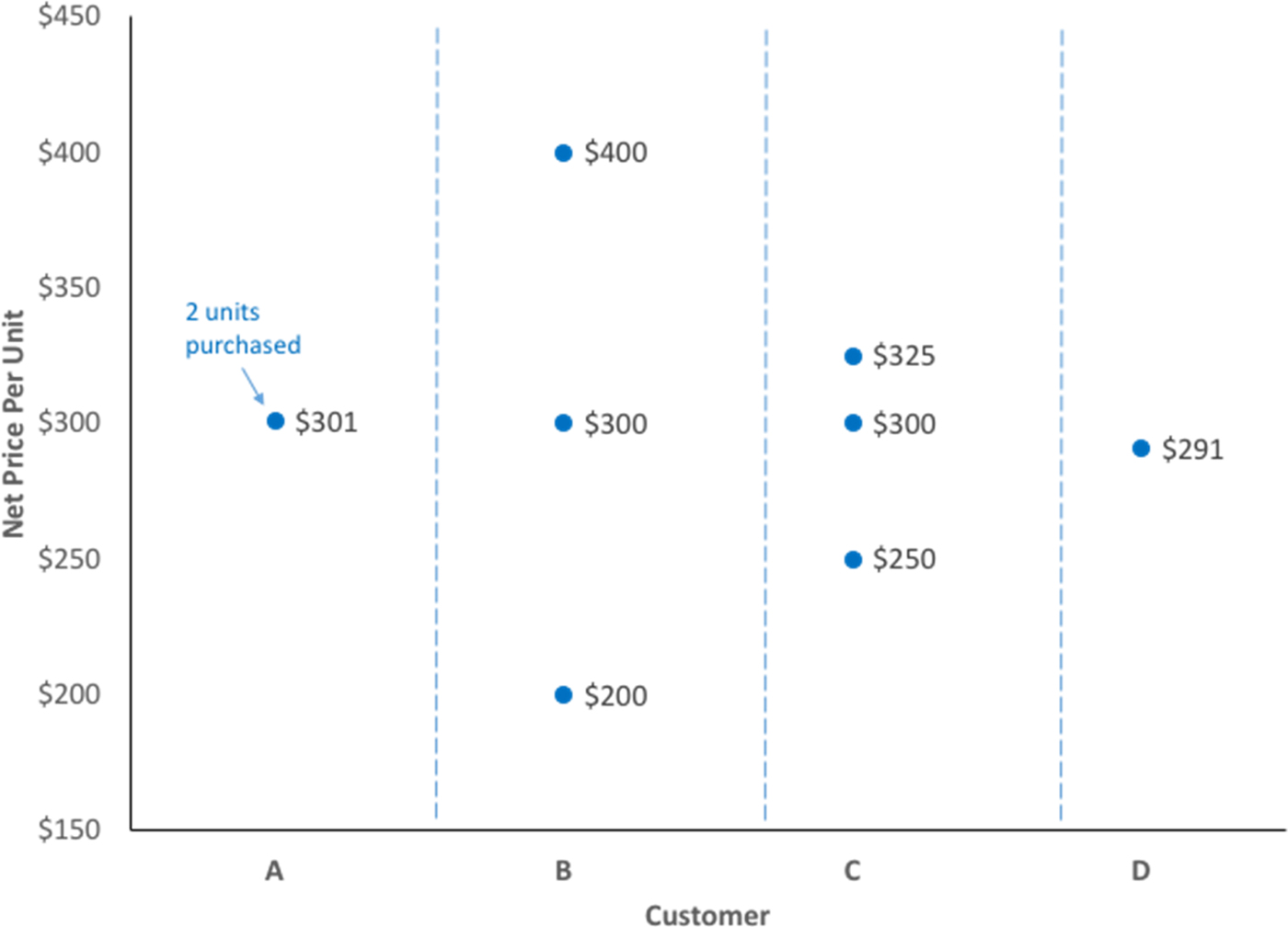
Suppose there are four customers (see Figure 1). The net price for Customer A is $301 (who buys at the same price on day 1 and 2). Customer B pays $400 on day 1, $300 on day 2, and $200 on day 3. Customer C pays $325 on day 1, $300 on day 2, and $250 on day 3. Customer D pays $291 on day 2. The weighted average net price across all customers is $296.44.
Net prices paid by customersFootnote 14

Do these data give rise to a pattern of export prices which differ significantly among different purchasers and, if so, which customer(s) were targeted? Given that the allegation is targeted dumping, one might reasonably guess that the large variation in market prices paid by Customer B would make it a likely suspect. Yet, according to the Nails test, Customer B was not targeted; rather Customer C was targeted.
How is this conclusion possible? The key reason is that the USDOC's Nails test uses average prices. In addition, the USDOC considers that all of each customer's transactions are conducted at the customer's average price. That is, the USDOC considers Customer B to have purchased each widget at a price of $300/unit, and Customer C to have purchased each widget at a price of $291.67/unit. Consequently, the USDOC's use of average prices allows it to conclude that Customers A and B experienced nearly identical pricing ($301 and $300, respectively).
When questioned about its use of average prices, the USDOC responded that using average prices rather than actual market prices is within its discretion:
Moreover, we disagree with APP–China that the Nails test should be run on the basis of transactions prices. In the context of testing to see whether customers have been targeted, the relevant price variance, in the Department's view, is the variance in prices across customers, not transactions. For this reason, the Department approached the problem by analyzing the variance in the average price paid by each customer. (Kubach, Reference Kubach2010)
Said differently, in this example the USDOC is concerned that the relatively low prices charged to Customer C are ‘masked’ by the relatively high prices charged to Customers A and B. For instance, one could imagine a situation where Customer C has a strong ‘buy local’ procurement policy and hence is the customer who most often buys from one of the domestic producers. In this scenario, low prices to Customer C might be needed in order to persuade it to buy from the exporter.
We note that since the USDOC neither asks for, nor provides, an explanation of the ‘pattern’, this background justification would not be provided in order to vindicate the targeted dumping methodology. Rather, the entire basis for the USDOC's assertion of a pattern is quantitative. The question, therefore, is whether the Nails test correctly identifies and distinguishes unusually low prices from normal prices.
According to the USDOC, everything that needs to be known about the pattern of pricing is revealed by the average price paid by a customer. The fact that a customer might purchase three widgets (or 10,000 widgets) at different prices and at different times during the period reveals nothing about the customer's pattern of pricing. The USDOC's statement is remarkable, especially when one considers that the USDOC uses the finding of targeted dumping (based entirely on average prices) to justify zeroing dumping margins for individual transactions.
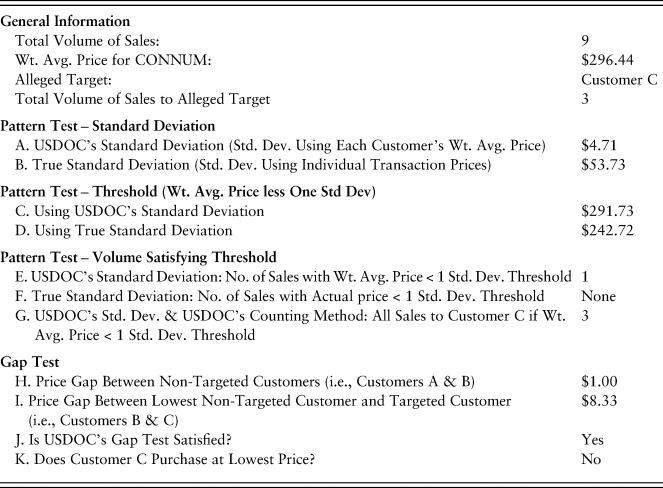
Once the average prices are computed, there are two key steps in the Nails test: the pattern (or standard deviation) test and the gap test (Table 1). The pattern test begins by calculating the standard deviation of prices. The Nails test acts as if there are only four prices to consider: $301 (2 transactions), $300 (3 transactions), $291.67 (3 transactions), and $290 (1 transaction).Footnote 15 Therefore, according to the Nails test the (weighted) standard deviation is just $4.71. For perspective, the standard deviation calculated on the nine actual net transaction prices is equal to $53.73. In other words, the USDOC's standard deviation is less than 1/10th of the true standard deviation ($4.71/$53.73 = 8.8%). The calculation of the standard deviation is crucial as the Nails test asserts that prices less than one standard deviation from the average price form the pattern. As this example highlights, the Nails test may in fact be based on transactions where prices are just 1/10th of a standard deviation below the average.
USDOC's targeted dumping method

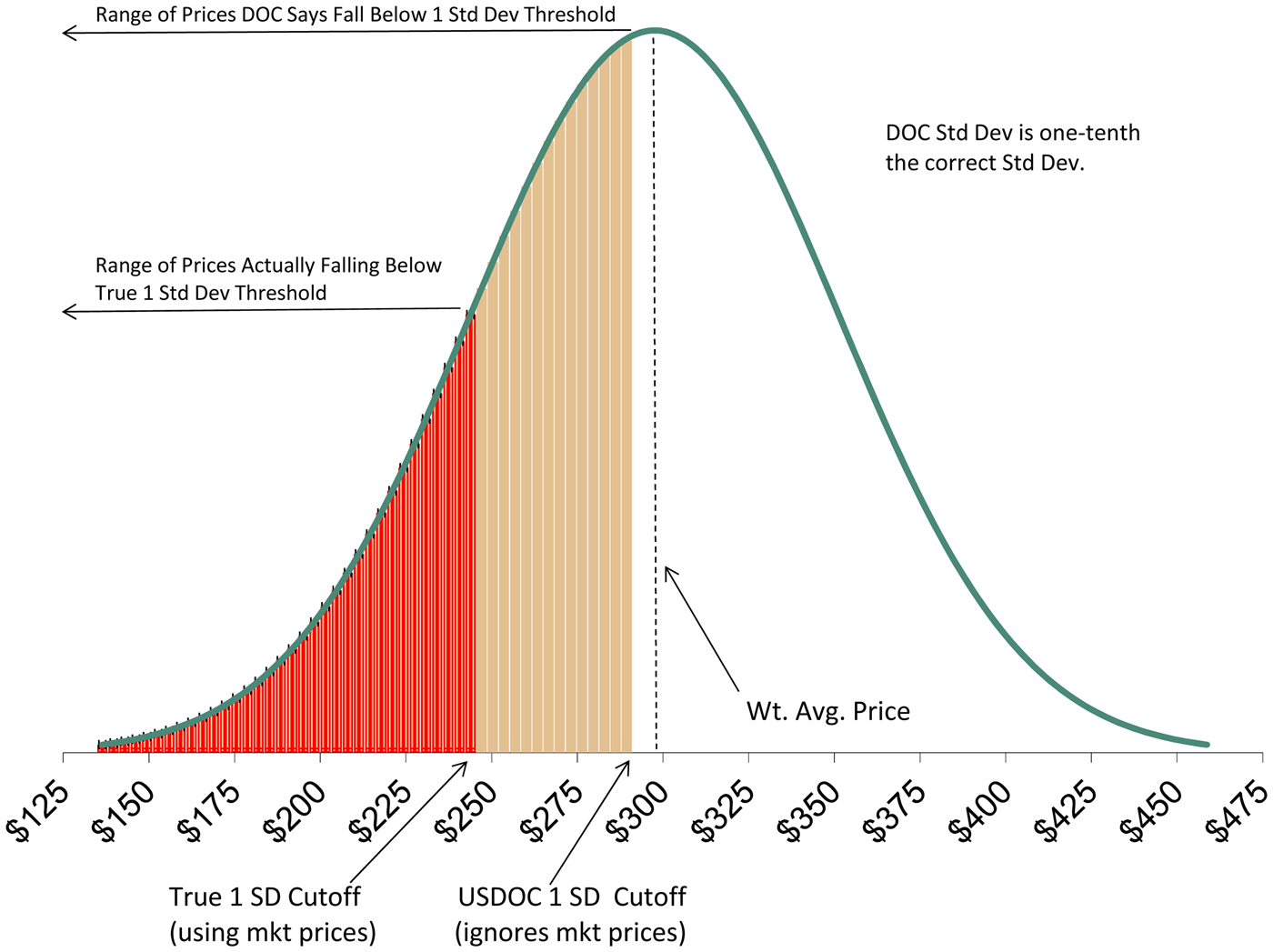
The understatement in the standard deviation has a powerful impact on the volume deemed to be sold at prices ‘too low’. In Figure 2, we graph the information from this example assuming the sales prices were normally distributed.Footnote 16 As shown, all transactions at prices in the lightly shaded region are below the USDOC's one standard deviation threshold. In reality, only transactions conducted at prices in the dark shaded region are in fact below the actual one standard deviation threshold. The Nails test allows the USDOC to conclude virtually all prices below the average are ‘too low’ according to the pattern test.
Graphical depiction of USDOC's understatement of the standard deviation

The USDOC's next step is to determine which of Customer C's transactions (if any) fall below the threshold. Under the USDOC's method for computing the standard deviation, Customer C is found to ‘pass’ the pattern test. Its average price of $291.67 is below the threshold of $291.73. If the USDOC had instead used the standard deviation computed using actual market prices, Customer C would fail the test as it had no purchases below $242.72.
The USDOC then determines if 33% of the purchases satisfy the pattern test. Because it assumes all of Customer C's transactions occurred at the average price of $291.67, the USDOC will conclude all three widgets pass the pattern test. In truth, only one of Customer C's purchases was below the USITC's calculated threshold.
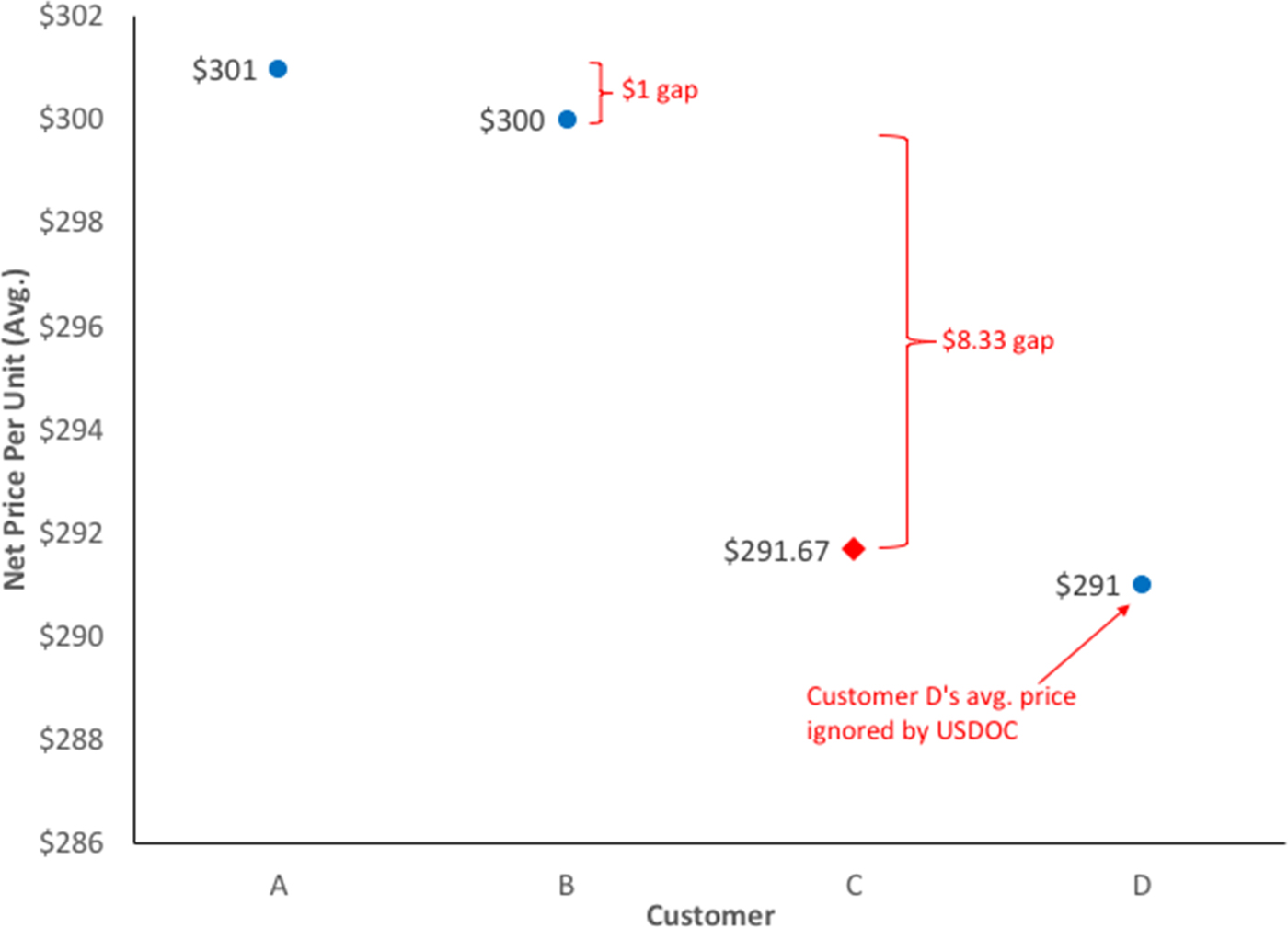
The second step is the gap test. The gap test calculates the differences in average prices paid by each customer. The USDOC begins by computing the gap between the average price paid by the non-targeted customers whose prices are above the target (i.e., Customers A and B), which is $1 ($301–$300). The USDOC then computes the gap between the average price paid by the lowest price non-targeted customer (whose price is above the target), i.e., Customer B, and the average price paid by the allegedly targeted customer. In this example, the targeted gap is $300 – $291.67 = $8.33. Because this gap is larger than the non-targeted gap ($1), the USDOC's gap test is satisfied. This means that Customer D's low price is ignored in the gap test. The AB ruled that ignoring Customer D's prices was inconsistent with the ADA.
In this example, the Nails test is satisfied and the USDOC would use zeroing for all transactions.
Gap test under USDOC nails test

2.3 Example 2: One transaction, many prices
As discussed in the previous example, before the USDOC performs the pattern test it makes an adjustment to all the prices in the data and effectively replaces every price with the weighted average for the basis type being examined. Given the language in Article 2.4.2, the Nails test seeks to identify patterns for three types of targeting: customers, time periods, and region.
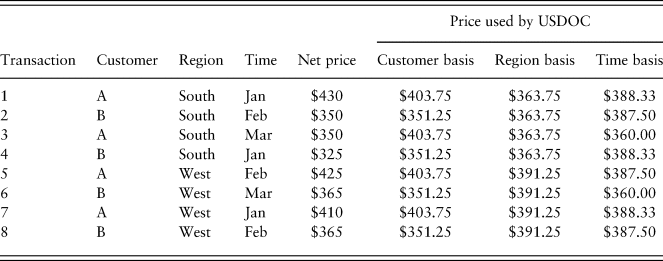
The USDOC asserts that it has the discretion to look at average prices. Yet, doing so creates puzzling inconsistencies in the pricing data across basis types. To see why, we say this: consider the example depicted in Table 2. In this example, there are two customers (A and B) who both purchase in two regions (South and West). Purchases are made in three different months (January, February, March). For each of the eight transactions, we have listed the actual net prices paid by the customers.Footnote 17
Same transaction, different prices

In this example, the Nails test causes every transaction to be evaluated as if it had occurred at a price different than it actually did. For example, consider transaction 1. Customer A actually paid $430. Yet, the USDOC treats transaction 1 as if the net price was $403.75 when USDOC evaluates the pattern of targeted dumping under the customer basis. The USDOC treats that exact same transaction as if the net price were $363.75 under the region basis. Finally, the USDOC treats transaction 1 as if the net price were $388.33 under the time basis.
This example highlights the challenge of satisfying Article 2.4.2, which requires the identification of a ‘pattern of export prices which differ significantly among different purchasers, regions or time periods’. There are eight transactions and three basis types – and none of the average prices used to evaluate the pattern corresponds to the actual net price paid for any of the transactions. We do not believe this type of price adjustment can reasonably be claimed to fall within the realm of an investigative authority's discretion. Rather, given the fact that no actual net transaction prices are used in the analysis, we feel any claim of identifying a pattern must be false.
Example 3: Product pricing with a time trend or seasonality
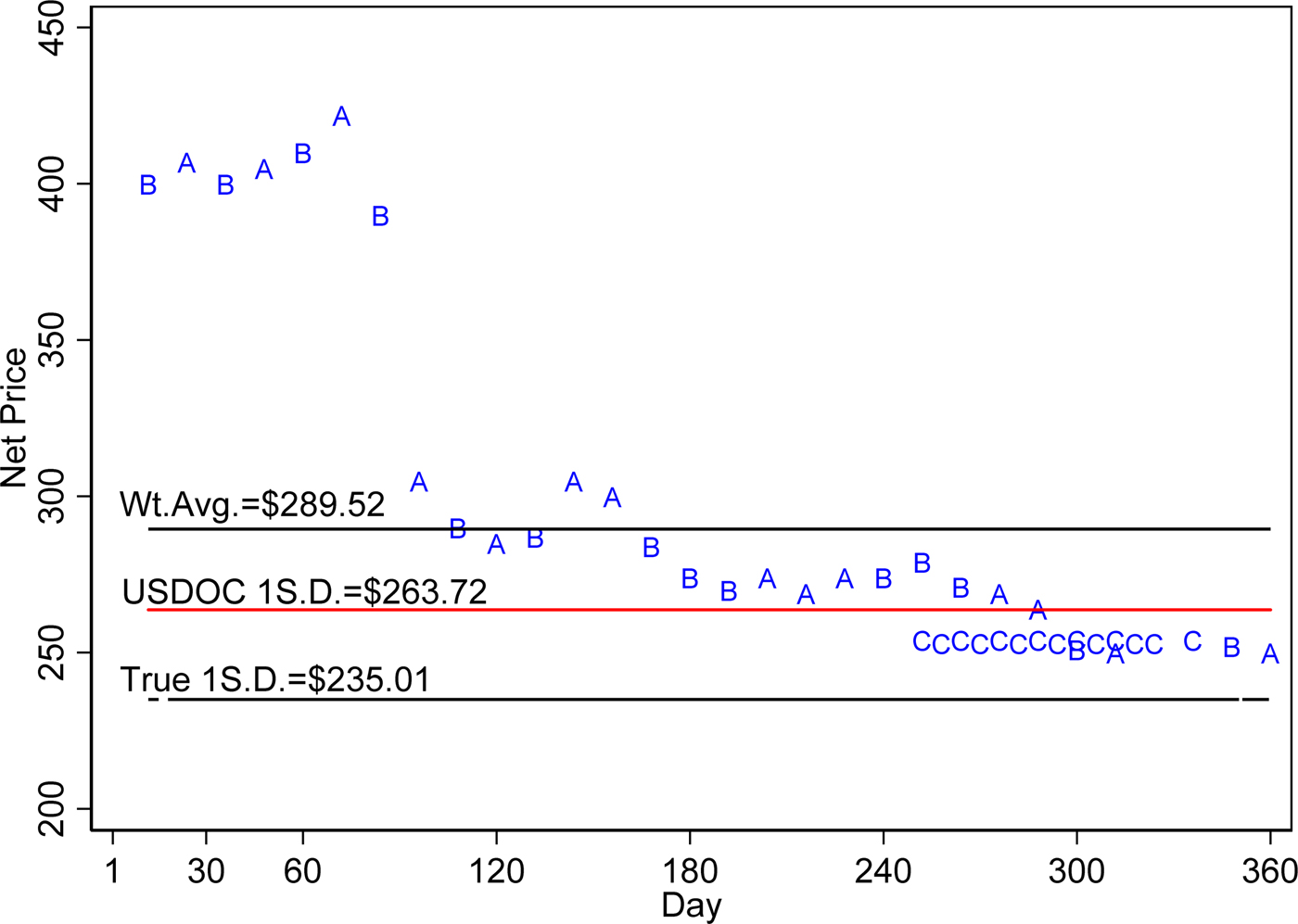
In our third example, we consider hypothetical data for one year of transactions (see Figure 4). There is a total of 42 transactions to three customers (one unit sold per transaction). The weighted average price is $289.52.Footnote 18 The letters A, B, and C in the figure correspond to each customers’ net price on a given day. Customer A has 13 transactions at an average price of $306.08; Customer B has 15 transactions at an average price of $308.80; Customer C has 14 transactions at an average price of $253.50.
Net pricing data and the one standard deviation lower bound

Two comments on the pricing. First, Customers A and B make purchases throughout the year while Customer C's purchases are concentrated at the end of the year. Note, however, that during the period of time when Customer C is purchasing, the prices it receives are comparable to those received by Customers A and B. Second, the product displays a clear time pattern. That is, prices start off high at the beginning of the year and fall over the course of the year. Prices to all customers are considerably lower later in the year than early in the year. This might be because a new model of the product was introduced in January and then ‘retired’ late in the year (i.e. product life cycle pricing effect); or perhaps this product is discounted for the annual ‘Black Friday’ sales event in November – both of these explanations describe pricing patterns for many home appliances – or the price trend could reflect seasonal demand. Even if a clear explanation for the pattern exists, the Nails test does not require any explanation for the price variation – simply that it exists. And, in both US–Washing Machines and this dispute, the AB has ruled that the investigative authority need not consider these sort explanations for the pricing pattern.
There is considerable pricing variation over the course of the year. The standard deviation based on actual prices for all 42 transactions is $54.51, which means the one standard deviation ‘lower bound’ threshold is $235.01 ($289.52 – $54.51 = $235.01). If this were how the USDOC calculated the standard deviation, no transactions would satisfy the one standard deviation test. However, the Nails test does not calculate the standard deviation based on all transaction net prices; rather the USDOC adjusts prices so as to produce a far smaller standard deviation. Using the average prices paid by each customer, the Nails test will say the standard deviation is $25.81. This implies the one standard deviation lower bound is just $263.72 ($289.52 – $25.81 = $263.72). For perspective, the USDOC's $25.81 standard deviation is less than half the correct standard deviation ($54.51). Consequently, all of Customer C's purchases are at prices below the USDOC's one standard deviation threshold.
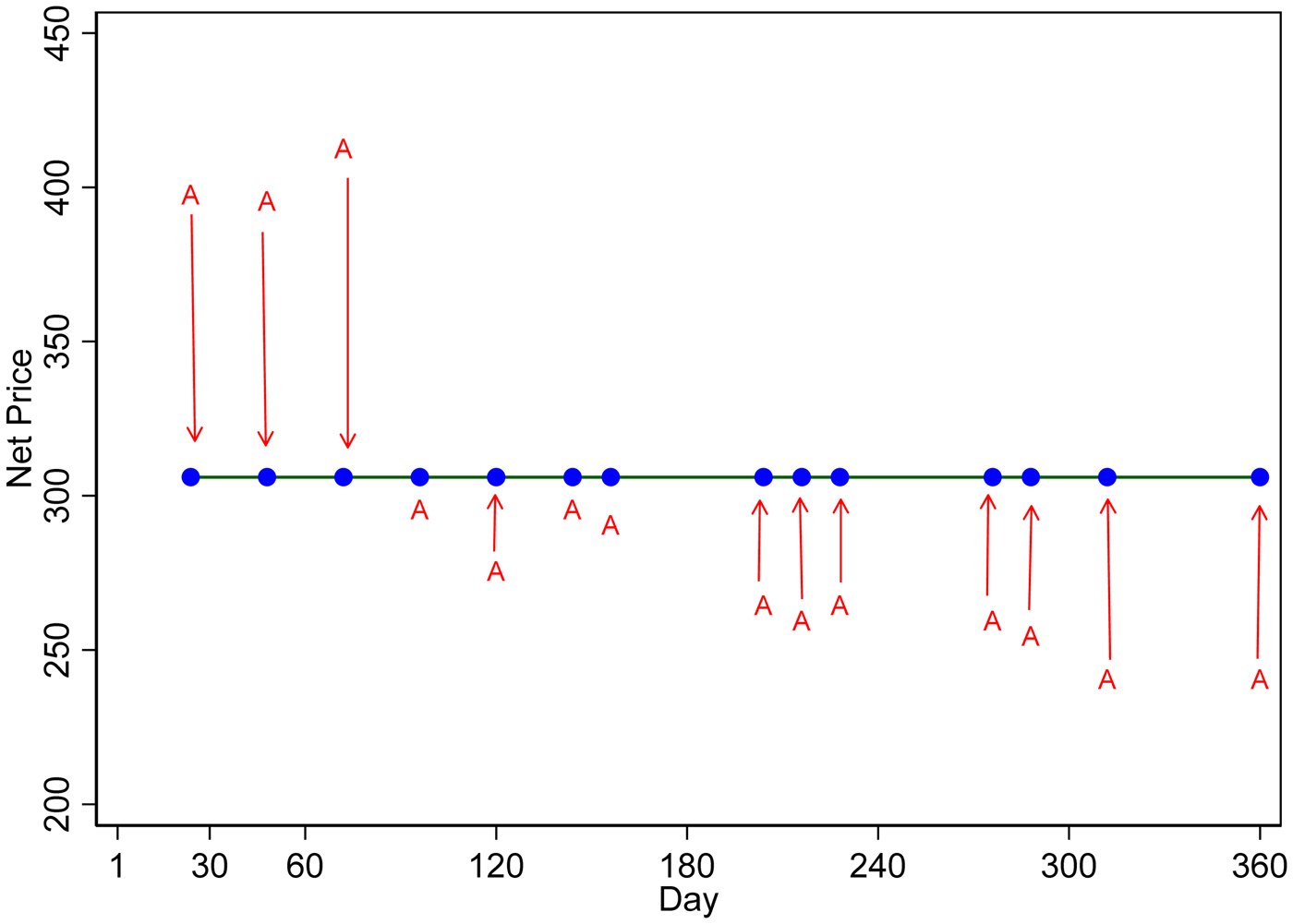
One way to understand the US's Nails test is that it adjusts net prices before attempting to identify a pattern. For example, early in the period of investigation (POI), when Customer A was paying more than $400 per unit, the USDOC will treat those transactions as if they occurred at $306.08 per unit. Later in the year, when Customer A was paying lower prices, the USDOC will treat those transactions as if they also occurred at a net price of $306.08. These price adjustments are depicted in Figure 5, where the letter A corresponds to the actual net prices and the blue dots depict the prices the USDOC uses in the Nails test. The USDOC does a similar price compression exercise for each firm. How much each firm's prices are changed will vary from firm to firm. The question is only about the magnitude of the compression – in all cases the USDOC's approach will compress the prices.
USDOC's adjustment to firm A's prices before calculating the standard deviation

As discussed in Bown and Prusa (Reference Bown, Prusa, Martin and Mattoo2011), one of the problems the AB has repeatedly found with the practice of zeroing is that zeroing treats transactions as if they occurred at prices different than their actual net prices. Ironically, this is exactly what the US does when performing the Nails test, which is the methodology the US uses to justify using zeroing. Thus, it is our opinion that the same principles that underlie the AB's condemnation of zeroing also apply to the US's approach to identifying a pattern.
China made a series of arguments that one standard deviation was not consistent with statistical conventions and that the test required the pricing data be normally distributed, or at least single peaked. The AB ruled against China, stating that China had failed to prove that the Nails test could not be used under these circumstances. China's decision to focus its challenge on the USDOC's use of one standard deviation (instead of the more common two or three standard deviations threshold) rather than the much larger issue of the downward bias in the calculation was likely a mistake. As we showed in our first and third examples, the problem with the US statistical test goes far beyond basing statistical significance on just one standard deviation. As the examples have illustrated, the standard deviation used by the US can be 1/10th (or even less) of one standard deviation.
This type of compression of the standard deviation is not a result of our use of peculiar numerical examples. To the contrary, it is the norm. An important finding in statistics is that the standard deviation of the weighted averages must be less than, or equal to, the standard deviation of the individual prices. This is a result that is at the heart of one of the most famous results in statistics – the Rao–Blackwell Theorem (Hogg et al., Reference Hogg, McKean and Craig2012: 98). The USDOC's method means the standard deviation it uses is always lower than the true standard deviation of prices in the CONNUM.Footnote 19
The deficiencies in the standards for statistical significance stemming from the use of average prices essentially neuter the key ‘significance’ requirement of Article 2.4.2. What is the statistical basis for concluding there is a significant difference in the pattern of export prices when the tests are based on 1/2, 1/10th, or perhaps 1/100th of a standard deviation? That the AB has condoned basing the pattern test on average prices renders statistics meaningless. Making matters worse is the fact that the AB has also ruled that the investigative authority needs not consider why export prices forming the relevant pattern differ. The AB decision with respect to the explanation requirement (or lack thereof) only makes sense if the statistical basis for the pattern test is reliable and yet we know that statistical tests based on average prices are biased toward finding a pattern.
3. Single rate presumption
In NME investigations, the USDOC presumes that all NME companies are part of a single NME-entity and therefore assigns one single duty rate to them (Single Rate Presumption or SRP), unless specific exporters demonstrate absence of government control, both in law and in fact, over their export activities by completing a separate rate application form and satisfying the conditions of the Separate Rate Test [SRT]. China claimed that the SRP violated Articles 6.10 and 9.2 of the ADA as such and as applied.
The Panel considered that it was undisputed that the SRP was attributable to the United States. It further found that its precise content was ascertainable from the evidence provided by China, notably various USDOC documents describing the SRP such as (1) the USDOC Policy Bulletin No. 05.1, (2) over 100 USDOC anti-dumping determinations covering a 24 years’ period,Footnote 20 (3) the USDOC's Anti-dumping Manual, (4) court decisions, and (5) the existence of templates of the separate rate application and certification (used if exporters previously received separate rate status). Based on a detailed analysis of all this documentary evidence, the Panel concluded that the SRP constituted a norm of general and prospective application that could be challenged as such. Thus, the US once more became the victim of its transparency (Prusa and Vermulst, Reference Prusa and Vermulst2011).
Relying on the AB findings in EC–Fasteners (China),Footnote 21 the Panel found that the SRP violates the Article 6.10 ADA obligation to calculate individual dumping margins and the Article 9.2 obligation to specify individual anti-dumping duties as such because it subjects NME exporters to a single dumping margin/duty, unless each exporter overcomes the presumption of de jure and de facto government control over its export operations.
For the same reasons,Footnote 22 the Panel found that the SRP violated Articles 6.10 and 9.2 ADA in the 38 anti-dumping determinations (13 original investigations and 25 administrative reviews) in which it had been applied per China's claim.
These findings of the Panel were not appealed.
4. The adverse facts available norm
China had argued before the Panel that what it called the AFA Norm constituted an unwritten norm of general and prospective application that as such violated Article 6.8Footnote 23 and Paragraph 7 of Annex II of the ADA.Footnote 24 China had described the content of the Norm as follows:
Whenever the USDOC considers that an NME-wide entity has failed to cooperate to the best of its ability, it systematically makes an adverse inference and selects, to determine the rate for the NME-wide entity, facts that are adverse to the interests of that fictional entity and each of the producers or exporters included within it’.Footnote 25
The Panel had found that the Norm was attributable to the United States. The Panel further found that its precise content corresponded to the description provided by China, based on an examination of 73 USDOC determinations (47 original investigations and 26 administrative reviews) provided by China (and covering a period of 12 years)Footnote 26 in which the USDOC had applied AFA:
These determinations show that, whenever the USDOC made a finding that an NME-wide entity failed to cooperate to the best of its ability, it adopted adverse inferences and, in determining the duty rate for the NME-wide entity, selected facts from the record that were adverse to the interest of such entity, and the exporters included within it.Footnote 27
However, the Panel considered that the practice reflected in the 73 determinations was insufficient to demonstrate that the Norm had prospective application:
This practice constitutes evidence that the USDOC has invariably engaged in the same conduct; it may even constitute evidence that the USDOC is likely to engage in that same conduct in the future. In our view, however, this does not suffice to show that the alleged AFA Norm has prospective application because it does not demonstrate that the USDOC will continue to follow the same course of action in the future.Footnote 28
China appealed on the ground that the Panel erroneously required ‘certainty’ of future application for a rule or norm to be challenged as such in WTO dispute settlement and that the Panel had applied a higher standard for the AFA as such claim than for the SRP as such claim.Footnote 29 On appeal, the AB agreed with China.Footnote 30
As regards the general application requirement, the AB considered such requirement to be met if the Norm affects an unidentified number of economic operators.Footnote 31
Concerning the prospective application requirement, the AB rejected the Panel finding that such condition required ‘certainty’ of future application.Footnote 32 The AB considered that where prospective application is not sufficiently clear from the constitutive elements of the Norm, it may be demonstrated by the existence of an underlying policy that is implemented by the Norm. The existence of an underlying policy may be evidenced by the more ‘frequent, consistent and extended’ the repetition of the conduct is. The AB considered as relevant evidence in this regard:
• The systematic application of the Norm;
• Its design, architecture and structure;
• The extent to which the Norm provides administrative guidance for future conduct; and
• The expectations it creates among economic operators that the Norm will be applied in the future.
The AB then considered that it was in a position to grant China's request that it complete the analysis and find that the AFA Norm had general and prospective application on the basis of the findings in the Panel report and the undisputed facts on the Panel record.
The AB found the AFA Norm to have general application because (1) it affects an unidentified number of economic operators, as witnessed by the un-appealed Panel finding to that effect; (2) the content of the Norm does not impose any express limitation on NME economic operators that may be included within an NME-wide entity subject to the Norm; (3) the application of the SRP may result in the establishment of NME-wide entities which will be subjected to the AFA Norm if the USDOC finds that they did not cooperate to the best of their ability, coupled to the Panel finding that the SRP was a measure of general application; and (4) it had been applied in 73 USDOC determinations covering a wide variety of products and companies.Footnote 33
The AB considered the AFA Norm to have prospective application because it (1) reflects a USDOC policy, (2) provides administrative guidance for future action, and (3) generates expectations among economic operators that it would continue to be applied in the future based on its invariable application during more than 12 years.Footnote 34
However, the AB found that it could not complete the analysis that the Norm violated Article 6.8 and paragraph 7 of Annex II of the ADA, as requested by China, in light of the absence of Panel findings concerning ‘the process of reasoning and evaluation undertaken by the USDOC prior to selecting facts available to replace missing information’, insufficient undisputed facts on the Panel record, and the arguments made by the parties on appeal.Footnote 35
Despite the failure of the AB to rule on the illegality of the AFA Norm, there seems to be little doubt that any continued use by the USDOC of its adverse facts available Norm against NME-wide entities following the failure of one or more of its constituent producers to cooperate to the best of its ability will not withstand future WTO scrutiny. In previous cases,Footnote 36 the US has already been faulted for its tough use of adverse facts available and the fact that in NME cases failure of, for example, one NME company will lead to punishment of the entire NME-wide entity, i.e. including all the companies that were found to have fully cooperated, exacerbates the unfairness of the approach. That having been said, the Panel ruling that the USDOC's SRP is illegal supposedly will lead to less findings of NME-wide entities in the first place.
5. Concluding comments
One would expect that the USDOC's targeted dumping rules would deter sophisticated foreign firms from pricing in such a manner. However, the pricing adjustments imposed as part of the USDOC's Nails test make it impossible for a foreign firm to anticipate what transaction prices will be used when the USDOC evaluates the significance of the ‘pattern’. While it might be able to anticipate the results of an analysis based on the customer basis, it is impossible for a firm to anticipate how the USDOC will define the time basis (months, weeks, quarters, or some other time unit) or region basis (state, region, North vs South, etc.) What should a foreign firm do in order to avoid a targeted dumping finding? Price higher? Price lower? It does not matter. The USDOC will ignore the actual transaction price in almost all scenarios.
While the Panel and AB found certain parts of the USDOC's methodology inconsistent – most notably applying W-T to all transactions and the use of zeroing – they refrained from finding the use of average prices in the Nails test inconsistent. While the US has moved away from the Nails test, the AB seems to have opened the door for future implementation of the pattern test to be based on average prices rather than actual transaction prices. As demonstrated in this paper, this will likely greatly expand the use of the exceptional method.
The Panel and the AB wrestled with what kind of discretion should be given to an investigative authority when determining the pattern. The answer, we believe, is that it depends on whether the methodology reasonably identifies a pattern and the basis for declaring the pattern as significant, thus leading to a fair comparison. We believe the Nails test, and likely any pattern test based on averages, cannot be considered a reasonable statistical approach and therefore does not meet the fair comparison requirement.
The Panel and AB rulings concerning the illegality of the SRP approach, unsurprising in light of EC–Fasteners (China), and the – likely – illegality of the AFA Norm mitigate some of the excesses of the discriminatory treatment of companies located in NMEs. It is therefore a welcome development that the AB thereby has put some more nails in the coffin of result-oriented dumping margin calculation methodologies.
Appendix: Transactions Prices in Example No. 3