

Introduction
The past 20 years have witnessed the growing influence of neoliberal ideas in policy-making circles. Influenced by neoliberal economics, many policymakers view markets as the most desirable mechanisms for regulating both domestic and world economies (Campbell and Pedersen Reference Campbell and Pedersen2001; Fourcade-Gourinchas and Babb Reference Fourcade-Gourinchas and Babb2002). As a result, the state monopolies in major infrastructure sectors have been abolished or restricted, and private investors are allowed or encouraged to own or participate in the management, maintenance and construction of urban infrastructure projects through schemes such as concessions, greenfield projects and divestiture (Grimsey and Lewis Reference Grimsey and Lewis2004; Savas Reference Savas2005).
Drawing on the practices and experiences of other developing as well as industrialised countries, the Chinese government began to open its infrastructure markets and allow the private sector to play a larger role in key urban services such as roads, metro, power, waste management, and water and sanitation (Su and Zhao Reference Su and Zhao2007). Despite the popular discourse that proclaims the increased efficiency and improved service standards that accompany liberalisation reform, cities have varied substantially in their choice of which infrastructure sector to begin with and the extent of cooperation with the private sector (Bellier and Zhou Reference Bellier and Zhou2003; Annez Reference Annez2007). The choice of sector not only involves investment risks but also faces potential resistance from the public. Similarly, the choice of the appropriate contractual arrangement is not an easy task. This is because, if the state retains too many rights and shifts too many risks to private parties, then the latter may not participate; but, if the state chooses the opposite approach, then customers may have to bail out private investors, and local governments may shoulder heavy financial and political pressures (Hammami et al. Reference Hammami, Ruhashyankiko and Yehoue2006).
In an uncertain institutional environment in which a comprehensive framework law for private infrastructure projects has yet to be established, the reform decisions of local policymakers can be driven by multiple forces. Borrowing insights from policy diffusion literature, this article explores factors that shape the parallel diffusion processes of different sectoral reforms and types of arrangements. It argues that, in addition to the availability of fiscal and political resources that can be mobilised and other city characteristics (Walker Reference Walker1969; Berry and Berry Reference Berry and Berry2007), the focal city’s liberalisation process is likely to be influenced by the decisions of their neighbouring or peer cities (Strang and Tuma Reference Strang and Tuma1993; Mooney Reference Mooney2001), the policy recommendations offered by policy research professionals (DiMaggio and Powell Reference DiMaggio and Powell1983; Henisz et al. Reference Henisz, Zelner and Guillen2005) and the direct or indirect influence of higher-level governments (Dobbin et al. Reference Dobbin, Simmons and Garrett2007).
This analysis contributes to the existing literature on policy diffusion in two ways. First, previous scholarship has often referred to the multiple mechanisms of diffusion, but with few exceptions these studies have not tested one explanation against another (Shipan and Volden Reference Shipan and Volden2008). This study tests the diffusion mechanisms simultaneously in a comparative context, and explores whether the effects of each mechanism change when other mechanisms are taken into consideration (Dobbin et al. Reference Dobbin, Simmons and Garrett2007). Second, this study introduces variation to the diffusion subjects, which enables us to explore how the effects of various diffusion drivers change according to the particular characteristics of different sectors and types of contracts (Strang and Soule Reference Strang and Soule1998; Sabatier Reference Sabatier2007).
In the next section, I introduce the variations among the different forms of public-private partnerships (PPP) and among the infrastructure sectors. I then consider the effects of various diffusion mechanisms on the diffusion processes and formulate the hypotheses. An empirical test using panel data on market-oriented reforms in Chinese cities follows, and then the findings are discussed.
Variation among contractual arrangements and infrastructure sectors
There are four basic types of contract arrangements that allow the private sector to participate in infrastructure programmes. The most conservative type is the management and lease (lease hereafter) contract under which governments still maintain ownership and investment stakes. This model is usually adopted when governments need private management experience and technology, but are reluctant to relinquish ownership because of their desire to maintain control or unwillingness to implement needed reforms (World Bank 1994; Delmon Reference Delmon2009). The most common models are concession and greenfield. The major advantage of these two models is that they are neither too conservative nor too radical. They offer private entrepreneurs considerable incentives while allowing the state to maintain its control over the ownership of state assets (Bellier and Zhou Reference Bellier and Zhou2003). In the concession model, a private entity manages a public service for a given period, during which it assumes significant investment risks and some commercial risks. The private entity is responsible for delivering services to users according to the terms and conditions specified in the concession contract. The public entity still owns the assets (Farquharson et al. Reference Farquharson, Mastle, Yescombe and Encinas2011).
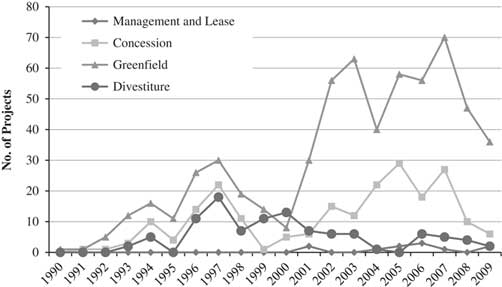
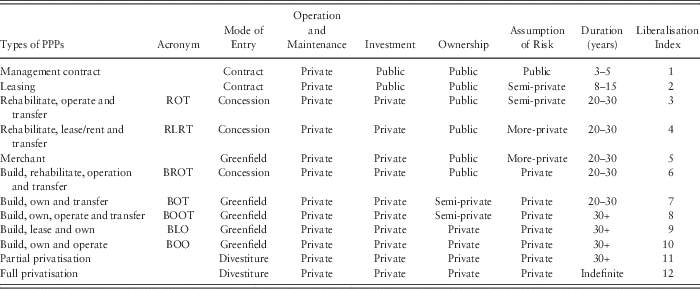
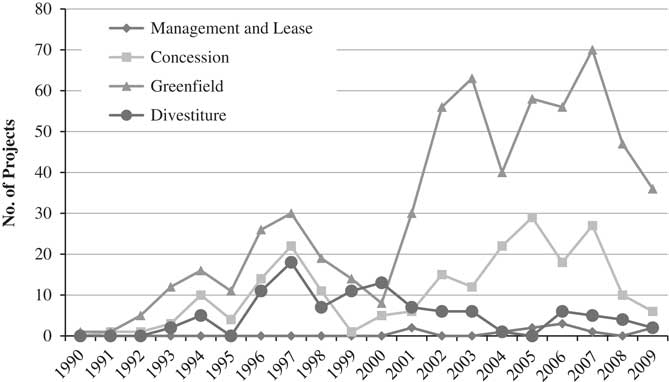
Under greenfield contracts, a private entity or a public-private joint venture builds and operates a new facility for the period specified in the project contract. At the end of the contract, the private entity transfers ownership of the facility to the government. In these contracts, a government usually provides a minimum revenue guarantee. Most greenfield projects in China use the build-operate-transfer (BOT) scheme (Bellier and Zhou Reference Bellier and Zhou2003). Divestiture is the highest level of privatisation arrangement in which a private entity buys an equity stake in a state-owned enterprise (SOE) through an asset sale, public offering or mass privatisation. This model was frequently used during state-sector reform in the late 1990s when the central government adopted the “grasp the big and let the small go” strategy. Local governments at various levels followed this guideline and sold their money-losing state enterprises to various nonstate investors (Farquharson et al. Reference Farquharson, Mastle, Yescombe and Encinas2011). Table 1 shows the liberalisation index for different types of contract forms. A higher index indicates a more liberal form of contract arrangement, which also suggests that the private party assumes a greater role in the project management. Figure 1 shows the temporal distribution of these four contract types during the period 1990–2009.
Number of projects by public-private partnerships types per year. Source: The World Bank PPI Database (http://ppi.worldbank.org).
The liberalisation index of major types of private participation models
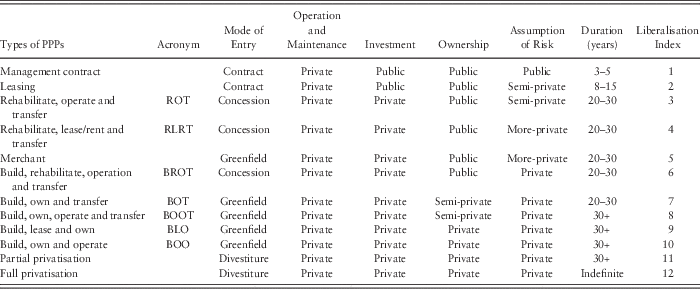
Source: World Bank’s PPI Database (Hammami et al. Reference Hammami, Ruhashyankiko and Yehoue2006).
Note: PPP=public-private partnerships.
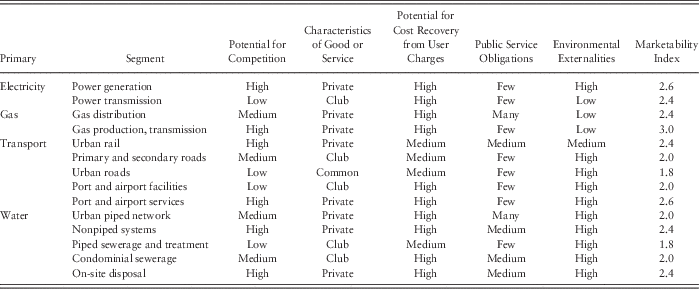
In addition to the variation in contract terms, projects also differ in terms of their marketability, which is determined by the production technology that leads to a natural monopoly, the potential for competition, the public nature of consumption, constraints on cost recovery, distributional concerns and so forth (World Bank 1994). Table 2 shows the important features of different infrastructure sectors and segments. The marketability index is the average of the scores (ranging from 1 to 3) for five characteristics. Private investments are first allowed in segments that are easily unbundled from other segments or industries, and the state is most cautious in granting private investments when participating in sectors of a monopolistic nature (Bellier and Zhou Reference Bellier and Zhou2003).
The marketability index of different infrastructure segments
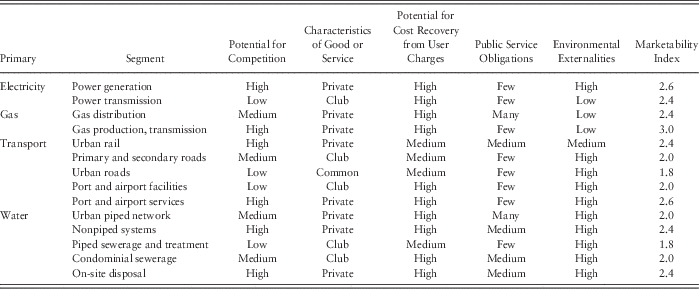
Source: World Bank (1994, 115).
The electricity industry has three segments: electricity generation, transmission and distribution. Of these three segments, electricity generation is more easily unbundled from other segments. Multiple companies were allowed to build power-generating plants and sell the electricity generated to state-owned power distribution companies (Bellier and Zhou Reference Bellier and Zhou2003). The public authority usually assumes part of the demand risk by making a minimum payment for a service or by providing price subsidies to companies that explore renewable energy sources, such as solar and wind power (World Bank 1994; Annez Reference Annez2007). The urban gas distribution industry has been unbundled from the gas production and transmission industry. Foreign as well as domestic private companies are now allowed to enter this market, which has transformed the once state-monopolised market into a highly competitive field. In contrast to the gas industry, the end users of electricity are not paying the power plants directly, and the actual end-user market size or purchasing power will not significantly affect the privatisation of power plants. Moreover, these projects will be built in places where equipment, raw materials or a system is available; the implementation of the project is thus less tightly connected to the socioeconomic characteristics of the facility site.
Urban transportation and water services can be provided by commercial companies. Local governments can delegate the service to a private company via a management, lease or concession contract (World Bank 1994). These types of services are user-fee projects in which the private party recoups its investment, operating and financing costs, and makes its profit by charging the public a user fee. The demand risk can be allocated in various ways. For example, the public authority can guarantee the purchase of a minimum level of usage or make payments to the private sector under certain conditions (Grimsey and Lewis Reference Grimsey and Lewis2004; Annez Reference Annez2007). As a large share of the project costs are covered by user fees, local market size and residents’ purchasing power are crucial to the successful implementation of these projects (Seppala et al. Reference Seppala, Hukka and Katko2001). These sector-specific or arrangement-specific characteristics may have a strong influence on the feasibility of utilising private investments or expertise. In the next section, I explore the mechanisms that drive the liberalisation process and how contractual and sectoral differences condition the effects of the diffusion mechanisms.
Theory and hypotheses
Empirical studies show that the process of new policy adoption often exhibits a high degree of temporal and spatial clustering (Simmons et al. Reference Simmons, Dobbin and Garrett2006). Scholars use economical (Walker Reference Walker1969; Berry and Berry Reference Berry and Berry2007), spatial (Strang and Tuma Reference Strang and Tuma1993; Tolnay et al. Reference Tolnay, Deane and Beck1996; Mooney Reference Mooney2001) and institutional models (DiMaggio and Powell Reference DiMaggio and Powell1983; Dobbin et al. Reference Dobbin, Simmons and Garrett2007) to explain the underlying mechanisms that lead to the observed distributional patterns of innovators. Although these models have been developed independently, and scholars from different traditions often attribute the causes of diffusion to different factors, in reality the process by which organisations adapt to change is likely to be a function of multiple interacting forces (Shipan and Volden Reference Shipan and Volden2006; Dobbin et al. Reference Dobbin, Simmons and Garrett2007).
In addition, a particular policy change is likely to be fuelled by a different mix of factors at different stages of the process. It is important to acknowledge that, although in this article I use “city” as the actor that carries out liberalisation policies, in fact individual decisionmakers, such as local leaders and bureaucrats, are the critical actors in these cities. Because the number of such individual policymakers and the forms of government bureaus are often large, I rely on the shorthand of referring to cities as actors. As in many other diffusion studies, the individual decisionmakers within these cities are believed to be interested in adopting beneficial policies either as a means of career advancement or as a way to improve the welfare of the local residents. Such motivations are at work across all mechanisms explored in this analysis (Shipan and Volden Reference Shipan and Volden2008).
Spatial contagion
Geographical proximity is an important factor that affects the diffusion process (Tolnay et al. Reference Tolnay, Deane and Beck1996; Wejnert Reference Wejnert2002; Berry and Berry Reference Berry and Berry2007). Walker (Reference Walker1969) argues that states emulate policies adopted by their neighbouring states as a way of “satisficing” and to simplify the decision-making process. The underlying mechanisms of this spatial contagion model are social learning and competition. Policymakers closely monitor the policies of other states in order to search for solutions to their practical problems. Among the many states, geographically proximate states are more likely to be used as sources of innovation information, because proximity can affect the frequency of communication and the nature of interactions between actors and then facilitate imitative behaviours (Rogers Reference Rogers1995). Moreover, spatial proximity fuels competition between neighbouring states over scarce resources, which in turn promotes the diffusion of more effective practices (Peterson and Rom Reference Peterson and Rom1989; Berry and Berry Reference Berry and Berry1990).
China’s de facto federalist structure leads to intense intercity competition over capital, resources and labour (Montinola et al. Reference Montinola, Qian and Weingast1995). As Tiebout (Reference Tiebout1956) argues, competition rewards local governments that are friendly to markets as factors of production move to their regions, while it heavily punishes interventionist local governments as they lose valuable factors of production. To find better ways of promoting local economic growth, local cadres frequently organise study trips to learn new practices from successful cities. They also actively imitate identified “good practices” in order to maintain their competitiveness (Krug and Hendrischke Reference Krug and Hendrischke2008). I thus expect that:
(H1) Increasing exposure to liberalisation practices will positively affect a focal city’s likelihood of adopting similar policies.
Provincial pressure
To facilitate market reform in infrastructure sectors, changes in the legal framework are often needed to allow private-sector companies to charge and collect user fees and to allow lower-level governments to contract with private bodies for the delivery of services. In the Chinese context, provincial governments assume these responsibilities and set the legal and regulatory framework. They exercise control over the pace and direction of infrastructure reform by providing overarching institutional structures that sanction local institutional differentiation and allow institutional competition (Krug and Hendrischke Reference Krug and Hendrischke2008).
More specifically, the directives that provincial governments give to lower-level governments usually include documents that articulate the following: the political rationale for promoting market-oriented infrastructure reforms; guidelines for local governments to use in selecting, preparing and implementing projects with private participation; the appropriate division of administrative power regarding who approves what kinds of projects through what processes; arrangements for monitoring contracts after they have been signed; and the financial incentives that can be given to private investors. These guidelines reduce the uncertainties associated with liberalisation reforms, help private investors evaluate the local institutional context and specify the political and economic benefits of the liberalisation reforms. When local policymakers perceive that the reforms are politically legitimate and economically beneficial, they will be more likely to embrace the changes and withstand opposition (Ramamurti Reference Ramamurti1999). I thus postulate that:
(H2) A city’s likelihood of adopting liberalisation policies is positively affected by the intensity of provincial pressure.
Peer pressure
In an uncertain environment, organisations tend to imitate the practices of similar organisations that they perceive to be successful (DiMaggio and Powell Reference DiMaggio and Powell1983; Haunschild and Miner Reference Haunschild and Miner1997). However, unlike the regional diffusion model, the institutional mimicry model emphasises the influence from structurally equivalent peers. Structural equivalence emerges if ego and alter occupy the same position in the social structure and have the same relations with other actors in the same system. It posits that people proximate in social structure use one another to manage the uncertainty of innovation (Burt Reference Burt1987). Learning theorists argue that policy-salient information is socially channelled. Some information sources are more important than others (Dobbin et al. Reference Dobbin, Simmons and Garrett2007). Although neighbouring cities are important sources, information channelled through socially connected peers tends to be regarded as more effective and appropriate for focal organisations.
In addition, unlike the competition between geographically proximate cities that results only in a differential allocation of economic resources, the competition among peer cities has both political and economic implications (Dougherty and McGuckin 2008; Krug and Hendrischke Reference Krug and Hendrischke2008). Politically speaking, structurally equivalent peer cities are subject to similar evaluation standards; the results of competition among same-level officials in the same province affect the chances of acquiring advancement opportunities (Whiting Reference Whiting2001). Therefore, cities may quickly imitate new practices that their peers have adopted even when the real effects are still uncertain (Krug and Hendrischke Reference Krug and Hendrischke2008). It is thus expected that:
(H3) The adoption of liberalisation policies by peer cities will positively affect the focal city’s likelihood of adopting similar policies.
Epistemic influences
Policy diffusion can also be affected by prevailing theories advocated by epistemic communities (DiMaggio and Powell Reference DiMaggio and Powell1983; Zucker Reference Zucker1987). Policy experts theorise a new policy solution for a particular policy issue. New policy norms advocated by experts often build on the experiences of early adopters, which later leads to innovations even when there are no particular examples in a given group (Strang and Meyer Reference Strang and Meyer1993; Wejnert Reference Wejnert2002).
Previous studies have focused on the theorisation efforts of well-organised professional associations in the form of complex organisations. Recent studies have shown that, in the absence of a well-defined professional organisation, loosely defined professional or social-movement communities can also accomplish the theorisation task (Haveman et al. Reference Haveman, Rao and Paruchuri2007). The theorisation of the infrastructure liberalisation policies in China has been carried out mainly by loosely connected epistemic communities consisting of policy analysts and local officials. The policy analysts promote the diffusion of new ideas by (1) introducing new policy ideas to a group of policymakers and articulating the institutional conditions under which a new policy could take effect and (2) comparing and summarising the experimental policy measures in different locations and specifying the advantages and limitations of the new policies. Through their work, the advantages and working mechanisms of the liberalisation reforms are gradually theorised and spread within the policy-making communities, and the liberalisation policies eventually become normative solutions. Therefore, it can be hypothesised that:
(H4) The increase of expert influence will positively affect the adoption of liberalisation policies.
The conditional nature of policy diffusion mechanisms
Previous studies indicate that the effects of different diffusion mechanisms may vary among actors with different characteristics (Shipan and Volden Reference Shipan and Volden2008). In this article, I argue that, in addition to the actors’ characteristics, the nature of the policy instrument and the context in which the policy is implemented can also condition the effectiveness of the policy diffusion mechanisms specified above. The first contingency factor is contract forms. In most developing countries and transitional economies, the institutional environment is uncertain and constantly evolving. Local governments thus find it relatively easy to regulate private partners through contracts, because the contract terms can be detailed on a case-by-case basis in advance and do not require systematic reform of the infrastructure investment institutions (World Bank 1994; Bellier and Zhou Reference Bellier and Zhou2003). The contracts between a public entity and a private entity differ considerably in their demand for administrative and regulatory resources, as well as in their degree of dependence on private-sector participation (Lieberman and Kirkness Reference Lieberman and Kirkness1998; Grimsey and Lewis Reference Grimsey and Lewis2004).
For local governments, the choice of arrangement types reflects its social and political considerations, investment needs and, more importantly, its openness to private participation (Delmon Reference Delmon2009). For private investors, the choice is driven by their perception of the investment risks or profitability associated with a certain project (Akintoye et al. Reference Akintoye, Beck and Hardcastle2003). Therefore, when adopting more liberal forms of contracts and giving more rights to private investors, the local state in fact faces greater ideological constraints and public resistance. This makes the endorsement from higher-level government and policy-making professionals particularly important for such adoptions. Moreover, such endorsements give private investors more confidence in the project and lead them to believe that the policy risks associated with the investment are lower.
In addition to the choice of arrangement types, choosing the proper starting point, i.e. the proper sector to start with, is also an important decision. Infrastructure sectors vary in terms of their marketability, which is determined by the production technology that leads to a natural monopoly, the potential for competition, the public nature of consumption, constraints on cost recovery, distributional concerns and so forth (World Bank 1994). Private investments are first allowed in segments that are easily unbundled from other segments or industries, and the state is most cautious in granting private investments when participating in sectors of a monopolistic nature (Bellier and Zhou Reference Bellier and Zhou2003). These sector-specific characteristics may have a strong influence on the decisions of local policymakers. As the more marketable projects are easier to implement, have higher potential for cost recovery from user charges and require little government investment, local states may compete for such projects and open corresponding sectors to private investors. I therefore argue that:
(H5a) The effects of provincial pressure and expert influence should be stronger on the diffusion of more liberalised contract arrangements.
(H5b) The effects of spatial exposure and peer competition should be stronger in sectors with higher marketability.
Data and method
Data
The aforementioned theoretical hypotheses were tested by using a compiled panel data set. The data set incorporates information about all Chinese mainland cities with a rank higher than or equal to the prefecture level (the only exception is Lhasa in Tibet because of data availability problems). Cities at the prefecture level and above are the natural choice for this study, because private-participated infrastructure (PPI) projects are typically located at these levels. By the end of 2008, there were 333 cities in China at the prefecture level and above (NBS 2009).
Data on city-level social and economic information were drawn from the China City Statistical Yearbook (1992–2009) published by China Statistics Press. Data on the infrastructure projects were drawn from the PPI Database managed by the PPI project team at the World Bank, which annually collects basic information on PPP projects implemented worldwide, including in mainland China. The team acquired the project information from public sources such as Factiva; specialised publications, such as Project Finance International; sponsors’ websites or public agencies granting the contracts; and multilateral agencies’ websites, including press releases and annual reports.
Infrastructure projects were included in the database if they met several criteria. First, the project had to provide services in at least one of the following sectors: energy (electricity and gas), transportation (airports, railways, seaports and roads) or water (potable water treatment and distribution, and sewerage collection and treatment). Second, the project was considered as one with private participation if a private sponsor was at least partially responsible for operating costs and risks of failure. Third, the project had to have a significant share of its business serve the public directly or indirectly. Fourth, the project had to have achieved financial closure. Finally, the projects’ total investment commitments had to be at least one million US dollars, and private ownership had to constitute at least 25% for greenfield projects and lease contracts and at least 5% for divestiture projects. A total of 824 PPP projects were included in the final data set.
Dependent variables
Data on the implementation of PPP projects were drawn from the Private Participation in Infrastructure Database managed by the PPI project team of the World Bank. I identified a PPP project as adopted as one in which the corresponding PPP project reached financial closure. I then constructed a binary variable to indicate whether a city adopted a PPP project in a given year.
Independent and control variables
Spatial exposure captures the effect of geographic proximity on influence between firms. The model used in the analysis must take into account the following considerations. First, the model must consider the potential impact of policy adoption in all other cities on the adoption decisions of the focal city. Second, it is highly likely that the potential impact of a policy innovation in one city on the adoption decisions of another city is weaker if the distance between these two cities is greater. Third, similarities in social and economic characteristics among cities may cause spurious inferences of spatial effects. Therefore, when estimating the spatial effect, heterogeneity among cities must be controlled. To satisfy these conditions, I followed previous studies and constructed the exposure measure to account for these complexities (Tolnay et al. Reference Tolnay, Deane and Beck1996; Keister Reference Keister2002).
The variable was constructed by solving two equations. The first equation was used to determine the effect of policy adoptions by each city on all other cities. The equation takes the form:
 $$O_{i} \,=\,\beta _{0} \,{\plus}\,\sum \beta _{k} X_{{ki}} \,{\plus}\, {\varepsilon}_{i} $$
where O i is the city i’s odds of opening the infrastructure markets to the private sector; β 0 the regression constant; X ki a set of k variables that describe the social and economic features of city i; β k the effect parameters that describe the effect of social and economic variables on the odds of adopting new policies; and ε i the disturbance term for Equation 2.
Using Equation 2, I obtained a set of predicted values O i * for each city that described the expected odds of opening the local infrastructure market, given the city’s social and economic characteristics. For each pair of cities, the predicted value was then divided by the geographic distance between the two cities. The exposure for each city i to the innovation decisions of all other cities was then calculated by the following equation:
 $$Exp_{i} = {\mathop{\sum}{\left( {O_{j}^{{\asterisk}} /D_{{ij}} } \right)} }^ \quad$$
where Exp i is the exposure for city i; O j * the predicted city j’s odds of opening the infrastructure market to the private sector; and D ij the geographic distance between city i and j, using the latitude and longitude for each city and taking the curve of the earth into consideration when calculating the distance between the two points.
The variable Exp i was then used as a predictor in the final model.
Peer pressure explores the effect of innovation pressure from peer cities. It is operationalised as the cumulative number of adoptions within a trait-based social group (Haunschild and Miner Reference Haunschild and Miner1997) and calculated as the year-end cumulative number of adopters divided by the total number of units in the same peer group (Fligstein Reference Fligstein1985). Cities affiliated with the same provincial government are treated as a peer group. However, due to the large differences between municipalities and other cities, the four municipalities are treated as a separate group. This variable is calculated year by year using the following equation:
 $$PP_{{ij}} =\mathop{\sum}\limits_{t\,=\,1992}^j {n_{{it}} /N_{i} } $$
where PP ij is the peer pressure in peer group i in year j; n it the number of adoptions in peer group i in year t; and N i the total number of cities in peer group i.
Provincial pressure measures how forcefully a province promoted certain policies among affiliated cities. To measure provincial pressure, I relied on the China Law Information Database for provincial legislative and administrative documents. I searched for the relevant documents by using several key words and their combinations and eventually identified 188 PPP-related documents. To identify the relevant documents, I used the keyword “infrastructure construction” plus one of the following terms: foreign investment, encouraging domestic private investment, urban utility market, BOT, restructuring or merging the SOEs or franchising. I then calculated how many of these components were highlighted in the documents for a given year. Finally, the cumulative number of key components that were highlighted in provincial official documents was used as the level of provincial pressure for liberalisation of urban infrastructure sectors.
Expert influence is conceptualised as experts’ efforts in theorising a new practice (Strang and Meyer Reference Strang and Meyer1993). To operationalise the influence of the legitimising efforts of policy professionals, I drew data from the China National Knowledge Infrastructure database. I identified 1,829 articles on infrastructure liberalisation and used the number of expert articles on infrastructure liberalisation practices that appeared in various professional journals as the measure of policy experts’ influence.
Liberalisation index. As I argued in the second section, there are many forms of PPP contracts. Each contractual arrangement markets a special division of rights and responsibilities between the public and private entities. In order to quantify such divisions, I followed previous examples and used the liberalisation indices that were assigned to different contract forms (Hammami et al. Reference Hammami, Ruhashyankiko and Yehoue2006). A higher index indicates a higher level of private-sector involvement in the project (see Table 1).
Marketability. This variable is included to account for the sectoral differences among different industries. This continuous variable measures the feasibility of using private companies to deliver services in a given sector. The level of marketability is determined by the production technology that leads to a natural monopoly, potential for competition, the public nature of consumption, constraints on cost recovery, distributional concerns and so forth (World Bank 1994). Table 2 shows the differences between sectors and segments. The marketability index is the average of the scores (ranging from 1 to 3) for the five characteristics.
Previous studies also suggest that the political, economic and social characteristics of a country or state often trigger its adoption of a new programme or policy (Berry and Berry Reference Berry and Berry2007). This is because the characteristics of an organisation can substantially influence the perception of an innovation’s costs and benefits, and affect the timing and probability of an organisation to innovate (Berry and Berry Reference Berry and Berry1990; Daley and Garand Reference Daley and Garand2005). Since the late 1990s, the need for urban infrastructure improvements has become a major problem for many Chinese cities, especially those experiencing rapid urbanisation and industrialisation processes. The privatisation of local urban infrastructure and utility firms provides a new way to attract and utilise external resources to improve the condition of infrastructure and the quality of utility services. I therefore controlled for a city’s economic characteristics to account for these effects.
Per capita GDP refers to the annual per capita gross domestic product that is produced in a given prefecture. It is calculated by dividing the total local GDP in a given year by the year-end local population.
Industrialisation ratio refers to the ratio of the local secondary industry GDP to the total local GDP.
Urbanisation ratio is used to measure the level of urbanisation in a given city. It refers to the proportion of residents who hold urban resident permits in a given city. It is calculated annually for each city.
Moreover, the formation of public and private partnerships often requires local governments to have substantial fiscal power. In order to attract private entities to invest in the local infrastructure sector, local governments often provide fiscal support to private investors so as to reduce the financial risks of a project or make it financially viable (Dailami and Klein Reference Dailami and Klein1998). In addition, a city’s political autonomy and capacity for coordinating the activities of multiple related agencies is important for the successful implementation of projects with private participation (Knoke Reference Knoke1982; Daley and Garand Reference Daley and Garand2005; Berry and Berry Reference Berry and Berry2007). I therefore constructed two variables to control for a city’s fiscal and political power.
Transfer dependency ratio measures the extent to which a prefecture depends on its superiors for fiscal resources. The Chinese Budget Law does not allow subprovincial governments to borrow or permit fiscal deficits, and thus local fiscal gaps are usually filled by fiscal transfers from higher levels. This variable is calculated by using the equation below, where TDR ij refers to the transfer dependency ratio of city i in year j, and EXP ij and REV ij , respectively, refer to the budgetary expenditure and budgetary revenue of city i in year j:
 $$TDR_{{ij}} ={{\left( {EXP_{{ij}} \,{\minus}\,{\rm REV}_{{ij}} } \right)} \mathord{\left/ {\vphantom {{\left( {EXP_{{ij}} {\minus}{\rm REV}_{{ij}} } \right)} {EXP_{{ij}} }}} \right. \kern-\nulldelimiterspace} {EXP_{{ij}} }}$$
Political status. Chinese cities have different political ranks. As administrative status is lowered, political autonomy decreases, as does the political status of the leadership. This variable is treated as an ordinal variable; from highest to lowest, the spectrum is as follows: municipalities (directly under central government control), independent planning cities, deputy provincial-level cities, provincial capitals, prefecture cities and prefectures.
I also included several city-level variables to account for their potential influence on infrastructure sector reform. Per capita fixed asset investment is used as a measure of capital spending in a given city in a given year. It refers to per capita investment within the measurement period (in this case, one year) in physical assets, such as machinery, real estate infrastructure and vehicles, and is used to indicate the volume of investment made in a region.
Population size refers to the total year-end population in a given city. For a prefecture city, this includes people living in both counties affiliated with the prefecture and the urban districts that are directly managed by the prefecture government.
Passenger transportation refers to the total number of people that have been transported by various transportation means (trains, aircraft, passenger cars, ships) in a given year. Cargo transportation is similar to the passenger transportation measure, and refers to the total tonnage of cargo that has been transported by various transportation means (trains, aircraft, cargo ships or freight trucks) in a given year. I use these indicators as measures of local demand for transportation facilities.
To account for potential endogeneity problems, I lagged the covariates by one year; i.e. I used the previous year’s values to predict the current year’s adoption decisions. Table 3 shows the descriptive statistics of the variables used in this analysis.
Summary statistics
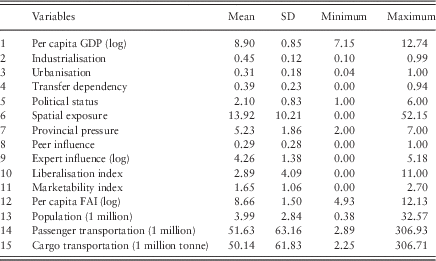
Note: Observations=4,632.
GDP=gross domestic product; FAI=fixed asset investment.
Method
In order to model the formation of PPP in a city, I used a binary variable to indicate whether a PPP project reached financial closure in a given year in a given city. These data have a clustered structure, which means a city can adopt multiple projects in a year or multiple projects in different years. This suggests that adoption decisions made by the same city are likely to display similar, correlated values on several variables as a function of the city characteristics’ influence. This violates the statistical assumption about the independent observation of traditional regression methods. If the within-cluster correlation is not accounted for, the parameters’ standard errors may be biased. In addition, as I am also modelling the effects of provincial-level features on the outcome variables, I used a three-level multilevel mixed-effects model to estimate the effects of the covariates in Stata. I specified three random effects: year, city id and province id.
Results
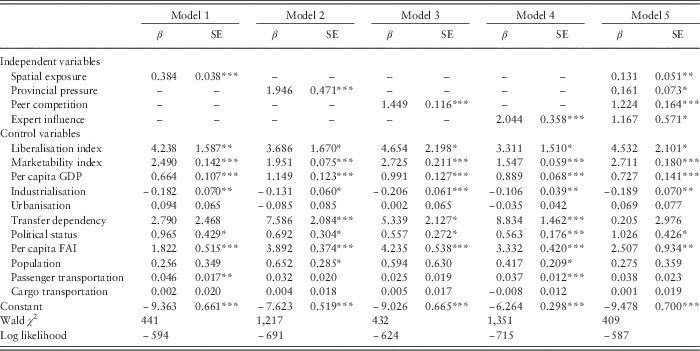
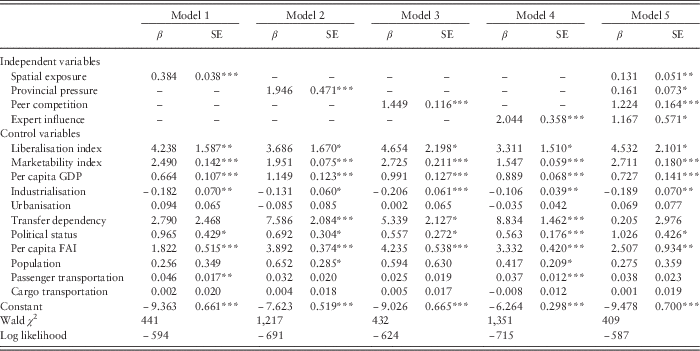
In this section, I first test the main effects of the four diffusion mechanisms and then explore how the nature of different liberalisation practices moderate the effects of these diffusion drivers. Table 4 presents the estimations from multilevel mixed-effects models. Model 1 tests H1, which postulates that a city is more likely to implement liberalisation reform if it is exposed to more adoption cases. The mechanisms underlying this spatial contagion hypothesis are social learning and competition. Spatial exposure captures the learning and competition that occurs between geographically proximate cities. The coefficient of the spatial exposure variable is positive and significant (β spatial exposure=0.384, p<0.001), suggesting that the adoption of PPP projects in neighbouring cities increases the focal city’s likelihood of adopting PPP projects, given other conditions are equal.
Multilevel mixed-effects models predicting the adoption of PPP projects
Note: n=4,632.
PPP=public-private partnerships; GDP=gross domestic product; FAI=fixed asset investment.
*p<0.05, **p<0.01, ***p<0.001 (two-tailed tests); Huber-White robust standard errors are reported.
Model 2 tests H2, which states that the intensity of provincial pressure will positively affect a lower-level city’s likelihood of adopting liberalisation policies. The model results show that the coefficient of the provincial pressure variable is positive and significant (β provincial pressure=1.946, p<0.001), suggesting that policy guidelines from the provincial level affect local governments’ liberalisation decisions. H2 is thus supported.
Model 3 explores the effects of peer pressure on adoption decisions. The positive and significant coefficient of peer competition (β peer competition=1.449, p<0.001) shows that, as the density of the adopters increases within a peer group (usually comprising same-level governments in a province), those who do not have PPP projects feel compelled to adopt similar means to improve the efficiency of their infrastructure facilities. It is important to note that the spatial contagion hypothesis and the peer competition hypothesis based on institutional theory share similar insights. Both emphasise the influence of social learning and competition among a group of actors; however, by comparing the effect size of these two covariates, we can see that similarities of the structural position in the same local political system are more predictive than the spatial proximity of cities.
Model 4 tests the effects of expert influence on the diffusion process. The coefficient of the expert influence variable is positive and significant (β expert influence=2.044, p<0.001), suggesting that ideas from the epistemic community can exert a significant impact on local governments’ liberalisation decisions. H4 is thus supported. Model 5 incorporates all four diffusion mechanisms. The results show that the effects of these four mechanisms still remain. In addition, the model results indicate that the liberalisation index of the contract arrangement and the marketability of PPP projects significantly affect the diffusion of liberalisation policies.
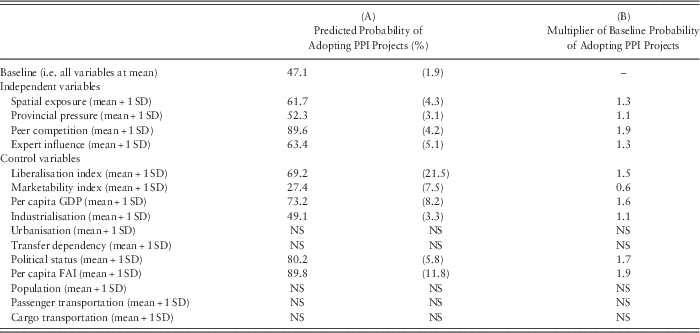
To better interpret the magnitude of the independent variables, Table 5 reports the predicted probabilities of the adoption of PPP projects. The numbers in column A show the predicted baseline probability and predicted probabilities associated with 1SD change in a variable, given other variables take their mean values. Column B shows the multiplier of the baseline probability associated with 1SD change in a variable. For example, if the spatial exposure is 1SD above its mean, then a city is 1.3 times more likely (61.7%) to form a PPP with a private party than a city with an average spatial exposure (47.1%) given all other variables are at their mean values. The results also show that the positive effects of peer competition on the formation of a PPP are greatest among four different institutional forces.
Estimated magnitude of the effects of variables predicting the adoption of PPI projects
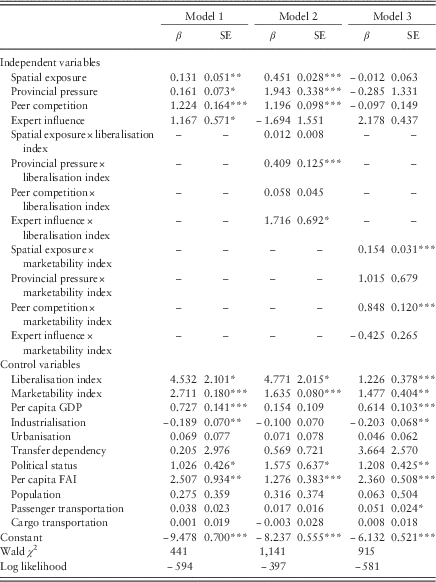
In addition to the tests of the main effects of the different diffusion drivers, I also explored how contract forms and sectoral differences condition the effects of different diffusion mechanisms. Table 6 presents the results of the analyses. Model 1 shows the main effects of the covariates. Model 2 tests H5a. I include interaction terms between the liberalisation index and the four diffusion mechanism variables. Model 3 tests H5b. I include interaction terms between the marketability index and the four diffusion drivers. As the liberalisation index captures the differences among different types of contract arrangements, it addresses how contract forms condition the effects of the four diffusion mechanisms. The results of Model 2 show that the interactions between provincial pressure and the liberalisation index (β provincial pressure×liberalisation index=0.409, p<0.001) and between expert influence and the liberalisation index (β expert influence×liberalisation index=1.716, p<0.05) are positive and significant, indicating that the diffusion of projects with more liberal contract forms is more powerfully affected by provincial government pressure and influence from epistemic communities. H5a is thus supported.
Multilevel mixed-effects models predicting the adoption of PPP projects
Note: n=4,632.
PPP=public-private partnerships; GDP=gross domestic product; FAI=fixed asset investment.
*p<0.05, **p<0.01, ***p<0.001 (two-tailed tests); Huber-White robust standard errors are reported.
The marketability index captures the differences among the different infrastructure segments. They vary greatly in terms of the ease of using market means to operate the facility and the ability to recover the investment in a given time period. This analysis thus addresses how the effects of the diffusion mechanism vary according to the extent of liberalisation of the projects. Model 3 shows that the interaction terms between spatial exposure and marketability index (β spatial exposure×marketability index=0.154, p<0.001) and between peer competition and marketability index (β peer competition×marketability index=0.848, p<0.001) are positive and significant. This suggests that the diffusion of projects that are more marketable is more forcefully promoted by competition among neighbouring cities and by cities in the same peer group. H5b is thus supported.
Discussion and conclusions
This study explored the mechanisms that underlie the diffusion of PPI projects among Chinese cities. Previous studies on policy diffusion fall short in integrating the explanations of different theoretical traditions (Wejnert Reference Wejnert2002). Because learning, competition, imitation, coercion and normative mechanisms typically all point to an increased likelihood of policy adoption, scholars often simply assess whether an effect exists without comparing the relative strength of these effects or considering whether these mechanisms may function differently in a certain context (Dobbin et al. Reference Dobbin, Simmons and Garrett2007; Shipan and Volden Reference Shipan and Volden2008). Regarding these issues, this study took multiple plausible alternative mechanisms into account and applied them to the study of related but qualitatively different diffusion processes to sort out which mechanism operates well in what context and how their effects are potentiated or mitigated by the nature of the practices under study (Henisz et al. Reference Henisz, Zelner and Guillen2005; Dobbin et al. Reference Dobbin, Simmons and Garrett2007).
Previous studies have shown that policy adoptions are often influenced by cities’ internal characteristics, economic competition and various institutional forces. I found that the diffusion of infrastructure liberalisation policies is no exception. Vertical mechanisms, such as pressure from provincial governments and professional ideas from policy research professionals, and horizontal mechanisms, such as competition among neighbouring cities and imitation among peer cities, all lead to an increased probability of adopting the PPP model in infrastructure sectors. However, when I incorporated the four often-studied diffusion mechanisms in the same study, I discovered new relations among these four mechanisms. Borrowing insights from spatial diffusion theory and social contagion theory, I explored the influence of neighbouring cities and structurally equivalent peer cities on focal cities’ liberalisation decisions (Wejnert Reference Wejnert2002; Dobbin et al. Reference Dobbin, Simmons and Garrett2007). It is worth noting that, although these two perspectives share similar insights and highlight the influences of social learning and competition among a group of actors, they do not complement each other in the process of liberalisation policy diffusion. The results suggest that cities’ similarity of structural position in the political system is more predictive of liberalisation policy than spatial proximity. This finding echoes arguments that the effects of spatial variables appear to be significantly modulated when focal actors and their alters are connected via nonspatial social and cultural relations (Strang Reference Strang1990). The underlying cause may be that the experiences of peer cities are more suitable to focal cities because of the similar microsocial and political contexts in which they are embedded. Moreover, the results of competition among neighbouring cities only affect the distribution of economic resources, whereas competition among peers in the same local political system not only has distributive consequences but also affects the political prospects of local leaders.
More importantly, this study contributes to policy diffusion literature by introducing variation to the practices that are being diffused and by finding that the effects of the four diffusion mechanisms are affected by sectoral differences and the nature of the contracts being used. Two measures, i.e. the marketability index and the liberalisation index, were used to capture the differences among different infrastructure segments and different PPP contracts. The results show that the liberalisation index positively moderates the effects of the vertical diffusion mechanism, i.e. provincial pressure and expert influence. This suggests that, in the Chinese context, when adopting more-liberal contract forms and giving private investors more rights over infrastructure projects, higher government approval and policy research professionals’ legitimation are more important than other forces in affecting local policymakers’ decisions. In addition, the results also indicate that the marketability index positively moderates the effects of horizontal diffusion mechanisms, i.e. spatial exposure and peer competition. This suggests that the diffusion of liberalisation policies in more marketable sectors is more forcefully driven by interjurisdictional competition and imitation.
This study has several important limitations. First, because this study was conducted at the city level, the collection of complete longitudinal data on various local social, political and economic indicators was difficult. This is especially challenging in a country with considerable disparities in local efforts on information disclosure. Therefore, data that can be used to construct valid measures are scarce. The findings may have been stronger and new effects may have emerged had the data been more complete. Moreover, the operationalisation of provincial pressure and expert influence represents one of the many possible ways of quantifying these two mechanisms. How to properly extract information from the qualitative and archival data is a challenge for most researchers. My operationalisation used only very limited information embedded in these data. Future scholars may further explore these data and construct new measures. Lastly, although the Chinese context provides a good case for testing the hypotheses and exploring the differential influence of the four diffusion mechanisms, it represents only one of many contexts that have experienced a significant liberalisation process. Therefore, my findings are context specific on the one hand, but on the other hand the vertical and horizontal diffusion forces are also evident in the diffusion processes in other institutional contexts. The findings of this study may thus help researchers in these economies to better understand the nature and process of policy diffusions.
Acknowledgements
The author is grateful to Peter John and four anonymous reviewers from the Journal of Public Policy for their insightful and constructive comments. The author also thanks Nan Lin, Lisa A. Keister, Bai Gao, Ken Spenner, Gary Gereffi and Ting Li for their helpful suggestions.