Introduction
In a recently published survey of popular science writing in early twentieth-century Britain I provided an overview of the science magazines available during this period based on a representative sampling of many relevant publications (Bowler Reference Bowler2009, chap. 9). This article extends that analysis, although with a narrower focus, using a database which is being assembled listing all significant articles in the three most important magazines published during the interwar years, Conquest, Discovery, and Armchair Science. The main goal of the study is to throw light on the production of the articles published in these magazines, identifying (as far as possible) the background of the many authors who contributed. Developing the argument of the earlier study, I will show that professional scientists and technical experts were active in writing for the general public in these magazines. Whether we study books or magazines, we find little evidence that professional scientists wanted to abandon popular writing, at least when it had an educational purpose. They published alongside a small cohort of science writers who were professional or semi-professional in the sense that they gained part of their income from fees and royalties. Some of these figures had close links with the scientific community, although they were not science correspondents in the modern sense of the term because they provided information about established knowledge rather than the latest developments. Much of the writing was done by expert amateurs in areas such as astronomy, natural history, and popular new technologies such as radio. These were individuals who had detailed knowledge of the fields they wrote about without being engaged in teaching or academic research.
The term “readership” is included in the title of this paper because the survey will also show how the different target audiences at which the three magazines were aimed determined their choice of authors. The intended readership also seems to have influenced the extent to which the degree of expertise possessed by the authors was displayed to the reader on title pages and in lists of contents. Popular science magazines have always had to choose between strategies based on education or strategies based on entertainment. If education is perceived as the goal – the strategy employed by Discovery – expert authors who can write with authority are preferred and their qualifications are always listed. The more popular magazines – Conquest and Armchair Science – did not presume that their readers wanted to acquire detailed technical information and realized that they would only succeed if their articles were entertaining as well as informative at a more general level. Armchair Science preferred authors who were not professional scientists, on the grounds that professionals allegedly could not write non-technical literature. Conquest was more willing to take material written by professional scientists, but sometimes chose not to publicize the fact that the authors had technical qualifications, presumably hoping to present a less forbidding appearance to the casual reader.
The analysis presented here has been developed in the context of the critique of what has been called the “dominant view” of popular science launched by sociologists and historians of science. According to the dominant view, science is done by professional scientists largely isolated from the public and its results are communicated to the public (often in a simplified form) by writers who are not necessarily scientists themselves. It is presumed that the public is, or at least ought to be, interested in learning about scientific and technical developments that may impinge on their lives. But there is little influence directed from the public to the scientific community – the public are essentially passive receivers of knowledge established “above their heads.” The dominant view was popular among scientists in the late twentieth century, although it has now become obvious that the scientific community cannot afford to remain indifferent to public concerns (critiques include Hilgartner Reference Hilgartner1990 and Whitley Reference Whitley, Shin and Whitley1985). Historians dealing with the period before the emergence of the modern scientific community around 1900 have also attacked the dominant view, pointing out that engagement with the public through lectures, demonstrations, and popular writing was once a key factor in gaining recognition as an expert. Taking the public's concerns into account was thus a vital part of a scientist's work, and there was no clear line of demarcation between research and popularization (Cooter and Pumphrey Reference Cooter and Pumphrey1994; Morus Reference Morus1998).
There are certainly problems with the dominant view, but in Science for All I argued that there were circumstances, most notably in the early twentieth century, when the “top down” model of dissemination from experts to a public eager to learn had some success. It worked in part because professional scientists and their allies were still willing to write at a level which the ordinary public could understand. More importantly, though, it worked for a particular segment of the public that was looking to “improve itself” by what might be called self-education, that is, education pursued at home rather than through formal academic study. In this period there were many who had a secondary education but no opportunity to go on to college or university. At best they might attend informal courses run by institutions such as the Workers Educational Association, but mostly they read at home or with friends. Publishers were well aware of this potential audience and launched numerous series of self-education books such as the Home University Library. They also issued serial works in magazine format which accumulated to form an encyclopedic survey of a field – The Science of Life, written by biologist Julian Huxley in collaboration with the popular author H. G. Wells and his son, was first published in this way (Wells, Huxley, and Wells Reference Wells, Huxley and Wells1929–30). Professional scientists who could write at this level were eagerly sought by publishers because their qualifications could be presented as an indication to the reader that the text carried some authority, something of value to those seeking self-improvement. Many responded to the call, and a few – including Huxley – undermined their careers as research scientists by taking on too many writing commissions. Most, however, wrote only a few texts and seem not to have suffered any criticism from their colleagues.
Serial works could sell many tens of thousands of copies, but most self-education books depended on accumulated sales over several years to make a profit. Only a small proportion of the population was sufficiently interested to spend their time and money on this activity, and only a fraction of these chose to read about science. For most ordinary people, the only information and comment about science they would encounter would be in the pages of newspapers or popular magazines. Here we know that there was only a very small amount of space devoted to science, and the accounts tended to be written by journalists with little knowledge of science who produced texts that the majority of professional scientists thought were both trivialized and sensationalized. Some modern commentators have seen this as a disaster for the relationship between the scientific community and the public, a reaction typical of those who favor the dominant view (e.g. Burnham Reference Burnham1987). But as Peter Broks (Reference Broks2006, 66–67) has pointed out, this kind of literature is intended to provide entertainment more than education, and the science it contains has to be presented accordingly. In a detailed study of British popular magazines of the early twentieth century, Broks (Reference Broks1996) has shown that editors and publishers knew what would sell magazines and would only work with authors who could write at the appropriate level. They were inclined to distrust professional scientists precisely because they would not avoid technical jargon, and only a few working scientists were willing and able to break through this barrier to communicate directly with the general public.
There were, of course, magazines for those who really needed to keep up-to-date in science, including Nature and Science Progress. There were also special-interest magazines for those enthusiasts and hobbyists who were attracted to certain areas of science, including astronomy, natural history, and new forms of technical gadgetry such as radio and photography. In these there might be a good deal of technical knowledge on display, and material might be supplied by writers who were either professional scientists or technicians, or by expert amateurs. Enthusiasts learned how to build their own equipment and often developed considerable technical knowledge without having had any formal training. Some of these informal experts had close contact with the professional scientific or technical communities, but others favored a more independent approach and were suspicious of academic education. Their attitude to expertise was closer to that prevalent in America, where Thomas Edison was a folk hero precisely because he had succeeded despite lack of formal education (LaFollette Reference LaFollette1990). In Britain, the work of “Professor” A. M. Low best encapsulated this model of “everyman his own inventor,” providing a popular alternative to the academic community's efforts to arouse public interest in scientific progress.
Low was a major contributor to the most popular of the three science magazines studied in this article, and his involvement highlights the problems encountered by this particular format of publication. A general science magazine aimed at a wide readership might appeal to several very different groups, and what appealed to some readers would be of little interest to others. Those looking for self-education material wanted texts displaying a certain amount of authority and expertise, but articles written at this level would not appeal to readers used to the sensationalized reports found in the most popular general magazines. The enthusiasts wanted news on their area of special interest but would have limited patience with broader surveys of science. The editors would also have to strike a balance between offering news of the latest developments and providing educational material on existing knowledge. The magazines we shall study here certainly tried to reach the self-education readers, but they were unable to match the success of the serial works which – although in the same physical format as a magazine – had the advantage of adding up to provide a comprehensive encyclopedia for a particular subject. We shall see how the three magazines adopted differing strategies in the attempt to balance the needs of their diverse potential readerships, calling on significantly different types of authors to supply what they thought would be appropriate material.
The Magazines and Their Contents
Many of the popular magazines available in the first decade of the twentieth century ceased publication during the Great War. Nature continued, but had by this time become a journal aimed mostly at the scientific community rather than a general readership. The three magazines studied here were all founded in the interwar years, Conquest in 1919, Discovery in 1920, and Armchair Science in 1929. Conquest changed its name to Modern Science in 1926 and ceased publication soon thereafter. Armchair Science in effect filled the gap left by the demise of Conquest, since both were targeted at the same very general readership. Discovery occupied a different niche – it was a product of the elite scientific and academic communities and was aimed at readers who had a serious interest in learning about the latest developments. Like Armchair Science it survived into the early years of World War II.
The differences between the magazines illustrate the diversity of publics that could be seen as recipients of the information purveyed by a popular science magazine, and the problems this created for publishers. To succeed they would have to compromise between entertainment and education, and getting the balance right proved to be very difficult. Conquest and Armchair Science were both commercial enterprises that needed to attract a large readership, and they did this by targeting general readers who had little formal education in science but wished to pick up some information about scientific and technical developments which might affect their everyday lives. The majority of such readers required that the information be presented in an easy-to-read format, without specialist terminology, and with a sugar-coating of entertainment. There was comparatively little discussion of pure or theoretical science, and a tendency to include topics that the professional scientific community would probably have considered irrelevant. They used quizzes, question-and-answer sections, and readers’ letters to encourage the readers to become engaged with the magazine on a regular basis. The failure of Conquest shows that it was hard to attract a sufficient readership, even given such attempts at popularization. Armchair Science adopted an even more populist tone and survived though to the start of World War II, although by this time it was commissioning very little original material. Discovery was much more a “top-down” vehicle for promoting what the scientific and academic communities thought was important. Significantly, it was supported at a loss by the publisher, who thought that its mission was worthwhile despite a very limited readership.
Conquest was founded in 1919 by the Wireless Press, which specialized in publishing books and magazines aimed at the expanding body of amateur radio enthusiasts. Its editorials proclaimed its policy of supplying information that was vital to anyone wishing to learn about how science and technology were transforming modern life, presented in a manner that was easy for the person on the street to read. Efforts were made to encourage members of the scientific community and those with technical expertise to contribute, provided they could write at the appropriate level (see for instance Anon. 1926). As we shall see, there were many who responded to this call. The contents focused on applied science and technology, but theoretical issues were occasionally covered and there were regular features on astronomy and natural history. The magazine sold for one shilling and the cover of the June 1921 issue claimed a circulation of 15,000. In the last few years before it changed its name and ceased publication the topics covered were extended to include some material on geographical exploration, archaeology, and anthropology. This brought the magazine more into line with Discovery, and when Conquest/Modern Science closed, its subscribers were transferred to the rival publication.
Those subscribers would have had a shock, however, because Discovery had a very different ethos and assumed a greater degree of sophistication in its readers. The magazine was founded in 1920 in response to concerns articulated in a government commission on science education chaired by the physicist J. J. Thomson. Thomson and other distinguished members of the scientific and academic communities were on the editorial board. Discovery was intended to be something more than a science magazine and at first included articles on a wide range of areas where “discoveries” were taking place, including exploration, anthropology, archaeology, and even modern history (where new evidence had emerged). The intention was to present science as an equivalent source of intellectual innovation, a very different motivation to the practical interests assumed for the readers of Conquest. Applied science was not ignored completely, but it was by no means the dominant theme. The non-scientific subjects at first took up nearly half the coverage, although the proportion gradually declined and by the late 1930s Discovery had become more or less a dedicated science magazine. Not surprisingly, given the motivations of its founders, most of the authors were professional scientists or academics, or at least had appropriate academic or technical qualifications. The presentation tended to assume at least a basic education in science and the other areas covered, and there was no effort to include quizzes or other apparatus designed to encourage the casual reader. The original price was sixpence, although this was soon raised to one shilling. The editor in the last few years before the war was C. P. Snow, and when the magazine closed (temporarily, as it turned out) he described the problems created by the need to be both educational and entertaining and conceded that the circulation had never been enough to make money for the publisher (Snow Reference Snow1940, 117–118). After early sales of 18,000 per month, the figure soon dropped to around 4,000 (Bowler Reference Bowler2009, 176).
Armchair Science was founded to fill the niche vacated by Conquest/Modern Science, and it too was the product of a group concerned mainly with the practical applications of science, including the aviation pioneer J. T. Moore-Brabazon. The science advisor and later editor was “Professor” A. M. Low, an inventor and popular science writer, a figure much distrusted by the scientific community, partly because he was not a professor and in fact had no academic education or standing (Bloom Reference Bloom1959). Low was an inventor who supplemented his income with popular writing, and although an enthusiast for scientific and technical progress he was suspicious of academic science and of government and big business. An editorial proclaimed the magazine's intention to produce literature that could be read by ordinary people and suggested that professional scientists were incapable of writing at that level (Anon. 1929, 11). The impression was that all the copy would be supplied by writers rather than scientists, although in fact a small but significant number of trained scientists did contribute. The magazine used an ever increasing proportion of features intended to attract ordinary readers, including material on popular topics such as sport, entertainment, and household gadgets. There was also an increase in features encouraging involvement by readers, going far beyond the level employed by Conquest and eventually including quizzes, competitions, letters pages, and question-and-answer sections (the expansion in the percentage of editorial material shown in fig. 2 is due to this factor). There was even some fiction, including the serialization of a science fiction novel by Low. Much of the magazine's contents reflected Low's vision of technical progress achieved by lone amateur inventors, rather than by scientists based in universities or large industrial concerns. To encourage a wider readership the magazine was initially priced at sevenpence, although this was eventually raised to one shilling. Low claimed a circulation of 80,000, but this was a wild exaggeration and Brabazon later conceded that the magazine was a financial failure (see his introduction to Bloom Reference Bloom1959, 12). In the course of the tenth volume there was an abrupt change of format: the magazine was now produced in “pocket size” and the price dropped to sixpence. The contents changed to include multiple sections of short items on certain popular themes, with all the major articles being reprinted from other magazines, many of them American.
In its final form Armchair Science came to resemble an earlier magazine, Popular Science Siftings, which had survived the Great War and lasted until 1927 with a change of title to Popular Science: The Chatty Weekly in its final year of publication. As the later title suggests, this was aimed at a very general readership and the magazine would have been disowned by the scientific community because it frequently included material on pseudoscience, as well as features on non-scientific topics. It is not included in the present study, but this is not because its tendency to trivialize science for the casual reader renders it inappropriate for the study of popular science. After all, both Conquest/Modern Science and Armchair Science included material that might seem inappropriate in a magazine intended to provide serious information about science. Popular Science Siftings could not be included because (like the successful weekly Tit-Bits) its contents consisted mostly of short, anonymous articles, making it impossible to gain any clear impression of who provided most of the material. The magazines studied here certainly contained some anonymous material (details below) but the proportion was relatively small, allowing us to identify the authors of most of the contents and in some cases their backgrounds and qualifications. Unlike Science Siftings, these publications did not make use of a large number of very short pieces, and when small items were included they were generally grouped together in editorial features with titles such as “Science News.”
The Survey and Its Methodology
The analysis in this paper uses part of a database which is being assembled to provide details of all significant articles and features published in the three magazines during their years of normal publication. All items consisting of a full page of material or more are listed (“full page” being interpreted generously so as not to exclude articles where an advertisement or other very short feature takes up a small proportion of the page). The average length of articles in all three magazines was between two and three pages. For Conquest, volumes 1–6 are included, omitting the final volume during which the name changed and publication abruptly ceased. For Discovery, all articles on scientific or technical topics in volumes up to 1939 (the year in which war broke out) are included. Armchair Science is surveyed for volumes 1–9, omitting the volume in which the format changed as noted above. The database will ultimately include authors and titles, allowing changing patterns of contents to be analysed. This article uses a more restricted set of information focused on the type of material (authored, editorial, and anonymous) and a complete listing of authors along with any information provided about their expertise in science or technology. The category “editorial” covers all items where it is presumed the editorial staff was responsible for writing or assembling the material, including actual editorials, quizzes, readers’ letters, etc.
Research so far has thus yielded a complete list of all authors who wrote for the magazines in the designated years, along with what information was supplied about their qualifications, academic or professional positions, membership of learned or technical institutions, and other indications of expertise.Footnote 1 Unfortunately the complete list is too large to be made available in print, but is available on-line. The sheer number of individuals involved (1,355), coupled with the obscurity of many, has made it impractical to check the information supplied about qualifications and positions. It should be remembered, however, that it was in the interests of both the authors and magazines to provide evidence of genuine expertise. Those authors for whom explicit indications of training or experience were supplied are designated as “Qualified” in the data supplied below. In some cases informal evidence was supplied of expertise by indicating that the author was “a well-known authority” on the topic, or a similar description, and again this has been taken at face value. It should be noted that in some areas, including astronomy, natural history, and technical hobbies such as radio and photography, there were enthusiastic amateurs who possessed significant levels of expertise. Another indication was provided by noting that the author had also written books on the topic. Authors for whom such informal evidence of expertise was indicated are designated as “Experts.” It should be noted that for authors who wrote more than once for the same magazine, the relevant information might not be supplied in every article (although it often was).
In addition to the complete list of authors, tables have also been assembled for each magazine showing (a) the percentage of authored, editorial, and anonymous material in each volume, and (b) the percentage of authors who were qualified or expert according to the definitions given above. The percentage of authors who could be positively identified as female has also been noted. These tables will allow analysis of the differing strategies of the magazines in terms of the proportion of qualified or expert authors used, and will also identify any changes in the strategy over time. To complicate matters we shall also have to take into account the fact that in some cases, especially with the two more popular magazines, there was a tendency to conceal the expertise of the authors on some occasions, possibly to avoid giving the appearance of being too “highbrow” for the general public.
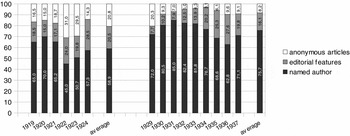
Before passing on to give details of the authors, the proportion of anonymous material in the magazines needs to be addressed. At the start of this research I had assumed on the basis provided by magazines such as Tit-Bits and Popular Science Siftings that the more general the readership targeted, the higher would be the proportion of anonymous material. This prediction has been falsified by the data provided in figs. 1 and 2. The most serious magazine, Discovery, had an average of 8.2 per cent anonymous material, rising from almost negligible proportions in the early years to a peak of 18.1 per cent in volume 14 (1933) and then dropping back to a trivial level when C. P. Snow took over in the late 1930s. The most popular magazine, Armchair Science, had exactly the same proportion of anonymous material over the volumes studied, 8.2 per cent. In this case publication began with a high of 20.3 per cent anonymous material and then dropped to a low of 3.1 per cent in volume 6, rising back to 9.1 per cent in the last volume surveyed. The highest proportion of anonymous material was published by Conquest, which averaged 20.8 per cent, with a peak of 31.0 per cent in its fourth volume. Although adopting a popular tone, Conquest had maintained a somewhat more academic format than Armchair Science, so the proportion of anonymous material was clearly not determined by publication strategy. The high proportion of anonymous material in Popular Science Siftings was probably linked to its use of many very short and often trivial articles. These might well have been written by journalists with no technical knowledge.
Percentage of authored, editorial, and anonymous articles in Discovery, vol. 1 (1920) – new series vol. 2 (1939).

Percentage of authored, editorial, and anonymous articles in Conquest, vol. 1 (1919) – vol. 6 (1924) and Armchair Science, vol. 1 (1929/30) – vol. 9 (1937/38).

It should also be noted that Discovery maintained a higher proportion of editorial material than the other magazines, averaging 23.7 per cent to Conquest’s 20.5 per cent and Armchair Science’s 16.1 per cent. Since Discovery did not employ quizzes and similar techniques used to encourage reader participation, this indicates much more substantial provision of editorial comment and news items.
The Authors
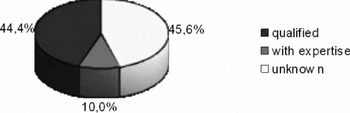
The list of authors compiled as above includes 1,355 names, a surprisingly large number which already points toward some significant conclusions (fig. 3). In my book Science for All I showed that a large proportion of the educational popular science produced in this period was written by authors who were professional scientists and technicians, or at least had significant training or interest in the relevant fields. I predicted that a detailed survey of the magazines would yield many more names of trained or professional scientists willing to write at least occasionally at this level. The reason why the list of magazine authors is so large is that it does indeed include a large number of individuals who had some training or experience, and who wrote only a small number of pieces on topics of special interest to them. There were few if any professional science writers willing to write on any topic in order to make money. There certainly were a small number of experts who wrote regularly in areas where there was considerable public interest, especially astronomy, natural history, and scientific hobbies such as radio. But these were exceptions and the vast majority wrote very little. One suspects that they were persuaded to write something on a topic of particular interest to them but did not find the experience sufficiently rewarding to continue. Only a few who found it easy to write at a suitable level continued to submit articles, the most active producing a stream of articles over many years.
Qualification of authors (total 1,355, qualified 602, with some expertise 135).

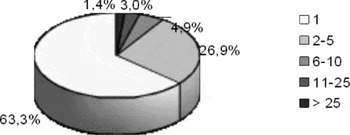
Of the 1,355 authors identified, 857 or 63.3 per cent wrote only a single article; 364 or 26.9 per cent wrote between two and five articles, so we have a total of just over 90 per cent who wrote no more than five pieces over the twenty-year period covered by the survey (fig. 4). This is clear evidence that much of the material was being produced by people who were not “regular” authors, most of whom wrote solely on specific topics of direct relevance to their research or area of technical expertise. In the case of Discovery, authors were almost certainly approached by the editor and requested to write on a specific topic. Conquest openly appealed for those with technical expertise to submit articles. Such appeals were clearly successful, but only a small proportion of those who responded went on to become regular authors.
Productivity of authors (total 1,355; with only one publication 857; 2 to 5 publications, 364; 6 to 10, 66; 11 to 25, 20; over 25 publications, 39).

Sixty-six authors, 4.9 per cent of the total, wrote between six and ten articles, and 40 or 3.0 per cent wrote between 11 and 25 articles (fig. 4). Only 19 or 1.4 per cent wrote more than 25 articles, but a few of these wrote very extensively. A. M. Low wrote at least one signed piece every week for Armchair Science, a total of 219 articles, and was probably responsible for all the unsigned editorials entitled “In Our Opinion,” adding another 108 over the period covered. R. I. Pocock, superintendant at the Zoological Society of London, wrote a regular natural history column for Conquest and ultimately produced over 60 articles. Ralph Stranger (a pen name) wrote 47 articles on radio for Armchair Science. Joseph H. Elgie, who was a member of the British Astronomical Association, wrote columns over several years for both Conquest and Armchair Science, producing a total of 39 articles. Harold J. Shepstone, a Fellow of the Royal Geographical Society, wrote on topics ranging from natural history and geology to transport and civil engineering. He was wealthy enough to have traveled the world gathering information for a book on zoological gardens and game reserves (Shepstone Reference Shepstone1931). These individuals had obviously become semi-professional science writers, but this does not appear to have been their only source of income. Only Low and Shepstone wrote across a wide spectrum of topics (although the latter avoided the physical sciences) – the others specialized in their own field of expertise.
Another indication of the relative inexperience of the majority of authors is the fact that very few wrote for more than one of the periodicals – regular science writers would have been anxious to place their pieces in as many outlets as possible. Only three individuals wrote for all three magazines, the most prolific being Shepstone, who wrote 37 articles for Armchair Science, seven for Conquest and five for Discovery. Some of the most prolific (e.g. Low and Pocock) wrote for only one magazine. Twenty-three authors wrote for both Conquest and Discovery, although most produced only a handful of articles. Twenty-one wrote for both Discovery and Armchair Science, ostensibly the least likely combination given their very different publication strategies. One would have expected a much greater continuity between Conquest and Armchair Science, since they successively occupied very similar niches in the market, yet only 11 authors actually made the transition. There is thus very little evidence of a significant body of general science writers seeking to place their work in whatever magazines were available.
It is also worth noting that some authors specialized in writing for either books or magazines. Low and Pocock did write widely in both formats, but Shepstone wrote only one book in the period covered by this survey (although he published several after World War II). Two of the most prolific writers of popular science books in the period, Charles R. Gibson and Archibald Williams, wrote nothing for any of the three magazines studied here.
In Science for All I provided a Biographical Register which listed 550 authors, mostly those who had written books on popular science (Bowler Reference Bowler2009, 279–94). Three-hundred and twenty-one or 58 per cent were either trained scientists, as indicated by possession of a degree or similar qualification, and/or occupied a position at a teaching or research institution. Of the 1,355 names in the magazine database, only 90 can be found in the Biographical Register, showing that there was a much wider field of authors available for the (perhaps less challenging) job of writing articles. Seventy-five of these wrote for Discovery, 14 for Conquest and nine for Armchair Science, suggesting that the more popular magazines drew their authors from a less experienced group (as measured by book authorship).
Of the 1,355 magazine authors, 602 or 44.4 per cent were qualified scientists or technical experts by the definition given above. Seventy-six of these appeared in the Biographical Register based mainly on book authorship, so that 526 names of qualified individuals have been added to the overall total of those contributing to popular science writing in one way or another, giving a grand total of 847. These figures confirm the point made in Science for All that a significant fraction of the country's professional scientists and technical experts were willing to write at least occasionally for a non-specialist readership. One-hundred and thirty-five or 10 per cent of the magazine authors had some form of expertise indicated informally, so well over half (54.4 per cent) can be positively identified as having some level of expertise in the fields they wrote about. They include a few famous names such as Julian Huxley and J. B. S. Haldane, but most had a much lower profile within the scientific community. In Science for All I noted that salaries for junior scientists were very poor at the time, so the prospect of earning a few pounds from writing the occasional article might have seemed quite attractive.
We can only speculate about the others for most of whom no formal evidence of expertise was provided. Like the qualified scientists, many wrote only one or a small handful of articles. Since the magazines carried some material on topics that were not strictly scientific, some may have been journalists or hack writers who just happened to produce occasional manuscripts that the magazines were willing to publish. But in the case of more technical articles it is hard to imagine ordinary journalists taking the time or trouble needed to acquire enough information to write at this level. My presumption is that many of these authors were enthusiastic amateurs with an interest in science or technology who (like their formally qualified brethren) chose to write mainly on topics they felt comfortable with. Individuals described as “qualified” here include those who gained membership in the various organizations conferring recognition of expertise, including the Royal Astronomical Society and the Linnaean, Zoological, and Geological Societies. In such societies professional scientists rubbed shoulders with highly experienced amateurs, and individuals from both backgrounds had the opportunity to write for a wide audience. Harold J. Shepstone, for instance, was a Fellow of the Royal Geographical Society, which indicated some level of engagement with the expert community in this area, although he seems to have had no formal technical education. His status was similar to that of Joseph H. Elgie in astronomy and many writers on natural history topics. The same was true for writers on technical topics such as radio and photography. Some of these writers may have shared Low's suspicion of the academic scientific community and the role of large industrial research organizations, preferring to support the work of lone amateur inventors. But others maintained contacts with the professionals and with industry, and were able to exploit such contacts to ensure that their texts were checked for accuracy by experts and to obtain photographs etc.
Sixty-three or 4.7 per cent of the magazine authors could be positively identified as female. This may well be an underestimate since a large proportion of the authors were identified by initials only and this may have been used to conceal the fact that some were women. But as noted in Science for All, the scientific community was heavily dominated by men, and if professional scientists were supplying much of the popular science literature, it is hardly surprising that women would be poorly represented. The significant body of expert (but unqualified) female popular science writers so active in Victorian times seems to have disappeared in the early twentieth century as the field came to be increasingly focused on applied science and technology.
Discovery – An Army of Qualified Writers
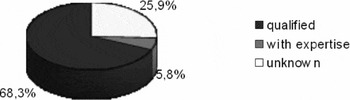
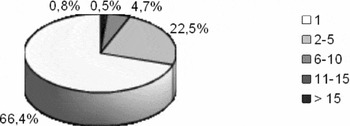
Tables compiled for the individual magazines permit an analysis of their contributors illustrating their different goals and publication strategies. Discovery, the most academic and (because it did not need to be commercially successful) the most long-lasting of the three, employed a total of 633 authors to write on scientific topics (generously interpreted) over the years studied (see fig. 5). Of these 431 or 68.3 per cent were credited with qualifications or professional status and another 37 (5.8 per cent) with some informal indication of expertise. Four hundred and twenty or 66.4 per cent wrote only a single article in the magazine, while 167 or 22.5 per cent wrote between two and five articles (fig. 6). The proportion writing only one article is the highest for any of the magazines despite the fact that Discovery ran for by far the longest period. This suggests that it was using a high proportion of authors who volunteered or were persuaded rather reluctantly to write on a specific topic. Discovery also had the lowest proportion of authors who wrote 16 or more articles (5 or 0.8 per cent), indicating that it had hardly any “regular” contributors.
Qualification of Discovery authors (total 633; qualified 431, with some expertise 37).

Productivity of Discovery authors (total 633, with only one publication 420; 2 to 5, 167; 6 to 10, 30; 11 to 15, 3; over 15, 5)

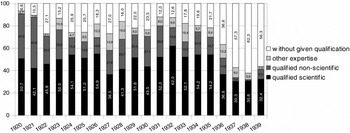
Figs. 1 and 7 provide more detailed information on the total authorship, including those who wrote on non-scientific topics such as history. This allows a comparison of those whose expertise lay in science versus those in other academic fields and also charts the changing relationship between them. Note that in the first year of publication over 90 per cent of the authors were qualified. This figure dropped rapidly but stabilized in the high 60 per cents or low 70 per cents through most of the interwar years until it apparently dropped sharply in the last few years before the outbreak of World War II (fig. 7).
Percentage of qualified authors (scientific and non-scientific), otherwise expert authors, and those without known qualification in Discovery, vol. 1 (1920) – new series vol. 2 (1939).

The decline in the proportion of qualified authors in these final years is far from easy to interpret, however. At first sight it might seem to indicate a move from employing authors derived from the scientific or academic communities to the use of unqualified writers. This may be part of the story, and would indicate that the magazine was trying to adopt a more populist strategy. But the way the figures are compiled is misleading because it relies on evidence of expertise provided explicitly on title or contents pages. Some of the individuals whose names were listed without any qualifications can be shown from independent biographical sources to have possessed qualifications – but this is simply not acknowledged. This raises an important topic to which we shall return below, the difference between actual and acknowledged levels of expertise. Citing authors’ qualifications confers an air of authority which may impress readers looking for information, but may intimidate those seeking entertainment more than education. The fact that in its late years Discovery began to omit some authors’ qualifications suggests that after years of presenting an “academic” front in which qualifications were always cited, under Snow's editorship it moved to a different strategy which appealed more to less-educated readers. The other, more popular, magazines certainly omitted qualifications from time to time.
The figures quoted above include authors on non-scientific topics, but it should be noted that the proportion of authors qualified in non-scientific areas declined from 40.0 per cent and 45.6 per cent in the first two years down to figures between 14 per cent and 28 per cent for most of the period, finally dropping to as low as 1.2 per cent in the penultimate year surveyed, 1938. This is a genuine decline indicating that the magazine had largely (although never completely) abandoned its earlier policy of balancing scientific discovery with discoveries in other areas such as geography, archaeology, and history.
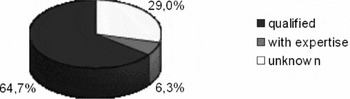
Conquest, or How to Balance Authority and Readability
Conquest was aimed at a more general readership, although we have seen that (unlike Armchair Science) it explicitly canvassed for contributions from working scientists and technical experts. Only six years were surveyed, so it is hardly surprising that the number of authors employed was the lowest of the three magazines, a total of 190 (see figs. 8 and 9). Of these 123 or 64.7 per cent were qualified by the above definition and another 12 or 6.3 per cent had informal evidence of expertise supplied. The percentage of qualified authors is lower than that for Discovery, but only by a couple of percentage points, suggesting that Conquest's appeal for professionals and experts to contribute was successful. But the magazine seems to have been better able to encourage contributors to submit multiple articles. One hundred and two, or 53.7 per cent submitted only one, while the number who contributed 10 or more articles was 12 or 7.2 per cent (fig. 9). This was in part because experts such as Pocock and Elgie were commissioned to write regular features in areas such as natural history and astronomy. There were only six female authors, none of whom wrote in the first four years of the magazine's existence.
Qualification of Conquest authors (total 190; qualified 123; with some expertise 12).

Productivity of Conquest authors (total 190; with only one publication 102; 2 to 5, 61; 6 to 10, 13; 11 to 15, 6; over 15, 6).

Qualifications were not always acknowledged, however. When the percentage of qualified authors is surveyed on a volume-by-volume basis (detailed figures not included here) we find that the figure for each individual year is always below that derived from the overall authorship, averaging 48.7 per cent. This apparent discrepancy is caused by the fact that for authors who published more than once, qualifications are sometimes listed and sometimes not. In some cases, of course, it may have been felt that the author was so well known that to keep harping on his qualifications was unnecessary. But the point already raised for the final years of Discovery may also be relevant here – Conquest wanted authoritative articles but it did not want to intimidate its readers with too extensive a display of academic credentials.
Armchair Science Reaching Out to the Amateur
Armchair Science was the most popular magazine in style and format. Unlike the other two it carried numerous advertisements, both at the front and the back and interspersed through the body of each issue. Each issue consisted of more than 60 pages, considerably longer than either Discovery or Conquest, which averaged around 35 pages and 45 pages per issue respectively. Even allowing for the space devoted to advertisements, this allowed the magazine to publish more articles. In the course of the nine years surveyed the presentation became increasingly more popular in tone. There had always been a preponderance of articles on applied science, but there were soon regular features on practical topics such as motoring, photography, radio and film, and household gadgets. There were features aimed at the housewife, allowing more women writers to play a role, although these were not scientifically trained. In fact the total proportion of female writers for Armchair Science was not significantly different to that for the other magazines.
This very different spread of topics ensured that there would be more authors from outside the ranks of the scientific and technical professions (tables 8 and 10). Given the editor's explicit statement that working scientists were incapable of writing at a level accessible to ordinary readers, it is hardly surprising that Armchair Science did, in fact, have a much smaller proportion of qualified authors than the other magazines, even for the more academic topics. Instead it had a larger percentage for whom some informal indication of expertise in the field was provided. Nevertheless, the percentage of qualified authors was far from negligible, suggesting that despite the reservations the magazine was willing to accept manuscripts from this source provided the scientists had learned how to write at the appropriate level. Of the 601 authors who wrote for the magazine over the nine years surveyed, 141 or 25.5 per cent were qualified and 51 or 8.5 per cent had informal evidence of expertise (fig. 10). There were significant fluctuations, however, and in volume five the proportion of qualified authors dropped to as low as 18.2 per cent. Armchair Science was anything but a vehicle for the scientific community to promote its views, and Low's comments on the role of academic and industrial science were frequently very negative. But over the decade in which it published it did provide an outlet for a significant number of working scientists and technical experts, although only for those who were willing to write in a very popular style. The majority of unqualified authors, many of whom wrote one or only a few articles, were probably enthusiastic amateurs – just the kind of person who would have been attracted to the magazine as a reader.
Qualification of Armchair Science authors (total 601; qualified 141; with some expertise 51).

Productivity of Armchair Science authors (total 601; with only one publication 391; 2 to 5, 154; 6 to 10, 26; 11 to 15, 8; over 15, 22).

Conclusions
The figures analyzed here provide valuable insights into the world of popular science publishing and the involvement of the scientific community (broadly interpreted) in that activity. We can see that a significant number of working scientists and technical experts contributed articles aimed at a non-specialist readership. This confirms the view that I expressed in Science for All that there was no hostility toward this activity in the scientific community, provided the material was seen as having some educational value. However, the vast majority of these individuals wrote only one or very few articles, suggesting that they were willing to write about their own specific interests but would not extend their scope to produce further articles on a broader range of topics. Only a few who were able to develop the necessary writing skills (and were prepared to spend the time) went on to become regular authors. Some may well have been attracted by the fees paid by these magazines, which could make a small but worthwhile addition to a modest professional salary or private income. The same points are probably valid for the large number of apparently unqualified individuals who also supplied articles for the magazines. Here too the majority wrote only one or a few articles, suggesting that they were enthusiastic amateurs writing on topics of particular interest rather than journalists who occasionally ventured into the realm of science writing.
The most active regulars, whether working scientists or dedicated amateurs, tended to be in popular areas such as astronomy or natural history, where there was a ready audience that the magazine could rely upon. In the applied sciences this was also the case for areas where there was a wide interest from hobbyists, such as radio, photography, or motoring. In these areas the division between professional and amateur could become blurred, because the best amateurs acquired levels of expertise almost as great as the professionals. For more technical matters and areas of theoretical science this intermingling was much less likely to occur, although professional scientists were still willing to write at least the occasional popular article if they (or an editor) felt it had sufficient appeal to catch the attention of the casual reader. Our survey has also illuminated the different strategies adopted by the magazines in an effort to get their message across to the general public, and the ways in which these strategies influenced their choice of authors. Discovery was very much a product of the scientific and academic communities. Most of its authors were professional scientists or academics and their qualifications were always stated to confer an air of authority to their work. There were few concessions to the style adopted by really popular magazines and the articles tended to assume that the reader was reasonably well-educated. Only in the final years before the war was the policy of stressing expertise abandoned, and it is significant that the editor at this time, C. P. Snow, showed that he was aware of the problem created by the tension between the desire to educate and the need to attract ordinary readers. As Snow admitted, Discovery had not been a commercial success, and the scientists who contributed had certainly not reached a large readership.
Conquest had tried to bridge the gap between education and entertainment by requiring that its articles be written in ordinary language, but encouraging scientists and experts to try their hand at producing articles at this level. It also included far more of the publishing techniques used by popular magazines to attract the general reader. Significant numbers of trained scientists and professionals did contribute, a few becoming regular columnists on popular topics such as astronomy and natural history. But the magazine was not a commercial success and closed abruptly after a temporary name change in its seventh year, suggesting that it was far from easy to attract a wide readership even when some effort was made to adjust to the format established by general magazines. Popular science, it seems, had its own problems in attracting the general reader. Armchair Science went even further down the road of popularization and had a much less easy relationship with the scientific community. It used fewer articles written by qualified scientists, although they were by no means completely absent from its pages. Since it included many topics that the scientific community would probably have thought irrelevant, it could more easily employ authors with no qualifications – although many of these were by no means regular contributors. Even here, one suspects the involvement of enthusiastic amateurs and hobbyists as well as full-time journalists and authors. Nor was Armchair Science a huge publishing success, although it did continue in the format studied here until its tenth volume, when it abandoned all effort to provide an outlet for original articles.