INTRODUCTION
During the second year of life, infants make considerable progress in acquiring the lexicon of their language community. Because language is a shared system of communication, the infant has to learn from other speakers how words refer to the world. However, it is unclear how much the speaker has to explicitly guide the infant towards forming the correct word mappings. A considerable number of studies have shown that infants' word learning is sensitive to social cues such as pointing and eye gaze (e.g. Baldwin, Markman, Bill, Desjardins, Irwin & Tidball, Reference Baldwin, Markman, Bill, Desjardins, Irwin and Tidball1996; Baldwin, Reference Baldwin1993). Nonetheless, many other researchers (e.g. Markman, Reference Markman1989; Reference Markman1990; Golinkoff, Mervis & Hirsh-Pasek, Reference Golinkoff, Mervis and Hirsh-Pasek1994; Hollich, Hirsh-Pasek & Golinkoff, Reference Hollich, Hirsch-Pasek and Golinkoff2000) have argued that the infant is biased to form particular word mappings, even in the absence of guidance from the speaker.
One proposal is that infants will map novel labels onto novel, name-unknown objects, rather than familiar, name-known objects (e.g. Hutchinson, Reference Hutchinson1986; Markman & Wachtel, Reference Markman and Wachtel1988; Merriman & Bowman, Reference Merriman and Bowman1989). Following Markman (Reference Markman1989; Reference Markman1990), we refer to this behaviour as mutual exclusivity. For example, an infant might see an object they know the name for, such as a ball, and an object they have not seen before. Upon hearing a novel label, such as wug, an infant using mutual exclusivity may associate the novel label with the novel object, rather than the ball. In principle, mutual exclusivity enables an infant to learn the meaning of new words even when the speaker does not provide overt cues, such as eye gaze or pointing towards a referent.
A number of explanations for this behaviour have been proposed. Markman (Reference Markman1989; Reference Markman1990) has argued that infants reject second labels for objects. Other explanations include the novel.name.nameless.category principle (Golinkoff et al., Reference Golinkoff, Mervis and Hirsh-Pasek1994; Mervis & Bertrand, Reference Mervis and Bertrand1994), and the principle of contrast (Clark, Reference Clark and MacWhinney1987). What all these accounts have in common is that the infant has to distinguish name-known and name-unknown objects. Alternatively, Merriman, Marazita & Jarvis (Reference Merriman, Marazita, Jarvis, Tomasello and Merriman1995) have proposed a feeling of novelty principle, a strategy of mapping novel labels to objects which feel novel. Hence, even without knowing or retrieving the name for the familiar object, the infant maps the novel label to the novel object. Some investigators have focused on deciding between these different theories (e.g. Merriman & Schuster, Reference Merriman and Schuster1991; Markman et al., Reference Markman, Wasow and Hansen2003). However, in this article we explore the question of whether evidence for mutual exclusivity is also evidence of word learning.
To understand the impact of mutual exclusivity on vocabulary development, it is important to examine carefully what has been demonstrated in prior studies. The methods used to study mutual exclusivity have varied. For example, some researchers have used object selection procedures (e.g. Merriman & Bowman, Reference Merriman and Bowman1989; Merriman & Schuster, Reference Merriman and Schuster1991; Horst & Samuelson, Reference Horst and Samuelson2008), while other researchers have used an intermodal preferential looking (IPL) procedure (e.g. Halberda, Reference Halberda2003; White & Morgan, Reference White and Morgan2008; Mather & Plunkett, Reference Mather and Plunkett2009). What these studies have in common is that the infant is required to select or attend to a novel object, rather than a familiar object, in response to a novel label. Thus, even though the novel label is presented in an ambiguous context, i.e. the presence of multiple objects, the infant is biased towards the novel object. What can be concluded from these studies about infants' ability to use mutual exclusivity to learn new words? We argue that while an infant might attend to the novel object, this does not guarantee that the infant has formed, or will form, an association between the novel label and novel object.
Our reasoning is as follows: evidence for an association between word and object cannot be established if anything other than knowledge of the association could bias attention to the correct referent of a label. The typical test of mutual exclusivity presents objects which differ in both familiarity and lexical status (i.e. whether name-known or name-unknown). The cognitive processes underlying the mutual exclusivity response need only exploit these differences to guide attention to the novel object. Furthermore, whether or not this leads the infant to form an association between a novel word and a novel object could depend on a host of factors, such as the processing load of the task. Thus, while a newly formed association might be the cause or outcome of the mutual exclusivity response, other explanations are possible.
Consequently, while there have been many demonstrations of the mutual exclusivity response (e.g. Merriman & Bowman, Reference Merriman and Bowman1989; Merriman & Schuster, Reference Merriman and Schuster1991; Halberda, Reference Halberda2003; Markman et al., Reference Markman, Wasow and Hansen2003) this response is not clear evidence of word learning. Yet, to understand the impact of mutual exclusivity on vocabulary development we need to know when it causes infants to learn new word mappings. Currently, the earliest age at which infants display the mutual exclusivity response is 1 ; 3 to 1 ; 5 (Halberda, Reference Halberda2003; Markman et al., Reference Markman, Wasow and Hansen2003). However, this might not correspond to the age at which infants use mutual exclusivity to form new word mappings. Indeed, even infants aged 0 ; 10 are reported to display a precursor form of the mutual exclusivity response (Mather & Plunkett, Reference Mather and Plunkett2010; see also Dewar & Xu, Reference Dewar and Xu2007). Yet, the very limited vocabularies of infants aged 0 ; 10 suggests that this behaviour is not contributing significantly to word learning. Markman et al. (Reference Markman, Wasow and Hansen2003) have argued that the onset of mutual exclusivity occurs prior to the purported ‘vocabulary explosion’, rather than as a consequence of increased vocabulary size. Yet, it remains to be seen whether infants as young as 1 ; 3 to 1 ; 5 can associate novel labels with novel objects when mutual exclusivity is the only cue to a word mapping.
Therefore, our understanding of how mutual exclusivity impacts vocabulary development can be strengthened by testing whether infants retain novel word mappings following the mutual exclusivity response. We know of two studies which have tested for novel word–object associations following trials in which infants can use mutual exclusivity to disambiguate the referent of a novel label. Mervis & Bertrand (Reference Mervis and Bertrand1994) tested infants aged 1 ; 4 to 1 ; 8 on such a task, and Horst & Samuelson (Reference Horst and Samuelson2008) tested infants aged 2 ; 0. However, in each case, test objects were not equated for familiarity or prior labelling of the object. Hence, it is difficult to interpret whether infants' responses were guided by their knowledge of the word mapping or some other process. For example, in Horst & Samuelson (Reference Horst and Samuelson2008) a ‘distractor object’ was included during test trials, which was familiarized but not labelled. The two-year-olds in this study did not display evidence of exploiting mutual exclusivity to form word mappings, yet the inclusion of a distractor object could have made the task unnecessarily difficult. We also note that the use of object selection procedures and other task demands (such as a delay between training and test trials) in Horst & Samuelson (Reference Horst and Samuelson2008) and Mervis & Bertrand (Reference Mervis and Bertrand1994) may have placed a limit on the youngest age of successful task performance.
We have argued that it is critical to test whether mutual exclusivity is used to learn words at the youngest age at which they display the response. To establish evidence of word learning, it is necessary to use an experimental procedure appropriate for the young age of the infants. In contrast to object selection paradigms, the IPL procedure is a sensitive test of word learning which does not require an overt behavioural response. The measurement of infants' visual fixations can be used to assess both the mutual exclusivity response and the formation of novel word–object associations. The use of the IPL procedure as a test of novel word learning was established by Schafer & Plunkett (Reference Schafer and Plunkett1998) . In their adaptation of the IPL paradigm, infants are trained and tested on two novel word–object associations to provide a rigorous test of word comprehension. At test, the two novel objects are paired together, and each object is labelled in turn. When one of the objects is labelled, a visual preference for one object over the other can only be caused by knowledge of the novel word mapping.
The use of the IPL procedure provides the opportunity to investigate other aspects of the mutual exclusivity constraint. An important aspect of mutual exclusivity is that it is a response to novel words. The use of mutual exclusivity to learn new words requires the infant to discriminate novel words from familiar words, and map the novel word to a novel object. Studies have found that the likelihood or strength of the mutual exclusivity response is related to the phonological similarity between a novel word and the name for a familiar object. Merriman & Schuster (Reference Merriman and Schuster1991) found that two- to four-year-olds were less likely to select a novel object over a familiar object in response to a novel label when the novel label was phonologically similar to the familiar object name than if phonologically distinct. White & Morgan (Reference White and Morgan2008) found that infants aged 1 ; 7 would incrementally increase attention to a novel object over a familiar object with graded decreases in the phonological similarity between the novel word they heard and the familiar object name, suggesting that the perceptual distance between novel and familiar words influences the perceived novelty of a word.
Infants' judgements of novelty can also draw upon their phonological knowledge beyond words and objects immediately present. Swingley & Aslin (Reference Swingley and Aslin2007) found that infants aged 1 ; 6 would not map a novel phonological neighbour (i.e. a novel word varying by one phonological segment) of a familiar word to a novel object, even though the referent of the familiar word was absent during training. However, their study used ostensive naming during training; it is currently not known whether the mutual exclusivity response would also be constrained by this form of global phonological knowledge. We also note that the studies by Merriman & Schuster (Reference Merriman and Schuster1991) and White & Morgan (Reference White and Morgan2008) do not assess the impact of phonological novelty on word learning, just as other investigations of mutual exclusivity discussed above have not directly assessed word learning. Hence, the IPL procedure can be used to understand the impact of phonological novelty on word learning via mutual exclusivity. Do judgements of phonological novelty in a mutual exclusivity task influence the formation of novel word mappings?
We report an IPL experiment with infants aged 1 ; 4 to test whether the mutual exclusivity response leads to the formation of novel word mappings. We train and test infants on two novel word mappings. During training, each novel object is paired with a familiar object, and the novel object is named with a novel label. We provide infants with multiple opportunities to form each novel word–object association. At test, the two novel objects are paired together across a series of trials, and each object is labelled equally often. A further manipulation is that one of the novel words is phonologically distinct from familiar words known by infants of this age, while the other novel word is phonologically similar to several words comprehended by infants aged 1 ; 4. If infants' phonological knowledge is important in the use of mutual exclusivity to form word mappings, we expect to observe a difference in their response to the novel words at test. Specifically, the absence of familiar phonological neighbours to a novel word may facilitate infants' use of mutual exclusivity to form a word mapping. In order to maintain infants' attention across the train and test procedure, we present a video of the speaker uttering the auditory stimuli during each trial.
METHOD
Participants
Thirty infants aged 1 ; 4 (M=1 ; 4.8; Range=1 ; 3.23–1 ; 4.24; 15 male, 15 female) contributed data to the experiment. All infants had no known hearing or visual problems and were recruited via the maternity ward at the local hospital. All infants were from homes where British English was the only language spoken. Nine additional infants were tested but excluded due to: fussiness (4), experimenter error (2), difficulty coding (1), reported hearing problems (1), or a second language spoken at home (1).
Stimuli
Auditory stimuli were two novel object labels (Meb, Pok), four familiar object labels (Chair, Clock, Key, Train), and the general directive phrase “Look at that!”. The novel word Meb was selected because it has no phonological neighbours in the typical lexicon of infants aged 1 ; 4. In contrast, the novel word Pok has the phonological neighbour Sock, a word commonly understood at 1 ; 4. (Analyses of parental vocabulary report are presented below.) Other neighbours to Pok include Clock, Block and Park. All familiar and novel object labels were embedded in the sentence “Look at the [X]!”. Another token of “Look!” was used as an attention stimulus between trials. Approximate durations of labels were as follows: familiar labels ranged between 700–900 ms, Meb was 500 ms, Pok was 650 ms and that in the directive phrase was 650 ms.
Auditory stimuli were produced by a native female speaker of British English in an infant-directed manner. The speaker was filmed against a plain, light background, with her head and the top of her shoulders in view. Filming took place in a quiet room using a Panasonic NV-DS28 camcorder. Video was captured at a frame rate of 25 fps and a sample size of 24 bits. Sound was captured at a sampling rate of 48 kHz in stereo and a sample size of 16 bits. Video files were edited using Adobe Premiere Pro to create separate sound and video files for each utterance. Corresponding sound and video stimuli were edited to ensure the synchronous onset of vocalization. Sound files were further edited in Goldwave v5.19 to remove background noise and match average volume (to −18 dB) across all stimuli.
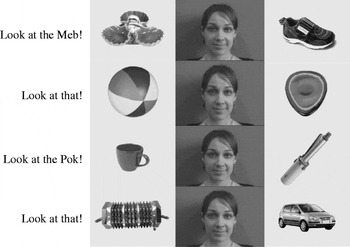
Visual stimuli were JPGs or AVIs with a display size of 32×24 cm and a resolution of 300×300 pixels (files were horizontally compressed from 400 to 300 pixels to accommodate to a widescreen display). Eight familiar object images (ball, car, chair, clock, cup, key, shoe, train) were presented during the experiment, four of which corresponded with the four familiar object labels. Eight novel object images were of unusual objects that the infants were unlikely to have seen or heard named (e.g. accordion, anchor, etc.). All object images were in colour and set against a pale grey background. Seven video files were of the speaker uttering one of four familiar object labels, two novel labels and a neutral phrase. Examples of the objects and a static image of the speaker are provided in Figures 1 and 2. An 8 cm square image of a red cross against a white background was used as an attention stimulus between trials.
Design
The experiment had two parts, a training phase and a test phase. During the training phase, infants viewed trials in which they could use the mutual exclusivity response to form two novel object–label associations. During the test phase, trials were presented to test for infants' learning of these novel word mappings. During all trials, two images were presented, one on the left and one on the right of the screen. A video of the speaker was presented in a central position between the two images, designed to maintain infants' interest for the duration of the experiment.
Every training trial presented one familiar object and one novel object. There were three different types of training trials: familiar label trials, presenting the name for the familiar object; novel label trials, presenting a novel name for the novel object; and control trials, presenting a general directive phrase. The familiar label trials were included to assess infants' responses to familiar word mappings. The novel label trials were designed to both elicit the mutual exclusivity response and provide infants with the opportunity to form a novel word mapping. Control trials were included to determine whether infants' responses to novel label trials were specific to hearing a novel label, or a more general attentional process (e.g. looking behaviour in the absence of hearing a familiar label).
During the experiment there were eight unique trials: four familiar label trials, two novel label trials and two control trials. A different pair of objects was presented in each of these eight different trials. The two novel label trials and two control trials were blocked together (see Figure 1), and this block was presented four times during training. Each presentation of this block was preceded by one of the familiar label trials. Thus, each of the four familiar labels was presented once, while the two novel label and two control trials were presented four times during the experiment. Within each block, two different novel labels (Meb, Pok) were presented on the two novel label trials, while both control trials presented the phrase “Look at that” (see Figure 1). Trials within each block were presented in the same order across the experiment.
Example of a training block.

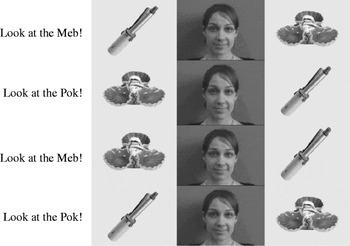
Example of a test block.

Four familiar objects – ball, car, cup, shoe – were presented during novel label or control trials. Four other familiar objects – chair, clock, key, train – were presented during familiar label trials. For the two novel label and two control trials, each infant received one of four possible sets of object pairs. Each of these sets consisted of the same four familiar objects and four novel objects, but with a different pairing of objects for each set. Across these sets, every object was paired with two other objects, once as a novel label trial and once as a control trial. Consequently, across infants, the two novel labels were counterbalanced across the four possible novel referents. Side of image presentation was counterbalanced for each of the novel label and control trials across the training blocks, and the familiar and novel images appeared an equal number of times to the left and right across trials within a block.
During the test phase, each trial presented the two novel objects from the novel label trials. Each novel label was presented on two test trials, counterbalancing for side of target presentation (see Figure 2). Each infant received a different randomization for the order of trials in training and test blocks. All trials during the experiment lasted 6 s, with the onset of naming (or the onset of that) at 2633 ms into the trial. Allowing for a response latency of 367 ms (Swingley & Aslin, Reference Swingley and Aslin2000), trials were split into equal 3 s pre- and post-naming phases.
Procedure
Prior to participation, all parents were requested to complete a British adaptation of the MacArthur-Bates Communicative Development Inventory (the British CDI; see Hamilton, Plunkett & Schafer, Reference Hamilton, Plunkett and Schafer2000). Infants sat on their parent's lap facing a flat widescreen display (110×40 cm) with their eyes at a distance of approximately 80 cm, level with the vertical midpoint of the images and at an equal horizontal distance from both object images. Object images were positioned on screen at a distance of 67 cm centre-to-centre. Two cameras mounted directly above the horizontal midpoints of each image recorded infants' eye movements. Synchronized signals from the cameras were routed via a digital splitter to create a recording of two time-locked images of the infant. Auditory stimuli were delivered via two loudspeakers centrally positioned side-by-side above the display. Caregivers were requested to keep their eyes closed, to wear headphones playing music and to not point at the screen. Trials were manually launched by the experimenter when the infant was looking towards the screen. If the infant was looking away between trials, the auditory and/or visual attention stimuli were presented to return the infant's gaze to centre.
Scoring
A digital video off-line scoring system was used to assess infants' eye movements on a frame-by-frame basis (every 40 ms) by a skilled blind coder. This technique enabled tracking of every fixation, coded either as left looking, right looking, centre looking or other looking. Coding reliability was assessed for all twenty-four trials by a second blind coder for a random sample of 20% of infants who contributed data to the experiment (N=6). The mean intra-class correlation coefficient was 0·978 (Range=0·922–0·998).
RESULTS
CDI analysis
British CDIs were completed by caregivers for 26 out the 30 infants who participated in the experiment. Mean comprehension vocabulary was 157 words (Range=41–348 words) and mean production vocabulary was 28 words (Range=0–177 words). Reported comprehension was high for the four familiar objects presented during novel label and control trials: Ball (85%), Car (92%), Cup (73%) and Shoe (96%). Reported comprehension for the four familiar objects presented during familiar label trials was somewhat lower: Chair (77%), Clock (46%), Key (50%) and Train (73%). However, Houston-Price, Mather & Sakkalou (Reference Houston-Price, Mather and Sakkalou2007) report parental underestimation of comprehension vocabulary on the British CDI for infants aged between 1 ; 3 and 1 ; 9, suggesting that the actual level of comprehension for the familiar objects may be higher than reported.
The British CDI contains four words which can be classified as phonological neighbours to the novel word Pok: Block, Clock, Park and Sock. A high proportion of infants were reported to understand the word Sock (96%), with smaller numbers of infants reported to understand the words Clock (46%), Block (42%)Footnote 1 and Park (38%). The British CDI does not contain any words which are phonological neighbours to the novel word Meb.
Speaker video analysis
Prior to analyzing infants' attention to the training and test images, we examined how much time they spent looking at the speaker video. Averaged across all 24 experimental trials, infants' mean total looking time to the speaker was 3543 ms (SD=664 ms) out of a maximum of 6000 ms total trial duration. Thus, on average, the infants spent just over half the trial duration looking at the video of the speaker. Infants' total looking time to the speaker declined significantly across the experiment (β=−0·846, t(22)=−7·45, p<0·001). However, there were similarly high levels of attention to the speaker during both training (M=3615 ms, SD=661 ms) and test (M=3187 ms, SD=918 ms) trials.
Training analysis
The infants' attention to the speaker video may have kept them ‘on-task’ for the duration of the experiment. However, the reduced share of attention to the images meant it was necessary to use a measure of looking behaviour which provided a reasonable index of infants' visual preferences. A proportional measure of total looking time (i.e. total duration of looks to one image divided by total duration of looks to both images) is a commonly used measure in IPL studies of word learning (e.g. Hollich et al., Reference Hollich, Hirsch-Pasek and Golinkoff2000; Halberda, Reference Halberda2003; Swingley & Aslin, Reference Swingley and Aslin2007). However, the calculation of a proportional measure can produce high levels of relative preference for one image over another, even if total looking time to the ‘preferred’ image is low. Because the infants did not spend a lot of time sampling each image, we instead used a longest look difference measure (longest look to one image minus the longest look to the other image), which also provides a measure of relative preference and yet is sensitive to the absolute amount of looking to an image (see e.g. Houston-Price, Plunkett & Harris, Reference Houston-Price, Plunkett and Harris2005; Meints, Plunkett, Harris & Dimmock, Reference Meints, Plunkett, Harris and Dimmock2004). We also note that because the infants were typically fixating the speaker video at the onset of naming (see Figure 4), we cannot use standard latency analyses (e.g. Swingley & Aslin, Reference Swingley and Aslin2000) of shifts between the target and distractor images.
A longest look difference (LLD) measure (longest look to the familiar object minus longest look to the novel object) was calculated for the pre- and post-naming phases of all 20 training trials for each infant. Initially, we assessed whether the LLD measure is a reliable index of infants' comprehension within our ‘speaker video’ paradigm. The LLD measure was averaged across the four familiar label trials for each infant (one infant was excluded from these analyses for not looking at either image during the post-naming phase of these trials). There was a highly reliable effect of naming, with the mean LLD increasing from −24 ms (SD=336 ms) to 497 ms (SD=565 ms) (t(28)=4·45, p<0·001, d=0·83). We further compared the LLD measure to chance (0 ms) for the pre- and post-naming phases of the familiar label trials. While the LLD measure was not significantly different to chance prior to naming (t(28)=−0·38, n.s.), it was significantly above chance following naming (t(28)=4·74, p<0·001, d=0·88).
Having established the LLD measure as a reliable index of infants' word comprehension, we analyzed infants' attention to the familiar and novel images during the novel label and control training trials. Because of the particularly high level of attention to the speaker video during training, approximately half of the infants were unable to contribute data to each of the 16 cells of the block (4)×condition (2)×naming (2) repeated-measures design. Therefore, we averaged the LLD measure across blocks to analyze the effect of condition and naming for all infants. For novel label trials, the mean LLD measure increased slightly from −37 ms (SD=315 ms) before naming to −29 ms (SD=436 ms) after naming, and during control trials the mean LLD measure decreased slightly from 25 ms (SD=268 ms) to −18 ms (SD=353 ms). In a condition (novel label, control) by naming (pre-naming, post-naming) repeated-measures ANOVA, there were no significant main effects or interactions. There were also no significant effects when the LLD measure was compared to chance (0 ms) for the pre- and post-naming phases of the novel label and control trials. Individual analyses of each of the four training blocks also did not reveal any significant effects (all ps>0·1). Finally, in a separate analysis of the novel label trials, there were no significant differences between the two novel labels in their effects during training. In summary, there were no reliable effects of hearing a novel label or a control phrase during training.Footnote 2
Test analysis
The LLD measure (longest look to the target minus longest look to the distractor) was calculated for the pre- and post-naming phases of each test trial for every infant. These scores were averaged across trials for each of the two novel labels, and entered into a repeated-measures ANOVA with the factors of naming (pre-naming, post-naming) and label (Meb, Pok). Because six infants did not contribute data to one cell of the naming×label design, a missing value analysis was computed using the Expectation-Maximization algorithm (Dempster, Laird & Rubin, Reference Dempster, Laird and Rubin1977), for the purpose of analyzing the data as a repeated-measures design. These values were entered into the main ANOVA (but not included in further analyses). There was a significant interaction between naming and label (F(1, 29)=4·46, p<0·05, ηp2=0·133). There were no main effects for either of these factors.
Figure 3 shows how attention to the target (i.e. named) object increased between the pre- and post-naming phases of Meb trials, but not during Pok trials. For Meb trials, there was a significant increase in the LLD measure from 7 ms (SD=673 ms) to 394 ms (SD=618 ms) (t(26)=2·66, p<0·025, d=0·51), and attention to the target object was significantly above chance during the post-naming phase (t(26)=3·31, p<0·005, d=0·64). For Pok trials, there was a non-significant decrease on the LLD measure from −36 ms (SD=658 ms) to −99 ms (SD=709 ms) (t(26)=0·322, n.s.). A binomial test revealed that a significant proportion of infants (20 out of 27 infants) had a preference for the target object during the post-naming phase of Meb trials (p<0·025). Therefore, the effect of naming during Meb trials was not an artifact of a small number of extreme values.
Mean longest look difference score for pre- and post-naming phases of test trials as a function of label (+/− 1 S.E.).

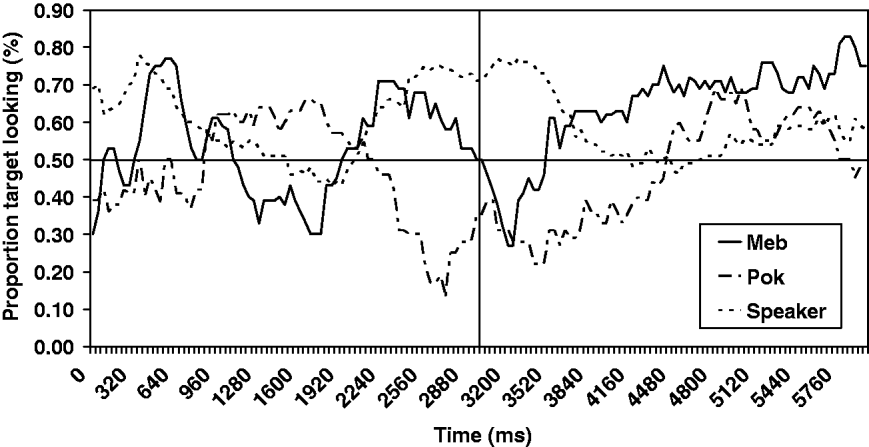
Proportion of target looking over time during Meb and Pok test trials (the dotted line indicates the proportion of attention to the speaker video vs. test objects).
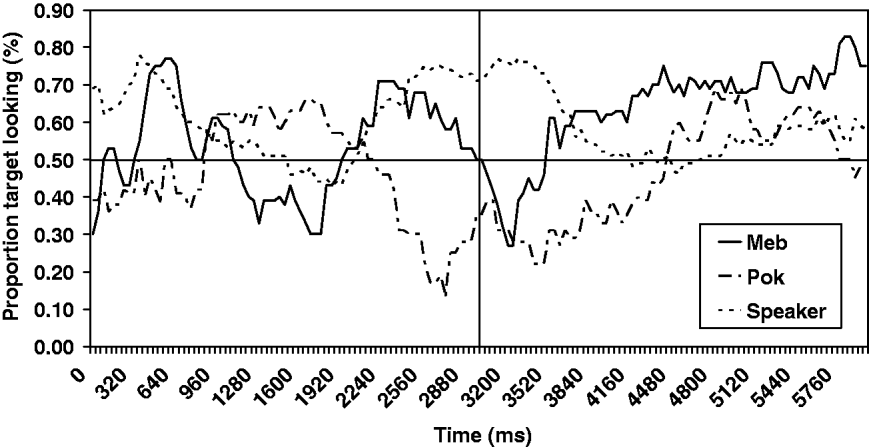
Figure 4 provides frame-by-frame data of how infants' attention to the speaker video and objects unfolds during the test trials. The proportional scores for Meb and Pok test trials indicate preference for the target object over the distractor object, while the measure for the speaker video indicates preference for the video over the test objects. Infants' attention to the target object fluctuates during the pre-naming phase of both Meb and Pok trials. During the post-naming phase, preference for the target object during Meb trials is above chance and increases over time. In contrast, while preference for the target object increases somewhat during the post-naming phase of Pok trials, attention to the target is not consistently above chance. Peak preference for the speaker video over the test objects occurs at the beginning of the test trial and when the speaker utters the naming phrase.
DISCUSSION
The aim of the present study was to investigate whether mutual exclusivity enables infants to form a mapping between a novel label and a novel object. While previous studies have provided considerable evidence for the mutual exclusivity response, it is not clear that this response is evidence of word learning. Hence, in this experiment, we investigated whether infants aged 1 ; 4 would use mutual exclusivity to form novel object–label associations. We found that the infants did not display an overt mutual exclusivity response during training. Yet, at test, the infants provided evidence of learning an association for the novel label Meb, but not for the novel label Pok. We provide further discussion of the role of phonological novelty below. We note here that attention to the correct referent of at least one label can only be caused by knowledge of the object–label association. Furthermore, acquisition of the object–label association could only have occurred during the training phase of the experiment, where novel label trials offered infants the opportunity to exploit mutual exclusivity to form a new object–label mapping. Our results, therefore, demonstrate that infants aged 1 ; 4 can use mutual exclusivity as a cue to form novel word mappings.
Although the precise pattern of findings differs from previous studies of mutual exclusivity in infants (e.g. Halberda, Reference Halberda2003; Markman et al., Reference Markman, Wasow and Hansen2003), we nonetheless provide convergent evidence that infants as young as 1 ; 4 can map a novel label to a novel object in an ambiguous context. Our finding reinforces the argument that mutual exclusivity contributes to infants' vocabulary development during the first half of the second year, and that infants can exploit their existing vocabulary to learn new words. Our findings do not discriminate between different explanations of the mutual exclusivity response (e.g. Clark, Reference Clark and MacWhinney1987; Markman, Reference Markman1989; Reference Markman1990; Mervis & Bertrand, Reference Mervis and Bertrand1994). However, our findings show that whichever process is responsible for this word-learning bias, it also leads infants to form novel object–label associations.
The most notable difference between our findings and those of Halberda (Reference Halberda2003) and Markman et al. (Reference Markman, Wasow and Hansen2003) is that we do not demonstrate the mutual exclusivity response per se. During training, the infants did not increase attention to a novel object over a familiar object upon hearing a novel label. Although it is not clear why they failed to do so, the presence of the speaker video drew infants' attention away from the objects, and may have consequently altered their pattern of attention to the objects. However, successful target looking during familiar label trials was not associated with greater overall attention to the objects than during novel label trials. Thus, the reduced attention to the objects might not itself be the reason for the absence of the mutual exclusivity response. A related possibility is that infants' interest in the familiar objects affected their pattern of attention to the novel objects. A bias towards familiar, nameable objects has been reported in other studies (e.g. White & Morgan, Reference White and Morgan2008; Schafer, Plunkett & Harris, Reference Schafer, Plunkett and Harris1999; see also Halberda, Reference Halberda2003). In contrast, the absence of distracting familiar objects in the test trials may have provided a more sensitive test of comprehension.
Other investigators (e.g. Halberda, Reference Halberda2003; White & Morgan, Reference White and Morgan2008) report an increase in attention to a novel object in response to a novel label. However, it is not clear that infants look more to the novel object than the familiar object – particularly if they have a preference for the familiar object prior to naming (White & Morgan, Reference White and Morgan2008; Schafer et al., Reference Schafer, Plunkett and Harris1999). Thus, although some processing of the novel object is necessary, infants' use of mutual exclusivity to learn new words might not require sustained attention to a novel object. In support of this position, Mather & Plunkett (Reference Mather and Plunkett2009) found that infants aged 1 ; 10.15 did not display a mutual exclusivity response the first time they were presented with a novel label and familiar and novel object. However, upon re-presentation of the stimuli, the infants' looking behaviour suggested that they had formed an association between the novel label and novel object. Therefore, processing of the relation between the novel label and novel object occurred during the original presentation, but this was not evidenced by any preferential fixations of the objects.
In combination with previous investigations, our findings suggest that 1 ; 4 is a threshold age for word learning via mutual exclusivity, and as such, an age where infants are sensitive to the learning context. Markman et al. (Reference Markman, Wasow and Hansen2003) found that a group of infants aged 1 ; 3 to 1 ; 5 displayed the mutual exclusivity response in an object search task. Yet, in Halberda (Reference Halberda2003), only infants aged 1 ; 5 displayed evidence of mutual exclusivity. At 1 ; 4, infants did not display a systematic response. In contrast, we have evidence of mutual exclusivity at 1 ; 4 in an IPL procedure similar to Halberda (Reference Halberda2003) . It is possible that the infants aged 1 ; 4 in Halberda's study might have displayed evidence of forming a novel word mapping if they had been tested for subsequent word learning. Alternatively, the inclusion of the speaker video in the present experiment may have facilitated the use of mutual exclusivity, even if it reduced attention to the objects. Unlike Halberda (Reference Halberda2003), the speaker video adds a social dimension to the learning context, similar to Markman et al. (Reference Markman, Wasow and Hansen2003) . Thus, while mutual exclusivity enables infants to form word mappings in the absence of social or pragmatic cues, the presence of a social context might facilitate the use of mutual exclusivity to learn words.Footnote 3
A further experimental manipulation involved training infants on one novel label without any known phonological neighbours (Meb) and on another novel label with several known phonological neighbours (Pok). Consistent with our predictions, we found that the infants formed a novel mapping for the label Meb, but not for the label Pok. The counterbalanced design of the experiment precludes the possibility that infants' looking during test trials was caused by their preference for particular objects. Across infants, four novel objects were counterbalanced as the referent of the two novel labels. Furthermore, the side of presentation of the target object was alternated for both labels at test. Hence, the asymmetry in infants' word learning is most likely an outcome of the phonological properties of the labels. An alternative explanation to the phonological neighbourhood account is that the infants had a spurious preference for one label over the other, affecting their ability to map the labels. Although this may have been true for individual infants, such an effect is unlikely to hold across a group of infants. For example, we know that words containing the phonemic segments present in Meb and Pok are prevalent in infants' early vocabularies, and thus unlikely to create idiosyncratic preferences.
A more parsimonious account is that systematic differences between the labels at the lexical level influenced infants' ability to map them to novel objects. Swingley & Aslin (Reference Swingley and Aslin2007) obtained a similar effect where the phonological neighbourhoods of novel words affected the ability of infants aged 1 ; 6 to map novel labels onto novel objects during an ostensive naming procedure. We extend these findings by demonstrating that phonological neighbourhoods can also impact the use of mutual exclusivity to form novel word mappings. Our findings also extend the work of Merriman & Schuster (Reference Merriman and Schuster1991) and White & Morgan (Reference White and Morgan2008), by demonstrating that the effect of phonological novelty might extend beyond the immediate naming context to draw upon the full scope of infants' lexical knowledge. Although the object ‘sock’ was not seen or labelled during the experiment, the phonological distance between the two words may nonetheless have interfered with forming a word mapping.Footnote 4 Infants' ability to discriminate between novel words and mispronunciations of familiar words may be critical to the use of mutual exclusivity to learn new words.
From as early as 1 ; 4, infants can map a novel label to a novel object, using only the difference in whether or not an object is name-known as the cue to the mapping. Even before the middle of the second year, infants can learn words in the absence of explicit cues from the speaker, drawing upon their previous learning experiences to guide how they form novel word mappings. Yet, this ability is not without limits. When there is no explicit guidance from the speaker, the infant has to accurately identify novel word forms which have not already been mapped onto other object categories. One important avenue for future research will be to investigate whether there are developmental changes in how phonological similarity constrains the mutual exclusivity mechanism. Our findings highlight the importance of the novelty of both the object and the label for successful use of the mutual exclusivity constraint.