Worlds of Welfare: institutional configurations and outcomes
Esping-Andersen's (Reference Esping-Andersen1990, Reference Esping-Andersen1999) seminal work on ‘Worlds of Welfare’ has inspired comparative social policy research for the past twenty-five years. Empirically, he identified regimes as clusters based on the concepts of decommodification, social stratification and the state–market relationship, i.e. the specific welfare mix. ‘Decommodification refers to the degree to which individuals, or families, can uphold a socially accepted standard of living independently of market participation’ (Esping-Andersen, Reference Esping-Andersen1990: 37). In contrast, Esping-Andersen used the ‘social stratification’ dimension to assess how welfare state institutions structure classes and consequently social order (Esping-Andersen, Reference Esping-Andersen1990: 55). He operationalised ‘decommodification’Footnote 1 by including indicators for eligibility rules and levels of income replacement for cash benefits insuring against risks from unemployment, sicknessFootnote 2 and old age (Esping-Andersen, Reference Esping-Andersen1990: 47), and ‘social stratification’ through seven indicators that aim at capturing the three worlds of welfare: corporatism; etatism – using indicators of pension segmentation – (conservative index); means-tested poor relief spending; private pension and health care spending as a share of the total respective spending (liberal index); average universalism; and average benefit equality (socialist index). Social policy can be provided through different institutional arrangements and combinations of the market, non-profit organisations and the state.
This operationalisation of decommodification and social stratification across eighteen OECD countries resulted in a parsimonious taxonomy based on different institutional configurations and legal entitlements for the average production worker (APW). Esping-Andersen classified these configurations by their underlying political traditions, i.e. social democracy, Christian democracy and liberalism. His three-fold taxonomy has been widely scrutinised, criticised and updated (for a summary of the debate, see Arts and Gelissen, Reference Arts and Gelissen2002, Reference Arts, Gelissen, Castles, Leibfried, Lewis, Obinger and Pierson2010; Ferragina and Seeleib-Kaiser, Reference Ferragina and Seeleib-Kaiser2011; for an in depth theoretical discussion, see Powell and Barrientos, Reference Powell and Barrientos2011).
At the substantive level, this literature on the welfare regime debate has mainly followed four streams of criticism: (1) the identification of additional regimes, (2) the presumed misclassification of specific countries, (3) the application of the regime theory to other policy domains and (4) the taxonomy's limitations resulting from being based on legal entitlements for the APW (for a summary of all four criticisms, see Ferragina and Seeleib-Kaiser, Reference Ferragina and Seeleib-Kaiser2011). Our work mainly contributes to the fourth stream.
We analyse welfare regimes on the basis of outcomes for different groups. This contrasts with previous analyses based only on inputs. Outcomes, such as achieved poverty reduction, we argue, are essential to the legitimacy of welfare states. Legitimacy in turn, we assume, is the basis for enduring welfare state arrangements that can be recognised as regimes.
From a theoretical point of view, polities obtain a general political legitimacy either through the democratic institutional process (input legitimacy) or through their problem-solving capacity (outcome legitimacy) (Scharpf, Reference Scharpf1999). For instance, research has demonstrated that support, or the lack thereof, for the European Union is strongly based on EU citizens' perceptions of (welfare-) state outcomes (Gabel and Whitten, Reference Gabel and Whitten1997; Haller, Reference Haller2009). We argue similarly that welfare states obtain their legitimacy from their long-standing institutional structures, but also from their ability to reach certain societal goals. Legitimacy provides the basis for acceptance of a given structure; therefore, our key hypothesis is that:
Welfare regimes persist, not only when looking at institutional configurations, but also when considering main ‘desired’ outcomes.
Welfare states’ ‘desired’ outcomes can be defined, in general, as the results from the objectives of social policies and welfare states. Depending on their institutional configurations, the literature (Goodin et al., Reference Goodin, Headey, Muffels and Dirven1999) often distinguishes three objectives of welfare states. They aim to: (a) provide autonomy to citizens/residents; (b) provide social stability in case of risk; and (c) reduce/ameliorate poverty.
Historically, as well as in Esping-Andersen's original work, these objectives (often implicitly) related to outcomes for one specific societal group, the APWs. These outcomes are the reduction of risks of old age poverty, unemployment rates and poverty of the male breadwinners.
Changing socio-economic conditions, including globalisation, de-industrialisation, demographic change and changed gender roles, as well as welfare state changes, including retrenchment, recommodification and recalibration (Pierson, Reference Pierson and Pierson2001), are said to have had a major impact on changing risk structures. Hence, to establish a more comprehensive assessment of outcomes for different societal groups, we extend the analyses beyond the APW and old risks, to also include new social risks (NSR) (Taylor-Gooby, Reference Taylor-Gooby2004; Bonoli, Reference Bonoli2005, Reference Bonoli2007). We deliberately chose the old versus new risks distinction, as it builds on the core aim of welfare states – to insure against social risks – and is less problematic than the normatively and analytically blurred distinction between those policies that primarily focus on social investment and those that primarily deal with compensation (Nolan, Reference Nolan2013). Core NSR are: the (in)ability to reconcile work and family life; single parenthood with the increased risk of child poverty; low skills and education; as well as insufficient social security coverage for atypical workers. NSR tend to be most prevalent among younger people, families and women (Bonoli, Reference Bonoli2005). Countries that effectively address these new risks should have low child and youth poverty rates, a high percentage of youth in education to improve human capital formation (ibid.), as well as high female labour force participation to minimise the risk of poverty and reduce inequality in societies that are increasingly characterised by homogamy (Esping-Andersen, Reference Esping-Andersen2009). Hence, on the one hand, we capture the extent of insurance against old social risks, measuring the incidence of poverty among pensioners, unemployed and prime-aged workers, as well as replacement rates for pensioners and the overall unemployment rate; and we assess the incidence of new social risks by considering child and youth poverty rates, percentage of youth in education and female labour force participation.
There have been intense debates, numerous empirical studies of regimes using cluster analysis (for example, Kangas, Reference Kangas, Janoski and Hicks1994; Gough, Reference Gough2001), and regimes are in continuous use as analytical tools for comparative social policy analysis. Despite this, few studies have tested whether welfare regimes translate into clusters similar to the original worlds of welfare when one considers welfare state outcomes (but see Goodin et al., Reference Goodin, Headey, Muffels and Dirven1999, and with a redistribution focus, Kammer et al., Reference Kammer, Niehues and Peichl2012), and particularly outcomes for new social risks.
Such a test needs a longitudinal perspective since, theoretically, regimes are said to be stable over time (Esping-Andersen, Reference Esping-Andersen1996, Reference Esping-Andersen1999; Pierson, Reference Pierson and Pierson2001). Danforth (Reference Danforth2014) identifies variations in welfare arrangements over a long time period (1950–2000) and argues that the three regimes were only established by 1975. Outcomes of welfare state changes will only become manifest over time, with lags, some would suggest, of a decade (i.e. Sabatier, Reference Sabatier1988), as well as variation due to contextual factors. According to some observers, the 1980s and 1990s were primarily characterised by welfare state retrenchment and recommodification, while more recent reforms are said to have been of a more transformative nature, including recalibration (Pierson, Reference Pierson and Pierson2001; Hemerijck, Reference Hemerijck2012). As these processes (especially since the early 2000s) have also been said to be characterised by ‘new politics’ (Pierson, Reference Pierson and Pierson2001), it cannot be assumed that the outcomes follow the logic previously observed.
Esping-Andersen's original taxonomy is based on three regimes. Following Ferrera (Reference Ferrera1993, Reference Ferrera1996), as well as Leibfried (Reference Leibfried, Zsuza and Kolberg1992), we hypothesise the existence of a fourth Mediterranean regime type different from the original three regimes. In our analyses, we consider empirically four distinct country clusters representing these welfare state regimes.
Methodologically, cluster solutions for a given dataset are necessarily sensitive to the availability and choice of data (Aldenderfer and Blashfield, Reference Aldenderfer and Blashfield1984). Past cluster analyses of welfare regimes did not account for cluster stability in relation to such factors (for example, Castles and Obinger, Reference Castles and Mitchell2008; Kammer et al., Reference Kammer, Niehues and Peichl2012).
In summary, this article, (a) revisits welfare state regime classifications from an outcome perspective, (b) distinguishes analytically and empirically welfare regimes in relation to old and new social risks and (c) for methodological and empirical reasons tests the stability of a four-fold typology across fourteen EU countries during the period 2005 to 2012.
Data and methods
Data
Our analyses are based on aggregate data published by Eurostat. They are mostly generated from the European Union Statistics on Income and Living Conditions (EU-SILC), European Union Labour Force Survey (EU-LFS), or, in the case of information on education, the joint UNESCO Institute of Statistics/OECD/Eurostat questionnaires on education statistics (for details on the measures and data sources, see Appendix 1). These data are regarded as a unique source of comparative data on incomes and households relating to welfare states (for example, EU-SILC cf. Iacovou et al., Reference Iacovou, Kaminska and Levy2012).Footnote 3
Methods and indicators
The empirical analysis is divided into two parts. The first part, based on descriptive statistics, analyses inequality and poverty outcomes, before and after benefits and taxes, alongside the insurance against old and new social risks. The second, based on cluster analyses (for details, see Appendix 2), assesses the similarity between institutional and outcome-based typologies (for an extensive literature on past research, see Appendix 3) in four steps. We cluster countries according to:Footnote 4
1. all selected measures relating to old and new social risks simultaneously;
2. their outcomes in covering old social risks by including indicators such as poverty levels after social transfers for male workers,Footnote 5 the elderly,Footnote 6 and the unemployed; and old-age pension replacement rates;Footnote 7
3. their outcomes in covering new social risks, including indicators such as poverty rates after social transfers for children and youths, female employment rates, and rates of enrolment in education for people aged between fifteen and twenty-four.
We assess the stability of cluster analyses using:
4. iterative methods (Hennig, Reference Hennig2007), dropping in turn indicators, countries and years (for more details, see Appendix 1).
We present analyses for two time periods: (a) we investigate welfare state outcomes in a single cross-section for 2012 to provide a descriptive picture for the outcome measures; (b) we conduct a cluster analysis for the pooled data over the period 2005–12. Finally, based on the literature differentiating between liberal, conservative, social-democratic and Mediterranean regimes (Esping-Andersen, Reference Esping-Andersen1990; Leibfried, Reference Leibfried, Zsuza and Kolberg1992; Ferrera, Reference Ferrera1993, Reference Ferrera1996; Bonoli, Reference Bonoli1997), we include an a priori cut-off of four clusters rather than simply looking for the highest degree of dissimilarity.
Geographical focus
Our research is focused on EU Member States. Europe is the continent most heavily influenced by the three political movements, liberalism, Christian democracy and social democracy, which are said to be the ideological basis for the three worlds of welfare. Thus, we exclude other rich OECD countries from our analysis where these ideological underpinnings are less clearly shared, i.e. Japan (on ‘Japanese uniqueness’, see Dale, Reference Dale1986; Esping-Andersen, Reference Esping-Andersen1997), the United States (on ‘American exceptionalism’, see Lipset, Reference Lipset1996), Australia and New Zealand (on the different natures of ‘radical welfare states’, see Castles and Mitchell, Reference Castles and Mitchell1992, Reference Castles and Obinger1993). EU countries have agreed to strive for ‘the promotion of a high level of employment, the guarantee of adequate social protection, the fight against social exclusion, and a high level of education, training and protection of human health’ (Council of the European Union, 2008: Article 9). Furthermore, the adoption of the Europe 2020 strategy places social policy at the core of EU policy: setting targets for raising the (female) employment rate, reducing early school leaving, increasing the proportion of young people completing tertiary education or equivalent and lifting at least 20 million people out of poverty. These indicators are said to be at the heart of the EU strategy for growth and are very likely to impact on the legitimacy of the EU. Finally, we limited our analyses to countries that had joined the European Union before the enlargement in 2004,Footnote 8 as central and eastern European countries have not reached ‘new social policy equilibria’ (Potuček, Reference Potuček and Seeleib-Kaiser2008: 95).Footnote 9
Results
Describing welfare state outcomes
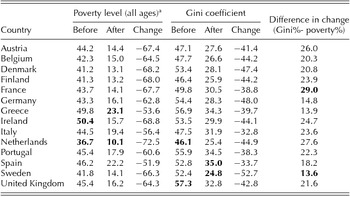
Our first objective is to examine welfare state outcomes amongst the EU 14. Across all countries, the welfare state has a remarkable effect in reducing poverty and inequality levels (Table 1 summarises poverty and inequality data before and after social transfers). Data also suggest a remarkable similarity in poverty reduction levels among EU 14 countries: Austria, Belgium, Denmark, Finland, France, Germany, Ireland, Sweden, and the United Kingdom (nine out of fourteen countries), have a poverty reduction level after social transfers ranging between 65 and 68 per cent.
Welfare state outcomes: poverty levels and inequality across the EU 14 (pre-2004 EU members) in 2012

Notes: aGross and net household income <60% median household income.
Source: Gini coefficient of equivalised disposable income; Gini coefficient of equivalised disposable income before social transfers (pensions included in social transfers. Eurostat (2014a).
However, if we look simultaneously at poverty and inequality, a distinctive ranking across countries appears. It is almost as if poverty and inequality reduction are in contrast. This relates to the aforementioned distinction between two objectives of the welfare state (Goodin et al., Reference Goodin, Headey, Muffels and Dirven1999): on the one hand, to provide autonomy (hence, reducing inequality) and, on the other hand, to reduce poverty. Our outcomes-based perspective suggests three different patterns, i.e. (a) Germany and Sweden seem to be committed in similar ways to reducing poverty as well as inequality, (b) France seems committed mainly to poverty reduction, and (c) Greece appears to lack a strong commitment to reduce both (for a review of the debate on the redistributive power of the welfare state, see Esping-Andersen and Myles, Reference Esping-Andersen, Myles, Salverda, Nolan and Smeeding2009).
Despite the fact that poverty and inequality reduction for the overall population provide good general measures of substantive welfare state outcomes, they do not account for the potential differential outcomes for different societal groups. Bonoli (Reference Bonoli2005), for example, argued that welfare states are still primarily geared towards covering old social risks, such as unemployment, sickness and old age. Hence, together with the description of overall poverty and inequality reduction, it is important to further distinguish outcomes in relation to old (i.e. unemployment and old-age replacement rates)Footnote 10 and new (i.e. child and youth poverty, educational participation and female employment rates) social risks.
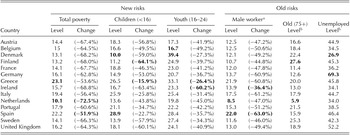
In all countries, poverty rates are higher among the unemployed (an old social risk), providing an indication that this societal group is the least protected, if compared to children, youth or pensioners (see Table 2). Moreover, poverty among the elderly is significantly more widespread than poverty among children in Belgium, Denmark, Ireland, Italy, the Netherlands, Spain and the United Kingdom, providing further evidence that in some countries insurance against old social risks would seem less comprehensive than against new social risks. Poverty levels for young people and the elderly seem to be quite high in most nations, and surprisingly so in Scandinavian countries. However, this is partially a statistical artifact due to the high percentage of people living independently rather than being part of a larger household. Since poverty is measured at the household level, poverty tends to be higher in those countries, with smaller households, including youths as well as elderly people who live independently (as in the case of Scandinavian countries).Footnote 11
Detailed welfare state outcome indicators: poverty levels by social group after social transfers (and change compared to before transfers levels)

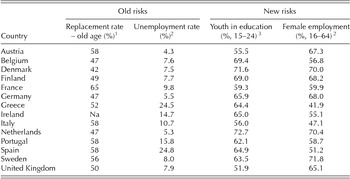
Child poverty seems to be especially high in Mediterranean countries.Footnote 12 The percentage of young people in education is high in Nordic countries and the Netherlands, whilst it is particularly low in the United Kingdom, Austria, Italy and France (see Table 3). Female employment rates are the lowest in Greece, Italy, Spain and Ireland, followed by Portugal and France.
Proxy indicators for welfare state output targeting new and old social risks

Sources: 1Aggregate replacement ratio: ‘ratio of the median individual gross pensions of 65–74 age category relative to median individual gross earnings of 50–59 age category, excluding other social benefits’, Eurostat (2014d).2‘Employment rates by sex, age and nationality (%)’, Eurostat (2014e).
3‘Participation rates in education by age and sex’ (based on the joint UNESCO Institute of Statistics/OECD/Eurostat questionnaires on education statistics), Eurostat (2014f).
It is worth noting that the relative reduction of poverty across different societal groups is much less consistent across countries, than the levels of poverty reductions observed for the overall population. We find large differences, ranging, for example, from a 15.9 per cent child poverty reduction in Greece to a 64.1 per cent reduction in Finland, highlighting the much greater effectiveness of the Finnish benefit and tax system in reducing child poverty. The data also suggest there might be more variation across countries when looking at new rather than old social risks. This means that despite the aim of institutional convergence amongst European countries towards employment-oriented social investment policies, and some convergence in overall poverty rates (Cantillon and Vandenbroucke, Reference Cantillon and Vandenbroucke2014: xiii), many differences continue to persist among European welfare states.
Welfare regimes outcome clusters
Our second objective is to cluster welfare states according to their outcomes. In a first step, we include all outcome indicators (including change in Gini before and after transfers)Footnote 13 in our analysis, pooled over the period 2005 to 2012. Where Tables 1 and 2 only look at, for example, child poverty in 2012, we now include child poverty for each year between 2005 and 2012, in each country. This provides for more robust results and takes into account variations over time.
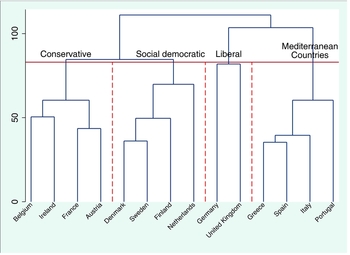
We find a set of outcome-based regimes similar to those based on institutional configurations, with the following exceptions (see Figure 1): Germany clusters with the United Kingdom, and Ireland falls into the conservative cluster. The clustering of Ireland within the conservative group might be dependent on achieving lower poverty rates amongst the unemployed and the elderly compared to the UK (data for 2012, see Table 2).
Country clusters by welfare state outcome

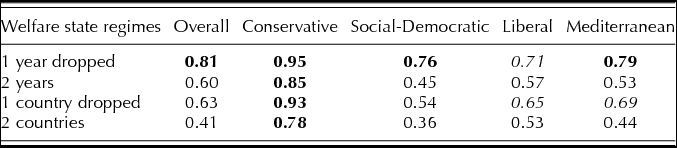
Although these findings are largely in line with the welfare regime literature, we also checked the robustness of clusters proposing a battery of sensitivity analyses. Ideally, we would find similar countries in each cluster, even if we changed some of the indicators or dropped a country or year of observation. In the following sensitivity analyses, JaccardFootnote 14 coefficients represent the effects of such data variations.
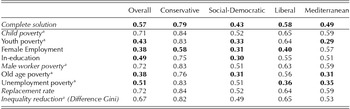
We examine the influence of omitting single indicators, by looking at the overall set of clusters and each cluster separately (see Table 4). Jaccard coefficients superior to 0.75 indicate cluster stability, even after dropping from the sample a variable or an observation. Values below 0.75 and superior to 0.65 suggest the existence of patterns in the data; however, in this case clusters are generally not perfectly stable against the variation in the data used. Our findings are rather sensitive to the omission of any indicator, with a coefficient of 0.57 for the overall solution. In contrast to the other clusters, the conservative cluster (Table 4) is robust to the omission of indicators, except for the rate of female employment; similar levels thereof seem to define the conservative regime. By contrast, the sensitivity analysis provides an explanation of the ‘surprising’ classification of Germany among the liberal cluster: high levels of poverty among the unemployed, rather than female employment rates, are the most defining feature of liberal welfare states (hence, Germany with its high poverty level is fully part of this group).Footnote 15 This is in line with previous research focusing on institutional change (Seeleib-Kaiser, Reference Seeleib-Kaiser2002; Bleses and Seeleib-Kaiser, Reference Bleses and Seeleib-Kaiser2004; Fleckenstein et al., Reference Fleckenstein, Saunders and Seeleib-Kaiser2011), but at odds with the notion whereby Germany continues to be the proto-typical conservative welfare state rooted in the ‘Bismarckian tradition’.Footnote 16
Welfare state output clusters: stability by indicator

Notes: Numbers in bold indicate variables whose removal results in considerably different cluster solutions, or cluster memberships (for the individual clusters). Cluster stability expressed as average Jaccard coefficient for 1,000 runs of randomly dropping observations/years: Coefficients >0.75: Stable cluster solution; >0.65–<0.75: Patterns in data., Seed: 823910233.
a(after transfers).
The social-democratic and Mediterranean clusters are quite sensitive to the choice of indicators, without a single indicator reaching the low cut-off point (0.65) established by the Jaccard coefficient to indicate a certain level of stability.
Following the same metric, we investigate the potential random omission of years or countries from our dataset (Table 5). Welfare outcome clusters are more or less stable over time, despite considerable welfare state change at the institutional level; for example, in the policy domain of family policy (Ferragina et al., Reference Ferragina, Seeleib-Kaiser and Tomlinson2013). Clusters are, however, more sensitive to the omission of countries. As the liberal cluster consists of only two countries, it is thus more prone to dissolution when randomly dropping one country. Amongst the social-democratic and Mediterranean clusters, one country is always less similar to the others. It is not surprising that the Netherlands do not squarely fit the social-democratic cluster, as they have been characterised as social-democratic, conservative or hybrid welfare regime, depending on the indicators chosen. Also Portugal is institutionally different from the other Mediterranean countries (Ferrera, Reference Ferrera1996).
Welfare state output clusters: stabilitya by number of observations/years dropped
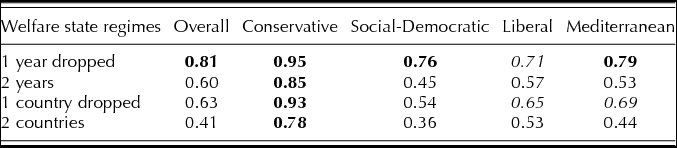
Notes: aCluster stability expressed as average Jaccard coefficient for 1,000 runs of randomly dropping observations/years: Coefficients >0.75: Stable cluster solution; >0.65–<0.75: Patterns in data.
To summarise: welfare state outcome clusters are largely in line with the previous regime literature based on institutional configurations. Clusters are also stable over time; however, they are quite sensitive (with the exception of the conservative cluster) to the choice of indicators and countries included in the sample.
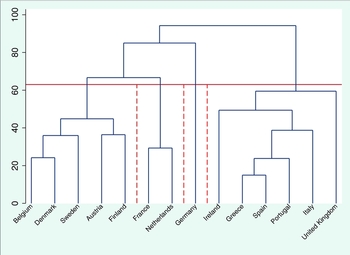
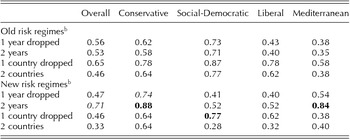
The cluster analysis for old social risk outcomes partitions countries into two large blocks and two smaller groups of outliers, which include only three countries (see Figure 2). Germany stands alone, mostly because of the high rate of poverty among the unemployed, and France and the Netherlands form another cluster due to the considerably low rates of old age poverty. The two large clusters include: Belgium, Denmark, Sweden, Austria and Finland (the first group), with higher levels of inequality reduction compared to those in the second group, Ireland, Greece, Spain, Portugal, Italy and the United Kingdom.
Outcome clusters for old social risks

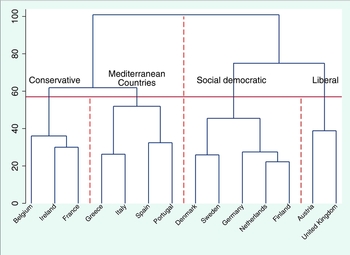
The cluster based on new social risk outcomes stands in sharp contrast to the old social risks cluster. New social risk indicators almost reproduce the clustering presented for the overall analysis (Figure 3), with the exceptions of Germany and Austria. Whilst Germany joins the social-democratic cluster, Austria joins the United Kingdom in the liberal world. This liberal cluster, formed only by two countries, should be treated with caution, as it is largely determined by a combination of high levels of female labour market participation and low rates of youth enrolment in education programs. Potential problems of accounting for vocational training in Austria might undermine our findings. As an aside, when disregarding the theory- and literature-driven four-cluster cut-off, the cluster analysis seems to be dominated by two super-clusters containing within each other the conservative and the social-democratic on the one hand, and the Mediterranean and liberal cluster on the other hand.
Outcome clusters new social risks

Different to the general clustering, the sensitivity analysis presented for old and new social risks is more limited. This is due to the small number of indicators used (Table 6 provides a comparison of the stability of the old and new social risk clusters). The old social risk clusters are not very stable to dropping any year, but are more stable to the omission of single countries. This is due to the presence of two large clusters and two small middle groups (as we have mentioned they only include Germany, the Netherlands and France). Also, the cluster analysis based on new social risks is quite sensitive to the choice of indicators and countries included, with the remarkable exceptions of the conservative and liberal worlds.
Old and new social risks clusters: stabilitya by number of observations/years dropped

Notes: aCluster stability expressed as average Jaccard coefficient for 1,000 runs of randomly dropping observations/years: Coefficients >0.75: Stable cluster solution; >0.65–<0.75: Patterns in data.
Random drops of observations/years starting with seed: 823910233, runiform() function in Stata 11.0.
In sum, our cluster solutions for old and new social risks suggest three interesting points. First, we find a significant difference in regimes, depending on the analysis of old social and new social risk outcomes. Second, the old social risk clustering differs significantly from the original welfare state analysis, whereas new social risk outcome clustering seems to be closer to the more conventional welfare regimes typologies. The stability test, finally, points towards the combined importance of the old and new social risk outcomes for identifying typologies. Neither the old nor the new social risks clusters are as stable as the general cluster solution (Table 4).
Discussion and conclusion
The aim of this work is to assess the potential use of welfare state outcomes to delineate four welfare regimes. In doing so, we also distinguish outcomes according to old and new social risks, going beyond policies focusing solely on the APW. To this end, we selected eleven outcome indicators, largely inspired by Goodin's (Reference Goodin1988) reasons for welfare – autonomy, social stability and poverty alleviation − and distinguished by the type of social risk addressed – old or new.
The results presented above show that all European welfare states have a strong effect in reducing poverty and inequality across the overall population. However, the high level of similarity, measured when looking at poverty reduction for the overall population, is not replicated when considering different societal groups. For example, the Finnish and Irish welfare states have a similar capacity in reducing poverty among the overall population, but they radically differ in relation to new social risks, such as child poverty (see Tables 1 and 3). The different levels of outcomes related to social protection for societal groups confirm the continued importance of welfare regime typologies, but simultaneously demonstrate the need to carefully consider the outcomes of the welfare state for different societal groups to identify regime variations.
The clustering based on the whole set of outcome indicators does provide a similar picture to previous welfare typologies, with the important exceptions of the classification of Germany and Ireland. In particular, while the classification of Ireland as belonging to the conservative cluster might be the result of achieving lower poverty rates amongst the unemployed and the old compared to the UK (the prototypical European liberal country), the classification of Germany within the Liberal regime is rather ‘unexpected’.
When analysing old social risk outcomes, Europe appears to be split into two groups. ‘The periphery’, which includes Liberal and Mediterranean countries, seems to be characterised by lower replacement rates and higher levels of inequality, than ‘the core’ countries (the social-democratic and continental clusters). Furthermore, considering old social risk outcomes, Germany stands alone, following a unique pattern compared to the rest of the continent.
For new social risks, the most striking finding is that the clustering replicates very closely the theoretical four-cluster typology. In addition, the clustering of new social risks divides European countries into two groups; on the one hand, the social-democratic and liberal countries, characterised by higher youth education and female employment; and, on the other hand, with opposite characteristics, the conservative and Mediterranean countries.
Our cluster analysis is robust against the choice amongst the indicators; in addition, the clusters are stable over time, but quite sensitive when old and new social risks are considered separately. The conservative cluster seems the most stable, while the others show more erratic patterns determined by the choice of indicators and countries. In sum, our findings carry a clear implication: across the EU 14, several groups of countries show a strong persistence in producing a certain set of social outcomes. This suggests that the contextual changes, for example the 2008 crisis, might have had less impact than one would expect, particularly with regard to insurance against new social risks.
The above findings should be interpreted with caution in the light of three major caveats: the limitation of data availability, the dependence on the context of outcome data and the fact that clusters are data-driven. First, the present study uses data from 2005 until 2012, and thereby is restricted to a rather short period of observation; for most countries, this eight-year period equates to two terms of parliament. Whilst we restricted the country sample on theoretical grounds, the choice of indicators was in part determined by the available data. Ideally, a detailed analysis of new and old social risks using poverty levels for different societal groups should have been complemented with the inequality reduction rates for the same groups. The limited availability of comparable indicators and data over time is a major limitation of this study. Second, welfare state outcomes are more context-dependent than welfare state inputs. Hence, the outcomes investigated above (and mainly ascribed to the welfare states) might vary considerably due to other factors than social policy. Third, our analyses are not a formal statistical test of the outcome regimes approach. They are data-driven and exploratory attempts to demonstrate the substantive validity of the approach.
Considering these limitations, future research should investigate longer time periods and perform analyses on the basis of individual level data (for example, EU-SILC and EU-LFS). Such research should aim at statistically testing the robustness of the outcome regime clusters. The most fruitful avenue might be to systematically contrast input- and outcome-based welfare state regimes. In particular, such research should focus on assessing the differences in terms of welfare state efficacy (see a similar analysis by Vandenbroucke and Diris, Reference Vandenbroucke, Diris, Cantillon and Vandenbroucke2014).
Despite the limitations, this article clearly shows that welfare state regimes are ‘alive’. They serve as useful analytical tools and also relate to the outcomes experienced by citizens. For them, small social policy changes, that do not radically affect welfare state structures, are highly unlikely to reduce poverty and inequality. Consistently high levels of inequality and poverty are very likely to have a detrimental impact on political legitimacy.
Appendix 1 Data sources for indicators (Eurostat)
The following data tables have been used (accessed 23.06.2014), square brackets give the stable name of the table on: http://epp.eurostat.ec.europa.eu/portal/page/portal/statistics/search_database:
• Gini coefficient of equivalised disposable income (source: SILC)[ilc_di12];
• Gini coefficient of equivalised disposable income before social transfers (pensions included in social transfers)[ilc_di12b];
• Eurostat, at-risk-of poverty rate by most frequent activity status (source: SILC) [tessi124];
• At-risk-of poverty rate by detailed age group (source: SILC) [tessi120];
• Aggregate replacement ratio (source: SILC) [ilc_pnp3];
• Employment rates by sex, age and nationality (%) [lfsa_ergan] based on EU-Labour Force Surveys (EU-LFS).
Participation rates in education by age and sex [educ_thpar] (based on the joint UNESCO Institute of Statistics/OECD/Eurostat questionnaires on education statistics).
Appendix 2 Cluster stability analyses
The stability analyses are conducted for variables, countries and years. Summary stability coefficients are reported for 10,000 and 1,000 iterations respectively. Instead of assessing the variations between cluster solutions one by one, iterative methods of cluster stability assessments examine all variations in random order repeating the variations a large number of times. In addition to the obvious statistical advantages, these procedures do not depend on a researchers subjective choice as to which variation to investigate.
Stability coefficients should be interpreted as the general stability of a cluster (solution) to variations in the data. Large changes indicate a low stability of the overall cluster solution for all countries. This follows the procedure proposed by Henning (Reference Hennig2007, Reference Henning2008). Often cluster stability assessments also investigate random perturbation of the values of the observed indicators, so-called jittering. The choice of the random variation is however very subjective, for this reason such analyses were not undertaken.
Appendix 3 Existing literature on empirical welfare state clusterings
Previously, scholars have used different methods to assess welfare regimes: descriptive statistics (Esping-Andersen, Reference Esping-Andersen1990; Castles and Mitchell, Reference Castles and Mitchell1992; Bonoli, Reference Bonoli1997; Korpi and Palme, Reference Korpi and Palme1998; Gallie and Paugam, Reference Gallie and Paugam2000; Goodin, Reference Goodin2001; Gal, Reference Gal2004; Scruggs and Allan, Reference Scruggs and Allan2006), qualitative comparative analysis (Ragin, Reference Ragin, Janoski and Hicks1994; Hudson and Kühner, Reference Hudson and Kühner2009), cluster analysis (Kangas, Reference Kangas, Janoski and Hicks1994; Obinger and Wagschal, Reference Obinger, Wagschal, Lessenich and Ostner1998, Reference Obinger and Wagschal2001; Gough, Reference Gough2001; Kautto, Reference Kautto2002; Saint-Arnaud and Bernard, Reference Saint-Arnaud and Bernard2003; Powell and Barrientos, Reference Powell and Barrientos2004; Bambra, Reference Bambra2005; Castles and Obinger, Reference Castles and Obinger2008), principal component analysis (Shalev, Reference Shalev and Shalev1996, Reference Shalev2007; Wildeboer Shut et al., Reference Wildeboer Shut, Vrooman and De Beer2001; Soede et al., Reference Soede, Vrooman, Ferraresi and Segre2004; Schröder, Reference Schröder2009; Vrooman, Reference Vrooman2009), and multiple correspondence analysis (Ferragina et al., Reference Ferragina, Seeleib-Kaiser and Tomlinson2013).