The 2008 Wenchuan 汶川 earthquake ushered in a new wave of bottom-up public participation, volunteering and social activism in disaster relief and post-crisis reconstruction in China. Many practitioners and scholars have thus considered 2008 a turning point in the overall development of non-governmental organizations (NGOs) and civil society in China, in spite of the salient constraints embedded in the political system.Footnote 1 However, others remain dubious about the full potential of civil society development after the initial surge in voluntary associations.Footnote 2 Moreover, comparative analyses of other countries such as Japan and Turkey arrive at inconclusive findings on the correlation between the initial growth of public volunteering behaviour and the long-term development of autonomous social organizations and civil society.Footnote 3
This paper engages with the above debate using new evidence from the field of disaster relief and explains how state–society relations in this particular area have evolved since 2008. It finds that activists and non-governmental actors in the disaster relief sector have been able to form networks, platforms and even a national alliance. In addition, equipped with funds, expertise and advanced information technologies, relief NGOs have substantially improved their capacity and have repeatedly completed cross-regional “joint relief operations” (minjian lianhe jiuzai 民间联合救灾). It appears that in the field of disaster relief, non-governmental actors have broken down the taboo of chuanlian 串联 – linking up beyond specific geographic locations and across organizationsFootnote 4 – and have built up a self-sufficient mechanism of relief delivery in parallel with the state. Without openly confronting the state, non-governmental actors have not only gradually surpassed state agencies in some aspects of disaster relief and reconstruction but have also transformed the socio-political space of the overall sector.
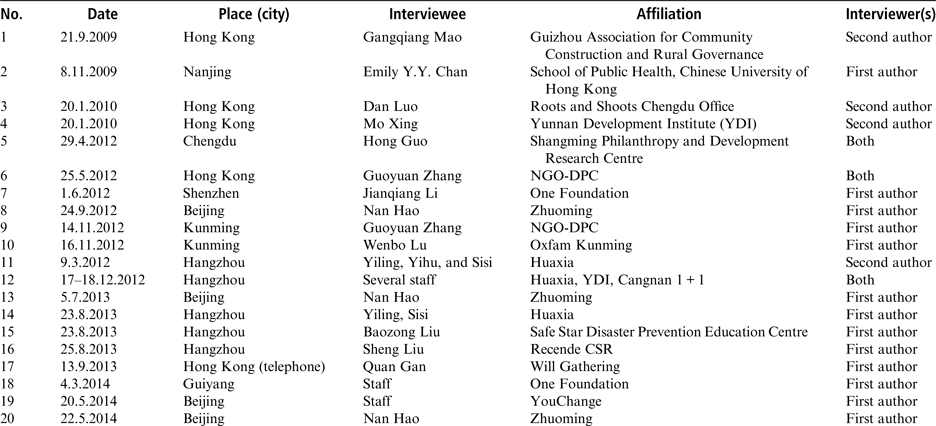
The rest of the paper proceeds as follows. First, it provides a literature review of the different approaches to examining the autonomy and political relevance of civil society in the Chinese context. The empirical part of the paper begins with a review of the development and main trends of non-governmental relief activities since the 2000s. It then analyses the most active platforms and networks in this field, focusing on their strategies of maintaining a broad-based partnership and enhancing inter-organizational connectivity. The next section takes an in-depth look at a successful joint non-governmental relief operation in Lushan 芦山, Sichuan province, in 2013, and explicates how NGOs can break down the state monopoly over information management, public donations and relief management. The paper concludes with cautious optimism about the future of civil society development in China. Most of the empirical data for this paper were gathered from interviews with activists, NGO staff and researchers, and from participation in various NGO meetings in Kunming, Hangzhou, Beijing, Guiyang, Hong Kong and a number of locations in Sichuan province, between 2009 and 2014.Footnote 5 The Appendix provides details of the 20 most relevant interviews.
Three Images of Civil Society in China
Scholarship on the development, autonomy and political relevance of civil society in contemporary China in the past two decades has painted three different general images. Drawing from the notion of socialist corporatism, the first image of China's civil society emphasizes the powerful Chinese state, which not only keeps citizens’ associational lives in order but also adeptly takes advantage of a growing sector of service delivery NGOs and non-profit organizations (NPOs).Footnote 6 For example, local Communist Party organs in Shanghai have invented NPOs of their own for the purpose of enhancing their social outreach.Footnote 7
In the second image, the diversity of civil society actors is highlighted, and the differences between grassroots NGOs and quasi-NGOs (or non-NGOs), such as the state-affiliated “people's organizations” (renmin tuanti 人民团体), and government-organized NGOs (GONGOs) are scrutinized. Researchers who adopt the narrower definition of NGOs and civil society and emphasize their grassroots-ness tend to arrive at the conclusion that Chinese NGOs, despite gaining some level of agency and autonomy, are still “embedded” in the extensive Chinese state system.Footnote 8 Grassroots NGOs, by and large, are inevitably trapped in an asymmetric “symbiotic” relationship with the state and are dependent on governmental agencies for resources and legitimacy.Footnote 9
The above two images, despite their different underlying logic, agree that civil society in China remains politically marginalized, with weak autonomy and capacity. There is, however, a third way of interpreting the expanding terrain of NGOs, social activism and civil society in China, one that perceives activists and NGOs as having a significant level of autonomy and as being the main agents of change. Led by Tony Saich's work on a group of environmental and women's rights NGOs that have been active in Beijing since the 1990s,Footnote 10 scholarship applying this approach has identified the exact strategies used by seemingly powerless NGOs to introduce new ideas, practices and solutions to Chinese society. In various fields of rights protection for extremely marginalized or discriminated populations, grassroots NGOs, by “chipping away at the edges,” often can generate a critical impact on policymaking and implementation. This is because they are usually the only ones out there to deliver services and mobilize collective voices.Footnote 11
This third approach does not evade the question of power contestation between the state and society but instead tackles it by paying more attention to the origins of change in social practices that have an accumulative impact on politics and policymaking. Neither does this approach overlook the Chinese context where the state is not only a set of institutions but also forms the important structures that shape social lives. However, this approach draws attention to micro-foundational changes introduced by social actors, particularly in emerging policy fields. For example, Susan McCarthy studies faith-based organizations and charities and has found them to be the most critical actors in shaping religious lives and substantiating policy stakes. Faith-based organizations can in fact “repurpose the state” by being the nodal of community affairs, acting ahead, and providing practical models for the state.Footnote 12 Carolyn Hsu and Yuzhou Jiang argue that even when NGOs are obtaining resources and funds from the government, there is a definite element of agency and strategy. In other words, for the NGOs who have developed capacity and expertise, it is by choice rather than necessity that they work with governmental agencies.Footnote 13 Based on fieldwork and participatory observations of the disaster relief sector over the years, this research also finds evidence of autonomy, innovation and self-governance among social actors who have formed independently from the Chinese state system. The core finding is that relief NGOs in practice have ignored taboos, taken all the risks, sought support from private donors and the public, and have excelled in delivering goods and reaching out to disaster victims. The result is that the state's systems and mechanisms to control this sector have become ineffective or even obsolete.
To better explain the political meaning of the rise of a non-governmental relief sector in China, the paper underlines the point that politics is not only about how the state and social forces compete and negotiate power and resources, but it is also about how the institutional environment, policy content and social practices are formed and reformed in general.Footnote 14 This study finds that instead of merely reacting to the state or following conventional practices, relief NGOs and charities have acquired new technologies of communication, social mobilization, rescue, logistics, and relief management. With professional knowledge, specialized skills, sufficient funds from the public and effective self-governance, relief NGOs have repositioned themselves in contrast to the state. As a result, they have surpassed the state in delivering public goods and have reconstructed a public issue area that provides more socio-political space for non-state actors. This strategy is different from both implicit dependency on the state system and strategic avoidance of state intervention.Footnote 15 The essence of this type of restructuring of state–society relations lies in finding new solutions to social problems and expanding social autonomy, and hence making the state less pivotal than before.
As mentioned above, there is a debate in the China field on the significance of the 2008 Wenchuan earthquake to the overall development of civil society in China.Footnote 16 Although the findings of this research do not fully address this debate, they can clarify whether non-governmental actors in the relief sector have survived, or even thrived, after the early stages of crises and initial acceptance by the state, and whether these actors are capable of transforming short-term opportunities into a sustainable stimulus for further capacity building.
Non-Governmental Actors in Disaster Relief: Before, During and After 2008
In the 1980s, the overall mode of China's disaster relief transformed from case-based mass mobilization rooted in the Maoist revolutionary tradition to the post-authoritarian professionalism centred on specialized agencies and technocrats.Footnote 17 The second half of the 1990s saw a grand transformation of the Chinese administrative system including the restructuring of disaster governance with first the Ministry of Economy and Trade (1998–2008) and then the Ministry of Civil Affairs (MoCA, since 2008) as the central bureaucracy.Footnote 18 This administrative change placed governmental agencies in a position to monopolize all the resources for disaster preparedness, relief and rehabilitation, and to control public participation and social mobilization throughout these processes. Such a restricted institutional environment refutes the assumption that the relief sector is among the least sensitive or controlled areas from which social activism can emerge in China.
While the number of NGOs has been on the rise in various fields such as environmental protection, women's rights, education and poverty relief in the past two decades, the same cannot be said about disaster relief. Only a handful of international NGOs such as Oxfam Hong Kong were allowed to work directly with victims of natural disasters alongside the official agencies before the 2000s.Footnote 19 Domestic specialized relief NGOs emerged only after the Wenchuan earthquake struck on 12 May 2008. More importantly, two platforms, the Sichuan NGO Earthquake Relief Coordinating Office (NGO-RCO) and the 512 Voluntary Relief Services Centre (hereafter, 512 Centre), were established to coordinate NGO relief work nationwide during the early response to the Wenchuan earthquake. The success of these two networks marked the beginning of a non-governmental relief sector and a recurrent mode of joint mission by relief NGOs (Table 1).
Main Natural Disasters and Non-Governmental Relief Missions, 2008–2013

Source:
Monthly newsletters published by the Zhuoming Disaster Information and Service Center, 2010–2013.
Note:
* + refers to 10 to 30 NGOs, ++ refers to 30 to 50 NGOs, +++ refers to more than 50.
In the years following 2008, relief NGOs and funding organizations were faced with sporadic waves of suppression by the state, as well as other adversities. State authorities resumed control of public donations and took over most NGO-run shelters and community reconstruction projects in Sichuan province within a year of the Wenchuan earthquake.Footnote 20 Local authorities began to resent NGOs and volunteers coming from outside and “messing around.”Footnote 21 The Guo Meimei incident and a series of corruption scandals related to the Red Cross Society China (RCSC) in 2011 shattered public trust in not only state-run charities but also, unexpectedly, private charities and NGOs.Footnote 22 During the Yiliang 彝良 earthquake relief operation in September 2012, the same methods used by NGOs to great effect in the Wenchuan earthquake relief effort yielded little public support.Footnote 23
Faced with these challenges, many NGOs withdrew from the field and only the most committed persevered.Footnote 24 According to the newsletters published by the Zhuoming Disaster Information and Service Centre (Zhouming zaihai xinxi fuwu zhongxin 卓明灾害信息服务中心, hereafter, Zhuoming) and the authors’ fieldwork, there are currently over 300 grassroots NGOs and voluntary groups across the country that participate in disaster relief on a regular basis. The majority of these groups are small-scale, locally rooted NGOs, staffed with outdoor sports enthusiasts, amateur or trained rescuers, and activist-minded specialists.Footnote 25 For example, the Beijing-based Blue Sky Rescue (BSR) is one of the oldest non-governmental outdoor rescue groups in China.Footnote 26 The Cangnan Emergency Rescue One Plus One (Cangnan 1 + 1) in southern Zhejiang province started its first mission when Typhoon Morakat struck in August 2009.Footnote 27
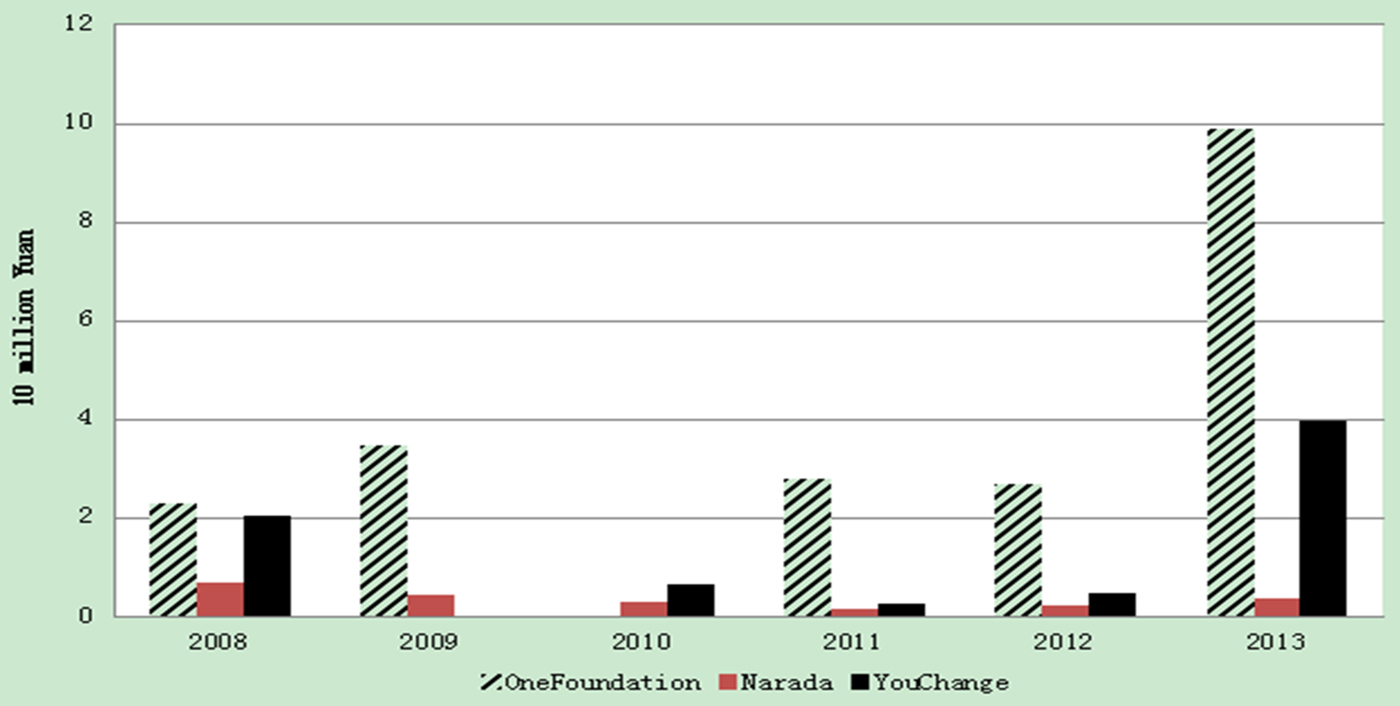
Private foundations and charities are another main type of non-governmental actor in the sector. Since the 2000s, new charities and funding organizations set up by business elites have emerged as frontrunners in philanthropy in China, as represented by the Narada Foundation (Narada), Alxa SEE Ecological Society, LaoNiu Foundation, YouChange Social Entrepreneur Foundation (YouChange) and One Foundation (OF). These organizations searched for politically acceptable and relevant projects to sponsor and responded with vigour to the Wenchuan earthquake. Following the public participation in the post-Wenchuan relief and reconstruction, many of these private foundations found disaster relief to be a suitable issue area to which they could devote their resources. Among them, Narada, YouChange and OF stand out as the biggest non-governmental donors in the field (Figure 1).
Disaster Relief Funding by Private Charities
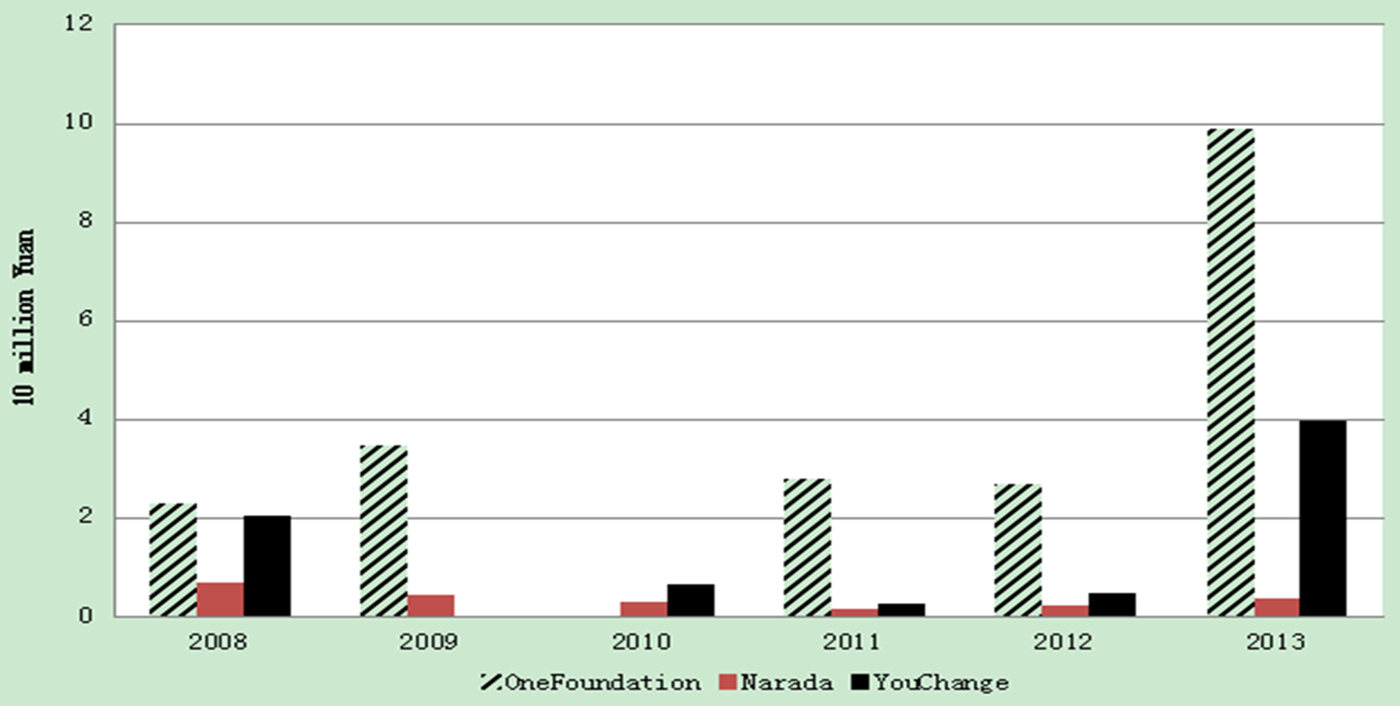
Narada, YouChange and OF are not merely new donors but hands-on advocates and innovators of public participation and NGO development in China.Footnote 28 Narada was established with an initial 100 million yuan endowment from the Shanghai Narada Group Co. to “foster civil society” and “cultivate a generation of future social entrepreneurs in China.”Footnote 29 Its chief administrator, Xu Yongguang 徐永光, is probably the best-known public figure in philanthropy and private charity in China. His progressive ideas on civil society and political development, together with his charisma and experience, have been well-received in private charity circles and have been instrumental to social identity building among all relief NGOs.Footnote 30 Similarly, YouChange was established by a group of business elites in Beijing in 2007 and began to fund relief projects via grassroots NGOs after Wenchuan.Footnote 31 OF was established by the internationally acclaimed film star Jet Li 李连杰 and became the most active donor organization in disaster relief after 2012 (Figure 1).Footnote 32
The third and arguably most important type of non-governmental actor in disaster relief includes the NGO platforms and networks that are built collaboratively by veteran activists, leading NGOs and resourceful private foundations. The next section will examine these platforms in detail.
A few basic trends have surfaced in the non-governmental relief community since 2008. First, this community is growing, despite its ups and downs. Its growth can be measured not only by the sheer number of organizations but also by the overall geographic spread, scope of work, and recurrence of joint missions. Second, a group of relief NGOs and private foundations has overcome challenges, gradually figured out the field of disaster relief as a whole, and emerged as leaders of the sector. Finally, non-governmental actors in this sector have shown a strong interest in building networks and platforms for inter-organizational cooperation. The following sections will further elaborate how collaborating with peer organizations has become an effective strategy for relief NGOs and private charities to accomplish organizational goals, thrive together, and gradually reshape the whole sector.
From Networking to the Birth of a National Alliance of Relief NGOs
This section explains how relief NGOs and charities have achieved a national alliance. Three types of partnerships and platforms are examined and compared. The focus of the analysis is on the various methods these platforms have used to attract peers, improve capacity, overcome mistrust, bear political risks, and achieve goals, all of which, for the social leaders who were eager to create an NGO alliance, were more critical issues than interacting with state agencies.
The 512 Centre – moving beyond allying with the state
Launched within 12 hours of the Wenchuan earthquake, the 512 Centre and the NGO-ROC were once viewed as symbols of NGO power and its collective identity in China. The 512 Centre and its organizational successor, the Shangming Social Development Research Centre (Shangming gongyi fazhan yanjiu zhongxin 尚明公益发展研究中心, hereafter, Shangming), have always maintained connections with local state agencies. The inception of the 512 Centre demonstrated how open-minded state-affiliated scholars could make full use of personal connections within the state apparatus to push for more space for NGOs. However, Shangming has shown signs of change and since 2011 has moved its organizational structures and resources out of the formal realms of the state system. Shangming's leaders have made it clear that their most important concern is “to win political space for all relief NGOs.”Footnote 33 Many small grassroots relief groups have joined and worked with Shangming, not only because it has resources but also because it is transparent about its working relationship with the government.Footnote 34
Despite its historic importance, Shangming has nevertheless retreated from the centre of non-governmental relief, and in recent years its leadership has been replaced by other platforms that do not rely on the formal support of, or close relations with, the state. This change indicates the new dynamism of the non-governmental relief sector, as explained in the following section.
Grassroots NGO networks based on shared experiences and values
Although aware of the 512 Centre platform, a group of over 40 grassroots NGOs made a conscious decision not to be part of it.Footnote 35 They instead chose to form NGO-RCO to maintain some distance from the state. After NGO-RCO completed its mission in 2008, its chief coordinator, Zhang Guoyuan 张国远 – a veteran NGO practitioner in rural development – launched the NGO Disaster Preparedness Centre (NGO-DPC) and co-founded United Rescue (UR) with the aim of conducting large-scale relief missions with peer NGOs.Footnote 36 In sharp contrast to the 512 Centre, UR's strength lies not in its connections with the state but in its hands-on and advanced knowledge of rescue and relief delivery, as well as a strong sense of solidarity among its member organizations formed from their shared experiences of working with international NGOs and participating in non-governmental relief missions.
Similarly, the Huaxia Public Service Centre (Huaxia gongyi fuwu zhongxin 华夏公益服务中心, hereafter, Huaxia) is also deeply rooted in the activist and grassroots NGO communities (not relief specific) that have emerged in China since the 1990s. Formally registered as a “public service centre” since 2012, Huaxia in reality is a virtual network with more than 200 autonomous member groups spread across the country. Much of Huaxia's activities such as fund raising, collecting disaster information and training take place in the “virtual world” and on the internet. Hundreds of webinars have been organized to broadcast talks by veteran activists and rescue experts and to discuss controversial policy topics among relief NGOs.Footnote 37
All of the founding leaders of Huaxia came from outside the state system and had shared experience of delivering relief goods following the Wenchuan earthquake.Footnote 38 They quickly learned managerial techniques for running volunteer platforms and cross-regional relief delivery and also learned lessons from the history and trends of the broader NGO community in China. Through meetings with peers and various training programmes, Huaxia's leaders have acquired in-depth knowledge of civil society development in the country. Believing strongly in the value of social autonomy and self-governance, they tend to disagree that the only “correct” model for NGOs is one that interacts with the state. They are aware that their approach to public participation in disaster relief differs from that of other initiatives such as the 512 Centre. According to Huaxia leaders, “Our approach is different from some NGOs in Beijing or Guangzhou. We do not see governments as the ultimate nemesis. Resisting the government is not the solution to social problems. We are committed to solving the problems.” “We communicate with local governments when necessary, but in fact we do not depend on them in our work. Our information is first-hand and fast, and we have the largest and most capable network [of relief volunteers]. Our members make our work possible, not the government. If we can persuade the government, we can duplicate our model in more locations, but this is a long-term goal.”Footnote 39
Additionally, Huaxia has adopted an inclusive principle with regard to membership and has rallied various types of civic actors, ranging from urban-based techno-activists, adventure-minded professional rescuers and experienced activists, to join volunteer groups based in remote rural towns. The founders of Zhuoming and Yiyun 益云 (translated as “cloud technology for public interest”), who revolutionized the mode of public participation in China with Web 2.0 technologies, were among the first batch to join Huaxia.Footnote 40
UR and Huaxia together have significantly broadened the scope of non-governmental participation in disaster relief across the country. They have overcome the political restrictions on cross-regional and cross-sectoral “linking-up” by both taking advantage of the newly available Web 2.0 technologies and, more importantly, establishing fluid, non-hierarchical structures of collaboration. The leaders of these collaborative platforms are bound together by their shared values and experiences; similarly, the large number of volunteer members of these networks are bound together by the open, innovative, exciting and collaborative atmosphere of UR and Huaxia.
From donor-driven networks to a national alliance
In 2010, YouChange, as a major donor in the field, established the Centre for Non-Governmental Disaster Response (CNDR) to better support its NGO grantees. The CNDR created a three-layered framework to link up resources from local to national levels which was anchored to a group of “pivotal organizations” in different provincial capitals.Footnote 41 The CNDR funded and mentored these organizations to become the NGO hub for relief work within a region, and sponsored workshops and training sessions to quickly boost the overall capacity of the relief NGO community. The founder of Zhuoming, who had also been an active member of Huaxia, recalled in an interview with the authors that his inspiration for establishing his own NGO to focus on disaster assessment came from a workshop organized by the CNDR.Footnote 42 Zhang Guoyuan explained that the CNDR also influenced the development of his organization, NGO-DPC, which became one of the pivotal organizations in the CNDR-led network.Footnote 43 By establishing the CNDR, YouChange turned capacity-development programmes into an interactive social space to facilitate not only information exchange but also trust building among actors with diverse backgrounds. This then laid the foundation for coordinated cross-regional relief actions and formal alliances.
Although the CNDR was dismissed in 2012, its training programmes had brought together the leaders of relief NGOs and provided much-needed opportunities for them to meet and become acquainted. The three-layered framework for the first time provided leading activists and NGOs with a mental map of disaster relief in the whole country, and initiated the experiment of self-governance within the sector.
In a way, all of the platforms and networks discussed above paved the way for the ascent of a more inclusive nationwide relief NGO alliance, the United Disaster Relief (UDR), formally established in March 2013. Three immediate factors propelled the UDR forward. First, in 2012, OF restructured itself and cluster recruited a group of staff who specialized in disaster relief management, all of whom had worked together with Oxfam Hong Kong and at Wenchuan. This unique team at OF, with their shared professional background, vision and personal connections with many grassroots NGOs, were to play a critical role in winning trust from the relief NGO community to form the UDR.Footnote 44 Second, OF's relief team inherited much of the legacy and foundational work done by CNDR, and continued the tradition of organizing large gatherings for relief NGOs to exchange information and expertise, which nurtured a sense of solidarity within the community in spite of different working styles and organizational origins.Footnote 45 Last but not least, OF adopted the principle of an equal partnership between the funder and the funded in the processes of establishing the UDR. This principle meant that OF, despite being the sole donor behind the UDR, would voluntarily subordinate itself to a standing committee elected by member NGOs – OF's grantees. This committee, instead of the donor (OF), would oversee the allocation of funds for the whole UDR and joint relief operations.Footnote 46 This principle of equal partnership received an overwhelming endorsement from relief NGOs, as shown by their eagerness to take part in the UDR alliance.
Compared with the early relief NGO networks, the UDR is significantly broader, stronger and better managed. Not only does the UDR have formal organizational substances but also its members are sufficiently funded and well equipped. For the year 2013 alone, OF provided close to 100 million yuan for disaster relief work implemented through the UDR. Pictures of UDR member NGOs and rescuers with advanced equipment often appeared online within hours of a disaster, earlier than the release of images by state agencies.Footnote 47 Furthermore, the participatory governing structure, led by the elected committee, has worked to bind all the members together.Footnote 48 Since its establishment, the UDR's membership has continued to grow and reach out to all provinces, even the far-flung ethnic minority communities in the Xinjiang and Tibet autonomous regions.
The UDR responded to many smaller disasters, such as wildfires, extreme weather, flooding and droughts, in remote interior provinces that neither central nor local state agencies were able to respond to in a timely and effective manner. The UDR, with its widespread local NGO partners, was able to deploy rescuers and relief supplies within 12 hours of a disaster. Relief workers affiliated with the UDR were often better equipped and more professionally skilled than those engaged by the state agencies. For instance, during the response to the tornado in Yancheng 盐城 in June 2016, the UDR's operation on the ground made the traditional style of war-like mobilization led by the state look obsolete. While the UDR's relief workers all carried sufficient supplies for themselves and brought their own tents, the armed police and People's Liberation Army soldiers deployed by the state to the affected areas had to sleep outdoors for the first night.Footnote 49 The UDR's relief supplies, especially tents and shelters, also arrived earlier than those sent by the state agencies and state-run charities, thanks to the UDR's “emergency storage system” – a programme that aims at long-term disaster preparedness – and the efficient crisis decision making of the UDR members. The UDR's responses to the earthquake in Minxian 岷县 in 2013, floods in Xinjiang and Guizhou in the summer of 2016, and many other types of natural disasters were also swift and effective. This demonstrated a consistency in the UDR's response to the urgent needs of affected communities and provided a remedy for the “blind spots” in the state relief system.Footnote 50
Joint Relief Operations and a Parallel Relief Mechanism
All the efforts to build up trust and a nationwide alliance of relief NGOs would have been in vain if they could not generate real collective output. In the years after 2008, many joint non-governmental disaster relief missions took place in times of crisis (Table 1). It is through these joint operations that relief NGOs developed a deeper awareness of each other and learned how to make and implement decisions collectively. The most successful joint non-governmental relief operation was carried out in the wake of the Lushan earthquake in 2013. This joint effort marked the emergence of a comprehensive non-governmental relief system, and broke the state monopoly over disaster relief in at least three aspects: the management of public donations, information gathering and sharing, and relief delivery. The main issue here is not about how severely relief NGOs have defeated governmental agencies, but rather how relief NGOS have made it possible to deliver what they want to deliver without having to go through official administrative channels.
First, at Lushan, non-governmental relief actors broke up the Chinese state's monopoly over public donations. Previously, ordinary citizens could only make a donation towards disaster relief through state-run charities, foundations and GONGOs such as RCSC offices. In early May 2008, the MoCA issued its “Administrative Measures for Donations for Disaster Relief,” which permitted registered and recognized private charities and NGOs to receive donations directly from individual citizens. However, the state still dominated both the mobilization and distribution of public donations. Over 90 per cent of all public donations for the Wenchuan earthquake were absorbed by the state-run charities, and the RCSC system alone received over 20 per cent.Footnote 51 After the Yushu 玉树 earthquake in April 2010, probably owing to the sensitive nature of the location in the Kahn Tibetan ethnic areas, MoCA, the State Council and other related ministries jointly issued a new administrative measure and ordered all public donations to be submitted to the Qinghai provincial government.Footnote 52 Thus, the regulatory environment for public donations reverted to pre-2008 status.
From 2008 to 2013, relief NGOs and private charities gradually gained more public trust and support after significantly improving their capacity in all aspects of disaster relief (including emergency response, damage assessment, information sharing, logistics management and resource delivery), financial transparency and self-governance. For example, during the relief periods after the Yushu, Yiliang and Lushan earthquakes, UDR and Huaxia's teams were able to deliver goods faster and more effectively to remote rural villages that were out of the reach of state-led relief task forces. This was primarily thanks to their consistent efforts in building stores of supplies in disaster-prone regions and improving their disaster-assessment capacity.Footnote 53 Relief NGOs also expanded on their comparative advantage vis-à-vis the state in responding to small-scale, low-intensity disasters by working with marginal populations in remote areas on long-term risk reduction beyond crisis times.Footnote 54
Moreover, their improved self-governance and public accountability, rather than their close ties with the authorities, have helped non-governmental relief NGOs to gain more legitimacy. Leading funders in the relief sector, such as Narada, YouChange and OF, have been active in promoting self-discipline and financial transparency among relief NGOs. In 2010, the China Foundation Centre (CFC) was set up as a voluntary mechanism of information disclosure, public monitoring and self-governance.Footnote 55 The CFC launched the Foundation Transparency Index in 2012 and has since released annual transparency rankings of private foundations in China. In addition, relief NGOs embraced new Web 2.0 technologies such as third-party online payment tools to enhance the transparency of their fundraising processes by releasing information about the transfer of funds to the public instantaneously.
All the efforts to build capacity and public accountability by relief NGOs received payback at the time of the Lushan earthquake when the public was more willing to give money to relief NGOs than before.Footnote 56 The dominance of state charities, particularly the RCSC system, began to decline as their total share of public donations dropped from more than 89 per cent in 2008 to less than 50 per cent after the Lushan earthquake.Footnote 57 OF alone received more than 380 million yuan, outshining all state-run foundations.Footnote 58 The public's positive reception of the relief NGOs’ performance at Lushan was partially reflected in the fact that OF again received over 16 million yuan in donations from ordinary citizens via its third-party online payment system within 48 hours of the Ludian 鲁甸 earthquake in August 2014.Footnote 59
The relief NGOs’ success in public fundraising after the Lushan earthquake has had a further impact on the roles they can perform in the field. A lack of funding has always been the biggest obstacle preventing relief NGOs from embarking on long-term post-disaster recovery and community re-building. Short-term rescue missions often allow NGOs to reach out to the population in need, but cannot keep them there for long. Only when NGOs stay on at the community level can they grow roots and make substantial changes. With the money donated to the Lushan earthquake relief operation, OF has funded 50 long-term reconstruction projects, which are to be managed by 46 NGOs over the next five years.Footnote 60 These projects have offered relief NGOs sufficient means to participate in local-level social reconstruction in the long term and have helped to enhance public recognition and accountability of the whole non-governmental relief community.
Second, relief NGOs developed an important strategy – utilizing Web 2.0 technologies and crowdsourcing to collect and process information directly from local partners and ordinary citizens – to improve the quality of relief at Lushan. This strategy bypassed and surpassed the state-run mechanism for disaster information management. Although the Chinese government has become more tolerant of public participation in disaster response since 2008, it still maintains tight control over the gathering and dissemination of disaster information, such as the location and damage assessment, which arguably has to some extent perpetuated the state's power in this field. However, the quality of information collection, analysis and dissemination has not been up to the task. Following repeated experiences on the ground, NGOs gradually became aware of the inefficiencies in the state-run disaster information management.Footnote 61 In a sense, it became necessary for relief NGOs to overcome the state's control of an ineffective means of information management. Several of the NGO staff interviewees informed the authors that state-run disaster relief agencies, especially those at local levels, had little idea about what NGOs were or how new information communication technologies were used for disaster relief.Footnote 62
The UDR and Huaxia were among the first organizations in China – way ahead of the state relief agencies – to experiment with collecting first-hand disaster information directly from ordinary citizens. With their hands-on knowledge and repeated training and learning, these relief NGO alliances developed systemic methods to analyse raw relief data independently and share findings instantaneously within their own networks. Two particular web-based relief NGOs, Zhuoming and Yiyun, championed the revolution of information management in the field of disaster relief by taking full advantage of the increasing availability of cheap smartphones, wireless internet connections and Web 2.0 technologies.Footnote 63 Zhuoming, which started as an online voluntary group after the 2010 Yushu earthquake, used social networking sites and instant messaging tools back then to collect information directly from the affected areas. It then weaved the fragmented information into briefings for relief groups.Footnote 64 Yiyun, in fact, emerged amid the Lushan earthquake relief efforts and then continued afterwards as a social enterprise providing Web 2.0 resources for civil society organizations.
During the Lushan relief period, Zhuoming outsourced the task of data collection to a large number of volunteers in social networking spaces. The activists behind Yiyun developed an interactive mapping app devoted to relief delivery that could be accessed on personal computers and mobile phones. This was the first such app in China. Volunteers who were inside the disaster zone, or individuals who wanted to help, could use this app to locate themselves and instantly share geo-tags containing updated assessments of local disaster damage and relief needs. Yiyun then streamlined a massive amount of these geo-tags and generated highly useful geo-maps. These maps were the most reliable guides available for all the relief agencies working on rescue, goods delivery and crisis management.Footnote 65 The two groups also worked closely with each other, as Yiyun incorporated and visualized crowd-sourced information from Zhuoming. Empowered by the highly collaborative and participatory Web 2.0 technologies, relief NGOs gained a great advantage over state agencies in real-time information collection, presentation and dissemination in the Lushan case.
Since the Lushan earthquake, relief NGOs have further utilized Web 2.0 technologies and have innovated new ways to manage information in crisis times such as cloud collaboration and peer-knowledge production, interactive disaster mapping and damage assessment based on crowdsourcing applications. Led by NGOS, this revolution in disaster information management has rendered the old state-controlled mechanisms of information management almost obsolete. State relief agencies gradually became aware of the fact that they were behind NGOs in terms of using crowd-sourced crisis information and applying new communication technologies.Footnote 66 During the relief operation for the Lushan earthquake, state-run charities began supplying information to the Yiyun map as it was the de facto guide for all volunteers and relief efforts. After Lushan, prominent state-run charities such as the China Foundation for Poverty Alleviation and China Charity Alliance, learning from the relief NGOs, tried to establish their own networks of relief NGOs and build an organizational infrastructure for collective disaster information management under their control – they even invited Zhuoming and Yiyun to join these “national teams” and serve as advisors. But, so far, the state-sponsored relief networks have not been able to launch crisis crowdsourcing and geo mapping on their own.Footnote 67
Last not least, relief NGOs accomplished a more efficient division of labour and coordination across places in the Lushan case compared with previous joint relief missions. With better trained rescuers, reliable information and local partners, OF and Lantian teams launched search-and-rescue and goods delivery in the epicentre area just one hour after the first tremor struck and earlier than any state agencies. The UDR and Huaxia established an operational office in the earthquake zone just a few hours later in order to coordinate the large number of volunteers and NGOs pouring in and provide them with information on local contacts, resources and relevant authorities. Huaxia established both a logistics team located at the epicentre and an information and coordination team outside the disaster region, which greatly improved information accuracy and the flow of supplies across multiple locations. Shangming initiated and formed the 420 United Rescue Team, in collaboration with the provincial Communist Youth League of Sichuan, to coordinate the information flow across grassroots NGOs, local governmental agencies and populations in need.Footnote 68
Members of the 420 Rescue Team, the UDR and Huaxia made a conscious effort to share information and manage volunteers together, rather than compete with one another.Footnote 69 According to several of our interviewees who had participated in many joint NGO relief missions, inter-organizational coordination was organized more quickly and operated more efficiently at Lushan than on previous occasions.Footnote 70 The Lushan earthquake relief operation showcased the development of professionalism, mutual trust and coordination skills within and across NGOs and their networks.
With sufficient funds, advanced information management and reliable coordination within and across organizations, a comprehensive and effective non-governmental system of disaster relief was taking shape and carried out in parallel with the state-run system. The transformation of disaster relief governance in China is distinguished by the establishment of the UDR and the coexistence of non-state and state-run relief mechanisms. It is important to highlight also that the organizational and tactical innovations and operational successes of relief NGOs have drawn the attention of state actors and even spurred their development.
Conclusion
When the rare window of opportunity for relief NGOs to experiment with inter-organizational collaboration in 2008 closed up and the implicit “political consensus”Footnote 71 that was once reached between the party-state and voluntary groups during the crisis ended, NGOs faced staunch resistance from all sides to re-building mutual trust and alliances among themselves. Essentially, it was the conscious and continuous efforts by several key NGOs and private charities that helped solidarity to prevail over mistrust. This solidarity not only led to the expansion of NGO capacity and the birth of the UDR but also made state restrictions (or irregular support) almost irrelevant. With the repeated success of their large-scale joint missions, relief NGOs and the UDR gradually established a de facto independent system paralleling that of the state – as exemplified in Lushan in 2013. Relief NGOs’ savvy application of instantaneous social media not only enabled social actors to access disaster information directly, therefore weakening the state's control, but also allowed social actors to access and develop their own sources of information and use such information to operate innovative relief services independent from the state. As discussed above, state relief agencies have much to learn from relief NGOs about improving their capacity in the areas of local relief preparedness and crisis information management.
The accounts of interlaced relief NGO networks and their successful joint operations are, however, not meant to paint an excessively rosy picture of all state–society relations in China. Explicit co-optation and implicit coercion of NGOs and activists by the state still continue. Since 2011, the central authorities have increased their penetration of society by expanding state-sponsored service-oriented organizations under the slogan of “social innovation in social administration.”Footnote 72 Governmental agencies such as the RCSC and MoCA launched their own projects to recruit volunteers and organize mass participation in disaster relief, which tended to either directly absorb newly emerged grassroots groups or divert public enthusiasm from established relief NGOs. In some cases, local governments’ co-optation strategies can be sophisticated. In 2010, mediated by the RCSC, Lantian obtained its legal registration under the MoCA and since then has integrated its work into the crisis management department of the Beijing municipal government. Similarly, Cangnan 1 + 1 accepted several long-term contracts from national and local governments in disaster relief after its leader, a young activist without much previous involvement in politics, was selected for the local political consultative conference in 2012. Relief NGOs and private charities still have to tango with state agencies on a regular basis. Some pay lip-service tributes to the state and refer to themselves as “a complementary party to the government only focusing on technical issues.”Footnote 73 Some refrain from becoming involved in petitions and protests that would openly challenge the legitimacy of the authorities. Most of the NGOs that hope to gain access to the epicentres of disaster zones stayed away from the campaigns launched by public intellectuals to expose policy frauds and corruption.
Bearing this background of micro-level everyday negotiations in mind, the most important change in the relief sector is, nevertheless, the significant rise of social forces and relief NGOs and the emergence of a self-sufficient relief mechanism run by non-governmental actors. This paper concludes with cautious optimism about the future of civil society development under the leadership of Xi Jinping 习近平. The case of disaster relief sheds light on one of the many paths that civil society actors can follow in order to grow strong together on the broad stage of Chinese politics. Along this path, NGOs and activists are neither confrontational nor heavily dependent on the state, but rather they are self-driven, creative and often ahead of the state in solving the problems on the ground.
Biographical notes
Lin Peng is a research assistant at the Institute of Politics and Law, Guangzhou Academy of Social Sciences, China. He holds a PhD in political science from the Chinese University of Hong Kong.
Fengshi Wu is a senior lecturer at the University of Melbourne, Australia.
Appendix: List of interviews