INTRODUCTION
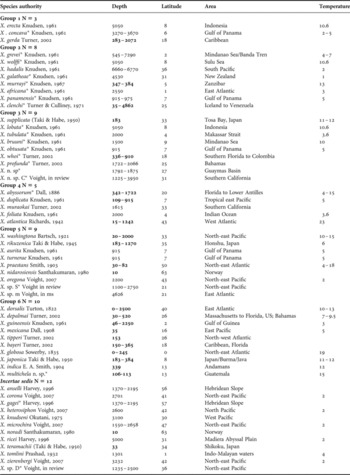
Species of Xylophaga are known to range from between 10 and 5050 m depth from the equator to near the Arctic Circle (Knudsen, Reference Knudsen1961; Schiøtte, Reference Schiøtte2005). As do shallow-water teredinids, species of Xylophaga use their ridged shells to bore into vegetation, most often wood, that has fallen to the sea floor. The bivalves ingest wood fragments and, with the help of endosymbiotic bacteria hosted on their gills (Distel & Roberts, Reference Distel and Roberts1997), digest it. Despite the apparent rarity of seafloor wood, the species of the Xylophagainae appear to be unusually diverse, with four to six co-occurring in comparatively small oceanic areas (Turner, Reference Turner2002). With over a third of the 55 known species of Xylophaga having been described since 1996 (Table 1), patterns of distribution of the group are becoming apparent.
Species of Xylophaga arranged by Turner's (2002) groups (with species not readily assigned to a group listed at the end), with depth range in m, absolute value of average latitude, geographical area and estimated maximum ambient temperature at depth (where available). An asterisk after the species name indicates that the species is considered to brood its young. Depth ranges of species occurring in the upper 500 m are in bold type.

Although species of deep-sea groups such as Xylophaga typically occur deeper than the photic zone or the ‘thermocline’ (Knudsen, Reference Knudsen1961), some species occur at shallow depths. Most frequently, deep-sea species make shallow water incursions at high latitudes, where the water column is isothermic. A description of two Xylophaga species from 10 m depth in Norway (Santhakumaran, Reference Santhakumaran1980) indicates that the group shows this pattern, but the description here of a new species of the genus from near 100 m depth on the Pacific coast of Guatemala documents that additional mechanisms are at work. The derived character states of a truncated excurrent siphon that continues as lappets on the dorsal incurrent siphon, and ear-shaped mesoplax plates place this species in Turner's (2002) species Group 6. All species in this group, in addition to sharing those morphological features, occur above 350 m depth, and most occur in the upper 150 m.
This paper describes a new species, Xylophaga multichela. The depth distributions of this and related species, are hypothesized to form a clade because they share what are argued to be highly derived characters. The occurrence of this clade on the continental shelf may relate to the high biotic interactions typical of the wood fall habitat and the hypothesized tolerance of this group for reduced oxygen availability.
MATERIALS AND METHODS
The 32 specimens examined were from the Scripps Institution of Oceanography Benthic Invertebrate Collection (SIO-BIC). They were removed from the vegetation (reeds) in which they had been collected and formalin-fixed and were transferred to 80% ethanol by the author. The duration of storage in formalin and its strength were unknown. All specimens were examined under light microscopy; all illustrations were made using a camera lucida to ensure their accuracy. Shell measurements of the holotype, including length, height and breadth (across both intact valves) were made with electronic callipers. Characters used in species descriptions are those of the shell, mesoplax and siphons, as is traditional within this genus (Knudsen, Reference Knudsen1961; Turner, Reference Turner2002). Two specimens of Xylophaga multichela sp. nov. were placed in a series of increasing ethanol solutions, critical-point dried and sputter-coated with gold; structures on the incurrent siphon were then examined by scanning electron microscopy.
Taxonomic history of wood-boring bivalves from the eastern tropical Pacific, other than Knudsen's (1961) description of six species collected from three sites in the Gulf of Panama, is lacking. Voight (Reference Voight2007, in press) reports the Xylophagainae from the eastern Pacific Ocean north of the US–Mexico border.
Turner (Reference Turner2002) defined six species groups in the genus Xylophaga based on unpolarized characters. Groups 5 and 6 share a truncated excurrent siphon that otherwise appears to be unique among the Pholadidae, and very rare among bivalves in general, and a longitudinal trough on the dorsal incurrent siphon defined laterally by lobes or folds, also referred to as low walls (in Group 5), or fringed lappets (in Group 6). In addition, species of Group 6 share roughly ear-shaped mesoplax plates, the truncation of the excurrent siphon being near the valves, and continuing as fringed lateral lobes along the dorsal incurrent siphon. Because recognition of Group 6 could make Group 5 paraphyletic, both groups are considered here, with Group 6 being the focal group for this study.
Latitudinal and depth records for each species of Xylophaga were compiled from the taxonomic literature (Harvey, Reference Harvey1996; Knudsen, Reference Knudsen1961, Reference Knudsen1967; Okutani, Reference Okutani1975; Santhakumaran, Reference Santhakumaran1980; Turner, Reference Turner2002; Voight, Reference Voight2007, in press), as most species are known only from their type localities. Sea temperature at the collecting site was taken from available reports (notably Knudsen, Reference Knudsen1961) and web-based references (e.g. http://faculty.washington.edu/kessler/pacs/inverse/epac.html). Differences between Groups 5 and 6 and between those species and others in the genus (Groups 1 to 4) in depth and geographical range, and in ambient temperature were analysed using Kolmogorov–Smirnov tests, nonparametric tests of differences in two samples. Knudsen (Reference Knudsen1961) reported two species of Group 6, X. guineensis Knudsen, Reference Knudsen1961 and X. dorsalis Turton, 1822, from depths over 2000 m. Turner (Reference Turner2002) however, argued that Knudsen's examination of the former species relied on dead shells that were transported post-mortem. Schiøtte (Reference Schiøtte2005) stated that X. dorsalis has a shallow rather than the wide depth range Knudsen (Reference Knudsen1961: Table 3) cited based on Dautzenberg (Reference Dautzenberg1927). This latter comment echoes Knudsen's (1961) text caution that Dautzenberg's (1927) report should be re-evaluated. The greater maximum depth records are retained in this dataset, despite these caveats, as they will act only to bias the test toward accepting the null hypothesis that no significant differences exist in depth distribution between the focal group and the other species of Xylophaga.
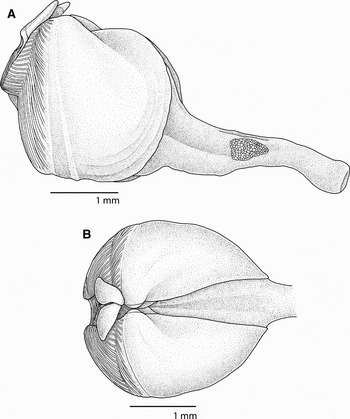
Xylophaga multichela sp. nov. (A) Line drawing of lateral intact holotype, triangular cluster of hooks positioned near halfway point of siphon; (B) line drawing of dorsal view of intact holotype. Scale bars: 1 mm.

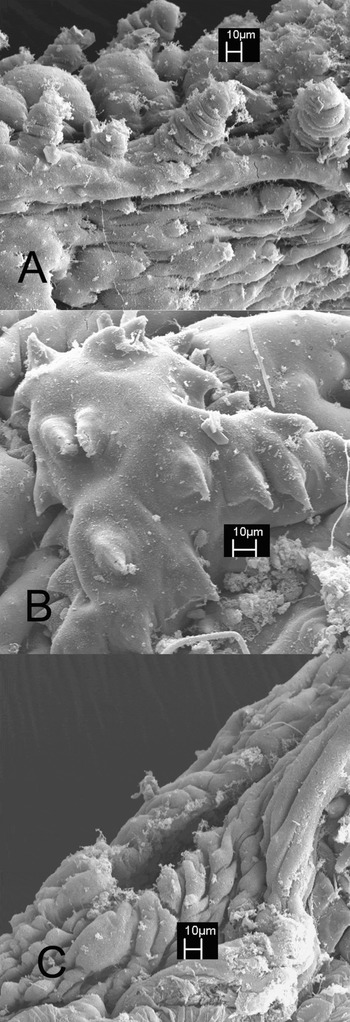
Xylophaga multichela sp. nov. (A) Scanning electron microscope (SEM) image of papillae that border the longitudinal trough on dorsal incurrent siphon; (B) SEM view of triangle of hooks just distal and lateral to excurrent opening; (C) SEM view of opening of excurrent siphon. Scale bar in each 10 µm.

TYPE MATERIAL
Holotype: (FMNH 312307 x-SIO-BIC M 11567), MV 73-I-47; Champerico, Guatemala; 13° 50.0′N 92° 01.7′W to 13° 52.5′N 92° 02.3′W; 113–106 m; 40′ otter trawl; 13 April 1973; RV ‘Agassiz’; Coll. Hubbs & Luke. Measurements of holotype: shell length 2.6; height 2.4; breadth 2.7; incurrent siphon length 2.3.
Paratypes: 31 adults (SIO-BIC M11567) collected with the holotype.
DIAGNOSIS
Large, ear-shaped mesoplax. Incomplete siphon: excurrent siphon truncate near valves; incurrent siphon with deep, dorsal channel, papillate edges. Triangle of white granules with recurved tips on lateral siphon distal to excurrent opening. Papillae variably present on distal incurrent siphon. Young brooded on common siphon.
ETYMOLOGY
Named after the triangle of hooks just distal and lateral to excurrent siphon opening (Latin: multi-; Greek -chela claw).
DESCRIPTION
Beak (Figure 1A): non-protruding, 20 toothed rows parallel to ventral edge, forming broad vertical band of 16–20 toothed rows at junction of beak and disk. Umbonal reflection: simple outward fold near dorso-lateral edge of anterior incision.
Mesoplax (Figure 1B): large, conspicuous, ear-shaped, with posterior coiling; plates always meet at midline, general form somewhat variable; posterior extensions reaching between umbos variably present.
Shell (Figure 1A): small, very white, glossy, delicate, often broken. Umbonal-ventral sulcus: narrow, very weak, sharply prominent ridge posterior to sulcus. Inner shell: dry shells iridescent when lit from some angles. Posterior adductor muscle scar: poorly defined shiny rectangle oriented diagonal to dorso-ventral axis of shell, without individual elements. Pedal retractor scar: anterior, slightly dorsal to posterior adductor scar.
Siphon (Figure 1A): length variable, generally about equal to shell length, muscle transparency suggests some artefact likely; common siphon covered by thin periostracal membrane from shell to excurrent siphon opening. Excurrent siphon: truncated, margin of opening (Figure 2C) forms deep U, continuous with longitudinal channel on dorsal incurrent siphon; opening lacks cirri. Incurrent siphon: often papillate, especially at mid-siphon, opening without cirri, dorsal trough bordered by intermittent papillae (Figure 2A), trough lacks papillae. Triangle of hooks curved toward shell, distal to excurrent opening on lateral siphon (Figures 1A & 2B), position slightly varies due to variable contraction, hook tips clear, shiny, bases white.
Muscles: foot small relative to shell, vertical line on face. Mantle often transparent; longitudinal muscles in common siphon and ventral shell adductors visible.
Reproduction: 7 of 36 individuals carry 1–2 juveniles on common siphon. Additional juvenile-sized bivalves found unattached.
DISTRIBUTION
Only known from the type locality. Estimated ambient temperature 15°C.
REMARKS
The ear-shaped mesoplax, truncated excurrent siphon, laterally papillate incurrent siphon with a dorsal longitudinal trough definitively place this species in Turner's Group 6. The triangular cluster of opaque white hooks on the lateral incurrent siphon and the presence of brooded young separate this species from all others. Of species in this group, neither X. globosa nor X. bayeri has granules on the siphon according to Turner (Reference Turner1955) and (2002), respectively. Turner (Reference Turner2002) described fine, irregular opaque or glass-like white granules in a linear array on incurrent siphons of X. tipperi, X. depalmai, X. guineensis, X. japonica and X. mexicana. The clustered granules in the present species distinguish it. The present species is distinguished from X. dorsalis by that species' projecting beak, more massive mesoplax plates and cirri on the incurrent opening; it is distinguished from X. indica by the two distinct ridges defining the umbonal-ventral sulcus and the simpler mesoplax of that little-known species. The type localities of both X. multichela sp. nov. and X. mexicana lie between the US–Mexico border and the Gulf of Panama and both species share a prominent, but narrow ridge posterior to the umbonal-ventral sulcus. The distribution of granules on the siphon and the strongly projecting beak of X. mexicana versus the non-projecting beak of X. multichela sp. nov. readily distinguish them. Turner (Reference Turner2002) illustrated barb-shaped granules on X. tipperi and Knudsen (Reference Knudsen1961) noted that some calcareous bodies on the siphon of X. praestans, assigned by Turner to her species Group 5, had curved spines. The granules of the present species are therefore not unique.
Brooding by only seven individuals of the 32 individuals of X. multichela sp. nov. available for study may indicate a flexible reproductive strategy, as Tyler et al. (Reference Tyler, Young and Dove2007) document in X. depalmai.
DISTRIBUTIONAL PATTERNS AMONG XYLOPHAGA SPECIES
The latitudinal distributions of species in Turner's species Groups 5 and 6 (Table 1) are statistically identical to those of other species in the genus (D = 0.1562; P = 0.899), as are the latitudinal distributions of Group 5 and of Group 6 (D = 0.4000; P = 0.313). Species of Groups 5 and 6 occur at significantly more shallow depths (Table 1) than do the other species in the genus (D = 0.4753; P = 0.006 for maximum depths; D = 0.5592; P = 0.001 for minimal depths). Group 6 species occur at significantly shallower maximum depths than do those of Group 5 (D = 0.6000; P = 0.031), but their minimal depths of occurrence are not significantly different (D = 0.5000; P = 0.111). The available temperature data for collection sites for other species in the genus do not differ from those of Groups 5 and 6 (D = 0.400; P = 0.086), although Group 6 species occur in significantly warmer waters than do those of Group 5 (D = 0.600; P = 0.031).
DISCUSSION
A derived clade within the deep-sea or ‘sub-thermocline’ (Knudsen, Reference Knudsen1961) genus Xylophaga is argued here to have colonized continental shelf depths, typically shallower than 300 m (Table 1). Deep-sea taxa have been suggested to be restricted to great, cold depths by the reduced oxygen availability associated with warmer temperatures (Jacobs & Lindberg, Reference Jacobs and Lindberg1998) and by increased biotic interactions in shallow water (Vermeij, Reference Vermeij1987), perhaps driven by onshore origination of evolutionary novelties that only later extend to greater depths (Jablonski et al., Reference Jablonski, Sepkoski, Bottjer and Sheehan1983). Vermeij (Reference Vermeij1987) argued that low temperatures and limited productivity slow biological processes in the deep sea, making it an ideal safe place for ‘adaptively anachronistic’ taxa. Turner (Reference Turner1973), however, demonstrated that species of the Xylophagainae can bore wood extremely rapidly at 1830 m depths.
Wood-borers may perceive differences between shallow and deep water differently than do most taxa. To species of Xylophaga, the shallow continental shelf may appear to be comparatively free of competition. At depth, multiple species of Xylophaga can occur in microsympatry (reviewed by Voight, Reference Voight2007); up to five species of Xylophaga have been recorded from one piece of wood (Hoagland & Turner, Reference Hoagland and Turner1981). Although shipworms of the Teredinidae can be abundant in shallow water, and are known from great depths (Knudsen, Reference Knudsen1961; Turner, Reference Turner1966) they tend to bore with the grain of the wood; in contrast, bivalves of Xylophaga bore at right angles to the grain (Knudsen, Reference Knudsen1961; personal observation). Physical partitioning of the wood fall habitat may reduce competition between species of Xylophaga and teredinids and increase it among members of each group.
Species of the Xylophagainae have also been suggested to face high predation pressure at depth (Voight, Reference Voight2007). Experimental wood deployments recovered inside lidded boxes from as deep as 3232 m supported high densities of polyclad flatworms of the Euryleptidae and of the echinoderm Xyloplax janetae, likely predators of newly settled bivalves (Quiroga et al., Reference Quiroga, Bolaños and Litvaitis2006; Voight, Reference Voight2005, Reference Voight2007). Despite trawl-collection, euryleptid flatworms were also recovered with these specimens of X. multichela sp. nov., although the poor preservation of the flatworms prevent further identification (M. Litvaitis, personal communication). In shallow-water habitats a greater diversity of predators may be encountered. The morphological features that unite this species group, and define this hypothesized clade, may also increase their physical defences against predation. The elaborate three-dimensional mesoplax can extend over the umbo and potentially could block predators. The siphon's hook-shaped granules may maintain the bivalve's position in its borehole, a role also attributed to the faecal chimney (Purchon, Reference Purchon1941), precluding attempts to extract the animal. The incurrent siphon's fringed papillae (Figure 2A) could be sensory in nature to increase the animal's ability to detect potential threats.
Oxygen is less soluble in warmer water, therefore less available in shallow water at temperate and tropical latitudes. In addition, each 5° increase in temperature can double oxygen uptake by the sediment, due to increased bacterial metabolic rates, and every 10° increase in temperature can double the metabolic oxygen requirement of benthic animals (Jacobs & Lindberg, Reference Jacobs and Lindberg1998). Turner (Reference Turner2002) documented that X. washingtona, a shallow-water species in Group 5 that may enter the Oxygen Minimum Zone of the Eastern Pacific, tolerates low oxygen tensions. Closely similar is X. oregonae, a species that generates dense accumulations of faecal chimneys (Voight, Reference Voight2007; Figure 13). Voight (Reference Voight2007) suggested that the chimneys lowered oxygen availability, and thus were evidence that this species like X. washingtona tolerates lower oxygen concentrations. Although the existence of such a physiological tolerance of low oxygen is documented in only one species, this physiological character could be a key innovation to allow invasion of shallow water.
Discovery of a second lot of Xylophaga multichela n. sp. (UMML 30.15163: RV ‘Gilliss’ Station 9, 6°36′N, 77°27′W, 119 m, 16 January 1972, 10-ft. otter trawl) extends the species range to Golfo de Cupica, Chocó, Colombia. The mesoplax of the 27 specimens shows considerable variation in morphology.
ACKNOWLEDGEMENTS
L. Lovell and G. Rouse of the Scripps Institution of Oceanography Benthic Invertebrate Collection, kindly allowed access to specimens in their care. L. Kanellos skilfully executed the illustrations of the type specimens; A. Reft ably generated the SEM illustrations. M. Litvaitis very kindly shared information about euryleptid flatworms. M. Daly provided helpful comments. NSF DEB-0103690 to the author provided financial support.